The purpose of this blog is the creation of an open, international, independent and free forum, where every UFO-researcher can publish the results of his/her research. The languagues, used for this blog, are Dutch, English and French.You can find the articles of a collegue by selecting his category. Each author stays resposable for the continue of his articles. As blogmaster I have the right to refuse an addition or an article, when it attacks other collegues or UFO-groupes.
Druk op onderstaande knop om te reageren in mijn forum
Zoeken in blog
Deze blog is opgedragen aan mijn overleden echtgenote Lucienne.
In 2012 verloor ze haar moedige strijd tegen kanker!
In 2011 startte ik deze blog, omdat ik niet mocht stoppen met mijn UFO-onderzoek.
BEDANKT!!!
Een interessant adres?
UFO'S of UAP'S, ASTRONOMIE, RUIMTEVAART, ARCHEOLOGIE, OUDHEIDKUNDE, SF-SNUFJES EN ANDERE ESOTERISCHE WETENSCHAPPEN - DE ALLERLAATSTE NIEUWTJES
UFO's of UAP'S in België en de rest van de wereld Ontdek de Fascinerende Wereld van UFO's en UAP's: Jouw Bron voor Onthullende Informatie!
Ben jij ook gefascineerd door het onbekende? Wil je meer weten over UFO's en UAP's, niet alleen in België, maar over de hele wereld? Dan ben je op de juiste plek!
België: Het Kloppend Hart van UFO-onderzoek
In België is BUFON (Belgisch UFO-Netwerk) dé autoriteit op het gebied van UFO-onderzoek. Voor betrouwbare en objectieve informatie over deze intrigerende fenomenen, bezoek je zeker onze Facebook-pagina en deze blog. Maar dat is nog niet alles! Ontdek ook het Belgisch UFO-meldpunt en Caelestia, twee organisaties die diepgaand onderzoek verrichten, al zijn ze soms kritisch of sceptisch.
Nederland: Een Schat aan Informatie
Voor onze Nederlandse buren is er de schitterende website www.ufowijzer.nl, beheerd door Paul Harmans. Deze site biedt een schat aan informatie en artikelen die je niet wilt missen!
Internationaal: MUFON - De Wereldwijde Autoriteit
Neem ook een kijkje bij MUFON (Mutual UFO Network Inc.), een gerenommeerde Amerikaanse UFO-vereniging met afdelingen in de VS en wereldwijd. MUFON is toegewijd aan de wetenschappelijke en analytische studie van het UFO-fenomeen, en hun maandelijkse tijdschrift, The MUFON UFO-Journal, is een must-read voor elke UFO-enthousiasteling. Bezoek hun website op www.mufon.com voor meer informatie.
Samenwerking en Toekomstvisie
Sinds 1 februari 2020 is Pieter niet alleen ex-president van BUFON, maar ook de voormalige nationale directeur van MUFON in Vlaanderen en Nederland. Dit creëert een sterke samenwerking met de Franse MUFON Reseau MUFON/EUROP, wat ons in staat stelt om nog meer waardevolle inzichten te delen.
Let op: Nepprofielen en Nieuwe Groeperingen
Pas op voor een nieuwe groepering die zich ook BUFON noemt, maar geen enkele connectie heeft met onze gevestigde organisatie. Hoewel zij de naam geregistreerd hebben, kunnen ze het rijke verleden en de expertise van onze groep niet evenaren. We wensen hen veel succes, maar we blijven de autoriteit in UFO-onderzoek!
Blijf Op De Hoogte!
Wil jij de laatste nieuwtjes over UFO's, ruimtevaart, archeologie, en meer? Volg ons dan en duik samen met ons in de fascinerende wereld van het onbekende! Sluit je aan bij de gemeenschap van nieuwsgierige geesten die net als jij verlangen naar antwoorden en avonturen in de sterren!
Heb je vragen of wil je meer weten? Aarzel dan niet om contact met ons op te nemen! Samen ontrafelen we het mysterie van de lucht en daarbuiten.
24-01-2024
Japan’s Moon Lander is Starved For Battery Life — Here’s How It Could Be Saved
Japan’s Moon Lander is Starved For Battery Life — Here’s How It Could Be Saved
Japan powered down this historic mission to keep it alive.
Shortly after Japan made history by placing its first lander on the Moon, the Japan Aerospace Exploration Agency (JAXA) powered it down. The decision is a cork-stopper, as officials are looking for ways to keep the robot alive.
Two and a half hours after Smart Lander for Investigating Moon (SLIM) turned Japan into the fifth nation to ever successfully land on the Moon, JAXA couldn’t confirm power from SLIM’s solar cells. This thin hardware is SLIM’s way of gathering renewable energy far away from Earth.
The SLIM lander coasted above the lunar landscape on Friday (the post-midnight hours of Saturday in Japan time). To safely touchdown, SLIM relied on its two navigation cameras, which tracked known lunar features while the engine and its thrusters fired in sequence. The final, nail-biting moments as SLIM hovered and descended towards the Moon ended with good news. The telemetry that reached JAXA’s mission control just 20 minutes past midnight Japan time proved that SLIM safely touched down.
JAXA officials answer questions at a SLIM press conference on January 20, 2024.
STR/AFP/GETTY IMAGES
SLIM’s battery life declined to just 12 percent before JAXA officials decided to power down the lander. Before they did, they downloaded images so they could determine how and where SLIM actually landed.
What they know so far is that the solar cells, designed to soak up energy from the Sun, aren’t facing the right direction. And the spacecraft cannot keep itself alive with such little sunlight.
“According to the telemetry data, SLIM’s solar cells are facing west,” JAXA officials announced on Monday on X (formerly Twitter).
But there is some hope that the lander can power on. A day on the Moon is almost 30 Earth days. As the weeks go on, the angle of the sun will change, potentially allowing the solar cells to gather more sunlight in the current configuration.
“So if sunlight begins to shine on the lunar surface from the west, there is a possibility of generating power,” JAXA officials added on X. “We are preparing for recovery.”
Dark and precious asteroid dirt spent months lying hidden inside the confines of a capsule — but it has finally emerged.
Last September, NASA’s OSIRIS-REx mission returned from a flyby with asteroid Bennu, where it made history on October 20, 2020, when it collected the space agency’s first-ever samples from an asteroid. The spacecraft had funneled samples into a capsule which mission scientists planned to open and analyze the inner contents once it was back on Earth. But they ran into a slight problem: Two stubborn fasteners wouldn’t budge from the head of an instrument inside the capsule called TAGSAM (short for Touch and Go Sample Acquisition Mechanism).
Officials at NASA’s Johnson Space Center in Houston have spent the past several months designing new tools to access the goods inside. On January 11, NASA announced that they had finally pried the pair of pesky fasteners off.
The new tools designed to open the device “include newly custom-fabricated bits made from a specific grade of surgical, non-magnetic stainless steel,” NASA officials wrote in the update. It’s “the hardest metal approved for use in the pristine curation gloveboxes,” the update said.
Now, this past Friday, officials announced they had successfully opened the capsule and shared an image of the asteroid material. The blackish material harvested from Bennu, a small, carbon-rich, near-Earth asteroid, is ripe for scientific investigations about the origins of the Solar System and possibly life, too.
A view of the outside of the OSIRIS-REx sample collector.
In a pleasant surprise, the capsule ferried back more dirt than planned. Even before TAGSAM’s head was pried open, curators had access to more than 70 grams of extra material curators found on the outside of the sampler head.
Now, the next steps are weighing the material, cataloging, and ultimately, sharing the sample profiles with scientists and institutions around the world for experiments.
Meanwhile, OSIRIS-REx is now on its way to its next asteroid target, Apophis, which it will reach in April 2029.
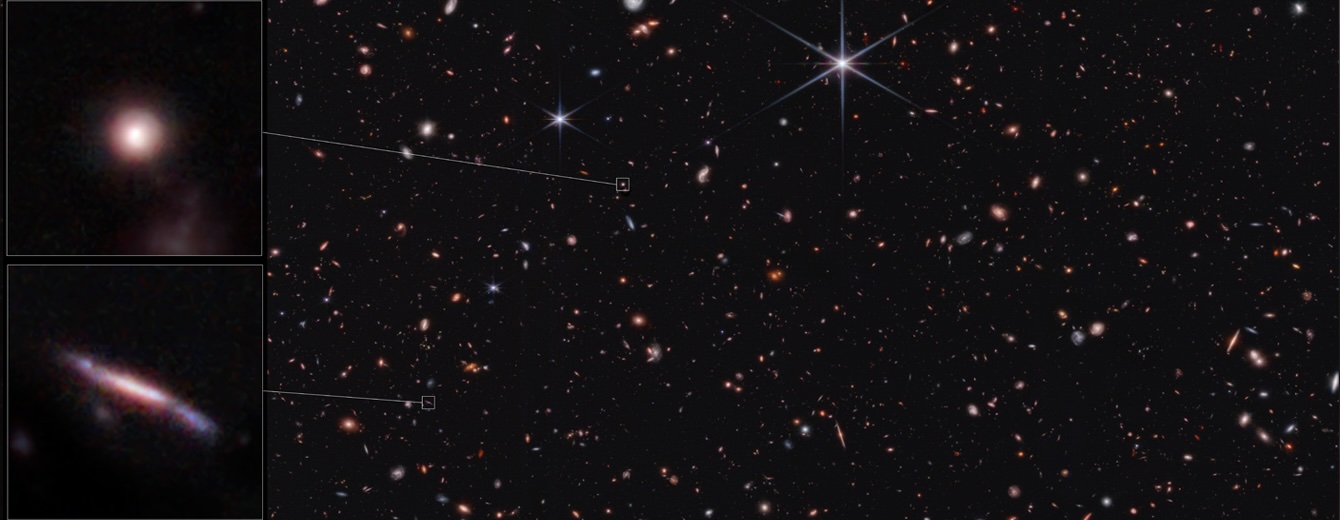
Peering back into the early universe with NASA’s James Webb Space Telescope (JWST) over the past few months, astronomers have noticed something odd. The supermassive black holes lurking at the heart of ancient galaxies are smaller than the ones in our nearby, modern slice of the universe. However, compared to the mass of stars in their host galaxies, these black holes almost seem too big.
In a new paper, Harvard University astrophysicist Fabio Pacucci and his colleagues suggest that these early black holes were thousands of times our Sun’s mass, likely spawned by enormous clouds of gas collapsing under their own gravity. These early black holes were also relatively more massive than their galaxies, but these galaxies gained stellar mass over time. The scientists published their work in The Astrophysical Journal Lettersin October, and Pacucci presented the study at the 243rd meeting of the American Astronomical Society (AAS) this week.
This image illustrates how the ratio of black hole mass to stellar mass differs between nearby (recent) and distant (ancient) galaxies.
CFA/MELISSA WEISS
“OVERMASSIVE” BLACK HOLES
We think of supermassive black holes as immense, star-swallowing leviathans lurking at the center of galaxies, but the stars in any given galaxy actually outweigh the supermassive black hole at the center by a factor of 1,000 to 1. That’s the case in our Milky Way Galaxy, and in most of the other galaxies we see in the nearby universe, but these galaxies have had billions of years to grow and evolve since the beginning of the universe.
Because JWST lets astronomers look farther back in the universe to see smaller, more distant objects, this has shed more light on how galaxies — and the supermassive black holes at their hearts — evolved. And it turns out that between 12 and 13 billion years ago, some galaxies’ stars accounted for only ten times as much mass as their supermassive black holes, meaning early galaxies sort of grew into the larger supermassive black holes at their centers as billions of years passed.
A BLACK HOLE ORIGIN STORY
While these “overmassive” black holes indicate how galaxies evolved and grew, they could also resolve a debate about what the “seeds” of modern supermassive black holes were like. The first black holes formed a few hundred thousand years after the Big Bang, and eventually, they evolved into supermassive black holes like the one at the heart of our own galaxy. But astronomers still don’t agree on how large a “seed” our friendly neighborhood supermassive black hole, Sagittarius A*, started out as — or exactly how it formed.
One option is that the first black holes formed when the first generation of massive stars burned out their fuel and collapsed, leaving behind black holes of just a few hundred times the mass of our Sun.
The other possibility is that the seeds of supermassive black holes formed even earlier in time when giant clouds of very dense gas collapsed under their own gravity. These clouds, according to the theory, would have been too enormous and too dense to form a mere star, and instead, they collapsed into black holes between 10,000 and 100,000 times more massive than our Sun. These heavy black hole seeds would have contained about as much mass as all the stars in their host galaxies.
According to Pacucci and his colleagues’ models, smaller black hole seeds couldn’t have grown quickly enough to become the “overmassive” black holes like the ones JWST sees in galaxies dating back to 12 billion years ago.
“Many studies suggest that if seeds formed heavy, then in the distant universe, the ratio between stellar mass and black hole mass should be [smaller],” says Pacucci. “This discovery suggests that black hole seeds may have formed heavy.”
AN OVERSIZED MYSTERY
So why did early galaxies’ supermassive black holes weigh so much in comparison to all the stars in the galaxy? One possibility, suggests Pacucci, is that those newborn black holes were active and voracious, and because black holes are messy eaters, that meant the young black holes were flinging radiation and electrically charged gas all over the place.
Eventually, as the black holes calmed down and spent less time feeding, they allowed more stars to form in the galaxy, tilting the balance more in the stars’ favor. Over time, smaller galaxies merged to form larger ones (a process that’s still happening today). Although those mergers would have led to larger supermassive black holes, they also would have triggered new waves of star formation, further boosting the galactic ratio we see today.
“Over cosmic time, we know that the ratio of stellar to black hole mass progressively catches up with the local 1000 to 1 ratio of the modern universe. This happens as the black hole and its host galactic system evolve together, merging with other galaxies and forming legions of stars,” says Pacucci. “What we're still working on is seeing deeply enough into the universe to piece together how this all got started.”
Mars Express Finds New Evidence for Ice-Rich Layered Deposits in Medusae Fossae
Mars Express Finds New Evidence for Ice-Rich Layered Deposits in Medusae Fossae
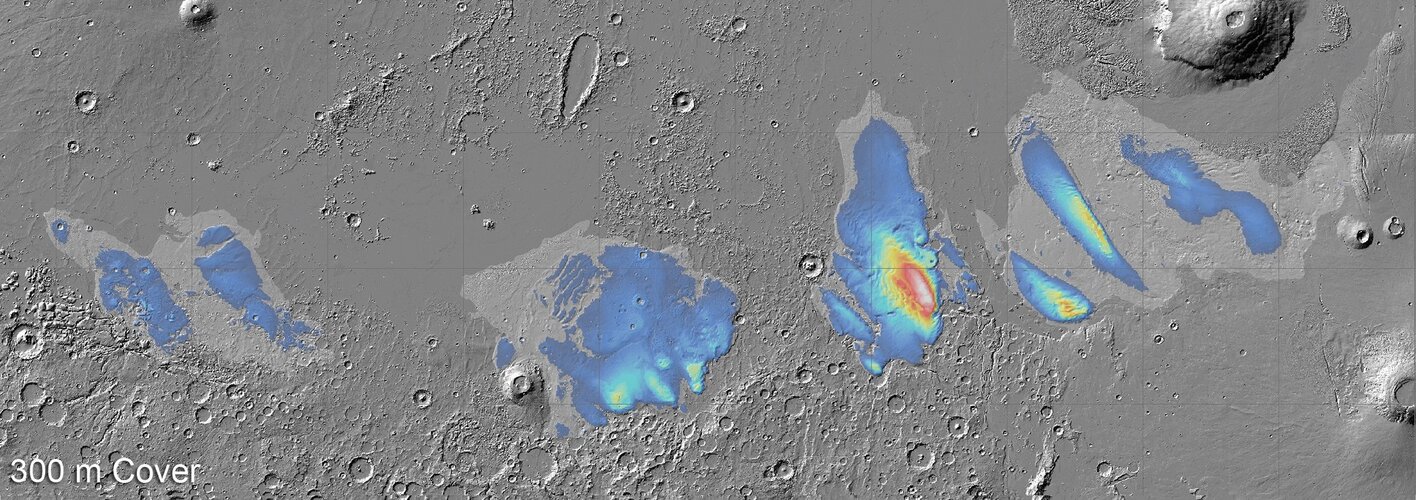
Over 15 years ago, ESA’s Mars Express spacecraft studied the Medusae Fossae Formation, revealing enigmatic deposits up to 2.5 km deep. From those early observations, it was unclear what the deposits were made of, but the new research has an answer.
This image shows a height map of the Martian surface, with lowest land in blue and highest in white.
Image credit: ESA.
The Medusae Fossae Formation (MFF) — a massive, unusual deposit of soft rock near Mars’ equator — is about one-fifth as large as the continental United States and 100 times more massive than the largest explosive volcanic deposit on Earth.
It consists of several wind-sculpted features measuring hundreds of km across and several km high.
Found at the boundary between the Martian highlands and lowlands, the features are possibly the biggest single source of dust on Mars.
Initial observations from ESA’s Mars Express spacecraft showed the MFF to be relatively transparent to radar and low in density, both characteristics we’d see from icy deposits.
However, planetary scientists couldn’t rule out a drier possibility: that the features are actually giant accumulations of windblown dust, volcanic ash or sediment.
“We’ve explored the MFF again using newer data from Mars Express’ MARSIS radar, and found the deposits to be even thicker than we thought: up to 3.7 km thick,” said Dr. Thomas Watters, a planetary researcher at Smithsonian Institution.
“Excitingly, the radar signals match what we’d expect to see from layered ice, and are similar to the signals we see from Mars’ polar caps, which we know to be very ice rich.”
“If melted, the ice locked up in the MFF would cover the entire planet in a layer of water 1.5 to 2.7 m deep: the most water ever found in this part of Mars, and enough to fill Earth’s Red Sea.”
“Here’s where the new radar data comes in! Given how deep it is, if the MFF was simply a giant pile of dust, we’d expect it to become compacted under its own weight,” said Dr. Andrea Cicchetti, a researcher at the National Institute for Astrophysics in Italy.
“This would create something far denser than what we actually see with MARSIS.”
“And when we modeled how different ice-free materials would behave, nothing reproduced the properties of the MFF — we need ice.”
“The new results instead suggest layers of dust and ice, all topped by a protective layer of dry dust or ash several hundred meters thick.”
In this image, the white line on Mars’ surface (top) shows a stretch of land that was scanned by Mars Express’ MARSIS radar. The graph below shows the shape of the land and the structure of the subsurface, with the layer of dry sediments (likely dust or volcanic ash) in brown and the layer of suspected ice-rich deposits in blue. The graph shows that the ice deposit is thousands of meters high and hundreds of km wide. If all the suspected water ice in the MFF melted, it would cover Mars in an ocean of water up to 2.7 m deep.
Image credit: CReSIS / KU / Smithsonian Institution.
“This latest analysis challenges our understanding of the MFF, and raises as many questions as answers,” said Dr. Colin Wilson, ESA project scientist for Mars Express and the ESA ExoMars Trace Gas Orbiter.
“How long ago did these ice deposits form, and what was Mars like at that time?”
“If confirmed to be water ice, these massive deposits would change our understanding of Mars climate history.”
“Any reservoir of ancient water would be a fascinating target for human or robotic exploration.”
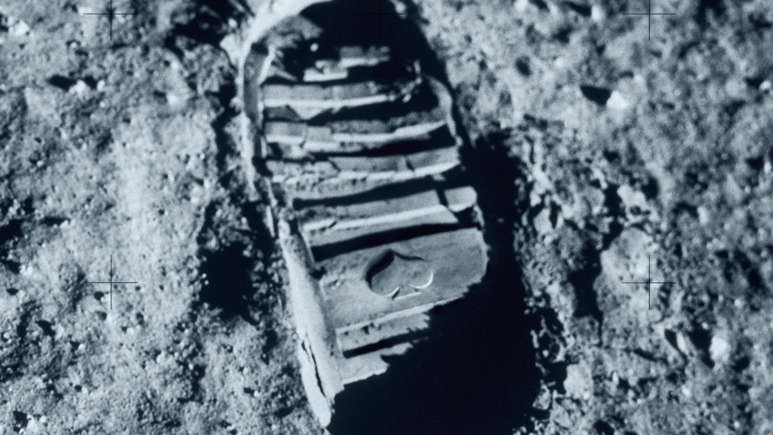
Man op de maan Meer dan 50 jaar geleden, in juli 1969, zette Neil Armstrong als eerste mens ooit voet op de maan. De Apollo 11-missie, gelanceerd door de Verenigde Staten, markeerde een belangrijke mijlpaal in de geschiedenis van de ruimtevaart.
Ruimte race Tijdens de Koude Oorlog werd de ruimtewedloop betwist tussen de voormalige Sovjet-Unie en de Verenigde Staten. Nu, in 2023, is het landschap echter veranderd.
Missies naar de maan Er zijn zeven landen die missies naar de maan zullen plannen. Dit zal de komende jaren een nieuw keerpunt worden in de geschiedenis van ruimtevaart.
1. Verenigde Staten Het NASA-project is zeer ambitieus en is opgedeeld in verschillende fasen. Het Artemis-programma heeft als ultieme doel om niet alleen terug te keren naar de maan, maar ook om een permanente en duurzame basis te vestigen op het maanoppervlak.
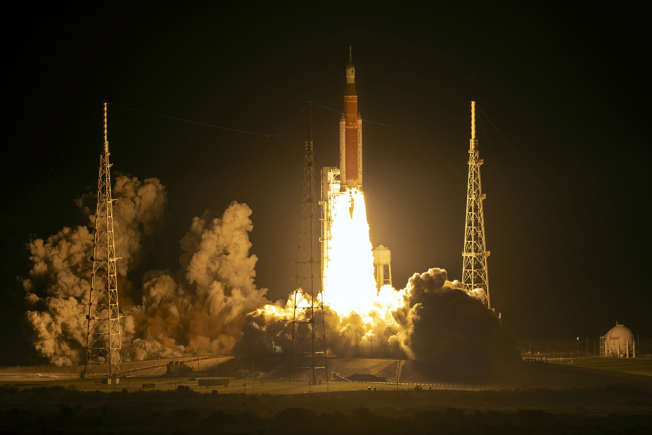
Artemis I-missie Op 16 november 2022 vond de eerste lancering plaats, bekend als de Artemis I-missie. Tijdens deze missie werd het onbemande Orion-ruimtevaartuig gelanceerd en de SLS-raket bereikte de baan van de maan. Hier verbleef het zes dagen.
Europa De ESA (European Space Agency) vervult een belangrijke rol binnen het Artemis-programma, aangezien zij verantwoordelijk zijn voor de bouw van de Orion-capsule. Dit is het interplanetair ruimtevaartuig dat rond de maan zal vliegen.
Artemis II 2024 De Artemis II-missie, gepland voor 2024, is afhankelijk van het succes van Artemis I. Tijdens de tweede missie zullen er vier astronauten aan boord zijn. Het ruimtevaartuig zal een soortgelijke baan als Orion volgen.
Wandelen op de maan in 2025 Een derde missie, gepland voor 2025, staat op de agenda. Er wordt verwacht dat tijdens deze missie opnieuw mensen het maanoppervlak zullen betreden.
2. Japan Jaxa, de Japanse ruimtevaartorganisatie, lanceerde in november 2022 een module. Kort na de lancering waren er communicatieproblemen. De exacte locatie van de module is nog onbekend.
Maankraters Het doel van de Japanners is om maankraters te identificeren met behulp van gezichtsherkenningstechnologieën. Indien de landing succesvol is, betekent dit een baanbrekende prestatie vanwege de ongekende precisie. De missie staat bekend als "Slim" (Intelligent Landing Module to Investigate the Moon).
Rashid, de robot uit de Verenigde Arabische Emiraten De andere robot die het Japanse bedrijf gaat inzetten komt uit de Verenigde Arabische Emiraten en heet Rashid. Het betreft een vierwielig voertuig dat speciaal is ontworpen om de bodem van de maan te onderzoeken.
3. Rusland Rusland zal onverminderd doorgaan met zijn ruimtevaartprojecten, ondanks de aankondiging dat het in 2024 het International Space Station (ISS) zal verlaten.
Luna-25-missie Het nieuwste project van Rusland, de Luna-25-missie, heeft als doel om in juli 2023 de zuidpool van de maan te onderzoeken. Deze informatie is bevestigd door Yuri Borisov, de directeur van Roscosmos (foto).
Op zoek naar water Een van de belangrijkste doelstellingen voor Rusland, evenals andere landen, is het analyseren van de bodem van de maan. Een speciale prioriteit is het onderzoeken van gebieden waar aanwijzingen zijn voor bevroren water.
Russische bemande missie voor 2025 In 2025 is Rusland van plan een bemande missie te lanceren met het ruimtevaartuig Orel. Bovendien zijn ze van plan de modules van hun eigen ruimtestation, genaamd Ross (Russian Orbital Service Station), in elkaar te zetten.
4. China Momenteel is China de grootste tegenstander van de VS in de nieuwe ruimtewedloop. Volgens de Chinese Aerospace Science and Technology Corporation (CCTA) is de Aziatische gigant van plan om tegen 2030 een bemande raket naar de maan te sturen.
Een nieuwe generatie bemande raketten In juni 2022 kondigde het bureau aan dat de eerste tests van een nieuwe motor voor de volgende generatie bemande raketten succesvol waren afgerond. De volgende fase omvat de productie van de eerste prototypemodellen.
Een Chinese robot op Mars In 2019 liet China zien hoe ver ze zijn ontwikkeld op het gebied van ruimtetechnologie. Ze behaalden een belangrijke mijlpaal door als eerste land een apparaat aan de achterkant van de maan te plaatsen. Bovendien zond het land in 2021 een kleine robot naar Mars.
Investeringen China investeert volgens de krant O Globo miljarden dollars in de ontwikkeling van nieuwe ruimtetechnologieën. Het feit dat ze hun eigen ruimtestation hebben gebouwd, getuigt hun toewijding en vooruitgang op dit gebied
5. Zuid-Korea Zuid-Korea daarentegen lanceerde op 4 augustus 2022 zijn eerste maanmissie. De robotsonde staat algemeen bekend als Danuri, wat "geniet van de maan" betekent in het Koreaans. Deze sonde werd met succes gelanceerd met behulp van een SpaceX-ruimtevaartuig.
Een observatiemissie van een jaar Volgens verklaringen van het ministerie van Wetenschap van Zuid-Korea wordt verwacht dat het ruimtevaartuig in december de baan van de maan zal bereiken. Vervolgens zal het beginnen aan een observatiemissie van een jaar.
Onderzoek naar de maanomgeving Het doel van de Zuid-Koreaanse missie is om potentiële landingsplaatsen voor toekomstige missies te verkennen. Daarnaast zal er wetenschappelijk onderzoek worden uitgevoerd naar de omgeving van de maan en zullen er tests worden uitgevoerd op het gebied van internettechnologie.
6. Verenigde Arabische Emiraten De rover Rashid, die eerder genoemd werd, staat op het punt aan zijn grote reis te beginnen. Het is het vlaggenschip van de Verenigde Arabische Emiraten in hun maanverkenningsexpeditie. Deze expeditie wordt uitgevoerd in samenwerking met het Japanse bedrijf ispace Inc. en zal worden gelanceerd met behulp van een raket ontworpen door SpaceX.
Camera's met hoge resolutie en zeer lage temperaturen Rashid zal het maanoppervlak bestuderen. Het voertuig is uitgerust met camera's van hoge resolutie, evenals een sonde en andere apparaten. Rashid is ontwikkeld met technologie die bestand is tegen extreem lage temperaturen (tot -173°C.).
Het eerste land in het Midden-Oosten dat op de maan landde Als de missie slaagt, zal het land een historische mijlpaal bereiken. Het zal het eerste land in het Midden-Oosten zijn dat erin slaagt een voertuig op het maanoppervlak te laten landen. Bovendien zal het de vierde natie ter wereld zijn die deze prestatie levert, na de Verenigde Staten, Rusland en China.
7. India In 2019 probeerde India een maanlanding, maar de Chandrayaan-2-missie mislukte nadat de communicatie kort voor de afdaling werd verbroken. De Indian Space Research Organization (ISRO) heeft plannen voor een nieuwe missie, genaamd 'Chandrayaan-3'.
Toekomstige verkenningen Volgens India Today heeft S. Somnath, de president van de Indiase ruimtevaartorganisatie, aangekondigd dat Chandrayaan-3 gepland staat om in juni 2023 te worden gelanceerd. Deze missie zal een robuustere maanrover aan boord hebben, wat volgens hem "cruciaal is voor toekomstige interplanetaire verkenningen".
Finally, Let’s Look at the Asteroid Treasure Returned to Earth by OSIRIS-REx
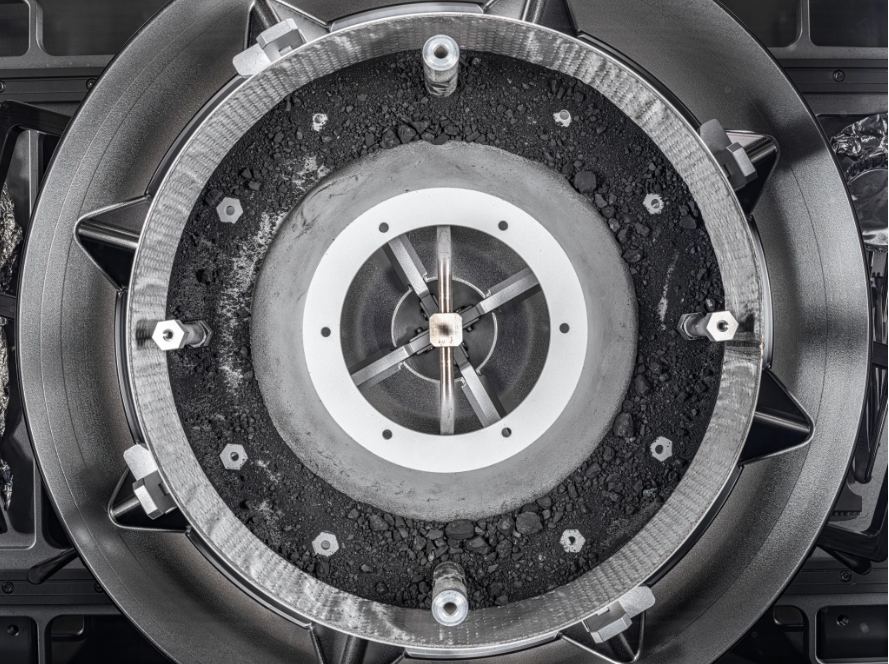
A top-down view of the OSIRIS-REx Touch-and-Go-Sample-Acquisition-Mechanism (TAGSAM) head with the lid removed, revealing the remainder of the asteroid sample inside. Photo: NASA/Erika Blumenfeld & Joseph Aebersold
Finally, Let’s Look at the Asteroid Treasure Returned to Earth by OSIRIS-REx
NASA’s OSIRIS-REx delivered its precious cargo to Earth on September 24th, 2023. The sample from asteroid Bennu is contained inside the spacecraft’s sampling head, and it’s in safe hands at NASA’s Johnson Space Center in Houston. Two stubborn fasteners delayed the opening of the sampling head, but they’ve been removed, and now we can see inside.
What looks like unremarkable dirt is primordial asteroidal material that’s billions of years old, a natural treasure trove that eager scientists can’t wait to begin studying.
The head and its sample are in the hands of the astromaterials curation team at Johnson Space Center. On January 10th, they opened the Touch-and-Go-Sample-Acquisition-Mechanism (TAGSAM.) The leading image shows what greeted them.
The sample material includes dust and rocks up to about .4 in (one cm) in size. Credit: NASA/Erika Blumenfeld & Joseph Aebersold
The next step is to remove the round metal collar and place the sample into trays. Each tray will be photographed, weighed, packaged, and stored. The final mass will be determined in the weeks ahead, including the 70.3 grams (2.48 oz) removed previously. That material was on the sampling machinery but outside of the capsule. OSIRIS-REx’s goal was to return 60 grams of material, so it’s already exceeded that amount.
The curation team will catalogue all of the samples later this year. After that, scientists from around the world can request access.
This map shows the 38 institutions that will be the first to receive Bennu samples. Image Credit: NASA/Goddard/University of Arizona.
Bennu is a carbonaceous asteroid, a primitive chunk of rock that forms a link to the past when the rocky planets were forming. Scientists have already found carbon and water in the previously removed material. In fact, according to initial analysis, its carbon concentration is close to 5%. That’s among the highest non-terrestrial carbon percentages ever measured. “The OSIRIS-REx sample is the biggest carbon-rich asteroid sample ever delivered to Earth and will help scientists investigate the origins of life on our own planet for generations to come,” said NASA Administrator Bill Nelson at the time.
Once scientists get their hands on more of the material, they’ll doubtlessly find other interesting components. Maybe even some of life’s building blocks, like amino acids. Bennu’s water and carbon content could indicate that life’s building blocks originated in asteroids like Bennu.
The sample also gives researchers an opportunity to test their findings against previous observations of Bennu. Astronomers studied the asteroid’s composition with OSIRIS-REx’s instruments as it approached Bennu, and the samples will tell them how accurate their efforts were. It’s an opportunity to verify and improve spacecraft instruments and remote sensing methods.
Bennu’s boulder-strewn surface. The asteroid is a rubble pile rather than a monolithic body. Image Credit: NASA/University of Arizona.
Scientists suspect that Bennu could actually be older than our Solar System. If that’s true, then it’s a window into the distant past when only the solar nebula and the proto-Sun existed. It may contain insights into how everything formed, including the Sun.
Bennu may also be one of the remaining pieces of a much larger body. Scientists think that the parent body broke apart between 700 million and two billion years ago. Scientists hope to learn more from the Bennu sample about its parent body and how Bennu migrated to the inner Solar System.
In a notable act of foresight, 75% of the sample will be stored for the future. Instruments and analysis techniques will only improve over time, and these pristine samples will be available when they do. NASA has done the same with other materials like lunar samples, and it’s paid off.
The Bennu samples can only enhance our understanding of our Solar System and how everything came to be. From its ancient early beginnings in the solar nebula to its present-day location in the inner Solar System, Bennu is a well-travelled message-bearer. Now that we have some of that message in our labs, scientists can reveal what Bennu has to say.
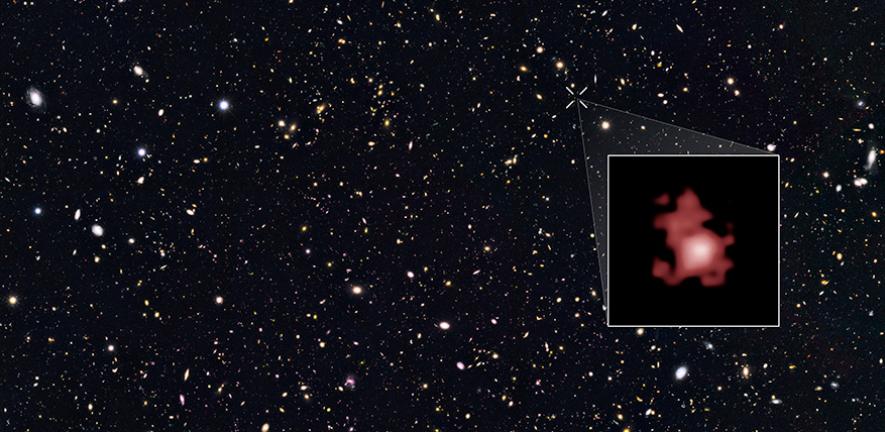
There’s an incredibly ancient black hole out there that’s challenging astronomers to explain how it could exist only 400 million years after the Big Bang. It’s at the heart of a galaxy called GN-z11. Astronomers using JWST saw evidence of it gobbling up that galaxy, which is one way a black hole can grow.
In JWST observations, GN-z11 appears to be about 13.4 billion light-years away and is about 100 times smaller than the Milky Way Galaxy. Yet, it has a very bright nucleus, which tells us there’s a black hole at its heart. An accretion disk surrounds the black hole, and it feeds material into the hungry black hole. The motion of the material in the disk heats it, causing it to glow in ultraviolet light. That’s what we see as the active galactic nucleus.
Artist’s representation of an active galactic nucleus (AGN) at the center of a galaxy. Credit: NASA/CXC/M.Weiss
A team of astronomers, led by Cambridge University professor Roberto Maiolino, used the JWST observations to study the motions of material in the galaxy. Finding a black hole like this early in cosmic history is a giant leap forward, he said. “It’s very early in the Universe to see a black hole this massive, so we’ve got to consider other ways they might form,” said Maiolino. “Very early galaxies were extremely gas-rich, so they would have been like a buffet for black holes.”
What Does GN-z11 Tell Us About Black Holes in the Early Universe?
No one is quite sure exactly when the first black holes began to form in the early Universe. If you look at standard models about their creation, it looks like they take a while to get started. Supermassive black holes—like the ones in the hearts of galaxies—could get started as stellar-mass black holes that continue to accrete matter. If that’s how this one in GN-z11 got started, it would have been born when a supermassive star died. Then, somehow it grew to be 6 million times the mass of the Sun. But, there’s a gotcha. It would take nearly a billion years to accumulate that kind of mass. JWST observations show this black hole at a time when the Universe wasn’t even a billion years old. So, something doesn’t add up and perhaps early black holes grew faster than astronomers suspect.
Maybe there’s another way for a black hole to grow that fast. The hint lies in its enormous appetite. Very early galaxies like this one have a lot of material to form stars. However, that also provides food for black holes. As it turns out, GN-z11’s black hole is devouring matter much faster than other black holes do in their galaxies in more modern times. That’s great for the growth of the black hole, but not so great if the galaxy wants to make more stars.
Artist concept of a growing black hole, or quasar, seen at the center of a faraway galaxy. This may be how they looked in the early Universe. (NASA/JPL-Caltech)
The hungry black hole is actually harming GN-z11. Since it’s consuming a lot of gas, it pushes the gas away in an ultra-fast wind. That stops the process of star formation. Since stars are what galaxies produce, the black hole’s gobbling can actually “kill off” the galaxy. The bad news (at least for the black hole) is that its appetite for gas will spell its doom as it runs out of material to eat.
Going Back to the Beginning
Ultimately, astronomers want to see the “seeds” of the earliest supermassive black holes in galaxies. These seeds likely formed very early in cosmic time, perhaps no later than 200 million years after the Big Bang. The first galaxies assembled fairly quickly and harbored very massive stars that lived perhaps only a few million years. Then, they exploded as supernovae and probably left behind the first stellar-mass black holes. Some have suggested that dark matter helped form early black holes by forcing matter in dense regions to collapse.
Artist view of merging black holes in the early universe. Supermassive black holes early in cosmic time could have experienced many such “mergers and acquisitions”. Credit: LIGO/Caltech/MIT/R. Hurt (IPAC)
However, they formed, black holes in early galaxies got swept up in early galactic mergers. Those seeds merged, too, creating ever more massive black holes. That’s probably why astronomers suspect that supermassive black holes grew by accretion, but not just with each other. They also grew by accretion of material inside their gas-rich galaxies, as GN-z11 seems to show.
Future observations using JWST (and future telescopes) should uncover evidence of those black hole “seeds”. That means GN-z11 may not be the oldest black hole for long. Studying black hole seeds should give Maiolino and other astronomers more clues to unravel the story of how these objects formed not long after the Big Bang.
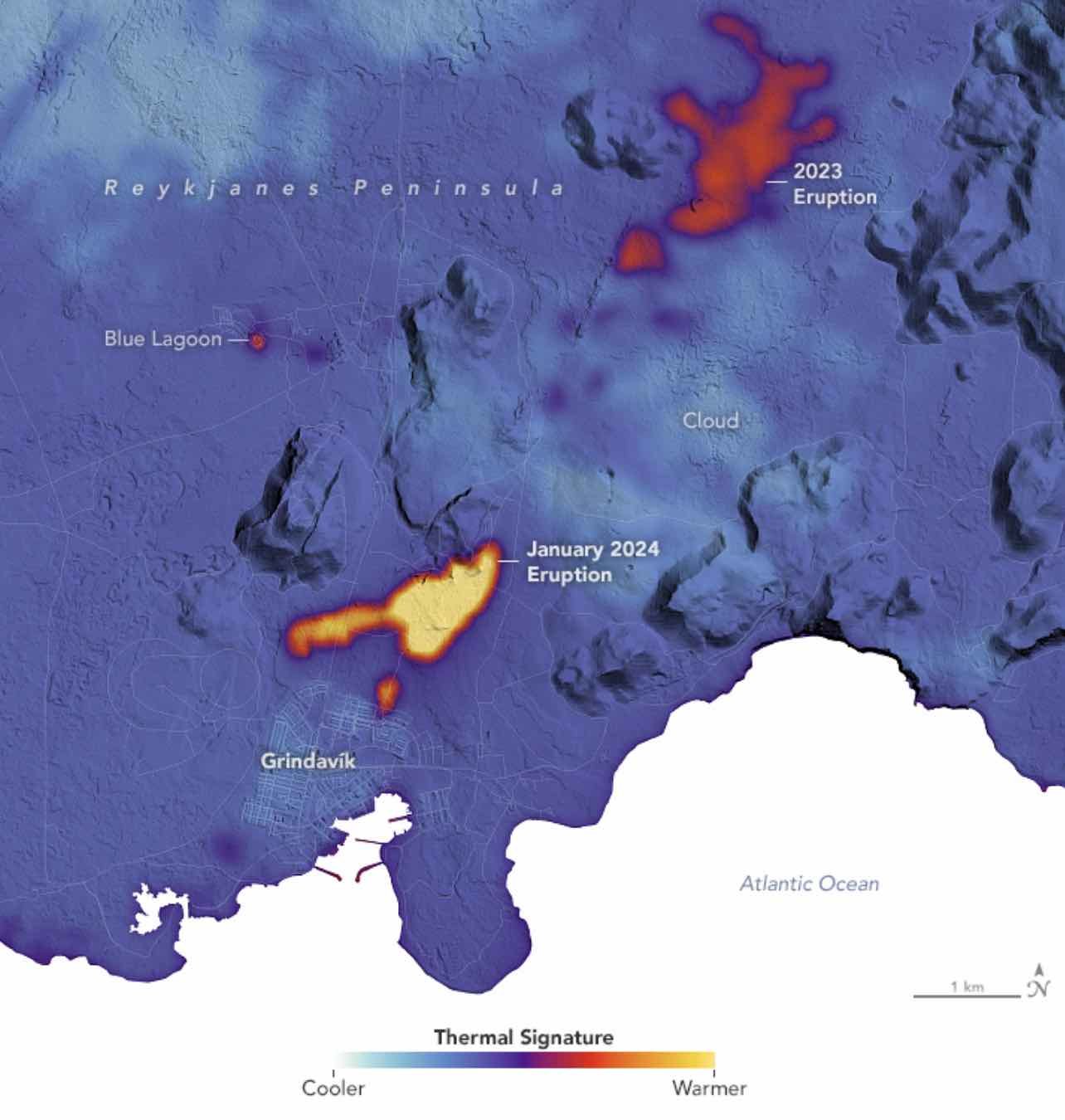
NASA satellite imagery has revealed the thermal signature of volcanic activity that reawakened on Iceland’s Reykjanes peninsula this month, following an eruption late last year that prompted evacuations.
Following a surge that began in mid-January, new fissures opened near the town of Grindavík that released lava over 48 hours. Barriers constructed in the area helped divert the flow away from the town, which remains perilous as volcanic activity continues.
The recent eruptions were the fifth that have occurred on the peninsula since 2021.
Watching from above as the hazardous activity has unfolded in recent weeks, NASA’s Landsat 9 satellite and its Thermal Infrared Sensor 2 (TIRS-2) instrument have collected data that reveals key areas where the volcanic activity is concentrated.
TIRS-2 can detect thermal radiation at two different wavelengths, which conveys the intense heat concentrated around areas where lava flows earlier this month made their way to the surface.
According to NASA’s Earth Observatory, which provides data, imagery, and resources related to climate, geology, as well as other Earth systems, TIRS-2 collected the thermal data as Landsat 9 passed overhead on January 16, which has now been superimposed over a digital elevation model of the affected region.
In the imagery provided by Earth Observatory below, the central warmest regions are shown in yellow, with surrounding the lightest temperatures in the region, shown in light blue, indicating cloud coverage.
(Credit: NASA/Earth Observatory)
In December, nearly 4,000 residents were evacuated from Grindavik, followed by a volcanic fissure eruption on December 18 on Sundhnúkagígaröðin, located east of Mt. Sýlingarfell, according to a statement provided by Iceland’s Meteorological Office.
The December eruption was preceded by a “powerful seismic swarm” that began at approximately 21:00 the same day.
Activity has continued since that time, with an additional fissure eruption that began on the morning of January 14, 2024, just one kilometer away from Grindavík. Although barriers constructed in the area since the recent eruptions began were able to divert some of the lava flow, a second fissure that opened shortly after noon local time erupted outside the barrier, resulting in lava flows that reached three homes on the edge of the town.
Fortunately, the volcanic activity subsided within 48 hours, according to the Icelandic Met Office. Although barriers have been used to prevent the flow of the lava from reaching residences during the recent eruptions, in decades past, efforts have included the use of millions of tons of sea water used to cool lava before it could destroy homes and infrastructure.
Based on current models, magma has moved beneath the region, causing uplift and deformation of the surrounding Earth.
“Clear signals of a continued land uplift are still being detected beneath Svartsengi,” read an update from Iceland’s Met Office on January 19. “It is yet too early to assert whether the rate of the land uplift has increased since prior to the eruption on January 14.”
The Met Office says that although it does appear that uplift has increased based on initial measurements, these readings “can fluctuate from one day to the next, and a longer timeline of measurement is needed to be able to interpret the long-term development of the land uplift.”
Fortunately, the Office says that seismic activity overall continues to decrease in the area and that current data suggests a “significant slow down of ground movement compared to previous days.”
“This information suggest[s] that magma is no longer flowing into the dyke and the eruption has ended,” the January 19 statement read.
Private Axiom Mission 3 is Off to the Space Station
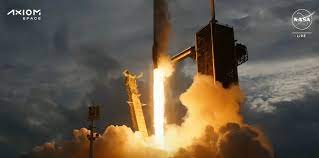
Axiom Mission 3 (Ax-3), the third all private astronaut mission to the International Space Station, lifted off at 4:49pm EST on Thursday Jan 18 from Launch Complex 39A at NASA’s Kennedy Space Center in Florida. NASA
Private Axiom Mission 3 is Off to the Space Station
A few decades ago, the idea of private individuals travelling to the International Space Station was as much science fiction as a time travelling police box. Yet here we are, in 2024 and a crew of four private astronauts are on board the ISS. The team will spend about two weeks undertaking various experiments, commercial activities and outreach tasks.
Axiom Space was founded in 2016 by Michael Suffredini and Kam Ghaffarian. Their goal, to arrange private missions into space, chiefly the ISS but they are also developing spacesuits for NASA’s future missions to the Moon. In realisting these goals, the team at Axiom Space have the wonderful dream ‘We are on a mission to reveal it [space] to as many humans as possible’.
On the 18th January four private astronauts were launched to ISS on the Dragon spacecraft, propelled by the Falcon 9 SpaceX rocket. The private mission was the third such enterprise by Axiom Space, the first mission flew in April 2022 and the second in May 2023. The crew for this mission composed of Commander Michael López-Alegría, Pilot Walter Villadei, and Mission Specialists Marcus Wandt and Alper Gezeravci.
An illustration shows SpaceX’s Crew Dragon capsule approaching the International Space Station. (Credit: SpaceX)
The crew arrived at the ISS on Saturday 20th January when the Dragon module autonomously docked with the Harmony module. When the hatch opens the Axiom crew will be welcomed by the Expedition 70 crew including NASA astronaut Jasmin Moghbeli and Loral O’Hara, ESA astronaut Andreas Mogensen, JAXA astronaut Furukawa Satoshi and cosmonauts Konstantin Borisov, Oleg Kononenko and Nikolai Chub.
AX-3 (as this mission is called) is due to depart from the ISS on Saturday 3rd February, weather permitting. They will have spent two weeks on board before returning to Earth, touching down to a wet arrival off the coast of Florida.
Axiom Space, and their partnership with NASA are doing great things, opening up low Earth orbit to more and more people. In the 1950’s and 1960’s we saw the space race where America and Russia were in a battle to become the first to get into space and to put a human on the Moon. Now the landscape for space travel and exploration has changed. Partnerships between large space organisations like NASA and private enterprises like Axiom are driving a thriving commercial space economy that may once and for all, open up space to us all.
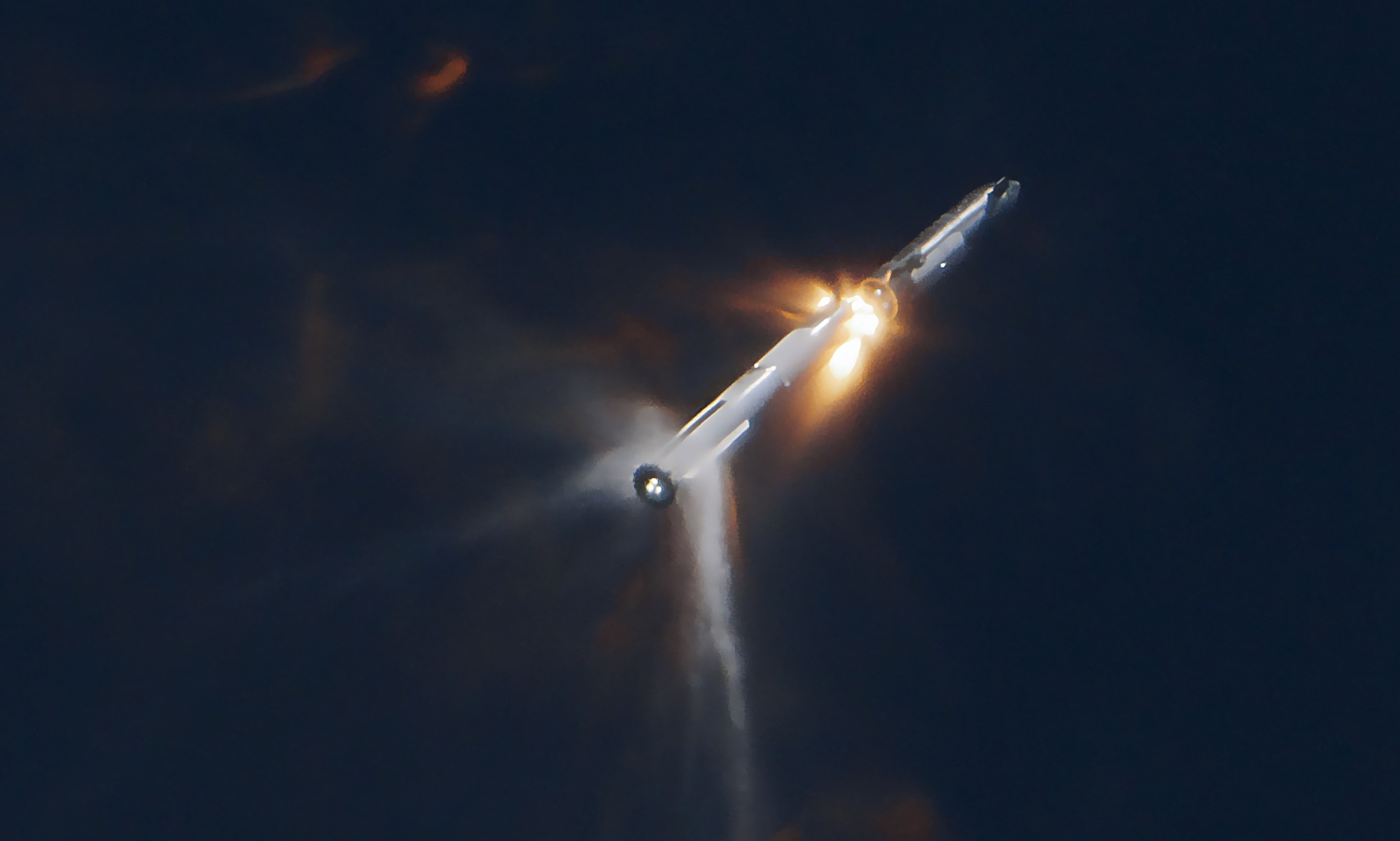
Now We Know Why Starship’s Second Flight Test Failed
SpaceX is often in the headlines, unfortunlatey its not always good news. On 18th November we saw the second of the Starship and SuperHeavy booster get off the launchpad successfully, it failed before reaching orbit. In a recent event, Elon Musk explained how a fuel venting near the end of the burn was responbie but entirely avoidable next time!
The Starship and SuperHeavy booster are an impressive combination. Standing at over 120 metres tall together they are one of the most powerful and versatile rocket systems ever built. It can produce 16,700,000 pound force of thrust making it twice as powerful as Saturn V that took the Apollo astrnauts to the Moon.
The Apollo 10 Saturn V during rollout. Credit: NASA
The first launch attempt failed when the rocket spun out of control, exploding about four minutes from liftoff. Following the disaster, the team identified that the flight termination system which was supposed to destroy the vehicle if it went out of control, failed to do its job.
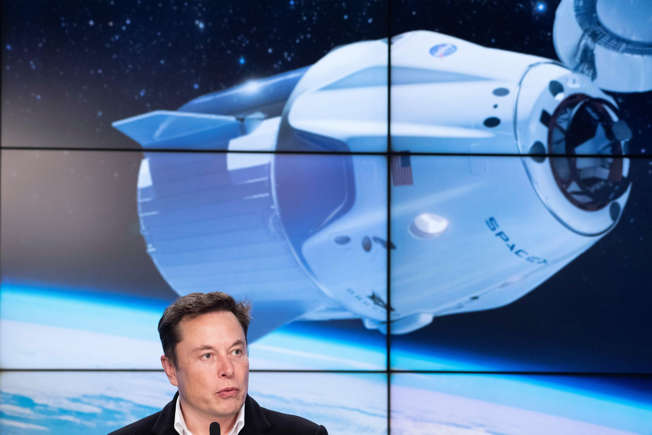
Musk reported on the second launch test from an event at Boca China in Texas where he explained that the lack of a payload meant that it needed to vent some of the liquid oxygen propellant. It almost made it to orbit and would have succeeded if it had a payload. The liquid oxygen would have been consumed by the mighty Raptor engines instead of being vented which was as per design. Musk however did not elaborate on how this all led to a fire.
Elon Musk on stage at his September 27th presentation at the IAC. Image: SpaceX
The third test flight is slated for February and Musk is confident it will reach orbit this time. On the assumption of a succesful launch they plan to test the de-orbit process, the payload door operations and transferring propellant from header tank to main tank. This latter test is part of the NASA Tipping Point program to test fuel transfer from one vehicle to another.
Whether its the third or even the fourth test launch that brings success for SpaceX their long term goals remain unchanged. They still hope to be able to carry up to 100 people on interplanetary missions and become a pivotal part of the return to the Moon.
Astronomers using a telescope array in South Africa have spotted a mysterious yet massive object within what astronomers term the “mass gap” between neutron stars and black holes, that also shares a binary orbit with a neutron star.
The fact that the mysterious object lies in this mass gap leads them to believe it is either the largest neutron star ever observed, the least massive black hole, or something else entirely. The discovery could have significant applications for understanding the “uncertain physics” underlying a range of massive cosmic objects.
The team used the sensitive MeerKAT radio telescope, located in the Karoo semi-desert in South Africa. CREDIT: SARAO
Objectsof this size are typically categorized as “astrophysical compact objects,” and they generally come in one of two varieties: black holes or neutron stars. Still, there is an enormous mass gap between the smallest black hole and the largest neutron star. For example, the largest neutron stars range between 2.2 to 2.5 solar masses, while black holes smaller than 5 solar masses are considered extremely rare. The result is a mass gap where these objects simply should not be.
As a result, discovering a compact astronomical object situated within this gap is a major event. Astronomers Ewan Barr and Arunima Dutta from the Max-Planck-Institut für Radioastronomie, who made the discovery, say that previous objects in this mass gap have also been spotted, but “the nature of these objects and the mechanisms through which they formed remain unknown.”
The astronomers made the discovery while scanning a globular cluster known as NGC 1851 using the Karoo Array Telescope (MeerKAT) in South Africa. There, they spotted a pulsar in a binary orbit with an unknown compact object with a mass that landed in the lower range of the mass gap.
“The nature of these mass gap objects is unknown, as is the formation of their host binary systems,” the researchers write in the study detailing their findings. They also point out that the companion’s mass of 2.09 to 2.71 (solar masses) is in the mass gap, “indicating either a very massive NS (Neutron Star) or a low-mass BH (Black Hole).”
FINDING COULD HAVE MAJOR IMPLICATIONS FOR UNKNOWN PHYSICS
The research team theorizes that these types of systems evolve from collisions between neutron stars that result in a binary system with a millisecond pulsar (MSP) and a Neutron Star. However, they think that given the correct conditions, “the same exchange process could also produce an MSP–black hole (BH) binary system.”
“We propose that the companion formed in a merger between two earlier (Neutron Stars),” they explain.
Canadian Institute for Theoretical Astrophysics researcher Maya Fishbach, who wrote a perspective piece to accompany the published study outlining the finding, says that even though the object’s origin is still unknown, the fact that it lies within this huge gap is incredibly significant.
“Regardless of its origin … the discovery of a compact object with a mass between 2.09 and 2.71 solar masses in a globular cluster has fascinating implications,” Fishbach explained.
Potential formation history of the radio pulsar NGC 1851E and its exotic companion star (see text for details). CREDIT: Thomas Tauris (Aalborg University / MPIfR)
For example, the researchers involved feel that studying these types of systems could have numerous help unravel some of the remaining unsolved mysteries in astrophysics. “Observing such systems allows their component masses to be measured and can test theories of Gravity,” they explain.
“It could inform understanding of the uncertain physics of extremely dense nuclear matter, of supernova explosions, or of dynamical interactions such as neutron star mergers inside globular clusters,” adds Fishbach.
Christopher Plain is a Science Fiction and Fantasy novelist and Head Science Writer at The Debrief. Follow and connect with him on X, learn about his books at plainfiction.com, or email him directly at christopher@thedebrief.org.
Japan has successfully landed on the Moon, becoming only the fifth country to nail the often-perilous maneuver.
The accomplishment comes one day after Astrobotic’s highly-anticipated Peregrine lander careened into Earth’s atmosphere for controlled self-destruction. Peregrine had to chart this course because, shortly after launch, it suffered a propulsion anomaly that erased Astrobotic’s dreams of becoming the first private company to land on the Moon. But the week would end with some good news, albeit for another organization.
On Friday at 10:00 a.m. Eastern (midnight in Japan), the descent phase began for the Smart Lander for Investigating Moon (SLIM) spacecraft from the Japan Aerospace Exploration Agency (JAXA). The mission’s landing procedure started 15 km above the lunar surface, and it then spent five minutes ascending to reach a brief coasting mode at an altitude of 25 km.
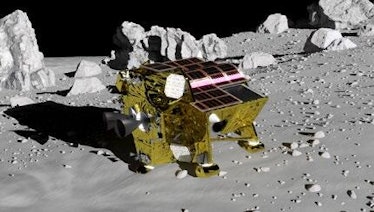
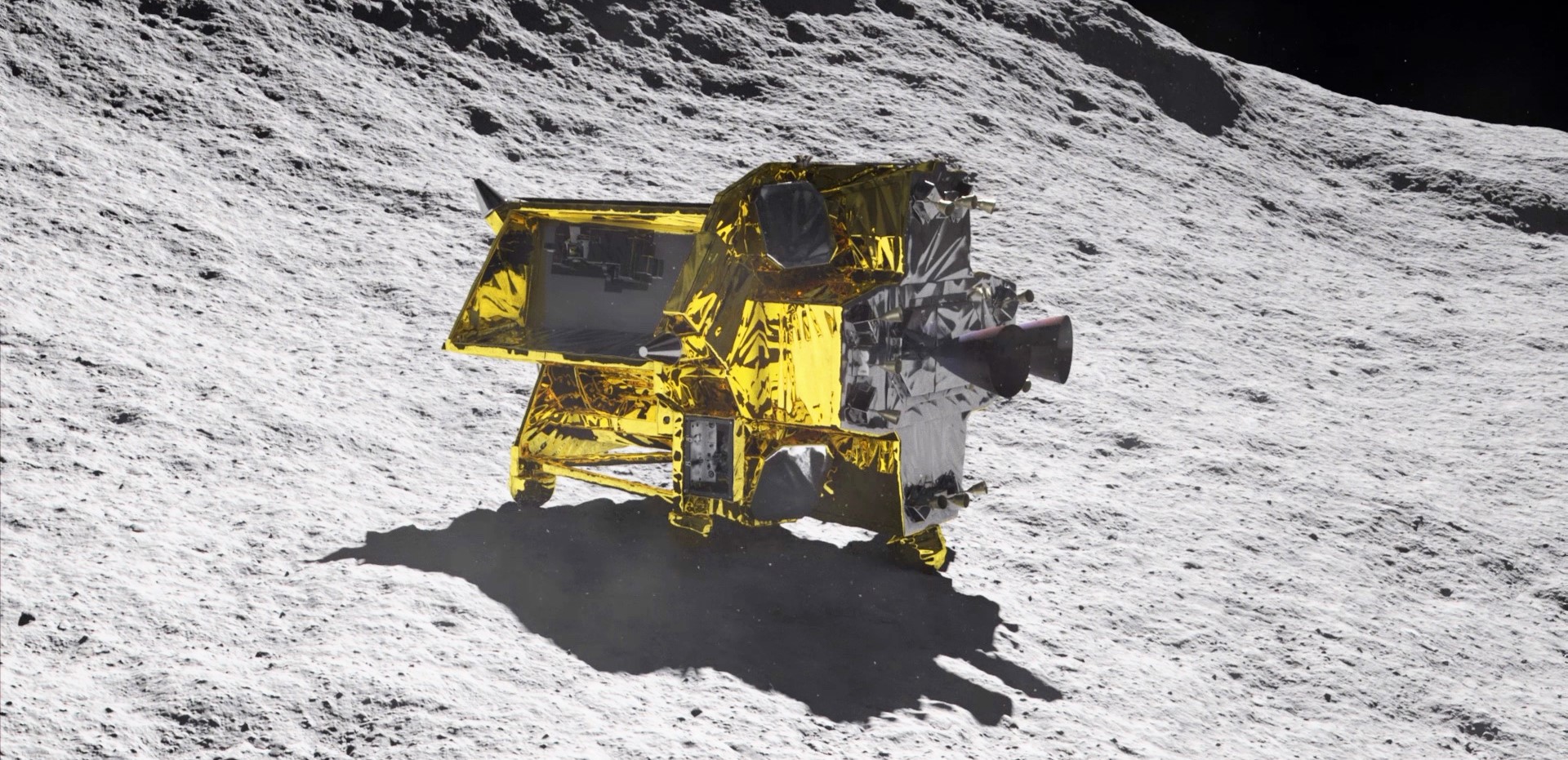
An illustration of JAXA’s SLIM spacecraft on the Moon’s surface.
SLIM scanned the Moon’s surface for features whose locations are highly familiar to astronomers and preexisting spacecraft. This is the mission’s major feature: tracking known landmarks using its onboard navigation system to bring its small spacecraft down for a precise landing within 100 meters of its target.
SLIM traveled accurately along the planned trajectory, an English translator for Japan Aerospace Exploration Agency (JAXA) said during Friday’s landing live feed. At 10:08 a.m. Eastern, SLIM began its approach towards the lunar surface.
SLIM’s vertical descent phase officially started at 10:16 a.m. Eastern, when the lander had reached a 5-km altitude. The descent procedure included a few hovering maneuvers, first at 500 meters above the Moon, then 50 meters, and then at just two meters from the ground.
Japan realized it had made history at 10:21 a.m. Eastern, when SLIM telemetry showed the lander safely touched down. The major win, however, is still a month away. That’s when JAXA officials will learn how accurately SLIM got to its target landing spot.
Japan is now the fifth country to successfully land on the Moon. It’s preceded by India, which became the fourth country to land on the Moon just last year. China became the third to do so in 2013. The U.S. was the second country on the Moon in 1969 with Apollo 11, and Russia placed the first robotic lander on the Moon in 1959.
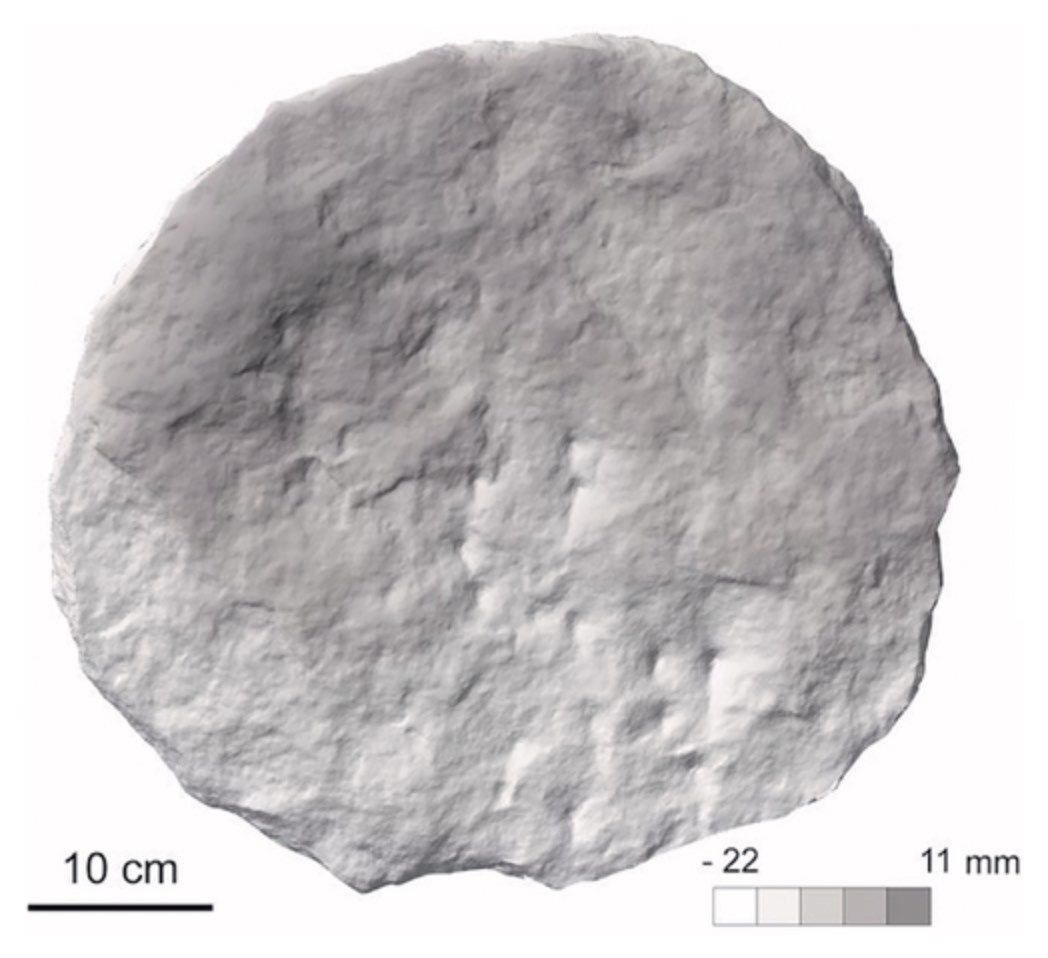
A stone disk bearing peculiar markings could be an ancient star map representing one of the world’s oldest depictions of the night sky, according to recent findings that have prompted debate among experts.
The stone, which features close to 30 carvings on its front and back, was found several years ago near the ancient Rupinpiccolo protohistoric hill fort in northeastern Italy. According to research published in the journal Astronomical Notes, the markings may indicate the locations of the brightest stars that were visible to the ancient night sky observers who carved it at least as far back as 2,400 years ago.
THE ENIGMA OF RUPINPICCOLO’S CURIOUS STONE DISKS
Located close to the border between northwestern Italy and Slovenia, the sprawling ruins of the castelliere of Rupinpiccolo were first documented toward the end of the 19th century. A massive ancient defense structure protected by huge, seven-meter-wide ramparts, archaeological excavations did not occur there until almost a century after its initial discovery.
Along with the stones used in the fortification’s construction were smaller, round stone artifacts that were later discovered in the collections sent to the Museo Archeologico Nazionale di Aquileia.
The Rupinpiccolo disk features a series of markings that could represent an ancient star map (Credit: Bernardini et al.).
Among the rounded artifacts, a pair of limestone disks were discovered close to the southeastern entrance of the castelliere. Although one of the disks bears no markings, the other is covered in a crude pattern of chiseled etchings, the meaning of which remained a puzzle at the time the disks were discovered.
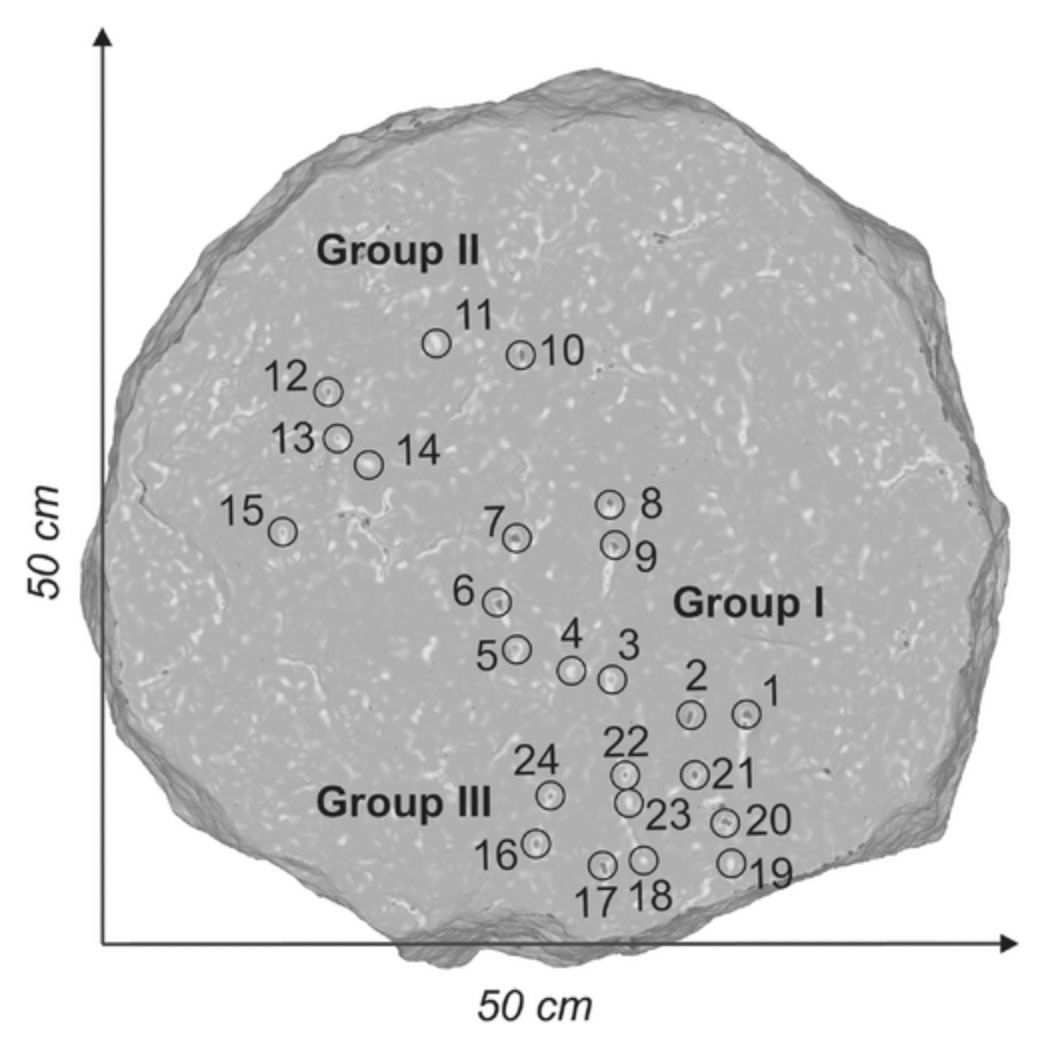
Now, according to Paolo Molaro, an astronomer and former director of the Astronomical Observatory of Trieste, and archaeologist Federico Bernardini with the Abdus Salam International Centre for Theoretical Physics at Trieste, Italy, nine of the 29 markings on the enigmatic stone appeared to be good matches for constellations that would have been visible in the sky at the time they were carved
“Nine marks are found to match the Tail of Scorpius and five the Orion’s Belt, together with Rigel and Betelgeuse,” Molaro and Bernardini write in their recent paper. Additionally, nine of the etchings on the same side of the stone appear to be a close match for the location of the Pleiades, while on the artifact’s opposite side, there are a series of marks the researchers associated with Cassiopeia.
The stone’s markings, according to Molaro and Bernardini, are consistent with how constellations like Scorpius and Orion would have appeared in the night sky during the period the fort was constructed, which is believed to have been sometime between 1800 and 400 BCE.
Altogether, 28 markings covering the stone “show a Pearson correlation coefficient with stellar positions higher than 0.99,” denoting the correlation coefficient used by statisticians to measure linear correlations between two data sets, adding that the probability of a wrong correlation is “lower than 0.001.”
AN UNIDENTIFIED CELESTIAL OBJECT IN AN ANCIENT STAR MAP?
However, there are other markings on the back side of the stone that are not as easily identifiable with known celestial features.
“One mark slightly North of Orion cannot be identified,” the researchers write, admitting that this solitary unidentified marking “challenges the whole picture.”
Overlay depicts the positions of stars that purportedly align with chiseled features on the stone disk, which Molaro and Bernardini contend to be an ancient star map (Credit: Bernardini et al.).
As a possible solution, they conclude that this out-of-place celestial feature, if that is indeed what it would have represented to its carvers thousands of years ago, “could have been the progenitor of a failed supernova, thus offering also the possibility of a verification.”
While the authors present several compelling possibilities in their paper, the argument that the Rupinpiccolo stone may represent one of the world’s oldest star maps has received pushback from other experts.
ANCIENT STAR MAP OR SPECULATION?
Dr. Ed Krupp, Director of the Griffith Observatory, is regarded as a leading expert in the discipline of archaeoastronomy, which studies the intersection of archaeology and astronomy through research into how ancient cultures viewed the sky. Recently, Krupp had already expressed doubts about the argument Molaro and Bernardini present in their paper.
“The authors’ own remarks inform us the matches between marks on the stone and stars in the sky are not very good, despite their assertion of Pearson correlation coefficient support for the notion,” Krupp told The Debrief in an email. “I am not able to argue about the statistical case here, but I don’t think it is either necessary or relevant.”
“The statistical argument suggests something is there that doesn’t really seem to be there, and that can happen with such analyses,” Krupp added.
Responding to Dr. Krupp’s assertions, Molaro told The Debrief that he felt Krupp’s assessment of their research “does not go into the merits of the statistical analysis on which the result is based” and that beyond this aspect of their paper, he and Bernardini have offered more than just statistical results as evidence for their conclusions.
“Why on earth do the asterisms of Orion and the Scorpion’s tail have the same scale despite having been reproduced at different times?” Molaro said. “Why do they have the same orientation in the sky? How come they are complete for all and only the brightest stars?”
“Why are only the most popular asterisms and those traditionally found in many of the planet’s cultures reproduced?” Molaro added. “We have indicated a possible explanation supported by statistics and further considerations.”
While Krupp concedes that several of the chisel marks do resemble star patterns that are present in the constellations of Orion and Scorpius as Molaro contends, he also points out that there are a few outliers beyond the unexplained marking that the authors themselves say they could not match with any known celestial object.
“In the Scorpius marks, there are at least four marks that don’t match any of the brighter stars, which seems odd,” Krupp told The Debrief. “And you would expect that Antares, not only the brightest star in Scorpius but one of the brightest stars in the sky, would be unambiguously marked. It isn’t.
“There are two stars that could represent a misplaced Antares, but why is that? It’s actually a problem.”
“If we have a representation of a key piece of the real estate of Scorpius, Antares should be obvious,” Krupp said.
THE DEBATE—AND THE SCIENCE—CONTINUES
Although Krupp raised several points of contention with the findings Molaro and Bernardini present in their paper, he conceded that “a rather robust statistical argument is made for the chisel marks matching actual formations of stars in the sky,” though maintaining Molaro and Bernardini’s resulting assessment “doesn’t really square with what just looking at the disk reveals
“It is fair to say the paper is a serious study,” Krupp contends. “It provides plenty of disciplined archaeological context and makes the data and the method of analysis very clear. I don’t have any quarrel with the authors’ serious intent.”
“I believe, however, the possibility of celestial representations in the chisel marks was just too tempting for them.”
Given Krupp’s position on their findings, Molaro told The Debrief that, to an extent, he could understand some of the pushback he and Bernardini have received from the archeoastronomy community.
“It does not surprise me that, considering the total absence of information on the cultural level of these populations who inhabited the hillforts between 2000-400 BC, the discovery could raise many doubts in astro-archaeology circles,” Molaro said, though maintaining that the unique features on the disk point to the significance it must have had to its makers.
“The fact remains that the pair of discs found near the entrance to the castle were made by human hands and not natural and must have had a particular meaning for these populations,” Molaro said.
“The incisions on one of the discs are not random or made to flatten the stone as their distribution demonstrates.”
“So they also had a special meaning,” Molaro said.
Despite the pushback he has offered on Molaro and Bernardini’s paper, Krupp shares the authors’ interest in the potential identification of asterisms in ancient rock art, a subject which Krupp says he is presently exploring in a new paper he soon plans to publish. However, at the end of the day, Krupp maintains that a compelling argument will require more than just similarities.
“We need more than similar patterns,” Krupp told The Debrief.
“We are pattern-seeking creatures, but we are not always rigorous in our efforts to determine whether the patterns we see are meaningful.”
“That goes beyond how well they match,” Krupp said.
Molaro and Bernardini’s paper, “Possible stellar asterisms carved on a protohistoric stone,” appeared recently in Astronomical Notes and can be read in its entirety here.
Wetenschappers vinden ijs op evenaar van Mars: “Hiermee kan je hele planeet bedekken met laag water tot 2,7 m diep”
Ook op de evenaar van Mars bevindt er zich water in de vorm van ijs. Dat heeft het Europese ruimtevaartagentschap ESA vandaag bekend gemaakt. Met hun Mars Express ruimtesonde hebben ze bepaalde structuren onderzocht op het oppervlak van de rode planeet waarvan men niet wist of het nu om verwaaid stof ging of om lagen ijs. De nieuwe resultaten, gepubliceerd in Geophysical Research Letters, tonen aan dat het effectief om ijs zou gaan dat zich kilometers onder de grond zou uitstrekken. Nog nooit vond men zoveel water in dit deel van de planeet.
Martijn Peters
Meer dan 15 jaar geleden bestudeerde Mars Express voor het eerst de Medusae Fossae Formation (MFF) op de evenaar van Mars. De Medusae Fossae Formation is honderden kilometers breed en enkele kilometers hoog. Het bevindt zich op de grens tussen de hooglanden en laaglanden van Mars. Tijdens dit onderzoek onthulde de ruimtesonde massieve afzettingen tot 2,5 km diep.
Uit deze vroege waarnemingen was echter onduidelijk waaruit die afzettingen precies bestonden. Men zag dat de structuur relatief doorzichtig was op de radar en een lage dichtheid had, beide kenmerken die je ziet bij ijzige afzettingen. Echter konden de wetenschappers een “drogere” mogelijkheid uitsluiten waarbij het ging om gigantische ophopingen van door de wind geblazen stof, vulkanische as of sediment. Maar nieuw onderzoek heeft dus nu een antwoord op die prangende vraag.
“We hebben de MFF opnieuw onderzocht met behulp van nieuwere gegevens van de MARSIS-radar van Mars Express. We weten nu niet alleen waaruit de afzettingen bestaan maar ook dat ze nog dikker zijn dan we dachten: tot 3,7 km dik,” zegt Thomas Watters van het Smithsonian Institution. Hij is hoofdauteur van zowel het nieuwe onderzoek als de oorspronkelijke studie uit 2007. “Opwindend genoeg komen de radarignalen overeen met wat we zouden verwachten te zien van gelaagd ijs. Zo zijn ze vergelijkbaar met de signalen die we zien van de poolkappen van Mars, waarvan we weten dat ze zeer rijk zijn aan ijs.” Als het ijs in de MFF zou smelten, zou het de hele planeet kunnen bedekken met een laag water van 1,5 tot 2,7 m diep, genoeg om de Rode Zee hier op aarde te vullen. Dit is dan ook het meeste water ooit gevonden in dit deel van Mars.
Ondanks dat Mars er nu uitziet als een droge wereld, laat dit nieuwe onderzoek nog maar eens zien dat het oppervlak van de planeet vol zit met tekenen dat water ooit overvloedig was. Er zijn al opgedroogde rivierkanalen, oude oceaan- en meerbeddingen, en door water uitgesleten valleien gevonden. Wetenschappers hebben ook significante hoeveelheden ijs op Mars gevonden, zoals de enorme poolkappen, begraven gletsjers dichter bij de evenaar en ijs vlak onder het oppervlak dat de bodem van Mars doorweeft.
“Deze laatste analyse helpt ons om de Medusae Fossae Formation beter te begrijpen maar roept tegelijkertijd ook eveneel vragen op als antwoorden,” zegt Colin Wilson, ESA-projectwetenschapper voor Mars Express en de ESA ExoMars Trace Gas Orbiter (TGO). “Hoe lang geleden hebben deze ijsafzettingen zich gevormd, en hoe was Mars toen?” Als er nog meer bevestiging komt dat het om waterijs gaat, dan zouden deze enorme afzettingen ons begrip van de klimaatgeschiedenis van Mars kunnen veranderen.
Elk reservoir van oud water is daarnaast ook een interessant doelwit voor menselijke of robotverkenning in de toekomst. Missies naar Mars moeten landen in de buurt van de evenaar van de planeet, ver weg van de ijsrijke poolkappen of gletsjers op hoge breedtegraden. En ze hebben water nodig als hulpbron, dus het vinden van ijs in deze regio is bijna een noodzaak voor menselijke missies naar de planeet. “Helaas zijn deze MFF-afzettingen bedekt met honderden meters stof, waardoor ze minstens de komende decennia ontoegankelijk zijn. Maar elke hoeveelheid ijs die we vinden, helpt ons een beter beeld te krijgen van waar het water van Mars eerder heeft gestroomd en waar het vandaag te vinden is als we het nodig hebben in de toekomst.”
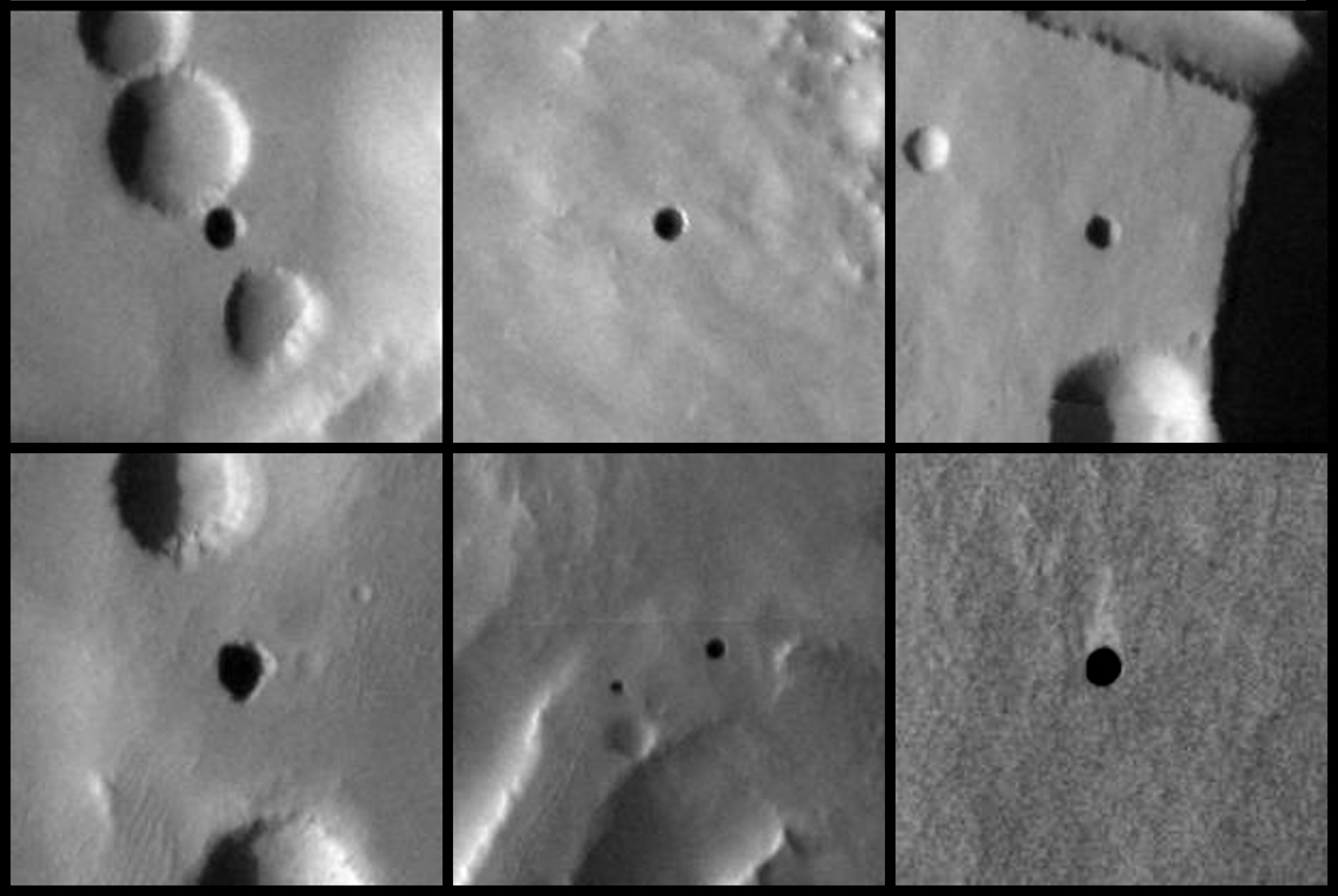
The exploration of Mars continues, with many nations sending robotic missions to search for evidence of past life and learn more about the evolution of the planet’s geology and climate. As of the penning of the article, there are ten missions exploring the Red Planet, a combination of orbiters, landers, rovers, and one helicopter (Ingenuity). Looking to the future, NASA and other space agencies are eyeing concepts that will allow them to explore farther into the Red Planet, including previously inaccessible places. In particular, there is considerable interest in exploring the stable lava tubes that run beneath the Martian surface.
These tubes may be a treasure trove of scientific discoveries, containing water ice, organic molecules, and maybe even life! Even crewed mission proposals recommend establishing habitats within these tubes, where astronauts would be sheltered from radiation, dust storms, and the extreme conditions on the surface. In a recent study from the University Politehnica Bucuresti (UPB), a team of engineers described how an autonomous Martian Inspection Drone (MID) inspired by the Inginuity helicopter could locate, enter, and study these lava tubes in detail.
The study was conducted by Daniel Betco and Sabina Ciudin, two aerospace engineers at the University of Bucharest Polytechnic, with the support of Petrisor Valentin Parvu, an associate professor with UPB’s Department of Aerospace Sciences. The paper that details their concept, “Autonomous Navigation for the Martian Inspection Drone,” recently appeared in Acta Astronautica. In it, they describe how guidance, navigation, and control operations could be developed for their MID concept, which would rely on a convolutional neural network (CNN) to ensure autonomy.
Martian lava tubes were first noticed by the Viking orbiters, that studied Mars between 1976 and 1980. The images acquired by these missions revealed many features that showed how Mars was once a very different place. These included flow channels, basins, and alluvial deposits that indicated Mars once had flowing water on its surface. The presence of these lava tubes was confirmed by subsequent orbiters like the Mars Odyssey, Mars Global Surveyor (MGS), Mars Express, and Mars Reconnaissance Orbiter (MRO), which indicated that it was geologically active in the past as well.
As Betco and his colleagues told Universe Today via email, there are many things that make Martian lava tubes appealing to scientists. Much like lava tubes on the Moon, which are similarly large enough to accommodate entire planetary bases (or even whole cities), this includes natural radiation shielding and protection against the elements:
“In some instances, predicted surface values are reduced by as much as 98%. These lava tubes are of particular interest to astrobiology as they may preserve evidence of life on Mars by offering protection from UV radiation. Additionally, the caves could serve as a refuge for future human missions exploring Mars. Deeper locations within the caves could be utilized as a shield against micrometeoroids or as a heat insulator.”
There is also considerable research that suggests that lava tubes may contain water ice and even be a haven for Martian life (most likely in the form of hardy bacteria). This makes lava tubes a viable location for astronaut habitats, astrobiology research, and possibly permanent settlements. Many mission concepts have been proposed for exploring these lava tubes, including networked rovers and robotic snakes. However, the Ingenuity helicopter – a technology demonstrator that accompanied the Perseverancerover to Mars – effectively demonstrated that aerial vehicles could be the best option for exploring Mars.
As Betco and his colleagues indicated, this includes the lava tubes that run beneath its surface, which would be tricky for rovers to navigate. “Aerial vehicles are well-suited for lava cave exploration as they can move in any direction in three-dimensional space, allowing them to enter the lava tube for inspection,” they said. “In comparison, a rover is limited to two dimensions and would require a highly complex configuration to enter and navigate within a lava tube.”
Artist illustration of NASA’s Ingenuity (upper right), a Sample Recovery Helicopter for the NASA-ESA Mars Sample Return mission (foreground), and a future Science Helicopter (upper center). Credit: NASA/JPL-Caltech
Using the Ingenuity helicopter as their touchstone, the team produced a design for their Martian Inspection Drone (MID). But whereas Ingenuity relies on two coaxial rotors, their vehicle has an octocopter configuration with eight. The vehicle will also have a suite of advanced scientific instruments for inspecting the cave and lava tube interiors. It will weigh a maximum of 15 kg (33 lbs), making it significantly heavier than Ingenuity – which weighs just 1.8 kg (4 lbs). As they describe it, the MID will also rely on an autonomous navigation system and AI to ensure it can make decisions without human controllers:
“A foldable mechanism is proposed to occupy a smaller volume during launch. Its autonomous navigation relies on acquiring data from sensors such as accelerometers, gyroscopes, altimeters, and cameras, processing them to determine the position and attitude of the drone during flight. Another layer of autonomy is implemented through MID’s capability to make decisions regarding the next steps based on a trained Convolutional Neural Network (CNN) model. This model offers the possibility to detect and inspect lava-tube entrances (pits).”
Looking to the future, it is clear that aerial vehicles will play a significant role in exploring extraterrestrial environments. This includes NASA’s Dragonflymission, the nuclear-powered quadcopter that will explore Saturn’s largest moon, Titan (starting in 2034). Other concepts, like solar-powered aircraft and fleets of balloons, are being considered as a possible means of exploring the cloud tops of Venus and deploying sample-return drones to the surface. An autonomous helicopter, said Betco and his colleagues, could drastically expand future exploration efforts on Mars:
“Our work’s potential implications lie in the efficient exploration of the Martian planet, as the drone offers the possibility to survey and inspect areas of interest without requiring constant human intervention. The development of MID contributes to the integration of artificial intelligence in Martian missions. Even though the technology is not quite ready for this, the lessons learned and technologies developed now will drastically benefit future exploration of the Red Planet.”
The team is currently working on implementing new capabilities that will allow their concept to inspect the insides of lava tubes using Simultaneous Localisation and Mapping (SLAM) techniques. If realized, similar concepts could be used to explore lava tubes and recesses on the Moon, Mercury, and anywhere else in the Solar System they are found.
Japan’s Moon Lander Touches Down, But Power Problem Mars Its Mission
Japan has become the fifth nation to land a functioning robot on the moon, but the mission could fall short of complete success due to a problem with the lander’s power-generating solar cells.
The Smart Lander for Investigating Moon, or SLIM, was launched along with an X-ray space telescope called XRISM from Japan’s Tanegashima Space Center in early September — and after weeks of in-space maneuvers, SLIM touched down today at 1520 GMT (10:20 a.m. ET Jan. 19, or 12:20 a.m. JST Jan. 20).
The Japan Aerospace Exploration Agency reported that the landing was successful. During a news briefing, Hiroshi Kuninaka, director general of JAXA’s Institute of Space and Astronautical Science, said the achievement marked “a major milestone” in Japan’s effort to send spacecraft to the moon, and eventually to Mars.
Kuninaka said SLIM was able to communicate with Earth and respond to commands. “However, it seems that the solar cells are not generating electricity at this point in time,” he said. “And since we are not able to generate electricity, the operation is being done using batteries alone.”
Mission controllers prioritized efforts to transmit the data stored on the lander back to Earth before the batteries ran out. SLIM was expected to lose power within hours if the solar panel problem couldn’t be fixed.
Kuninaka said the problem could have arisen because the solar cells weren’t properly aligned toward the sun. “We are trying to analyze the data that we’re gathering at this point in time and analyzing the status,” he said.
The lander was designed to make a precision touchdown near Shioli Crater, in a region of the moon not far from where the Apollo 11 and Apollo 16 landings took place more than 50 years ago. SLIM’s objective was to land within 100 meters (330 feet) of the targeted landing spot. The plan for an ultra-accurate moonshot explains why SLIM came to be called “Moon Sniper.” Kuninaka said mission managers would need “a little more time” to confirm how close SLIM came to the target.
He also said two mini-rovers, known as LEV-1 and LEV-2, were successfully deployed during SLIM’s descent to the surface. LEV-1 is built to capture imagery and record temperature and radiation levels as it hops around the surface. LEV-2 has the shape of a deformable sphere, and is designed to roll around the surface to take pictures.
“If LEV-1 and LEV-2 are functioning properly, then SLIM’s photos and images have been taken by LEV-1 and LEV-2. I believe such data is now being sent to us,” Kuninaka said.
Despite the power problem, SLIM’s successful landing was a welcome development for JAXA’s space exploration program. It added Japan to a short list of countries that have guided robotic spacecraft to soft landings on the moon — a list that also includes the U.S., Russia, China and India.
Other recent developments have demonstrated that putting a robot on the moon isn’t easy. This week, for example, Astrobotic’s Peregrine lunar lander fell back to Earth after a propellant leak ruled out a moon landing.
What Future Propulsion Technologies Should NASA Invest In?
Researchers consistently complain about how difficult it is to fund breakthrough research. Most funding agencies, especially governmental ones, think funding incremental, evolutionary technological steps is the way to go, as it has the most significant immediate payback. But longer-term, higher-risk research is necessary to provide those incremental steps 20-30 years in the future. And in some cases, they are required to underpin completely new things that other researchers want to do.
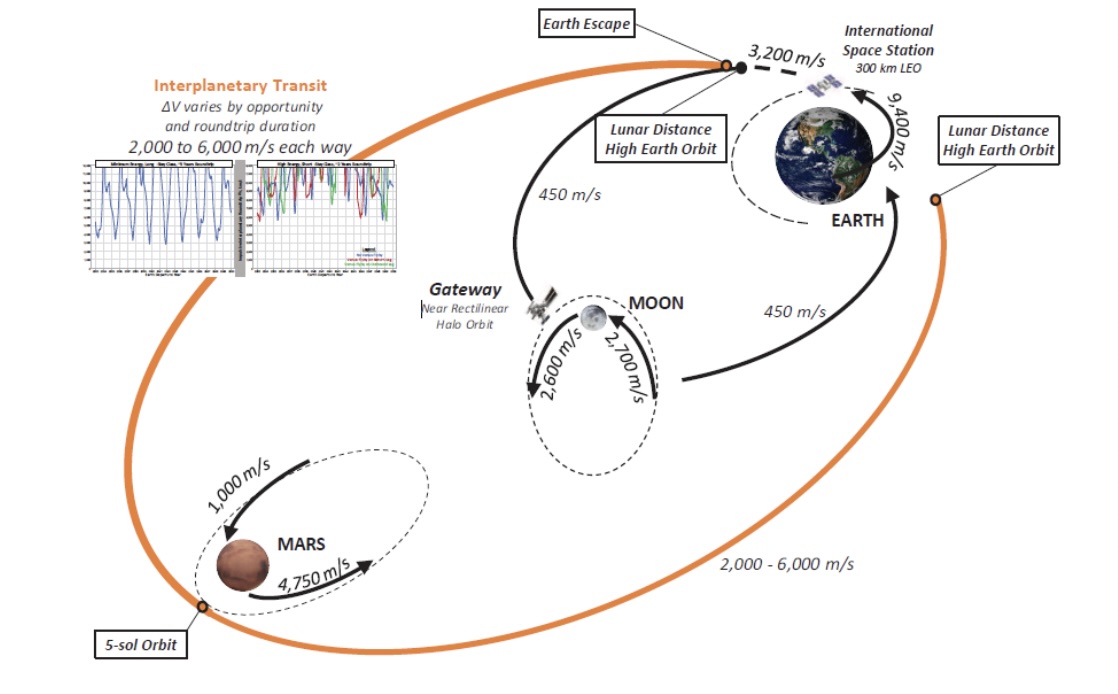
That is the case with space propulsion systems. Current mature technologies, mainly derived from chemical rockets, cannot provide the necessary force to allow for a gravitational lens telescope out in the Oort cloud, an interstellar probe, or a round trip to Mars that would take less than a year. But other technologies on the horizon could if only we spent more time and resources developing them. So a group of NASA and DoE engineers recently released a paper detailing some of those and where they think America’s space agency should direct its funding when developing new propulsion systems.
At the beginning of the paper, the authors lament that there hasn’t been any large-scale NASA investment in breakthrough propulsion technologies since the 1970s. And they’re right; the last significant effort was the Nuclear Engine for Rocket Vehicle Application (NERVA) project, which wound down in the 1970s. Despite the lack of prototyping, plenty of ideas were put forward then. Just none have made them into hardware.
Novel propulsion systems are always fun to talk about – as Fraser proves int his interview.
Those ideas can be broadly categorized into four different groups of systems: chemical propulsion, nuclear thermal propulsion, solar electric propulsion (SEP), and nuclear electric propulsion (NEP). The rest of the study aimed to determine what if any, significant advancements could be made in those four systems that could lead to them lowering the round-trip time to Mars to less than one year.
The authors discard chemical propulsion and nuclear thermal propulsion, stating that they are simply not cut out for the rapid technological changes that could enable their use for these game-changing propulsion systems. Chemical propulsion suffers from “the tyranny of the rocket equation,” as Isaac Arthur puts it. But nuclear thermal propulsion suffers from the same underlying problem – they must carry too much weight in propellants to be viable for truly ground-breaking speed increases.
That leaves solar electric propulsion and nuclear electric propulsion. The authors break down the current state-of-the-art technologies for each technology and calculate the weight per kilowatt of energy they produce. Neither looks particularly promising at the state of the art – with NEP coming in at 51 kg/kWe and various solar arrays that could drive a SEP system ranging from 5 kg/kWe up to 22.73 kWe. None of those weight/power tradeoffs would result in anything approaching a sub-one-year time to Mars.
Ion engines could potentially be scaled to the point where we could get to Mars quickly – if we fund them enough.
But why stop there? The authors do a deep dive into potential technologies on the horizon, ranging from materials to photovoltaics, that could dramatically impact those calculated ratios. The paper concludes with “transformative” technologies that could decrease the kg/kWe to below one. In that case, an extensive enough power system can reasonably transport humans to Mars in between 50 and 100 days.
The researchers also looked at some early-stage propulsion concepts from NASA’s Institute for Advanced Concepts – including the ever-popular “pulsed nuclear” propulsion system, where a nuclear explosion is intentionally initiated behind the spacecraft to push it forward. These technologies are too early to be included in a deep-dive analysis, but they could lead to some promising alternative technologies.
To invest in those alternative technologies, the authors suggest NASA commit 1% of its Space Nuclear Propulsion budget to developing breakthrough technologies. At $45 million for FY2023, the whole budget isn’t exactly breaking the bank, and a mere $450,000 probably wouldn’t make too big of waves in the industry. But, it is undoubtedly better than what is currently allotted toward maturing these transformative propulsion technologies.
Early Galaxies Looked Nothing Like What We See Today
Though an estimated 100 million black holes roam among the stars in our Milky Way galaxy, astronomers have never identified an isolated black hole – until now. Following six years of meticulous observations, NASA’s Hubble Space Telescope has provided, for the first time ever, strong evidence for a lone black hole plying interstellar space. The black hole that was detected lies about 5,000 light-years away, in the Carina-Sagittarius spiral arm of our galaxy. However, its discovery allows astronomers to estimate, statistically, that the nearest isolated black hole to Earth might be as close as 80 light-years. Black holes are born from rare, monstrous stars (less than one-thousandth of the galaxy’s stellar population) that are at least 20 times more massive than our Sun. These stars explode as supernovae, and the remnant core is crushed by gravity into a black hole. Because the self-detonation is not perfectly symmetrical, the black hole may get a kick, and go careening through our galaxy like a blasted cannonball. Hubble can’t photograph the wayward black hole because it doesn’t emit any light, but instead swallows all radiation due to its intense gravitational pull. Instead, Hubble measurements capture the ghostly gravitational footprint of how the stealthy black hole warps space, which then deflects starlight from anything that momentarily lines up exactly behind it. Ground-based telescopes, which monitor the brightness of millions of stars in the rich star fields in the direction of the central bulge of our Milky Way, look for the tell-tale sudden brightening of one of them when a massive object passes between us and the star. Then Hubble follows up on the most interesting such events. Kailash Sahu of the Space Telescope Science Institute in Baltimore, Maryland, along with his team, made the discovery in a survey designed to find just such isolated black holes. The warping of space due to the gravity of a foreground object passing in front of a star located far behind it will momentarily bend and amplify the light of the background star as it passes in front of it. The phenomenon, called gravitational microlensing, is used to study stars and exoplanets in the approximately 20,000 events seen so far inside our galaxy. The signature of a foreground black hole stands out as unique among other microlensing events. The very intense gravity of the black hole will stretch out the duration of the lensing event for over 200 days. Also, If the intervening object was instead a foreground star, it would cause a transient color change in the starlight as measured because the light from the foreground and background stars would momentarily be blended together. But no color change was seen in the black hole event. Next, Hubble was used to measure the amount of deflection of the background star’s image by the black hole. Hubble is capable of the extraordinary precision needed for such measurements. The star’s image was offset from where it normally would be by two milliarcseconds. That’s equivalent to measuring the diameter of a 25-cent coin in Los Angeles as seen from New York City. This astrometric microlensing technique provided information on the mass, distance, and velocity of the black hole. The amount of deflection by the black hole’s intense warping of space allowed Sahu’s team to estimate it weighs seven solar masses. The isolated black hole is traveling across the galaxy at 90,000 miles per hour (fast enough to travel from Earth to the moon in less than three hours). That’s faster than most of the other neighboring stars in that region of our galaxy. “Astrometric microlensing in conceptually simple but observationally very tough,” said Sahu. “It is the only technique for identifying isolated black holes.” When the black hole passed in front of a background star located 28,000 light-years away in the galactic bulge, the starlight coming toward Earth was amplified for a duration of 265 days as the black hole passed by. However, it took several years of Hubble observations to follow how the background star’s position appeared to be deflected by the bending of light by the foreground black hole. The existence of stellar-mass black holes has been known since the early 1970’s, but all of them—until now—are found in binary star systems. Gas from the companion star falls into the black hole, and is heated to such high temperatures that it emits X rays. About two dozen black holes have had their masses measured in X-ray binaries through their gravitational effect on their companions. Black hole masses in X-ray binaries inside our galaxy range from 5 to 20 solar masses. Black holes detected in other galaxies by gravitational waves from mergers between black holes and companion objects have been as high as 90 solar masses. “Detections of isolated black holes will provide new insights into the population of these objects in our Milky Way,” said Sahu. He expects that his program will uncover more free-roaming black holes inside our galaxy. But it is a needle-in-a-haystack search. The prediction is that only one in 1500 microlensing events are caused by isolated black holes. NASA’s upcoming Nancy Grace Roman Space Telescope will discover several thousand microlensing events out of which many are expected to be black holes, and the deflections will be measured with very high accuracy. In a 1916 paper on general relativity, Albert Einstein predicted that his theory could be tested by observing the sun’s gravity offsetting the apparent position of a background star. This was tested by astronomer Arthur Eddington during a solar eclipse on May 29, 1919. Eddington measured a background star being offset by 2 arc seconds, validating Einstein’s theories. Both scientists could hardly have imagined that over a century later this same technique would be used – with unimaginable precision of a thousandfold better — to look for black holes across the galaxy.
Early Galaxies Looked Nothing Like What We See Today
Talk to anyone about galaxies and it often conjurs up images of spiral or elliptical galaxie. Thanks to a survey by the James Webb Space Telescope it seems the early Universe was full of galaxies of different shapes. In the first 6 billion years up to 80% of the galaxies were flat, surfboard like. But that’s not it, there were others like pool noodles too, yet why they looked so different back then is a mystery.
Galaxies were first identified back in the 17th Century by French astronomer Charles Messier. He was a comet hunter who identified a number of fuzzy objects which he realised were not comets. He catalogued them in his famous catalogue of deep sky objects but it wasn’t until Edwin Hubble measure the distances to some of them in the 1920’s that they were recognised as galaxies.
The bluish-white spiral galaxy NGC 1376 hangs delicately in the cold vacuum of space. Credit: NASA, ESA, and the Hubble Heritage Team (STScI/AURA)
Analysing images from the JWST survey known as the Cosmic Evolution Early Release Science Survey, the team studied galaxies from a time when the universe was between 600 million and 6 billion years old. To their surprise they did not see the usual cosmic zoo of galaxies like spiral, elliptical and irregular galaxies. Instead they found that between 50 and 80% of the galaxies seem to be glattened in two dimensions.
Illustration of James Webb Space Telescope
Instead, the team found galaxies shaped like surfboards, pool noodles, frisbees and volleyballs. Among these new types, the surfboard shape was most common with the least common being the volleyball, sphere shaped galaxies. Interestingly too they foudn that the frisbee and noodle shaped galaxies became more common in the later era around 6 billion years.
The mass of the early galaxies seemed to be far less than the mass of galaxies we see today. It seems they had far less time to grow when compared to today’s galaxies which are far more massive. The team would have not been able to complete their work without the incredible sensitivity and resolution of the JWST.
The paper was authored by Viraj Pandya, a NASA Hubble Fellow at Columbia University. They went further to explore what category our own Milky Way galaxy would fall into if we could hop in a time machine and wind back time. They concluded it was likely to have been surfboard shaped galaxy, not too dissimilar to the spiral structure familiar to us today.
We have learned lots about galaxies over the years and images from Hubble has most certainly helped. The latest set of images from JWST have shown us that we still have lots to learn and as we delve deeper and deeper into space and further and further back into time we are only just starting to scratch the surface.
The Ice Sheet on Mars is Even Thicker Than Previously Believed
Maybe Mars isn’t as dry as we thought. ESA’s Mars Express has revealed new details about a region near Mars’ equator that could contain a massive deposit of water ice several kilometers deep. If it is indeed ice, there is enough of it in this one deposit that if melted, water would cover the entire planet up to 2.7 meters (almost 9 feet) deep.
But ice is just one explanation for the unusual features detected by the orbital spacecraft. Another is that this is a giant pile of dust several kilometers deep — although the dust would still need to have some ice mixed in.
Mars Express has been orbiting Mars since December of 2003 and back in 2007, the spacecraft studied the Medusae Fossae Formation (MFF), a large geological formation that includes wind-sculpted ridges and grooves, abrupt mesas, interspersed with smooth and gently undulating areas. The region extends intermittently for more than 5,000 km (3,100 miles) along the equator of Mars, extending from just south of Olympus Mons to Apollinaris Patera, with a smaller additional region closer to Gale Crater, where the Curiosity rover is exploring.
This image shows a height map of the Martian surface, with lowest land in blue and highest in white. Standing at an impressive 22 km, Olympus Mons is the tallest volcano in the entire Solar System. The Medusae Fossae Formation (MFF) is shown near the equatorCredit: ESA
Various spacecraft in addition to Mars Express, such as NASA’s Mars Global Surveyor and Mars Odyssey, have also detected subsurface ice, as much as 2.5 km (1.5 miles) deep.
Now, new data from Mars Express suggest layers of water ice stretching even further underground – the most water ever found in this part of the planet.
“We’ve explored the MFF again using newer data from Mars Express’s MARSIS radar, and found the deposits to be even thicker than we thought: up to 3.7 km (2.3 miles) thick,” said Thomas Watters of the Smithsonian Institution, USA, lead author of both the new research and the initial 2007 study, in an ESA press release. “Excitingly, the radar signals match what we’d expect to see from layered ice, and are similar to the signals we see from Mars’s polar caps, which we know to be very ice rich.”
Watters and his team say that if melted, the ice contained within the MFF would cover the entire planet in a layer of water 1.5 to 2.7 m deep, enough to fill Earth’s Red Sea.
An isolated hill in the Medusae Fossae Formation. The effect of wind erosion on this hill is evident by its streamlined shape. Credit: High Resolution Stereo Camera/European Space Agency
But MFF’s windswept landscapes contains one of the most extensive deposits of dust on Mars, which is possibly the biggest single source of dust on Mars. Some studies determined the strange features in this landscape could have been formed by explosive volcanoes.
In the 2007 observations with Mars Express, the radar data showed the MFF to be relatively transparent to radar and low in density – two characteristics which would reveal icy deposits. However, scientists couldn’t rule out a drier possibility: that the features are actually giant accumulations of windblown dust, volcanic ash or sediment.
But the beauty of long-lasting spacecraft is that it provides the opportunity for multiple observations of a single region on Mars over many years, providing additional follow-up data for study.
At the top is an image of Mars’s surface. A white line crosses the surface diagonally, with a black arrow coming down from the white line to point at a graph below. The graph shows the shape of the surface and subsurface. It indicates that under the surface is a thin layer of dry sediments then a thick layer of ice deposit. The x axis of the graph shows distance, indicating that the diagonal white line covers a distance of 1000 km. The y axis of the graph shows elevation, indicating that the ice deposit is up to 3000 m thick. Credit: CReSIS/KU/Smithsonian Institution.
“Here’s where the new radar data comes in! Given how deep it is, if the MFF was simply a giant pile of dust, we’d expect it to become compacted under its own weight,” said co-author Andrea Cicchetti of the National Institute for Astrophysics, Italy. “This would create something far denser than what we actually see with MARSIS. And when we modelled how different ice-free materials would behave, nothing reproduced the properties of the MFF – we need ice.”
The new results instead suggest layers of dust and ice, all topped by a protective layer of dry dust or ash several hundred meters thick.
We do know that massive stores of ice near the equator could not have formed in the planet’s present climate.
“This latest analysis challenges our understanding of the Medusae Fossae Formation, and raises as many questions as answers,” says Colin Wilson, ESA project scientist for Mars Express and the ESA ExoMars Trace Gas Orbiter (TGO). “How long ago did these ice deposits form, and what was Mars like at that time? If confirmed to be water ice, these massive deposits would change our understanding of Mars climate history. Any reservoir of ancient water would be a fascinating target for human or robotic exploration.”
If this does turn out to be large stores of water ice, the MFF deposits would be an incredibly valuable resource for any future human exploration of Mars. These types of missions would need to land near the planet’s equator, due to landing constraints, and resources like abundant solar power, and more moderate temperatures. The presence of equatorial water ice could provide a steady supply of water for a future base on Mars.
Astronomers using the NASA/ESA/CSA James Webb Space Telescope have detected a small and vigorous black hole in GN-z11, an exceptionally luminous galaxy that existed just 420 million years after the Big Bang, more than 13 billion years ago. That this black hole with a mass of a few million solar masses even exists so early in the Universe challenges current assumptions about how black holes form and grow.
GN-z11, shown in the inset, is seen as it was 13.4 billion years in the past, just 400 million years after the Big Bang.
Image credit: NASA / ESA / P. Oesch, Yale University / G. Brammer, STScI / P. van Dokkum, Yale University / G. Illingworth, University of California, Santa Cruz.
Astronomers believe that the supermassive black holes found at the centre of galaxies like the Milky Way grew to their current size over billions of years.
But the size of this newly-discovered black hole suggests that they might form in other ways: they might be ‘born big’ or they can eat matter at a rate that’s five times higher than had been thought possible.
According to standard models, supermassive black holes form from the remnants of dead stars, which collapse and may form a black hole about a hundred times the mass of the Sun
If it grew in an expected way, this newly-detected black hole would take about a billion years to grow to its observed size.
However, the Universe was not yet a billion years old when this black hole was detected.
“It’s very early in the Universe to see a black hole this massive, so we’ve got to consider other ways they might form,” said Dr. Roberto Maiolino, an astronomer at the University of Cambridge.
“Very early galaxies were extremely gas-rich, so they would have been like a buffet for black holes.”
Like all black holes, the young black hole in GN-z11 is accreting material from its host galaxy to fuel its growth.
Yet, this ancient black hole is found to gobble matter much more vigorously than its siblings at later epochs.
GN-z11 is a compact galaxy, about one hundred times smaller than the Milky Way, but the black hole is likely harming its development.
When black holes consume too much gas, it pushes the gas away like an ultra-fast wind.
This ‘wind’ could stop the process of star formation, slowly killing the galaxy, but it will also kill the black hole itself, as it would also cut off the black hole’s source of ‘food.’
“It’s a new era: the giant leap in sensitivity, especially in the infrared, is like upgrading from Galileo’s telescope to a modern telescope overnight,” Dr. Maiolino said.
“Before Webb came online, I thought maybe the Universe isn’t so interesting when you go beyond what we could see with the NASA/ESA Hubble Space Telescope.”
“But that hasn’t been the case at all: the Universe has been quite generous in what it’s showing us, and this is just the beginning.”
“The sensitivity of Webb means that even older black holes may be found in the coming months and years,” he added.
“We are hoping to use future observations from Webb to try to find smaller ‘seeds’ of black holes, which may help them untangle the different ways that black holes might form: whether they start out large or they grow fast.”
A paper on the findings was published in the journal Nature.
R. Maiolino et al. A small and vigorous black hole in the early Universe. Nature, published online January 17, 2023; doi: 10.1038/s41586-024-07052-5
Beste bezoeker, Heb je zelf al ooit een vreemde waarneming gedaan, laat dit dan even weten via email aan Frederick Delaere opwww.ufomeldpunt.be. Deze onderzoekers behandelen jouw melding in volledige anonimiteit en met alle respect voor jouw privacy. Ze zijn kritisch, objectief maar open minded aangelegd en zullen jou steeds een verklaring geven voor jouw waarneming! DUS AARZEL NIET, ALS JE EEN ANTWOORD OP JOUW VRAGEN WENST, CONTACTEER FREDERICK. BIJ VOORBAAT DANK...
Druk op onderstaande knop om je bestand , jouw artikel naar mij te verzenden. INDIEN HET DE MOEITE WAARD IS, PLAATS IK HET OP DE BLOG ONDER DIVERSEN MET JOUW NAAM...
Druk op onderstaande knop om een berichtje achter te laten in mijn gastenboek
Alvast bedankt voor al jouw bezoekjes en jouw reacties. Nog een prettige dag verder!!!
Over mijzelf
Ik ben Pieter, en gebruik soms ook wel de schuilnaam Peter2011.
Ik ben een man en woon in Linter (België) en mijn beroep is Ik ben op rust..
Ik ben geboren op 18/10/1950 en ben nu dus 75 jaar jong.
Mijn hobby's zijn: Ufologie en andere esoterische onderwerpen.
Op deze blog vind je onder artikels, werk van mezelf. Mijn dank gaat ook naar André, Ingrid, Oliver, Paul, Vincent, Georges Filer en MUFON voor de bijdragen voor de verschillende categorieën...
Veel leesplezier en geef je mening over deze blog.