The purpose of this blog is the creation of an open, international, independent and free forum, where every UFO-researcher can publish the results of his/her research. The languagues, used for this blog, are Dutch, English and French.You can find the articles of a collegue by selecting his category. Each author stays resposable for the continue of his articles. As blogmaster I have the right to refuse an addition or an article, when it attacks other collegues or UFO-groupes.
Druk op onderstaande knop om te reageren in mijn forum
Zoeken in blog
Deze blog is opgedragen aan mijn overleden echtgenote Lucienne.
In 2012 verloor ze haar moedige strijd tegen kanker!
In 2011 startte ik deze blog, omdat ik niet mocht stoppen met mijn UFO-onderzoek.
BEDANKT!!!
Een interessant adres?
UFO'S of UAP'S, ASTRONOMIE, RUIMTEVAART, ARCHEOLOGIE, OUDHEIDKUNDE, SF-SNUFJES EN ANDERE ESOTERISCHE WETENSCHAPPEN - DE ALLERLAATSTE NIEUWTJES
UFO's of UAP'S in België en de rest van de wereld Ontdek de Fascinerende Wereld van UFO's en UAP's: Jouw Bron voor Onthullende Informatie!
Ben jij ook gefascineerd door het onbekende? Wil je meer weten over UFO's en UAP's, niet alleen in België, maar over de hele wereld? Dan ben je op de juiste plek!
België: Het Kloppend Hart van UFO-onderzoek
In België is BUFON (Belgisch UFO-Netwerk) dé autoriteit op het gebied van UFO-onderzoek. Voor betrouwbare en objectieve informatie over deze intrigerende fenomenen, bezoek je zeker onze Facebook-pagina en deze blog. Maar dat is nog niet alles! Ontdek ook het Belgisch UFO-meldpunt en Caelestia, twee organisaties die diepgaand onderzoek verrichten, al zijn ze soms kritisch of sceptisch.
Nederland: Een Schat aan Informatie
Voor onze Nederlandse buren is er de schitterende website www.ufowijzer.nl, beheerd door Paul Harmans. Deze site biedt een schat aan informatie en artikelen die je niet wilt missen!
Internationaal: MUFON - De Wereldwijde Autoriteit
Neem ook een kijkje bij MUFON (Mutual UFO Network Inc.), een gerenommeerde Amerikaanse UFO-vereniging met afdelingen in de VS en wereldwijd. MUFON is toegewijd aan de wetenschappelijke en analytische studie van het UFO-fenomeen, en hun maandelijkse tijdschrift, The MUFON UFO-Journal, is een must-read voor elke UFO-enthousiasteling. Bezoek hun website op www.mufon.com voor meer informatie.
Samenwerking en Toekomstvisie
Sinds 1 februari 2020 is Pieter niet alleen ex-president van BUFON, maar ook de voormalige nationale directeur van MUFON in Vlaanderen en Nederland. Dit creëert een sterke samenwerking met de Franse MUFON Reseau MUFON/EUROP, wat ons in staat stelt om nog meer waardevolle inzichten te delen.
Let op: Nepprofielen en Nieuwe Groeperingen
Pas op voor een nieuwe groepering die zich ook BUFON noemt, maar geen enkele connectie heeft met onze gevestigde organisatie. Hoewel zij de naam geregistreerd hebben, kunnen ze het rijke verleden en de expertise van onze groep niet evenaren. We wensen hen veel succes, maar we blijven de autoriteit in UFO-onderzoek!
Blijf Op De Hoogte!
Wil jij de laatste nieuwtjes over UFO's, ruimtevaart, archeologie, en meer? Volg ons dan en duik samen met ons in de fascinerende wereld van het onbekende! Sluit je aan bij de gemeenschap van nieuwsgierige geesten die net als jij verlangen naar antwoorden en avonturen in de sterren!
Heb je vragen of wil je meer weten? Aarzel dan niet om contact met ons op te nemen! Samen ontrafelen we het mysterie van de lucht en daarbuiten.
20-01-2024
Japan’s Moon Lander Touches Down, But Power Problem Mars Its Mission
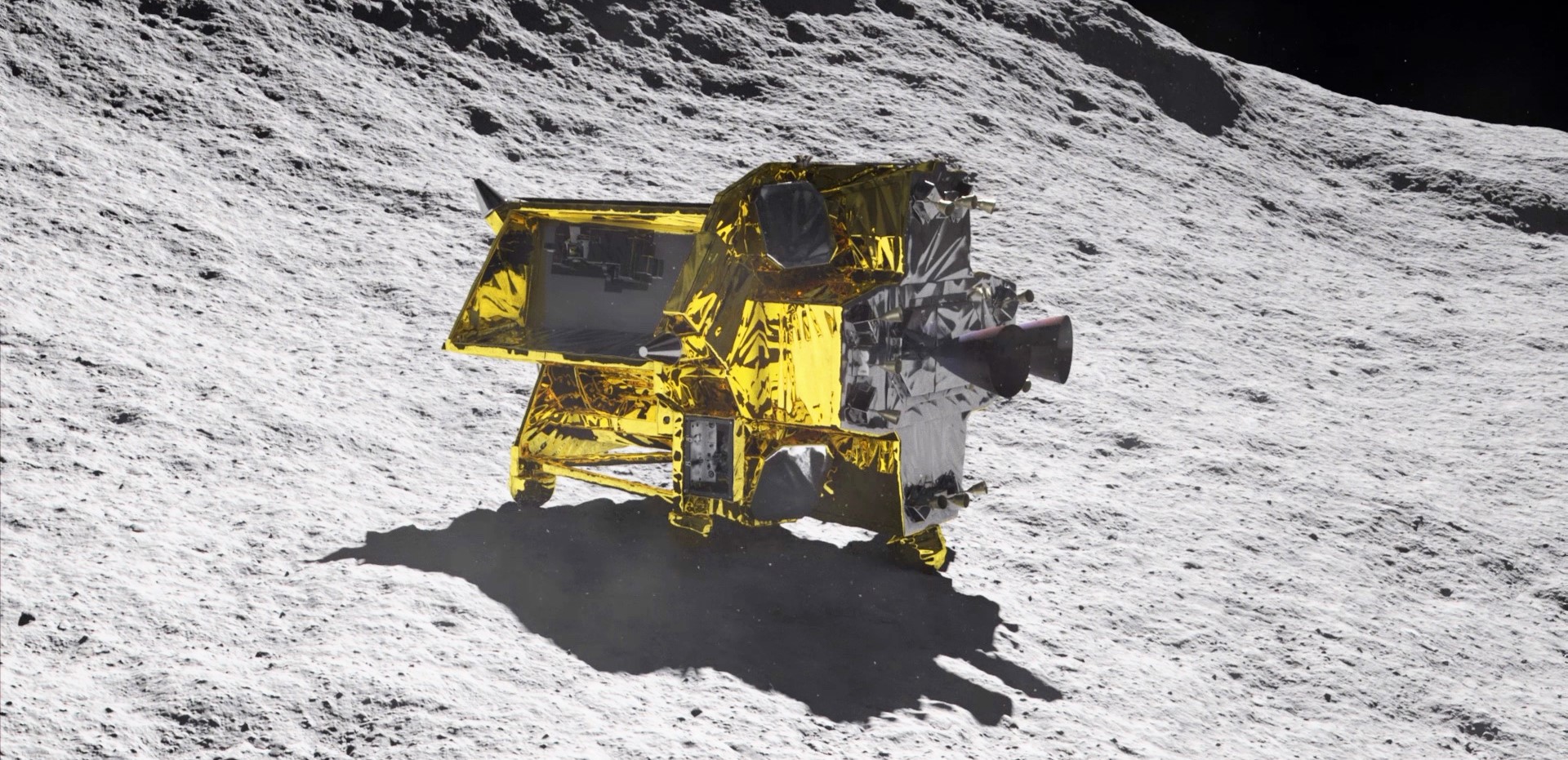
An artist's conception shows Japan's SLIM lander on the moon. (ISAS / JAXA Illustration)
Japan’s Moon Lander Touches Down, But Power Problem Mars Its Mission
Japan has become the fifth nation to land a functioning robot on the moon, but the mission could fall short of complete success due to a problem with the lander’s power-generating solar cells.
The Smart Lander for Investigating Moon, or SLIM, was launched along with an X-ray space telescope called XRISM from Japan’s Tanegashima Space Center in early September — and after weeks of in-space maneuvers, SLIM touched down today at 1520 GMT (10:20 a.m. ET Jan. 19, or 12:20 a.m. JST Jan. 20).
The Japan Aerospace Exploration Agency reported that the landing was successful. During a news briefing, Hiroshi Kuninaka, director general of JAXA’s Institute of Space and Astronautical Science, said the achievement marked “a major milestone” in Japan’s effort to send spacecraft to the moon, and eventually to Mars.
Kuninaka said SLIM was able to communicate with Earth and respond to commands. “However, it seems that the solar cells are not generating electricity at this point in time,” he said. “And since we are not able to generate electricity, the operation is being done using batteries alone.”
Mission controllers prioritized efforts to transmit the data stored on the lander back to Earth before the batteries ran out. SLIM was expected to lose power within hours if the solar panel problem couldn’t be fixed.
Kuninaka said the problem could have arisen because the solar cells weren’t properly aligned toward the sun. “We are trying to analyze the data that we’re gathering at this point in time and analyzing the status,” he said.
The lander was designed to make a precision touchdown near Shioli Crater, in a region of the moon not far from where the Apollo 11 and Apollo 16 landings took place more than 50 years ago. SLIM’s objective was to land within 100 meters (330 feet) of the targeted landing spot. The plan for an ultra-accurate moonshot explains why SLIM came to be called “Moon Sniper.” Kuninaka said mission managers would need “a little more time” to confirm how close SLIM came to the target.
He also said two mini-rovers, known as LEV-1 and LEV-2, were successfully deployed during SLIM’s descent to the surface. LEV-1 is built to capture imagery and record temperature and radiation levels as it hops around the surface. LEV-2 has the shape of a deformable sphere, and is designed to roll around the surface to take pictures.
“If LEV-1 and LEV-2 are functioning properly, then SLIM’s photos and images have been taken by LEV-1 and LEV-2. I believe such data is now being sent to us,” Kuninaka said.
Despite the power problem, SLIM’s successful landing was a welcome development for JAXA’s space exploration program. It added Japan to a short list of countries that have guided robotic spacecraft to soft landings on the moon — a list that also includes the U.S., Russia, China and India.
Other recent developments have demonstrated that putting a robot on the moon isn’t easy. This week, for example, Astrobotic’s Peregrine lunar lander fell back to Earth after a propellant leak ruled out a moon landing.
What Future Propulsion Technologies Should NASA Invest In?
Researchers consistently complain about how difficult it is to fund breakthrough research. Most funding agencies, especially governmental ones, think funding incremental, evolutionary technological steps is the way to go, as it has the most significant immediate payback. But longer-term, higher-risk research is necessary to provide those incremental steps 20-30 years in the future. And in some cases, they are required to underpin completely new things that other researchers want to do.
That is the case with space propulsion systems. Current mature technologies, mainly derived from chemical rockets, cannot provide the necessary force to allow for a gravitational lens telescope out in the Oort cloud, an interstellar probe, or a round trip to Mars that would take less than a year. But other technologies on the horizon could if only we spent more time and resources developing them. So a group of NASA and DoE engineers recently released a paper detailing some of those and where they think America’s space agency should direct its funding when developing new propulsion systems.
At the beginning of the paper, the authors lament that there hasn’t been any large-scale NASA investment in breakthrough propulsion technologies since the 1970s. And they’re right; the last significant effort was the Nuclear Engine for Rocket Vehicle Application (NERVA) project, which wound down in the 1970s. Despite the lack of prototyping, plenty of ideas were put forward then. Just none have made them into hardware.
Novel propulsion systems are always fun to talk about – as Fraser proves int his interview.
Those ideas can be broadly categorized into four different groups of systems: chemical propulsion, nuclear thermal propulsion, solar electric propulsion (SEP), and nuclear electric propulsion (NEP). The rest of the study aimed to determine what if any, significant advancements could be made in those four systems that could lead to them lowering the round-trip time to Mars to less than one year.
The authors discard chemical propulsion and nuclear thermal propulsion, stating that they are simply not cut out for the rapid technological changes that could enable their use for these game-changing propulsion systems. Chemical propulsion suffers from “the tyranny of the rocket equation,” as Isaac Arthur puts it. But nuclear thermal propulsion suffers from the same underlying problem – they must carry too much weight in propellants to be viable for truly ground-breaking speed increases.
That leaves solar electric propulsion and nuclear electric propulsion. The authors break down the current state-of-the-art technologies for each technology and calculate the weight per kilowatt of energy they produce. Neither looks particularly promising at the state of the art – with NEP coming in at 51 kg/kWe and various solar arrays that could drive a SEP system ranging from 5 kg/kWe up to 22.73 kWe. None of those weight/power tradeoffs would result in anything approaching a sub-one-year time to Mars.
Ion engines could potentially be scaled to the point where we could get to Mars quickly – if we fund them enough.
But why stop there? The authors do a deep dive into potential technologies on the horizon, ranging from materials to photovoltaics, that could dramatically impact those calculated ratios. The paper concludes with “transformative” technologies that could decrease the kg/kWe to below one. In that case, an extensive enough power system can reasonably transport humans to Mars in between 50 and 100 days.
The researchers also looked at some early-stage propulsion concepts from NASA’s Institute for Advanced Concepts – including the ever-popular “pulsed nuclear” propulsion system, where a nuclear explosion is intentionally initiated behind the spacecraft to push it forward. These technologies are too early to be included in a deep-dive analysis, but they could lead to some promising alternative technologies.
To invest in those alternative technologies, the authors suggest NASA commit 1% of its Space Nuclear Propulsion budget to developing breakthrough technologies. At $45 million for FY2023, the whole budget isn’t exactly breaking the bank, and a mere $450,000 probably wouldn’t make too big of waves in the industry. But, it is undoubtedly better than what is currently allotted toward maturing these transformative propulsion technologies.
Early Galaxies Looked Nothing Like What We See Today
Though an estimated 100 million black holes roam among the stars in our Milky Way galaxy, astronomers have never identified an isolated black hole – until now. Following six years of meticulous observations, NASA’s Hubble Space Telescope has provided, for the first time ever, strong evidence for a lone black hole plying interstellar space. The black hole that was detected lies about 5,000 light-years away, in the Carina-Sagittarius spiral arm of our galaxy. However, its discovery allows astronomers to estimate, statistically, that the nearest isolated black hole to Earth might be as close as 80 light-years. Black holes are born from rare, monstrous stars (less than one-thousandth of the galaxy’s stellar population) that are at least 20 times more massive than our Sun. These stars explode as supernovae, and the remnant core is crushed by gravity into a black hole. Because the self-detonation is not perfectly symmetrical, the black hole may get a kick, and go careening through our galaxy like a blasted cannonball. Hubble can’t photograph the wayward black hole because it doesn’t emit any light, but instead swallows all radiation due to its intense gravitational pull. Instead, Hubble measurements capture the ghostly gravitational footprint of how the stealthy black hole warps space, which then deflects starlight from anything that momentarily lines up exactly behind it. Ground-based telescopes, which monitor the brightness of millions of stars in the rich star fields in the direction of the central bulge of our Milky Way, look for the tell-tale sudden brightening of one of them when a massive object passes between us and the star. Then Hubble follows up on the most interesting such events. Kailash Sahu of the Space Telescope Science Institute in Baltimore, Maryland, along with his team, made the discovery in a survey designed to find just such isolated black holes. The warping of space due to the gravity of a foreground object passing in front of a star located far behind it will momentarily bend and amplify the light of the background star as it passes in front of it. The phenomenon, called gravitational microlensing, is used to study stars and exoplanets in the approximately 20,000 events seen so far inside our galaxy. The signature of a foreground black hole stands out as unique among other microlensing events. The very intense gravity of the black hole will stretch out the duration of the lensing event for over 200 days. Also, If the intervening object was instead a foreground star, it would cause a transient color change in the starlight as measured because the light from the foreground and background stars would momentarily be blended together. But no color change was seen in the black hole event. Next, Hubble was used to measure the amount of deflection of the background star’s image by the black hole. Hubble is capable of the extraordinary precision needed for such measurements. The star’s image was offset from where it normally would be by two milliarcseconds. That’s equivalent to measuring the diameter of a 25-cent coin in Los Angeles as seen from New York City. This astrometric microlensing technique provided information on the mass, distance, and velocity of the black hole. The amount of deflection by the black hole’s intense warping of space allowed Sahu’s team to estimate it weighs seven solar masses. The isolated black hole is traveling across the galaxy at 90,000 miles per hour (fast enough to travel from Earth to the moon in less than three hours). That’s faster than most of the other neighboring stars in that region of our galaxy. “Astrometric microlensing in conceptually simple but observationally very tough,” said Sahu. “It is the only technique for identifying isolated black holes.” When the black hole passed in front of a background star located 28,000 light-years away in the galactic bulge, the starlight coming toward Earth was amplified for a duration of 265 days as the black hole passed by. However, it took several years of Hubble observations to follow how the background star’s position appeared to be deflected by the bending of light by the foreground black hole. The existence of stellar-mass black holes has been known since the early 1970’s, but all of them—until now—are found in binary star systems. Gas from the companion star falls into the black hole, and is heated to such high temperatures that it emits X rays. About two dozen black holes have had their masses measured in X-ray binaries through their gravitational effect on their companions. Black hole masses in X-ray binaries inside our galaxy range from 5 to 20 solar masses. Black holes detected in other galaxies by gravitational waves from mergers between black holes and companion objects have been as high as 90 solar masses. “Detections of isolated black holes will provide new insights into the population of these objects in our Milky Way,” said Sahu. He expects that his program will uncover more free-roaming black holes inside our galaxy. But it is a needle-in-a-haystack search. The prediction is that only one in 1500 microlensing events are caused by isolated black holes. NASA’s upcoming Nancy Grace Roman Space Telescope will discover several thousand microlensing events out of which many are expected to be black holes, and the deflections will be measured with very high accuracy. In a 1916 paper on general relativity, Albert Einstein predicted that his theory could be tested by observing the sun’s gravity offsetting the apparent position of a background star. This was tested by astronomer Arthur Eddington during a solar eclipse on May 29, 1919. Eddington measured a background star being offset by 2 arc seconds, validating Einstein’s theories. Both scientists could hardly have imagined that over a century later this same technique would be used – with unimaginable precision of a thousandfold better — to look for black holes across the galaxy.
Early Galaxies Looked Nothing Like What We See Today
Talk to anyone about galaxies and it often conjurs up images of spiral or elliptical galaxie. Thanks to a survey by the James Webb Space Telescope it seems the early Universe was full of galaxies of different shapes. In the first 6 billion years up to 80% of the galaxies were flat, surfboard like. But that’s not it, there were others like pool noodles too, yet why they looked so different back then is a mystery.
Galaxies were first identified back in the 17th Century by French astronomer Charles Messier. He was a comet hunter who identified a number of fuzzy objects which he realised were not comets. He catalogued them in his famous catalogue of deep sky objects but it wasn’t until Edwin Hubble measure the distances to some of them in the 1920’s that they were recognised as galaxies.
The bluish-white spiral galaxy NGC 1376 hangs delicately in the cold vacuum of space. Credit: NASA, ESA, and the Hubble Heritage Team (STScI/AURA)
Analysing images from the JWST survey known as the Cosmic Evolution Early Release Science Survey, the team studied galaxies from a time when the universe was between 600 million and 6 billion years old. To their surprise they did not see the usual cosmic zoo of galaxies like spiral, elliptical and irregular galaxies. Instead they found that between 50 and 80% of the galaxies seem to be glattened in two dimensions.
Illustration of James Webb Space Telescope
Instead, the team found galaxies shaped like surfboards, pool noodles, frisbees and volleyballs. Among these new types, the surfboard shape was most common with the least common being the volleyball, sphere shaped galaxies. Interestingly too they foudn that the frisbee and noodle shaped galaxies became more common in the later era around 6 billion years.
The mass of the early galaxies seemed to be far less than the mass of galaxies we see today. It seems they had far less time to grow when compared to today’s galaxies which are far more massive. The team would have not been able to complete their work without the incredible sensitivity and resolution of the JWST.
The paper was authored by Viraj Pandya, a NASA Hubble Fellow at Columbia University. They went further to explore what category our own Milky Way galaxy would fall into if we could hop in a time machine and wind back time. They concluded it was likely to have been surfboard shaped galaxy, not too dissimilar to the spiral structure familiar to us today.
We have learned lots about galaxies over the years and images from Hubble has most certainly helped. The latest set of images from JWST have shown us that we still have lots to learn and as we delve deeper and deeper into space and further and further back into time we are only just starting to scratch the surface.
The Ice Sheet on Mars is Even Thicker Than Previously Believed
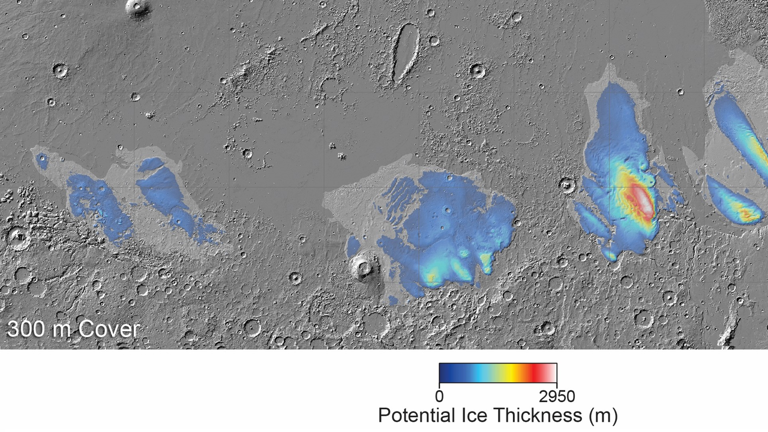
Maybe Mars isn’t as dry as we thought. ESA’s Mars Express has revealed new details about a region near Mars’ equator that could contain a massive deposit of water ice several kilometers deep. If it is indeed ice, there is enough of it in this one deposit that if melted, water would cover the entire planet up to 2.7 meters (almost 9 feet) deep.
But ice is just one explanation for the unusual features detected by the orbital spacecraft. Another is that this is a giant pile of dust several kilometers deep — although the dust would still need to have some ice mixed in.
Mars Express has been orbiting Mars since December of 2003 and back in 2007, the spacecraft studied the Medusae Fossae Formation (MFF), a large geological formation that includes wind-sculpted ridges and grooves, abrupt mesas, interspersed with smooth and gently undulating areas. The region extends intermittently for more than 5,000 km (3,100 miles) along the equator of Mars, extending from just south of Olympus Mons to Apollinaris Patera, with a smaller additional region closer to Gale Crater, where the Curiosity rover is exploring.
This image shows a height map of the Martian surface, with lowest land in blue and highest in white. Standing at an impressive 22 km, Olympus Mons is the tallest volcano in the entire Solar System. The Medusae Fossae Formation (MFF) is shown near the equatorCredit: ESA
Various spacecraft in addition to Mars Express, such as NASA’s Mars Global Surveyor and Mars Odyssey, have also detected subsurface ice, as much as 2.5 km (1.5 miles) deep.
Now, new data from Mars Express suggest layers of water ice stretching even further underground – the most water ever found in this part of the planet.
“We’ve explored the MFF again using newer data from Mars Express’s MARSIS radar, and found the deposits to be even thicker than we thought: up to 3.7 km (2.3 miles) thick,” said Thomas Watters of the Smithsonian Institution, USA, lead author of both the new research and the initial 2007 study, in an ESA press release. “Excitingly, the radar signals match what we’d expect to see from layered ice, and are similar to the signals we see from Mars’s polar caps, which we know to be very ice rich.”
Watters and his team say that if melted, the ice contained within the MFF would cover the entire planet in a layer of water 1.5 to 2.7 m deep, enough to fill Earth’s Red Sea.
An isolated hill in the Medusae Fossae Formation. The effect of wind erosion on this hill is evident by its streamlined shape. Credit: High Resolution Stereo Camera/European Space Agency
But MFF’s windswept landscapes contains one of the most extensive deposits of dust on Mars, which is possibly the biggest single source of dust on Mars. Some studies determined the strange features in this landscape could have been formed by explosive volcanoes.
In the 2007 observations with Mars Express, the radar data showed the MFF to be relatively transparent to radar and low in density – two characteristics which would reveal icy deposits. However, scientists couldn’t rule out a drier possibility: that the features are actually giant accumulations of windblown dust, volcanic ash or sediment.
But the beauty of long-lasting spacecraft is that it provides the opportunity for multiple observations of a single region on Mars over many years, providing additional follow-up data for study.
At the top is an image of Mars’s surface. A white line crosses the surface diagonally, with a black arrow coming down from the white line to point at a graph below. The graph shows the shape of the surface and subsurface. It indicates that under the surface is a thin layer of dry sediments then a thick layer of ice deposit. The x axis of the graph shows distance, indicating that the diagonal white line covers a distance of 1000 km. The y axis of the graph shows elevation, indicating that the ice deposit is up to 3000 m thick. Credit: CReSIS/KU/Smithsonian Institution.
“Here’s where the new radar data comes in! Given how deep it is, if the MFF was simply a giant pile of dust, we’d expect it to become compacted under its own weight,” said co-author Andrea Cicchetti of the National Institute for Astrophysics, Italy. “This would create something far denser than what we actually see with MARSIS. And when we modelled how different ice-free materials would behave, nothing reproduced the properties of the MFF – we need ice.”
The new results instead suggest layers of dust and ice, all topped by a protective layer of dry dust or ash several hundred meters thick.
We do know that massive stores of ice near the equator could not have formed in the planet’s present climate.
“This latest analysis challenges our understanding of the Medusae Fossae Formation, and raises as many questions as answers,” says Colin Wilson, ESA project scientist for Mars Express and the ESA ExoMars Trace Gas Orbiter (TGO). “How long ago did these ice deposits form, and what was Mars like at that time? If confirmed to be water ice, these massive deposits would change our understanding of Mars climate history. Any reservoir of ancient water would be a fascinating target for human or robotic exploration.”
If this does turn out to be large stores of water ice, the MFF deposits would be an incredibly valuable resource for any future human exploration of Mars. These types of missions would need to land near the planet’s equator, due to landing constraints, and resources like abundant solar power, and more moderate temperatures. The presence of equatorial water ice could provide a steady supply of water for a future base on Mars.
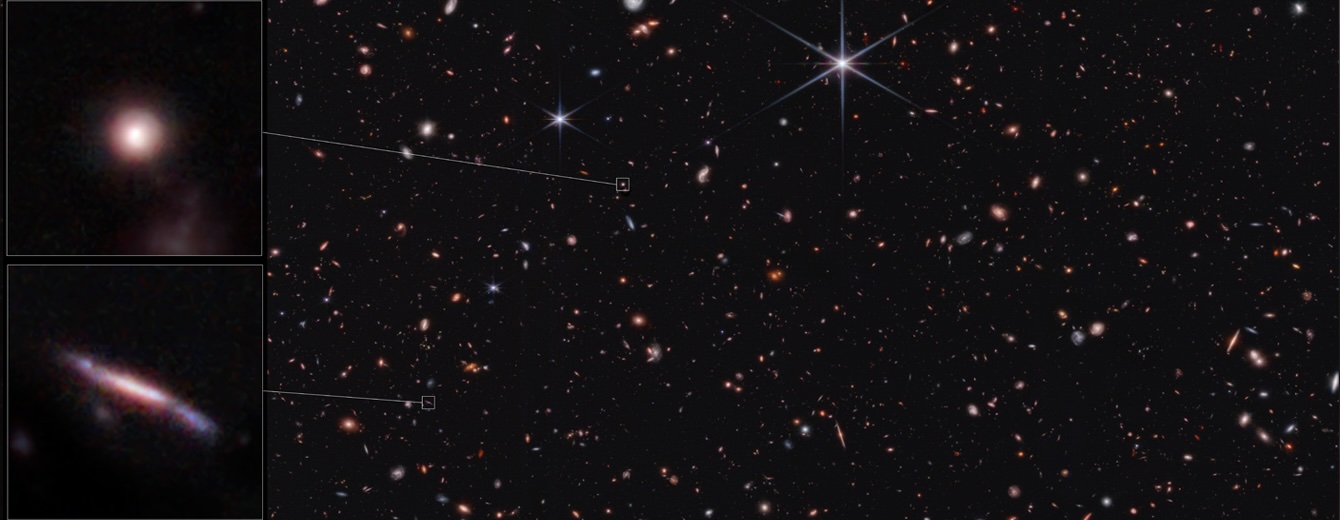
Astronomers using the NASA/ESA/CSA James Webb Space Telescope have detected a small and vigorous black hole in GN-z11, an exceptionally luminous galaxy that existed just 420 million years after the Big Bang, more than 13 billion years ago. That this black hole with a mass of a few million solar masses even exists so early in the Universe challenges current assumptions about how black holes form and grow.
GN-z11, shown in the inset, is seen as it was 13.4 billion years in the past, just 400 million years after the Big Bang.
Image credit: NASA / ESA / P. Oesch, Yale University / G. Brammer, STScI / P. van Dokkum, Yale University / G. Illingworth, University of California, Santa Cruz.
Astronomers believe that the supermassive black holes found at the centre of galaxies like the Milky Way grew to their current size over billions of years.
But the size of this newly-discovered black hole suggests that they might form in other ways: they might be ‘born big’ or they can eat matter at a rate that’s five times higher than had been thought possible.
According to standard models, supermassive black holes form from the remnants of dead stars, which collapse and may form a black hole about a hundred times the mass of the Sun
If it grew in an expected way, this newly-detected black hole would take about a billion years to grow to its observed size.
However, the Universe was not yet a billion years old when this black hole was detected.
“It’s very early in the Universe to see a black hole this massive, so we’ve got to consider other ways they might form,” said Dr. Roberto Maiolino, an astronomer at the University of Cambridge.
“Very early galaxies were extremely gas-rich, so they would have been like a buffet for black holes.”
Like all black holes, the young black hole in GN-z11 is accreting material from its host galaxy to fuel its growth.
Yet, this ancient black hole is found to gobble matter much more vigorously than its siblings at later epochs.
GN-z11 is a compact galaxy, about one hundred times smaller than the Milky Way, but the black hole is likely harming its development.
When black holes consume too much gas, it pushes the gas away like an ultra-fast wind.
This ‘wind’ could stop the process of star formation, slowly killing the galaxy, but it will also kill the black hole itself, as it would also cut off the black hole’s source of ‘food.’
“It’s a new era: the giant leap in sensitivity, especially in the infrared, is like upgrading from Galileo’s telescope to a modern telescope overnight,” Dr. Maiolino said.
“Before Webb came online, I thought maybe the Universe isn’t so interesting when you go beyond what we could see with the NASA/ESA Hubble Space Telescope.”
“But that hasn’t been the case at all: the Universe has been quite generous in what it’s showing us, and this is just the beginning.”
“The sensitivity of Webb means that even older black holes may be found in the coming months and years,” he added.
“We are hoping to use future observations from Webb to try to find smaller ‘seeds’ of black holes, which may help them untangle the different ways that black holes might form: whether they start out large or they grow fast.”
A paper on the findings was published in the journal Nature.
R. Maiolino et al. A small and vigorous black hole in the early Universe. Nature, published online January 17, 2023; doi: 10.1038/s41586-024-07052-5
Want volgens ons huidige begrip omtrent het ontstaan en de evolutie van zwarte gaten zou dit exemplaar eigenlijk niet moeten bestaan.
Dat is te lezen in het blad Nature. De studie handelt over een zwart gat dat wetenschappers met behulp van ruimtetelescoop James Webb hebben ontdekt. Het zwarte gat dateert uit de periode kort na de oerknal; de astronomen zien het zoals het er slechts 400 miljoen jaar na het ontstaan van het universum uitzag. En daarmee gaat het zwarte gat de boeken in als het oudste zwarte gat dat astronomen tot op heden hebben gedetecteerd.
Hoofdbrekens Wat opvalt, is dat dit zwarte gat, dat al zo kort na de oerknal moet zijn ontstaan, vrij zwaar is: enkele miljoenen keren zwaarder dan onze zon. En dat leidt toch wel tot hoofdbrekens bij astronomen. Aangenomen wordt namelijk dat dergelijke superzware zwarte gaten – zoals we die vandaag de dag ook in het hart van onze eigen Melkweg vinden – miljarden jaren nodig hebben om zo zwaar te worden (zie kader). Maar zoveel tijd heeft het superzware zwarte gat dat nu in het jonge universum is ontdekt overduidelijk niet gehad. “Dus we moeten andere manieren gaan bedenken waarop superzware zwarte gaten kunnen ontstaan,” concludeert onderzoeker Roberto Maiolina nuchter.
Het ontstaan van superzware zwarte gaten Superzware zwarte gaten zijn zwarte gaten met een massa die honderdduizenden, miljoenen of zelfs miljarden keren groter is dan de massa van onze zon. Volgens de huidige standaardmodellen zien dergelijke zware zwarte gaten het levenslicht wanneer zware sterren aan het einde van hun leven ineenstorten. Een dergelijke gebeurtenis zou resulteren in een zwart gat dat ‘slechts’ enkele honderden malen zwaarder is dan onze zon. Maar gaandeweg kan zo’n zwart gat – bijvoorbeeld door omringende materie op te slokken – steeds zwaarder worden en uiteindelijk uitgroeien tot een superzwaar zwart gat. Maar dat kost tijd. Zo zou het zwarte gat dat wetenschappers nu met behulp van James Webb in het jonge universum hebben ontdekt, volgens deze theorie zo’n 1 miljard jaar nodig hebben gehad om zijn huidige massa te verkrijgen. Maar dat klopt duidelijk niet, want het zwarte gat was 400 miljoen jaar na de oerknal al superzwaar.
De ontdekking van dit superzware zwarte gat in het jonge universum dwingt wetenschappers duidelijk om na te gaan denken over andere manieren waarop superzware zwarte gaten kunnen ontstaan of evolueren. Misschien zijn sommige superzware zwarte gaten bijvoorbeeld bij hun ‘geboorte’ al wel groter dan tot voor kort voor mogelijk werd gehouden. Een andere mogelijkheid is dat sommige superzware zwarte gaten gewoon veel sneller kunnen groeien dan onderzoekers dachten.
Hongerig Dat het zwarte gat dat wetenschappers nu gedetecteerd hebben, hongerig is, staat vast (zie kader). Onderzoek heeft namelijk al uitgewezen dat het zwarte gat veel sneller materie opslokt dan zwarte gaten in latere tijden.
Hongerig zwart gat Het zwarte gat is misschien wel één van de meest mysterieuze en fascinerende fenomenen in het universum. Door de intense zwaartekracht van zwarte gaten kan niets aan hun greep ontsnappen. Zelfs licht niet. Hierdoor zijn zwarte gaten volslagen donker en in feite dus onzichtbaar. Dat wetenschappers ze toch kunnen detecteren, is te danken aan het feit dat de intense zwaartekracht van zo’n zwart gat van invloed is op de omgeving. Zo is het zwarte gat dat wetenschappers nu in het jonge universum hebben ontdekt, druk bezig om materie (gas) naar zich toe te trekken. Alvorens dat gas daadwerkelijk in het zwarte gat verdwijnt, begeeft het zich in een baan rond het zwarte gat en vormt daar een zogenoemde accretieschijf. Het gas in die schijf wordt heel heet en begint te gloeien. En die gloed hebben onderzoekers nu met James Webb gedetecteerd. En uit die gloed kunnen ze afleiden dat zich hier een zwart gat bevindt (dat vrij druk bezig is om gas naar zich toe te trekken).
In eerste instantie zorgt die vraatzucht ervoor dat het zwarte gat lekker kan groeien. Maar op lange termijn kan de zucht naar meer dit zwarte gat zomaar fataal worden, zo merken de onderzoekers op. Want als het zwarte gat te veel gas consumeert, gaat deze ook krachtige ‘winden’ – in feite een uitstroom van straling en geladen deeltjes – produceren die gas juist van het zwarte gat vandaan duwen. En daarmee duwt het zwarte gat zijn ‘voedsel’ als het ware weg, waardoor het zichzelf langzaam uithongert. Ook op het sterrenstelsel waar het zwarte gat deel van uitmaakt, heeft dit proces overigens een enorme impact. Want de krachtige ‘winden’ die het zwarte gat genereert, remmen de stervorming. Hierdoor worden er minder nieuwe sterren geboren, ‘vergrijst’ het sterrenstelsel en sterft het uiteindelijk een langzame dood.
Vervolgonderzoek Hoewel er dus aanwijzingen zijn dat het zwarte gat dat onderzoekers nu in het jonge universum hebben gevonden, actief en ook vrij snel aan het eten is, is daarmee zeker nog niet helemaal te verklaren hoe het zwarte gat in zo’n korte tijd zo zwaar is geworden. Meer onderzoek is nodig om uit te vogelen hoe een superzwaar zwart gat zo vroeg in de ontstaansgeschiedenis van ons universum kan bestaan. James Webb kan daar zeker bij helpen, zo verwacht Maiolino. Met deze zeer scherpe en gevoelige telescoop is een nieuw tijdperk in de astronomie aangebroken, zo stelt hij. “Voor Webb online kwam dacht ik dat het universum dat voorbij het gezichtsveld van ruimtetelescoop Hubble ligt, misschien niet zo interessant zou zijn. Maar dat blijkt helemaal niet het geval te zijn.”
Maiolino denkt dat James Webb gevoelig genoeg is om in de komende maanden en jaren nóg oudere zwarte gaten te spotten. Oftewel: zwarte gaten die nog korter na de oerknal zijn ontstaan. De hoop is dat James Webb daarbij ook op superzware zwarte gaten in wording (of in de groei) stuit en zo meer inzicht kan gaan geven in hoe sommige zwarte gaten in verbazingwekkend weinig tijd superzwaar kunnen worden.
Tegenwoordig kunnen we ons nauwelijks voorstellen dat er op Mars ooit rivieren stroomden. Maar de dorre, rode planeet zag er lang geleden heel anders uit. Astronomen hebben nu in kaart gebracht hoe lang het duurde voor dit water de Martiaanse valleien kon vormen.
“Mars is nu één grote woestijn, maar zijn oppervlak zit vol met bewijs dat er vroeger stromend water was. Er zijn bijvoorbeeld een soort rivierbeddingen zichtbaar. Hoe lang het duurde voor deze valleien zijn gevormd, zegt iets over de leefbaarheid op het vroege Mars, aangezien lange periodes van stabiel vloeibaar water meer bevorderlijk zijn voor leven”, zegt onderzoeker Alexander Morgan van het Planetary Science Institute in Tucson, Arizona.
De kraters als bewijs De valleien op Mars zijn meer dan 3 miljard jaar geleden ontstaan en vormen al lange tijd zo ongeveer het sterkste bewijs dat er ooit vloeibaar water was op de rode planeet. Eerdere studies toonden al aan dat er minstens tienduizenden jaren aan erosie nodig was voor er sprake was van zoiets als valleien, maar het aantal keer dat er water doorheen stroomde en dus de totale periode waarin de rivierbeddingen zich konden vormen, is nooit vastgesteld.
Om daar achter te komen keek Morgan naar de kraters op de rode planeet. “Ik gebruikte kraters die voor en na de valleisystemen zijn ontstaan om grenzen te kunnen stellen aan de periode waarin deze systemen zijn gevormd, dus deze nieuwe resultaten leveren een bovengrens van de tijdschaal op, waarin de Martiaanse valleien actief waren”, legt de wetenschapper uit. Hij komt tot een periode van honderden miljoenen jaren. “Uitgaande van wat we weten over de erosie op het vroege Mars, wijzen langere tijdschalen erop dat de condities die rivieren mogelijk maken alleen met grote tussenpozen bestonden, waarbij lange droge periodes werden afgewisseld met korte episodes van stromend water.”
Een valleinetwerk op Mars met rood en blauw omcirkeld de kraters. De kraters in blauw zijn van voor de valleien ontstonden en de rode zijn van erna. Afbeelding: MOLA MEGDR, NASA/USGS; THEMIS mosaic, ASU/NASA/USGS; CTX, NASA/MSSS.
Twee kampen Wetenschappers die het vroege Mars bestuderen zijn het overigens niet allemaal met elkaar eens. Er zijn twee kampen: de ene groep gaat ervan uit dat het er toen warm en nat was met een oceaan. Anderen denken dat het er koud en ijzig was met grote ijskappen. “In de afgelopen tien jaar zijn we er achter gekomen dat deze beschrijvingen veel te algemeen zijn. Het is niet echt logisch om te proberen om honderden miljoenen jaren aan klimaatgeschiedenis samen te vatten in twee woorden”, aldus Morgan.
Zoals er op de vroege Aarde ook ijstijden werden afgewisseld met warmere periodes, was ook op Mars het klimaat niet altijd hetzelfde. “Net als op onze planeet was Mars vroeger complex en varieerden de omstandigheden waardoor oppervlaktewater kon ontstaan. De Aarde heeft in zijn geschiedenis enorme klimaatveranderingen doorgemaakt. Twintigduizend jaar geleden nog lag wat nu Chicago is onder een halve kilometer ijs. Zo kwamen en gingen waarschijnlijk ook de omstandigheden die nodig waren voor stromend water op Mars”, legt de planeetwetenschapper uit.
Beetje warmte nodig De resultaten wijzen uit dat de rivieren op Mars maar heel langzaam erodeerden, vergelijkbaar met delen van de Atacama-woestijn in Chili. Een verklaring daarvoor is dat de erosie mogelijk werd tegengehouden door grote stenen in de rivierbedding, die niet verder afgebroken konden worden. Een andere verklaring is dat de rivieren erg onregelmatig stroomden, misschien maar 0,001 procent van de tijd. De rivieren op Mars zouden dan een groot deel van de tijd kurkdroog zijn geweest, maar actiever worden tijdens vulkanische activiteit of als de planeet dichterbij de zon stond, waardoor het er warmer werd. Dit soort lange termijnveranderingen kennen we ook op Aarde. Hier worden ze Milankovitch-cycli genoemd. Ze zijn bijvoorbeeld verantwoordelijk voor de laatste ijstijden op onze planeet.
“Op de korte termijn wordt de stroming van rivieren bepaald door neerslag of sneeuw die smelt. Maar over langere periodes worden ook de rivieren op Aarde beïnvloed door klimaatverandering”, legt de wetenschapper uit. “20.000 jaar geleden bijvoorbeeld waren er grote meren en rivieren in wat nu Nevada is. Martiaanse rivieren zouden op dezelfde manier hebben bestaan met variaties op de korte termijn door stormen of neerslag en op de lange termijn door veranderingen in de rotatie van de planeet en wijzigingen in zijn baan rond de zon.”
Wat zijn Milankovitch-cycli? Milankovitch-cycli zijn periodieke veranderingen van het klimaat doordat de baan van de Aarde en de positie ten opzichte van de zon ieder jaar een klein beetje verandert. Daardoor komt er meer of minder zonlicht op de Aarde, wat invloed heeft op de temperatuur.
De structuur – die voorlopig de veelzeggende naam ‘The Big Ring on the Sky‘ heeft gekregen – heeft een diameter van ongeveer 1,3 miljard(!) lichtjaar en een omtrek van 4 miljard lichtjaar.
De bizar grote structuur bestaat onder meer uit sterrenstelsels en is ontdekt door een studente aan de University of Central Lancashire, Alexia Lopez. Met de ontdekking van The Big Ring on the Sky is ze op een groot kosmologisch mysterie gestuit. Want structuren zo groot als The Big Ring on the Sky zouden eigenlijk – volgens de huidige theorieën – niet moeten bestaan.
Er is meer Wat het nog een tikje meer bizar maakt, is dat The Big Ring on the Sky niet de eerste bizar grote structuur is die Lopez ontdekt heeft. Twee jaar eerder ontdekte de studente namelijk al de Giant Arc on the Sky; een object dat 3,3 miljard lichtjaar breed is. En om het allemaal nog vreemder te maken, bevinden zowel The Big Ring on the Sky als de Giant Arc on the Sky zich in hetzelfde deel van het universum; ze bevinden zich op ongeveer dezelfde afstand van de aarde, in dezelfde tijd en staan slechts op 12 graden afstand van elkaar aan de hemel.
Deze artistieke impressie laat zien hoe de Big Ring (blauw) en de Giant Arc (rood) er aan de hemel uit zouden zien. De Big Ring is onlangs ontdekt en lijkt zo op een bijna perfect ringvormige verzameling sterrenstelsels, maar volgens onderzoek van Lopez heeft de structuur in werkelijkheid een meer kurkentrekker-achtige vorm waar we van de aarde gezien in kijken. Beide structuren bevinden zich op dezelfde afstand van ons; op zo’n 9,2 miljard lichtjaar. Het betekent dat ze beiden bestonden toen het universum nog vrij jong was. Afbeelding: Stellarium.
Onverklaarbaar “Geen van deze twee ultragrote structuren is met ons huidige begrip van het universum gemakkelijk te verklaren,” aldus Lopez. “En hun ultragrote omvang, opvallende vorm en het feit dat ze relatief dicht bij elkaar staan, moet ons iets belangrijks vertellen. Maar wat precies?”
Kosmologisch Principe Het is een raadsel. Allereerst natuurlijk omdat structuren van deze omvang volgens de huidige theorieën niet zouden moeten bestaan. Zo is daar het Kosmologisch Principe dat dicteert dat het universum isotroop en homogeen is. Volgens dit principe ziet het heelal er in alle richtingen hetzelfde uit en heeft het op iedere plek ook dezelfde eigenschappen. “Het Kosmologisch Principe neemt aan dat het deel van het universum dat we kunnen zien een vrij goed beeld geeft van wat we in de rest van het universum mogen verwachten aan te treffen. We verwachten dus dat materie als we het universum op een grotere schaal bekijken op een vergelijkbare manier verdeeld is.” Volgens dit principe ligt het niet in de lijn der verwachtingen om op één plek in het universum veel grotere structuren aan te treffen dan elders denkbaar worden geacht. Laat staan dat wetenschappers verwachten er twee te vinden, in hetzelfde deel van het heelal.
Limiet overschreden “Kosmologen hebben berekend dat de huidige theoretische limiet die aan de omvang van structuren gesteld kan worden, 1,2 miljard lichtjaar is,” vertelt Lopez. “Maar beide structuren zijn veel groter: De Giant Arc is bijna drie keer groter en de omtrek van de Big Ring is vergelijkbaar met de lengte van de Giant Arc. Afgaand op de huidige kosmologische theorieën hadden we niet verwacht dat structuren op deze schaal konden bestaan,” concludeert Lopez. En nu blijken er dus twee te zijn. “De Big Ring en de Giant Arc zijn twee enorme structuren en zelfs kosmologische buren, wat bijzonder fascinerend is.”
Hoe het bestaan van beide enorme structuren verklaard moeten worden, is dus volstrekt onduidelijk. “De identificatie van twee uitzonderlijke, ultragrote structuren die zo dicht bij elkaar staan, doet vermoeden dat ze samen een nog uitzonderlijke kosmologisch systeem vormen,” aldus Lopez, die de ontdekking van de Big Ring vorige week aankondigde tijdens een bijeenkomst van de American Astronomical Society. “De Big Ring en de Giant Arc vormen – zowel individueel als samen – een groot kosmologisch mysterie.”
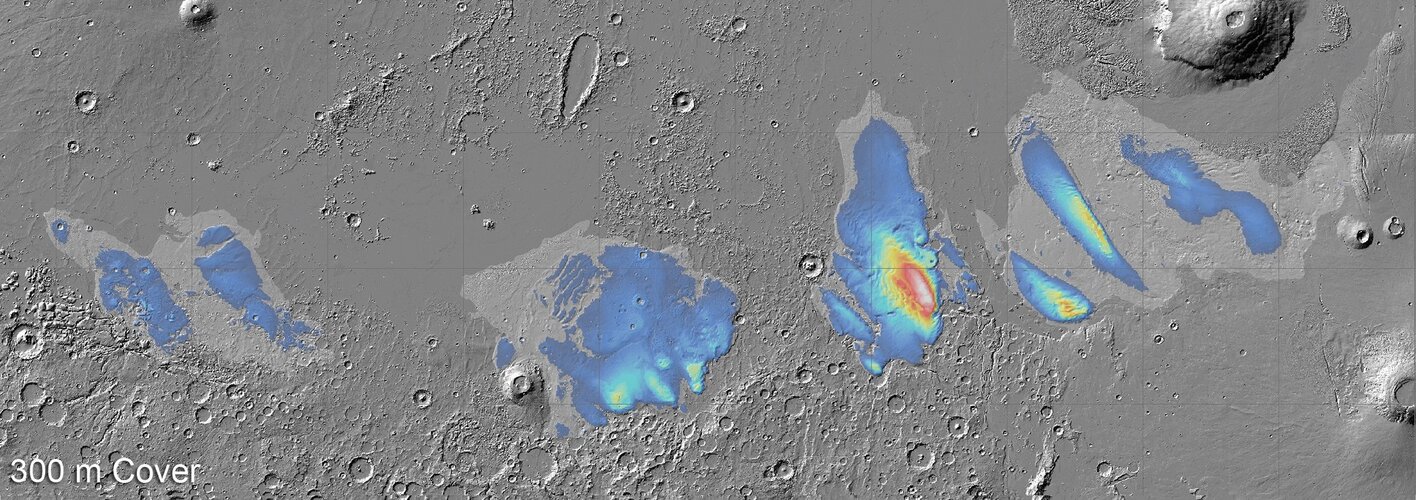
De hoeveelheid gevonden water is gigantisch, klinkt het bij ESA. Volgens de wetenschappers zou het, in vloeibare toestand, genoeg zijn om de hele planeet 1,5 tot 2,7 meter onder water te zetten. Genoeg ook om de Rode Zee tussen Afrika en Azië volledig mee te vullen.
De ontdekking is gedaan met de Europese ruimtesonde Mars Express die al 20 jaar rond Mars cirkelt. Die had 15 jaar geleden al gevonden dat er een dikke laag afzettingen verborgen lag onder een gebied rond de evenaar, de Medusae Fossae Formation.
Dat is een geologische formatie die zich uitstrekt over meer dan 5.000 kilometer en vroeger vulkanisch moet zijn geweest. Het gebied bestaat uit een reeks door de wind gevormde afzettingen van honderden kilometers breed en enkele kilometers hoog.
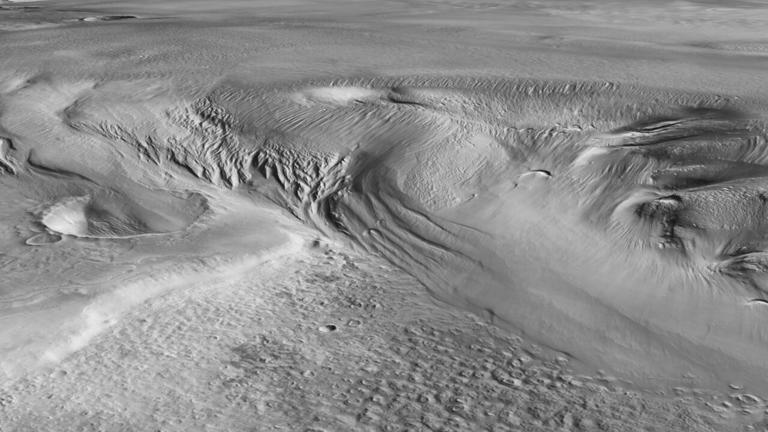
Foto van een deel van de Medusae Fossae Formation op Mars
Uit eerdere waarnemingen bleek al dat de laag afzettingen onder het oppervlak tot 2,5 kilometer dik was. Maar veel meer duidelijkheid was er niet.
"Daarom hebben we het gebied opnieuw bestudeerd, aan de hand van nieuwe waarnemingen van Mars Express", zegt hoofdonderzoeker Thomas Watters van het Amerikaanse Smithsonian Instituut.
"We hebben ontdekt dat de laag nog dikker was dan verwacht, tot zelfs 3,7 kilometer dik. De resultaten kwamen overeen met wat we verwachten te zien bij ijslagen. Er waren ook verrassend veel gelijkenissen met wat we eerder al zagen op de poolkappen van Mars. Daarvan weten we dat ze rijk zijn aan ijs."
Kaart van de Medusae Fossae Formatie op Mars. Hoe warmer de kleur, hoe dikker de mogelijke ijslaag.
Met wiskundige modellen werden alle eigenschappen nog eens volledig doorgerekend. "Mochten het simpelweg gigantische hoeveelheden weggewaaid stof zijn, dan zouden we een veel hogere dichtheid moeten zien", zegt co-auteur Andrea Cicchetti van het Italiaanse Nationale Instituut voor Astrofysica. "Er bleef maar één optie over: het moet ijs zijn."
Belangrijk voor astronauten op Mars
Hoewel Mars nu op een dorre, droge wereld lijkt, moet er ooit overvloedig water zijn geweest. Het oppervlak is bezaaid met overblijfselen daarvan, zoals opgedroogde rivierkanalen, beddingen en valleien. Er zijn ook al grote hoeveelheden waterijs gevonden op de poolgebieden en ook dichter bij de evenaar zijn er al gletsjers gevonden onder het oppervlak.
Maar volgens ESA is het nu de eerste keer dat er zo'n grote hoeveelheid water in de buurt van de evenaar is gevonden. En dat kan belangrijk zijn voor als er ooit mensen naar Mars willen reizen.
Want zij komen wellicht terecht dicht bij de evenaar, waar het zonniger en warmer is dan op de polen. Omdat het onmogelijk is om van op aarde voldoende water mee te nemen, moet er op Mars water worden gemaakt, of gevonden.
"Helaas ligt het gevonden ijs op honderden meters onder het stof, waardoor het de komende decennia zeker niet toegankelijk zal zijn", zegt ESA-wetenschappers Colin Wilson.
"Maar elk stukje ijs dat we vinden helpt ons wel om een beter beeld te krijgen van waar het water op Mars ooit moet hebben gestroomd. En waar het vandaag de dag nog te vinden is."
Mars moet ooit veel op onze aarde hebben geleken. Maar dé vraag blijft: is er leven geweest op Mars? Een sluitend antwoord hebben wetenschappers nog altijd niet.
Machine Learning Could Find all the Martian Caves We Could Ever Want
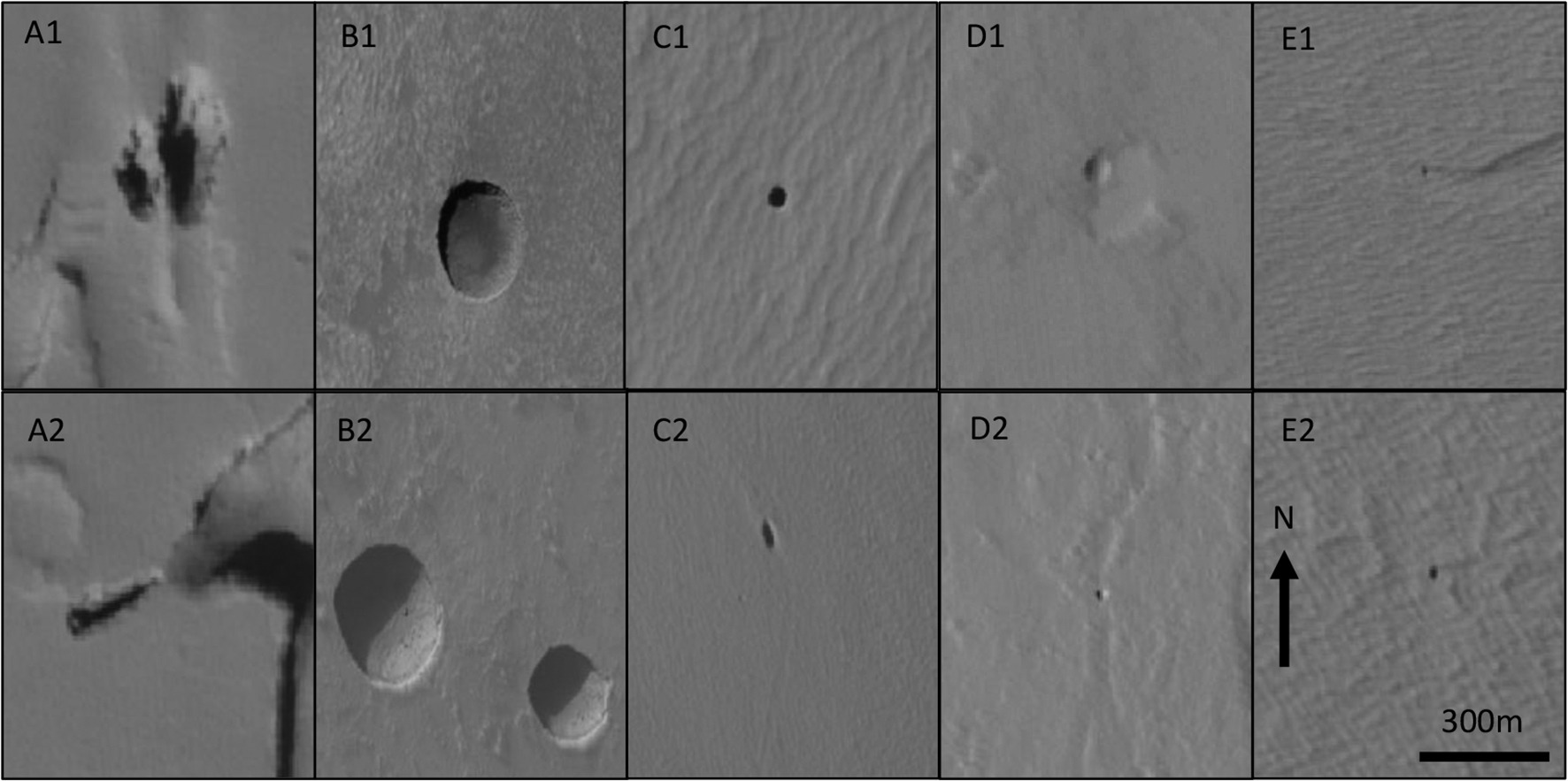
Examples of potential cave entrances (PCEs) on Mars and their assigned category from the Mars Global Candidate cave Catalogue (MGC3). Credit: NASA/JPL/MSSS/The Murray Lab.
Machine Learning Could Find all the Martian Caves We Could Ever Want
The surface of Mars is hostile and unforgiving. But put a few meters of regolith between you and the Martian sky, and the place becomes a little more habitable. Cave entrances from collapsed lava tubes could be some of the most interesting places to explore on Mars, since not only would they provide shelter for future human explorers, but they could also be a great place to find biosignatures of microbial life on Mars.
But cave entrances are difficult to spot, especially from orbit, as they blend in with the dusty background. A new machine learning algorithm has been developed to quickly scan images of the Martian surface, searching for potential cave entrances.
Researchers Thomas Watson and James Baldini from Durham University in the UK used a convolutional neural network (CNN), trained to identify potential cave entrances (PCEs) from images of the Martian surface to locate new potential caves. It was able to identify 61 new cave entrances from images in four different regions on Mars.
Previously, most detections of Martian PCEs have come from a manual review of visible satellite imagery, with images taken by the Mars Reconnaissance Orbiter’s (MRO) Context Camera (CTX) and High-Resolution Imaging Science Experiment (HiRISE) cameras. A database from that manual review called the Mars Global Candidate Cave Catalogue (MGC3) contains the coordinates and brief descriptions of over one thousand identified PCEs on Mars.
The circular black features in this 2007 figure are caves formed by the collapse of lava tubes on Mars. Image credit: NASA/JPL-Caltech/ASU/USGS
“Manual review of satellite imagery for Martian cave detection is far from efficient on a planet-wide scale,” wrote Watson and Baldini in their paper, published in the journal Icarus, “due to the time constraints associated with reviewing such a large dataset. Machine learning presents an intriguing solution to this problem, reducing the dataset to only include imagery computationally determined to contain a PCE.”
The caves on Mars are created by lava tubes, which were formed by flowing lava on ancient Mars. As the outside of the flowing lava cooled and solidified into a ceiling and walls, the interior stayed molten and kept flowing. Eventually, the lava flowed out of the tube in a downslope direction, leaving the tube intact and open. Sometimes these lava tubes are apparent from linear pit chains on the surface – many of which are likely connected linearly underground. But more commonly, they are found by locating a “skylight” or collapsed lava tube ceiling in an orbital image. That skylight provides an entrance to the underground cave.
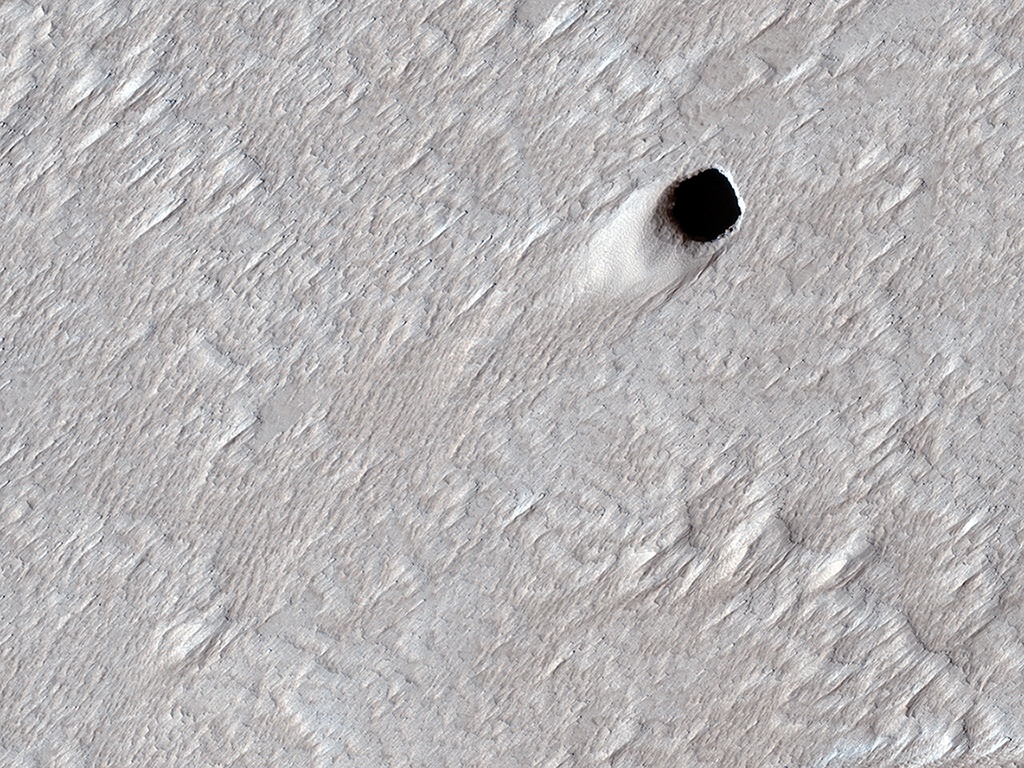
This is a collapsed ceiling of a Martian lava tube. It measures 50 meters (150 ft) across, much larger than any Earth lava tubes. Image Credit: NASA/JPL/University of Arizona
Lava tubes can be found on Earth, the Moon, and Mars. Even though Earth is larger than Mars, some incredibly large lava tubes have been found on Mars, bigger than those found on Earth. On Earth, lava tubes are usually only as large as 14–15 meters (46–49 ft) wide – and typically much narrower. In 2020, the HiRISE (High-Resolution Imaging Science Experiment) camera on NASA’s Mars Reconnaissance Orbiter (MRO) took a picture of a collapsed lava tube ceiling that is pit crater is 50 m (150 ft) across. The subsurface lava tube cave is likely larger than that.
Regular neural networks are commonly used for natural language processing and speech recognition. But CNNs or ConvNets are more often utilized for classification and computer vision tasks. CNNs can recognize patterns in images and provide image classification and object recognition to projects both large and small. For example, in a previous study, CNNs were trained to recognize Martian surface features, such as craters, and achieved accuracies of more 90%
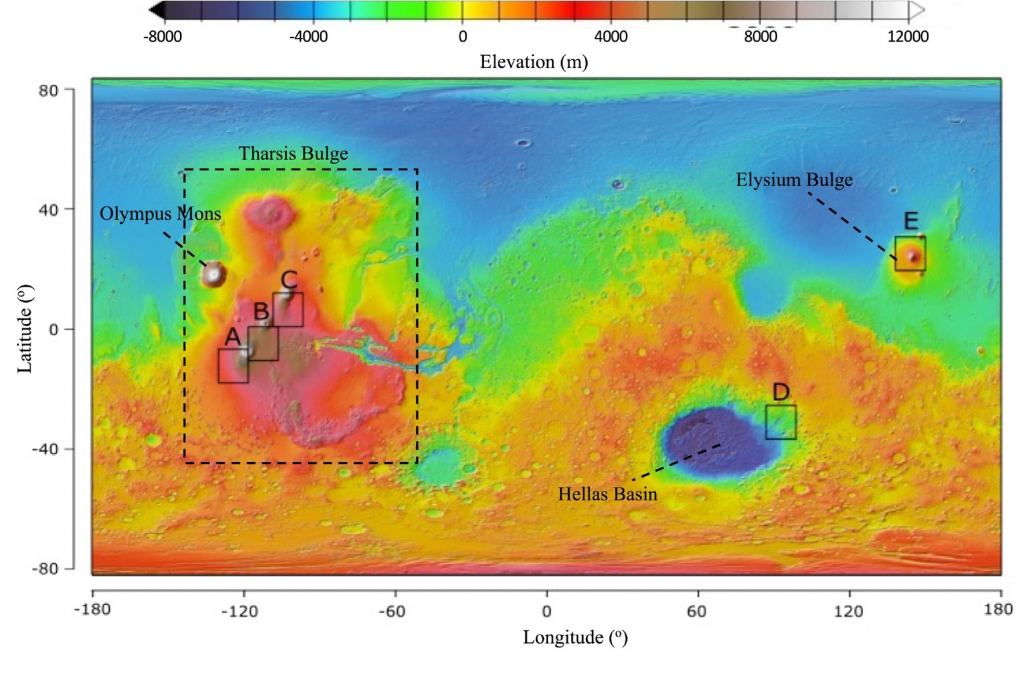
Watson and Baldini created and trained their CNN model, called CaveFinder by having it look at images from the MGC3 catalog from the Tharsis and Elysium regions on Mars, which has the highest concentrations of volcanoes.
Elevation map of Martian surface with five survey regions highlighted. The Tharsis and Elysium Bulges and the Hellas Basin are also highlighted. Map created using MOLA Shaded relief/ colorized digital elevation map from JMARS. Credit: Watson and Baldini/Icarus.
After the training period, CaveFinder achieved a test accuracy of 77%. It found four PCEs that Watson and Baldini highlighted for having specific qualities that make them interesting for further research, including one PCE nicknamed Marvin, which was the largest PCE identified, as well as another they called Emily, whose low altitude could enable surveyance by drone. Additionally, CaveFinder identified twelve regions that appear to have multiple PCEs, which the authors say be a great place to explore multiple caves with a future mission, due to the proximity and abundance of PCEs.
But the researchers say that CaveFinder needs more work before being used on a large, planet-wide database. It had a large number of false positives, and it appears to have a limited ability to identify “lone small cave types, such as skylights and pinholes.”
“CaveFinder is still not considered appropriate for detection on a planet-wide scale, due to the high number of false positive outputs requiring manual assessment,” Watson and Baldini wrote. “However, it could prove effective in smaller regions perhaps already known to contain PCEs.”
For future tests, they plan to increase the size of the training dataset used. Other ideas for improving CaveFinder’s accuracy is to use thermal imagery alongside the visible data. Higher resolution images from a future Mars orbiter would also be beneficial for CaveFinder’s increased detection and accuracy.
“Overall, this survey’s findings indicate that, with these additions, machine learning has a great potential to advance remote cave detection, which is key to future Martian exploration,” the researchers concluded.
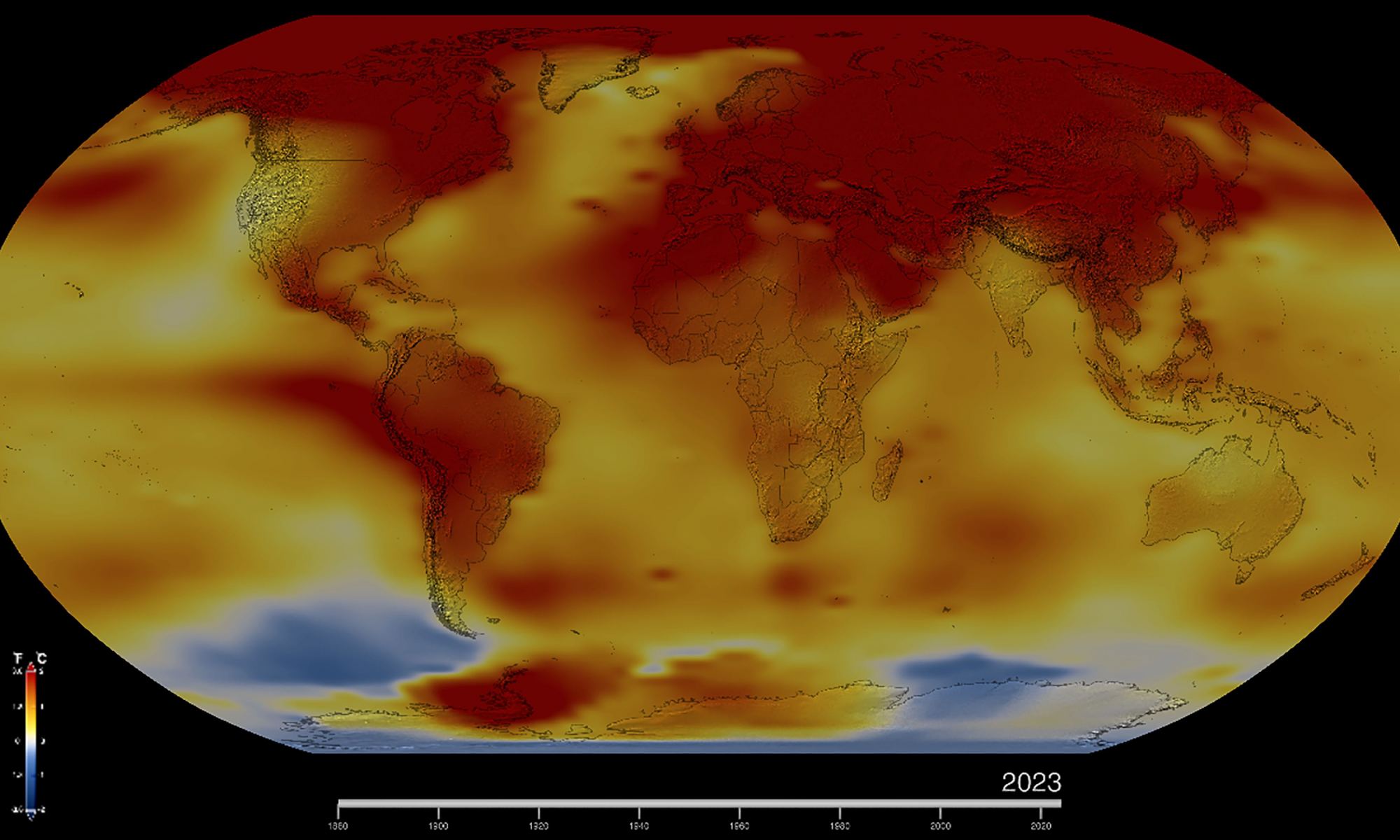
NASA Confirms that 2023 was the Hottest Year on Record
This map of Earth in 2023 shows global surface temperature anomalies, or how much warmer or cooler each region of the planet was compared to the average from 1951 to 1980. Normal temperatures are shown in white, higher-than-normal temperatures in red and orange, and lower-than-normal temperatures in blue. Image Credit: NASA SVS
NASA Confirms that 2023 was the Hottest Year on Record
After analyzing the temperature data from 2023, NASA has concluded that it was the hottest year on record. This will surprise almost nobody. If you live in one of the regions stricken by drought, forest fires, or unusually powerful weather, you don’t need NASA to confirm that the planet is warming.
NASA’s Goddard Institute for Space Studies produced the analysis that led to this conclusion. They looked at temperature anomalies rather than strictly at temperatures. Temperature anomalies show how much hotter or colder than normal it is at a specific place and time. In this case, normal means the average over a 30-year period between 1951 and 1980 for a time and place.
The analysis, which makes use of extensive satellite data, showed that 2023 was the hottest year on record. In fact, every month from June to December 2023 was the hottest month compared to the same months in previous years. Not only that, but July was the hottest month ever recorded.
This image shows the global temperature anomalies for July 2023. 3Image Credit: NASA’s Scientific Visualization Studio
How much hotter was 2023? “Global temperatures in 2023 were around 2 degrees Fahrenheit (1.1 degrees Celsius) above the average for NASA’s baseline period (1951-1980),” NASA’s Goddard Institute for Space Studies (GISS) said.
Anyone who follows news from around the world knows the world is facing more severe weather. In the USA, a mega-drought meant that parts of the Southwest suffered from a water shortage. Reservoirs were reduced to historically low levels.
In Canada, massive, numerous, and stubborn forest fires dominated the summer, with smoke moving south and enshrouding some of America’s largest cities for days. Many of those fires are still burning as zombie fires that will spring back to life after this winter.
The Donnie Creek fire of 2023 in British Columbia, Canada, was the largest-ever fire in that province. It covered over 600,000 hectares. Image Credit: BC Wildfire Service.
In Asia, a record-breaking heat wave struck India, China, Vietnam, and other countries. In India, major cities exceeded 45 Celsius, schools and other places were shutdown, and rolling blackouts, triggered by air conditioner use, made things even worse.
In the desert kingdom of Saudi Arabia, the temperatures reached 49 C in some places. In Europe, the Cerberus Heatwave brought temperatures above 40 C to many countries, including Spain, where temperatures reached 45 C.
Hundreds of millions of us faced extreme temperatures during the summer of 2023. Millions of us watched helplessly as forest fire smoke clouded our skies and damaged our lungs. Farmers struggled, and food prices rose.
But climate change isn’t just about heat, smoke, and fire. It’s also about extreme rainfall, flooding, and hurricanes. Whatever the consequences, it’s not something humanity has seen before.
“The exceptional warming that we’re experiencing is not something we’ve seen before as a species,” said Gavin Schmidt, director of GISS. “It’s driven primarily by our fossil fuel emissions, and we’re seeing the impacts in heat waves, intense rainfall, and coastal flooding.”
Most of what the Earth is going through is due to human-caused climate change. But other things still contribute to the climate, like El Nino and El Nina. Climate scientists consider all these things when trying to understand what’s happening.
This image shows how the El Niño Southern Oscillation (ENSO) affects global temperatures. There are three phases in the South Pacific’s ENSO: El Niño, La Niña, and neutral, or average. El Nino is a weakening of trade winds that blow from east to west in the South Pacific, allowing the sea surface to warm up and rise. La Nina is the opposite: the winds become stronger, and sea temperatures become cooler than normal. La Nina can help offset some of the effects of climate change, but only temporarily. Image Credit: NASA
But we have no control over El Nino. Our carbon emissions are the only thing we have control over. Vegetation and the oceans only absorb about 50% of our emissions, and the rest persists in the atmosphere.
This visualization shows the atmosphere in three dimensions and highlights the accumulation of CO2 during a single calendar year.
It’s not just Earth’s atmosphere that warms. Our oceans absorb most of the heat trapped by greenhouse gases, about 90% of it. The oceans are a gigantic heat sink, and they’ll continue to warm as the atmosphere does. That changes the biochemistry and the overall health of the oceans and also accelerates the melting of our major ice sheets.
“Just like global temperatures, ocean temperatures are on the rise,” said Josh Willis, a climate scientist at NASA’s Jet Propulsion Laboratory. “They have been rising for the last century or more, and they are not slowing down. If anything, they are speeding up.”
This image shows anomalies in the sea surface temperature. These temperatures reached new record highs in 2023. Image Credit: NASA.
The world will keep warming for the next several decades or more, no matter what changes we make today. But the future is still in play. Scientists still need as much detailed climate data as we can gather, even though we know we’re responsible for the warming world. We can still prepare for the worst of it while developing and implementing solutions.
“We are very interested in the weather and extremes of any particular year because those are the things that impact us,” said GISS Director Schmidt. “But the key difference between this decade and the ones before is that the temperatures keep rising because of our activities, principally the burning of fossil fuels.”
NASA’s results show the future we face. More heatwaves, more devastating forest fires, more pressure on agriculture and food prices, and a bleak future for some of the world’s poorest people.
But it’s not foreordained. There are solutions, and they’re being implemented. Renewable energy use is on the rise, for example, and people around the world are demanding that governments implement more changes. And while arcane scientific arguments about atmospheric chemistry and physics are not that impactful for many people, extreme heat is a much more effective alarm bell. So are the things that extreme heat brings, like flooding, fire, smoke, heat waves, rising sea levels, and higher food prices.
Let’s hope the next generations and the politicians that accompany them don’t keep pressing the snooze button like we have.
Engineers Finally Open OSIRIS-REx’s Sample Container
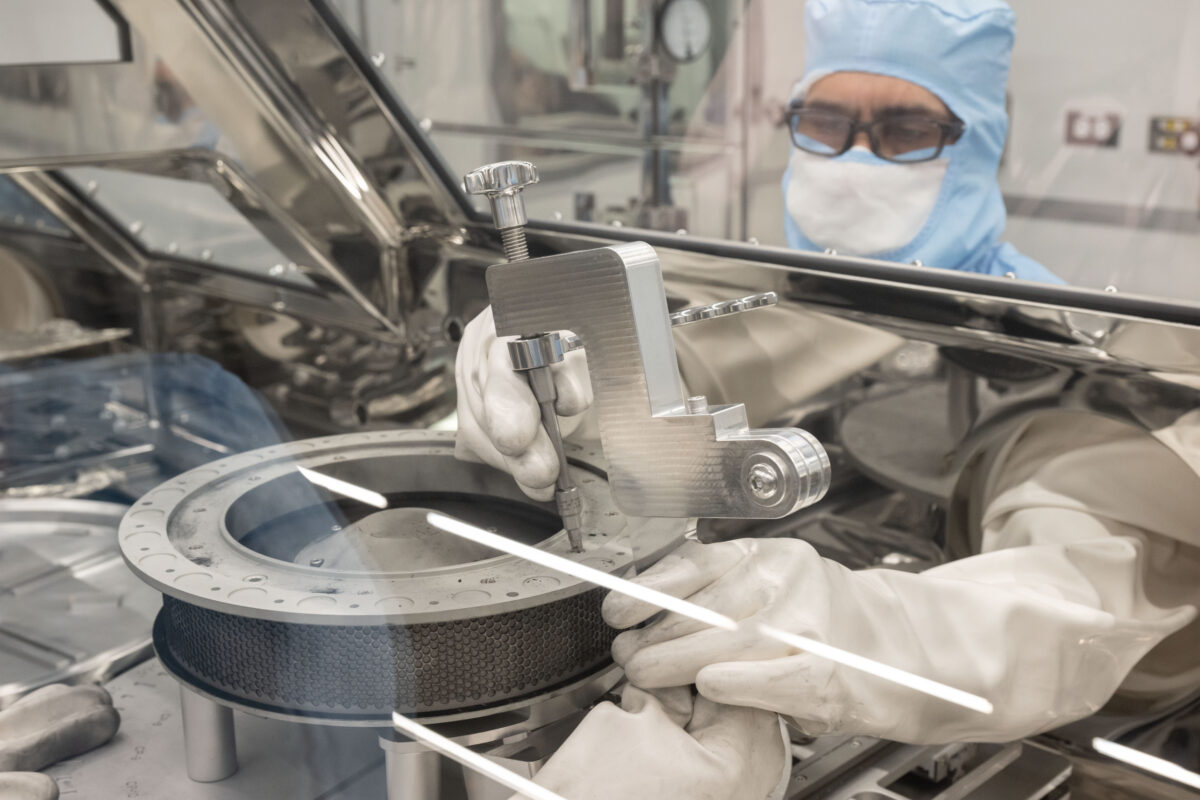
OSIRIS REx curation team attempting to remove the two stuck fasteners that are currently prohibiting the complete opening of the TAGSAM head. Photo Date: January 10, 2024. Location: Bldg. 31 - 2nd Floor - OSIRIS-REx lab. Photographer: Robert Markowitz
Engineers Finally Open OSIRIS-REx’s Sample Container
We have all been there, had that one stubborn jar of jam that we just can’t open. Maybe you grab a rubber band or run it under warm water and its an easy fix but just imagine when the jar is a module from a $1.16 billion interplanetary probe! That’s what happened to NASA engineers when they were trying to recover samples from the OSIRIS-REx module when they discovered the clamps had cold welded shut!
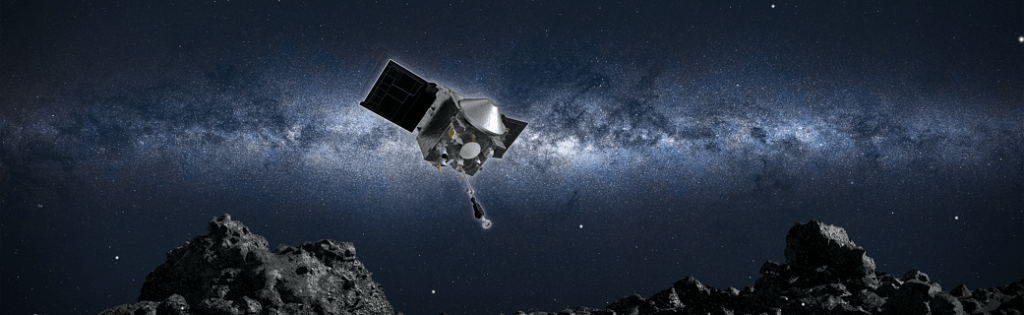
OSIRIS-REx is a NASA mission to retrieve a sample from asteroid Bennu and return it to Earth. The probe launched in September 2016 in what was a complex and audatious mission. In order to collect the samples the probe ‘kissed’ the surface at just the right trajectory and velocity so not to be destroyed and to return them, OSIRIS-REx completed a flyby manouvre of Earth and dropped them off before continuing on to a new destination. Impressive stuff.
An artist’s illustration of NASA’s OSIRIS-REx spacecraft approaching asteroid Bennu with its sampling instrument extended. Image Credit: NASA/Goddard/University of Arizona
The samples were successfully returned to Earth on 24 September 2023 having been deployed high above the Earth’s atmosphere. The capsule then gracefully floated down under a parachute to the Department of Defense’s Utah Test and Training Range. The samples that were contained within will help us to better understand how the planets formed, how life began and to improve our knowledge of asteroids and just how we might be able to defend ourselves from future potential impacts.
Having successfully completed the sample collection and recovery, it seems that getting the samples out of the capsule was destined to be the more challenging aspect. When the engineers tried to open the sample head of the Touch and Go Sample Acquisition Mechanism they quickly learned that two of the 35 fastenings had cold welded themselves shut!
Unfortunately, the team did not have any ready made tools for such a situation so they had to improvise and created their own new tool from a special non-magnetic stainless steel. If this wasn’t hard enough, the team’s challenge was exaserbated because of the lack of space in the container that the samples and the capsule were stored within. This process was a laborious one though as the team had to test and refine the tool and instrument many times to minimise risk of damage and contamination.
Success was limited as the team were only able to recover 70 grams of the asteroid sample although this was in excess of the target 60 grams. The science teams are now working with some of the samples and have hermetically sealed the rest for future studies.
Astronomers Have Mapped the Milky Way's Magnetic Fields in 3D
Our galaxy is filled with magnetic fields. They come not just from stars and planets, but from dusty stellar nurseries and the diffuse hydrogen gas of interstellar space. We’ve long known of this galactic magnetic field, but mapping it in detail has posed a challenge. Now a new study gives us a detailed 3-dimensional map of these fields, with a few surprises.
Magnetic fields don’t emit light on their own, so we can’t simply scan the sky with optical telescopes to see where they are. Instead, we must look for ways in which magnetic fields cause charged particles to emit light, or how distant light is affected by interstellar gas within the magnetic field.
For objects such as stars and planets, we mostly map their magnetic fields by charged particles. Ions can become trapped by magnetic field lines, spiraling along them as they emit light. It’s how we first mapped the magnetic field of Jupiter, and how we can study the magnetic fields of the accretion disks of black holes. But galactic magnetic fields are much weaker and diffuse. While charged particles can spiral along galactic magnetic fields, the light they emit is often too faint for us to detect. So instead we use a trick of polarized light.
Polarized light is light where its waves oscillate in a particular direction, rather than randomly in various directions. It’s often used in things like polarized sunglasses, which filter out light scattered off shiny objects, and water, which helps to eliminate glare. There are lots of things in space that emit polarized light, such as pulsars and matter within accretion disks. Radio telescopes in particular can detect the polarization of this light, which gives astronomers more information than they’d otherwise have.
One of the properties of polarized light is that different frequencies move through ionized gas at slightly different speeds. This gives a beam of polarized light and effective rotation depending on how much ionized gas it travels through. Since ionized gas is caught by magnetic fields, we can map the magnetic fields by looking at the polarization of various light sources.
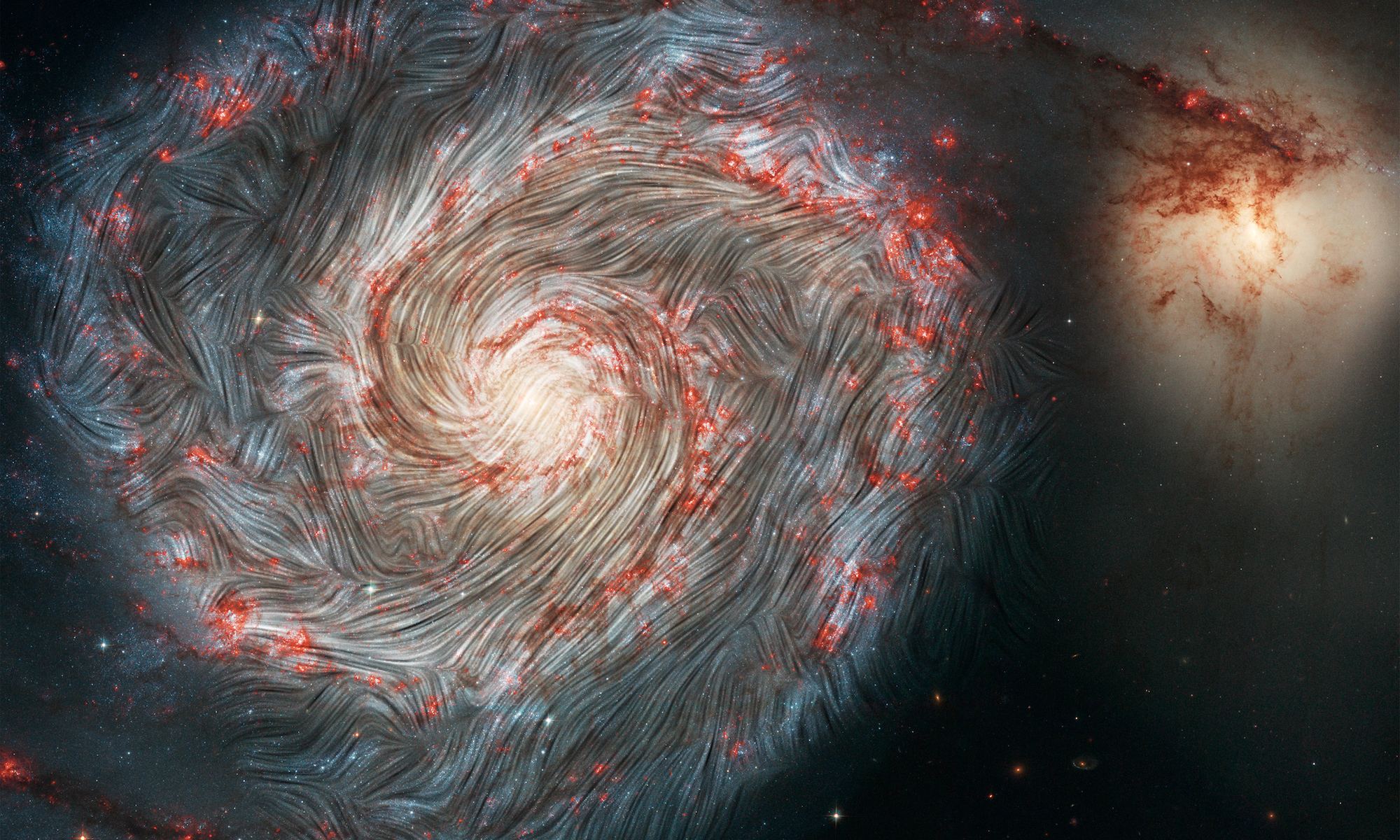
White lines show the complex structure of magnetic fields in our galaxy. Credit: Doi, et al
This has been done before, and it has given us a rough map of magnetic fields in our galaxy. What these studies found was that the magnetic fields of the Milky Way tend to fall uniformly along the disk shape of the galaxy. This new study took this one step further. Using data from the Gaia spacecraft, the team had a detailed map of the distribution of stars and nebulae in the local region of our galaxy. They then combined this with polarization observations of the Sagittarius spiral arm. Together this gave them a detailed 3-dimensional magnetic field map of the region.
They found that the magnetic fields aren’t uniform, and don’t simply lie along the galactic plane. Even within the diffuse regions of interstellar space galactic magnetic fields can take complex forms. Many of their field lines diverge significantly from the galactic plane. They also found that these galactic magnetic fields can strongly interact with stellar nurseries, penetrating them and affecting the motion of gas and dust. This could explain how some stellar nurseries have regions of star formation that could not have formed from gravity alone.
As we capture a more detailed view of magnetic fields, we will better understand how they interact with the galaxy as a whole. They not only affect the formation of new stars but could impact the structure of galaxies and how they evolve over time.
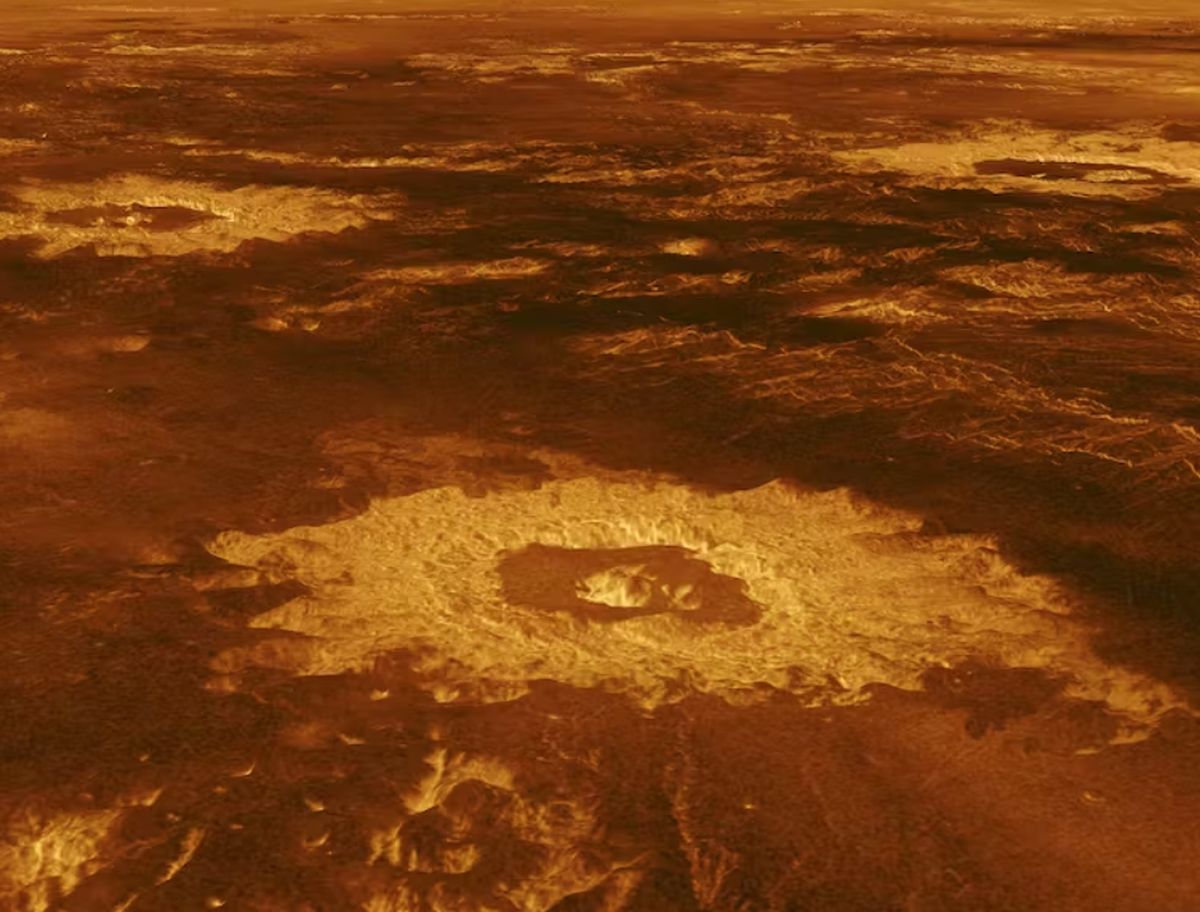
In Dante Alighieri’s epic poem The Divine Comedy, the famous words “Abandon all hope, ye who enter here” adorn the gates of hell. Interestingly enough, Dante’s vision of hell is an apt description of what conditions are like on Venus. With an average temperature of 450 °C (842 °F), atmospheric pressures 92 times that of Earth, and clouds of sulfuric acid rain to boot, Venus is the most hostile environment in the Solar System. It is little wonder why space agencies, going all the way back to the beginning of the Space Age, have had such a hard time exploring Venus’ atmosphere.
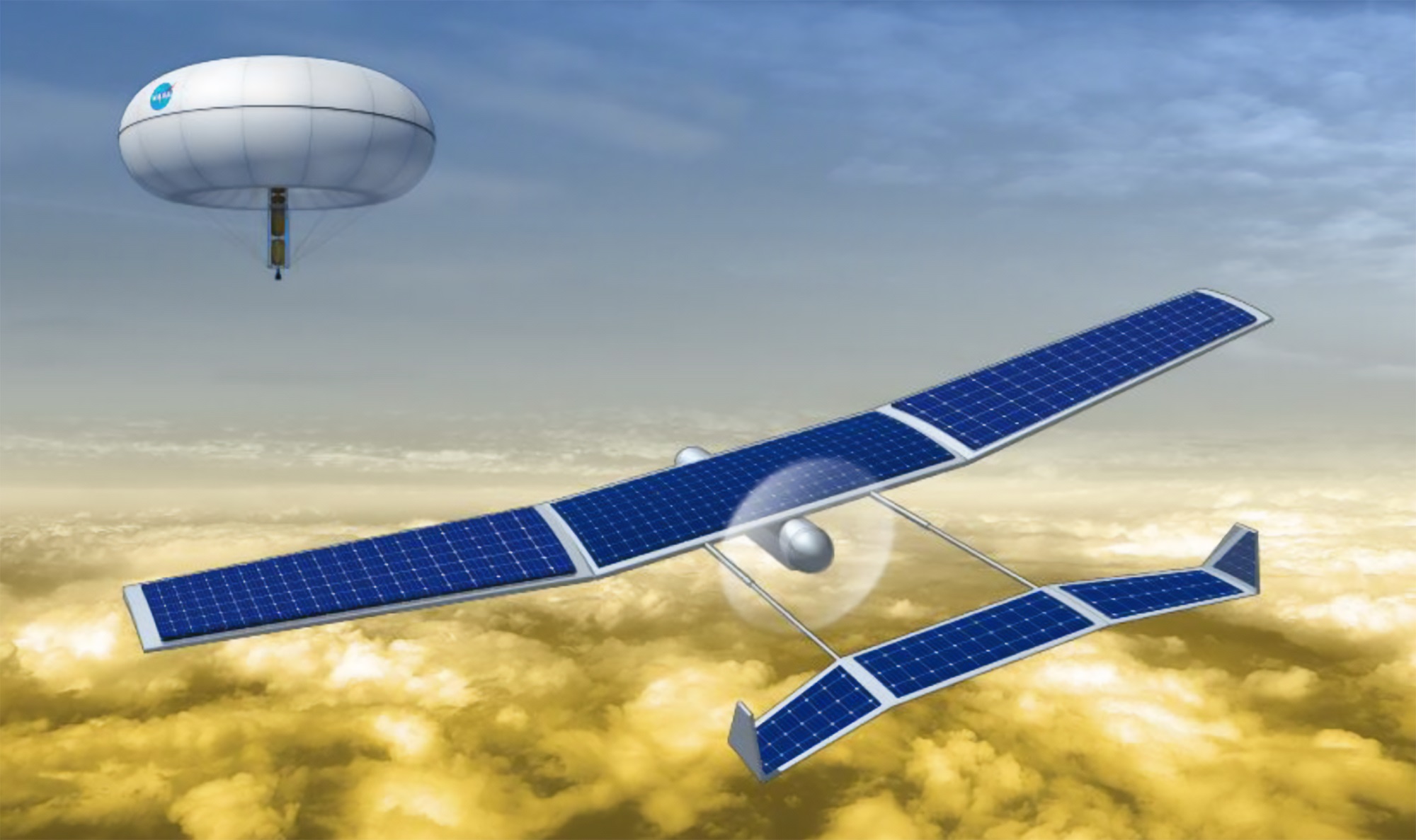
Despite that, there are many proposals for missions that could survive Venus’ hellish environment long enough to accomplish a sample return mission. One such proposal, the Sample Return from the Surface of Venus, comes from aerospace engineer and author Geoffrey Landis and his colleagues at the NASA Glenn Research Center. Their proposed concept was selected for this year’s NASA Innovative Advanced Concepts (NIAC) program. It consists of a solar-powered aircraft that would fashion propellant directly from Venus’ atmosphere and deploy a sample-return rover to the surface.
The concept of a solar-powered airplane exploring Venus is one Landis and his colleagues have been developing for roughly twenty years. In his first paper, released in 2001, “Exploring Venus by Solar Airplane,” Landis indicated how a solar-powered airplane could safely explore above the cloud deck on Venus – roughly 60 km (37 mi) above the surface. At this altitude, he claimed, the solar intensity is “comparable to or greater than terrestrial solar intensities,” and the atmospheric pressure makes flight easier than on Mars.
He also noted how Venus’s slow rotation would ensure that the airplane would be exposed to continuous sunlight and wouldn’t require stored energy for night-time flight. In a paper released in 2003, “Atmospheric Flight on Venus: A Conceptual Design,” Landis and colleagues from NASA Glenn and the University of Illinois shared specifications for a potential fleet of solar-powered aircraft. Two years later, This was followed by “Venus atmospheric exploration by solar aircraft” in 2005, where Landis and these same colleagues advocated for a mission to explore Venus’ atmosphere 50 to 75 km (31 to 47 mi) from the surface.
This region is part of Venus’ “middle atmosphere,” where temperatures range from -100 °C (-148 °F) to about 30-70°C (86-158 °F), and exposure to sulfuric acid rain would be minimal. What’s more, thanks to Venus’ slow rotational period (243 days), a solar-powered aircraft flying above the cloud deck would also be exposed to perennial daylight. As Landis told Universe Today via email:
“The middle atmosphere of Venus is nearly the most unknown region of the planet, and simply flying an airplane in this region could lead to some interesting science. Aircraft have the advantage that they have complete control over flight; you go where you want to go, not where the wind sends you. For the sample return, the airplane gives us the option to do a controlled rendezvous with the return rocket.”
In a subsequent paper released in 2004, “Robotic Exploration of the Surface and Atmosphere of Venus,” Landis presented a mission architecture that included both surface robots and a solar-powered airplane. Whereas the robots would explore the surface for 50 days (their full lifetime), the aircraft would probe Venus’ atmosphere between 100 km (62 miles) and 60 km (37 mi) above the surface – i.e., just above the cloud deck. From this point onward, Landis and his colleagues at NASA’s Glenn began to consider how advances in materials science would enable a mission to the surface.
Slide from a 2008 presentation to NASA’s STDT for Venus. Credit: Geoffrey A. Landis/NASA
In 2008, Landis and his team presented their concept to NASA’s Science and Technology Definition Team (STDT) for Venus. As they revealed, the concept would have a wingspan of 9 meters (29.5 feet) and measure 7 m (23 ft) long, with a foldable design that would allow it to fit inside an aeroshell. The aircraft would unfold once it reached Venus and would have many advantages over other airborne concepts – such as balloons and solar-powered airships. Several studies by Landis and his team followed, and the design has evolved with time.
Suffice it to say the concept has evolved considerably over the past twenty years and owes its existence to many different sources. In its latest version, which was selected for Phase I NIAC development, the aircraft relies on carbon monoxide rocket technology and generates its own propellant directly from Venus’ atmosphere. As Landis told Universe Today, this concept is still in line with the original idea and could enable the first sample-return mission from Venus:
“[T]he first paper I did, looking at Venus airplanes, was back in 2001, when we were still hoping it would be exciting to celebrate the centenary of the Wright Flyer with the first flight on another planet. The solar airplanes we looked at in the past, though, were for flight in the upper atmosphere, not in the hot near-surface atmosphere. But high-temperature electronics are being developed at NASA Glenn and elsewhere, and it was reasonable to start thinking whether it’s possible to actually fly all the way to the surface and back up.”
“Separately, we were looking at in-situ propellant production for other missions, and I started thinking, where else could we think to apply in-situ propellant production that hasn’t already been analyzed, and particularly, where could it make a real difference in an otherwise nearly impossible mission?” said Landis.“The Venus sample return stemmed from that kind of thinking.”
The aircraft would be paired with a surface element that takes advantage of high-temperature surface systems. As explored in previous articles, scientists have spent years working on concepts that could operate in Venus’ hellish environment. This has led to a diverse range of proposals that incorporate “steampunk” technology, a wind sail, or special electronic systems that can withstand the extreme heat and pressure of Venus’ atmosphere. In addition, the aircraft could also obtain atmospheric samples, perhaps settling the debate on whether there could be life in Venus’ clouds.
“For the surface sample, this would be primarily a geology and mineralogy mission,” said Landis. “An atmospheric sample would also have tremendous scientific value for astrobiology and would be a good stepping stone to the more difficult surface sample mission. The recent discovery of phosphine in the clouds of Venus makes the idea of a cloud sampler even more exciting.”
With Phase I funding secured, Landis and his colleagues are now focused on turning the conceptual mission architecture into detailed designs. As Landis explained, this will consist of a step-by-step concept of operations (CONOPS), where all the mission components will be combined to create a mass budget, produce some hard numbers, and show that it is feasible. Looking to the future, Landis and his colleagues hope that their proposal will lead to applications for aerial vehicles and exploration that go far beyond Venus and Mars:
“I do think that the next big step in planetary exploration, pioneered by the Mars ‘Insight’ helicopter, is flight. In-situ resource utilization, although talked about extensively, has yet to be attempted on any solar system body (other than Earth). Putting these together should open doors to the exploration of many planetary bodies.”
Astronomers Rule Out One Explanation for the Hubble Tension
Perhaps the greatest and most frustrating mystery in cosmology is the Hubble tension problem. Put simply, all the observational evidence we have points to a Universe that began in a hot, dense state, and then expanded at an ever-increasing rate to become the Universe we see today. Every measurement of that expansion agrees with this, but where they don’t agree is on what that rate exactly is. We can measure expansion in lots of different ways, and while they are in the same general ballpark, their uncertainties are so small now that they don’t overlap. There is no value for the Hubble parameter that falls within the uncertainty of all measurements, hence the problem.
Of course, most of the results depend on a long chain of observational results. When we measure cosmic expansion using distant supernovae, for example, the result depends on the derived distances of these supernovae as found through the cosmic distance ladder, where ever greater distances are determined based on the distance of closer things. So, from parallax we measure nearby stellar distances, use that to calibrate a type of variable star known as Cepheid variables, use Cepheids to measure galactic distances in our local group, use that to standardize the brightness of Type Ia supernovae, and finally use those supernovae to measure the most distant galaxies.
Each step in the cosmic distance ladder has a certain amount of uncertainty and this carries on to the next level. So, if one kind of distance measure happens to be really off, that would throw off our measure of cosmic expansion for any method that depends upon the distance ladder. As a result, astronomers have started to take a very close look at various ladder steps, looking for an error that would solve the tension problem. Much of that has focused on Cepheid variable stars.
Cepheid variables are a type of variable star that varies in brightness at a rate proportional to its overall luminosity. This period-luminosity relation was first discovered by Henrietta Leavitt in the 1800s, and has been central to cosmology ever since. If you measure the period of a Cepheid, you know its actual brightness and compare it to its apparent brightness to determine its distance. Cepheids were used by Edwin Hubble to discover cosmic expansion in the first place, and the method has proven quite reliable.
But over the years we found that Leavitt’s period-luminosity relation is a bit more subtle than originally thought. For example, we now know that the period of a Cepheid is slightly different based upon its metallicity and other factors. Perhaps there’s some variation in the data we’ve missed.
Comparison of Cepheid period-luminosity relations used to measure distances. The red points are from Webb and the gray points are from Hubble. Credit: NASA, ESA, CSA, J. Kang (STScI)
A few years ago Cepheid observations from Hubble were used to see if adjustments in the period-luminosity relation could account for the Hubble tension, but the results didn’t look promising. Now a study using JWST observations has been released. One advantage of JWST over Hubble is that Webb observes Cepheids in infrared light, which penetrates interstellar dust more readily. The Webb observations are also better at addressing the issue of “crowding,” where light from the Cepheid can be overwhelmed a bit by the light of stars in the same cluster. So these latest results are the most accurate Cepheid observations we have. In this new study, the team looked at more than a thousand Cepheid variables and was able to pinpoint the distance relation for Cepheids with extreme precision. From this, they proved that Cepheid variable error can’t account for the Hubble tension.
The Cepheid solution to the tension problem is ruled out at a statistical level of 8-sigma. In science, a 5-sigma result is considered “certain,” so the Hubble tension is very, very real. Whether it’s spacetime structure, dark energy, or something we haven’t yet discovered, there is something we simply don’t understand about cosmic expansion.
New research from the University of Bristol sheds light on the origin of titanium-rich basaltic magmas on the Moon.
A map of the titanium abundances of the Moon’s surface, obtained from NASA’s Clementine spacecraft; the red parts indicate extremely high concentrations compared to terrestrial rocks.
Image credit: Lunar and Planetary Institute.
Surprisingly high concentrations of the element titanium (Ti) in parts of the lunar surface have been known since NASA’s Apollo missions, back in the 1960s and 1970s, which successfully returned solidified, ancient lava samples from the Moon’s crust.
More recent mapping by orbiting satellite shows these magmas, known as high-Ti basalts, to be widespread on the Moon.
In a series of high temperature lab experiments with molten rocks and sophisticated isotopic analyses of lunar samples, University of Bristol’s Professor Tim Elliott and his colleagues identified a critical reaction that controls the composition of these distinctive magmas.
This reaction took place in the deep lunar interior some 3.5 billion years ago, involving exchange of the element iron in the magma with the element magnesium in the surrounding rocks, modifying the chemical and physical properties of the melt.
“The origin of volcanic lunar rocks is a fascinating tale involving an ‘avalanche’ of an unstable, planetary-scale crystal pile created by the cooling of a primordial magma ocean,” Professor Elliott said.
“Central to constraining this epic history is the presence of a magma type unique to the Moon, but explaining how such magmas could even have got to the surface, to be sampled by space missions, has been a troublesome problem. It is great to have resolved this dilemma.”
“Until now models have been unable to recreate magma compositions that match essential chemical and physical characteristics of the high-Ti basalts,” said Dr. Martijn Klaver, a researcher in the Institute of Mineralogy at the University of Münster.
“It has proven particularly hard to explain their low density, which allowed them to be erupted some three and a half billion years ago.”
“We managed to mimic the high-Ti basalts in the process in the lab using high-temperature experiments,” the researchers said.
“Measurements of the high-Ti basalts also revealed a distinctive isotopic composition that provides a fingerprint of the reactions reproduced by the experiments.”
“Both results clearly demonstrate how the melt-solid reaction is integral in understanding the formation of these unique magmas.”
The findings appear today in the journal Nature Geoscience.
M. Klaver et al. Titanium-rich basaltic melts on the Moon modulated by reactive flow processes. Nat. Geosci, published online January 15, 2024; doi: 10.1038/s41561-023-01362-5
Solar Electric Propulsion Systems are Just What we Need for Efficient Trips to Mars
There are many different ways to get to Mars, but there are always tradeoffs. Chemical propulsion, proven the most popular, can quickly get a spacecraft to the red planet. But they come at a high cost of bringing their fuel, thereby increasing the mission’s overall cost. Alternative propulsion technologies have been gaining traction in several deep space applications. Now, a team of scientists from Spain has preliminary studied what it would take to send a probe to Mars using entirely electric propulsion once it leaves Earth.
Electric propulsion systems have several advantages over chemical rockets. While they will never be able to be scaled up enough to lift anything heavy into orbit, once in space, they are extraordinarily efficient at moving payloads where they need to go. While a typical chemical rocket requires 70-90% of its launch mass to be used as fuel, an electric propulsion system can get by with just 10-40% of its launch mass as fuel.
The tradeoff to be made is in thrust. Electric propulsion systems typically have a thrust at least four orders of magnitude smaller than that created by chemical rockets. Meanwhile, in space, its significant impact is that electric propulsion systems are much slower. But that might not be as much of a concern for uncrewed missions.
Fraser describes the underlying mechanics of an ion engine.
So far, no one has spent the time to consider just how much difference there would be between a Mars mission driven by electric rather than chemical propulsion. The closest study was one drawn up for a visit to Mars’ moons – Phobos and Deimos – that relied entirely on electric propulsion. In that study, the researchers found that the chemical propulsion option would require 2.5 times as much mass as the electric propulsion option. That would significantly decrease the overall cost of the mission.
In this new study, the researchers focused on a trajectory that would place a 2000 kg spacecraft into a polar orbit around Mars between 300 km and 1000 km. The 2000 kg weight limit was selected as a package that could contain equivalent scientific packages to the ExoMars orbiter that ESA worked on.
With those mission constraints, the researchers considered several different types of electric propulsion systems. They came up with an additional requirement – it must operate at the upper thrust range of many electric propulsion systems. A thrust of .1 N is the minimum required to enter into orbit around Mars successfully.
Electric Drives can be used for some pretty incredible thing, as described in this video with Dr. Sonny White.
This constraint led to the selection of the BHT-6000 as the mission’s primary propulsion system. It’s a Hall Effect thruster that operates with between 2 and 6kW of power and can use relatively common electrical propulsion propellants such as Xenon and Krypton. With this selection of propulsion, it was time to get to every astrodynamist’s favorite activity – modeling.
The researchers used a multi-body model to map out the gravitational impact of their selected trajectory. Then, they ran simulations of a mission with a standard chemical propellant and the BHT-6000. What they found seemed in line with general expectations of the advantages of electric propulsion.
In terms of speed, the chemical rocket was faster, but not egregiously so. A chemical rocket could make the journey in a little under a year, while a BHT-6000-powered mission would take approximately 3.2 years from launch. However, the weight of the chemical propulsion system would be 2.4 times that of the electric propulsion system. Even at a relatively conservative launch cost of $10,000 / kg, that would put the cost saving of an electric propulsion system at almost $30 million over the chemical alternative. All at the cost of a few more years of travel time to get the mission on station.
That is a tradeoff many space exploration agencies would gladly pay due to constrained budgets. But, so far, this is only a model as there is no planned deep space mission that would use this electric propulsion method as its primary propulsion system, though a few deep space missions, such as Hayabusa-2, already have. As the technology advances, though, it’s becoming more and more likely that future deep space missions, especially unmanned ones, will go to Mars.
There are Mysteries at Venus. It’s Time for an Astrobiology Mission
When scientists detected phosphine in Venus’ atmosphere in 2020, it triggered renewed, animated discussions about Venus and its potential habitability. It would be weird if the detection didn’t generate interest since phosphine is a potential biomarker. So people were understandably curious. Unfortunately, further study couldn’t confirm its presence.
But even without phosphine, Venus’ atmosphere is full of chemical intrigue that hints at biological processes. Is it time to send an astrobiology mission to our hellish sister planet?
While the phosphine discussion petered out pretty quickly, there are other, more long-lived indications that Venus’ atmosphere contains chemical anomalies, some of which might relate to life. Some of the atmospheric gases appear to be out of thermodynamic equilibrium, for example. Adding to the complexity, scientists aren’t certain what the composition of large particles in the lower atmosphere is.
The authors of a new paper illustrate why Venus captures our chemical curiosity and suggest that it’s time for an astrobiological mission to satisfy it.
“Scientists have been speculating on Venus as a habitable world for over half a century,” the authors write, “based on the Earth-like temperature and pressure in Venus’ clouds at 48–60 km above the surface.”
Most space-interested people know that Venus’ atmosphere is extremely dense ant hot. We also know that it’s dominated by carbon dioxide, that its other main component is nitrogen, and that it supports dense clouds of sulfuric acid. Other chemicals are present in only tiny, trace amounts.
There’s not much else to Venus’ atmosphere beyond CO2 and a small component of nitrogen. The trace elements add up to less than one percent of the atmosphere. Image Credit: By Junkcharts – Own work, CC BY-SA 3.0, https://commons.wikimedia.org/w/index.php?curid=31595105
The atmospheric region between 48 to 60 km above the surface is particularly interesting. At that altitude, both the pressure and the temperature approach near Earth-like levels. Between about 52.5 km and 54 km, the temperature is between 20 °C and 37 °C.) At about 49.5 km above the surface, the pressure is the same as at Earth’s sea level. There’s no way that liquid water could be present on Venus’ surface, but in the atmosphere it’s possible.
That’s the backdrop for considering Venus’ potential habitability.
But there are ample chemical considerations, too, and in their paper, the authors outline one long-standing mystery in the planet’s atmosphere.
“In this paper, we review and summarize Venus’ long-lasting, unexplained atmospheric observations, which have been acquired over the span of the last half-century,” they write.
A lot of the mystery around Venus concerns the so-called “unknown absorber(s).” As far back as the 1920s, ultraviolet observations showed unusual high-contrast features that move in conjunction with Venus’ upper cloud deck’s four-day rotation. Something is absorbing the UV light. “Much effort has gone into attempting to identify the substance(s) responsible for the absorption between 320–400 nm, but no proposed candidate satisfies all of the observational constraints, leading to the oft-used descriptive term ‘unknown UV absorber,'” the authors write.
Researchers have made a prolonged effort to understand what the absorber or absorbers might be, and some have made progress. Research has shown that sulphur allotropes and sulphur compounds could be responsible, and researchers have uncovered new pathways for their formation in Venus’ atmosphere. But these pathways are the result of simulations, not exploration. Not everyone agrees with these findings. There’s no consensus.
“Despite decades of effort and observations by two orbiting spacecraft in the 21st century (Venus Express by ESA and Akatsuki by JAXA), none of the proposed candidate molecules have been found to entirely fit the observational data,” the authors explain. The candidates either don’t match the profile well, or they’re not abundant enough. Some of the proposed candidates aren’t stable, either.
But it’s critical that we figure out what it is. “The unknown absorber is remarkably efficient, capturing more than 50% of the solar energy reaching Venus, with consequent effects on atmospheric structure and dynamics,” write the authors. Though the mystery persists, it’s a huge missing piece that stymies our efforts to understand the planet.
Some researchers propose that the UV absorber is a sign of cloud-based biological activity. “The spectral characteristics of the Venus clouds, including the strong UV absorption, are consistent with the spectrum of certain types of terrestrial bacteria,” the authors explain.
A composite image of the planet Venus as seen by the Japanese probe Akatsuki. The clouds of Venus could have environmental conditions conducive to microbial life. Credit: JAXA/Institute of Space and Astronautical Science
Another of the mysteries concerns lower clouds. A subset of cloud particles larger than 7 µm is unknown. Adding to the mystery is that some of them aren’t round. We know this from NASA’s Pioneer Venus mission. Since the particles, called Mode 3 particles, are non-spherical, they can’t be liquid droplets. “The nature and composition of the Mode 3 particles is debated with data presently in hand,” the authors write, making it clear that we need more data from a modern mission.
Some have proposed that the particles could be sulfuric acid, but the authors say data rules that out. If they’re not sulfuric acid, that works in favour of the idea that life could persist in the clouds. “This result could indicate unknown chemistry and is intriguing with regard to the possible presence of ‘life as we know it,’ which cannot withstand a concentrated sulfuric acid environment,” the authors explain.
It should be noted, however, that not all scientists agree that the large particles even exist and that calibration errors could be responsible for their detection instead.
The authors outline other reasons why only a biological mission to Venus can solve these mysteries. In-situ measurements from the Venera program and the VeGa balloons suggested that the atmosphere hosted non-volatile compounds necessary for life. Life as we know it requires metals, including iron. Venera found iron, while VeGa didn’t. More mystery waiting to be solved.
There are other unexplained components in Venus’ atmosphere. There are trace gases with abundance profiles that scientists can’t explain. Venera and Pioneer also found oxygen there. Nobody knows where it came from, and it’s a subject of frequent discussion. Other chemical detections add to the mystery and complexity.
The maddening thing about studying Venus from afar is that many of the observations could be explained by either biotic or abiotic processes. That’s why we need a biological mission.
NASA’s upcoming DAVINCI mission will send an orbiter and an atmospheric probe to Venus sometime in the 2030s. Image Credit: NASA
“The habitability of the Venusian clouds should also be explored by new in situ missions,” the author explains. Lots of scientists agree with them, including renowned planetary scientist Sara Seager. In fact, Seager goes even further, suggesting that a sample-return mission is needed.
There are missions to Venus coming in the future. NASA’s VERITAS mission and DAVINCI mission will both head to Venus, but not for several more years. DAVINCI will send a probe into Venus’s atmosphere for in situ observations, while VERITAS will map the surface in more detail.
In the meantime, the data we have is all the data scientists have to work with. While scientists are resourceful and determined, that’s not enough.
Only a mission to Venus that’s solely focused on biology and chemistry can solve the planet’s mysteries.
The Meteorites That Made Earth Were Filled With Water
According to the most widely accepted scientific theory, our Solar System formed from a nebula of dust and gas roughly 4.56 billion years ago (aka. Nebula Theory). It began when the nebula experienced gravitational collapse at the center, fusing material under tremendous pressure to create the Sun. Over time, the remaining material fell into an extended disk around the Sun, gradually accreting to form planetesimals that grew larger with time. These planetesimals eventually experienced hydrostatic equilibrium, collapsing into spherical bodies to create Earth and its companions.
Based on modern observations and simulations, researchers have been trying to understand what conditions were like when these planetesimals formed. In a new study, geologists from the California Institute of Technology (Caltech) combined meteorite data with thermodynamic modeling to better understand what went into these bodies from which Earth and the other inner planets formed. According to their results, the earliest planetesimals have formed in the presence of water, which is inconsistent with current astrophysical models of the early Solar System.
The research was conducted in the laboratory of Paul Asimow, the Eleanor and John R. McMillan Professor of Geology and Geochemistry at Caltech. The team was led by assistant professor Damanveer Grewal, the leader of the CosmoGeo Lab at Arizona State University (ASU) and a former postdoctoral scholar with the Division of Geological and Planetary Sciences at Caltech. Grewal and Asimow were joined by planetary scientists from the Massachusetts Institute of Technology (MIT), the University of California Los Angeles (UCLA), and Rice University.
Sample from a rare meteorite family revealing that its parent planetesimal had a layered structure with a molten core and solid crust (similar to Earth). Credit: Carl Agee, Institute of Meteoritics UNM/MIT
Grewal and his colleagues specialize in studying the chemical signatures of iron meteorites to gather information about the early Solar System. These meteorites are remnants of the metallic cores of the first planetesimals that did not accrete to form a planet and continue to orbit within our Solar System today. Over many eons, some of these objects fell into Earth’s gravity well and ultimately crashed to the surface. The chemical composition of these meteorites is of particular interest since it reveals a great deal about the environments in which they formed.
For one thing, the composition of planetesimals can reveal whether they (and Earth) formed closer to or farther away from the Sun. If the former scenario were the case, cooler conditions would have allowed Earth to retain water ice as a building block. If the latter is correct, Earth would have formed dry and obtained its water by some other means later on, which is what current astrophysical models suggest. According to these models, water was delivered to the inner Solar System via comets and asteroids billions of years ago, a period known as the Late Heavy Bombardment.
While water is no longer present in these meteorites, scientists can infer its existence from the presence of other elements. These include iron oxide (FeO), which occurs when iron is oxidization by exposure to water. A sufficient excess of water will drive the process further, creating ferric oxide (Fe2O3) and ferric oxyhydroxide, or FeO(OH) – the ingredients of rust. While the earliest planetesimals would have lost all traces of iron oxide long ago, Grewal and his team were able to determine how much was present by examining the metallic nickel, cobalt, and iron contents of these meteorites.
These three elements should be present in roughly equal ratios relative to other materials in the meteorite, which means that any “missing” iron would have been depleted through oxidation. As Asimow explained in a Caltech news release:
“Iron meteorites have been somewhat neglected by the planet-formation community, but they constitute rich stores of information about the earliest period of Solar System history, once you work out how to read the signals. The difference between what we measured in the inner solar system meteorites and what we expected implies an oxygen activity about 10,000 times higher.”
Artist concept of Earth during the Late Heavy Bombardment period.
Credit: NASA’s Goddard Space Flight Center.
The team’s results indicate that meteorites believed to have originated in the inner Solar System had roughly the same amount of missing iron as meteorites from the outer Solar System. This suggests that both groups formed in a part of the Solar System where conditions were cool enough for water. It further implies that planets accreted water from the beginning, which could have profound implications for theories of how life emerged on Earth. “If water was present in the early building blocks of our planet, other important elements like carbon and nitrogen were likely present as well,” said Grewal. “The ingredients for life may have been present in the seeds of rocky planets right from the start.”
This represents a significant challenge for our current models for how the Solar System formed and evolved, which could indicate that conditions in the early inner Solar System were much cooler than previously thought. The results could also mean that Earth and its fellow rocky planets formed farther from the Sun and gradually migrated to their current orbits. However, as Asimow acknowledged, there is a degree of uncertainty when it comes to the study of ancient planetesimals, which means the results may not contradict current astrophysical models:
“However, the method only detects water that was used up in oxidizing iron. It is not sensitive to excess water that might go on to form the ocean. So, the conclusions of this study are consistent with Earth accretion models that call for late addition of even more water-rich material.”
NASA stelt "opvolger van de Concorde" voor: vliegen door de geluidsmuur, zonder storende luide knal
NASA stelt "opvolger van de Concorde" voor: vliegen door de geluidsmuur, zonder storende luide knal
Artikel door Wim De Maeseneer
De X-59 is vanavond voor de eerste keer voorgesteld aan het grote publiek tijdens een officiële ceremonie. Het was vooral uitkijken naar het moment dat het nieuwe, supersonische vliegtuig uit de hangar reed van Lockheed Martin in Palmdale in Californië.
De X-59 is 30 meter lang, 9 meter breed en kan tot 1.500 kilometer per uur vliegen, op een hoogte van 16,7 kilometer. De lange neus heeft tot gevolg dat de piloot geen zicht heeft op de voorkant van het vliegtuig.
De voorruit van de cockpit is dan ook vervangen door een scherm. Daarop wordt het beeld getoond van een camera die aan de neus hangt samen met grafische elementen.
NASA stelt "opvolger van de Concorde" voor: vliegen door de geluidsmuur, zonder storende luide knal
De X-59 is nog een prototype. Het is dus niet bedoeld om er ooit echt passagiers mee te vervoeren. Het vliegtuig moet bewijzen dat sneller vliegen dan het geluid ook kan zonder de luide knallen die daarbij horen.
Als een vliegtuig sneller vliegt dan het geluid (zo'n 1.200 kilometer per uur) dan haalt het de geluidsgolven in die het zelf produceert. De golven kunnen zich niet meer verspreiden en verzamelen zich voor het vliegtuig, tot het moment dat er een schokgolf en bijhorende luide knal ontstaat.
De oplossing zit in de neus. De X-59 heeft een lange, scherpe neus van wel 11 meter lang. Die zou de knal zodanig verminderen dat je aan de grond enkel nog het geluid van een dichtslaande autodeur hoort.
Het is nog wachten op de eerste testvlucht, maar eens die achter de rug is, wil NASA het vliegtuig over woonwijken laten vliegen om te onderzoeken of inwoners het geluid effectief als minder storend ervaren. Dat zou kunnen helpen om ooit weer supersonische passagiersvliegtuigen over bewoonde gebieden te laten vliegen, iets wat momenteel in veel landen verboden is.
Brussel - New York in minder dan 4 uur?
Sneller vliegen dan het geluid is iets waar luchtvaartmaatschappijen en reizigers wel vaker van dromen. Een vlucht van Brussel naar New York zou geen 7 of 8 uur meer duren, maar 4 uur of zelfs minder. Toch is er tot op vandaag slechts één commercieel passagiersvliegtuig die dat ooit gekund heeft: de legendarische Concorde.
Die vloog sinds 1976, kon twee keer sneller vliegen dan het geluid, maar maakte nooit winst. De vluchten waren enorm duur en door de luide knallen mocht de Concorde ook enkel boven de zee supersonisch vliegen. Er werden uiteindelijk maar 20 toestellen gebouwd, waarvan een kwart prototypes.
De doodsteek voor Concorde kwam op 25 juli 2000, toen een toestel van Air France met 100 passagiers crashte tijdens het opstijgen.
Sindsdien is een opvolger voor de Concorde al vaak aangekondigd en even vaak zijn de plannen weer in de koelkast beland. Toch is het iets waar verschillende vliegtuigfabrikanten nog steeds mee bezig zijn. Misschien kan de X-59 een doorbraak betekenen.
Op 25 juli 2000 vatte een Concorde van Air France vuur tijdens het opstijgen in Parijs. Alle 100 passagiers en 9 bemanningsleden kwamen om het leven
Beste bezoeker, Heb je zelf al ooit een vreemde waarneming gedaan, laat dit dan even weten via email aan Frederick Delaere opwww.ufomeldpunt.be. Deze onderzoekers behandelen jouw melding in volledige anonimiteit en met alle respect voor jouw privacy. Ze zijn kritisch, objectief maar open minded aangelegd en zullen jou steeds een verklaring geven voor jouw waarneming! DUS AARZEL NIET, ALS JE EEN ANTWOORD OP JOUW VRAGEN WENST, CONTACTEER FREDERICK. BIJ VOORBAAT DANK...
Druk op onderstaande knop om je bestand , jouw artikel naar mij te verzenden. INDIEN HET DE MOEITE WAARD IS, PLAATS IK HET OP DE BLOG ONDER DIVERSEN MET JOUW NAAM...
Druk op onderstaande knop om een berichtje achter te laten in mijn gastenboek
Alvast bedankt voor al jouw bezoekjes en jouw reacties. Nog een prettige dag verder!!!
Over mijzelf
Ik ben Pieter, en gebruik soms ook wel de schuilnaam Peter2011.
Ik ben een man en woon in Linter (België) en mijn beroep is Ik ben op rust..
Ik ben geboren op 18/10/1950 en ben nu dus 75 jaar jong.
Mijn hobby's zijn: Ufologie en andere esoterische onderwerpen.
Op deze blog vind je onder artikels, werk van mezelf. Mijn dank gaat ook naar André, Ingrid, Oliver, Paul, Vincent, Georges Filer en MUFON voor de bijdragen voor de verschillende categorieën...
Veel leesplezier en geef je mening over deze blog.