The purpose of this blog is the creation of an open, international, independent and free forum, where every UFO-researcher can publish the results of his/her research. The languagues, used for this blog, are Dutch, English and French.You can find the articles of a collegue by selecting his category. Each author stays resposable for the continue of his articles. As blogmaster I have the right to refuse an addition or an article, when it attacks other collegues or UFO-groupes.
Druk op onderstaande knop om te reageren in mijn forum
Zoeken in blog
Deze blog is opgedragen aan mijn overleden echtgenote Lucienne.
In 2012 verloor ze haar moedige strijd tegen kanker!
In 2011 startte ik deze blog, omdat ik niet mocht stoppen met mijn UFO-onderzoek.
BEDANKT!!!
Een interessant adres?
UFO'S of UAP'S, ASTRONOMIE, RUIMTEVAART, ARCHEOLOGIE, OUDHEIDKUNDE, SF-SNUFJES EN ANDERE ESOTERISCHE WETENSCHAPPEN - DE ALLERLAATSTE NIEUWTJES
UFO's of UAP'S in België en de rest van de wereld Ontdek de Fascinerende Wereld van UFO's en UAP's: Jouw Bron voor Onthullende Informatie!
Ben jij ook gefascineerd door het onbekende? Wil je meer weten over UFO's en UAP's, niet alleen in België, maar over de hele wereld? Dan ben je op de juiste plek!
België: Het Kloppend Hart van UFO-onderzoek
In België is BUFON (Belgisch UFO-Netwerk) dé autoriteit op het gebied van UFO-onderzoek. Voor betrouwbare en objectieve informatie over deze intrigerende fenomenen, bezoek je zeker onze Facebook-pagina en deze blog. Maar dat is nog niet alles! Ontdek ook het Belgisch UFO-meldpunt en Caelestia, twee organisaties die diepgaand onderzoek verrichten, al zijn ze soms kritisch of sceptisch.
Nederland: Een Schat aan Informatie
Voor onze Nederlandse buren is er de schitterende website www.ufowijzer.nl, beheerd door Paul Harmans. Deze site biedt een schat aan informatie en artikelen die je niet wilt missen!
Internationaal: MUFON - De Wereldwijde Autoriteit
Neem ook een kijkje bij MUFON (Mutual UFO Network Inc.), een gerenommeerde Amerikaanse UFO-vereniging met afdelingen in de VS en wereldwijd. MUFON is toegewijd aan de wetenschappelijke en analytische studie van het UFO-fenomeen, en hun maandelijkse tijdschrift, The MUFON UFO-Journal, is een must-read voor elke UFO-enthousiasteling. Bezoek hun website op www.mufon.com voor meer informatie.
Samenwerking en Toekomstvisie
Sinds 1 februari 2020 is Pieter niet alleen ex-president van BUFON, maar ook de voormalige nationale directeur van MUFON in Vlaanderen en Nederland. Dit creëert een sterke samenwerking met de Franse MUFON Reseau MUFON/EUROP, wat ons in staat stelt om nog meer waardevolle inzichten te delen.
Let op: Nepprofielen en Nieuwe Groeperingen
Pas op voor een nieuwe groepering die zich ook BUFON noemt, maar geen enkele connectie heeft met onze gevestigde organisatie. Hoewel zij de naam geregistreerd hebben, kunnen ze het rijke verleden en de expertise van onze groep niet evenaren. We wensen hen veel succes, maar we blijven de autoriteit in UFO-onderzoek!
Blijf Op De Hoogte!
Wil jij de laatste nieuwtjes over UFO's, ruimtevaart, archeologie, en meer? Volg ons dan en duik samen met ons in de fascinerende wereld van het onbekende! Sluit je aan bij de gemeenschap van nieuwsgierige geesten die net als jij verlangen naar antwoorden en avonturen in de sterren!
Heb je vragen of wil je meer weten? Aarzel dan niet om contact met ons op te nemen! Samen ontrafelen we het mysterie van de lucht en daarbuiten.
12-01-2024
Record-Breaking Fast Radio Burst Localized to Extremely Distant Galaxy Group
Record-Breaking Fast Radio Burst Localized to Extremely Distant Galaxy Group
A fast radio burst event called FRB 20220610A flashed in what seems like an unlikely place: a collection of at least seven galaxies that existed when the Universe was only 5 billion years old. The large majority of previous fast radio bursts have been found in isolated galaxies.
This Hubble image shows the host galaxy of the exceptionally powerful fast radio burst FRB 20220610A.
Image credit: NASA / ESA / STScI / Alexa Gordon, Northwestern University.
FRB 20220610A was first detected on June 10, 2022, by the Australian Square Kilometer Array Pathfinder (ASKAP) radio telescope in Western Australia.
ESO’s Very Large Telescope confirmed that the FRB came from a distant place. The FRB was four times more energetic than closer FRBs.
“It required Hubble’s keen sharpness and sensitivity to pinpoint exactly where the FRB came from,” said Dr. Alexa Gordon, an astronomer at Northwestern University.
“Without Hubble’s imaging, it would still remain a mystery as to whether this was originating from one monolithic galaxy or from some type of interacting system.”
“It’s these types of environments — these weird ones — that are driving us toward better understanding the mystery of FRBs.”
Astronomers used the Hubble Space Telescope to trace a fast radio burst back to a compact group of at least seven galaxies.
Space Telescope Science Institute
Hubble’s crisp images suggest FRB 20220610A originated in an environment where there may be as many as seven galaxies on a possible path to merging, which would also be very significant.
“We are ultimately trying to answer the questions: What causes them? What are their progenitors and what are their origins?” said Northwestern University astronomer Wen-fai Fong.
“The Hubble observations provide a spectacular view of the surprising types of environments that give rise to these mysterious events.”
Despite hundreds of detected FRBs, their progenitors are uncertain; one leading candidate is magnetars.
They have a magnetic field that is so strong that, if a magnetar was located halfway between Earth and the Moon, it would erase the magnetic strip on everyone’s credit card in the world.
Much worse yet, if an astronaut traveled within a few hundred miles of the magnetar, they would effectively be dissolved, because every atom in their body would be disrupted.
Possible mechanisms involve some kind of jarring starquake, or alternatively, an explosion caused when a magnetar’s twisting magnetic field lines snap and reconnect.
A similar phenomenon happens on the Sun, causing solar flares, but a magnetar’s field is a trillion times stronger than the Sun’s magnetosphere.
The snapping would generate an FRB’s flash, or might make a shock wave that incinerates surrounding dust and heats gas into plasma.
There could be several flavors of magnetars. In one case, it could be an exploding object orbiting a black hole surrounded by a disk of material.
Another alternative is a pair of orbiting neutron stars whose magnetospheres periodically interact, creating a cavity where eruptions can take place.
It’s estimated that magnetars are active for about 10,000 years before settling down, so they would be expected to be found where a firestorm of star birth is taking place. But this doesn’t seem to be the case for all magnetars.
In the near future, FRB experiments will increase their sensitivity, leading to an unprecedented rate in the number of FRBs detected at these distances.
“We just need to keep finding more of these FRBs, both nearby and far away, and in all these different types of environments,” Dr. Gordon said.
The astronomers presented the findings at AAS243, the 243rd meeting of the American Astronomical Society in New Orleans, Louisiana, the United States.
Alexa Gordon et al. 2024. Revealing the Environment of the Most Distant FRB with the Hubble Space Telescope. AAS243, abstract #3679
Komen deze voorspellingen van Stephen Hawking daadwerkelijk uit? Stephen Hawking (1942-2018) stond bekend om zijn werk op het gebied van zwarte gaten en de algemene relativiteitstheorie. Maar de beroemde natuurkundige stapte vaak buiten zijn eigen onderzoeksveld en gebruikte zijn erkenning om te benadrukken wat hij zag als de grote uitdagingen en existentiële bedreigingen voor de mensheid in de komende decennia. Variërend van onderwerpen als buitenaardse wezens tot het einde van de wereld, haalden zijn uitspraken de krantenkoppen en bleken ze soms controversieel.
Nieuwsgierig? Lees hieronder enkele van zijn beroemdste voorspellingen.
De aarde verlaten Al tientallen jaren vertelt de theoretische natuurkundige de mensen dat ze moeten beginnen met het proces om zich permanent op andere planeten te vestigen.
De aarde verlaten Hawking beweerde dat de mensheid uiteindelijk het slachtoffer zou worden van een ramp die zo groot was dat we zouden uitsterven, misschien wel eerder vroeger dan later.
De aarde verlaten In 2016 vertelde hij de BBC het volgende: "Hoewel de kans op een ramp voor de planeet Aarde in een bepaald jaar vrij klein kan zijn, wordt het in de loop van de tijd steeds groter en wordt het een bijna zekerheid in de komende duizend of 10.000 jaar.
Andere planeten en zonnestelsels koloniseren Om het voortbestaan van de mensheid te garanderen, geloofde Hawking dat we andere planeten en zonnestelsels zouden moeten koloniseren.
Andere planeten en zonnestelsels koloniseren "Verspreiding is misschien het enige dat ons van onszelf redt. Ik ben ervan overtuigd dat de mens de aarde moet verlaten", zei hij in 2017 op een Noors wetenschaps- en kunstenfestival.
De opkomst van kunstmatige intelligentie Hawking zag de kansen van de vooruitgang op het gebied van kunstmatige intelligentie, maar waarschuwde ook voor de gevaren.
De opkomst van kunstmatige intelligentie In 2014 vertelde hij de BBC dat "de ontwikkeling van volledige kunstmatige intelligentie het einde van het menselijk ras zou kunnen betekenen".
De opkomst van kunstmatige intelligentie Hawking geloofde dat de kunstmatige basisintelligentie die tot nu toe was ontwikkeld al heel nuttig was gebleken. De technologie die hij gebruikte om te communiceren bevatte bijvoorbeeld een basisvorm van AI.
De opkomst van kunstmatige intelligentie Maar Hawking vreesde de gevolgen van geavanceerde vormen van machine-intelligentie die mensen zouden kunnen evenaren of overtreffen.
Genbewerking In zijn postume verzameling artikelen en essays 'Brief Answers to the Big Questions' voorspelde Hawking dat genetische manipulatietechnieken zullen leiden tot een ras van "supermensen".
Genbewerking "Ik ben er zeker van dat mensen in de loop van deze eeuw zullen ontdekken hoe ze zowel intelligentie als instincten zoals agressie kunnen veranderen," schreef hij.
Genbewerking "Zodra zulke supermensen verschijnen, zullen er aanzienlijke politieke problemen zijn met niet-verbeterde mensen, die niet in staat zullen zijn om te concurreren," schreef hij. "Vermoedelijk zullen ze uitsterven of onbelangrijk worden. In plaats daarvan zal er een ras zijn van zelfontwerpende wezens die zich steeds sneller verbeteren."
De grootste bedreiging voor de aarde In hetzelfde boek voorspelde Hawking dat de grootste bedreiging voor de aarde een botsing met een asteroïde is, net zoals de asteroïde die de dinosauriërs doodde.
De grootste bedreiging voor de aarde Daar hebben we echter "geen verdediging" tegen, schreef Hawking. Aan de andere kant zag hij de opwarming van de aarde als een meer directe bedreiging.
Klimaatverandering "Trump's actie [het terugtrekken uit het Akkoord van Parijs] kan de aarde over de rand duwen, om te worden zoals Venus, met een temperatuur van 250 graden en zwavelzuurregens," vertelde Hawking aan de BBC.
Klimaatverandering De Intergouvernementele Werkgroep inzake klimaatverandering (IPCC) van de VN waarschuwt ook voor het potentiële risico op het bereiken van omslagpunten in het klimaat, naarmate de temperaturen stijgen.
De aarde zal in een vuurbal veranderen Hawking theoretiseerde dat de planeet tegen 2600 in een gigantische vuurbal zou veranderen door overbevolking en energieverbruik. Dit zou de aarde onbewoonbaar maken.
De aarde zal in een vuurbal veranderen "Met de klimaatverandering, de dreigende inslagen van asteroïden, epidemieën en de bevolkingsgroei wordt onze eigen planeet steeds precairder," vertelde hij de BBC in 2017.
De aarde zal in een vuurbal veranderen Dit was een van de redenen waarom Hawking het idee verdedigde dat mensen zich permanent op andere planeten zouden vestigen.
Buitenaards contact Aangezien Hawking het grootste deel van zijn leven naar de ruimte heeft gekeken, is het niet verwonderlijk dat hij nadacht over de vraag of er andere levensvormen bestaan.
Buitenaards contact Er is zelfs een hele tak van wetenschap, SETI (Search for Extra-Terrestrial Intelligence) genaamd, die zich bezighoudt met het luisteren naar signalen van intelligente wezens elders in het universum.
Buitenaards contact In 2010 vertelde hij Discovery Channel: "Als buitenaardse wezens ons bezoeken, zou de uitkomst hetzelfde zijn als toen Columbus in Amerika landde, wat niet goed afliep voor de inheemse Amerikanen."
Het beste idee dat de mensheid zou kunnen uitvoeren Toen het tijdschrift Time hem in 2010 vroeg welke wetenschappelijke ontdekking of vooruitgang hij tijdens zijn leven zou willen zien, antwoordde Hawking met "kernfusie". Dit zou een nieuwe bron van koolstofvrije energie zijn, waarbij twee waterstofatomen samensmelten om een heliumatoom en veel energie te produceren.
Het beste idee dat de mensheid zou kunnen uitvoeren "Ik zou graag zien dat kernfusie een praktische energiebron wordt. Het zou een onuitputtelijke energiebron zijn, zonder vervuiling of opwarming van de aarde," zei hij.
NASA satellite images obtained late last year captured an odd-looking occurrence in the skies off the coast of eastern Russia, coinciding with an “anomalously low” temperature drop, the agency reported in a recent online posting.
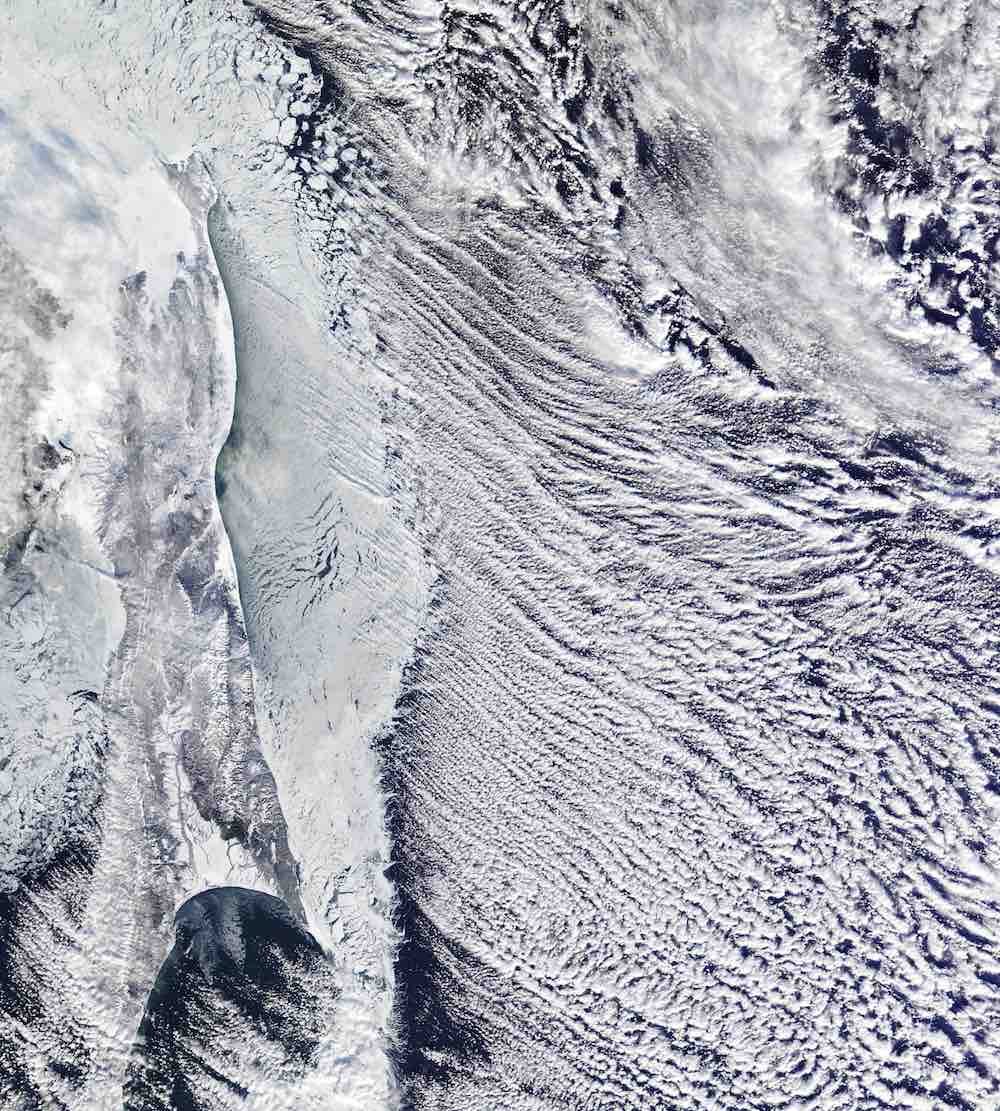
Captured by the Moderate Resolution Imaging Spectroradiometer (MODIS) instrument on NASA’s Terra satellite, a series of odd parallel lines could be seen taking shape in cloud formations just east of Sakhalin Island, Russia’s largest island which separates the Sea of Okhotsk to its east and the Sea of Japan, which lays to the southwest.
Roughly the size of a school bus, the Terra satellite, launched in 1999, studies Earth’s climate through connections between the atmosphere and a range of planetary features that include land and sea. Equipped with five instruments capable of measuring different features of the Earth, Terra collects data that helps scientists gauge the impact of human activity on our planet, as well as how natural disasters impact human population centers and ecosystems.
Through the lens of its camera eye, the MODIS instrument visualizes every point on Earth every 1-2 days from its position in orbit, recording what it observes in 36 spectral bands, making it the most comprehensive of all the sensors on board the Terra satellite and tracking the largest array of our planet’s vital signs.
On December 28, 2023, Terra’s MODIS detected the odd formation of parallel lines of cumulus clouds over the Sea of Okhotsk. Striking in appearance, these unusual cloudy structures are a phenomenon well-known to atmospheric scientists.
Above: Cloud streets visible in the cumulus cloud formations off the eastern coast of Russia on December 28, 2023
(Credit: Michala Garrison/NASA Earth Observatory/EOSDIS LANCE/GIBS/Worldview).
Horizontal convective rolls, more commonly known as “cloud streets,” these odd-looking structures take shape in the troposphere as cool dry pockets of air make their way out over warm coastal waters, where they begin to acquire moisture rising from the sea. The resulting vapor condensation gives rise to cloud formation, whereas cooler portions of the surrounding air sink.
The atmosphere above Russia’s eastern coast is ideal for the formation of features like these, which generally appear in the same direction as the prevailing wind. Over the Sea of Okhotsk, the exceptionally cold northwest winds emerging from Siberia have been likened to a “factory” of ice and cloud formation, where temperatures on Sakhalin Island this time of year often plummet to as low as -6 degrees Fahrenheit (-21 degrees Celsius).
In the photos made available at NASA’s Earth Observatory page, Arctic stratospheric conditions were producing clouds featuring striking iridescent coloration.
“These ethereal polar stratospheric clouds develop in extremely cold conditions and were recently visible to observers at lower latitudes than usual,” wrote Lindsey Doermann in an entry on the Earth Observatory website describing the phenomenon in the NASA satellite images.
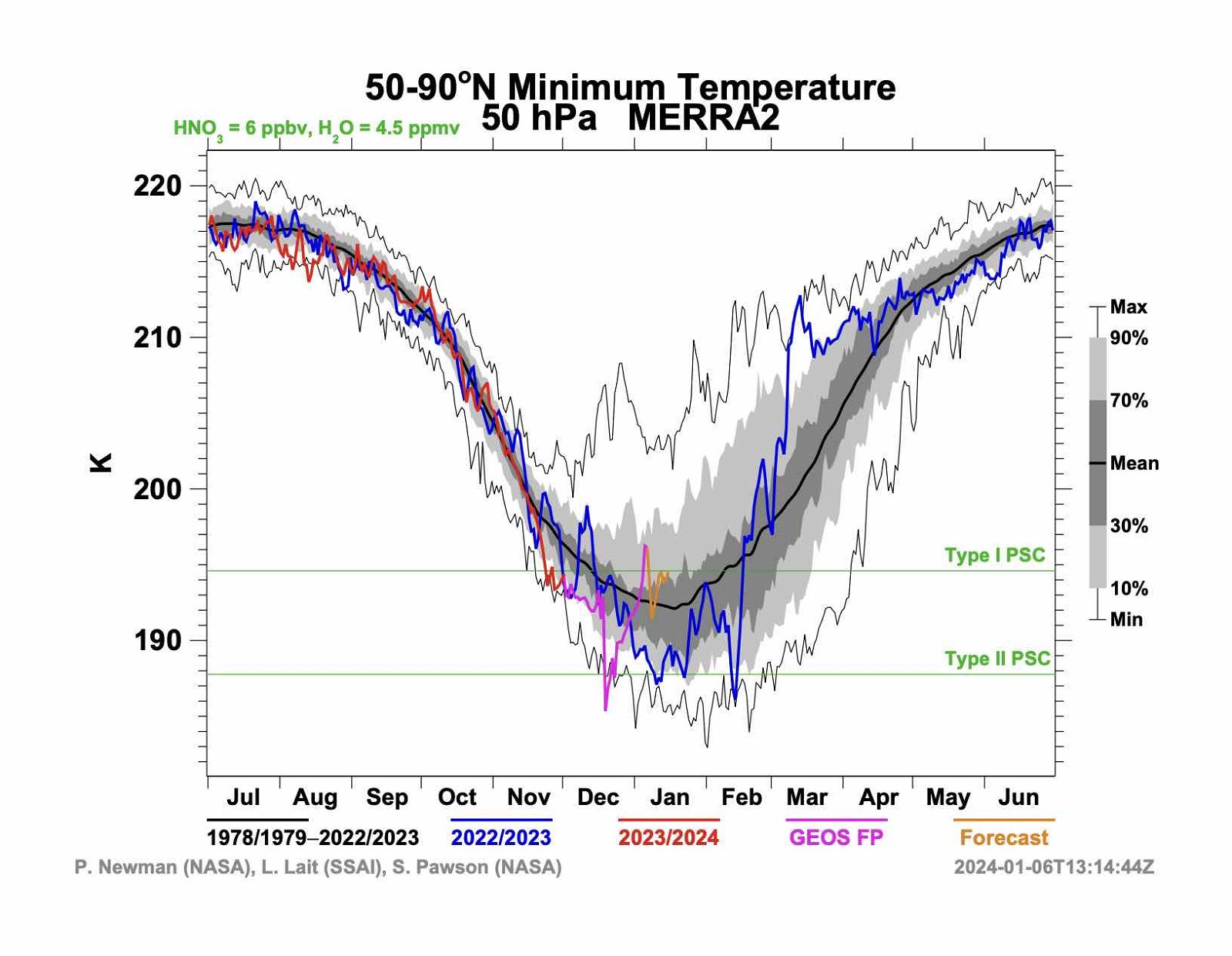
Data collected by NASA’s Global Modeling and Assimilation Office (GMAO) conveyed what it described as “anomalous” low temperatures coinciding with the appearance of the cloud streaks over the eastern Russian coast in recent weeks (Credit: P. Newman (NASA), L. Lait (SSAI), S. Pawson (NASA)).
At the time the cloud streets appeared off the Russian coast, Arctic stratospheric temperatures had dropped extremely low (see above), according to data models produced by the space agency’s Global Modeling and Assimilation Office (GMAO).
Supporting NASA’s Earth Science mission, the GMAO provides modeling and data assimilation to help strengthen the information obtained from NASA satellite images, and to provide additional analysis and predictions about events occurring in the atmosphere, as well as on land and in the oceans.
Additional information about the formation of cloud streets can be found here, and further information about NASA’s Global Modeling and Assimilation Office can be found at the GMAO Research Site.
NASA has delayed humanity’s highly-anticipated return to the Moon, its Artemis II mission, to September 2025 from an original target launch of November 2024, citing the need for extra time to analyze why the space capsule’s heat shield created hazardous, burning debris upon re-entry to Earth during the Artemis I mission.
Hellish heat of about 5,000 degrees Fahrenheit engulfed NASA’s Artemis I Orion capsule on December 11, 2022, as it careened through Earth’s atmosphere at more than 24,000 miles per hour after visiting the Moon. But charred material unexpectedly flaked off Orion’s heat shield during a maneuver to slow the vehicle down. NASA officials say they didn’t expect the heat shield to burn and fall apart as much as it did.
At high speeds and high heat, debris can become a safety hazard. The space agency spent this past year analyzing the potentially hazardous debris, Amit Kshatriya, deputy associate administrator of NASA’s Moon to Mars Program, said during a media teleconference call on Tuesday. If the Artemis I Orion had a crew onboard, they wouldn’t have been in harm’s way, officials said on Tuesday. However, it could have posed a hazard if there was a crew onboard and it happened to be oriented in a different way. Because of this, Kshatriya said the team wants to fully understand why this debris happened in the first place and prevent it from occurring on future missions.
Hazardous debris is a known major safety risk for space launches. About a minute after the Space Shuttle Columbia launched in January 2003, the external tank released foam insulation. The debris struck the shuttle’s left wing, leaving a wound that likely contributed to the Columbia reentry disaster on February 1, 2003, which killed all seven crew members onboard.
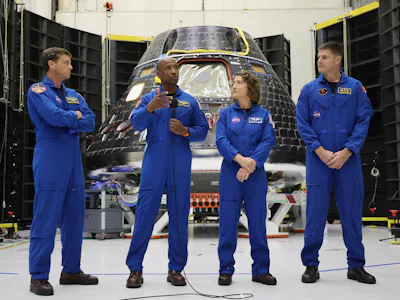
The Artemis missions are NASA’s major push to establish an ongoing human presence on the Moon. Artemis II will be the first test of the vehicle that will send four astronauts — Reid Wiseman, Victor Glover, Christina Koch, and Jeremy Hansen — around the Moon’s farside and back. Artemis III is set to be the first Moon landing since Apollo (as long as no other country beats us to it). But that, too, is delayed. NASA Administrator Bill Nelson said Artemis III won’t fly earlier than September 2026, a year later than originally planned.
“Safety is our number one priority,” said Jim Free, NASA Associate Administrator, at the press conference. “We will launch when we are ready.”
Samengevat. China kondigt plannen aan voor een eigen satelliet-internetnetwerk, vergelijkbaar met StarLink, met de bedoeling om wereldwijde dekking te bieden door 26.000 satellieten te lanceren, een onderneming geleid door staatsbedrijven.
Deze stap markeert een belangrijke ontwikkeling in de wereldwijde ruimtewedloop, waarmee China zichzelf als een dominante ‘ruimtemacht’ positioneert, in directe competitie met de Verenigde Staten. Die tonen bezorgdheid over China’s ruimteambities, wat leidt tot geopolitieke spanningen en concurrentie.
In het nieuws. China begint dit jaar met de bouw van een satelliet-internetconstellatie die de concurrentie wil aangaan met Starlink van Elon Musk.
Plannen omvatten de lancering van ongeveer 26.000 satellieten om wereldwijde dekking te bieden.
Staatsbedrijven leiden deze ontwikkeling, wat het militaire en commerciële belang van dit project onderlijnt.
Zoom in. Een specifieke lanceerlocatie is in aanbouw nabij de Wenchang Space Launch Site in Hainan.
Het plan is om ongeveer 1.300 satellieten, of 10% van het geplande aantal, te lanceren tussen 2024 en 2029.
De focus ligt op het ondersteunen van hoge snelheid 6G-communicatiesystemen, met een doelstelling om het project tegen 2035 te volooien.
Zoom out. Dit project is onderdeel van China’s bredere ambitie om tegen 2030 een ruimtemacht gelijkwaardig aan de VS te worden.
Naast satellieten omvat het plan ook het ontwikkelen van een eigen ruimtestation en Marsverkenningen.
Andere landen en bedrijven tonen bezorgdheid over China’s ruimteambities, wat leidt tot geopolitieke spanningen en concurrentie.
De Duitse overheid blokkeerde een ruimtevaartbedrijf in Shanghai – een grote aandeelhouder in een Berlijnse satelliet startup – om aandelen van andere houders te kopen.
De Amerikaanse lucht- en ruimtevaartgigant Boeing annuleerde een contract voor de verkoop van satellieten met een Amerikaanse startup nadat bekend werd dat een door de Chinese overheid gesteunde entiteit in het bedrijf had geïnvesteerd.
An “anomaly” that followed shortly after a successful launch on Monday–one that seemingly set the stage for the first soft landing of a spacecraft on the Moon in more than 50 years–brought an ambitious space mission carrying human remains to a premature end yesterday.
Shortly after separating from a United Launch Alliance (ULA) rocket early Monday morning, Peregrine, a lunar lander built by Pittsburgh-based space company Astrobotic, began to receive telemetry data from NASA’s Deep Space Network, as its avionics, propulsion, and control systems all began to power on.
As Peregrine reached its fully operational state, everything appeared to be on track for the spacecraft as it began its ascent toward the Moon.
Then, something unexpected happened.
Shortly after entering its operational state, “an anomaly occurred” as the Peregrine team became aware of a system malfunction that prevented them from being able to control the spacecraft’s ability to achieve a stable sun-pointing orientation.
“The team is responding in real time as the situation unfolds,” read a mission update posted on the company’s X account, “and will be providing updates as data is obtained and analyzed.”
As the Peregrine team worked to try and determine the cause of the problem, the situation began to look increasingly dire. All indications pointed to a complication arising from the spacecraft’s propulsion system which, if confirmed, would likely end Peregrine’s mission before it ever came close to landing on the lunar surface.
“As the team fights to troubleshoot the issue, the spacecraft battery is reaching operationally low levels,” the company wrote in a subsequent update yesterday at 11:04 AM. As the spacecraft was nearing a brief communication outage, an improvised attempt to reorient the spacecraft’s solar panels was undertaken, aiming to point them toward the Sun.
Following the reestablishment of communication with the spacecraft, the team learned that their attempt to point Peregrine’s solar array toward the Sun had been successful, allowing the spacecraft’s battery systems to charge as the Peregrine team’s Mission Anomaly Board worked to try and determine what was affecting the spacecraft.
Soon, it became evident that the anomaly had occurred due to a failure within the spacecraft’s propulsion system.
“We are grateful for the outpouring of support we’re receiving,” Astrobotic wrote in another candid mission update, thanking the community of professionals within the space industry who “unite in the face of adversity.”
Hours later at 4:12 PM, Astrobotic released an image from Peregrine, captured from the camera positioned above the spacecraft’s payload deck which provided additional confirmation that a propulsion system anomaly was the root cause behind the lander’s precarious condition.
With its solar array pointing toward the Sun, the spacecraft nonetheless was able to charge its battery, and the Peregrine team continued to carry out payload and spacecraft operations with the existing power stores.
“At this time, the majority of our Peregrine mission team has been awake and working diligently for more than 24 hours,” Astrobotic wrote in a subsequent update. “We ask for your patience as we reassess incoming data so we can provide ongoing updates later this evening.”
Shortly after 9:15 PM Eastern Time, Astrobotic shared what would be its final mission update of the day, confirming that an “ongoing propellant leak” had been causing Peregrine’s Attitude Control System (ACS) to malfunction, pushing its thrusters “to operate well beyond their expected service life cycles to keep the lander from an uncontrollable tumble.” Peregrine was given a best-case scenario of being able to maintain operations within a stable sun-pointing state for around 40 hours.
With the mission now effectively doomed, Astrobotic announced its aim was to continue to move Peregrine as close to the Moon as possible. However, once the spacecraft lost its ability to maintain its sun-pointing position, it would lose power at some point well before it reached its intended destination.
Still aboard the ill-fated spacecraft are several payloads that rank among some of the most unique ever to be sent to space. The cremated remains of humans that include several cast members from “Star Trek,” as well as DNA from former U.S. presidents, were all on board at the time the anomaly occurred, and presumably will remain adrift in space after Peregrine ceases operations.
The failed mission also raises significant questions for NASA, casting doubts on whether the American space agency will be able to safely rely on commercial partners to aid in reaching its scientific goals, particularly in advance of its plans to send humans back to the Moon in the years ahead.
Despite the mission failure, many took to social media to thank the company for its transparency on Monday as the propulsion system anomaly removed any possibility that Peregrine’s fuel stores would allow it to reach the Moon.
“Appreciate the prompt and transparent updates!” wrote another of the company’s followers on X, who added that it was “unfortunate that we have approximately 40 hours left but nevertheless, to get to this point is still a great accomplishment!”
As of Tuesday morning, no additional updates had been shared by Astrobotic on the company’s website or on social media.
Altijd al gedroomd van eens in de ruimte te verblijven? Dat kan waarschijnlijk al in 2027!
Het eerste commerciële ruimtehotel ooit, Voyager Station, wil in 2027 haar deuren openen. Het project biedt plaats aan 280 gasten en 112 bemanningsleden en wordt gepland door Orbital Assembly Corporation, een bouwbedrijf gerund door John Blincow. Het station wordt het eerste grote project van OAC en het eerste commerciële ruimtestation met kunstmatige zwaartekracht.
De bouw van de 50.000 vierkante meter grote Voyager-faciliteit zal in 2026 van start gaan, en OAC streeft ernaar om de eerste passagiers in 2027 in het hotel te verwelkomen. Het team legt uit dat het project mogelijk wordt gemaakt door een lage baan om de aarde.
Wat eet je in de ruimte?
OAC is van plan om traditioneel ‘ruimtevoedsel’ zoals gevriesdroogd ijs te serveren, terwijl ze ook streven naar recreatieruimtes voor activiteiten zoals basketbal, waarbij ze profiteren van de gewichtloosheid in de ruimte. Er zijn geen kamerprijzen bekendgemaakt, maar het team hoopt op een dag de kosten vergelijkbaar te maken met die van een cruiseticket. Het eerste element van het roterende hotel dat zal worden gebouwd, zal een centrale drukloze ringstructuur zijn die de docking hub zal bevatten. Een buitenste ringspant zal via een netwerk van spaken verbonden worden met de centrale ring en van daaruit zullen 24 woonmodules ontstaan.
One of the fascinating things about being a human in this age is that we can do more than wonder about other life and other civilizations. We can actually look for them, although there are obvious limitations to our search. But what’s equally fascinating is that we can wonder if others can see us.
Assuming that all civilizations who have begun to explore their surroundings are interested in finding other civilizations, then the question of who can detect who comes down to technology. It takes advanced technological tools to search for the technosignatures of other civilizations. It also takes technology to produce most of them. But what level of technology is needed on both sides of that equation?
The technology needed to produce technosignatures is not complex. We’ve had that technology for thousands of years. The Great Pyramids are proof of that. But what technology is needed to see them? And from how far away?
In new research published in the journal Acta Astronautica, a researcher associated with SETI poses the question, “Are we visible to advanced alien civilizations?” His name is Z. Osmanov, and he’s the author and co-author of multiple studies and articles on SETI and related topics.
“We considered the question of how our artificial constructions are visible to advanced extraterrestrial civilizations,” Osmanov writes. Osmanov explains how the universal laws of physics set the limits for detection and how more advanced civilizations can solve this problem. The maximum distance for detections is about 3,000 light-years, according to Osmanov, adding that “under certain conditions, Type-II advanced alien societies might be able to resolve this problem.”
What technologies are needed to receive our technosignatures?
The background for Osmanov’s work is the classification of civilization types called the Kardashev Scale, which is familiar to many readers. It’s the work of Soviet astronomer Nikolai Kardashev, and it describes three types of hypothetical civilizations:
Type I Civilizations harvest, use and store all the energy on their planet.
Type II Civilizations directly consume their star’s energy with a Dyson sphere or something similar.
Type III Civilizations can capture all the energy available in their entire galaxy.
(Note that in the Kardashev Scale, humanity is about 0.75.)
A Type II civilization is one that can directly harvest the energy of its star using a Dyson Sphere or something similar. Credit: Fraser Cain (with Midjourney)
In his research, Osmanov ignores Type III civilizations and focuses on Types I and II. He asks a relatively straightforward question: “Can the artifacts of our technological society be visible and potentially detectable by the telescopes of ETs?”
Our technological artifacts are things like large engineering projects and satellites. A Type I or II civilization would recognize these things as technological artifacts if they could see them. According to Osmanov, the best way for an ETI to detect them is with reflected light, and that means high-powered optical telescopes with extreme angular resolution.
We’re busy building more powerful telescopes with greater angular resolution, and ETIs are probably working on it, too. ETIs more advanced than us are way ahead of us. “In this paper, we analyze how visible we are to advanced ETs, depending on their technological level.”
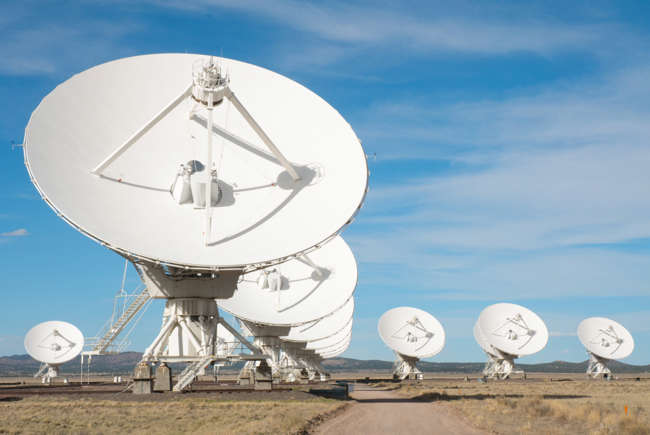
Osmanov says that ETIs will make use of interferometry to detect us. Astronomical interferometry uses two or more individual telescopes separated by distance to observe the same object at the same time. The data from the detectors is combined and processed. So rather than viewing something with the limited angular resolution of a single telescope, interferometry basically builds a “virtual” telescope—a telescope array—that is much larger than any physical telescope could be.
This aerial view shows the ESO’s VLTI, the Very Large Telescope Interferometer. It has a total of eight separate, movable telescopes that can all look at the same object, increasing the interferometer’s angular resolution. Image Credit: ESO
Osmanov calculates that for an alien civilization to detect the Great Pyramids of Giza, for example, the civilization would have to be no further away than about 3,000 light years. Because of the number of photons that would have to be sensed to see the Pyramids, the telescope would have to be extraordinarily huge. Only an interferometer could do it. “It is clear that the diameter of the telescope should be on the order of several million kilometres,” the author explains.
That eliminates Type 1 civilizations. “Such huge megastructures might be built only by Type-II civilizations but not by Type-I alien societies,” Osmanov writes.
But how can we know if any ETIs of Types II or III are within the 3,000 light-year range? Osmanov uses the well-known Drake Equation to determine that number. The Drake Equation is a probabilistic argument that thinkers can use to try to understand how many ETIs there might be in the Milky Way, but of course, there’s no absolute way of verifying its answers. It’s a thought experiment tool that keeps everyone on the same page when thinking about the question of ETIs.
In his calculations, the author determines the average distance among advanced civilizations. “As an order of magnitude, we assume that the civilizations are uniformly distributed over the galactic plane,” Osmanov writes. There would have to be something like 650 ETIs in the Milky Way for one of them to be close enough to detect our large engineering projects from the ancient world up to our medieval times. That includes things like the Pyramids and maybe other large constructions.
JAXA astronaut Koichi Wakata captured this image of the Great Pyramids from the ISS in February 2023. The most visible one is the Great Pyramid of Giza, built in the 23rd century B.C. Image Credit: Koichi Wakata.
The numbers are different when it comes to ETIs detecting our modern structures, because there hasn’t been enough time for the reflected light from these modern structures to propagate as far into space. There would have to be vastly more ETIs for one to be close enough to detect our modern structures, including satellites. “They can detect our modern constructions only if their total number in the MW is of the order of 106, which has been hypothesized by <Carl> Sagan,” Osmanov writes.
Of course, we have no way of knowing if there are any other ETIs or if one might have found our technosignatures. But the study does give context to the question and to thought experiments.
Barring first contact, all we have is thought experiments.
The clouds of Venus are believed to be composed of sulfuric acid and minor constituents including iron-bearing compounds. Respective concentrations of these compounds vary with height in the thick atmosphere of our neighboring planet. In a new study, researchers at the University of Cambridge synthesized iron-bearing sulfate minerals that are stable under the harsh chemical conditions in the Venusian clouds. Their spectroscopic analysis revealed that a combination of two minerals, rhomboclase and acid ferric sulfate, can explain the mysterious ultraviolet (UV) absorption feature in the Venusian atmosphere.
Jiang et al. hypothesize a rich and largely unexplored heterogeneous chemistry in the cloud droplets of Venus that has a large effect on the optical properties of the clouds and the behavior of trace gas species throughout Venusian atmosphere.
Image credit: Mattias Malmer / NASA.
The clouds of Venus hold several mysteries. They extend from 48 km to roughly 65 km and provide a transition region between the lower atmosphere (<48 km) that is dominated by thermochemistry and dynamics and the upper atmosphere (>65 km), for which photochemistry and dynamics are relevant.
To understand the chemical cycles between the Venusian atmosphere and its volcanic surface, and to correctly interpret potential biosignatures, an increasing research effort has been dedicated to generating a complete model framework of Venusian atmosphere.
“The only available data for the composition of the clouds were collected by probes and revealed strange properties of the clouds that so far we have been unable to fully explain,” said Dr. Paul Rimmer, a researcher with Cavendish Laboratory at the University of Cambridge.
“In particular, when examined under UV light, the Venusian clouds featured a specific UV absorption pattern.”
“What elements, compounds, or minerals are responsible for such observation?”
Formulated on the basis of Venusian atmospheric chemistry, Dr. Rimmer and colleagues synthesized several iron-bearing sulfate minerals in an aqueous geochemistry lab.
By suspending the synthesized materials in varying concentrations of sulfuric acid and monitor the chemical and mineralogical changes, they narrowed down the candidate minerals to rhomboclase and acid ferric sulfate, of which the spectroscopic features were examined under light sources specifically designed to mimic the spectrum of solar flares.
In an attempt to mimic the even more extreme Venusian clouds, the authors measured the UV absorbance patterns of ferric sulfate under extreme acidic conditions.
“The patterns and level of absorption shown by the combination of these two mineral phases are consistent with the dark UV-patches observed in Venusian clouds,” said Dr. Clancy Zhijian Jiang, a researcher at the University of Cambridge.
“These targeted experiments revealed the intricate chemical network within the atmosphere, and shed light on the elemental cycling on the Venusian surface.”
“Venus is our nearest neighbor, but it remains a mystery,” Dr. Rimmer said.
“We will have a chance to learn much more about this planet in the coming years with future NASA and ESA missions set to explore its atmosphere, clouds and surface.”
“This study prepares the grounds for these future explorations.”
The team’s paper appears in the journal Science Advances.
Clancy Zhijian Jiang et al. 2024. Iron-sulfur chemistry can explain the ultraviolet absorber in the clouds of Venus. Science Advances 10 (1); doi: 10.1126/sciadv.adg8826
De medeoprichter van OceanGate wil tegen het jaar 2050 zo'n 1.000 mensen naar een drijvende kolonie op Venus sturen en zegt dat we absoluut niet moeten stoppen met het verleggen van de grenzen van innovatie.
Guillermo Söhnlein is onverwachts in de schijnwerpers gezet in de nasleep van de ramp met de onderzeeër Titan. De mede-oprichter van OceanGate Expeditions worstelt met heel wat vragen over de noodlottige reis van het bedrijf naar het scheepswrak van de Titanic op 18 juni, waarbij vijf mensen om het leven kwamen, onder wie voormalig collega en vriend Stockton Rush. Er wordt aangenomen dat de onderzeeër binnen enkele uren na zijn afdaling is geïmplodeerd. Dat zorgt alvast voor heel wat bezorgdheid omtrent OceanGate's benadering van innovatie en veiligheid.
Maar OceanGate is niet de enige onderneming van Söhnlein. De zakenman wil immers tegen 2050 zo'n 1.000 mensen naar de atmosfeer van Venus sturen. Hij beweert dat zijn plan niet zo gek is als het lijkt. "Ik denk dat het minder ambitieus is dan tegen 2050 een miljoen mensen op het oppervlak van Mars te hebben", zei hij tegen Insider.
Mensen naar de boosaardige tweeling van de aarde sturen
Hoewel venus vaak "de tweeling van de aarde" wordt genoemd, lijkt Venus niet de ideale plek voor mensen om te gedijen. Zelfs Söhnlein is het daarmee eens. "Je hebt helemaal gelijk dat als je het over Venus hebt, de wenkbrauwen gaan fronsen buiten de ruimtevaartindustrie. En het doet zelfs wenkbrauwen fronsen binnen de ruimtevaartindustrie", zei hij.
Venus is immers de warmste planeet in het zonnestelsel. De atmosfeer zit boordevol koolstofdioxide, de oppervlaktetemperatuur zou lood kunnen doen smelten en zwavelzuur regent uit de wolken. De atmosferische druk is verpletterend - meer dan 90 keer die van de aarde, volgens NASA.
Desondanks ziet Söhnlein niet in waarom de mensheid niet zou moeten proberen op de planeet te leven. Hij wijst op onderzoek dat suggereert dat er een strook van de Venusiaanse atmosfeer ongeveer 30 mijl van het oppervlak is waar mensen theoretisch zouden kunnen overleven omdat de temperaturen er lager zijn en de druk minder intens.
Als een ruimtestation ontworpen zou kunnen worden om het zwavelzuur in de wolken te weerstaan, zegt Söhnlein, zouden er op een dag honderden tot duizenden mensen in de atmosfeer van Venus kunnen leven.
Hij zegt dat een drijvende kolonie tegen 2050 1.000 mensen in de Venusiaanse atmosfeer zou kunnen doen leven. Hoe hij dit precies ziet, is nog niet geheel duidelijk.
Wordt ongetwijfeld vervolgd!
Skwadra by Tagtik
Source: Business Insider/Illustration picture: Pixabay)
A piece of string-like material photographed on Mars by the Perseverance Rover just last week has suddenly disappeared, according to recent NASA photos obtained by its rover on the Red Planet.
The wiry-looking substance many likened to a piece of string or thin pasta first appeared in photographs taken by the rover on July 12th, photos that were shared by NASA earlier this week. However, a photo taken four days later shows the string has somehow disappeared.
Photo taken by Perseverance on July 12 shows Martian “string”
Image Credit NASA/JPL-CalTech
Photo taken by Perseverance on July 16 reveals the “string” has disappeared.
Image Credit NASA/JPL-CalTech
Since landing on the red planet, humanity’s various rovers have made a habit of taking odd, unusual, often perplexing photos. In some cases, like the “flower” or recently discussed “door” on Mars, the photos ultimately proved to be natural formations instead of foreign objects.
Of course, Martian rovers bring their own junk with them. And many of the more infamous photos sent back from those rovers are of their own pieces of human-made debris.
NASA’s experts told the media the recent photograph is likely something artificial and not a natural formation masquerading as a manufactured object. However, rather than a remnant of a kite flown by E.T. on his Martian holiday, the same experts say this string was also probably a piece of material from the rover’s landing rocket.
“The string could be from the rover or its descent stage, a component similar to a rocket-powered jet pack used to lower the rover to the planet’s surface safely,” a Perseverance mission spokesperson at NASA’s Jet Propulsion Laboratory toldCNN.
The same spokesperson concedes that the string was photographed in an area not previously visited by Perseverance but guessed that the string likely blew there on its own.
Either that. Or it has a completely different origin.
Adding more mystery to the mystery, when the rover passed over the same spot on July 16th, the string had magically disappeared. Once again, most suggest that the string left the same way it arrived, on a gust of wind.
Still, given the incredibly thin Martian atmosphere and the great lengths designers had to go through just to get the Ingenuity helicopter to grasp that atmosphere and take flight, it would take some mighty gusts of wind to send that string into and out of the same spot within a four day period. So, for now, at least, the mystery of the Martian string remains.
Follow and Connect with Author Christopher Plain on Twitter @plain_fiction
Uranus and Neptune are Actually Pretty Much the Same Color
Scientists reprocessed Voyager 2 images to get the "true" colors of Uranus and Neptune. Turns out they're a pretty blueish-green. Courtesy NASA/Irwin, et al, Anton Pozdnyakov.
Uranus and Neptune are Actually Pretty Much the Same Color
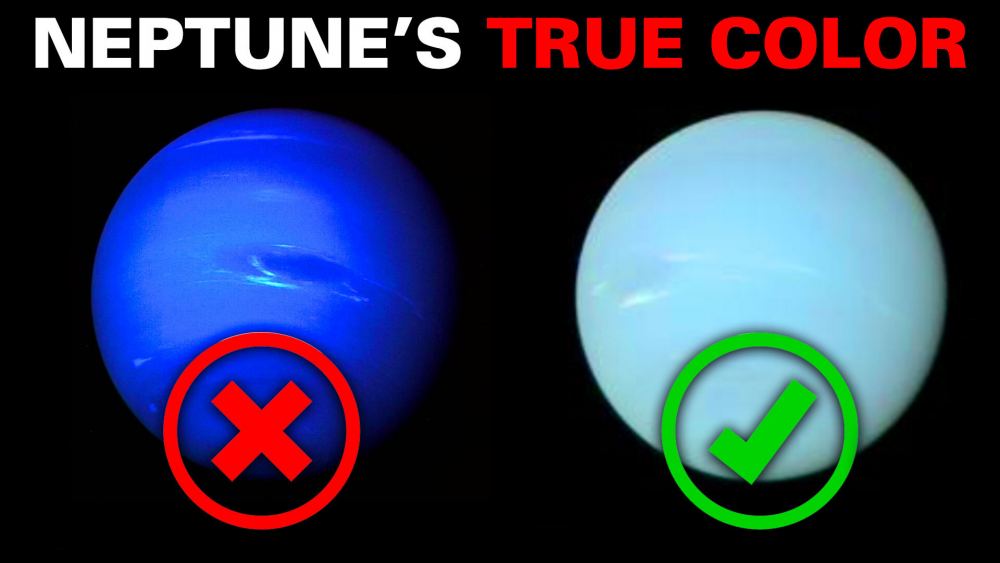
In the late 1980s, the Voyager 2 spacecraft snapped the “canonical” up-close images of Uranus and Neptune. In those views, Uranus was a pretty greenish-blue and Neptune appeared a deep azure color. It turns out that both planets are pretty close in color: a greenish-blue more akin to Uranus’s appearance.
No, Uranus and Neptune haven’t swapped color values. It turns out that those images aren’t precise recordings of their actual colors. Planetary scientists re-examined the Voyager 2 images and compared them to more recent observations made with both space-based and ground-based observatories. Then they created a model of what the colors should be. After that, they re-processed the images to come up with a more “true color” view of each planet. The result is a more realistic view of both worlds.
Having a better sense of each planet’s true color allows scientists to better understand actual changes in their atmospheres due to internal activity and seasonal shifts in position and temperature. In particular, the observations and color redefinitions help reveal something about the mysterious color changes that Uranus undergoes during its 84-year orbit.
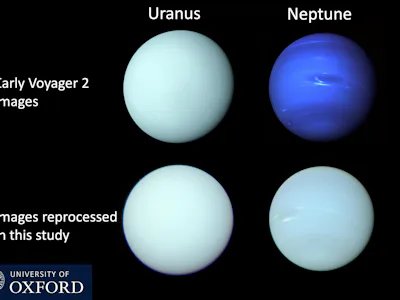
Voyager 2/ISS images of Uranus and Neptune were released shortly after the Voyager 2 flybys in 1986 and 1989, respectively. They’re compared here with a reprocessing of the individual filter images to determine the best estimate of the true colors of these planets. Credit: Patrick Irwin, University of Oxford.
What Voyager 2 Saw at the Ice Giants
The Voyager 2 spacecraft whizzed past Uranus and Neptune in 1986 and 1989, respectively. It was on a lightning-fast visit to each planet. Both close approaches lasted less than a day apiece. That gave the spacecraft a finite amount of time to gather as much information as possible. To get good pictures of the planets, Voyager’s cameras took images through different filters. The imaging team was under tremendous time constraints, with press conferences to prepare for nearly every day. They combined the single-color images and processed them to make the “press release” views we all know and love.
NASA’s Voyager 2 spacecraft captured these views of Uranus and Neptune (l, r, respectively) in the 1980s.
Think of it like taking a landscape image with your smartphone in black-and-white mode. Then you take the same one with different-colored filters. After that, you’d drag them into an image-processing software package and combine them. Depending on how they look, you might tweak them a bit in the contrast. Or you could enhance some colors to bring out specific features.
That’s what the Voyager imaging team did. For Neptune, they cranked up the image contrast to bring out specific clouds, cloud bands, and storms. That meant applying a bit more blue to increase the contrast. The resulting image was pretty and certainly did showcase those odd features—which caught everyone’s attention during the flybys. But, did the images reflect reality?
Neptune, as seen by Voyager 2 in 1989. The deep blue color applied helped enhance the view of features in the atmosphere. Image Credit: NASA/JPL
The same question gets asked about Uranus’s color, especially since its appearance has changed slightly from the canonical Voyager 2 image in the intervening decades. The Voyager 2 mission took spectra of Uranus as it flew by and confirmed that the planet’s atmosphere is mainly hydrogen and helium, with a small amount of methane. That composition was well-known from ground-based observations and spectra since the early part of the 20th century.
Determining True Planetary Colors of Uranus and Neptune
Professor Patrick Irwin and a team of scientists at Oxford University in the UK set out to answer questions about the actual colors of Uranus and Neptune. They analyzed the Voyager 2 images, plus studies made by the Hubble Space Telescope, ESO’s Very Large Telescope, and others, to come up with a model of the planets’ actual colors.
“Although the familiar Voyager 2 images of Uranus were published in a form closer to “true” color, those of Neptune were, in fact, stretched and enhanced, and therefore made artificially too blue,” said Irwin. “Even though the artificially saturated color was known at the time amongst planetary scientists – and the images were released with captions explaining it – that distinction had become lost over time. Applying our model to the original data, we have been able to reconstitute the most accurate representation yet of the color of both Neptune and Uranus.”
A reconstruction by Irwin, et al, of the visible colors of Uranus and Neptune from Voyager 2/ISS NAC observations, using their processing model to even out the colors. Courtesy: Irwin, et al.
Essentially, the team “rebalanced” the colors of both planets. The result is that both are similar shades of greenish-blue, although Neptune still has a bit more blue to it than Uranus does. However, Uranus sometimes develops a bit more green over its poles.
These colors seem to better match long-stand observations of both planets made at Lowell Observatory between 1950 and 2016. According to Heidi Hammel, a scientist who has studied the two planets for years, rebalancing the colors in Uranus and Neptune imagery is a good thing. “The misperception of Neptune’s color, as well as the unusual color changes of Uranus, have bedeviled us for decades,” she said. “This comprehensive study should finally put both issues to rest.”
What Causes Color Changes on Uranus?
Scientists may be happy with the colors of these ice giants now, although they do still note some slight seasonal color shifts in both planets throughout their orbits. In particular, the changing appearance of Uranus over time remains something of a mystery to be solved. For example, the Lowell observations show something intriguing: Uranus appears a little greener at its winter and summer solstices. That’s the point in its orbit when one of the planet’s poles is pointed towards our star. Things change during the equinoxes when the Sun is over the equator. Then, it has a somewhat bluer tinge.
Part of that change is due to Uranus’s unusual spin. It rolls around the Sun on its side, pointing one or the other of its poles at the Sun during the solstices. (Recently, JWST took advantage of that positioning to grab a look at its northern polar region.) The “tipped” position of Uranus likely forces some changes in its reflectivity at those times, making it look brighter to us here on Earth. Now the big question is, do those changes indicate something else happening in the atmosphere?
Uranus was imaged by Voyager 2 in 1986. Its rotational axis is tipped over 89 degrees from the plane of the Solar System. During its “year” one pole or the other points toward the Sun at the solstices. Credit: NASA
In the paper they published about this work, Irwin and the team suggest that the changes that Lowell Observatory saw could be caused by Uranus’s distance from the Sun. That affects the production of a dark haze—a sort of “polar hood”. It settles over the upper atmosphere at the poles. Production would be more intense when Uranus is closest to the Sun. That would explain a change in reflectivity and brightness. The team modeled a hood that produced a steadily thickening haze, probably consisting mostly of methane ice. The model simulation showed that the ice particles increased reflection at green and red wavelengths at the poles. That could explain the greenish tint astronomers see at solstice.
Tracking Changes on Uranus
The modeling and re-jiggering of imagery of Uranus, in particular, go a long way toward explaining Uranus’s color changes. “This is the first study to match a quantitative model to imaging data to explain why the color of Uranus changes during its orbit,” said Irwin.
At the moment, Uranus is heading into its high summer season. That should cause its northern polar hood to thicken and grow. It may end up looking more like the hood seen in the Voyager 2 images and the team’s model. Irwin suggests that the Hubble Space Telescope and the Very Large Telescope should focus on spectroscopic studies of the planet to watch it change. Future Hubble observations should also use filtering methods that correlate with the Voyager imaging system filters to make better comparisons. It’s likely that future studies should be able to replicate the work Irwin and his team have done, and do more to explain the changes that Uranus’s atmosphere appears to experience as it moves through its seasons.
NASA Selects the MAGGIE Solar-Powered Aircraft for the 2024 NIAC Program
Since 1998, the NASA Innovative Advanced Concepts program has fostered innovation by accepting new and unconventional proposals from the scientific community. Those selected are awarded funding to conduct early-stage technology studies that could lead to applications that help advance the agency’s scientific and exploration objectives. In a recent press statement, NASA announced the 13 concepts it has selected for Phase I development, which will receive a combined award of up to $175,000 in grants to assess the concepts’ feasibility and develop the technology further.
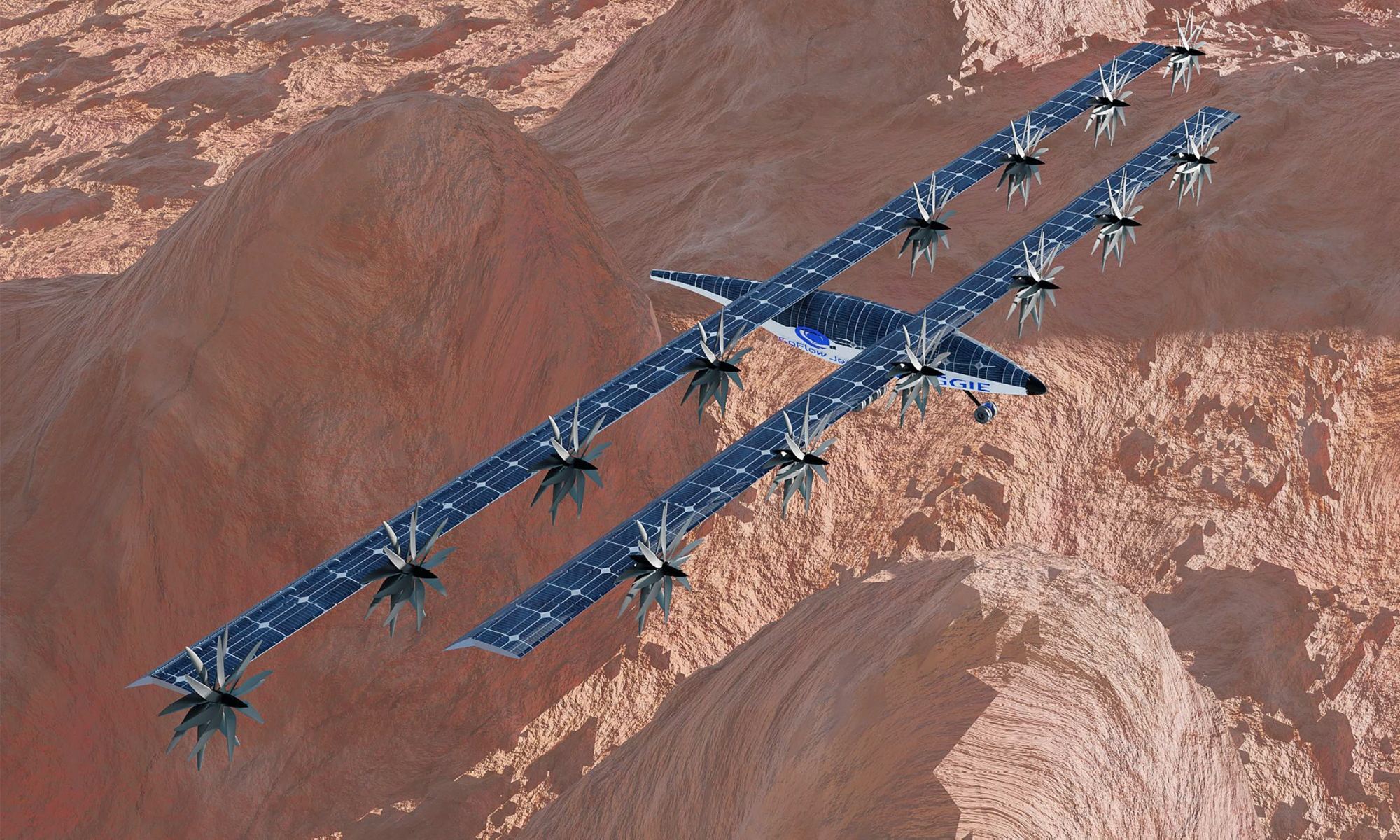
This year’s selectees range from a sample return from the surface of Venus, a fixed-wing aircraft for Mars, a swarm of probes to travel to Proxima Centauri and explore its system of exoplanets, and more. One of the more eye-catching is the Mars Aerial and Ground Global Intelligent Explorer (MAGGIE) proposed by Ge-Cheng Zha, a Professor of Aerodynamics at the Univeristy of Miami and the President of Coflow Jet LLC. The concept calls for a compact, fixed-wing, solar-powered aircraft capable of vertical take-off and landing (VTOL).
A collage of illustrations highlighting the novel concepts proposed by the 2024 NIAC Phase I awardees. Credit: (clockwise, from upper right) Benner/Zhang/McQuinn/Romero-Calvo/Eubanks/Carpenter/Bickford/Romero/Calvo/Cabauy/ Landis/Rothschild/Zha/NASA
Through the NIAC, NASA maintains a strong tradition where game-changing proposals submitted by the public became missions that made crucial contributions. As NASA Associate Administrator Jim Free said in the statement:
“The daring missions NASA undertakes for the benefit of humanity all begin as just an idea, and NIAC is responsible for inspiring many of those ideas. TheIngenuity helicopter flying on Mars and instruments on the MarCO deep space CubeSats can trace their lineage back to NIAC, proving there is a path from creative idea to mission success. And, while not all these concepts will fly, NASA and our partners worldwide can learn from fresh approaches and may eventually use technologies advanced by NIAC.”
According to Zha’s proposal paper, the inclusion of the CoFlow Jet (CFJ) deflected slipstream technology means that MAGGIE will be capable of cruising at Mach 0.25 (~300 km/h; 190 mph) with a cruise lift coefficient (CL) of 3.5 – nearly an order of magnitude higher than conventional subsonic aircraft in Mars’ thin atmosphere. A fully charged battery would last 7.6 Martian days (sols), giving MAGGIE a range of 179 km (111 mi) at an altitude of 1,000 m (3280 ft). The total range of MAGGIE for an entire Martian year – which works out to 668 sols or 687 Earth days – is 16,048 km (9972 mi). As Zha told Universe Today via email, the proprietary CFJ technology consists of three elements:
“First, CoFlow Jet (CFJ) active flow control enhances lift coefficient, which is needed to overcome the low air density on Mars (1% of that on Earth). Conventional lift coefficient will not be able to lift a useful payload. Second, CFJ removes flow separation or stall. Due to the low air density on Mars, the Reynolds number is very low, which makes the Aircraft prone to flow separation and stall. If the aircraft stalls, the aircraft will crash, and the game is over.
“Third, CFJ enables deflected slipstream, which is the flow pulled by the propeller. It can turn the flow 90 deg downward so that the VTOL aircraft does not need to tilt the propellers upward at hover. The propeller will remain at the forward-facing position like the at cruise. The CFJ is used in the flap to turn the flow. It makes the VTOL aircraft much simpler than conventional aircraft.”
Image of the Mars Ingenuity helicopter.
Credit: NASA
The mission profile envisioned here would consist of three atmospheric and geophysical investigations. These would explore how long Mars had a magnetic field, the source of methane signals detected by the Curiosity rover in the Gale Crater, and in-depth mapping of the subsurface water ice observed around Mars’ mid-latitudes.Its reliance on solar energy also means that the mission (barring an accident) could remain operational indefinitely. In short, MAGGIE would be able to perform the first global-scale atmospheric mission of Mars and would be the first concept to enable the ongoing exploration of the Red Planet.
“It has a global scale range. It can go anywhere on Mars,” said Zha. “All the previous rovers can only explore a point on Mars. Their ranges are very limited. MAGGIE can not just do the examination on the ground surface, but also examine the atmosphere since it flies.”
The professor also noted how his concept pays homage to the Ingenuity helicopter, which effectively demonstrated the potential for airborne missions on Mars. MAGGIE, he claims, would be similarly engaging to the public because of its audacious nature and the variety of environments it could explore, study, and image. In keeping with the proud tradition of NASA Spinoff, Zha also noted how developing this concept for investigating extraterrestrial environments will have applications for VTOL technologies here on Earth:
“Currently, there is a big movement on Earth to develop eVTOL for urban air mobility. They all need to use tilt rotors, tilt wings, and lift-plus-cruise. It is heavy, draggy, and inefficient. Using the same technology of CoFlow Jet deflected slipstream of MAGGIE, we can improve the efficiency of the eVTOL on Earth significantly.”
Titan’s “Magic Islands” Could Be Floating Blobs of Organic Solids
When the Cassini spacecraft returned radar scans of the surface of Saturn’s moon Titan, the results were mindblowing. It revealed giant lakes or seas of liquid methane, a complete absence of waves and what seemed to be islands in the giant bodies of water. Now a team of scientists think they may be blobs of organic molecules that form in the atmosphere, collect in the lakes and float around!
The bus sized space probe Cassini was launched in October of 1997. The journey took the craft 3.5 billion km using gravitational slingshots following launch from Venus (twice), Earth and Jupiter before arriving in July 2004. The mission at Saturn lasted for 14 years when Cassini dived into the atmosphere of Saturn on 15 September 2017. While it was there it orbited Saturn a total of 290 times, explored many of its moons and discovered seven more.
Artist impression of Cassini Space Probe
A particularly interesting part of the mission was the Huygens probe that hitched a ride aboard Cassini with Titan as its destination. Titan is Saturn’s largest moon, the second largest moon in our Solar System and larger even than our own Moon and the planet Mercury. It’s also the only moon known to have a dense atmosphere and large, stable bodies of water on its surface.
Natural color image of Titan taken by Cassini in January 2012. (Credit: NASA/JPL-Caltech/Space Science Institute)
The atmosphere of Titan has a neat trick, it transforms gasses like methane and nitrogen (of which there is plenty in the atmosphere) into organic compounds. The team, led by Xinting Yu from the University of Texas studied what happens to those compounds when they reach the surface of the Moon.
Surpisingly, they found that the compounds reach the surface as solids, even on the lakes. Just what happens then was what the team were interested to explore. If they were structured like a sponge, mostly full of empty space then they would simply float. If on the other hand they were solids, they may still float depending on their composition, otherwise they will just sink to the lake bed.
One mysterious feature of the Titanian (if that’s even a word) lakes that was picked up ws temporary bright spots seen by radar. They were dubbed ‘magic islands’ because they seemed to be only temporary features. The team found that the only plausible explanation for the observations was that the solid material landing on the surface.. and by chance, in the lakes, must be porous in nature giving it the ability to float.
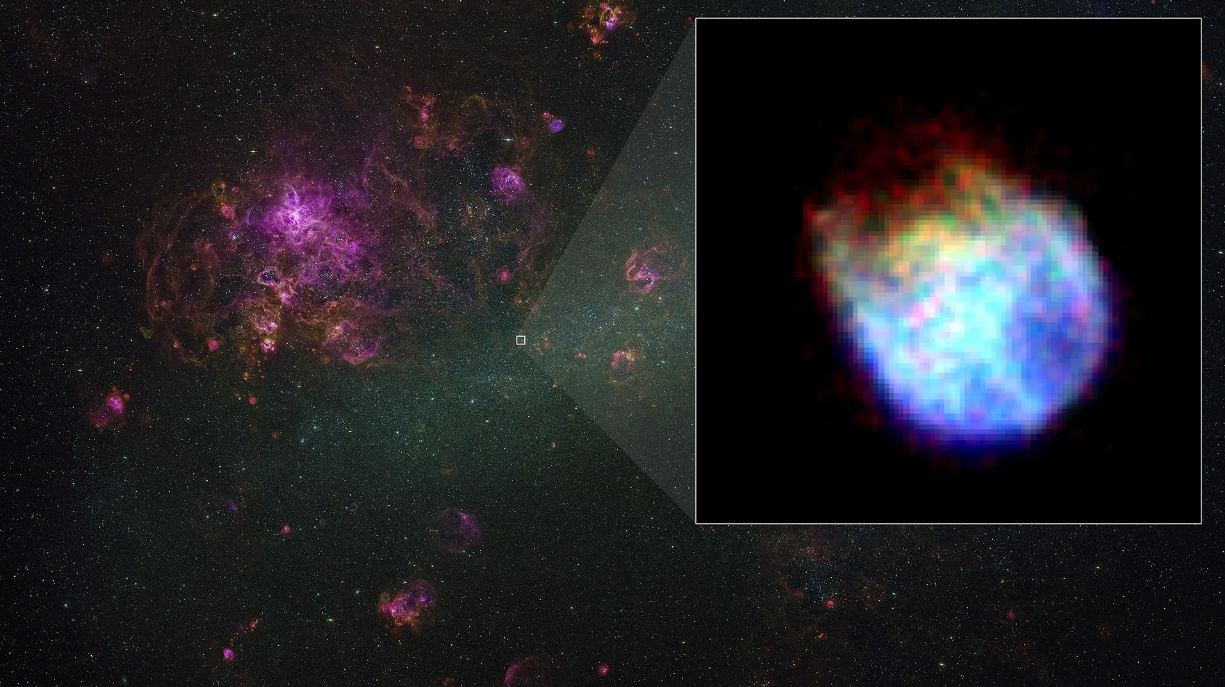
Supernova remnant N132D lies in the central portion of the Large Magellanic Cloud, a dwarf galaxy about 160,000 light-years away. XRISM’s Xtend captured the remnant in X-rays, displayed in the inset. Although bright in X-rays, the stellar wreckage is almost invisible in the ground-based background view taken in optical light. Credit: Inset, JAXA/NASA/XRISM Xtend; background, C. Smith, S. Points, the MCELS Team and NOIRLab/NSF/AURA
XRISM, the X-ray Imaging and Spectroscopy Mission, is a joint NASA/JAXA mission led by JAXA. The X-ray space telescope began its mission in low-Earth orbit on September 6th, 2023. Science operations won’t begin until later this year, but the satellite’s science team has released some of the telescope’s first images.
XRISM is a stop-gap telescope. Our existing X-ray observatories, XMM Newton and Chandra, are aging, and their missions will end soon. Their replacement, the European Advanced Telescope for High Energy Astrophysics (ATHENA), won’t launch until 2035, leaving a years-long gap with no X-ray telescope coverage. Japan’s Hitomi X-ray observatory was meant to succeed XMM Newton and Chandra, but it failed a few weeks after launch.
Even though XRISM is intended as a fill-in mission, it’s still very powerful and will deliver robust scientific observations.
“XRISM will provide the international science community with a new glimpse of the hidden X-ray sky,” said Richard Kelley, the U.S. principal investigator for XRISM at NASA’s Goddard Space Flight Center in Greenbelt, Maryland. “We’ll not only see X-ray images of these sources but also study their compositions, motions, and physical states.”
Some new images from the telescope show just how powerful this ”stop-gap’ observatory is.
XRISM has two instruments: Resolve and Xtend. Resolve is a microcalorimeter spectrometer, a cryogenic instrument that’s kept at barely above absolute zero. When a photon hits it, it warms the detector by a specific amount related to its energy. “By measuring each individual X-ray’s energy, the instrument provides information previously unavailable about the source,” NASA explains.
Xtend is an X-ray CCD camera with a higher resolution than its predecessor on the failed Hitomi observatory.
The first image from XRISM at the top of the page is of a supernova remnant (SNR) in the Large Magellanic Cloud called N132D. The remnant is almost unseeable in the optical light image but is bright in X-rays. XRISM is a spectrometer and it created the most detailed X-ray spectrum of N132D ever.
XRISM’s X-ray spectrum of N132 reveals the presence of Silicon, Sulfur, Argon, Calcium, and Iron. The numbers indicate the number of electrons lost, or the ionization state, required to produce each peak. These elements originated in the remnant’s progenitor star and blasted out into space when it exploded as a supernova. Image Credit: JAXA/NASA/XRISM Resolve and Xtend
The progenitor star was about 15 times as massive as the Sun and exploded when it depleted its hydrogen and collapsed in on itself. The wreckage, the supernova remnant, is about 3,000 years old and is still expanding. These remnants are important because they spread heavy elements throughout the galaxy, heat the interstellar medium, and accelerate cosmic rays. Their shockwaves can even compress nearby gas and trigger new star formation.
Brian Williams, NASA’s XRISM project scientist at Goddard, explained how XRISM will help us understand SNRs.
“These elements were forged in the original star and then blasted away when it exploded as a supernova,” said Williams. “Resolve will allow us to see the shapes of these lines in a way never possible before, letting us determine not only the abundances of the various elements present but also their temperatures, densities, and directions of motion at unprecedented levels of precision. From there, we can piece together information about the original star and the explosion.”
Measuring the chemical composition of objects is important in astrophysics, and XRISM is proving to be even better than expected at that task.
“Even before the end of the commissioning process, Resolve is already exceeding our expectations,” said Lillian Reichenthal, NASA’s XRISM project manager at Goddard. “Our goal was to achieve a spectral resolution of 7 electron volts with the instrument, but now that it’s in orbit, we’re achieving 5. What that means is we’ll get even more detailed chemical maps with each spectrum XRISM captures.”
Xtend, XRISM’s X-ray imager, plays an important role in the observations. Its large field of view means it can observe an area about 60% larger than the full Moon. The science team released an Xtend X-ray image of Abell 2319, a nearby galaxy cluster that’s the object of frequent study.
XRISM’s Xtend instrument captured galaxy cluster Abell 2319 in X-rays, shown here in purple and outlined by a white border representing the extent of the detector. The background is a ground-based image showing the area in visible light. The pink is X-ray light from gas that permeates the cluster heated to millions of degrees. By measuring it with XRISM, astronomers can measure the mass of the entire cluster, an important point in understanding it. Image Credit: JAXA/NASA/XRISM Xtend; background, DSS
The purple in the image is gas that is leftover from billions of years of star birth and death. XRISM will tell astronomers what elements are present and how abundant they are, especially elements heavier than hydrogen and helium, called ‘metals’ in astronomy. These XRISM observations will help us understand how the Universe has become enriched in metals over its 13+ billion-year history.
Astronomers have observed Abell 2319 with the Chandra and identified different substructures in the intracluster medium (ICM.) They found cold fronts between masses of cooler and warmer gases and even finer substructures within the fronts. It all hints at more complexity than previously thought, triggered by mergers between galaxies and groups and interactions with the cluster’s AGN. Abell 2319 is currently undergoing a major merger event, and since XRISM is more powerful than Chandra, it should reveal even more details about the merger.
But alongside the success represented by these first images, XRISM is facing its first challenge. An aperture door that protects the Resolve detector before launch hasn’t opened. This means that photons below 1,700 electron volts can’t reach the detector. XRISM personnel have made several attempts to open it but haven’t yet been successful. If it remains closed, then the mission won’t detect photons below 1,700 electron volts, while it’s designed to measure photons as low as 300 electron volts. This problem, however, doesn’t affect Xtend, and the XRISM team is still working on a solution.
Though the XRISM mission is primarily a partnership between NASA and JAXA, the ESA and the Canadian Space Agency are also involved.
An aperture that protects the Resolve instrument is stuck closed, meaning XRISM can’t operate at its full electron volt detection range. Xtend, which has its own aperture, is unaffected. Image Credit: By ESA – https://www.esa.int/ESA_Multimedia/Images/2023/08/XRISM_in_a_nutshell, CC BY-SA 3.0 igo
“It’s so exciting to see XRISM already carrying out such marvellous scientific observations, even though it is not yet fully calibrated,” says ESA Director of Science Carole Mundell. “It shows the potential this mission offers to our science communities for groundbreaking discoveries in the study of the most energetic phenomena in the Universe.”
Historic color photos of Uranus and Neptune are actually the wrong colors, and a recent study used new data and a lot of math to set the record straight.
In Voyager 2’s full-color photos of the ice giants, Uranus looks pale blue, while Neptune has a deeper, more vivid shade. That’s because Voyager 2’s cameras actually photographed each planet several times, each in a single color, and NASA teams here on Earth combined those single-color shots into the multi-hued composite images we see today. In the process, they enhanced the images to make certain features, like Neptune’s bands of clouds, stand out more. As useful as that was for planetary scientists, it also skewed our perception of what these two long-neglected worlds actually look like.
“Even though the artificially saturated color was known at the time among planetary scientists – and the images were released with captions explaining it — that distinction had come lost over time,” says Irwin in a recent statement to the press.
Irwin and his colleagues used data from Hubble and the VLT to correct the images — a little like space-age art restoration — and solve a decades-old mystery about why Uranus changes colors (stop laughing). They published their work in the Monthly Notices of the Royal Astronomical Society.
This figure shows the original Voyager 2 images, with Neptune in deep, high-contrast blue, and the actual appearance of the two ice giants.
PATRICK IRWIN
ICE GIANTS SHOW THEIR TRUE COLORS AT LAST
Irwin and his colleagues used data from a spectrograph (an instrument that splits light into the individual wavelengths that make it up) on the Hubble Space Telescope and one on the evocatively-named Very Large Telescope, perched on a mountaintop in Chile. The spectrograph data basically provided a list of which specific wavelengths, or colors, were present in every pixel of their images of Uranus and Neptune. By comparing that data to the [date] Voyager 2 images of the ice giants, the team managed to rebalance the historic images, creating versions that show the planets in more realistic colors.
The two worlds turn out to be close to the same color: a light greenish blue. Neptune has a slightly bluer tint thanks to a thinner layer of haze in its upper atmosphere, but not nearly as blue as it looks in the composite images from Voyager 2.
“Although the familiar Voyager 2 images of Uranus were published in a form closer to ‘true’ color, those of Neptune were, in fact, stretched and enhanced, and therefore made artificially too blue,” says Irwin.
When NASA crews processed the Voyager 2 data, they turned the contrast on Neptune’s image all the way up to make bands of clouds and storms easier to see. That’s a bit like turning up the contrast in a video game so you can see better in weird lighting; you spot details you might otherwise have missed, but you’re not seeing anything in its “true” color. In Neptune’s case, turning up the contrast also turned our image of the planet a deep, vivid blue. It’s a very pretty blue, but it’s not what Neptune would really look like if you were peering out the window of a passing spaceship.
WHY DOES URANUS TURN GREEN?
In the process of working out what color the ice giants actually were, Irwin and his colleagues also solved a decades-long mystery about Uranus. They now know why Uranus sometimes turns green (seriously, stop laughing; we mean it).
Earth’s axis is tilted at about a 23-degree angle, which is why we have seasons. Uranus, on the other hand, is at closer to a 90-degree angle; it’s basically lying on its side while it spins. The planet's 98-degree axial tilt means that each pole points directly at the Sun during its summer solstice and directly away from the Sun during its winter solstice (instead of just sort of leaning one way or the other, as our relatively well-behaved planet does).
At each solstice, Uranus looks greener than it does during the rest of its 84-Earth-year-long Uranian year. And for decades, planetary scientists have been trying to work out why.
Irwin and his colleagues noticed that, based on the spectra from Hubble and the VLT, there’s less methane in Uranus’s atmosphere at the poles than near the equator. But what methane is floating around at Uranus’s poles tends to be ice crystals, drifting in a chilly (and smelly) haze in the upper atmosphere. And those ice crystals reflect a lot of light, which accounts for the seasonal color change.
Methane absorbs red light and reflects blue-green light. So for the parts of the long Uranian year when one pole, swathed in sparkly methane ice clouds, is pointed at the Sun, the whole planet seems to sparkle with greenish reflected light.
And that’s why Uranus turns green (and smells like farts)
ESA Gives Us a Glimpse of its Future Space Exploration Plans with a Cool New Video
The European Space Agency (ESA) has made incredible contributions to space exploration and space-based science. Last year, the agency launched the Euclid space telescope, which will survey the Universe back to 3 billion years after the Big Bang to measure cosmic expansion and the influence of Dark Energy. After more than a decade of development, theAriane 6 launch vehicle conducted its first full-scale dress rehearsal, which included an engine fire test. In arecent video, the ESA showcased its plans for the future, which include some new launch vehicles and engine technology.
As the ESA describes it in the statement accompanying the video’s release, “brand-new rockets are set to take flight, some reusable, some carbon-neutral, with hybrid propulsion, two and three stages, small, large, crewed and uncrewed, to Earth orbit and deep space, the journey continues.” The video provides a rundown of the technologies the ESA has in the works, which includes footage of hot fire tests and other milestones being accomplished at ESA facilities and those of their commercial partners.
Upon review of these new concepts and technologies, some priorities become apparent. Looking to the next decade and beyond, the ESA is committed to ensuring independence in design, manufacture, and launch capabilities. They are also pursuing reusable rocket technology for both engines and launch vehicles, reducing the carbon footprint of spaceflight and servicing the commercial space sector (especially where constellations of small satellites are concerned).
In-House Assembly
SPECTRUM:This two-stage orbital launch vehicle, developed by Isar Aerospace, is specifically designed for small and medium satellites. The vehicle is manufactured at the Isar facility to allow for flexibility with the design and mission profiles. Spectrum has nine ISAR Aquila engines on its first stage and a single Aquila on its second. These engines rely on a combination of liquid oxygen (LOX) and liquid propane fuel. The rocket can reportedly transport 1000 kg (2200 lbs) to LEO and 700 kg (~1545 lbs) to Sun-Synchronous Orbit (SSO).
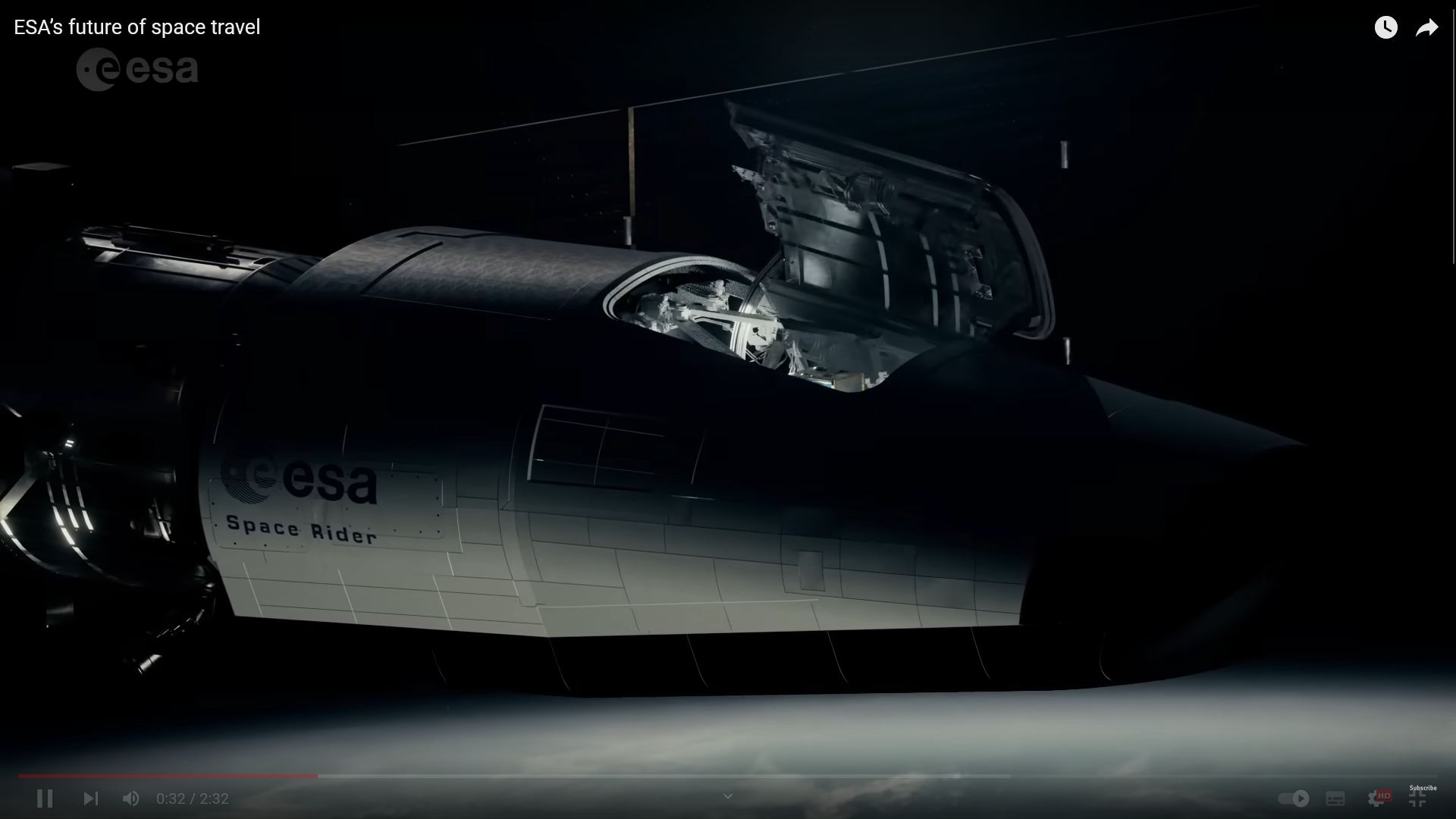
Space Rider: This reusable uncrewed robotic laboratory, currently being developed by the Agenzia Spaziale Italiana (ASI), Switzerland, and the Portuguese Space Agency, will allow for technology demonstrations and research in pharmaceutics, biomedicine, biology, and physical science. It will be launched to Low Earth Orbit (LEO) using the new four-stage Vega-C, where it will remain for up to two months conducting experiments within its cargo bay. At the end of its mission, it will return to Earth and land on a runway to be refurbished for its next flight.
MIURA-1:Next up is the suborbital launch vehicle fully designed and developed in-house by Spanish aerospace provider PLD Space. Designed for microgravity research, this rocket can transport up to four experiments to space and return them to Earth, with a total payload capacity of 100 kg (220 lbs). The vehicle relies on a single TEPREL-B liquid bipropellant engine that burns kerosene and LOX propellant.
RFA One:This 3-stage rocket is another launch vehicle entirely developed in-house by Austrian aerospace company Rocket Factory Augsburg. The first stage relies on nine Helix ORSC engines optimized for sea level that rely on LOX and RP1 fuel and are equipped with thrust-vector control (TVC). The second stage relies on a single Helix Vac engine built in-house using additive manufacturing. The launch system also has a Redshift Orbital Transfer Vehicle (OTV) that ensures accurate delivery to the desired orbit, with payloads of 1300 kg (2866 lbs) to SSO and 300 kg (660 lbs) to a Lunar Transfer Orbit (LTO).
Susie with cargo bay open @ArianeGroup
Reusability
Prometheus and Themis:Next up is the Prometheus engine and Themis launch stage, both courtesy of ArianeGroup. The former is being developed as part of an ESA program in collaboration with the French Space Agency (CNES) with support from the German Aerospace Agency (DLR). This low-cost, potentially reusable engine runs on LOX and liquid methane and will serve as a precursor for next-generation European launchers used in the post-2030 time frame. Similarly, Themis is an ESA rocket prototype and demonstrator that will test retrieval and reuse technologies.
SUSIE:Short for Smart Upper Stage for Innovative Exploration, SUSIE is a reusable upper stage concept capable of autonomously transporting cargo to LEO or performing crewed missions with up to 5 astronauts. ArianeGroup is currently developing the vehicle to be launched with the Ariane 6 rocket on future ESA missions.
Propulsion
M10 Engine: This engine is under development by a consortium led by the Italian space propulsion company Avio with the help of commercial partners from Belgium, Czechia, Switzerland, France, Austria, and Romania. The M10 will be Europe’s first LOX/methane engine and stage that will help pave the way for next-generation launchers (like the Vega-E), thus ensuring increased competitiveness by European small launchers.
SL1: The Small Launcher-1 is being developed by HyImpulse, a German aerospace company specializing in hybrid propulsion. The three-stage smallsat launch vehicle is equipped with twelve hybrid rocket motors that rely on a combination of LOX and Paraffin wax, a low-cost option that allows for greater safety and flexible launch operations. The SL1 will be the first European launch vehicle capable of launching satellites with a payload of up to 500 kg (1100 lbs) to dedicated Earth orbits.
Green Technology
Orbex Prime: This two-stage launch system is the work of Orbex, a UK-based orbital launch services company specializing in low-carbon, high-performance micro-launch vehicles. This two-stage micro-launcher is carbon-neutral, relying on bio-liquid natural gas (BioLPG) to power its seven engines. Most of its propulsion subsystem is built using additive manufacturing (3D printing), while the main structure and tanks are composed of carbon fiber/graphene composites. With a payload capacity of 180 kg (~400 lbs), this micro-launcher will service the growing small satellite (smallsat) market.
XL: Developed by UK-based launch vehicle manufacturer Skyrora, the XL is a three-stage, light-class launch vehicle intended to send payloads to SSO or Polar Orbit. Powering the first and second stages are nine and one Skyforce engines (respectively) that run on LOX and a kerosene fuel made from waste plastic (Ecosene).
These concepts align with several emerging trends, cutting-edge technologies, and priorities that characterize the modern space age. In addition to reducing costs and increasing access to space, there is the growing role of commercial space and the need for collaboration between the public and private sectors. On top of that, there are significant concerns that so many launches per year will mean more emissions, thus significantly contributing to climate change – hence the need for carbon-neutral manufacturing and fuel options.
De Indiase ruimtesonde Aditya-L1 heeft zaterdag de baan rond de zon bereikt na een reis van vier maanden. Premier Narendra Modi sprak op sociale media van een "mijlpaal" voor het ruimtevaartprogramma van zijn land.
Een Indiaas ruimtevaartuig dat de zon moet observeren, heeft na een maandenlange vlucht door de ruimte zijn bestemming bereikt. Premier Narendra Modi van India presenteerde dat op sociale media als een nieuwe mijlpaal voor het ruimtevaartprogramma van zijn land.
(ANP / Associated Press)
De Aditya, "zon" in het Hindi, werd in een zogenaamde 'halo-baan' geplaatst in een sector in de ruimte die ongeveer 1,5 miljoen kilometer van de aarde is verwijderd.
De sonde werd in september gelanceerd en heeft een reeks instrumenten aan boord om metingen en observaties uit te voeren aan de buitenste lagen van de zon. Aditya moet voortdurend heldere beelden van de zon doorsturen, om zo meer te weten te komen over de eigenschappen van zonnevlammen, de straling van de zon en de dynamiek van zonnewinden.
De Indiase minister van Wetenschappen en Technologie Jitendra Singh schreef op de sociale media dat de sonde zijn einddoel bereikt had "om de mysteries van de band tussen de zon en de aarde te ontrafelen".
"Dit is een bewijs van de niet aflatende toewijding van onze wetenschappers", schreef ook premier Modi. "We zullen nieuwe wetenschappelijke grenzen blijven verkennen om de mensheid te helpen".
De Amerikaanse Nasa en het Europese ESA hebben al eerder ruimtesondes gelanceerd om de zon te bestuderen, maar voor India gaat het om een primeur. India is ook het eerste Aziatische land dat zijn sonde in een baan rond de zon brengt. Ook Japan en China lanceerden dergelijke missie, maar hun sondes hebben hun doel nog niet bereikt.
Het Indiase ruimtevaartprogramma ISRO heeft al eerder successen geboekt. India werd vorig jaar het eerste land dat met succes een ruimtevaartuig liet landen op de zuidpool van de maan. Rusland deed toen ook een poging om daar een onbemand toestel te laten landen, maar die mislukt.
EXCLUSIVETop secret UFO meeting in Congress to reveal 'classified' details of illegal crash retrieval program - and US intelligence insider tells DailyMail.com what they believe will really happen behind closed doors
EXCLUSIVE - Top secret UFO meeting in Congress to reveal 'classified' details of illegal crash retrieval program - and US intelligence insider tells DailyMail.com what they believe will really happen behind closed doors
Top spy watchdog Thomas Monheim, the US Intelligence Community's Inspector General, is slated to brief the House Oversight Committee on UFOs this Tuesday
The 'members only' UFO briefing will reportedly require 'Top Secret' clearances
But a source familiar with operations at the IC IG's office tells DailyMail.com, 'I would be very shocked if they hear the same things the Intel committees heard'
While Americans wait in anticipation for possible new details, a source with direct knowledge of standard operations inside the US Intelligence Community's Inspector General's office (IC IG) told DailyMail.com that the meeting will be 'only for show.'
'The IG, when he goes and briefs Oversight, his job, between you and I, is going to be to make them feel as though they're getting information,' this source said, 'and basically tell them nothing.'
Although some House Oversight members intimated last November that they have now acquired 'permission' to view the classified version of Grusch's formal IC IG complaint, this source said: 'I do not expect that to occur.'
Tuesday's secret briefing on Unidentified Anomalous Phenomena (UAP) will be conducted by the Office of the Intelligence Community Inspector General (IC IG), headed by Thomas Monheim (above). An intel insider told DailyMail.com the hearing will amount to 'nothing'
While Tuesday's Oversight hearing will be held at the 'Top Secret/Sensitive Compartmented Information' (TS/SCI) level, inside a 'Sensitive Compartmented Information Facility' (SCIF), DailyMail.com understands that a direct look at Grusch's classified IC IG complaint is unlikely
Grusch's allegations were first made in detail via this classified formal complaint, a 'Disclosure of Urgent Concern(s); Complaint of Reprisal' filed to the IC IG's office in May of 2022, according to The Debrief.
But this past June, Grusch made public the unclassified, broad strokes of his charges in an explosive series of interviews, first with The Debrief, then cable news channel News Nation and soon after in sworn testimony to the House Oversight committee.
'I made the decision, based on the data I collected, to report this information to my superiors and multiple inspectors general,' Grusch continued, under oath, 'in effect becoming a whistleblower.'
'Given the significant penalties for making false statements to an inspector general,' as ex-Defense Department official Marik von Rennenkampff, wrote in The Hill, 'it is extremely unlikely that multiple high-level, highly-cleared officials would falsely claim to have first-hand knowledge of myths and rumors.'
Explosive charges, made by former high-ranking US intelligence official David Grusch (center) before Congress, have accused both the US military and its defense contractors of stonewalling on evidence of crashed UFOs, recovered 'beings,' and even UFO-related deaths
But the classified details of that whistleblower complaint, while disclosed to cleared lawmakers on the House and Senate's intelligence committees, has yet to be made available to lawmakers with the House Oversight committee.
DailyMail.com's US intelligence community insider said this is to be expected.
'The statute doesn't give their committee cognizance over David [Grusch]'s complaint,' this source said. 'Oversight, they have nothing to do with Intel.'
'The statute gives HPSCI [the House Permanent Select Committee on Intelligence] and SSCI [the Senate Select Committee on Intelligence] cognizance,' this source explained in a telephone interview.
Attorney Daniel Sheehan says whistleblowers with knowledge of a classified UFO 'reverse-engineering' program have opted to testify to the Senate intelligence committee, in part over their reported mistrust of the Pentagon's dedicated UFO office and its first director Dr. Sean Kirkpatrick. Above, a page from the US Air Force's Project 1794, declassified in 2012
The revelations came amid an invite-only UFO gathering at Stanford University. But many speakers at the exclusive event expressed worry over the risk of social and economic upheaval. One former CIA scientist said that Washington insiders had deeply weighed both the positive and negative ramifications of declassifying America's top secret UFO programs in 2004. They came to believe that risks of UFO 'disclosure' were just too great.
'So that's kind of an internal 'food fight' for Capitol Hill,' according to this intelligence community insider. 'That's not really our problem, you know? That's theirs — and they're very territorial.'
Nevertheless, Florida Congresswoman Anna Paulina Luna told assembled reporters late last November that plans were in place for she and other House Oversight members to finally review the classified details of Grusch's IC IG complaint.
'Referencing Grusch, I know that there was many questions in regards to what was happening with his current IG report,' Representative Luna said, 'and whether or not we were able to receive access to that information.'
'We were previously denied this,' Rep. Luna continued, stating, 'we have now received permission from him directly to go back into the SCIF to review that information.'
But while Tuesday's Oversight hearing will be held at the 'Top Secret/Sensitive Compartmented Information' (TS/SCI) level, inside a 'Sensitive Compartmented Information Facility' (SCIF), DailyMail.com understands that a direct look at Grusch's classified IC IG complaint is unlikely.
'I don't think there's going to be a whole lot to come out of this,' the anonymous IC IG insider told DailyMail.com.
'What I expect to occur — and I could be completely wrong — is you're going to see those people [House Oversight] walk out into the hallway and give a press conference saying that they're mad that they can't get access to it.'
Over the past year, a bipartisan group of Oversight Committee members, led by Tennessee Republican Congressman Tim Burchett has sought more details on UFOs: activities that included last July's open hearing and a closed-door meeting this fall with representatives of the Department of Defense's own Office of the Inspector General.
Reps. Luna and Burchett have joined other lawmakers in what's been called the 'Congressional UAP Caucus,' in reference to the more contemporary term-of-art for UFOs: Unidentified Anomalous Phenomena (UAP).
Few from House Oversight or the UAP caucus, however, which includes reps Jared Moskowitz (D-Fla.), Nancy Mace (R-S.C.), Eric Burlison (R-Mo.), Jaimie Raskin (D-Md.) and others, have gone into detail on the expected material to be covered in Tuesday's top secret UFO hearing.
For his part, Rep. Burchett said via a spokesperson that 'the event,' which was originally scheduled for January 12, 2024, 'will be a classified members-only briefing with the Inspector General of the Intelligence Community (ICIG), Thomas Monheim.'
'It is open to members of the House Oversight Committee, but if other House members or senators are interested they may notify the Committee and would be welcome to attend.'
'David Grusch will not be in attendance,' Rep. Burchett's spokesperson told UFO researcher Douglas Dean Johnson. 'We do not have a SCIF scheduled for a briefing with David Grusch currently, but the UAP Caucus is continuing to push for one.'
A source with direct knowledge of standard operations inside the IC IG's office told DailyMail.com that Tuesday's meeting will only help lawmakers 'feel as though they're getting information.' Above, another page from the US Air Force's Project 1794, declassified in 2012
Whether it proves to be momentous or not, Tuesday's classified hearing follows months of pitched backroom battles on the Hill over a bipartisan bill that would have formalized a 'controlled disclosure plan' to release the US government's UFO secrets.
Ohio representative and UFO skeptic Mike Turner told News Nation the original 64-page bill was 'poorly drafted' complaining that 'no one has even raised it' with him.
But, in an interview on the Joe Rogan Experience podcast, Grusch called out Turner, accusing him of 'blocking' the bill on behalf of his defense contractor donors.
The legislation was originally to be modeled on the President John F. Kennedy Assassination Records Collection Act of 1992, passed in response to public debate following Oliver Stone's 1991 film about the daylight killing of a sitting US president.
But the work of that Assassination Records Review Board (ARRB) was itself stonewalled and remains incomplete, suggesting that even a robustly proposed UFO panel modelled on that board would have faced similar limitations.
Late in the debate on this Schumer-Rounds UAP Amendment, Reps. Luna, Burchett and other members of the 'UAP Caucus' criticized the bill, with Rep. Burchett ultimately proposing an alternative bill that was curiously only one-page long.
Tennessee Republican Congressman Tim Burchett, who serves on the House Oversight committee, led this past summer's open UFO hearing on July 26th - which he said had been undermined by Pentagon and US Intelligence Community efforts to 'continuously block things'
According to the DailyMail.com's well-placed US intelligence community source, who is intimately familiar with the policies and mandates of the IC IG's office, House Oversight's Tuesday hearing will likely be marred by similar curiosities.
'I don't know what they're doing,' the source told DailyMail.com.
Attorney Thomas Monheim, the Inspector General of the Intelligence Community, this source believes, will likely feel compelled to walk a tightrope between keeping multiple competing congressional committees satisfied.
'He's in charge of what he's going to tell them,' the source said.
'I would be very shocked if they hear the same things the Intel committees heard,' the source elaborated, 'not because he doesn't want to tell them — because they're Congress — but because HPSCI and SSCI have probably said to him, 'Hey! We are your committees of jurisdiction, not Oversight.''
The US intel community insider suggested that the House UAP caucus, and others interested in transparency on UFOs and 'non-human intelligences,' would be better served by redirecting their attention toward lawmakers on those intel committees.
'David [Grusch] briefed HPSCI and SSCI because that's what the statute allowed him to do,' the source told DailyMail.com
'David spent hours and hours and hours and hours with SSCI,' the source said. 'And then hours and hours and hours and hours with HPSCI.'
'All the staffers that he briefed were all cleared TS/SCI. They all had to have compartmented read-ins. It was a big deal.'
'It's not [House] Oversight that's going to do anything, you know? It's 'What is SSCI doing?' and 'What is HPSCI doing?'' the intel insider opined.
'Who's going to hold their feet to the fire?'
Have details about Tuesday's UFO hearing? Please get in touch with the author at matthew.phelan@mailonline.com or matthew.d.phelan@protonmail.com
The world's UFO hotspots are revealed - as Pentagon admits hundreds of objects have been spotted 'all over the world'
The US government is notoriously secretive when it comes to sharing what it knows about extraterrestrial life.
But in a possible bid for transparency, the Department of Defense has released a new document disclosing the 'world's UFO hotspots'.
It includes a map disclosing where the most sightings of unidentified objects have been recorded, based on reports between 1996 and 2023.
The map discloses where the most sightings have been recorded based on reports between 1996 and 2023 - naming Japan and the coasts of the US as particular hotspots
Among them Nagasaki and Hiroshima in Japan, the east and west coasts of the US including California, as well as parts of the Middle East.
Uranus and Neptune Are in Fact Similar Shade of Greenish Blue, New Color-Corrected Images Reveal
Uranus and Neptune Are in Fact Similar Shade of Greenish Blue, New Color-Corrected Images Reveal
Uranus and Neptune, the so-called ice giants, are the most distant giant planets in our Solar System. Our knowledge of these worlds was revolutionized by the flybys of NASA’s Voyager 2 spacecraft on January 24, 1986 and August 25, 1989, respectively. Since these Voyager encounters, our perception of the visible appearance of these worlds comes primarily from images reconstructed from observations from Voyager 2’s Imaging Science System (ISS), which recorded images in several separate filters, running from ultraviolet to orange. In those images, Uranus appears pale green, while Neptune appears darker blue, and this perception of the relative colors of these planets has become commonly accepted. But a new study has revealed that the two ice giants are actually far closer in color.
Voyager 2/ISS images of Uranus and Neptune released shortly after the Voyager 2 flybys in 1986 and 1989, respectively, compared with a reprocessing of the individual filter images in this study to determine the best estimate of the true colors of these planets.
Image credit: Irwin et al., doi: 10.1093/mnras/stad3761.
“Although the familiar Voyager 2 images of Uranus were published in a form closer to ‘true’ color, those of Neptune were, in fact, stretched and enhanced, and therefore made artificially too blue,” said University of Oxford’s Professor Patrick Irwin.
“Even though the artificially-saturated color was known at the time amongst planetary scientists — and the images were released with captions explaining it — that distinction had become lost over time.”
“Applying our model to the original data, we have been able to reconstitute the most accurate representation yet of the color of both Neptune and Uranus.”
This means that STIS and MUSE observations can be unambiguously processed to determine the true apparent color of Uranus and Neptune.
The astronomers used these data to re-balance the composite color images recorded by the Voyager 2 camera, and also by Hubble’s Wide Field Camera 3 (WFC3).
This revealed that Uranus and Neptune are actually a rather similar shade of greenish blue.
The main difference is that Neptune has a slight hint of additional blue, which the model reveals to be due to a thinner haze layer on that planet.
The study also provides an answer to the long-standing mystery of why Uranus’ color changes slightly during its 84-year orbit of the Sun.
The authors came to their conclusion after first comparing images of the ice giant to measurements of its brightness, which were recorded by the Lowell Observatory in Arizona from 1950 to 2016 at blue and green wavelengths.
These measurements showed that Uranus appears a little greener at its solstices (i.e. summer and winter), when one of the planet’s poles is pointed towards our star.
But during its equinoxes — when the Sun is over the equator — it has a somewhat bluer tinge.
Part of the reason for this was known to be because Uranus has a highly unusual spin.
It effectively spins almost on its side during its orbit, meaning that during the planet’s solstices either its north or south pole points almost directly towards the Sun and Earth.
This is important because any changes to the reflectivity of the polar regions would therefore have a big impact on Uranus’ overall brightness when viewed from our planet.
What astronomers were less clear about is how or why this reflectivity differs.
This led the researchers to develop a model which compared the spectra of Uranus’ polar regions to its equatorial regions.
It found that the polar regions are more reflective at green and red wavelengths than at blue wavelengths, partly because methane, which is red absorbing, is about half as abundant near the poles than the equator.
However, this wasn’t enough to fully explain the color change so the researchers added a new variable to the model in the form of a ‘hood’ of gradually thickening icy haze which has previously been observed over the summer, sunlit pole as the planet moves from equinox to solstice.
Astronomers think this is likely to be made up of methane ice particles.
When simulated in the model, the ice particles further increased the reflection at green and red wavelengths at the poles, offering an explanation as to why Uranus is greener at the solstice.
“This is the first study to match a quantitative model to imaging data to explain why the color of Uranus changes during its orbit,” Professor Irwin said.
“In this way, we have demonstrated that Uranus is greener at the solstice due to the polar regions having reduced methane abundance but also an increased thickness of brightly scattering methane ice particles.”
“The misperception of Neptune’s color, as well as the unusual color changes of Uranus, have bedevilled us for decades. This comprehensive study should finally put both issues to rest,” said Dr. Heidi Hammel, a researcher at the Association of Universities for Research in Astronomy (AURA).
The results appear in the Monthly Notices of the Royal Astronomical Society.
Patrick G.J. Irwin et al. 2024. Modelling the seasonal cycle of Uranus’s colour and magnitude, and comparison with Neptune. MNRAS 527 (4): 11521-11538; doi: 10.1093/mnras/stad3761
Beste bezoeker, Heb je zelf al ooit een vreemde waarneming gedaan, laat dit dan even weten via email aan Frederick Delaere opwww.ufomeldpunt.be. Deze onderzoekers behandelen jouw melding in volledige anonimiteit en met alle respect voor jouw privacy. Ze zijn kritisch, objectief maar open minded aangelegd en zullen jou steeds een verklaring geven voor jouw waarneming! DUS AARZEL NIET, ALS JE EEN ANTWOORD OP JOUW VRAGEN WENST, CONTACTEER FREDERICK. BIJ VOORBAAT DANK...
Druk op onderstaande knop om je bestand , jouw artikel naar mij te verzenden. INDIEN HET DE MOEITE WAARD IS, PLAATS IK HET OP DE BLOG ONDER DIVERSEN MET JOUW NAAM...
Druk op onderstaande knop om een berichtje achter te laten in mijn gastenboek
Alvast bedankt voor al jouw bezoekjes en jouw reacties. Nog een prettige dag verder!!!
Over mijzelf
Ik ben Pieter, en gebruik soms ook wel de schuilnaam Peter2011.
Ik ben een man en woon in Linter (België) en mijn beroep is Ik ben op rust..
Ik ben geboren op 18/10/1950 en ben nu dus 75 jaar jong.
Mijn hobby's zijn: Ufologie en andere esoterische onderwerpen.
Op deze blog vind je onder artikels, werk van mezelf. Mijn dank gaat ook naar André, Ingrid, Oliver, Paul, Vincent, Georges Filer en MUFON voor de bijdragen voor de verschillende categorieën...
Veel leesplezier en geef je mening over deze blog.