The purpose of this blog is the creation of an open, international, independent and free forum, where every UFO-researcher can publish the results of his/her research. The languagues, used for this blog, are Dutch, English and French.You can find the articles of a collegue by selecting his category. Each author stays resposable for the continue of his articles. As blogmaster I have the right to refuse an addition or an article, when it attacks other collegues or UFO-groupes.
Druk op onderstaande knop om te reageren in mijn forum
Zoeken in blog
Deze blog is opgedragen aan mijn overleden echtgenote Lucienne.
In 2012 verloor ze haar moedige strijd tegen kanker!
In 2011 startte ik deze blog, omdat ik niet mocht stoppen met mijn UFO-onderzoek.
BEDANKT!!!
Een interessant adres?
UFO'S of UAP'S, ASTRONOMIE, RUIMTEVAART, ARCHEOLOGIE, OUDHEIDKUNDE, SF-SNUFJES EN ANDERE ESOTERISCHE WETENSCHAPPEN - DE ALLERLAATSTE NIEUWTJES
UFO's of UAP'S in België en de rest van de wereld Ontdek de Fascinerende Wereld van UFO's en UAP's: Jouw Bron voor Onthullende Informatie!
Ben jij ook gefascineerd door het onbekende? Wil je meer weten over UFO's en UAP's, niet alleen in België, maar over de hele wereld? Dan ben je op de juiste plek!
België: Het Kloppend Hart van UFO-onderzoek
In België is BUFON (Belgisch UFO-Netwerk) dé autoriteit op het gebied van UFO-onderzoek. Voor betrouwbare en objectieve informatie over deze intrigerende fenomenen, bezoek je zeker onze Facebook-pagina en deze blog. Maar dat is nog niet alles! Ontdek ook het Belgisch UFO-meldpunt en Caelestia, twee organisaties die diepgaand onderzoek verrichten, al zijn ze soms kritisch of sceptisch.
Nederland: Een Schat aan Informatie
Voor onze Nederlandse buren is er de schitterende website www.ufowijzer.nl, beheerd door Paul Harmans. Deze site biedt een schat aan informatie en artikelen die je niet wilt missen!
Internationaal: MUFON - De Wereldwijde Autoriteit
Neem ook een kijkje bij MUFON (Mutual UFO Network Inc.), een gerenommeerde Amerikaanse UFO-vereniging met afdelingen in de VS en wereldwijd. MUFON is toegewijd aan de wetenschappelijke en analytische studie van het UFO-fenomeen, en hun maandelijkse tijdschrift, The MUFON UFO-Journal, is een must-read voor elke UFO-enthousiasteling. Bezoek hun website op www.mufon.com voor meer informatie.
Samenwerking en Toekomstvisie
Sinds 1 februari 2020 is Pieter niet alleen ex-president van BUFON, maar ook de voormalige nationale directeur van MUFON in Vlaanderen en Nederland. Dit creëert een sterke samenwerking met de Franse MUFON Reseau MUFON/EUROP, wat ons in staat stelt om nog meer waardevolle inzichten te delen.
Let op: Nepprofielen en Nieuwe Groeperingen
Pas op voor een nieuwe groepering die zich ook BUFON noemt, maar geen enkele connectie heeft met onze gevestigde organisatie. Hoewel zij de naam geregistreerd hebben, kunnen ze het rijke verleden en de expertise van onze groep niet evenaren. We wensen hen veel succes, maar we blijven de autoriteit in UFO-onderzoek!
Blijf Op De Hoogte!
Wil jij de laatste nieuwtjes over UFO's, ruimtevaart, archeologie, en meer? Volg ons dan en duik samen met ons in de fascinerende wereld van het onbekende! Sluit je aan bij de gemeenschap van nieuwsgierige geesten die net als jij verlangen naar antwoorden en avonturen in de sterren!
Heb je vragen of wil je meer weten? Aarzel dan niet om contact met ons op te nemen! Samen ontrafelen we het mysterie van de lucht en daarbuiten.
De NASA werkt al een tijdje aan de Rotating Detonation Rocket Engine (RDRE). Die nieuwe, efficiëntere raketmotor moet ruimtereizen veel goedkoper maken.
De ontwikkeling van een nieuw soort aandrijving, de Rotating Detonation Combustion, kan echt bruikbare hypersone raketten een stap dichterbij brengen. De NASA heeft nu nieuwe tests uitgevoerd met een motor die grofweg dezelfde techniek gebruikt; niet om vijanden genadeloos uit te schakelen, maar om een trip naar Mars flink te verkorten.
Explosiereeks
De test met die Rotating Detonation Rocket Engine (RDRE) werd uitgevoerd op het NASA Marshall Space Flight Center in Alabama. De nieuwe raketmotor werkt op basis van een serie brandstofexplosies die zich rond een cirkelvormig kanaal (annulus) bewegen. Brandstof en een oxidatiemiddel worden daarbij via kleine openingen of smalle spleten in dat kanaal gespoten en tot ontbranding gebracht. De energie die daardoor vrij komt brengt de volgende brandstofexplosie op gang. De hete gassen worden door de inkomende brandstof en oxidator uit het kanaal geduwd en zorgen voor de voortstuwing.
Als de motor eenmaal is gestart, houden de detonaties zichzelf dus in stand. Een mooi en simpel ontwerp dat gebaseerd is op de pulse jet of pulse detonation engine. Dat ontwerp is eind negentiende eeuw al door de Rus Nikolai Afanasievitsj Telesjov bedacht. De Duitsers werkten dat idee vanaf 1934 verder uit en dat leidde tot de Argus As 109-014, de pulsmotoren waarmee V1-raketten werden aangedreven.
Nadeel van zo’n pulserende straalmotor is dat hij bijzonder lawaaiig is, dat hij flink wat trillingen veroorzaakt, veel brandstof verbruikt en niet geschikt is voor supersone snelheden. Prima dus voor een soort domme kruisraket in oorlogstijd, maar niet voor veel andere, vreedzamere toepassingen.
Stuwkracht
Die problemen zijn kennelijk met RDRE opgelost en het resultaat is een motor die tijdens de meest recente test 251 seconden lang een vermogen van 25.810 newton leverde, een flinke verbetering van een test uit het begin 2023 toen de stuwkracht nog bleef steken op 17.800 newton.
Doordat de aandrijving een stuk zuiniger is, wordt het goedkoper om de ruimte in te gaan en wordt het bovendien mogelijk om daar grotere afstanden af te leggen. De NASA wil uiteindelijk toe naar een volledig herbruikbare RDRE met een vermogen van 44.000 newton. Die zou er dan voor moeten zorgen dat de eerste Amerikanen ergens in 2030 voet op Mars kunnen zetten.
Spending Time in Space? Maximize Your Health with this Space Salad
This salad made up of soybeans, poppy seeds, barley, kale, peanuts, sweet potato and sunflower seeds could be the optimal meal for men on long-term space missions.
Spending Time in Space? Maximize Your Health with this Space Salad
Space exploration carries with it many challengs and one of them is eating, or more accurately the provision of food. During short duration missions then its reasonable to take pre-packaged meals that have been provided from Earth. For long germ missions its a different story, not only will the fearless space explorers crave fresh food its also more of a logistical challenge to take enough food for a trip spanning many years. Researchers have now developed a healthy ‘space salad’ from ingredeints that could be grown in space.
Travelling in space is a demanding activity and astronauts burn many more calories than those of us safely down here on the surface. Not only is it more demanding but the long term exposure to microgravity means that extra nutrients are required such as calcium to help keep bones strong (astronauts have a rigorous daily exercise regime to help keep their bones and muscles strong) To sustain this, a way must be found to grow food during the mission.
Expedition 38/39 astronaut Koichi Wakata (Japanese Aerospace Exploration Agency) uses the advanced Resistive Exercise Device (aRED) in the Tranquility node of the International Space Station in February 2014. Credit: NASA
A team, led by Volker Hessel has now developed a space meal that takes all of those requirments but also looks and tastes great. This wasn’t as easy as nipping to the supermarket and reading the labels of multiple foods, instead the team used a method called linear programming to construct the perfect meal with the right combination of fresh ingredients.
The use of fresh ingredients is important so that future crews can grow their own food using minimum amounts of water too. They also had to ensure the food identified was sustainable, meaning it used as little fertiliser as possible to maximise yield using as little space as possible and even be recyclable if not used.
Of all the combinations they found that a vegetarian meal made from soya beans, poppy seads, barley, kale, peanuts, sweet potato and sunflower seeds was the best at providing maximum nutrients with minimal effort and overhead from the astronauts. This combination didn’t provide absolutely everything an astronaut needed but any shortfall in nutrients could be topped up with suplements.
The team didn’t stop there though and just identify the right ingredients, they even knocked up a recipe for the perfect space sald for four people. Even going for taste tests here on Earth although mixed reviews were received. One tester said they would be happy to eat it all week as an astronaut while others seemed less enthralled but still went for more.
There is one problem in particular that the team had to overcome, strong flavours. In space, more especially in microgravity liquids tend to equalise around the body so that sinuses can become blocked. If you have ever had a cold and a blocked nose you will know how your experience of taste can be diminished – it’s thought as much as 80% of the sense of taste comes from smell. So it is with astronauts, they like strong, flavoursome food. Some of the ingredients in the all new space salad carry strong tastes to satisfy the appetite. The team are now looking to shape up more meal options so that future space travellers can enjoy cullinary delights across space.
Want to Find Life? See What's Missing in an Atmosphere
The world runs on carbon. Not just fossil-fuel-driven human society, but all life on Earth. Carbon-based organic molecules are a part of every living thing on Earth. Along with oxygen, nitrogen, and water, carbon is a necessary ingredient for life as we know it. So one way to look for life on other worlds could be to look for carbon in its atmosphere. But a new study shows that it’s actually a lack of carbon that could be the best clue to life on another world.
One of the more common carbon molecules for terrestrial planets is carbon dioxide or CO2. Although its rising levels in Earth’s atmosphere pose serious environmental challenges, it has existed in our atmosphere for most of Earth’s history. Carbon dioxide is also the primary component of both the Martian and Venusian atmospheres. So we can expect CO2 to be present in the atmospheres of rocky exoplanets.
Of course, of the Sun’s three potentially habitable worlds, only Earth has abundant life. It also happens to be the only one of the three where carbon dioxide is a trace atmospheric component, not the dominant one. It turns out that’s not a fluke. Earth is not only rich with life, it’s also rich with water and water-rich minerals, and these are really great at absorbing carbon dioxide. Our vast oceans hold much of the carbon dioxide that was once in our atmosphere, which is why it is so lacking in our atmosphere.
In this new study, the authors demonstrate that this is a likely outcome for water-rich worlds. It’s not an easy thing to prove. Just because Earth’s oceans absorb lots of carbon, that doesn’t mean every water-rich planet will. The authors had to comb through troves of research on everything from biology, chemistry, and carbon sequestration to make their case. One key question focused on whether a deficit of atmospheric carbon is a biosignature or merely a habiosignature. In other words, is it primarily the living organisms on a wet Earth-like world that drive carbon sequestration, or is merely the presence of large oceans enough to get the job done?
How carbon deficits can indicate habitable worlds. Credit: Triaud, et al
The answer seems to be that while life helps sequester carbon, it could also happen on a lifeless hycean world. So if we look at the atmospheres of terrestrial exoplanets, those with only traces amount of CO2 are the ones likely to be the most like Earth. This doesn’t mean that these exoplanets harbor life, but it does mean that they have all the necessary ingredients for life, with heat, water, and the kind of complex molecules that form the foundation of life.
The team went on to show that this carbon deficit in exoplanet atmospheres can be detected by the James Webb Space Telescope for nearby systems. An excellent candidate for this kind of search is the Trappist-1 system, which is only 40 light-years away. So we might find evidence of potential neighbors in the near future.
When NASA decided to send the little Ingenuity rotorcraft to Mars on the belly of the Perseverance rover, they weren’t certain of success. Nothing like it had ever been attempted in Mars’ extremely thin atmosphere. Mission planners hoped and planned for a total of five flights, enough for a technology demonstration.
But now, as almost everyone knows, Ingenuity has wildly exceeded NASA’s initial expectations.
NASA’s Ingenuity has racked up important milestones since it detached itself from the Perseverance Rover’s underbelly in April 2021 and got to work. On April 19th, 2021, it became the first aircraft to complete a powered, controlled extraterrestrial flight. Since that day, it has blown away expectations and completed 70 flights.
Its most recent flight was its 70th, far exceeding its planned five flights. But the previous flight, number 69, was the helicopter’s longest. On December 21st, Ingenuity flew about 706 meters, or 2315 feet. That surpassed its previous longest flight, which was 704 meters, or 2,310 feet, in April 2022.
This video shows Ingenuity during its 54th flight on August 3rd, 2023. Credit: NASA/JPL-Caltech/ASU/j. Roger
Five feet further might not seem like much. But Ingenuity is operating in a harsh environment that no aircraft has ever flown in before. Mars is extremely cold and dry, which can be good for aircraft on Earth. But it’s not on Earth; it’s flying in Mars’ very thin atmosphere, only about 1% the density of Earth’s. The thin atmosphere makes lift more difficult to generate, though the gravity is weaker, which helps. Not to mention the time delay in communications between Mars and Earth that adds a layer of complexity to every endeavour.
In that context, a 706-meter-long flight is a serious achievement.
The Perseverance Rover’s Mastcam-Z instrument captured this image of NASA’s Ingenuity Mars Helicopter on June 15, 2021, the 114th Martian day, or sol, of the mission. The location, “Airfield D” (the fourth airfield), is just east of the “Séítah” geologic unit. Credits: NASA/JPL-Caltech/ASU/MSSS.
In total, the 1.8 kg (4 lb) 10 cm (19 inch) tall rotorcraft has flown just under 17 km (10.5 miles) over the Martian surface. It’s spent 127.7 minutes in flight and has climbed as high as about 24 meters (79 ft.) Its 69th and longest flight lasted 135 seconds at speeds as high as 35 km (22 mi) per hour.
These numbers signify a rousing success. Ingenuity has proven the value of having an airborne companion for Mars rovers. An eye in the sky can help plan a rover’s path and can identify intriguing features in need of exploration. Ingenuity is no longer a technology demonstration. Now, NASA is using it as a scout for Perseverance, and the goal is to keep the rotorcraft ahead of the rover. But the successful scouting has led to communication disruptions.
NASA lost contact with Ingenuity back in April 2023 during its 52nd flight. The flight was successful, but NASA lost contact with the tiny rotorcraft as it descended back to the surface to land. The dropout in communications was expected due to an interfering hill between Ingenuity and Perseverance, which handles all of the craft’s communications. Perseverance was busy working on one side of the hill while Ingenuity sat on the other side. After 63 days, the rover crested the hill and could see Ingenuity again, and communications were restored, just as planned.
NASA’s Ingenuity Mars helicopter is seen here next to Perseverance’s tracks in a close-up taken by Mastcam-Z, a pair of zoomable cameras aboard the Perseverance rover. This image was taken on April 5, the 45th Martian day, or sol, of the mission. Credits: NASA/JPL-Caltech/ASU
Ingenuity was never meant to be a working scout, so it’s well outside of its planned mission parameters now. In future missions, these communication dropouts will be avoided as much as possible.
Ingenuity suffered another setback, too, on May 3rd, 2022. Seasonal dust blocked the rotorcraft’s solar arrays, and Ingenuity was unable to fully recharge its batteries. One of the machine’s instruments went into a low-power state and reset its clocks. “When the sun rose the next morning and the solar array began to charge the batteries, the helicopter’s clock was no longer in sync with the clock aboard the rover,” NASA wrote in a statement. “Essentially, when Ingenuity thought it was time to contact Perseverance, the rover’s base station wasn’t listening.”
That communications drop-out didn’t last long, though. NASA personnel instructed Perseverance to continually listen for Ingenuity’s signal until communications were re-established a couple of days later on May 5th.
These hiccups are expected in a technology demonstration mission. By lasting this long and flying so much, and by dealing with communication problems and dust problems, NASA’s learning a lot more than they hoped for. Failures and problems are all a part of it.
And Ingenuity isn’t done yet. It’s survived everything Mars has thrown at it for almost two years. Each successful flight is a huge bonus now.
As the first aircraft on Mars, Ingenuity is a technological trailblazer. Its successors will be based on the many lessons NASA has learned from the little rotorcraft. And if rover design is any template, the aircraft that follow in Ingenuity’s footsteps will be larger, more robust, and more capable.
Mars exploration will never be the same again.
There are plans to send a pair of rotorcraft to Mars in the Mars Sample Return mission. And engineers are already thinking about a Mars Science Helicopter to accompany a future rover mission. It would be much larger and more capable than Ingenuity. It’ll have six rotors and be able to carry several kilograms of scientific payload to study areas inaccessible to rovers.
Artist illustration of three solar-powered Mars helicopters from NASA: Ingenuity (upper right), along with the proposed design for a Sample Recovery Helicopter to be used on the future NASA-ESA Mars Sample Return Mission (foreground) and a concept for a future Science Helicopter (upper center). Image Credit: NASA/JPL-Caltech
Ingenuity’s success, including its 69th and longest flight, is directly responsible for the future success of other rotorcraft on Mars. And each successive flight creates more data that’ll be used to improve future rotorcraft.
This artist’s impression shows NASA’s Dragonfly soaring over the dunes of Saturn’s moon Titan. NASA has authorized the mission team to proceed on development toward a July 2028 launch date. Image credit: NASA/Johns Hopkins APL/Steve Gribben
Falcon Heavy Launches Space Force’s Mysterious X-37B Space Plane
Rocket launches seem to have become a bit mundane for many these days yet the odd launch captures peoples imagination. One such launch took place on 29th December when a SpaceX Falcon Heavy rocket carried an uncrewed and autonomous craft into orbit. The configuration of the Falcon Heavy was such that the boosters landed safetly but the central booster was setup as expendable to carry the plane to its heighest altitude yet but its mission remains a mystery.
The Falcon Heavy lifted off from NASA’ Kennedy Space Centre on Friday morning at 01:07 GMT, its payload, the US military X-37B space plane. It resembles a space shuttle but with one rather obvious visual difference, there are no windows. This space plane was never designed to carry passengers indeed it is entirely automated.
The X-37B Orbital Test Vehicle taxiing on the flightline on March 30th, 2010, at the Astrotech facility in Titusville, Florida. Credit: USAF
Besides its strange appearance, the X-37B’s missions have been shrouded in mystery with much speculation about its activities. Previous flights have seen research into collecting solar energy from space and relaying it to Earth and studying how radiation effects seeds to inform future space travel logistics.
This latest mission looks to be even more intriguing due to the use of the Falcon Heavy, the most powerful of all rockets. With its extra lift capability there is even speculation that the space plane might be destined for the Moon or maybe even Mars. Unfortunately with the higher altitude destination it is going to be more difficult for sky watchers like the team at COMSPOC who track space objects to determine what its up to.
Regardless of its purpose, X-37B gives the US the opportunity to test space operations to inform future missions. One such test enables NASA to develop ways to sustain astronauts on long duration deep space trips. If humans are ever to conquer deep space, even long term planetary exploration then we must learn how to grow food successfully in the soilless environment of space. Called ‘Seeds-2’, seeds will be exposed to the radiation and harsh environment of long term space flight.
Just how long this latest mission will last or what altitude it is destined for is unknown but one thing is for sure, whatever it is up to, some exciting developments in space exploration can be expected.
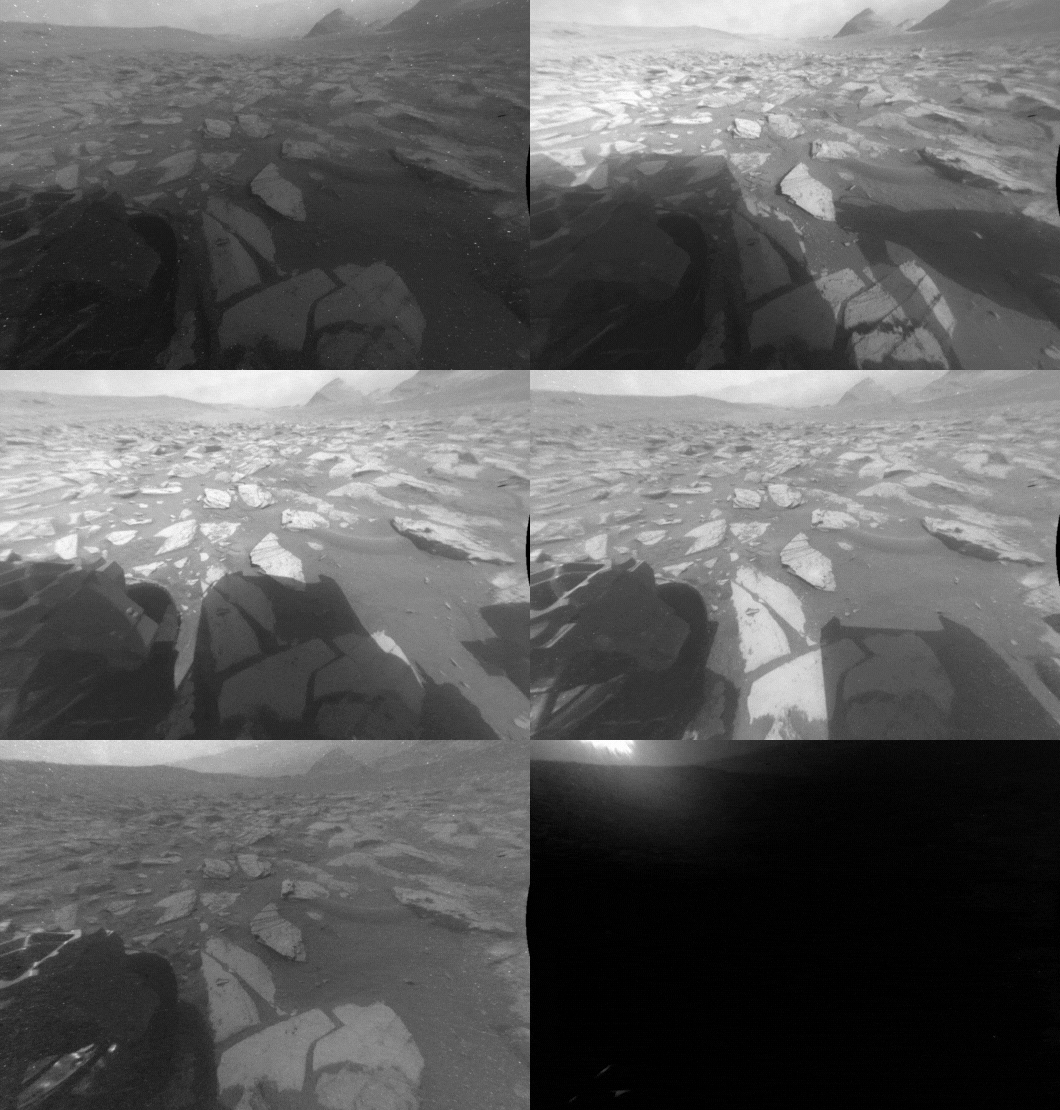
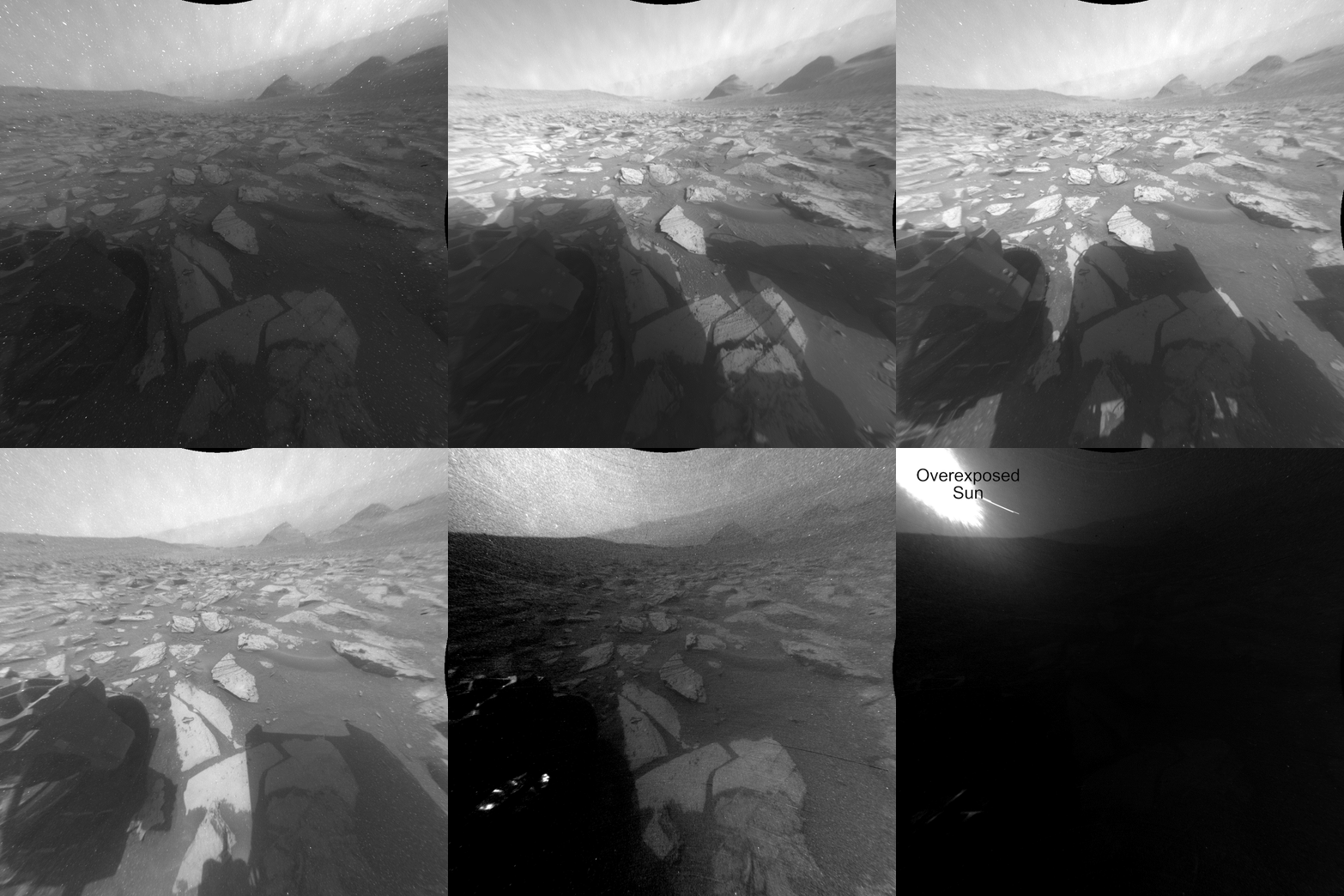
De marsrover Curiosity heeft stilstaand een opname van 12 uur gemaakt, waarbij je zowel de zonsopgang als zonsondergang kan zien. De beelden bieden een uniek inkijkje op hoe een dag op Mars eruitziet.
Normaal scheurt de rover Curiosity rond op Mars in de naam van de wetenschap. Echter komt het af en toe voor dat de zon tussen de aarde en de rode planeet gaat staan, waardoor signalen verstoord kunnen raken door geïoniseerde gassen van onze moederster. Dit evenement heet ook wel de zonneconjunctie en is de grootste reden dat wetenschappers één keer in de twee jaar een ‘pauze’ van twee weken inlassen om er zeker van te zijn dat apparatuur op Mars geen wilde dingen gaat doen. Voor het racemonster Curiosity betekent dit dus vooral parkeren en wachten totdat het evenement voorbij is. Tijdens deze geforceerde pitstop heeft de rover echter nog wel werk verricht. Zo heeft Curiosity op acht november een opname gemaakt van zonsopgang tot zonsondergang.
Beelden van de voorkant van de rover.
Credit: NASA
Hazcams De wetenschappers hadden gehoopt om een uniek weerfenomeen vast te leggen, maar helaas is dat niet gelukt. Wat we wel goed kunnen zien, is hoe een normale dag er op Mars uitziet. Zo zien we de schaduw van de rover over het oppervlak kruipen en zien we de zon in de lucht haar weg vervolgen. Helaas zijn de beelden in zwart-wit. Dit is omdat de zogenoemde ‘Hazcams’ zijn gebruikt voor de opname. Deze hazcams maken ‘slechts’ zwartwitfoto’s en hebben de belangrijke functie om ervoor te zorgen dat de rover niet over gevaarlijk terrein gaat rijden. Zo heeft Curiosity eerder rechtsomkeert moeten maken vanwege een enorme verzameling aan windkeien. Het grootste probleem hierbij is vooral de slijtage die passage door een met windkeien – of met andere gevaren – bezaaid gebied aan de wielen oplevert.
De achterste Hazcam van Curiosity legde de schaduw van de achterkant van de rover vast in deze 12 uur durende opname, kijkend naar de bodem van de Gale-krater. Een verscheidenheid aan factoren veroorzaakte verschillende beeldartefacten, waaronder een zwart stipje, het vervormde uiterlijk van de zon en de rijen witte pixels die uit de zon komen.
NASA/JPL-Caltech
Stoffig scherm De bovenstaande beelden zijn afkomstig van de voorkant van de rover. De onderstaande beelden zijn afkomstig van de achterkant van de rover. Het zijn vooral deze beelden waar de wetenschappers van NASA een aantal kanttekeningen bijzetten. Zo is het ten eerste goed om te onthouden dat de beelden enigszins ‘stoffig’ over kunnen komen. De grootste reden hiervoor is dat er (helaas) nog niemand langs is geweest om de lenzen op te poetsen, en er dus elf jaar aan stof op de buitenkant van de rover zit. Ten tweede valt het op dat tijdens de zonsondergang er een soort van ‘witte sneeuw’ in de lucht lijkt te hangen. Dit heeft te maken met de camera’s die zichzelf proberen af te stellen op het licht en hierbij een gek effect lijken te veroorzaken, een effect dat ook wel te boek staat als ‘hot pixels’. Als laatste wijzen de wetenschappers op een willekeurig zwart vlekje dat vlak voor de zonsondergang op het beeld verschijnt. Dit vlekje is het gevolg van een kosmische straal die toevallig op dat moment de hazcams terroriseerde.
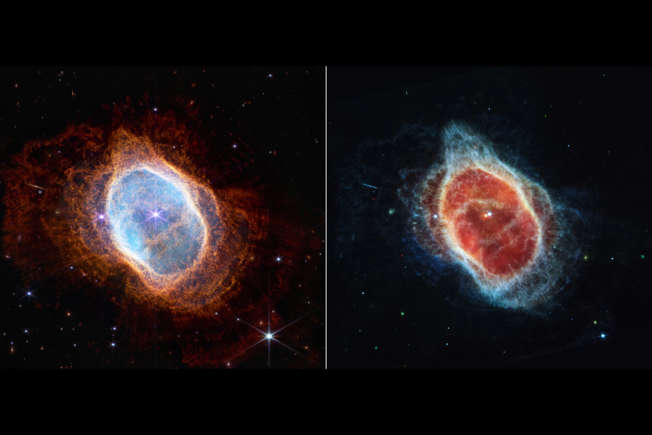
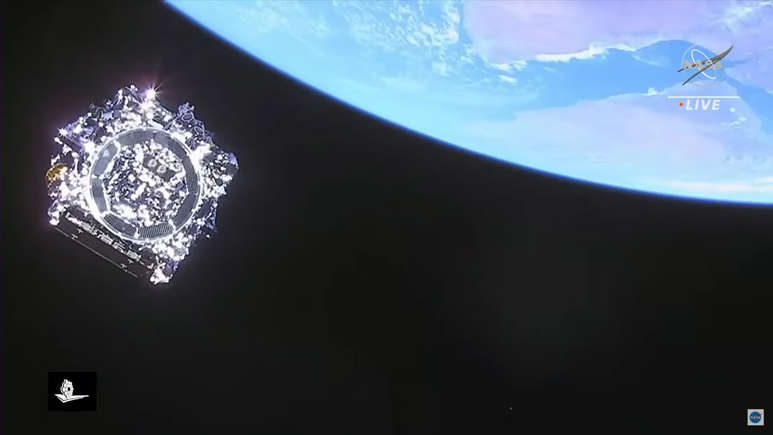
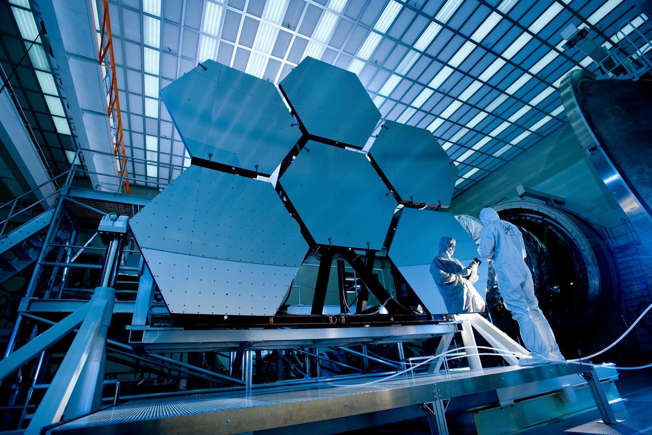
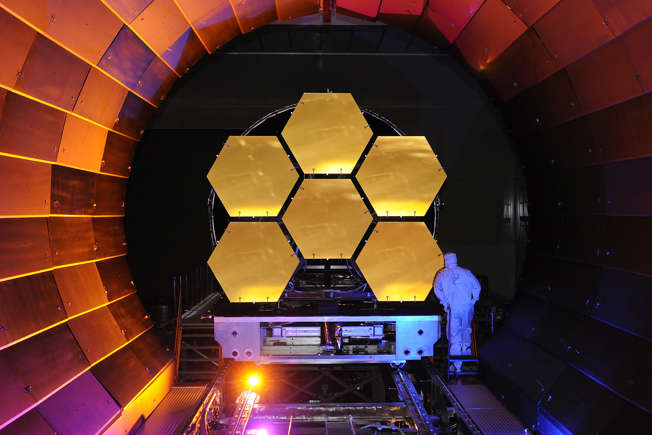
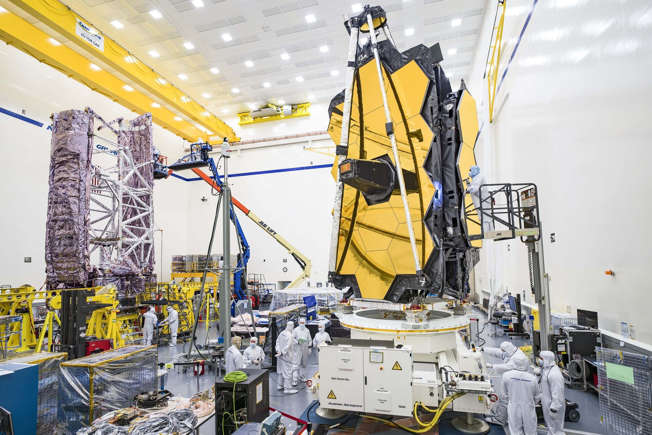
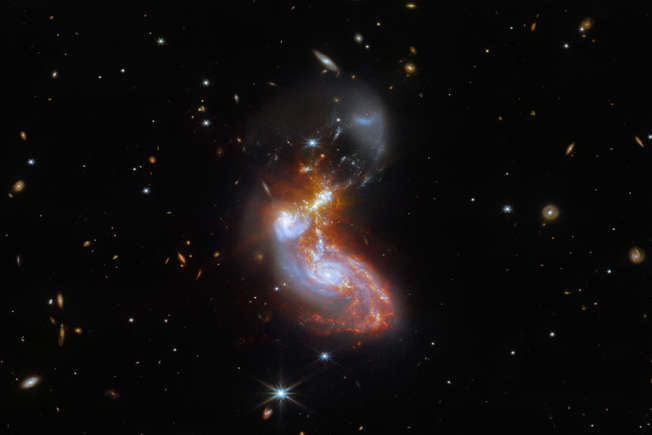
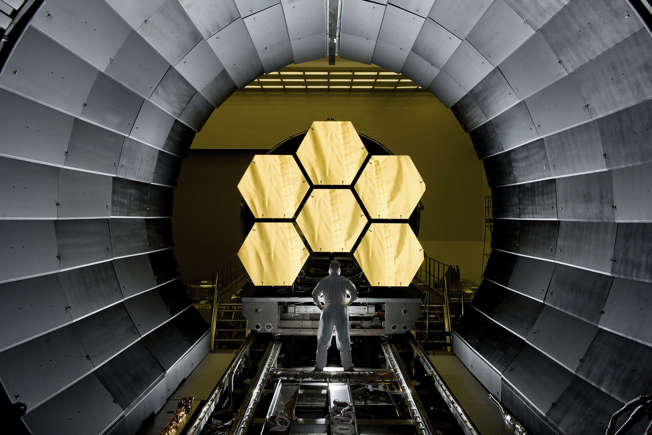
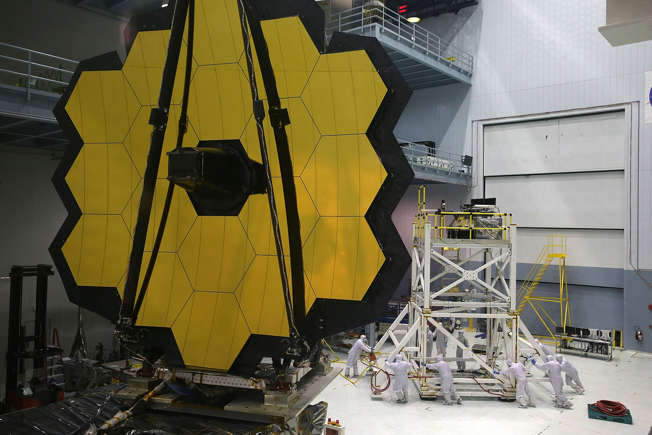
The James Webb Space Telescope filled us with awe this year. Here's a look back on how.
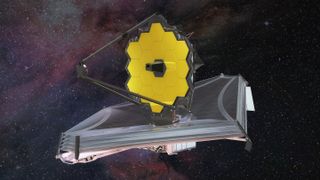
An artist's impression of the James Webb Space Telescope.
(Image credit: Northrop Grumman)
On Christmas morning two years ago, astronomers and space fans received the gift they'd been waiting on for 30 years: the launch of the James Webb Space Telescope(JWST), the world's biggest, most daring endeavor to probe the earliest stars and galaxies in the universe.
This year, the space observatory has continued to deliver breathtaking and scientifically valuable images of the cosmos. Here's a look back at the JWST discoveries that altered our understanding of the universe in 2023.
1. THE JWST TAKES A FRESH LOOK AT OUR SOLAR SYSTEM
(Image credit: NASA, ESA, CSA, STScI, Ricardo Hueso (UPV), Imke de Pater (UC Berkeley), Thierry Fouchet (Observatory of Paris), Leigh Fletcher (University of Leicester), Michael H. Wong (UC Berkeley), Joseph DePasquale (STScI))
Although the JWST's purpose is to see some of the first stars and galaxies in the universe, its fresh look at our own solar system has been nothing short of breathtaking.
Take this image, which, in October, revealed a high-speed jet stream on Jupiter, previously unseen despite being over 3,000 miles (4,800 kilometers) wide and traveling at about 320 mph (515 km/h).
2. NEARBY EXOPLANET HAS ABUNDANT LIFE-SUPPORTING MOLECULE
An artist's concept of K2-18 b. (Image credit: ESA/Hubble, M. Kornmesser)
In September, the JWST discovered methane and carbon dioxide in the atmosphere of a fairly nearby exoplanet named K2-18 b, which circles a cool star 120 light-years from Earth and is larger than our planet but smaller than the giant planets in our solar system.
Previous observations with the Hubble Space Telescope had indicated that K2-18 b may be s a "Hycean world," an exoplanet that hosts thick, hydrogen-rich atmospheres with oceans of liquid water underneath. Recent observations with the JWST support that hypothesis, as the new data shows evidence for abundant methane and carbon dioxide but little ammonia.
"These results are the product of just two observations of K2-18 b, with many more on the way," study co-author Savvas Constantinou, an astronomer at the University of Cambridge, said in a statement. "This means our work here is but an early demonstration of what Webb can observe in habitable-zone exoplanets."
An artist's impression of an irregularly shaped asteroid in deep space. (Image credit: N. Bartmann (ESA/Webb), ESO/M. Kornmesser and S. Brunier, N. Risinger (skysurvey.org))
In February, scientists were thrilled with the JWST's unexpected discovery of a small asteroid embedded in the main asteroid belt between Mars and Jupiter. Like most residents of that region, the space rock, which is about as tall as the Washington Monument, is thought to be a remnant of the formation of the solar system and thus contains tantalizing history about its evolution.
Asteroids less than a mile long are difficult to spot with other telescopes, so the find underscored the telescope's usefulness closer to home.
4. THE JWST FINDS MASSIVE, MYSTERIOUS GALAXIES IN THE INFANT UNIVERSE
These six galaxies may force astronomers to rewrite cosmology books. (Image credit: NASA, ESA, CSA, I. LABBE)
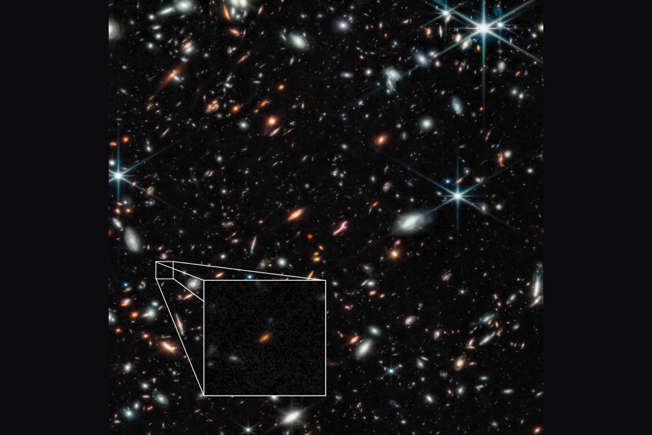
In February, scientists announced the discovery of galaxies as massive as the Milky Way sprinkled across the JWST's images of the universe just 500 million to 700 million years after the Big Bang. From what existing theories and models tell us, the galaxies the JWST found are too big, and the mature red stars in them too old, that the study authors said the find "creates problems for science."
"It calls the whole picture of early galaxy formation into question," study co-author Joel Leja, an astronomer at Penn State, said in a statement.
5. AN INTENSIFYING DEBATE OVER THE UNIVERSE'S EXPANSION RATE
Combined observations from NASA’s NIRCam (Near-Infrared Camera) and Hubble’s WFC3 (Wide Field Camera 3) show spiral galaxy NGC 5584, which resides 72 million light-years away from Earth. (Image credit: NASA, ESA, CSA, and A. Riess (STScI))
We know that the universe is expanding at an ever-increasing rate, but we don't know precisely how fast. The issue has become a debate centered on resolving the correct value of the Hubble constant, an important number for estimating the universe's expansion rate. Right now, model estimates for the Hubble constant don't agree with values based on telescope observations.
This year, the JWST observed a class of stars known as Cepheid variables, which are usually humongous stars some 100,000 times brighter than the sun and the most reliable source to measure cosmic distances (and thus to tease out the universe's expansion rate). But instead of resolving the debate, the JWST's data only deepened the ongoing debate over the Hubble constant.
"I don't care what the value of the Hubble constant comes out to be," said Adam Riess, an astronomer at Johns Hopkins University and a Nobel laureate. "I want to understand why our best tools — our gold standard tools — are not agreeing with each other."
6. SHINING A SPOTLIGHT ON THE FIRST SUPERMASSIVE BLACK HOLES
The quasar HSC J2236+0032 as seen by the James Webb Space Telescope. (Image credit: Ding, Onoue, Silverman, et al.)
This year, the JWST helped astronomers see starlight from two early galaxies where they think one of the first supermassive black holes emerged. The JWST observed the galaxies as they were when the universe was younger than 1 billion years, showing how, over time, black holes gain unfathomable masses — often millions or billions of times that of the sun.
7. COMPLEX ORGANIC MOLECULES IN A PRIMORDIAL GALAXY
Astronomers using the James Webb Space Telescope discovered evidence of complex organic molecules similar to smoke or smog in the distant galaxy shown here. In this false-color image, the foreground galaxy is shown in blue, while the background galaxy is red. The organic molecules are highlighted in orange. (Image credit: J. Spilker / S. Doyle, NASA, ESA, CSA)
In June, astronomers revealed that the JWST had detected intriguing carbon-based molecules, similar to the ones found in oil and coal deposits on Earth, from over 12 billion years ago, when the universe was just 10% of its current age. In space, these molecules link to minuscule dust grains. Detecting them had been challenging because of the limits of our telescopes. However, "Webb really makes looking for organic molecules look too easy," Justin Spilker, an astronomer at Texas A&M University, told Space.com.
8. YUP, MAISIE'S GALAXY IS AMONG THE EARLIEST EVER SPOTTED
Maisie's galaxy, as captured by the JWST earlier this year. (Image credit: NASA/STScI/CEERS/TACC/ University of Texas at Austin/S. Finkelstein/M. Bagley)
This blurry orange blob, imaged by the JWST in summer 2022, is known as Maisie's galaxy, and in August 2023, astronomers announced that it's one of the earliest galaxies ever discovered. The galaxy seems to have existed when the universe was only 390 million years old, making it one of the four earliest galaxies ever seen.
"This was the undiscovered frontier where we really didn't know how the galaxies formed or what they looked like until we went and looked for them with the JWST," study author Steven Finkelstein, an astronomer at the University of Texas at Austin, told Space.com.
9. THE MOST DISTANT SUPERMASSIVE BLACK HOLE EVER SEEN
A panoramic vista of over 100,00 galaxies known as the Cosmic Evolution Early Release Science (CEERS) Survey. (Image credit: Image: NASA, ESA, CSA, Steve Finkelstein (UT Austin), Micaela Bagley (UT Austin), Rebecca Larson (UT Austin).Image processing: Alyssa Pagan (STScI))
In July, astronomers announced that the JWST had detected the most distant active supermassive black hole ever seen, whose host galaxy formed just 570 million years after the Big Bang. However, this ancient black hole has puzzlingly low mass — just 9 million times that of the sun. For comparison, most of these cosmic beasts weigh over 1 billion solar masses. "It is still difficult to explain how it formed so soon after the universe began," the researchers said.
10. THE JWST REDISCOVERS AN ANCIENT GHOSTLY GALAXY
The galaxy AzTECC71 as imaged by the James Webb Space Telescope. (Image credit: J. McKinney/M. Franco/C. Casey/The University of Texas at Austin)
The JWST's sighting of a fuzzy galaxy embedded deep inside a dust cloud has been of recent interest to astronomers, in part because it is seen as it appeared just 900 million years after the Big Bang, when the very first stars were appearing. But astronomers are also interested in the science lessons this galaxy is waiting to reveal, "potentially telling us there's a whole population of galaxies that have been hiding from us," Jed McKinney, an astronomer at the University of Texas at Austin, said in a statement.
"When we look at the James Webb data, there are two competing possibilities for these objects," Katherine Freese, a professor of physics at The University of Texas at Austin, said in a statement. "One is that they are galaxies containing millions of ordinary, population-III stars. The other is that they are dark stars. And believe it or not, one dark star has enough light to compete with an entire galaxy of stars."
Astronomers think these types of stars are powered by dark matter, the elusive substance that makes up 85% of the matter in our universe but is invisible to telescopes. If dark stars really do exist, their presence would help solve the puzzling observations of how a very young universe grew to host so many large galaxies as observed by the JWST, researchers say.
12. THE EARLIEST GALAXIES LOOKED SURPRISINGLY SIMILAR TO OUR MILKY WAY
Images from JWST of the newly discovered Milky Way-like galaxies seen in the early universe. Each row shows a different galaxy as observed in the different infrared wavelengths where JWST takes imaging data. (Image credit: L. Ferreira, C. Conselice)
"Based on our results astronomers must rethink our understanding of the formation of the first galaxies and how galaxy evolution occurred over the past 10 billion years," study co-author Christopher Conselice, a professor of astronomy at the University of Manchester in the U.K., said in a statement.
Helicity Space, a startup founded in 2018, is developing a fusion drive poised to transform space travel. With a fresh round of investment, the company is developing a proof-of-concept for a fusion-powered propulsion system that can get from Earth to Mars in two months.
In a recent press release, the space-based startup recently secured $5 million in seed funding from Airbus Ventures, TRE Ventures, Voyager Space Holdings, E2MC Space, Urania Ventures, and Gaingels.
Unlike traditional rockets that rely on chemical reactions, Helicity’s fusion drive operates on a magneto-inertial fusion method. This involves fusing two hydrogen isotopes into helium, releasing immense energy – ten million times more per unit mass than chemical fuels.
According to Helicity, the core technology behind their fusion drive efficiently converts electricity into plasma heating, using a unique approach to scale fusion conditions and directly produce thrust. Their method, distinct from conventional magnetic or inertial (laser) fusion, employs self-organized Taylor relaxation and magnetic reconnection physics, combined with a peristaltic magnetic compression scheme.
In very simple terms, the engine uses hot ionized plasma gas heated by magnetic fields that are constantly forced together to the point where they must then break apart. It is this seesaw of magnetic forces that generates vast amounts of energy, heating the plasma to the point where fusion occurs, forcing the nuclei so close that they overcome their electrostatic repulsion and fuse together. To simplify this even more, the energy created by that fusion is aimed out of the tailpipe of the Helicity Drive, and you generate a helluva lot of thrust.
So much so that it cuts the current seven or eight-month trip to Mars down to two, or the six-year trip to Jupiter down to just one.
One of the key advantages of Helicity’s fusion drive is its fuel and propellant efficiency. It enables faster travel over interplanetary distances, with less exposure to space radiation and the agility to alter trajectories or abort missions if necessary. The Helicity Drive creates short bursts of fusion conditions in a design optimized for propulsive plasma exhaust, thus providing acceleration with each pulse. You proverbially slam on the gas pedal, accelerate, and then take your foot off the gas letting momentum do the work. This propulsion method can be deployed before achieving continuous power generation, significantly advancing the feasibility of fusion propulsion in space.
Helicity’s efforts are part of a larger movement to leverage fusion technology in space exploration. Fusion power, unlike fission, merges atoms together, releasing vast energy amounts with safer byproducts. This contrasts starkly with fission’s splitting of atoms, which leads to radiation issues and the complex disposal of irradiated waste. Helicity’s fusion engines use multiple magnetically-controlled, super-heated plasma jets to propel spacecraft, marking a substantial shift from conventional rocket technology, which requires large amounts of super-cold or highly explosive fuel.
“Fusion propulsion can contribute to Earth’s environmental goals indirectly by enabling offworld mining and industry, reducing terrestrial resource consumption and ecological impact,” explained Helicity co-founder Dr. Setthivoine You in an interview. “Ultimately, we see our technology playing a significant role in both space exploration and Earth’s sustainable future.”
The company’s vision extends to catalyzing humanity’s spacefaring ambitions, boosting both human and robotic exploration, and possibly leading to ventures like asteroid mining. The technology’s scalability and practical use in space, even before establishing self-sustaining reactors, demonstrate its potential for early testing and gradual scaling up.
Helicity Space collaborates with top scientific institutes globally, including the California Institute of Technology and the University of Tokyo. Supported by entities like the U.S. Department of Energy’s Innovation Network for Fusion Energy, these partnerships underscore the scientific community’s interest in and support for Helicity’s groundbreaking work.
“We’re currently focused on proving the technology for space propulsion. Once we achieve this, we anticipate drawing more substantial interest and investment, including from energy companies, for broader applications,” said Dr. You.
While building a working fusion drive will require more than their current $5 million dollar investment, the fact that there was funding clearly shows there is a hard push for novel space technology. While still in development, the potential applications of this technology in enhancing human and robotic space exploration are immense.
MJ Banias is a journalist who covers security and technology. He is the host of The Debrief Weekly Report. You can email MJ at mj@thedebrief.org or follow him on Twitter @mjbanias.
NASA’s exploration of our skies and space will continue in 2024. Here are some of the high-profile missions that are currently underway, and some events are just a few weeks away, including NASA’s newest stride toward the Moon.
The first flight for its Commercial Lunar Payload Services (CLPS) program is scheduled to launch on January 8. NASA’s Artemis II mission, where humans would return to lunar orbit for the first time since Apollo, could fly as early as November 2024.
There’s plenty to watch from Earth’s surface, too. NASA is debuting a supersonic plane in 2024. There’s also a major astronomical event on April 8: a total solar eclipse.
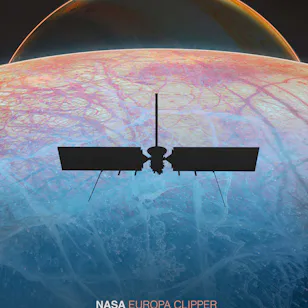
Far beyond the Earth and the Moon, NASA will send its Europa Clipper spacecraft as early as October 10, which will explore a possible life-sustaining moon around Jupiter.
Here’s a closer look at five major NASA goals for the new year.
Europa intrigues astrobiologists. The Jupiter moon is coated in ice and cracks along the surface as well as jumbled features called chaos regions, hint that it might be geologically active. Jupiter could be stretching and pulling on Europa to the point that it warms it up inside, allowing ice to remain as liquid water below the surface.
An abundance of salt in this hidden ocean would explain why NASA data shows Europa conducting some of Jupiter’s magnetic field. And in the depths, hydrothermal vents may be erupting in a manner like the “black smokers” at the bottom of Earth’s oceans. Dark, salty, deep aquatic regions on Europa might have the recipe for microbial life. But finding out if this is true will be hard. Jupiter has a mighty influence. To evade the danger of Jupiter’s high radiation, NASA’s Europa Clipper spacecraft will take data as it flies by the moon, “clipping” it. Europa Clipper could launch as early as October 10, 2024, though it won’t arrive at Jupiter until 2030.
2. NASA INSTRUMENTS WILL FLY TO THE MOON ONBOARD ASTROBOTIC’S PEREGRINE LANDER
ANDREW MERRY/MOMENT/GETTY IMAGES
Pittsburgh-based private space company Astrobotic, is on track to become the first commercial company to successfully land a craft on the surface of the Moon. Their stout, six-foot-tall Peregrine lander will launch from Cape Canaveral, Florida, on board United Launch Alliance’s new Vulcan rocket on January 8, 2024. If Peregrine successfully lands on the Moon on February 23, it would usher in NASA’s partnership with private companies for ongoing delivery services to the Moon instead of building carriers themselves. Once on the lunar regolith, a handful of NASA payloads will begin collecting data about the lunar environment that could give NASA a leg-up on how to approach longer-term Moon exploration with crewed missions.
3. A TOTAL SOLAR ECLIPSE WILL BE SEEN ACROSS NORTH AMERICA
Photo taken on Dec. 14, 2020 shows a total solar eclipse witnessed in Freire, La Araucania Region, Chile.
On April 8, 2024, the Moon’s shadow will block the entire disk of the Sun, hiding all but the star’s outer corona. The event is like a sequel to the 2017 Great American total solar eclipse: The lunar shadow will align with the Sun over a stretch of North America. The total solar eclipse begins in the Pacific Ocean, makes landfall in western Mexico, and then moves northeast across the continent, from Texas through Vermont, then out towards eastern Canada, and ending in the northern Atlantic Ocean. NASA officials will be watching from the Indianapolis Motor Speedway in Indiana.
4. QUESST SONIC PLANE
Artist illustration of NASA’s X-59 Quesst aircraft.
In 2024, NASA will seek to fly its Quesst mission for the first time. The X-59 plane would fly over American land at supersonic speed, hopefully minus the harsh noise. X-59 will fly over several communities, whose members would then report back to the space agency how they perceived the plane’s sound. National and international regulators currently prohibit commercial supersonic flight over land because of the boom noise. Quesst’s success could revolutionize commercial air travel by clearing the sonic obstacle, allowing for supersonic flights, and thus significantly reducing travel time.
5. ARTEMIS II, WITH ITS FOUR-PERSON CREW, COULD ORBIT THE MOON
Left to right, Artemis II astronauts Pilot Victor Glover, Commander Reid Wiseman, and Mission Specialists Christina Hammock Koch and Jeremy Hansen stand in front of the Artemis II Orion Crew Module.
NASA’s Artemis program has repeatedly faced delays, so it’s possible that the follow-up to 2022’s Artemis I mission might not happen by their 2024 target. But the four astronauts of the Artemis II mission have already begun training to ready themselves for that historic launch date when they could become the first humans to fly to the Moon in more than 50 years. Reid Wiseman, Victor Glover, Christina Koch, and Jeremy Hansen could fly as soon as November 2024 on a nine-day mission around the Moon and back and come in faster and hotter into Earth’s atmosphere than any crew has ever done before.
Artist's rendering of DARPA's experimental X-65 CRANE aircraft being build by Aurora Flight Sciences.
(Image credit: DARPA)
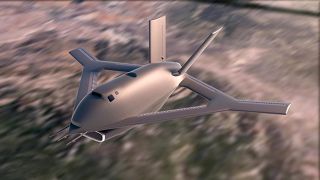
DARPA and Aurora Flight Sciences have begun building the first full-scale X-65 aircraft to demonstrate a new method of flight control that uses no external moving parts.
The X-65 is an experimental jet being developed by the Control of Revolutionary Aircraft with Novel Effectors (CRANE) program overseen by DARPA, (Defense Advanced Research Projects Agency), the Pentagon's research and development agency. Since the first aircraft were invented, they have been controlled by moving surfaces such as rudders, flaps, elevators and ailerons.
The CRANE program aims to do away with these entirely and develop an aircraft controlled fully by jets of pressurized air that alter how the surrounding air flows over the aircraft while in flight.
However, in order to minimize risk, the first X-65 demonstrator will feature both conventional moving control surfaces and what are known as active flow control (AFC) actuators, the jets of pressurized air.
"The X-65 conventional surfaces are like training wheels to help us understand how AFC can be used in place of traditional flaps and rudders," Richard Wlezien, program manager for CRANE, said in a DARPA statement. "We'll have sensors in place to monitor how the AFC effector's performance compares with traditional control mechanisms, and these data will help us better understand how AFC could revolutionize both military and commercial craft in the future."
The X-65 will feature a 30-foot (9-meter) wingspan and weigh 7,000 pounds (3,200 kg), making it roughly the size of the T-38 trainer aircraft used by NASA astronauts and the U.S. military. It will be able to reach speeds of up to Mach 0.7, which DARPA says will "make the flight-test results immediately relevant to real world aircraft design."
"The X-65 conventional surfaces are like training wheels to help us understand how AFC can be used in place of traditional flaps and rudders," Wlezien said in the statement. "We'll have sensors in place to monitor how the AFC effectors' performance compares with traditional control mechanisms, and these data will help us better understand how AFC could revolutionize both military and commercial craft in the future."
The X-65 will even feature a modular design, meaning its wings and active flow control systems will be able to be swapped out in the future, allowing it to be used for additional testing in the future after the conclusion of the CRANE program.
In the statement, DARPA says the X-65 could be completed and unveiled as soon as early 2025, with the first flight occurring as soon as summer of 2025.
Een ontdekking die alles verandert dat we weten over ons universum De James Webb-ruimtetelescoop is door de internationale gemeenschap gebouwd om het heelal beter te kunnen begrijpen. Beelden die tijdens recent ruimteonderzoek zijn gemaakt, hebben ons begrip van het universum mogelijk nog complexer gemaakt
Iets dat niet zou moeten bestaan Foto's die zijn gemaakt tijdens de verkenning van een stukje nachtelijke hemel dichtbij de Grote Beer, hebben verschillende abnormaal oude sterrenstelsels onthuld die niet zouden moeten bestaan.
Zes enorme sterrenstelsels In de door de James Webb ruimtetelescoop gemaakte opnamen waren subtiele sporen van zes massieve sterrenstelsels verborgen. Volgens astrofysici moeten deze kort na de oerknal zijn ontstaan. Deze sterrenstelsels zijn zo oud en zo groot dat ze onmogelijk echt kunnen zijn, aldus astrofysici.
Veel groter dan verwacht Volgens de wetenschappelijke nieuwswebsite phys.org verklaart Joel Leja, een professor in de astronomie en astrofysica aan de Penn State University, dat deze objecten veel zwaarder zijn dan verwacht. Ze is een van de onderzoekers die het licht van de ontdekte sterrenstelsels modelleerde.
Volwassen sterrenstelsels uit het begin der tijden "We hadden verwacht dat we op dit moment alleen kleine, jonge sterrenstelsels zouden vinden, vergelijkbaar met babystelsels. Tot onze verrassing hebben we sterrenstelsels ontdekt die net zo volwassen zijn als de onze. Sterrenstelsel die komen uit een tijd die wij beschouwen als het begin van het universum", voegde Leja eraan toe.
Grootte doet er toe Zowel de leeftijd als de grootte van deze sterrenstelsels zijn van immens belang. Als de voorlopige gegevens juist zijn, kan dit onze huidige kennis over de vorming van het vroege universum op zijn kop zetten.
13 miljard jaar oud "Elk van de kandidaat-sterrenstelsels bestonden mogelijk aan het begin van het universum. Ongeveer 500 tot 700 miljoen jaar na de oerknal, of meer dan 13 miljard jaar geleden", schreef Daniel Strain van de Universiteit van Boulder Colorado.
“Ze zijn ook gigantisch” "Ze zijn ook gigantisch," voegde Strain, eraan toe. ''Elk sterrenstelsel bevat bijna net zoveel sterren als het moderne Melkwegstelsel."
Er is meer onderzoek nodig Onderzoekers hebben nog meer gegevens nodig om te bevestigen dat de sterrenstelsels inderdaad zo oud en groot zijn als aangegeven. Toch wordt in Science Daily in de publicatie opgemerkt dat deze ontdekking "een veelbelovende voorproef biedt van hoe dankzij de komst van James Webb, de astronomieboeken herschreven kunnen worden", voegde Leja eraan toe.
"Het is waanzinnig" "Het is waanzinnig", zegt Erica Nelson, een astrofysicus van de Universiteit van Colorado en één van de co-auteurs van het onderzoek dat de zes oude sterrenstelsels identificeerde.
"Deze sterrenstelsels hebben geen tijd gehad om zich te vormen" “Je verwacht gewoon niet dat het vroege heelal zich zo snel kan organiseren. Deze sterrenstelsels hebben geen tijd gehad om zich te vormen”, voegde Nelson eraan toe.
Dit verandert alles wat we weten Leja herhaalde Nelson's verklaring en zei dat ze ontdekt hebben dat massieve sterrenstelsels zich extreem vroeg in de geschiedenis van het universum hebben gevormd. Dit betekend een ommekeer in de wetenschap. Mensen dachten dat bepaalde zaken gewoon vaststonden in de wetenschap, maar daar klopt niets meer van.
"Universele vernietigers" Volgens Leja hebben verschillende leden van het onderzoeksteam informeel verwezen naar de zes superzware sterrenstelsels die ze ontdekt hebben als 'universele vernietigers'. Dit vanwege de implicaties die ze zouden kunnen hebben voor wat we nu weten over het heelal.
99% van de kosmologische modellen zijn fout Hoewel wetenschap soms moeilijk te begrijpen is, komt het er volgens Leja in wezen op neer dat elk van de zes sterrenstelsels zo groot zijn, dat ze niet overeenkomen met 99% van onze huidige kosmologische modellen.
De eerste keer kijken naar het vroege heelal "We keken voor het eerst in het zeer vroege universum en hadden geen idee wat we zouden vinden", zei Leja.
Alles staat nu ter discussie "Het blijkt dat we iets onverwachts hebben gevonden. Dit gaat eigenijk zorgen voor problemen in de wetenschap. Het hele beeld van de vroege vorming van sterrenstelsels wordt nu in twijfel gebracht.''
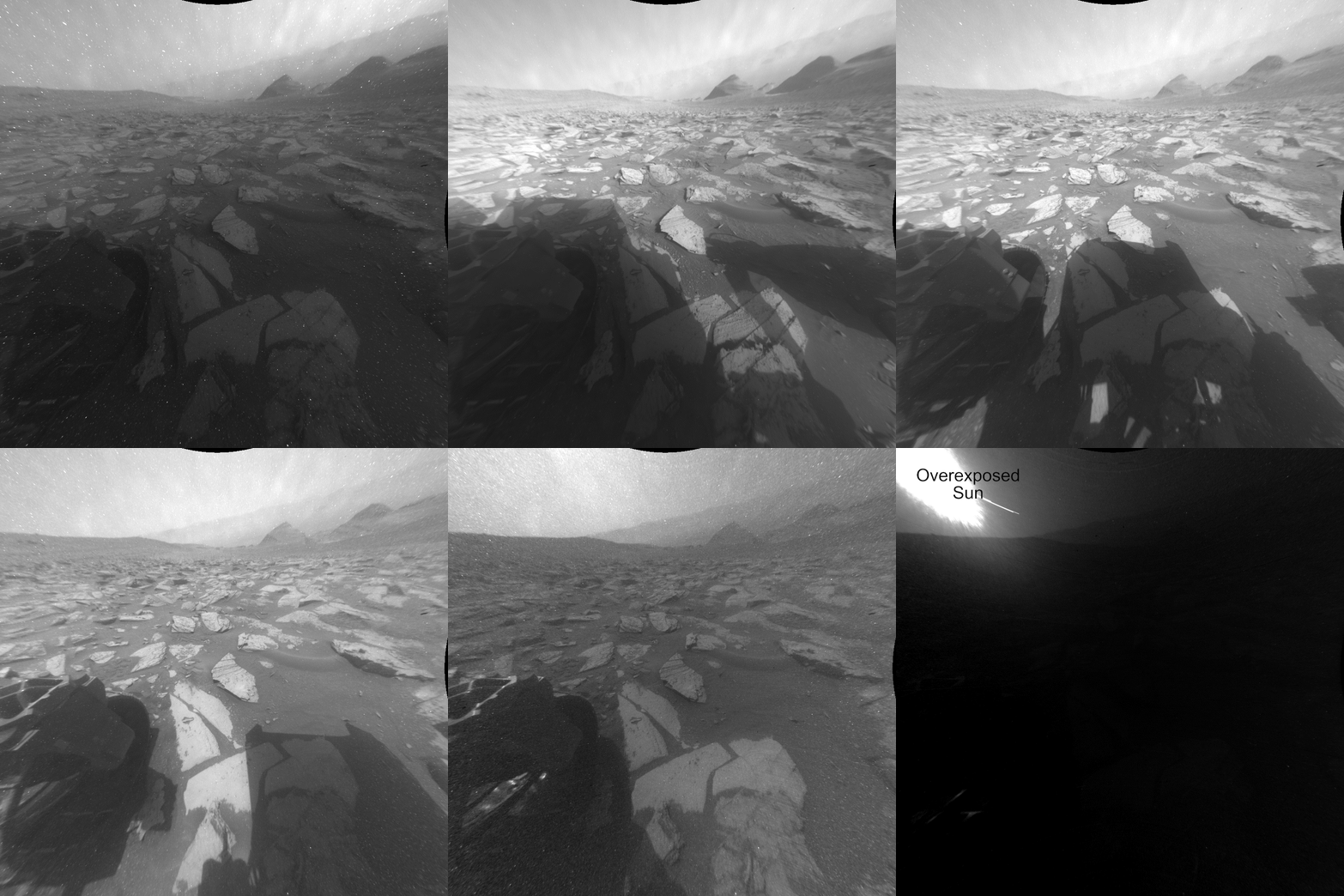
Curiosity’s rear Hazcam captured the shadow of the back of the rover in this 12-hour view looking toward the floor of Gale Crater. A variety of factors caused several image artifacts, including a black speck, the distorted appearance of the Sun, and the rows of white pixels that streak out from the Sun. NASA/JPL-Caltech
On November 8th, NASA’s Curiosity Rover paused its incessant science work and just watched the day unfold on Mars. The rover used its black-and-white Hazard-Avoidance Cameras (Hazcams) to watch an entire 12-hour day on Mars as the shifting Sun cast shadows across the Martian landscape. NASA chose this day because of the Mars solar conjunction when the Sun interferes with communications with the Red Planet, meaning the rover doesn’t do any roving about. The timelapse comprises 25 frames from both the front and rear Hazcams.
When the rover stays in one place, it works pretty well as a sundial, NASA says. You can see in the video below, posted on X, how the Sun and shadows move across Curiosity and the surrounding vistas. This is the first time the Hazcams were used to record 12 hours of images from a day on Mars.
The rover team back on Earth sent the instructions to record the timelapse videos just before the start of Mars solar conjunction because during this time, the Sun’s plasma interferes with communications between Earth and Mars. While the rover isn’t completely out of contact, no complex instructions are sent during the several weeks of potential radio interference.
The Hazcams are usually used to spot rocks, slopes, and other hazards that may be risky for the rover to traverse. Because Curiosity wasn’t doing any roving or other science, the team hoped that by using the Haxcams to record a day on Mars, they might be able to capture clouds or dust devils that could reveal more about the Red Planet’s weather. However, it was a relatively mild weather day on Mars, so no unusual weather events show up in the video.
The Hazcams have an autoexposure algorithm to deal with the various amounts of daylight at different parts of the day. For example, during mid-day, the algorithm settles on exposure times of around one-third of a second. By nightfall, that exposure time grows to more than a minute. This causes a typical sensor noise known as “hot pixels” that appears as white snow across the final image.
The video posted on X shows the first part of the day, with images from the front Hazcam. The view looks southeast along Gediz Vallis, a valley found on Mount Sharp. Curiosity has been ascending the base of the 3-mile-tall (5-kilometer-tall) mountain, which sits in Gale Crater, since 2014.
This annotated image from NASA’s Perseverance Mars rover shows its wheel tracks in Jezero Crater and a distant view of the first potential location it could deposit a group of sample tubes for possible future return to Earth. Credits: NASA/JPL-Caltech
At sunrise, the shadow of the rover’s 7-foot (2-meter) robotic arm moves to the left, and Curiosity’s front wheels emerge from the darkness on either side of the frame. Also visible at left is a circular calibration target mounted on the shoulder of the robotic arm. Engineers use the target to test the accuracy of the Alpha Particle X-ray Spectrometer, an instrument that detects chemical elements on the Martian surface.
The second video, which is our lead animated gif image, shows the view of the rear Hazcam as it looks northwest down the slopes of Mount Sharp to the floor of Gale Crater. The rover’s right rear wheel is visible, along with the shadow of Curiosity’s power system. NASA explained that a small black artifact that appears at the left midway through the video, during the 17th frame, resulted from a cosmic ray hitting the camera sensor. Likewise, the bright flashing and other noise at the end of the video are the result of heat from the spacecraft’s power system affecting the Hazcam’s image sensor.
How well does your own dozen-plus-year-old camera work? NASA said that speckled appearance of the images, especially prominent in the rear-camera video, is due to 11 years of Martian dust settling on the lenses. You can see in the image above how dust settles on many parts of the rover.
Curiosity launched from Earth on November 26, 2011 and landed on August 4, 2012.
NASA’s Juno spacecraft has been getting closer and closer to Jupiter’s volcanic moon Io with each recent orbit. Juno is in its 57th orbit of Jupiter, and on December 30th, Juno came to within 1500 km (930 miles) of Io’s surface. It’s been more than 20 years since a spacecraft came this close.
The Galileo spacecraft travelled over the moon’s south pole in 2001, coming to within 181 km (112 miles.) Galileo showed us a lot about the nature of Io’s surface.
But Juno is a different spacecraft with more modern instruments and cameras that will fly by Io multiple times. One of the mission’s specific goals is to determine if Io has a magma ocean or not. And while the spacecraft’s suite of scientific instruments can shed light on that question, Juno also carries a powerful camera that rides shotgun: Junocam.
Junocam was included with the spacecraft primarily to satisfy us, the interested public around the world. It takes high-resolution visible light images that are available for anyone to process and share. Two other imagers were also busy during the Io flyby. One is the Jovian Infrared Auroral Mapper (JIRAM), which takes images in infrared. The other is the Stellar Reference Unit, which usually takes images of stars for navigation.
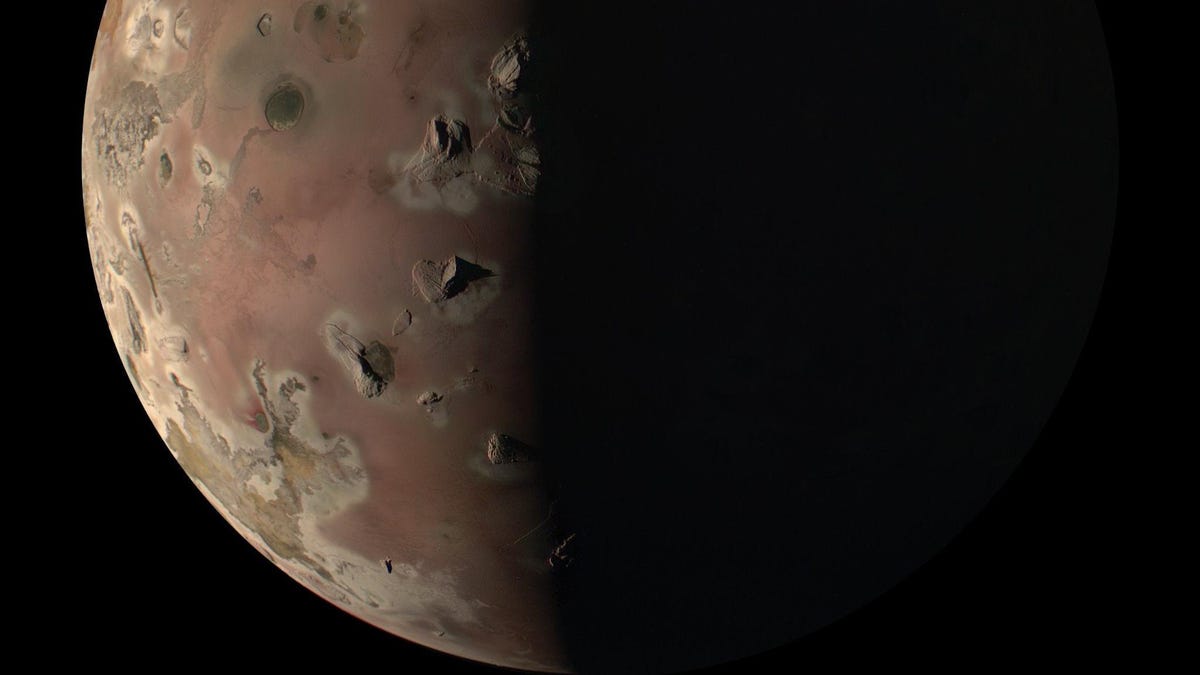
Io’s forbidding surface looks almost inviting in this Junocam image processed by Kevin Gill. But don’t be fooled: Io is a volcanic hellscape. If you’d like a phone wallpaper version of this image, Kevin made one here. Image Credit: NASA / JPL-Caltech / SwRI / MSSS / Kevin Gill
Junocam images get the most attention because NASA makes them available for anyone to process and post. Junocam captured six separate images of the volcanic moon, including black and white and colour. The image below is a composite showing the lit and shadowed sides of Io, processed by Hemant Dara.
Scientists know that Io is the most volcanic body in the Solar System by far. But they hunger for more detailed knowledge of its interior. Juno’s series of flybys will allow researchers to watch its volcanoes over time, which will help lead to some new understandings.
“By combining data from this flyby with our previous observations, the Juno science team is studying how Io’s volcanoes vary,” said Scott Bolton, Juno’s principal investigator and a scientist at the Southwest Research Institute, in a statement issued before this most recent flyby. “We are looking for how often they erupt, how bright and hot they are, how the shape of the lava flow changes, and how Io’s activity is connected to the flow of charged particles in Jupiter’s magnetosphere.”
Io remains volcanic to this day because of its eccentric orbit around Jupiter. Jupiter’s mass squeezes Io, and the squeezing generates heat that drives its volcanoes. The other Galilean moons add to the effect. The tidal force is so strong that Io’s surface can rise and fall by as much as 100 meters.
Io is about the same size as Earth’s Moon, yet it’s covered in hundreds of active volcanoes. Eruptions can launch lava dozens of kilometres above the moon’s surface. There’s so much volcanic activity on the surface of Io that some lava flows are hundreds of kilometres long. These voluminous eruptions are like the ones that triggered mass extinctions here on Earth.
Juno’s next Io flyby will be on February 3rd. During that visit, Juno will also approach about 1500 km (930 miles) above Io’s surface.
“With our pair of close flybys in December and February, Juno will investigate the source of Io’s massive volcanic activity, whether a magma ocean exists underneath its crust, and the importance of tidal forces from Jupiter, which are relentlessly squeezing this tortured moon,” said Bolton.
Juno is nearing the end of its mission in 2025. One of the hazards that’s bringing its end is Jupiter’s intense radiation. The spacecraft’s orbits are designed to protect it from Jupiter’s radiation, except when it approaches the planet for closer looks. It has to remove itself from the intense radiation to both extend the life of its electronics and allow it to send data back to Earth.
Juno was designed to withstand only 17 orbits of Jupiter but has so far survived 57. With a few more to come, the mission still has lots to teach us about Io and the Jovian system. No doubt we’ll be gifted more stunning images and science as it completes its mission.
“Io is only one of the celestial bodies which continue to come under Juno’s microscope during this extended mission,” said Juno’s acting project manager, Matthew Johnson of NASA’s Jet Propulsion Laboratory in Southern California. “As well as continuously changing our orbit to allow new perspectives of Jupiter and flying low over the nightside of the planet, the spacecraft will also be threading the needle between some of Jupiter’s rings to learn more about their origin and composition.”
Io’s primary mission ended in July 2021, and its current extended mission will end in September 2025. At that time, the spacecraft will be sent plunging to its destruction in Jupiter’s atmosphere, ending its nine-year mission.
But these pictures of Io will always be part of its legacy.
A solar-powered balloon mission detected a repeating infrasound noise in the stratosphere. Scientists don't know what is making it.
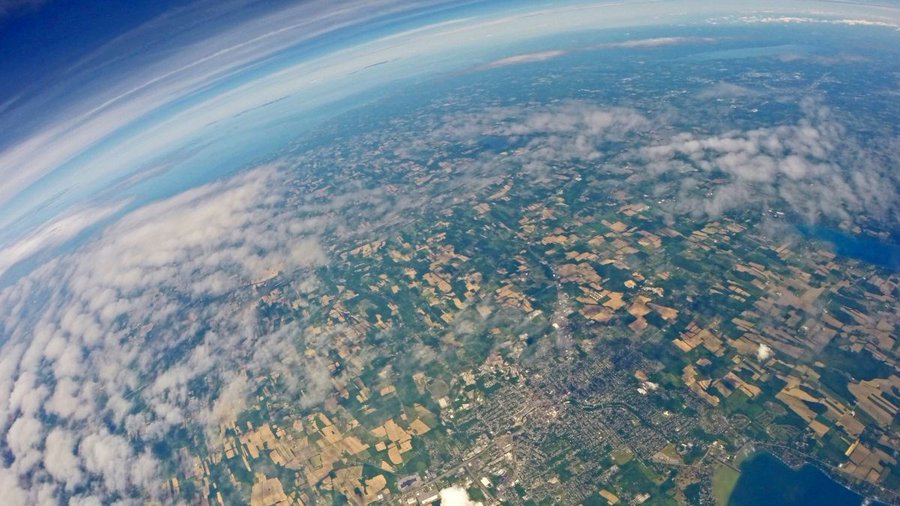
A view of Earth from a high-altitude balloon.
(Image credit: Matt Champlin/Getty Images)
Scientists have detected sounds high in Earth's atmosphere that can't be identified.
A solar-powered balloon mission launched by researchers from Sandia National Laboratories carried a microphone to a region of Earth's atmosphere found around 31 miles (50 km) above the planet called the stratosphere. This region is relatively calm and free of storms, turbulence and commercial air traffic, meaning microphones in this layer of the atmosphere can eavesdrop on the sounds of our planet, both natural and human-made.
However, the microphone in this particular study also heard strange sounds that repeat a few times per hour. Their source has yet to be identified. The sounds were recorded in the infrasound range, meaning they were at frequencies of 20 hertz (Hz) and lower, well below the range of the human ear. "There are mysterious infrasound signals that occur a few times per hour on some flights, but the source of these is completely unknown," Daniel Bowman of Sandia National Laboratories said in a statement..
To gather acoustic data from the stratosphere, Bowman and the team used devices initially designed to monitor volcanoes called microbarometers that are capable of detecting detect low-frequency sounds.
Along with the expected natural and man-made sounds, the microbarometers detected the mysterious repeating infrasound signals.
The sensors were carried aloft by balloons that Bowman and fellow researchers built. Featuring diameters between 20 and 23 feet (6 and 7 meters), the balloons were built from common and inexpensive materials. Powered by sunlight, these deceptively simple devices were able to climb to altitudes of around 70,000 feet (13.3 miles) over Earth.
"Our balloons are basically giant plastic bags with some charcoal dust on the inside to make them dark," Bowman said. "We build them using painter's plastic from the hardware store, shipping tape, and charcoal powder from pyrotechnic supply stores. When the sun shines on the dark balloons, the air inside heats up and becomes buoyant."
Bowman explained that this passive solar power is enough to propel the balloons from the surface of the planet to the stratosphere. After launch, the balloons were tracked using GPS, something that the team had to do because balloons can often fly for hundreds of miles and may land in difficult-to-navigate regions of the planet.
And, as recent events have shown, scientific balloons can be mistaken for other objects, sometimes causing unintentional alarm.
Researchers with Sandia National Laboratories inflating a solar hot air balloon with an infrasound microbarometer payload. (Image credit: Darielle Dexheimer, Sandia National Laboratories)
In addition to helping further investigate these mysterious stratospheric sounds, solar-powered balloons like these could be used to investigate mysteries much further from Earth.
Such vehicles are currently being tested to discover if they could be partnered with a Venus orbiter to observe seismic and volcanic activity through its thick atmosphere. Robotic balloons could drift through the upper atmosphere of "Earth's evil twin," high above its hellishly hot and high-pressure surface investigating its thick atmosphere and clouds of sulfuric acid.
The team's research containing the detection of these unidentified infrasound sources will be presented by Bowman on Thursday (May 11) at the 184th Meeting of the Acoustical Society of America being held in Chicago.
The hunt for habitable exoplanets has taken a new turn with a groundbreaking discovery made by an international team of scientists from the University of Birmingham (UK), the Massachusetts Institute of Technology (MIT), and others. The team has formulated a novel technique to locate planets that could potentially harbor life, using an analysis of carbon dioxide (CO2) levels in their atmospheres and comparing these values with those of neighboring planets.
The new study, published in Nature Astronomy, offers an unprecedented scope in determining the presence of life far beyond our own solar system.
Traditionally, planets within the ‘habitable zone’ – dubbed the ‘Goldilocks zone’ – have been the prime suspect for potentially habitable planets. However, the ability to confirm the existence of liquid water on these celestial bodies has remained elusive, despite theoretical paradigms.
In an innovative transition, scientists have now devised a ‘habitability signature,’ a discernible marker that can reliably indicate the presence of liquid water on a planet. Prior to this development, the best method we had was the detection of a water ‘glint’ – the faint reflection of starlight off a planet’s liquid surface. However, this signature proved too weak for current observational facilities to pick up, making this new method a timely discovery.
Professor Amaury Triaud of the University of Birmingham, co-lead on the study, shed light on the significance of the approach and its practical feasibility.
“Measuring the amount of carbon dioxide in a planet’s atmosphere is fairly easy, as CO2 is a strong absorber in the infrared. By comparing the CO2 levels across different planets’ atmospheres, we can isolate those with oceans and thereby identify planets more likely to be able to support life,” explained Triaud.
The researchers suggest looking for planets that have lower levels of carbon in their atmospheres compared to other planets in the same system. The presence of lower carbon could indicate the presence of significant amounts of liquid water, plate tectonics, and/or biomass (material from living organisms), all of which are considered important for supporting life as we know it.
The wavelength at which carbon dioxide is best detected is at 4.3 micrometers, which falls in a spectral “sweet spot” where there is minimal noise and interference from clouds or atmospheric haze. Because of this, the researchers believe that using the James Webb Space Telescope (JWST), the detection of this “carbon depletion” could be used as an indicator of a planet’s habitability.
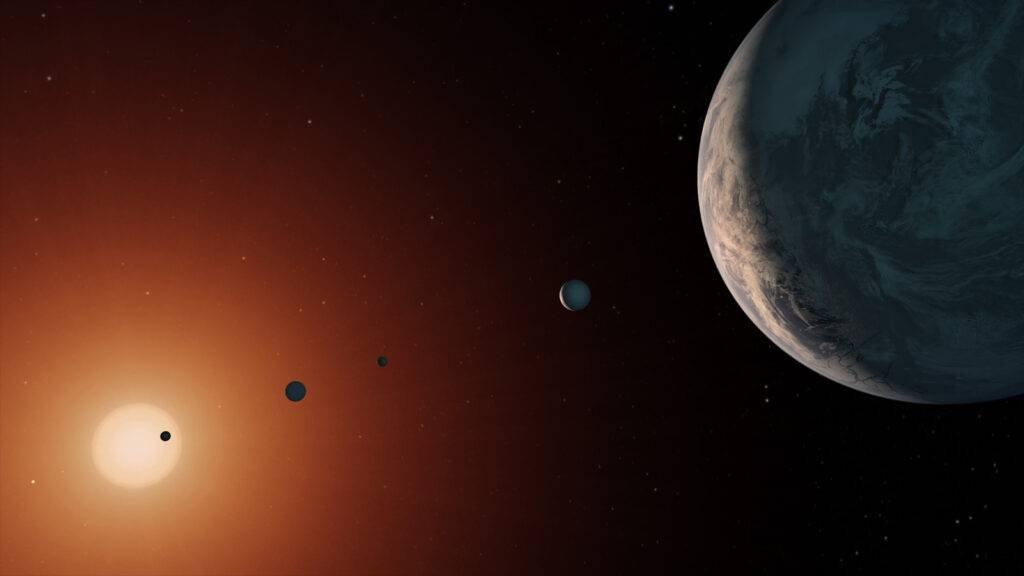
Trappist-1 System is often looked at as a candidate for a solar system with exoplanets harboring alien life
(Image: NASA/JPL-Caltech).
The strategy involves a few steps, starting with detecting an atmosphere around suitable terrestrial planets for about 10 transits (i.e., when the star’s brightness dips as the planet passes in front of it), then determining if there is low carbon in about 40 transits, and finally measuring ozone levels in about 100 transits to differentiate whether the low carbon levels are due to the presence of water or biomass.
The researchers suggest that this new concept of carbon depletion could serve as an effective signature for habitability and is adaptable for next-generation direct-imaging telescopes. This development potentially ushers in a new era in the search for habitable planets, enabling scientists to focus their efforts on celestial bodies more likely to harbor conditions supportive of life.
This method’s implications extend beyond locating habitable planets and venture into the realm of understanding environmental tipping points, acting as markers that urge us to consider the impending climate crisis on Earth in a new light.
Dr. Julien de Wit from MIT points out that the method could act as both a biosignature as well as a habitability signature. The method acknowledges that biology captures carbon dioxide on Earth, life forms account for 20% of the total captured CO2. Following this logic, the presence of oxygen, which can transform into detectable ozone, in tandem with CO2 could indicate not only habitability but also the existence of life.
Underscoring the practicality of the approach, de Wit noted that this method could work with existing telescopes. This finding offers renewed hope for the scientific community, who had begun to resign themselves to the idea that even major telescopes such as the JWST would be unable to detect life on exoplanets.
Looking ahead, the research team plans to detect atmospheric carbon dioxide compositions on a range of exoplanets, identifying those with oceans on their surfaces, and prioritizing further observations of those that could potentially support life.
MJ Banias is a journalist who covers security and technology. He is the host of The Debrief Weekly Report. You can email MJ at mj@thedebrief.org or follow him on Twitter @mjbanias.
New research aims to shed light on the puzzling winds on Titan, Saturn's largest moon, whose mysterious weather patterns have puzzled astronomers for decades.
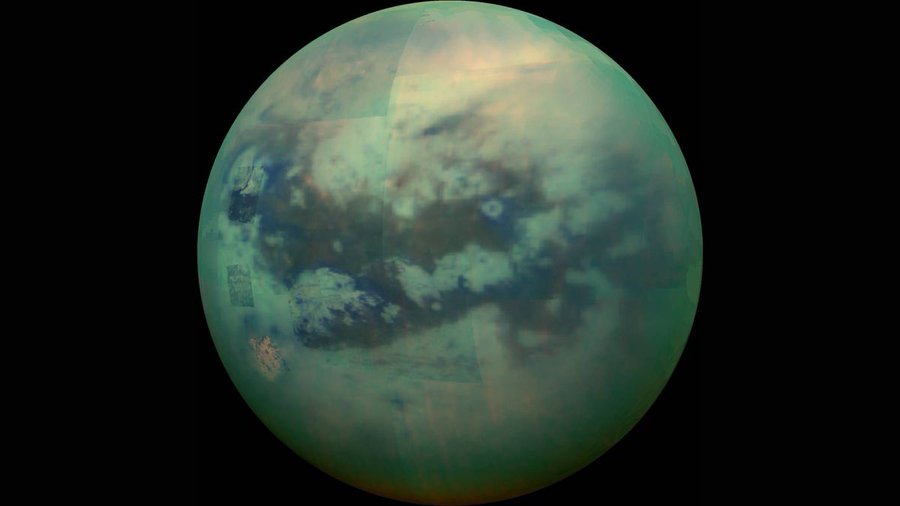
This composite image shows an infrared view of Saturn's moon Titan from NASA's Cassini spacecraft, acquired during the mission's "T-114" flyby on Nov. 13, 2015.
(Image credit: NASA/JPL-Caltech/University of Arizona)
New research is shedding light on peculiar winds swirling on Saturn's largest moon, Titan, whose mysterious weather patterns have puzzled astronomers for decades.
The answers may help to explain how Titan became the only moon in the solar system that still hosts a planet-like atmosphere, researchers say.
Astronomers have long known that seasons on Titan — each of which lasts nearly 7.5 Earth years — affect the moon's winds. But they haven't been able to pin down the speeds of those winds; two related studies, done nearly 30 years apart, have led to contradictory findings.
Now, astronomers are revisiting this decades-old mystery with updated telescopes. The paradoxical findings from past research might have resulted from incorrect assumptions about the data or instrument limitations, or it may just be that "there's something basic that we don't understand," Eliot Young, a principal scientist at the Southwest Research Institute in Texas, said in a statement.
Titan has a thick, smog-like atmosphere that reaches 370 miles (600 kilometers) into space and is 95% nitrogen with a sprinkle of organic molecules. Winds on the moon encircle it in just a day, repeatedly carrying currents of warm air from lower altitudes to the moon's poles, as if blowing on what NASA calls a high-speed conveyor belt.
In 1989, astronomers found that Titan's winds are slowest near its equator and fastest at midlatitudes in both the northern and southern hemispheres. This was revealed thanks to a chance alignment of a star behind Titan that allowed astronomers to study how the star's dimming light filtered through the moon's atmosphere, which helped them interpret wind speeds.
In 2016, a different team used ground-based telescopes to study how the light beamed by molecules in the atmosphere changed with shifting wind speeds and directions. The findings from this method revealed the opposite: The winds were fastest near Titan's equator and slowest at its lower latitudes.
Because there's a nearly three-decade gap between the two sets of observations, astronomers think different seasons on Titan may have led to the dramatic wind changes between both studies. Also, the 1989 research studied winds circling in the middle layers of the moon's atmosphere, while the more recent research focused on winds in the upper layers, which also may explain the varying wind speeds, the astronomers said.
"Just like on Earth, the winds on Titan are different at different altitudes and also change with seasons," Juan Lora, an assistant professor of Earth and planetary sciences at Yale University, told Space.com in an email. "And both of these likely explain why the observations don't agree perfectly with each other."
To get to the bottom of this discrepancy, a group of scientists has collected new data about Titan's winds using both methods at the same time. Last year, the team used eight telescopes in the United States and South America to observe two chance alignments of Earth, Titan and faraway bright stars.
In September 2022, four telescopes in Hawaii — including NASA's Infrared Telescope Facility and the Keck Observatory — watched as the star, 2MASS 21312124-1602427, snuck behind Titan. In November of the same year, a different star called 2MASS 21292356-1611056 slid behind Titan. Data from this event was collected by four more telescopes in Chile, including the Very Large Telescope and the Atacama Large Millimeter/submillimeter Array (ALMA).
An artist's impression of the 'light curve' produced by a star passing behind Titan. The spike at the center of the light curve represents the central flash produced by Titan's atmosphere acting as a lens and refracting the starlight toward a single focal point. (Image credit: NASA/ESA/C.Carreau)
The team is still comparing data from both observations and expects the results to be ready later this year. So far, ALMA observations already show evidence of speedy winds parallel to Titan's equator, Martin Cordiner, a planetary science researcher at NASA's Goddard Space Flight Center in Maryland whose team first identified the discrepancy in 2021, told Space.com.
The researchers behind the latest study said they were just in time to capture valuable data about Titan's winds before the 2025 northern autumnal equinox, when both of the moon's hemispheres will briefly receive equal sunlight before its northern hemisphere points more directly toward the sun. During this time, Titan's winds will reverse directions and start flowing from north to south — a change that has sprouted powerful dust storms in the past, according to the journal Nature.
"Titan is amazingly similar to Earth in many ways, but it's also alien and often surprising — teasing out which of these applies to individual phenomena as we observe them is one of the fun bits about this research for me," Lora told Space.com.
ESA’s Tiny Pinhole Thruster is Ready for Production.
Rocket propulsion technology has progressed leaps and bounds since the first weaponised rockets of the Chinese and Mongolian empires. They were nothing more than rocket powered arrows and spears but they set the foundations for our exploration of space. Liquid propellant, ion engines and solar sails have all hit the headlines as we strive for more efficient methods of travel but a team has taken the next leap with a palm sized thruster system that could boost future tiny space craft across the gulf of space.
Palm sized thrusters are quite different to the gargantuan rockets we are used to, for example the Saturn V rocket that took the Apollo astronauts to the Moon which stood 110m tall. The difference for the ATHENA thrusters is that they are designed for manoeuvring and propelling cubesats and small satellites once they are in space rather than propelling rockets from the surface of the Earth.
The Apollo 10 Saturn V during rollout. Credit: NASA
The team led by Daniel Perez Grande, CEO and Co-Founder of IENAI Spain, have called their palm sized thruster ‘Athena’, not the most catchy title but neatly represents what it does- the Adaptable, THruster based on Electrospray powered NAnotechnology. The technology has been developed for ESA and, following a successful design stage and, if all goes to plan, a prototype will be available by the end of 2024.
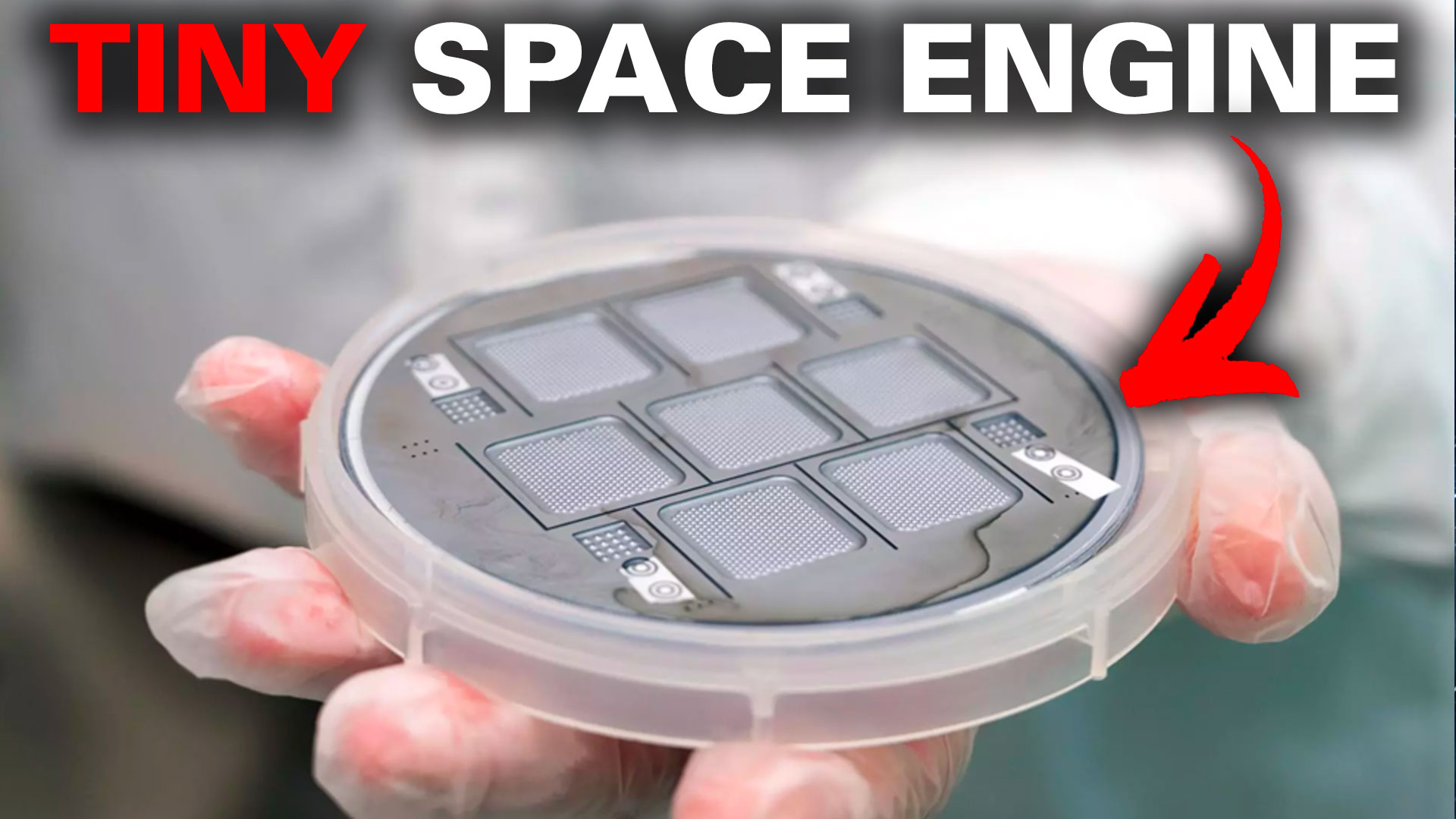
The technology relies upon something known as an electrospray which has previously been used in mass spectrometry but has now found its way into space. Each thruster has seven emitter arrays that are etched onto silicon wafers and each houses 500 pinhole emitters. Electrically charged particles from a conductive salt are sprayed out, propelled via an electrostatic field to produce the maximum amount of thrust which can be of the order of 20km per second. The concept is very similar to the ion propulsion systems already in use but on a much smaller scale.
Like its ION and liquid propellant cousins the thruster is highly adjustable and can be reconfigured in flight. The thrusters are eco-friendly too since the propellant is a non-toxic liquid and require no pressurised storage tanks. The small size of the thrusters means they can be grouped together in any required configuration with a total of six required to fit the face of a typical 10cm cubesats and can be clustered together on satellites and probes of up to 50kg mass. The team are hoping they can develop the technology further to work on craft up to 300kg.
Space technology is where possible, getting smaller and smaller like most other areas of technology. In order to achieve this though the propulsion systems also need to shrink and this is potentially a more challenging ask. ATEHNA looks to be a promising development but ESA and their partners are working on two other thruster systems based upon electrospray technology all of which, seem to be bringing promising results.
A recent study published in The Astrophysical Journal Letters investigates the potential existence of Mars-sized free-floating planets (FFPs)—also known as rogue planets, starless planets, and wandering planets—that could have been captured by our Sun’s gravity long ago and orbit in the outer solar system approximately 1,400 astronomical units (AU) from the Sun. For context, the farthest known planetary body in the solar system is Pluto, which orbits approximately 39 AU from the Sun, and is also part of the Kuiper Belt, which scientists estimate extends as far out as 1,000 AU from the Sun.
This study comes as scientists currently estimate that billions, if not trillions, of FFPs could exist within our Milky Way Galaxy, with a recently submitted study using data from NASA’s James Webb Space Telescope (JWST) to identify 540 potential Jupiter-sized rogue planet candidates, with some hypothesized to be pairs of rouge planets, also called binary rogue planets. This was followed up by another recently submitted study that investigated the origin and evolution of those binary rogue planets, as well. Scientists currently hypothesize that rogue planets are formed from two scenarios: As part of their own solar system but are then somehow ejected into the cosmos, or they form in isolation. But what is the significance of studying free-floating planets, overall?
“There are three interesting areas of astrophysics that we can learn about from free-floating planets,” Amir Siraj, who is a PhD student in the Department of Astrophysical Sciences at Princeton University and sole author of the study, tells Universe Today. “The first is planetary system formation — free-floating planets are ostensibly byproducts of the planetary system formation process, so studying them can help illuminate how planetary systems like our own came to be. The second is habitability — free-floating planets may greatly outnumber bound planets, so if any fraction of them have regions with energy budgets that can support liquid water, free-floating planets could collectively represent an important swath of habitable real estate in the universe. The third is dynamical interactions with stars and planetary systems — since free-floating planets are not bound to any particular star, they roam the galaxy and can have dynamical interactions with many different stars and planetary systems.”
It was this third area that Siraj tells Universe Today he used as influence for this study, as he asked the probability of FFPs potentially being captured by our own solar system throughout its approximate 4.5-billion-year history.
For the study, Siraj used computer models to simulate the potential for FFPs being captured in the outer solar system while incorporating a myriad of factors, including semimajor axis, eccentricity, and observation times of FFPs. After conducting approximately 100,000,000 simulations, the results indicate the potential for the existence of a Mars-sized, or even a Mercury-sized planetary body somewhere in the outer solar system approximately 1,400 AU from the Sun, with Siraj noting in the study the distance could range between 600 to 3,500 AU. But what is the significance of a terrestrial planet so far out in the outer solar system as opposed to a gas giant planet?
“Since this planet would be a former exoplanet, studying it in detail would reveal a wealth of information about how planets form around other stars,” Siraj tells Universe Today. “The fact that it’s a terrestrial planet means that its surface is probably rocky — which is very exciting because it means that by studying its surface, we could learn about the habitability of terrestrial exoplanets in general.”
Siraj recommends in his study that future work could include gaining greater understanding of how rogue planets are captured in the first place, along with investigating observational tests to identify where to look in the sky for rogue planets, as well. He also notes how microlensing has become the preferred method in identifying rogue planets based on past studies.
What new discoveries will scientists make about rogue planets in the coming years and decades? Only time will tell, and this is why we science!
Het Amerikaanse GE Aerospace heeft tests uitgevoerd met een hypersone motor die ook op lage snelheden werkt.
Hypersone wapens vliegen met minimaal 5000 kilometer per uur richting hun doel en zijn daardoor met bestaande luchtafweersystemen niet of nauwelijks te stoppen. Ten minste, dat werd gedacht en dat is ook wat de Russische president Vladimir Poetin in 2018 zei tijdens de onthulling van de hypersone Kinzhal-raket. Inmiddels blijkt dat de huidige modellen, waar onder meer de Amerikanen, Russen en Chinezen aan werken, niet de superwapens zijn die men voor ogen had. In mei van dit jaar schoten Oekraïense troepen met hun westerse Patriotraketten meerdere Kinzhals uit de lucht.
Maar een nieuwe Amerikaanse aandrijving, Rotating Detonation Combustion (RDC), kan er weleens voor zorgen dat hypersone raketten een stap voorwaarts maken. En die motor werd nu voor het eerst getest.
Scram!
Hypersone raketten maken gebruik van scramjet-motoren. De techniek in zo’n supersonic combustion ramjet is eenvoudiger dan die van een straalmotor. Bij bestaande straalmotoren zuigt een turbine lucht de motor in, die wordt samengeperst. Verderop wordt er brandstof (kerosine) toegevoegd en dan wordt het mengsel ontstoken. Bij de verbranding neemt de druk nog verder toe; het gasmengsel met de ontstane verbrandingsgassen zet sterk uit en verlaat de motor aan de achterkant.
Een scramjet gebruikt daarentegen de eigen snelheid om de lucht samen te persen. De interne druk en de temperatuur lopen daarbij zo hoog op dat de brandstof vanzelf ontbrandt. Er zijn dus veel minder bewegende onderdelen nodig om hem te laten werken en vooral het achterwege laten van de dure en kwetsbare turbine betekent dat er veel hogere snelheden mogelijk zijn.
Snel maar bestuurbaar
Nadeel is dat een scramjet dus eerst die enorme snelheid moet bereiken voordat hij stuwkracht kan leveren en dat wordt nog steeds gedaan met ouderwetse draagraketten. Om de hypersone raket een groter bereik te geven, wordt de hypersone projectiel bovendien naar grote hoogte gebracht, waarna hij in een duik/glijvlucht naar zijn doel schiet. En die lange, hoge vlucht maakt hem kwetsbaar.
Wat dus nodig is, zijn motoren die een hypersone raket tijdens zijn hele vlucht kunnen aandrijven, die ondanks hun extreme snelheid laag kunnen vliegen en toch, net als een kruisraket, bestuurbaar zijn. Om dat voor elkaar te krijgen ontwikkelde het Amerikaanse GE Aerospace de Dual-Mode Ramjet met dus zogenoemde Rotating Detonation Combustion.
Minitornado
Een RDC werkt met een cilinder die in een iets grotere cilinder valt. Door een mengsel van lucht en brandstof in de ruimte tussen de twee cilinders te spuiten en te ontsteken, gaat dat mengsel met supersonische snelheden rondtollen. Naarmate er meer brandstof en lucht wordt toegevoerd, loopt de druk steeds verder op en wordt er meer warmte geproduceerd. Door die ‘hete minitornado’ vervolgens aan de achterkant uit te stoten, wordt de raket voortgestuwd. Bekijk ook de video hieronder.
De inhoud op deze pagina wordt momenteel geblokkeerd om jouw cookie-keuzes te respecteren. Klik hier om jouw cookie-voorkeuren aan te passen en de inhoud te bekijken.
Je kan jouw keuzes op elk moment wijzigen door onderaan de site op “Cookie-instellingen” te klikken.”
De nieuwe motor, die dus zowel onder als boven mach 5 kan werken, werd gedemonstreerd op een testopstelling in GE’s fabriek in Niskayuna, in de staat New York. GE Aerospace verwacht in 2024 een volledige versie van de motor klaar te kunnen hebben.
Iedereen naar de maan en veel nieuwe raketten: Dit brengt 2024 voor de ruimtevaart
Iedereen naar de maan en veel nieuwe raketten: Dit brengt 2024 voor de ruimtevaart
Artikel van Wim De Maeseneer
Terug naar de maan
Ruimtekenners Koen Geukens, Nancy Vermeulen, Stijn Ilsen en Katrien Kolenberg zijn het er over eens: de maan zal volgend jaar het ruimtenieuws domineren.
"Alles wordt in gereedheid gebracht om terug te keren naar de maan. En deze keer om er te blijven", zegt Koen Geukens van volkssterrenwacht Urania. "2024 mag je zien als het voorspel van de hoogtepunten die de komende jaren zullen volgen."
Toch staat er ook dit jaar een hoogtepunt op de agenda. Eind 2024 zullen 4 astronauten een rondje rond de maan vliegen. Het is van de laatste Apollomissie in 1972 geleden dat er nog eens mensen zo dicht bij het maanoppervlak zijn geweest. En voor het eerst zal er ook een vrouwelijke astronaut meegaan.
De missie, Artemis II, is de eerste bemande testvlucht van het nieuwe ruimteschip Orion, waarmee eind 2025 (maar waarschijnlijk pas ten vroegste in 2026) opnieuw astronauten naar de maan zullen vliegen om er ook effectief te landen.
"Al die maanmissies dienen vooral als voorbereiding op een langer verblijf op de maan", zegt Geukens. "Er moet nog heel veel worden uitgetest, bijvoorbeeld om drinkbaar water en zuurstof te maken op de maan, of hoe we maanstof kunnen gebruiken om in 3D te printen... Dit jaar vertrekt in totaal een tiental ruimtevluchten met allerlei experimenten naar de maan."
Uitkijken naar megaraket Starship en Europese Ariane 6
Geen Amerikaanse astronauten op de maan zonder SpaceX, het ruimtebedrijf van Elon Musk. De maanlander, die de astronauten tot op de maan moet brengen, zal worden gebouwd én gelanceerd door SpaceX.
Daarvoor wordt Starship gebruikt, de grootste en krachtigste raket tot nog toe. Alleen is die raket nog geen enkele keer tot in de ruimte geraakt zonder te ontploffen.
"Toch verwacht ik de eerste succesvolle vlucht van Starship al begin 2024", zegt ruimtevaartingenieur Stijn Ilsen. "Het is de strategie van SpaceX: leren uit mislukkingen en snel weer doorgaan. Het zou me niet verbazen als we tegen eind 2024 zeker 3 of 4 succesvolle testvluchten hebben gezien."
Maar er zijn nog hordes te nemen. Eens Starship in een baan om de aarde vliegt, moet het ruimteschip door een tweede Starship bijgetankt worden met ultrakoude brandstof. "Ook dat proces wordt mogelijk al in 2024 getest", zegt Ilsen.
2024 wordt ook belangrijk voor de Europese ruimtevaart. Als alles goed gaat, wordt in de zomer de langverwachte Ariane 6-raket voor de eerste keer gelanceerd. Het is de opvolger van Ariane 5, die sinds juli 2023 met pensioen is.
"Europa heeft op dit moment geen enkele raket meer om zware vracht naar de ruimte te vervoeren", zegt ruimtevaartkenner Nancy Vermeulen. "Die eerste lancering wordt heel belangrijk. Mocht die mislukken, dan zou dat een ramp zijn."
Eerste ruimtewandeling door "ruimtetoeristen"
Wie geld genoeg heeft en ervan droomt om zelf eens naar de ruimte te reizen, kan sinds een aantal jaar terecht bij verschillende commerciële ruimtevaartbedrijven. Ook op dat vlak worden er grenzen verlegd in 2024.
"Ik kijk vooral uit naar "Polaris Down", de commerciële ruimtevlucht die de Amerikaanse miljardair Jared Isaacman heeft gekocht bij SpaceX", zegt Nancy Vermeulen. "Isaacman vliegt samen met 3 andere passagiers tot op 700 kilometer hoogte. Dat is bijna dubbel zo hoog als het internationale ruimtestation ISS."
"Ze gaan 5 dagen lang rond de aarde vliegen en zelfs een ruimtewandeling doen. Daar hou ik toch wel een beetje mijn hart voor vast. Het is de eerste keer dat niet-professioneel getrainde astronauten een ruimtewandeling gaan doen."
Belgische zonnesatellieten en Japan vertrekt naar Mars
Of we in 2024 ook wetenschappelijke doorbraken mogen verwachten, is moeilijk te voorspellen. Toch wordt het ongetwijfeld een jaar vol interessante ontdekkingen, zegt sterrenkundige Katrien Kolenberg (KU Leuven).
"We zitten in een tijdperk waarin we veel nieuwe resultaten mogen verwachten in verschillende domeinen. De James Webb-telescoop levert ons betere beelden dan ooit tevoren. We leren voortdurend bij over exoplaneten, sterren, zwarte gaten... Er zijn verschillende missies onderweg en de resultaten daarvan komen beetje bij beetje binnen."
Zo is in de zomer van 2023 de Europese ruimtetelescoop Euclid gelanceerd om de grootste en nauwkeurigste 3D-kaart ooit te maken van het heelal. De eerste kleurenfoto's zijn alvast verbluffend. "Daar gaan we dit jaar zeker ook nog van horen", zegt Kolenberg. "Ook onze modellen worden altijd beter. Dankzij artificiële intelligentie vinden we nieuwe manieren om resultaten beter te analyseren."
Foto door ruimtetelescoop Euclid van het "Verborgen Sterrenstelsel" (IC 342), op 11 miljoen lichtjaar van ons.
In de zomer wordt Proba-3 gelanceerd: twee Europese satellieten die op een heel nieuwe manier de zon gaan bestuderen. Ze moeten daarvoor perfect synchroon door de ruimte vliegen. De satellieten zijn in elkaar gezet bij Redwire Space in Kruibeke.
Japan lanceert in september een onbemand ruimtetuig naar Phobos, de grootste maan rond Mars, om er bodemstalen te halen. In oktober vertrekt dan weer een Amerikaanse ruimtesonde naar Europa, een ijsmaan van Jupiter.
En ESA vliegt diezelfde maand naar de ruimterots Dimorphos, waartegen in 2022 doelbewust een ruimtetuig is geknald. De nieuwe missie gaat van dichtbij kijken hoe groot de impact precies is geweest. Het uiteindelijke doel is om een redmiddel te vinden voor mocht er ooit een grote ruimterots op de aarde afstevenen.
Een overzicht van de belangrijkste gebeurtenissen:
Januari / februari: Twee Amerikaanse bedrijven vertrekken elk naar de maan. Eén van hen kan het eerste privébedrijf ooit worden dat kan landen op de maan. Er vliegen ook verschillende instrumenten van NASA mee.
19 januari: Aankomst van de "slimme" maanlander van Japan. Als de landing lukt, wordt Japan het 5e land ooit dat op de maan kan landen.
April: Polaris Dawn, een commerciële ruimtevlucht tot op 700 kilometer hoogte en eerste ruimtewandeling door niet-professionele astronauten
April:eerste vlucht van het commerciële ruimteveer Dream Chaser, een soort van kleine spaceshuttle. Moet op termijn ook mensen kunnen vervoeren.
Mei: China lanceert Chang'e 6, om voor het eerst bodemstalen van de achterkant van de maan op te halen en terug te brengen.
Zomer:ESA lanceert voor de eerste keer de Ariane 6-raket.
Augustus: Eerste lancering van New Glenn, de nieuwe raket van het ruimtebedrijf Blue Origin van Jeff Bezos. De krachtige, herbruikbare raket moet de concurrentie aangaan met de Falcon Heavy van SpaceX.
September: Japan lanceert onbemande ruimtesonde naar Phobos, de grootste maan rond Mars, om er bodemstalen te halen.
Oktober: Lancering Hera-missie van ESA naar de planetoïde Dimorphos. Daar is in 2022 een onbemand ruimteschip tegen gecrasht als test voor als er ooit een grote ruimtesteen zou afstevenen op onze aarde.
Oktober: NASA lanceert ruimtesonde naar Europa, één van de ijsmanen van Jupiter
Eind 2024: Artemis II, de tweede testvlucht naar de maan, met deze keer ook astronauten aan boord
Beste bezoeker, Heb je zelf al ooit een vreemde waarneming gedaan, laat dit dan even weten via email aan Frederick Delaere opwww.ufomeldpunt.be. Deze onderzoekers behandelen jouw melding in volledige anonimiteit en met alle respect voor jouw privacy. Ze zijn kritisch, objectief maar open minded aangelegd en zullen jou steeds een verklaring geven voor jouw waarneming! DUS AARZEL NIET, ALS JE EEN ANTWOORD OP JOUW VRAGEN WENST, CONTACTEER FREDERICK. BIJ VOORBAAT DANK...
Druk op onderstaande knop om je bestand , jouw artikel naar mij te verzenden. INDIEN HET DE MOEITE WAARD IS, PLAATS IK HET OP DE BLOG ONDER DIVERSEN MET JOUW NAAM...
Druk op onderstaande knop om een berichtje achter te laten in mijn gastenboek
Alvast bedankt voor al jouw bezoekjes en jouw reacties. Nog een prettige dag verder!!!
Over mijzelf
Ik ben Pieter, en gebruik soms ook wel de schuilnaam Peter2011.
Ik ben een man en woon in Linter (België) en mijn beroep is Ik ben op rust..
Ik ben geboren op 18/10/1950 en ben nu dus 75 jaar jong.
Mijn hobby's zijn: Ufologie en andere esoterische onderwerpen.
Op deze blog vind je onder artikels, werk van mezelf. Mijn dank gaat ook naar André, Ingrid, Oliver, Paul, Vincent, Georges Filer en MUFON voor de bijdragen voor de verschillende categorieën...
Veel leesplezier en geef je mening over deze blog.