The purpose of this blog is the creation of an open, international, independent and free forum, where every UFO-researcher can publish the results of his/her research. The languagues, used for this blog, are Dutch, English and French.You can find the articles of a collegue by selecting his category. Each author stays resposable for the continue of his articles. As blogmaster I have the right to refuse an addition or an article, when it attacks other collegues or UFO-groupes.
Druk op onderstaande knop om te reageren in mijn forum
Zoeken in blog
Deze blog is opgedragen aan mijn overleden echtgenote Lucienne.
In 2012 verloor ze haar moedige strijd tegen kanker!
In 2011 startte ik deze blog, omdat ik niet mocht stoppen met mijn UFO-onderzoek.
BEDANKT!!!
Een interessant adres?
UFO'S of UAP'S, ASTRONOMIE, RUIMTEVAART, ARCHEOLOGIE, OUDHEIDKUNDE, SF-SNUFJES EN ANDERE ESOTERISCHE WETENSCHAPPEN - DE ALLERLAATSTE NIEUWTJES
UFO's of UAP'S in België en de rest van de wereld Ontdek de Fascinerende Wereld van UFO's en UAP's: Jouw Bron voor Onthullende Informatie!
Ben jij ook gefascineerd door het onbekende? Wil je meer weten over UFO's en UAP's, niet alleen in België, maar over de hele wereld? Dan ben je op de juiste plek!
België: Het Kloppend Hart van UFO-onderzoek
In België is BUFON (Belgisch UFO-Netwerk) dé autoriteit op het gebied van UFO-onderzoek. Voor betrouwbare en objectieve informatie over deze intrigerende fenomenen, bezoek je zeker onze Facebook-pagina en deze blog. Maar dat is nog niet alles! Ontdek ook het Belgisch UFO-meldpunt en Caelestia, twee organisaties die diepgaand onderzoek verrichten, al zijn ze soms kritisch of sceptisch.
Nederland: Een Schat aan Informatie
Voor onze Nederlandse buren is er de schitterende website www.ufowijzer.nl, beheerd door Paul Harmans. Deze site biedt een schat aan informatie en artikelen die je niet wilt missen!
Internationaal: MUFON - De Wereldwijde Autoriteit
Neem ook een kijkje bij MUFON (Mutual UFO Network Inc.), een gerenommeerde Amerikaanse UFO-vereniging met afdelingen in de VS en wereldwijd. MUFON is toegewijd aan de wetenschappelijke en analytische studie van het UFO-fenomeen, en hun maandelijkse tijdschrift, The MUFON UFO-Journal, is een must-read voor elke UFO-enthousiasteling. Bezoek hun website op www.mufon.com voor meer informatie.
Samenwerking en Toekomstvisie
Sinds 1 februari 2020 is Pieter niet alleen ex-president van BUFON, maar ook de voormalige nationale directeur van MUFON in Vlaanderen en Nederland. Dit creëert een sterke samenwerking met de Franse MUFON Reseau MUFON/EUROP, wat ons in staat stelt om nog meer waardevolle inzichten te delen.
Let op: Nepprofielen en Nieuwe Groeperingen
Pas op voor een nieuwe groepering die zich ook BUFON noemt, maar geen enkele connectie heeft met onze gevestigde organisatie. Hoewel zij de naam geregistreerd hebben, kunnen ze het rijke verleden en de expertise van onze groep niet evenaren. We wensen hen veel succes, maar we blijven de autoriteit in UFO-onderzoek!
Blijf Op De Hoogte!
Wil jij de laatste nieuwtjes over UFO's, ruimtevaart, archeologie, en meer? Volg ons dan en duik samen met ons in de fascinerende wereld van het onbekende! Sluit je aan bij de gemeenschap van nieuwsgierige geesten die net als jij verlangen naar antwoorden en avonturen in de sterren!
Heb je vragen of wil je meer weten? Aarzel dan niet om contact met ons op te nemen! Samen ontrafelen we het mysterie van de lucht en daarbuiten.
01-01-2024
Watch This Nebula 2,500 Light Years From Earth Light Up Like a Christmas Tree
Watch This Nebula 2,500 Light Years From Earth Light Up Like a Christmas Tree
Space- and ground-based telescopes (along with some artistic processing) made this photo possible.
The Milky Way is delivering some holiday cheer in a new image and video NASApublished Tuesday.
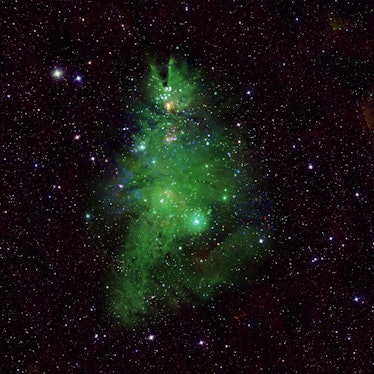
Young stars clustered together some 2,500 light years from Earth are creating a Christmas tree in space. With a little help from telescopes of different specialties that show phenomena beyond what we could normally see with our eyes, a busy stellar nursery glows with festive illumination.
The Christmas Tree Cluster, officially known as NGC 2264, is made of stars about one to five million years old. That’s young by cosmic standards. Some of these juveniles are less than a tenth of the mass of the Sun, but others would dwarf our nearby star with their hefty sizes of up to seven solar masses. Altogether, their visible light, their X-ray emissions, and their infrared glow make up the space agency’s holiday image.
NGC 2264, also known as the “Christmas Tree Cluster.”
“This new composite image enhances the resemblance to a Christmas tree through choices of color and rotation,” NASA’s image description says.
The tree itself is made of gas in the nebula. The National Science Foundation’s WIYN 0.9-meter telescope on Kitt Peak in Arizona captured this glow, appearing in visible light. This region was colored green, however, to fit the Christmas theme (sometimes the nebula is given purple and pink colors, too). The boreal shape also pops out because the image is turned to show a vertical tree. It’s rotated clockwise by about 160 degrees from standard North.
The blinking lights in this animation are X-ray emissions from young stars. They’ve been synchronized artificially to create the effect of Christmas tree lights.
The accompanying video shows synchronized flashes that look like Christmas tree lights. This is artificial, to an extent. The young stars emit volatile phenomena into space, like flares, which astronomers saw with NASA’s Chandra X-Ray Observatory. The stars do create these flashes, which show up in NASA’s data. But, they aren’t synchronized. That’s added for the holiday effect.
The perpetual white lights in this image are stars aglow in the infrared, observed with the Two Micron All Sky Survey in Arizona and Chile.
Science literacy is possible when people can learn more about the world around us. Presentations like this Christmas edit of a crowded cosmic corner may be an effective tool in spreading both astronomy knowledge — and holiday cheer.
Like most humans on Earth this past week, NASA’s Curiosity rover took a vacation of itself a few weeks ago. After soaking up the Martian scenery, it beamed back holiday videos from its cameras. On Thursday, NASA published the tranquil alien footage.
Among many things, the dawn-to-dusk videos show the shadow of the six-wheeled rover sliding across the rugged terrain. “When NASA’s Curiosity Mars rover isn’t on the move, it works pretty well as a sundial,” space agency officials wrote in a description of the videos. The rover also caught a cosmic ray.
Curiosity captured the videos from 5:30 a.m. to 5:30 p.m. Mars time on November 8, the car-sized rover’s 4,002nd Martian day. Mission specialists on Earth had directed Curiosity’s front and rear Hazard-Avoidance Cameras (Hazcams) to gaze at the landscape. It was one of the last commands NASA sent Curiosity before the craft entered a two-week lull.
DAWN TO DUSK ON MARS
Curiosity’s shadow glides along on the Martian surface in these images taken by its front Hazcam.
Mars’ orbit triggered a pause in sending commands. The Red Planet was passing behind the Sun, presenting issues for mission communications. During the event, called Mars solar conjunction, super-hot plasma swimming around the Sun’s outer atmosphere put the risk of interfering with messages from Earth to Mars on high. The team waited until November 25 to begin running its science tasks. So, like many people now, passing the days ahead of the New Year, Curiosity was on hiatus.
The two videos show views in front of and behind Curiosity. In the first video, the front Hazcam looks towards Gediz Vallis, a valley of Mars’ Mount Sharp. This 3-mile-tall mountain rises from the basin of Gale Crater, Curiosity’s home since 2012.
Curiosity’s rear Hazcam captured the shadow of the back of the rover in this 12-hour view on November 8.
In the other video, from the rear Hazcam, the distant crater walls are visible, although they’re faint, and the viewer gazes down Mount Sharp’s slope. Left of the center of this video, during the 17th frame, a small black mark appears. A cosmic ray was the culprit, according to NASA’s description of the videos.
“Rover drivers normally rely on Curiosity’s Hazcams to spot rocks, slopes, and other hazards that may be risky to traverse,” according to NASA.
“But because the rover’s other activities were intentionally scaled back just prior to conjunction, the team decided to use the Hazcams to record 12 hours of snapshots for the first time,” officials added.
There are signs of Curiosity’s aging. The “speckled appearance” of the images, NASA officials explain, comes from the dust that’s accumulated on Curiosity’s lenses since beginning its grand tour of Gale Crater 11 Earth years ago.
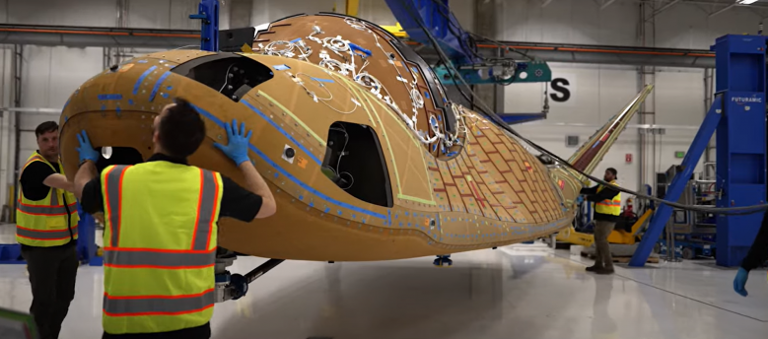
De bouw van Tenacity is voltooid. Dit ruimtevaartuig van Sierra Space gaat goederen van en naar het ISS vervoeren en kan bij terugkomst landen op een landingsbaan.
Het internationale ruimtestation (ISS) – en de toekomstige opvolger – moeten continu bevoorraad worden. Daarvoor zijn er momenteel meerdere ruimtevaartuigen beschikbaar, zoals Northrop Grummans Cygnus en de H-II Transfer Vehicle van de Japanse ruimtevaartorganisatie.
Soms moet er ook materiaal terug naar de aarde worden gestuurd, maar de meeste bevoorradingsvaartuigen zijn daartoe niet in staat. Space X’s Dragon is een van de weinige die dat wel kan, en landt bij terugkomst in zee. Het Amerikaanse bedrijf Sierra Space komt nu met Tenacity, een ruimteschip dat bij terugkomst als een soort vliegtuig kan landen op een landingsbaan.
Spaceshuttle
Vorige week maakte Sierra Space bekend dat de bouw van Tenacity is afgerond en dat het ruimtevliegtuig in de komende weken wordt verscheept naar NASA’s Neil A. Armstrong Test Facility in Ohio voor milieutests.
Hoewel Tenacity momenteel het enige ruimtevaartuig is dat zijn ruimtereis kan eindigen op een landingsbaan, konden NASA’s spaceshuttles die in 2011 met pensioen gingen dat ook al. Niet gek dus dat het uiterlijk van de Dream Chaser sterk lijkt op dat van de spaceshuttles.
Een ruimteschip dat de atmosfeer binnenkomt, heeft naast extreme hitte (ruim 1600 graden) ook te maken met een enorme versnelling en dus hoge g-krachten. Toch kan Tenacity die krachten beperken tot anderhalf keer de zwaartekracht (1,5 g), wat schade aan kwetsbare lading kan voorkomen. De vleugels spelen hierbij een belangrijke rol; ze creëren lift.
Bij een vliegtuig zorgt liftkracht ervoor dat het toestel in de lucht blijft en bij Tenacity dat het toestel afremt.
Eerste missie is al snel
Sierra Space heeft een contract met NASA voor de lancering van bevoorradingsmissies van het ISS met Dream Chaser-toestellen. En de eerste missie zou al ergens april 2024 kunnen beginnen.
De lancering zal dan plaatsvinden vanaf NASA’s Kennedy Space Center in Florida aan boord van United Launch Alliance’s nieuwe Vulcan Centaur-raket. Bij terugkomst zal Tenacity landen op NASA’s Shuttle Landing Facility, waar de spaceshuttles vroeger ook landde. Daarna kan het ruimteschip opnieuw worden gelanceerd, volgens Sierra Space heeft de Dream Chaser namelijk een levensduur van minstens vijftien missies.
Autonome bevoorradingsmissies zijn slechts het begin voor de Dream Chaser-toestellen. In de toekomst wil Sierra Space ook mensen vervoeren met het vaartuig.
Bekijk hieronder een animatie van een lancering en landing van het ruimtevliegtuig:
These 11 Space Photo Award Winners Are Truly Out of This World
-These 11 Space Photo Award Winners Are Truly Out of This World
See the wispy aurorae, amazing star clusters, and picturesque planets that make this year’s Royal Museums Greenwich Astronomy Photographer of the Year contest.
For the past 15 years, England’s Royal Museums Greenwich has held an annual Astronomy Photographer of the Year contest, highlighting all the incredible nebulas, breathtaking gas clouds, awesome aurorae, and gobsmacking galaxies captured throughout the year. This year’s 11 winners encompass both professional photographers and amateur astronomers, and the shortlisted photographs are just as incredible.
If you’re inspired to see more, visit the Royal Museums Greenwich online and cast your vote for the People’s Choice Award for 2023.
Three European photographers — Marcel Drechsler, Xavier Strottner, and Yann Sainty — took 110 hours of exposure to see the Andromeda Galaxy in a whole new way. They discovered faint light from a massive sea of charged particles that were essentially hiding in plain sight.
The blue streak to the left of the famous galaxy is now named the Strottner-Drechsler-Sainty Object 1 (SDSO-1) after the amateur astronomy trio. This huge extragalactic plasma streak appeared in an Oxygen-3 telescopic filter, an unpopular choice for viewing space. The team tried their luck, seeing if they could add a new visual dimension to the popular astronomy target.
The result was “an absolute accident,” Drechsler said in an image description.
Photographer Angel An stood on a Himalayan ridge as the sky erupted in this transient luminous event (TLE) on May 20, 2022. A TLE is a rare phenomenon that happens high above thunderstorm clouds, and while scientists have some knowledge about them, there is plenty left to discover.
This particular TLE called a sprite, extended much higher than the upper edge of the photo, as the ethereal “sprites” danced like fireworks, according to the photographer.
A mosaic of 115 frames picked from out of 3,400, this photo captures a filament as it meanders in the shape of a question mark across the Sun’s richly textured surface. Photographer Eduardo Schaberger Poupeau imaged this solar quandary from Rafaela, Argentina, on October 1, 2022.
“If you zoom into the surface of the Sun, the image has a paint-like quality,” competition judge Sheila Kanani said in the image description. “I feel like I can see the brush strokes. There’s a sense of movement.”
Mars plays peekaboo behind a full Moon during the December 8, 2022, lunar occultation. The lunar ground rises and dips as its textures reach out towards the horizon. Captured by photographer Ethan Chappel in Cibolo, Texas, this image displays our only satellite’s gray, dusty color in sharp contrast with the rust-orange tones of the Red Planet.
“To capture the level of detail on Mars that you see here takes a huge amount of skill and practice,” competition judge Steve Marsh said in an image description.
“It’s always a different show every time,” photographer Monika Deviat says in an image description of her photo of this aurora borealis above Utsjoki, Finland, and capturing “a single moment of the dance” requires skill, one Deviat has been honing since starting out as a concert photographer.
One challenge is that a person's eyes at night aren’t adept at picking up colors. A camera, however, can capture them well — the photographer doesn’t rely entirely on their tool. Exceptional photographers like Deviat keep an eye skyward for interesting, sudden motion because the sequence that birthed this aurora strand lasted less than a minute.
Although usually pictured as a suffocating hellscape, Venus puts on a creamy, soft texture for this award-winning image.
The planet is easily seen from Earth with the naked eye, shining exceptionally brightly in the sky as it reflects visible light from the Sun. But on February 26, 2023, from Trowbridge, U.K., photographer Tom Williams elected to look at Venus in ultraviolet light, which highlighted the contrasts in Venus’ atmosphere from the ground.
As a shipwreck in Hentiesbaai, Namibia, sits along a treacherous Atlantic coastline on September 18, 2022, the weathered and beaten artifact is accompanied by incredible star trails — an amazing backdrop for photographer Vikas Chander.
“It is a hauntingly beautiful image that would be the perfect setting for a ghost story and is one of my favorites from this year’s competition,” judge Melissa Brobby writes in an image description.
4. “NEW CLASS OF GALACTIC NEBULAE AROUND THE STAR YY HYA”
This is “the heart of the Hydra,” which amateur astronomer Marcel Drechsler discovered when observing the sky from Ovalle, Chile, from March 2021 to April 2022. Drechsler is also part of the team behind the 2023 winning photograph of the Andromeda Galaxy.
Here, a pair of stars are surrounded by a common swaddle of dust and gas, called an envelope. More than 360 hours of exposure time were required to make this image, lasting around 100 nights over the course of about a year.
3. “SH2-132: BLINDED BY THE LIGHT”
Sir Patrick Moore Prize for Best Newcomer 2023 Winner
Newcomer Aaron Wilhelm impressed the judges with this photo of the Lion Nebula, photographed from Santa Monica, California, in September 2022. “With subtle but varying colors across the whole palette, the dark, twisting lanes of dust are resolved in exquisite detail, and the stars are perfectly round with no hint of trailing,” Judge Steve Marsh said in an image description.
Wilhelm took almost 70 hours of data to capture these faint emissions near the border of the Cepheus and Lacerta constellations.
Resembles a galactic cavern, this amazing image almost seems to invite the viewer to crawl inside and take a look.
This is the Running Chicken Nebula, named for its faint central feature shaped like a bird mid-sprint. Photographers Runwei Xu and Binyu Wang took this image from El Sauce Observatory in Río Hurtado, Chile, on December 19, 2022.
1. “BLACK ECHO”
Annie Maunder Prize for Image Innovation 2023 Winner
To create this image, John White passed audio through a receiver into an old speaker. Onto this device, White attached a petri dish with a blackened-out base. Then, this was filled with 3mm of water. The image seen here is the best shot out of about 100 White took as sound perturbed the water in a dark room where only a halo light shined — but this isn’t any ordinary sound.
These audio waves emanate from a black hole at the Perseus galaxy cluster’s center as the black hole emits pressure waves through abundant hot gas. NASA’s Chandra X-Ray Observatory observed this twenty years ago, but NASA scaled the sound 57 octaves above its true pitch so human ears could hear it.
Batteries could charge up by relying on a quantum effect known as indefinite causal order, whereby the laws of cause and effect are scrambled and power can move through the system quicker.
An artist's illustration of a particle in a quantum superposition.
(Image credit: agsandrew | Shutterstock.com)
Quantum batteries of the future could gain charge by breaking the conventional laws of causality, research has shown.
Conventional batteries charge by converting electrical energy into chemical energy on the scale of vast numbers of electrons.
But in a new proof-of-principle experiment researchers have demonstrated how a weird quantum effect may lead to batteries that charge faster and with more efficiency by scrambling cause and effect, according to research Dec. 14 in the journal Physical Review Letters.
Causality, or the relationship between cause and effect, is not always straightforward in quantum mechanics, the strange rules that govern the world of the very small.
"Normally, if event A comes first and causes event B, it is assumed that B cannot in turn cause A at the same time," co-first author Yuanbo Chen, a physicist at the University of Tokyo, told Live Science. "However, recent advancements in theoretical physics propose that in certain frameworks, scenarios where 'A causes B' and 'B causes A' could simultaneously be true."
The principle of quantum superposition enables particles to exist in many different states at once, at least until they are observed and "pick" a state to land in.
Any property of a quantum object (such as its momentum, location, or, in the famed case of Erwin Schrödinger’s hypothetical cat, whether it’s alive or not) can exist in superposition — a probabilistic jumble of every possible state that only collapses into a definite outcome when the object is viewed.
This realization has led physicists to conduct all kinds of bizarre experiments that contradict our intuitive notions of what should be possible, including ones where a single particle can both exist and not exist in many different places at the same time.
But superposition doesn’t just mess with our intuitive sense of space, it scrambles our sense of causality too. In 2009, physicists used a device called a quantum switch to observe a phenomenon called indefinite causal order. By sending a light particle, or photon down a pair of diverging paths, the physicists caused it to split into two possible versions of itself — one which went down the first path, and the other the second.
Then, depending on the path the photon took, physicists applied two different processes in a different order depending on the path. The result was a photon that had its causality jumbled: it was in a quantum superposition where both orders of events were true.
"Say that we have two processes: A and B," Chen said. "With a quantum switch, you can create a superposition of (First apply A and then B) and (First apply B and then A)."
Chen and his colleagues wondered if they could incorporate this into a quantum battery, a proposed device that could theoretically store the energy of photons and charge faster than conventional electrochemical batteries.
They compared three charging methods: connecting two chargers to a battery sequentially, simultaneously, or in a superposition that made it impossible to tell the order of input.
Their calculations showed that the superposition method would enable a low-power, causally-scrambled charger to deliver more energy more efficiently than a conventional high-power charger.
They followed up their calculations with a proof-of-principle experiment using light. By sending photons through a quantum switch with two possible paths, the researchers split the light particles into two possible versions of themselves, each one traversing a different path.
Then, after subjecting the light to two inputs that would polarize them in a different order (A then B or B then A) based on the path they were on, the researchers measured the polarization at the end and found that the individual photons had been causally scrambled.
Having tested their protocol, the scientists say their next challenge is to create a physical quantum battery that can hold a charge. However, the first experimental evidence for a quantum battery was only published last year, so it may not happen any time soon.
"Given the current situation characterized by limited experimental efforts and ongoing theoretical exploration in the realm of quantum batteries, it is challenging to estimate a precise timeline for achieving conclusive outcomes," Chen said.
Astronomers Find New Way to Detect Water Oceans and Alien Life on Rocky Exoplanets
Astronomers Find New Way to Detect Water Oceans and Alien Life on Rocky Exoplanets
Planets too close to their star are too hot (such as Venus), those too far, are too cold (like Mars), whereas planets in the habitable zone are just right. Whilst there has been much effort in identifying planets in the theoretical habitable zones of their stars, until now there was no way of knowing whether they truly have liquid water. Now, astronomers from the University of Birmingham, MIT and elsewhere have shown that if an exoplanet has a reduced amount of carbon dioxide in its atmosphere compared to neighboring planets, it suggests there is liquid water on that planet’s surface.
An artist’s impression of the super-Earth planet Ross 508b.
Image credit: Sci.News.
Astronomers have so far detected more than 5,200 extrasolar worlds. With current telescopes, they can directly measure a planet’s distance to its star and the time it takes it to complete an orbit.
Those measurements can help scientists infer whether a planet is within a habitable zone.
But there’s been no way to directly confirm whether a planet is indeed habitable, meaning that liquid water exists on its surface.
Across our own Solar System, astronomers can detect the presence of liquid oceans by observing glints — flashes of sunlight that reflect off liquid surfaces.
These glints, or specular reflections, have been observed, for instance, on Saturn’s largest moon, Titan, which helped to confirm the moon’s large lakes.
Detecting a similar glimmer in far-off planets, however, is out of reach with current technologies.
But MIT astronomer Julien de Wit, University of Birmingham astronomer Amaury Triaud and their colleagues realized there’s another habitable feature close to home that could be detectable in distant worlds.
“An idea came to us, by looking at what’s going on with the terrestrial planets in our own system,” Dr. Triaud said.
Venus, Earth, and Mars share similarities, in that all three are rocky and inhabit a relatively temperate region with respect to the Sun.
Earth is the only planet among the trio that currently hosts liquid water. And the researchers noted another obvious distinction: Earth has significantly less carbon dioxide in its atmosphere.
“We assume that these planets were created in a similar fashion, and if we see one planet with much less carbon now, it must have gone somewhere,” Dr. Triaud said.
“The only process that could remove that much carbon from an atmosphere is a strong water cycle involving oceans of liquid water.”
Indeed, the Earth’s oceans have played a major and sustained role in absorbing carbon dioxide.
Over hundreds of millions of years, the oceans have taken up a huge amount of carbon dioxide, nearly equal to the amount that persists in the Venusian atmosphere today.
This planetary-scale effect has left Earth’s atmosphere significantly depleted of carbon dioxide compared to its planetary neighbors.
“On Earth, much of the atmospheric carbon dioxide has been sequestered in seawater and solid rock over geological timescales, which has helped to regulate climate and habitability for billions of years,” said Dr. Frieder Klein, a researcher at the Woods Hole Oceanographic Institution.
The astronomers reasoned that if a similar depletion of carbon dioxide were detected in a far-off planet, relative to its neighbors, this would be a reliable signal of liquid oceans and life on its surface.
“After reviewing extensively the literature of many fields from biology, to chemistry, and even carbon sequestration in the context of climate change, we believe that indeed if we detect carbon depletion, it has a good chance of being a strong sign of liquid water and/or life,” Dr. de Wit said.
In the study, the researchers lay out a strategy for detecting habitable planets by searching for a signature of depleted carbon dioxide.
Such a search would work best for ‘peas-in-a-pod’ systems, in which multiple terrestrial planets, all about the same size, orbit relatively close to each other, similar to our own Solar System.
The first step the scientists propose is to confirm that the planets have atmospheres, by simply looking for the presence of carbon dioxide, which is expected to dominate most planetary atmospheres.
“Carbon dioxide is a very strong absorber in the infrared, and can be easily detected in the atmospheres of exoplanets,” Dr. de Wit said.
“A signal of carbon dioxide can then reveal the presence of exoplanet atmospheres.”
Once astronomers determine that multiple planets in a system host atmospheres, they can move on to measure their carbon dioxide content, to see whether one planet has significantly less than the others.
If so, the planet is likely habitable, meaning that it hosts significant bodies of liquid water on its surface.
But habitable conditions don’t necessarily mean that a planet is inhabited. To see whether life might actually exist, the authors propose that astronomers look for another feature in a planet’s atmosphere: ozone.
On Earth, plants and some microbes contribute to drawing carbon dioxide, although not nearly as much as the oceans. Nevertheless, as part of this process, the lifeforms emit oxygen, which reacts with the Sun’s photons to transform into ozone, a molecule that is far easier to detect than oxygen itself.
If a planet’s atmosphere shows signs of both ozone and depleted carbon dioxide, it likely is a habitable, and inhabited world.
“If we see ozone, chances are pretty high that it’s connected to carbon dioxide being consumed by life,” Dr. Triaud said.
“And if it’s life, it’s glorious life. It would not be just a few bacteria. It would be a planetary-scale biomass that’s able to process a huge amount of carbon, and interact with it.”
The team estimates that the NASA/ESA/CSA James Webb Space Telescope would be able to measure carbon dioxide, and possibly ozone, in nearby, multiplanet systems such as TRAPPIST-1, a seven-planet system that orbits a bright star, just 40 light-years from Earth.
“TRAPPIST-1 is one of only a handful of systems where we could do terrestrial atmospheric studies with Webb,” Dr. de Wit said.
“Now we have a roadmap for finding habitable planets. If we all work together, paradigm-shifting discoveries could be done within the next few years.”
The study was published in the journal Nature Astronomy.
A.H.M.J. Triaud et al. Atmospheric carbon depletion as a tracer of water oceans and biomass on temperate terrestrial exoplanets. Nat Astron, published online December 28, 2023; doi: 10.1038/s41550-023-02157-9
Organic Molecules Come from the Universe’s Cold Places
Life, as we all know, is based on chemistry. Prebiotic chemical building blocks existed on our planet for a long time before life arose. Astrobiology and cosmochemistry focus on the formation of those building blocks. They also look at the role each played in creating all the life forms we know today.
For a long time, cosmo-chemists have known that organic molecules called polycyclic aromatic hydrocarbons (PAHs) are quite plentiful in the Universe. Scientists consider them plausible prebiotic building blocks that likely played an important role in the formation of life on Earth. What’s not as well understood is their origin story. For a long time, scientists suspected that they formed in regions where temperatures get to around 1000 K. That would supply energy to promote chemical activity to create PAHs, such as in star-forming molecular clouds or circumstellar disks. It’s also possible they form as part of the processing of carbon-rich dust grains by nearby energy sources (such as stars).
However, based on recent studies of an asteroid and meteorite, it turns out that some PAHs formed in cold regions of space, too. In those regions, the temperature does not get much higher than 100 K. That finding opens up new pathways for understanding life’s chemical journey on other planets and celestial bodies.
Understanding These Organic Molecules
According to Professor Kliti Grice, a researcher at the Western Australia Organic and Isotope Geochemistry Centre at Curtin University, understanding these materials is a big step. “PAHs are organic compounds made up of carbon and hydrogen that are common on Earth but are also found in celestial bodies like asteroids and meteorites,” said Grice.
They’re spread throughout the interstellar medium and detected in galaxies across the Universe. Generally, they’re used as a tracer of cold molecular gas, which is where stars—and planets—begin their formation journey.
An image of an interstellar nebula with some polycyclic aromatic hydrocarbon (PAH) molecular structures superimposed. These organic molecules exist throughout the Universe. Courtesy: NASA.
As such, scientists want to trace their path from space to Earth and compare space-based PAHs to Earth-based ones. That’s because PAHs are a very likely precursor to the kinds of materials that eventually lead to the formation of life. That makes their presence on other celestial bodies intriguing as scientists work to understand the formation and evolution of life.
Beyond Earth, PAHs account for about 30 percent of all carbon found in regions around stars, in molecular clouds, and on planets (and other bodies). On Earth, many PAHs exist in coal deposits and oil reservoirs. Plants burning (as in forest fires) also produce these compounds. They work their way into the soil and eventually end up in plants (among other things).
Organic Molecules and Rocky Bodies
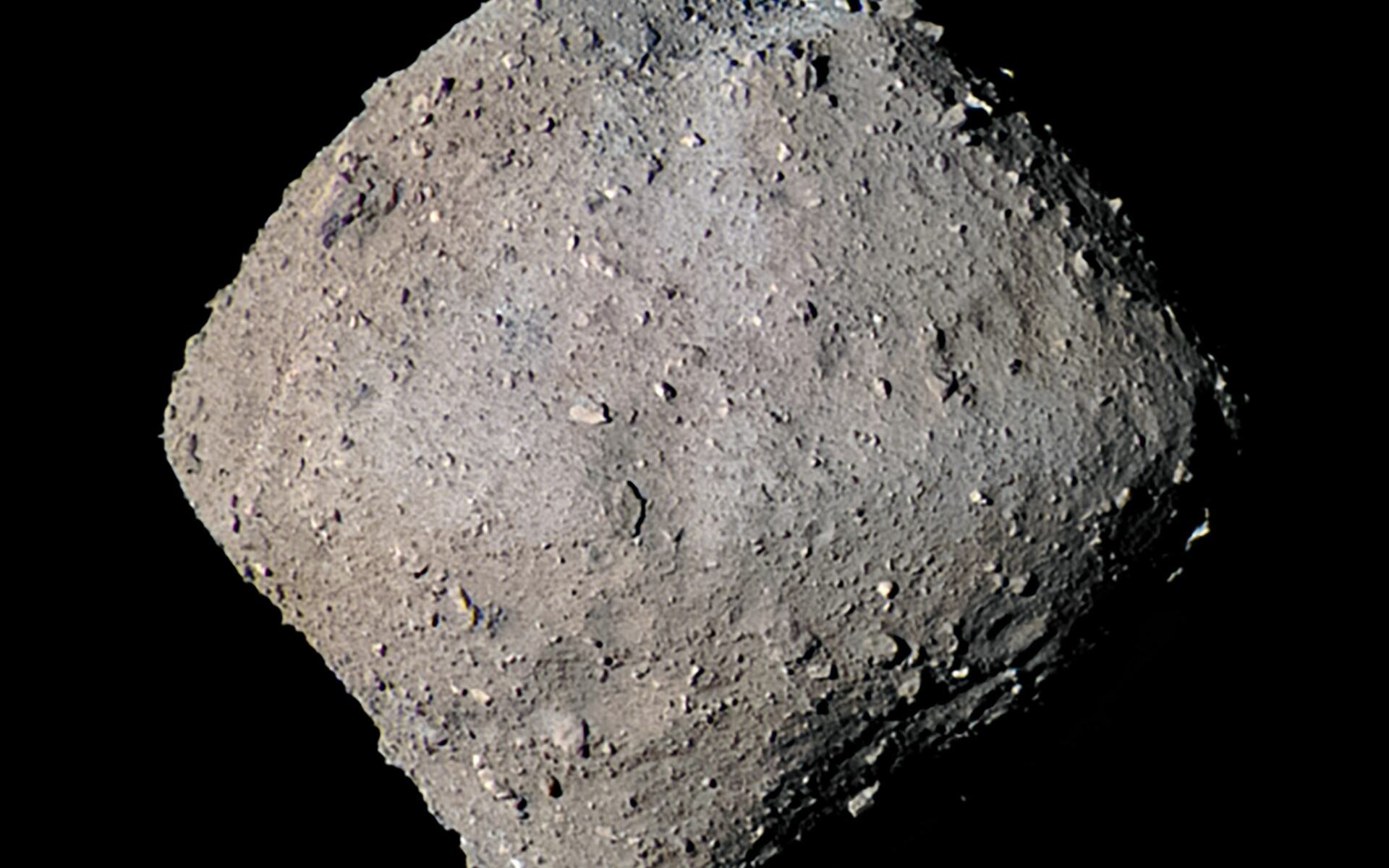
Grice is part of an international research team that focused on pieces of asteroid Ryugu and the famous Murchison meteorite to figure out where their PAHs formed. The team started with an unusual chemistry project: burning plants. That’s because plants contain PAHs that form here on Earth. “We performed controlled burn experiments on Australian plants,” said Grice, “which were isotopically compared to PAHs from fragments of the Ryugu asteroid that were returned to Earth by a Japanese spacecraft in 2020, and the Murchison meteorite that landed in Australia in 1969. The bonds between light and heavy carbon isotopes in the PAHs were analyzed to reveal the temperature at which they were formed.”
The Murchison Meteorite, which fell to Earth in 1969. It contains organic molecules. Courtesy Basilicofresco, CC BY-SA 3.0
Using high-tech methods to study Ryugu and Murchison, the team found two sources of PAHs with slightly different characteristics. “The smaller ones likely formed in cold outer space, while bigger ones probably formed in warmer environments, like near a star or inside a celestial body,” according to Grice.
Ryugu is particularly interesting since it formed early in the Solar System’s history. A critical analysis of its chemistry found several PAHs. The team also detected organosulfides (compounds with sulfur). These all likely formed in very cold interstellar clouds. That means they predate the formation of the Solar System, making bits of Ryugu older than the Sun and planets.
PAHs on the Pathway of Life
Why are scientists interested in PAHs? Their role as precursor compounds for life is intriguing. The fact that they can exist out in space opens up avenues of research into life beyond Earth. In addition, their presence gives new insight into the bodies that contain them.
Research team member Dr. Alex Holman said that studying the isotopic composition of PAHs found in celestial bodies offers a glimpse of their formation conditions. “This research gives us valuable insights into how organic compounds form beyond Earth and where they come from in space,” Dr Holman said. Ultimately, in the search for life elsewhere in the Universe, understanding the chemical pathways it takes through different formation environments will be important information.
NASA Tests Out 3D-printed Rotating Detonation Rocket Engine!
Engineers at NASA’s Marshall Space Flight Center in Huntsville, Alabama, conduct a successful, 251-second hot fire test of a full-scale Rotating Detonation Rocket Engine combustor in fall 2023, achieving more than 5,800 pounds of thrust. Credit: NASA
NASA Tests Out 3D-printed Rotating Detonation Rocket Engine!
Looking to the future, NASA is investigating several technologies that will allow it to accomplish some bold objectives. This includes returning to the Moon, creating the infrastructure that will let us stay there, sending the first crewed mission to Mars, exploring the outer Solar System, and more. This is particularly true of propulsion technologies beyond conventional chemical rockets and engines. One promising technology is the Rotating Detonation Engine(RDE), which relies on one or more detonations that continuously travel around an annular channel.
In a recent hot fire test at NASA’s Marshall Space Flight Center in Huntsville, Alabama, the agency achieved a new benchmark in developing RDE technology. On September 27th, engineers successfully tested a 3D-printed rotating detonation rocket engine (RDRE) for 251 seconds, producing more than 2,630 kg (5,800 lbs) of thrust. This sustained burn meets several mission requirements, such as deep-space burns and landing operations. NASA recently shared the footage of the RDRE hot fire test (see below) as it burned continuously on a test stand at NASA Marshall for over four minutes.
While RDEs have been developed and tested for many years, the technology has garnered much attention since NASA began researching it for its “Moon to Mars” mission architecture. Theoretically, the engine technology is more efficient than conventional propulsion and similar methods that rely on controlled detonations. The first hot fire test with the RDRE was performed at Marshall in the summer of 2022 in partnership with advanced propulsion developer In Space LLC and Purdue University in Lafayette, Indiana.
During that test, the RDRE fired for nearly a minute and produced more than 1815 kg (4,000 lbs) of thrust. According to Thomas Teasley, who leads the RDRE test effort at NASA Marshall, the primary goal of the latest test is to understand better how they can scale the combustor to support different engine systems and maximize the variety of missions they could be used for. This ranges from landers and upper-stage engines to supersonic retropropulsion – a deceleration technique that could land heavy payloads and crewed missions on Mars. As Teasley said in a recent NASA press release:
“The RDRE enables a huge leap in design efficiency. It demonstrates we are closer to making lightweight propulsion systems that will allow us to send more mass and payload further into deep space, a critical component to NASA’s Moon to Mars vision.”
Meanwhile, engineers at NASA’s Glenn Research Center and Houston-based Venus Aerospace are working with NASA Marshall to identify ways to scale the technology for larger mission profiles.
The full, weird story of the quantum world is much too large for a single article, but the period from 1905, when Einstein first published his solution to the photoelectric puzzle, to the 1960’s, when a complete, well-tested, rigorous, and insanely complicated quantum theory of the subatomic world finally emerged, is quite the story.
This quantum theory would come to provide, in its own way, its own complete and total revision of our understanding of light. In the quantum picture of the subatomic world, what we call the electromagnetic force is really the product of countless microscopic interactions, the work of indivisible photons, who interact in mysterious ways. As in, literally mysterious. The quantum framework provides no picture as to how subatomic interactions actually proceed. Rather, it merely gives us a mathematical toolset for calculating predictions. And so while we can only answer the question of how photons actually work with a beleaguered shrug, we are at least equipped with some predictive power, which helps assuage the pain of quantum incomprehensibility.
Doing the business of physics – that is, using mathematical models to make predictions to validate against experiment – is rather hard in quantum mechanics. And that’s because of the simple fact that quantum rules are not normal rules, and that in the subatomic realm all bets are off.
Interactions and processes at the subatomic level are not ruled by the predictability and reliability of macroscopic processes. In the macroscopic world, everything makes sense (largely because we’ve evolved to make sense of the world we live in). I can toss a ball enough times to a child that their brain can quickly pick up on the reliable pattern: the ball leaves my hand, the ball follows an arcing path, the ball moves forward and eventually falls to the ground. Sure, there are variations based on speed and angle and wind, but the basic gist of a tossed ball is the same, every single time.
Not so in the quantum world, where perfect prediction is impossible and reliable statements are lacking. At subatomic scales, probabilities rule the day – it’s impossible to say exactly what any given particle will do at any given moment. And this absence of predictability and reliability at first troubled, and then disgusted, Einstein, who would eventually leave the quantum world behind with nothing more than a regretful shake of his head at the misguided work of his colleagues. And so he continued his labors, attempting to find a unified approach to joining the two known forces of nature, electromagnetism and gravity, with an emphatically not quantum framework.
When two new forces were first proposed in the 1930’s to explain the deep workings of atomic nuclei – the strong and weak nuclear forces, respectively – this did not deter Einstein. Once electromagnetism and gravity were successfully united, it would not take much additional effort to work in new forces of nature. Meanwhile, his quantum-leaning contemporaries took to the new forces with gusto, eventually folding them into the quantum worldview and framework.
By the end of Einstein’s life, quantum mechanics could describe three forces of nature, while gravity stood alone, his general theory of relativity a monument to his intellect and creativity.
NASA Astronauts are Trying Out the Starship Lunar Elevator
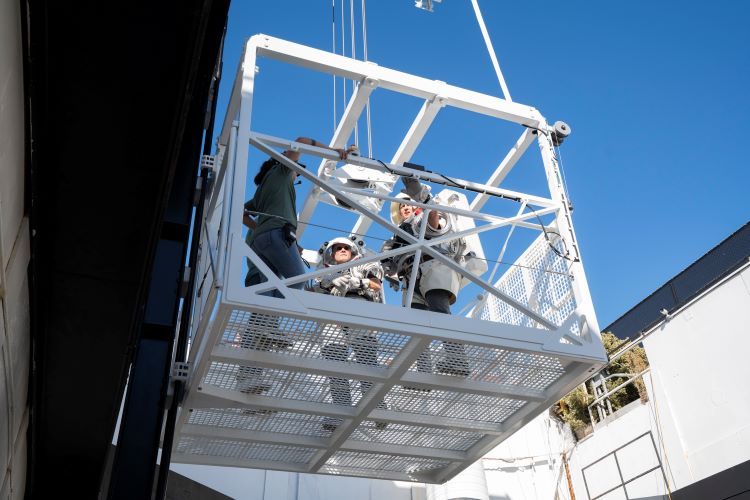
Image of NASA astronauts Nicole Mann and Doug “Wheels” Wheelock conducting recent training on a mock-up of the SpaceX human landing system (HLS) elevator system with the help of a technician.
NASA Astronauts are Trying Out the Starship Lunar Elevator
As NASA continues to ramp up efforts for its Artemis program, which has the goal of landing the first woman and person of color on the lunar surface, two NASA astronauts recently conducted training with a replica of SpaceX’s Starship human landing system (HLS), albeit on a much smaller scale. Given that Starship is 50 meters (160 feet) tall, and the crew quarters are located near the top of Starship, the HLS will need an elevator with a basket to transport crew and supplies from the crew quarters down to the surface. The purpose of this training is to familiarize astronauts with all aspects of this system, including elevator and gate controls and latches, along with how the astronauts perform these tasks in their bulky astronaut suits, which both astronauts wore during the training.
The two NASA astronauts who participated in the recent training are Nicole Mann and Doug “Wheels” Wheelock. NASA Astronaut Mann is a Colonel in the United States Marine Corps who was selected as a NASA astronaut in the 2013 NASA Group 21. Her spaceflight experience includes 157 days in space as part of Expedition 68 onboard the International Space Station (ISS) and being launched aboard the SpaceX Crew-5 mission. NASA Astronaut Wheelock is a Colonel in the United States Army who was selected as a NASA astronaut in the 1998 NASA Group. His spaceflight experience includes 178 days in space as part of STS-120 and later as part of Expedition 24/25 on the ISS and being launched aboard the Soyuz TMA-19.
As noted, Starship is 50 meters (160 feet) tall and 9 meters (30 feet) in diameter and capable of landing 100 tons (99,790 kilograms/220,000 pounds) on the lunar surface, which is in stark contrast to the Apollo lunar module that landed 12 men on the lunar surface during the Apollo program, which was only 5.5 meters (17.9 feet) tall and approximately 4.3 meters (14 feet) in diameter and a mass of 15,103 kilograms (33,296 pounds) with fuel.
Ironically, the original plan for landing astronauts on the Moon during the Apollo program was known as direct ascent that involved a single, large vehicle with a payload of 74,000 kilograms (163,000 pounds) landing on the lunar surface. While NASA was in favor of using the direct ascent method in early 1961 since spacecraft rendezvous and docking had not been performed in Earth orbit yet, this was later scrapped in favor of the lunar orbit rendezvous (LOR) mission mode that was advocated by NASA aerospace engineer, John Houbolt, who estimated this would significantly reduce the weight involved in such a landing approach. LOR not only successfully landed six Apollo missions on the Moon, but it was also responsible for saving the Apollo 13 crew when one of their oxygen tanks ruptured and the crew was able to use the lunar module as a lifeboat as they flew around the Moon and came back to Earth.
As NASA astronauts train for using the Starship HLS elevator someday, Starship has already conducted two flight tests—Ship 24 in April 2023 and Ship 25 in November 2023, respectively. While both flights ended in failure, Ship 25 officially passed the Karman Line, which is the traditional boundary of outer space. A third Starship test flight is currently scheduled to occur sometime in the first quarter of 2024, which also comes as the crewed Artemis II mission is gearing up for their 10-day mission orbiting the Moon in November 2024 and Artemis III currently scheduled to land astronauts near the lunar south pole sometime in 2025.
How will Starship HLS help future Artemis astronauts on the lunar surface in the next few years? Only time will tell, and this is why we science!
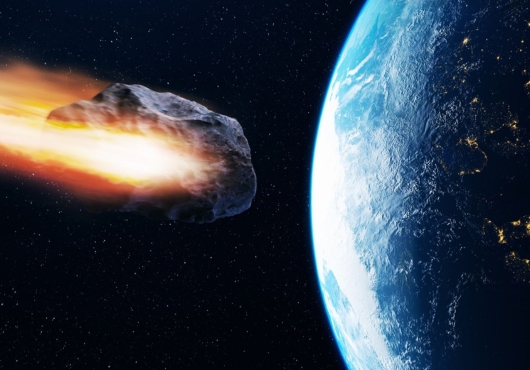
Het klinkt misschien wat rigoureus, maar als de dreiging hoog is, moeten we toch actie ondernemen.
Astronomen hebben tot nu toe de meeste grote en potentieel gevaarlijke planetoïden opgespoord en geanalyseerd. En voorlopig lijkt er geen reden tot zorg te zijn. Uit hun bevindingen blijkt dat er op dit moment geen enkele bekende planetoïde is die in de komende 100 jaar een serieuze bedreiging voor de aarde vormt. Desalniettemin nemen onderzoekers geen risico’s en bestuderen manieren om onze planeet te beschermen tegen mogelijke inslagen van ruimtestenen. En ondanks de veelbelovende resultaten van de DART-missie, overwegen experts of een iets rigoureuzere ingreep met kernbom mogelijk een nog effectievere oplossing kan bieden.
Nucleaire explosie “Hoewel de kans op een grote planetoïde-inslag tijdens ons leven klein is, zouden de mogelijke gevolgen enorm verwoestend kunnen zijn,” zegt onderzoeker Bruck Syal. Daarom bestudeert hij samen met zijn collega’s of mogelijk een nucleaire explosie soelaas zou kunnen bieden. “Kernwapens hebben de grootste verhouding van energiedichtheid per massa van alle menselijke technologieën,” legt hoofdauteur Mary Burkey uit. “Hierdoor zijn ze uitermate waardevol bij het verminderen van dreigingen veroorzaakt door aardscheerders.”
Zo werkt het In een nieuwe studie hebben onderzoekers een model ontwikkeld waarmee ze kunnen bekijken of het mogelijk is om een kernwapen te gebruiken om de aarde te beschermen tegen allesverwoestende inslagen van planetoïden. En de bevindingen zijn veelbelovend. “Als we genoeg waarschuwingstijd hebben, kunnen we een kernwapen afvuren en het naar een planetoïde op miljoenen kilometers afstand sturen die onderweg is naar de aarde,” stelt Burkey. “Daarna zouden we het apparaat laten ontploffen, waardoor de planetoïde van koers verandert. Hierdoor zou de aardscheerder intact blijven, maar wel een gecontroleerde duw weg van de aarde krijgen. Een andere optie is om de planetoïde te verstoren, waardoor hij in kleine, snelbewegende stukken uit elkaar valt en onze planeet ook zou missen.”
Het model laat zien hoe een planetoïde uit elkaar ‘spat’ door een denkbeeldige kernbom die explodeert in de buurt van de aardscheerder. Afbeelding: Mary Burkey
DART Met dit model bouwen de wetenschappers voort op de lessen die zijn geleerd tijdens de recente DART-missie van NASA. Tijdens deze missie, die in september 2022 plaatsvond, werd bewust een ruimtesonde naar een planetoïde gestuurd om diens baan te wijzigen. Dankzij deze missie hebben we veel geleerd over wat er nodig is om een gevaarlijke planetoïde om te leiden. En hoewel de DART-missie succesvol was, heeft een dergelijke strategie ook enkele haken en ogen. We kunnen bijvoorbeeld maar een beperkte hoeveelheid massa de ruimte in sturen. Daarom kijken wetenschappers nog steeds naar het gebruik van nucleaire afbuiging als een mogelijk alternatief.
Meer over de DART-missie Als een planetoïde regelrecht op de aarde afstevent, geven wetenschappers de voorkeur aan een missie waarbij ze de baan van de planetoïde willen veranderen. Tijdens zo’n missie wordt de planetoïde voorzichtig aangeraakt, wat resulteert in een kleine wijziging van de baansnelheid. Hierdoor blijft het grootste deel van de planetoïde bij elkaar, maar wordt de baan voorzichtig afgebogen, zodat de planetoïde niet meer in botsing komt met de aarde. Deze aanpak werd getest tijdens de DART-missie, waarbij een ruimtevaartuig koers zette naar de planetoïde Didymos om te proberen de baan van het maantje Dimorphos te veranderen, door zich tegen de ruimtesteen te pletter te slaan. En met succes. Voorafgaand aan de inslag van DART voltooide het maantje Dimorphos elke 11 uur en 55 minuten een rondje rond zijn grotere moederlichaam Didymos. Maar nu cirkelt Dimorphos in 11 uur en 23 minuten rond Didymos. En dat betekent dat zijn omlooptijd met 32 minuten is verkort.
Met het nieuwe model kunnen de onderzoekers eigenlijk nabootsen wat er gebeurt als een nucleaire bom in de buurt van een planetoïde tot ontploffing wordt gebracht. Deze tool draagt bij aan een beter begrip van hoe de straling van een nucleaire explosie reageert op het oppervlak van een ruimtesteen en onderzoekt ook de schokgolfdynamiek die het binnenste van de steen kan beïnvloeden. Hierdoor begrijpen we beter hoe de straling werkt als we zo’n wapen gebruiken om de koers van een hemelobject te veranderen.
Simulaties Het artikel omvat een handige en precieze verzameling van informatie over hoe röntgenstralen worden geabsorbeerd door oppervlakken. Met zeer nauwkeurige simulaties werden fotonen gevolgd terwijl ze het oppervlak van asteroïde-achtige materialen, zoals steen, ijzer en ijs, binnendrongen. Het model houdt rekening met verschillende omstandigheden, zoals de samenstelling van de materialen, verschillende porositeit en de hoek waaronder de straling invalt. Hierdoor is het model bruikbaar voor verschillende mogelijke scenario’s.
De nieuwe simulaties bieden wetenschappers meer inzicht en meer keuzemogelijkheden mocht er onverhoopt toch een ruimterots op de aarde afstevenen. “Als er ooit een echte noodsituatie ontstaat waarbij de aarde moet worden verdedigd, is het van cruciaal belang om zeer nauwkeurige simulatiemodellen te hebben,” zegt onderzoeker Megan Bruck Syal. “Deze modellen kunnen besluitvormers voorzien van waardevolle informatie. Hiermee kunnen ze mogelijke inslagen van planetoïden voorkomen, essentiële infrastructuur beschermen en levens redden.”
Space travel is hard. From building the rockets to braving the vacuum, surviving the radiation, and safely returning to terra firma, there are few things about it that don’t have a high potential to fail spectacularly.
And yet when everything goes as planned — like when Curiosity touches down on Mars, the James Webb Space Telescope launches, or a spaceship grabs a sample of a hard-to-reach asteroid — space travel can seem easy, if not miraculous. But despite the best efforts of humans, the natural entropy of the space environment and the persnickety nature of rockets and software code still occasionally prevail. One in 25 NASA rockets have failed historically. In 2023, we’re not doing much better. Engineering bloopers abound: Some 50 percent of Space X’s Starship rockets blew up (but, hey, 50 percent didn’t!); researchers kept contact with Voyager 2 for the better part of 46 years (until that dropped call), and only one asteroid retrieval failed to deliver thanks to a canister that was screwed on just a bit too tight.
This is what science is all about, folks. Without further ado, here are the top eight Space Fails of 2023:
8. THE EUCLID SPACECRAFT MADE A COSMIC DOODLE
Euclid’s imperfect observation of a star field made a pretty picture in space.
The European Space Agency spent more than a decade developing the Euclid mission before it launched in July. A space telescope capable of making fine measurements of the shapes of galaxies up to 10 billion light years away and across a third of the sky, Euclid will serve as a window into the dark universe, dark matter, and dark energy. Invisible to any direct observation, Euclid will search for the gravitational influence of dark matter and dark energy on the shapes of galaxies and of space itself.
But while commissioning Euclid’s instruments, they ran into a problem: The Fine Guidance Sensor, designed to hold Euclid’s Visible Instrument on target when viewing a star field, wasn’t working properly. This caused the instrument to wobble while taking an image in October, resulting in an image of a star field with a bright, looping, lasso-like trail, the astrophotography equivalent of painting tracers for a camera with a sparkler. Only in this case, the camera was moving, and the sparkler was a distant sun. No stars or telescopes were harmed due to the failure, and a software update appears to have fixed the problem.
7. NASA IS STILL UNABLE TO OPEN THE OSIRIS-REX ASTEROID SAMPLE CONTAINER
Once they got the sample return capsule back to Johnson Space Center and carefully placed it in a sealed box filled with a neutral nitrogen atmosphere, they hit a snag: two of the 35 fasteners sealing the capsule shut couldn’t be removed.
NASA
Imagine spending $1.16 billion on a jar of pasta sauce and then being unable to open the lid. It’s an absurd scenario, but then, that’s probably the only way to describe the frustration NASA’s science team must be feeling at the moment. The Origins, Spectral Interpretation, Resource Identification, and Security–Regolith Explorer, OSIRIS-REx, was launched in 2016 with the expressed goal of rendezvousing with the near-Earth asteroid Bennu, grabbing a sample of the space rock, and bringing it back to Earth. It was a fantastically complex mission pulled off with precision, right down to the coordinated retrieval of the sample-containing capsule on September 24 after it reentered the Earth’s atmosphere and floated onto the Utah desert.
But once they got the sample return capsule back to Johnson Space Center and carefully placed it in a sealed box filled with a neutral nitrogen atmosphere, they hit a snag: two of the 35 fasteners sealing the capsule shut couldn’t be removed. And unlike a jar of marinara, they can’t just run it under some hot water, tap it on the counter, and twist it really hard with one of those rubber jar openers. NASA is currently working to develop entirely new tools to remove the obstinate fasteners. But at least in the meantime, they have plenty of Bennu material to work with — a surplus of the material coalesced on the outside of the capsule, more material, in fact, than the mission originally hoped to extract from Bennu altogether.
6. A PRIVATE SPACE TUG SPUN OUT OF CONTROL AFTER A RECENT SPACEX LAUNCH
After successfully reaching orbit atop a SpaceX Falcon 9 rocket, the SN3 began spinning uncontrollably, forcing Launcher to prematurely deploy its payloads.
LAUNCHER SPACE
Sometimes a space mission fails because a bolt won’t come out or an O-ring deteriorates. But sometimes, it fails because even mission-critical software can be buggy. That’s what happened after the June 12 launch of the Orbiter SN3, designed by the company Launcher to act as an orbital tugboat that could maneuver smaller satellites into their operational orbits. After successfully reaching orbit atop a SpaceX Falcon 9 rocket, the SN3 began spinning uncontrollably, forcing Launcher to prematurely deploy its payloads. One of those was Otter Pup, a spacecraft built by Starfish Space to service satellites in orbit. Starfish had hoped to demonstrate an on-orbit Rendezvous between Otter Pup and a satellite, but the spacecraft was also set to spinning by the SN3 failure, and in November, Starfish Space abandoned plans to attempt the mission. Launcher did apologize, at least.
5. TWO ASTRONAUTS LOST A TOOL BAG IN SPACE
On November 1, NASA astronauts Jasmin Moghbeli and Loral O’Hara spent more than six hours on a spacewalk to perform some maintenance on the International Space Station exterior, and as a NASA update put it, “during the activity, one tool bag was inadvertently lost.”
SHUTTERSTOCK
Anyone who has worked on their car or tried to fix a leaky sink has experienced that moment where they can’t find that wrench or screwdriver they were just using a minute ago. They put it down somewhere, but where is the question. It turns out astronauts are not immune to the syndrome, but of course, it gets much worse in an environment where things can actually float away when you’re not looking.
On November 1, NASA astronauts Jasmin Moghbeli and Loral O’Hara spent more than six hours on a spacewalk to perform some maintenance on the International Space Station exterior, and as a NASA update put it, “during the activity, one tool bag was inadvertently lost.”
That tool bag now joins the more than 36,000 pieces of space debris larger than 3.9 inches orbiting the Earth at more than 17,000 miles per hour. We hope it didn’t contain anyone’s favorite wrench.
4. VIRGIN ORBIT BLAMED ITS LAUNCH FAILURE ON UPPER-STAGE ANOMALY, FILED FOR BANKRUPTCY
After a Virgin Orbit rocket failed to reach orbit on January 9 due to an engine shutting down, the company pitched into a financial nosedive.
PATRICK T. FALLON/AFP/GETTY IMAGES
Virgin Orbit founder Richard Branson was one of the first billionaires to hop on the commercial space tourism bus when he founded Virgin Galactic in 2004, and the first billionaire to actually ride to space aboard his company’s spacecraft in July 2021. But he was late to the small satellite space launch game. Virgin Orbit was spun out of Virgin Galactic in 2017 with the intention of providing launch services for small payloads using a rocket that would be carried aloft by an aircraft, dropped, and then launched toward the heavens — a possible shortcut to reusability without having to engineer the sorts of self-recovering first stage rocket boosters SpaceX developed for it’s Falcon 9 rockets.
Instead, it was a shortcut to failure.
After a Virgin Orbit rocket failed to reach orbit on January 9 due to an engine shutting down, the company pitched into a financial nosedive. By March, the company had laid off 675 people and by April, filed for Chapter 11 bankruptcy. The bankruptcy was finalized in May, and what was left of the company was sold off for a fraction of its initial value.
3. VOYAGER 2’S DROPPED CALL
On July 21, the operators of the Voyager 2 space probe at NASA’s Jet Propulsion Laboratory accidentally sent a message that commanded the spacecraft to tilt its antenna two degrees away from Earth.
MPI/ARCHIVE PHOTOS/GETTY IMAGES
It’s the second longest distance call you can make, and NASA almost hung up by accident. On July 21, the operators of the Voyager 2 space probe at NASA’s Jet Propulsion Laboratory accidentally sent a message that commanded the spacecraft to tilt its antenna two degrees away from Earth. Given that the spacecraft is now more than 12.3 billion miles away on a trajectory toward interstellar space, that meant Voyager wasn’t listening for NASA in the right part of the sky anymore. Was that it for the famous spacecraft launched 46 years ago in 1977? The probe that brought us our first close-up images of the ice giant planets Neptune and Uranus? The second further human emissary to the Cosmos, trailing only its twin spacecraft Voyager 1? On August 4, NASA announced they had been able to get Voyager 2’s attention with the equivalent of an interstellar “shout” using the radio antenna dishes making up the space agency’s Deep Space Network. Barring any other unexpected dropped calls, Voyager 2 will keep sending data home from outside our Solar System until 2035.
2. LUNA-25 — RUSSIA’S GLORIOUS RETURN TO THE MOON THAT WASN’T
Luna-25 launched on August 10 and would have beaten India’s Chandrayaan-3 lander to the Moon by just a few days.
On August 20, the Russian space agency Roscosmos’s hopes for a triumphant return “ceased to exist as a result of a collision with the surface of the Moon.” The Luna-25 lander launched on Aug. 10, but crash landed near the lunar south pole after a failed orbital maneuver, a blow to both the Russian space program and national pride at a time when the nation has become a pariah over its invasion of Ukraine in February 2022. Initially dubbed Luna-Glob, it was renamed Luna-25 in the tradition of the Soviet era Luna probes, which included the first soft landing on the Moon by Luna-9 in 1966. But it ultimately had more in common with the July 3, 1969 explosion of the Soviet N-1 rocket on the launchpad — the launch vehicle was meant to carry a Soviet crew to the Moon, and the USSR quietly abandoned the project following the US Apollo 11 mission later that month. Adding a historical echo to the Luna-25 failure, Russia was again surpassed by a foreign rival: India successfully landed its Chandrayaan-3 spacecraft near the lunar south pole on August 23.
1. SPACEX'S STARSHIP MAINTAINED A 100 PERCENT EXPLOSION RATE
The Super Heavy Booster, the launch vehicle’s main rocket stage, exploded shortly after it separated from the Starship spacecraft. The investigation is still ongoing, but SpaceX believes Starship exploded not long afterward, a self-destructive act by the spacecraft’s flight termination system, which blows the rocket up if it veers off course.
TIMOTHY A. CLARY/AFP/GETTY IMAGES
On November 18, the second attempt at an uncrewed test flight of Starship and the Super Heavy Booster ended in a fiery explosion in the skies over Texas. The Super Heavy Booster, the launch vehicle’s main rocket stage, exploded shortly after it separated from the Starship spacecraft. The investigation is still ongoing, but SpaceX believes Starship exploded not long afterward, a self-destructive act by the spacecraft’s flight termination system, which blows the rocket up if it veers off course.
Not an ideal second outing for the world’s largest and most powerful rocket, which Musk hopes will take humans to Mars and a variant of which NASA hopes will land its astronauts on the Moon in 2025. But Starship did technically make it to space this time, flying for about eight minutes before blowing up — the first orbital Starship test flight in April ended in flames just moments after launch.
Fermi Produces Unique Time-Lapse Tour of Gamma-Ray Sky
Fermi Produces Unique Time-Lapse Tour of Gamma-Ray Sky
A new movie from NASA’s Fermi mission shows the intensity of gamma rays — the highest-energy form of light — with energies above 200 million electron volts (MeV) detected by Fermi’s Large Area Telescope between August 2008 and August 2022. For comparison, visible light has energies between 2 and 3 electron volts. Brighter colors mark the locations of more intense gamma-ray sources.
“The bright, steady gamma-ray glow of the Milky Way is punctuated by intense, days-long flares of near-light-speed jets powered by supermassive black holes in the cores of distant galaxies,” said Dr. Seth Digel, a senior staff scientist at SLAC National Accelerator Laboratory.
“These dramatic eruptions, which can appear anywhere in the sky, occurred millions to billions of years ago, and their light is just reaching Fermi as we watch.”
“One of the first things to strike your eye in the movie is a source that steadily arcs across the screen,” said Dr. Judy Racusin, a researcher at NASA’s Goddard Space Flight Center.
“That’s our Sun, whose apparent movement reflects Earth’s yearly orbital motion around it.”
Most of the time, Fermi’s Large Area Telescope (LAT) detects the Sun faintly due to the impact of accelerated particles called cosmic rays. When they strike the Sun’s gas or even the light it emits, gamma rays result.
At times, though, the Sun suddenly brightens with powerful eruptions called solar flares, which can briefly make our star one of the sky’s brightest gamma-ray sources.
The Fermi team made an all-sky time-lapse movie using 14 years of data acquired by Fermi’s Large Area Telescope.
Image credit: NASA’s Goddard Space Flight Center / DOE / LAT Collaboration.
“The new movie shows the sky in two different views,” the astronomers said.
“The rectangular view shows the entire sky with the center of our Galaxy in the middle.”
“This highlights the central plane of the Milky Way, which glows in gamma rays produced from cosmic rays striking interstellar gas and starlight.”
“It’s also flecked with many other sources, including neutron stars and supernova remnants.”
“Above and below this central band, we’re looking out of our Galaxy and into the wider Universe, peppered with bright, rapidly changing sources.”
“Most of these are actually distant galaxies, and they’re better seen in a different view centered on our Galaxy’s north and south poles.”
“Each of these galaxies, called blazars, hosts a central black hole with a mass of a million or more Suns.”
“Somehow, the black holes produce extremely fast-moving jets of matter, and with blazars we’re looking almost directly down one of these jets, a view that enhances their brightness and variability.”
“The variations tell us that something about these jets has changed,” Dr. Racusin said.
“We routinely watch these sources and alert other telescopes, in space and on the ground, when something interesting is going on.”
“We have to be quick to catch these flares before they fade away, and the more observations we can collect, the better we’ll be able to understand these events.”
Fermi plays a key role in the growing network of missions working together to capture these changes in the Universe as they unfold.
“Many of these galaxies are extremely far away,” the researchers said.
“For example, the light from a blazar known as 4C +21.35 has been traveling for 4.6 billion years, which means that a flare up we see today actually occurred as our Sun and Solar System were beginning to form.”
“Other bright blazars are more than twice as distant, and together provide striking snapshots of black hole activity throughout cosmic time.”
“Not seen in the time-lapse are many short-duration events that Fermi studies, such as gamma-ray bursts, the most powerful cosmic explosions.”
“This is a result of processing data across several days to sharpen the images.”
NASA's Perseverance Rover Deciphers Ancient History of Martian Lake
NASA's Perseverance Rover Deciphers Ancient History of Martian Lake
Perseverance’s 360-Degree View From 'Airey Hill’: This 360-degree mosaic from the “Airey Hill” location inside Jezero Crater was generated using 993 individual images taken by the Perseverance Mars rover’s Mastcam-Z from Nov. 3-6. The rov
er remained parked at Airey Hill for several weeks during solar conjunction. Credits: NASA/JPL-Caltech/ASU/MSSS. Download image ›
Now at 1,000 days on Mars, the mission has traversed an ancient river and lake system, collecting valuable samples along the way.
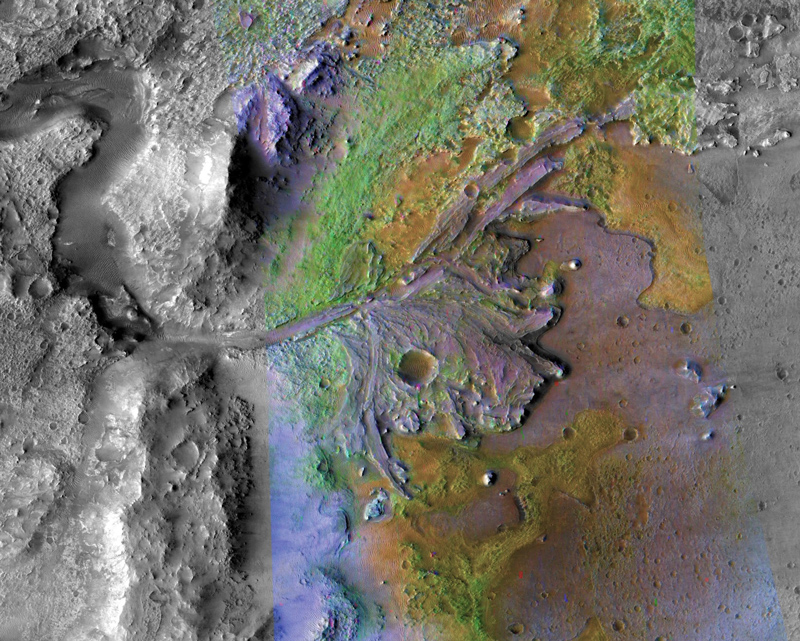
Jezero Crater, Mars 2020's Landing Site: This image of Mars’ Jezero Crater is overlaid with mineral data detected from orbit. The green color represents carbonates – minerals that form in watery environments with conditions that might be favorable for preserving signs of ancient life. NASA’s Perseverance is currently exploring the green area above Jezero’s fan (center).
Marking its 1,000th Martian day on the Red Planet, NASA’s Perseverance rover recently completed its exploration of the ancient river delta that holds evidence of a lake that filled Jezero Crater billions of years ago. The six-wheeled scientist has to date collected a total of 23 samples, revealing the geologic history of this region of Mars in the process.
One sample called “Lefroy Bay” contains a large quantity of fine-grained silica, a material known to preserve ancient fossils on Earth. Another, “Otis Peak,” holds a significant amount of phosphate, which is often associated with life as we know it. Both of these samples are also very rich in carbonate, which can preserve a record of the environmental conditions from when the rock was formed.
Perseverance Rover Zooms in on Ancient Mars River: After 1,000 Martian days of exploration, NASA’s Perseverance rover is studying rocks that show several eras in the history of a river delta billions of years old. Credits: NASA/JPL-Caltech/ASU/MSSS; ESA/DLR/FU-Berlin. Download image ›
The discoveries were shared Tuesday, Dec. 12, at the American Geophysical Union fall meeting in San Francisco.
“We picked Jezero Crater as a landing site because orbital imagery showed a delta – clear evidence that a large lake once filled the crater. A lake is a potentially habitable environment, and delta rocks are a great environment for entombing signs of ancient life as fossils in the geologic record,” said Perseverance’s project scientist, Ken Farley of Caltech. “After thorough exploration, we’ve pieced together the crater’s geologic history, charting its lake and river phase from beginning to end.”
Water Enters Jezero Crater Billions of Years Ago (Artist's Concept): This animated artist’s concept depicts water breaking through the rim of Mars’ Jezero Crater, which NASA’s Perseverance rover is now exploring. Water entered the crater billions of years ago, forming a lake, delta, and rivers before the Red Planet dried up. Credits: NASA/JPL-Caltech. Download video ›
Jezero formed from an asteroid impact almost 4 billion years ago. Since landing in February, 2021, the Perseverance team has discovered the crater floor is made of igneous rock formed from magma underground or from volcanic activity at the surface. They have since found sandstone and mudstone, signaling the arrival of the first river in the crater hundreds of millions of years later. Above these rocks are salt-rich mudstones, signaling the presence of a shallow lake experiencing evaporation. The team thinks the lake eventually grew as wide as 22 miles (35 kilometers) in diameter and as deep as 100 feet (30 meters).
Later, fast-flowing water carried in boulders from outside Jezero, distributing them atop of the delta and elsewhere in the crater.
"We were able to see a broad outline of these chapters in Jezero’s history in orbital images, but it required getting up close with Perseverance to really understand the timeline in detail," said Libby Ives, a post-doctoral fellow at NASA’s Jet Propulsion Laboratory in Southern California, which manages the mission.
Enticing Samples
The samples Perseverance gathers are about as big as a piece of classroom chalk and are stored in special metal tubes as part of the Mars Sample Return campaign, a joint effort by NASA and ESA (European Space Agency). Bringing the tubes to Earth would enable scientists to study the samples with powerful lab equipment too large to take to Mars.
To decide which samples to collect, Perseverance first uses an abrasion tool to wear away a patch of a prospective rock and then studies the rock’s chemistry using precision science instruments, including the JPL-built Planetary Instrument for X-ray Lithochemistry, or PIXL.
At a target the team calls “Bills Bay,” PIXL spotted carbonates – minerals that form in watery environments with conditions that might be favorable for preserving organic molecules. (Organic molecules form by both geological and biological processes.) These rocks were also abundant with silica, a material that’s excellent at preserving organic molecules, including those related to life.
“On Earth, this fine-grained silica is what you often find in a location that was once sandy,” said JPL’s Morgan Cable, the deputy principal investigator of PIXL. “It’s the kind of environment where, on Earth, the remains of ancient life could be preserved and found later.”
Perseverance’s instruments are capable of detecting both microscopic, fossil-like structures and chemical changes that may have been left by ancient microbes, but has yet to see evidence for either.
At another target PIXL examined, called “Ouzel Falls,” the instrument detected the presence of iron associated with phosphate. Phosphate is a component of DNA and the cell membranes of all known terrestrial life and is part of a molecule that helps cells carry energy.
PIXL Instrument on NASA's Perseverance Studies 'Ouzel Falls': PIXL, one of the instruments aboard NASA’s Perseverance Mars rover, analyzed the chemical makeup of an area of abraded rock dubbed “Ouzel Falls,” finding it rich in minerals containing phosphate, a material found in the DNA and cell membranes of all known life. Credits: NASA/JPL-Caltech/MSSS. Download image ›
After assessing PIXL’s findings on each of these abrasion patches, the team sent up commands for the rover to collect rock cores close by: Lefroy Bay was collected next to Bills Bay, and Otis Peak at Ouzel Falls.
PIXL Instrument on NASA's Perseverance Studies 'Ouzel Falls': Analyzing this abraded rock patch dubbed “Bills Bay,” the PIXL instrument on NASA’s Perseverance Mars rover found it rich in carbonates (purple) and silica (green), both of which are good at preserving signs of ancient life. The image is overlaid with the instrument’s chemical data. Credits: NASA/JPL-Caltech/MSSS. Download image ›
"We have ideal conditions for finding signs of ancient life where we find carbonates and phosphates, which point to a watery, habitable environment, as well as silica, which is great at preservation," Cable said.
Perseverance’s work is, of course, far from done. The mission’s ongoing fourth science campaign will explore Jezero Crater’s margin, near the canyon entrance where a river once flooded the crater floor. Rich carbonate deposits have been spotted along the margin, which stands out in orbital images like a ring within a bathtub.
More About the Mission
A key objective for Perseverance’s mission on Mars is astrobiology, including the search for signs of ancient microbial life. The rover will characterize the planet’s geology and past climate, pave the way for human exploration of the Red Planet, and be the first mission to collect and cache Martian rock and regolith (broken rock and dust).
Subsequent NASA missions, in cooperation with ESA (European Space Agency), would send spacecraft to Mars to collect these sealed samples from the surface and return them to Earth for in-depth analysis.
The Mars 2020 Perseverance mission is part of NASA’s Moon to Mars exploration approach, which includes Artemis missions to the Moon that will help prepare for human exploration of the Red Planet.
JPL, which is managed for NASA by Caltech in Pasadena, California, built and manages operations of the Perseverance rover.
"This is an amazing time to be a part of this program."
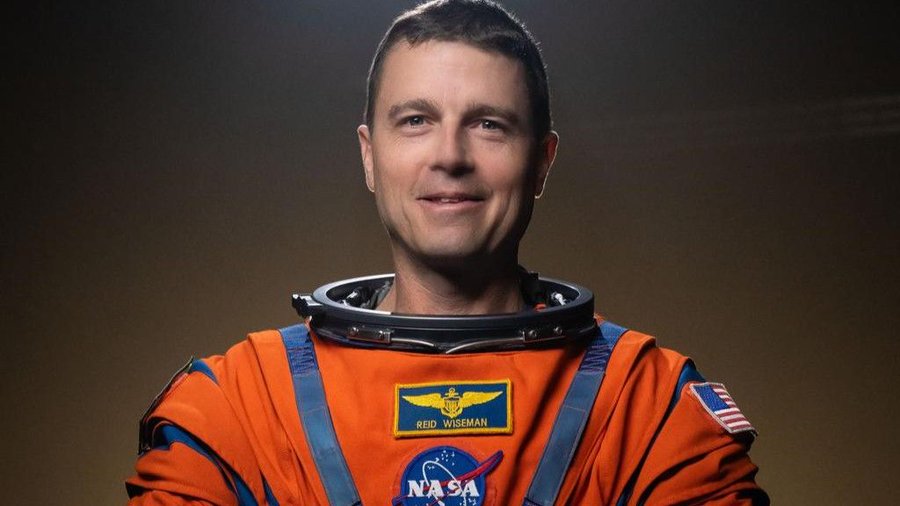
NASA astronaut Reid Wiseman will command Artemis 2, the first human moon mission in half a century.
(Image credit: Robert Markowitz/NASA-JSC)
The commander of humanity's first moon mission in half a century has a special invite from SpaceX in his pocket.
Reid Wiseman, the NASA astronaut leading the four Artemis 2 crew members, told Space.com in a Dec. 18 exclusive that SpaceX wants to talk to his crew about Starship. That's no coincidence, given that SpaceX is developing Starship for Artemis 3, which intends to land humans on the moon for the first time since 1972.
When and how that all comes together is not known yet. Artemis 2 is expected to fly around the moon no earlier than 2024 if schedules hold. Artemis 3 is manifested for 2025 or 2026, but that assumes that SpaceX's Starship has passed enough tests to satisfy NASA's strict safety requirements for human-rated spacecraft.
Wiseman spoke with Space.com not only about SpaceX, but what his crew plans to take along with them on the mission, the outreach he has been doing, and how his crew is dealing with developmental uncertainty. Riding to the moon with him (and back) are NASA pilot Victor Glover (who will become the first person of color to leave low Earth orbit), NASA mission specialist Christina Koch (the first woman) and Canadian Space Agency mission specialist Jeremy Hansen (the first non-American).
We're about a year out from the launch of Artemis 2. Can you talk about your main goals for the mission, and what you're focusing on as a crew and as a team right now?
Reid Wiseman, Artemis 2 commander: It's pretty basic for us. We really want to enable the Orion and the Space Launch System for our fellow astronauts that are going to go land on the moon and work in the lunar vicinity. So every day we show up to work.
It just happened in a class we were just in: We are not only looking at how to make this better for Artemis 2. We're thinking about, "How do we position this for Artemis 3, 4, and 5?" Victor Glover today — we were talking about, "Hey, it [Artemis 2] is just a nine-day mission." We were in a survival class, but we said, "We won't be that deconditioned [after the mission]." And Victor was like, "Hey, wait a minute. We have to think about the max mission duration, because this will be valid for all Artemis missions."
So we've done — I think — an awesome job of just really looking at, what does this vehicle need for the future for our crewmates, when they go and land on the moon? How can we wring out Orion and SLS so that when our peers are training for moonwalking missions, that is almost just a basic in that [they think], "Okay, we know Orion. So we don't have to worry about that [spacecraft]. Let's instead focus on the HLS [human landing system spacecraft] or, let's focus on the new suit designs." That's really our fundamental goal.
Training has been fantastic, really well-prepared classes. It kind of comes in little waves. We're really busy, in the last few weeks, and then we have a little bit of down time. Then you're really busy again.
Can you talk about the excitement that all the teams are feeling for Artemis 2, along with the responsibilities?
Wiseman: It completely has blown me away, and not just on the professional side, but on the outreach side,to traveling around the world. Seeing where the European Service Module was built in Bremen, Germany with Airbus. Those people are so fired up to have humans riding on their vehicle. Or going into the Cape [Canaveral area] with Lockheed and Orion. I even got a call two weeks ago from the lead engineer at SpaceX. He was like, 'Next time you guys are at Cape [Canaveral, nearby NASA's Kennedy Space Center), come by and talk to us. We're doing Starship, and Dragon, and we just want to hear what is going on with the Artemis 2 crew."
I had to take a step back. They launched two Starships [in 2023], and got another one rolling onto the pad. Here they want us to come talk to them, because they are just motivated. Then of course, there are the teams that we're training with, especially at NASA. A lot of these folks, this is their career. Their career is spent preparing for us to go work on the moon. So to be a crew, marching towards a launch, it's far more meaningful for them than it is for us. We really try to embrace that. It's very powerful.
The Artemis 2 moon crew during a launch simulation at NASA's Kennedy Space Center on Sept. 20, 2023. They stand on the crew access arm at Launch 39B, which will one day bring them to the waiting Space Launch System rocket and Orion spacecraft. From left: NASA astronaut and pilot Victor Glover, Canadian Space Agency astronaut and mission specialist Jeremy Hansen, NASA astronaut and mission specialist Christina Koch, and NASA astronaut and commander Reid Wiseman. (Image credit: NASA/Frank Michaux)
Any surprises with the training?
Wiseman: My surprise might be a little cliche. We figured — as the crew that's going to fly this vehicle for the first time — there are going to be so many unknowns. We're going to work our way through a really rough training syllabus. But what I neglected was, we're being trained by the flight controllers who just operated Artemis 1 [an uncrewed mission around the moon in 2022] very successfully. So we go into these classes, and they are just polished. They know everything there is to know about this vehicle. They just got done flying it, and around the moon. They know their systems. So there, it's just wired. I've been very impressed. They really know what's going on.
Your crew has emphasized that Artemis 2 is very much a developmental mission. So you're informed in making this mission by decades of spaceflight experience at NASA, even among all the crew. However, many of the procedures and training facilities are being created as you train. So as such, how's everybody doing on the timeline for launch?
How would NASA deal with any ripple effects in scheduling later Artemis missions if this one happened to be delayed?
Wiseman: You know, as a crew, we don't get into the programmatic of, "We ought to launch in November of 2024." There's political implications. There's operational implications. What we really care about is when this vehicle is ready, and when NASA says it's ready to go fly, we will be prepared to go fly it. That is our critical milestone. But as they're going through assembly, I think we're gonna face a little bit of a slip. For sure. So we'll see how that goes.
But I think so far, everything that I'm seeing is coming along very logically. Very methodically. And when the Orion program, or SLS, has hit a snag, we have stopped the appropriate amount of time. We're really analyzing, "Do we need to fix this? Do we have an operational workaround? Do we have a hardware workaround?" And then we're proceeding on.
I think everything has been, and what I have seen is, a safety culture. The mission assurance culture right now has been extremely healthy. We're very methodically going along at a great pace to fly when this vehicle is ready.
Artemis 2 crew members inspect their Orion crew module inside the high bay of the Neil A. Armstrong Operations and Checkout Building at NASA’s Kennedy Space Center in Florida, on Aug. 7, 2023. (Image credit: NASA)
Have you and the crew discussed the personal items that you're taking to the moon, yet?
Wiseman: We are pretty weight-limited, but we do all have little things. I won't speak for the rest of the crew, but my whole life, I've realized how important tradition is to me. Things that I do with my children, or that my parents did with me and my brother growing up. So I will take something that nods to my personal family tradition, just as a personal token to myself.
When I flew on the Soyuz in 2014 [to the International Space Station], on my kneeboard, I had a little black-and-white picture of my kids just printed on the piece of paper, because mass is everything. So you don't take anything extra that you don't need to take. So I printed it directly on my kneeboard, and I'll do something very similar to that.
But to be honest — I didn't think about this when we first got assigned — but I get to work with Victor, Christina and Jeremy. I just want to be immersed in this experience with them. They are such special people. So I just can't wait to watch them operate as we head out around the moon.
How have you in the crew been engaging with NASA personnel, contractors, when visiting facilities and training locations?
Wiseman: We've been heading absolutely everywhere. The thing we have to remind ourselves, is everywhere we go, people know who we are. It is amazing to see just how excited people are. I mean, they are so fired up. We went to Marshall Space Flight Center, one of our own NASA centers, and we stood for an entire hour as people just took picture after picture after picture. Just walking up to the crew. We are just a human representation of what these people have been working for for over a decade. It's just so powerful.
As a group, you've been making a lot of other types of appearances. For example, you were beside Apollo 13 movie actor Tom Hanks — a moon astronaut in the movies, of course. You were also at the F1 car racing event, and many other places. Can you talk about what that experience has been like for you and the crew?
Wiseman: That is definitely surreal, because we're in places that most people don't get a chance to experience. Tom Hanks — he had a formative place in my childhood with "Apollo 13," and with "Forrest Gump." Just to get to meet these people, and to interact a little bit, has been really neat. But you know, if you gave us our wishes, we would be at a fifth-grade class trying to motivate kids to go study STEM [science, technology, engineering and math].
But this is important. We need all elements of outreach to get the message as far and wide as we possibly can, that this is worth doing. Human exploration is important to bring our world together. We can tackle big problems when we work together. So that's the message we want to send. Having people like Tom Hanks involved, and getting to F1 — getting to a few markets that typically we don't get to — has been cool.
It was fun to be immersed in the Formula One parallels between that, and Mission Control and spaceflight. The way they communicate — the way they structure and organize the things that matter to the drivers, and then the different things that matter to the engineering teams — I took a lot away from Formula One.
Actor and "Apollo 13" movie star Tom Hanks (center) with the Artemis 2 crew. The new moon astronauts include, from left, the Canadian Space Agency's Jeremy Hansen, NASA's Reid Wiseman, NASA's Christina Koch and NASA's Victor Glover. Behind them is a mockup of the Orion spacecraft for moon missions. (Image credit: NASA)
Is there anything else you would like to talk about?
Wiseman: I just want to really thank you for what you all do at Space.com. We have a lot of great, great learning from you guys, and I appreciate the research that you do and showing up [at the events]. I think it's really important.
I love the public-private partnership of Artemis. I don't think we do a good enough job highlighting just how that is going. The CLPS [commercial lunar payload services program, or robotic missions in support of Artemis] are going to launch soon, with robotic missions to the moon. And what SpaceX is doing, and now Blue Origin is coming on, with the HLS design. When you're when you live in this and you marinate in it, it's just awesome. This is an amazing time to be a part of this program. So we really appreciate the public support.
Helicity Space, a startup founded in 2018, is developing a fusion drive poised to transform space travel. With a fresh round of investment, the company is developing a proof-of-concept for a fusion-powered propulsion system that can get from Earth to Mars in two months.
In a recent press release, the space-based startup recently secured $5 million in seed funding from Airbus Ventures, TRE Ventures, Voyager Space Holdings, E2MC Space, Urania Ventures, and Gaingels.
Unlike traditional rockets that rely on chemical reactions, Helicity’s fusion drive operates on a magneto-inertial fusion method. This involves fusing two hydrogen isotopes into helium, releasing immense energy – ten million times more per unit mass than chemical fuels.
According to Helicity, the core technology behind their fusion drive efficiently converts electricity into plasma heating, using a unique approach to scale fusion conditions and directly produce thrust. Their method, distinct from conventional magnetic or inertial (laser) fusion, employs self-organized Taylor relaxation and magnetic reconnection physics, combined with a peristaltic magnetic compression scheme.
In very simple terms, the engine uses hot ionized plasma gas heated by magnetic fields that are constantly forced together to the point where they must then break apart. It is this seesaw of magnetic forces that generates vast amounts of energy, heating the plasma to the point where fusion occurs, forcing the nuclei so close that they overcome their electrostatic repulsion and fuse together. To simplify this even more, the energy created by that fusion is aimed out of the tailpipe of the Helicity Drive, and you generate a helluva lot of thrust.
So much so that it cuts the current seven or eight-month trip to Mars down to two, or the six-year trip to Jupiter down to just one.
One of the key advantages of Helicity’s fusion drive is its fuel and propellant efficiency. It enables faster travel over interplanetary distances, with less exposure to space radiation and the agility to alter trajectories or abort missions if necessary. The Helicity Drive creates short bursts of fusion conditions in a design optimized for propulsive plasma exhaust, thus providing acceleration with each pulse. You proverbially slam on the gas pedal, accelerate, and then take your foot off the gas letting momentum do the work. This propulsion method can be deployed before achieving continuous power generation, significantly advancing the feasibility of fusion propulsion in space.
Helicity’s efforts are part of a larger movement to leverage fusion technology in space exploration. Fusion power, unlike fission, merges atoms together, releasing vast energy amounts with safer byproducts. This contrasts starkly with fission’s splitting of atoms, which leads to radiation issues and the complex disposal of irradiated waste. Helicity’s fusion engines use multiple magnetically-controlled, super-heated plasma jets to propel spacecraft, marking a substantial shift from conventional rocket technology, which requires large amounts of super-cold or highly explosive fuel.
“Fusion propulsion can contribute to Earth’s environmental goals indirectly by enabling offworld mining and industry, reducing terrestrial resource consumption and ecological impact,” explained Helicity co-founder Dr. Setthivoine You in an interview. “Ultimately, we see our technology playing a significant role in both space exploration and Earth’s sustainable future.”
The company’s vision extends to catalyzing humanity’s spacefaring ambitions, boosting both human and robotic exploration, and possibly leading to ventures like asteroid mining. The technology’s scalability and practical use in space, even before establishing self-sustaining reactors, demonstrate its potential for early testing and gradual scaling up.
Helicity Space collaborates with top scientific institutes globally, including the California Institute of Technology and the University of Tokyo. Supported by entities like the U.S. Department of Energy’s Innovation Network for Fusion Energy, these partnerships underscore the scientific community’s interest in and support for Helicity’s groundbreaking work.
“We’re currently focused on proving the technology for space propulsion. Once we achieve this, we anticipate drawing more substantial interest and investment, including from energy companies, for broader applications,” said Dr. You.
While building a working fusion drive will require more than their current $5 million dollar investment, the fact that there was funding clearly shows there is a hard push for novel space technology. While still in development, the potential applications of this technology in enhancing human and robotic space exploration are immense.
MJ Banias is a journalist who covers security and technology. He is the host of The Debrief Weekly Report. You can email MJ at mj@thedebrief.org or follow him on Twitter @mjbanias.
It was the first time the satellite's lasers were caught on camera.
A mysterious spectacle of green laser beams in the sky was caught on video by motion-detecting cameras positioned outside Hiratsuka City Museum in Japan.
Daichi Fujii, the museum curator, set up the motion-detecting cameras to capture meteors andcalculate their position, brightness and orbit. At first, the bright green lines that appeared on the camera footage from Sept. 16, 2022, were a mystery. However, further inspection revealed the beams were synchronized with a tiny green dot that was briefly visible between the clouds.
On Sept. 16, 2022, motion-sensing cameras set up by museum curator Daichi Fujii to capture meteors instead caught the laser beams of NASA’s ICESat-2 satellite as it passed over Japan. It’s the first time the ICESat-2 team has seen footage of the lasers at work in orbit. Credits: Video Courtesy of Daichi Fujii, Hiratsuka City Museum
As it turns out, the lasers were being beamed down from space by one of NASA's Earth-orbiting satellites. The Ice, Cloud and Land Elevation Satellite 2, or ICESat-2, flew over the museum at the perfect time for its green lasers to be caught in action, streaming from orbit to Earth.
The museum's motion detector footage is the first time the satellite's laser beams have been caught on camera, according to a NASA statement.
On Sept. 16, 2022, motion-sensing cameras set up by Hiratsuka City Museum curator Daichi Fujii to capture meteors instead caught the laser beams of NASA's ICESat-2 satellite as it passed over Japan. It's the first time the ICESat-2 team has seen footage of the lasers at work in orbit. (Image credit: Daichi Fujii, Hiratsuka City Museum/NASA)
"ICESat-2 appeared to be almost directly overhead of [the museum], with the beam hitting the low clouds at an angle," Tony Martino, ICESat-2 instrument scientist at NASA's Goddard Space Flight Center in Greenbelt, Maryland, wrote in the statement from the space agency. "To see the laser, you have to be in the exact right place, at the right time, and you have to have the right conditions."
ICESat-2, which launched in September 2018, uses lasers and a very precise detection instrument to measure the elevation of ice sheets, sea ice thickness and land topography on Earth. The laser instrument is technically a lidar sensor, which stands for Light Detection and Ranging. Lidar sensors are typically used to generate precise 3D measurements, and are also used by autonomous vehicles to sense their surroundings. The lidar system aboard ICESat-2 fires 10,000 times a second, sending six beams of light to Earth from orbit.
As its picture was being taken from the ground, ICESat-2 was at work collecting data on the height profile of the clouds, mountainous terrain and ocean of Japan below. This ICESat-2 data plot shows what the satellite measured as it passed over Fuji City, Japan (marked with a vertical green line) on Sept. 16, 2022. The laser instrument detected two cloud layers, one high and one low, which scattered the light enough to be detected by the cameras on the ground.
Credits: NASA/Tony Martino
"It precisely times how long it takes individual photons to bounce off the surface and return to the satellite," NASA wrote in the statement. "Computer programs use these measurements to calculate ice losses from Greenland and Antarctica, observe how much of the polar oceans are frozen, determine the heights of freshwater reservoirs, map shallow coastal regions, and more."
Generally, the satellite's laser beams are difficult to spot from Earth. Located hundreds of miles up in space, the lasers have roughly the strength of a camera flash more than 100 yards away. Plus, the laser's light has to reflect off something to be seen. However, on Sept. 16, 2022, there were just enough clouds to scatter — not obscure — the laser light, making it visible to the museum's cameras.
"With the precise location of the satellite in space, the location of where the beam hit, the coordinates of where Fujii's cameras were set up, and the addition of cloudy conditions, Martino was able to confirm, definitively, that the streaks of light came from ICESat-2's laser," NASA officials added in the statement.
Japan is on track to become the fifth country to land a probe on the Moon, after its SLIM spacecraft successfully entered lunar orbit on Dec. 24. The $100m mission, dubbed the “moon sniper”, aims to demonstrate Tokyo’s ability to land a lightweight, low-cost spacecraft on the Moon with high precision.
The SLIM spacecraft is expected to land within 100m of a location near the Shioli crater, on the near side of the Moon. The landing attempt is scheduled for Jan. 19, after the spacecraft spends a month circling the Moon. This would mark a historic moment for Japan, as a successful touchdown would join the ranks of the United States, Russia, China, and India, who have previously achieved the feat of landing a probe on the Moon.
The SLIM mission is part of Japan’s ambitious space exploration efforts, which include sending a rover to explore the lunar surface, collecting samples from an asteroid, and participating in the Artemis program to return humans to the Moon. The mission also showcases Japan’s technological prowess and innovation, as the SLIM spacecraft is designed to be smaller, lighter, and cheaper than previous lunar landers.
The SLIM spacecraft weighs only 130kg, compared to the 1,500kg of China’s Chang’e-4 lander, which landed on the far side of the Moon in 2019. The SLIM spacecraft also costs only $100m, a fraction of the $1.3bn budget of India’s Chandrayaan-2 mission, which failed to land on the Moon in 2019. The SLIM spacecraft is equipped with advanced navigation and guidance systems, which allow it to autonomously adjust its trajectory and attitude during the landing process.
The launch of SLIM was carried out by a Mitsubishi Heavy Industries H-2A rocket, which also carried the X-Ray Imaging and Spectroscopy Mission (XRISM) satellite. The XRISM is a joint project between the Japanese, American, and European space agencies. The satellite, containing a telescope the size of a bus, has parted ways with the lunar lander to orbit around the Earth. It will now begin studying space phenomena such as black holes.
The successful launch and lunar orbit entry of SLIM follow a series of failures over the past year. Last November, JAXA lost contact with its OMOTENASHI spacecraft and aborted the Moon landing mission. More recently in April, a private Japanese start-up, iSpace, failed to land its Hakuto-R lander after it too lost contact with the spacecraft. Two test rocket launches have also failed this year.
The SLIM mission represents a significant step forward in Japan’s space exploration efforts. The mission’s success so far demonstrates the country’s resilience and determination in the face of previous setbacks. As the world watches, the upcoming moon landing attempt is set to be a pivotal moment in space exploration history.
Artist's impression of the lunar explorer on the Moon.
Japan Probe Enters Lunar Orbit Ahead of Historic Moon Landing
Japan Probe Enters Lunar Orbit Ahead of Historic Moon Landing
By AFP
Artist's impression of the lunar explorer on the Moon.
(JAXA)
Japan's SLIM space probe entered the Moon's orbit on Monday in a major step towards the country's first successful lunar landing, expected next month.
The Smart Lander for Investigating Moon (SLIM) is nicknamed the "Moon Sniper" because it is designed to land within 100 metres (328 feet) of a specific target on the lunar surface.
If successful, the touchdown would make Japan only the fifth country to have successfully landed a probe on the Moon, after the United States, Russia, China and India.
On Monday, SLIM "successfully entered the moon's orbit at 04:51 pm Japan time" (0751 GMT), the Japan Aerospace Exploration Agency (JAXA) said in a statement released Monday evening.
"Its trajectory shift was achieved as originally planned, and there is nothing out of the ordinary about the probe's conditions," the agency said.
The lander's descent towards the moon is expected to start around 12:00 am Japan time on January 20, with its landing on the surface scheduled for 20 minutes later, JAXA said.
The H-IIA rocket lifted off in September from the southern island of Tanegashima carrying the lander, after three postponements linked to bad weather.
JAXA said this month that the mission would be an "unprecedentedly high precision landing" on the Moon.
The lander is equipped with a spherical probe that was developed with a toy company.
Slightly bigger than a tennis ball, it can change its shape to move on the lunar surface.
Compared to previous probes that landed "a few or 10-plus kilometres" away from targets, SLIM's purported margin of error of under 100 metres suggests a level of accuracy once thought impossible, thanks to the culmination of a 20-year effort by researchers, according to JAXA.
With the advance of technology, demand is growing to pinpoint targets like craters and rocks on the lunar surface, Shinichiro Sakai, JAXA's SLIM project manager, told reporters this month.
"Gone are the days when merely exploring 'somewhere on the moon' was desired," he said.
Hopes are also high that SLIM's exactitude will make sampling of lunar permafrost easier, bringing scientists a step closer to uncovering the mystery around water resources on the moon, Sakai added.
Japanese missions have failed twice – one public and one private.
Last year, the country unsuccessfully sent a lunar probe named Omotenashi as part of the United States' Artemis 1 mission.
In April, Japanese startup ispace tried in vain to become the first private company to land on the Moon, losing communication with its craft after what it described as a "hard landing".
Since its launch last year, NASA’s James Webb Space Telescope has repeatedly proven itself to be an incredible asset in the search for answers to many of the lingering questions about our universe.
Having offered some of the most stunning imagery of the distant universe ever collected, NASA has said the telescope “has delivered on its promise of revealing the universe like never before in its first year of science operations.”
Looking back on a year of groundbreaking discoveries and breathtaking imagery Webb has brought to the world, here are some of the key highlights brought to us by Webb in 2023 that have expanded our view of the cosmos.
JAMES WEBB SPACE TELESCOPE CONFIRMS ITS FIRST EXOPLANET
In January, a team of researchers led by Kevin Stevenson and Jacob Lustig-Yaeger confirmed the discovery of an exoplanet with help from the James Webb Space Telescope. Formally named LHS 475 b, the discovery was made following a careful review of a series of targets of interest from NASA’s Transiting Exoplanet Survey Satellite (TESS).
Artist’s concept of Exoplanet LHS 475 b and Its Star (Credit: NASA, ESA, CSA, Leah Hustak (STScI)).
The telescope’s powerful Near-Infrared Spectrograph (NIRSpec) succeeded in obtaining imagery of the exoplanet throughout just two of its transit observations.
“There is no question that the planet is there,” said Lustig-Yaeger. “The fact that it is also a small, rocky planet is impressive for the observatory.” Mark Clampin, Astrophysics Division director at NASA Headquarters in Washington, added that the detection of “an Earth-size, rocky planet open the door to many future possibilities for studying rocky planet atmospheres with Webb.”
WEBB GETS GRITTY WITH VIEW OF A REMOTE CLOUDY PLANET
In March, NASA unveiled new features about the atmosphere of a distant planet 40 light-years away from Earth, which included the swirling sandstorms in its scorching atmosphere.
The planet, designated VHS 1256 b, is located within a relatively young triple brown dwarf system approximately 40 light years away, orbiting a pair of stars over 10,000 years, which are roughly four times farther from it than the distance between the Sun and Pluto.
(Credit: NASA, ESA, CSA, Joseph Olmsted)
The James Webb Space Telescope was able to reveal the presence of silicate clouds blanketing the alien world, along with its rising and mixing atmosphere, which confirmed that silicate dust grains of varying sizes are present within the clouds encircling VHS 1256 b, resulting in scorching hot sandstorms that blanket the alien world.
WEBB FINDS WATER, AND MUCH MORE WHILE OBSERVING AN ASTEROID
In May, Webb’s NIRSpec (Near-Infrared Spectrograph) instrument helped astronomers make the first detection of water vapor in the vicinity of a comet in the main asteroid belt, confirming that water ice from the early solar system can be preserved there.
Artist’s Concept of Comet 238P/Read (Credit: NASA/ESA).
Curiously, the detection of water vapor was made in the absence of any sign of carbon dioxide, presenting new questions for astronomers involved with the discovery.
Stefanie Milam, Webb’s deputy project scientist for planetary science and the co-author of a study on the discovery, said her team’s observations help to unravel “the history of water distribution in the solar system,” adding that it “will help us to understand other planetary systems, and if they could be on their way to hosting an Earth-like planet.”
WEBB SPOTS EERIE RINGS SURROUNDING A STAR
Astronomers attempting to study the first asteroid belt ever seen beyond our solar system using Webb’s Mid-Infrared Instrument (MIRI) discovered far more than they went looking for this year, which included a series of glowing discs encircling the star Fomalhaut.
Fomalhaut, as seen by Webb
(NASA, ESA, CSA, A. Gáspár, University of Arizona, A. Pagan).
According to NASA’s Jet Propulsion Lab (JPL), a trio of nested belts was detected around the star, sprawling as much as 14 billion miles outward into the surrounding space.
The brightest star visible in the “Southern Fish” constellation Piscis Austrinis, Fomalhaut is a relatively young class A star located around 25 light-years from Earth’s Sun.
WEBB CELEBRATES ITS ANNIVERSARY BY PEERING INTO THE OPHIUCHI CLOUD COMPLEX
In celebration of the anniversary of its launch in 2022, in July NASA released images obtained by the telescope featuring a nursery for star formation, located in an area of interstellar clouds consisting of different nebulae within the Ophiuchus constellation some 390 light years from Earth, known as the Rho Ophiuchi cloud complex.
Released on July 12, the image represented more than just a snapshot of the nearest region to Earth where stellar formation occurs; at less than 400 light years away, there are no stars in the foreground obstructing Webb’s view of Pho Ophiuchi, meaning that the imagery provides some of the greatest clarity and depth of any infrared view of the cosmos any human-made telescope has ever obtained of the distant universe.
The Rho Ophiuchi cloud complex, as captured in imagery by the James Webb Space Telescope marking its first year in operation (Credit: NASA/JWST).
The imagery prompted Nicola Fox, associate administrator of NASA’s Science Mission Directorate, to call them “a breathtaking treasure trove of images and science that will last for decades,” adding that Webb’s sharp eye has “given us a more intricate understanding of galaxies, stars, and the atmospheres of planets outside of our solar system than ever before, laying the groundwork for NASA to lead the world in a new era of scientific discovery and the search for habitable worlds.”
JAMES WEBB SPACE TELESCOPE OFFERS A NEW LOOK AT AN ICONIC SUPERNOVA
In August, Webb’s NIRCam managed to obtain new imagery of the Large Magellanic Cloud, providing astronomers with potentially crucial information not only about this iconic celestial object, but also about the development of supernovae.
Officially designated SN 1987A, this supernova within the Large Magellanic Cloud has long appealed to astronomers since its discovery in 1987, presenting an ideal target for viewing at gamma-ray and radio wavelengths.
In the imagery obtained earlier this year, a central structure resembling a keyhole was detected within the heart of the supernovae. “This center is packed with clumpy gas and dust ejected by the supernova explosion,” read a NASA statement, which added that the dust within it is “so dense that even near-infrared light that Webb detects can’t penetrate it.” Of course, that didn’t prevent Webb from obtaining some of the most striking imagery ever obtained of the object.
MYSTERIOUS BRIGHTNESS AT THE COSMIC DAWN IS FINALLY SOLVED
New simulations produced by a Northwestern University-led team of astrophysicists in October helped to solve the riddle of why galaxies appeared too bright in the James Webb Space Telescope’s (JWST) initial images of the universe’s earliest galaxies.
Artist’s concept of early starbursting galaxies
(Credit: Aaron M. Geller, Northwestern, CIERA + IT-RCDS)
The Northwestern team found that the galaxies weren’t as massive as the imagery seemed to convey, and that even galaxies possessing less mass can glow as brightly as more massive ones, due to the presence of brilliant bursts created with the birth of new stars, in findings that align with the standard model of cosmology.
WEBB EXOPLANET DISCOVERY MAY “RESHAPE OUR UNDERSTANDING” OF PLANETARY EVOLUTION
In November, astronomers reported that the James Webb Space Telescope (JWST) succeeded in detecting water vapor, sand clouds, and sulfur dioxide in the atmosphere of the exoplanet WASP-107b.
A transmission spectrum of the warm Neptune exoplanet WASP-107b, captured by the Low Resolution Spectrometer (LRS) of the Mid InfraRed Instrument (MIRI) on board JWST, reveals evidence for water vapour, sulfur dioxide, and silicate (sand) clouds in the planet’s atmosphere.
(Image: Michiel Min / European MIRI EXO GTO team / ESA / NASA; Klaas Verpoest (LUCA School of Arts, Belgium)
The discovery, led by a team of European astronomers from Belgium’s KU Leuven University, revealed the presence of water vapor, sulfur dioxide, and silicate sand clouds while notably lacking methane, a common greenhouse gas, around the exoplanet.
JAMES WEBB SPACE TELESCOPE UNVEILS URANUS IN WAYS NEVER BEFORE SEEN
In December, NASA released stunning new enhanced imagery of the ice giant Uranus, in a series of updated images captured by its premiere space observatory earlier this year.
The seventh planet from the Sun in our solar system, Uranus possesses a striking bluish green color, caused by its atmosphere composed primarily of helium and hydrogen, which the new imagery captured by the James Webb Space Telescope showcases in remarkable clarity, along with several of the planet’s twenty-seven known satellites.
The newly enhanced versions of imagery depicting Uranus, were originally obtained earlier this year by the James Webb Space Telescope
(Credit: NASA/ESA/JWST).
The new image was based on enhancements of a two-color version of the same view of Uranus released earlier in 2023, which employs additional wavelength coverage that allows more details to be revealed in the latest versions.
With the many incredible discoveries Webb has made throughout 2023, the future is looking bright for NASA’s premier space observatory, and we can certainly expect more remarkable views of the cosmos from Webb as we head into 2024.
Beste bezoeker, Heb je zelf al ooit een vreemde waarneming gedaan, laat dit dan even weten via email aan Frederick Delaere opwww.ufomeldpunt.be. Deze onderzoekers behandelen jouw melding in volledige anonimiteit en met alle respect voor jouw privacy. Ze zijn kritisch, objectief maar open minded aangelegd en zullen jou steeds een verklaring geven voor jouw waarneming! DUS AARZEL NIET, ALS JE EEN ANTWOORD OP JOUW VRAGEN WENST, CONTACTEER FREDERICK. BIJ VOORBAAT DANK...
Druk op onderstaande knop om je bestand , jouw artikel naar mij te verzenden. INDIEN HET DE MOEITE WAARD IS, PLAATS IK HET OP DE BLOG ONDER DIVERSEN MET JOUW NAAM...
Druk op onderstaande knop om een berichtje achter te laten in mijn gastenboek
Alvast bedankt voor al jouw bezoekjes en jouw reacties. Nog een prettige dag verder!!!
Over mijzelf
Ik ben Pieter, en gebruik soms ook wel de schuilnaam Peter2011.
Ik ben een man en woon in Linter (België) en mijn beroep is Ik ben op rust..
Ik ben geboren op 18/10/1950 en ben nu dus 75 jaar jong.
Mijn hobby's zijn: Ufologie en andere esoterische onderwerpen.
Op deze blog vind je onder artikels, werk van mezelf. Mijn dank gaat ook naar André, Ingrid, Oliver, Paul, Vincent, Georges Filer en MUFON voor de bijdragen voor de verschillende categorieën...
Veel leesplezier en geef je mening over deze blog.