The purpose of this blog is the creation of an open, international, independent and free forum, where every UFO-researcher can publish the results of his/her research. The languagues, used for this blog, are Dutch, English and French.You can find the articles of a collegue by selecting his category. Each author stays resposable for the continue of his articles. As blogmaster I have the right to refuse an addition or an article, when it attacks other collegues or UFO-groupes.
Druk op onderstaande knop om te reageren in mijn forum
Zoeken in blog
Deze blog is opgedragen aan mijn overleden echtgenote Lucienne.
In 2012 verloor ze haar moedige strijd tegen kanker!
In 2011 startte ik deze blog, omdat ik niet mocht stoppen met mijn UFO-onderzoek.
BEDANKT!!!
Een interessant adres?
UFO'S of UAP'S, ASTRONOMIE, RUIMTEVAART, ARCHEOLOGIE, OUDHEIDKUNDE, SF-SNUFJES EN ANDERE ESOTERISCHE WETENSCHAPPEN - DE ALLERLAATSTE NIEUWTJES
UFO's of UAP'S in België en de rest van de wereld Ontdek de Fascinerende Wereld van UFO's en UAP's: Jouw Bron voor Onthullende Informatie!
Ben jij ook gefascineerd door het onbekende? Wil je meer weten over UFO's en UAP's, niet alleen in België, maar over de hele wereld? Dan ben je op de juiste plek!
België: Het Kloppend Hart van UFO-onderzoek
In België is BUFON (Belgisch UFO-Netwerk) dé autoriteit op het gebied van UFO-onderzoek. Voor betrouwbare en objectieve informatie over deze intrigerende fenomenen, bezoek je zeker onze Facebook-pagina en deze blog. Maar dat is nog niet alles! Ontdek ook het Belgisch UFO-meldpunt en Caelestia, twee organisaties die diepgaand onderzoek verrichten, al zijn ze soms kritisch of sceptisch.
Nederland: Een Schat aan Informatie
Voor onze Nederlandse buren is er de schitterende website www.ufowijzer.nl, beheerd door Paul Harmans. Deze site biedt een schat aan informatie en artikelen die je niet wilt missen!
Internationaal: MUFON - De Wereldwijde Autoriteit
Neem ook een kijkje bij MUFON (Mutual UFO Network Inc.), een gerenommeerde Amerikaanse UFO-vereniging met afdelingen in de VS en wereldwijd. MUFON is toegewijd aan de wetenschappelijke en analytische studie van het UFO-fenomeen, en hun maandelijkse tijdschrift, The MUFON UFO-Journal, is een must-read voor elke UFO-enthousiasteling. Bezoek hun website op www.mufon.com voor meer informatie.
Samenwerking en Toekomstvisie
Sinds 1 februari 2020 is Pieter niet alleen ex-president van BUFON, maar ook de voormalige nationale directeur van MUFON in Vlaanderen en Nederland. Dit creëert een sterke samenwerking met de Franse MUFON Reseau MUFON/EUROP, wat ons in staat stelt om nog meer waardevolle inzichten te delen.
Let op: Nepprofielen en Nieuwe Groeperingen
Pas op voor een nieuwe groepering die zich ook BUFON noemt, maar geen enkele connectie heeft met onze gevestigde organisatie. Hoewel zij de naam geregistreerd hebben, kunnen ze het rijke verleden en de expertise van onze groep niet evenaren. We wensen hen veel succes, maar we blijven de autoriteit in UFO-onderzoek!
Blijf Op De Hoogte!
Wil jij de laatste nieuwtjes over UFO's, ruimtevaart, archeologie, en meer? Volg ons dan en duik samen met ons in de fascinerende wereld van het onbekende! Sluit je aan bij de gemeenschap van nieuwsgierige geesten die net als jij verlangen naar antwoorden en avonturen in de sterren!
Heb je vragen of wil je meer weten? Aarzel dan niet om contact met ons op te nemen! Samen ontrafelen we het mysterie van de lucht en daarbuiten.
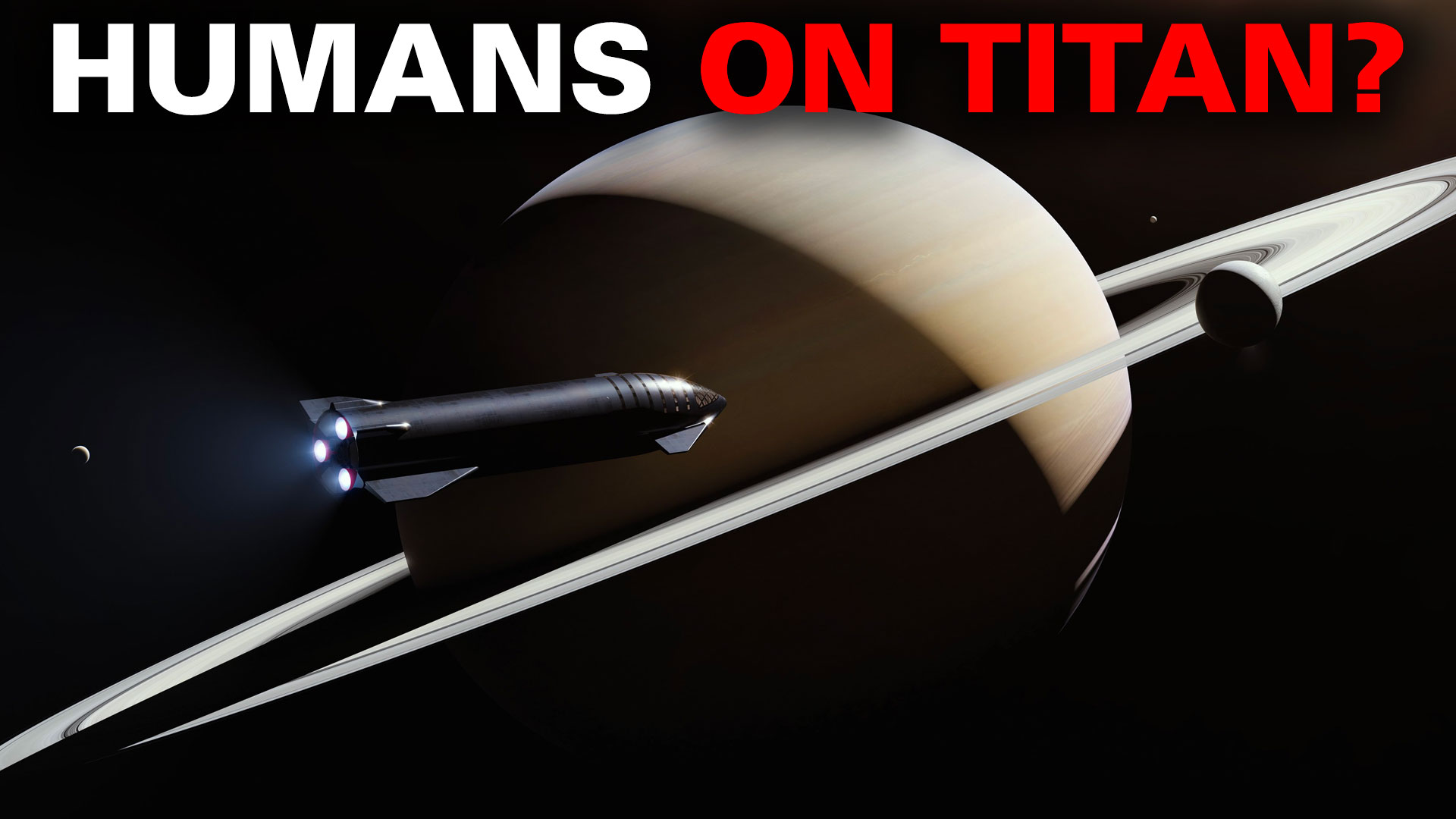
Universe Today recently examined the potential for sending humans to Jupiter’s icy moon, Europa, and the planet Venus, both despite their respective harsh surface environments. While human missions to these exceptional worlds could be possible in the future, what about farther out in the solar system to a world with much less harsh surface conditions, although still inhospitable for human life? Here, we will investigate whether Saturn’s largest moon, Titan, could be a feasible location for sending humans sometime in the future. Titan lacks the searing temperatures and crushing pressures of Venus along with the harsh radiation experienced on Europa. So, should we send humans to Titan?
“Yes!” Dr. Jason Barnes, who is a Professor in the Department of Physics at the University of Idaho, excitedly tells Universe Today. “Titan is the second-safest place in the solar system after Earth. It’s protected from radiation, pressurized, and has great science to be gained by crewed exploration.”
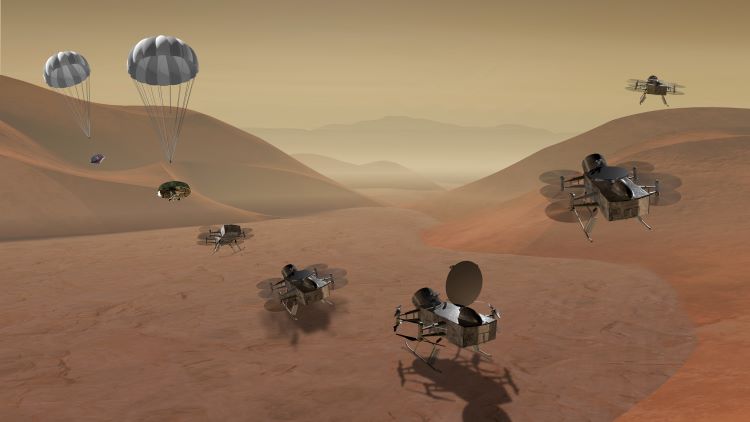
In addition to his academic duties, Dr. Barnes is also the Deputy Principal Investigator for NASA’s upcoming Dragonfly mission, which is a rotorcraft designed to explore Titan’s prebiotic chemistry and liquid methane lakes and seas, along with Titan’s atmosphere of 95 percent nitrogen and 5 percent methane. Powered by a Multi-Mission Radioisotope Thermoelectric Generator (MMRTG)—which currently power NASA’s Curiosity and Perseverance rovers—Dragonfly will carry a suite of instruments to help determine the habitability potential for Titan, which, in addition to being the largest moon of Saturn, is is also the second-largest moon in the solar system—the largest being Jupiter’s moon, Ganymede.
Artist’s rendition of NASA’s Dragonfly exploring the Titan’s surface. (Credit: NASA)
While Dragonfly will conduct the most in-depth surface exploration of Titan, this will not be the first spacecraft to land on Titan’s surface, as that honor goes to the European Space Agency’s Huygens probe, which landed on Titan’s surface in January 2005 and transmitted data for approximately 90 minutes after touchdown before its batteries ran out. Additionally, Titan was studied in-depth by NASA’s Cassini spacecraft at various times throughout its mission between 2004 and 2017. But with all this science having already been conducted by these robotic explorers, what additional science could be conducted by a human mission to Titan compared to a robotic mission?
“Similar to Mars, human boots on the ground could accomplish more exploration science faster than robots,” Dr. Barnes tells Universe Today. “Additionally, should life or prebiotic chemistry be found on Titan, people on-site could more safely study such life without risk of backward contamination to Earth. Finally, because of its safety, Titan is a prime target for long-term human habitation as we progress outward into the solar system.”
In terms of an orbital versus a surface mission for humans to Titan, Dr. Barnes tells Universe Today, “Orbital missions with people don’t make sense for science. Robotic orbiters do a great job, and our experience has shown that human remote sensing doesn’t provide any advantages over the robots. But a long-term surface mission with a base and surface mobility could open up an entire world of science.”
This “world of science” includes up-close investigations of Titan’s prebiotic chemistry, biochemistry, and organic chemistry, along with how Titan’s atmosphere and seas and lakes of liquid methane could influence such chemical reactions for both the short and long term. However, living on Titan’s surface would also come with its myriad of challenges, as well. While Titan is well-shielded from harmful solar radiation, its surface is both unbearably cold and extremely dark, as surface temperatures have been measured at -179.2 degrees Celsius (-290.6 degrees Fahrenheit) and Titan’s surface is estimated to receive only 0.1 percent of the sunlight that Earth receives. But, how else could this “world of science” pose additional challenges to human explorers on Titan’s surface?
“Challenges on the surface could be that the very organic molecules that make Titan so interesting could prove carcinogenic to a crew if pains are not taken to avoid getting them into the habitat,” Dr. Barnes tells Universe Today. “Another challenge is generating power out there — you’d basically need to bring a nuclear reactor with you, because there’d be no native way to generate the power needed to drive crewed exploration.”
In addition to the challenges of living on Titan’s surface, there is also the concern of the distance and travel time to the Saturnian system from Earth, as several missions have taken a minimum of several years to reach the Saturnian system, even if they took a direct route. For example, NASA’s Pioneer 11 spacecraft launched in 1973 and needed six and a half years to reach Saturn after flying by Jupiter. Only a few years later, NASA’s Voyager 1 and Voyager 2 spacecraft were launched in 1977 and required three years and two months and four years, respectively, to reach Saturn after they conducted flybys of Jupiter. While NASA’s Cassini mission conducted the most in-depth investigation of Saturn and its many moons, the spacecraft still required six years and nine months to get to Saturn after conducting two gravity assists at Venus, one at Earth, and one at Jupiter.
Currently, the fastest spacecraft to reach Saturn is NASA’s New Horizons spacecraft, which only required two years and four months to reach the ringed planet on its direct trajectory to Pluto. Therefore, even if a human mission were to take a direct route to Titan, it would still require a minimum of two years to arrive. Therefore, this lengthy travel time could hamper any resupply or rescue operation to Titan for a human mission.
“The travel time would be so long that any such expedition would need to be a pretty massive undertaking,” Dr. Barnes tells Universe Today. “Although astronauts would be safe on Titan’s surface from radiation, they would be subject to damage from solar storms en-route, at least while in the inner solar system. They’d be so far away from home that there would be no possibility of rescue if their systems failed, so plenty of backups would need to be brought along.”
Will we ever send humans to Titan? Will we learn more science than from a robotic mission like Dragonfly, and what will such a mission teach us about living and working so far from Earth? Only time will tell, and this is why we science!
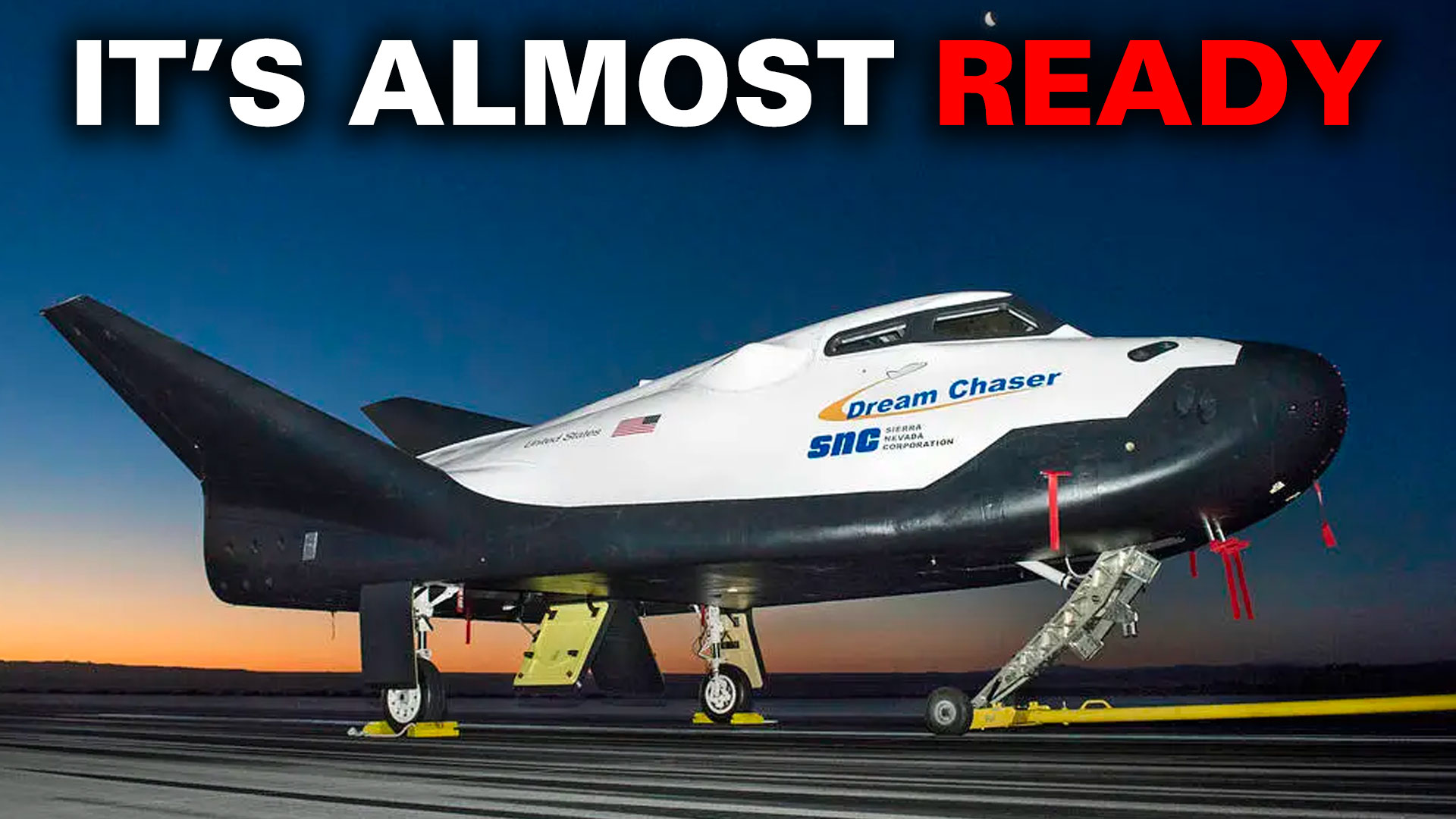
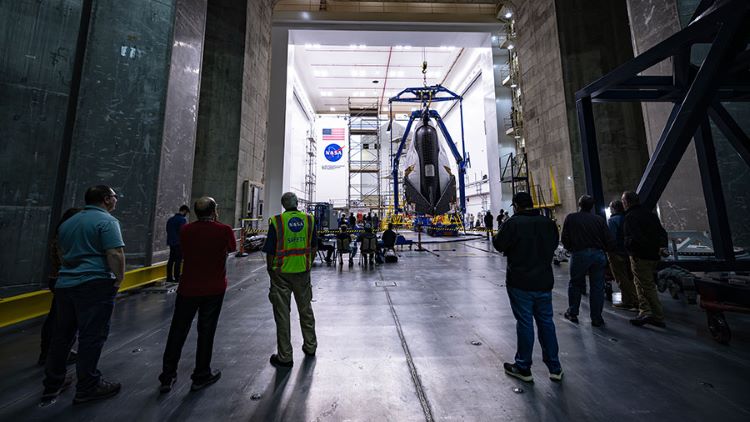
After a journey spanning almost two decades, Sierra Nevada Corporation’s Dream Chaser reusable spaceplane, named Tenacity, is officially undergoing environmental testing at NASA’s Neil Armstrong Test Facility located at NASA’s Glenn Research Center in anticipation of its maiden flight to the International Space Station (ISS), currently scheduled for April 2024. The environmental testing consists of analyzing the spacecraft’s ability to withstand rigorous vibrations during launch and re-entry, along with the harsh environment of outer space, including extreme temperature changes and vacuum conditions. This testing comes after Sierra Space announced the completion of Tenacity at its facilities in Louisville, Colorado last month, along with the delivery of Sierra Space’s cargo module, Shooting Star, to the Neil Armstrong Test Facility that same month, as well.
Sierra Space’s Dream Chaser spaceplane, Tenacity, imaged at the Neil Armstrong Test Facility after being delivered just a few days ago. (Credit: Sierra Space/Shay Saldana)
“At Sierra Space, we are ushering in the next industrial revolution with a business and technology platform that provides our customers with a complete turn-key solution offering space as a service,” Tom Vice, Sierra Space CEO, said in an official statement. “Our platform includes Dream Chaser, a revolutionary, highly reusable commercial spaceplane with global runway access, and the first business-ready commercial space station, leveraging the most advanced expandable structural architecture that will exponentially decrease the cost of product development and manufacturing in space.”
Sierra Nevada naming its first spacecraft “Tenacity” is only fitting given Dream Chaser’s long and difficult journey getting to this point. This includes rejections, company buyouts, legal proceedings, engineering designs, test flights, and finally being selected by NASA in January 2016 to deliver cargo to the ISS. Less than a year after being approve by NASA, Dream Chaser successfully performed a successful free flight test at Edwards AFB in southern California in November 2017, which was a huge milestone for the spacecraft and the advancement of the commercial space industry.
The goal of Dream Chaser is to provide a more cost-effective method for delivering cargo and supplies to the ISS, as while the spaceplane will be launched on a rocket, it will land like an airplane just like NASA’s Space Shuttle used to do. This will further enable its reusability capabilities, as NASA has contracted Dream Chaser for a minimum of six cargo resupply missions to the ISS during its contract.
Dream Chaser’s maiden flight next year will be a collaboration between flight and ground controllers at the Dream Chaser Mission Control Center in Louisville, Colorado, NASA’s Kennedy Space Center in Florida, and NASA’s Johnson Space Center in Texas. During this flight, Tenacity will conduct a myriad of in-flight tests after launch and prior to docking with the ISS. This includes performing vehicle maneuvering demonstrations within the ISS approach ellipsoid, which is a 4 x 2 x 2-kilometer (2.5 x 1.25 x 1.25-mile) invisible border encircling the ISS.
Unlike the autonomous docking system employed on SpaceX’s Dragon spacecraft, Dream Chaser will be docked and undocked to the ISS using the Canadarm2, which is a 17-meter-long (56-foot-long) robotic arm built by the Canadian Space Agency and installed on the ISS in 2001. During this mission, Tenacity is slated to deliver more than 3,500 kilograms (7,800 pounds) to the ISS and stay docked with the orbiting laboratory for approximately 45 days before being undocked by Canadarm2 and returning to Earth.
Once Dream Chaser is greenlit for future flights after this first mission, it will be capable of delivering approximately 5,200 kilograms (11,500 pounds) of supplies to the ISS while staying docked for up to 75 days. Additionally, Dream Chaser will be capable of returning more than 1,600 kilograms (3,500 pounds) of experiments and cargo from the ISS to Earth, with more than 4,000 kilograms (8,700 pounds) of trash being discarded during Earth reentry using the Shooting Star cargo module.
How will Dream Chaser help improve outer space exploration in the coming years and decades? Only time will tell, and this is why we science!
After a journey spanning almost two decades, Sierra Nevada Corporation’s Dream Chaser reusable spaceplane, named Tenacity, is officially undergoing environmental testing at NASA’s Neil Armstrong Test Facility located at NASA’s Glenn Research Center in anticipation of its maiden flight to the International Space Station (ISS), currently scheduled for April 2024. The environmental testing consists of analyzing the spacecraft’s ability to withstand rigorous vibrations during launch and re-entry, along with the harsh environment of outer space, including extreme temperature changes and vacuum conditions. This testing comes after Sierra Space announced the completion of Tenacity at its facilities in Louisville, Colorado last month, along with the delivery of Sierra Space’s cargo module, Shooting Star, to the Neil Armstrong Test Facility that same month, as well.
Sierra Space’s Dream Chaser spaceplane, Tenacity, imaged at the Neil Armstrong Test Facility after being delivered just a few days ago. (Credit: Sierra Space/Shay Saldana)
“At Sierra Space, we are ushering in the next industrial revolution with a business and technology platform that provides our customers with a complete turn-key solution offering space as a service,” Tom Vice, Sierra Space CEO, said in an official statement. “Our platform includes Dream Chaser, a revolutionary, highly reusable commercial spaceplane with global runway access, and the first business-ready commercial space station, leveraging the most advanced expandable structural architecture that will exponentially decrease the cost of product development and manufacturing in space.”
Sierra Nevada naming its first spacecraft “Tenacity” is only fitting given Dream Chaser’s long and difficult journey getting to this point. This includes rejections, company buyouts, legal proceedings, engineering designs, test flights, and finally being selected by NASA in January 2016 to deliver cargo to the ISS. Less than a year after being approve by NASA, Dream Chaser successfully performed a successful free flight test at Edwards AFB in southern California in November 2017, which was a huge milestone for the spacecraft and the advancement of the commercial space industry.
The goal of Dream Chaser is to provide a more cost-effective method for delivering cargo and supplies to the ISS, as while the spaceplane will be launched on a rocket, it will land like an airplane just like NASA’s Space Shuttle used to do. This will further enable its reusability capabilities, as NASA has contracted Dream Chaser for a minimum of six cargo resupply missions to the ISS during its contract.
Dream Chaser’s maiden flight next year will be a collaboration between flight and ground controllers at the Dream Chaser Mission Control Center in Louisville, Colorado, NASA’s Kennedy Space Center in Florida, and NASA’s Johnson Space Center in Texas. During this flight, Tenacity will conduct a myriad of in-flight tests after launch and prior to docking with the ISS. This includes performing vehicle maneuvering demonstrations within the ISS approach ellipsoid, which is a 4 x 2 x 2-kilometer (2.5 x 1.25 x 1.25-mile) invisible border encircling the ISS.
Unlike the autonomous docking system employed on SpaceX’s Dragon spacecraft, Dream Chaser will be docked and undocked to the ISS using the Canadarm2, which is a 17-meter-long (56-foot-long) robotic arm built by the Canadian Space Agency and installed on the ISS in 2001. During this mission, Tenacity is slated to deliver more than 3,500 kilograms (7,800 pounds) to the ISS and stay docked with the orbiting laboratory for approximately 45 days before being undocked by Canadarm2 and returning to Earth.
Once Dream Chaser is greenlit for future flights after this first mission, it will be capable of delivering approximately 5,200 kilograms (11,500 pounds) of supplies to the ISS while staying docked for up to 75 days. Additionally, Dream Chaser will be capable of returning more than 1,600 kilograms (3,500 pounds) of experiments and cargo from the ISS to Earth, with more than 4,000 kilograms (8,700 pounds) of trash being discarded during Earth reentry using the Shooting Star cargo module.
How will Dream Chaser help improve outer space exploration in the coming years and decades? Only time will tell, and this is why we science!
The Atmosphere of an Exoplanet Reveals Secrets About Its Surface
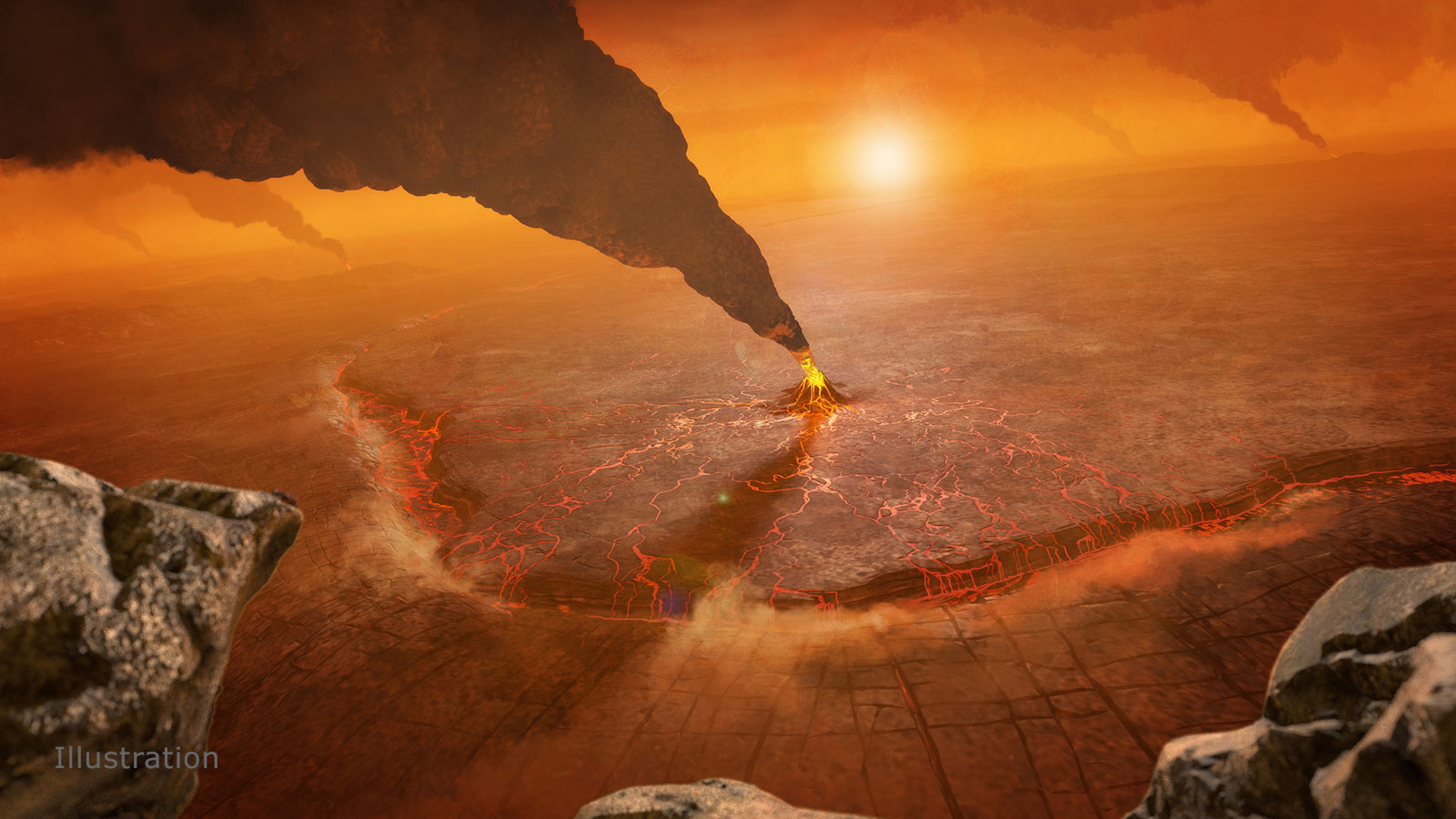
As astronomers have begun to gather data on the atmospheres of planets, we’re learning about their compositions and evolution. Thick atmospheres are the easiest to study, but these same thick atmospheres can hide the surface of a planet from view. A Venus-like world, for example, has such a thick atmosphere making it impossible to see the planet’s terrain. It seems the more likely we are to understand a planet’s atmosphere, the less likely we are to understand its surface. But that could change thanks to a new study in the Monthly Notices of the Royal Astrophysical Society.
Rocky worlds have a rich chemical exchange between their surfaces and their atmospheres. On Earth, the cycles of rain and evaporation, seasons of growth and harvest, and volcanic activities change the atmospheric composition over time. These exchanges happen over a long timescale, so Earth’s surface and atmosphere are never in a state of mutual equilibrium. On Venus, with its thicker atmosphere and dry surface, the timescale of exchange is shorter, but still not fast enough to reach a balance.
In this study, the authors argue that for warm Venus-like worlds with particularly thick atmospheres, a chemical equilibrium between surface and air can be reached. These worlds are the kind we find closely orbiting small stars, so they are well-suited for atmospheric studies.
How different types of terrestrial worlds affect their atmospheres. Credit: Byrne, et al
To show how this works, the team simulated chemical interactions right at the interface between the atmosphere and the rocky surface. Their simulations showed that chemical equilibrium for simple molecules such as carbon dioxide the atmosphere of Venus can be used to probe the composition of its surface, and depending on surface temperature, Venus-like exoplanets could see strong interactions for more complex molecules CaAl2Si2O8 and MgAl2O4.
In other words, under the right circumstances, small rocky worlds closely orbiting their warm star are excellent candidates for this kind of study. What we learn about their atmospheres can open a window on the composition of their surface, and even their geological activity. We could even determine whether certain minerals are present or absent on the surface of an exoplanet, without ever viewing its surface directly.
This kind of information is vital to our understanding of how terrestrial planets form. Previous studies have already shown that our solar system is rather unusual and that a solar system free of large planets in the inner solar system is rare. By understanding the evolution and composition of the inner planets of other stars, we will learn why our solar system is unusual, and perhaps even learn if life such as ours is common or rare in the Universe.
Questions Remain on Chinese Rocket That Created an Unusual Double Crater on the Moon
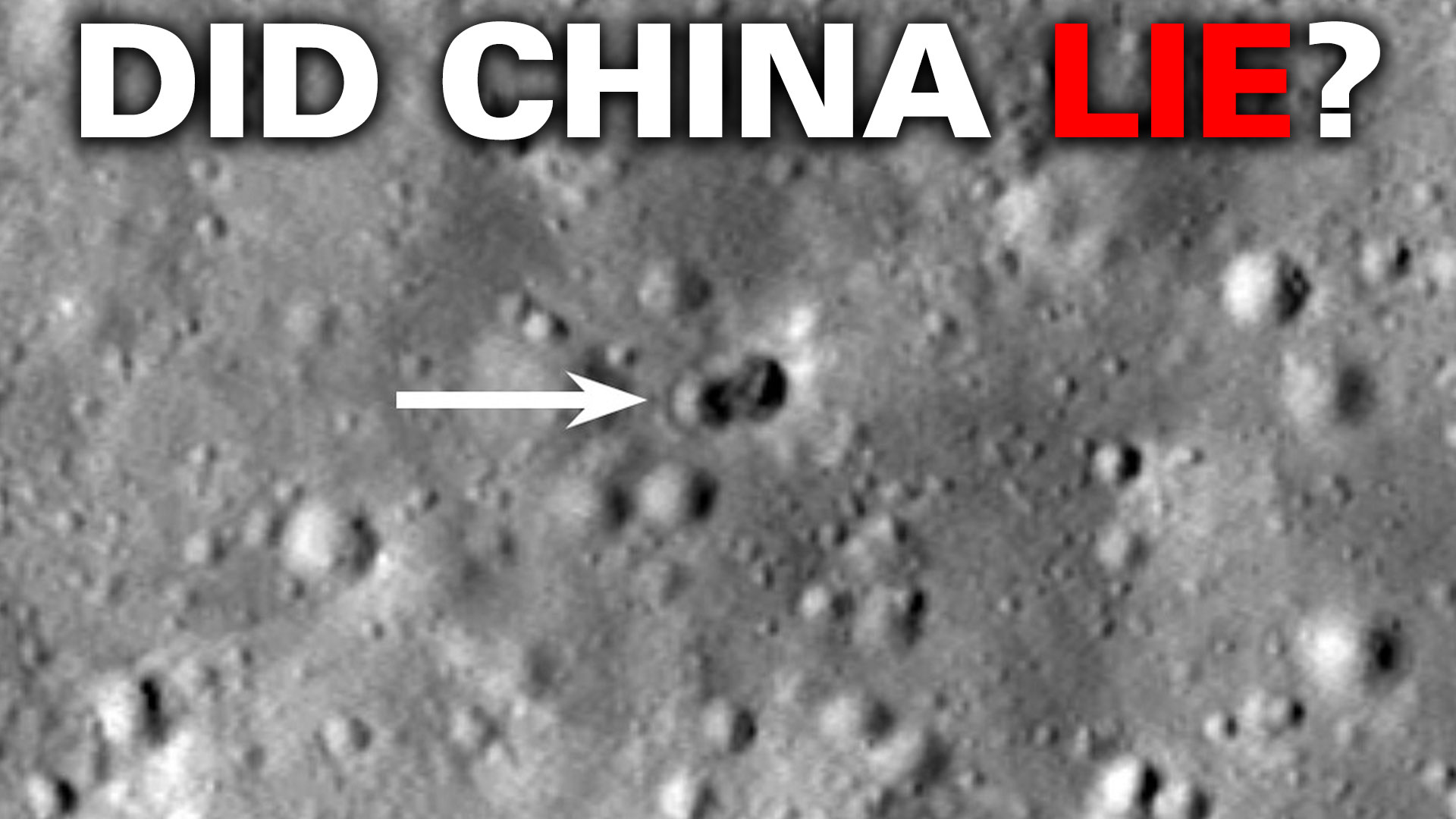
A rocket body impacted the Moon on March 4, 2022, near Hertzsprung crater, creating a double crater roughly 28 meters wide in the longest dimension. Credits: NASA/Goddard/Arizona State University
Questions Remain on Chinese Rocket That Created an Unusual Double Crater on the Moon
In November, we reported how an impact on the Moonfrom a Chinese Long March rocket booster created an unusual double crater. For a single booster to create a double crater, some researchers thought there must have been an additional – perhaps secret – payload on the forward end of the booster, opposite from the rocket engines. But that may not necessarily be the case.
Other researchers feel the extra mass wasn’t anything secretive, but possibly an inert structure such as a payload adapter added to the rocket to support the primary mission payload.
Chang’e 5-T1 was an experimental robotic spacecraft, launched on October 23, 2014, by the China National Space Administration (CNSA) to test out the return capsule design planned for use on the future Chang’e 5 mission, China’s first-ever sample-return effort. Chang’e 5 landed on the Moon in November 2020 and successfully gathered lunar samples from the Moon’s Ocean of Storms region, with the container landing back on Earth on December 16, 2020.
Chang’e-5’s soot-streaked sample return capsule sits amid the snows of Inner Mongolia with a Chinese flag set up nearby. (Image via CCTV)
Before engaging in the first sample return effort for the country (and first in over forty years), China wanted to test out procedures and their sample return capsule. That was one of the 5 T-1 mission’s goals.
“The rocket was carrying a ‘Service Module’ satellite with a sample return capsule attached,” said Phillip Stooke, professor emeritus at the University of Western Ontario, in an email to Universe Today. “It would need a fairly substantial support structure (called a payload adaptor) to support the mass against the vibration and acceleration of launch.”
Stooke explained how the Service Module flew around the Moon and back to Earth, where it released the capsule to test its ability to survive atmospheric re-entry. Then the Service Module headed back out to the Earth-Moon L2 point, staying there for a few months before entering a low lunar orbit, possibly to perform a gravity mapping mission. The Service Module is still in lunar orbit.
“The combination Service Module and capsule had a mass of 2,500 kg – 2.5 tons,” Stooke said, “so it can’t just sit on top of the rocket’s fuel tanks. I can’t guess at the mass [of the payload adapter] but it would be quite significant.”
Payload adaptors for medium-sized payloads can weigh anywhere from 135 Kg (300 lbs.) to 225 kg (500 lbs) or more.
The Chang’e 5 T-1 test vehicle captured this beautiful view of Earth over the far side ofthe Moon on October 28, 2014. Credit: Chinese national space agency (CNSA) and Chinese Academy of Sciences (CAS)
Chang’e 5-T1 did also have additional payloads, but they were small (and known to be onboard) and couldn’t account for the mass large enough to create a second crater. The two payloads were a small radiation exposure experiment for bacteria and plants, as well as the first commercial payload to the Moon called the 4M mission (Manfred Memorial Moon Mission) for the German space technology company OHB System, in honor of the company’s founder, Manfred Fuchs, who died in 2014. That payload weighed only 14 kilograms but contained two scientific instruments: a radio beacon to test a new approach for locating spacecraft and a radiation dosimeter (provided by the Spanish company iC-Málaga) to continuously measure radiation levels throughout the satellite’s circumlunar journey. The 4M mission was mounted in the equipment bay of the booster.
“There would be no reason to suspect the rocket had anything else attached to it other than 4M and the usual flight electronics,” said citizen scientist Scott Tilley, who monitors the orbits of artificial satellites of the Earth and the Moon. “There would also be some extra mass to support the payload adapter and related structure for supporting the payload stack, which was likely at the limit of the rocket’s capabilities. Consider this is the first mission they launched toward the Moon with stacked payload. It would have likely been more complex to mount and secure it than the other payloads, which were more self-contained.”
The ongoing debate on the extra mass and what it might be would not have ensued if not for two things: the unusual double crater created by this booster’s impact and the denial by Chinese foreign ministry officials that the space junk and the impact is from their rocket. They insist that the Chang’e 5T-1 rocket already burned up on its return trip to Earth in 2014. However, on March 1, 2022, the U.S. Department of Defense’s Space Command, which tracks low-Earth orbit space junk, released a statement saying that China’s 2014 rocket never de-orbited.
Additionally, Chinese officials have never commented on the nature of the double crater.
The crater was imaged by NASA’s Lunar Reconnaissance Orbiter (LRO).
This animated GIF confirms the location of the newly formed rocket body double crater. The before image is LRO’s view from Feb. 28, 2022 (M1400727806L). The after image is from May 21, 2022 (M1407760984R). The width of the frame is 367 meters, about 401 yards. Credit: NASA/Goddard/Arizona State University
A team of researcher from the University of Arizona discovered the errant booster (it was initially thought to be an asteroid), tracking its movements to determine it came from the Chang’e 5-T1 mission. They also conducted spectroscopic analysis of the object from ground-based telescope observations during several Earth flybys, which showed conclusively that the object was the Long March 3C rocket body from the Chang’e 5-T1 mission. They were able to predict approximately where and when the booster would impact the Moon, which was why the LRO team could search for and easily find the impact crater in their data.
Everyone was surprised the impact created a double crater. No other rocket body impacts on the Moon created double craters, as seen in these images of craters from four Saturn rocket boosters from Apollos 13, 14, 15, 17.
These four images show craters formed by impacts of the Apollo SIV-B stages: crater diameters range from 35 to 40 meters (38.2 to 43.7 yards) in the longest dimension. Credits: NASA/Goddard/Arizona State University.
The researchers from the University of Arizona said there had to be additional, undisclosed mass at the front end of the rocket body.
“The results from the Bayesian analysis imply that there may have been additional mass on the front of the rocket body,” wrote Tanner Campell, Vishnu Reddy and several others in their paper “Physical Characterization of Moon Impactor WE0913A.” “Comparing the pre- and post-impact images of the location shows two distinct craters side by side that were made by the Chang’e 5-T1 R/B. The double crater supports the hypothesis that there was additional mass at the front end of the rocket body, opposite the engines, in excess of the published mass of the secondary permanently affixed payload.”
Asked about the payload adaptor as the possible culprit for the excess mass, team member Vishnu Reddy didn’t want to venture a guess without more data.
“It is hard to speculate on the support structure because we are not aware of anything like that on usual boosters sent to the Moon,” he said.
Tilley told Universe Today that among both amateur and professional satellite and rocket trackers, it is known that China’s space agency has “struggled” in the past with their aim for having these type boosters to re-enter the Earth’s atmosphere or get ejected from the Earth-Moon system to properly dispose of the object.
“The Chinese expected the rocket to re-enter the Earth’s atmosphere,” Tilley explained, noting details in a paper by LuxSpace, the company that operated the 4M mission. “That didn’t happen so it seems that part of their mission failed, which is likely why the Chinese denied it was their rocket later on.”
Subsequently, however, more recent missions, such as the booster for the Chang’e 5 sample return mission successfully re-entered Earth’s atmosphere and was properly disposed of.
Another question about the impact is understanding the dynamics of why a single booster, even if it had substantial weight at each end, would create a double crater.
“Regarding the double crater,” Vishnu explained, “I think the booster impacted at a near vertical angle, so the engines created the first crater and the secondary mass toppled over and created the second crater.” Vishnu added, however, it is also possible that if the booster was tumbling and happened to be horizontal when it hit, it could create the two craters.
But like much of this unusual space drama story, questions still remain.
“That is why we leave the actual mechanism for a future paper when we have better data to model,” Vishnu said.
Watch 14 Years of Gamma-Ray Observations in This Fascinating NASA Video
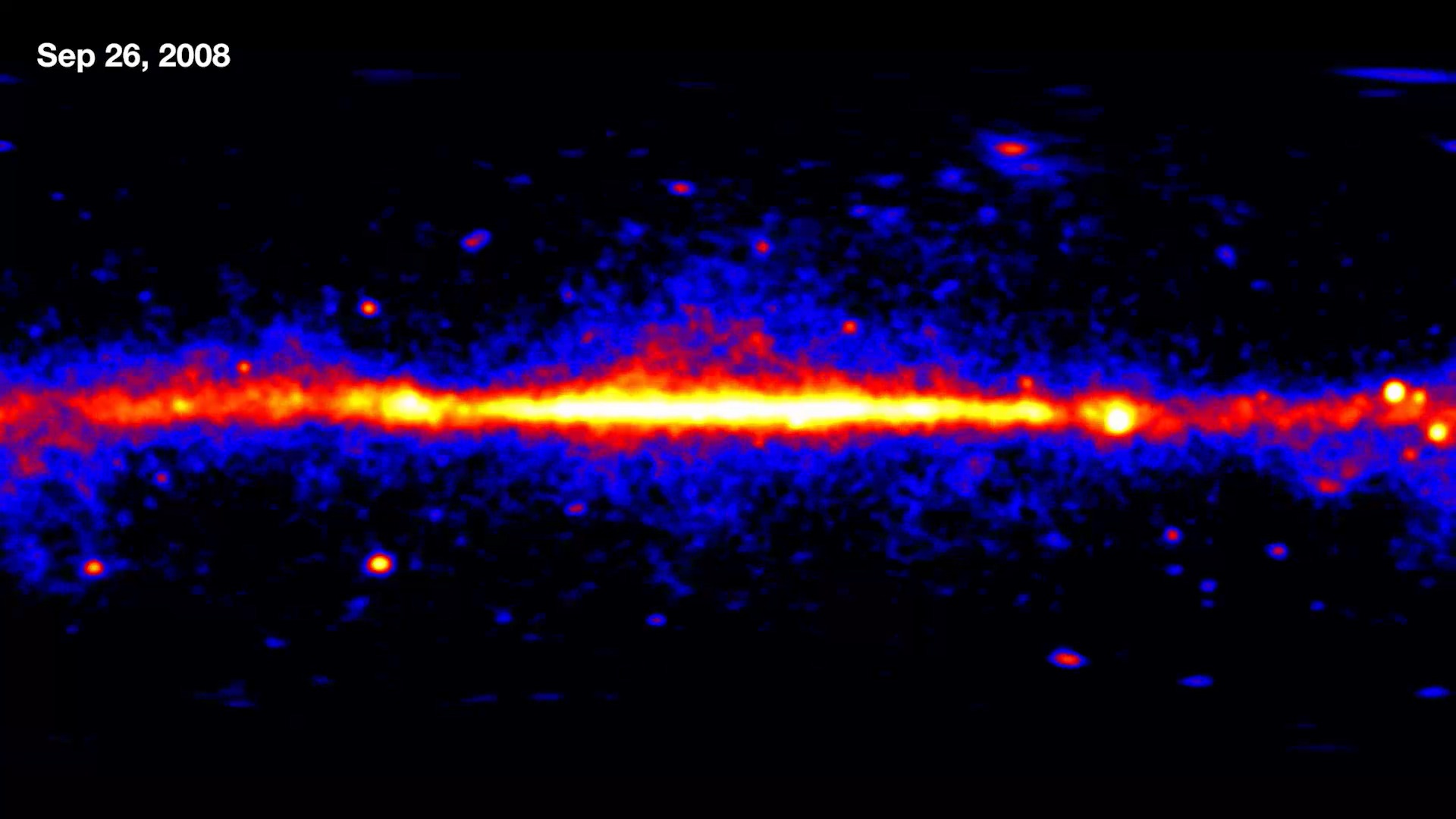
The Fermi Gamma-ray Space Telescope, named in honor of noted physicist Enrico Fermi, has been in operation for almost a decade and a half, monitoring the cosmos for gamma rays. As the highest-energy form of light, these rays are produced by extremely energetic phenomena – like supernovae, neutron stars, quasars, and gamma-ray bursts (GRBs). In honor of this observatory’s long history, NASA’s Goddard Spaceflight Center has released a time-lapse movie that shows data acquired by the Fermi Space Telescope between August 2008 and August 2022.
The movie shows gamma rays with energies above 200 million electron volts (MeV), where brighter colors indicate more intense gamma-ray sources detected by Fermi’s Large Area Telescope (LAT) during its 14-year run. The movie also shows the gamma-ray sky from two perspectives. First, there’s the rectangular view that shows a full-sky view with the central plane of the Milky Way Galaxy in the center. The disk glows predominantly from gamma rays produced by cosmic rays striking interstellar gas and starlight.
Other tiny light sources indicate the presence of neutron stars and supernova remnants, with cosmic sources peppered about the cosmic background. The second perspective shows what the gamma-ray sky looks like when Fermi is oriented towards Galactic North and South (or “up” and “down” relative to the galactic disk). This perspective allows astronomers to view gamma-ray sources in the extra-galactic sky, including distant galaxies with active nuclei (aka. quasars). The central plane of our galaxy wraps around the edges of both circles, where its brightness is suppressed, and our view of active galaxies in the distant Universe is improved.
The Sun can occasionally be seen passing into view and flaring against the background of high-energy sources within our galaxy and beyond. The brightest extra-galactic sources are blazars, or galaxies that host central black holes of a million Solar masses or more. These supermassive black holes (SMBH), as they’re called, produce jets of superheated material that travel at a fraction of the speed of light (aka. relativistic jets). For some blazars, Fermi could look almost directly down some of these jets, enhancing their brightness and variability.
When these galaxies flare, their central regions temporarily outshine all the stars in their disk. These flare-ups also cause them to temporarily become the brightest objects in the gamma-ray sky, then fade to obscurity. Many of these galaxies are billions of light-years away, meaning that flare-ups occurred when Earth and the Solar System were still young (or didn’t even exist yet!) Not seen in the time-lapse are many short-duration events, such as gamma-ray bursts, resulting from data processing designed to sharpen the images.
Miniaturized Jumping Robots Could Study An Asteroid’s Gravity
Missions focusing on small bodies in the solar system have been coming thick and fast lately. OSIRIS-Rex, Psyche, and Rosetta are all examples of projects that planned or did rendezvous with a small body in the solar system. But one of their biggest challenges is understanding the gravity of these bodies – which was especially evident when Philae, Rosetta’s lander, had a hard time staying on the surface of its intended comet. A new idea from researchers at the University of Colorado Boulder and NASA’s Jet Propulsion Laboratory could help solve that problem – by bouncing small probes around.
The concept, called Gravity Poppers, resulted from a NIAC grant back in 2020. The idea is simple enough – release a bunch of probes onto the surface of a small body and have them periodically jump off it. When they do so, keep track of them. If you know the force they jumped off with and can track them as they return to the surface, you can estimate the gravity of the area they’re floating over more accurately than alternative techniques.
Scientists use three main alternative techniques to calculate the gravity of small bodies – radar tomography, seismic imaging, and gravimetry. Each has disadvantages that the Gravity Poppers can overcome.
Here’s Dr. Benjamin Hockman, one of the researchers, describing the concept at the NIAC symposium. Credit – Ben Hockman YouTube Channel
Radar tomography uses reflections of radio signals to estimate what the gravity is like in a particular area. However, it’s difficult to penetrate the deeper sections of a small body. Some materials don’t reflect electromagnetic waves at all, making it impossible to characterize areas with these materials.
Seismic imaging is commonly used on Earth. By tracking the movement of seismic waves across the surface of a body, scientists can estimate the gravity of regions surrounding them. However, some small bodies, especially asteroids, are just piles of rubble with no internal coherent structure. Seismic waves don’t do very well in such environments. Ryugu, the asteroid Hayabusa-2 visited, absorbed the seismic energy of an impact event such that the spacecraft couldn’t even discern any changes in its surface features.
Gravimetry is the most straightforward of the three techniques and requires the least equipment onboard the spacecraft. How does the small body pull on the spacecraft orbiting it? As it passes over different regions, does the gravity increase or decrease? However, measuring gravity from far away isn’t easy, as orbits tend to be relatively far away. So, the accuracy of this technique is relatively low.
Fraser discusses techniques to stop a potentially dangerous asteroid from hitting Earth. Many of the techniques would involve understanding its gravity.
Enter Gravity Poppers. An orbiter could release a few dozen of these – a paper detailing the idea suggests 20. As they land on the surface of the asteroid, comet, or small moon, they occasionally use an internal force to jump off the surface, but not enough to break the hold of gravity. Depending on the intended area to be studied, they could do this at an angle or straight up.
As they fly off the surface, the orbiting mothership tracks them and calculates their trajectory, which can then be used to calculate the gravity of the region they are flying over. They then land, reset themselves, and do it repeatedly with the orbiter tracking them. The team studied two types of structures for the poppers: spherical and cubic. They settled on the cube, which also had embedded LEDs that create a light source the orbiter could track.
It’s not as simple as tracking the light source, though – plenty of system dynamics go into calculating the trajectory angle, the force with which the popper jumped, and the landing location. The paper also details simulations of how such a mission would operate in practice, using modeling software developed at NASA.
Unfortunately, that means that there are no prototypes in the works for this as of yet. It did not receive NIAC Phase II funding as of yet either. But the idea is unique and simple enough that with a little bit of development effort, engineers might be able to master this novel way of prospecting some of the most economically and scientifically interesting worlds in our solar system.
SpaceXheeft woensdag (20 december) een “statische test” uitgevoerd met het prototype van het bovenste trapgedeelte van de Starship dat bekend staat als Ship 28, waarbij de Raptor-motoren van het voertuig kort werden ontstoken terwijl het verankerd bleef aan het platform op de Starbase-basis van het bedrijf in het zuiden van Texas.
Ruimteschip 28 wordt voorbereid om de derde testvlucht van de Starship uit te voeren, die SpaceX in de komende weken wil lanceren. En dit tijdschema lijkt binnen de planning te blijven, aangezien de test op woensdag goed verliep.
“Starship Flight 3 heeft succesvol een totale statische vuurproef met alle zes Raptor-motoren voltooid”, aldus SpaceX in een tweet, waarin ook de video van de test was opgenomen.
De Starship bestaat uit twee elementen: een enorme eerste trapversterker genaamd Super Heavy en een 50 meter hoog bovenste traptuig dat bekend staat als Starship.
Beide trappen zijn ontworpen om volledig en snel herbruikbaar te zijn en worden aangedreven door de volgende generatie Raptor-motor van SpaceX.
Super Heavy heeft 33 Raptors en Starship wordt aangedreven door zes daarvan.
Video: SpaceX voert een statische vuurtest uit van de Starship. Foto's en video's: Reproductie Twitter @SpaceX
Former NASA scientist says aliens 'could have secret base beneath Earth's oceans'
Former NASA scientist says aliens 'could have secret base beneath Earth's oceans'
There are solid scientific reasons why the pilots of UFOs visiting the Earth might perfer to base themselves in the deep oceans, says former NASA researcher Kevin Knuth.
A former NASA researcher believes pilots of UFOs could be living underneath our oceans.
Kevin Knuth, a distinguished academic who worked at NASA's Ames Research Center from 2001 to 2005, thinks there are many reasons why alien visitors might choose to base themselves underwater, rather than on the Earth’s surface.
For a start, he says, if they prefer to remain undetected, the deep oceans are ideal. He told the Theories of Everything podcast: “75% of the Earth's surface is water and we really have very little access to it. So, if you are going to hide out somewhere, that's perfect.”
For more stories of the paranormal, strange and unexplained, check out the Daily Star's Weird News section.
Many recent UFO sightings have involved craft that appear to move effortlessly between the air and sea, and Kevin adds that aliens from a water-world home planet would have many reasons to base themselves beneath the sea.
Kevin outlines the reasons why extraterrestrials might find our environment quite inhospitable(Image: Kevin Knuth)
De Hubble Space Telescope heeft de afbeelding vrijgegeven van het heldere spiraalvormige sterrenstelsel dat bekend staat als MCG-01-24-014, dat een zeer interessante eigenschap vertoont.
Dit sterrenstelsel bevindt zich op een ongelooflijke afstand van ongeveer 275 miljoen lichtjaar van de aarde en heeft een zeer intense helderheid. MCG-01-24-014 wordt geclassificeerd als een Seyfert Galaxy of Type-2, omdat het wordt gekenmerkt door een goed gedefinieerde spiraal en een zeer energieke kern genaamd ‘actieve galactische kern (AGN)’ heeft.
Seyfert-galaxies herbergen, samen met quasars, een veelvoorkomende klasse van actieve galactische kernen, waarbij Seyfert de neiging heeft dichterbij te zijn en een kern te hebben die de helderheid van het gaststerrenstelsel niet overstraalt, terwijl quasars verre AGN’s zijn met intense helderheden die hun gaststerrenstelsels overtreffen.
Hubble Telescoop onthult intrigerend fenomeen in de ringen van Saturnus
Hubble Telescoop onthult intrigerend fenomeen in de ringen van Saturnus
Hubble Telescoop onthult intrigerend fenomeen in de ringen van Saturnus (NASA, ESA, STScI, Amy Simon (NASA-GSFC))
De Hubble Space Telescope heeft een bijzondere afbeelding van Saturnus onthuld, gemaakt in oktober 2023, die een intrigerend fenomeen genaamd “spokes” (spaken in het Engels) laat zien.
Deze spaken werden waargenomen toen de planeet meer dan 1,3 miljard kilometer van de aarde verwijderd was, en het heldere zicht van de Hubble toonde structuren die samen met de ringen van Saturnus draaiden en slechts voor twee of drie omwentelingen rond de planeet bleven bestaan.
Sinds hun ontdekking in 1981 door de Voyager 2-sonde zijn de spaken van Saturnus bestudeerd, en nu documenteert het Outer Planets Atmospheres Legacy (OPAL) -programma van de Hubble hun seizoenscyclus, wat suggereert dat hun frequentie verband houdt met de seizoenen van de planeet en de interactie van de zon met zijn magnetisch veld.
Blue Origin’s New Shepard Completes 24th Flight; New Glenn Hopefully on the Horizon
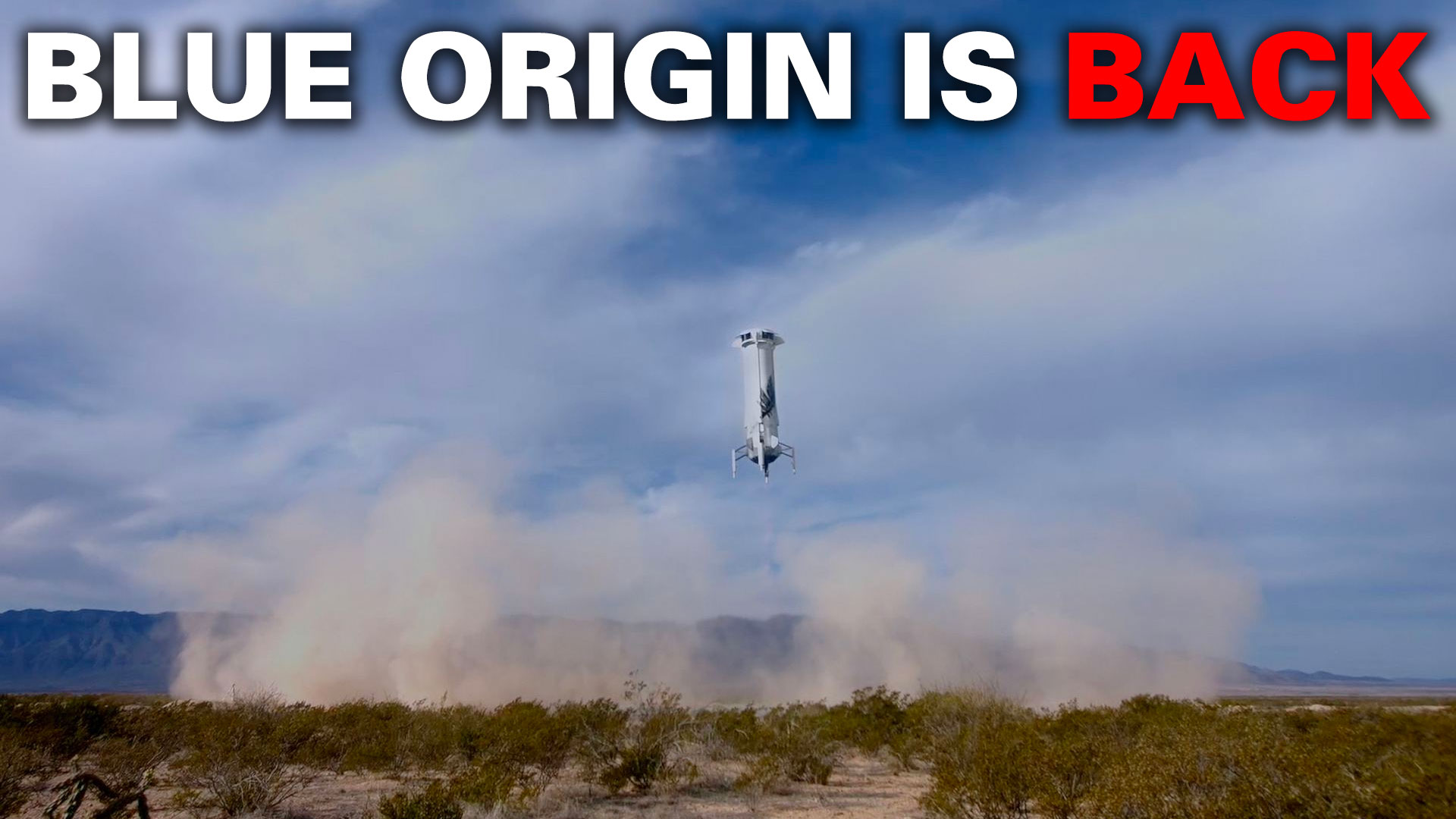
Blue Origin’s New Shepard rocket successfully launched and landed today at the company’s Launch Site One in West Texas, with an uncrewed science and goodwill payload onboard. This was the 24th New Shepard flight and 13th payload mission today from Launch Site One in West Texas.
This marked the first flight since September of 2022 when the uncrewed NS-23’s booster suffered an in-flight anomaly; however, the escape system jettisoned the capsule, which was able to land safely. With the success of NS-24, Blue Origin hopes to soon restart its commercial passenger flights.
“We look forward to flying our next crewed flight soon,” said Erika Wagner, senior director of emerging market development for Blue Origin, at the end of the launch broadcast. Watch the liftoff and landing below.
Liftoff occurred at 10:43 Central Time, with the capsule reaching about 106 km (66 miles) at its highest point. The 33 science experiments on board experienced about three minutes of microgravity before the capsule safely touched down under three parachutes — with a retrorocket to cushion the landing — approximately 10 minutes after launch.
The rocket booster touched down vertically about seven minutes after launch, on a landing pad 3.2km north of the launch pad.
The first launch attempt for the mission was scrubbed on Monday due to a ground system issue. But today’s countdown and launch went smoothly.
The payloads on board included research from NASA, academia, research institutions, and commercial companies, as well as student experiments from classrooms in Maine, New Mexico, and Kansas. New Origin said New Shepard has now flown more than 150 payloads to space. Also on board were about 38,000 postcards as part the company’s Postcards to Space program. Each postcard will be returned to its creator stamped “Flown to Space.” To send a postcard on future mission, see the company’s Club for the Future website.
“A special thank you to all of our customers who flew important science today and the students who contributed postcards to advance our future of living and working in space for the benefit of Earth,” said Phil Joyce, Senior Vice President, New Shepard, in a press release. “Demand for New Shepard flights continues to grow and we’re looking forward to increasing our flight cadence in 2024.”
When will New Glenn fly?
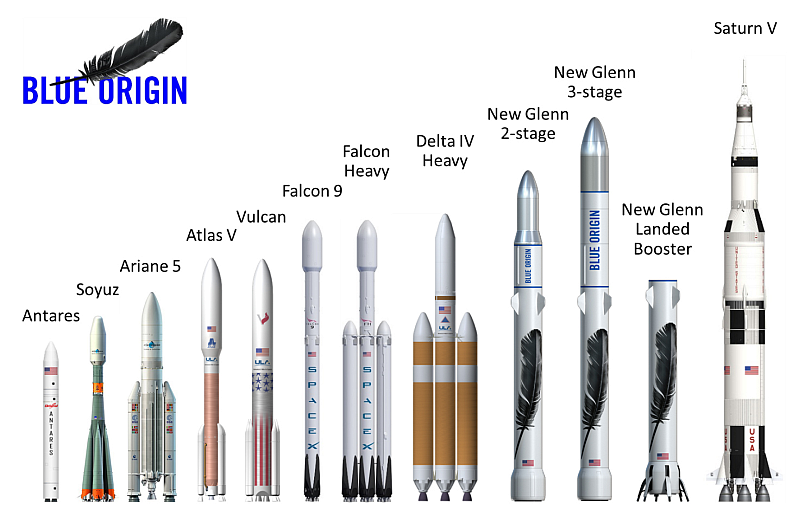
Meanwhile, Blue Origin is hoping to finally deliver on their next big project, the massive New Glenn rocket which will be capable of bringing satellites and other large payloads to orbit and beyond. But the rocket is years behind schedule. Initially, Jeff Bezos said that New Glenn would be ready to launch by 2020, but the latest estimate is that the first launch is expected to take place no earlier than August 2024.
NASA and Blue Origin announced in February 2023 that the first launch of New Glenn will carry NASA’s EscaPADE spacecraft to Mars. The Escape and Plasma Acceleration and Dynamics Explorers mission is a small planetary science mission that will use two spacecraft to measure plasma and magnetic fields around the Mars. With simultaneous observations from two locations in orbit, scientists hope to learn more about the processes that strip away atoms from the magnetosphere and upper atmosphere on the Red Planet.
In rocketry, size definitely matters. Image: Blue Origin
But if New Glenn can’t get off the ground by late 2024, it will miss the launch Mars launch window, and the mission will have to be delayed until 2026. Mars launch windows typically come every 26 months. ESCAPADE was originally scheduled to launch as a secondary payload NASA’s Psyche mission which blasted off on a Falcon Heavy rocket in October, but NASA removed ESCAPADE from the launch because it would not provide the mission with the proper trajectory.
A quarter century ago, physicist Juan Maldacena proposed the AdS/CFT correspondence, an intriguing holographic connection between gravity in a three-dimensional universe and quantum physics on the universe’s two-dimensional boundary. This correspondence is at this stage, even a quarter century after Maldacena’s discovery, just a conjecture. A statement about the nature of the universe that seems to be true, but one that has not yet been proven to actually reflect the reality that we live in. And what’s more, it only has limited utility and application to the real universe.
Still, even the mere appearance of the correspondence is more than suggestive. It’s telling that there is something deeply fundamental to the hologram, that the physics of the volume of the universe might just translate to the physics on the surface, and that there is more to be learned there.
It’s one thing to cast problems of physics in a new language, even a new set of dimensions, to make them easier to solve. After all, physics abounds with such mathematical tricks and games that practitioners employ to solve challenging problems and move on to the next one. But the AdS/CFT correspondence, and the more general holographic principle that it represents, is so much more than a mathematical curiosity.
Remember that the essential goal here is to describe gravity, which for centuries we believed to be just another force of nature, just one more interaction that entities in the cosmos can use to interact with each other. But gravity does stand alone and unique among all the forces, even beyond its quantum intractability. Gravity is the only force emitted and felt by every single entity in the cosmos. Anything with mass, anything with energy, creates a gravitational influence around it. And so too does anything with mass, anything with energy, anything with what we call existence respond to that gravitational influence.
Kepler was right to discern something special about the motions of the heavenly objects and connect those motions to our lives here on Earth. Newton was right to label it a force, a set of invisible strings that connect all of creation. Einstein was right to cast gravity not in terms of pushes and pulls, but in terms of the very fabric of spacetime itself.
The holographic principle, whether applied to the surface of a black hole and its mysterious contents or the relationship between string theory and quantum physics, is also telling us something meaningful about gravity. But Einstein already taught us what gravity is, it’s no mere force, but the natural response we living entities experience when we encounter the bends and wrinkles of spacetime.
Gravity is the spacetime playground that we all exist within. Another name for general relativity is geometrodynamics – the dynamics of geometry itself. Gravity is space and time and matter and energy all rolled into one breathing, vibrant system. What we call the universe is simply the container for all that activity, all the breadth fo space and depth of time and complexity that fills it.
We have failed to find a quantized theory of gravity. We have no description of what truly happens at the boundary of a black hole. But we have learned in our quantum wanderings that physical, three-dimensional entities are not exactly what they appear to be. Indeed, they are shallower: black holes may truly be described only by their surfaces, their boundaries, their edges, rather than their full extents.
And when we apply this same chain of reasoning, that holography is a vital component to the quantum gravitational puzzle, out comes the AdS/CFT correspondence and a potential path to string theory glory.
We Just had the Strongest Solar Flare in the Current Solar Cycle
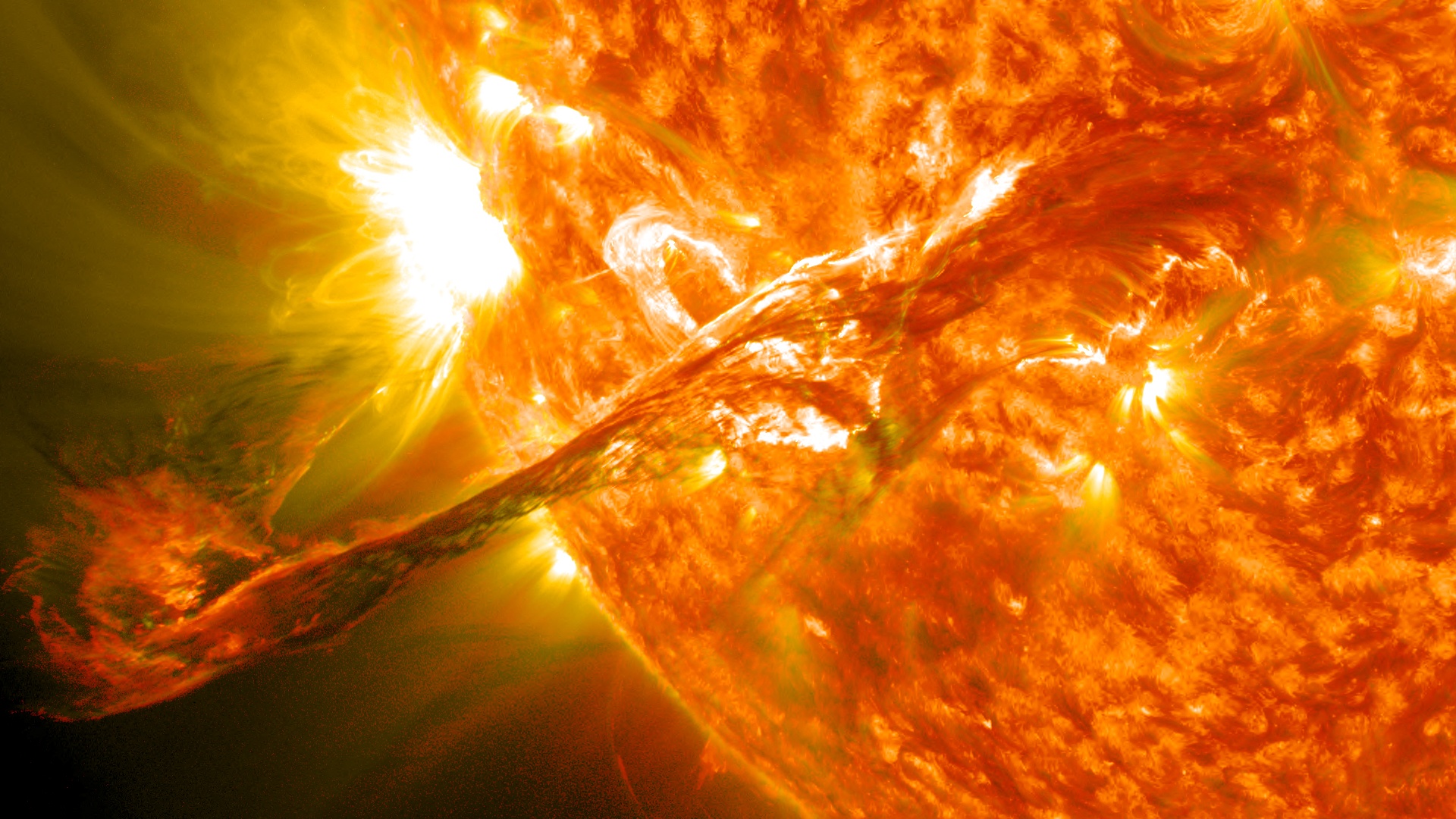
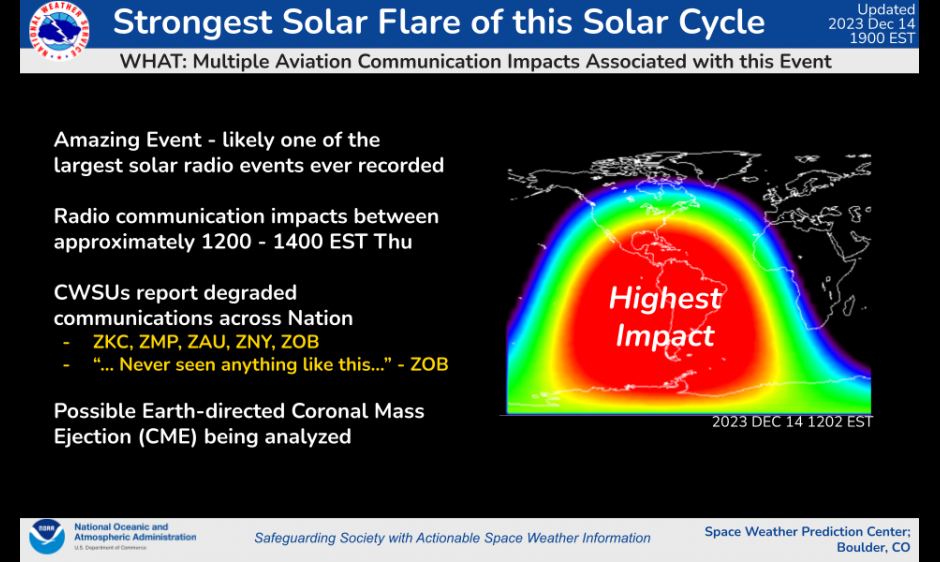
On December 14th, at 12:02 PM Eastern (09:02 AM Pacific), the Sun unleashed a massive solar flare. According to the Space Weather Prediction Center, part of the National Oceanic Atmospheric Administration (NOAA), this was the strongest flare of Solar Cycle 25, which began in 2019 and will continue until 2030. What’s more, scientists at the SWPC estimate that this may be one of the most powerful solar flares recorded since 1755 when extensive recording of solar sunspot activity began.
Solar flares occur in the Sun’s active regions, and activity varies over an 11-year solar cycle. This phenomenon is believed to result from stored magnetic energy in the Sun’s atmosphere accelerating charged particles in the surrounding plasma. These flares release radiation across the electromagnetic spectrum and are often accompanied by Coronal Mass Ejections (CME) and other solar phenomena. According to the SWPC, this recent flare may have triggered an Earth-bound CME, which they are currently analyzing.
The SWPC reported the largest solar flare of Solar Cycle 25. Credit: SWPC-NOAA
The SWPC also localized the flare to Region 3514, located over the far northwest area of the Sun. The flare caused interference with radio communications on Thursday, December 14th, between 12:00 PM to 02:00 PM EST (09:00 AM to 11:00 AM PST). According to the National Weather Service (NWS), Center Weather Service Units (CWSU) from the Eastern Seaboard to the Midwest reported interference with aircraft communications. The SWPC recommends that people continue to monitor their web page for the latest information and updates on the CME.
Enceladus’ Surface May Contain Relatively High Abundances of Pristine Organic Material
Enceladus’ Surface May Contain Relatively High Abundances of Pristine Organic Material
Enceladus, the sixth-biggest moon of Saturn, presents a remarkable opportunity in our Solar System for searching for evidence of extraterrestrial life, given its habitable ocean and plume that deposits organic-bearing ocean material onto the surface. Organic ocean material could be sampled by a lander mission at Enceladus. It is of interest to understand the amount of relatively pristine, unaltered organics present on the surface, given the ultraviolet and plasma environment.
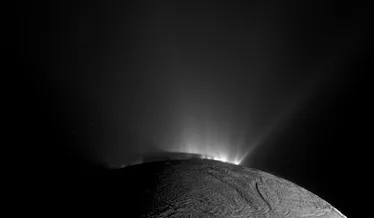
Enceladus’ tiger stripes are known to be spewing ice from the moon’s icy interior into space, creating a cloud of fine ice particles over the moon’s south pole and creating Saturn’s mysterious E-ring. Evidence for this has come from NASA’s Cassini spacecraft that orbited Saturn from 2004 to 2017. Pictured here, a high resolution image of Enceladus is shown from a close flyby. Tiger stripes are visible in false-color blue.
Image credit: NASA / ESA / JPL / SSI / Cassini Imaging Team.
“We can learn a lot about potential biosignatures in Enceladus’ ocean by sending a mission to the surface of Enceladus,” said Planetary Science Institute senior scientist Amanda Hendrix.
“Previously, it was thought that in order to sample the freshest material from the Enceladus ocean, you have to fly through the plume and measure plume grains and gases.”
“But now we know that you can land on the surface and be confident that your instruments can measure relatively pristine plume organics — sourced from the ocean.”
“We know that Enceladus’ ocean is habitable thanks to the measurements from NASA’s Cassini spacecraft,” she added.
“We know there is liquid water, energy, and the chemicals carbon, hydrogen, nitrogen, oxygen, phosphorus and sulfur. These are the ingredients necessary for life as we know it.”
“Enceladus is an ocean world: it harbors a liquid ocean below an icy surface.”
“There are at least several ocean worlds in our Solar System, but Enceladus is special because it is spraying its ocean material out into space via its south polar vapor-and-ice grain plume, which means that the instruments on Cassini were able to characterize the ocean as the spacecraft flew by and through the Enceladus plume.”
“Luckily, for this study, even though some of the plume grains are ejected out into the Saturnian system, close to 90% of the plume grains fall back onto the surface of the moon, which likely means that ocean material — including organics — is sitting right on the surface.”
Organic molecules found in the plume of Enceladus, include molecules like methane and ethane, along with more complex molecules.
Organics can be processed, or chemically transformed, by solar ultraviolet photons and by charged particles like electrons.
But if scientists want to find out if any ocean-derived biosignatures are present in the plume grains, they need these grains to be as pristine, and unexposed to ultraviolet light, as possible.
An artist’s impression of NASA’s Cassini spacecraft flying through plumes erupting from the south pole of Enceladus; these plumes are much like geysers and expel a combination of water vapor, ice grains, salts, methane and other organic molecules.
Image credit: NASA / JPL-Caltech.
In the new study, Dr. Hendrix and her colleague, Pennsylvania State University researcher Christopher House, used data from the NASA/ESA Hubble Space Telescope and Cassini to estimate how deeply ultraviolet photons can penetrate into the plume grain-coated surface of Enceladus.
“What we find in this study is that there are places on Enceladus’ surface where we could land with a spacecraft and take a sample — and we’d be measuring relatively pristine organics,” Dr. Hendrix said.
“That’s because the solar ultraviolet photons just don’t penetrate very deeply into the icy surface.”
“Those damaging solar ultraviolet photons only penetrate some 100 micrometers into the icy surface. That’s the width of a couple of human hairs!”
“So that very top part of the surface gets exposed to those damaging ultraviolet photons, but only a percentage of the organics are chemically transformed, and then soon enough that material is covered up by fresher plume material.”
“And the deeper grains don’t undergo more transformation — because the ultraviolet photons are prevented from interacting with the deeper material.”
“The freshly deposited plume grains act as a shield for the underlying material. They act like a sunscreen!”
“Ideally, we want to one day sample relatively pristine ocean-derived organics by landing on the surface of Enceladus.”
“This result is important because it tells us that there will be plenty of relatively pristine organics available to sample, because the penetration depth of those damaging ultraviolet photons is so shallow.”
“The slightly deeper grains haven’t been exposed much to ultraviolet, so that means the organics have a low exposure age.”
“Because ultraviolet light readily alters organic molecules, the depth that such light travels into the surface of an ice-covered world really matters,” Dr. House added.
“With the short ultraviolet penetration depths found, our results ensure that there is ample organic material locked away and preserved in the ices of Enceladus that can be traced back to its ocean.”
“It is awe-inspiring to think that with known technology, we can readily access lots of organic material from a habitable extraterrestrial ocean.”
The findings were published in the journal Communications Earth & Environment.
A.R. Hendrix & C.H. House. 2023. Low effective ultraviolet exposure ages for organics at the surface of Enceladus. Commun Earth Environ 4, 485; doi: 10.1038/s43247-023-01130-8
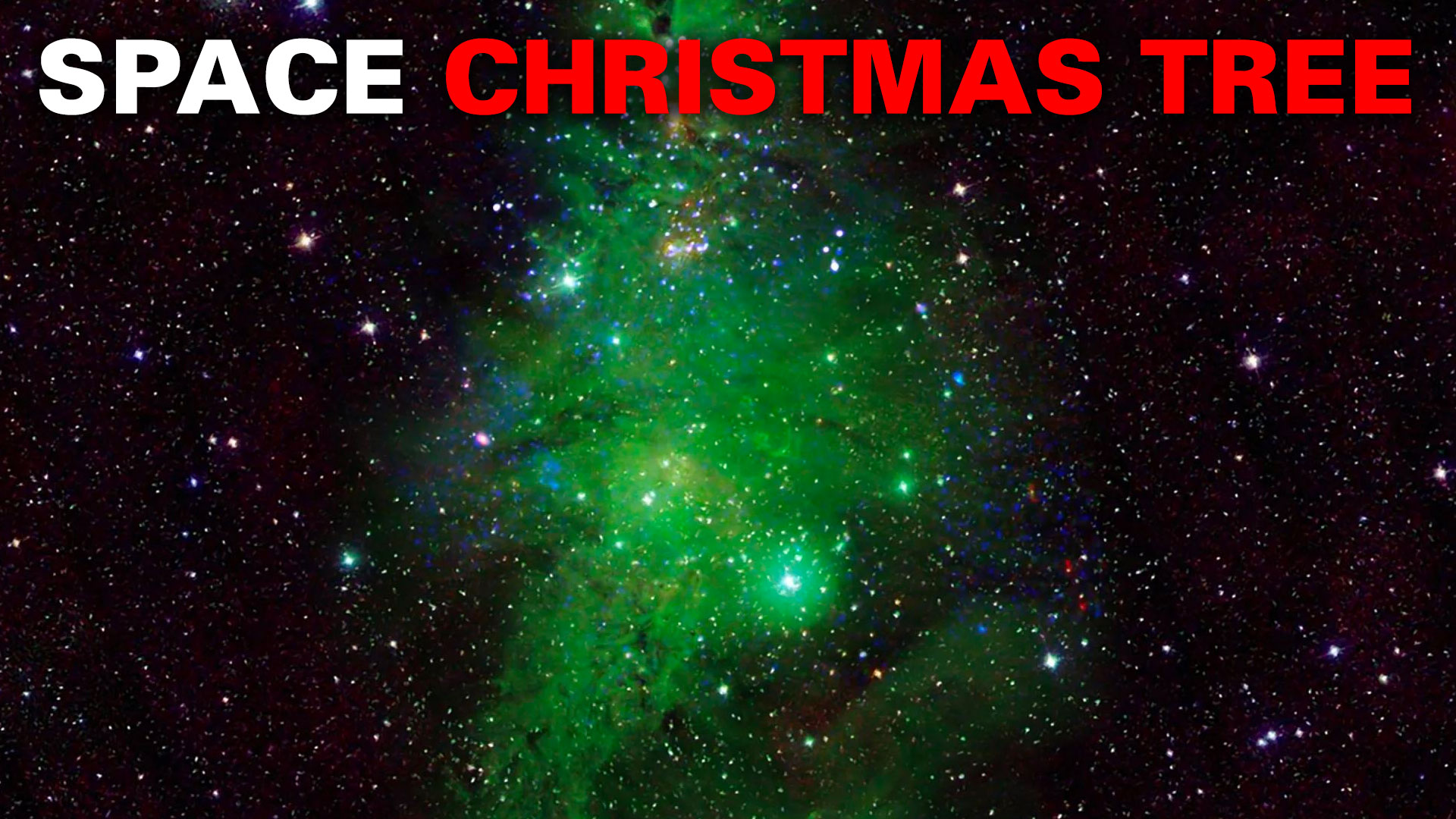
Just in time for the holidays, a new composite image of the Christmas Tree Cluster (NGC 2264) has been released. This image is a group effort: the blue and white stars in the cluster giving off X-rays are seen by Chandra, while the faint green nebula was imaged by the WIYN 0.9-meter telescope on Kitt Peak.
NGC 2264 is a cluster of young stars about 2,500 light-years from Earth with ages between one and five million years old, ranging in mass from greater than the Sun to 1/10th a solar mass.
To show the Christmas Tree shape us humans are familiar with, this image has been rotated clockwise by about 160 degrees from the astronomer’s standard of North pointing upward. That way, it appears as though the top of the tree is toward the top of the image.
NASA points out that the ‘green’ of the tree comes from the gas in the nebula, which is from the optical data as seen by the WIYN telescope. The bright yellow regions are areas of dense stars. But the Christmas tree also has flickering, colorful lights found within it. The blue and white lights (which blink in the animated version of this image, below) are young stars that give off X-rays. However, the coordinated blinking variations are not what you’d see in space. The artificial blinking lights were added to emphasize the locations of the stars.
The WIYN Observatory is a 3.5-meter telescope atop Kitt Peak National Observatory in Southern Arizona. It is owned and operated by the a consortium of several public and private universities. The Chandra X-ray Observatory launched in 1999 and is part of NASA’s ?eet of “Great Observatories” along with the Hubble Space Telescope, the Spitzer Space Telescope (retired in 2020) and the now deorbited Compton Gamma Ray Observatory. Chandra allows scientists from around the world to obtain X-ray images of exotic environments in space to help understand the structure and evolution of the Universe.
Below is another colorful view of NGC 2264, which is not rotated, but includes the sparkling blue baubles. This bright red version of the Christmas Tree cluster — as well as the Cone Nebula at the bottom — was created from data taken through four different filters (B, V, R and H-alpha) with the Wide Field Imager at ESO’s La Silla Observatory, 2,400 meters high in the Atacama Desert of Chile in the foothills of the Andes. This image shows a region of space about 30 light-years across.
The Christmas Tree Cluster as see by the Wide Field Imager at ESO’s La Silla Observatory. Credit: ESO.
This composite image shows the Christmas Tree Cluster. The blue and white lights (which blink in the animated version of this image) are young stars that give off X-rays detected by NASA’s Chandra X-ray Observatory. Optical data from the National Science Foundation’s WIYN 0.9-meter telescope on Kitt Peak shows gas in the nebula in green, corresponding to the “pine needles” of the tree, and infrared data from the Two Micron All Sky Survey shows foreground and background stars in white. This image has been rotated clockwise by about 160 degrees from the astronomer’s standard of North pointing upward, so that it appears like the top of the tree is toward the top of the image.
Hubble Benadrukt Melkweg met Miljarden Sterren die Op een Sneeuwbol Lijken
Hubble Benadrukt Melkweg met Miljarden Sterren die Op een Sneeuwbol Lijken
Hubble Benadrukt Melkweg met Miljarden Sterren die Op een Sneeuwbol Lijken (ESA/Hubble, NASA, ESA, Yumi Choi (NSF’s NOIRLab), Karoline Gilbert (STScI), Julianne Dalcanton (Center for Computational Astrophysics/Flatiron Inst., UWashington))
De Hubble Ruimtetelescoop van de NASA en de ESA heeft een nieuwe afbeelding vrijgegeven van een dwergstelsel, geclassificeerd als “onregelmatig” vanwege zijn niet-spiraalvormige of elliptische uiterlijk.
Officieel gecatalogiseerd als UGC 8091, bevindt het stelsel zich ongeveer 7 miljoen lichtjaar van de aarde in het sterrenbeeld Virgo en heeft het miljarden sterren, waardoor het lijkt op een sneeuwbol.
De afbeelding, samengesteld uit twaalf cameravilters, belicht de heldere sterren, terwijl rode vlekken wijzen op interstellair waterstofmoleculen die worden opgewonden door energierijke sterren. Naast zijn schoonheid draagt de afbeelding bij aan onderzoek naar de rol van dwergstelsels in de evolutie van het heelal en de evolutionaire verbindingen tussen oude en moderne sterrenstelsels, zoals ons Melkwegstelsel.
Some of the objects appear to be transmitting signals.
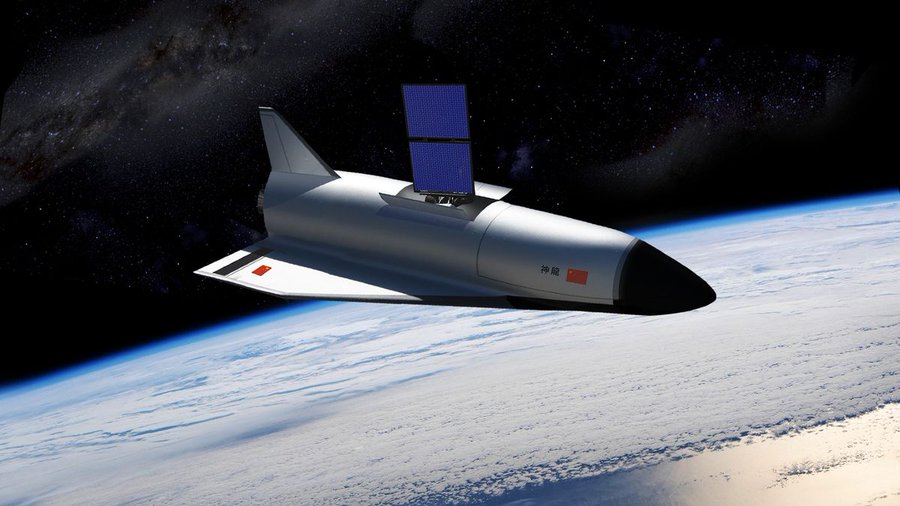
A notional rendering of China's reusable Shenlong space plane.
(Image credit: Erik Simonsen/Getty Images)
China's reusable space plane just got a little more mysterious.
Just four days after being launched on its third mission, China's Shenlong ("Divine Dragon") robotic space plane seems to have placed six objects into Earth orbit. Amateur spacecraft trackers around the world have been following the objects closely for days and have recorded emissions coming from some of them.
The six mystery objects have been designated OBJECT A, B, C, D, E and F. According to satellite tracker and amateur astronomer Scott Tilley, OBJECT A appears to be emitting signals reminiscent of those emitted by objects that China's space plane has released on previous missions.
"OBJECT A's or nearby emission is reminiscent of earlier Chinese space plane 'wingman' emissions in the sense the signal is modulated with a limited amount of data," Tilley told Space.com via email. "There is speculation that the emission from OBJECT A may be from an object close to it, but this is speculation not based on any evidence I'm aware of." Tilley has referred to the objects as "mysterious wingmen" on X (formerly Twitter).
OBJECT D and E, meanwhile, appear to be emitting idle "placeholder" signals with no data accompanying them. "It should be noted that unlike emissions early in the Chinese space plane missions 1 and 2, these emissions are very intermittent and do not stay on long," Tilley says. "It's taken days of observations tracking pass after pass with dish antennas to come up with this data."
Tilley and other satellite trackers have analyzed the signals and are confident that the emissions are coming either from the objects or from close proximity to them. This conclusion is based on observing them along their expected paths in the sky, the fact that no other known objects were in the beam of the trackers' antennas when the data was collected, and the fact that the particular modulation of these signals is "unique and has only been seen from previous Chinese space plane missions using [a frequency of] 2280MHz," Tilley says.
"In summary, this iteration of the Chinese space plane mission launched into a similar orbit as the last two but operationally it is exhibiting different radio behavior than before. The additional observations of the emissions from OBJECT D and E is new, but could also have been missed on earlier missions if they too were intermittent," Tilley added. "Something we should watch for is close encounters between OBJECT A and OBJECTs D and E. D and E are in fairly elliptical orbits while A is in a near circular orbit. In the next couple of days there will be close approaches between these objects at perigee."
Perigee is the point in a satellite's elliptical orbit when it's closest to Earth.
China's space plane has exhibited similar behaviors in the past. On its two previous missions — which launched in September 2020 and August 2022, respectively — the spacecraft was seen releasing a small unknown object into orbit. It was speculated that the objects could be service modules, test articles for practicing placing payloads into orbit, or perhaps even small satellites used to monitor the space plane, SpaceNews wrote in November 2022.
The United States also operates a reusable robotic space plane, the Boeing-built X-37B. Similar to China's Shenlong space plane, little is known about the exact operations or capabilities of the X-37B. The U.S. Space Force is currently set to launch the spacecraft atop a SpaceX Falcon Heavy rocket on Dec. 28 after several delays.
And the timing of the two reusable space plane launches isn't a coincidence. "These are two of the most watched objects on orbit while they're on orbit. It's probably no coincidence that they're trying to match us in timing and sequence of this," General Chance Saltzman, U.S. Space Force's Chief of Space Operations, said at a conference earlier this month.
Join our Space Forums to keep talking space on the latest missions, night sky and more! And if you have a news tip, correction or comment, let us know at: community@space.com.
JAMES WEBB SPACE TELESCOPE SPOTS ‘UNUSUAL’ AND ‘ENIGMATIC’ FEATURES ON ICE GIANT URANUS
JAMES WEBB SPACE TELESCOPE SPOTS ‘UNUSUAL’ AND ‘ENIGMATIC’ FEATURES ON ICE GIANT URANUS
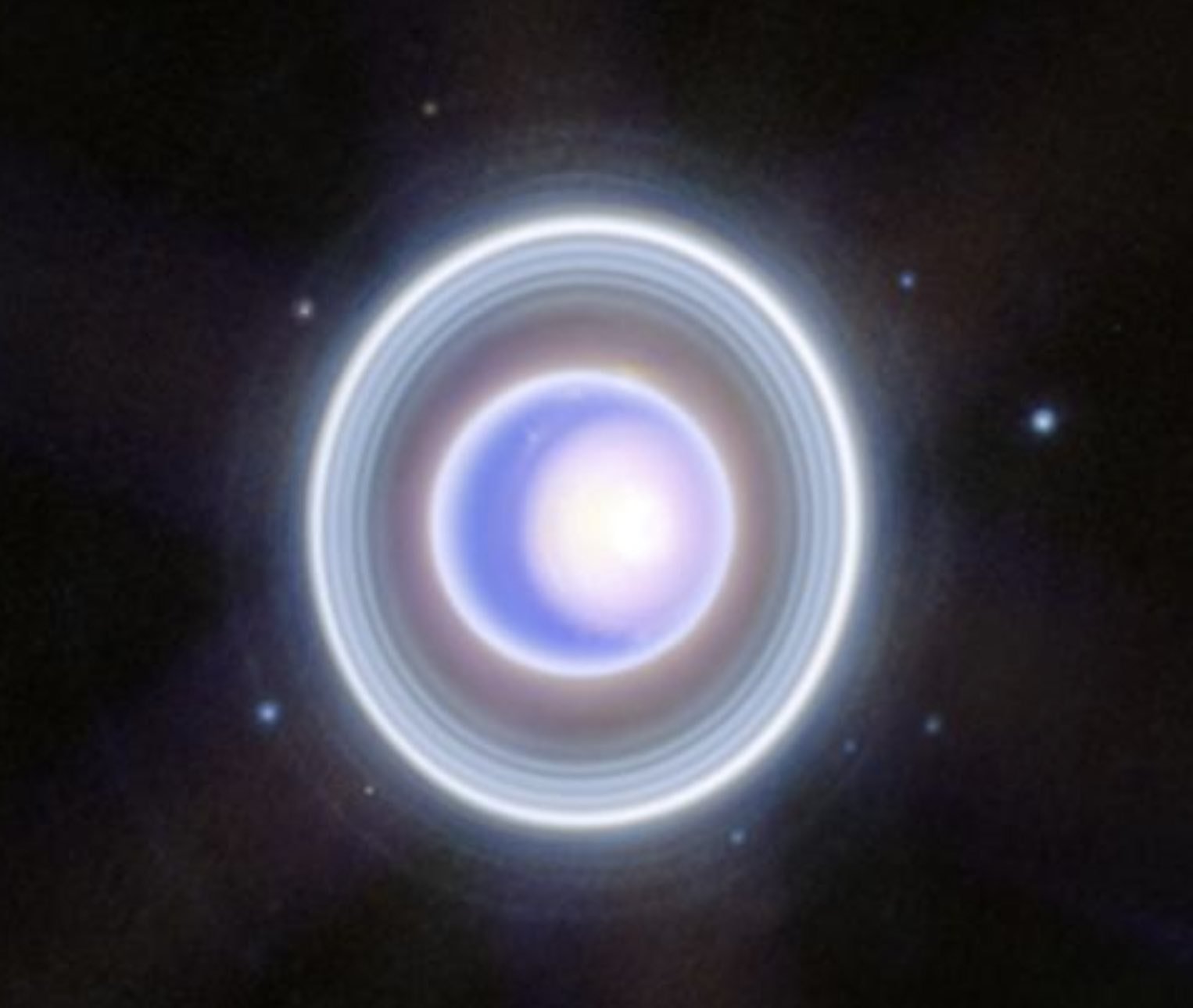
NASA has released stunning new imagery of the ice giant Uranus captured by its premiere space observatory, the James Webb Space Telescope.
The seventh planet from the Sun in our solar system, the orbit of icy Uranus falls between that of the gas giants Jupiter and Neptune, where, unlike other planets in our solar system, it spins on its side.
BLUE IS THE HUE
Uranus possesses a striking bluish-green color, caused by its atmosphere composed primarily of helium and hydrogen, which the new imagery captured by the James Webb Space Telescope showcases in remarkable clarity, along with several of the planet’s twenty-seven known satellites.
Referring to the Webb imagery, NASA recently called the planet “unusual and enigmatic,” describing it as a “dynamic world with rings, moons, storms,” and a range of other features.
The newly enhanced versions of imagery depicting Uranus were originally obtained earlier this year by the James Webb Space Telescope (Credit: NASA/ESA/JWST).
The new image is based on enhancements of a two-color version of the same view of Uranus released earlier in 2023, which employs additional wavelength coverage that allows more details to be revealed in the latest versions.
RINGS AND THINGS
While Saturn is the planet most renowned for its rings, Uranus is no slouch when it comes to the striking series of bands encircling it. Thanks to Webb and its unrivaled sensitivity, even the faintest outermost rings of Uranus, as well as its most elusive ring of all—the Zeta ring—which is positioned the closest to the planet of all its rings, can be seen in the new imagery.
Surrounding the enigmatic-looking planet are several of its moons, including Titania and Oberon, some of which can even be seen amidst the planet’s rings.
The new imagery is markedly different from previous photos of Uranus captured by the Voyager 2 probe decades ago, primarily because the more “unusual and enigmatic” features of the planet (to again borrow NASA’s characterization) only become visible at infrared wavelengths, which were not able to be obtained by Voyager’s cameras in the 1980s.
“In infrared wavelengths, Webb is revealing a strange and dynamic ice world filled with exciting atmospheric features,” read a NASA statement that appeared on the agency’s official page devoted to the James Webb Space Telescope.
AN ICY PLANET WITH A CLOUD CAP
Also revealed in unprecedented detail in the new imagery is the cloudy cap that adorns the planet’s north pole at certain times of the Uranian year. With the details that emerged in the newly enhanced versions of the images, both the seasonal cap, as well as a darker region near the bottom of the polar cap, can all be seen.
Beneath the planet’s north pole cap, several weather formations can be discerned in the imagery, revealing storm activity. Currently, planetary scientists are unclear about how many of these storms may be present, and how often they occur.
As Uranus tilts toward the Sun, its polar cap appears to become more prominent with the approach of the planet’s solstice, the next of which will occur in 2028. During these seasonal periods, scientists believe the extra sunlight the planet receives probably influences its unique atmosphere and the weather occurring within it.
JAMES WEBB SPACE TELESCOPE REVEALS CLUES TO URANUS’S TILT
Weather on Uranus is also impacted by the planet’s unique orientation, which causes it to possess the greatest seasonal extremities of any planet in the solar system. A significant portion of each year sees one of the planet’s poles cast in near-constant sunlight. By contrast, the “dark side” of the planet facing away from the Sun endures winters lasting nearly 21 years.
Scientists are uncertain why Uranus spins on its side at an exaggerated tilt of close to 98 degrees, although theories include the possibility that the planet may have impacted with another large object at some point in the past, knocking it into its current “tilted” position.
The newly enhanced Webb telescope imagery provides astronomers with the most detailed view of the planet ever obtained, revealing its most visually striking elements with incredible clarity, and allowing scientists to plan for future missions that will focus on revealing more of the mysteries about the most unique planet in our solar system.
In 2017, the Cassini spacecraft barrelled toward Saturn for the final time. NASA officials had elected to terminatethe mission in a death dive. Obliterating the probe in a controlled maneuver would safeguard Saturn’s precious rings, moons, plus whatever else Cassini’s Earthly material could damage, or even contaminate. Like, perhaps, life.
Currently, scientists have never detected biosignatures in another world. But space exploration is providing tantalizing ideas. The latest such notion comes from a frigid moon of Saturn. The work is detailed in a study published this week in the journal Nature Astronomy.
Six years before its fiery finale, Cassini flew through plumes of gas coming from Saturn’s moon Enceladus. The spray was coming through cracks on its icy surface. It was a natural delivery service, giving Cassini’s INMS, or Ion and Neutral Mass Spectrometer, a special taste of what’s inside the moon.
An illustration of Enceladus.
ALL ABOUT SPACE MAGAZINE/FUTURE/GETTY IMAGES
WHAT’S IN THE SPRAY?
Astronomers have been studying INMS data since Cassini’s 2011 and 2012 rendezvous of the plumes. So far, they’ve found compelling evidence that Enceladus may have conditions favorable to life. Inside the gaseous spray there was the presence of water, carbon dioxide, methane, ammonia, and molecular hydrogen. This suggests that life could potentially emerge far away from the Sun in another part of the solar system.
But that’s a big maybe. “We don't yet know how life originated on Earth, so it's difficult to say what the necessary conditions would be on Enceladus,” Jonah Peter, a graduate student at Harvard University and lead author of the new paper, tells Inverse.
Life, at least as we know it, requires an energy source.
“The ocean on Enceladus is covered by a thick ice shell, so sunlight is unlikely to provide enough energy for life underneath. That means for life to exist on Enceladus, there must be an alternative source of energy,” Peter said.
Chemical reactions are known to support microbial communities in the dark depths of Earth’s oceans, however.
This 2010 image from NASA’s Cassini mission shows water from the subsurface ocean of Saturn’s moon Enceladus spraying out into space from huge cracks in its icy surface.
The team performed a statistical analysis to find what might be hiding inside Cassini’s INMS data. It was built upon earlier work on the plume data.
“Searching for compounds in the plume is a bit like putting the pieces of a puzzle back together,” Peter said. It’s a search for the “right combination of molecules” that would create the data Cassini gathered more than a decade ago in the outer solar system.
Peter’s team found five new compounds inside the plume: alcohol (methanol), molecular oxygen, plus three organic compounds called hydrogen cyanide (HCN), acetylene (C2H2), and propylene (C3H6).
These molecules are not biosignatures, meaning they don’t indicate that life exists on Enceladus. “They do, however, indicate conditions favorable for organic synthesis, which could lead to the formation of more complex molecules related to the origin of life,” Peter said.
One compound in particular, HCN, is a versatile building block of life. It goes into forming amino acids, sugars, and nucleobases. These are the precursors to proteins and DNA.
They indicate that Enceladus’ subsurface ocean has the ability to contain a diverse array of chemical reactions, acting in the Sun’s absence to provide energy for life. It’s an exciting finding, but like most things that thrill, more insight is necessary.
At least Cassini, reduced to a tattered mess of tiny bits in Saturn’s sky, lives on in the data.
Beste bezoeker, Heb je zelf al ooit een vreemde waarneming gedaan, laat dit dan even weten via email aan Frederick Delaere opwww.ufomeldpunt.be. Deze onderzoekers behandelen jouw melding in volledige anonimiteit en met alle respect voor jouw privacy. Ze zijn kritisch, objectief maar open minded aangelegd en zullen jou steeds een verklaring geven voor jouw waarneming! DUS AARZEL NIET, ALS JE EEN ANTWOORD OP JOUW VRAGEN WENST, CONTACTEER FREDERICK. BIJ VOORBAAT DANK...
Druk op onderstaande knop om je bestand , jouw artikel naar mij te verzenden. INDIEN HET DE MOEITE WAARD IS, PLAATS IK HET OP DE BLOG ONDER DIVERSEN MET JOUW NAAM...
Druk op onderstaande knop om een berichtje achter te laten in mijn gastenboek
Alvast bedankt voor al jouw bezoekjes en jouw reacties. Nog een prettige dag verder!!!
Over mijzelf
Ik ben Pieter, en gebruik soms ook wel de schuilnaam Peter2011.
Ik ben een man en woon in Linter (België) en mijn beroep is Ik ben op rust..
Ik ben geboren op 18/10/1950 en ben nu dus 75 jaar jong.
Mijn hobby's zijn: Ufologie en andere esoterische onderwerpen.
Op deze blog vind je onder artikels, werk van mezelf. Mijn dank gaat ook naar André, Ingrid, Oliver, Paul, Vincent, Georges Filer en MUFON voor de bijdragen voor de verschillende categorieën...
Veel leesplezier en geef je mening over deze blog.