The purpose of this blog is the creation of an open, international, independent and free forum, where every UFO-researcher can publish the results of his/her research. The languagues, used for this blog, are Dutch, English and French.You can find the articles of a collegue by selecting his category. Each author stays resposable for the continue of his articles. As blogmaster I have the right to refuse an addition or an article, when it attacks other collegues or UFO-groupes.
Druk op onderstaande knop om te reageren in mijn forum
Zoeken in blog
Deze blog is opgedragen aan mijn overleden echtgenote Lucienne.
In 2012 verloor ze haar moedige strijd tegen kanker!
In 2011 startte ik deze blog, omdat ik niet mocht stoppen met mijn UFO-onderzoek.
BEDANKT!!!
Een interessant adres?
UFO'S of UAP'S, ASTRONOMIE, RUIMTEVAART, ARCHEOLOGIE, OUDHEIDKUNDE, SF-SNUFJES EN ANDERE ESOTERISCHE WETENSCHAPPEN - DE ALLERLAATSTE NIEUWTJES
UFO's of UAP'S in België en de rest van de wereld Ontdek de Fascinerende Wereld van UFO's en UAP's: Jouw Bron voor Onthullende Informatie!
Ben jij ook gefascineerd door het onbekende? Wil je meer weten over UFO's en UAP's, niet alleen in België, maar over de hele wereld? Dan ben je op de juiste plek!
België: Het Kloppend Hart van UFO-onderzoek
In België is BUFON (Belgisch UFO-Netwerk) dé autoriteit op het gebied van UFO-onderzoek. Voor betrouwbare en objectieve informatie over deze intrigerende fenomenen, bezoek je zeker onze Facebook-pagina en deze blog. Maar dat is nog niet alles! Ontdek ook het Belgisch UFO-meldpunt en Caelestia, twee organisaties die diepgaand onderzoek verrichten, al zijn ze soms kritisch of sceptisch.
Nederland: Een Schat aan Informatie
Voor onze Nederlandse buren is er de schitterende website www.ufowijzer.nl, beheerd door Paul Harmans. Deze site biedt een schat aan informatie en artikelen die je niet wilt missen!
Internationaal: MUFON - De Wereldwijde Autoriteit
Neem ook een kijkje bij MUFON (Mutual UFO Network Inc.), een gerenommeerde Amerikaanse UFO-vereniging met afdelingen in de VS en wereldwijd. MUFON is toegewijd aan de wetenschappelijke en analytische studie van het UFO-fenomeen, en hun maandelijkse tijdschrift, The MUFON UFO-Journal, is een must-read voor elke UFO-enthousiasteling. Bezoek hun website op www.mufon.com voor meer informatie.
Samenwerking en Toekomstvisie
Sinds 1 februari 2020 is Pieter niet alleen ex-president van BUFON, maar ook de voormalige nationale directeur van MUFON in Vlaanderen en Nederland. Dit creëert een sterke samenwerking met de Franse MUFON Reseau MUFON/EUROP, wat ons in staat stelt om nog meer waardevolle inzichten te delen.
Let op: Nepprofielen en Nieuwe Groeperingen
Pas op voor een nieuwe groepering die zich ook BUFON noemt, maar geen enkele connectie heeft met onze gevestigde organisatie. Hoewel zij de naam geregistreerd hebben, kunnen ze het rijke verleden en de expertise van onze groep niet evenaren. We wensen hen veel succes, maar we blijven de autoriteit in UFO-onderzoek!
Blijf Op De Hoogte!
Wil jij de laatste nieuwtjes over UFO's, ruimtevaart, archeologie, en meer? Volg ons dan en duik samen met ons in de fascinerende wereld van het onbekende! Sluit je aan bij de gemeenschap van nieuwsgierige geesten die net als jij verlangen naar antwoorden en avonturen in de sterren!
Heb je vragen of wil je meer weten? Aarzel dan niet om contact met ons op te nemen! Samen ontrafelen we het mysterie van de lucht en daarbuiten.
27-11-2023
NASA Tests its Next-Generation Mars Helicopter Blades
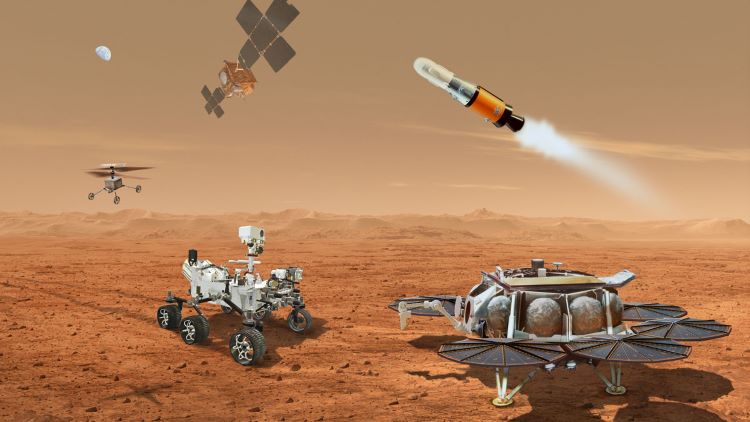
Artist illustration of three solar-powered Mars helicopters from NASA: Ingenuity (upper right), along with the proposed design for Sample Recovery Helicopter to be use on the future NASA-ESA Mars Sample Return Mission (foreground) and a concept for a future Science Helicopter (upper center). (Credit: NASA/JPL-Caltech)
NASA Tests its Next-Generation Mars Helicopter Blades
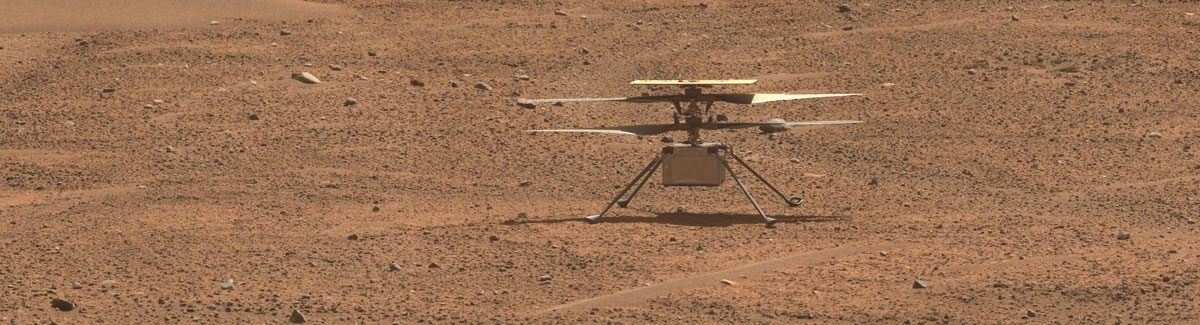
While NASA’s Ingenuity Mars Helicopter continues to break records for both airspeed and altitude while it explores Jezero Crater on the Red Planet, NASA engineers back on Earth are hard at work testing carbon fiber blades for next-generation Mars helicopters that could exceed the performance of Ingenuity on future missions to Mars, specifically with the planned Mars Sample Return mission that NASA hopes to accomplish sometime in the 2030s.
“Our next-generation Mars helicopter testing has literally had the best of both worlds,” Teddy Tzanetos, who is the project manager for Ingenuity and manager for the Mars Sample Recovery Helicopters, said in an official NASA statement. “Here on Earth, you have all the instrumentation and hands-on immediacy you could hope for while testing new aircraft components. On Mars, you have the real off-world conditions you could never truly re-create here on Earth.”
These off-world conditions on Mars include surface atmospheric pressure and surface gravity that is less than one percent and one-third of Earth’s surface, respectively. It is because of this significantly reduced surface pressure that Ingenuity’s rotations per minute (rpm) are between 2,400 to 2,900 rpm to achieve flight on the Red Planet. This is significantly higher than on Earth, as helicopters typically only need 500 to 600 rpm to achieve flight.
The Ingenuity Mars Helicopter incorporates four carbon fiber blades organized into two counter-rotating rotors, meaning that rotate opposite to each other, spanning 1.2-meters (4-feet) across with the aforementioned rotating speed of between 2,400 to 2,900 rpm (rotations per minute). Additionally, Ingenuity also weighs in at approximately 1.8 kilograms (4 pounds) on Earth, but with Mars having approximately one-third the gravity Ingenuity weighs only 0.68 kilograms (1.5 pounds) on the surface of the Red Planet.
April 2021 video discussing the design and development of Ingenuity.
For the next-generation Mars helicopters, NASA engineers at Jet Propulsion Laboratory (JPL) in Pasadena are constructing blades that are slightly more than 10 centimeters (4 inches) longer than Ingenuity’s blades, along with exhibiting a separate design and increased strength, as well.
“We spun our blades up to 3,500 rpm, which is 750 revolutions per minute faster than the Ingenuity blades have gone,” Tyler Del Sesto, who is the Sample Recovery Helicopter deputy test conductor at JPL, said in an official NASA statement. “These more efficient blades are now more than a hypothetical exercise. They are ready to fly.”
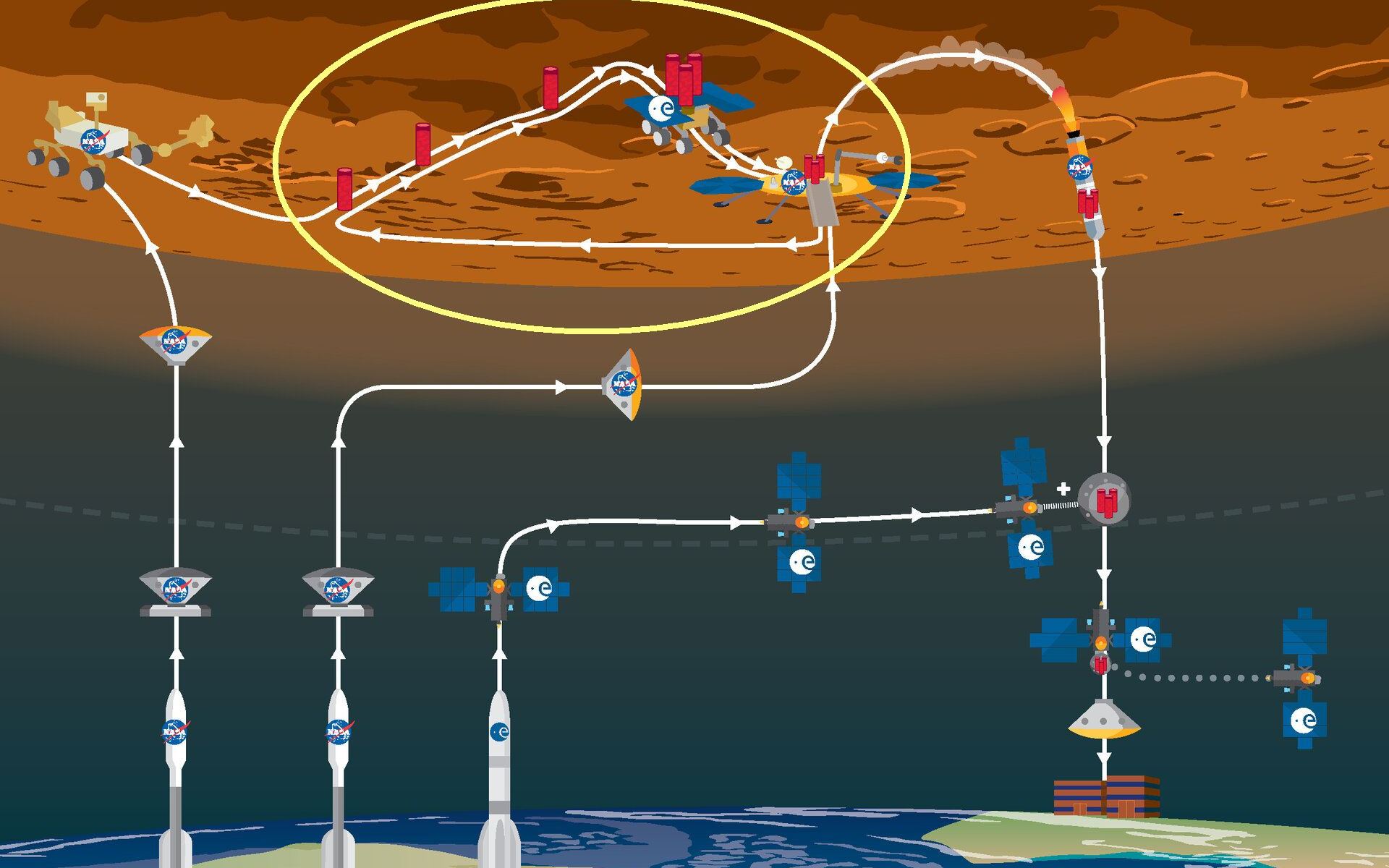
One goal of these next-generation Mars helicopters could be on the joint NASA-ESA Mars Sample Return mission slated to occur sometime in the 2030s. This mission will encompass three parts: sample collection, sample retrieval, and a return mission. It is the sample retrieval mission that will involve the most equipment, including two Ingenuity-class helicopters tasked with collecting samples with a robotic arm that are currently being placed on the surface of Mars in Jezero Crater by NASA’s Perseverance rover.
These sample retrieval helicopters will vary in design from Ingenuity in that they are planned to have a set of four wheels used to drive to the sample upon landing a few meters from them. Upon retrieval, the helicopters will fly to the Sample Retrieval Lander (SRL), which will then load the samples into the Mars Ascent Vehicle (MAV), which will launch the samples to low Martian orbit where they will return to Earth for analysis. Currently, Perseverance has collected a total of 23 samples with the goal of collecting 38 samples in the end.
Artist illustration of the various components that will comprise the Mars Sample Return mission, which is slated for the 2030s. These components include NASA’s Perseverance rover (lower left, and currently on Mars), Sample Retrieval Lander (far right), two Ingenuity-class helicopters, Mars Ascent Vehicle, and the Earth Return Orbiter. (Credit: NASA/JPL-Caltech)
As noted, Ingenuity continues to break records for both altitude and speed as it has completed a total of 66 flights as of this writing, which far exceeds the original plan of five flights over the course of a 30-day mission that began on April 19, 2021. Thus far, Ingenuity has achieved a maximum horizontal distance of 704 meters (2,309.71 feet), which it achieved on its 25th flight on April 3, 2022, and a maximum altitude of 24 meters (78.7 feet), which it achieved on its 61st flight on October 5, 2023.
How will these next-generation Mars helicopters help improve the science and engineering performed on the Red Planet in the coming years and decades? Only time will tell, and this is why we science!
The heart of the Milky Way revealed some of its secrets to theJames Webb Space Telescope(JWST) — and new images could help reveal more about the origin story of the universe.
Just 300 light years from the supermassive black hole that churns in the Milky Way’s center, there’s a hub of about 500,000 stars. JWST saw this place by peering 25,000 light-years from Earth, a relatively short distance by space standards. This proximity allows astronomers to see individual stars, including a nest, and gain data on how massive stars form. The image may help tackle a question of nature versus nurture, offering clues about how a cosmic environment impacts star formation. And some places, like the rose-colored cloud on the image’s right side, have never been seen before in this much detail.
“The galactic center is a crowded, tumultuous place,” Rubén Fedriani, a co-investigator of the project at the Instituto Astrofísica de Andalucía in Spain, said in a statement NASA published on Monday. NASA shares credit for the telescope with the Canadian Space Agency and the European Space Agency.
The Sagittarius C region, seen here in this NIRCam JWST image, is home to approximately 500,000 stars.
NASA, ESA, CSA, STSCI, SAMUEL CROWE (UVA)
WHAT DOES THE IMAGE SHOW?
The star-forming region is called Sagittarius C, not to be confused with the name of the supermassive black hole near it, Sagittarius A*. Despite the neighboring chaos, the star nest is dense and abundant with massive protostars, including one juvenile already 30 times the mass of our Sun.
JWST’s Near-Infrared Camera (NIRCam) was able to peer through some, but not all, of Sagittarius C’s dense gas. In the image, a dark region signals where the material was so thick that NIRCam couldn’t see the background stars behind it. Appropriately, this place is called the infrared-dark cloud. And near where this cloud meets the vivid blue region, there’s a pink pocket. It’s a cluster of massive protostars.
“The cloud the protostars are emerging from is so dense that the light from stars behind it cannot reach Webb, making it appear less crowded when in fact it is one of the most densely packed areas of the image,” both space agencies wrote.
The cyan-colored wisps that take up half of the image are hydrogen, which is protostar-building gas that has struck and turned into charged particles.
SEARCHING FOR ANSWERS
“The image from Webb is stunning,” Samuel Crowe, the observation team’s principal investigator and an undergraduate student at the University of Virginia, said in the NASA statement. “And the science we will get from it is even better.”
Massive stars are critical to the evolution of the universe, since they produce heavy elements in their nuclear cores. This hard-to-see cradle of massive stars near the center of the Milky Way might be better — or worse — at making these special stars than other places in our home galaxy, like its extended spiral arms.
To find the answer, astronomers will continue searching for clues in the galaxy’s chaotic heart.
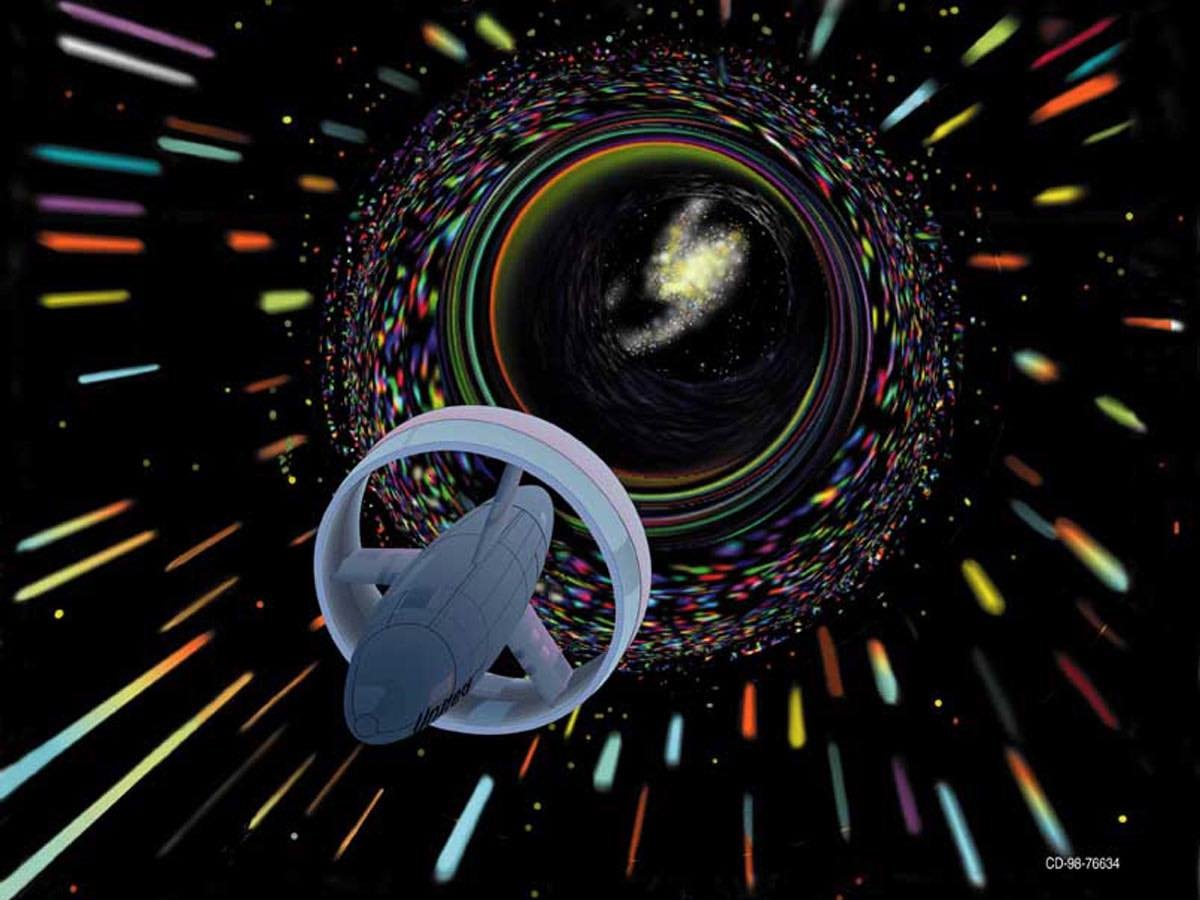
Since Captain Kirk first ordered the Starship Enterprise to engage the warp drive back in 1967, fans of science fiction have dreamed of traveling to the stars at warp speed. That idea remained in the realm of science fiction until 1994, when Mexican mathematician Miguel Alcubierreproposed a mathematically viable solution for building a real-world faster-than-light warp drive.
Since then, numerous scientists and engineers have taken a swing at their own version of a viable, real-world warp drive, including an attempt to patent one of these “out there” ideas.
Here, The Debrief looks at three of the past most promising warp drive models, along with one brand new physics concept called the “Tri-Space Model,” which may hold the key to making faster-than-light travel possible.
THE ORIGINAL: ALCUBIERRE/WHITE WARP DRIVE
While Alcubierre’s warp drive concept showed that traveling faster than light was mathematically possible, it was widely criticized for its massive power requirements and use of purely theoretical “exotic matter.” Still, many scientists and engineers were intrigued by his work, including former NASA engineer and physicist Dr. Harold G. “Sonny” White.
Hoping to move Alcubierre’s metric from theory into a published, canonical form, White first looked at the idea more closely in 2003.
“I started working in the (NASA) space program in 2000,” White told The Debrief in an interview. “While I was working in the space program, I was thinking about this Advanced Power propulsion. I was thinking about this Alcubierre Warp metric. You know, it was not published in its canonical form. And so, in 2003, I published a paper in the journal General Relativity and Gravitation.”
White immediately noted how Alcubierre’s math worked but also spotted areas he thought his own background in engineering and physics could improve the concept.
“Some things didn’t quite make sense to me, but by putting it into canonical form, helped me figure out ‘how does this concept really work?’, White told The Debrief. “From the process of not being at warp to being at warp… what would that look like when you look at the mathematics? And the only way I could see to answer the question is to put it in the canonical form in 2003, so that’s what I talked about in that paper.”
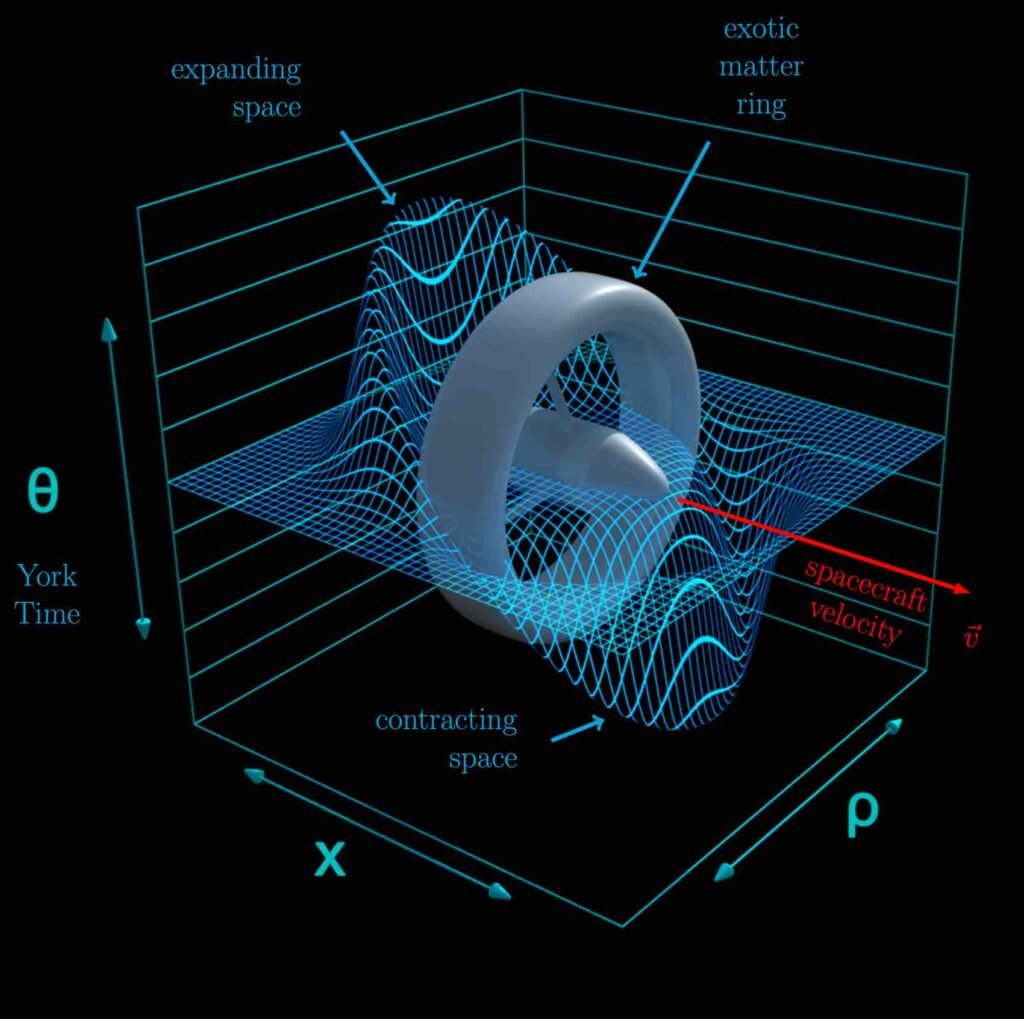
Theoretical Warp Bubble Structure
(Image Credit LSI)
Years later, White was asked by NASA to present his updated warp concept, leading to his 2011 paper and the warp drive concept now known as the “Acubierre/White Warp Drive.”
“I got asked to give a talk [about the warp drive] to DARPA and NASA at the DARPA 100-year Starship Symposium in 2011,” he told The Debrief. “I did a sensitivity study on the metric. I looked at what happens when you change the parameters and the mathematics.”
Specifically, White looked at the geometry of the classic warp drive model and found something that dramatically reduced the amount of energy required by Alcubierre.
“It basically comes down to how thick you make the toroidal ring and negative vacuum energy density,” he explained. “How thick or thin to make it, topologically? What does that do to the overall energy required? And so, during that work, I had no ‘objective’ objectives, per se, other than just to explore. In the process of doing that, I discovered that by making that ring a little thicker, instead of being like a wedding band wrapped around your finger, it’s a little bit more like a lifesaver, was key.”
In fact, White’s geometric adjustment to the classic model dramatically reduced the amount of exotic matter required to a much more manageable concept.
“By using that optimization technique, I was able to reduce the amount of exotic matter from a Jupiter-sized amount down to something about the size of the Voyager spacecraft,” said White. “So about two metric tons or just under two metric tons.”
As White notes, even a few tons of a theoretical substance like exotic matter is still unachievable by today’s scientists and engineers, but his changes definitely improved the ultimate viability of Alcubierre’s idea.
“Instead of just being mathematically possible in our work, we potentially move it into the category of maybe it’s plausible,” he noted with a lighthearted shrug. “There are now two metric tons of this stuff we’re not quite sure exactly how to make.”
White’s views about the feasibility of warp drives and their related effects have garnered a fair amount of attention from critics over the years. Among them is astrophysicist Ethan Siegel who, while remaining skeptical of White’s claims, has noted that the warp drive concept “remains an interesting possibility and one worthy of continued scientific investigation, but one that you should remain tremendously skeptical about given the current state of affairs.”
THE LENTZ DRIVE
A decade after White updated the original warp drive concept, reducing the need for exotic matter down from a Jupiter-sized amount to a few tons, another scientist named Dr. Eric W. Lentz decided to take a stab at his own warp drive concept. Published in 2021, his paper “Breaking the warp barrier: hyper-fast solitons in Einstein–Maxwell-plasma theory” lays out a whole new warp drive concept. And unlike Alcubierre and White, Lentz believed that his faster-than-light warp drive model could be accomplished in a completely new and different way.
“The Alcubierre solution provided an intuitive picture of what a warp drive would do: contract the space immediately in front of the central region containing the ship or transport, and expand the space immediately behind,” Dr. Lentz explained in an email to The Debrief. “This gives us the picture of the warp drive as a wave of curvature on which a ship will ride to its destination.”
However, Lentz explains, “this picture is not an essential feature of a warp drive.” Instead, he says, a solution proposed by physicist Jose Natario back in 2002 showed that the expansion and contraction weren’t necessary to transport the ship forward. That work, says Lentz, was critical to forming his own theory, one where a warp field could be created using only traditional matter and not exotic matter.
“[Natario] showed that the expansion could be trivial (zero) everywhere and still perform the same task of transporting a ship,” Lentz told The Debrief. This is a significant breakthrough, he says, because it means that exotic matter that warps the space in front of the theoretical passenger, as well as behind them (as depicted in nearly all theoretical warp drive solutions), is no longer needed to achieve faster-than-light travel.
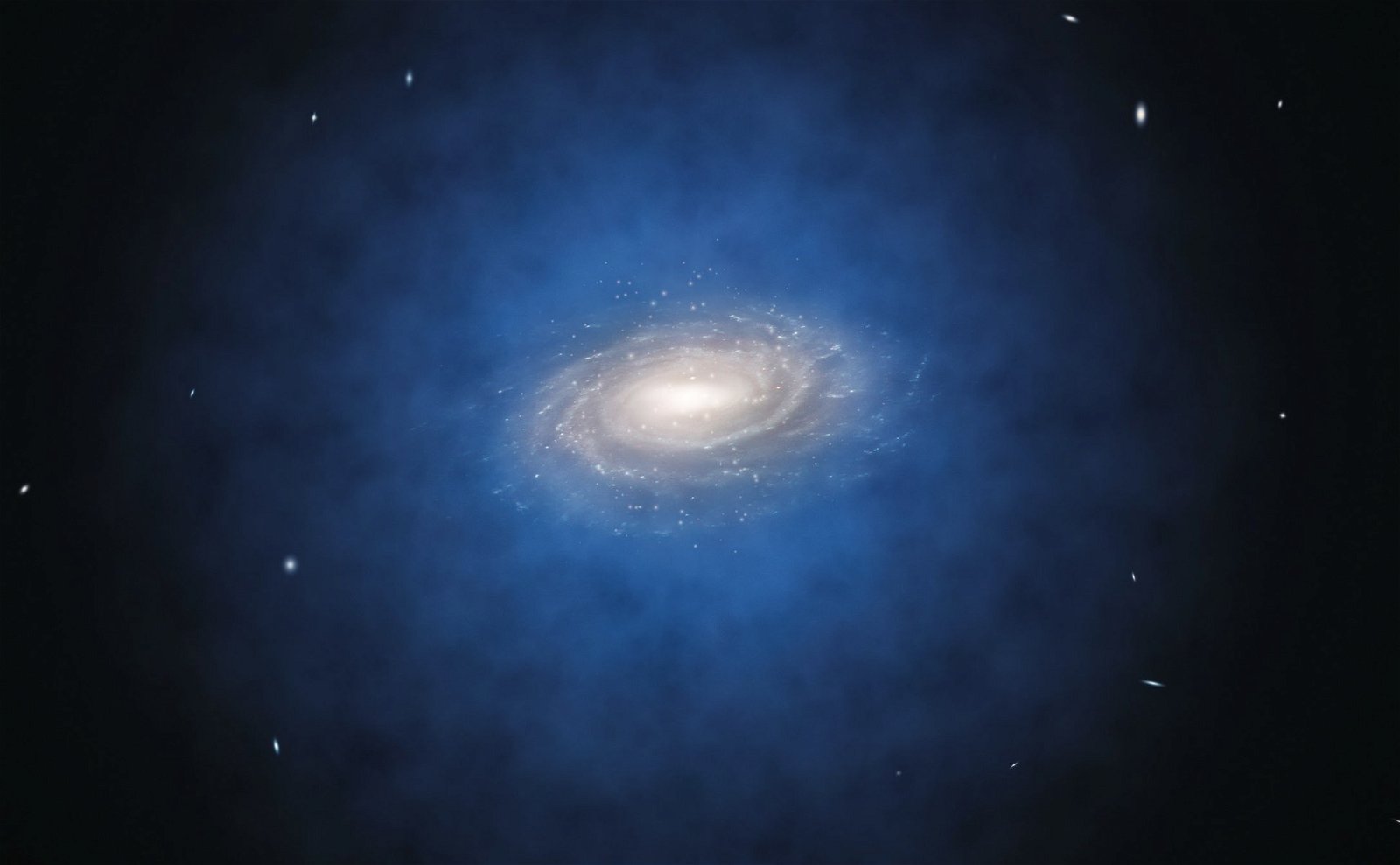
Could dark matter allow physicists a path toward overcoming the challenges of faster-than-light travel?
(Credit: ESO).
“In the Alcubierre solution, the energy density and curvatures are maximally separated, with the energy being restricted to a small torus between the regions of high contraction and expansion,” Lentz told The Debrief, once again evoking the classic image of the Alcubierre Warp model. “The curvatures and sources in my proposal are instead highly correlated, with the regions of high energy density and high expansion and contraction overlapping almost exactly.”
As his published paper explains, “This is the first example of hyper-fast solitons resulting from known and familiar sources, reopening the discussion of superluminal mechanisms rooted in conventional physics.”
Lentz does freely admit that his theory is somewhat novel, even in this highly theoretical arena. “The expansion factor in my proposal is stranger still [than in Natario or Alcubierre], having regions of large expansion and contraction of space surrounding the central region containing a ship.”
Still, the issue of power requirements is not totally solved by Lentz, although he told The Debrief there is some hope in this area.
“There are a number of very effective energy-saving mechanisms for the Alcubierre drive described in the literature,” he explained. “The challenge would be to either modify these mechanisms to operate using only conventional sources, [like his proposed theory which does not require exotic matter] or to innovate novel energy saving techniques.”
In other words, if these proposed energy reduction techniques don’t work on his drive concept due to the lack of exotic matter, a legitimate concern, then an entirely new solution, the likes of which has not yet been proposed, would need to be found. Fortunately, Lentz says, his drive already accomplishes some of that goal since “not all the energy needs to come directly from the reactor, as we expect much of the energy sourcing the bubble to come from the particles’ rest masses.”
Those particles, known in physics as solitons, are at the heart of the Lentz solution to faster-than-light travel and, aside from any theoretical attempts to further reduce energy needs, are something he believes represents the most viable area for future, practical testing. Lentz told The Debrief he sees a handful of reasonable goals going forward, including zeroing in on a viable energy level for a real-world, testable drive concept using only current power generation technology.
“After the energy requirements are low enough and suitable means of creating such solitons has been found, I would want to have the existence of such solitons confirmed in a laboratory setting for a small (~1m radius), slow (~km/s speed), but detectable soliton,” he said. “The target energy level is where a bubble of radius ten meters moving at 1% of the speed of light could be powered by a modern-day fission reactor.”
Although he is obviously enthusiastic about his novel solution to faster-than-light travel without exotic matter, Lentz also told The Debrief he is excited about all of the new, innovative concepts being discussed.
“It has been exciting to see how much progress has been made in this field recently,” he said, “and I think there are many more advances ready to be made. I am looking forward to seeing what the next few years bring.”
APPLIED PHYSICS WARP CONCEPT
Sometimes slower is better, especially when you want to avoid using “exotic matter” to make your theory work. Enter the Applied Physics (APL) Group. Their designs were recently published in the peer-reviewed journal Classical and Quantum Gravity and represent the latest in an increasingly crowded field of warp proposals.
Unlike the Alcubierre and White designs, the APL team shuns exotic matter as a power source. However, sacrifices need to be made. The physical nature of APL’s design means it is constrained by Newtonian physics. In short, while their drive concept is indeed designed to transport humans across the galaxy, it is not capable of breaking the speed of light. Damn.
“There is a common misconception that interstellar travel has to be superluminal,” Gianni Martire told The Debrief last year, “it doesn’t. If we can send a probe to reach another star within ten years, it is still incredibly useful.”
And while Sci-fi fans have the itch to go fast, APL’s warp drive doesn’t have the same energy requirements and, therefore, radiation, which tends to be a massive problem in building a crewed warp-capable vessel. Basically, no one gets cooked to death when they hit Warp Factor 1.
“Before our paper,” Martire says, “saying such things [like warp] was nonsense sci-fi. Now it’s real science.We took a small step into the future, do you feel it?”
THE TRI-SPACE MODEL
It all began in college when a young science fiction buff, future engineer, and Senior Project Leader for The Aerospace Corporation, Gregory Meholic, stumbled upon a curious little pamphlet made by the RAND Corporation.
“It was on Tachyon particles and their potential for faster-than-light travel and motion,” Meholic explained to The Debrief. “And I mean, lots of science fiction uses tachyons as the go-to faster-than-light widget, right?”
That RAND pamphlet was an exploratory work in speculative physics written by Lt. Col. Edward Puscher for the United States Air Force in 1980. It explores the theory regarding a theoretical particle called a tachyon that may exist in a permanent faster-than-light state.
“Basically, it was an algebraic solution to the general and special relativity equations that govern motion near the speed of light,” Meholic explained.
A big kick in the FTL pants for any science fiction fan is Einstien’s Theory of Relativity. The closer you get to light speed, the more your mass increases. As you near the 300,000 kilometers per second mark (the speed of light), you require an infinite amount of energy to hit light speed.
“And this pamphlet basically was trying to show that, first, Tachyons can theoretically exist in a super-liminal realm,” says Meholic. “And second, it provided the logical algebraic follow-outs of special and general relativity to show their characteristics.”
After Meholic read the pamphlet, it tweaked his imagination.
“What occurred to me in reading this was that three possible velocities could be associated with any given point in space: sub-light, light speed, and superluminal travel,” he explained.
So, in a nutshell, Meholic’s Tri-Space Theory breaks up reality into three “realms” that coexist at any point in spacetime. The sub-light realm is everything that moves slower than the speed of light, like your old Honda Accord or that barista at your regular coffee shop. The light-speed realm is the world of the massless photon zipping around at the 300,000 kps speed limit. And then there is the superliminal realm where things like tachyons dwell. Once you go beyond the math curve that brings you to light speed, the math doubles back.
“So when I started to think about this ‘other side of the curve,’ so to speak, what happens in this superluminal realm is really interesting because when you take energy away from the system, you go faster,” says Meholic.
In our realm, sub-light, the more energy you put into travel, the faster you go. In the superliminal realm, beyond the algebraic curve, as Meholic says, the more energy you put into travel, the slower you go, eventually bumping into the crawling 300,000 kps limit, but from the topside. To slow down to the speed of light, a superliminal object would require an infinite amount of energy; almost like a backward theory of relativity.
“And this implies that the rest mass becomes imaginary, which is the whole square root negative one thing…And so, as long as you’re moving faster than light speed, this particular algebraic solution says that tachyon particles could have a real positive mass traveling at these superluminal speeds,” Meholic postulates.
And for science fiction fans who need their ship to get from Earth to Wolf 359 in a hurry, the idea that something can have mass and achieve faster-than-light travel solves the whole cosmic speed limit issue. The Tri-Space Model doesn’t violate the rules because the superliminal object exists outside the sub-light and light-speed realms. No causality issues. No weird time dilations. No accidental time travel. No infinite mass problems. Just open superliminal space.
Sounds fun, but it begs one big question: How?
For an object to exist in superliminal space, it must jump from this realm to the superliminal realm. The idea isn’t to speed up to superliminal speed but to pop into it. And the best way to do that is to convert ordinary dull sub-light matter into a version that can exist in the superliminal realm. So how does someone build the machine to make such a conversion possible? Zero clue.
While Meholic’s idea is still very much speculative, it is unique. It doesn’t require a warp in spacetime or a wormhole or much in the way of new math. It is very similar to dark matter and dark energy; the biggest challenge is that we cannot currently observe the superliminal, so to say a “superliminal realm” exists becomes a matter of theoretical physics.
In sum total, we are still a long way from making the concept of faster-than-light travel anything more than just an entertaining element of science fiction. However, with the work of scientists like these who remain dedicated to its study, this fictional form of travel may indeed one day make its way into the realm of science fact.
Follow and Connect with Christopher Plain on Twitter @plain_fiction.
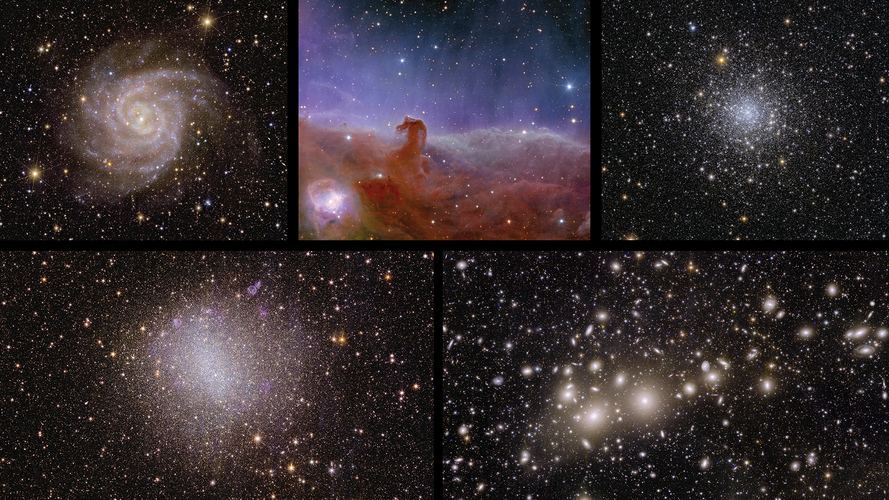
Many a space enthusiast first became interested in the topic when they saw some astounding picture taken by one of the world’s great telescopes and began to get a sense of scale of the universe. This author personally remembers the first time he saw Hubble’s Ultra Deep Field – arguably the image that has changed his life more than any other. Given the massive size of the universe, there are always more incredible pictures to be taken, and now humanity has a new tool for that task. Euclid, the European Space Agency’s dark matter/energy hunter, has released its first set of images – and they are absolutely mesmerizing.
One of the most breathtaking is something equivalent to the famous Ultra Deep Field shot. Except in this case, Euclid decided to concentrate on the Perseus Cluster, a group of over 1,000 galaxies located about 240 million light years away from us. It’s one of the most massive known structures in the universe and will undoubtedly shed some insights into the nature of dark matter and how it affects galaxy formation.
But even more impressively, the shot of the cluster also contains around 100,000 additional galaxies in the background, some as far as 10 billion light years away from us. So look again at those little dots in the background – each of those is a galaxy, and while it might not be quite as big as the Milky Way, it is still likely comprised of hundreds of millions of stars. If that doesn’t provide some sense of scale of the universe, it’s unclear what would be able to.
Video showing off some of the new images from Euclid.Credit – European Space Agency YouTube Channel
Closer to home, there are some images of more familiar-looking objects. One, known as IC 342, is a spiral galaxy that looks suspiciously like the Milky Way if we were able to see it from the top. It’s also known as the “Hidden Galaxy,” but Euclid’s infrared imaging system makes it pop in the newly released picture.
Globular clusters are also of particular interest in hunting for dark matter, and Euclid’s first crop of images contained one of NGC 6397, the second closest globular cluster to Earth. At only 7800 light years distant, it’s only a short hop in astronomical terms, but Euclid has allowed us to see it as never before by capturing an image of the entire cluster in a single observation – no other telescope developed so far can do that.
But possibly one of the author’s personal favorites of this set of images is a new rendition of one of the most famous structures in all of space. Euclid’s capture of the Horsehead Nebula is stunning and ethereal in its sharpness and quality. Part of Euclid’s mission will be to collect information about Jupiter-sized planets being created in this star-forming region. But taking a fantastic picture is a nice bonus, if for no other reason than the aesthetics.
Fraser interviews a Euclid project scientist who goes into details about the plans for the mission.
There are several other fascinating images in the first round, including a type of galaxy called an “irregular dwarf,” which looks more like a diffuse shell of light rather than the spiral or other structures we typically associate with galaxies. ESA also released a video showing a series of captured images, and they probably have more sitting on the telescopes’ data banks as we speak.
However, we might have to wait a little while before they are released. Euclid is currently at the Earth-Sun Lagrange 2 point, and its operators are starting up systems and testing them out. They currently plan on starting full scientific observations in early 2024 and release the data from those observations once a year. With about six years of data expected as part of the mission, expect plenty more stunning photos to come out of this new telescope over the coming years.
Composite image of a series of new pictures from Euclid. Credit – ESA/Euclid/Euclid Consortium/NASA, image processing by J.-C. Cuillandre (CEA Paris-Saclay), G. Anselmi, CC BY-SA 3.0 IGO
How NASA Keeps Ingenuity Going After More than 50 Flights
More information is always better when it comes to publicly funded space exploration projects. So it’s welcome when a NASA engineer takes time out of the assuredly busy work lives to provide an update on everyone’s favorite helicopter on Mars. Ingenuity has been having a rough few months, and a new article entitled “The Long Wait,” posted by Travis Brown, Chief Engineer on the Ingenuity project, on NASA’s website, provides a good amount of detail as to why.
The problems started when Ingenuity took off for flight #52 on April 26th. When the helicopter landed, it was out of range Perseverance, its rover companion, and the helicopter’s radio link back to its controllers on Earth. This was intentional, but it meant that Ingenuity’s minders didn’t know whether the flight had been completed successfully.
Dr. Brown explains why the team would intentionally choose to land the helicopter out of range of Perseverance and details the four main mission priorities for the helicopter’s secondary mission. Unsurprisingly, the number one priority is: don’t mess up Perseverance. The rover is currently collecting interesting samples for the now-endangered Mars Sample Return mission, which, assuming it still goes ahead, will see those samples eventually return to Earth.
Fraser describes Ingenuity’s long silence, among other topics.
If Ingenuity accidentally interferes with that process, needless to say, the NASA brass would be upset. The helicopter’s handlers have decided that the best way for it is to stay well ahead of the rover and let it catch up to them, which is what it was trying to do with Flight #52.
Unfortunately, part of Perseverance’s mission is flexibility, and its own project team can make the call as to where they want the rover to go next. After Ingenuity’s flight, the rover team decided not to stick to the planned path that would take it near the helicopter in a few days but instead take a long way around to do some exciting science elsewhere. When Perseverance did move back into range, 61 days had passed where the helicopter had been patiently waiting for it.
When Ingenuity could finally transmit its images back, the science team was excited as it had landed on a group of pebbles that had never before been seen on the Martian surface. Another flight was planned immediately, with this one intended to scout the immediate area for any other interesting geological features for Perseverance to look at.
NASA released a video to celebrate Ingenuity’s 50th flight. Credit – NASA Jet Propulsion Laboratory YouTube Channel
That’s where the second problem came up. During Ingenuity’s flight #53, a never-before-seen error forced the helicopter to land unexpectedly, what Dr. Brown describes as a time desynchronization between a camera that keeps track of ground features and other sensors tied to its inertial guidance system. Any engineer who has worked with multiple systems can tell you how difficult timing synchronization timing can be, so the guidance system was right to shut the system down for machine safety. Still, it means that Ingenuity was once again grounded without being able to fulfill a potentially interesting mission objective.
While Ingenuity was recovering from its unexpected landing, Perseverance caught up to the helicopter, making it redundant to provide scientific data since the superior instruments on the rover were now on station. Luckily, that freed the helicopter up for a brief flight #54, where it tested its systems out again and then returned to its scouting duties with flight #55 shortly afterward, with no attendant synchronization problems.
Remember that the original mission plan for Ingenuity lasted for 30 days and three flights. It is now on day 979 and has completed 66 flights in total. That is astounding for such a tiny machine on such a remote planet, and congratulations to Dr. Brown and his team. May they be able to overcome many more obstacles and complete many more flights.
Gamma-ray Bursts: Harvesting Knowledge From the Universe's Most Powerful Explosions
Gamma-ray Bursts: Harvesting Knowledge From the Universe's Most Powerful Explosions
The most powerful events in the known universe – gamma-ray bursts (GRBs) – are short-lived outbursts of the highest-energy light. They can erupt with a quintillion (a 10 followed by 18 zeros) times the luminosity of our Sun. Now thought to announce the births of new black holes, they were discovered by accident.
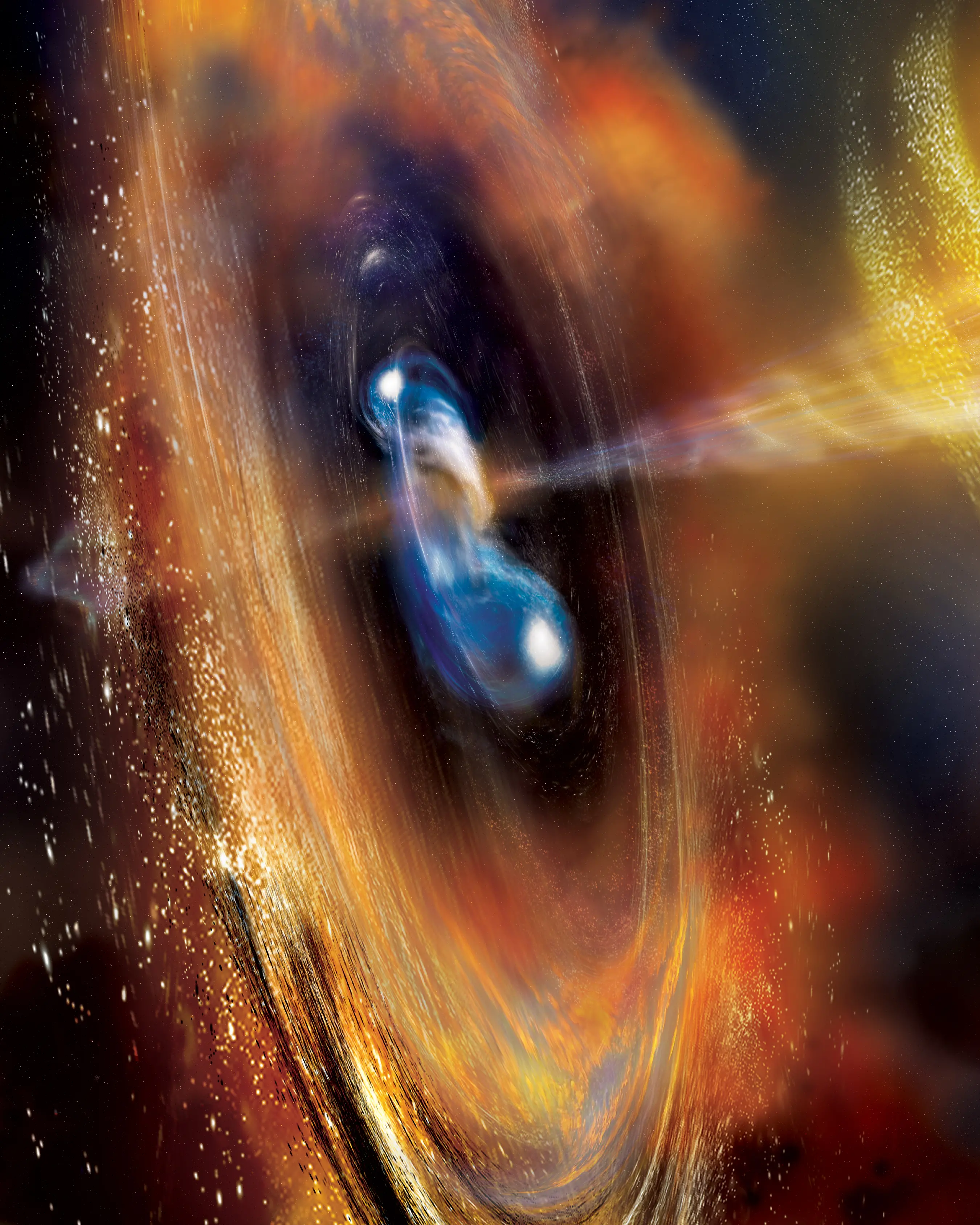
Two neutron stars begin to merge in this artist’s concept, blasting jets of high-speed particles. Collision events like this one create short gamma-ray bursts. Credit: NASA’s Goddard Space Flight Center/ A. Simonnet, Sonoma State University
The backstory takes us to 1963, when the U.S. Air Force launched the Vela satellites to detect gamma rays from banned nuclear weapons tests. The United States had just signed a treaty with the United Kingdom and the Soviet Union to prohibit tests within Earth’s atmosphere, and the Vela satellites ensured all parties’ compliance. Instead, the satellites stumbled upon 16 gamma-ray events. By 1973, scientists could rule out that both Earth and the Sun were the sources of these brilliant eruptions. That’s when astronomers at Los Alamos National Laboratory published the first paper announcing these bursts originate beyond our solar system. Scientists at NASA’s Goddard Space Flight Center quickly confirmed the results through an X-ray detector on the IMP 6 satellite. It would take another two decades and contributions from the Italian Space Agency’s BeppoSax and NASA’s Compton Gamma-Ray Observatory to show that these outbursts occur far beyond our Milky Way galaxy, are evenly distributed across the sky, and are extraordinarily powerful. The closest GRB on record occurred more than 100 million light-years away.
Though discovered by chance, GRBs have proven invaluable for today’s researchers. These flashes of light are rich with insight on phenomena like the end of life of very massive stars or the formation of black holes in distant galaxies.
Still, there are plenty of scientific gems left to discover. In 2017, GRBs were first linked to gravitational waves – ripples in the fabric of space-time – steering us toward a better understanding of the how these events work.
The Long and Short of GRBs
Astronomers separate GRBs into two main classes: short (where the initial burst of gamma rays lasts less than two seconds) and long events (lasting two seconds or longer).
Shorter bursts also produce fewer gamma rays overall, which lead researchers to hypothesize that the two classes originated from different progenitor systems.
Astronomers now associate short bursts with the collision of either two neutron stars or a neutron star and a black hole, resulting in a black hole and a short-lived explosion. Short GRBs are sometimes followed by kilonovae, light produced by the radioactive decay of chemical elements. That decay generates even heavier elements, like gold, silver, and platinum.
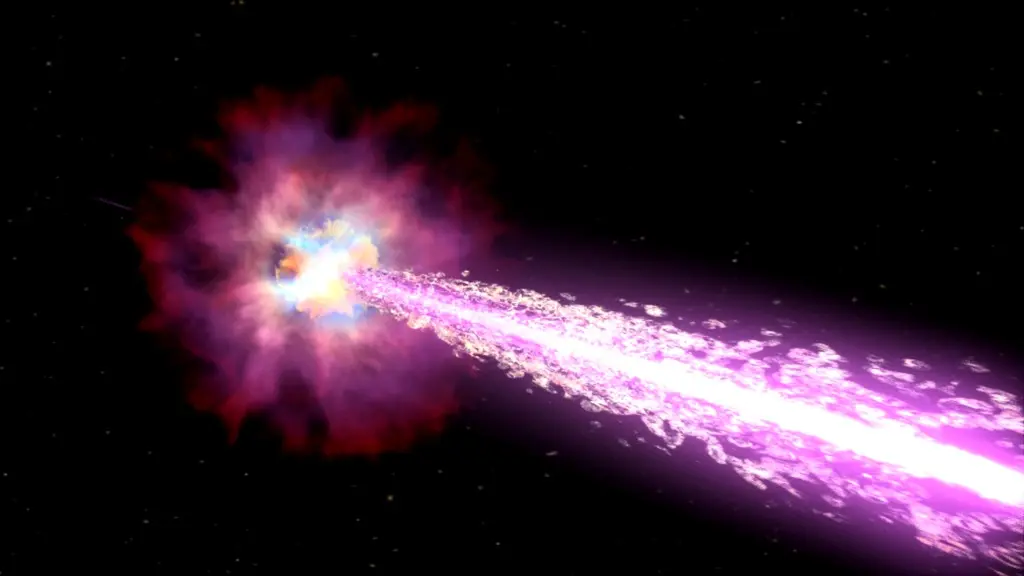
Long bursts are linked to the explosive deaths of massive stars. When a high-mass star runs out of nuclear fuel, its core collapses and then rebounds, driving a shock wave outward through the star. Astronomers see this explosion as a supernova. The core may form a either a neutron star or a black hole.
In both classes, the newly born black hole beams jets in opposite directions. The jets, made of particles accelerated to near the speed of light, pierce through and eventually interact with the surrounding material, emitting gamma rays when they do.
As a high-mass star explodes in this artist’s concept, it produces a jet of high-energy particles. We see GRBs when such gets point almost directly at Earth. Credit: NASA/Swift/Cruz deWilde
This broad outline isn’t the last word, though. The more GRBs astronomers study, the more likely they’ll encounter events that challenge current classifications.
In August 2020, NASA’s Fermi Gamma-ray Space Telescope tracked down a second-long burst named GRB 200826A, over 6 billion light-years away. It should have fallen within the short-burst class, triggered by mergers of compact objects. However, other characteristics of this event – like the supernova it created – suggested it originated from the collapse of a massive star. Astronomers think this burst may have fizzled out before it could reach the duration typical of long bursts.
Fermi and NASA’s Neil Gehrels Swift Observatory captured its opposite number, GRB 211211A in December 2021. Located a billion light-years away, the burst lasted for about a minute. While this makes it a long GRB, it was followed by a kilonova, which suggests it was triggered by a merger. Some researchers attribute this burst’s oddities to a neutron star merging with a black hole partner.
As astronomers discover more bursts lasting several hours, there may still be a new class in the making: ultra-long GRBs. The energy created by the death of a high-mass star likely can’t sustain a burst for this long, so scientists must look to different origins.
Some think ultra-long bursts occur from newborn magnetars – neutron stars with rapid rotation rates and magnetic fields a thousand times stronger than average. Others say this new class calls for the power of the universe’s largest stellar residents, blue supergiants. Researchers continue to explore ultra-long GRBs.
Afterglows Shedding New Light
While gamma rays are the most energetic form of light, they certainly aren’t the easiest to spot. Our eyes see only a narrow band of the electromagnetic spectrum. Studying any light outside that range, like gamma rays, hinges tightly on the instruments our scientists and engineers develop. This need for technology, alongside GRBs’ already fleeting nature, made bursts more difficult to study in early years.
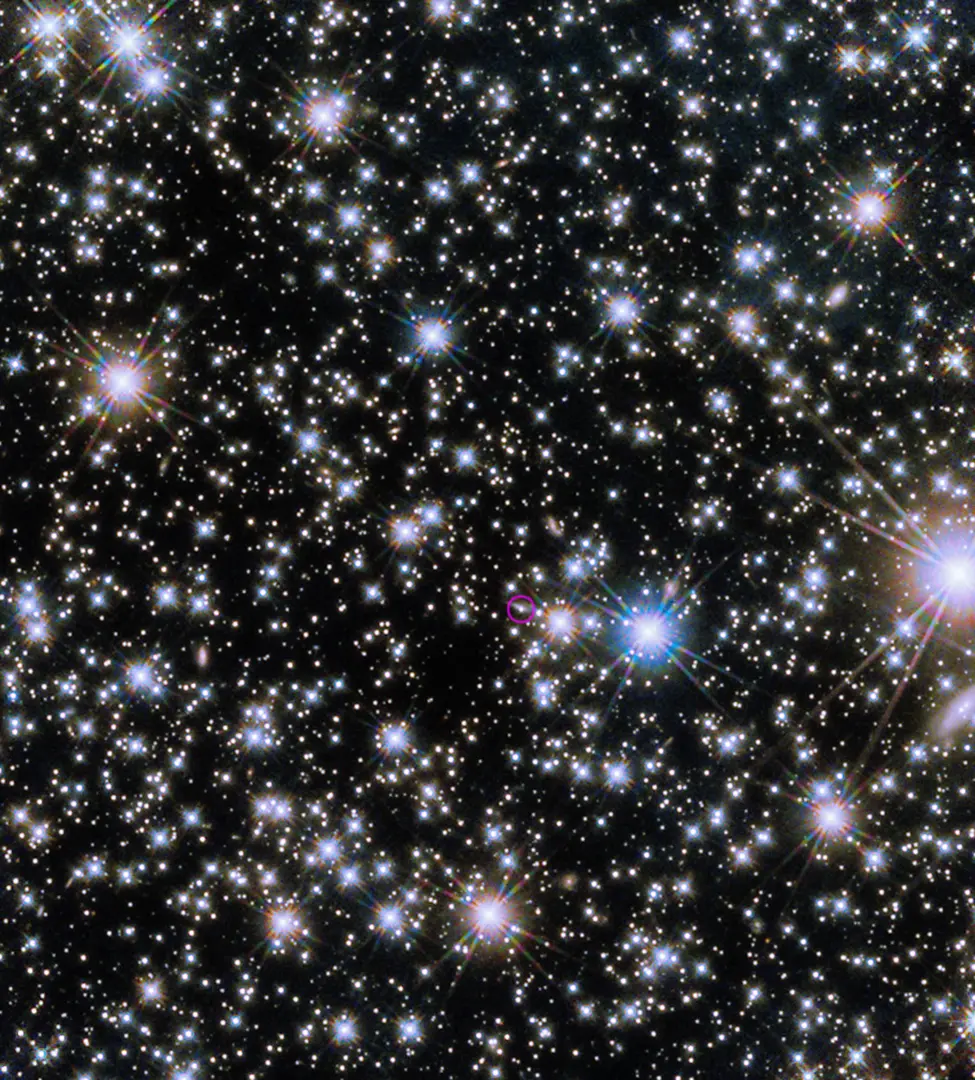
The Hubble Space Telescope’s Wide Field Camera 3 revealed the infrared afterglow (circled) of GRB 221009A and its host galaxy, seen nearly edge-on as a sliver of light extending to upper left from the burst.
Credit: NASA, ESA, CSA, STScI, A. Levan (Radboud University); Image Processing: Gladys Kober
GRB afterglows occur when material in the jets interact with surrounding gas.
Afterglows emit radio, infrared, optical, UV, X-ray, as well as gamma-ray light, which provides more data about the original burst. Afterglows also linger for hours to days (or even years) longer than their initial explosion, creating more opportunities for discovery.
Studying afterglows became key to deducing the driving forces behind different bursts. In long bursts, as the afterglow dims, scientists eventually see the source brighten again as the underlying supernova becomes detectable.
Because afterglows last for such a long time and emit light large telescopes can detect, astronomers can pinpoint their locations and identify their host galaxies. This helps them determine more about bursts, including how far away they are.
Although light is the universe’s fastest traveler, it can’t reach us instantaneously. By the time we detect a burst, millions to billions of years may have passed, allowing us to probe some of the early universe through distant afterglows.
Bursting With Discovery
Despite the expansive research conducted so far, our understanding of GRBs is far from complete. Each new discovery adds new facets to scientists’ gamma-ray burst models.
Fermi and Swift discovered one of these revolutionary events in 2022 with GRB 221009A, a burst so bright it temporarily blinded most space-based gamma-ray instruments. A GRB of this magnitude is predicted to occur once every 10,000 years, making it likely the highest-luminosity event witnessed by human civilization. Astronomers accordingly dubbed it the brightest of all time – or the BOAT.
This is one of the nearest long burst ever seen at the time of its discovery, offering scientists a closer look at the inner workings of not only GRBs, but also the structure of the Milky Way. By peering into the BOAT, they’ve discovered radio waves missing in other models and traced X-ray reflections to map out our galaxy’s hidden dust clouds.
NASA’s Neil Gehrels Swift Observatory detected X-rays from the initial flash of GRB 221009A for weeks as dust in our galaxy scattered the light back to us, shown here in arbitrary colors. Credit: NASA/Swift/A. Beardmore (University of Leicester)
GRBs also connect us to one of the universe’s most sought-after messengers. Gravitational waves are invisible distortions of space-time, born from cataclysmic events like neutron-star collisions. Think of space-time as the universe’s all-encompassing blanket, with gravitational waves as ripples wafting through the material.
In 2017, Fermi spotted the gamma-ray flash of a neutron-star merger just 1.7 seconds after gravitational waves were detected from the same source. After traveling 130 million light-years, the gravitational waves reached Earth narrowly before the gamma rays, proving gravitational waves travel at the speed of light.
Scientists had never detected light and gravitational waves’ joint journey all the way to Earth. These messengers combined paint a more vivid picture of merging neutron stars.
With continued research, our ever-evolving knowledge of GRBs could unravel the unseen fabric of our universe. But the actual burst is just the tip of the iceberg. An endless bounty of information looms just beneath the surface, ready for the harvest.
Later dubbed the Oh-My-God particle, the cosmic ray’s energy shocked astrophysicists. Nothing in our Galaxy had the power to produce it, and the particle had more energy than was theoretically possible for cosmic rays traveling to Earth from other galaxies.
Led by the University of Utah and the University of Tokyo, the Telescope Array has since observed more than 30 ultra-high-energy cosmic rays, though none approaching the Oh-My-God-level energy. No observations have yet revealed their origin or how they are able to travel to the Earth.
On May 27, 2021, the Telescope Array experiment detected the second-highest extreme-energy cosmic ray.
At 2.4*1020 eV, the energy of this single subatomic particle is equivalent to dropping a brick on your toe from waist height.
The Telescope Array consists of 507 surface detector stations arranged in a square grid that covers 700 km2 outside of Delta, Utah.
The event triggered 23 detectors at the north-west region of the Telescope Array, splashing across 48 km2.
Its arrival direction appeared to be from the Local Void, an empty area of space bordering the Milky Way Galaxy.
“The particles are so high energy, they shouldn’t be affected by galactic and extra-galactic magnetic fields,” said Dr. John Matthews, Telescope Array co-spokesperson at the University of Utah.
“You should be able to point to where they come from in the sky.”
“But in the case of the Oh-My-God particle and this new particle, you trace its trajectory to its source and there’s nothing high energy enough to have produced it.”
“That’s the mystery of this — what the heck is going on?”
The researchers named it the Amaterasu particle after the Sun goddess in Japanese mythology.
The Oh-My-God and the Amaterasu particles were detected using different observation techniques, confirming that while rare, these ultra-high energy events are real.
“These events seem like they’re coming from completely different places in the sky. It’s not like there’s one mysterious source,” said University of Utah’s Professor John Belz.
“It could be defects in the structure of spacetime, colliding cosmic strings. I mean, I’m just spit-balling crazy ideas that people are coming up with because there’s not a conventional explanation.”
Ultra-high-energy cosmic rays must exceed 5*1019 eV. This means that a single subatomic particle carries the same kinetic energy as a major league pitcher’s fast ball and has tens of millions of times more energy than any human-made particle accelerator can achieve.
Astrophysicists calculated this theoretical limit, known as the Greisen-Zatsepin-Kuzmin (GZK) cutoff, as the maximum energy a proton can hold traveling over long distances before the effect of interactions of the microwave background radiation take their energy.
Known source candidates, such as active galactic nuclei or black holes with accretion disks emitting particle jets, tend to be more than 160 million light-years away from Earth.
The new particle’s 2.4*1020 eV and the Oh-My-God particle’s 3.2*1020 eV easily surpass the cutoff.
The scientists also analyzed cosmic ray composition for clues of its origins: heavier particles, like iron nuclei, have more charge and are more susceptible to bending in a magnetic field than lighter particles made of protons from a hydrogen atom.
The new particle is likely a proton.
Particle physics dictates that a cosmic ray with energy beyond the GZK cutoff is too powerful for the microwave background to distort its path, but back tracing its trajectory points towards empty space.
“Maybe magnetic fields are stronger than we thought, but that disagrees with other observations that show they’re not strong enough to produce significant curvature at these ten-to-the-twentieth electron volt energies. It’s a real mystery,” Professor Belz said.
Het concept van tijdreizen boeit lezers en bioscoopbezoekers al tientallen jaren. Maar hoewel mensen gefascineerd zijn door het idee, is niemand erin geslaagd om het tijdreizen meer tot realiteit te maken dan voorheen. Het lijkt een droom die net iets te ver buiten bereik ligt. Maar in een tijdperk waarin de wetenschap de grenzen van het mogelijke blijft verleggen, weten we eigenlijk wel - in theorie - wat de fysica van tijdreizen zou kunnen inhouden?
Het zal je misschien verbazen dat natuurkundigen nog steeds niet precies weten hoe tijd werkt. Voorlopig lijkt reizen naar de toekomst mogelijk (aangezien we er elke dag naartoe razen).
Maar als het aankomt op het mogelijk ontmoeten van onze over-over-overgrootouders door naar het verleden te reizen, ziet het er extreem moeilijk, of bijna volledig onmogelijk uit.
Tijd was relatief voor Einstein. Een belangrijk resultaat van relativiteit is dat de tijdstroom niet constant is. Tijd kan versnellen of vertragen, afhankelijk van de omstandigheden.
Voor ons zijn de relativistische effecten van tijd te subtiel om op te merken. Maar ze hebben wel degelijk invloed op de satellieten die worden gebruikt voor het Global Positioning System (GPS).
De klokken in de lucht tikken sneller dan de klokken op aarde. Daarom moeten de klokken in de lucht constant worden bijgesteld om de nauwkeurigheid te garanderen. Als dat niet gebeurt, kan je navigatie-app ongeveer 10 km per dag onnauwkeurig zijn!
Relativiteit betekent dat het mogelijk is om naar de toekomst te reizen. Of je nou reist met de lichtsnelheid of tijd doorbrengt in een intens zwaartekrachtsveld, je ervaart een relatief korte hoeveelheid aan subjectieve tijd.
In de rest van het universum zouden daarentegen tientallen jaren of eeuwen voorbijgaan. Dus wanneer je terugkeert, zou je verder in de toekomst zijn dan de tijd die je hebt ervaren.
Een studie uit 1949, gepubliceerd door Kurt Gödel, stelde voor dat een gesloten tijdachtige kromme, een pad waar ruimte en tijd in zichzelf teruglopen, tijdreizen naar het verleden mogelijk zou kunnen maken.
Zonder bewijs voor het bestaan van een gesloten tijdachtige kromme, is er geen manier om deze te reconstrueren. Emily Adlam, filosoof aan de Chapman Universiteit in Californië, zegt: "Zelfs als we veel grotere technologische krachten hadden dan we nu hebben, lijkt het onwaarschijnlijk dat we in staat zouden zijn om doelbewust gesloten tijdachtige krommen te creëren."
In 1991 kwam de natuurkundige Richard Gott met de theorie dat zo'n gesloten cirkel mogelijkµzou zijn als er twee "kosmische snaren" waren die in tegengestelde richting langs elkaar heen bewogen.
Wat geweldig zou zijn... als kosmische snaren bestonden! Deze snaren zijn nog steeds hypothetisch en volgens sommige theorieën zouden ze het hele vroege universum hebben gevormd.
Een ander fenomeen dat volgens de relativiteit mogelijk is, zijn wormgaten. Theoretisch is het mogelijk dat ruimtetijd wordt gevouwen als een stuk papier, waardoor een tunnel kan worden geperforeerd om een kortere weg te creëren tussen twee ver van elkaar verwijderde punten, oftewel een wormgat.
Het probleem met wormgaten is weer dat hoewel in theorie is aangetoond dat ze zouden kunnen bestaan, als een wiskundige mogelijkheid, het fysieke bestaan van wormgaten iets heel anders is.
Als wormgaten zouden bestaan, zouden ze niet erg lang bestaan. Sterker nog, als het twee zwarte gaten zijn die zich hebben samengevoegd, zoals wordt getheoretiseerd, dan zou hun intense zwaartekrachtsveld instorten onder hun eigen zwaartekracht.
Er is nog meer slecht nieuws voor toekomstige tijdreizigers: deze wormgaten zouden microscopisch klein zijn, te klein voor een bacterie, laat staan voor een mens om er doorheen te gaan.
Om het omvang- en zwaartekrachtprobleem op te lossen zou er een grote hoeveelheid negatieve energie in het atoom nodig zijn. De energie van het atoomveld moet over het algemeen echter meer positieve energie bevatten, dus zelfs als er kleine zakjes negatieve energie in het atoomveld zouden ontstaan, is het geen erg realistisch beeld.
Terwijl relativiteit het gedrag beschrijft van grote objecten zoals mensen en sterrenstelsels, verklaart kwantummechanica het hele kleine: kleiner dan atomen, zoals elektronen en fotonen.
Uit de kwantummechanica zijn vreemde waarnemingen naar voren gekomen, met name non-lokaliteit. Dit is waar een verandering in de toestand van een deeltje op één locatie onmiddellijk een ander "verstrikt" deeltje ergens anders kan beïnvloeden.
Einstein noemde dit "spookachtige actie op afstand". Het is vele malen experimenteel aangetoond, maar veel natuurkundigen zijn ongelukkig met de mogelijkheid van niet-lokaliteit.
Als reactie hierop zijn sommige natuurkundigen met een alternatieve manier gekomen om de experimenten te interpreteren. Sommigen suggereren dat wanneer iets er direct lijkt te zijn, het eigenlijk naar de toekomst is gereisd en weer terug. Dit introduceert retrocausaliteit, oftewel gebeurtenissen die in de toekomst plaatsvinden hebben een effect op het verleden.
Als dit het geval is, is ons lineaire concept van tijd niet noodzakelijk correct. Het betekent in feite dat informatie uit de toekomst altijd terugkeert om het verleden te beïnvloeden. Het is goed om in gedachten te houden dat deze theorie ook niet door iedereen wordt geaccepteerd. Sommigen vinden deze theorie nog ongehoorder dan non-lokaliteit.
Kortom, we hebben geen volledig antwoord. Relativiteit en kwantumfysica zijn niet met elkaar te combineren, maar ze werken wel om bepaalde aspecten van ons universum te verklaren. Misschien is er een overkoepelende, verenigende theorie die ze met elkaar verbindt, maar die is nog niet ontdekt. Voorlopig blijft tijdreizen buiten bereik - net als de meer mysterieuze aspecten van het universum.
Astronomers pouring over imagery obtained by the Very Large Array Sky Survey (VLASS) in New Mexico recently spotted a transient object they say is unique—and potentially far more energetic—than past examples they have witnessed, according to new research.
In astrophysics, the area of transient astronomy involves the study of short-lived astronomical events or phenomena. Some of these transient objects may last as little as a few seconds, or even fractions of one, while others could persist for several weeks, or even years.
From the enigmatic fast radio bursts of recent years to sudden eruptions of gamma rays and the appearances of novae and supernovae, the primary feature uniting many transient events is their extremity. That is, they usually result from the powerful energy released by the complete or partial destruction of distant celestial objects.
Now, a team of researchers says they may have located one of the most powerful transient objects in its class that astronomers have ever observed, a discovery that could potentially offer clues toward unraveling other unusual phenomena observed in recent years.
The new object, dubbed VT 1137-0337, is believed by astronomers to be a pulsar wind nebula (PWN), also known as a plerion. These objects occur when a nebula forms within the remaining shell of a supernova remnant (SNR). The unique feature of a PWN involves how winds generated by a central pulsar are what astronomers believe powers the nebula.
The discovery of VT 1137-0337 resulted from the analysis of images collected by VLASS, part of an ongoing project of New Mexico’s National Radio Astronomy Observatory, by astronomers Dillon Dong, a graduate student at Caltech, and Professor Gregg Hallinan, his doctoral adviser.
Comparisons between VLA images of the area where VT 1137-0337 exists as seen in 2018 (right) and in 1998 (left), showing that the object only appeared within recent years (Credit: Dong & Hallinan, NRAO/AUI/NSF).
Dong explained to The Debrief that the otherwise monumental task of sifting through the VLASS imagery was made easier by applying filtering that relied on code he wrote, which scanned every image they acquired and identified all of the radio sources present at the time they were recorded. Dong’s program also filtered out artifacts that occasionally turn up in VLASS images, all of which helped him and Hallinan narrow down transient objects that would likely be of interest to their research.
The next step was to take the filtered data and compare that against data from previous radio surveys conducted over the last several decades.
“By cross-matching my catalog of VLASS radio sources with a catalog from a historical radio survey from the 90s and 2000s called FIRST, I identified several thousand variable and transient sources,” Dong told The Debrief, noting that the transient objects he and Hallinan focused on were primarily “sources that have brightened substantially or newly appeared in the radio sky over the past two decades.”
Dong says that several of the transient objects they detected result from far distant black holes that possess relatively compact jets of powerful radio emissions, the likes of which have been discovered in previous studies of VLASS imagery in recent years.
However, during his recent research effort, Dong was more interested in objects that existed closer to us, within an estimated 600 million light-years.
“To find those nearby sources, I cross-matched the catalog of radio variables/transients with a catalog of nearby galaxies,” Dong explained. What he found surprised him.
“As it turns out, there are about 20 transients that are located too close to nearby galaxies to be explained by chance,” Dong told The Debrief, calling the new collection of transient objects—all presumably in nearby galaxies—a sort of “gold mine.”
One of the sources that stood out among those detected by Dong’s code filtering system turned out to be the first known instance involving a stellar collision that is believed to have given rise to a supernova explosion. And there were other transients that caught the eye of Dong and Hallinan, one in particular on account of several unusual features it possessed.
“VT 1137-0337 was another transient that stood out, this time because it had a very unusual flat radio spectrum and because it was fading so slowly,” Dong says. “Both of these properties are unique among known radio transients, and their combination is best explained by an emerging pulsar wind nebula.”
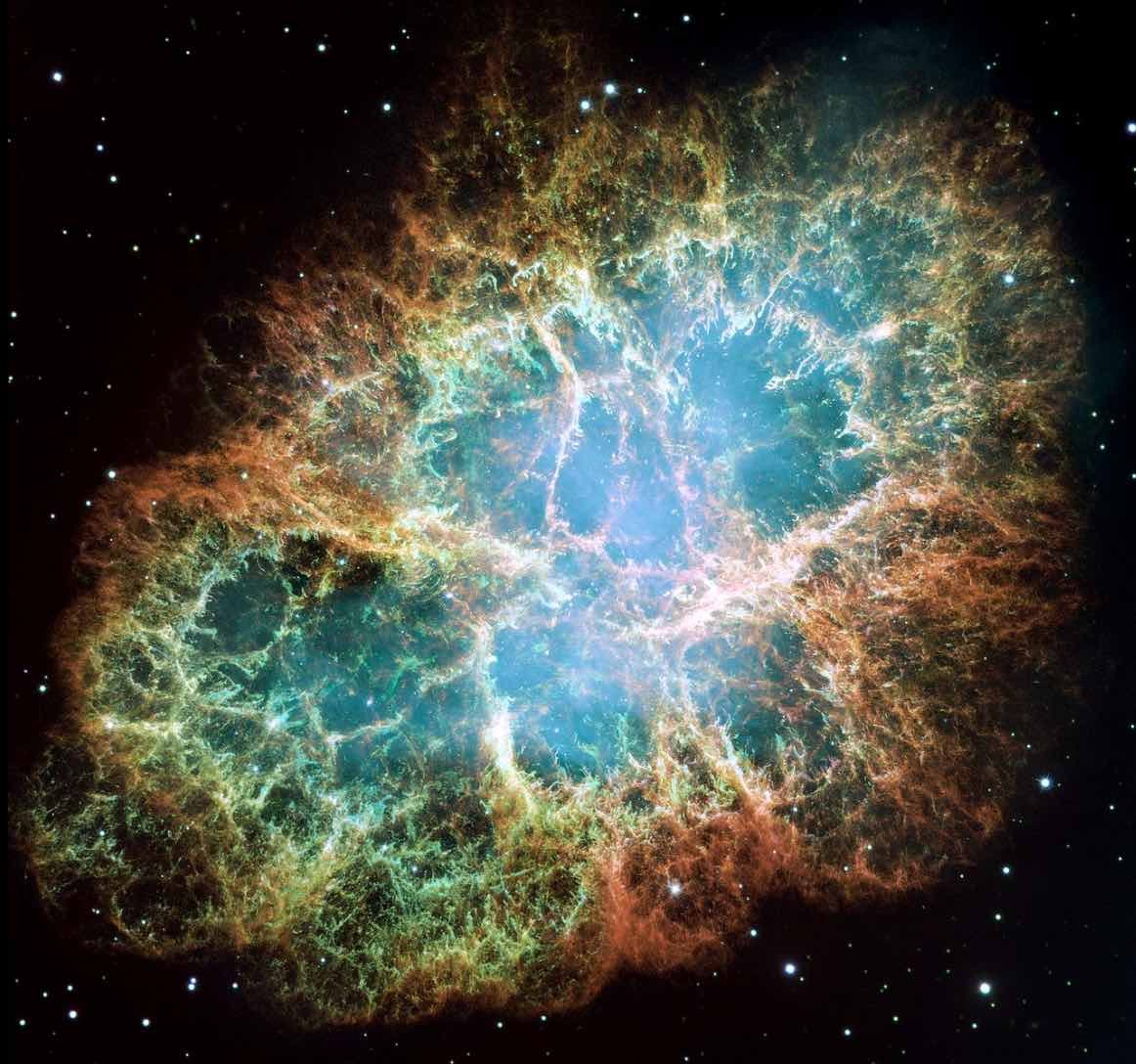
Dong says that the radio emission characteristics displayed by VT 1137-0337 resemble those of known pulsar wind nebula, the most famous of which is the Crab Nebula, located in the constellation Taurus. However, what set VT 1137-0337 apart from other nebulae like it was the amount of energy it produced: close to 10,000 times more than the Crab Nebula.
The Crab Nebula, as seen by NASA’s Hubble Space Telescope
(Public Domain).
“VT 1137-0337 one is 10,000x the luminosity of the Crab Nebula,” Dong says, “mostly because the neutron star is young and hasn’t had a chance to slow down. It is also five to 500 times more strongly magnetized than the Crab Pulsar, which contributes to the energy.”
Dong says that astronomers currently think that most neutron stars have their genesis from within supernovae, which as he words it, “carve-out” a nebula that eventually emerges as gas ejected from the supernova becomes transparent.
“This one nicely fits the picture which is why we were able to identify it as a PWN,” Dong says, though noting that it “will be interesting to see if we can find examples of others that may be formed in different ways.”
However, the data Dong and Hallinan are processing could lead to more than just the discovery of transient objects like VT 1137-0337, now believed to be the most powerful PWN ever observed. In addition to being extremely dense, neutron stars are also some of the most magnetic objects in the universe (hence the name magnetar, which simply denotes a neutron star with a highly magnetic field). As highly magnetized neutron stars spin, a wind of highly charged particles is produced, which are ejected from the star at close to the speed of light.
However, even in the case of an object as powerful as VT 1137-0337, the amount of energy required to propel the particle wind outward eventually has a braking effect.
“If you leave the magnet spinning for hundreds or thousands of years, the energy it takes to launch that wind will act as an extremely strong brake and will significantly slow down the rotation” Dong explains.
“That’s the case for pretty much every neutron star we know of in the Milky Way” Dong told The Debrief, who says that “the previous youngest one is about 700 years old and has been slowing down ever since it was born.”
“In our case, we found one that’s less than 80 years old, which provides astronomers an opportunity to directly observe how particularly powerful neutron stars behave when they’re young.” Not only that, but it could also potentially shed light on another great mystery of modern astrophysics: fast radio bursts.
“Some of the leading theories for fast radio bursts claim that they are also due to young, highly magnetized neutron stars,” Dong says. “We haven’t seen any bursts yet from this source, but if we do, that would be an important piece of evidence in confirming this theory.”
Going forward, Dong says he plans to continue to watch VT 1137-0337, although he is always on the lookout for additional evidence of transient features that turn up in the VLASS imagery, and even hints at the fact that there may already have been a few others detected.
“There are many interesting transients left to publish,” Dong told The Debrief, confiding that he plans to “be spending much of the next year writing papers.”
Micah Hanks is Editor-in-Chief and Co-Founder of The Debrief. Follow his work atmicahhanks.com and on Twitter:@MicahHanks.
NASA is gearing up for a new space biology research program, which the agency says will advance its understanding of how lunar dust can affect animals and plants, along with a range of other investigations into how the lunar environment may affect organisms.
NASA announced that it has awarded nearly a dozen grants or cooperative agreements as part of its Thrive In DEep Space (TIDES) program, which aims “to enable long-duration space missions and improve life on Earth through innovative research,” the agency said in a release on Tuesday.
The focus areas of the TIDES program will study how environmental stressors imposed by spaceflight can impact organisms, along with other information aimed at helping NASA better understand how to leverage technologies in the years ahead as advances in human spaceflight carry our explorations further into deep space.
The space biology research programs include investigations into plants undertaken by University of Wisconsin, Madison scientist Simon Gilroy, Ph.D., who will look at how lunar regolith impacts the nutrition of vegetation. Aymeric Goyer, Ph.D. of Oregon State University, will also undertake a study of potato plants grown in lunar regolith.
At the intersection of plant studies and microbial organisms, Christopher Mason, Ph.D., a professor of physiology and biophysics at Weill Medical College of Cornell University, will study how microbes known as extremophiles can potentially aid plant growth in lunar soil.
A similar research effort, undertaken by University of Texas, Austin researcher Thomas Juenger, Ph.D., will look at engineering plant-microbial interactions to aid plant growth in simulated lunar soil, and Miranda Haus, Ph.D. of Michigan State University will examine root stunting in lunar highland regolith and its effect on legumes.
Additional TIDES research efforts will focus on how lunar regolith-based substrate impacts the growth of tomatoes, lettuce, and other vegetables, along with a series of experiments undertaken by Kathryn Fixen, Ph.D. with the University of Minnesota, into small-scale investigations of how lunar regolith may affect plants.
Animal research investigations are also included in the array of experiments undertaken by the TIDES program, which includes studies by Arizona State University scientist Cheryl Nickerson into the effects of lunar dust on the human intestine, as well as infectious disease risks, and investigations by NASA Ames researcher into how biological systems on the cellular level may be impacted by spaceflight and lunar regolith.
“Eleven investigators will conduct these Space Biology investigations from ten institutions in nine states,” the NASA statement reads. “Eight of these awards are to investigators new to the Space Biology Program.”
“When fully implemented, approximately $2.3 million will be awarded in fiscal years 2024-2027,” the agency said. More about NASA’s TIDES program can be found at the agency’s website.
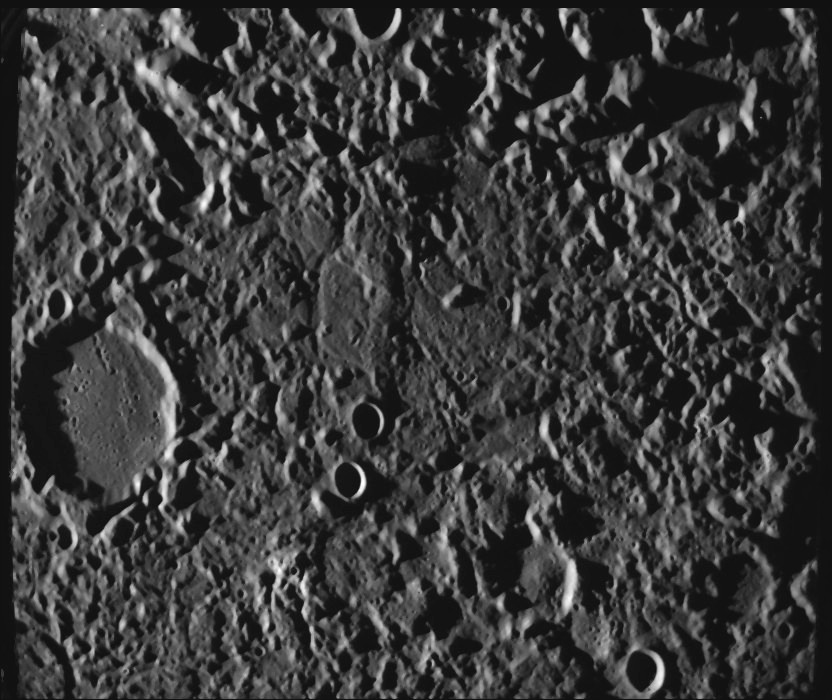
A view of Mercury’s north polar chaotic terrain (Borealis Chaos) and the Raditladi and Eminescu craters where evidence of possible glaciers has been identified (Credit: NASA)
I have lost count of how many times I have given public lectures and explained the temperature differences between Mercury and Venus. How Mercury, surprisingly isn’t the hottest planet in the Solar System and how that badge goes to Venus, thick atmosphere blah blah blah. Mercury and its complex surface geology does of course get a good chunk of time but a recent paper has rather caught my attention and turned what I thought I knew about Mercury on its head! In short, a team of scientists have announced evidence for salt glaciers on Mercury!
Planetary Science Institute (PSI) scientists; Deborah Domingue, Bryan Travis, Jeffrey S Kargel, Oleg Abramov, John Weirich, Nicholas Castle and Frank Chuang are the co-authors of a paper that made the announcement. Their discovery of Mercurian glaciers (which are made of salt rather than the glaciers composed of water ice we are familiar with on Earth) are believed to have formed under the crust in Volatile Rich Layers (VRLs). The glaciers are then exposed by asteroid impacts. Salt glaciers are a rare phenomenon on Earth but have been seen in areas like the Zagros Mountains in Iran.
The irregular dark patches are the salt glaciers. Satellite image of the Zagros Mountains in Iran (Credit : U.S. Department of the Interior, U.S. Geological Survey)
The team went on to suggest formation processes for these salt glaciers and the chaotic terrain that Mercury is well known for and at mechanisms that can explain the VRL formation? They studied the Borealis Chaos region near Mercury’s north pole, a region rich in chaotic terrain. Asteroid impacts have to all intents almost wiped out the craters in this region, many dating back to the early days of the formation of the planet. Underneath this layer lies ancient cratering that was discovered through analysis of localised gravitational fields. The placement of the two layers suggest perhaps that the VRLs may have in some way developed on top of an already solid terrain.
The chaotic terrain at the antipode of the Caloris Basin on Mercury (Credit : NASA)
Previous theories suggest the different layers formed through mantle differentiation where minerals separate out into layers but now a new theory is emerging. It seems the evidence points to some sort of global event, perhaps even from the collapse of Mercury’s fleeting hot atmosphere shortly after the formation of the planet. An alternative theory suggests that escaping volcanic gas may temporarily create pools of water or dense, highly salty steam which could have deposited salt. Significant amounts of the water would have swiftly been lost into space while some could have been trapped in minerals leaving behind a clay and salt rich layer.
The discovery of the glaciers on Mercury is in itself fascinating yet what has really captured my imagination is the impact this has on the potential for areas of habitability on Mercury – or any other planet for that matter.
On Earth, the existence of certain salt compounds in what would otherwise be inhospitable locations has given life a foot hold. We often talk of the Goldilock Zones around stars, the distance at which liquid water can exist and therefore has the potential for life. Yet the discovery of subsurface volatiles (which would ordinarily have evaporated out into space) suggests perhaps depth is also a key criteria for a hospitable environment. The surface of Mercury seems inhospitable to life but perhaps, life may get a foot hold underground. Okay this may seem far fetched but it does add an interesting dimension to the debate around a planets suitability for life.
Fast communications could speed up science on the asteroid mission.
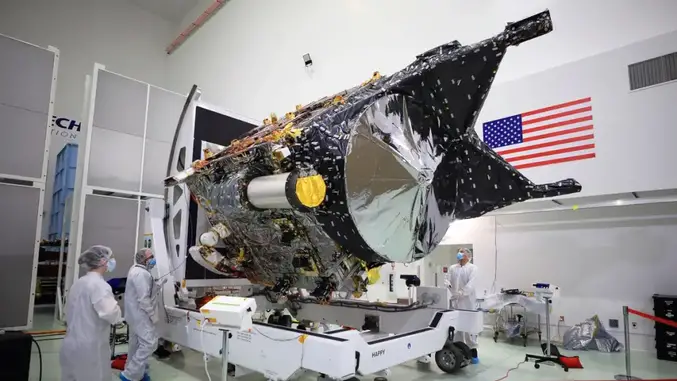
Artist's impression of the Psyche spacecraft.
(Image credit: NASA/JPL-Caltech/ASU)
A NASA laser just fired successfully in a deep-space test.
On Nov. 14, NASA picked up a laser signal fired from an instrument that launched with the Psyche spacecraft, which is currently more than 10 million miles (16 million kilometers) from Earth and heading toward a mysterious metal asteroid. (The spacecraft is at more than 40 times the average distance of Earth's moon, and still voyaging afar.)
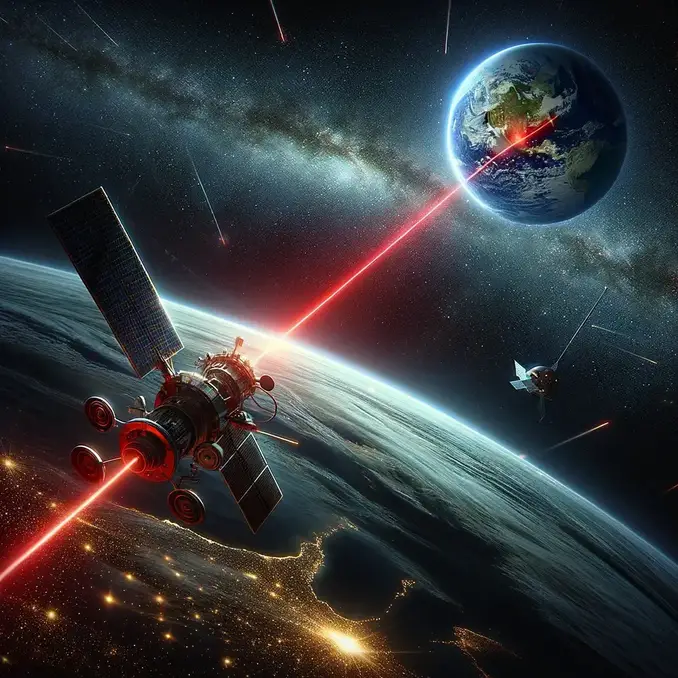
The moment marked the first successful test of NASA's Deep Space Optical Communications (DSOC) system, a next-generation comms link that sends information not by radio waves but instead by laser light. It's part of a series of tests NASA is doing to speed up communications in deep space, on different missions.
"Achieving first light is a tremendous achievement. The ground systems successfully detected the deep space laser photons from DSOC," Abi Biswas, the system's project technologist at NASA's Jet Propulsion Laboratory (JPL) in Southern California, said in an agency statement.
"And we were also able to send some data, meaning we were able to exchange 'bits of light' from and to deep space," Biswas added.
Other missions have tried out laser comms in Earth orbit or on the way to the moon and back, but DSOC gives laser communications its trickiest, most distant test yet. If it's successful, NASA officials expect that astronauts of the coming decades, bound for the moon or for Mars, may use laser light as their means of taking with ground control.
This DSOC test began in California, at JPL's Table Mountain Facility. There, in the hills outside Los Angeles, engineers switched on an uplink beacon, a near-infrared laser pointed in Psyche's direction. About 50 seconds later, a transceiver on Psyche received the laser and relayed its own laser signal back to Palomar Observatory, near San Diego.
The task requires astronomical precision, and automated guidance systems help aim Psyche's own laser. But should the test work out, the benefits are high: Because laser light has shorter wavelengths than radio waves, using optical light would allow space missions to send 10 to 100 times more information per unit time than they currently do.
The Nov. 14 test marked "first light" for DSOC, and engineers will continue to test the system as Psyche voyages to its namesake asteroid, which resides in the asteroid belt between Mars and Jupiter. Psyche should get there in 2029, then spend 29 months surveying the bizarre metallic world.
Exploring the Cosmos: NASA’s Psyche Spacecraft Pioneers Laser Communication from the Depths of Space
Exploring the Cosmos: NASA’s Psyche Spacecraft Pioneers Laser Communication from the Depths of Space
In a groundbreaking achievement that may revolutionize space exploration communication, NASA’s Psyche spacecraft, on a pioneering mission to explore the asteroid belt, has successfully sent a laser-beamed message from a staggering distance of 16 million kilometers—far beyond the Moon’s orbit. This landmark event, a testament to human ingenuity and the relentless pursuit of knowledge, marks a new era in how we reach out to the vastness of space.
The Deep Space Optical Communications Breakthrough
At the heart of this revolutionary feat is the Deep Space Optical Communications (DSOC) tool, a marvel of modern engineering. Onboard the Psyche spacecraft, DSOC accomplished what no other has done before: transmitting a near-infrared laser encoded with test data from a position about 40 times farther than the distance between the Moon and Earth. The message was successfully received by the Hale Telescope at Caltech’s Palomar Observatory in California, proving the viability of laser communication over immense cosmic distances.
The Psyche Mission: A Journey to the Unknown
Psyche, an ambitious NASA mission, is not just a spacecraft; it’s a daring voyage to a metal-rich asteroid named Psyche, nestled in the asteroid belt between Mars and Jupiter. This mission, however, is not just about reaching an asteroid; it’s a testbed for futuristic technologies that could shape the future of space exploration. The DSOC technology demonstration, riding along on this journey, is one such innovation, aiming to revolutionize how we communicate in the vastness of space.
Captured in December 2022: Psyche’s DSOC with Gold-Capped Laser Transceiver at NASA’s Astrotech Facility Image credit: NASA
Laser Communication: The Future of Deep Space Messaging
Traditional space communication has relied heavily on radio waves, which, while effective, have their limitations, especially when it comes to data transmission speed and volume. DSOC changes the game by using laser beams, tightly packed with data, to send information across the solar system. This method allows for the transmission of vast amounts of data at unprecedented speeds, a crucial feature for future deep-space missions, including potential manned voyages to Mars and beyond.
Overcoming Cosmic Challenges
However, this technological leap is not without its challenges. The further the distance, the more precision is required in pointing the laser beam. Additionally, the signal weakens over long distances, introducing communication lags. For instance, during the initial test, photons took around 50 seconds to travel from Psyche to Earth, a duration that will only increase as the spacecraft ventures further into space.
The Implications of DSOC’s Success
The successful test of DSOC’s laser communication is more than a mere technical accomplishment; it’s a beacon of possibilities. It heralds an era where high-resolution scientific data, detailed imagery, and even live video streams from distant planets could become the norm. This technology promises to enhance our understanding of the cosmos, bringing distant worlds within our digital reach.
Looking Ahead: A New Dawn in Space Exploration
As NASA’s Psyche spacecraft continues its journey, carrying with it the DSOC technology, we stand on the brink of a new age in space exploration. This is not just about the exploration of distant celestial bodies, but also about how we connect with our robotic emissaries in the void. The success of DSOC’s laser communication is a pivotal step towards a future where the mysteries of the universe are just a laser beam away. With this incredible technology, we are rewriting the rules of space exploration, bringing the cosmos closer to Earth than ever before.
Wow. JWST Just Found Methane in an Exoplanet Atmosphere
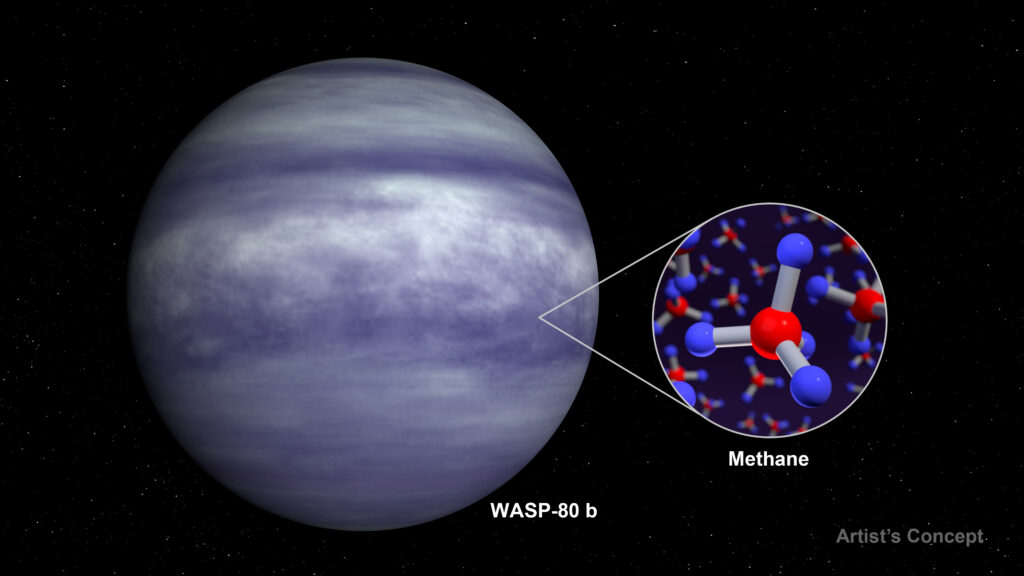
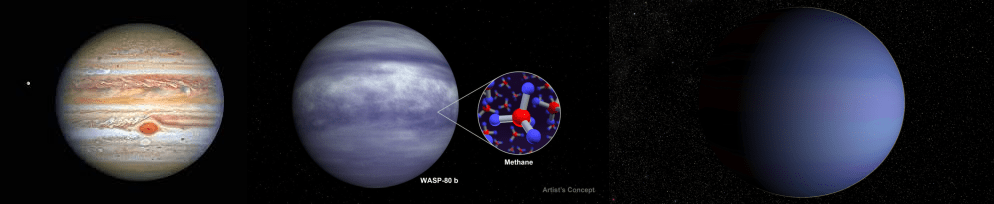
This artist’s rendering shows the warm exoplanet WASP-80 b. When viewed with human eyes, the colour may appear bluish due to the lack of high-altitude clouds and the presence of atmospheric methane identified by NASA’s James Webb Space Telescope. That makes it similar to the planets Uranus and Neptune in our own solar system. Image credit: NASA.
Wow. JWST Just Found Methane in an Exoplanet Atmosphere
If there’s one chemical that causes excitement in the search for biosignatures on other worlds, it’s methane. It’s not a slam dunk because it has both biotic and abiotic sources. But finding it in an exoplanet’s atmosphere means that planet deserves a closer look.
Methane captures scientific attention mainly because of its short duration in a planetary atmosphere. Methane can’t withstand starlight for very long, at least not in terrestrial atmospheres. It succumbs to photodissociation and needs to be replenished continually to maintain its presence in an atmosphere.
If a rocky planet has a lot of methane, then the source has to be massive, making a biotic source likely. On Earth, biological activity creates an enormous amount of methane. Metabolically, methane is not difficult to make.
Methane is common in our Solar System, though not necessarily plentiful. As far as scientists can tell, it’s all abiotic. Processes like serpentinization could explain it. Serpentinization is a natural, abiotic process involving water, carbon dioxide, and the mineral olivine. Olivine is common on Earth and is the primary component of our planet’s upper mantle. We’ve also found it on the Moon, on Mars, and on some asteroids.
Recently, the James Webb Space Telescope detected methane in the atmosphere of WASP-80b, a gas giant about half as massive as Jupiter. WASP-80b orbits a K-type main sequence star about 1.5 billion years old. WASP 80 is about 162 light-years away, and WASP-80b is the only planet detected around the star so far.
This image shows the measured transit spectrum (top) and eclipse spectrum (bottom) of WASP-80 b from the JWST’s NIRCam. In both spectra, there is clear evidence for absorption from water and methane. During a transit, the planet passes in front of the star, and in a transit spectrum, the presence of molecules makes the planet’s atmosphere block more light at certain colours, causing a deeper dimming at those wavelengths. During an eclipse, the planet passes behind the star, and in this eclipse spectrum, molecules absorb some of the planet’s emitted light at specific colours, leading to a smaller dip in brightness during the eclipse compared to a transit. Image Credit: BAERI/NASA/Taylor Bell.
Since WASP-80b is a gas giant, then life is ruled out, barring some extreme sci-fi scenarios. But the serpentinization of olivine, the most well-known abiotic source of methane, is also ruled out since WASP-80b is not a rocky planet. But finding it is still interesting. That’s partly because we can now compare the exoplanet to the methane-containing atmospheres of Uranus and Neptune in our own Solar System. That can only help us understand future methane detections better.
WASP-80b is a warm Jupiter. Its temperature is about 550 Celsius (1,025 F; 825 K.) So it’s in between hot Jupiters like HD 209458 b (the first transiting exoplanet discovered) and cold Jupiters, like our Solar System’s largest planet. Our Jupiter is about 112 Celsius (235 F; 125 K.)
Three Jupiters: Our Jupiter (L) is a cool Jupiter. WASP-80b (M) is a warm Jupiter, and HD 209458 b is a hot Jupiter. Image Credits: Jupiter: By NASA/Johns Hopkins University Applied Physics Laboratory/Southwest Research Institute. WASP-80b: NASA. HD 209458 b: By JohnVanVliet – Own work, CC BY-SA 4.0, https://commons.wikimedia.org/w/index.php?curid=87759452
The temperature is an important point. There’s a dearth of methane detections in exoplanet atmospheres, so at this stage of the game, each detection plays an important role in developing atmospheric theory and guiding follow-up research. WASP-80b’s temperature puts it in “an interesting transitional regime where equilibrium chemistry models predict that there should be detectable CH4 and CO/CO2 features in the planet’s transmission and emission spectra…” the authors of the research explain.
WASP-80b is really close to its red dwarf star and takes only three days to orbit. Because the planet is so far away and so close to its star, even the powerful JWST can’t actually see it. Instead, astronomers used the JWST to study the combined light from the star and the planet in transits and eclipses.
There haven’t been many methane detections in exoplanet atmospheres by telescopes like the Hubble and the Spitzer, which can both observe in infrared, though not like the JWST can. The lack of detections led scientists to develop theoretical explanations of how methane could be depleted in atmospheres. High metallicity, high interior heat flux, and other reasons were explored as methane depletion mechanisms.
Since the JWST has now detected methane, it raises an important question. “However, this definitive detection of methane throughout the atmosphere of WASP-80b with low-resolution, JWST spectroscopy raises the question to what extent past non-detections were affected by the sparse wavelength coverage and precision achievable with HST and Spitzer,” the authors write. So if astronomers keep detecting methane in more exoplanet atmospheres, we may have to change our thinking about methane as a biosignature.
This figure from the research shows the light curves from WASP-80b’s transit (L) and eclipse (R) observations with the JWST’s NIRCam instrument. One thing to note is that the error bars in panel c are smaller than the point size. That indicates a strong detection. Image Credit: Bell et al. 2023
“As we find methane and other gases in exoplanets, we will continue to expand our knowledge about how chemistry and physics work under conditions unlike what we have on Earth, and maybe sometime soon, in other planets that remind us of what we have here at home,” the authors wrote in a NASA blog post.
The researchers explain that finding exoplanets with methane in their atmospheres also helps us understand our own Solar System. “NASA has a history of sending spacecraft to the gas giants in our solar system to measure the amount of methane and other molecules in their atmospheres,” the authors write. “Now, by having a measurement of the same gas in an exoplanet, we can start to perform an “apples-to-apples” comparison and see if the expectations from the solar system match what we see outside of it.”
NASA’s Voyager 2 spacecraft captured these views of Uranus (on the left) and Neptune (on the right) during its flybys of the planets in the 1980s. Both planets have methane in their atmospheres which makes them appear blue. But they have different amounts. Uranus’ atmosphere contains about 2.3% methane, making it the third most common component. Neptune contains about 1.5% methane. While that may not seem like a huge difference, it could be a clue to how and where planets like these form, either in our Solar System or elsewhere. Image Credit: NASA/JPL/Caltech
The researchers also say that measuring methane alongside water helps define how and where a planet formed. “For example, by measuring the amount of methane and water in the planet, we can infer the ratio of carbon atoms to oxygen atoms,” they write. “This ratio is expected to change depending on where and when planets form in their system.” Astronomers can use this data to determine if a planet formed close to its star or formed further away and then migrated inward.
The JWST likely isn’t done with WASP-80b. This data is from the space telescope’s NIRCam instrument. Future MIRI and NIRCam observations will probe the planet at different wavelengths, which should detect other carbon molecules like carbon monoxide and carbon dioxide. “Our findings lead us to think that we will be able to observe other carbon-rich molecules, such as carbon monoxide and carbon dioxide, enabling us to paint a more comprehensive picture of the conditions in this planet’s atmosphere,” the researchers explain.
While methane catches everyone’s attention because of its link to biology, this research shows us another side to methane. It can help us understand how and where some planets formed and if they migrated. Methane detections in exoplanets will help us build a better overall understanding of exoplanet atmospheres. They can even help us understand our own Solar System, about which we still have so many questions.
The JWST is poised to play a key role in building our knowledge of methane and atmospheres.
“One thing is clear: the journey of discovery with the James Webb Space Telescope is brimming with potential surprises,” the authors say.
What’s Going on With the Mars Sample Return Mission?
Anybody with a modicum of intellectual curiosity is looking forward to the NASA/ESA Mars Sample Return Mission. NASA’s Perseverance rover is busily collecting and caching samples for eventual return to Earth. While the technical and engineering challenges in getting those samples into scientists’ hands here on Earth are formidable, budgeting and funding might be the mission’s biggest headaches.
Budgetary wrangling between NASA and Congress is nothing new. During its development, the James Webb Space Telescope faced potential cancellation as lawmakers balked at its growing expense. Even the Apollo Program had its budget cut. But this time, it’s NASA itself that is curtailing its budget. NASA announced that it’s taking the unusual step of cutting its budget for the Mars Sample Return Mission
The MSR mission has struggled with ballooning costs. While initially estimated at $4 billion US, the expected cost has inflated to nearly $11 billion US. Compare that to the Perseverance mission, which cost about $2.4 billion to build and launch. Obviously, the MSR mission is more complicated, but a $7 billion price increase can be hard to rationalize, no matter what comparison is made.
In this case, NASA has decided to take action, possibly hoping to forestall governmental interference in the mission.
“It’s very unfortunate that we have to make this decision at this point.”
Sandra Connelly, deputy associate administrator for science at NASA
“It is our responsibility to spend American taxpayer funding responsibly. Significant reductions in spending must be implemented immediately, or the program will not have sufficient funds to last through the fiscal year,” Margaret Vo Schaus, NASA’s chief financial officer, said in a statement.
The budget cuts stem from an independent review of the MSR mission. There’s nothing remarkable about it being reviewed; mission reviews are commonplace. And while a $7 billion jump from the initial $4 billion projection to $11 billion might seem shocking, it may be because the price was set too low to begin with.
“MSR was established with unrealistic budget and schedule expectations from the beginning,” the Independent Review Board (IRB) said in their report. “Technical issues, risks, and performance-to-date indicate a near zero probability of the mission launching on time,” they wrote.
“The projected overall budget for MSR in the FY24 President’s Budget Request is not adequate to accomplish the current program of record,” they stated.
The Perseverance has already collected and cached some of the sample tubes for eventual return to Earth. This photo montage shows each of the sample tubes shortly after they were deposited onto the surface by Perseverance, as viewed by the WATSON (Wide Angle Topographic Sensor for Operations and eNgineering) camera. Image Credit: NASA/JPL-Caltech/MSSS
That’s pretty damning. The report also criticizes NASA for its weak job of explaining the significance of the MSR mission. The IRB also says that NASA should reorganize the mission. “Alternate architectures should be examined under clear guidelines provided by NASA HQ for yearly budget constraints,” they write in their recommendations.
Is NASA being rash with their internal budget cutting?
Some lawmakers in California, where JPL is situated, think so. They’re decrying the cut and the effect it will have on people and the economy.
Six Californian lawmakers wrote a letter that said, “We write to express our strongest opposition to NASA’s recent unilateral and unprecedented decision to prematurely move forward with funding cuts to the Mars Sample Return (MSR) mission before Congress has finalized its Fiscal Year 2024 appropriations process.”
“This short-sighted and misguided decision by NASA will cost hundreds of jobs and a decade of lost science, and it flies in the face of congressional authority,” according to the letter. “We are mystified by NASA’s rash decision to suggest at this stage of the appropriations process that any cuts would be necessary.”
NASA’s Perseverance rover puts its robotic arm to work around a rocky outcrop called “Skinner Ridge” in Mars’ Jezero Crater. Perseverance gathered an important sample of sedimentary rock here. Credit: NASA/JPL-Caltech/ASU/MSSS
The lawmakers point out that the mission has assembled an elite team of people and that cutting the budget might drive some of them into the arms of the private sector. That would be difficult to reverse, they say.
“This talent represents a national asset that we cannot afford to lose, and if this uniquely talented workforce is lost to the private sector, it will be near impossible to reassemble,” they write.
The internal budget cut could also lead to cancelled contracts between NASA and different companies, adding to the economic fallout.
It’s also about American leadership in science, technology, and space exploration. America’s position is being challenged by China, who announced their own sample return mission to Mars named Tianwen 3 that should launch in 2028 and return samples by 2031. If China beats NASA and the ESA, that changes the space science landscape considerably.
A wireless camera took this ‘group photo’ of China’s Tianwen-1 lander and rover on Mars’ surface. China is only the third nation to execute a soft landing on Mars, after the USA and the USSR. The USSR’s space ambitions are in disarray, so they likely aren’t returning any time soon. But if China completes a Mars sample return mission before the US and the ESA, how will it change the space exploration landscape? Credit: Chinese Space Agency
“China is rapidly expanding its space program with a new space station, a goal of landing taikonauts on the moon by the end of this decade, a stated intention of being the first to return samples from Mars, and an aggressive vision for more ambitious endeavours,” the lawmakers write.
The IRB also recognizes China’s Mars ambitions and said in their report, “China is planning to return Mars samples on a similar timetable, but lack similar scientific rigour. MSR will bring back carefully selected samples that the international Mars science community has deemed are of the greatest value.”
NASA itself seems committed to leadership in space exploration, so from that perspective, the MSR budget cut appears confounding. “Interviews with NASA and ESA personnel reflected a strong commitment to a partnership of world leadership in Mars exploration and to mission success,” the IRB report says.
Politicians control the purse strings, so who knows what will come of this. If the six bi-partisan lawmakers who wrote the letter have enough influence, perhaps NASA will reverse its decision.
The committee behind the House appropriations bill that funds NASA had this to say: “The Committee supports consistent funding for the Mars Sample Return mission. The Committee directs NASA to allocate no less than $949,300,000 for this mission.” (Note that that figure is an annual figure.) “The Committee directs NASA to ensure that its fiscal year 2025 budget request includes the funding necessary to complete the mission launch no later than 2030,” the committee wrote.
So where does this leave the MSR mission?
NASA isn’t going it alone in the MSR mission. This artist’s illustration shows the ESA’s Mars Sample Return ascent module lifting off from Mars’ surface with the Martian soil samples. Image Credit: ESA
It seems like NASA is wary of the turmoil in Congress as the Republican majority struggles to work together. They get some of their funding from the Senate, which is confirmed, but the rest comes from the House, which is struggling to fund the government itself.
Sandra Connelly is the deputy associate administrator for science at NASA. She said that NASA is responding to a worst-case scenario that would see NASA only receive funding from the Senate while other funding might be stalled.
On November 13, she said, “It’s very unfortunate that we have to make this decision at this point. However, the intent is to enable sufficient funding to carry us throughout the year so we can continue working on and architecting this mission,” she said.
In a roundabout way, the letter from the six Californian lawmakers could be a shot across the bow of the House of Representatives and the dysfunction the Republicans in the House are struggling with.
In the end, it’s up to politicians to sort it out. The problem is many of the US’s politicians seem to be distracted with other issues at this point. Hopefully, they’ll sort it out before American space leadership is undermined.
De James Webb Ruimtetelescoop van de NASA, in samenwerking met andere ruimteagentschappen, heeft een fantastisch en gedetailleerd beeld vastgelegd van het centrum van ons sterrenstelsel, de Melkweg, waarbij kenmerken werden onthuld die tot nu toe onontdekt waren door astronomen.
De James Webb heeft het stervormingsgebied Sagittarius C vastgelegd, gelegen op 300 lichtjaar van het supermassieve zwarte gat in het centrum van ons sterrenstelsel en op 25.000 lichtjaar afstand van de aarde.De afbeelding onthult een cluster van jonge sterren en benadrukt een nog in vorming zijnde ster met meer dan 30 keer de massa van onze zon. De gegevens van Webb zullen astronomen helpen meer te weten te komen over stervorming in een extreem kosmische omgeving en de geschiedenis van de oorsprong van ons universum.
Last March, a mystery object was tracked by astronomers as it hurtled toward the lunar surface, which eventually crashed into the far side of the Moon along the northwestern fringe of the Mare Orientale impact basin near the massive Hertzsprung Crater.
Although the object was believed to have been identified as a defunct portion of a Chinese rocket, something about the errant spacecraft’s impact with the Moon had puzzled scientists. Unlike the normal impact features that are formed when objects collide with the lunar regolith, this one had left a curious, double crater, which was later spotted by the cameras on NASA’s Lunar Reconnaissance Orbiter (LRO) as it passed over the impact site.
The unusual double-impact craters left by the collision of a mystery object with the far side of the Moon last March (Credit: NASA/Goddard/Arizona State University).
Speculation ensued about what the object might have been that could have caused such an unusual impact feature. Now, a team of researchers at the University of Arizona says they have uncovered evidence that can definitively prove the Chinese rocket’s identity.
However, the findings, recently published in ThePlanetary Science Journal, also reveal an additional twist: that the Chinese craft had likely carried a mysterious payload with it, the identity of which remains unknown.
A MYSTERY OBJECT IS DETECTED IN SPACE
The mysterious object, designated WE0913A, was first spotted several years ago by researchers at the University of Arizona’s Catalina Sky Survey, who noticed it moving at a surprising pace as it passed between Earth and the Moon.
Although initially thought to have been a SpaceX Falcon 9 rocket booster launched in 2015, spectral analysis of light reflected off the object by the team’s Raptor Telescope helped determine that the object’s movement and appearance made a booster from China’s Chang’e 5-T1 rocket a more likely solution.
China initially disputed this, claiming that the rocket, a part of the Chinese National Space Administration’s lunar exploration program, was believed to have burned up in the Earth’s atmosphere during re-entry. However, U.S. Space Command officials confirmed that the Chinese rocket’s third stage was never detected impacting Earth’s atmosphere.
The rogue booster, which had been the rocket’s third and uppermost stage that provided thrust to carry the experimental Chang’e 5-T1 to its eventual orbit around the Moon, was left behind after it jettisoned the mission’s orbiting module and sample return capsule.
That is until light reflecting off the rotating rocket booster was eventually spotted by astronomers at the University of Arizona.
SHEDDING LIGHT ON THE MYSTERY
Vishnu Reddy, a professor of planetary science at the University of Arizona’s Lunar and Planetary Laboratory, said that the team was able to observe variations in the light being reflected off the rocket that helped them narrow down the object’s likely identity.
“When the broad side of the rocket is pointed at you, you get more light, and as it turns, you get less light from that side,” Reddy, one of the co-authors of the new paper, said in a statement.
Tanner Campbell, a doctoral student under Reddy at the University of Arizona’s Department of Aerospace and Mechanical Engineering and the first author of the new study, said the team was able to make comparisons between light curve data made during observations of WE0913A and computer simulations that accounted for thousands of hypothetical space objects, which allowed them to identify key features of the object that were able to help reveal its identity.
Co-authors Grace Halferty, Vishnu Reddy, Adam Battle and Tanner Campbell, whose new paper appeared in The Planetary Science Journal, appear before the RAPTORS-1 telescope they used for the spectral observations of the errant rocket booster
(Credit: Vishnu Reddy/University of Arizona).
“Something that’s been in space as long as this is subjected to forces from the Earth’s and the moon’s gravity and the light from the sun,” Campbell said. However, unlike a typical empty rocket booster fitted with an engine on one side, the Arizona team noticed WE0913A had been moving very strangely.
“You would expect it to wobble a little bit,” Campbell said. “But this was just tumbling end-over-end, in a very stable way.” The only solution would seemingly have been another object aboard the rocket booster, which would provide a counterweight to the pair of 1,200-pound engines it carried.
“We performed a torque balance analysis, which showed that this amount of weight would have moved the rocket’s center of gravity by a few inches,” Campbell said, adding that the observed movement could not be explained in the absence of an additional source of weight on board the craft.
“That’s what leads us to think that there must have been something more mounted to the front,” Campbell said.
A TALE OF TWO CRATERS
Along with their observations of the tumbling craft, the team says that additional revealing data came from the strange, double crater the craft produced as it collided with the lunar surface.
The pair of impressions, separated approximately 100 feet from one another, are unique among craters caused by collisions between manmade spacecraft and the Moon.
“This is the first time we [have seen] a double crater,” Campbell said. Past observations of craters produced by Apollo-era rockets are generally round or oval-shaped, depending on whether the impacting object had been traveling straight downward or if it approached at an angle. When Chang’e 5 T1 made impact, it came almost straight down, and although the shape of the craters it produced is consistent with this trajectory, Campbell says that something else must have been present in order to account for there being two of them.
“To get those two craters of about the same size, you need two roughly equal masses that are apart from each other,” Campbell said.
TRACKING DEFUNCT SPACE HARDWARE
Roberto Furfaro, deputy director of the University of Arizona’s Space4 Center and also one of Campbell’s co-advisers, says the team’s research underscores the need for being able to track the growing number of objects that are populating space as more nations engage in their own off-planet explorations.
“[O]nce you’re putting more and more objects on the moon, it becomes extremely important that we not only track the object, but also understand what they are going to do once they get there,” Furfaro said.
Currently, the identity of the object presumed to have created the second crater remains undetermined, and according to Campbell, we may never know what it was unless China chooses to disclose it.
“Obviously, we have no idea what it might have been,” Campbell said. “Perhaps some extra support structure, or additional instrumentation, or something else.”
“We probably won’t ever know,” he guesses.
Campbell and the team’s paper, “Physical Characterization of Moon Impactor WE0913A,” was published in The Planetary Science Journal on November 16, 2023.
Which Presidents Have Seen UFOs? Yep, It’s More Than One.
Which Presidents Have Seen UFOs? Yep, It’s More Than One.
A wild history of Oval Office obsession with the biggest conspiracy theory of the modern era.
By GARRETT M. GRAFF
Early in Ronald Reagan’s second term, he asked his Soviet counterpart a seemingly off-the-wall question. Ostensibly, he and Mikhail Gorbachev had come to Lake Geneva for an arms control summit. But on a private walk around the lake, Reagan turned to his Cold War enemy and said:
‘What would you do if the United States were suddenly attacked by someone from outer space? Would you help us?’” Gorbachev later recounted. “I said, ‘No doubt about it.’ He said, ‘We too.’ So that’s interesting.”
To the U.S. president, the question was an opportunity to recognize a shared desire to protect humanity on Earth, a species that might very well succumb to the horrors of nuclear war. But his reference to aliens as a possible shared enemy wasn’t as random as it might sound. Reagan was a lifelong fan of science fiction and he’d had an encounter with a UFO while riding in plane in the 1970s.
Reagan, it turns out, wasn’t the only president who has had a more than passing interest in the possibility of extraterrestrial life.
For the past half-century, almost every president has come to office pledging — publicly or privately — to get to the bottom of UFOs. Ever since the modern UFO age began during Harry Truman’s administration, presidents have nosed around hoping to find the truth. In 1947 and 1948, waves of “flying saucer” sightings captured the public imagination — the Pentagon feared they represented not aliens but secret Soviet spacecraft built by kidnapped Nazi rocket scientists — and as the sightings increased month and month, Truman’s own interest piqued. One afternoon in 1948, Truman summoned his military aide, Col. Robert Landry to the Oval Office and “talked about UFO reports and what might be the meaning for all these rather way-out reports of sightings, and the subject in general,” Landry recalled. “All manner of objects and things were being seen in the sky by people.”
Truman told Landry that he hadn’t given much serious thought to the reports, but was worried about the possibility of new and underestimated threats. “If there was any evidence of a strategic threat to the national security,” the president said, “the collection and evaluation of UFO data by Central Intelligence warranted more intense study and attention at the highest government level.” Moving forward, he wanted a quarterly oral report from Landry and the Air Force on whether any of the UFO sightings presented any real danger. Over the rest of Truman’s presidency, Landry regularly provided the briefings, but as he later recalled in an oral history, “Nothing of substance considered credible or threatening to the country was ever received from intelligence.” But the sightings never fully went away and solid explanations never materialized. Truman himself eavesdropped on Landry as he phone-banked Air Force officers in an unsuccessful search of answers to a wave of UFO sightings over the capital region in 1952.
The problem — and puzzle — of UFOs would continue to confound many of Truman’s successors, right up to modern times. As the 42nd president of the United States, Bill Clinton’s framed portrait hung in nearly every government office across the country — and at least one imaginary one in Hollywood: the office of FBI Assistant Director Walter Skinner, the fictional boss of special agents Fox Mulder and Dana Scully, the protagonists of The X-Files. As millions tuned in every Friday night on Fox to watch the criminal profiler Mulder and medical doctor Scully work to uncover the truth about extraterrestrials, circling ever closer to an alien invasion, Clinton’s very real administration also found itself repeatedly considering the possibility of life “out there.”
Like his Oval Office predecessors, the former Arkansas governor had expressed interest in aliens as soon as he had taken the oath of office. When Webb Hubbell, Clinton’s longtime friend, started as the associate attorney general, Clinton gave him specific marching orders: “Webb, if I put you over at Justice, I want you to find the answers to two questions for me. One, who killed JFK? And two, are there UFOs?” (“He was dead serious,” Hubbell later wrote in his memoir. “I had looked into both, but wasn’t satisfied with the answers I was getting.”)
As the years passed, Clinton’s interest in UFOs — and, specifically, the idea that the government wasn’t leveling with the American people about what it knew — never seemed far from his mind. Responding to a question from a child named Ryan during a 1995 trip to Ireland, he said, “No, as far as I know, an alien spacecraft did not crash in Roswell, New Mexico, in 1947,” and then quipped, “and Ryan, if the United States Air Force did recover alien bodies, they didn’t tell me about it, either, and I want to know.”
Yet despite such consistent presidential curiosity and interest across generations and the 80-year history of modern UFOs, only once have two UFO-spotting presidential believers run against each other — that would be Reagan and Jimmy Carter in 1980 — and only once has a president’s interest in UFOs helped to change the course of world geopolitics. Having established some unlikely common ground with Gorbachev during their lakeside stroll, Reagan was able to negotiate nuclear arms reduction treaties that significantly altered an arms race that threatened humanity.
‘It was obviously there, and obviously unidentified’
Jimmy Carter spotted his UFO while waiting for a Lions Club event to start on Jan. 6, 1969. The Lions Club was one of the most important networks of Carter’s life — he’d followed his father into the service group and risen in its ranks by 1969 to be a district governor, in charge of about 56 clubs in southwestern Georgia, a network that provided him important visibility as a rising politician and one that he’d credit later for stoking his ambition to run for governor in the first place.
That January night it was about 7:15 p.m., just after dark on what weather records would describe as a clear, cold night, and he was standing outside a little one-story restaurant in Leary, Ga., a town of less than a thousand residents, with a group of about a dozen other men waiting for their meeting to start at 7:30 when a bright approaching light attracted their attention.
One of Carter’s club colleagues pointed to the horizon, “Look, over in the west!” The men watched a bright light appear to come toward them and then move rapidly away. “It was about 30 degrees above the horizon and looked about as large as the moon. It got smaller and changed to a reddish color and then got larger again,” Carter recalled. At various times, the luminous object appeared more blue, other times more reddish. He estimated the object was perhaps 300 to 1,000 yards away, set against the star-filled night sky, and the group watched it for about 10 to 12 minutes before it seemed to move away and disappear for good. Carter had a tape recorder that night and, as he explained later, captured some of his colleagues’ memories of the incident immediately.
Some four years later, Carter, then Georgia governor and set to run for the presidency, documented his UFO sighting. Hayden Hewes, the director of the ambitiously named International UFO Bureau, had heard that Carter had seen something suspicious and sent him the group’s standard questionnaire at the state capitol in Atlanta. Carter dutifully filled out the details, noting his previous military service in the U.S. Navy and his training in nuclear physics. He was no crackpot — and it was technically a UFO, albeit he believed not likely to be an alien spacecraft. Carter speculated that the UFO “was probably an electronic occurrence of some sort,” but the governor told Atlanta Constitution reporter Howell Raines, “it was obviously there, and obviously unidentified.”
In the 1970s, many wrote off Carter’s sighting as confusion over the appearance of the particularly bright planet Venus in the night sky — a standard phenomenon that accounts for a large percentage of UFO sightings — but to more trained observers, it seemed unlikely that the Naval Academy-trained Carter, who would have known celestial navigation through and through, would be confused by a planet. The mystery persisted: What had he seen?
It wasn’t until 2016 that a researcher finally solved Carter’s sighting and proved him correct — in fact, he was only off by a few minutes and the sighting would have appeared at the almost precise location in the sky he’d recorded. That year, former Air Force scientist Jere Justus read Carter’s description and knew almost instantly what the future president had seen: a high-altitude rocket-released barium cloud.
Justus had worked in the 1960s on Air Force and NASA atmospheric studies that involved releasing clouds of barium to study winds in the upper atmosphere. At twilight and just after dark, the particle clouds can give off a green or blue glow as the barium becomes electrically charged in the atmosphere. As Justus dug into the records, he found that just such an experiment had been launched from Eglin Air Force Base in Florida’s Panhandle at 6:41 p.m., with the rocket rising into the sky and releasing three different clouds of barium at various heights, through about 7:09 p.m. The clouds — rising and growing rapidly in brightness — would have been visible from Leary about 150 miles away.
“The rapid growth in apparent cloud size and brightness, followed by the subsequent diminishment in both size and brightness, could easily be interpreted by an observer as an ‘object’ first approaching and then receding,” Justus wrote.
He knew from his own experience how to someone unfamiliar with the characteristics of a barium cloud, the rocket launches could appear to be objects moving closer and further away in the dark — and could even appear as almost nearby despite being a hundred kilometers up in the sky. Justus recalled an incident from one of his own experimental launches in the early 1960s: “An Atlanta woman saw a sodium vapor trail, launched one evening from Eglin AFB, about 600 km distant. She viewed the cloud through the bare branches of a deciduous tree, then called a local Atlanta TV station to report that a “UFO had landed in a tree at the end of her street’!”
Carter, as it turns out, might be the only president to run twice against fellow UFO viewers. He was the Democratic presidential nominee against two Republican challengers — incumbent Gerald Ford in 1976 and then California Gov. Ronald Reagan in 1980 — and both men had had their own experiences with UFOs. Ford led a congressional investigation into strange sightings in his home state of Michigan in the 1960s, and Reagan had encountered a UFO while flying in a Cessna Citation near Bakersfield, Calif., in 1974.
Reagan’s pilot that night, Bill Paynter, later recounted noticing a strange object several hundred yards behind their plane. “It was a fairly steady light until it began to accelerate. Then it appeared to elongate. Then the light took off. It went up at a 45-degree angle at a high rate of speed. Everyone on the plane was surprised,” he said. “The UFO went from a normal cruise speed to a fantastic speed instantly. If you give an airplane power, it will accelerate — but not like a hot rod, and that’s what this was like.”
Reagan was wowed: “It went straight up into the heavens.”
As Carter campaigned in ’76 against Ford, he promised he would open up the nation’s UFO secrets. “One thing’s for sure, I’ll never make fun of people who say they’ve seen unidentified objects in the sky,” he pledged in his original presidential campaign. “If I become president, I’ll make every piece of information this country has about UFO sightings available to the public and the scientists.”
But, once in the Oval Office, Carter never followed up on his pledge. Whatever the government was hiding would stay hidden.
‘Here come the little green men again’
Four years later, when Reagan defeated Carter, his presidency ended up being fundamentally shaped by the intersection of UFOs and American culture. For much of his life, Reagan had been fascinated by science fiction and dramas of the skies, seeing the stories not so much as fiction but as a road map to the outer bounds of human imagination and future utopias. He loved the drama and mystery of the Kennedy-era space race, and the novels of Edgar Rice Burroughs about a Martian warlord named John Carter. His service in World War II had brought him into the motion picture unit of the Army Air Forces, and later as an actor, he’d starred in countless films focused on military operations, as well a couple of science fiction-oriented productions, including Murder in the Air, in which he played a government agent who is asked to impersonate a dead spy in order to destroy a U.S. Navy dirigible and stop a death ray.
Now, upon his election to the presidency in 1981, he had pulled together a space advisory council that included leading sci-fi writers, a team he’d kept in place even after the presidential transition was complete, and governed through anecdotes and experiences from movies. He had long loved the message of the 1951 invasion movie The Day the Earth Stood Still, that the nations of the world could set aside their difference and unite against a common foe. In the heady postwar era, he’d even joined the United World Federalists, a North Carolina-based utopian group that advocated for a single peaceful global government.
Such feelings of hope and optimism were sorely needed, as the Soviet Union appeared to be on the downslide, and fears of a nuclear war caused out of desperation persisted. Despite a hawkish first few years in office, Reagan had quickly intuited that in the nuclear age, as Armageddon loomed, the heroes were no longer the warriors — the heroes were the peacemakers. The Cold War, he realized, was like a Western — two quick-draw gunslingers facing off at high noon, but he knew that both would fall in any shoot-out. There would be no hero left standing once the ICBMs launched. Peace, instead, was the heroic option. And he wanted very much to be the hero on the global stage, just as he’d long been on screen. In 1983, influenced in part by his emotional reaction to a TV movie called The Day After that depicted the fallout of a nuclear Armageddon in graphic visuals, the president began a campaign for a new missile defense system called the Strategic Defense Initiative that was quickly nicknamed, pejoratively, “Star Wars.”
Reagan would also use the analogy about an alien attack in a speech to the United Nations, saying, “Perhaps we need some outside, universal threat to make us recognize this common bond. I occasionally think how quickly our differences worldwide would vanish if we were facing an alien threat from outside this world. And yet, I ask you, is not an alien force already among us? What could be more alien to the universal aspirations of our peoples than war and the threat of war?” (Reagan’s frequent references to the alien invasions did not sit well with all his staff. According to Reagan biographer Lou Cannon, National Security Advisor Colin Powell “would roll his eyes and say to his staff, ‘Here come the little green men again.’”)
For Reagan, that stretching of the imagination — the intersection in a thought experiment of UFOs, Hollywood, and geopolitics — was just the nudge he needed to help push the Cold War toward a conclusion and the world toward a safer path.
‘We don’t know exactly what they are’
In the years since Reagan, his successors have continued to wonder what, if anything, is up there in the sky.
Most recently, in 2021, former President Barack Obama spoke about the mystery — what the government by then called UAPs, unidentified anomalous phenomenon — telling late night host James Corden, “When I came into office, I was like ‘All right, is there the lab somewhere where we’re keeping the alien specimens and spaceship?’ And you know, they did a little bit of research and the answer was ‘no.’ But what is true — and I’m actually being serious here — is that there’s footage and records of objects in the skies that we don’t know exactly what they are. We can’t explain how they moved, their trajectory. They did not have an easily explainable pattern.”
It was a remarkable statement and one that hinted at how long-standing — and real — the mystery of UFOs was, even to commanders in chief who, presumably, would have had access to answers if there were ones.
Het vliegtuig Natilus Kona, met een gemengde vleugel en momenteel uitgebreide tests in Californië, zal een versie hebben met nul koolstofemissie dankzij een samenwerking met het bedrijf Zeroavia.
Het is gepland dat de demonstrator Kona de grootste commerciële drone ter wereld zal worden. Met een spanwijdte van 26 meter wordt verwacht dat hij al in 2024 zal vliegen.
Als op afstand bediende vrachtdrone is hij ontworpen om te opereren op landingsbanen van maximaal 800 meter lang en zal hij in staat zijn om 3,8 ton aan nuttige lading over een afstand van maximaal 1.667 km in één vlucht te vervoeren wanneer hij wordt bediend met conventionele verbrandingsmotoren.
Tweede testvlucht van Starship is een succes (al is de grootste raket ter wereld wel ontploft)
Tweede testvlucht van Starship is een succes (al is de grootste raket ter wereld wel ontploft)
Artikel van Michaël Torfs
Starship is de grootste raket ter wereld. Ze maakt deel uit van het commerciële ruimteprogramma SpaceX van de Amerikaanse ondernemer Elon Musk. De raket bestaat uit twee delen: een stuwraket, Super Heavy genaamd, en het eigenlijke ruimteschip. De volledige tweetrapsraket is zowat 120 meter hoog.
In april was al een eerste lanceerpoging gedaan. Dat was deels een succes, omdat de raket effectief kon opstijgen. Maar net op het moment dat de draagraket zich zou loskoppelen, ontplofte alles. Het doel was om dit keer beter te doen en dat is ook gelukt.
De lancering zelf verliep goed vandaag. Alle 33 motoren van Super Heavy werkten zoals gepland. Met succes ging de raket recht omhoog de ruimte in, met gejuich in het ruimtestation Starbase in Boca Chica (zuid-Texas) tot gevolg.
Ook de afsplitsing van Super Heavy lukte, al ontplofte Super Heavy kort daarna. Een ramp was dat niet, want Super Heavy zou sowieso gecontroleerd neerstorten. Belangrijker was dat Starship zelf bleef doorvliegen, en dat alle zes stuwmotoren bleven werken.
So far, so good. Maar dan gebeurde het
Alles ging goed, maar enkele minuten later raakte het contact met Starship onderbroken. Er volgde een lange radiostilte, ook op de live uitzending. Uiteindelijk bleek dat de Starship ontploft was, na een achttal minuten vlucht. Starship bevond zich toen op 148 kilometer hoogte en kliefde door de ruimte met 24.000 kilometer per uur.
De ontploffing gebeurde net voor het moment dat de motoren zouden uitvallen - Starship zou dan voldoende gelanceerd zijn om zonder stuwkracht het traject verder af te leggen. "We hebben contact verloren met de tweede trap", vertelde commentator John Insprucker op de livestream. "En we denken dat we de tweede trap (het ruimteschip Starship, red.) hebben verloren."
Het plan was om bijna volledig rond de aarde te vliegen tijdens een anderhalf uur durende vlucht. Starship had, als alles was gelukt, gecontroleerd moeten neerstorten voor de kust van Hawaï. Dat alles lukte dus niet. Maar omdat de vlucht het dit keer toch een heel stuk langer uithield dan in april, wordt het beschouwd als een volgende succesvolle stap.
Een tijdlang was het ruimteschip zelfstandig op weg door de ruimte.
Elon Musk zelf feliciteerde zijn team na de "opwindende" tweede vlucht. Hij onderstreepte dat alle 33 Raptor-motoren van Super Heavy op de afspraak waren, en dat de loskoppeling is gelukt.
"Bij een test als deze heeft succes te maken met wat je eruit leert. De test van vandaag zal ons helpen om de betrouwbaarheid van Starship te verhogen met het oog op de toekomst en de interplanetaire plannen", liet SpaceX nog weten.
Maar ook Bill Nelson, de baas van de Amerikaanse ruimtevaartorganisatie NASA, had lof in petto. Hij feliciteerde de SpaceX-ploeg voor de "vooruitgang" die vandaag is geboekt. "Ruimtevaart is een straf avontuur waarbij je de juiste instelling moet hebben - dingen gewoon doen en durven vernieuwen. Vandaag is een kans om te leren - en dan opnieuw te vliegen."
Maanprogramma
Starship moet een belangrijke rol gaan spelen in de plannen om weer mensen op de maan te krijgen. De raket brengt daarbij een maanlander in een baan om de maan, waarin astronauten dan kunnen overstappen om uiteindelijk voet op de maan te zetten.
Starship moet later, in samenwerking met de NASA, ook vracht vervoeren richting de maan. In een latere fase moet Starship ook een rol gaan spelen in het reizen naar Mars.
Starship stijgt op op de lanceerbasis Boca Chica in het zuiden van Texas.
Beste bezoeker, Heb je zelf al ooit een vreemde waarneming gedaan, laat dit dan even weten via email aan Frederick Delaere opwww.ufomeldpunt.be. Deze onderzoekers behandelen jouw melding in volledige anonimiteit en met alle respect voor jouw privacy. Ze zijn kritisch, objectief maar open minded aangelegd en zullen jou steeds een verklaring geven voor jouw waarneming! DUS AARZEL NIET, ALS JE EEN ANTWOORD OP JOUW VRAGEN WENST, CONTACTEER FREDERICK. BIJ VOORBAAT DANK...
Druk op onderstaande knop om je bestand , jouw artikel naar mij te verzenden. INDIEN HET DE MOEITE WAARD IS, PLAATS IK HET OP DE BLOG ONDER DIVERSEN MET JOUW NAAM...
Druk op onderstaande knop om een berichtje achter te laten in mijn gastenboek
Alvast bedankt voor al jouw bezoekjes en jouw reacties. Nog een prettige dag verder!!!
Over mijzelf
Ik ben Pieter, en gebruik soms ook wel de schuilnaam Peter2011.
Ik ben een man en woon in Linter (België) en mijn beroep is Ik ben op rust..
Ik ben geboren op 18/10/1950 en ben nu dus 75 jaar jong.
Mijn hobby's zijn: Ufologie en andere esoterische onderwerpen.
Op deze blog vind je onder artikels, werk van mezelf. Mijn dank gaat ook naar André, Ingrid, Oliver, Paul, Vincent, Georges Filer en MUFON voor de bijdragen voor de verschillende categorieën...
Veel leesplezier en geef je mening over deze blog.