The purpose of this blog is the creation of an open, international, independent and free forum, where every UFO-researcher can publish the results of his/her research. The languagues, used for this blog, are Dutch, English and French.You can find the articles of a collegue by selecting his category. Each author stays resposable for the continue of his articles. As blogmaster I have the right to refuse an addition or an article, when it attacks other collegues or UFO-groupes.
Druk op onderstaande knop om te reageren in mijn forum
Zoeken in blog
Deze blog is opgedragen aan mijn overleden echtgenote Lucienne.
In 2012 verloor ze haar moedige strijd tegen kanker!
In 2011 startte ik deze blog, omdat ik niet mocht stoppen met mijn UFO-onderzoek.
BEDANKT!!!
Een interessant adres?
UFO'S of UAP'S, ASTRONOMIE, RUIMTEVAART, ARCHEOLOGIE, OUDHEIDKUNDE, SF-SNUFJES EN ANDERE ESOTERISCHE WETENSCHAPPEN - DE ALLERLAATSTE NIEUWTJES
UFO's of UAP'S in België en de rest van de wereld Ontdek de Fascinerende Wereld van UFO's en UAP's: Jouw Bron voor Onthullende Informatie!
Ben jij ook gefascineerd door het onbekende? Wil je meer weten over UFO's en UAP's, niet alleen in België, maar over de hele wereld? Dan ben je op de juiste plek!
België: Het Kloppend Hart van UFO-onderzoek
In België is BUFON (Belgisch UFO-Netwerk) dé autoriteit op het gebied van UFO-onderzoek. Voor betrouwbare en objectieve informatie over deze intrigerende fenomenen, bezoek je zeker onze Facebook-pagina en deze blog. Maar dat is nog niet alles! Ontdek ook het Belgisch UFO-meldpunt en Caelestia, twee organisaties die diepgaand onderzoek verrichten, al zijn ze soms kritisch of sceptisch.
Nederland: Een Schat aan Informatie
Voor onze Nederlandse buren is er de schitterende website www.ufowijzer.nl, beheerd door Paul Harmans. Deze site biedt een schat aan informatie en artikelen die je niet wilt missen!
Internationaal: MUFON - De Wereldwijde Autoriteit
Neem ook een kijkje bij MUFON (Mutual UFO Network Inc.), een gerenommeerde Amerikaanse UFO-vereniging met afdelingen in de VS en wereldwijd. MUFON is toegewijd aan de wetenschappelijke en analytische studie van het UFO-fenomeen, en hun maandelijkse tijdschrift, The MUFON UFO-Journal, is een must-read voor elke UFO-enthousiasteling. Bezoek hun website op www.mufon.com voor meer informatie.
Samenwerking en Toekomstvisie
Sinds 1 februari 2020 is Pieter niet alleen ex-president van BUFON, maar ook de voormalige nationale directeur van MUFON in Vlaanderen en Nederland. Dit creëert een sterke samenwerking met de Franse MUFON Reseau MUFON/EUROP, wat ons in staat stelt om nog meer waardevolle inzichten te delen.
Let op: Nepprofielen en Nieuwe Groeperingen
Pas op voor een nieuwe groepering die zich ook BUFON noemt, maar geen enkele connectie heeft met onze gevestigde organisatie. Hoewel zij de naam geregistreerd hebben, kunnen ze het rijke verleden en de expertise van onze groep niet evenaren. We wensen hen veel succes, maar we blijven de autoriteit in UFO-onderzoek!
Blijf Op De Hoogte!
Wil jij de laatste nieuwtjes over UFO's, ruimtevaart, archeologie, en meer? Volg ons dan en duik samen met ons in de fascinerende wereld van het onbekende! Sluit je aan bij de gemeenschap van nieuwsgierige geesten die net als jij verlangen naar antwoorden en avonturen in de sterren!
Heb je vragen of wil je meer weten? Aarzel dan niet om contact met ons op te nemen! Samen ontrafelen we het mysterie van de lucht en daarbuiten.
18-11-2023
We’re Entering a New Age When Spacecraft Communicate With Lasers
This artist's illustration shows NASA's Psyche spacecraft approaching the asteroid of the same name. Image Credit: Maxar/ASU/P. Rubin/NASA/JPL-Caltech
We’re Entering a New Age When Spacecraft Communicate With Lasers
In October 2023, NASA launched its long-awaited on-again, off-again Psyche mission. The spacecraft is on its way to study the metal-rich asteroid 16-Psyche, an M-type asteroid that could be the remnant core of a planetesimal that suffered a collision long ago. But understanding the giant, metal-rich asteroid isn’t the Psyche mission’s only goal.
It’s also testing a new laser communication technology.
The new system is called Deep Space Optical Communications (DSOC.) DSOC uses infrared lasers to communicate between spacecraft and ground stations. In this first experiment, the Psyche spacecraft communicated with the Hale Telescope at Caltech’s Palomar Observatory in San Diego County, California. Psyche was beyond the Moon when it communicated, and the distance between the spacecraft and the Hale Telescope was nearly 16 million km (10 million miles.)
The successful test took place on November 14th, and during the test, data was transmitted and received by both the spacecraft and the ground station, a phenomenon called “closing the link.” The successful test is the DSOC’s ‘first light.’
“Achieving first light is one of many critical DSOC milestones in the coming months, paving the way toward higher-data-rate communications capable of sending scientific information, high-definition imagery, and streaming video in support of humanity’s next giant leap: sending humans to Mars,” said Trudy Kortes, director of Technology Demonstrations at NASA Headquarters in Washington.
The technology may be coming to fruition just in time. As our spacecraft instruments become more powerful and as the amount of data they send back grows, current spacecraft communication systems are struggling to keep up. High-bandwidth laser communication systems should relieve the bandwidth bottleneck that hampers existing missions.
This image shows the Psyche spacecraft in a clean room. The DSOC is the silver tube extending toward the top of the image. Image Credit: NASA.
Current spacecraft communication systems are based on state-of-the-art radio systems. But the infrared laser system at the heart of DSOC works with data transmission rates from 10 to 100 times greater than radio systems.
The benefits are obvious if the system can be perfected.
Currently, spacecraft communicate with Earth using NASA’s Deep Space Network (DSN). The DSN is made up of three facilities around the world, separated by about 120 degrees. So, no matter where a spacecraft is, it can communicate with one of the facilities. The three facilities are in California, Spain, and Australia.
The three facilities that make up the DSN. Each is separated by 120 degrees. Image: NASA/JPL
The DSN is reliable, and NASA allows other spacefaring nations to use the system. But since it’s based on radio communications, it’s becoming an outdated bottleneck.
While the DSN and other space communications systems are impressive, they’re struggling to keep up with future plans. It can take up to 20 hours to transmit a 250-megabit data payload directly to Earth. And it gets worse the further a spacecraft is from Earth.
NASA’s New Horizons mission is an instructive example. When it performed its flyby of Jupiter in 2007, it transmitted data back to Earth at about 38 kilobits per second (kbps.) That’s a little slower than old telephone dial-up modems from the past. The data rate dropped precipitously when it encountered its main objective, Pluto. The data rate plummeted to approximately 2,000 bits per second (bps) at that extreme distance. That’s like the telecommunications equivalent to Morse code.
To reach those speeds, New Horizons had to use both its antennae and transmit to NASA’s largest receiving dish here on Earth. It reached Pluto in July 2015, but it took until 2016 to transmit all of the data from the historic encounter. Imagine being a member of the New Horizons team waiting for critical, career-defining data.
“More data means more discoveries.”
Dr. Jason Mitchell, Director, Advanced Communications and Navigation Technologies Division, NASA’s Space Communications and Navigation (SCaN) program
This image shows the Psyche spacecraft in a clean room. The DSOC is the silver tube extending toward the top of the image.
Image Credit: NASA.
DSOC’s infrared laser system will be a huge improvement. It’s similar to radio communications but uses tighter waves. This allows ground stations to receive more data, which is a critical problem with our rapidly-improving spacecraft. The DSOC on Psyche has only a 22 cm antennae, while the ground transmit antenna is 1 meter and the ground receiving antenna is 5 meters. At a distance of 0.4 AU, the uplink speed should reach 292 kbit/s, and the downlink speed should reach 100 Mbit/s.
DSOC does suffer from some drawbacks, though. For instance, downlink speeds are slower in the daytime.
Spacecraft instruments, and especially cameras, are generating more and more data. These speeds, and hopefully higher speeds in future DSOC systems, should be able to keep pace.
This graph shows the expected data rates required for future deep space missions. Image Credit: By JPL, NASA – JPL, NASA, Public Domain, https://commons.wikimedia.org/w/index.php?curid=64264594
“Optical communication is a boon for scientists and researchers who always want more from their space missions, and will enable human exploration of deep space,” said Dr. Jason Mitchell, director of the Advanced Communications and Navigation Technologies Division within NASA’s Space Communications and Navigation (SCaN) program. “More data means more discoveries.”
This isn’t NASA’s first foray into DSOC. They’ve been working on it for years, and they’ve demonstrated it in Near-Earth Orbit and out as far as the Moon. But November’s test was the first deep space test. While DSOC promises faster communication, it requires extremely precise pointing, and the precision required increases with distance. The system works by transmitting a laser beacon from Earth to the spacecraft. That helps stabilize the line-of-sight between the two and helps Psyche aim its downlink laser accurately. Further tests at greater distances are the next step.
“We were able to exchange ‘bits of light’ from and to deep space.”
Abi Biswas, Project Technologist for DSOC at NASA’s Jet Propulsion Laboratory.
There’s also the latency problem. From the Moon, it takes about 2.5 seconds for a signal to reach Earth. In this test, Psyche was well beyond the Moon, and the signal took about 50 seconds to reach Earth. But while it’s at the asteroid, a signal from the Psyche spacecraft will need up to 20 minutes to reach Earth. That latency problem doesn’t go away just because the system is based on a near-infrared laser. Infrared light moves at the same speed as radio waves.
But even though there are future challenges yet to be overcome, the test was successful, and that’s the only result NASA can hope for.
“Achieving first light is a tremendous achievement. The ground systems successfully detected the deep space laser photons from DSOC’s flight transceiver aboard Psyche,” said Abi Biswas, project technologist for DSOC at JPL. “And we were also able to send some data, meaning we were able to exchange ‘bits of light’ from and to deep space.”
This view of NASA’s Ingenuity Mars Helicopter was generated using data collected by the Mastcam-Z instrument aboard the agency’s Perseverance Mars rover on Aug. 2, 2023, one day before the rotorcraft’s 54th flight. Imagine what it would be like to watch a video of the little helicopter. Credit: NASA/JPL-Caltech/ASU/MSSS
The future of space exploration is going to be more and more data-dependent. Imagine real-time (with a signal delay, of course) video from the surface of Mars, taken by high-resolution cameras on rovers. Imagine astronauts on the surface of Mars with real-time, Mars-hardened versions of Go-Pro cameras on their helmets. Imagine subscribing to the personal YouTube channel of a Mars astronaut.
Naturally, some people won’t believe what they’re seeing. But for those of us who follow along as space technology develops year by year, it will be another crowning moment.
I discovered a a Dyson Sphere in Google Sky map, Nov 2023, UFO Sighting News.
I discovered a a Dyson Sphere in Google Sky map, Nov 2023, UFO Sighting News.
Date of discovery: Nov 17, 2023
Location of discovery: Space Source coordinates: 5h08m06.84s 24°16'13.71"
I think I found a mega structure around a star on Google Sky Map. It's a Dyson sphere an alien built megastructure that encompasses a star and captures a large percentage of its solar power output. I have seen hundreds of stars, but never one like this. It's not a glitch, it's something much more significant. Imagine if you will, a structure built around a sun, and the sun is already 1000X bigger than earth, and that structure would be 5-10X that size. People would live within in and look up and see the sun, its energy controlled 100% and harnessed and used by the alien tech used to make the Dyson sphere. If you don't know what a Dyson Sphere is, just take a look at the Star Trek scene below as Captain Picard describes it to us.
NASA heeft op deze vrijdag (17) de ongelooflijke aurora borealis van Qeqertaq benadrukt als de ‘Astronomische Foto van de Dag‘. Het kleine kustdorp, met iets meer dan 100 inwoners, bevindt zich in Groenland.
Qeqertaq heeft het voorrecht om een zeer lage ‘lichtvervuiling’ te hebben, wat betekent dat, in tegenstelling tot grote steden, de schoonheid van de nachtelijke hemel niet wordt overschaduwd. Op de foto toont het noorderlicht al zijn pracht en lijkt het te dansen aan de Arctische hemel – echt een hemels spektakel
De afbeelding is vastgelegd vanuit de geïsoleerde nederzettingQeqertaqdoorDennis Lehtonen. Hierop is een eenzame ijsberg te zien die door de ijzige zee drijft, verlicht door de lichten van de kust en een magische scène creëert.
Het noorderlicht is een natuurlijk lichtverschijnsel dat optreedt in de poolgebieden van de aarde en wordt veroorzaakt door de interactie tussen geladen deeltjes van de zonnewind en de gassen in de aardse atmosfeer.
Virgin Galactic Flies Science Experiments to the Edge of Space
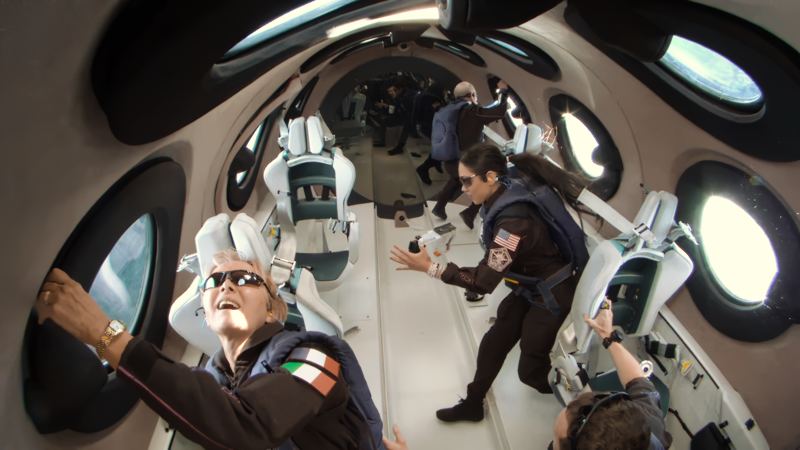
On November 2, Virgin Galactic flew Unity 2 on the Galactic 05 mission. It carried two scientists, a private tourist, and an astronaut trainer on a sub-orbital trip flown by Pilots Mike Masucci and Kelly Latimer. It was the company’s sixth successful flight in six months and the last for 2023.
The scientists aboard were Dr. Alan Stern of Southwest Research Institute (SWRI), joined by Kellie Gerardi, who was sponsored by the International Institute for Astronautical Sciences (IIAS) in Canada. Stern is also the principal investigator of the New Horizons mission to Pluto and the Kuiper Belt and is vice president at SWRI. He’s a long-time planetary scientist who has served on a number of missions. Stern has conducted suborbital research aboard NASA sounding rockets. He is the former board chair of the Commercial Space Flight Federation and a current member of the National Science Board.
Kelli Gerardi is active in aerospace, and bioastronautics and served as a payload specialist for this mission. She leads mission operations for Palantir Technologies, serves on the Defense Council for Truman National Security Project, and served on the board of directors for The Explorers Club. In addition, she is a prolific science communicator with several books and a Website to her credit. She also maintains an active social media presence.
During its almost four minutes in microgravity at apogee at 87.2 kilometers (54.2 miles) above Earth, the science team performed a series of biomedical experiments aimed at tracking human performance in space. Also included was a microgravity fluids experiment and a human-tended practice session with a mockup of a camera that will fly on future space missions.
Carrying Science to Apogee
During his brief time in microgravity, Stern used the Accutracker II heart and pulse monitor to collect physiological data on himself. “This particular version flew on the Shuttle many times,” he said. Stern and his co-investigator, Dr. Dan Durda have also flown with the harness on high-performance F-104 flights and parabolic missions aboard the so-called “Vomit Comet” aircraft. Stern described the flight on Galactic 05 as a risk-reduction mission to test the technology. “For me, this was mostly a training flight,” he said, noting that NASA will sign a contract with Virgin after 13 successful test flights like this one.
The Accutracker II harness worn by Alan Stern aboard Virgin Galactic’s 05 expedition. Courtesy Dan Durda/SWRI.
Their second experiment was a practice run learning to use a handheld Xybion wide-field visible and ultraviolet astronomical imager. “What we carried today was a mockup of the camera we’ll carry on the next flight,” he said. “It’s a training and learning experience, but this is part of the new era that it’s affordable enough that you can do that. I’m going to recommend to my colleagues in the funding agencies that they give these training flights to people.
Practicing for Future Flights
Essentially, the team has to show NASA that they can manipulate the camera in space efficiently. Stern’s aim was to learn to maneuver the camera in space. He had to stabilize it in microgravity and get the timing sequences down for a successful run with the real thing. “We now, as a result of Galactic 05 have videos of it in flight that tell us how long it took to do all the steps,” he said.
Other aspects of using the camera in space revolve around the transmissive nature of Unity’s windows on Unity. “What you don’t know is how glints affect the camera, how micro-abrasions and scratches on the windows produce flaws, what kind of exhaust film gets on them,” he said. ” “The only way to find that out is to get data through the windows in flight, to get data from three different windows, three geometries, and then compare it to Shuttle data that we have.”
Alan Stern practicing with a mockup of an astronomical camera his team hopes to fly aboard Virgin Galactic. Courtesy Virgin Galactic.
More Biomedical Studies at Apogee
Kellie Gerardi’s experiments collected biomedical and fluid behavior data during the Unity 2 flight. Her sponsor developed all three through a series of reduced gravity flights prior to the mission. The first examined questions about how confined fluids behave in low-gravity environments. That has implications for everything from spacecraft life support systems to administering medications in space through special syringes.
In her second experiment, Gerardi gathered biometric data from the Astroskin biomonitoring device built into a “smart shirt”. It provided ECG data as well as heart rate, breathing rate, and air volume. It also measured skin temperature during flight. Unity 2’s flight was the first time it collected data through all phases of a mission. Interestingly, hospitals, first responders, and others here on Earth also use this Astroskin.
Kellie Gerardi tested a biomedical Astroskin suit, a blood glucose monitor, and tended a fluids experiment. She also made time to simply gaze at the view out the portholes during flight. Courtesy Virgin Galactic.
The third experiment measured blood glucose changes during flight. Changes in blood sugar are a well-known aspect of long-duration flight aboard the Shuttle and International Space Station. This is because prolonged periods of weightlessness induced a sort of “pre-diabetes” condition in astronauts. This sort of insulin resistance affects the way the muscles and liver absorb glucose and regulate blood sugar levels. The aim of Gerardi’s experiment was to see if that was affected during launch, apogee, and return to Earth.
Science at Suborbital Heights
After landing, both scientists talked about their experiences and the experiments they conducted. For Stern and SWRI, the mission was critical and went beyond just the two experiments he conducted. “When we set the objectives for this flight for Southwest Research, we had 8 objectives. Some were what we call minimum mission success and then accomplishing what we call slow mission success,” he said. “We got everything we wanted. All eight objectives were fully accomplished.”
Just after landing, Kellie Gerardi (left), Alan Stern (center), and space tourist Kettie Maisonrouge (right), talked about their experience during the Virgin Galactic flight. Image credit: Carolyn Collins Petersen
For Gerardi, her Institute’s tests were critical confirmation of prior work. “The Astroskin unit I was wearing is the identical unit that is flown currently on the International Space Station,” said Gerardi. She noted that there was a significant difference between its use there and on her Virgin Galactic flight. “I was able to wear it during the launch, reentry, and landing portions of the flight. Normally astronauts put it on once they’re already in a microgravity environment,” she said. “So, it’s measuring pretty much all of the things you would expect. It’s like free vector cardiography (VCG is a method of getting 2D images of cardiac electrical activity). It’s got pulse oximetry and a number of different sensor data.”
Her third experiment focused on continuous blood glucose monitoring during flight. This test is in response to evidence that long-duration space missions produce insulin resistance in astronauts. The data from the monitor she wore adds new data to studies of this condition in space flyers. It should help answer questions about how quickly that resistance resolves after flight.
Gerardi was particularly excited about the fluids payload, and its operation in microgravity. “One of the experiments we flew had Shuttle heritage. It was bolted down on the Shuttle and the G jitter really disrupted the data,” she said. The Unity 2 flight was a good chance to see how the fluids in the experiment would behave. “What we saw was extraordinary. We exceeded anything that we have seen in parabolic flight here on Earth…we were collecting the highest-quality data and watching some really novel behavior from the fluid cell and being able to react to that in real-time.”
Why Do Suborbital Science?
A question that keeps coming up is, “Why do suborbital flights? Why not just go to the International Space Station?” It’s not like suborbital science is new. Scientists have been doing suborbital science for years—using sounding rockets and high-altitude balloons. Those continue today. So, going to suborbital heights is not a new idea. Going to orbit, on the other hand, adds several challenges. One is accessibility. The ISS is a limited commodity. To get an experiment on it takes years of planning and waiting for a launch window. Getting onto a suborbital flight still has some lead time, but as more of these missions happen, the accessibility increases.
A NASA Black Brant IX sounding rocket soars skyward into an aurora over Alaska during the launch on 5:13 a.m. EST, Feb. 22, 2017. Credit: NASA/Terry Zaperach
Suborbital Is Economical
Another challenge is cost. Cost figures vary across launch platforms, but, for example, a seat on Axiom can cost in the range of $70 million. Going up on suborbital flights to microgravity to do short-term experiments (or even a tourist ride) is much more accessible and much less expensive, Stern pointed out. “The new commercial vehicles, such as the Virgin rocket ship that we just flew on, fly at ten times lower costs and they fly presently about ten times more often, and soon hundreds of times, and then soon many hundreds of times more frequently,” he said. “So, it’s opening up access in a way that we never could afford to do, or had the capacity to do all the way back to the 1950s, when rocket-borne research was really getting underway.”
Virgin Galactic’s VSS Unity conducted her second powered test flight on Tuesday, May 29th. With six flights under their belts, the VG crews are planning for more in 2024. Credit: Virgin Galactic
At the current time a tourist seat on Virgin Galactic’s Unity 2 cost around half a million dollars. (Those prices may well rise to ~$1 million, according to recent announcements from the company.) Science teams can expect to pay around $650,000 for a seat and equipment to get four minutes of microgravity in suborbital space. By comparison, someone flying a hyperbolic “vomit comet” type flight pays around $10,000 for an experience in a lunar-gravity (1/6 G) environment. An uncrewed suborbital rocket costs around $3 to $5 million (at the low end).
Training Scientists in Suborbital Space
Suborbital flight puts scientists back in control of experiments to be done in space. “You know, volcanologists go to volcanoes, astronomers go to observatories, oceanographers go into the ocean space, but space scientists have been going to control rooms,” Stern said. “And that’s not the best way to do your experiment because automating things is expensive and it’s error-prone, with lots of failure modes.” Gerardi agreed and pointed out that the research she did onboard allowed her to do things in microgravity that couldn’t be done on the ground.
Putting people into space, even for short periods of time in microgravity, is changing the face of space flight, according to both Unity 2 astronauts. “It’s going to be really transformative all the way across the 21st century and probably forever,” said Stern, also pointing out that his flight put Southwest Research Institute (where he is a vice-president), in a very competitive place for continuing human spaceflight for suborbital science. For IIAS, it’s a chance to enhance its robust educational programs that train future astronauts and explorers. “It’s a new era of access to space,” she emphasized, “for scientists and for civilians.”
The Galactic 05 expedition was the last Unity flight of the year. The next Unity 2 mission is planned for January 2024 and the company will then begin phasing out those flights by mid-year. The company is already working on the Delta suborbital craft to replace it and plans to open a new spacecraft plant in Phoenix next year. Virgin has announced layoffs as part of a process of streamlining the non-Delta workforce. The first Delta craft may launch as soon as 2026, and the company expects to serve both tourist and science research passengers.
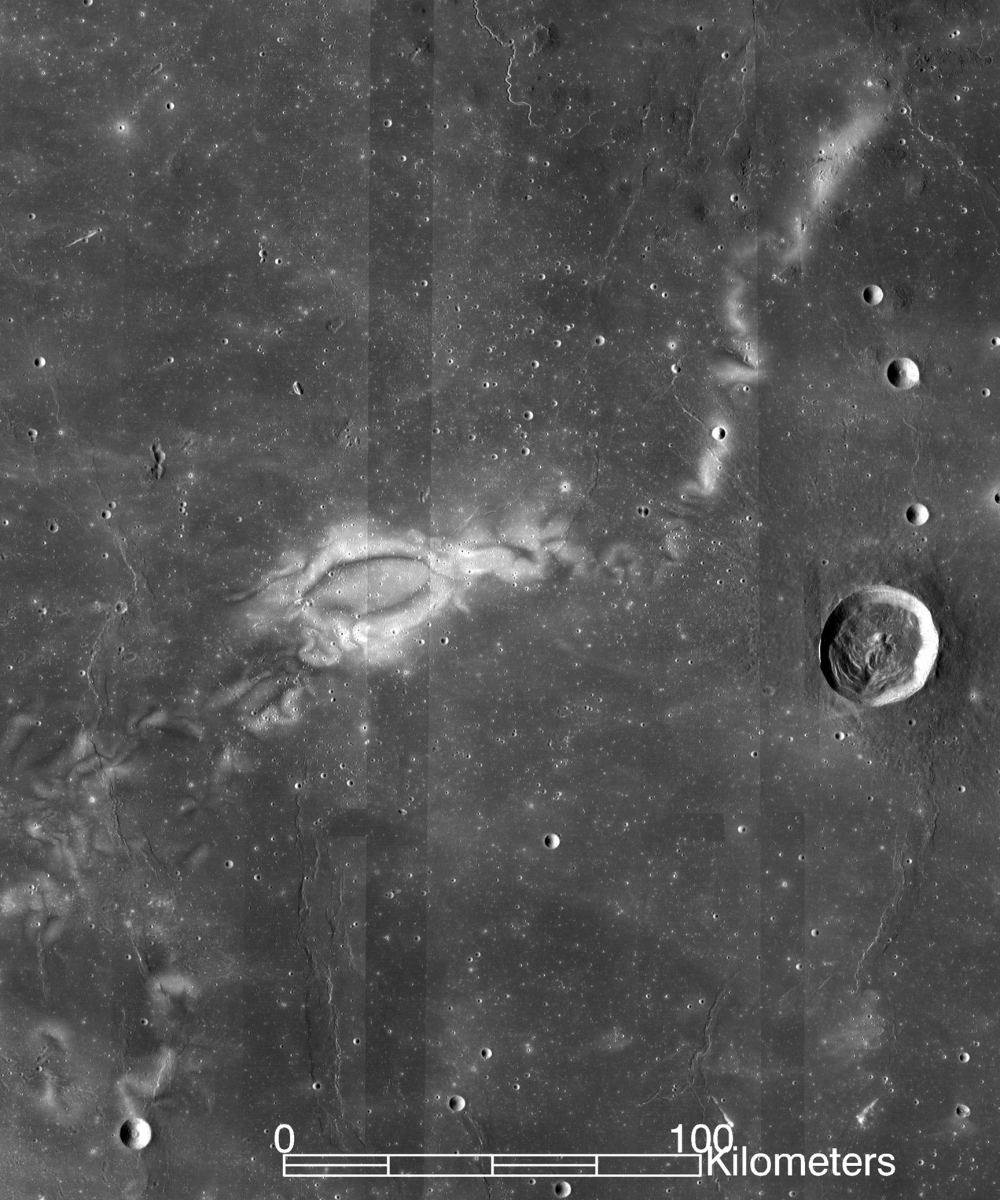
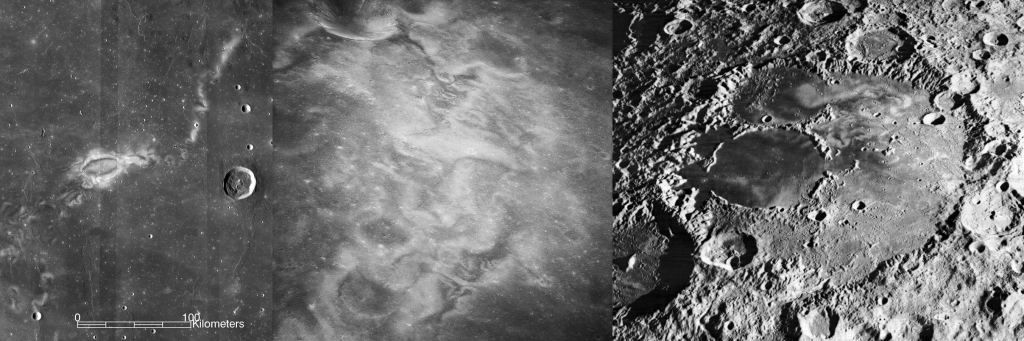
For years, people noticed strange features on the Moon dubbed “Lunar Swirls.” They’re bright regions that appear to be concentrations of lighter-colored material on the surface. It turns out that interactions between the solar wind and magnetic regions on the Moon may play a role at two sites.
Scientists long thought that these swirls weren’t related to the surrounding topography, but it turns out there’s some kind of interaction going on between the swirl deposition and the surface. Planetary Science Institute senior scientist John Weirich led a team to study topographic data for lunar swirls at high resolution. They found a correlation between the swirl areas and lower topography in a region called the Reiner Gamma swirl.
About Swirl Regions
The Moon has a number of similar regions with high-contrast bright markings that appear to loop across the surface. Generally, they look like wide bright swirls separated by darker off-swirl lanes. The fact that they exist spurs questions about how they form and there isn’t a clear answer, yet. Once that mystery is solved, scientists will have a better understanding of how the lunar surface is affected by the solar wind, bombardment by micrometeorites, how the lunar soil “migrates”, and what other effects the local environment has on the surface.
Lunar swirls are found in several regions on the Moon. Courtesy NASA.
“Lunar swirls have piqued scientists’ interest since they were discovered, partly because the scientific community doesn’t completely understand how they formed. There are many hypotheses about their formation process. Each hypothesis has observations that support it, but there are also other observations that contradict them,” Weirich said. “Since we don’t have a full understanding of how these swirls formed, we don’t completely understand the story they can tell us about the Moon. Forming them could involve a combination of well-understood processes interacting together or a currently unknown process. Unusual objects or phenomena are sometimes the key to obtaining deeper knowledge, and for this reason, lunar swirls are very intriguing. And the fact that they look really cool.”
Studying Swirls in Higher Detail
To do their work, Weirich’s team looked at earlier research showing that bright areas are 2-3 meters lower than dark areas, particularly in the Mare Ingenii lunar swirl. “However, it is not as simple as the bright areas are uniformly lower than the dark areas. If that was the case this relationship between topography and swirl would be easy to demonstrate by comparing an elevation map to a picture of the swirl. Instead, this relationship is only seen when we compare the average height of the bright areas and the average height of the dark areas.”
Weirich studied Lunar Reconnaissance Orbiter mission images and applied a special software suite to determine the surface topography. The team also used machine-learning tools on specific images. It classified the swirls into various units: bright areas (on-swirl)and dark areas (or “off-swirl”). The studies allowed them to identify transition regions between the two units, and they labeled those “diffuse-swirl”.
The correlation between topography and swirl formation still doesn’t explain exactly why they form. But, it does give planetary scientists some new clues as they study other swirl features on the Moon. At present, there are several theories about formation, but none of them explain all of the details. One idea is that they formed as a result of cometary impacts. That explains the brightness of these features. Another theory is that the swirls form when weak magnetic fields protect lighter-colored lunar surface soil (regolith) from the solar wind. Finally, weak electric fields created by brief interactions between the magnetic anomalies and solar wind plasma could play a role. Those fields could affect electrically charged fine dust on the surface. How topography plays into any of these theories is still an unknown.
How They Did It
The specialized software the team used does stereophotoclinometry to analyze the topography of a surface. It combines stereo imaging and photoclinometry to get the surface height of a region. The swirl units of interest were defined by machine learning procedures. The team then compared that information to the SPC-derived topography. That allowed them to statistically determine if height correlations existed and what differences they showed.
The SPC methodology has been used on various surfaces, including using data from the OSIRIS-REx mission, among other missions. Planetary scientists use SPC methodologies to describe the shapes of planets, asteroids, comets, and other small bodies. Still, there’s not yet a definite explanation for these swirls. However, the combo of high-resolution imaging, machine learning, and advanced software techniques gives planetary scientists more insight into their still-mysterious origins.
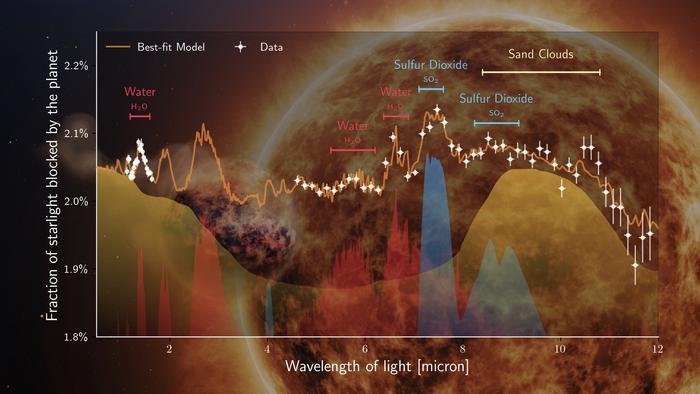
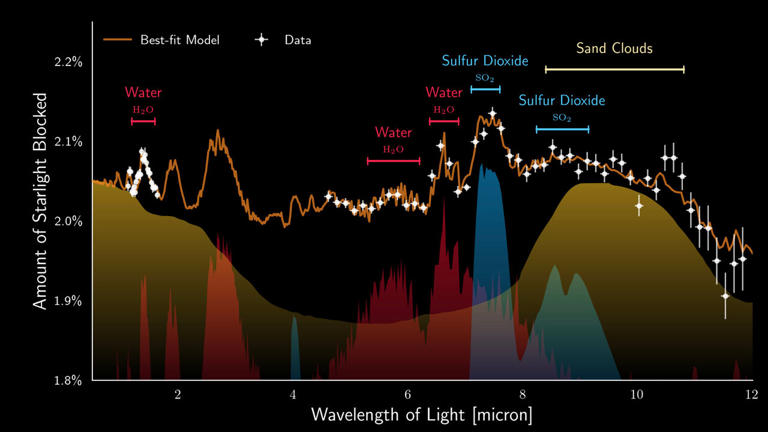
Astronomers report that the James Webb Space Telescope (JWST) recently detected water vapor, sand clouds, and sulfur dioxide in the atmosphere of the exoplanet WASP-107b, according to newly published findings.
Led by a team of European astronomers from Belgium’s KU Leuven University, the researchers pointed the JWST’s Mid-Infrared Instrument (MIRI) at the exoplanet, located roughly 211 light-years from Earth. Their discovery, now published in Nature, has revealed the presence of water vapor, sulfur dioxide, and silicate sand clouds while notably lacking methane, a common greenhouse gas
WASP-107b is a low-density exoplanet orbiting WASP-107. Discovered in 2017, the exoplanet immediately challenged our understanding of planetary development. The super-Neptune planet, meaning it’s larger than Neptune, has a surprisingly low density. This has implications for our understanding of gas giant formation and structure.
Moreover, it orbits very close to its star, with a year lasting only about 5.7 Earth days. Due to its proximity to its star, astronomers still need clarification on how the planet can retain an atmosphere, which generally would burn up due to its proximity to its star.
The recent discovery has only complicated astronomers’ understanding of this unique gas giant.
Due to its atmospheric conditions, Neptune is distinguished by its ‘fluffy’ nature. Astronomers were able to peer deep into its atmosphere. This fluffiness, combined with the precision of the JWST infrared system, has enabled a new understanding of the planet’s atmospheric composition.
The absence of methane in WASP-107b’s atmosphere is intriguing, hinting at a potentially warm interior and shedding light on the planet’s internal heat dynamics. Detecting sulfur dioxide, typically associated with the smell of burnt matches, was unexpected, as previous models had not predicted its presence.
According to the report, due to the “fluffy” atmosphere and the general cooler temperatures of the planet’s host star, photons from the star can penetrate deeper into the planet’s gaseous atmosphere, allowing for complex chemical reactions to occur. Moreover, the discovery of water vapor in the atmosphere was also surprising since it seems connected to giant clouds made of sand.
Elements like water and sulfur do not appear often in cloudless atmospheres, so the fact that they were detected indicates that WASP-107b has high-altitude clouds. The JWST was able to peer into these clouds and indicated that they were a silicate-type material, similar to sand on Earth. According to traditional models of exoplanet formation, sand clouds like this usually form much closer to the planet’s surface, where the temperature is much warmer. However, since WASP-107b’s atmospheric temperature sits at around 500 degrees Celsius, the clouds seemingly “fluff” up into the upper atmosphere due to its close proximity to a star.
The endurance of these high-altitude sand clouds is similar to Earth’s water cycle. Silicate vapors from evaporated sand droplets in hotter, deeper layers rise and then recondense into clouds at cooler, higher altitudes. This vaporization and condensation process keeps the sand clouds persisting high in the atmosphere.
“The fact that we see these sand clouds high up in the atmosphere must mean that the sand rain droplets evaporate in deeper, very hot layers and the resulting silicate vapour is efficiently moved back up, where they recondense to form silicate clouds once more,” explained lead author Dr. Michiel Min. “This is very similar to the water vapour and cloud cycle on our own Earth but with droplets made of sand.”
Professor Leen Decin of KU Leuven emphasized that JWST’s discovery is reshaping our comprehension of planetary formation and evolution, offering new perspectives on the Solar System itself. Moreover, the study demonstrates how JWST can characterize exoplanets without counterparts in our own Solar System.
WASP-107b, with all its fluffiness, points astronomers to a whole new host of possible planetary incarnations that have yet to be discovered. While this exoplanet is undoubtedly inhospitable to life, at least as we know it, it allows us to imagine strange new worlds that do not fit the mold of planetary evolution.
ESA’s Trace Gas Orbiter Observes Green Atmospheric Nightglow on Mars
ESA’s Trace Gas Orbiter Observes Green Atmospheric Nightglow on Mars
The atmospheric nightglow is observed on Earth. On Mars, it was something expected, yet never observed in visible light until now.
This image shows an artist’s impression of what nightglow might look like to an astronaut in the polar winter regions of Mars at night.
Image credit: NASA / JPL-Caltech /Cornell University / Arizona State University / E.W. Knutsen.
Airglow occurs when two oxygen atoms combine to form an oxygen molecule, about 50 km above the planetary surface.
The oxygen atoms form on Mars’s dayside when sunlight gives energy to carbon dioxide molecules, making them split apart.
When the oxygen atoms migrate to the night side and stop being excited by the Sun, they regroup and emit light at lower altitudes.
“This emission is due to the recombination of oxygen atoms created in the summer atmosphere and transported by winds to high winter latitudes, at altitudes of 40 to 60 km in the Martian atmosphere,” said Dr. Lauriane Soret, a planetary scientist at the University of Liège.
The illumination from the nightglow could be bright enough to light the way of future see the glow as bright as moonlit clouds on Earth.
“These observations are unexpected and interesting for future trips to the Red Planet,” said Dr. Jean-Claude Gérard, a planetary scientist at the University of Liège.
ESA’s Mars Express spacecraft observed the Martian nightglow in infrared wavelengths a decade ago.
ESA’s Trace Gas Orbiter followed up by detecting glowing green oxygen atoms high above the dayside of Mars in 2020 — the first time that this dayglow emission was seen around a planet other than Earth.
These atoms also travel to the nightside and then recombine at lower altitude, resulting in the visible nightglow detected by the orbiter.
Orbiting Mars at an altitude of 400 km, Trace Gas Orbiter was able to monitor the night side of Mars with the ultraviolet-visible channel of its NOMAD instrument.
The instrument covers a spectral range from near ultraviolet to red light and was oriented towards the edge of the planet to better observe the upper atmosphere.
“The nightglow serves as a tracer of atmospheric processes,” the researchers said.
“It can provide a wealth of information about the composition and dynamics of a region of the atmosphere difficult to measure, as well as the oxygen density.”
“It can also reveal how energy is deposited by both the Sun’s light and the solar wind.”
“Understanding the properties of the Martian atmosphere is not only scientifically interesting but it is also key for missions to the planet’s surface.”
“Atmospheric density, for example, directly affects the drag experienced by orbiting satellites and by the parachutes used to deliver probes to the Martian surface.”
The team’s paper was published in the journal Nature Astronomy.
JC. Gérard et al. Observation of the Mars O2 visible nightglow by the NOMAD spectrometer onboard the Trace Gas Orbiter. Nat Astron, published online November 9, 2023; doi: 10.1038/s41550-023-02104-8
Wetenschappers van KU Leuven ontdekken zandwolken op exoplaneet WASP-107b: "Wetenschappelijke mijlpaal"
Wetenschappers van KU Leuven ontdekken zandwolken op exoplaneet WASP-107b: "Wetenschappelijke mijlpaal"
Artikel van Vincent Merckx
Stel het je eens voor: in de plaats van de regenbuien die we momenteel over onze hoofden uit gegoten krijgen, valt zand uit de lucht. Dat zand wordt door luchtstromen de atmosfeer in gestuwd, bevriest daar en "regent" vervolgens weer uit. Dat hele proces herhaalt zich opnieuw en opnieuw en opnieuw.
Klinkt een beetje apocalyptisch, niet? Toch doet precies dát zich voor 200 lichtjaar hiervandaan, op de exoplaneet WASP-107b. Dat ontdekte een team van Europese astronomen, geleid door onderzoekers van het Instituut voor Sterrenkunde aan de KU Leuven. Ze publiceren hun bevindingen vandaag in het wetenschappelijke tijdschrift Nature.
Kringloop van zand
Eerst iets meer over die exoplaneet - een planeet buiten ons eigen zonnestelsel, dus. WASP-107b draait rond een ster die iets koeler is dan "onze" zon. Het is ook een erg ijle exoplaneet, een zogenoemde gasreus. WASP-107b heeft ongeveer de massa van Neptunus, maar is meer dan twintig keer groter. Doordat de atmosfeer er zo ijl is, kan je er ook makkelijk doorheen kijken.
Dat biedt een mooie kans voor onderzoekers die de verschillende lagen van die atmosfeer willen onderzoeken. Het team van astronomen, onder wie professor Leen Decin van de KU Leuven, analyseerde de atmosfeer door de golflengtes op te meten van het licht dat erdoorheen viel. De verschillende golflengtes van dat licht leerden hen op hun beurt iets over de chemische samenstelling van de atmosfeer van WASP-107b.
Zo ziet het lichtspectrum van de atmosfeer van WASP-107b eruit.
Daarbij deden ze twee opvallende ontdekkingen: zwaveldioxide (SO₂) en siliciumwolken. Die zwaveldioxide was een grote verrassing. Volgens wetenschappelijke modellen kon er immers geen zwaveldioxide aanwezig zijn.
Dat er wolken waren, was op zich niet zo nieuw. Die zijn al vaker aangetroffen op exoplaneten. Wel slaagde het team er als eerste in om de chemische samenstelling van de wolken uit te lezen. Ze bleken te bestaan uit kleine deeltjes silicium (het belangrijkste bestanddeel van zand op onze Aarde).
Dat silicium vormt op WASP-107b een kringloop zoals die van water en wolken op onze planeet, legt Michiel Min uit. Hij is astronoom aan het SRON Netherlands Institute for Space Research en werkte mee aan het onderzoek. "Het feit dat we deze zandwolken hoog in de atmosfeer zien, moet betekenen dat de zandregendruppels verdampen in diepere, zeer hete lagen van de atmosfeer en dat de resulterende siliciumdamp omhoog wordt getransporteerd, waar ze opnieuw condenseren om opnieuw siliciumwolken te vormen."
Immense spiegel
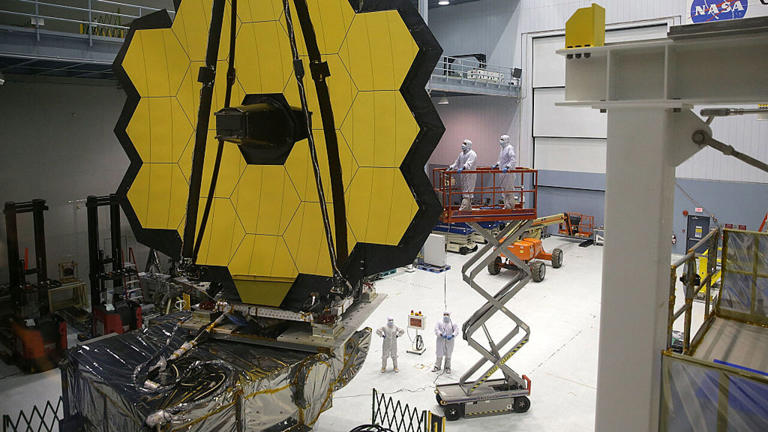
We hebben de ontdekkingen te danken aan de James Webb-ruimtetelescoop, zegt Decin van het Instituut voor Sterrenkunde, en dan in het bijzonder het instrument MIRI. Daar is twintig jaar lang aan gewerkt door een team van Europese en Amerikaanse wetenschappers. De KU Leuven leverde daar een belangrijke bijdrage aan.
De gigantische spiegel van de James Webb-telescoop kan veel zwakkere lichtsignalen opvangen.
Maar ook de immense spiegel van de James Webb-ruimtetelescoop was onmisbaar. Die heeft een diameter van zes meter. "Die spiegel zorgt dat je dingen kan waarnemen die vroeger veel te zwak waren om te zien", legt Decin uit. "Planeten zenden geen eigen licht uit, die reflecteren licht van hun moederster. Dat vraagt om krachtige instrumenten om dat zwakke signaal te kunnen waarnemen."
Gigantisch veel andere zonnestelsels
Maar waarom is die ontdekking van siliciumwolken en zwaveldioxide nu belangrijk?
Decin noemt het "een wetenschappelijke mijlpaal". "Het verandert ons begrip van de vorming en evolutie van planeten en werpt een nieuw licht op ons eigen zonnestelsel."
"Zwaveldioxide, dat kennen we op aarde bijvoorbeeld van de geur van verbrande lucifers. We begrepen niet hoe dat op een exoplaneet gevormd zou kunnen worden. Als we onze kennis enkel baseren op wat hier op aarde te zien is, dan is dat onvoldoende om te begrijpen wat er gebeurt op exoplaneten."
Dit dwingt ons om onze horizonten te verbreden, vindt Decin. "Ons zonnestelsel is maar één planetenstelsel. Daarbuiten bestaan gigantisch veel andere architecturen met compleet andere chemische samenstellingen dan wat we kennen van hier op Aarde of hier in ons eigen zonnestelsel."
Over enkele miljarden jaren zal onze Melkweg botsen en samensmelten met het Andromeda-stelsel, onze ruimtelijke buur, in een kosmische gebeurtenis die het hele zonnestelsel zou kunnen beïnvloeden.
Astronomen spreken al geruime tijd over de dreigende botsing tussen de twee stelsels, en dankzij gegevens verkregen via de Hubble-ruimtetelescoop is dit onderzoek aangevuld met een simulatie van dit belangrijke galactische evenement.
Volgens deNASAzal de botsing leiden tot een significante transformatie van beide stelsels. Wetenschappers illustreren de botsing met een analogie van honkbal, waarbij deMelkwegde slagman zou zijn en de balAndromeda, die beweegt met een snelheid van 110 kilometer per seconde.
Wanneer ze botsen, over ongeveer 4 miljard jaar, zullen de sterren binnen elk stelsel niet botsen, maar worden ze in verschillende banen rond het nieuwe galactische centrum geworpen. Zo zal bijvoorbeeld onze Zon worden weggeslingerd naar een nieuw gebied, wat invloed kan hebben op de Aarde.
De volledige samensmelting van de Melkweg met Andromeda staat gepland om twee miljard jaar na de ontmoeting van beide plaats te vinden.
NASA, ESA, CSA, STScI, T. Temim (Princeton University)
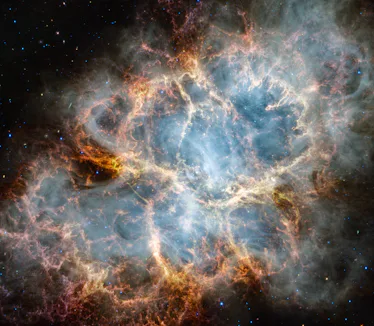
When Chinese astronomers first glimpsed the Crab Nebula in 1054 CE — they didn’t see anything like this. A new photo courtesy of the James Webb Space Telescope (JWST) captures milky strands of material, known as synchrotron radiation, as it courses throughout the body of SN 1054 — a hat tip to the supernova remnant’s original discovery.
The $10 billion telescope, filled with an array of infrared instruments, began snapping photos of the universe in unprecedented detail in the summer of last year. In that short amount of time, JWST has already delivered groundbreaking revelations about our universe, and the Crab Nebula is its latest subject in a new image published on Monday by NASA.
The Crab Nebula is located in the constellation Taurus, and in 1054 CE, its star went supernova. Amazingly, the resulting explosion caught the attention of Chinese astronomers during the Song Dynasty, some 6,500 light years away. Fast forward 1,000 years later, and the nebula is an ever-expanding remnant of that medieval explosion, but interest in the nebula has only grown as we’ve improved ways to glimpse the cataclysmic aftermath.
But unlike previous images of this iconic cosmic object, the JWST reveals the smoke-like feature flushed throughout the nebula in greater detail. These ethereal wisps come from the pulse of the Crab Nebula’s zombie heart. When certain massive stars die, they go supernova by ejecting their outermost layer, leaving behind an ultra-dense object called a neutron star.
When some neutron stars rapidly rotate, they emit what NASA describes as a “milky smoke-like material,” known as synchrotron radiation. These wind-charged particles move around magnetic field lines, and as they blow through the supernova remnant, they push the Crab Nebula’s shell of gas and dust outward.
A STELLAR DEATH
The Princeton University research team behind the latest investigation relied on JWST’s Near-Infrared Camera (NIRCam) and Mid-Infrared Instrument (MIRI) to better understand the nebula’s origins and to explore how stars die. Stars are complicated objects, and what happens when one dies can be incredibly varied. That’s why detailed imagery like this one is necessary for scientists to unpack the complicated machinations of a star’s violent ending.
A neutron star, like the one in the center of the Crab Nebula, forms when a star roughly eight to 20 times the mass of the Sun runs out of hydrogen in its core. This triggers the beginning of the end. As NASA explains, a star will then begin to fuse helium into carbon, carbon into neon, neon into oxygen, oxygen into silicon, and silicon into iron.
“By the time silicon fuses into iron, the star runs out of fuel in a matter of days. The next step would be fusing iron into some heavier element, but doing so requires energy instead of releasing it,” NASA says.
The star’s core then collapses, and when it does, there emerges a cataclysmic shock wave that ripples through the star’s outer layers as the core rebounds to its original size, which creates a supernova.
“Webb’s sensitivity and spatial resolution allow us to accurately determine the composition of the ejected material, particularly the content of iron and nickel, which may reveal what type of explosion produced the Crab Nebula,” Princeton University’s Tea Temim shared in NASA’s announcement.
According to NASA, scientists will rely on new data from another major observatory, the Hubble Space Telescope, over the next year or so. By drawing comparisons, astronomers hope to get one step closer to providing brand-new insight into this 1,000-year-old cosmic explosion.
Picture this: you are an astronomer working the night shift at the observatory, where scientists scour the heavens for celestial wonders and potential signs of intelligent life from afar. Tonight, however, rather than peering through telescopes, you have prepared for a long evening spent pouring over data sets from various projects happening around the facility.
You step over to visit the observatory’s director, your friend John Kraus, in the office beside you to see how his night is going. John is reading a new paper about telescope design, and beside him is a pile of books scattered across the floor covering radio astronomy and antenna theory.
You glance at your wristwatch, and it’s getting close to midnight.
You walk down the dark hallway to make yourself a strong cup of coffee because you know you’ll be here for the long haul. Somebody has to get through all this data; it won’t sort itself.
As you start to pour your coffee, a tiny beeping indicator echoes in the distance. You think nothing of it at first, but suddenly, it is followed by a sound that catches your attention: one indicating a radio transmission 30 times louder than ambient sound. Your cup of coffee is left steaming on the counter as you bolt back down the hall to your desk.
You can’t believe what you’re hearing and seeing. The transmission lasts for over 72 seconds. Looking over at your data chart, you then wipe your eyes to make sure what you’re seeing is right.
Could this really be what it looks like?
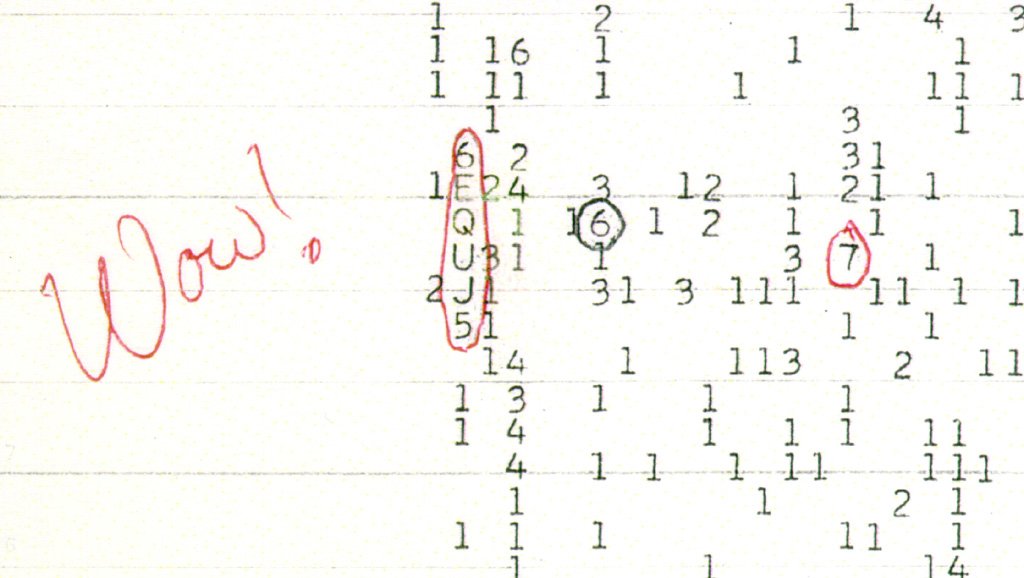
You double-check all the information on the printout in front of you and confirm the narrowband radio transmission you’re hearing is being broadcast at 1,420 megahertz. Excitedly, you circle a portion of the code, a vertical orientation of letters and numbers that reads “6EQUJ5”, and write “WOW!” in the margin: it is the precise spot where your fellow scientists have predicted that a message from an alien civilization, if one were to exist, would likely be found.
The famous “Wow! Signal” (Credit: Big Ear Radio Observatory and North American AstroPhysical Observatory).
This, or something close to it, is how the events might have unfolded for you on the night of August 15, 1977, at 11:16 p.m., if you had been working the Big Ear radio telescope at Ohio State University Radio Observatory. For it was under circumstances like these that astronomer Jerry R. Ehman discovered what has since been remembered, appropriately enough, as the WOW! Signal.
Originating from the direction of Sagittarius, the famous signal seemed to possess the characteristics scientists would expect from a genuine signal from an intelligent alien civilization. However, the actual source of the signal remains undetermined, and scientists remain divided on whether it had been something mundane or if it might have actually been an alien message.
Regardless of its source, the Wow! Signal became highly influential in terms of galvanizing the search for extraterrestrial intelligence (SETI). It inspired many to wonder what would happen if humans ever did receive a clear, unambiguous message from an extraterrestrial civilization.
Now, the idea of how and when we may receive alien messages from the stars has also served as part of the inspiration behind an innovative new SETI-themed artistic effort geared toward educating the public about some of the opportunities and challenges communication with extraterrestrials might present.
A SIGN IN SPACE
Daniela de Paulis, an interdisciplinary artist and licensed radio operator presently holding the title of Artist in Residence at both the SETI Institute and the Green Bank Observatory, has assembled a diverse team of experts from around the world that includes SETI researchers, space scientists, and artists, all collaborating on her most recent artistic venture, A Sign in Space.
Daniela de Paulis.
An innovative global theatre presentation, Paulis’s project aims to showcase how receiving, decoding, and interpreting an extraterrestrial message would work through the involvement of the worldwide SETI community. Drawing on professionals from various fields, as well as the general public, the project requires international collaboration to foster communication, including SETI space research, societies, and cultures from multiple disciplines.
“I presented this proposal to some scientists I’ve met through the SETI committee, and they reacted very positively. From a small core group of people, including myself and these scientists, we had the opportunity to talk with the European Space Agency.”
“The European Space Agency loved the proposal so much that they suggested using one of their spacecraft for this project,” adds de Paulis. The result was that on May 24, 2023, at 19:00 UTC / 12:00 pm PDT, the European Space Agency’s ExoMars Trace Gas Orbiter sent an encoded message to Earth from its position in orbit around Mars, simulating a signal from a form of extraterrestrial intelligence.
DECODING A COSMIC CRYPTOGRAM
Three prominent radio astronomy observatories situated worldwide detected this encoded message, including the SETI Institute’s Allen Telescope Array, the Robert C. Byrd Green Bank Telescope at the Green Bank Observatory, and the Medicina Radio Astronomical Station observatory managed by the Italian National Institute for Astrophysics.
The precise content of the encoded message, developed by de Paulis and her team, remained a secret until the release date, allowing the public to contribute to its decoding and interpretation in a live Discord channel open to the public 24-7.
To encourage public involvement, a live social media event was organized by the SETI Institute, featuring interviews with crucial team members that included scientists, engineers, and artists, all of whom participated from different parts of the world.
After the signal was transmitted to Earth, it was made available to the public for decoding. Meanwhile, the A Sign in Space team followed up by hosting a series of Zoom panel discussions made available to the public, which focused on topics that explore the societal implications of detecting a signal from an extraterrestrial civilization.
The message generated for A Sign in Space, which remains undeciphered (Credit: A Sign in Space).
A CODED MESSAGE, UNSOLVED
As of now, the message has still not been decoded, and de Paulis and her team are unsure if ever will ever be.
“Some of us thought, okay, this is going to take two weeks. Other people said, Oh, this is not going to be decoded ever. So we simply have no idea,” de Paulis told The Debrief.
“It could be months. It could be years.”
If it remains unsolved, de Paulis hasn’t decided when the message will be revealed. However, she admits that she has considered not sharing the decoded version at all, an outcome that could also exist in real-life scenarios if an ET civilization does contact us.
“For me and my team, it’s really important not to give any spoilers because we want to really give the sense that, if we ever received an extraterrestrial message, we would have no one to ask, for help,” de Paulis says.
No one to ask for help, of course, except for each other.
“People now understood that it might be better to work with each other because the skills of one person would add to the skills of another person. And in general, there is, I would say, more self-reflection,” adds de Paulis.
One major takeaway for de Paulis has been watching the limitations that humans place on themselves, particularly as she observes the community Discord chat trying to decode the message.
“Knowing, of course, the content of the message, it’s really interesting to see how biased the human mind can be,” de Paulis told The Debrief, “and how we very quickly narrow down the options to something that we deem safer.”
“This dynamic seems to be really recurrent,” de Paulis says.
Regardless of how or when it occurs, receiving a clear and obvious message from an extraterrestrial civilization would be a profoundly transformational experience for all humankind.
However, for de Paulis and her team, what A Sign in Space has helped reveal is that before we can understand and potentially communicate with other intelligent forms of life in the cosmos, humanity must first consider how we can improve the ways we communicate with each other.
“We know how great we are, but also there are so many limitations, like exactly communicating with each other,” de Paulis explains. “Even solving human problems that, from the external side, seem to be solvable.”
Chrissy Newton is a PR professional and founder of VOCAB Communications. She hosts the Rebelliously Curious podcast, which can be found on The Debrief’s YouTube Channel. Follow her on X: @ChrissyNewton Or chrissynewton.com.
“Monsters” lurk amidst the flickering lights from galaxy cluster MACS0416.
A new image published by NASA and the European Space Agency on Thursday shows a story from a long time ago. MACS0416 is located 4.3 billion light-years away from Earth. To reach the visible-light instrumentation onboard the Hubble Space Telescope and the infrared technology on the James Webb Space Telescope (JWST), its light made quite an odyssey. It began its journey at the tail-end of the formation of the Solar System.
Astronomers are learning more about this region, tucked away in the constellation Eridanus (the River), thanks to the two observatories. “The image reveals a wealth of details that are only possible to capture by combining the power of both space telescopes,” JWST officials wrote in a Thursday image description.
Galaxy cluster MACS0416 is seen in this composite image that uses Hubble and JWST data.
Astronomers took this latest view of MACS0416 to hunt for transient objects or things that change in brightness over time.
The galaxy cluster is packed with enough of these flickers to earn a special nickname.
“We’re calling MACS0416 the Christmas Tree Galaxy Cluster, both because it’s so colorful and because of these flickering lights we find within it,” Haojing Yan, associate professor at the University of Missouri and lead author of a paper accepted for publication in The Astrophysical Journal, said in NASA’s announcement.
The body of this imaginary tree is made of two colliding galaxy clusters that will eventually form one heftier object. The soft glow throughout the center of the image acts like a trunk of sorts. According to Hubble officials in 2018, this light comes from stars scattered throughout the hodgepodge cluster, pulled out of the galaxies they once called home.
Left: Hubble Space Telescope’s optical light observations of galaxy cluster MACS0416. Right: James Webb Space Telescope’s infrared observations of the same region.
The tree’s ornaments are varied and abundant. Thanks to a phenomenon called gravitational lensing, the light from distant galaxies gets magnified. Although they are located much farther away than MACS0416, the lensing makes their light appear and spruces up the holiday visuals.
THERE’S A “MONSTER”
One distant ornament stands out. Incredibly, it's not a galaxy but something even smaller: a clutch of stars. “Among the transients the team identified, one stood out in particular,” NASA officials wrote in their Thursday announcement.
The stars, magnified by a factor of at least 4,000, come from an ancient place in space where light is just now reaching the telescopes. These stars are from just 3 billion years after the Big Bang when the universe was about a quarter of its current age.
This archaic visual behemoth received quite a name. “The team nicknamed the star system ‘Mothra’ in a nod to its ‘monster nature,’ being both extremely bright and extremely magnified,” NASA officials wrote. They added that Mothra “joins another lensed star the researchers previously identified that they nicknamed ‘Godzilla’” because both are names of giant monsters in Japanese cinema.
This image of galaxy cluster MACS0416 highlights one particular gravitationally-lensed background galaxy, from when the universe was about a quarter of its current age. It contains a group of stars, highlighted here, whose brightness varies over time. It’s nicknamed “Mothra.”
Mothra is one of 14 transient objects across this field of view. Remarkably, two of these very highly magnified objects are supernovas, explosions of stars visible to astronomers from exceptionally distant places.
With blues indicating relatively nearby galaxies and reds showing dusty places or distant galaxies, this visual cornucopia provides plenty of science to celebrat
NASA’s Curiosity mission has just passed a special milestone. On Monday, NASA announced that Curiosity has now surpassed 4,000 sols, or days on Mars.
The small-SUV-sized rover reached the Red Planet on August 5, 2012, to explore Gale Crater for signs that past or present life could have existed on Mars. To find glimmers of this evidence, Curiosity has sojourned across a sediment-rich landscape on the alien planet with its six wheels over the last 11 years.
Curiosity is the oldest active Martian rover, taking over the title in 2019 when the 15-year-old Opportunity mission ended. NASA personnel think Curiosity still has quite a bit of life left.
“Despite having driven almost 20 miles (32 kilometers) through a punishingly cold environment bathed in dust and radiation since 2012, Curiosity remains strong,” according to a statement published Monday from NASA’s Jet Propulsion Laboratory in California, the hub for Curiosity and the fleet of NASA’s Mars explorers.
To commemorate Curiosity’s accomplishment, Inverse has compiled images that define Curiosity’s last decade.
BILLIONS OF YEARS OF HISTORY
Curiosity took the images that went to making this composite view of Mars on April 10 and 11, 2015.
On April 10 and 11, 2015 — Curiosity’s 952nd and 953rd sols on Mars — both of its Mastcam lenses worked together to create this expansive view of the alien landscape.
According to JPL’s image description, the sand ripples and gravel that appear in the middle and at the bottom of this image were the sort of terrain that Curiosity first traversed. The rover left behind its landing site to reach Mount Sharp, a 3-mile-high peak in the middle of Gale Crater.
"This may be one of the thickest exposed sections of layered sedimentary rocks in the solar system. The rock record preserved in those layers holds stories that are billions of years old — stories about whether, when, and for how long Mars might have been habitable,” Joy Crisp, Curiosity deputy project scientist at JPL, shared in a statement NASA published in 2011.
ALIEN SUNSET
Curiosity took the images for this sunset sequence on April 15, 2015.
To produce this view of a sunset on another planet, Curiosity’s team stitched together four images that Mastcam’s left eye captured over the span of 6 minutes, and 51 seconds. This sequence was captured on April 15, 2015, the mission's 956th sol.
This was the first time that the mission observed the Martian sunset in color. According to JPL officials, “Mastcam sees color very similarly to what human eyes see, although it is actually a little less sensitive to blue than people are.”
SAND DUNE SELFIE
Curiosity took 57 images on January 19, 2016, to produce this self-portrait (minus its robotic arm).
Curiosity is well-known for its selfies. The rover took this portrait from Namib Dune, located along the northwestern flank of Mount Sharp.
This image shows most, but not all, of Curiosity’s body. “The view does not include the rover's arm,” JPL officials wrote in an image description published on January 27, 2016. “The arm was positioned out of the shot in the images, or portions of images, that were used in this mosaic.”
The selfie is a mosaic of 57 images, taken on January 19, 2016 — Curiosity’s 1,228th sol — with a camera located at the end of the rover’s robotic arm called the Mars Hand Lens Imager (MAHLI).
DRILLING INTO BEDROCK
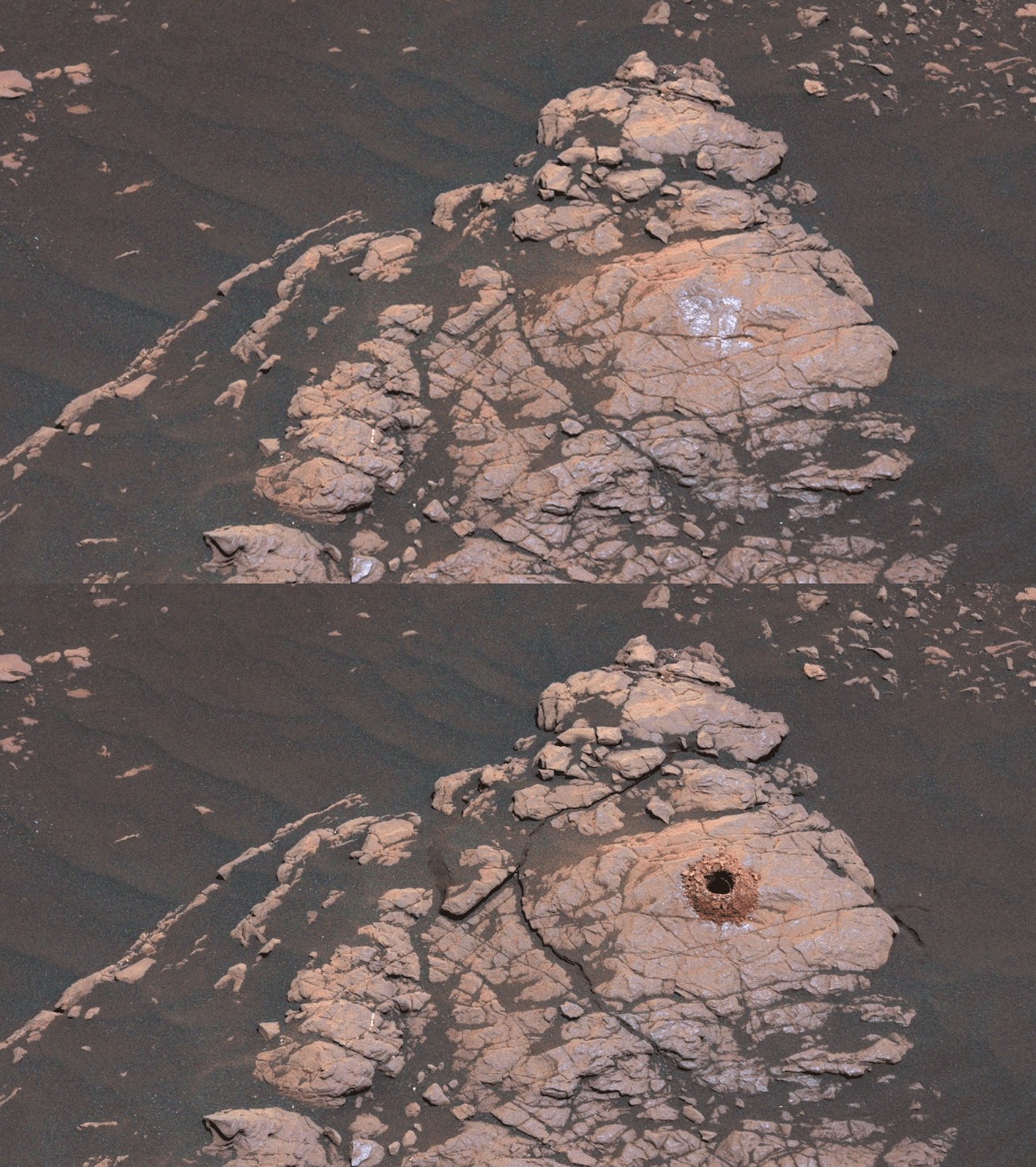
Curiosity captured the before and after of obtaining the Aberlady sample from Martian bedrock on April 6, 2019.
This Mastcam sequence shows the first time Curiosity drilled into the bedrock of a clay-bearing unit, a maneuver that the mission team had highly anticipated.
Curiosity is equipped with four spectrometers that can measure the chemical composition within rock samples. The one collected here on April 6, 2019 — the mission’s 2,370th sol — was called Aberlady.
CLOUDS OVER MOUNT SHARP
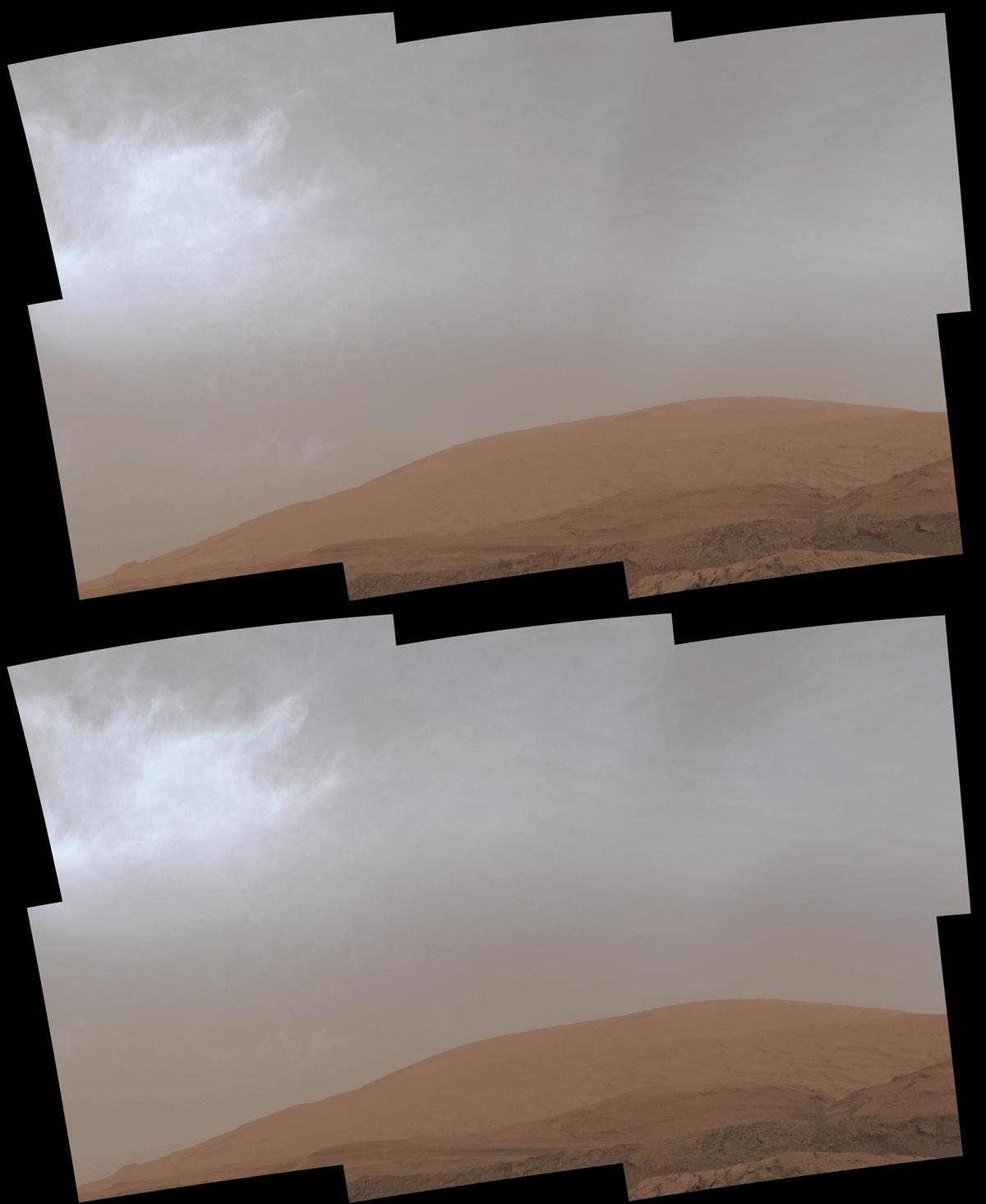
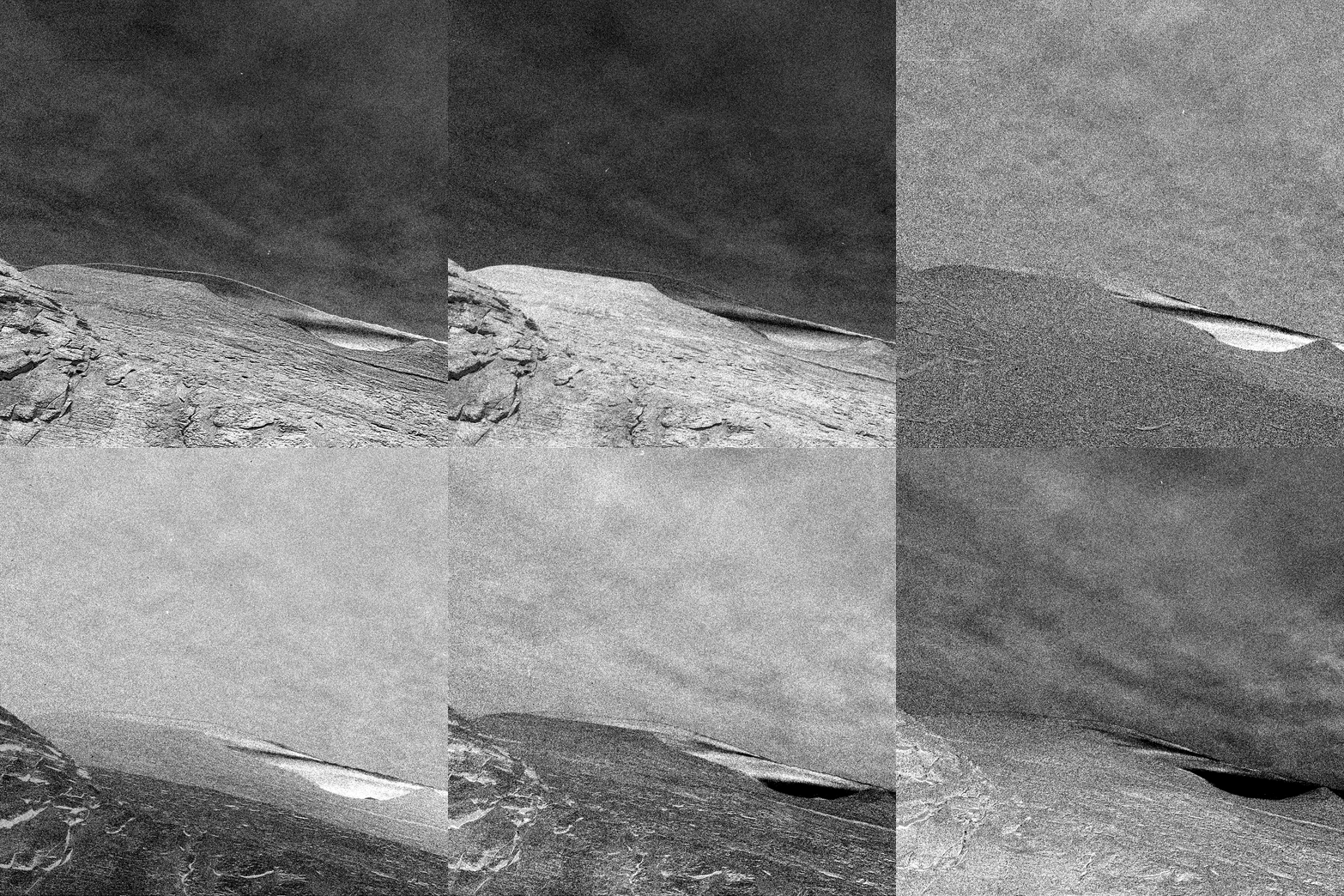
Curiosity captured images of clouds rolling over Mount Sharp on March 19, 2021.
To gather scientific data, sometimes Curiosity has to look up.
Each frame in this scene is a mosaic of six individual images. They show clouds drifting over Mount Sharp on March 19, 2021, the 3,063rd sol of the mission.
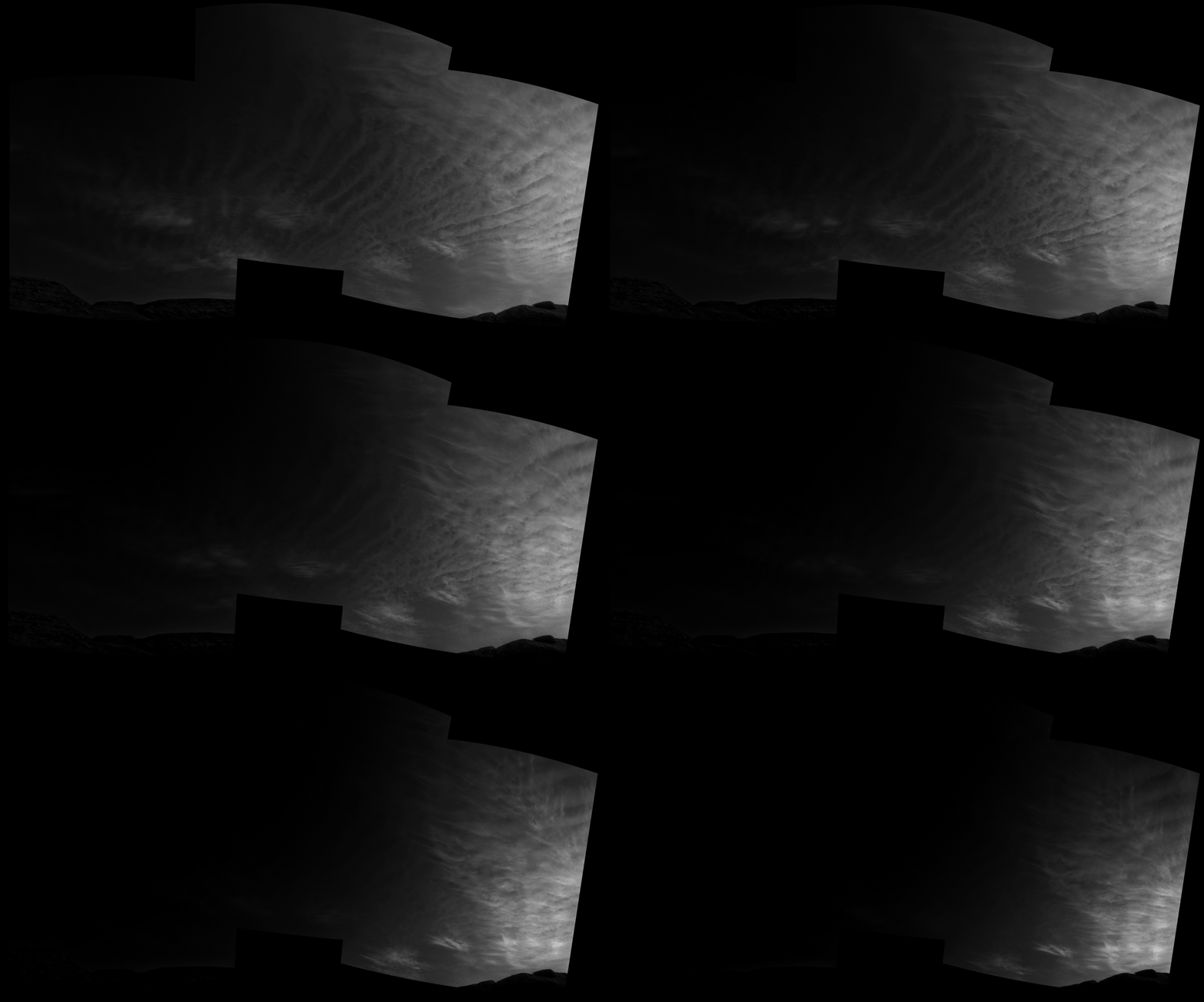
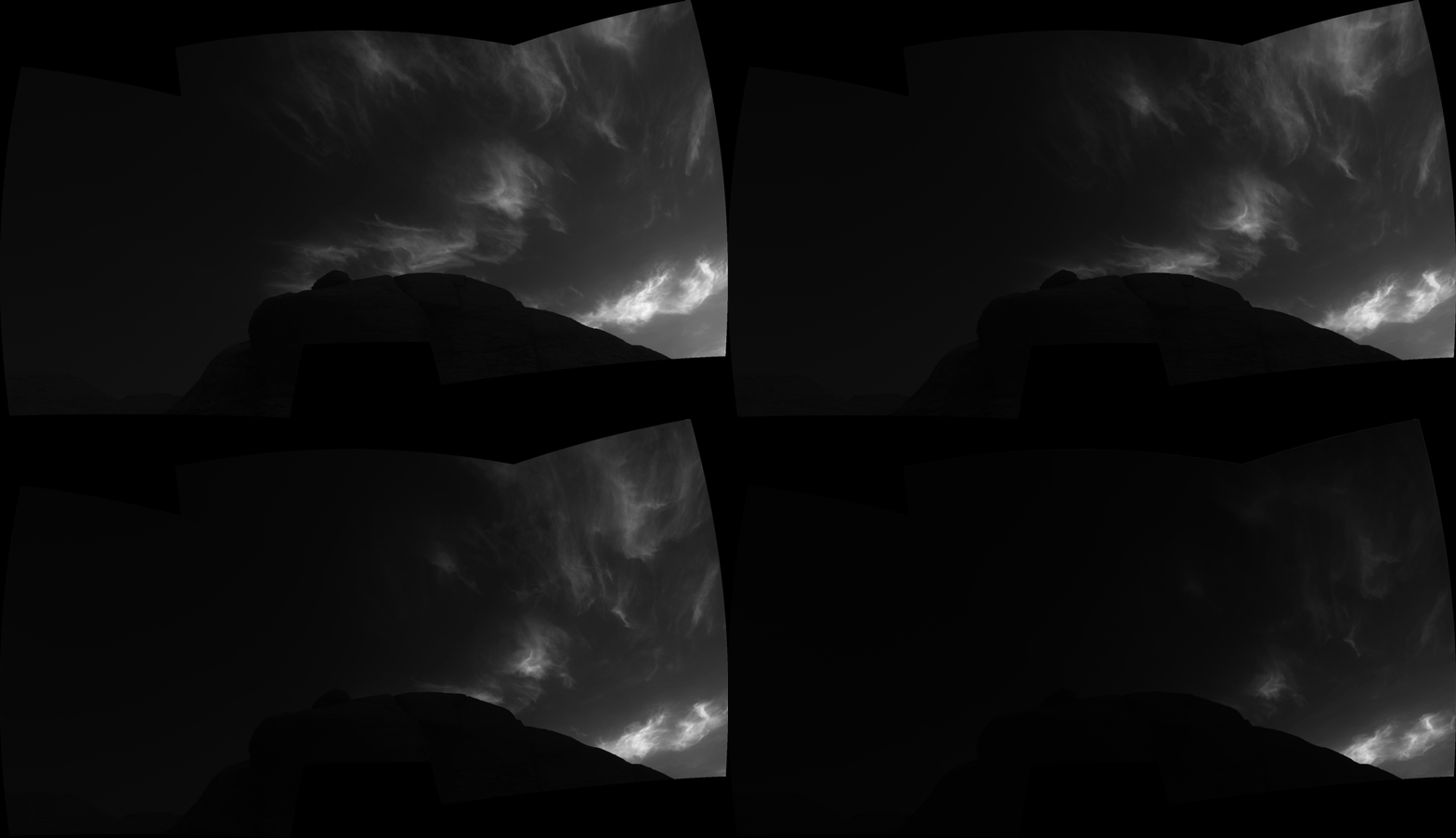
Curiosity Navigation Cameras Spot Twilight Clouds on Sol 3075: Using the navigation cameras on its mast, NASA’s Curiosity Mars rover took these images of clouds just after sunset on March 31, 2021, the 3,075th sol, or Martian day, of the mission.
Curiosity Navigation Cameras Spot Twilight Clouds on Sol 3072: Using the navigation cameras on its mast, NASA’s Curiosity Mars rover took these images of clouds just after sunset on March 28, 2021, the 3,072nd sol, or Martian day, of the mission.

Cloudy days are rare on Mars because of the planet’s thin atmosphere, but they can appear seasonally when Mars is farthest away from the Sun in its orbit, according to NASA. Curiosity’s images of the clouds helped scientists realize that clouds were much higher than most clouds which hover around 27 miles above the surface. Their larger altitude indicates they are made of dry ice (or frozen carbon dioxide) rather than water ice.
ROLLING ALONG
This eight-frame movie comes from the Curiosity rover, captured on December 12, 2021.
These clouds rolling along the Martian sky appeared to Curiosity’s navigation camera on December 12, 2021, the 3,325th sol of the mission.
This wasn’t easy, according to NASA. “Martian clouds are very faint in the atmosphere, so special imaging techniques are needed to see them,” according to an image description from JPL.
To get a clear, static background, Curiosity had to snap multiple images. “That allows anything else moving within the image (like clouds or shadows) to become visible after subtracting this static background from each individual image,” JPL officials added.
AN EARTHLY PERSPECTIVE
Curiosity took this view of the Martian landscape on August 23, 2022. Its color has been adjusted to depict what the human eye would perceive on Earth.
Mission team members adjusted the color in this image “to match the lighting conditions as the human eye would perceive them on Earth,” according to an image description published in 2022.
This scene is a mosaic of 23 Mastcam images captured near a hill called Bolivar on August 23, 2022, the 3,572nd sol of the mission.
Soon after reaching its 4,000th sol milestone, Curiosity went offline. From November 6 to 28, the mission team will await the end of solar conjunction. This is when Mars passes behind the Sun. During this time, Curiosity cannot communicate with Earth because the star’s plasma could interfere with sending commands.
But in a few weeks, Curiosity will continue its explorations.
Space exploration should never be run of the mill nor something that finds itself on the back pages of the newspaper. Captain James T. Kirk was right that space really is the final frontier and making it more accessible is one of the driving forces behind SpaceX. Their mission to seek out new life and new civilisations, wait that’s wrong – that’s Starfleet. The SpaceX mission ‘to revolutionise space technology, with the ultimate goal of enabling people to live on other planets is at the forefront of the development of the enormous Starship which may make another launch attempt as soon as this Friday 17th November.
SpaceX is a company that shot to fame since it was founded (I really wanted to type ‘launched’ but resisted) back in 2002 by Elon Musk. Musk had a vision to revolutionise space exploration by reducing costs and more excitingly he wanted to colonise Mars. SpaceX operate the Falcon rockets, the Dragon capsule that is often transporting supplies to and from the International Space Station and skywatchers around the globe are familiar with the infamous Starlink project that has launched more than 5,000 small satellites into orbit providing global internet coverage. There is no doubt the SpaceX brand is a well known one.
SpaceX Falcon 9 rocket carrying the company’s Crew Dragon spacecraft is launched from Launch Complex 39A (Credit : NASA/Joel Kowsky)
One of the more recent additions to the SpaceX fleet is the super heavy lift launch vehicle known rather imaginatively as Super Heavy and, when coupled with Starship in its final configuration has the capability of lifting at least 150 tonnes into low earth orbit. It is the tallest and most powerful rocket ever to have flown at an immense 120m tall but the real headline statement for Starship is that it is designed to be fully re-usable with both stages being recovered after launch and used again. If you haven’t yet watched the Starship stages landing then you really should hunt them down, I never tire of watching it.
The plans for Super Heavy and Starship are not just to get objects into low earth orbit though, there are plans to use them to refuel other Starships in orbit, to be a part of the NASA Artemis program to get humans back to the Moon and ultimately the colonisation of Mars. The power behind Super Heavy are the powerful Raptor rocket engines that burn liquid methane and oxygen to get off the launchpad but fire again to slow down the booster during descent to a graceful landing, ready to be used again.
SpaceX sea-level Raptor at the company headquarters at Hawthorne, California (Credit : Brandon De Young)
This all sounds pretty amazing but as we saw on 20 April this year, space flight is anything but routine. Four minutes after launch, at an altitude of 39km above the Gulf of Mexico, Musk’s beloved Starship failed to separate from the booster leading to the whole system exploding in a fireball on its maiden voyage. The FAA grounded the entire fleet but, it looks like we may be set for a fresh attempt this Friday 17th November subject to final approval from the FAA. If or when the launch finally goes ahead, it will be from a new reinforced launch site and will use a new separation technique known as Hot Staging where the second stage engines will fire to put the booster away! Good luck SpaceX.
NASA has temporarily lost the ability to communicate with its Mars fleet, according to a statement issued by the space agency citing a phenomenon that occurs every two years that blocks commands from being sent to its robotic explorers.
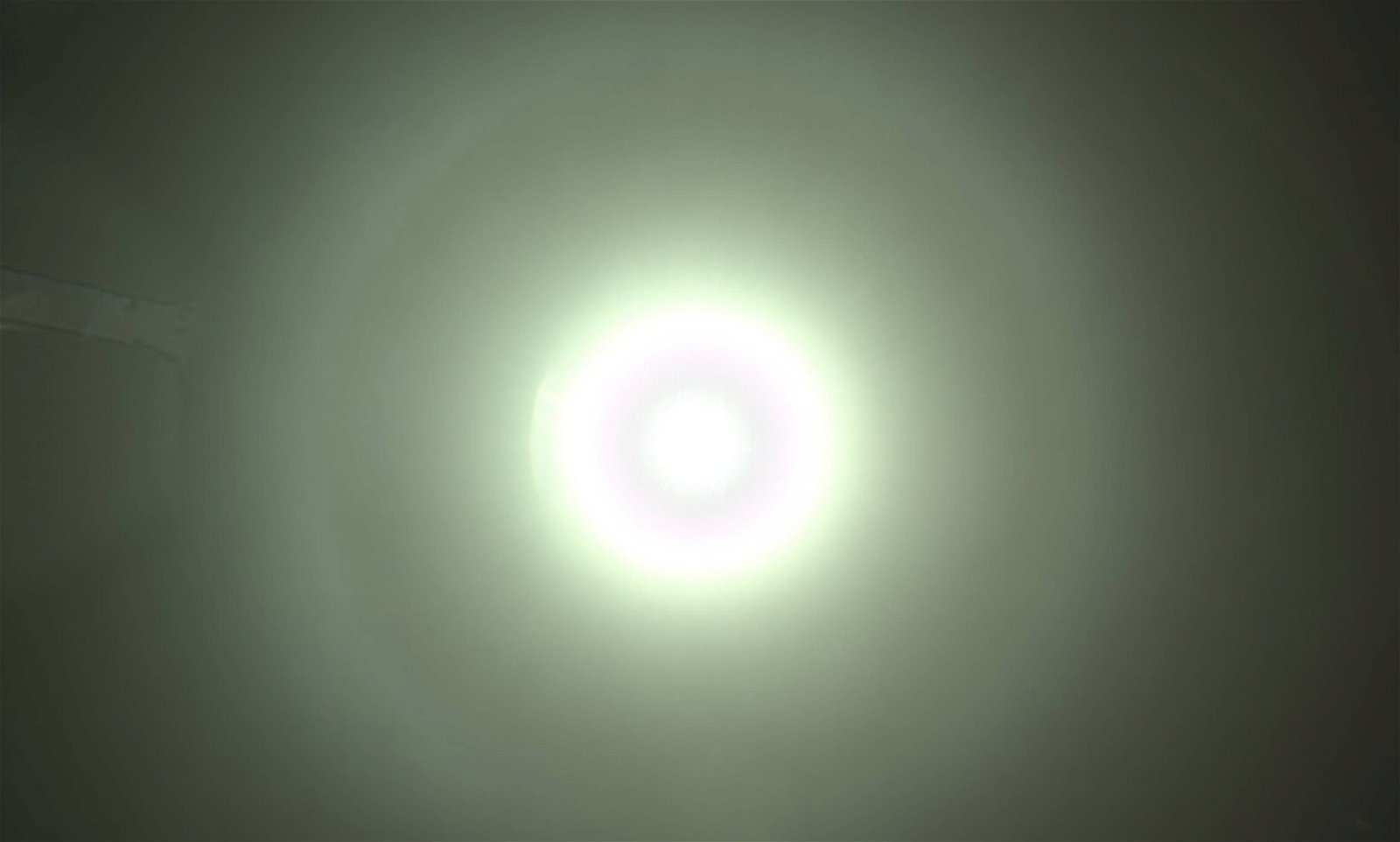
The phenomenon, known as Mars solar conjunction, occurs when the Sun moves between Earth and Mars every other year.
“Like dancers on either side of a huge bonfire, the two planets are temporarily invisible to each other,” reads a NASA FAQ page describing the biennial celestial event.
The Sun photographed by Perseverance on Nov. 7, 2023 (Sol 965), just prior to the onset of the 2023 Mars solar conjunction
(NASA/Caltech).
NASA says its rovers and orbital craft currently engaged in science missions on Mars will not discontinue operations, although data collection will remain limited for two weeks while Earth and Mars remain on either side of the Sun.
This year’s solar moratorium officially began on November 11 and will last until the 25th.
During the period of interrupted communication, some of the instruments are temporarily taken offline by engineers at NASA’s Jet Propulsion Laboratory, and no new instructions are dispatched to the robotic scientists on the Red Planet due to the likelihood that they will be lost once they encounter the interference caused by the Sun and the highly charged particles it emits.
However, in preparation for the communication breakdown, NASA sends two weeks’ worth of commands to its Mars fleet so that limited operations can continue.
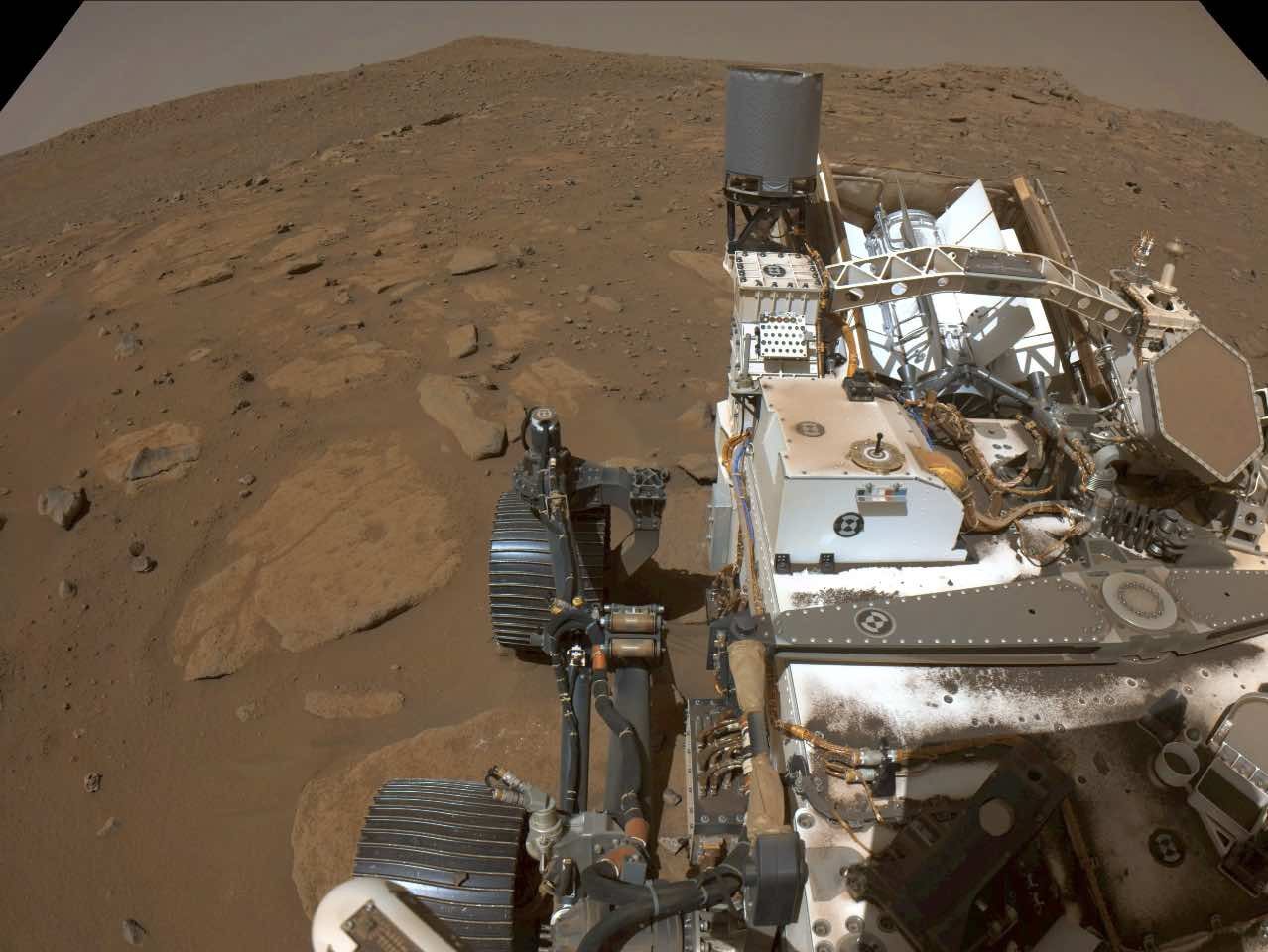
Perseverance captured a selfie from the location where it will remain parked during the 2023 Mars solar conjunction
(NASA/Caltech).
Currently, NASA says its Perseverance and Curiosity rovers are being tasked with ongoing monitoring of surface conditions on Mars, as well as observations of weather conditions, radiation levels, and other information their onboard sensors can continue to monitor.
The Ingenuity Mars Helicopter has also been tasked with observing the motion of sand on the Red Planet throughout the course of the solar conjunction, while the Mars Reconnaissance Orbiter and the Odyssey orbiter will keep their camera eyes trained on the Martian surface from their positions in orbit, along with the MAVEN spacecraft’s collection of data about the Martian atmosphere.
Limited information about the status of the Mars fleet will continue to be dispatched back to NASA, all except for a period of two days at the height of the conjunction where Mars and Earth are on the exact opposite ends of the Sun from each other.
“We’ll still be able to hear from them and check their states of health over the next few weeks,” said Roy Gladden, manager of the Mars Relay Network at NASA’s Jet Propulsion Laboratory (JPL), in a NASA statement.
After November 25, full communication is expected to be restored, and science data that has remained in limbo for the previous two weeks will be sent back to Earth, while new instructions will also be sent to the Mars fleet.
NASA Wants to Learn to Live Off the Land on the Moon
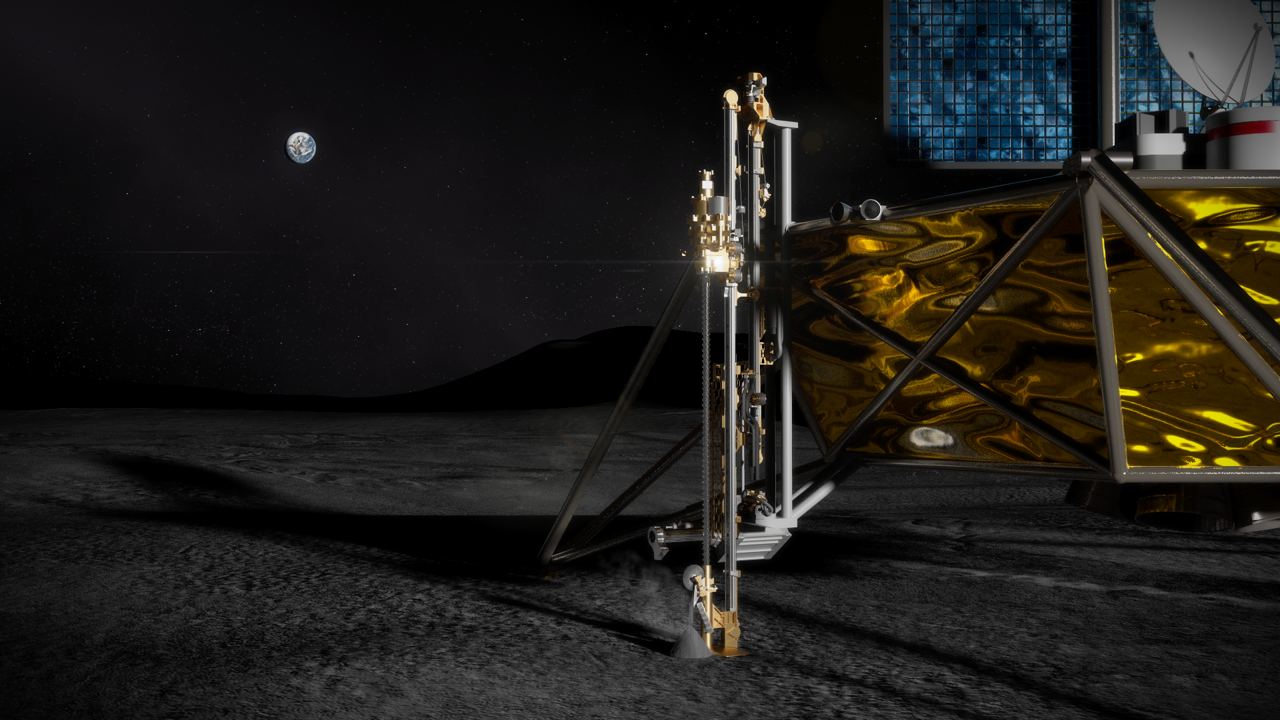
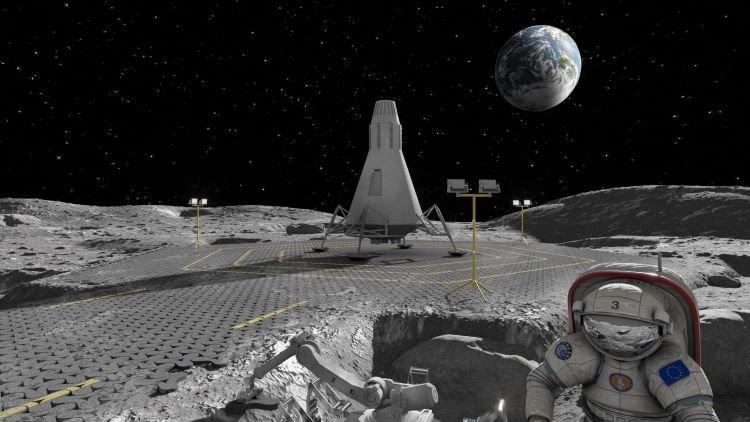
Artist rendition of an In-situ Resource Utilization (ISRU) technology demonstration on the lunar surface. NASA is working with industry and academia to develop technologies for future production of fuel, water, or oxygen from local resources, thus advancing space exploration capabilities. (Credit: NASA)
NASA Wants to Learn to Live Off the Land on the Moon
In preparation for the upcoming Artemis missions to the lunar south pole, NASA recently solicited a Request for Information (RFI) from the lunar community to map out its future Lunar Infrastructure Foundational Technologies (LIFT-1) demonstration for developing In-situ Resource Utilization (ISRU) technologies as part of the agency’s ambitious Lunar Surface Innovation Initiative (LSII). The primary goal of LIFT-1, which is being driven by NASA’s Space Technology Mission Directorate (STMD), is to advance ISRU technologies for extracting oxygen from the lunar regolith, including manufacturing, harnessing, and storing the extracted oxygen for use by future astronauts on the lunar surface. Proposals for LIFT-1 became available to be submitted via NSPIRES on November 6, 2023, with a deadline of December 18, 2023.
Artist rendition of future Artemis astronauts on the lunar surface using available resources for production of fuel, water, and oxygen. (Credit: NASA)
“The LIFT-1 demonstration creates a viable path to launch, land, and conduct operations on the lunar surface. This is the infusion path we need for ongoing industry and NASA center-led technology development activities,” said Dr. Prasun Desai, who is the acting associate administrator of STMD at NASA Headquarters in Washington DC. “Using in-situ resources is essential to making a sustained presence farther from Earth possible. Just as we need consumables and infrastructure to live and work on our home planet, we’ll need similar support systems on the Moon for crew and robots to operate safely and productively.”
NASA is heavily invested in developing ISRU technologies and is in collaboration with industry and academia in a wide range of studies involving lunar regolith, including construction, oxygen extraction, and growing plants. In addition to using lunar regolith to extract oxygen, efforts are being made to extract oxygen from lunar water ice, which is the primary reason Artemis is targeting the lunar south pole due to its proximity to the permanently shadowed regions (PSRs) of the Moon.
Lunar regolith being used to grow plants at the University of Florida, which is an example of NASA collaborating with academia in developing ISRU technologies for future human missions to the Moon. (Credit: UF/IFAS photo by Tyler Jones)
The purpose of ISRU is to “live off the land” through the resources that are available on-hand without the need for constant resupply from Earth. Future astronauts on both the Moon and Mars will need both food and water to survive for long-term missions, and supply missions from Earth can be both costly and risky, especially as humans venture farther out into the cosmos. Therefore, steps are being taken to learn how future astronauts can use available resources to their benefit, specifically for food, water, and oxygen.
An example of the most recent off-Earth ISRU technology demonstration is the toaster-sized Mars Oxygen In-Situ Resource Utilization Experiment (MOXIE) onboard NASA’s Perseverance rover with the goal of extracting oxygen from the carbon dioxide-heavy Martian atmosphere, which was accomplished in April 2021, only a few months after Perseverance landed in Jezero Crater. After just over an hour of the test, MOXIE produced 5.37 grams (0.01 pounds) of breathable oxygen, which is enough breathable oxygen for an astronaut to use for approximately 10 minutes. After this successful test, NASA now aspires to use develop similar technologies on the Moon using lunar resources, specifically lunar regolith and water ice found at the poles.
“An ISRU technology demonstration approach has been a topic of discussion within the Lunar Surface Innovation Initiative and Consortium communities for several years,” said Niki Werkheiser, who is the director of Technology Maturation in STMD at NASA. “This RFI is the next phase to make it a reality.”
As noted, LIFT-1 is part of NASA’s Lunar Surface Innovation Initiative, but developing ISRU technologies is just one of six areas the Initiative is targeting, with the other areas of interest being surface power, excavation and construction, extreme environment, dust mitigation, and extreme access. The development of these various technologies is a massive collaborative effort between various industries and academia, and will involve both human and robotic exploration efforts, as well. But development of these various technologies will not be limited to just the Moon, as NASA is hoping to use the lessons learned from Artemis to establish the necessary technologies for future human missions to Mars and beyond.
Artist illustration showing the construction of a landing pad at a future lunar base. (Credit: European Space Agency)
How will ISRU help improve the upcoming Artemis missions and what new discoveries with ISRU technologies will be made in the coming years and decades? Only time will tell, and this is why we science!
If You Account for the Laniakea Supercluster, The Hubble Tension Might Be Even Larger
One of the great unsolved mysteries of cosmology is known as the Hubble tension. It stems from our inability to pin down the precise rate of cosmic expansion. There are several ways to calculate this expansion, from observing distant supernovae to measuring the Doppler shift of maser light near supermassive black holes, and they all give slightly different results. Maybe we don’t fully understand the structure of the Universe, or maybe our view of the heavens is biased given that we are located deep within a galactic supercluster. As a new study shows, the bias problem is even worse than we thought.
If we were floating deep in space, far away from any galaxies, then our view of cosmic expansion would be free of gravitational influences and we could better see how distant galaxies move away from us. Since we are part of a local cluster of galaxies, we have a bit of bias in our data. This is why many local galaxies are blue-shifted. The Universe isn’t contracting near us, we’re just in a galactic gravitational well. We can easily account for this bias, so it isn’t a problem. However, given the Hubble tension, a team recently looked for gravitational biases beyond the local group, hoping it would solve the issue.
They looked at the largest gravitational structure we’re a part of, known as the Laniakea Supercluster. It is a massive cluster of galaxies more than 520 million light-years across, containing more than 100,000 galaxies, including the Milky Way. Our local group is being pulled toward the heart of Laniakea, and thus our motion through the Universe could skew our observations of cosmic expansion.
Observations show a statistical bias in the data. Credit: Giani, et al
When the team measured the gravitational influence of the supercluster as a whole, they found it does bias our observations by about 2% – 3%. But it’s biased in the wrong direction. In other words, by not taking the effect of Laniakea into account, the Hubble tension seemed smaller than it actually is. These new results show that the tension is 2% – 3% greater than we thought. Even some of the more recent Hubble constant measurements that seemed encouraging aren’t enough to account for the Laniakea bias.
Removing subtle biases from our cosmological data is challenging, so it is possible that further observations may swing the results back in the right direction. But we can’t rely on bias alone to solve this mystery. Clearly, something subtle and strange is going on, and the solution isn’t obvious. It will take a great deal more study to understand Hubble’s tension.
This image was taken by a small camera that was jettisoned from China's Tianwen-1 spacecraft to photograph the spacecraft in orbit above the Martian north pole. Credit: CNSA/PEC
China continues to take great strides as part of its goal to become a superpower in space and a direct competitor with NASA. In addition to its proposed expansion of the Tiangong space station and the creation of the International Lunar Research Station (ILRS), China is also planning on sending crewed missions to Mars in the coming decade. In preparation for the arrival of taikonauts on the Red Planet, China is gearing up to return samples of Martian soil and rock to Earth roughly two years ahead of the proposed NASA-ESA Mars Sample Return (MSR).
This mission will be the third in the China National Space Administration’s (CNSA) Tianwen program (Tianwen-3) and will consist of a pair of launches in 2028 that will return samples to Earth in July 2031. According to a new study recently published in the journal Chinese Science Bulletin, Chinese scientists announced that they have developed a new numerical model to simulate the atmospheric environment of Mars. Known as the Global Open Planetary atmospheric model for Mars (aka. GoPlanet-Mars, or GoMars), this model offers research support in preparation for the Tianwen-3 mission.
A wireless camera took this ‘group photo’ of China’s Tianwen-1 lander and rover on Mars’ surface. Credit: Chinese Space Agency
In the past two decades, the number of missions and space agencies engaged in the exploration of Mars has increased considerably. At present, ten robotic missions are exploring its surface and atmosphere, including seven orbiters, two rovers, and one helicopter. And with many more destined for Mars in the next decade (as well as crewed missions), the demand for Martian weather forecasts is growing. As they indicate in their paper, “The world’s aerospace powers have developed Mars atmosphere models to provide meteorological environment protection for landing exploration.”
To provide information on the meteorological conditions around the Tianwen-3 mission’s potential landing sites, the research team built a global open planetary atmospheric model for Mars. They then used this model to replicate the three critical cycles of the Martian atmosphere: dust, water, and carbon dioxide. They then tested the model using the Open access to Mars Assimilated Remote Soundings (OpenMARS) dataset, a global record of Martian weather from 1999 to 2015, as well as observations made by China’s Zhurongrover (part of China’s Tianwen-1 mission) and NASA’s Viking 1 and 2 landers.
Their results showed that the GoMars model successfully reproduced the unique characteristics of surface pressure on Mars and provided good simulation performance for the surface temperature, zonal wind, polar ice, and dust. According to Wang, the Tianwen-3 mission will expand upon Tianwen-1 by adding the additional tasks of landing, sampling, and returning, which requires detailed information about Mars’ atmospheric conditions. This is crucial given how sandstorms caused multiple missions to be lost, such as Opportunity, Insight, and Zhurong – all due to the buildup of dust on their solar panels.
In addition, the Perseverance rover suffered damage to one of its wind sensors during a sandstorm due to airborne pebbles colliding with it. Since observation data is in short supply for Mars, the model also has applications for virtual reality simulations. This is necessary when prepping missions to remote planets, which helps them design vehicles and select appropriate landing sites. In this respect, a “virtual Mars” program that incorporates GoMars and future observations could take a lot of the guesswork out of future mission planning.
Since the 1960s, when the Soviet and American space programs began sending probes to Mars, scientists have been developing Martian atmospheric models in the hopes of overcoming the “Mars Curse.” With a growing number of nations sending missions to Mars, the need for climate modeling has become all the more crucial. In the end, dust and weather can have a significant impact on the entry, descent, and landing (EDL) phase. They can also affect surface operations, particularly where solar panels, communications, and sensitive instruments are concerned.
They can also be a problem during the ascent phase, where missions attempt to reach orbit and return to Earth – for example, as part of a sample return mission. As Wang commented in an interview with the Xinhua News Agency:
“The dust cycle on Mars is as important as the water cycle on Earth. GoMars can be used to simulate the dust activity before and after the rover’s dormancy, which can provide atmospheric environment data to analyze the possible causes of the dormancy. For example, GoMars can simulate the temperatures of the landing zone, and scientists can use these data to design materials that are suitable for building Mars rovers to cope with extreme cold.”
Early in the next decade, NASA and the ESA also intend to send the Mars Sample Return (MSR) mission to retrieve samples obtained by the Perseverance rover. This will consist of a NASA Sample Retrieval Lander, two Sample Recovery Helicopters, a Mars Ascent Vehicle, and an ESA Earth Return Orbiter. NASA and the ESA currently expect this mission to launch no sooner than 2033, coinciding with NASA’s first crewed mission to Mars leaving Earth. Clearly, the new Space Race extends beyond the Moon and now includes reaching Mars!
The Oort Cloud Might be More Active Than We Thought
Every now and then a comet or asteroid comes to our solar system from interstellar space. We have observed two interstellar objects in recent years, Oumuamua in 2017, and Borisov in 2019. One would assume then that in the past at least some interstellar objects have struck Earth. But we’ve never found an interstellar meteorite. A new study argues that this is because the Oort cloud is much more active than we thought.
The Oort cloud is a halo of icy material on the outermost edge of the solar system, where the Sun’s gravity is barely strong enough to hold them in a stellar orbit. When another star passes somewhat near the Sun, members of the Oort cloud can be nudged toward the inner solar system, where they can become long-period comets. We have never observed the Oort cloud, but we know it’s there because comets can approach the Sun from every direction, not just the orbital plane of the planets.
Astronomers can distinguish between Oort cloud objects and interstellar objects by their orbits. Interstellar objects have a hyperbolic orbit, meaning that if you traced their path purely under the gravitational influence of the Sun, it would continue on to interstellar space, never to return. Oort cloud objects, on the other hand, have an orbital path that is closed. They may travel to the most distant region of space, but they are gravitationally bound to the Sun.
Of course, some interstellar objects could make a close approach to Jupiter or another planet, where the gravitational tug of that world shifts it into a bound orbit. So some interstellar objects could appear similar to Oort cloud objects. The opposite chance encounter, where an Oort cloud object is nudged into a hyperbolic orbit, was thought to be much more rare.
The path of a meteor as calculated from observations. Credit: Peña-Asensio, et al
We have observed some meteors with hyperbolic paths. By combining multiple images of a meteor path, we can calculate the path of entry into Earth’s atmosphere. In this study, the team looked at a meteor seen in Finland in 2022, which appeared to have a hyperbolic path. They found that based on the uncertainties of the observations, the meteor is statistically more likely to be a perturbed Oort cloud object rather than a true interstellar object. Applying the same statistics to six other hyperbolic meteors, they found four of them showed a similar statistical leaning toward being Oort objects. This would imply that most hyperbolic meteors are not interstellar.
Interstellar objects have still likely struck Earth, but more rarely than the initial data suggested. So our search for interstellar meteorites is going to be a challenge.
Diep onder het Afrikaanse continent en de Stille Oceaan, nabij het centrum van de aarde, bevinden zich vreemde en flinke ‘klonters’ (twee keer groter dan de maan). Decennialang was onduidelijk waar ze vandaan komen, maar Amerikaanse onderzoekers denken er nu uit te zijn: het zijn brokstukken van een andere planeet.
Dat schrijven onderzoekers in het blad Nature. Hun studie handelt over twee mysterieuze ‘blobs’ of ‘klonters’ die in de jaren tachtig van de vorige eeuw al zijn ontdekt (zie kader). Deze klonters – formeel aangeduid als Large Low-Velocity Provinces (LLVPs) zijn ongeveer twee keer groter dan de maan en bevinden zich nabij het centrum van de aarde. De ene LLVP bevindt zich diep onder het Afrikaanse continent. En de andere onder de Stille Oceaan. Onderzoek heeft reeds uitgewezen dat de LLVPs waarschijnlijk een andere samenstelling hebben dan de omringende aardmantel. Maar decennialang bleef onduidelijk waar het materiaal nu precies vandaan kwam.
LLVPs LLVPs bevinden zich diep in het binnenste van de aarde. Ze zijn niet te zien, maar toch weten onderzoekers vrij zeker dat ze er zijn. Hoe kan dat? Het is te danken aan seismische golven. Deze golven – die bijvoorbeeld ontstaan tijdens aardbevingen – kunnen door het binnenste van de aarde heen reizen. De snelheid waarmee ze dat doen, wordt bepaald door de samenstelling van dat binnenste. En tijdens metingen aan seismische golven ontdekten onderzoekers in de jaren tachtig dat die golven afgeremd werden. Het hintte op de aanwezigheid van twee grote klonters materiaal die een hoog ijzergehalte hebben en de seismische golven met hun hoge dichtheid en temperatuur vertragen. Onderzoekers besloten ze daarom aan te duiden als Large Low-Velocity Provinces, wat zoveel betekent als grote gebieden waarin de snelheid laag ligt.
Theia In een nieuwe studie denken Amerikaanse onderzoekers nu meer duidelijkheid te kunnen geven over de herkomst van de LLVPs. Hun onderzoek suggereert namelijk dat het om brokstukken gaat van Theia: een planeet die miljarden jaren geleden op de aarde klapte. Bij de zware botsing ontstonden grote brokstukken – zowel afkomstig van de aarde als van Theia – die uiteindelijk in een baan rond de aarde samenklonterden en zo de ons allemaal welbekende maan vormden.
Eureka! Die conclusie volgt uit een heus ‘eureka-moment’ dat zich voor onderzoeker Qian Yuan aandiende toen deze een seminar over planeetvorming bijwoonde. Eén van de sprekers presenteerde het verhaal over het ontstaan van de maan en het viel Yuan tijdens deze presentatie op dat de maan relatief rijk aan ijzer is. Het eureka-moment diende zich kort daarna aan, toen de spreker vertelde dat er op aarde – in tegenstelling tot de maan – geen spoor van Theia te vinden is. “Nadat hij gezegd had dat niemand wist waar de ingeslagen planeet nu is, had ik een ‘eureka-moment’,” vertelt Yuan. “Ik realiseerde me dat het ijzerrijke ingeslagen object getransformeerd zou kunnen zijn tot ‘mantelklonters’.”
Simulaties Samen met collega’s besloot Yuan dat scenario verder te onderzoeken. Ze gebruikten daarvoor onder meer modellen waarmee ze de botsing tussen de aarde en Theia simuleerden. En die bevestigden dat de botsing zowel de maan als klonters in het binnenste van de aarde kan hebben voortgebracht. “Middels simulaties van mantelconvectie ontdekten we dat de dichte, ijzerrijke materialen van Theia naar de onderkant van de aardmantel konden zinken en zich aldaar konden ophopen,” vertelt onderzoeker Mingming Li. “Het lijkt erop dat de klonters het resultaat zijn van een planetaire botsing die onze maan vormde,” concludeert collega Ed Garnero. “In andere woorden: de gigantische klonters die momenteel diep in de aarde, diep onder onze voeten, te vinden zijn, zijn buitenaards. De aarde bezit niet alleen klonters, de aarde heeft buitenaardse klonters!”
Het nieuwe onderzoek wijst erop dat de twee klonters in het binnenste van de aarde bestaan uit materiaal afkomstig van Theia. De klonters zijn flink; als je ze over het aardoppervlak zou uitsmeren, zouden ze een 100 kilometer dikke laag rond de volledige planeet vormen. Afbeelding: Hernan Canellas / Image courtesy of ASU.
Twee mysteries Met hun onderzoek lossen de wetenschappers mogelijk twee mysteries in één klap op. Allereerst natuurlijk het mysterie van de klonters: het nieuwe onderzoek verklaart – eindelijk – waar ze vandaan komen. Daarnaast lost het onderzoek ook een ander raadsel op, namelijk waarom er gek genoeg buiten de maan nooit materiaal van Theia is teruggevonden. Het onderzoek suggereert namelijk dat het leeuwendeel van de onfortuinlijke planeet door de jonge aarde is geabsorbeerd (en de resterende stukken zijn opgegaan in de maan).
“Dit onderzoek laat zien dat de enorme klonters (de LLVPs) diep in de aardmantel kunnen bestaan uit materialen van de planeet die op de proto-aarde insloeg en de maan vormde,” vertelt onderzoeker Mingming Li. “En dat de maan en de klonters dus dezelfde oorsprong kennen.” “Door naar binnen te kijken – naar het binnenste van de aarde – in plaats van naar buiten – naar de maan – hebben we nog een bewijsstuk gevonden voor de kosmische catastrofe die de gigantische inslag waarbij de maan ontstond, is,” concludeert onderzoeker Travis Gabriel.
Beste bezoeker, Heb je zelf al ooit een vreemde waarneming gedaan, laat dit dan even weten via email aan Frederick Delaere opwww.ufomeldpunt.be. Deze onderzoekers behandelen jouw melding in volledige anonimiteit en met alle respect voor jouw privacy. Ze zijn kritisch, objectief maar open minded aangelegd en zullen jou steeds een verklaring geven voor jouw waarneming! DUS AARZEL NIET, ALS JE EEN ANTWOORD OP JOUW VRAGEN WENST, CONTACTEER FREDERICK. BIJ VOORBAAT DANK...
Druk op onderstaande knop om je bestand , jouw artikel naar mij te verzenden. INDIEN HET DE MOEITE WAARD IS, PLAATS IK HET OP DE BLOG ONDER DIVERSEN MET JOUW NAAM...
Druk op onderstaande knop om een berichtje achter te laten in mijn gastenboek
Alvast bedankt voor al jouw bezoekjes en jouw reacties. Nog een prettige dag verder!!!
Over mijzelf
Ik ben Pieter, en gebruik soms ook wel de schuilnaam Peter2011.
Ik ben een man en woon in Linter (België) en mijn beroep is Ik ben op rust..
Ik ben geboren op 18/10/1950 en ben nu dus 75 jaar jong.
Mijn hobby's zijn: Ufologie en andere esoterische onderwerpen.
Op deze blog vind je onder artikels, werk van mezelf. Mijn dank gaat ook naar André, Ingrid, Oliver, Paul, Vincent, Georges Filer en MUFON voor de bijdragen voor de verschillende categorieën...
Veel leesplezier en geef je mening over deze blog.