The purpose of this blog is the creation of an open, international, independent and free forum, where every UFO-researcher can publish the results of his/her research. The languagues, used for this blog, are Dutch, English and French.You can find the articles of a collegue by selecting his category. Each author stays resposable for the continue of his articles. As blogmaster I have the right to refuse an addition or an article, when it attacks other collegues or UFO-groupes.
Druk op onderstaande knop om te reageren in mijn forum
Zoeken in blog
Deze blog is opgedragen aan mijn overleden echtgenote Lucienne.
In 2012 verloor ze haar moedige strijd tegen kanker!
In 2011 startte ik deze blog, omdat ik niet mocht stoppen met mijn UFO-onderzoek.
BEDANKT!!!
Een interessant adres?
UFO'S of UAP'S, ASTRONOMIE, RUIMTEVAART, ARCHEOLOGIE, OUDHEIDKUNDE, SF-SNUFJES EN ANDERE ESOTERISCHE WETENSCHAPPEN - DE ALLERLAATSTE NIEUWTJES
UFO's of UAP'S in België en de rest van de wereld Ontdek de Fascinerende Wereld van UFO's en UAP's: Jouw Bron voor Onthullende Informatie!
Ben jij ook gefascineerd door het onbekende? Wil je meer weten over UFO's en UAP's, niet alleen in België, maar over de hele wereld? Dan ben je op de juiste plek!
België: Het Kloppend Hart van UFO-onderzoek
In België is BUFON (Belgisch UFO-Netwerk) dé autoriteit op het gebied van UFO-onderzoek. Voor betrouwbare en objectieve informatie over deze intrigerende fenomenen, bezoek je zeker onze Facebook-pagina en deze blog. Maar dat is nog niet alles! Ontdek ook het Belgisch UFO-meldpunt en Caelestia, twee organisaties die diepgaand onderzoek verrichten, al zijn ze soms kritisch of sceptisch.
Nederland: Een Schat aan Informatie
Voor onze Nederlandse buren is er de schitterende website www.ufowijzer.nl, beheerd door Paul Harmans. Deze site biedt een schat aan informatie en artikelen die je niet wilt missen!
Internationaal: MUFON - De Wereldwijde Autoriteit
Neem ook een kijkje bij MUFON (Mutual UFO Network Inc.), een gerenommeerde Amerikaanse UFO-vereniging met afdelingen in de VS en wereldwijd. MUFON is toegewijd aan de wetenschappelijke en analytische studie van het UFO-fenomeen, en hun maandelijkse tijdschrift, The MUFON UFO-Journal, is een must-read voor elke UFO-enthousiasteling. Bezoek hun website op www.mufon.com voor meer informatie.
Samenwerking en Toekomstvisie
Sinds 1 februari 2020 is Pieter niet alleen ex-president van BUFON, maar ook de voormalige nationale directeur van MUFON in Vlaanderen en Nederland. Dit creëert een sterke samenwerking met de Franse MUFON Reseau MUFON/EUROP, wat ons in staat stelt om nog meer waardevolle inzichten te delen.
Let op: Nepprofielen en Nieuwe Groeperingen
Pas op voor een nieuwe groepering die zich ook BUFON noemt, maar geen enkele connectie heeft met onze gevestigde organisatie. Hoewel zij de naam geregistreerd hebben, kunnen ze het rijke verleden en de expertise van onze groep niet evenaren. We wensen hen veel succes, maar we blijven de autoriteit in UFO-onderzoek!
Blijf Op De Hoogte!
Wil jij de laatste nieuwtjes over UFO's, ruimtevaart, archeologie, en meer? Volg ons dan en duik samen met ons in de fascinerende wereld van het onbekende! Sluit je aan bij de gemeenschap van nieuwsgierige geesten die net als jij verlangen naar antwoorden en avonturen in de sterren!
Heb je vragen of wil je meer weten? Aarzel dan niet om contact met ons op te nemen! Samen ontrafelen we het mysterie van de lucht en daarbuiten.
12-11-2023
Evidence of alien life may exist in the fractures of icy moons around Jupiter and Saturn
Evidence of alien life may exist in the fractures of icy moons around Jupiter and Saturn
"That type of faulting can facilitate the exchange of surface and subsurface materials through shear heating processes, potentially creating environments conducive for the emergence of life."
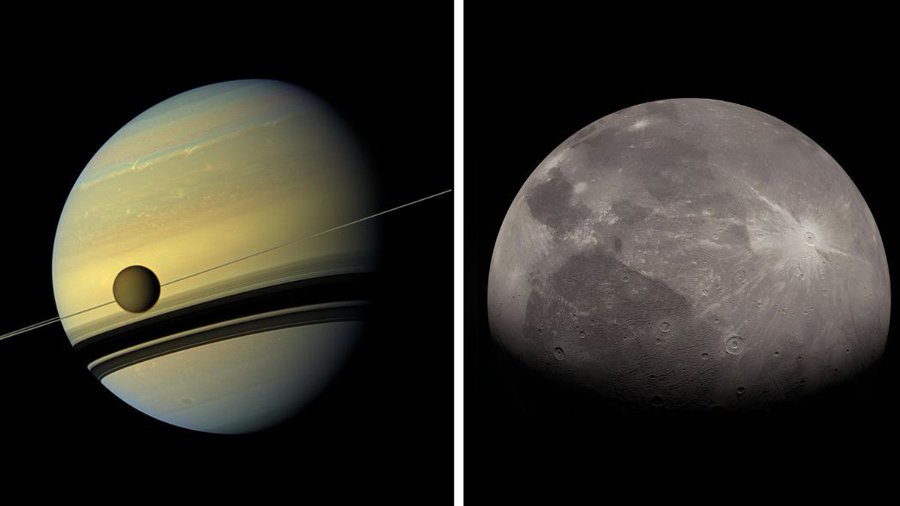
(Left) a view of Titan around Saturn and (right) the Jovian moon of Jupiter.
(Image credit: NASA/JPL-Caltech/SwRI/ MSSS/ Kalleheikki Kannisto/ Space Science Institute)
Scientists are investigating specific geological features on the largest moons of both Jupiter and Saturn that could be ideal spots for the emergence of life elsewhere in the solar system.
The team, led by researchers from the University of Hawaii at Mānoa, looked at what are called "strike-slip faults" on the Jovian moon, Ganymede — the solar system’s largest moon, bigger even than the planet Mercury — and Saturn's moon, Titan. Faults like these happen when fault walls move past each other horizontally, either to the left or the right, with a famous example here on Earth being the San Andreas fault. It's sort of like a giant crack, rift, or certain type of crevice in the ground.
Such seismic features are generated on these icy moons, scientists believe, when these bodies orbit their parent gas-giant planets. The planets' immense gravitational influences generate tidal forces that squash and squeeze the moons, inevitably flexing the natural satellites' surfaces. Plus, these tidal forces aren’t very consistent because the orbits of both moons are elliptical, meaning they are sometimes closer to Saturn or Jupiter. Other times, they're much farther away. That, in turn, leads to even stronger tidal forces.
"We are interested in studying shear deformation on icy moons because that type of faulting can facilitate the exchange of surface and subsurface materials through shear heating processes, potentially creating environments conducive for the emergence of life," Liliane Burkhard, lead author of the research and a scientists at the Hawaii Institute of Geophysics and Planetology, said in a statement.
Saturn’s moon, Titan, has surface temperatures of around minus 290 degrees Fahrenheit (minus 179 degrees Celsius). This is incredibly cold — cold enough that the water of this moon actually plays the role of rock. It can crack, deform and, ultimately, form faults.
During its flybys of Titan, NASA’s Cassini spacecraft was able to determine that this moon of Saturn may have liquid water oceans tens of miles beneath its thick shell of ice. Additionally, Titan is the only solar system moon with a dense, Earth-like atmosphere, meaning it has a similar hydrological cycle with methane clouds, rain and liquid flowing across the surface to fill lakes and seas. For this reason, Titan is already considered one of just a few bodies in our solar system that could support life — as we know it, at least.
When the NASA Dragonfly mission (which launches in 2027) arrives at Titan in 2034, it will send a rotorcraft lander to fly across the frigid surface of this moon in an effort to hunt for those potential biological signs. That doesn't exactly mean it'll search for bug-eyed aliens, however. At the very least, the team hopes the lander will detect the chemical building blocks of life we're familiar with.
The Dragonfly mission is initially set to land at the Selk crater area on Titan, a region that is also of interest to Burkhard and the team. This is because when calculating the stress exerted on Titan’s surface as a result of tidal forces, the researchers weren't only focused on whether there might be signs of extraterrestrial life on the ground. They also explored the chance that the Selk crater region could be subjected to shear deformation to figure out whether it's a safe landing site option for Dragonfly in the first place.
"While our prior research indicated that certain areas on Titan might currently undergo deformation due to tidal stresses, the Selk crater area would need to host very high pore fluid pressures and a low crustal coefficient of friction for shear failure, which seems improbable," said Burkhard. "Consequently, it’s safe to infer that Dragonfly won’t be landing in a strike-slip ditch!"
Strike-slip faults at the San Andreas Fault (a) on Ganymede (b) and on Titan (Image credit: University of Hawaii)
Burkhard and colleagues also looked at the geology of the Jovian moon, Ganymede, to investigate the icy body’s history of tidal stress. In particular, the team looked at a bright region in the northwest of Ganymede called Philus Sulcus, which is composed of parallel sets of fractures.
The researchers basically looked at available high-resolution observations of the area to find that there were different degrees of tectonic deformation in bands of light terrain that cross over each other. The cross-cutting nature of these bands indicated to Burkhard and colleagues the existence of three distinct eras of geological activity — ancient, intermediate, and young.
"I investigated strike-slip faulting features in intermediate-aged terrain, and they correspond in slip direction to the predictions from modeling stresses of a higher past eccentricity," said Burkhard. "Ganymede could have undergone a period where its orbit was much more elliptical than it is today."
When investigating other parts of Philus Sulcus, the team found the direction of slip features to have different alignments. This implies these features may have been generated by processes other than high tidal stress. "So, Ganymede has had a tidal 'midlife crisis,' but its youngest 'crisis' remains enigmatic," Burkhard added.
The geologic investigations undertaken by this team and others are vital for informing the missions of spacecraft that aim to explore solar system moons like Titan and Ganymede. said Burkhard.
“Missions such as Dragonfly, Europa Clipper, and ESA’s JUICE will further constrain our modeling approach and can help pinpoint the most interesting locations for lander exploration and possibly for gaining access to the interior ocean of icy moons,” Burkhard concluded.
The team’s research is published across two papers in the journal Icarus.
Join our Space Forums to keep talking space on the latest missions, night sky and more! And if you have a news tip, correction or comment, let us know at: community@space.com.
Op 13 juli 2023 scheerde planetoïde 2023 NT1 op een afstand van 100.000 km langs de aarde, en dat zonder dat wetenschappers ook maar ergens vanaf wisten. Dit roept de vraag op: in hoeverre kunnen we als mensheid de aarde beschermen tegen kleine(re) planetoïden zoals 2023 NT1? Wetenschappers uit Amerika hebben hiervoor mogelijk een oplossing bedacht.
In het onderzoek schrijven de onderzoekers dat kleine planetoïden, zoals 2023 NT1, ook wanneer ze op het moment van ontdekking al heel dicht bij de aarde in de buurt komen, nog kunnen worden vernietigd middels een methode die bekend staat als PI, oftewel ‘Pulverize it’. In het Nederlands betekent dit ‘verpulver het’. Bij deze methode wordt er gebruik gemaakt van een raket die een aantal doorborende staven als lading heeft. Sommige van deze staven zijn compleet van één materiaal gemaakt, anderen zijn gevuld met traditionele explosieven. Zodra de raket in de buurt komt van de planetoïde worden de staven afgeschoten en doorboren ze het vliegende gevaar. Dit zorgt er uiteindelijk voor dat de planetoïde in kleinere stukken breekt met een diameter van maximaal 15 meter.
Snelle reactie Het grote voordeel van PI is dat er erg snel gereageerd kan worden. Zo schrijven de wetenschappers dat zelfs op het moment dat een inslag enkele uren verwijderd is, de planetoïde nog steeds onschadelijk kan worden gemaakt. Zelfs in dat geval zullen de overgebleven brokstukken grotendeels verbranden in de atmosfeer. De schokgolf van de brokstukken die eventueel zouden landen hebben dan niet genoeg energie om significante schade toe te brengen aan natuurgebieden en steden. Op aarde zullen omstanders op het moment van doorboring dan vooral een grote lichtshow zien, welke bestaat uit een reeks (ongevaarlijke) knallen en flitsen.
Onzichtbaar PI is niet de enige manier waarop planetoïden vernietigd kunnen worden; wetenschappers hebben eerder al een andere verdedigingstechniek ontwikkeld. Hierbij wordt er gebruik gemaakt van deflectie. Een goed voorbeeld hiervan is het experiment dat ongeveer een jaar geleden werd uitgevoerd met de ruimtesteen Dimorphos. Bij deze test werd er een DART-ruimtesonde met een snelheid van 6 km/s tegen de ruimtesteen aan geknald. Het resultaat was een succesvolle koerswijziging van de ruimtesteen.
Het nadeel van deflectie is dat het plannen, bouwen en afschieten van de ruimtesonde al snel enkele jaren, zo niet decennia kan duren. Daarnaast kost het ook veel geld en materieel om zo’n ruimtesonde te bouwen. Het probleem met kleinere planetoïden is dat deze niet altijd enkele jaren, maar soms pas enkele weken of enkele dagen voor inslag pas waargenomen kunnen worden. Of, zoals bij 2023 NT1 het geval was, soms zelfs helemaal niet (zie kader).
Over 2023 NT1 2023 NT1 scheerde in juli op een afstand van zo’n 100.000 kilometer langs de aarde. Daarmee kwam de ruimtesteen ongeveer drie keer dichter bij dan de maan! Maar wetenschappers hebben dat gemist; ze ontdekten de ruimtesteen pas twee dagen later. In deze studie leggen de onderzoekers ook uit hoe dat komt: de ruimtesteen kwam vanuit de richting van de zon en ging dan ook als het ware schuil in het felle zonlicht.
Catastrofe voorkomen In het beste geval wordt een planetoïde al decennia of eeuwen van tevoren waargenomen voordat deze inslaat. In dat geval zou deflectie wel eens beter kunnen werken, omdat er dan een kleinere koerswijziging nodig is. In het onderzoek wordt dan ook meermaals benadrukt dat PI vooral bedoeld is als een toevoeging aan de beschikbare mogelijkheden, in plaats van een vervanging van de deflectiemethode.
Echter wordt er ook gewezen op het feit dat om iets op te kunnen blazen, je het wel eerst moet kunnen observeren. De onderzoekers benadrukken dan ook meermaals het belang van goede detectiemethoden. Hierbij wordt vooral hoopvol uitgekeken naar toekomstige observatoria zoals het Rubin Observatory Legacy Survey of Space and Time (LSST) en NASA’s aankomende Near-Earth Object (NEO) Surveyor. Het is dus erg mooi dát er nu een manier is bedacht om kleinere planetoïden zoals 2023 NT1 onschadelijk te kunnen maken, maar tegelijkertijd voelt het vooralsnog ook een beetje als jagen in het donker zonder zaklamp.
"If they're out there, this analysis lets us figure out where they could be living."
(Image credit: ALLVISIONN/Getty Images)
Scientists usually search for life elsewhere in the universe by using Earth as a template — after all, it is the only planet we know where life thrives. (Life as we know it, at least.) But according to new research, a bygone era of Earth may be a better indicator of complex life than the Earth we know of today.
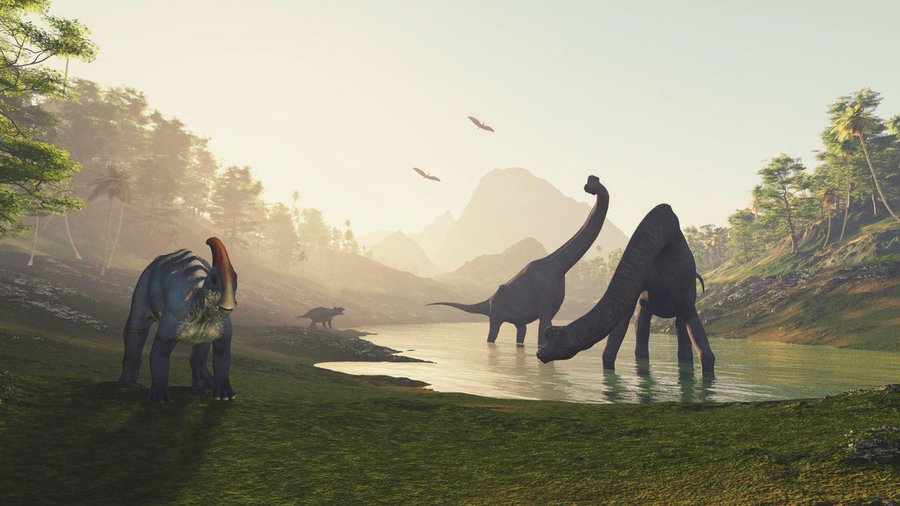
Telescopes that help assess whether exoplanets are habitable typically search for biosignatures in offworld atmospheres based on compounds, and compound levels, we see on Earth right now. However, scientists say these telescopes may be able to more easily detect those telltale signatures on worlds that don't look a lot like modern Earth. Instead, it may be a better bet to have our observatories look for worlds that resemble Earth as it was long ago, when dinosaurs ruled the surface. The reason for this is that, at that time, there were higher oxygen levels on our world. Simply put, it's easier to detect a lot of oxygen on an exoplanet than a little bit of oxygen.
"Modern Earth's light fingerprint has been our template for identifying potentially habitable planets, but there was a time when this fingerprint was even more pronounced — better at showing signs of life," study co-author Lisa Kaltenegger, who is the director of the Carl Sagan Institute, said in a statement. "This gives us hope that it might be just a little bit easier to find signs of life — even large, complex life — elsewhere in the cosmos."
Scientists generally agree the amount of oxygen in Earth's atmosphere has swung back and forth over the past 400 million years, going from 16 percent (just enough to spark a fire), to as high as 35 percent (beyond which that fire could never be extinguished.) Then, about 50 million years ago, oxygen levels stabilized to the 21 percent we see today.
Importantly, the new study's models show oxygen levels reached 30 percent about 300 million years ago, which would've been sufficient to enable growth of complex life forms. That includes the dinosaurs that ruled our planet roughly between 245 million and 66 million years ago.
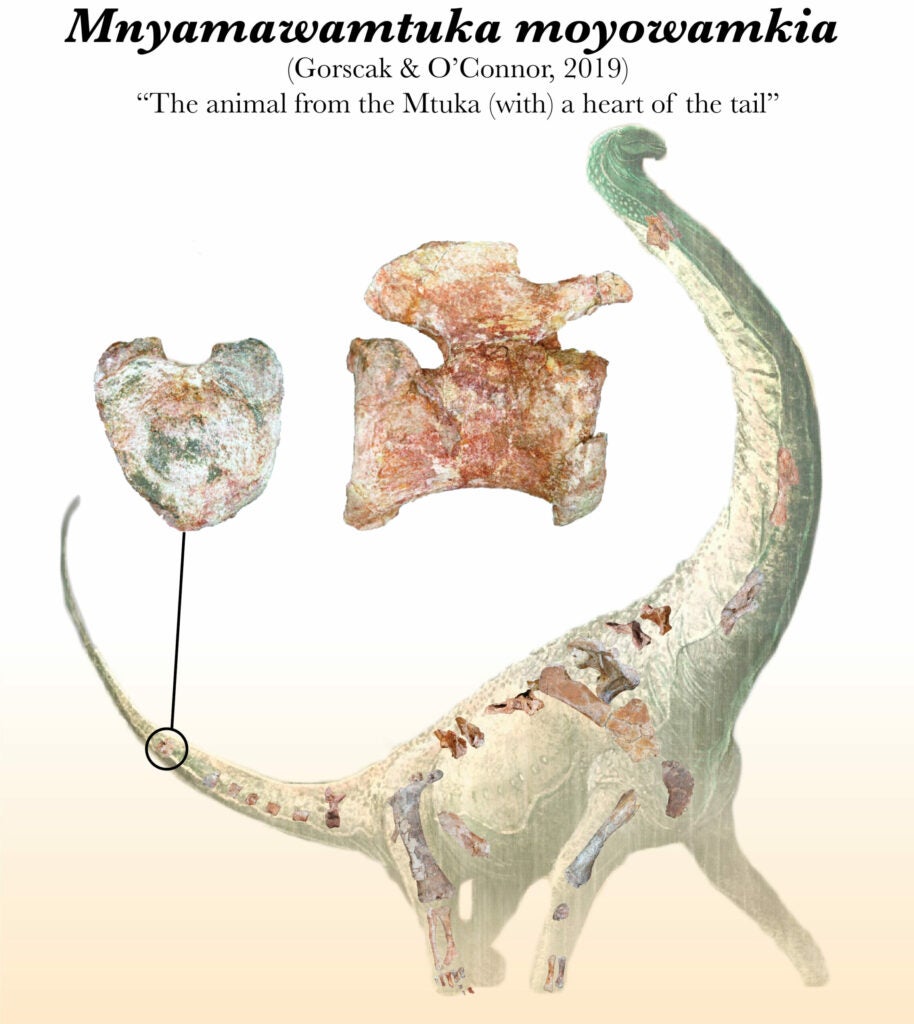
An artist’s impression of the new titanosaur and its heart-shaped bones
Mark Witton
So, telescopes could spot exoplanets in their own versions of the Phanerozoic era, scientists say. The atmospheres of such planets would be rich in oxygen, like Earth's was then, and would likely have two pairs of biosignatures — oxygen and methane and ozone and methane, which are easily identifiable by a telescope, the new study finds.
"The Phanerozoic is just the most recent 12% or so of Earth's history, but it encompasses nearly all of the time in which life was more complex than microbes and sponges," Rebecca Payne , the study's lead author and a scientist at Cornell University, said in the statement. "These light fingerprints are what you'd search for elsewhere, if you were looking for something more advanced than a single-celled organism."
Scientists are also excited by the hypothesis that an exoplanet that has an atmosphere with 30 percent oxygen may indicate it hosts life beyond just microbes, perhaps "creatures as large and varied as the megalosauruses or microraptors that once roamed Earth."
"Hopefully we'll find some planets that happen to have more oxygen than Earth right now, because that will make the search for life just a little bit easier," said Kaltenegger. "And, who knows, maybe there are other dinosaurs waiting to be found."
This research is described in a paper published in October in the journal Monthly Notices of the Royal Astronomical Society.
A European Space Agency satellite has detected a mysterious glow coming from Mars. Measured in the visible spectrum with the NOMAD-UVIS instrument on board the European Space Agency (ESA) Trace Gas Orbiter (TGO) satellite, the unexpected glow emanates from the night side of Mars and was observed in the planet’s upper atmosphere.
A similar glow was witnessed by the same research team using a satellite orbiting Venus. Like that visible light signal, the researchers believed the mysterious glow coming from Mars resulted from oxygen interacting with the planet’s upper atmosphere. That’s mainly because they also saw a similar mysterious glow coming from Mars, only in the daytime.
“Back in 2020, we were already able to detect the presence of a green emission between 40 and 150 km in altitude, present during the Martian day,” explained Jean-Claude Gérard, a planetologist at the Laboratory for Planetary and Atmospheric Physics (LPAP) at the University of Liège (BE), where the research team was headquartered. “This was due to the dissociation of the CO2 molecule, the main constituent of the atmosphere, by ultraviolet solar radiation”.
However, the researchers soon discovered that this unexpected mysterious glow coming from Mars was originating from the nighttime side. They also figured out it was caused by something else entirely.
“This emission is due to the recombination of oxygen atoms created in the summer atmosphere and carried by the winds towards the high winter latitudes,” explained Lauriane Soret, a researcher at LPAP.
Once at higher altitudes, the atoms recombine with CO2 molecules when they come in contact. This reaction, the researcher explains, produces an oxygen molecule “in an excited state” that relaxes, causing it to emit light “in the visible range.”
MYSTERIOUS GLOW COMING FROM MARS COULD PROVIDE CRITICAL EVIDENCE ABOUT THE PLANET’S SEASONS
The researchers say they discovered the glow by reorienting the UVIS-NOMAD instrument on the ESA’s Mars Trace Gas Orbiter (TGO) satellite so it could scan the atmosphere on its edge. They quickly detected the light emissions, which appeared to be concentrated over the polar regions of the red planet. According to the announcement of the discovery, “the oxygen atoms converge in the downward branch of the gigantic trajectory from the opposite hemisphere.”
Illustration of the dissociation of CO2 molecules in the summer atmosphere and the transport of oxygen atoms to the winter polar regions.
CREDIT: @ESA
Now that they know what to look for, Soret says their study will be continued during the TGO mission, hoping it “will provide us with valuable information about the dynamics of the Martian upper atmosphere and its variations over the course of the Martian year.”
ANOTHER MYSTERIOUS LIGHT EMISSION SPOTTED IN THE ULTRAVIOLET RANGE
In their published research, which appears in the journal Nature Astronomy, the team says that along with the mysterious glow coming from Mars in the visible light range, they have also spotted a glow in the ultraviolet range. That glow, they believe, is not caused by oxygen but something else entirely.
“We have noticed that another ultraviolet emission due to the nitric oxide (NO) molecule is also observed by UVIS in the same regions,” said Soret. “Comparing the two emissions will enable us to refine the diagnosis and identify the processes involved.”
Fellow researcher Jean-Claude Gérard adds that these “unexpected and interesting” observations will also likely help guide future missions to the red planet. The researcher even points out that future missions could carry cameras to capture images of the glow for all to see.
“The intensity of the night glow in the polar regions is such that simple and relatively inexpensive instruments in Martian orbit could map and monitor atmospheric flows,” he concludes, noting that the glow is bright enough “to be observable during the polar night by future astronauts in orbit or from the Martian ground.”
Christopher Plain is a Science Fiction and Fantasy novelist and Head Science Writer at The Debrief. Follow and connect with him on X, learn about his books at plainfiction.com, or email him directly at christopher@thedebrief.org.
Astronomers Directly Detect Atomic Oxygen on Venus
Astronomers Directly Detect Atomic Oxygen on Venus
tomic oxygen is produced on the dayside of Venus by photolysis of carbon dioxide and carbon monoxide.
Atomic oxygen is a key species in the mesosphere and thermosphere of Venus. It peaks in the transition region between the two dominant atmospheric circulation patterns, the retrograde super-rotating zonal flow below 70 km and the subsolar to antisolar flow above 120 km altitude. However, past and current detection methods are indirect and based on measurements of other molecules in combination with photochemical models. Hübers et al. show direct detection of atomic oxygen on the dayside as well as on the nightside of Venus by measuring its ground-state transition at 4.74 THz.
Image credit: Mattias Malmer / NASA.
Venus is known to rotate very slowly, with one day on Venus lasting the equivalent of 243 Earth days.
Atomic oxygen, a key species in the mesosphere and thermosphere of Venus, is produced on the dayside of the planet by the breakdown of carbon dioxide and carbon monoxide, and then transported to the nightside.
Atomic oxygen is important for the photochemistry and energy balance of Venus’s atmosphere, but it has not yet been directly observed on the dayside of Venus.
Nightside detections have previously been limited to observations of the night airglow of Venus, a faint emission of light by the planetary atmosphere.
In a new study, Dr. Heinz-Wilhelm Hübers, a researcher at the Deutsches Zentrum für Luft- und Raumfahrt and the Humboldt-Universität zu Berlin, and his colleagues analyzed a total of 17 points on both Venus’ dayside and nightside using the German Receiver for Astronomy at Terahertz Frequencies (upGREAT) array spectrometer on board NASA’s Stratospheric Observatory for Infrared Astronomy (SOFIA) airplane.
“The observations were made in the early evenings of November 10, 11 and 13, 2021,” they said.
“In total, 17 positions on Venus have been measured: seven on the dayside, nine on the nightside and one at the terminator.”
The researchers detected atomic oxygen at all observed points and found it to be concentrated at altitudes of around 100 km.
The measurements were based on an atomic oxygen ground state fine structure at 4.74 Terahertz.
They also found variations in the column densities, with a maximum density recorded on the dayside.
“The observed average Venus continuum brightness temperature is approximately 246 K corresponding to an altitude of about 65-70 km right above the cloud layer,” they said.
“The temperature of the atomic oxygen is approximately 156 K on the dayside and approximately 115 K on the nightside, which corresponds to altitudes around 100 km.”
“Future observations, especially near the antisolar and subsolar points but also at all solar zenith angles, will provide a more detailed picture of this peculiar region and support future space missions to Venus such as NASA’s DAVINCI mission or ESA’s EnVision mission,” they added.
“Along with measurements of atomic oxygen in the atmospheres of Earth and Mars these data may help to improve our understanding of how and why Venus and Earth atmospheres are so different.”
The findings were published in the journal Nature Communications.
HW. Hübers et al. 2023. Direct detection of atomic oxygen on the dayside and nightside of Venus. Nat Commun 14, 6812; doi: 10.1038/s41467-023-42389-x
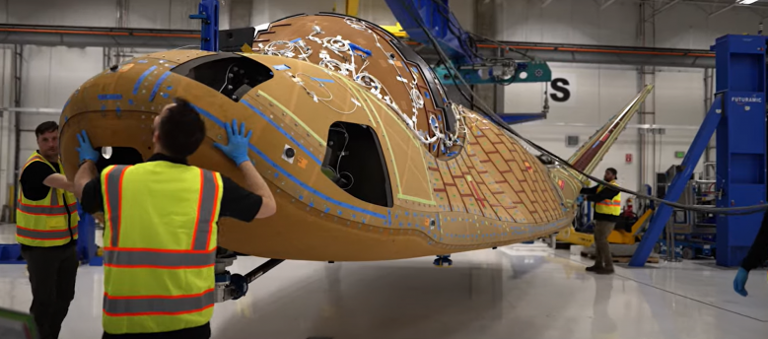
De bouw van Tenacity is voltooid. Dit ruimtevaartuig van Sierra Space gaat goederen van en naar het ISS vervoeren en kan bij terugkomst landen op een landingsbaan.
Het internationale ruimtestation (ISS) – en de toekomstige opvolger – moeten continu bevoorraad worden. Daarvoor zijn er momenteel meerdere ruimtevaartuigen beschikbaar, zoals Northrop Grummans Cygnus en de H-II Transfer Vehicle van de Japanse ruimtevaartorganisatie.
Soms moet er ook materiaal terug naar de aarde worden gestuurd, maar de meeste bevoorradingsvaartuigen zijn daartoe niet in staat. Space X’s Dragon is een van de weinige die dat wel kan, en landt bij terugkomst in zee. Het Amerikaanse bedrijf Sierra Space komt nu met Tenacity, een ruimteschip dat bij terugkomst als een soort vliegtuig kan landen op een landingsbaan.
Spaceshuttle
Vorige week maakte Sierra Space bekend dat de bouw van Tenacity is afgerond en dat het ruimtevliegtuig in de komende weken wordt verscheept naar NASA’s Neil A. Armstrong Test Facility in Ohio voor milieutests.
Hoewel Tenacity momenteel het enige ruimtevaartuig is dat zijn ruimtereis kan eindigen op een landingsbaan, konden NASA’s spaceshuttles die in 2011 met pensioen gingen dat ook al. Niet gek dus dat het uiterlijk van de Dream Chaser sterk lijkt op dat van de spaceshuttle
Een ruimteschip dat de atmosfeer binnenkomt, heeft naast extreme hitte (ruim 1600 graden) ook te maken met een enorme versnelling en dus hoge g-krachten. Toch kan Tenacity die krachten beperken tot anderhalf keer de zwaartekracht (1,5 g), wat schade aan kwetsbare lading kan voorkomen. De vleugels spelen hierbij een belangrijke rol; ze creëren lift.
Bij een vliegtuig zorgt liftkracht ervoor dat het toestel in de lucht blijft en bij Tenacity dat het toestel afremt.
Eerste missie is al snel
Sierra Space heeft een contract met NASA voor de lancering van bevoorradingsmissies van het ISS met Dream Chaser-toestellen. En de eerste missie zou al ergens april 2024 kunnen beginnen.
De lancering zal dan plaatsvinden vanaf NASA’s Kennedy Space Center in Florida aan boord van United Launch Alliance’s nieuwe Vulcan Centaur-raket. Bij terugkomst zal Tenacity landen op NASA’s Shuttle Landing Facility, waar de spaceshuttles vroeger ook landde. Daarna kan het ruimteschip opnieuw worden gelanceerd, volgens Sierra Space heeft de Dream Chaser namelijk een levensduur van minstens vijftien missies.
Autonome bevoorradingsmissies zijn slechts het begin voor de Dream Chaser-toestellen. In de toekomst wil Sierra Space ook mensen vervoeren met het vaartuig.
Bekijk hieronder een animatie van een lancering en landing van het ruimtevliegtuig:
The Webb Telescope Reveals a Spooky, Skeletal View of a Nearby Galaxy This image of the Southern Pinwheel Galaxy is the ultimate galactic Halloween skeleton. BY KIONA SMITH NOVEMBER 8, 2023
This image of the Southern Pinwheel Galaxy is the ultimate galactic Halloween skeleton.
The Webb Telescope Reveals a Spooky, Skeletal View of a Nearby Galaxy
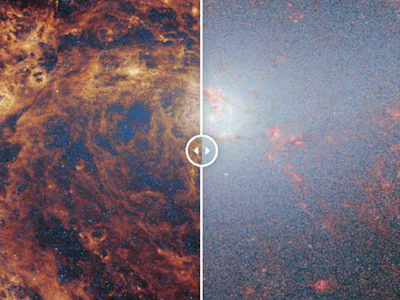
The James Webb Space Telescope (JWST) captured two views of the Southern Pinwheel Galaxy, revealing that galaxies — like ogres and onions — have layers.
So much is invisible to us because our eyes can only see light in a narrow band of wavelengths, between 0.38 and 0.75 micrometers (a micrometer is one-thousandth of a millimeter). But JWST’s instruments perceive the universe in much longer wavelengths called infrared. In infrared, we can see into (and through, depending on the specific wavelengths of light involved) the clouds of gas and dust that block shorter light waves, like visible light. That helps astronomers peel back the layers of a galaxy like the Southern Pinwheel, 15 million light-years away, and see the galaxy’s structure in a whole new light.
WHAT DO GALAXIES LOOK LIKE ON THE INSIDE?
By matching visible colors to each wavelength of infrared light, image processors turned NIRCam data into this stunning image.
ESA
JWST’s Near InfraRed Camera (NIRCam) shows M83 in light wavelengths between 0.6 and 5 micrometers long. The image looks staticky and pixellated, but all those tiny specks of static radiating out from the blue-white center of the galaxy to fill the image are actually billions of stars. Those densely-packed stars are mostly older; their younger neighbors show up as patches of bright blue nestled in the reddish threads of gas that trace the galaxy’s spiral shape.
Powerful stellar winds and radiation from those young, temperamental stars have blasted the nearby gas clouds, stripping electrons away from hydrogen atoms and leaving the ionized gas glowing in bright pink.
If you’re located near or south of the Equator, you can spot the Southern Pinwheel Galaxy in the night sky with a good pair of binoculars, but it won’t look anything like this MIRI image.
ESA
In even longer wavelengths of light, from 6.6 to 8.7 micrometers long, JWST’s Mid InfraRed Instrument (MIRI) sees the dusty scaffolding of the galaxy in shades of yellow, orange, and red — and this is where it gets weird. The darker reds and oranges are organic molecules called polycyclic aromatic hydrocarbons. These molecules form when carbon and other elements bond with the ionized hydrogen in the pink clouds NIRCam revealed.
Yellow tendrils in the dust clouds, where new stars are in the process of forming, trace the galaxy’s familiar spiral shape. The core of the galaxy blazes brightly with its dense population of stars.
To compare these two views of the same galaxy, visit ESA’s website and move the slider and back and forth. Can you spot any of the same features?
On the European Space Agency’s website, you can move a slider back and forth to compare the images; make sure to notice how the bright pink areas of ionized hydrogen in the NIRCam image line up with the bright yellow stellar nurseries in the MIRI version. It’s also worth taking a moment to compare what the galaxy’s bright core looks like in the different infrared wavelengths.
Some of the Moon's Craters are From Interstellar Impacts. Can We Tell Which?
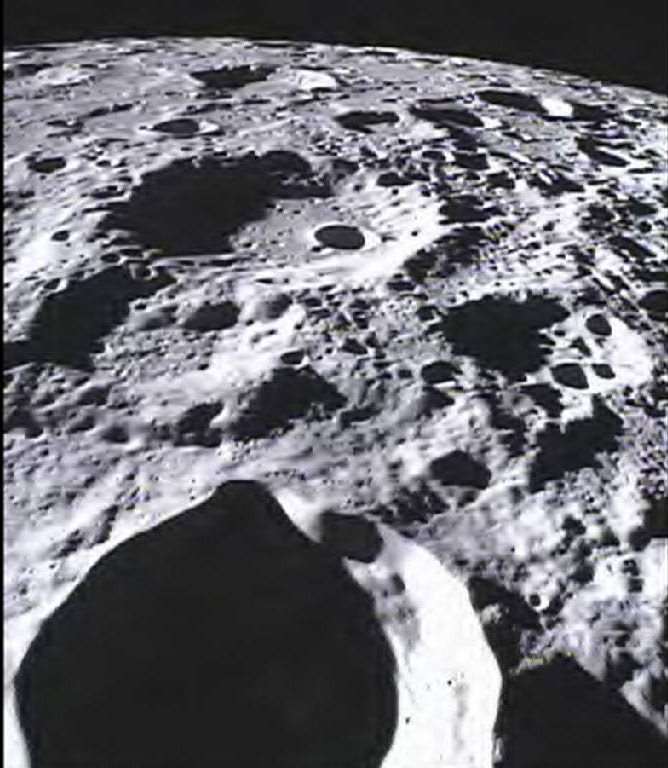
Far Side of Moon Imaged by MoonKAM. This image of the lunar surface was taken by the MoonKAM system onboard NASA’s Ebb spacecraft on March 15, 2012. Credit: NASA/Caltech-JPL/MIT/SRS
Some of the Moon's Craters are From Interstellar Impacts. Can We Tell Which?
By discovering two interstellar objects (ISOs), we know that asteroids and comets from other star systems pass through the Solar System from time to time. By inference, some of these must have crashed into the Moon, creating impact craters. If we could study the impact sites, we might be able to learn about the star systems that they came from.
A new paper suggests there could be a way to determine which lunar craters came from interstellar object impacts. The authors say that young, small craters with high-melt volume near the Moon’s equator are likely the best candidates for ISO-generated craters on the lunar surface.
The two landmark discoveries of ISOs have changed our thinking on what’s possible for the origins of objects in our Solar System. Detecting the cigar-shaped body named ‘Oumuamua (2017) and the speedy rogue Comet 2I/Borisov (2019) suggest that these objects — which have somehow been ejected from other solar systems — can wander through the Milky Way, unattached to any star system, for hundreds of millions of years. Astronomers say their detections – made possible by improved telescopes and observing techniques — implies a large population of such objects exist and that ISOs enter our Solar System on a fairly regular basis. Estimates have ranged from one, to seven, to twenty-one and even seventy objects every year.
“We find that selecting young, small craters with a high volume of melt located away from the lunar poles increases the likelihood of association with a high-speed ISO by 100-fold as compared to selecting randomly, assuming high-speed ISO impacts generate melt,” the authors wrote.
Figure 1. (a) shows the difference between the cumulative distribution functions of craters generated from solar system objects and ISOs. Most craters generated from solar system objects were formed in the first billion years, so that the ratio of the CDFs for craters with ages less than 3?Gyr is ?20. (b) shows the cumulative probabilities of impact angles at various latitudes on the Moon for Near Earth Objects, calculated from the probability found in (Robertson et al. 2021). For latitudes 0° through 70°, there is a <10% probability that the crater is generated from vertical impact, while the probability is much higher at around 40% for latitudes 70°–90°. Credit: Daniel Chang, Cheng-Han Hsieh, and Gregory Laughlin.
Most craters on the surface of planetary bodies in our Solar System were formed during the first heavy bombardment period about 4 billion years ago. Therefore, since about 95% of lunar craters were formed during the first billion years of the Moon’s existence, and assuming a constant ISO flux, the scientists write that selecting young craters (<3?Gyr) “increases the probability of ISO association by a factor of 20 as compared to selecting randomly.”
Among that selection, the next criteria would be to search for craters formed from high-velocity impactors. This would be craters with diameter less than 300?m with visible high-impact melt pond. Impact melt is exactly what its name implies: surface rocks that were instantly melted due to a high-velocity impact from an asteroid or comet. Large volumes of impact melt can pool to form what’s known as crater-fill deposits, which over time hardens to form an entirely new rock.
Craters with impact melt ponds accounts for 15% of the crater population. Then, the authors say, discard all the craters that appear to be created by vertical impact and choose craters that nearer to the equator.
“In total, selecting craters that fit these constraints [crater age, size, melt, and latitude] results in a 100 times higher probability of association with a high-speed ISO as compared to selecting randomly,” the authors write.
But, they note, no one should expect that a large number of lunar craters are the result of ISO impacts, since “craters from other sources, however, still massively outnumber ISO-generated craters.”
What? Wow! That New Asteroid Image from Lucy Just Got Even More Interesting
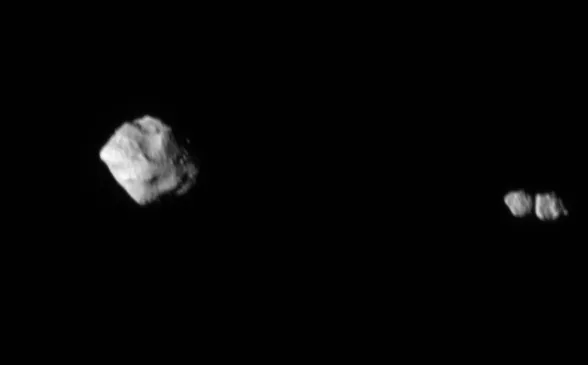
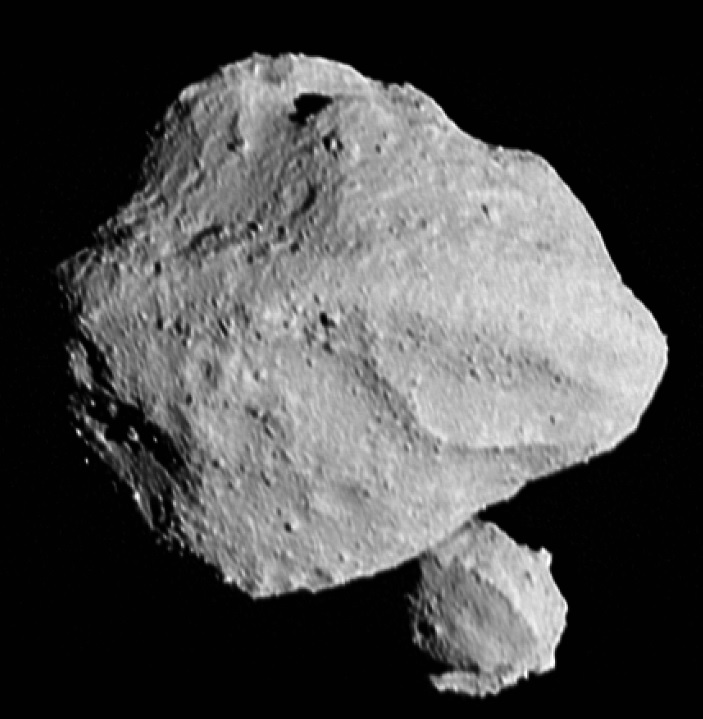
Lucy’s images of asteroid Dinkinesh are the gift that keeps on giving. First, it was the discovery of a smaller companion. Now, it turns out that the companion itself is a contact binary. That’s two smaller objects touching each other as they orbit with Dinkinesh. So, how did they get that way?
NASA describes the companion as “unanticipated”, although according to Lucy project scientist John Spencer, they’re actually pretty common in the solar system. “We just haven’t seen many up close, and we’ve never seen one orbiting another asteroid,” he said.
Spencer and the team thought there might be something odd about Dinkinesh, given that it was showing some pretty strange brightness variations as the spacecraft got closer. “It gave us a hint that Dinkinesh might have a moon of some sort, but we never suspected anything so bizarre!”
Dinkinesh itself is an interesting target and part of Lucy’s target population of Jupiter Trojan asteroids. It orbits in the Main Asteroid Belt at an average distance of 2.1 AU. Jupiter Trojans make up a distinct population of asteroids trapped in Jupiter’s orbit. They date back to the origins of the Solar System and can provide insight into conditions that existed some 4.5 billion years ago.
Hints About Asteroid Moons
As news of the images spread across the Internet, people began commenting about “moon-moons” to describe Dinkinesh’s companions. One comment on X, by Michigan State University planetary scientist Seth Jacobson, referenced his 2011 thesis work. It focused on modeling similar systems, and even before that, interest in these systems was not new. Understanding what causes such “kissing asteroids” as the Dinkinesh moons, requires a great deal of observation. That’s what Lucy’s doing now.
Jacobson looked at “rotationally fissioned” asteroids, which form when two bodies “fission” as they reach a certain limiting rotational speed. That is, they slowly move apart, but appear tidally locked together. His 2011 paper looked at ideal cases of these objects as sources of then-current observations of small systems.
The work focused on so-called “rubble pile” asteroids and their physical characteristics and gravitational interactions. It involves looking at near-Earth asteroid evolution via something called the YORP (Yarkovsky–O’Keefe–Radzievskii–Paddack) effect. The Yarkovsky part of the effect basically describes how orbits of small asteroids are changed by a tiny amount of thrust created as sunlight re-radiates off their uneven surfaces. Since the amount of thrust is so small, it takes a long time to make big changes in the orbit. The effect also changes an asteroid’s spin rate, albeit slowly. The additional factors (added by other researchers looking into the effect) include any possible effects on asteroid orbits and obliquities. This happens to individual asteroids as well as floating rubble piles, with each piece being affected as well as the aggregate.
So, in addition to collisions that shape asteroids, sunlight, and gravitational effects contribute to their evolution. And, in the case of the recent Lucy images, we see direct evidence of that.
Kissing Asteroid Moons
So, how does this relate to Dinkinesh’s moon-moons? They definitely look like a contact binary. Over time, they rotated into place together, at least partly driven by the YORP effect. The end result is two moons looking as if they’re “kissing” each other after incident solar radiation and re-radiation drove them together in a long dance. Are they actually touching? Or simply moving together very closely in a rubble pile? If they are simply very close to each other in a mutual gravitational headlock, then perhaps rotational fission played a role.
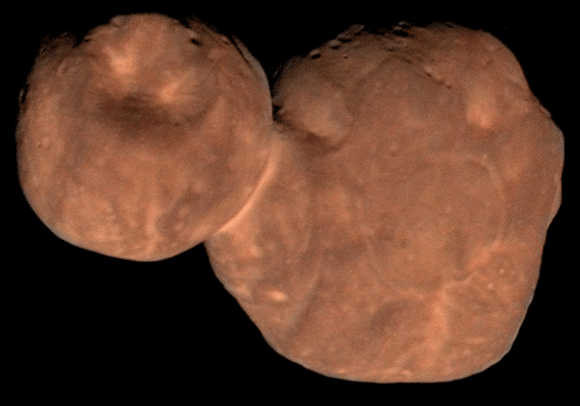
This composite image of the primordial contact binary Kuiper Belt object 2014 MU69 (officially named Arrokoth) was compiled from data obtained by NASA’s New Horizons spacecraft as it flew by the object on Jan. 1, 2019. The image combines enhanced color data (close to what the human eye would see) with detailed high-resolution panchromatic pictures. Credits: NASA/Johns Hopkins University Applied Physics Laboratory/Southwest Research Institute//Roman Tkachenko
We’ve seen similar bodies in the solar system, including the strangely shaped Arrokoth in the Kuiper Belt. It’s a contact binary that appears to be doing more than kissing. The two lobes look almost welded together around a narrow “neck”. They probably merged together after getting locked together in a gravitational (tidal) dance. Unlike Dinkinesh’s companions, Arrokoth’s two lobes are not the same size.
Why Dinkinesh?
Dinkinesh is about 790 meters across, and its moon-moons are much smaller and don’t yet have names. This asteroid is part of Lucy’s larger mission to survey Jupiter Trojan asteroids. Interestingly, Dinkinesh was added into the mission timeline as a targeting and tracking test. The spacecraft’s systems not only did that, but also provided excellent imaging over time to give multiple views of this asteroid and its moons from different perspectives.
The results look intriguing for now, giving planetary scientists a lot to chew on. “It is puzzling, to say the least,” said Hal Levison, principal investigator for Lucy. “I would have never expected a system that looks like this. In particular, I don’t understand why the two components of the satellite have similar sizes. This is going to be fun for the scientific community to figure out.”
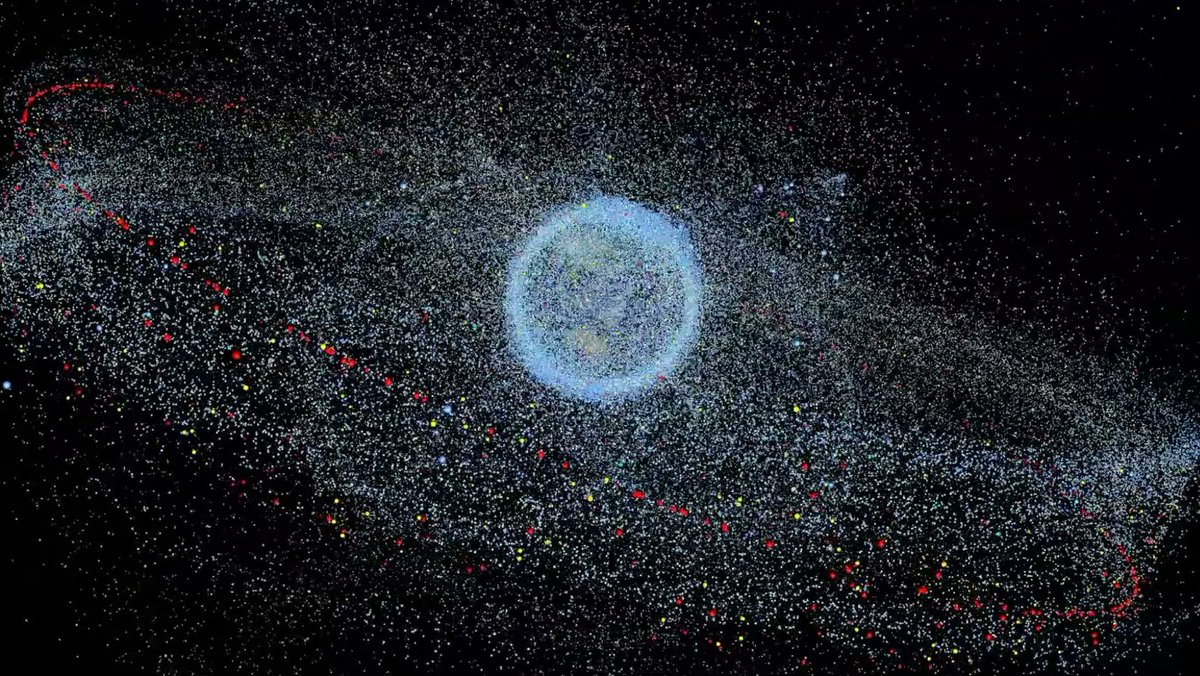
This image from the ESA's MASTER (Meteoroid and Space Debris Terrestrial Environment Reference) risk-assessment tool shows the dangerous debris orbiting Earth. Image Credit: IRAS/TU Braunschweig
What can we do about space junk? We know how much debris is in orbit, and we know the problem is getting worse. It’s our fault.
Our Earth now has a halo of orbital debris, and the ESA has a plan to stop contributing to the problem.
You can only kick a can down a road for so long before you’re tripping over all the cans. While politicians seem particularly adept at kicking them into the future and then blaming the other side when we’re ankle-deep in pesky cans, people in scientific pursuits don’t have the same luxury of intellectual dishonesty.
“Behaviours in space have to change.”
-ESA
We’re all aware of the space debris problem, and we know it’s getting worse. We’ve been launching satellites at an increased pace in the last few years. When combined with all of the satellites launched in prior decades, the result is a congested area that’s getting more crowded by the month. And like empty cans kicked into the future, many of the objects in orbit are no longer functioning or serving any purpose. They’re just there. If only someone had seen this coming.
But at least the ESA is committing to a plan to stop putting more debris in space.
“130 million pieces of space debris larger than a millimetre orbit Earth, threatening satellites now and in the future,” the ESA writes. “Once a week, a satellite or rocket body reenters uncontrolled through our atmosphere. Behaviours in space have to change.”
There’s not much of an argument that things need to change. But in an international world where not all countries want to cooperate and where private companies are responsible for a growing amount of stuff in space, change is tricky.
The ESA is setting a new standard for itself. They call it the “Zero Debris Approach.”
The space debris problem isn’t something that exists down the road. In 2009, two satellites collided over Siberia. One was defunct, but one was active. Besides destroying an active Iridium satellite, the collision created a whole bunch more debris. Perhaps the most troubling part is that the collision was predicted. In fact, of all the satellites that come close to each other, these two weren’t even in the top 200 satellites in dangerous proximity to one another.
“Arguably, the best approach is adopting practices that prevent creating debris in the first place,” an article in American Scientist said at the time.
There’s also the growing risk that even without any additional launches, collisions between existing debris will still make the problem worse. “It has been estimated that even in the case of no further launches into orbit, collisions among the existing space objects can lead to further growth in space debris population,” the ESA writes. The worst possible outcome is the Kessler syndrome, where collisions produce more debris that leads to a growing cascade of collisions that ultimately makes Earth orbit unusable.
American astrophysicist Donald Kessler predicted the Kessler syndrome back in 1978. In 2012, he co-authored an article saying that we’re already passed the tipping point for orbital debris. “That runaway debris generation scenario, often called the Kessler syndrome, may seem far off,” the article said. “But in fact, the sheer density of derelict objects in orbit has already exceeded what many consider to be the mathematical point of no return.”
This illustration depicts the Kessler Syndrome, named after American astrophysicist Donald Kessler. In 2012, Kessler co-authored an article warning that we’re already at the tipping point. Image Credit: ESA
There’s lots of talk about developing systems to remove existing space debris, especially larger pieces like intact satellites. There’s talk of harpoons, robotic arms, and even using other satellites to move debris into graveyard orbits. But there’s not much action to stop adding more debris.
Now, here we are, almost 15 years since the collision, and at least the ESA got the message.
“We are seeing a dramatically increased use of space, but still insufficient technology to prevent the risks that follow. Our aim to become debris neutral in just a few years will require clearing precious Earth orbits once a mission is complete, and if the mission fails to do this, it must be actively removed by dedicated vehicles,” explains Holger Krag, ESA’s Head of Space Safety.
This figure shows the amount of debris in space and what type it is. Image Credit: ESA
Krag likens it to the backcountry hiker’s motto: pack out what you pack in. “We are aiming for rules that compare to every national park on Earth – what you bring in, you must take with you when you leave.”
The ESA’s Zero Debris Approach starts with mission design. In 2022, the ESA undertook a large study involving all of their sites across Europe as well as 270 experts from industry, governmental agencies and academia. The study produced recommendations to help the ESA reach Zero Debris by 2030. The recommendations form the basis of the recently published ‘ESA Space Debris Mitigation Requirements.’
Here are the eight recommendations in the document:
Guarantee successful disposal
Improve orbital clearance
Avoid in-orbit collisions
Avoid internal break-ups
Prevent the intentional release of space debris
Improve on-ground casualty risk assessment
Guarantee Dark and Quiet skies
Beyond the protected regions (This includes GNSS constellations and lunar orbits.)
That’s a pretty comprehensive list, and it should be. We rely heavily on satellites, but many of us never think about them. They’re an important structural element in modern society.
“As space infrastructure has become the backbone of our modern society, the proliferation of space debris is threatening our way of life. Now is the time to act as a community to channel our collective efforts,” said ESA Director General Josef Aschbacher. “To implement the Zero Debris Charter, ESA will focus on developing ground-breaking technologies for satellite end-of-life disposal, in-orbit servicing and active debris removal. In addition, ESA will work hand-in-hand with institutions in charge of regulatory aspects.”
So, where are the rest of the world’s space agencies on this issue? NASA has made lots of statements about ‘limiting’ orbital debris and even has an office dedicated to the problem. But they haven’t taken the same type of bold step the ESA has.
China? They’re working on ways to de-orbit space junk successfully. But again, no bold, clear language commitment. ISRO? India’s set up a Centre for Space Debris Research, but they’ve made no promises about not adding to the problem.
How about Russia? Does what’s left of Roscosmos’ corpse have any plans? They make all kinds of statements, but nobody believes them. Especially since they keep messing with everyone else’s satellites.
You’ve gotta hand it to the ESA. Even though they’re an organization made up of 22 separate nations, they’ve come together and are the ones leading the charge on this issue.
NASA benadrukt een ongelooflijke foto van de Krabnevel gemaakt door de James Webb
NASA benadrukt een ongelooflijke foto van de Krabnevel gemaakt door de James Webb
NASA benadrukt een ongelooflijke foto van de Krabnevel gemaakt door de James Webb (NASA, ESA, CSA, STScI; Tea Temim (Princeton University) // NASA – APOD)
Op de afbeelding is de Krabnevel, officieel gecatalogiseerd als M1, in al zijn pracht te zien dankzij de geavanceerde infraroodcamera’s van de James Webb, waarbij de helderheid, de wolk en de gefragmenteerde restanten van de explosie van een massieve ster in 1054 worden benadrukt.
In het midden bevindt zich een van de meest ongelooflijke objecten die astronomen kennen, de Krabpulsar, een neutronenster die ongelooflijk 30 keer per seconde draait en zichtbaar is als een helder punt.
De Krabnevel staat bovenaan de lijst van de 18e eeuw van Charles Messier, samengesteld uit hemellichamen die geen kometen zijn.
ESA is Testing a Modular Multipurpose Rover that Could Be a Science Lab or a Tiny Bulldozer
Most rovers have been built for Mars, and each one of them is a complex machine designed with specific goals and terrains in mind. But the Moon is different than Mars. We’re not searching for life there; we’re trying to establish a presence.
In recognition of the difference, the ESA is developing modular rovers that can serve different needs with only small modifications.
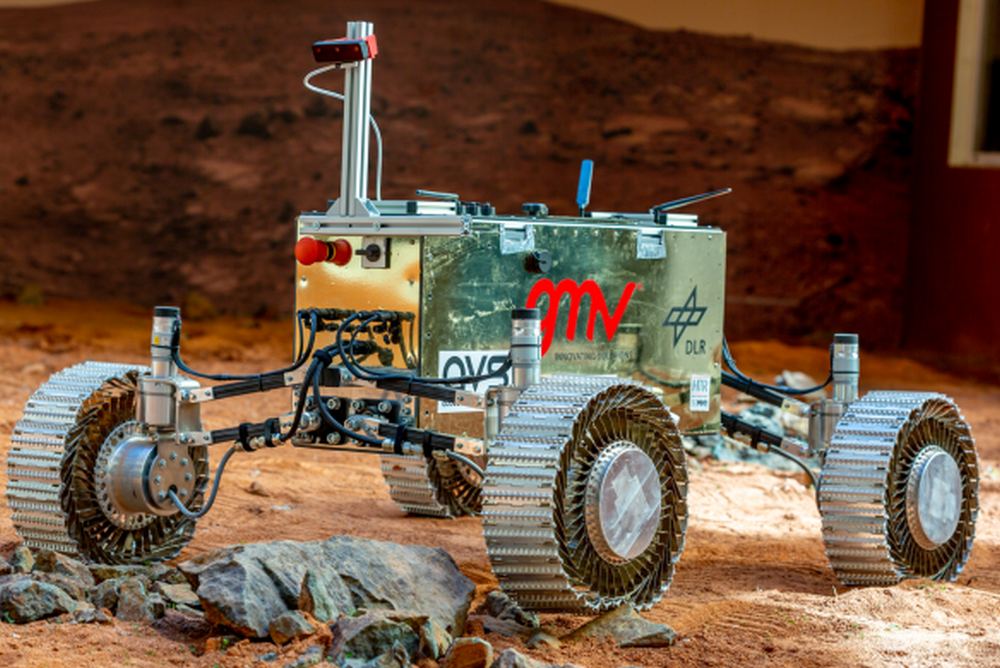
It’s called the European Moon Rover System (EMRS), and its goal is to “develop a versatile surface mobility solution for future lunar missions,” according to newly published papers. The surface mobility systems will serve four upcoming ESA missions: the Polar Explorer (PE), In-Situ Resource Utilization (ISRU), Astrophysics Lunar Observatory (ALO) and Lunar Geological Exploration Mission (LGEM).
Each of the four missions has specific requirements, including placing scientific instrumentation at the lunar south pole, excavating and transporting over 200 kg (440 lbs) of regolith, building an astrophysical observatory on the far side of the Moon, and studying the Moon’s volcanic history. The ESA is developing a rover that uses modularity to meet each goal rather than a completely different rover.
The new modular lunar rover design will have to move lunar regolith as part of building the Astrophysics Lunar Observatory. This image shows the test rover with its bulldozer blade attached during testing. Image Credit: ESA
“To achieve this, a modular approach has been adopted for the design of the platform in terms of locomotion and mobility, which includes onboard autonomy,” the paper explains.
There are obvious benefits to modularity and its offshoot, redundancy. Modular payloads can be used more advantageously for the specific mission at hand. They can also be removed and added as the need arises and are less time-consuming to work on and develop. And if one rover is out of commission for some reason, payloads can be swapped according to changing priorities.
When it comes to mobility, the new rovers will rely on Adaptable Wheels for Exploration (AWE) designed by Hellenic Technology of Robotics (HTR). “Rover wheels play a pivotal role, especially given the challenging lunar surface conditions and regolith,” the paper states. There’s plenty of loose sand on the Moon, and AWE will supply enough traction. The wheels have caterpillar-style tracks on top of springs and a fixed internal hub. These wheels are remarkably flexible and will be tough enough to meet the mission’s requirements, including being built with materials that can handle the wild temperature swings on the lunar surface.
This figure shows the EMRS wheels developed by HTR. The image on the right shows them being tested on the rover prototype. Image Credits: ESA/HTR
The rover’s four wheels are just part of the mobility design. The steering system is just as important. There are two potential steering system designs: on-top steering and on-side steering. The ESA has chosen on-side steering partly because it’s more compatible with upper payload bay volume.
On-side steering allows for four different turning modes: Skid Steering, Ackermann Turn, Crab Turn, and Point Turn.
The steering system allows for four different turning modes: Skid Steering, Ackermann Turn, Crab Turn, and Point Turn. Image Credit: ESA
The suspension system will be a hybrid of passive and active, with an independent suspension for each wheel. “The independent, active suspension enables a wheel-walking mode, and coupled with the independent steering even a’ paddling’ mode,” the paper states. Paddling mode provides a safeguard in case the rover gets stuck in very soft terrain. Getting stuck in soft ground is one of the most challenging scenarios for conventional passive suspension systems.
The suspension design also allows for the rover’s stored configuration during spaceflight.
This schematic shows the rover’s suspension system is stowed (L) and normal configurations (R.) Image Credit: ESA
When it comes to the modular rover’s chassis, the design team proposes a strong and lightweight Carbon Fiber Reinforced Polymer (CFRP) design. The chassis will have four separate bays. The primary bay is common among all rovers and will hold the common avionics, thermal control systems, and power components. There will also be two side bays and a top bay, all able to hold different payloads.
This schematic shows the rover’s four payload bays. The grey one is the primary bay. The pink ones flanking the primary bay are lateral payload modules that can hold equipment needing access to the lunar surface, like drills or excavators. The green one on top is a configurable cargo bay. The image on the right shows the cargo bay carrying materials for the Astrophysics Lunar Observatory (ALO.) Image Credit: ESA
The rover will have onboard software (OBSW) that will allow it to drive autonomously. It’ll be able to detect and identify different obstacles and objects and determine its way through, around, or over them. “It also has manipulation capabilities, allowing it to perform ISRU tasks, manipulate tools, and scientific sampling,” the paper states. Astronaut time is valuable, and the more autonomous the rovers can be, the more time astronauts will have for other tasks.
The paper points out that rover modularity starts paying off well before a rover is ever deployed. “The modular design of our prototype provides a unique advantage by allowing us to evaluate the rover’s locomotion and software in tandem with a variety of scientific payloads,” it states. That’s extremely valuable since the payloads could variously consist of things like drills, bulldozer blades, spectrometers and cameras.
The modular rover design is still in the concept phase, though test models have been built and tested.
“A series of rigorous obstacle and excavation tests has been carried out, shedding light on the remarkable capabilities of the EMRS system configuration,” the paper states. “These tests not only demonstrate the rover’s ability to safely navigate lunar terrain but also underscore its proficiency in lunar regolith excavation.”
The ESA is developing some ambitious plans not only for lunar exploration but for a sustained human presence on the Moon. Rovers will be the workhorse for these activities, and the modular design should give the rovers an advantage.
We’ll find out in a few years when the ESA lands on the Moon.
The details of the EMRS design process are in two new papers:
Guys, take a deep breath, make sure you are very, very relaxed, because what I have to say is not the typical small talk. I was looking at a Gizmodo story that was about the asteroid Dinkinesh having not one, but two tiny moons orbiting it. But I noticed that the photos were over exposed...meaning they had too much light added on purpose to drown out the detail. So I added shadow and added focus then something awesome happened, I soon saw the two moons were actually two alien ships! And Dinky asteroid is actually has structures built into it, so it looks like an asteroid, but is really a space station or mother craft. Kinda mind-blowing. We don't need the gov to tell us what is and isnt real, we ourselves can research, enhance and discover the truth on our own. We already have mountains of factual pieces of evidence about UFOs and aliens existing in NASA photos themselves, I've been doing it over 20 years so I know.
JWST Detects Carbon Dioxide in a Centaur for the First Time
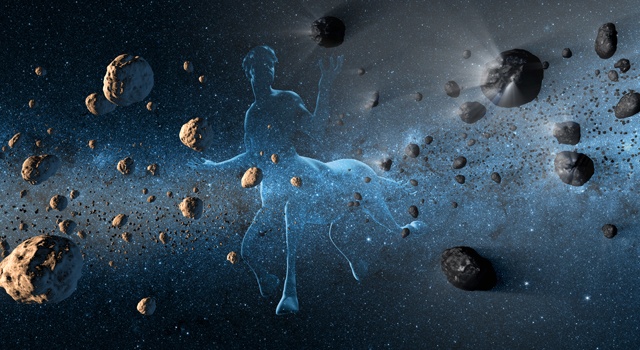
Centaurs are small planetary bodies that orbit between Jupiter and Neptune and have baffled astronomers for sharing characteristics with both asteroids and comets. Centaurs got their name after the mythical half-horse, half-human creatures called centaurs due to their dual characteristics. Above is an artist's illustration displaying a centaur creature among asteroids (left) and comets (right). (Credit: NASA/JPL-Caltech)
JWST Detects Carbon Dioxide in a Centaur for the First Time
A study published today in The Planetary Science Journal examines how NASA’s James Webb Space Telescope (JWST) has conducted a first-time detection of carbon dioxide in a Centaur, this one designated 39P/Oterma. A Centaur is a small planetary body that orbits between Jupiter and Neptune and frequently crosses the orbits of one or more of the gas giant planets within our solar system. While no Centaur has been imaged up-close, they typically exhibit a combination of attributes between comets and asteroids. While carbon monoxide has been detected in two known centaurs, this recent discovery could mark a turning point in how scientists understand the formation, evolution, and composition of not only Centaurs, but of the early solar system, as well.
“Centaurs are important to study since they are fairly well-preserved objects in space that can provide insight on the chemical composition and physical processes of the early solar system,” Study lead author, Dr. Olga Harrington Pinto, who is a postdoctoral researcher at Auburn University but conducted the research while a PhD student at the University of Central Florida, tells Universe Today.
Centaur 39P/Oterma was discovered on April 8, 1943, by Finnish astronomer, Dr. Liisi Oterma, who was the first woman to earn PhD in astronomy in Finland, along with being the first woman PhD of the faculty of sciences at Turku University. While 39P/Oterma has long been classified as an inactive comet, it currently exhibits a Centaur-like orbit between Jupiter and Saturn, meaning it doesn’t approach the Sun, and has a radius of approximately 2.21 to 2.49 km (1.37 to 1.55 mi), according to this study. So, why was 39P/Oterma chosen for this specific study?
“39P/Oterma is what we call an active centaur, a centaur that develops a coma and a tail like a normal comet,” Dr. Adam McKay, who is an assistant professor in the Department of Physics and Astronomy at Appalachian State University and a co-author on the study, tells Universe Today. “Since they are active, we can use spectroscopy to observe molecules in their coma to gain insights into their composition. 39P was chosen as one of our targets because it would be active during the time of the proposed observations.”
For the study, the researchers used JWST’s Near-Infrared Spectrograph (NIRSpec) instrument and was supported by ground-based observations from the Gemini North Observatory and Lowell Discovery Telescope to investigate the characteristics of 39P/Oterma while it was orbiting close to its perihelion (closest distance to the Sun) at 5.82 astronomical units (AU) from the Sun in July 2022. For context, the perihelion of 39P/Oterma has gradually increased since its discovery: 3.39 AU (1958), 5.47 AU (1983), and 5.71 AU (2023), and is projected to reach 5.91 AU and 6.15 AU in 2042 and 2246, respectively.
After analyzing the JWST NIRSpec data, the researchers confirmed the first detection of carbon dioxide in any Centaur, and the lowest amount of carbon dioxide ever detected in any Centaur or comet. They also did not detect traces of water or carbon monoxide, which are traditionally detected in Centaurs, specifically 29P/Schwassmann-Wachmann 1 (29P/SW1), another Centaur that shares approximately the same AU distance as 39P/Oterma.
“These results are important because they show that thanks to the impressive capabilities of JWST, we are able to see low production rates of a relatively small object that is very far away,” Dr. Pinto tells Universe Today. “And, though the production rates are low, it shows a different chemical behavior from another Centaur, 29P/SW1, seen at a similar distance (~6 AU). This difference in chemical behavior could be from the very different sizes of Centaurs 29P and 39P, or from having different orbital histories, or starting out with different compositions, or possibly a combination of all of these.”
The finding of carbon dioxide in a Centaur could be a gamechanger in terms of understanding the compositions and characteristics of Centaurs, asteroids, and comets throughout the solar system, along with potentially gaining better insight into the formation and evolution of the solar system, overall.
What new discoveries about Centaurs will researchers make in the coming years and decades and how many more Centaurs could possess carbon dioxide throughout the solar system? Only time will tell, and this is why we science!
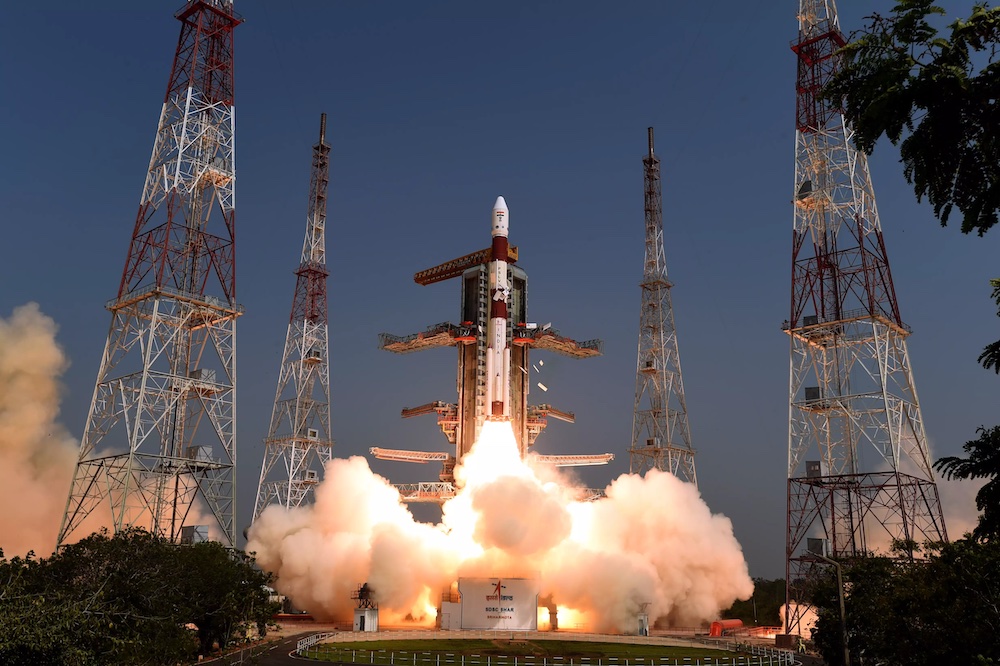
The Indian space program has been on a bit of a tear lately. Chadrayaan-3 was just the latest successful for the ISRO, India’s space agency, when it launched in July – especially juxtaposed with Luna-25, a Russian moon lander mission that launched around the same time and failed spectacularly by crashing into the Moon. Maybe in part due to the ISRO’s success, Indian Prime Minister Narendra Modi appears to have taken an increased interest in the program and recently chaired a meeting to review the Gaganyaan Mission, India’s first foray into crewed space flight. But while in the meeting, he suggested the country’s exploration goals should go further – much further.
Let’s start with the Gaganyaan mission itself. It’s hit a series of setbacks after initially being planned for launch in December 2020. Admittedly, some of those setbacks were caused by the pandemic, which hit India particularly hard. However, the program appears to be back on track, and the mission planners confirmed a launch in 2025, though this is slightly later than even the Wikipedia page for the missions says at the time of writing, and it was updated only in September.
Press releases from the PM’s office most likely overrules any Wikipedia site, so while the mission may be delayed until 2025, the testing leading up to it is still ongoing. A test of the Crew Escape System Test Vehicle, a critical component in modern-day human spaceflight systems, occurred successfully recently. Around 20 additional tests are planned over the next two years to ensure the mission’s success.
Fraser discusses India’s moon mission.
One key component of the new mission is the development of a Human Rated Launch Vehicle called HLVM3 by the ISRO. This is a modified version of the Launch Vehicle Mark 3, which has been the workhorse of ISRO’s satellite launching efforts since its first orbital flight back in 2017. However, launching humans is not the same as launching satellites, and much work needs to be done to ensure the safety of any future astronauts that might take a ride on this rocket.
That might seem like enough to keep the mission planners and engineers at ISRO busy for the foreseeable future. But PM Modi wants to aim higher – literally to the Moon in this case. He suggested sending an Indian astronaut to the Moon by 2040. Doing so in 17 years is feasible, especially considering the US did so in 9 with 1960s technology.
But the Moon won’t be the only stop for the ISRO. PM Modi also announced a plan to build a Bharatiya Antariksha Station – translated as “Indian Space Station” in the press release, by 2035. What exactly this station will entail and how it will fit with the wider plans for the Moon were not detailed in the press release. Still, assumedly, an orbital station will plan a key staging role for astronauts traveling to our nearest cosmic neighbor.
And about the success of that mission.
Human spaceflight isn’t the only kind, though, and ISRO will be busy in the robotic arena as well. Interplanetary missions were also mentioned by the PM, who took special note of a Venus Orbiter and Mars landers in his discussions during the meeting. Neither of those projects has yet garnered a name, so it’s unclear how much support they’ll have going forward. But if recent history is any indication, India will be adding plenty of new accomplishments to its portfolio of successful space missions in the near future.
Saturn's moon Enceladus isn't just bright and beautiful. It has an ocean under all that ice that has chemicals necessary for life. Image Credit: NASA, ESA, JPL, SSI, Cassini Imaging Team
Saturn’s ocean moon, Enceladus, is attracting increasing attention in the search for life in our Solar System. Most of what we know about Enceladus and its ice-covered ocean comes from the Cassini mission. Cassini ended its exploration of the Saturn system in 2017, but scientists are still working through its data.
New research based on Cassini data strengthens the idea that Enceladus has the chemicals necessary for life.
During its mission, Cassini discovered geyser-like plumes of water erupting through Enceladus’ icy shell. In 2008, Cassini performed a close-proximity flyby and analyzed the plumes with its Cosmic Dust Analyzer (CDA). The CDA showed that the water in the plumes contained a surprising mix of volatiles, including carbon dioxide, water vapour, and carbon monoxide. It also found trace amounts of molecular nitrogen, simple hydrocarbons, and complex organic chemicals.
The plumes of Enceladus have phosphate-rich ice grains entrained.Credit: NASA
The work centers on the discovery of ammonia and inorganic phosphorous in Enceladus’ ocean. The researchers used ecological and metabolic theory and modelling to understand how these chemicals could make Enceladus amenable to life. “Apart from speculating about threshold concentrations of bioactive compounds to support ecosystems, metabolic and ecological theory can provide a powerful interpretative lens to assess whether extraterrestrial environments are compatible with living ecosystems,” the authors explain.
A critical component of ecological theory is the Redfield ratio. It’s named after the American oceanographer Alfred Redfield. In 1934, Redfield published results showing that the ratio of carbon to nitrogen to phosphorous (C:N:P) was remarkably consistent across ocean biomass at 106:16:1. Other researchers found that the ratio shifted slightly depending on the area and the phytoplankton species present. More recent work refined the ratio to 166:22:1.
The exact numbers aren’t necessarily the critical point. Redfield’s conclusion is the vital part. The Redfield ratio shows a remarkable unity between the chemistry of living things in the deep ocean and the ocean itself. He proposed that there’s an equilibrium between ocean water and plankton nutrients that’s based on biotic feedback. He described a chemical framework for nutrients and simple life.
“Whatever its explanation, the correspondence between the quantities of biologically available nitrogen and phosphorus in the sea and the proportions in which they are utilized by the plankton is a phenomenon of the greatest interest,” Redfield said in the conclusion of his paper.
So, how does the discovery of ammonia and phosphorous in Enceladus’ ocean relate to the Redfield ratio and Enceladus’ biological potential?
This figure illustrates a cross-section of Enceladus, summarizing the processes SwRI scientists modelled in the moon in a 2020 study. Oxidants produced in the surface ice when water molecules are broken apart by radiation can combine with reductants produced by hydrothermal activity and other water-rock reactions, creating an energy source for potential life in the ocean. Image Credit: SwRI
The Redfield ratio is widespread all across the Tree of Life on Earth. “Because of this seeming ubiquity, the Redfield ratio has been considered a target signature for astrobiological life detection, especially on ocean worlds such as Europa and Enceladus,” the authors of the new paper write. When it comes to life, all we have to go on is Earth. So it’s sensible to use foundational aspects of life’s chemistry here on Earth as a lens through which to examine other potential life-supporting worlds.
Analysis of Cassini’s data from Enceladus’ plumes shows a high level of inorganic phosphate in the ocean. Other geochemical simulations based on Cassini’s findings indicate the same. “These reports of phosphorus follow on the tails of previous work identifying numerous elemental constituents of terrestrial life (C, N, H, O) from the Enceladus plume,” the authors explain. Even more analysis suggests that the ocean contains many of the chemicals common in living organisms, like amino acid precursors, ammonium, and hydrocarbons.
So Enceladus’ ocean has a rich chemistry, and many chemicals reflect life’s chemical makeup. In particular, there’s an emerging hypothesis that Enceladus could support methanogenesis. Earth’s Archaea perform methanogenesis across a wide swath of different environmental conditions on Earth and have done so for over three billion years, proving their survivability. Biochemical modelling suggests that Earth’s methanogens are compatible with Enceladus’ ocean.
The researchers developed a new, more detailed model for methanogens on Enceladus to see if they could survive and thrive there. Their model leaned heavily on the Redfield ratio. They found that though phosphorous is present in high levels in the moon’s ocean, the overall ratio “may be limiting to Earth-like cells.”
“High standing stocks of these nutrients could be consistent with incomplete drawdown due to a small or metabolically slow biosphere, a biosphere with a recent origin of life,” or other reasons that could cause an imbalance.
So where does that leave the prospects for life on Enceladus?
We’re improving at identifying individual chemicals on other worlds, and the JWST is leading the way. But we need a better understanding of overall chemical environments to advance the search for life. A transmission spectrum of the hot gas giant exoplanet WASP-39 b, captured by Webb’s Near-Infrared Spectrograph (NIRSpec) on July 10, 2022, reveals the first definitive evidence for carbon dioxide in the atmosphere of a planet outside the Solar System. Credit: NASA, ESA, CSA, and L. Hustak (STScI). Science: The JWST Transiting Exoplanet Community Early Release Science Team
We’re only at the beginning of biosignature science. We can identify individual chemicals, but from this great distance away, we can’t accurately measure Enceladus’ overall chemistry. Newer biosignature research, including this paper, aims to identify how biological processes reorganize chemical elements in telltale ways. By looking at entire ecosystems, as Redfield did, scientists may discover new biosignatures that are less ambiguous.
If we can do that, we may discover that non-Earthly lifeforms reorganize chemicals in entirely different ways.
This research is part of a new effort to detect more than individual chemical biosignatures, some of which can be false positives. Methane, for example, can be a biosignature but can also be produced abiotically. There are others, like the recently discovered phosphine on Venus
The problem with individual biosignatures like methane is that they can have both biological and abiotic sources. This image illustrates possible ways methane might get into Mars’ atmosphere and be removed: microbes (left) under the surface that release the gas into the atmosphere, weathering of rock (right), and stored methane ice called a clathrate. Ultraviolet light can work on surface materials to produce methane as well as break it apart into other molecules (formaldehyde and methanol) to produce carbon dioxide. Credit: NASA/JPL-Caltech/SAM-GSFC/Univ. of Michigan
Understanding ecosystems as a whole is the next step. There’s a bewildering number of factors to consider. Cell size, nutrient availability, radiation, salinity, temperature. On and on. But to understand the overall chemical environment at Enceladus, Europa, or anywhere else, we need more detailed data.
Luckily, instrument science keeps improving, and upcoming missions to Europa will start to paint a fuller picture. According to the authors, the next step requires more fulsome data and a more generalized approach.
“We suggest two priorities for further astrobiological research to better understand the implications of these conclusions,” they write. “First, we echo previous calls in the astrobiology literature to explore more generalized notions of metabolism and physiology.” They also suggest that looking for direct parallels to terrestrial life in the form of biochemistry may not be the best strategy for looking for life on Enceladus.
“Second, we recommend broadening the scope of Earth analogue environments to include those with extreme resource supply ratios mirroring that suggested for Enceladus,” they explain.
Our understanding of habitability grows incrementally, as this study clearly shows. There’ll likely be no revelatory moments where we suddenly understand it.
Nature has created a vast variety of worlds, each with its own chemistry. While using tools like the Redfield ratio as a lens is one way of looking at these worlds in all their unique glory, we can’t get tunnel vision.
While most of what our imaginations dream up about life on other worlds is fanciful and unlikely, life could’ve found another way on Enceladus. There could be different ways that life exists in and reorganizes chemical environments
NASA heeft een verbluffende nieuwe afbeelding van Jupiter vrijgegeven, vastgelegd door de Hubble Space Telescope! Op de afbeelding verschijnt de grootste planeet in ons zonnestelsel in een compositie van ultraviolet licht.
De Hubble heeft de planeet ook in zichtbaar licht getoond, waar een grote rode vlek te zien is, die in ultraviolette golflengten blauw lijkt en een storm vertegenwoordigt.Deze gegevens maken deel uit van een onderzoek naar diepe waterwolken in de atmosfeer vanJupiter.
DeHubbleheeft een geschiedenis van het bestuderen van externe planeten en, met zijn ultraviolette mogelijkheden, maakt het de analyse van kosmische fenomenen en de evolutie van sterrenstelsels mogelijk.
A new analysis of data from NASA’s retired Kepler space telescope has revealed a system of seven giant planets around Kepler-385.
An artist’s concept of Kepler-385, the seven-planet system revealed in a new catalog of planet candidates discovered by NASA’s Kepler space telescope.
Image credit: NASA / Daniel Rutter.
Kepler-385 is an F-type star located 4,944 light-years away in the constellation of Cygnus.
Also known as KIC 11968463, KOI-2433 or TIC 27082352, the star is about 10% larger and 5% hotter than the Sun.
The star hosts seven planets smaller than Neptune: Kepler-385b, c, d, e, f, g, and h.
The two inner planets, both slightly larger than Earth, are probably rocky and may have thin atmospheres.
The other five planets are larger — each with a radius about twice the size of Earth’s — and expected to be enshrouded in thick atmospheres.
This planetary system is among the highlights of a new Kepler catalog that contains almost 4,400 planet candidates, including more than 700 multi-planet systems.
It is one of only a few planetary systems known to contain more than six verified planets or planet candidates.
“We’ve assembled the most accurate list of Kepler planet candidates and their properties to date,” said Dr. Jack Lissauer, an astronomer at NASA’s Ames Research Center.
“NASA’s Kepler mission has discovered the majority of known exoplanets, and this new catalog will enable astronomers to learn more about their characteristics.”
While the Kepler mission’s final catalogs focused on producing lists optimized to measure how common planets are around other stars, Dr. Lissauer and colleagues were able to produce a comprehensive list of accurate information about each of the systems, making discoveries like Kepler-385 possible.
The new catalog uses improved measurements of stellar properties and calculates more accurately the path of each transiting planet across its host star.
This combination illustrates that when a star hosts several transiting planets, they typically have more circular orbits than when a star hosts only one or two.
After Kepler already showed us there are more planets than stars, the new study paints a more detailed picture of what each of those planets and their home systems look like, giving us a better view of the many worlds beyond our Solar System.
“Our primary catalog lists all known Kepler planet candidates that orbit and transit only one star,” the astronomers said.
“For completeness, we also provide an abbreviated listing of the properties of the two dozen non-transiting planets that have been identified around stars that host transiting planets discovered by Kepler.”
Jack J. Lissauer et al. 2023. Updated Catalog of Kepler Planet Candidates: Focus on Accuracy and Orbital Periods. Planetary Science Journal, in press; arXiv: 2311.00238
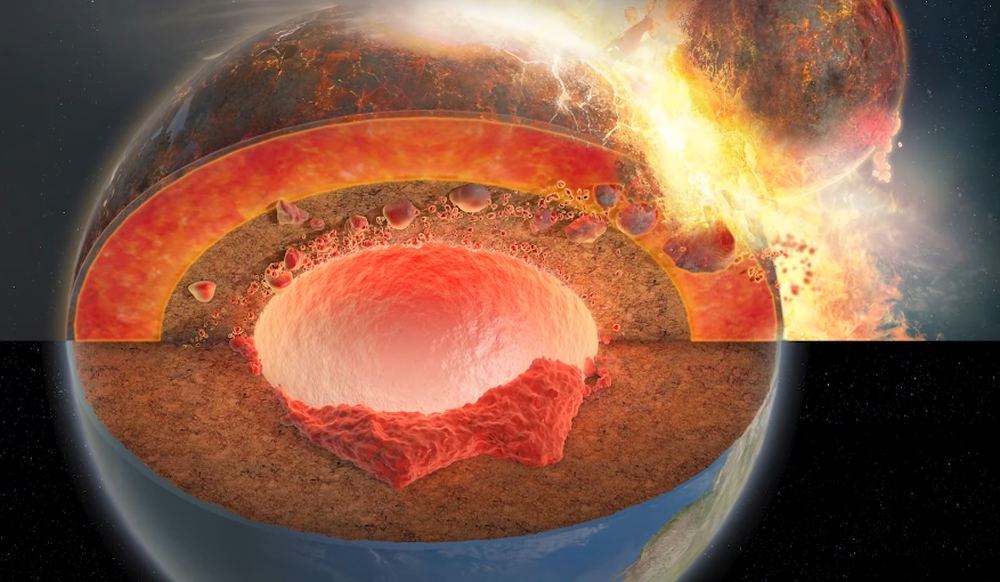
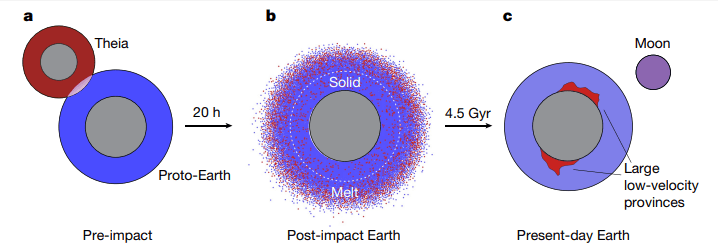
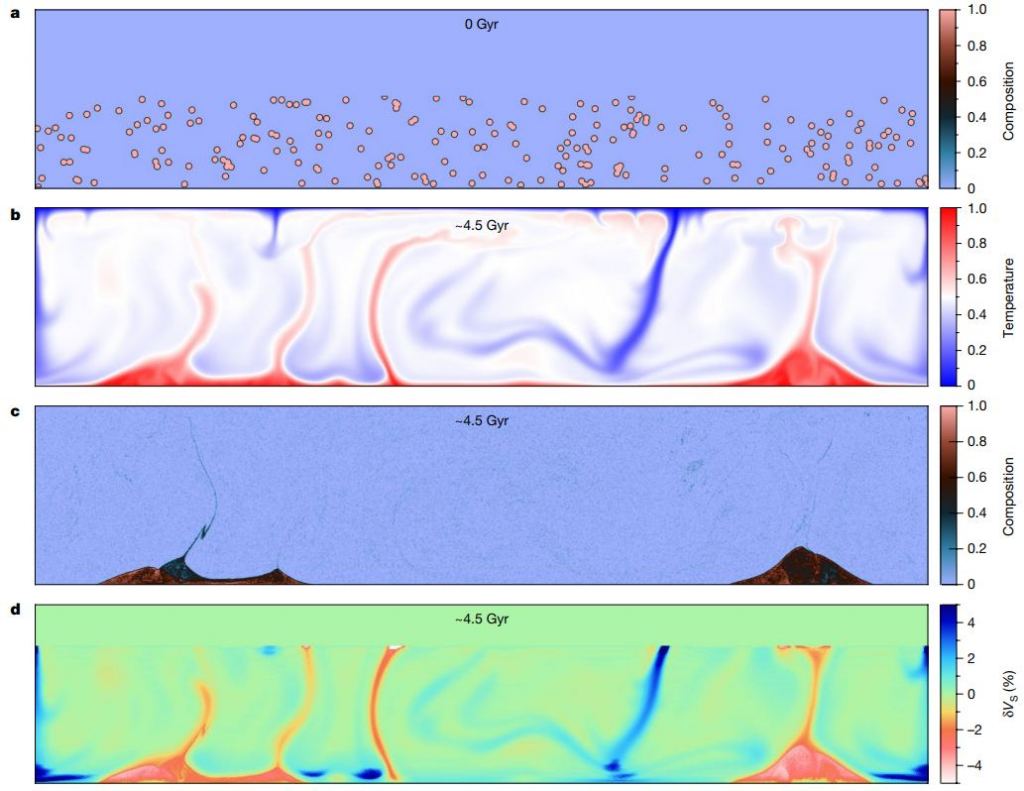
During an ancient collision, the protoplanet named Theia slammed into Earth, leading to the creation of the Moon. But it left some of its remains inside Earth. Image Credit: CalTech
Earth’s early history is marked by massive collisions with other objects, including planetesimals. One of the defining events in our planet’s history, the formation of the Moon, likely resulted from one of these catastrophic collisions when a Mars-sized protoplanet crashed into Earth. That’s the Giant Impact Hypothesis, and it explains how the collision produced a torus of debris rotating around the Earth that eventually coalesced into our only natural satellite.
New research strengthens the idea that Theia left some of its remains inside Earth.
The Giant Impact that created the Moon occurred in the Hadean eon. The Hadean is the first of Earth’s four eons and spans from the Earth’s formation about 4.5 billion years ago up to about 4.03 billion years ago when it was succeeded by the Archaean eon.
Earth was a magma ocean for about the first 50 million years. It began cooling during the Hadean, but the mantle was still much more viscous than it is today. Residual heat from its formation and the higher level of radiogenic heating kept the mantle in a more fluid state. There was more water in the mantle at that time, too, adding to the mantle’s fluidity.
Artist’s impression of magma ocean planet. Scientists think all terrestrial planets go through a magma ocean phase early in their history, and Earth is no exception. Credit: Mark Garlick
That’s important because when objects slammed into Earth, they were able to sink deeper into the mantle.
Back in the 1980s, scientists made a remarkable discovery. Two gigantic, continent-sized blobs were embedded deep in the Earth. One is under Africa, and one is under the Pacific Ocean. They’re called LLSVPs, or Large Low-Shear-Velocity Provinces, and they have unusually high iron levels. The iron concentration changes the speed of seismic waves that travel through them, leading to their discovery.
Scientists discovered two large low-shear-velocity provinces deep inside Earth in the 1980s. They contain high levels of iron that generate tell-tale seismic wave patterns. Image Credit: Edward Garnero.
Both the LLSVPs extend for thousands of kilometres horizontally and extend up to 1000 km upwards from the boundary between the Earth’s core and its mantle. They contain about 8% of the Earth’s mantle volume and about 6% of the Earth’s total volume.
For decades, their origins were a mystery. Scientists wondered if they could be the remains of Theia, the protoplanet that slammed into Earth, resulting in the Moon. But convincing evidence was elusive.
Now, new research points convincingly at the Giant Impact as the LLSVP’s source. The new paper is “Moon-forming impactor as a source of Earth’s basal mantle anomalies.” It’s in the journal Nature, and the lead author is Qian Yuan, a Postdoctoral Scholar Research Associate at Caltech’s Seismological Laboratory.
Yuan is a geophysicist, but when he attended a seminar on planet formation by Mikhail Zolotov, a professor at Arizona State University, in 2019, a light went on. Zolotov was explaining the Giant Impact Hypothesis. Two things happened simultaneously: Qian noted that the Moon is relatively iron-rich, and Zolotov explained that no trace of Theia has ever been found.
“Right after Mikhail had said that no one knows where the impactor is now, I had a ‘eureka moment’ and realized that the iron-rich impactor could have transformed into mantle blobs,” says Yuan.
This schematic from the research shows how the LLSVPs formed. Image Credit: Yuan et al. 2023.
Yuan isn’t the first scientist to consider this possibility. But, scientific methods and tools improve over time. Yuan worked with other researchers from multiple disciplines to perform multiple simulations of the Giant Impact with different chemical compositions for Theia and its impact on the Hadean Earth.
According to their work, this is what happened.
When Theia slammed into Earth, it released an enormous amount of energy. It sprayed molten material from both planets into orbit around Earth. Some escaped, much of it coalesced into the Moon, and some of it remained inside Earth’s molten form.
But much of the energy delivered by the collision remained in Earth’s upper regions, never penetrating to the core. This is where Yuan’s simulations differ from previous efforts. They’re more detailed and higher resolution. Previous efforts failed to show that the energy never penetrated the core, leading to uncertain conclusions.
But if Earth’s core was effectively blocked off from the impact energy, it remained much cooler. That also means that the Earth’s lower mantle wasn’t heated to the degree previous research showed. So, the material from Theia, called Theia Mantle Material (TMM) that remained inside the Earth didn’t dissolve completely into the mantle. Instead, it formed the two recognizable clumps that form both of Earth’s LLSVPs.
If the mantle had been warmer, meaning it had received more energy from the impact, the Earth’s mantle material and the TMM would’ve mixed together more thoroughly. But they didn’t mix, and the higher iron content in the TMM makes the LLSVPs visible in seismic probing because all that iron slows down the seismic waves.
The result is what geophysicists call thermochemical piles.
This figure from the study’s simulations shows how the Giant Impact formed LLSVP-like thermochemical piles from Theia Mantle Material. a shows how TMM is introduced to a depth of 1400 km to the core-mantle boundary (CMB.) When introduced, the material is in the form of randomly distributed spheres. b shows the temperature at 4.5 billion years. c shows the TMM accumulating into two distinct LLVPS-like thermochemical piles. d shows the perturbations measured in the seismic shear velocity. Image Credit: Yuan et al. 2023.
“Our mantle convection models show that dense TMM blobs with a size of tens of kilometres after the impact can later sink and accumulate into LLVP-like thermochemical piles atop Earth’s core and survive to the present day,” the authors write in their paper. “The LLVPs may, thus, be a natural consequence of the Moon-forming giant impact.”
This all leads to another fascinating line of inquiry. How did this material influence the rest of Earth’s history? Its plate tectonics, climate, even the course of evolution?
“A logical consequence of the idea that the LLVPs are remnants of Theia is that they are very ancient,” said study co-author Paul Asimow. “It makes sense, therefore, to investigate next what consequences they had for Earth’s earliest evolution, such as the onset of subduction before conditions were suitable for modern-style plate tectonics, the formation of the first continents, and the origin of the very oldest surviving terrestrial minerals.”
Lucy Completes its First Flyby… and Discovers a Bonus Asteroi
Moonlet rise over Dinkinesh as seen from NASA's Lucy spacecraft, taken within a minute of closest approach. Credit: NASA/Goddard/SwRI/Johns Hopkins APL/NOAO
Lucy Completes its First Flyby… and Discovers a Bonus Asteroid
NASA’s Lucy mission hits the jackpot on its very first asteroid flyby earlier this week.
Welcome to Dinkinesh. NASA’s Lucy missionflew past its first target of Wednesday, November 1st, and turned up a surprise: 152830 Dinkinesh (meaning ‘marvelous’ in the Amharic language) is not one asteroid, but two (!)
The Dinkinesh Flyby
The the 16,000 kilometers per hour (10,000 mph) flyby occurred at a range of 430 kilometers (270 miles), and served as a test for Lucy’s instruments on its way to the Trojan asteroids. Closest approach was on November 1st and occurred at 16:54 Universal Time (UT)/12:54 PM U.S. Eastern Time (EDT). The image really caught lots of us off guard, revealing a boulder-strewn surface on both small worlds. At most, we were expecting a few small pixels, so the dramatic resolution was a huge bonus.
An animation of Dinkinesh and its newly discovered moonlet as seen from Lucy’s tracking camera. NASA/SwRI
The L’LORRI Long Range Reconnaissance Imager and T2Cam tracking cameras really demonstrated their resolution and pinpoint tracking capability on this first flyby. If the names sound familiar, its because the instruments are similar to those carried aboard NASA’s New Horizons mission, with completed a flyby past Pluto and Charon in 2015.
The flyby is reminiscent of New Horizons’ dramatic 2019 rendezvous with the Kuiper Belt Object 486958 Arrokoth. That passage also surprised scientists, with the object’s strange twin-lobed structure.
A Tiny Moonlet
The Dinkinesh moonlet is an estimated 220 meters (720 feet) across, about the size of an Iowa-class battleship. Variations in brightness seen in Dinkinesh on approach hinted at the presence of the unseen moon. As of yet, no orbital period for the moon has been published.
Dinkinesh is a small main belt asteroid, discovered in 1999. Up close, 790 meter-wide Dinkinesh actually looks lots like 101955 Bennu, visited by OSIRIS-REx. The next target for Lucy is asteroid 52246 Donaldjohanson in 2025. Lucy will perform another Earth flyby for a gravitational assist later next year in December 2025. Lucy delivered a great portrait of the Earth and Moon pair during the October 2022 flyby:
The Earth and Moon (faint, to the left) as seen by Lucy during the first Earth flyby. Credit: NASA/SwRI
“Dinkinesh really did live up to its name; this is “marvelous’” says principal investigator Hal Levison (Boulder-SwRI) in a recent press release. “When Lucy was originally selected for flight, we planned to fly by seven asteroids…now with this satellite, we’ve turned it up to 11.”
What’s Next for Lucy
Lucy takes its name from the 3.2-million year old Lucy hominid fossil, which in turn was named from the Beatles song ‘Lucy in the Sky With Diamonds.’ The naming alludes to the fossils of planetary formation sought out by planetary researchers in the Jupiter Trojan asteroids. Not only does the spacecraft’s L’TES instrument carry a disc made of lab-grown diamonds, but it also has a plaque with poems, speeches and quotes from Earth.
The Lucy plaque affixed to the spacecraft. Credit: NASA
Launched in 2021 atop an Atlas V rocket from Cape Canaveral Space Force Station, the main goal of Lucy is the exploration of the Trojan asteroids, located at stable L4 and L5 points ahead and behind massive Jupiter in its orbit. Plans at launch called for Lucy to visit seven Trojans from 2027 through 2033, though the number has now grown to 11. This now includes two main belt asteroids, plus two moonlets discovered since launch.
Asteroid 15094 Polymele targeted for a Lucy flyby in 2027 was found to possess a moonlet in March 2022. This moonlet is informally named ‘Shaun’ and was discovered during a stellar occultation. There’s an intriguing campaign underway worldwide to observe stellar occultations by target asteroids for the mission. This effort will help map asteroid profiles, refine orbits, and tease out undiscovered moonlets. This is a professional and amateur collaboration, with several events coming right up in 2024.
Lucy will be an amazing mission to follow in the coming decade. Now, what will we name Dinkinesh’s new companion moon?
Beste bezoeker, Heb je zelf al ooit een vreemde waarneming gedaan, laat dit dan even weten via email aan Frederick Delaere opwww.ufomeldpunt.be. Deze onderzoekers behandelen jouw melding in volledige anonimiteit en met alle respect voor jouw privacy. Ze zijn kritisch, objectief maar open minded aangelegd en zullen jou steeds een verklaring geven voor jouw waarneming! DUS AARZEL NIET, ALS JE EEN ANTWOORD OP JOUW VRAGEN WENST, CONTACTEER FREDERICK. BIJ VOORBAAT DANK...
Druk op onderstaande knop om je bestand , jouw artikel naar mij te verzenden. INDIEN HET DE MOEITE WAARD IS, PLAATS IK HET OP DE BLOG ONDER DIVERSEN MET JOUW NAAM...
Druk op onderstaande knop om een berichtje achter te laten in mijn gastenboek
Alvast bedankt voor al jouw bezoekjes en jouw reacties. Nog een prettige dag verder!!!
Over mijzelf
Ik ben Pieter, en gebruik soms ook wel de schuilnaam Peter2011.
Ik ben een man en woon in Linter (België) en mijn beroep is Ik ben op rust..
Ik ben geboren op 18/10/1950 en ben nu dus 75 jaar jong.
Mijn hobby's zijn: Ufologie en andere esoterische onderwerpen.
Op deze blog vind je onder artikels, werk van mezelf. Mijn dank gaat ook naar André, Ingrid, Oliver, Paul, Vincent, Georges Filer en MUFON voor de bijdragen voor de verschillende categorieën...
Veel leesplezier en geef je mening over deze blog.