Ontdek de Fascinerende Wereld van UFO's en UAP's: Jouw Bron voor Onthullende Informatie!
Ben jij ook gefascineerd door het onbekende? Wil je meer weten over UFO's en UAP's, niet alleen in België, maar over de hele wereld? Dan ben je op de juiste plek!
België: Het Kloppend Hart van UFO-onderzoek
In België is BUFON (Belgisch UFO-Netwerk) dé autoriteit op het gebied van UFO-onderzoek. Voor betrouwbare en objectieve informatie over deze intrigerende fenomenen, bezoek je zeker onze Facebook-pagina en deze blog. Maar dat is nog niet alles! Ontdek ook het Belgisch UFO-meldpunt en Caelestia, twee organisaties die diepgaand onderzoek verrichten, al zijn ze soms kritisch of sceptisch.
Nederland: Een Schat aan Informatie
Voor onze Nederlandse buren is er de schitterende website www.ufowijzer.nl, beheerd door Paul Harmans. Deze site biedt een schat aan informatie en artikelen die je niet wilt missen!
Internationaal: MUFON - De Wereldwijde Autoriteit
Neem ook een kijkje bij MUFON (Mutual UFO Network Inc.), een gerenommeerde Amerikaanse UFO-vereniging met afdelingen in de VS en wereldwijd. MUFON is toegewijd aan de wetenschappelijke en analytische studie van het UFO-fenomeen, en hun maandelijkse tijdschrift, The MUFON UFO-Journal, is een must-read voor elke UFO-enthousiasteling. Bezoek hun website op www.mufon.com voor meer informatie.
Samenwerking en Toekomstvisie
Sinds 1 februari 2020 is Pieter niet alleen ex-president van BUFON, maar ook de voormalige nationale directeur van MUFON in Vlaanderen en Nederland. Dit creëert een sterke samenwerking met de Franse MUFON Reseau MUFON/EUROP, wat ons in staat stelt om nog meer waardevolle inzichten te delen.
Let op: Nepprofielen en Nieuwe Groeperingen
Pas op voor een nieuwe groepering die zich ook BUFON noemt, maar geen enkele connectie heeft met onze gevestigde organisatie. Hoewel zij de naam geregistreerd hebben, kunnen ze het rijke verleden en de expertise van onze groep niet evenaren. We wensen hen veel succes, maar we blijven de autoriteit in UFO-onderzoek!
Blijf Op De Hoogte!
Wil jij de laatste nieuwtjes over UFO's, ruimtevaart, archeologie, en meer? Volg ons dan en duik samen met ons in de fascinerende wereld van het onbekende! Sluit je aan bij de gemeenschap van nieuwsgierige geesten die net als jij verlangen naar antwoorden en avonturen in de sterren!
Heb je vragen of wil je meer weten? Aarzel dan niet om contact met ons op te nemen! Samen ontrafelen we het mysterie van de lucht en daarbuiten.
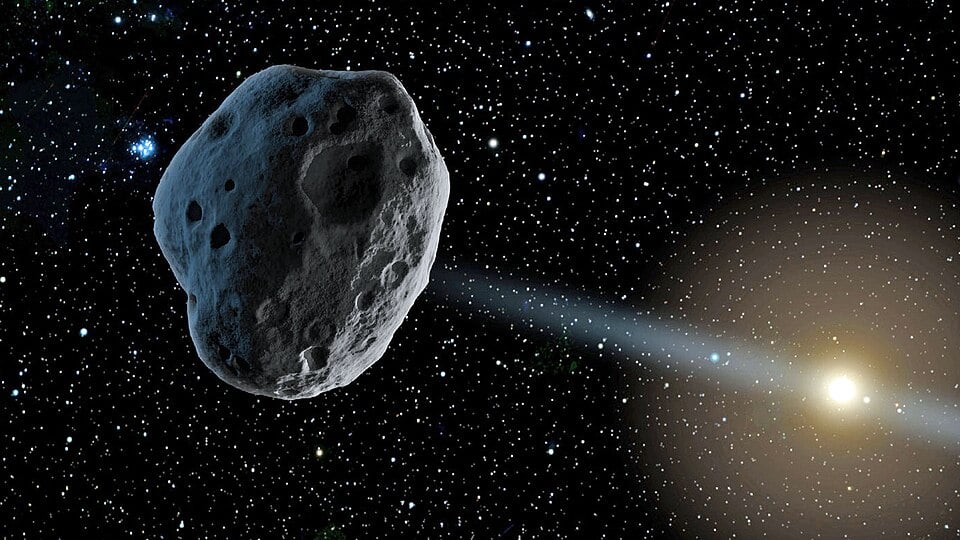
Image of an asteroid traveling through the solar system. Credit - NASA / JPL-Caltech
It’s amazing how much one movie can act as a cultural touchpoint for an entire topic - even a topic as serious as defense of a planet. Popular media consistently use the 1998 movie Armageddon as a reference when talking about how we would destroy a civilization-ending asteroid. That’s despite the movie’s glaring scientific flaws, not the last of which is the likely size of the rogue comet that threatens the Earth. Planetary defense researchers at MIT were recently interviewed by the university’s media department as part of their “3 Questions” series. One of the most important takeaways is that the size of any likely planetary impactor in our lifetime is going to be much smaller than the kilometer-sized behemoth that did in Bruce Willis’ character.
These smaller objects, known as decameter-scale asteroids because they typically have a diameter of 10s of meters, aren’t the civilization-destroying kind—those are typically kilometer scale and above. But they are much more common. The MIT researchers believe they impact the Earth-Moon system roughly every couple of decades, compared to the once in ten million years a larger impactor would hit us.
To be clear, these decameter sized objects are bigger than the ones that have been causing a significant amount of fireballs over US cities. For example, the one that burst over my home city of Cleveland a few weeks ago, which was loud enough to shake houses in the area, was only around 2 meters in diameter.
One recent example of an asteroid in this size is 2024 YR4, which was discovered a little more than a year ago, and comes in at between 53 and 67 meters - roughly the size of a 15 story building. According to the MIT researchers, this class of objects isn’t likely to cause human casualties. However, if they strike a populated area, they certainly could, as they could release an airburst equivalent to 8 to 10 megatons of TNT.
But what they are sure to do is disrupt space infrastructure - including the satellites used for GPS and communications. In really bad scenarios, they could potentially be the spark that ignites Kessler syndrome - the orbital debris cascade that could lock us out of space access for decades or longer. So even if all this type of asteroid did was knock out a few satellites, its best if we knew it was coming and could potentially do something about it.
The problem is they are really hard to see. At this scale, these asteroids don’t reflect much light, and ground-based observatories have a hard time tracking them. Some space-based observatories, such as the James Webb Space Telescope, fare better. It was used by some members of the MIT team to track 2024 YR4 and recently definitively rule out an impact on the Moon in 2032. But, since the JWST is our most capable deep-space telescope, demands on its time are so frequent it can’t constantly be used to watch for decameter scale asteroids.
Another ground-based telescope that is coming online shortly should be able to help, though. The Vera Rubin Observatory is expected to find up to 10 times more decameter-scale asteroids than we have previously found. However, while it's great at detecting very faint objects like these small asteroids, it is not great at tracking them, making it hard to determine either the asteroid’s size or trajectory.
To make up for this shortfall, the MIT team is developing a pipeline of other telescopes, such as the MIT Haystack and Wallace Observatories, that should be able to track the asteroids that Vera Rubin finds. That pipeline will also include data analysis to make sure they are tracking actual objects and not artifacts from the telescope or other noise.
Figuring out what to do when they inevitably find a decameter sized asteroid that will actually hit the Earth (or the Moon) is a different matter entirely. It’s almost inevitable that we will though. The MIT researchers expect that, within the next decade, astronomers will identify several small objects on a course to impact the Earth-Moon system this century. As of now, there’s still no framework for the nations of the world to deal with this possibility. But what planetary defenders can be sure of is simply sending Bruce Willis and his hand picked team to take care of it definitely won’t help.
Less than two days from now, NASA’s Artemis II mission is scheduled to lift off for its historic 10-day journey around the Moon, marking the first time humans have ventured beyond Low Earth Orbit for the first time since Apollo 17 in 1972, and possibly even set new distance records for traveling beyond Earth. However, Artemis II is only scheduled as a flyby mission and will not be landing humans on the lunar surface, with this endeavor being scheduled for later missions.
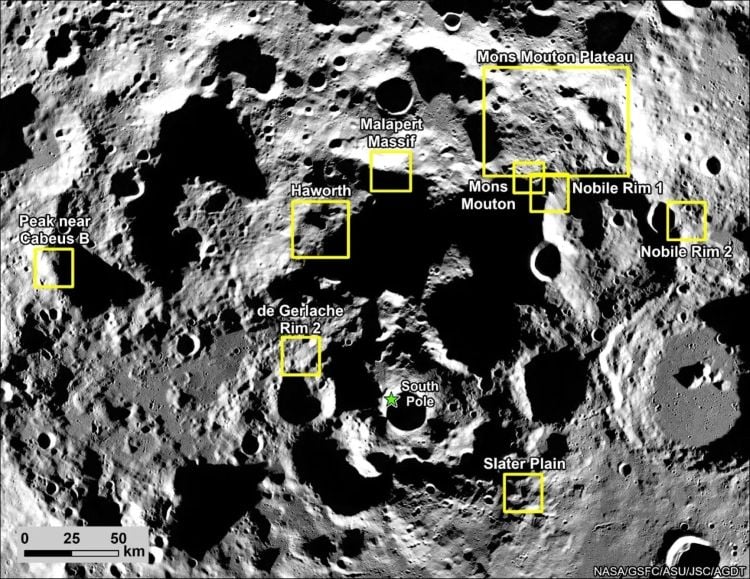
Now, a team of researchers from NASA and industry might be one step closer to landing humans on the lunar surface, as they recently presented findings at the 57th Lunar and Planetary Science Conference (LPSC) discussing how they narrowed down the landing site selection for future Artemis missions. While the study mentions site selection for Artemis III, NASA changed the landing mission to Artemis IV in 2028 before this year’s LPSC meeting, with Artemis III now being used as a testing mission for an Earth orbit docking test in mid-2027 for the Starship or Blue Origin landers. Nonetheless, the research presented in this study is paramount for future human landings on the lunar surface.
For the study, the researchers provided an updated list of 9 candidate landing sites that was also announced in October 2024. Both the October 2024 and LPSC announcements build off the initial NASA announcement in 2022 regarding 13 candidate landing sites with the goal of narrowing down the most plausible landing sites to maximize mission success.
The team notes that between the 2022 and 2024 announcements, numerous assessments and mission updates were conducted and made for narrowing landing site candidates based on several mission needs, including crewed lander and vehicle design, communications, surface lighting, safety, and surface mission duration, the last of which the researchers estimate will be 5.75 to 6.25 days.
The study notes,“The resulting down selection from thirteen to 9 regions reflects prioritization under current Artemis III constraints and does not imply that removed regions are unsuitable for future exploration. Rather, the 9 regions represent those that continue to balance operational feasibility, terrain safety, and science potential most effectively for the architecture envisioned for the first crewed mission.” Once again, Artemis III has been re-designated as a test mission, so the landing sites in this study will likely get pushed back to Artemis IV or later.
With all landing sites located at the lunar south pole, communications become crucial for staying in constant contact with Earth. While the Earth is tilted approximately 23.5 degrees relative to the Sun, the Moon is only tilted approximately 5 degrees. This much smaller angle means some regions of the lunar poles are not directly in line with Earth, meaning communications can be intermittent.
This issue became apparent during the IM-2 mission for Intuitive Machines that attempted to land near the south pole but ended up landing sideways in a crater. This is because during the descent, the spacecraft’s telemetry and altitude experienced large changes, meaning the spacecraft didn’t know where it was due to intermittent communications with Earth. This occurs if a spacecraft passes behind a crater rim or small hill, temporarily cutting communications with ground controllers on Earth. While a robotic mission might end in failure, or in the case of IM-2, sideways in a crater, future human missions will require constant and uninterrupted communication relay with Earth to ensure maximum safety and mission success.
A primary reason NASA is targeting the lunar south pole is due to the large deposits of water ice present in deep craters that scientists estimate that haven’t seen sunlight in billions of years, resulting in slow buildup of water ice from the frigid temperatures. Known as the permanently shadowed regions of the Moon, these exist due to the aforementioned small axial tilt of the Moon, whereas Earth’s tilt allows sunlight to bathe our entire surface over the course of one Earth year. For context, one “day” on the Moon lasts approximately 29.5 days, with half that time in sunlight and the other half in shade, which is also experienced on the lunar polar regions.
What landing site will ultimately be selected for the first human lunar landing since 1972? Only time will tell, and this is why we science!
Secret treaties: "Tall White" aliens and the human military-industrial complex
Could the so-called tic-tac UFOs be the result of a long-standing, mutually beneficial exchange agreement between the “Tall White” aliens and human military forces, along with private aerospace companies, an arrangement that may date back to at least the 1950s?
In this scenario, the propulsion systems would be supplied by the Tall Whites, while the structural design and hulls are developed by human engineers, alongside the exchange of other advanced technologies.
While this idea may sound far-fetched, author Charles Hall, a former weather observer, has claimed that he lived and worked in close proximity to a group of Tall Whites during the 1960s in the Nevada desert. These beings, often associated with the so-called Nordic or Pleiadian archetype, are typically described as human-like in appearance, standing between 5 and 9 feet tall, with pale skin and white hair. Hall further alleged that such entities operated for decades near military installations like Nellis Air Force Base and Edwards Air Force Base.
The video in question is of poor quality, making it difficult to determine whether it captures a genuine tic-tac UFO or a fabricated one. However, the real issue may not be the authenticity of the footage itself, but rather the broader question it raises: to what extent, if any, are claims of collaborative agreements between extraterrestrial beings and human institutions grounded in reality?
Adding another layer to this speculation are statements made by Donald Trump, who has repeatedly suggested that the United States possesses highly advanced military and artificial intelligence technologies, capabilities that, to some, seem almost unbelievable.
This raises an intriguing question: could such remarks be indirectly referencing technologies similar to the tic-tac UFOs? And if so, might they hint knowingly or unknowingly at a deeper level of cooperation between human organizations and non-human entities?
UFO shoots out of sky, Nashville, Tennessee, USA March 30, 2026 UAP Paranormal Alien breaking news.
Date of sighting: March 30, 2026 9pm
Location of sighting: Nashville, Tennessee, USA
Source: Email report scwaring @yahoo.com
This report just in. An eyewitness was driving home and recorded this UFO coming down from the sky. The UFO actually hesitated in the sky for a split second and then continued on its way, be it began to curve and fly away from the eyewitness car. Meteors don't change direction, but this object did. There is no doubt about this object. It's 100% alien technology.
Scott C. Waring - UFO Sightings Daily
Eyewitness states:
I was driving home from work and saw this strange thing I thought was a crashing plane. I got it on car cam so maybe someone can make heads or tails of this.
The Shroud of Turin mystery has deepened yet again, as a new analysis has uncovered DNA from 'multiple sources' on the material.
For centuries, Catholics have flocked to the Italian city of Turin to be in the presence of its famous shroud.
The venerated piece of linen bears a faint image of the front and back of a man – interpreted by many as Jesus Christ.
Believers say it was used to wrap the body of Christ after his crucifixion, leaving his bloody imprint, like a photographic snapshot.
In their new study, researchers from the University of Padova found DNA from several sources on the cloth.
This includes multiple humans, as well as animals, plants, and fungi.
'This research provides original insights into the diversity of DNA extracted from samples collected in 1978 from the Turin Shroud, revealing its biological complexity through rigorous DNA and metagenomic analyses,' the researchers explained.
'Our findings highlight its preservation conditions and environmental interactions, offering valuable perspectives into the identified genetic variants, which originated from multiple biological sources.'
The Shroud of Turin mystery has deepened yet again, as a new analysis has uncovered DNA from 'multiple sources' on the material
In their new study, researchers from the University of Padova found DNA from several sources on the cloth. This includes multiple humans, as well as animals, plants, and fungi
Currently stored at the Cathedral of St. John the Baptist in Turin, the Shroud of Turin is a 14ft–long linen cloth with a faint image of a man.
The image on the shroud is believed to reflect the story of Jesus' crucifixion, giving rise to the belief that the cloth is the burial shroud of Jesus himself.
However, the authenticity of the shroud has been frequently brought into question over the years.
Writing in their study, published as a preprint in bioRxiv, the researchers, led by Gianni Barcaccia, said: 'The true nature of the Shroud has been highly debated among historians, theologians, and scientists.
'Several hypotheses regarding its origin have been proposed, but as of today, no one has yet been able to establish to any degree of certainty when and where this textile originated from.'
To get to the bottom of it, the researchers analysed DNA extracted from 12 samples collected from the shroud in 1978.
Given how many people have handled the shroud, the researchers were unsurprised to discover 'clear signatures' of modern DNA contamination.
However, what was more surprising was the amount of older human DNA on the shroud.
Currently stored at the Cathedral of St. John the Baptist in Turin, the Shroud of Turin is a 14ft–long linen cloth with a faint image of a man
The image on the shroud is believed to reflect the story of Jesus' crucifixion, giving rise to the belief that the cloth is the burial shroud of Jesus himself
Shroud of Turin: The burial cloth of Jesus Christ?
The Shroud of Turin is a 14–foot–long linen cloth with a faint image of a crucified man.
The image on the shroud is believed to reflect the story of Jesus' crucifixion, giving rise to the belief that the cloth is the burial shroud of Jesus himself.
The authenticity of the shroud has been frequently brought into question over the years but there are also many studies claiming to validate its origin.
It is considered to be one of the most intensely studied human artefacts in history.
Since it first emerged in 1354 Vatican authorities have repeatedly gone back and forth on whether it should be considered the true burial shroud.
The shroud is currently stored at the Cathedral of St. John the Baptist in Turin but is only publicly displayed on special occasions.
'Our analyses revealed several human mtDNA lineages, including one common in Western Eurasia and another prevalent in the Near East,' the researchers explained.
Unfortunately, this suggests we may never be able to find out if the shroud really was used to wrap Jesus' body, according to the experts.
'The occurrence of an unusually high number of human heteroplasmies and the coexistence of different mtDNA variants confirm that the Shroud came into contact with multiple individuals, thereby challenging the possibility of identifying the original DNA of the Shroud,' the team added.
As well as human DNA, the researchers found traces from multiple animals, including cats, dogs, chickens and cows.
While this might not sound like much, it could help to unravel the mystery of where the shroud came from.
'Concerning the Shroud’s journey, the presence of red coral, livestock (e.g. chickens, cows, pigs, goats, sheep, rabbits, horses), and domestic cats and dogs suggest Mediterranean origins or transit through Mediterranean regions,' the team explained.
What's more, the cloth was found to contain DNA traces of carrots and cereals – crops that aren't usually associated with the Middle East.
'The prevalence of Mediterranean crops and the absence of typical Middle Eastern flora raise questions about the agricultural landscape when the Shroud was created or used as a burial cloth,' the researchers added.
'Comparative analyses with other ancient textiles and artifacts could further illuminate cultural and historical interactions with plants and animals.'
Overall, the findings suggest that the Turin Shroud has a 'complex history'.
'The overall DNA results – derived from rigorous methodological handling in clean rooms and metagenomic analyses supported by robust bioinformatics – suggest a diverse mosaic of genetic traces,' the team concluded.
The Daily Mail has contacted the researchers for further comment on the implications of the findings.
No physical description of Jesus is found in the Bible.
He's typically depicted as Caucasian in Western works of art, but has also been painted to look as if he was Latino or Aboriginal.
It's thought this is so people in different parts of the world can more easily relate to the Biblical figure.
The earliest depictions show him as a typical Roman man, with short hair and no beard, wearing a tunic.
It is thought that it wasn't until 400AD that Jesus appears with a beard.
This is perhaps to show he was a wise teacher, because philosophers at the time were typically depicted with facial hair.
The conventional image of a fully bearded Jesus with long hair did not become established until the sixth century in Eastern Christianity, and much later in the West
Medieval art in Europe typically showed him with brown hair and pale skin.
This image was strengthened during the Italian Renaissance, with famous paintings such as The Last Supper by Leonardo da Vinci showing Christ.
Modern depictions of Jesus in films tend to uphold the long-haired, bearded stereotype, while some abstract works show him as a spirit or light.
Is NASA's Artemis II mission safe? Scientists raise concerns about the Orion capsule's heat shield – and warn 'there's no chance of escape' for the astronauts if anything goes wrong
Scientists have raised safety concerns about the Orion capsule's heat shield ahead ofNASA's long–awaited Artemis II mission.
Set to launch as early as 1 April,the mission will see four astronauts – Reid Wiseman, Victor Glover, Christina Koch and Jeremy Hansen – blast off on a 10–day mission to the moon.
Now, Ed Macaulay, a lecturer in Physics and Data Science at Queen Mary University of London, has voiced his fears about Orion's heat shield, which bears the brunt of the searing heat during re–entry through Earth's atmosphere.
Dr Macaulay points out that during Artemis I, large chunks of material were found to have been lost from the heat shield.
Should this happen again on Artemis II, it could expose the crew to 'dangerously high temperatures'.
'During the final phase of the Artemis II mission, there's no backup, no contingency, and no chance of escape,' Dr Macaulay explained in an article for The Conversation.
'The four astronauts on board will be depending on a few inches of resin–coated silica to shield themselves from temperatures approaching half that of the surface of the Sun.'
The most dangerous moment will occur during re–entry, as Orion's heatshield is subjected to enormous temperatures due to friction with the atmosphere. Pictured: Orion's heatshield after re–entry during Artemis I
During 2022's unmanned Artemis I test, NASA found that Orion's heat shield was cracked and cratered with unexpected damage.
The heat shield material, known as Avcoat, is designed to burn away during re–entry to help dissipate the heat.
However, the damage was well beyond what NASA had expected.
'Instead of burning away evenly over the whole surface, parts of the Artemis I heat shield were lost unexpectedly in uneven chunks,' Dr Macaulay explained.
'This uneven ablation makes modelling the thermal loads of re–entry more unpredictable, and raises the possibility that the Orion capsule could be exposed to dangerous levels of heating.'
Further investigation found that the problem was that the Avcoat layer wasn't permeable enough, so gases built up in pockets and blasted off entire chunks.
Following the mission, Dr Danny Olivas, a former NASA astronaut who served on review team that investigated the incident, told CNN: 'There's no doubt about it: This is not the heat shield that NASA would want to give its astronauts.'
Surprisingly, NASA has decided not to change the heat shield going into Artemis II.
NASA has not altered the heatshield for Artemis II, but has adjusted the trajectory so that Orion will spend less time at critical temperatures
The heatshield coating is designed to burn away during re–entry, however, NASA found that the coating had chipped and deteriorated far more than expected during Artemis I
Instead, it has made some important changes to the mission itself.
Instead of 'skipping' back to Earth – a technique that sees the capsule act like a stone bouncing on water as it dips and lowers itself into the atmosphere – NASA will use a more direct re–entry model for the crewed Orion capsule.
This should reduce the uncertainty in the heating profile, and will mean less time at peak temperatures for trapped gases to damage the heat shield.
'[It] also means that the crew will be subjected to increased deceleration on re–entry,' Dr Macaulay added.
As the astronauts return to Earth, the heat shield is all that will protect them – so NASA's tweaks to the mission could prove vital.
'Human spaceflight has always brought with it calculated risks, but it has also provided a uniquely human perspective on our place in the cosmos,' Dr Macaulay added.
'The Artemis II mission will make its crew the first humans in over half a century to observe the blue marble of planet Earth in its entirety with their own eyes.
'The crew will carry with them the hopes and aspirations of a whole new generation of explorers.
'They will be depending on the meticulous work of thousands of scientists and engineers for their safe return, bringing with them a renewed human perspective on not just the Moon, but the planet we all call home.'
NASA's Artemis II gets the green light for April 1: Step–by–step graphic reveals exactly what will happen as four astronauts venture to the moon for the first time in over 50 YEARS
NASA's Artemis II mission has been given the green light to launch, sending four astronauts to the moon for the first time in over 50 years.
The 32–storey Space Launch System (SLS) rocket is set to blast off from the Kennedy Space Centre inFlorida tomorrow.
It will send Reid Wiseman, Victor Glover, Jeremy Hansen and Christina Koch on a mammoth 10–day 685,000–mile (1.1 million km) trip around the moon and back.
At a briefing by NASA yesterday, space agency chiefs said the mission is 'ready to go'.
'As we enter the pre–launch phase, the teams are in a strong posture, and the mission remains on track,' NASA's associate administrator Amit Kshatriya said.
'The vehicle is ready. The system is ready. The crew is ready.
'I have complete confidence in this team. 53 years ago humanity left the Moon and did not return. Now we go back.'
Here, the Daily Mail's step–by–step graphic reveals exactly what will happen during the mission.
NASA has said the launch window opens on April 1, with multiple backup opportunities available over the following days depending on weather, technical readiness and range availability.
The SLS rocket itself consists of several parts, including a launch system and the Orion capsule that sits atop it.
During take–off, four RS–25 engines will fire non–stop for 8.5 minutes.
Along with two boosters, this will produce 8.8 million pounds of thrust – more than any rocket in history.
After launch, the Orion crew capsule will separate from the rocket's upper stage and enter a highly elliptical orbit around Earth.
The crew will then spend the first few days conducting extensive systems checks.
These include testing Orion's life–support, propulsion, navigation and communications systems to ensure the spacecraft is ready to head into deep space.
Once checkouts are complete, Orion's propulsion system will perform a critical engine burn known as translunar injection, sending the spacecraft out of Earth orbit and onto a trajectory toward the moon.
NASA's SLS rocket with the Orion spacecraft sits on its launch pad at the Kennedy Space Center
NASA astronauts Reid Wiseman (left), Victor Glover (second left), Christina Koch (second right) and Canadian Space Agency astronaut Jeremy Hansen (right)
Orion crew capsule: Key specs
Unlike the Space Shuttle or ISS, Orion is designed to go far beyond Earth's orbit
It can support four astronauts for up to 21 days
It has a built–in escape rocket that can pull the crew away from danger during launch
It has the largest heat shield ever built for a human spacecraft
The astronauts will live in about 330 cubic feet of space – roughly the size of two minivans
To get some shut–eye, crew members will strap sleeping bags to the wall
It has a mini gym onboard, equipped with a compact flywheel exercise device
It will take astronauts father from Earth than any humans have travelled since the Apollo missions
Orion will pass behind the moon on a 'free–return' trajectory — a path that naturally swings the spacecraft back toward Earth without requiring additional propulsion.
It will reach its greatest distance from Earth during this phase.
After the lunar flyby – during which the crew will photograph and analyse the lunar surface – the spacecraft will spend several days heading home.
As Orion approaches Earth, it will separate key components before plunging into the atmosphere at speeds of about 25,000 miles per hour (40,233 kph).
Testing the capsule's heat shield during high–energy re–entry is one of the mission's primary objectives – as well as one of its most dangerous.
The spacecraft is expected to splash down in the Pacific Ocean, where recovery teams will retrieve the crew.
'Our team has worked extremely hard to get us to this moment', said launch director Charlie Blackwell–Thompson.
'Certainly all indications are right now we are in excellent, excellent shape.'
The rocket itself consists of several parts, including a launch system and the Orion capsule (pictured) that sits atop it
Crew members will strap sleeping bags to the wall to catch some shut–eye, as shown in this mock–up image
Crewed moon missions
Orbit and test missions
Apollo 8: December 21–27, 1968
Apollo 10: May 18–26, 1969
Moon landing missions
Apollo 11: July 16–24, 1969
Apollo 12: November 14–24, 1969
Apollo 14: January 31 – February 9, 1971
Apollo 15: July 26 – August 7, 1971
Apollo 16: April 16–27, 1972
Apollo 17: December 7–19, 1972
NASA's Artemis II mission should have launched in February, but was grounded by hydrogen fuel leaks.
The leaks were fixed, but then a helium pressurization line became clogged, forcing a return to the hangar late last month.
NASA has the first six days of April to launch Artemis II before standing down until the end of the month.
Tomorrow's launch window opens at 6:24pm EDT (11:24pm BST).
'Our teams in mission control and our crew members have been spent the last two years dedicated to training for this particular mission, developing all of the products associated with this flight, and they are ready to go,' chief flight director Emily Nelson said.
'The opportunity is immense for us to finally send our crew farther than anyone's gone before.'
While the astronauts will not actually touch down on the lunar surface, it will still mark the first time humans will return to the vicinity of the moon since the Apollo 17 mission in 1972.
During the lunar flyby, the Orion spacecraft will travel around 4,700 miles (7,500 km) beyond the far side of Earth's natural satellite, setting a new record.
In this photo provided by NASA, astronaut Charles M. Duke Jr. collects lunar samples during the first Apollo 16 extravehicular activity at the Descartes landing site on April 21 1972
NASA says the mission paves the way for a future lunar landing – planned for 2028 – and will also inform planning for longer missions such as to Mars.
It is also historically significant because it will send the first woman and the first Black person on a lunar mission.
British astronaut Major Tim Peake has said Europe, including the UK, is heavily involved in the Artemis programme.
'We were there on Artemis I... we built the European service module which powers the Orion spacecraft that provides all the electrical power, the life support systems, the propellant,' he said.
He hopes the mission can help inspire young people in the UK to consider a career related to space.
Goonhilly Earth Station, near Helston, Cornwall, will also help to track the capsule on its epic celestial voyage.
Launch date: NASA initially identified three possible launch windows for Artemis II: From February 6 to February 11, from March 6 to March 11, and from April 1 to April 6. The space agency is now targeting the April window.
Mission objective: To complete a lunar flyby, passing the 'dark side' of the moon and test systems for a future lunar landing.
Total distance to travel: 685,000 miles (1.1 million km)
Mission duration: 10 days
Estimated total cost:$44billion (£32.5billion)
NASA Space Launch System rocket: $23.8billion (£17.6billion)
Could a second Sphinx be buried beneath the sands of Egypt's most famous ancient site? A team of Italian researchers using cutting-edge radar technology claims to have detected a massive underground anomaly at the Giza Plateau that mirrors the profile of the iconic Great Sphinx. The announcement has ignited fierce debate, with some researchers hailing it as a potential breakthrough and mainstream Egyptologists dismissing it as unsupported speculation. The controversy cuts to the heart of an enduring question: how much of ancient Giza still lies hidden beneath the sand?
The bold assertions stem from the Khafre Research Project, spearheaded by radar engineer Filippo Biondi and his colleagues. By employing Synthetic Aperture Radar (SAR) Doppler tomography, the team analyzed subsurface variations across the ancient site. According to reports from the New York Post, Biondi claims the radar scans revealed organized geometric formations and deep chambers. The data suggests the presence of a sprawling underground megastructure featuring vertical shafts and interconnected pathways.
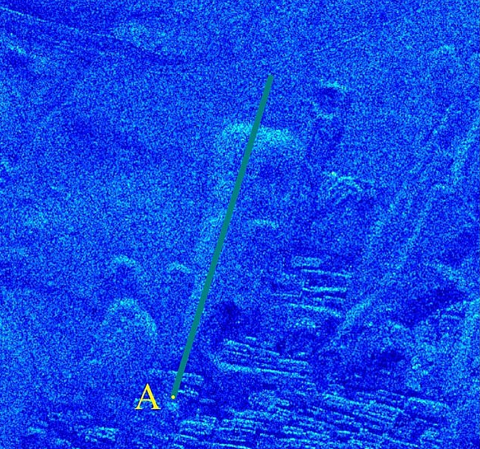
Preliminary scans from the Giza Plateau presented by Filippo Biondi, who claims to have captured a structure that mirrors the Great Sphinx.
(Filippo Biondi/The Khafre Project)
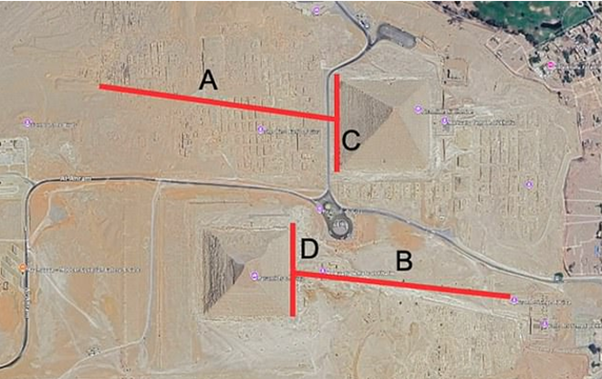
At the heart of their hypothesis is the detection of a 108-foot-tall dune made of hardened sand, which researchers believe conceals the monument. Biondi notes that the first Sphinx sits in a shallow depression, making it plausible that a twin could be hidden beneath this elevated mound. The team reported a precise geometric correlation between the visible pyramids and the suspected second monument, suggesting a deliberate ancient design. Biondi expressed high confidence in the data, stating that the structural network mirrors the passages found beneath the known Sphinx reports the Daily Mail.
Researchers from The Khafre Project claim that a second sphinx lies beneath a sand dune where A is shown, adjacent to the Great Sphinx shown as B
(Filippo Biondi/The Khafre Project)
The Dream Stele and Ancient Clues
To support their technological findings, the research team points to historical artifacts and ancient Egyptian mythology. A key piece of evidence cited is the Dream Stele, a granite slab erected by Pharaoh Thutmose IV between the paws of the Great Sphinx of Giza. The stele is famously carved with a pair of the mythical feline creatures, which some interpret as an indication that two such statues were originally built. This dual iconography has long fueled theories among alternative historians about a lost companion to the iconic guardian.
The idea of undiscovered structures at Giza is not entirely new, as ancient texts and accounts have often hinted at hidden realms. The Greek historian Herodotus wrote of a vast Egyptian labyrinth, while esoteric traditions speak of a legendary Hall of Records preserving ancient knowledge. Furthermore, Egyptologist Bassam El Shammaa previously proposed the existence of a second Sphinx, theorizing it was destroyed by a lightning strike based on mythological texts. These enduring narratives provide a compelling backdrop to the recent radar anomalies detected by the Italian team.
Expert Skepticism and the Need for Excavation
Despite the excitement generated by the satellite imaging, the archaeological community has responded with significant caution and criticism. Prominent Egyptologist Zahi Hawass has firmly dismissed the claims of a second Sphinx and an underground city as baseless fabrications. He emphasized that extensive excavations of the Giza Plateau over many decades have yielded no evidence of such monumental structures. Experts argue that radar data alone is insufficient to confirm the presence of human-made monuments, as natural geological formations can produce similar subsurface anomalies.
Radar specialists have also highlighted the inherent challenges of interpreting deep subsurface signals without physical corroboration. Experts warn that remote sensing requires controlled excavation to validate any findings, and anomalies must be treated with care.
Hawass was particularly pointed in his criticism, stating that the rumors about columns beneath the Pyramid of Khafre are:
"nothing but fabrications propagated by individuals with no expertise in ancient Egyptian civilization or the history of the pyramids."
The Italian research team is reportedly awaiting permission from Egyptian authorities to conduct further physical investigations of the mound.
What Comes Next?
The debate over the second Sphinx raises broader questions about how new technologies should be applied in archaeology and how claims should be communicated to the public. Remote sensing tools like SAR Doppler tomography have genuinely advanced the field, helping to identify targets for excavation at sites around the world. However, as this case illustrates, the leap from a subsurface anomaly to the announcement of a second Sphinx is a significant one, and the lack of peer-reviewed publication has drawn criticism from the scientific community. Until an underground chamber or monument is physically uncovered, the existence of a second Sphinx remains a tantalizing but unproven hypothesis.
The Giza Plateau has already surprised archaeologists in recent years, with discoveries of hidden air voids and new passages within the pyramid complex. Whether or not a second Sphinx ultimately emerges from the sand, the renewed focus on what may lie beneath Giza is a reminder that the ancient world still has secrets to reveal. Biondi and his team continue to analyze their data and have expressed hope that Egyptian authorities will grant permission for a physical investigation of the site. For now, the world watches and waits.
Top image: The Great Sphinx of Giza with the Pyramid of Khafre in the background.
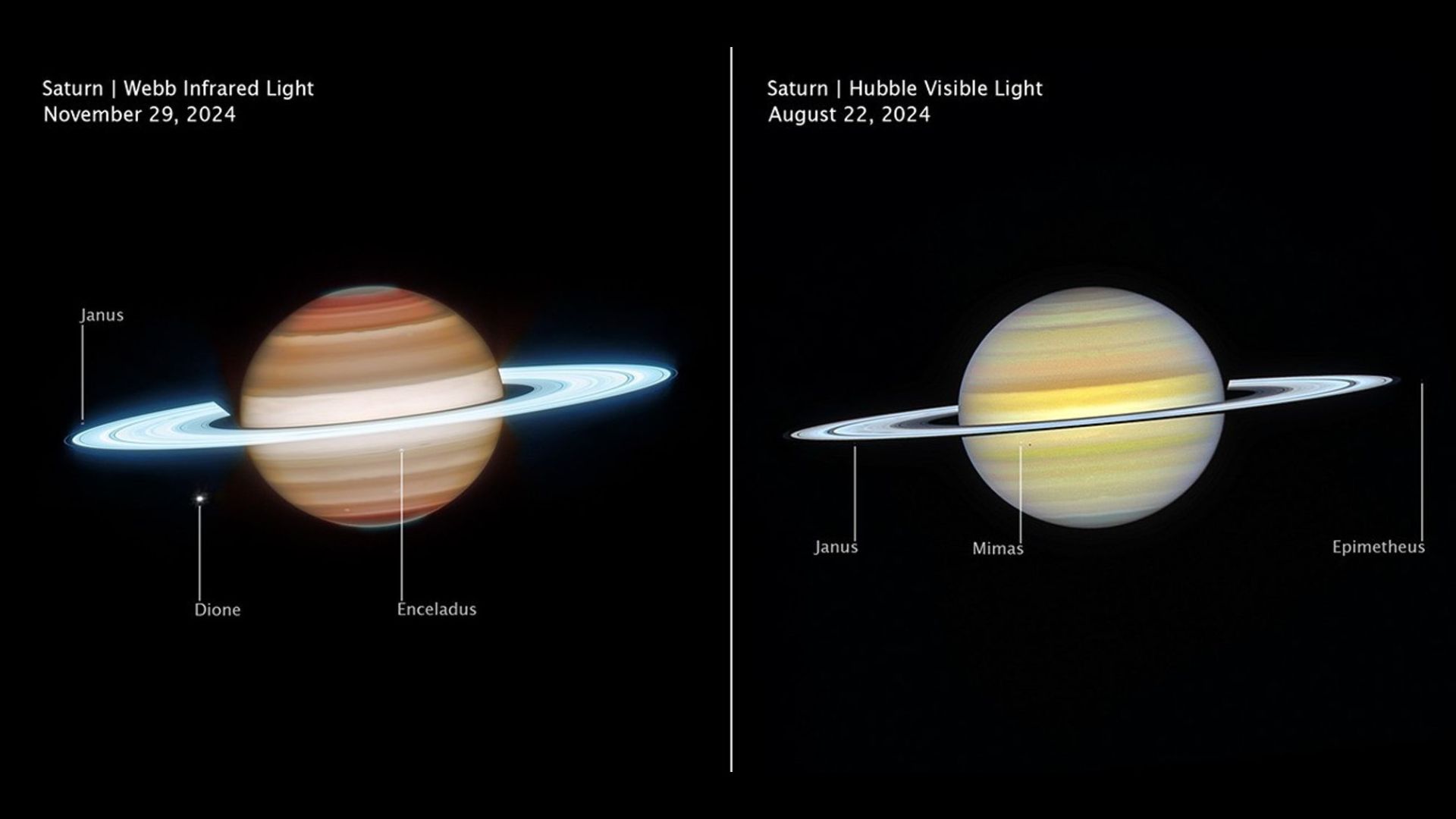
Viewing Saturn in complementary wavelengths, the James Webb and Hubble space telescopes reveal more about what makes up the layers of ringed planet's atmosphere.
Two images of Saturn from NASA's James Webb Space Telescope and Hubble Space Telescope show different aspects of the planet, from its atmosphere to its orbiting moons.
(Image credit: NASA, ESA, CSA, STScI, Amy Simon (NASA-GSFC), Michael Wong (UC Berkeley); Image Processing: Joseph DePasquale (STScI))
Saturn may be famous for its rings, but it has long fascinated scientists for another reason: its restless atmosphere, which is shaped by fierce winds, stubborn megastorms and strange weather patterns that can linger for years.
Now, two new views from the James Webb and Hubble space telescopes are cutting through the ringed planet's clouds, giving researchers what NASA calls the "most comprehensive view of Saturn to date." Together, the images let researchers "slice" through Saturn's atmosphere at different heights.
The paired observations capture one of Saturn's strangest landmarks: the famous hexagon at the north pole. According to NASA, the faint edges of the six-sided jet stream appear in both images. These pictures could be some of the last high-resolution views of the hexagon until the 2040s, as Saturn's north pole is about to tip into 15 years of winter darkness.
Studying Saturn's atmosphere not only allows scientists to understand how large, planet-size storms grow and thrive but also gives further insight into how the planet formed and evolved over billions of years.
A planet seen two ways
In August 2024, Hubble took its visible-light image of Saturn as part of the Outer Planet Atmospheres Legacy program, a decade-long project that tracks the outer planets annually. The James Webb Space Telescope (JWST) captured its infrared image a few months later, in November 2024. Those observations, taken 14 weeks apart, showed the ringed planet shifting from northern summer toward its 2025 equinox.
While Hubble captured Saturn's pale-yellow bands and brilliant-white rings, JWST's infrared image revealed even more striking details. In the infrared view, Saturn's rings transformed into glowing blue "because they are made of highly reflective water ice," NASA representatives said in a statement. Saturn's poles also shone a strange gray-green, emitting light at wavelengths of about 4.3 microns. These emissions could be from either light scattering off of high-altitude aerosols or auroras, NASA suggested. (The telescope recently caught giant auroras shining on Uranus.)
As Saturn tilts into its southern springtime, both space telescopes will continue to keep their eyes on its atmosphere, perhaps revealing more about the planet's weather dynamics. Until then, Saturn is keeping some of its most interesting secrets hidden in the clouds.
Earth has seen a mysterious surge in massive fireballs lighting up the sky, sparking concerns about a potentially city-killing asteroid striking the planet and questions about these objects being UFOs.
The American Meteor Society (AMS), a nonprofit group that has been tracking meteor sightings for over a century, revealed that there have been more reports of fireballs in the first three months of 2026 than in the first quarter of any year dating back to 2011.
The society said: 'The first quarter of 2026 has produced what appears to be a significant surge in large fireball events. The data, drawn from the AMS database going back to 2011, shows a pattern that warrants serious investigation.'
AMS also noted that the recent uptick of space rocks ripping through the atmosphere cannot be definitively explained by local meteor showers or other natural events in space, with 2,046 fireballs already tracked since the start of 2026.
That included 38 major events worldwide reported by more than 50 people, more than the last two years combined.
As many witnesses have suspected that the sightings include extraterrestrial ships visiting Earth, researchers addressed the possibility that the fireballs could be UFOs or some type of artificial craft.
AMS said that the fireballs were not objects of alien origin, adding that their analysis found there has simply been a strange increase in the number of natural meteors flying across Earth's path recently.
'These are rocks from the inner solar system. There is no evidence of anomalous trajectory behavior, controlled flight, or non-natural composition,' the team claimed.
On March 17, witnesses in Pittsburgh reported seeing what appeared to be a burning object streaking through the sky, describing it as 'a rocket or something like a meteor'
There have been more widely witnessed meteor fireballs around the globe in the first three months of 2026 than at any point since records started being kept by AMS in 2011
These bright streaks of light, created when space rocks burn up in Earth’s atmosphere, can be potentially dangerous if a large enough piece reaches the ground and strikes people or homes, but this is considered an extremely rare event.
Recent reported fireballs include widespread sightings over the US, in Pennsylvania and Ohio, Texas and California, and in other countries such as Australia and Turkey.
March 2026 has stood out the most, as there were far more events seen by over 50 and 100 people, fireballs lasting longer than four seconds and meteors producing loud 'sonic booms' - when a meteor shoots through the atmosphere at speeds over 25,000 mph.
For example, one fireball over Germany on March 8 was reported by 3,229 people. Several other widely visible events had hundreds of witnesses each this month.
Overall, nearly a thousand more fireballs have been spotted in this year's first three months than were detected a decade ago, when only 1,175 were seen in 2016.
However, skeptics have challenged the society's analysis that these are all natural phenomena taking place during a random uptick in space traffic streaking past the planet.
Most notably, one fireball over Texas on March 17 has been widely theorized to be a genuine UFO, after it was seen defying the normal trajectory of a shooting star.
Witnesses across Red Oak captured the shocking moments when an orange fireball streaking through the night sky suddenly turned back up into the air instead of crashing to Earth.
Hundreds of people across the western US reported seeing a mysterious green flash ripple across the sky on March 22
'Not your typical burn-up trajectory. UFO or space rock? You decide,' one person posted online after seeing the strange fireball turning and zig-zagging over Texas.
AMS has pushed back on the claims that anything besides harmless asteroid fragments has entered Earth's atmosphere this year, saying that every piece of a meteorite recovered has been a common rock seen falling from space for years.
'The recovered specimens from Ohio and Germany are achondritic HEDs with mineral compositions formed over billions of years on differentiated asteroids,' researchers revealed in a statement.
Achondritic HEDs refer to a special group of meteorites. Achondritic means these are stony meteorites without small round grains, called chondrules, that most common meteorites have. They formed from melted and cooled rock, like volcanic rocks on Earth.
HED stands for Howardite–Eucrite–Diogenite. These are three closely related types of achondrites that all came from the same large asteroid, Vesta, which sits in the asteroid belt between Mars and Jupiter.
The meteor society added that there was no current threat from this surge in meteorite impacts. There was also no risk of a massive space rock colliding with the planet and devastating humanity.
'The objects involved range from pebble-sized to a few [feet] across and are part of the normal continuum of material that Earth encounters. None posed a danger beyond localized effects.'
The meteorite that landed in Sherrie James's home just outside Houston on March 21
Over the last decades, the first quarter of 2026 has seen the most fireballs worldwide, suggesting that more meteors are passing Earth than ever before
NASA said the three-foot-long rock that weighed over a ton prior to colliding with Sherrie James's house was traveling at 35,000 mph before most of it burned up in the atmosphere.
A tiny chunk of the meteor survived and struck the woman's home with such force that it ripped through the ceiling of her daughter's bedroom, ricocheted off the floor, and hit the ceiling again before landing on an empty bed.
AMS said part of the reason for the massive surge in fireballs being reported to them by the public could be because of AI chatbots.
In 2025, there were only 15 fireballs witnessed by more than 50 people in the first three months of the year. There have already been 38 in 2026
When people see a bright fireball, witnesses often ask ChatGPT, Siri, Grok or Google’s AI 'I just saw a fireball - where do I report it?' and the AI directs them straight to the AMS website.
This can cause each big event to get more reports than it would have in the past. However, the report noted that AI likely only explains the higher number of witnesses per event, not the actual increase in loud sonic booms or the meteorites striking Earth.
The last time there were more than 2,000 fireballs seen in Earth's atmosphere before the start of April was 2021.
AI is outperforming humans in coding, science, and decision-making
Sam Altman warns we’ve crossed a key threshold
Experts say laws and safeguards are not keeping up
Artificial Intelligence is moving fast, faster than many expected. Some experts now believe Artificial Intelligence may already be smarter than humans in some areas. OpenAI CEO Sam Altman says we’ve already crossed the line.
“We are past the event horizon. The takeoff has started,” he wrote in a blog post. This implies that we might already be living in an era where machines are smarter than us at critical work. But the question is: Are we prepared to deal with what comes after?
AI Is Beating Us at Some Tasks
Artificial Intelligence is now more capable than humans at many particular things. It can code, respond to questions, do math problems, and even assist in science and medicine. Applications such as ChatGPT, Google Gemini, and Claude can accomplish work in seconds that it took humans hours to accomplish.
A new report from Stanford University revealed that AI software is performing better than expert human counterparts on some tests. For instance, they are better at predicting the outcomes of scientific research than scientists.
Altman reports that humans employ Artificial Intelligence for crucial tasks daily. “Hundreds of millions of people depend on it,” he said. He also cautioned that if there is ever a problem with AI, a large number of people could be impacted very rapidly.
Life Still Feels Normal, For Now
Despite the rapid advancement of AI, life is still normal to everyone, as most people confirm. Altman also concedes this. “Robots are not roaming the streets. Most of us don’t chat with AI all day. People continue to die of illness, and we can’t easily go to space,” he said.
But that doesn’t indicate that change is not taking place. AI is now replacing human employees in tech, design, writing, and customer support. It’s just not deafening. The revolution is silent, yet true.
What’s Coming Next?
Altman thinks Artificial Intelligence will be doing even more very soon. In 2025, he predicts, it will begin generating new scientific concepts independently. By 2027, robots will start functioning in the physical world. By 2030, we will have an ‘abundance’ of intelligence and power.
That is, we’re entering a world where AI will be able to revolutionize the way everything operates, jobs, schools, even governments.
The aspiration of most technology firms is AGI, Artificial General Intelligence. This would be a machine which could learn and reason like a human being in a wide variety of topics.
Currently, AI is still narrow. It can perform one task well, but it does not actually know what it is doing. It is not capable of emotions, nor does it have memory or common sense.
But others believe AGI isn’t around the corner. DeepMind and OpenAI leaders believe it might happen within 5–10 years.
Rules Haven’t Caught Up
The frightening thing? Few nations are prepared. There are no robust rules regarding how AI ought to be designed, deployed, or governed. There’s no universal consensus on boundaries. No robust safety net.
Altman and others such as Geoffrey Hinton and Nick Bostrom have cautioned that one wrong move in AI might create huge issues.
We already have examples to see: deepfakes, fake news, cheating on tests, and even AI being used in war. These are warnings of what might go wrong when technology outpaces regulations.
What Do We Do?
Following is what experts tell us we need to pay attention to at this point:
Make clear rules to guide how AI is used.
Test and review AI tools to make sure they are safe and fair.
Train people to use AI wisely.
Support workers who might lose jobs to machines.
Encourage open talks about AI’s impact on society.
Final Thoughts
AI is no longer science fiction. It’s already here. It may already be smarter than us in some ways. But that’s not the main issue.
The actual question is: Are we intelligent enough to handle it?
Currently, AI is running ahead of our laws, our plans, and our intellect. If we don’t hurry up, we may lose control over a technology that we invented.
AI will be ready to score full marks on one of the world's most challenging knowledge tests branded Humanity's Last Exam (HLE) in a matter of months, developers claim.
HLE was set up by tech bosses to see just how intelligent their systems are and consists of 2,500 meticulously chosen questions, spanning around a hundred topics from rocket science and mythology to physiology.
Each one requires at least PhD levels of understanding and to achieve a score even close to 100 per cent would earn someone the title of a 'universal expert'.
Just two years ago, the much-vaunted ChatGPT system from OpenAI scored a measly 3 per cent on the exam with its rivals at Google and Anthropic not doing much better.
The test served to assuage fears over the growing dominance of AI, with researchers claiming it proved 'a marked gap' remained between large language models (LLMs) and the world's finest academics.
But the seemingly impossible HLE may prove to be just another milestone in AI's unstoppable rise.
Google Gemini scored an impressive 45.9 per cent on the exam last month having soared to a score of 18.8 per cent within months of its first attempt.
And full marks are on the horizon, according to Calvin Zhang, the research lead at Scale, the AI company behind HLE.
AI will be ready to score full marks on one of the world's most challenging knowledge tests branded Humanity's Last Exam (HLE) in a matter of months, developers claim (Stock Photo)
'We wanted to create this close-ended academic benchmark, set to the frontier of expert humans, that only a handful of people on earth can really solve,' he said.
'We've seen over the past few years insane progress on these language models. It's impressive, model builders have really done a great job at improving these reasoning models.'
Kate Olszewska, a product manager at Google DeepMind added: 'If we truly cared about this as the only thing in life, I think we could get to it pretty quickly.'
Anthropic - the company behind the Claude AI system - has achieved a score of 34.2 per cent in HLE and is improving its marks at a rapid pace.
AI returning a score of 100 per cent in the exam would be a significant development given the test is 'designed to be the final closed-ended academic benchmark of its kind', according to its authors.
It means that if the technology cracks the HLE, it will need to be tested on questions no human knows the answer to in future.
The test was created by researchers at Scale and the Center for AI Safety, a non-profit organisation, to examine both the AI's breadth of knowledge and its depth of reasoning.
Illustration: Jacey
Experts from roughly 50 countries submitted 70,000 questions for consideration in response to a global appeal in September 2024 which offered a $500,000 prize pot.
They had to require a short unambiguous answer and be difficult to find on the internet.
The list was whittled down to 13,000 after questions which any existing model could answer were removed from consideration.
Some of the 2,500 that were chosen have since been removed or edited following feedback from users.
They require a wide-range of expertise - from knowledge of biology to proficiency in languages - and a large number of them have remained secret in a bid to stop systems benefiting from answers being publicly discussed online.
Success in HLE would evoke memories of IBM's supercomputer Deep Blue defeating world chess champion Garry Kasparov in a game in 1997, confounding most experts' predictions.
Since then, a string of major AI benchmarks have been cleared including the multi-disciplinary Massive Multitask Language Understanding, released in 2020, which was canned after systems began finding it too easy, often scoring above 90 per cent.
As AI approaches the stage where it can master human-made tests, expanding beyond the existing limits of human knowledge has increasingly become the main focus of developers, Ms Olszewska added.
But there will always be room for human specialism, according to Zhang, with physical fields such as surgery, as well as decision-based skills including judgment and creativity harder for AI to master.
Who were the nephilim? The word nephilim appears twice in the Old Testament of the Bible. They are first mentioned in chapter 6 of the book of Genesis and then again in Number 13:33. But their brief mention in the Bible has led to an ongoing debate as to who or what the nephilim were. Much of this debate stems from the passage in the Bible that states:
When people began to multiply on the face of the ground, and daughters were born to them, the sons of God saw that they were fair; and they took wives for themselves of all that they chose. The Nephilim were on the earth in those days - and also afterward - when the sons of God went in to the daughters of man, who bore children to them. These were the heroes that were of old, warriors of renown. – Genesis 6: 1-4
The Sons of God Saw the Daughters of Men That They Were Fair (1923) by Daniel Chester French. Corcoran Gallery of Art. (CC0)
What Does ‘Nephilim’ Mean?
The traditional definition of Nephilim is giant. Some dictionaries describe the nephilim as being giants who also possess super human strength. The Greek Septuagint, an ancient translation of the Hebrew Bible, refers to them as gigantes, which actually means "earth -born," a concept we will be coming back to as we continue.
It is believed that the word Nephilim comes from the root word "Naphal" which means to fall. In biblical circles this definition has quickly put the Nephilim into the role of the children of the fallen angels. The word Naphal, however, is never directly associated with the concept of fallen angels. Its meaning in context is more closely associated with the idea of lying prostrate or of prostrating oneself. There are also ties in this word to the concept of failure, falling short, or being cast down.
‘The Fall of the Rebel Angels’ (1685) by Charles Le Brun. (Public Domain)
Mythos of the Nephilim
Over the years a mythos has developed around the concept of the nephilim. It alleges that these giants were the offspring of the "Sons of God" and the "Daughters of Man". Are the nephilim the children of the untoward relationship?
The connection between the biblical text and this claim, although commonly pointed to as the basis of this belief, is unfounded. The document in which we find statements that support this claim actually comes from the apocryphal Book of Jubiliees:
And it came to pass when the children of men began to multiply on the face of the earth and daughters were born unto them, that the angels of God saw them on a certain year of this jubilee, that they were beautiful to look upon; and they took themselves wives of all whom they chose, and they bare unto them sons and they were giants. The Book of Jubilees - Chapter V: 1
Is the claim that the nephilim were the offspring of the sons of god and the daughters of men supported by sources outside the Judeo-Christian tradition? In other words, does mythology worldwide support this belief?
The Sons of God Saw the Daughters of Men That They Were Fair, by Maurice Greiffenhagen. (Public Domain)
Giants Roaming the Earth Across Cultures
The notion of giants roaming the earth can be found in cultures worldwide. Greek mythology tells us that the Titan Cronus castrated his father Uranus in order to gain control of the Greek pantheon. It is from the blood of the castrated Uranus that fell upon the earth that the giants, the "earth-born", were created.
The Earth-born, when compared to us, were giants. The giants, lived under the rule of Cronos during the golden age, in a time that was free from sorrow or care and everyone lived happy and joyous lives.
It was only after Cronos' son Zeus fought for control of both the heavens and the earth that everything changed. In his new role, Zeus, according to Greek myth, put the giants to work. It was just a matter of time before the giants started ignoring the god's mandates.
Bell krater depicting Zeus fighting against the giant Porphyrion. (Egisto Sani/CC BY NC SA 2.0)
They were no longer prostrating themselves to the will of the gods. Their lack of complete servitude and their failure to comply with the god’s demands incited the "children of god" into a full blown rebellion against the heavenly gods. Heavy losses were taken on both sides, but their revolution was finally suppressed by the gods.
A truce was declared. As part of their reparations to the giants it was decided to create a new race to handle the burdens that were cast upon the giants - man.
Padraic Column in his book entitled Orpheus, Myths of the World, relates this tale about the creation of man: Aztec legend recounts how the Earth-mother, Citlalicue, gave birth to a flint knife. When the knife was flung down onto the Earth, it was transformed into sixteen hundred "earth-gods." (Is there connection between the flint knife, flung down by Citlalicue, and the sickle used by Cronus to castrate his father?)
These newly formed earth-gods lived as men and women and labored in search of food. After some time, the Earth-gods began to think that this work was below their station. They were, after all, the children of the Sky-father and Earth-mother. They asked their mother Citlalicue to make a race who would serve them and bear the burdens they faced. With the help of Citlalicue, mankind was created.
‘A group of natives in the central highlands of Mexico, capturing and putting to death a giant.’ (CC0)
Based upon these mythological traditions it seems clear that the earth-born giants, the nephilim, existed long before man first inhabited the earth. Thus when you read the line "The Nephilim were on the earth in those days - and also afterward" it seems clear from this perspective that the authors were not being vague. Instead they were just making a statement of fact - that the Nephilim, the earth-born, were on the earth at that time.
The Offspring of the Sons of God and the Daughters of Man
So who were the offspring of the sons of god and the daughters of man? The Hebrew Bible refers to them as gibborim. The inferred meaning of this word is men of great stature, heroes, men who are valiant or brave.
The Greek Septuagint identifies them as the renominati or men or renown. In Greek mythology the gods have a long history of having relations with humans. The names of some of these "demi-gods", or semi-human individuals, whose names have withstood the tests of time include were Hercules, Perseus, and Achilles. In India they are called Hanuman and Garuda and in Sumer Gilgamesh and Adapa.
Interestingly, a parallel myth to this biblical narrative does exist. It comes to us from the pages of the Hindu epic the Ramayana. The Ramayana is the epic tale of Rama, the 7th avatar of the supreme god Vishnu.
Rama lived during the Treta Yuga. It was an age where the world was filled with giants. Around the same time as Rama's birth, the supreme god Vishnu, knowing what was in store for him, requested that all of the gods descend to the earth and mate with the apes and the bears. This request was made in order to, when the time was right, provide Rama with an army he could use to help him conquer Ravana - the giant demon king of Lanka.
The offspring of these unions obtained an array of impressive skills from their divine parents. The mighty Sugríva was the ruler of the vanara, the ape-men. His father was Surya, the chief solar deity. The demi-god Hanúmán was the son of the wind god and is described as being able to travel very fast, while Nala was the son of the god of building and construction and is the vanara that helps Rama to build a bridge from mainland India to Lanka.
These thousands did the Gods create Endowed with might that none could mate, In monkey forms that changed at will; So strong their wish the fiend to kill.
Are the nephelim the offspring of the sons of god and the daughters of man? No. They were the race of earth-born giants who lived before the creation of man. They are the group who revolted against the gods in antiquity.
They are also the ones responsible for the creation of mankind. Additionally, based upon the references that come to us from the Ramayana, it does seem clear the when the gods mated with "ape-men" their offspring were men of renown, heroes, or individuals who are valiant or brave.
Top Image: ‘Norandino and Lucina Discovered by the Ogre’ (1624) by Giovanni Lanfranco. Source: Public Domain
NASA scientist backs evidence of non-human intelligence in Earth's skies
By ROB WAUGH
A former NASA scientist has backed a groundbreaking study investigating mysterious flashes in the skies during the early nuclear age, decades before the first satellites were launched.
Ivo Busko, a retired NASA developer who worked at the Space Telescope Science Institute, published a pre-print paper this week that independently confirmed mysterious transient flashes first identified by astronomer Dr Beatriz Villarroel and her VASCO research team.
Villarroel, from the Nordic Institute for Theoretical Physics in Sweden, identified a possible connection between nuclear tests conducted between 1949 and 1957 and an increase in mysterious bright spots known as 'transients' appearing in the sky.
These transients have proven difficult to explain using known natural phenomena, with Villarroel noting that some appeared highly reflective, similar to mirrors, and showed signs consistent with rotating objects.
Busko conducted an independent search of archival sky photographs from the 1950s, using a separate analytical method designed specifically to verify Villarroel's earlier discoveries.
His investigation uncovered dozens of transient flashes displaying the same unusual signatures reported by the VASCO team, including extremely short-duration bursts of light.
Busko wrote that the findings 'independently confirm the presence of such transients,' adding further weight to the unusual flashes first reported by Villarroel's team.
The satellite image on the left captured an object, known as a transient, passing over Earth. On the right, the same satellite revealed the object had moved moments later
Photos from the 1940s and 1950s revealed thousands of bright spots called transients appearing in Earth orbit during the world's early nuclear tests
The new traces found in Busko's analysis are tantalizingly similar, he wrote.
'By analyzing pairs of plates taken in rapid sequence (about 30 minutes apart) of the same sky regions, we find evidence of transients similar to those previously reported by the VASCO Project,' he added in the study published in arXiv.
Many of the mysterious bright spots in both sets of data predate the launch of the first man-made satellite, Sputnik-1, which entered orbit in October 1957, and cannot be explained away as the result of human activity.
The new research corroborated this by analyzing 98,000 photographic plates from separate sky surveys, also from the mid-1950s, taken at the Hamburg Observatory with a 1.2m camera.
Busko and his team looked at pairs of plates with the same field of view, separated by a few minutes, looking for objects that are different between the two, and discounting factors such as dirt on the plates.
The plates were digitized through the APPLAUSE archive, which contains billions of recorded sources from historical astronomical images.
The researchers found 'glints' that were startlingly similar to those uncovered by the VASCO project.
Out of an initial batch of 41 plates examined so far, Busko reported identifying 70 candidate flashes, which were later refined to 35 strong candidates after careful visual review.
Transients were more likely to be spotted the day after a nuclear test was conducted, eliminating the possibility of the spots be a result of the explosion
Busko wrote: 'As discussed … unresolved flashes lasting less than a second naturally appear sharper and more circular than stellar images, particularly on long-exposure plates where stars are significantly blurred by seeing and tracking errors.'
'Such profiles are therefore an expected observational signature of sub-second optical flashes, further reinforcing the transient interpretation.'
The researchers said that the 'transients' bear the hallmarks of rapid flashes - similar to those found by the VASCO project.
These bursts of light appear suddenly in one image but vanish in the next, suggesting an extremely short-lived event lasting less than a second.
Busko noted that the results from the 1950s astronomical plates 'seem to independently confirm the presence of such transients,' with detected events appearing to be 'extremely short-duration flashes.'
He now hopes to digitize more of the archive and analyze more plates - with a goal to confirm transients already identified by the VASCO project. Future phases of the research will expand beyond the initial 41 plates to include additional photographic collections from other observatories across Europe.
He believes that the new evidence is potentially hugely important for research into life beyond Earth.
'While such transients are difficult to reconcile within a conventional astronomical framework, they are consistent with sub-second optical glints produced by sunlight reflecting from flat surfaces on rotating objects transiting above Earth's atmosphere,' the study reads.
'Given the potential implications for SETI-related research, establishing a robust observational basis for the reality and behavior of these events is of clear importance.'
The 'transients' seem to appear near the sites of nuclear tests
Villarroel's peer-reviewed study previously highlighted how the mysterious 'transients' do not seem to correspond to any Earthly explanation.
The study analyzed mysterious star-like objects seen in old photos from the Palomar Observatory Sky Survey in California during the early nuclear days of the US, UK, and Soviet Union.
Specifically, researchers focused on 124 above-ground nuclear bomb tests conducted by the three nations, causing explosions in the open air.
Using digitized photographic sky surveys, Villarroel's team searched for light flashes that appeared in one frame but were completely absent in earlier and later exposures, ruling out known stars or natural cosmic sources.
The unknown objects appeared briefly and then vanished, and they were captured on camera before humans began launching any kind of devices into space, so they can't be explained as human-made craft.
Not only did the researchers find that UFO sightings went up on days when nuclear testing was taking place, but the total number of transients spotted in the photos also increased by 8.5 percent.
These unidentified objects were most likely to appear the day after a nuclear test, making explanations that the sightings were just streaks or clouds created by the explosions unlikely.
'Nature can always surprise us with something we could never have imagined. So, I cannot exclude that there might be some other explanation that is just outside my imagination,' Villarroel told NewsNation.
'But from what I see, I cannot find any other consistent explanation than that we are looking at something artificial,' she added.
Transients were more likely to be spotted the day after a nuclear test was conducted, eliminating the possibility that the spots were a result of the explosion.
The statistical pattern suggested that these flashes were not random but followed measurable trends linked to historical testing periods, strengthening the case that the events were not simple photographic artifacts.
Villarroel could not say for sure whether the objects spotted in Earth's orbit in the 1950s were still there, but noted that if they were truly constructed by a non-human intelligence, they may still be circling the planet.
If confirmed, researchers believe the objects could represent some of the earliest recorded evidence of unidentified structures operating above Earth's atmosphere.
The scientists found over 100,000 transients during their observations, with about 35,000 in the northern hemisphere alone.
The study found nearly 60 of these artificial objects floating in orbit on days when there was nuclear testing, and witnesses reported seeing UFOs.
That number went down to 40 transients on days when only one of these two events took place.
Taken together, Busko's independent verification and Villarroel's earlier discovery have created what scientists describe as one of the most intriguing unresolved astronomical puzzles from the early atomic age, one that researchers say could reshape how scientists interpret unexplained phenomena recorded long before the dawn of the space era.
The astronaut who promptedNASA's first medical evacuation earlier this year has revealed he lost the ability to speak in space.
Mike Fincke said he was eating dinner on January 7 after prepping for a spacewalk when the terrifying event unfolded.
He couldn't talk and remembers no pain, but his anxious crewmates jumped into action after seeing him in distress and requested help from flight surgeons on the ground.
But doctors still don't know why he suddenly fell sick.
'It was completely out of the blue,' Mr Fincke said. 'It was just amazingly quick.'
The 59-year-old retired Air Force colonel said the episode lasted roughly 20 minutes and he felt fine afterward. He said he had never experienced anything like that before and hasn't since.
Doctors have ruled out a heart attack and the astronaut said he wasn't choking, but everything else is still on the table and could be related to his 549 days of weightlessness.
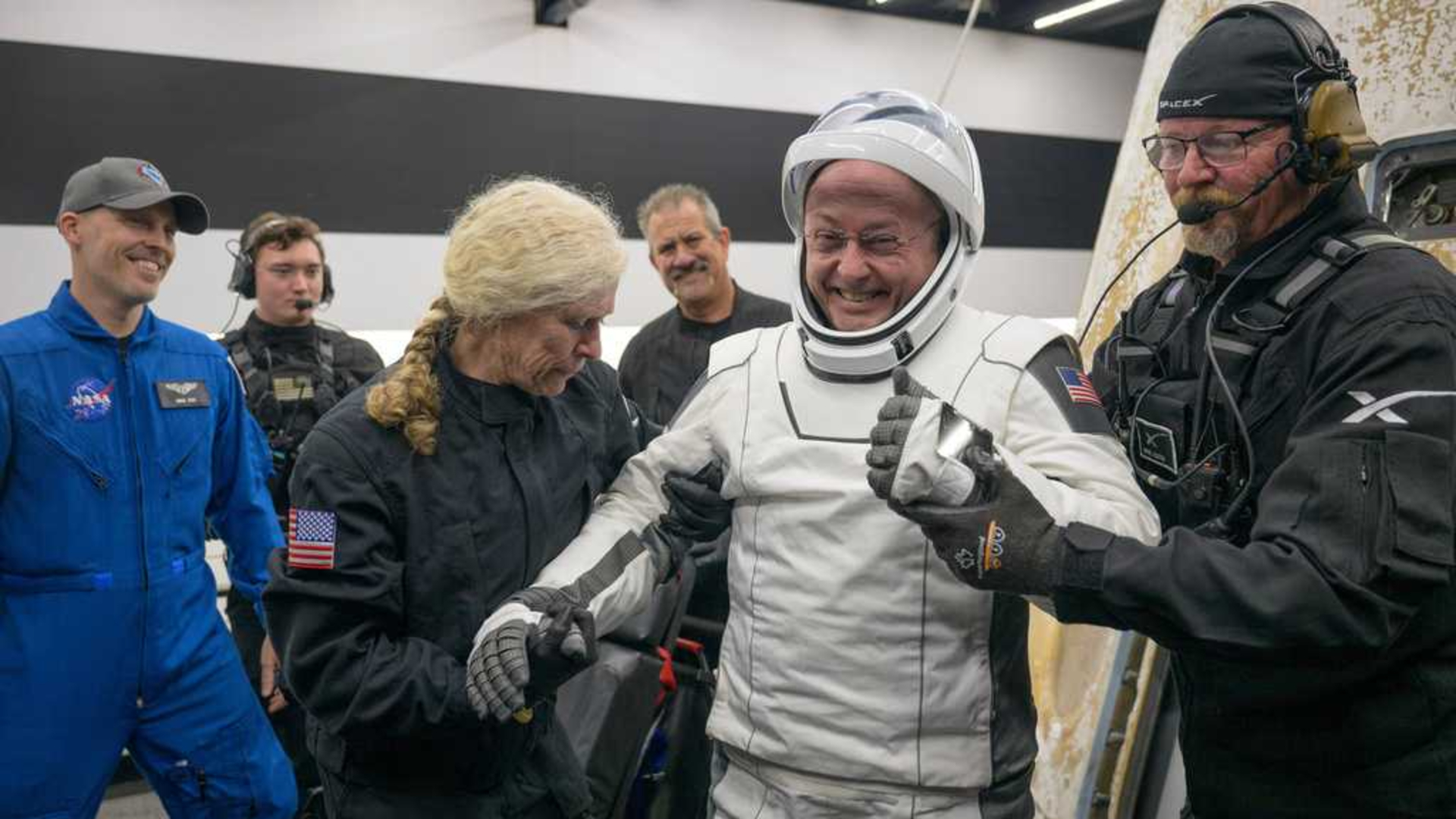
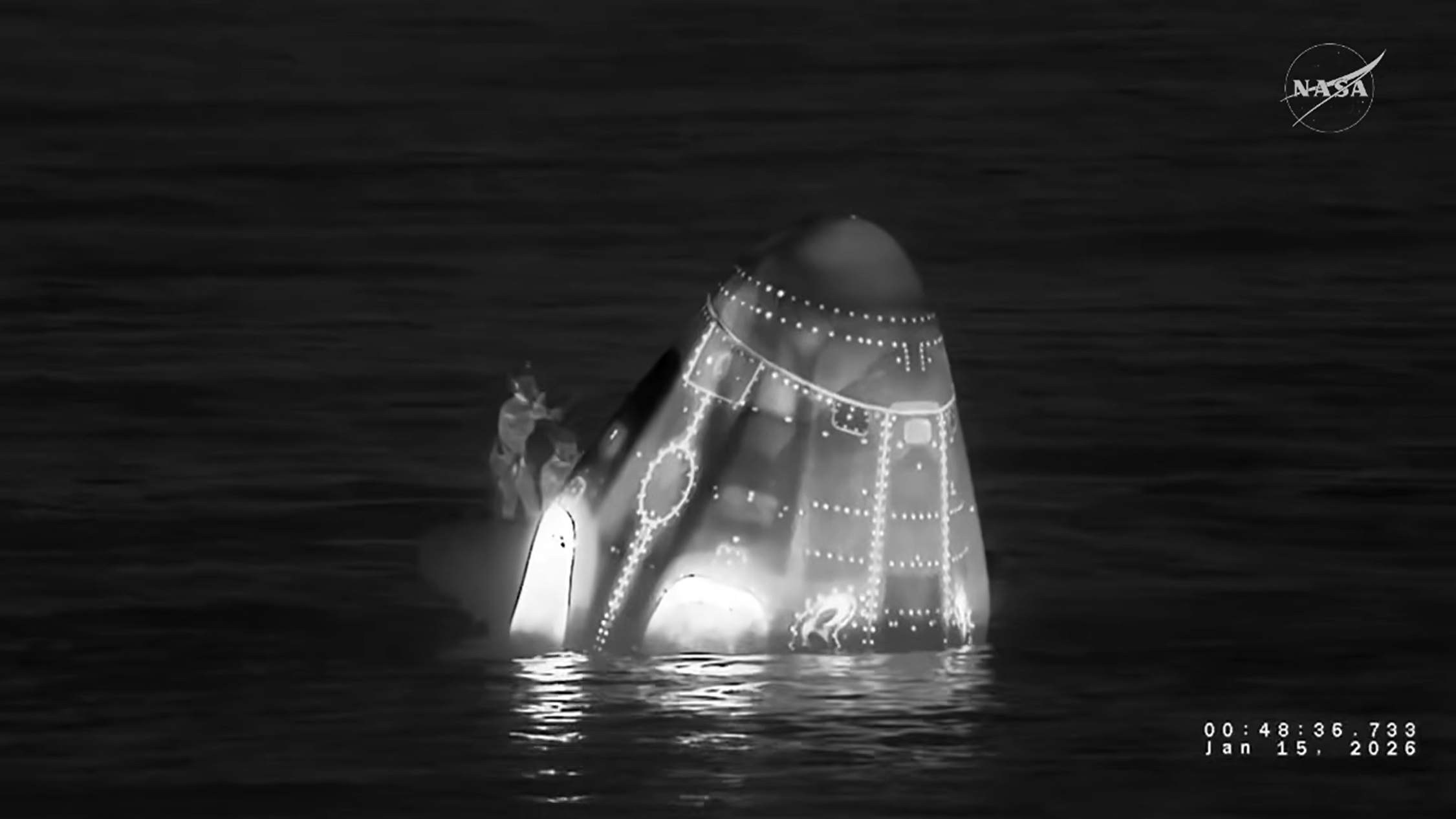
NASA astronaut Mike Fincke is helped out of the SpaceX Crew-11 capsule after they re-entered the Earth in a middle-of-the-night splashdown near San Diego, California on January 15
The agency previously revealed that astronaut Mike Fincke (second from left) experienced the issue, which cut Crew 11's mission short
Mr Fincke was five and a half months into his latest space station mission when the problem struck like 'a very, very fast lightning bolt'.
'My crewmates definitely saw that I was in distress,' he said, with all six gathering around him.
'It was all hands on deck within just a matter of seconds.'
Mr Fincke said he can´t provide any more details about his medical episode. The space agency wants to make sure that other astronauts do not feel that their medical privacy will be compromised if something happens to them, he explained.
The space station's ultrasound machine came in handy when the event occurred, he revealed, and he said he has gone through numerous tests since returning to Earth.
NASA is poring through other astronauts' medical records to see if any related instances might have happened in space.
The Crew-11 astronauts safely splashed back to Earth following NASA's first medical evacuation in 65 years of spaceflight.
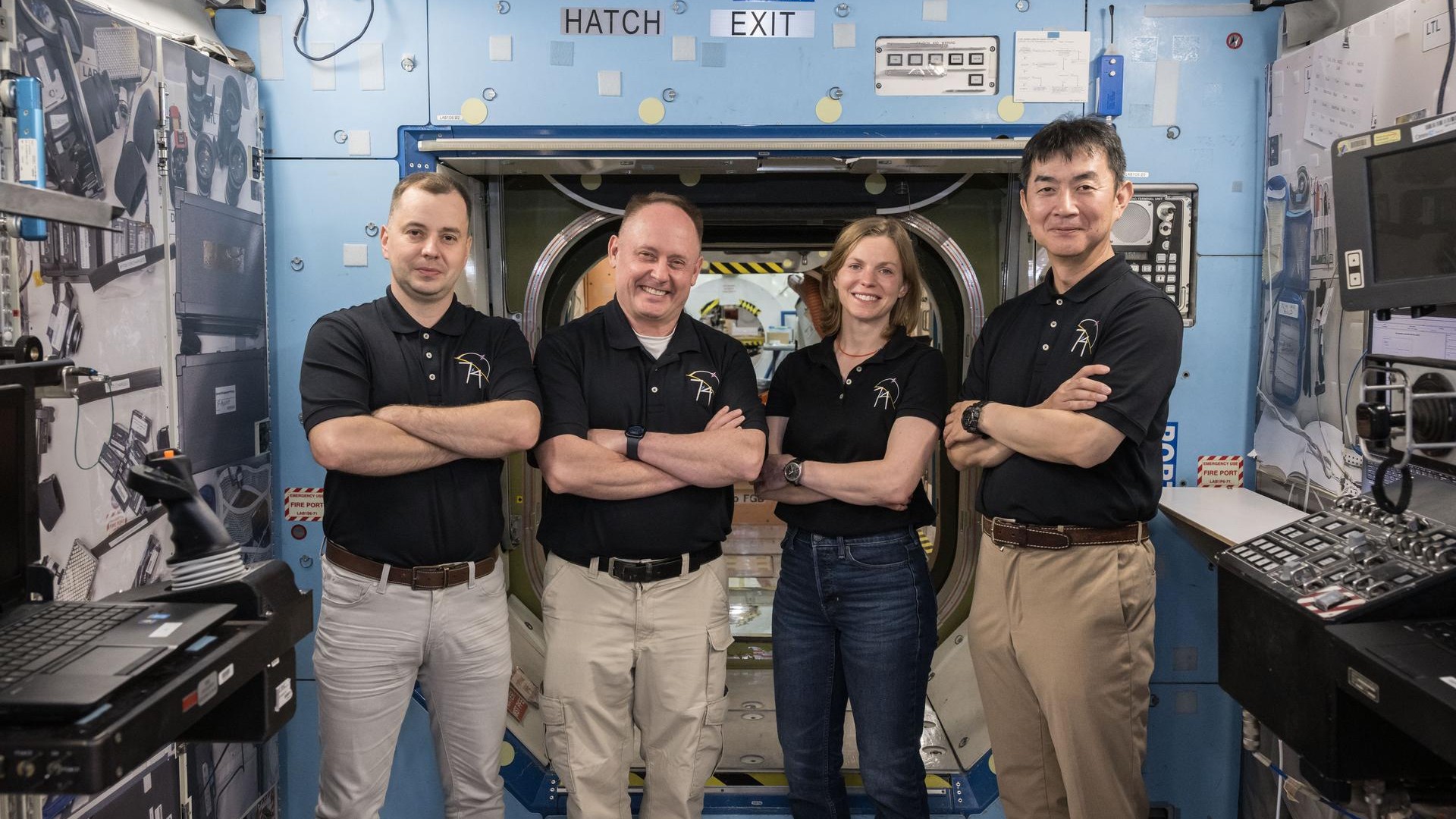
The decision was made to bring the crew - including NASA astronauts Zena Cardman, Mike Fincke, Japanese astronaut Kimiya Yui, and Russian cosmonaut Oleg Platonov - home a month ahead of schedule.
This was the first time a crew on board the ISS had their mission ended early due to medical reasons
Last month, Mr Fincke identified himself as the one who fell ill to put an end to swirling public speculation.
Health issues that can arise on the ISS
Blood clots
Bone and muscle atrophy
Loss of vision
Radiation damage
Circadian rhythm disruption
Accelerated ageing
General health decline
He said he still feels bad that his illness caused the spacewalk to be cancelled - it would have been his 10th spacewalk but first for crewmate Zena Cardman - and resulted in an early return for her and their two other crewmates.
The crew were taken straight to hospital after being brought back to Earth by SpaceX.
'I've been very lucky to be super healthy, so this was very surprising for everyone,' Mr Fincke said.
However, he said he has stopped apologising to everybody after NASA's new administrator Jared Isaacman ordered him to.
'This wasn't you - this was space, right?' his colleagues assured him. 'You didn't let anybody down.'
The astronaut, who has been to space four times, says he hopes he can return one day.
When news of a medical emergency first broke, Mr Isaacman said he decided to bring the crew home out of an abundance of caution.
He noted that the astronaut's medical episode was considered 'serious' and would require additional medical care on Earth.
The evacuation followed NASA's Spaceflight Human-System Standard, which mandates contingency return procedures whenever onboard medical resources are insufficient.
Although statistical models have long predicted that such an event could occur roughly once every three years, the plan has never before been used.
Located 250 miles above Earth, the ISS functions as a testbed for research that supports deeper space exploration, including eventual missions to return humans to the moon and onward to Mars.
The ISS is set to be decommissioned after 2030, with its orbit gradually lowered until it breaks up in the atmosphere over a remote part of the Pacific Ocean called Point Nemo, a spacecraft graveyard.
The International Space Station (ISS) is a $100 billion (£80 billion) science and engineering laboratory that orbits 250 miles (400 km) above Earth.
It has been permanently staffed by rotating crews of astronauts and cosmonauts since November 2000.
Crews have come mainly from the US and Russia, but the Japanese space agency JAXA and European space agency ESA have also sent astronauts.
The International Space Station has been continuously occupied for more than 20 years and has been expended with multiple new modules added and upgrades to systems
Research conducted aboard the ISS often requires one or more of the unusual conditions present in low Earth orbit, such as low-gravity or oxygen.
ISS studies have investigated human research, space medicine, life sciences, physical sciences, astronomy and meteorology.
The US space agency, NASA, spends about $3 billion (£2.4 billion) a year on the space station program, with the remaining funding coming from international partners, including Europe, Russia and Japan.
So far 244 individuals from 19 countries have visited the station, and among them eight private citizens who spent up to $50 million for their visit.
There is an ongoing debate about the future of the station beyond 2025, when it is thought some of the original structure will reach 'end of life'.
Russia, a major partner in the station, plans to launch its own orbital platform around then, with Axiom Space, a private firm, planning to send its own modules for purely commercial use to the station at the same time.
NASA, ESA, JAXA and the Canadian Space Agency (CSA) are working together to build a space station in orbit around the moon, and Russia and China are working on a similar project, that would also include a base on the surface.
Mars captured on 30 August 2021 (Credit : Kevin M. Gill)
Mars is our nearest planetary neighbour and the world humans are most likely to set foot on beyond the Moon. The fourth planet from the Sun, it sits about 225 million kilometres from Earth on average, close enough that we have sent dozens of spacecraft to explore it, yet far enough to remain, in many ways, deeply mysterious. Roughly half the size of Earth, it has a day almost identical in length to ours, polar ice caps, towering volcanoes, and a canyon system that would stretch across the entire United States. But for all its surface familiarity, Mars today is a world that has been dead for a very long time with a thin atmosphere, no global magnetic field, and temperatures that plunge to minus 80 degrees Celsius on a typical night.
Look at Mars today though and it's hard to imagine it was ever anything other than what it is, a cold, rust coloured desert where the wind carries dust across a landscape that hasn't seen liquid water for billions of years. But the planet's rocks remember what the atmosphere has long since forgotten.
NASA’s Perseverance Mars rover took these 2 selfie versions over a rock nicknamed “Rochette,” on September 10, 2021, the 198th Martian day, or sol of the mission
(Credit : NASA/Caltech)
NASA's Perseverance rover has been trundling across Jezero crater since it landed in February 2021, and among the reddish debris scattered along its path it has spotted something that immediately catches the eye, white rocks. Not just a few, there are pebbles, fragments, and boulders of pale, bleached material standing out sharply against the dusty orange surroundings.
Those rocks are kaolinite, an aluminium rich clay mineral, and their presence on Mars is scientifically extraordinary. On Earth, kaolinite forms in one of the most rain soaked environments imaginable….. tropical rainforests, where millions of years of heavy rainfall leach away virtually every other mineral from the rock, leaving this distinctive white clay behind. It is, in essence, a geological fingerprint for a warm, wet, persistently humid climate. Finding it on Mars changes the picture considerably.
"You need so much water that we think these could be evidence of an ancient warmer and wetter climate where there was rain falling for millions of years" - Briony Horgan, professor of planetary science at Purdue University.
To confirm what they were looking at, lead researcher Adrian Broz compared the Martian kaolinite with samples collected from sites near San Diego in California and in South Africa. The match was striking. The rocks from two different planets, separated by hundreds of millions of kilometres, told the same geological story. Kaolinite can also form through hydrothermal activity, where hot water forces its way through rock, but that process leaves a different chemical signature, and the Martian samples don't carry it. What they do carry points firmly toward slow, persistent leaching by rainfall over vast timescales.
Purdue University research into scattered kaolinite rocks on Mars’ surface shows the dry, dusty planet could have featured a rain heavy climate billions of years ago
(Credit : NASA)
There's a puzzle that remains, though. No obvious source for the kaolinite has been identified nearby. The rocks are scattered, suggesting they were either washed into the ancient Jezero lake, which once held a body of water twice the size of Lake Tahoe, or perhaps hurled there by a meteorite impact long ago. For now, nobody is certain.
What is certain is that these pale fragments are some of the most compelling evidence yet that Mars was once a world capable of supporting life. As Broz puts it, all life uses water. And the rocks of Jezero crater are quietly insisting there was once plenty of it.
Astronomershave long been intrigued by planet Saturn, and new research is revealing how a decades-long mystery involving the ringed planet’s spin has finally been solved.
Led by a team of researchers at Northumbria University, the mystery lies at the core of the planet, heated and charged by itsaurora. According to new research, the entire system is driven by a self-sustaining feedback loop powered by the planet’s own northern lights.
The discovery follows the discovery decades ago based on data from NASA’s Cassini spacecraft, which showed that Saturn’s rotation rate was not constant, unlike most planets, whose spins remain fairly consistent. This inconsistency raised questions about what factors could potentially cause Saturn’s rotation to somehow increase or slow down with time.
“What we are seeing is essentially a planetary heat pump. Saturn’s aurora heats its atmosphere, the atmosphere drives winds, the winds produce currents that power the aurora, and so it goes on. The system feeds itself,” says lead researcher Professor Tom Stallard in a statement.
“For decades, we knew something strange was happening with Saturn’s apparent rotation rate, but we could not explain it,” Stallard said. “We then showed it was being driven by atmospheric winds, but we still did not know why those winds existed.”
“These new observations, made possible by JWST, finally give us the evidence we needed to close that loop,” Stallard added.
This image shows the asymmetric temperature structure revealed in the new paper, as it was observed from JWST. These are offset from where the currents flow into and out of the planet, but ultimately, the winds generated by this temperature offset are what drive those currents. Image/movie credit: NASA/ESA/CSA, Tom Stallard (Northumbria University), Melina Thévenot, Macarena Garcia Marin (STScI/ESA).
In 2021, scientists proposed that the changing “spin” was only an illusion. Instead of the planet itself altering its rotation, the powerful winds in Saturn’s upper atmosphere were generating electrical currents. Astronomers believed these currents influenced the planet’s aurora, creating signals that made it seem like the rotation rate was shifting.
But scientists were still puzzled. What was driving those atmospheric winds?
By using new data from the James Webb Space Telescope (JWST), researchers looked more closely at detailed observations of Saturn’s “northern lights” over the course of a Saturnian day. The new JWST data reviewed far surpassed any previous data on the planet’s rotation.
By studying infrared emissions from a form of molecular hydrogen cation known as the trihydrogen cation, which serves as a natural thermometer in Saturn’s atmosphere, the team mapped temperature and particle density in the aurora, revealing subtle heating and cooling variations that were not apparent in earlier data.
The findings revealed a clear pattern to scientists: the aurora itself is responsible for heating the atmosphere across the planet. The local heating created winds, which in turn produce electrical currents. That means those current powers of Saturn’s “northern light” or aurora create a feedback loop.
Overall, Saturn’s aurora acts like a planetary heat engine. It heats the atmosphere, drives winds, and sustains the electrical currents that power the aurora. Scientists now understand that the rotation rate would change as the planet’s spin undergoes minor changes with time.
The discovery not only solves a long-standing mystery but also reshapes our understanding of how planetary systems work. Further, it can also provide astronomers with new insights into planets, atmospheric behavior, and the connection between planetary weather systems and space environments across the universe.
Chrissy Newton is a PR professional and the founder of VOCAB Communications. She currently appears on The Discovery Channel and Max and hosts the Rebelliously Curious podcast, which can be found on YouTube and on all audio podcast streaming platforms. Follow her on X: @ChrissyNewton, Instagram: @BeingChrissyNewton, and chrissynewton.com. To contact Chrissy with a story, please email chrissy @ thedebrief.org.
Alien orb caught studying wildlife on backyard cam, Wilmer, Alabama, USA March 2026, UFO Sightings Daily.
Date of sighting: March 25, 2026 8PM
Location of sighting: Wilmer, Alabama, USA
Source: NUFORC
Hey all, check out this UFO report just in. A persons animal cam in the back yard captured an orb that was studying the two deer in the photo. The orb is seen moving its position from left to right and changing its luminousness. I have been preaching about how infrared cameras can capture cloaked UFOs for over 15 years and current researchers have followed my lead. Even US government states the videos released caught it because of the camera recording in infrared. Now an orb is caught on a wildlife cam and I have to say, this is rare footage. I have only seen about 10 such cases in the last 15 years come to light. This is not an insect, or it would not be so far back and so big in the distance. The orb is right behind the two deer, who seem oblivious to its presence. Aliens are curious about not just humans, but the planet they own and we inhabit. Even a NUFORC note was in the report staying that its not possible it's an insect.
Scott C. Waring - UFO Sightings Daily
Eyewitness states:
Weird egg shaped light on camera I have a game camera in my backyard. Last night from 8pm till 4am I have multiple pictures of an egg shaped light in my backyard . It's even around the deer while they are eating grass. You can tell the deer are even looking at it. Estimated Size: 4ft in diameter and 6 to 8ft long.
NUFORC Note:
Normally we would classify this as an insect flying very close to the camera, but this image is unusually bright.
The alleged ruins were discovered near the Chandeleur Islands, a chain of uninhabited barrier islands sitauted about 50 miles east of New Orleans.WWLTV
A new Atlantis has emerged from the sands.
An amateur archaeologist has potentially made the discovery of a lifetime after uncovering the alleged ruins of a lost metropolis off Louisiana that predated modern US history.
“All I know is that someone built the city 12,000 years ago,” retired architect George Gelé claimed in a resurfaced WWLTV interview from 2022.
"Somebody floated a billion stones down the Mississippi River and assembled them outside what would later become New Orleans,” declared Gelé.WWLTV
In the clip, Gelé claimed that for 50 years, he has been capturing sonar images of submerged structures off Chandeleur Islands, a chain of uninhabited barrier islands situated in the Gulf of Mexico around 50 miles east of New Orleans.
The mysterious buildings reportedly number in the hundreds and are located 30 feet below the water’s surface and are buried underneath an additional 100 feet of sediment.
The crown jewel of this so-called lost city is a so-called 280-foot pyramid jutting up from the ocean floor, which the architect claims emits a powerful electromagnetic signature that affects passing boats. In fact, he believes that these aquatic remnants are “geographically related to the Great Pyramid of Giza in Egypt.”
All together, these pieces form a former civilization, dubbed Crescentis, which dates back 11,700 years to the end of the last Ice Age when rising seas inundated the coast.
Gelé with a block of granite he claims had a “rain gutter.”WWLTV
Gelé based his theory on mounds of mysterious granite stones found beneath Chandeleur Sound that are comprised of material not naturally found in Louisiana, leading the amateur archaeologist to believe that they were transported there.
“Somebody floated a billion stones down the Mississippi River and assembled them outside what would later become New Orleans,” declared the metropolitan forensics enthusiast, who has personally bankrolled and executed over 40 underwater research excursions in the region since 1974.
While this discovery has not been published in any peer-reviewed journals, Gelé is not the only one who things there’s something fishy going on beneath the sound.
Gelé claimed the rocks (like the one pictured) had been transported there.WWLTV
Local shrimper Ricky Robin, who ferried Gelé to the site on numerous occasions, claims that his boat gadgets started behaving strangely when he passed over the location of the alleged pyramid.
“I thought right away it was pieces of the pyramid because it was right around where that compass spun,” the prawner claimed. “Everything will go out on your boat. All your electronics like you were in the Bermuda Triangle.”
He claimed that other anglers had also swooped up strange square rocks in their nets.
However, other researchers have suggested that the structures could have a simpler explanation.
A Texas A&M study from the 1980s asserted that the stones could’ve been ballast discarded by Spanish or French galleons so they wouldn’t be as cumbersome in the shallows, Ancient Origins reported.
Meanwhile, in 2011, archaeology professor Rob Mann postulated that the granite could be the remnants of an attempt to erect an artificial reef in the 1940s. Although he claimed that searching underwater wouldn’t yield any more answers.
However, Gelé is not convinced.
“This is a piece of architecture, this is not ballast,” he declared while examining one of the stones, which sported a groove that he claimed was a “rain gutter.”
“Whether or not they (the people of Crescentis) had somebody on their shoulder flew in with a UFO, I don’t know,” he said. “All I know is that they left a whole bunch of granite rocks out there.”
Amateur sleuth finds 'lost city' with giant pyramid that sends compasses into a frenzy
Retired architect George Gele claims to have uncovered the ruins of a sprawling 'lost city' he's dubbed 'Crescentis' near Louisiana's Chandeleur Islands.
Gelé believes the waters near the Chandeleur Islands hide the ruins of an old civilisation
(Image: Getty Images)
An amateur archaeologist asserts to have made the find of a lifetime - a vast "lost city" submerged off the coast of the United States, predating modern history.
The centerpiece of his discovery is a colossal 280-foot-tall pyramid resting on the seafloor, which Gelé alleges emits a significant electromagnetic force.
Gelé suggests that the sunken structure is so potent that it disrupts navigation equipment.He maintains that the pyramid releases energy surges that send boat compasses into disarray.
Local shrimper Ricky Robin, who has transported Gelé to the site for numerous expeditions, corroborated these unusual claims. He compared the area to the notorious Bermuda Triangle, reports the Daily Star.
Retired architect George Gelé claims to have discovered a lost city
(Image: WWLTV/Youtube)
Robin told local station WWL-TV, "Everything will go out on your boat. All your electronics like you were in the Bermuda Triangle."
The fisherman even remembered the moment his tech malfunctioned: "I thought right away it was pieces of the pyramid because it was right around where that compass spun."
Gelé has named the location "Crescentis" and believes the structures lie approximately 30 feet beneath the surface, covered by an astounding 100 feet of silt. Despite the absence of peer-reviewed scientific support, he remains convinced of its importance.
He proposes the site was submerged by the ocean at the conclusion of the last Ice Age, roughly 11,700 years ago, and asserts the configuration is "geographically related to the Great Pyramid of Giza." The architect's key evidence is a collection of enigmatic granite mounds discovered underwater - a type of rock not naturally occurring in the Louisiana terrain.
Gelé stated: "Somebody floated a billion stones down the Mississippi River and assembled them outside what would later become New Orleans."
While the concept of an American Atlantis is captivating, skeptics aren't quite prepared to revise the history books. Multiple scientists propose the "pyramids" might actually be something far more ordinary.
A Texas A&M University study from the 1980s indicated the granite blocks were probably ballast stones discarded by Spanish or French vessels to reduce their weight in shallow waters. In 2011, archaeology professor Rob Mann proposed the mounds could be remnants from an effort to construct an artificial reef in the 1940s.
A former state archaeologist concurred the site appears to be the outcome of large barges dumping stone, though he noted: "But why and why there? Those are questions that need to be answered." While Gelé is aware of the theories, he remains doubtful, pointing out that granite is a costly material and unlikely to be discarded as waste. For now, the enigma of the Louisiana pyramid continues to lie at the bottom of the sea.
Representative Eric Burlison, a Missouri Republican, has discussed videos he said he had viewed involving unidentified anomalous phenomena (UAP) during a recent podcast appearance.
Why It Matters
Congressional attention to such phenomena grew following a 2023 House hearing in which former Air Force intelligence officer David Grusch suggested thegovernment had concealed informationabout UAPs.
The topic drew headlines again recently following comments from former President Barack Obama, who told political commentator Brian Tyler Cohen “they’re real” when asked about aliens—though he immediately clarified that he had never seen them himself and dismissed the notion that they were being kept at Area 51.
Shortly afterward, President Donald Trump announced he would be directing Secretary of Defense Pete Hegseth to startidentifying and releasing government filespertaining to unidentified flying objects (UFOs) and aliens.
What To Know
Speaking on hisFresh Freedompodcast, Burlison said, “I have seen videos of objects. I can't tell you exactly what they are—I say that because I'm saying I saw it and I can't tell what they are and neither could the people that filmed them. It’s something that’s wild like, you know defies logic, the way in which they operate.”
“What you're often seeing is these glowing type orbs. They look like balls of plasma that seem to be stationary and then sometimes they'll just move at incredible speeds,” Burlison said.
“I don't know what that is, and I don't think that our intelligence community knows what these things are.”
TheNew York Postreported that Burlison has been pursuing access to classified military installations he believes may be connected to UAPs and alleged crash‑retrieval programs. Burlison told the outlet he has already toured one classified U.S. base and hopes to visit several others.
Burlison emphasized that, despite viewing classified material and videos—including footage of small, silver orb‑like objects—he remains skeptical and suggested he needs more concrete evidence before drawing conclusions about the nature of UAPs, it reported.
Republican Missouri Representative Eric Burlison speaks at the U.S. Capitol on July 20, 2023, in Washington, D.C.|Win McNamee/Getty Images
“I've been given access to go visit a site—multiple sites potentially. I've already visited one. I plan to visit at least three more,” he said on the podcast.
“And you know, I might be given the dog and pony show and taken to the cafeteria or whatever, but at least I'm able to do my part and try to do everything I can to get to these locations and see what's there. And then I've also asked for briefings. We're getting more and more information and we have more and more whistleblowers coming to us all the time. So I think that this is starting to unravel. I really do.”
What Happens Next
Secretary of Defense Pete Hegsethoffered an updateon disclosure plans while speaking to reporters last month, saying, “We’ve got our people working on it right now. I don't want to oversell how much time it will take, right? We're digging in. We're going to be in full compliance with that executive order, eager to provide that for the president. So, there'll be more coming on that as far as the process of what we'll do.”
Bill Maher argued that a growing number of credible sightings by military personnel and intelligence officials suggests alien life may be observing Earth, saying skeptics are increasingly the ones sounding like "conspiracy theorists."
"My opinion changes when the information changes," Maher said Friday on "Real Time."
"Yes, there was a time when the only actual contact we heard about aliens was from rural people who had been abducted and anally probed," he quipped.
"But you don't hear about that anymore. Why? My guess is the aliens gathered all the information they needed about us … [and] now they seem to be in a different phase. They seem to want to be spotted. Why else for this constant ‘playing peek-a-boo’ with our military? And it's serious people [saying this] now."
Comedian Bill Maher faces the camera during a March 27 episode of "Real Time with Bill Maher."
(Real Time with Bill Maher/YouTube)
Maher pointed to reports from military pilots and government officials who have described encountering unidentified objects exhibiting capabilities far beyond known technology.
"They keep seeing things move through air and ocean in ways that defy our physics. Military pilots who say, ‘Yeah, I saw something doing Mach 10, and then it stopped on a dime and disappeared,’" he said.
"That's not a drone. That's not something from another country. Even Elon is like, 'Not me.""
An aircraft is seen in a GOFAST video released by the Pentagon.
(Department of Defense)
Maher also cited a growing number of lawmakers and officials who have acknowledged the unexplained phenomena, noting that the issue has moved well beyond fringe speculation.
"It’s not weirdos and beardos saying this," he said. "It’s guys with buzz cuts and security clearances who are spilling the tea, and politicians who you don't think are crazy people."
He pointed to bipartisan interest in unidentified aerial phenomena, including past comments and actions from figures such as former Sen. Marco Rubio, Sen. Kirsten Gillibrand and Senate Minority Leader Chuck Schumer, who helped push for government investigations and transparency into the issue.
Maher also referenced high-profile remarks from former President Barack Obama, who appeared to acknowledge the existence of extraterrestrials but later clarified his remarks on social media.
He wrote, "Statistically, the universe is so vast that the odds are good there's life out there. But the distances between solar systems are so great that the chances we've been visited by aliens is low, and I saw no evidence during my presidency that extraterrestrials have made contact with us. Really!"
Former President Barack Obama ignited discussion by appearing to joke that "aliens are real" but later clarified the remarks.
(Spencer Platt/Getty Images;Netflix)
"They're real, but I haven't seen them," Obama said initially during an interview with U.S. podcast host Brian Tyler Cohen.
"And they’re not being kept in … Area 51. There’s no underground facility unless there’s this enormous conspiracy and they hid it from the president of the United States."
Maher noted that Congress has already held historic hearings on unidentified aerial phenomena, noting how seriously the government is now treating sightings it still cannot explain.
"The government's official public line is, 'We don't know what these things are.'" he said. "But, in private, what they say is, 'No, seriously, we don't know what these things are, but they didn't leak from a lab in China."
RELATED VIDEOS
“Aliens Are Real? 😳 Bill Maher Just Said THIS…”
Bill Maher Drops UFO Bombshel
Bill Maher quips that UFO skeptics are now the ones who sound like 'conspiracy theorists' on aliens
Mystery as co-worker of missing USAF general linked to UFOs 'vanishes'
Matt Davies
William Neil McCasland
A mysterious missing persons investigation involving a general "linked to UFO research" has taken a strange twist after it was revealed that his former colleague has also disappeared. Retired US Air Force General William McCasland has been missing since he departed his Albuquerque,New Mexico, residence on February 27.
William served as commander of the Air Force Research Laboratory at Wright-Patterson Air Force Base
(Image: wikipedia)
He stated at a press conference: "There's no indication, and we are not putting forward that Mr. McCasland was disoriented or confused. Arguably, he would still be the most intelligent person in the room that any of us would be in. Highly intelligent, highly capable."
William's disappearance stands apart from typical missing persons cases due to its seeming link to the UFO phenomenon. Significantly, he previously served as commander of the Air Force Research Laboratory at Wright-Patterson Air Force Base in Ohio.
Heightening the mystery, Wright-Patterson has long been rumored to host secret government research into UFOs. The facility is also claimed to have housed alleged alien bodies retrieved from the 1947 Roswell incident in New Mexico.
As per CNN, William would likely have been involved in the Pentagon's advanced aerospace research. The mystery deepened when he vanished just days after Donald Trump ordered the release of documents related to extraterrestrial life and UFOs.
Wright-Patterson Air Force Base is often rumoured to host covert government research into UFOs
(Image: US Army)
In a video for NewsNation's YouTube channel, anchor Elizabeth Vargas said: "Now, before retiring, General McCasland oversaw a highly classified programme linked to UFO research.
"And many are wondering if that secretive work past and researching UFOs could have made him a target somehow. Even if you're a UFO sceptic, it's hard not to be curious about another strange aspect of this case."
The "strange aspect" Elizabeth referred to was the similarly mysterious disappearance of William's former colleague, Monica Reza, under "strange circumstances" the previous summer. This led her to question: "Is it all a coincidence?"
Hailing from Los Angeles County, Monica, 60, was last seen hiking on June 22 last year, at 9.10am at 60001 Trailhead Ave, Angeles Crest Highway. According to NewsNation reporter Alex Caprariello, Monica "vanished off the face of the earth".
Monica Reza likewise "vanished under unusual circumstances" last summer
(Image: undefined)
He reported: "Last seen hiking in the Los Angeles forest with a companion. By all accounts, everything seemed normal that day. She was about 30 feet behind that person she was hiking with, smiling and waving.
"He turned around, next thing, you know, she was just completely gone. Rescue teams spent days looking for her but actually never recovered her body."
He observed that Monica was "essentially connected" with William to the location from where he was reporting, New Mexico. He detailed how she worked as an aerospace engineer who "developed a special medal" that was "used in rockets".
Alex noted that this project received US government funding and was "overseen" by William. Whilst it remains unclear whether the two cases are linked, both individuals have vanished "within less than one year".
TR-3B Black Manta: The secret US aircraft with ‘anti-gravity’ technology
For three decades, a black triangular-shaped object with bright lights has been reported to hover at low altitudes and vanish like a state change.
Dr Omar Memon
Have you ever seen or heard stories of a black triangular object hovering at low altitudes? For three decades, the object has been reported as a silent black UFO with bright colored lights in its centre.
It is said to be a secret US aircraft called TR-3B Black Manta. Typically observed at night, the TR-3B is rumoured to have a steady geometry that silently loiters in the air and vanishes like a state change.
The visible bright pulsating lights change through modes, giving the UFO a mysterious look. The aircraft is allegedly a top-secret, anti-gravity reconnaissance aircraft developed by the US military under a black project.
A black project is a classified military project not formally acknowledged by a government or associated authorities.
What is a TR-3B Black Manta, and what is it possibly designed for?
While the existence of the TR-3B UFO is speculative, the strong pattern of sightings in different parts of the world suggests the presence of a purpose-built aircraft. A recent article from Medium, which focused on the physics and engineering of the TR-3B, states that the UFO shows two operational patterns.
A steady power mode showing silent low-altitude hovers for station-keeping, and a pulsed mode revealing state-change transitions through speeds and altitudes. The sightings imply that the TR-3B is purposely designed to perform station control, power transitioning, and thermal management under atmospheric loads.
Photo: 3D Rendering of the TR-3B / Hakan Hancer
The Black Manta is speculated to also have what is known as the “anti-gravity” technology. While having no gravity is impossible, counteracting the gravity in various ways can be achieved. The UFO may use nuclear energy to accelerate high-pressure plasma, creating an anti-gravity field around it.
Moreover, specialised thrust generators onboard the UFO offer rapid transitions in speed, orientation, and position. Military.com states that the plasma created through nuclear reactions significantly reduces radar signatures, enhancing the aircraft’s survivability and lethality.
The perceived capability coincides with the TR-3B’s reported sightings at various locations. The aircraft can fly to any part of the world undetected by most air traffic radars and defence systems.
The design elements were determined from hundreds of Black Triangle sightings
The National Institute of Discovery Science (NIDS) conducted an extensive investigation into the black triangle sighting, following the accumulation of over 150 separate reports from the US, Canada, and Europe. All reports suggested the sighting of a large, low-flying triangle object. Based on the NIDS reports and from the accounts of independent aircraft designers, the size, thrust, and payload approximations of the black triangle were estimated.
TR-3B Black Manta
Length
600 ft (183 m)
Width
300 ft (91.5 m)
Height
40 ft (12.2 m)
Mass
100 tonnes
Horizontal Surface
180,000 sq.ft
Vertical Surface
94,245 sq. ft
Total Surface
274,245 f sq.ft
Horizontal Thrust
468,000 lbs. / 234 tons
Vertical Thrust
245,037 lbs. / 122 tons
Total Thrust
713,037 lbs. / 356 tons
Hull Volume
3,600,000 cubic ft.
Pay Estimate
200,000 lbs. / 100 tons
The NIDS concluded that the black triangular-shaped object is a very large, brightly lit, and extremely silent craft. It is mostly sighted near water, including lakes. Moreover, its ability to quickly accelerate from a hovering position suggests the use of powerful nuclear-based technology. The Black Manta may be designed to conduct intelligence, surveillance, and reconnaissance (ISR) missions.
Given the aircraft’s relatively flat triangular shape, as suggested by numerous sightings, a range of advanced systems can be installed. From aperture radars and high-resolution cameras, to Electro-optical/infrared (EO/IR) sensors, the patterns suggest sensing and data-gathering missions.
Photo: Satellite / Wikimedia Commons
With its low observability and minimal signatures, the TR-3B seems to operate in specific timeframes while having significantly long station times. Moreover, if Black Manta is indeed a human-built aircraft, it could be designed as a technology demonstrator to explore advanced technologies for future IS aircraft.
Man Builds Alien UFO Landing Pad In Argentinian Desert.
Jaisli disappeared the man who built the airport for the arrival of UFOs. This man of Swiss origin. In Cachi in the mountains of western Salta, a great project began to build an UFO port, its infrastructure consisted of a 36-pointed Star of 48 meters in diameter. Jaisli said he had telepathic contacts with aliens and was ordered to build this UFO. It is rumored with the locals that this man has not been seen again in that place or in the surroundings and that his disappearance has surprised them, connoisseurs of the ufological subject comment that he could have been abducted or taken by extraterrestrials.
A man has built an alien UFO landing pad in an Argentinian desert and claims extraterrestrials telepathically told him to construct it. He claims the alien contact occurred after he witnessed a recent UFO sighting in the area. The UFO landing strip was built near the town of Cachi, Argentina. Werner Jaisli constructed the pad. The Swiss man traveled to the South American country after receiving orders from an extraterrestrial source.
The area is barren and the inhabitants of the land are surrounded by natural beauty in every direction. Mr. Jaisli built his UFO landing pad using a massive collection of white and brown rocks. An ‘ovniport‘ is at the center of the pad. This is a shape that resembles a star and many believe it to have an extraterrestrial connection. The Swiss man traveled to this exotic location after hearing voices in his head, which he believes are not from this world. Apparently, this would be the ideal for an alien UFO to land should they have traveled through the vastness of space. I wonder if the saying is true, “build it and they will come.” Well, it is built, and now we wait for them to come!
Mr. Jaisli spent much of his time from 2008-2012 building the UFO pad. Not only did he build the main landing pad for an alien craft, but he has also put together smaller monuments, which are clearly visible from the sky.
It all begun on a November night in 2008 when he witnessed a UFO sighting at a party. He explains how the power was suddenly cut off during the party at a friends house. “They were at the height of my eyes, from my position. They were solid, circular and looked like burnished metal. I do not know why, but mentally I asked them to come closer. And they did!“ After this initial first UFO sighting, he explained how he received a telepathic order from the extraterrestrials on the craft to build a UFO landing pad. It took a long time, but he eventually completed his orders. All with the hope that soon the extraterrestrial race aboard the UFO would land. What Happened Next? After spending four years of his life building this amazing landing pad for UFO’s, Werner has since disappeared!
The locals of Cachi have not seen him in the streets as they did during the construction. Some are even saying that he has since been abducted by aliens! However, others say that he simply got tired of all the attention and returned to his life back in Switzerland.
Alien abduction Did aliens abduct Werner? Image credit: The Conversation. Since his mysterious disappearance, the UFO landing area is owned by the Municipality of Cachi. They promote the area as a tourist destination. Nowadays the site attracts hundreds of UFO enthusiasts a year.
Wow! UFO at Mississippi coast, seen across several states, UAP Paranormal Alien Sighting Breaking News
Date of sighting: March 28, 2026
Location of sighting: Mississippi coast, USA
Source: Email report scwaring @yahoo.com
This was recorded by a reader at UFO Sightings Daily and he recorded this strange craft over the ocean when he was at the beach. The UFO was a huge disk and semi transparent which indicates that this UFO was trying to cloak but was have some kind of technical difficulties. UFOs are more frequently seen over the ocean than over land, 3X more frequently. You see water covers three quarters of the Earth and land just a quarter, thus, logic dictates that as much as they are seen over land, it's 3X more over the ocean. Now the US gov will make fake explanations for this UFO seen for hours over several states, but don't believe them.
The US government will never reveal the truth, they will never allow Trump to reveal the truth, there are alien species that are really in charge of the human race and if they say no, then its no. We humans do not control the planet...it was belongs to many alien species billions of years before humans ever existed...and they still control it now.
A strange phenomenon: Feeling the exact moment someone else is dying
Over the years, we’ve written many articles about near-death experiences, reincarnation, the afterlife, and the supernatural. But there’s one phenomenon we’ve never truly explored, something just as unsettling and far less talked about.
It involves people who are fully awake, fully conscious, yet suddenly experience something profound at the exact moment someone else is dying. A family member, a close friend, or even someone nearby, or thousands of miles away.
Like the hundreds of nurses, doctors, and everyday people who have reported witnessing something at the exact moment someone dies.
For example, a doctor who walks into a trauma room and sees a dead woman floating above a dying man. He isn't the patient's physician. He just felt the pull to go in.
Researchers have now collected over 800 of these cases. The patterns are nearly identical across cultures, ages, and belief systems, including committed atheists.
What are they experiencing? And why have so many of them stayed silent for decades?
De Mysterie van de Ghost Rockets uit Scandinavië: Een Diepgaande Analyse
In 2015 bracht een onthullende documentaire de wereldwijde belangstelling terug naar een fascinerend fenomeen dat al decennia lang de gemoederen bezighoudt: de Ghost Rockets van Scandinavië. Deze mysterieuze verschijnselen, die zich sinds het einde van de Tweede Wereldoorlog voordeden, blijven tot op heden een intrigerend mysterie. Het onderzoek dat werd uitgevoerd door UFO-Sweden onder leiding van Clas Svahn, onthult een complex verhaal vol onverklaarbare waarnemingen, controverses en theorieën. In dit artikel nemen we je mee op een gedetailleerde reis door de geschiedenis, de theorieën en de actuele stand van zaken rondom de Ghost Rockets, met concrete voorbeelden en diepgaande analyse.
Mysterieuze raket?
De Oorsprong van het Mysterie: Na de Tweede Wereldoorlog
De eerste meldingen van de Ghost Rockets dateren uit 1946, kort na het einde van de Tweede Wereldoorlog. Europa was nog altijd in een staat van herstellende rust, maar de herinneringen aan de oorlog, vooral de luchtaanvallen en de bombardementen, zaten diep. De angst en de spanning waren nog niet weg, en de nieuwe dreiging van de Koude Oorlog hing als een donkere sluier over het continent.
Op 9 juni 1946 zag een inwoner van Helsinki, Finland, een vreemd licht dat zich door de hemel bewoog. Het leek een lichtgevende object dat tien minuten lang zichtbaar was, vergezeld van het geluid van donder. De volgende dag herhaalde de verschijning zich, maar deze keer voerde het een volledige draai uit in de lucht, alsof het bewust manoeuvreerde. Vervolgens schoot het terug in de richting waar het vandaan kwam en verdween uit het zicht.
Later, op 15 juli, zagen meerdere getuigen in Oslo, Noorwegen, een vreemd, lichtgevend object dat zich in een bijna rechte lijn door de lucht bewoog. Het was overduidelijk dat het geen natuurlijk verschijnsel kon zijn, omdat de beweging te precies en gestroomlijnd was. Binnen een minuut was het object verdwenen, maar de getuigen waren zeker van wat ze hadden gezien.
Deze eerste meldingen markeerden het begin van een golf van onverklaarbare waarnemingen die zich over de jaren zouden voortzetten. Wat deze objecten precies waren, bleef lange tijd een raadsel. De waarnemingen werden snel bekend onder de naam “Ghost Rockets”, een term die in de media werd geïntroduceerd om de mysterieuze, raketachtige verschijnselen te beschrijven.
.Voordat we naar enkele van deze waarnemingen kijken, bekijk hieronder de trailer van de documentaire 'Ghost Rockets'
De Waarnemingen en de Uitbreiding van het Fenomeen
Gedurende de jaren 1940 en 1950 werden honderden meldingen gedaan over de Ghost Rockets. Vooral in Scandinavië, en in het bijzonder Zweden, nam het aantal incidenten toe. De waarnemingen varieerden van enkelvoudige getuigen tot grote groepen die dezelfde verschijning zagen. Sommige getuigen rapporteerden dat de objecten langwerpig waren, met een metallic glans en een raket- of torpedo-achtige vorm. Andere beschrijven ze als “machine-achtig”, met scherpe hoeken en een gestroomlijnde structuur.
Een van de opvallendste meldingen kwam uit de regio rond Lake Nammajaure in Zweden, in de zomer van 1980. Liz en Bo Berg waren toen aan het wandelen langs de oever van het meer toen ze een vreemd, raketachtig object zagen passeren. Liz beschreef het als een “glanzend, metallic object” dat over hun hoofd vloog en vervolgens een scherpe U-bocht maakte, recht op hen afkwam. Voordat het hen kon bereiken, verdween het in het water.
Wat deze waarneming bijzonder maakt, is dat het getuigen niet alleen het object zagen, maar ook het geluid ervan hoorden. Liz Berg vergeleek het geluid met een “swoosh” en dacht aanvankelijk dat het een Russische kruisraket was die zich boven hen bevond. De waarneming werd direct gerapporteerd bij de militaire autoriteiten, die vervolgens een uitgebreide interviewronde hielden met de getuigen. Toch bleef het antwoord uit; de militaire diensten toonden weinig interesse om de zaak verder te onderzoeken en gaven geen verdere informatie vrij.
De eerste golf van waarnemingen in 1946 en de daaropvolgende jaren leidde tot een breed scala aan theorieën over de aard van de Ghost Rockets. Sommigen dachten dat het militaire experimenten waren, mogelijk geheime testen van nieuwe wapentechnologieën door de Verenigde Staten of de Sovjet-Unie. Anderen gingen verder en suggereerden dat het misschien buitenaardse voertuigen waren die de aarde bezochten.
De Geopolitieke Context en Mogelijke Oorzaken
Het was logisch dat overheden in de nasleep van de oorlog en tijdens de opbouw van de Koude Oorlog een grote belangstelling toonden voor de vermeende raketachtige verschijnselen. De Sovjet-Unie had zich gesloten en geheimzinnig opgesteld, en er was veel angst dat deze “Ghost Rockets” mogelijk Russische wapentechnologieën waren die geheime tests uitvoerden.
Echter, nader onderzoek naar de archieven van de Sovjet-Unie, die na de val van de Sovjet-Unie werden vrijgegeven, wijst uit dat deze theorie niet houdbaar is. De Sovjet-archieven bevatten geen bewijs van dergelijke geheime rakettesten in Scandinavië in die periode. Ook was het voor de Sovjet-Unie niet logisch om zulke testen uit te voeren op zichtbare plekken in Europa, vooral niet in nabijheid van de NAVO-landen, omdat dat hun strategie en veiligheid ondermijnde.
Wat betreft de theorie dat de waarnemingen natuurlijke fenomenen waren, zoals meteorieten of atmosferische verschijnselen, wordt dit ook in twijfel getrokken door de consistente beschrijvingen van de getuigen. Veel waarnemingen beschrijven objecten die manoeuvreerden met precisie en snelheid die meteorieten niet kunnen bereiken. Bovendien werden er vaak bewegingen waargenomen die niet door natuurlijke fenomenen verklaard konden worden, zoals plotselinge omwentelingen en het veranderen van richting in de lucht.
De mogelijkheid dat de Ghost Rockets geheime militaire technologieën waren, blijft een theorie, maar wordt door veel onderzoekers als onvolledig beschouwd. Waarom zouden landen zulke experimenten uitvoeren op zichtbare plekken en in de buurt van populaties? Het lijkt onwaarschijnlijk dat geheime testen zulke opvallende en gedetailleerde waarnemingen zouden opleveren zonder dat er enige restanten of bewijs werd gevonden.
De Meer Mysterieuze Mogelijkheid: Buitenwereldse Intelligentie?
Een van de meest intrigerende theorieën is dat de Ghost Rockets niet van deze wereld zijn. Het idee dat buitenaardse wezens de aarde bezoeken en zich op een of andere manier manifesteren in de vorm van deze raketachtige objecten, wordt door een deel van de wetenschappelijke en UFO-gemeenschap serieus genomen.
Uiteraard is er geen sluitend bewijs dat deze objecten buitenaards zijn, maar verschillende aspecten maken deze theorie interessant. Bijvoorbeeld, de waarnemingen van objecten die onder water verdwijnen of opduiken, suggereren dat er een verbinding zou kunnen bestaan met ondergrondse of onderwaterbasis van buitenaardse wezens. Sommige getuigen rapporteerden dat de objecten niet alleen door de lucht vlogen, maar ook in rivieren en meren onder water verdwenen of opduiken, wat de suggestie versterkt dat er mogelijk een verborgen onderwaterfaciliteit is waar deze voertuigen vandaan komen of naartoe gaan.
Daarnaast worden er regelmatig meldingen gedaan van objecten die in de lucht manoeuvreren met ongelooflijke precisie en snelheid, die niet overeenkomen met menselijke technologieën uit die tijd. Sommige getuigen beschrijven dat de objecten van helder naar onzichtbaar kunnen verdwijnen, wat in theorie kan wijzen op technologische capaciteiten die verder gaan dan onze huidige kennis.
Bekijk de onderstaande video – een interview met Clas Svahn over de Ghost Rocket-waarnemingen.
De Theorieën en Mogelijke Verklaringen
De vraag blijft: wat zijn de Ghost Rockets nu werkelijk? Het antwoord is complex en er bestaan verschillende theorieën, elk met hun eigen bewijzen en tekortkomingen. We kunnen ze samenvatten in drie hoofdcategorieën:
Natuurlijke fenomenen:Meteorieten, atmosferische verschijnselen zoals ball lightning of zonsverduisteringen, die soms spectaculaire en onverklaarbare verschijnselen kunnen veroorzaken. Echter, de beschrijvingen van de waarnemingen maken dit minder waarschijnlijk, vooral gezien de manoeuvres en precisie van de objecten.
Menselijke technologie:Geheime militaire testen of experimenten met nieuwe wapens en vliegtuigen. Dit zou kunnen verklaren waarom de objecten vaak langs bepaalde routes vlogen en in bepaalde gebieden werden waargenomen. Maar de opvallende bewegingen en de waargenomen onderwatermanoeuvres maken dit ook twijfelachtig.
Buitenaardse intelligentie:De meest fascinerende en controversiële theorie. Het suggereert dat de Ghost Rockets buitenaardse voertuigen kunnen zijn die de aarde bezoeken en mogelijk in contact staan met onderwaterbases of geheime installaties. Het feit dat sommige objecten onder water verdwijnen, versterkt deze hypothese, hoewel het bewijs nog altijd niet sluitend is.
Voorbeelden en Recente Ontwikkelingen
Een bekend voorbeeld is het incident van 1980 bij Lake Nammajaure, waarbij getuigen een object zagen dat over het meer vloog, een scherpe bocht maakte en in het water verdween. Deze waarneming werd gevolgd door een militaire en civiele reactie, maar er werd nooit verdere informatie vrijgegeven.
Daarnaast zijn er talloze andere meldingen uit Scandinavië en omringende landen, die vaak vergelijkbare kenmerken vertonen: langwerpige, metallic verschijnselen die manoeuvreren met precisie en snelheid die niet door menselijke technologie uit die tijd konden worden nagebootst.
In 1984 declassificeerde Zweden haar Ghost Rocket-archieven en kwam er meer dan 1500 rapporten naar boven. Interessant is dat, ondanks de officiële neutrale houding, de meeste rapporten over de jaren heen blijven binnen de Scandinavische regio en vooral in Zweden en Noorwegen worden gerapporteerd.
Moderne onderzoeken, zoals die van UFO-Sweden onder leiding van Clas Svahn, proberen nog altijd het mysterie te ontrafelen. Er worden nieuwe analyses uitgevoerd op oude rapporten, radargegevens en getuigenverklaringen. Sommige onderzoekers suggereren dat de objecten mogelijk geavanceerde menselijke technologieën zijn, terwijl anderen nog steeds geloven in een buitenaardse oorsprong.
De Conclusie: Een Blik op de Toekomst
Tot op heden blijft de ware aard van de Ghost Rockets een mysterie. Ondanks talloze onderzoeken, rapporten en theorieën, is er geen sluitend bewijs dat de objecten natuurlijke fenomenen, menselijke technologieën of buitenaardse voertuigen zijn.
Wat we wel weten, is dat de waarnemingen consistent en overtuigend genoeg zijn om de aandacht van zowel de publieke opinie als de wetenschappelijke gemeenschap vast te houden. De waarnemingen onder water, de manoeuvres en de herhaalde verschijnselen maken het fenomeen bijzonder en vragen om verder onderzoek.
Het is mogelijk dat toekomstige technologieën en nieuwe archieven meer duidelijkheid zullen bieden. Bijvoorbeeld, met de ontwikkeling van betere radar- en beeldvormingstechnologieën, kunnen we misschien meer objecten detecteren en analyseren. Daarnaast kunnen nieuwe getuigenverklaringen en onderzoeksmethoden meer licht werpen op dit eeuwenoude mysterie.
Tot die tijd blijft de vraag bestaan: zijn de Ghost Rockets een grensverleggend bewijs van buitenaardse intelligentie, geheime militaire experimenten of natuurlijke verschijnselen die nog niet volledig begrepen worden? Het antwoord ligt mogelijk nog altijd verborgen onder de oppervlakte van onze kennis, wachtend op dat ene doorbraakmoment dat alles zal veranderen.
Kortom, de Ghost Rockets blijven een fascinerend fenomeen dat ons uitdaagt om verder te kijken dan de horizon van onze huidige wetenschap. Ze herinneren ons eraan dat er nog veel te ontdekken valt in de uitgestrekte ruimte boven Scandinavië en misschien zelfs in de diepten van onze oceanen. De zoektocht naar de waarheid gaat door, en met elke nieuwe ontdekking komen we misschien een stapje dichterbij het begrijpen van deze mysterieuze verschijnselen.
Onderzoekers uit Japan hebben één enkele muis steeds opnieuw gekloond, 57 generaties lang. Alle kopieën leken gezond en hadden een normale levensloop. Maar onder de motorkap stapelden de DNA-fouten zich op, tot het systeem crashte.
Onderzoekers van de Universiteit van Yamanashi begonnen in januari 2005 aan een experiment dat je gerust episch mag noemen. Ze namen één vrouwelijke muis als startpunt en kloonden haar via kerntransplantatie. Dat is een techniek waarbij je de kern van een lichaamscel in een lege eicel plaatst. Toen de kloon drie maanden oud was, namen ze daar weer cellen van af en maakten ze een volgende generatie. Zo gingen ze door, jaar na jaar. Ze maakten drie tot vier generaties per jaar. In totaal produceerden ze meer dan 1.200 gekloonde muizen uit dat ene originele dier.
Eerst ging het beter, toen slechter
Het vreemde is: in het begin leek klonen juist steeds makkelijker te worden. Tot en met generatie 26 steeg het slagingspercentage gestaag, zo blijkt uit de studie, tot zo’n 15 procent. DNA-analyses lieten op dat moment geen noemenswaardige verschillen zien tussen de eerste en de 25e generatie. De onderzoekers dachten aanvankelijk dat ze eindeloos konden doorgaan.
Dat bleek te optimistisch. Vanaf ruwweg generatie 27 begon het geboortepercentage te dalen. Eerst langzaam, dan steeds sneller. Bij generatie 57 resulteerde nog maar 0,6 procent van de pogingen in een levend dier. Generatie 58 haalde het niet: alle muizen stierven de dag na hun geboorte.
De klonen die wél geboren werden en overleefden, leken volkomen normaal. Ze hadden een gemiddelde levensduur van zo’n twee jaar. Dat is hetzelfde als gewone muizen. Ze waren vruchtbaar en ze zagen er goed uit. Niets aan de hand, zou je denken.
Pas toen het team het DNA ging sequencen van klonen uit verschillende generaties, werd duidelijk dat schijn kan bedriegen. Met elke ronde klonen slopen er gemiddeld 70 kleine foutjes in de DNA-code. Ook ontstonden er structurele fouten. Die laatste werden met de generaties steeds ernstiger. Er verdwenen hele stukken chromosoom, chromosomen kwamen aan elkaar vast te zitten en op een gegeven moment verdween zelfs een volledig X-chromosoom.
Bij klonen is er geen mechanisme dat deze fouten eruit filtert. Bij normale voortplanting doet de natuur dat wel. Via meiose (de celdeling die eicellen en zaadcellen maakt) worden chromosomen door elkaar gehusseld en worden schadelijke combinaties weggeselecteerd. Klonen slaat dat hele proces over. Elke fout wordt gewoon doorgegeven aan de volgende kopie, plus de nieuwe fouten die erbij komen.
Een theorie uit 1964, nu bewezen bij zoogdieren
Dit was tot nu toe nooit experimenteel aangetoond bij zoogdieren. De geneticus Hermann Muller voorspelde echter al in 1964 dat aseksuele organismen onvermijdelijk schadelijke mutaties ophopen die ze niet meer kwijtraken. Dit proces staat bekend als ‘Muller’s ratchet’. Het kan maar één kant op draaien: de mutatielast wordt alleen maar zwaarder, nooit lichter. Uiteindelijk leidt het tot wat biologen een ‘mutational meltdown’ noemen. Dat is het punt waarop de soort zichzelf niet meer in stand kan houden.
En toen kwam seks te hulp
Het mooiste deel van het verhaal komt op het eind. De onderzoekers lieten klonen uit de late generaties (met al hun opgestapelde DNA-schade) paren met normale mannetjesmuizen. De meeste embryo’s gingen alsnog dood. Toch overleefden er een paar.
De overlevende jongen waren vrijwel normaal. Het was alsof het proces van bevruchting en meiose een soort reset-knop indrukte op het beschadigde DNA. De jongen waren weliswaar niet perfect, maar ze waren goed genoeg om weer levensvatbare nakomelingen te produceren.
Voor de praktijk betekent dit veel. Als je klonen wilt inzetten om bijvoorbeeld een bedreigde soort te redden, moet je op een gegeven moment terug naar geslachtelijke voortplanting om de genetische gezondheid te herstellen. De natuur heeft seks dus kennelijk niet bedacht voor de lol.
Afbeelding bovenaan dit artikel: Matthew Mejia / Unsplash
Still uit een video van de onderzoekers, die hier de kern uit de eicel van een muis verwijderen. Credit: University of YamanashiMuizen keer op keer klonen gaat 57 opeenvolgende generaties relatief goed, maar dan zorgen ophopende mutaties er toch voor dat jongen niet langer levensvatbaar zijn.
Astronaut Don Pettit shared the photo on his X account (Picture: SWNS)
A bizarre floating growth on the International Space Station has sent the internet into a frenzy because of its alien-like roots.
NASA’s Don Pettit shared a picture of a potato he grew while onboard the orbiting platform.
"I flew potatoes on Expedition 72 for my space garden, an activity I did in my off-duty time," Pettit explained on X. "This is an early purple potato, complete with spot of hook Velcro to anchor it in my improvised grow light terrarium."
Nicknaming the crop ‘Spudnik-1’, Don said: ‘I flew potatoes on Expedition 72 for my space garden, an activity I did in my off-duty time.
‘This is an early purple potato, complete with a spot of hook Velcro to anchor it in my improvised grow light terrarium.’
He explained: ‘Potatoes are one of the most efficient plants based on edible nutrition to total plant mass (including roots).
‘Recognised by Andy Weir in his book/movie ‘The Martian’, potatoes will have a place in future exploration of space. So I thought it good to get started now!’
The purple roots disgusted many online ( Picture: SWNS)
But not everyone was pleased with the result of his space experiment.
One commented: ‘I genuinely thought this was some kind of egg hatching.’
The alien-looking potato had gross purple tendrils growing out of it, which Don explained was due to the zero gravity.
‘The roots would grow in all directions absent gravity, and all plants I have ever grown in space have grown far slower than they would have on Earth,’ he said.
Pettit experimented during his time on NASA’s Expedition 72 mission aboard the ISS.
Some online thought the potato roots looked like an alien (Picture: SWNS)
After splashdown, the scientific samples were taken to NASA’s Kennedy Space Centre in Florida, where scientists performed additional analyses before the effects of gravity fully kicked in.
The Veg-05 experiment grew dwarf tomatoes in the station’s Veggie facility to examine the effects of light quality and fertiliser on fruit production, microbial safety, and nutritional value.
The Veggie vegetable-production system on the ISS offers an opportunity to develop a ‘pick-and-eat’ fresh vegetable component to food on the space station.
This particular investigation is expected to help define horticultural best practices to achieve high yields of safe, nutritious dwarf tomato fruit to supplement a space diet of pre-packaged food.
It was also used to assess any psychological impacts that growing plants might have on the astronauts.
A documentary filmmaker sparked a discussion of advanced Martian civilizations after sharing footage that appeared to depict a “three-sided pyramid” on the Red Planet.
A photo of a three-sided Martian “pyramid” has raised questions about advanced life on the Red Planet.NASA
NASA researcher Keith Laney had initially stumbled across the anomaly in 2001 while using NASA’s Mars Global Surveyor to scan the terrain for unusual formations, the Daily Mail reported.
He posited that the interplanetary prism could be artificial, declaring, “Were this found anywhere on Earth, we’d surely be digging into it.”
The mysterious pyramidal structure on Mars.NASA
This footage was then shared to X by documentarian Brian Dobbs. “On Mars, there is a three-sided pyramid the size of the Great Pyramid in Egypt,” he wrote.
Accompanying footage shows zoomed in footage of the triangular mound, which is situated in Valles Marineris, the second-largest canyon system in the solar system, stretching 2,500 miles long and boasting depths of up to 4 miles down.
The area is known for its sheer cliffs and layered rock formations, which can produce anomalous geometric features such as the alleged space pyramid.
“What geological process creates a three-sided pyramidal structure like this?” Wondered documentary filmmaker Brian Dobbs. “It just is so baffling to me why we can take a look at this and say to ourselves there is nothing to see here, clearly this is an anomaly.”NASA/JPL/University of Arizona
Interestingly, the formation has been captured on four separate occasions between 2001 and 2016. The pyramid maintained its symmetrical three-sided geometry in each.
Dobbs acknowledged that this doesn’t offer definitive proof of Martian life, but wondered why we haven’t conducted investigations to rule out its potential artificial origins.
“What geological process creates a three-sided pyramidal structure like this?” he wondered in a Youtube video. “It just is so baffling to me why we can take a look at this and say to ourselves there is nothing to see here, clearly this is an anomaly.”
Satellite view of the pyramidal structure on Mars, which has prompted theories about advanced life on the Red Planet.NASA
Dobbs isn’t the only one to suggest that said prism is technological.
In a research paper from last year, Mars researcher George Haas posited that said structure “exhibits a level of geometry and symmetry that supports a high probability of artificial origins.”
“You don’t have to be a geologist to know the difference between a rock and a sculpture, something that’s geometric,” he told the Daily Mail.
Meanwhile, the CIA released documents in 2025 detailing a mysterious recon mission they conducted to gain intel on the Red Planet.
They reportedly found pyramids riddling the Martian surface, fueling speculations that said pyramid could be of artificial provenance.
Former CIA agent Joe McMoneagle said one of the Martian prisms housed “monster rooms” and was bigger than anything found in Egypt.
There were some naysayers, however. Harvard Scientist Avi Loeb, who has repeatedly asserted that interstellar comet 3I/ATLAS could be technological, told the Post that the pyramid could be “natural.”
“We know that the Mars had lakes, rivers, oceans of water, liquid water,” he said. “So you could get shapes like that.”
He also dismissed any comparisons to the Egyptian pyramids, claiming, “they are made of stones, the blocks that you don’t see in this image.”
“If I were to see that, then I would obviously say it’s a construction.”
Far more compelling, per Loeb, was a cylindrical object discovered on Mars in 2022, which he suggested could have non-human, technological origins.
The researcher called on NASA’s Curiosity Rover to investigate in a March 8 blog post.
“Should we just assume that the mysterious cylinder is human-made debris and move on or turn back the rover to figure out whether its origin is different?” he wondered.
The odds of a hostile close encounter have reportedly never been higher in the Big Apple.
New York was named the third most likely place to get abducted in the US, according to gambling guide Casino.ca‘s annual ranking, which it conducted to honor National Alien Abduction Day — yes, that’s real — on March 20.
The Empire State, which moved up a stellar two spots from last year, boasted a staggering 8,314 UFO sightings reported since 1974, or one for every 1,003 residents.
You could get abducted in a New York minute.
Dennis Anderson, a former member of the Center for UFO Studies, believes that the Empire State’s high number of sightings is due to the sheer volume of people, most of whom don’t know what they’re looking at.rolffimages – stock.adobe.com
That places it just behind Washington (7,595 reported sightings, or one for every 977 peeps) and first-place winner Delaware (one for every 928 residents).
For reference, the likelihood of getting attacked by a shark clocks in at about one in 11.5 million.
A map detailing the US States where you’re most likely to be abducted.Casino.ca
The gaming site said some recent sightings in New York included a “white, Tic-Tac-shaped object in the sky” and another that one witness reported as a “silver orb flying overhead.” This comes as a trio of mysterious, luminous dots was spotted hovering over Corona, Queens — coincidentally (or not) the site of the climactic final encounter in the 1997 sci-fi hit “Men in Black” — sparking a fresh wave of conspiracy theories.
Among the most famous sightings in state history were the “Arthur Kill Lights” of 2001, where between five and 16 bright orange “ovals” were spotted flying in a “V” formation over the waterway between New Jersey and Staten Island.
“They were big, and they were only about 1,000 feet up,” Dennis Anderson, a former member of the Center for UFO Studies who investigated the phenomenon, told The Post.
And they weren’t all mere sightings, apparently.
Anderson recalled the highly-publicized Brooklyn Bridge abduction, in which aliens supposedly whisked Linda Napolitano out of her lower Manhattan high-rise apartment in 1989.
“She’s going up in this beam of light and there are these three little guys in kind of like fetal positions or something going up around her and going up into this thing,” Anderson recalled of the incident, which was chronicled in a 2024 Netflix docu-series.
Nonetheless, the UAP spotter feels it’s necessary to take such sightings with a grain of salt.
“Probably 99% of what they say they’re seeing in New York as a UFO is just somebody who doesn’t know what they’re looking at,” the former head of Staten Island’s Wagner College Planetarium told The Post. “They just look up and they don’t recognize something that’s common because they don’t look up very much. Plus, you got such light-polluted skies.”
Anderson chalked up many of the sightings to the fact that there are so many people who are unfamiliar with stargazing.
“They’re not used to seeing something, so they’ll call it in. Because there are more people, there’s more chance of somebody looking up and seeing something that they don’t recognize,” he said. “Whereas out maybe in the Midwest, say, or something where it’s nice and dark, people are more nature-oriented.
“They probably go out at night, look at the sky, they become familiar with it,” he continued. “Things aren’t so unusual to them.”
Happy National Alien Abduction Day to those who … celebrate?fergregory – stock.adobe.com
To conduct the latest out-of-this-world study, Casino.ca sifted through 150,000 sighting entries on the National UFO Reporting Center (between 1974 and 2026) and then cross-referenced them with current data from social media.
They found that the US boasted a total of 187,870 UFO sightings, putting the odds of an intergalactic snatch-and-grab at around one in 1,770.
As the site declared, “You never know when an extra-terrestrial in a big green spaceship might decide to make a surprise visit.”
Top 10 states for potential abductions:
Delaware (one sighting per 928 people)
Washington (one sighting per 977 people)
New York (one per 1,003 people)
Oregon (one per 1,054)
Florida (one per 1,102)
Texas (one per 1,119)
Montana (one per 1,125)
Vermont (one per 1,158)
New Mexico (one per 1,169)
Georgia (one per 1,260)
Fortunately, people can avoid a potential intergalactic kidnapping by decamping to Louisiana, which has recorded just 1,325 sightings, or one per 3,464 people — the fewest in the nation.
The Pyramids of Giza might only be the tip of the iceberg.
Italian researchers claim they might’ve found signs of a Sphinx located beneath the Pyramids of Giza, suggesting the existence of a sprawling subterranean citadel.
The Great Sphinx, which Biondi claims has a twin beneath the sand.
Pius Lee – stock.adobe.com
Radar engineer Filippo Biondi dropped this alleged historical bombshell during a recent episode of the “Matt Beall Limitless” podcast, the Daily Mail reported.
He said, “There is something very huge that we are measuring” beneath the Giza Plateau, which features the Great Pyramid of Khufu, the Pyramid of Khafre, the Pyramid of Menkaure and the Great Sphinx.
He and his team said they were tipped off to the alleged underground guardian by explaining that lines between the pyramids to the known Sphinx also point to a parallel mound under which the second feline facsimile supposedly resides — like a cryptic puzzle from an “Indiana Jones” movie.
Satellite images of the Giza Plateau have reportedly captured this dune, which the signal processing researcher claims measures approximately 108 feet tall.
“The first Sphinx sits slightly below the surrounding surface, in a shallow depression, so it is possible the second Sphinx could be hidden beneath this higher mound,” he said.
Scans hinting at a complex megastructure beneath the Giza Plateau.X / Matt Beall Podcast
He noted that this mound was made of hardened sand that would facilitate its existence, rather than an impenetrable bedrock as well.
Biondi said the “precise geometrical correlation” between the visible structures and this mysterious dune has made him about 80 percent confident his theory.
The researcher also referenced the fact that the Dream Stele — a granite slab sitting in front of Sphinx number one — is carved with a pair of the mythical cats, suggesting that there were always supposed to be a second sculpture.
His theory implies that there was an actual function to the propagandistic symbol, which was constructed by Pharaoh Thutmose IV around 1401 BC — when the civilization was at its zenith — to ostensibly justify his divine right to the throne.
Scans showing the alleged parallels between the Great Sphinx and its supposed subterranean doppelganger.X / Matt Beall Podcast
The hieroglyphics reportedly describe how the Sphinx was a deity that appeared to a young Prince Thutmose IV as he slept in its shade, promising him the Egyptian throne in exchange for clearing off the sand that had entombed it.
To get to the bottom of the matter, team scanned the ground beneath the “first Sphinx, all the pyramids, the conjunction between the Sphinx and the Khafre pyramid” — the second largest on the Giza plateau.”
He claimed they found “vertical shafts, horizontal passages” that pointed to an “underground megastructure.” The lowest shaft had tunnels that branched outward, per the researcher.
These reportedly mirrored a network of shafts and passages beneath the above-ground Sphinx, illustrating an “incredible symmetry.”
Coincidentally, Biondi is not the only researcher to claim the existence of a second Sphinx. Egyptologist Bassam El Shammaa first raised the theory more than a decade ago, citing ancient Egyptian records and mythology that describe a lightning bolt striking the Sphinx.
He postulated that this image could allude to a second monument that was destroyed after being cursed by a powerful Egyptian god.
In 2021, Egyptian tourism official Reda Abdel Halim told local media that they had not only found a second Sphinx, but that it measured 246-feet high, with a head 67-feet high, and hands extended over 50.8 feet, similar to its visible counterpart.
Egypt’s former Minister of Antiquities Zahi Hawass has thrown cold water on such theories, arguing that extensive excavations of the area have yielded nothing.
Biondi stressed the need to “study” the “phenomenon” more carefully.
“We are still analyzing the data,” said the engineer, who is currently awaiting permission from Egyptian authorities to dissect the mound.
Asthe Red Planet turns, its spin is quickening, according to new findings that reveal the discovery of “hidden structures” pointing to the existence of a gravity anomaly 1,200 kilometers below the Martian surface.
The findings, detailed in a new paper in the journal JGR Planets, report the discovery of what researchers characterize as a “large mass anomaly” beneath Tharsis Rise, a massive volcanic plateau located near the Martian equator.
“The NASA InSight mission has given us new information about the crust of Mars, which means that we can reexamine how we understand the support for the Tharsis Rise,” the paper’s authors said in a summary of its findings.
A “Large Mass Anomaly” is Revealed
Existing data on the surface gravitational signals of Mars appear to conform to recent models, according to the Dutch researchers behind the study, which includes team members Bart Root, Weilun Qin, and Youandi van der Tang of the Delft University of Technology, as well as Cedric Thieulot with the University of Utrecht, Netherlands.
“The gravity signal of its surface fits well with our model that represents the planet as a thin elastic shell,” the team reports. “This model suggests that Mars can be modeled with a crust of about 55 km thick and an elastic rigidity layer of approximately 100 km thick.”
Yet, despite models of the Red Planet’s thin outer shell being mostly aligned with observational data, the team notes that there were still deviations in some locations—particularly concerning the unusual gravity field displayed around the Tharsis Region.
Based on their research, a “large mass anomaly” located beneath the Tharsis volcanic plateau would potentially explain the unusual gravity signals from the location, adding that their analysis revealed the presence of “hidden structures in the Martian crust that do not have surface expressions,” which the team believes point “a much more complex geology of Mars hidden by the surface.”
A Volcanic Curiosity on the Red Planet
Past studies of the Tharsis Region had already revealed the presence of a long-wavelength gravity anomaly in the area, although past modeling had failed to offer any definitive answer about its possible relationship to the volcanic complex’s topography and structural attributes, particularly within the Martian crust.
In this image, collected by NASA’s InSight lander, small pits excavated by the probe’s thrusters can be seen (Image Credit: NASA/JPL-Caltech).
They began with an examination of the existing topographic and gravity signal data, which revealed that models involving a “thin shell” of Mars provided a good match for the existing gravity field, particularly in terms of crustal thickness at Elysium, the second largest volcanic region on Mars after its Tharsis Region.
The team’s “thin shell flexure” model assumed average crustal thicknesses of around 55 kilometers, with crustal densities at 3,050 kilograms and mantle densities of 3,750 kilograms per cubic meter. Finally, an elastic thickness of 100 kilometers was calculated.
Based on deviations between the team’s models and observed gravitational fields in the region, they concluded that this points to dynamic support for the volcanic region that, as revealed through additional modeling, led the team to believe that “a substantial negative mass anomaly” exists within the mantle beneath Tharsis Rise.
The Quickening of Mars’ Spin
This anomaly likely consists of extremely high-temperature mantle material, which the team believes can explain the well-known long-wavelength gravity phenomenon associated with Tharsis. Additionally, the researchers say that the short-scale gravity residuals they observed can provide insights into the geological structure of Mars, as well as its crustal density.
However, the team notes that despite their findings at Tharsis, the same phenomena may not yet explain all the unusual below-ground features that are known to exist in various regions on Mars.
“Buried mass anomalies in the subsurface of the northern polar plains seem not to be related to any geological or surface expressions,” the team clarifies, which they believe could point to “a more complex geology of the northern Martian crust than is suggested by the surface topography.”
Nonetheless, the team notes that apparent increases in the rotation of Mars, first revealed in data collected by NASA’s Viking lander in the mid 1970s, are likely linked to the “upward rising negative mass anomaly in the mantle” revealed by their new research.
The increasing rate of the planet’s spin, they conclude, “could be explained by our estimated mass anomaly,” although they add that “more precise analysis is needed to take into account the huge uncertainty in flow velocity in the mantle of Mars.”
The team’s new paper, “Describing the Global Gravity Field of Mars With Lithospheric Flexure and Deep Mantle Flow,” appeared in JGR Planets on February 18, 2026.
Micah Hanks is the Editor-in-Chief and Co-Founder of The Debrief. A longtime reporter on science, defense, and technology with a focus on space and astronomy, he can be reached at micah@thedebrief.org. Follow him on X @MicahHanks, and at micahhanks.com.
While discussing the mystery surrounding UFOs, Vice PresidentJD Vance, who is Catholic, said he believes what people think of as aliens are actually "demons."
While interviewing Vance, conservative commentator Benny Johnson asked the vice president, "You gonna release all the UFO files?"
"Ah, we're workin' on it," Vance said.
He explained that when he took office he "was obsessed with the UFO files" but ended up being busy with other issues.
Vance asserted that he will "get to the bottom" of the matter.
Vice President JD Vance boards Air Force Two on March 18, 2026, at Joint Base Andrews, Md.
(Elizabeth Frantz-Pool/Getty Images)
"I don't think they're aliens. I think they're demons anyway," Vance noted.
Prompted by Johnson, Vance later elaborated on his view.
"Well, look, I, I think that celestial beings who fly around, who do weird things to people — I think that the desire to describe everything celestial… to describe it as aliens — I mean every great world religion, including Christianity, the one that I believe in, has understood that there are weird things out there, and there are things that are very difficult to explain," he said.
"And I naturally go — when I hear about, sort of, extra-natural phenomenon — that's where I go to is the Christian understanding that, you know, there's a lotta good out there, but there's also some evil out there," he continued.
Vice President JD Vance and President Donald Trump attend the inaugural meeting of the Board of Peace at the Donald J. Trump Institute of Peace on Feb. 19, 2026, in Washington, D.C.
(Chip Somodevilla/Getty Images)
He added that he believes that among "the devil's great tricks is to convince people he never existed."
Last month, President Donald Trump said he would order the release of files pertaining to the issue of aliens and UFOs.
This image shows Juno's track over Jupiter with a yellow line. The blue circles represent a cluster of radio pulses from lightning. These pulses are far more powerful than terrestrial pulses. The source of the lightning might be what's called a "stealth superstorm." Image Credit: Michael Wong et al. (2026, AGU Advances; HST and Juno MWR)
When NASA's Juno spacecraft reached Jupiter in 2016, its observations took some of the guesswork out of understanding the massive gas giant. It showed us that the planet's magnetic field, already known to be powerful, was far more powerful than we thought. It showed us that its cloud bands extended much deeper into the atmosphere than we thought. It also exposed the chaotic polar regions that each host multiple cyclones in strange yet stable geometric configurations.
Nobody should feign surprise, then, that new research based on Juno's Microwave Radiometer (MWR) found that lightning on Jupiter, already known to be powerful, could be up to one million times more powerful than terrestrial lightning.
Prior to Juno reaching Jupiter and entering its polar orbit, most of what we knew about the giant planet was based on observations from a more equatorial viewpoint. The study of the planet's lightning was also based on observing the nightside, where lightning was easily visible. Almost every spacecraft that passed by the planet also saw lightning, including New Horizons.
*NASA's New Horizons spotted lightning on Jupiter when it passed by the planet in 2007. Each blob in the image is actually several lightning flashes, blurred into one by the exposure time. Detecting lightning at polar latitudes was a significant finding.
Image Credit: NASA / JHUAPL / SwRI*
"The Juno spacecraft—now in its 10th year of science operations at Jupiter—has detected lightning signals in both optical and radio bandpasses," the authors write. "We focus here on data from the Microwave Radiometer instrument, which has two key advantages for surveying lightning statistics."
The first reason concerns ionospheres and their effect on electromagnetic waves. Planetary ionospheres are like plasma, and plasma is a problem. Plasmas have a certain frequency, and electromagnetic waves below that frequency can't propagate through the plasma. Think of AM radio waves that are mostly propagated back toward Earth by its ionosphere. But the MWR detects pulses that have higher frequencies than Jupiter's plasma frequency. That means the pulses can propagate directly from the lightning source to the instrument.
The second reason concerns the MWR's multiple antennas. It has six antennas, and each one is dedicated to a specific range of frequencies. One of them detects microwaves at the high frequency range of the radio spectrum. The instrument detects the radio pulses from lightning, not the optical pulses. Optical pulses are blocked by Jupiter's deep, thick atmosphere, while radio is not. This means that MWR is measuring a more reliable indicator of the lightning's strength, too. "The MWR thus measures typical pulse power in the storms, rather than high-power outliers," the authors explain.
MWR's capabilities let the researchers probe Jupiter's lightning more deeply.
In a press release, lead author Wong said that lightning on Jupiter “tells us about convection, which is how the atmosphere churns and transports heat from below. Convection operates a little bit differently on Earth and Jupiter because Jupiter has a hydrogen-dominated atmosphere, so moist air is heavier and harder to bring upward.”
This means that for a storm to rise up through Jupiter's atmosphere, it has to be more powerful than a comparable storm on Earth. When it reaches the top, that energy is released as powerful lightning jumping from cloud to cloud. It also generates extremely powerful winds.
Our understanding of Jupiter's lightning leans heavily on nightside observations. But the problem is that in the optical, clouds can block light and make the lightning's true strength difficult to determine. Questions arose when Juno spotted numerous weaker lightning flashes similar to Earth's with a star-tracking camera.
That's when Juno's MWR got involved. Though it wasn't designed to study lightning, it ended up being very effective.
One of the issues in studying Jupiter's lightning is that it's almost continuous along belts that loop around the planet. That makes it difficult to pin down the exact location of the storm, which is critical to understanding its strength. Luckily, in 2021-22, there was a pause in between storms on Jupiter's north equatorial belt. Wong was able to pinpoint a single large storm at a time with images from the Hubble, Junocam, and amateur astronomers, and measure it with the MWR.
Wong found what he calls "stealth superstorms" which lasted for months and transformed Jupiter's cloud structure. They're stealth storm because unlike other superstorms, they only reach modest heights.
This image shows Juno's track over Jupiter and a cluster of radio pulses from lightning. The inset image is a Junocam image of a stealth superstorm plume from January 12th, 2022.
Image Credit: NASA/JPL-Caltech/SwRI/MSSS/Björn Jónsson (JunoCam); Wong et al. (2026, AGU Advances; HST and Juno MWR)
“Because we had a precise location, we were able to just say, ‘OK, we know where it is. We’re directly measuring the power,’” Wong said.
Juno passed over the region 12 times and each time it flew over a different isolated storm. For four of them, Juno was close enough to measure the microwave static from the lightning. There were an average of three lightning flashes per second for each of the four. Juno detected 206 separate pulses of microwave radiation over one of them.
"The isolated nature of these storms (as lightning sources) resolved the degeneracy between pulse location and pulse strength, allowing measurement of a pulse power distribution with statistical median values ranging from 27 to 214 W over the MWR bandpass, well within the observational sensitivity range.
In all, Juno detected 613 lightning pulses. The researchers calculated their power and found that the weakest were comparable to Earth lightning, and the strongest may have been 100 times more powerful," the authors write.
This figure shows what Juno saw during one orbit above Jupiter in August 2022 and observed a cluster of lightning signals with its MWR instrument. (a) shows the spacecraft's track and the pulses, and (b) shows a zoomed-in view of the storm system in enhanced RGB from the Hubble. (c) is an altitude map of the storm system, with color indicating vertical level and brightness indicating cloud opacity. It shows deep clouds as red, high clouds and hazes as blue, and very thick clouds reaching high altitudes as white.
Image Credit: Wong et al. 2026, AGU Advances; HST and Juno MWR.
But measuring lightning strength is difficult. In this work, the researchers are dealing with apples and oranges. They're comparing Earth lightning on one radio wavelength to Jupiter lightning on a different radio wavelength. One study said that Jupiter's lightning could be one million times more powerful than Earth's.
When measuring microwaves from lightning, researchers are only sampling a part of its power, making the whole endeavour complicated. Lighting emits at optical and radio, but also generates chemical, thermal, and acoustic energy. It's a complex expression of energy.
"Jovian stealth superstorm lightning at in the 600-MHz MWR bandpass may be similar in strength to radio pulses from terrestrial lightning, or up to 106 times stronger, depending on the uncertain powerlaw slope used to extrapolate different measurements over a large frequency range," the researchers write. "The wide range leaves open the possibility that Jovian lightning is strong enough to fall within the terrestrial radio superbolt range, but refining the terrestrial/Jovian relative power comparison requires future data with more closely matched observational radio frequencies."
A single bolt of Earthly lightning releases an estimated 1 gigaJoule of total energy, or a billion Joules. That's enough to power 200 average homes for one hour. But Jupiter's lightning dwarfs that. Wong estimates that a single bolt of lightning on Jupiter ranges up to 500 times, possibly even 10,000 times that of an Earth bolt.
The gas giant's powerful lightning indicates that the voltage level in clouds is much higher, but that's based on how lightning works on Earth. Scientists can't assume that the process is the same on other worlds, especially a gas giant like Jupiter.
“This is where the details start to get exciting, where you can ask, ‘Could the key difference be hydrogen versus nitrogen atmospheres, or could it be that the storms are taller on Jupiter and so there’s greater distances involved?’” he said. A storm on Earth is about 10 km tall, while Jupiter’s storms breach the 100 kilometers mark.
“Or could it be that greater energy is available because with moist convection on Jupiter, you have a bigger buildup of heat needed before you can generate the storm to create lightning?” he added. “It’s an active area of research.”
Note that the statement that Jupiter's lightning could be on million times more powerful than Earth's lightning is at the extreme range of estimates. A single study arrived at that number. But whether it's one million times more powerful, or some lesser number, Jupiter's lightning is a powerful natural force that begs to be understood.
"Pulse power in the stealth superstorms may be comparable to terrestrial lightning radio emission, or up to a million times more powerful, depending on uncertainties in unresolved pulse duration and lightning spectral energy distributions. Future studies may determine whether the lightning pulse power in stealth superstorm is typical or anomalous of Jupiter's lightning in general," the researchers conclude.
UFO at Worley, Idaho, USA On March 2026, UAP Paranormal Alien Sighting Breaking News.
Date of sighting: March 24, 2026
Location of sighting: Worley, Idaho, USA
Source: NUFORC
This is a shapeshifting UFO that changes from a silver white to a green color. The shape is often triangular to oval and was very far from the eyewitness who saw it move behind the clouds and disappear. Aliens know that US president Trump is forcing an alien disclosure of all US documents, so they are making more of an effort to be seen around the world.
Scott C. Waring - UFO Sightings Daily
Eyewitness states:
Lights on object, Emitted other objects, Changed Color, Electrical or magnetic effects, Animals reacted Came home from work caught this on my iphone I pulled into the driveway. I got out and saw the moon and a bright star by it. The star moved I thought my eyes might be playing tricks on me. I got out my phone then zoomed in.
The object hovered for a bit then started moving and changing color and caused snowflake looking lights to swirl when there was nothing really in the sky between me and it. It started swirling multi colored lights faster and faster then started accelerating away and the zipped out of view disappearing into the sky. When I came in shortly after filming my dog started whining and crying scared and other dogs started howling in my neighborhood. The craft was back when I went outside to smoke and check on it. I called my cousin and told him the craft in the video I sent him was back. It’s been hovering over my town now for the last hour. It’s very spooky. It hovers and moves behind the clouds.
The most famous UFO sightings in the world Peering up at the sky and seeing something unusual may not be just the stuff of science fiction films. Enough reports of global UFO sightings have been made over the years to suggest that we are not alone.
In the US, a former Defense official claims that secrecy around extraterrestrial evidence has fueled a culture of intimidation in the Pentagon.
Click through to learn more about recent developments in official UFO/UAP investigations, and see a list of some of the most famous UFO sightings in the world. Take a look and make your own mind up about whether or not anybody, or anything, is out there!
Evidence Former Pentagon official Luiz Elizondo testified to Congress in November 2024, claiming that US officials have evidence of extraterrestrial life but have kept it secret. As the former head of the Defense Department's Advanced Aerospace Threat Identification Program, which investigated Unidentified Anomalous Phenomena (UAPs), Elizondo alleged that a “cabal” of government insiders are suppressing information on the existence of alien life.
NASA's 2023 panel On May 31, 2023, the panel held their first public meeting to share preliminary reports of their work. They explained that they receive approximately 50-100 new reports each month, but that only around 2-5% of the total database of sightings actually remains unexplained. The panel released its final report in September 2023. The team concluded that there was no evidence of extraterrestrial life, and the task force was dissolved.
The Greifswald lights, German Democratic Republic Thousands witnessed an organized formation of seven lights that hovered for 30 minutes in the night sky over the Greifswald nuclear power plant near Peenemünde, in 1990. Several witnesses, including a Russian nuclear physicist working at the station, managed to film the incident.
The Greifswald lights, German Democratic Republic The incident drew a skeptical response from many, though the fact the lights appeared to hang in the sky for half an hour could not be explained. One of the reasons given was that the lights were flares fired into the sky by the Russian or Polish navy. The reunification of Germany was due to take place six weeks later and some thought this was in some way a diplomatic protest to prevent or delay the union from taking place.
The Warrenton sightings, South Africa In 1994, a farmer claimed to have seen what he thought was a small, noisy air craft traveling at speed through the night sky alongside a larger 'mother ship.'
The Warrenton sightings, South Africa The noise the ship made was compared with that of a helicopter, or the engine of a Volkswagen beetle. Four other people witnessed the 1994 sighting, which was never properly explained.
The Kolkata sighting, India In 2007, a report carried in The Times Of India cited several witnesses claiming to have seen a flying object moving at high velocity through the skies over Kolkata. The sightings were reported between 3.30 am and 6.30 am.
The Kolkata sighting, India Those who witnessed the event affirmed that the object was able to alter its form, from a spherical shape something resembling a triangle. Specialists contacted by the Times of India could not explain the phenomenon.
The Vancouver sighting, Canada On February 20, 2011 several people in Vancouver reported seeing an object hovering in the sky that emitted green and red lights.
The Captain William Schaffner incident, North Sea On September 9, 1970 Royal Air Force pilot William Schaffner was flying over the North Sea when he spotted a strange object ahead of his plane, hovering over the water in the North Sea. He decided to investigate, but a few minutes later radio communication with Captain Schaffner's aircraft was lost.
The Captain William Schaffner incident, North Sea Schaffner's plane was later found ditched in the sea. Oddly, the canopy was closed and there was no trace of the pilot. This remains one of the most intriguing of cases involving a so-called UFO, and as The Telegraph reported at the time, there seems no answer as to what might have happened other than the RAF captain was practicing night time low altitude target training when his aircraft inexplicably crashed.
Incident of the Berwyn range, Wales On the night of January 23, 1974 several villagers living in the mountainous region of Berwyn in northern Wales reported seeing bright lights in the sky accompanied for a while by a very loud noise.
Incident of the Berwyn range, Wales Despite the scare the incident provoked, it was subsequently dismissed as a UFO sighting after the British Ministry of Defense confirmed that a falling meteor created the light, and after hitting the ground produced the subsequent tremor, which measured 3.5 on the Richter scale—the noise heard by the villagers.
The Yenikent complex incident, Turkey Throughout 2007, 2008, and 2009, a night watchman at the Yenikent complex called Yalcin Yalman was able to film on several occasions what many believe to be UFOs hovering in the skies over Turkey.
The Yenikent complex incident, Turkey The visual recordings, now considered one of the most compelling pieces of evidence that alien life exists beyond our world, have been confirmed as genuine and free of any manipulation. They can be seen here.
The Belgian wave of UFOs The Belgian UFO wave was the term used to describe a series of sightings of unidentified flying objects that took place between November 1989 and April 1990 in Belgium. Thousands of people reported seeing various objects in the sky, triangular in shape with lights attached to the base.
The Belgian wave of UFOs Despite the huge volume of sightings reported by the public at the time, no photographs or video footage was ever officially released to confirm the event. A photograph that emerged in 1990 and released to the press was later proved to be an altered image.
The lights of Lubbock, Texas Between August and September 1951, several unusual light formations were spotted in the skies above Lubbock, in Texas. Witnesses described seeing about 20 to 30 lights arranged in a 'V' pattern. The incident is one of the first in the United States reported as a UFO sighting.
The lights of Lubbock, Texas The same year the United States Air Force investigated the incident and concluded that the lights had been caused by a plover, a small wading bird. However, this bizarre explanation was later recounted by the USAF and no other reason was given.
The Tehran incident, Iran As two Iranian air force jets approached the mystery object the pilots lost radio communications with the ground. As they prepared to open fire on the UFO, their weapons systems also failed. It was only after leaving the vicinity of the strange craft that they resumed full control of their aircraft.
The sighting by Jimmy Carter In 1973, before he held office as the President of the United States, Jimmy Carter, governor of the state of Georgia, reported seeing an unidentified flying object.
The sighting by Jimmy Carter The case only became public after Carter was in the White House. By the late 1970s, when he was no longer president, the US press used the sighting by Carter to open up a debate about UFO sightings.
The São Paulo sightings, Brazil In 1986, 20 UFOs appeared on Brazilian military forces radars. An air force jet was scrambled to intercept them but the objects eventually disappeared from screens.
The São Paulo sightings, Brazil Several conspiracy theories subsequently surfaced regarding the sightings, but the general consensus is that the 'objects' were in fact pieces of debris from the decommissioned Salyut-7 Soviet space station, disintegrating as it fell out of orbit and into the Earth's atmosphere.
The 'Roswell Incident' The 'Roswell Incident' continues to catch the imagination of the public and media around the world. In 1947, two men out hunting claimed to have seen US Army personnel recover an alien spacecraft from the desert near Roswell.
The 'Roswell Incident' The United States military denied any such incident occurred, and continues to do so today. The explanation offered by the authorities is that the army was engaged on a secret mission to recover a surveillance device.
The case of Kenneth Arnold, Washington In 1947, an American businessman named Kenneth Arnold claimed to have seen several disc-shaped objects flying over Mount Rainier, in Washington state.
The case of Kenneth Arnold, Washington The objects reported by Arnold were renamed 'flying saucers,' a description he subsequently popularized when recalling the incident.
The lights of Rendlesham Forest, England The Rendlesham Forest incident is the name given to a series of sightings that occurred in 1980 after a supposed landing of an unidentified flying object in Rendlesham Forest.
The lights of Rendlesham Forest, England The UK Ministry of Defense never considered the event a threat to national security. As such, the incident was never officially investigated.
The Levelland case, Texas In Levelland in 1967, the engines of several vehicles stopped working after drivers encountered a bright, egg-shaped object in the sky. The cars restarted after the mystery object disappeared.
The Levelland case, Texas A subsequent police investigation concluded that the engines were disabled as a result of an electrical storm. However, this explanation continues to be refuted by those who believe in UFOs and alien life-forms.
Onverwachte verschuiving van de magnetische noordpool De magnetische noordpool van de aarde is aan het verschuiven. Hoewel dit eeuwenlang een geleidelijk proces is geweest, hebben recente waarnemingen een verandering in het tempo van de beweging aan het licht gebracht. Maar waarom gebeurt dit en wat zijn de gevolgen voor onze planeet?
Van de manier waarop onze smartphones werken tot de navigatie van vliegtuigen, de verschuivende magnetische noordpool heeft een verrassende invloed op ons dagelijks leven.
Geïntrigeerd? Klik verder door deze galerij om het zwervende magnetische veld van de aarde en de verrassende implicaties ervan te ontdekken.
Wat is het magnetische veld van de aarde? De aarde is een gigantische, bolvormige magneet. De aarde is omgeven door een magnetisch veld dat in de tijd en in de ruimte verschuift. Dit veld is afkomstig van verschillende bronnen binnen en buiten de aarde.
Als een staafmagneet Het lijkt erg op het veld dat wordt gecreëerd door een staafmagneet, maar dan geplaatst in het middelpunt van de aarde. Magnetische velden worden gecreëerd door bewegende elektrische ladingen. In een staafmagneet zijn deze ladingen elektronen die rondjes draaien in atomen.
William Gilbert Wetenschappers bestuderen het magnetisme van de aarde al eeuwenlang. William Gilbert, een 17e-eeuwse Engelse natuurkundige, was een pionier op dit gebied. Zijn experimenten en het gebruik van termen als 'elektrische kracht' en 'magnetische pool' legden de basis voor de moderne elektriciteit.
Reuzenmagneet Gilberts boek uit 1600, 'De Magnete', zorgde voor een revolutie in het begrip van magnetisme. Na uitgebreid onderzoek stelde hij voor dat de aarde zich gedraagt als een reusachtige staafmagneet, wat het gedrag van kompasnaalden en magnetische variaties gekoppeld aan geografische kenmerken verklaart.
Bevindingen Hij besprak het magnetisme van de aarde aan de hand van een model: een bolvormig stuk laststeen dat een terrella (kleine aarde) wordt genoemd. Magnetische naalden op een terrella wijzen naar de noordpool (aangeduid als punt A). Zelfs op een oneffen oppervlak, zoals bij punt O, wijzen de naalden nog steeds naar het noorden.
Vintage uitrusting In het begin van de 19e eeuw bestudeerden wetenschappers het magnetisme van de aarde met behulp van dipnaalden. Deze maten de hoek van het magnetische veld van de aarde op een willekeurig punt. Naalden staan horizontaal op de evenaar en verticaal op de polen. Wetenschappers gebruikten dompelnaalden op expedities vanaf de 18e eeuw.
Ontdekking De Schotse schout-bij-nacht Sir James Clark Ross ontdekte de Noordelijke Magnetische Pool in het noorden van Canada voor het eerst in 1831, na een aantal Arctische expedities.
Technische vooruitgang Een beter begrip van de magnetische polen van de aarde leidde tot vooruitgang in de navigatie. De 'True Course Finder', bijvoorbeeld, automatiseerde berekeningen voor zeelieden, waardoor ingewikkelde formules niet meer nodig waren. Vóór deze apparaten konden zeelieden alleen het magnetische noorden bepalen met een kompas, waardoor ze extra berekeningen nodig hadden voor het ware noorden.
In beweging Eeuwenlang hebben wetenschappers de magnetische noordpool gevolgd. In tegenstelling tot de stationaire geografische noordpool is de magnetische noordpool voortdurend in beweging. Tussen 1600 en 1900 bewoog hij ongeveer 10-15 kilometer per jaar.
Siberië-gebonden In de jaren 1990 dreef het naar de Atlantische Oceaan voordat het versnelde richting Siberië. Aan het begin van de jaren 2000 was de snelheid toegenomen tot ongeveer4 kilometer per jaar.
Siberië-gebonden In 2005 probeerden de Canadese geofysicus Larry Newitt en de Franse geoloog Jean-Jacques Orgeval het magnetische veld van de aarde vast te stellen tijdens een expeditie naar het Canadese noordpoolgebied. Ze bevestigden dat de dolende pool internationale wateren was binnengedrongen en op weg was naar Siberië.
Magnetisch Wereldmodel Het World Magnetic Model (WMM), gezamenlijk ontwikkeld door het Amerikaanse National Geophysical Data Center en de British Geological Survey (BGS), is een grootschalig model van het magnetisch veld van de aarde dat wordt gebruikt om de locatie van de pool te voorspellen. Het WMM wordt elke vijf jaar bijgewerkt en de nieuwste versie is nu beschikbaar.
Op de rem Terwijl de reis richting Rusland doorgaat, is de magnetische migratie van de Noordpool de afgelopen vijf jaar vertraagd tot ongeveer 35 kilometer per jaar. Deze snelheid van vertraging is volgens wetenschappers ongekend.
Canada vs. Rusland Een team onder leiding van professor Phil Livermore van de Universiteit van Leeds heeft een verklaring voorgesteld voor het recente gedrag van de magnetische Noordpool. Hij suggereert dat de pool gevangen zit in een touwtrekwedstrijd tussen twee concurrerende magnetische krachten, de ene onder Canada en de andere onder Siberië.
Canada vs. Rusland Livermore suggereert dat de Canadese magnetische patch uitgerekt en gesplitst is, waardoor de Siberische patch mogelijk sterker is geworden. Deze verschuiving in het evenwicht zou de verschuiving van de pool naar Rusland kunnen verklaren.
Wat veroorzaakt de beweging De buitenkern van de aarde bestaat voornamelijk uit gesmolten ijzer, een vloeibaar metaal. Als warmte uit de kern ontsnapt, beweegt dit gesmolten ijzer en wordt het magnetische veld van de aarde opgewekt.
Ronddwarrelend Onvoorspelbare veranderingen in de wervelende beweging van dit gesmolten ijzer, dat zich ongeveer 3.218 kilometer onder het oppervlak bevindt, beïnvloeden het magnetische veld van de aarde en de positie van de magnetische pool.
Warme thee "Het is net een reusachtige kop thee," legt William Brown uit, een wereldwijde modelleur van het aardmagnetisch veld bij de British Geological Survey. "Het is een hete vloeistof met de substantie van water.
Implicaties voor de echte wereld De beweging van de noordelijke magnetische pool is cruciaal voor nauwkeurige navigatie. De gegevens die worden verzameld door de beweging te volgen, worden gebruikt om kompassen en andere navigatieapparaten te kalibreren.
Militaire navigatie Het leger vertrouwt ook op het World Magnetic Model voor nauwkeurige navigatie van onderzeeërs, vooral in moeilijke omgevingen zoals de Noordpool.
Luchthavens Landingsbanen van luchthavens zijn genummerd op basis van hun kompasrichting. Als het magnetisch veld van de aarde verschuift, moeten deze nummers worden bijgewerkt. De noordbaan van Berlin Brandenburg Airport veranderde bijvoorbeeld van 25R/07L naar 24R/06L in oktober 2024.
Constante bewaking Hoewel het onmogelijk is om exacte bewegingen te voorspellen, blijft de BGS het magnetische veld van de aarde in de gaten houden. Ze gebruiken een netwerk van grondstations en satellieten om het veld op verschillende locaties in kaart te brengen.
Pool flip? Wetenschappers weten dat het gesmolten ijzer in de kern van de aarde voortdurend wervelt en dat de magnetische polen altijd bewegen. Is het dan mogelijk dat er een volledige omkering plaatsvindt, waarbij het noorden het zuiden wordt en omgekeerd?
Magneetveld spiegelen De laatste volledige omkering vond 780.000 jaar geleden plaats. Een tijdelijke omkering vond 41.000 jaar geleden plaats, maar die duurde slechts 250 jaar voordat hij terugkeerde naar, de positie waar de polen zich vandaag de dag nog steeds bevinden.
Geen reden tot zorgen Hoewel omkeringen van de aardmagnetische polen alarmerend kunnen klinken, vinden ze over een lange periode plaats en vormen ze geen directe bedreiging voor het leven. Wetenschappers hebben bevestigd dat dergelijke gebeurtenissen geen significante kortetermijnveranderingen veroorzaken in het milieu van de aarde.
Veteran astronaut Michael Fincke's sudden medical emergency aboard the ISS is a stark reminder that, as NASA pushes toward long-term lunar missions, astronaut health remains one of spaceflight's biggest unknowns.
NASA astronaut Michael Fincke is helped to his feet after returning to Earth from the ISS with other members of the SpaceX Crew-11.
(Image credit: NASA/Bill Ingalls)
AsNASA prepares to send four astronauts around the moonfor the 10-day Artemis II mission, a veteran space flier's unexplained illness in orbit is spotlighting one of the biggest risks of deep-space travel: the need for medical systems in case of emergencies.
NASA astronaut Michael Fincke said a sudden episode aboard the International Space Station (ISS) in January left him unable to speak and forced NASA's first-ever medical evacuation from the orbiting laboratory. Doctors have ruled out a heart attack, Fincke told the Associated Press, but they still don't know what caused the medical issue.
NASA was able to get Fincke (along with the three other members of the crew) back to Earth relatively quickly from the ISS. But that may not be the case for the longer lunar missions the agency envisions under the Artemis program. As NASA works toward building a lasting human presence on and around the moon — including plans for a $20 billion lunar base — unexplained medical events like Fincke's may become harder to dismiss as one-off scares.
"It was completely out of the blue. It was just amazingly quick," Fincke said, according to the Associated Press. "My crewmates definitely saw that I was in distress. It was all hands on deck within just a matter of seconds."
Fincke, the pilot on NASA's SpaceX Crew-11 mission to the ISS, flew alongside NASA astronaut Zena Cardman, Japan Aerospace Exploration Agency astronaut Kimiya Yui and Roscosmos cosmonaut Oleg Platonov. Crew-11 conducted research on astronaut health and other space-station science while helping to keep the orbital laboratory running.
The episode hit on Jan. 7, 2026, while Fincke was eating dinner after preparing for a spacewalk. He said he felt no pain, and the event lasted around 20 minutes. Seeing Finke's distress, his crewmates quickly called flight surgeons back on Earth.
Fincke was more than five months into the mission when the medical issue happened. NASA used the station's ultrasound machine during the emergency, he said, and the agency is now reviewing astronaut medical records to see if anything similar has happened in space.
The incident shortened Crew-11's mission as NASA canceled the next day's spacewalk and brought Fincke and his three crewmates home early on Jan. 15.
For now, Fincke says he feels fine. Artemis II is nearing its scheduled April 2026 launch date, and Fincke was never scheduled for that mission — but the medical mystery highlights a key weakness that NASA must overcome before astronauts can safely live and work beyond Earth.
In 1952, DC’s skies were littered with US fighter jets chasing UFOs. More than 70 years later, the mystery persists
Illustration by Leah Abucayan/CNN
The night was warm and muggy over New Castle Air Force Base in Delaware, the kind of heat that clung to the metal skins of the alert fighter jets lined along the runway.
Lt. William L. Patterson of the 142nd Fighter Interceptor Squadron did not stray far from the flight line as part of the readiness posture routine for pilots in 1952: Keep the engines warm, be airborne in minutes and stay alert for the remote chance that Soviet bombers close in on the mid-Atlantic.
Then the order came: intercept unknown objects flying around the White House and Pentagon. Radar screens at nearby Washington National Airport and Andrews Air Force Base were lighting up with targets no one could identify, and they taunted restricted airspace.
Across the country, Americans were constantly looking up. The Red Scare churned on, the Korean War dragged into another year and the threat of Soviet bombardment felt imminent. The country was also in the middle of a record-breaking year for UFO sightings – adding to mounting concerns of aerial attacks – including an eerily similar case just a week earlier, when radar operators and commercial pilots reported unfamiliar objects in the skies over the nation’s capital maneuvering in ways no known aircraft could.
For generations, the events of those two weekends were treated as a Cold War ghost story safely relegated to the past. But as 2025 draws to a close, more pilots than ever are reporting unexplained encounters in US airspace, according to Americans for Safe Aerospace, a nonprofit offering pilots confidential channels to report their sightings.
The modern surge in reports raises the same unanswered questions that sent Patterson scrambling into the night more than 70 years ago.
The retelling of how that night and the chaotic days that followed unfolded is based on a historical review of unclassified government documents, archived news articles, books, interviews with researchers, and more.
Surrounded on all sides
It was late in the night on July 26, 1952, when Patterson and fellow pilot Capt. John McHugo, known by their callsigns Shirley Red 1 and 2, roared their F-94 jets into the humid dark, burners flaring white against the runway as they turned south toward the unknown.
Just like the incident a week prior, DC airport controllers were watching unknown targets dip, stop, vanish and reappear on radar screens for hours across a 100-mile sweep. They called up their counterparts at Andrews who confirmed they were tracking the same objects.
The operators said the blips appeared to be aircraft, but they knew of no friendly flights in the area.
Patterson, flying at 20,000 feet, arrived first near National Airport when controllers steered him toward a cluster of blips registering around Andrews.
The night was dark and thick in front of him, leaving Patterson with little more than the faint glow of his instruments and the silhouette of the horizon.
Then, suddenly, he saw them.
Four bright lights appeared, 10 miles ahead and slightly above him.
But they didn’t blink or drift like normal aircraft lights. They waited.
He told the controllers what he saw and went full throttle ahead. His interceptor accelerated to nearly 600 miles per hour.
Controllers watched the blips on radar respond in real time, maneuvering through the sky in a way no known aircraft could: They rapidly reversed, hovered, made sharp 90 degree turns and sped in and out of sight at incredible speed.
Air traffic controllers monitor equipment while looking out the windows at Washington National Airport in Arlington, Virginia, on June 17, 1958.
Library of Congress/Interim Archives/Getty Images
Before Patterson could close the distance, the lights broke formation and began converging on his interceptor. Radar scopes in the tower showed the targets tightening around his position. In the cockpit, Shirley Red 1 was suddenly engulfed in blinding light.
“They’re closing in on me,” he radioed to controllers, voice edged with alarm. “What shall I do?”
Patterson, a Korean War veteran, was asking if he should open fire on whatever was drowning his aircraft in light.
There was no immediate answer. Controllers and military officials who had gathered in the tower, by several accounts, were stunned into silence.
For a breathless moment, Patterson was alone with the lights circling his aircraft. Then, as suddenly as they had appeared, they shot away into the night, streaking off radar in seconds.
Patterson was sent after new targets which radar showed probing the capital’s airspace, but each one vanished before he could reach it. After nearly an hour of high-power flight, low on fuel, he returned to base. McHugo, directed to a different sector, reported no visual sightings before joining Patterson shortly after back in New Castle.
Operators insisted they tracked solid metal objects
A week earlier, on July 19, controllers at National Airport had tracked several unidentified blips, corroborated by Andrews, Bolling Air Force Base and a commercial pilot who reported bright lights pacing his airliner. Interceptor jets didn’t see anything, and many senior officials dismissed the incident to the media as weather anomalies.
The radar blips were caused by a temperature inversion, the officials said – a hot, humid layer in the cool atmosphere that can bend radar waves and produce false returns.
But the second weekend of sightings shattered such confidence.
Capt. Edward Ruppelt, director of the government’s UFO investigation team Project Blue Book, first learned flying objects had returned to Washington when a reporter called him at his home in Dayton late on July 26, asking what the Air Force planned to do.
Members of the 142nd Fighter Interceptor Squadron stand on the flight line in front of their F-94s and discuss flying over Washington, DC, in pursuit of elusive "flying saucers," in 1952.
Bettmann Archive/Getty Images
Capt. Edward Ruppelt, stood in the middle, is shown at a news conference in July 1952 with other Air Force officials after "unidentified objects" were reported in different parts of the nation.
Bettmann Archive/Getty Images
“I have no idea what the Air Force is doing,” Ruppelt told the reporter. “In all probability it’s doing nothing.”
He soon confirmed as much. After calling the Pentagon, Ruppelt sent military officers to investigate. Navy radar specialist Lt. John Holcomb and Maj. Dewey Fournet, the Pentagon’s liaison for Project Blue Book, hurried to National Airport’s control tower.
There they found the same radar operators who had tracked the blips the week before. Now the screens showed more than a dozen targets scattered across the region, from northern Virginia to Andrews.
This time, the officers watched firsthand as several fighters, including Patterson’s, chased after the mysterious craft that night.
Holcomb and Fournet considered the possibility of a temperature inversion, observing targets for hours in the tower and speaking with controllers. Holcomb, the radar expert, confirmed with the airport weather center a slight inversion was present, but he didn’t think it was strong enough to produce such convincing radar targets.
Fournet later reported to Ruppelt no one in the tower believed the blips were weather-related. Operators insisted they were tracking unidentifiable, solid metal objects.
Newspapers fanned the flames of hysteria
Ruppelt arrived in Washington on UFO business Monday morning to find every major paper splashed with headlines about saucers. In the lobby of his hotel, reporters cornered him with questions about the mysterious intrusions in the capital.
The Air Force found itself flooded with telegrams, letters and calls from the public demanding information. As the Pentagon tried to tamp down speculation and ignore the press, newspapers ran alarmist headlines and printed rumors of alien aircraft.
“SAUCERS SWARM OVER CAPITAL,” ran on the front page of The Cedar Rapids Gazette in Iowa, in bold lettering on July 29, 1952. “Air Force Confirmation of Strange Lights In Sky Puts All Bases on Alert,” a headline in the Daily-Times Advocate in Escondido, California, read the day before.
Even Albert Einstein weighed in. “Those people have seen something,” the Times Herald of Washington, DC, reported the influential thinker saying on July 30, 1952. “What it is I do not know, and I am not curious to know.”
The consecutive weekends of sightings were dubbed the “Washington Flap,” and the public’s hunger for more details became so great, the fast-approaching 1952 presidential election and Summer Olympics were denied precious space on front pages.
Newspaper headlines from around the country cried of "flying saucers" buzzing around the nation's capital in the summer of 1952.
Illustration by Leah Abucayan/CNN
The modern UFO era had begun five years earlier, when civilian pilot Kenneth Arnold from Boise, Idaho, described seeing nine disks flying around Mount Rainier “like a saucer skipping across water.” Newspapers seized on the phrase as readers became captivated by the mystery.
By 1952, UFO sightings were a national fixation, and Project Blue Book logged a record number of reported sightings. Ruppelt later estimated in just six months, 148 major newspapers published more than 16,000 stories about unidentified objects.
Even Patterson joined the frenzy, recounting his mad dash to reporters the morning after landing. “I saw several bright lights,” he told them. “I was at maximum speed, but I had no closing speed.”
Before long, public cries for answers were echoed by the White House. President Harry Truman’s Air Force aide, Brig. Gen. Robert Landry, called Ruppelt on Tuesday to ask what he thought whizzed over DC just days before. Ruppelt could only offer theories as an investigation was yet to resolve.
By afternoon, with the demand for clarity reaching a fever pitch, Air Force Director of Intelligence Maj. Gen. John Samford convened the largest and longest Air Force news conference since World War II.
Samford, flanked by Ruppelt and other intelligence officers in room 3E-869 of the Pentagon, offered there was “about a 50/50” chance the blips were a result of a temperature inversion warping the radar waves. He skillfully sidestepped reporters’ clarifying questions for more than an hour, rejecting claims of a cover-up or hostile reconnaissance.
Holcomb and Fournet, the only military officials who had witnessed the radar returns in the tower, were notably absent.
The mystery persists
The authoritative tone from the Air Force panel seemed to placate the press, even though officials never actually offered a definitive explanation. Still, headlines were reassuring readers the mysterious blips were nothing more than weather phenomena.
But the Air Force’s files tell a different story.
The eventual investigation found temperature inversions happened almost every night in DC during the summer of 1952. Yet the unexplained radar returns appeared only a few times.
Ruppelt also found some pilots suspected the lights they saw were reflections, and investigators didn’t disagree — until they talked to the radar operators. The director found himself returning to the fact these were experienced specialists who knew the difference between a phantom return and a solid, fast-moving object.
Over those two weekends, three top-notch facilities tracked the same targets they said were legit. Before interceptors like Patterson’s were scrambled to intercept, controllers told investigators they confirmed their equipment was operating properly and received visual confirmation from commercial airliners there were lights in the sky where they tracked blips on radar.
Ultimately, the Washington sightings were officially classified as “unknowns” in the Air Force’s Project Blue Book records.
Aeronautical engineer Harry Barnes shows positions of suspected flying saucers near National Airport in Washington, DC, in July 1952.
Al Fenn/The LIFE Picture Collection/Shutterstock
More than 70 years later, still with no determined cause for the dozen coordinated radar returns or for the bright, maneuvering lights pilots saw firsthand, the classification never changed. Even among UFO researchers, there isn’t a clear consensus on what happened in July 1952.
“Something was in the air, and it was not just a temperature inversion,” Kevin Randle, a prominent ufologist, retired military pilot and author of “Invasion Washington: UFOs Over the Capitol,” told CNN.
“Yes, it is certainly possible that the men in various radar facilities at Washington National (Airport) and at Andrews could have been fooled,” Randle wrote in his book. “That does not explain the visual sightings from all the other locations, nor does it explain the interceptor pilot’s or airline pilots’ experiences.”
Blue Book investigated 12,618 UFO sightings from 1947 until the project was terminated in 1969. Of those, 701 sightings remain unidentified, including whatever streaked and hovered over the nation’s capital in July 1952.
The Air Force has said it hasn’t seen evidence to suggest unidentified sightings represent “technological developments or principles beyond the range of modern scientific knowledge,” nor indications the sightings were “extraterrestrial vehicles.”
“Since the termination of Project Blue Book, nothing has occurred that would support a resumption of UFO investigations by the Air Force,” the military branch has said.
Today, efforts to officially address unidentified anomalous phenomena, or UAPs – the modern government term for UFOs – are handled by the All-domain Anomaly Resolution Office inside the Department of Defense after it was established in 2022.
The office conducts research and collects and publishes data, using details from sightings across decades to assess “whether contemporary UAP reports point to conventional explanations or something potentially anomalous,” Pentagon spokesperson Sue Gough told CNN.
“By reexamining historical UAP reports with modern scientific knowledge and data, AARO can shed new light on old UAP cases and continuously refine its analytic framework and methodology,” she said.
‘This isn’t a problem that’s going away’
UAPs are spotted in American skies by pilots every single day, Americans for Safe Aerospace founder Ryan Graves told CNN. The former Navy fighter pilot has testified before Congress about his own unexplained aerial encounters, and advocates for greater UAP transparency and whistleblower protections through his organization connecting pilots with official reporting channels.
Fighter Jets Chase Mysterious UFO in Storm 😱 What Happens Next Is Unreal! #views #viral
“I have no doubt that (Patterson) was confident that there were truly objects up there that he was pursuing,” Graves said. “But it can be lonely up there, and I imagine that the amount of confusion, uncertainty he had was exceptional.”
Ironically, Graves said, it is the same, dangerous problem for pilots today who see the inexplicable. Even with modern tools, pilots are “still left without the context to understand or with procedures to mitigate these threats.”
In 2025, Americans for Safe Aerospace had its biggest year with more than 700 UAP reports, up from just over 300 in 2024. Graves said the goal for 2026 is to create a globally agreed-upon UAP reporting standard, developed with aviation and government partners across continents, to make pilot encounter data comparable and usable.
While the prominent UAP whistleblower highlights the potential threats of these sightings, skeptics often focus on ordinary explanations for UAPs like weather phenomena, drones and faulty radar, questioning implications of foreign adversaries or nonhuman intelligence.
But for now, the Air Force – which spent 20 years of resources combing through UAP sightings nationwide – says anyone wishing to report an unexplained object should simply contact local law enforcement.
The CIA was rumored to have experimented with mind-control methods during the Cold War, in an attempt to turn citizens into cold-blooded assassins.
Now, a psychiatrist who reviewed more than 1,500 declassified government records has claimed those chilling whispers were not fiction, but part of a coordinated effort to fracture human minds and control behavior.
'You have documented projects called MK-Ultra and other variations of mind control that focused on creating splits and multiple personalities, couriers, spies and Manchurian candidates capable of assassinating world leaders,' said Ross, who specializes in trauma-related disorders and has spent decades studying dissociation and memory.
'They used whoever they could get their hands on, hypnotizing them, using brain electrode implants and electric shock, all in an effort to create the super spy.'
The concept, known as the 'Manchurian candidate,' refers to an individual trained to carry out violent acts without conscious awareness, activated by specific commands or triggers.
Ross said the ultimate goal was to create operatives who could perform acts of violence or espionage and later have no memory of what they had done, a tactic long feared during the Cold War.
He cited Lee Harvey Oswald and Charles Manson as notorious examples of figures he believes may have crossed paths with intelligence-linked mind-control networks.
Dr Collins Ross said some of the most controversial material he reviewed involved figures tied to major moments in American history, particularly the assassination of President John F Kennedy
MKUltra, an infamous CIA program, was led by chemist Sidney Gottlieb (pictured) to develop mind control techniques during the Cold War
Many of the programs Ross discussed, including MKUltra, are historically documented, having been exposed during congressional investigations in the 1970s.
However, several of the connections he raises involving high-profile figures remain disputed among historians and intelligence researchers.
Ross said his conclusions are based on thousands of pages of declassified CIA and military documents he obtained through Freedom of Information Act requests and archival research during the 1990s.
Additional revelations came from congressional hearings in the mid-1970s, when officials disclosed the scale of chemical testing conducted on human subjects as part of behavioral research programs.
According to testimony cited by Ross, the US Army admitted to testing roughly 120 different drugs in mind-control experiments and exposing at least 1,500 people to LSD, with some accounts suggesting the total may have reached 4,000.
Those admissions came during investigations by the Senate's Church Committee, which uncovered widespread abuses within US intelligence agencies and forced public acknowledgment of previously secret experiments.
Ross said the CIA efforts spanned multiple classified programs beginning in the early 1950s, at the height of Cold War fears that rival nations were developing psychological warfare techniques capable of controlling human behavior.
MKUltra, led by chemist Sidney Gottlieb, was a top-secret CIA program from 1953 to 1973 designed to develop methods for behavioral modification, mind control and interrogation, largely using unsuspecting subjects.
Ross cited Lee Harvey Oswald ( pictured) and Charles Manson as notorious examples of figures he believes may have crossed paths with intelligence-linked mind-control networks.
It involved unethical experimentation, including administering drugs like LSD, sensory deprivation, and hypnosis.
Some subjects were reportedly unaware they were being tested on, raising ethical concerns that later triggered lawsuits and congressional outrage.
The program was exposed in 1975, prompting investigations into CIA abuses of power.
Before MKUltra, however, the CIA was running Bluebird, which would later be named Project Artichoke, which set the stage for its mind-control mission.
The earliest documentation of Bluebird dates to April 1950. Early activities included testing on human subjects, including a team traveling to Japan in July 1950 to test methods on suspected double agents.
A declassified document from 1954 detailed turning a foreign official into an assassin without their knowledge. While the memo noted the target as a high-ranking politician in the unknown country, it also added that this technique could also be used against American officials 'if necessary.'
Ross said that the document is among the clearest written examples suggesting intelligence agencies seriously explored the possibility of creating unwitting assassins.
Project Artichoke detailed plans to target a member of an unnamed foreign government with mind-altering drugs in order to kill their political leaders
He told podcast host Jesse Michels that the CIA used hypnotism, electric shock, drugs, sensory deprivation and isolation during experiments.
'Basically, they threw everything at the wall to see what would stick,' he said.
Ross said some of the most controversial material he reviewed involved figures tied to major moments in American history, particularly the assassination of President John F Kennedy.
According to Ross, Lee Harvey Oswald's background contains several details that he believes raise unanswered questions about whether the accused gunman had contact with intelligence-linked figures before the shooting.
Among those concerns was Oswald's defection to the Soviet Union during the Cold War, a move that typically resulted in harsh consequences for American citizens.
The psychiatrist also explored the case of Charles Manson, the cult leader responsible for the brutal Tate-LaBianca murders in 1969, suggesting his rapid transformation from petty criminal to manipulative cult figure remains difficult to explain
Instead, Ross noted, Oswald was later allowed to return to the US. That unusual sequence of events has fueled decades of speculation.
'So Marine guy defects to Russia and then we just let him back in, nothing to see here,' Ross said, describing what he views as one of the most puzzling elements of Oswald's history.
Ross also pointed to claims that Oswald may have been impersonated overseas before Kennedy's assassination, something his mother reportedly warned officials about.
If true, he suggested, that detail could indicate intelligence-level involvement or surveillance surrounding Oswald long before November 22, 1963.
Oswald, however, consistently denied shooting anyone and claimed he was innocent, famously stating, 'I didn't kill anybody' and 'I'm just a patsy.'
The psychiatrist also explored the case of Charles Manson, the cult leader responsible for the brutal Tate-LaBianca murders in 1969, suggesting his rapid transformation from petty criminal to manipulative cult figure remains difficult to explain.
Dr Collins Ross specializes in trauma-related disorders and has spent decades studying dissociation and memory
Ross said Manson frequently visited the Haight-Ashbury Free Medical Clinic in San Francisco during the late 1960s, a facility that treated large numbers of young people experimenting with drugs.
What makes that location significant, Ross noted, is that psychiatrist Dr Louis Jolyon West, a figure linked to CIA-funded research, worked at the clinic during that period.
West later became one of the most controversial psychiatrists connected to government-funded behavioral research, and his work has been repeatedly cited in discussions surrounding MK-Ultra-era experimentation.
Ross also described Manson's sudden rise to influence as striking.
'You have this transformation of this guy from this petty criminal to this cult leader, it's just this day and night sort of thing,' Ross said.
While he stopped short of claiming direct involvement, Ross suggested the overlap between Manson and intelligence-linked figures remains an area of ongoing speculation among researchers.
Ross believes the destruction of many MK-Ultra records in the 1970s ensured that the full extent of the program may never be known, leaving historians and investigators with only fragments of what he described as one of the most secretive operations in US intelligence history.
Mysterious 'three-sided pyramid' similar to those in Egypt spotted on Mars in NASA footage
Story by Conor Sheeran
A mysterious pyramid-like structure spotted onMars has sparked theories that an ancient civilization similar to our own may have once existed on the Red Planet.
A viral post has flooded the internet this week, highlighting aNASA video of the Martian surface that some claim shows a three-sided pyramid.
The formation was initially spotted by researcher Keith Laney in footage captured by NASA’s Mars Global Surveyor (MGS) in 2001. He was scanning the imagery for unusual structures when he came across what he believes could be an artificial formation.
He is quoted as saying: 'Were this found anywhere on Earth, we'd surely be digging into it.'
The footage was recently reshared by documentary filmmaker Brian Dobbs, who claimed: 'On Mars, there is a three-sided pyramid the size of the Great Pyramid in Egypt.'
Dobbs acknowledged the structure is far from proof of ancient life, but said it raises questions about whether another species could have once inhabited the planet.
The so-called 'pyramid' sits in the western region of Candor Chasma, one of the largest canyons within Valles Marineris, the second-largest canyon system in the solar system.
The region is known for steep cliffs, landslides and layered rock formations, which scientists say can naturally create unusual and highly geometric surface features.
A mysterious pyramid-like structure spotted on Mars has sparked theories that an ancient civilization such as ours could have once existed on the red planet
The formation has been observed across five separate images taken by NASA’s Mars Global Surveyor and Mars Reconnaissance Orbiter missions between 2001 and 2016.
The earliest image, taken on July 4, 2001, showed the formation illuminated from the west, highlighting one face of the structure while the others fell into shadow. A follow-up image in April 2002 captured similar features under different lighting conditions, again revealing a three-sided shape.
Later, more detailed images from the Mars Reconnaissance Orbiter, including one taken in 2007 with a much higher resolution, revealed additional surface features that were not visible in earlier photographs. These images showed sharper edges and more defined symmetry across the structure’s faces.
Further images taken in 2014 and 2016 continued to show the same triangular formation, with shifting sunlight casting varying shadows that emphasized its geometric appearance. In some cases, one side of the structure appeared almost completely dark, while others were partially illuminated.
Researchers noted that despite differences in image quality, sun angle and seasonal conditions, the formation consistently displayed a uniform, three-sided symmetry across all observations.
Dobbs is just one of many believers who have questioned whether potentially alien or artificial buildings on Mars, such as pyramids, could exist.
Speaking to the Daily Mail last year, Mars researcher George Haas echoed Laney's findings and other investigations into similar objects on the planet's surface.
'You don't have to be a geologist to know the difference between a rock and a sculpture, something that's geometric,' he explained.
The 'pyramid' sits in the Western Region of Candor Chasma, one of the largest canyons in the Valles Marineris, which is in itself the second longest and deepest canyon system in the whole Solar System
A viral post has flooded in internet this week, showing a NASA video of the Martian world, which many have claimed to find a three-sided pyramid on the surface
In a research paper co-authored with other investigators, Haas reported that 'the structural form of this three-sided pyramid observed within the western region of Candor Chasma is real and exhibits a level of geometry and symmetry that supports a high probability of artificial origins.'
Laney commented on Haas's findings, saying that the pyramid is 'most definitely artificial.'
At the end of 2025, unearthed CIA documents revealed that the agency had conducted mysterious experiments in an effort to learn more about Mars.
According to the agency, these missions revealed that an ancient civilization that built at least one pyramid did exist, lending credence to Laney's research.
Codenamed 'Project Stargate,' the researchers allegedly transported a subject's consciousness back in time via astral projection.
The subject described seeing a mysterious pyramid and a road that suggested an ancient civilization lived on the planet.
'It sort of looks... I kind of got an oblique view of a ah... pyramid or pyramid form,' one of the test subjects of Project Stargate said.
Additionally, former CIA agent Joe McMoneagle also revealed that the agency had conducted experiments that spotted similar-looking pyramids across the surface of Mars.
McMoneagle described a pyramid larger than the ones in Egypt, filled with 'monster rooms.'
Without actually setting foot on Mars, it will be difficult to determine the exact makeup of pyramids such as these, but that hasn't stopped rampant speculation of how they were created.
Unusual Activity Across the US (March 21-24, 2026) - Glowing Objects, Buzzing Noises, UAP Sightings
Overview
A compilation of unverified eyewitness footage captured across six U.S. states between March 21‑24, 2026, has been posted online to highlight a series of anomalous visual and auditory events. The material—drawn from smartphone recordings, security cameras, and infrared devices—shows glowing objects on the ground, rapidly moving lights in the sky, and unexplained noises reported both outdoors and inside private residences. While the uploader stresses that the videos have not been independently authenticated, the collection reflects a noticeable uptick in public reports of unidentified aerial phenomena (UAP) during the same period, echoing a broader trend observed by civilian reporting networks over the past year.
Key Sightings by Location
Texas:A user identified as “Shy” recorded a luminous object resting in grass on March 21 that appeared to pulse in brightness. In a separate clip, an anonymous Texas witness captured a fast‑spinning, translucent formation containing smaller glowing points, suggesting a multi‑component structure.
Florida:Security footage submitted by Kaylee Butters shows a glowing orb descending into her yard, after which she remarks it seemed to “drop something off.” Later, an infrared camera captured multicolored, high‑speed objects skimming close to the ground.
Louisiana: User “evan_po6” posted video of three white lights arranged in a triangular pattern over Denham Springs on March 24, a configuration frequently described in other UAP reports.
Ohio: Robert Walker’s March 24 security feed records a bright white flash illuminating a line of trees, followed minutes later by an identical flash captured from a nearby parking lot camera.
Kansas & California: “Jen Girl” from California documented a ball of light falling from the sky on March 15, while a Kansas resident filmed an orb hovering near a structure, speculating it was “accessing the grid.”
Pennsylvania:An anonymous resident described a sudden, extremely loud noise with no visible source, leaving the witness visibly shaken.
Domestic Anomalies
The phenomenon was not confined to open spaces. A contributor known as “Therealfefe” posted video of objects moving autonomously inside his home, accompanied by unexplained thuds and a persistent buzzing. Additional footage from March 19 shows what the narrator describes as “particles” or “orbs” traversing a kitchen and living area, suggesting that similar visual anomalies can occur within interior environments. These reports, though limited in number, broaden the scope of inquiry beyond traditional sky‑watching.
Evidence and Community Response
The primary evidence consists of low‑resolution smartphone videos, CCTV recordings, and infrared imagery posted on platforms such as Reddit’s r/AnnArbor community. Viewers have offered alternative explanations—ranging from insects to lens artifacts—but many witnesses assert that the observed motions and luminosity patterns do not match known natural or man‑made sources. A commenter identified as “P Nut Gallery 2511” claimed comparable night‑vision captures, and the uploader notes analogous reports emerging from New Zealand, indicating a potential global dimension. Nonetheless, no official agency has confirmed the authenticity of the clips, and scientific analysis remains pending.
Context and Outlook
The surge of submissions aligns with a documented increase in civilian UAP reporting channels, which have logged thousands of sightings this year alone. While the current compilation lacks verification, its breadth underscores a growing public willingness to document and share anomalous events. “The sheer volume of reports suggests a significant occurrence that many feel is being overlooked,” the narrator concludes, urging continued documentation to facilitate systematic investigation. As authorities and researchers await corroborated data, the community’s collective effort may prove essential in determining whether these incidents represent isolated curiosities or a pattern warranting deeper scientific scrutiny.
Illustration by Tag Hartman-Simkins / Futurism. Source: Getty Images
Here’s the cautionary tale you didn’t know you needed: cloning the same mouse in perpetuity will produce horrific affronts to mammalian biology.
A team of researchers in Japan discovered this firsthand. In a stunning experiment lasting two decades, they cloned a female mouse, and then cloned its clones, for 58 successive generations. But over 1,200 clones later, the experiment stopped, because by that last generation the mice kept dying immediately after being born, despite displaying no outward physical abnormalities.
The findings, published in a new study in the journal Nature Communications, suggest there’s a hard limit to duplicating mammals. And to scientists hoping for “infinite” cloning, this came as a major let down.
“We had believed that we could create an infinite number of clones. That is why these results are so disappointing,” study senior author Teruhiko Wakayama, of the University of Yamanashi, told Reuters.
“At this point, we have no ideas for overcoming this limitation. I believe we need to develop a new method that fundamentally improves nuclear transfer technology,” he added, referring to leading technique for animal cloning.
At first, there didn’t seem to be much of a catch to “recloning,” as the practice is known. Between 2005 to 2013, the researchers recloned the mice for 25 generations and found that the clones were largely healthy. At the time, Wakayama said, they concluded that recloning could likely continue “indefinitely.”
Mice can only be repeatedly cloned for so long
Xinhua/Zhou Qi/Imago/Alamy
As the experiment continued, however, the clones began showing signs of trouble. Starting with the 27th generation, they became less fertile as they gave birth to smaller litters, and they also had larger placentas. All the while, more and more of them kept dying. By the 57th generation, less than one percent of the clones survived. By the 58th generation, all of the recloned mice died the day after being born, their precise cause of death unknown.
Perfect clones, it turns out, aren’t perfect clones. Sequencing their DNA throughout the generations revealed that they were accruing small mutations over time that snowballed into larger ones, even though the clones were superficially identical. In some cases, the clones even lost an entire copy of their X chromosome.
Scientists harvested eggs from 25th-generation cloned mice and fertilized the eggs, which grew into these early-stage embryos.
Credit: Univ. Yamanashi
“It was once believed that clones were identical to the original, but it has become clear through this study that mutations occur at a rate three times higher than in offspring born through natural mating,” Wakayama said.
What does ruthlessly cloning the same mouse tell us about our biology? Many organisms like certain plants and bacteria reproduce by essentially cloning themselves. But us mammals, which reproduce sexually, apparently can’t pull this off without paying a price. It seems we need an injection of genetic diversity to keep the whole blood line from crumbling down.
“In cloning, all genes are passed on to the next generation, meaning that all defective genes are also passed on,” Wakayama said. “Because all these mutations continue to accumulate, mammals cannot sustain their species through cloning,” he added.
The findings also don’t bode well for a number of “de-extinction” initiatives, which hope to resurrect long dead species in part by cloning, or bail out endangered ones through the same intervention.
The Dream Stele, positioned between the paws of the Great Sphinx, appears to depict two sphinx figures, hinting that the legendary monument may once have had a twin.
Filippo Biondi revealed the discovery on Thursday while speaking on the Matt Beall Limitless podcast, explaining that lines drawn from the pyramids to the known Sphinx point to an identical mirrored location where the buried structure is believed to lie.
'We are finding precise geometrical correlation, 100 percent of correlation, in this symmetry,' he said, adding: 'We are very confident to announce this… we have a confidence about 80 percent.'
Using satellite radar technology capable of detecting subtle ground vibrations, Biondi claimed the data points to a massive structure concealed beneath a 180-foot-high mound of hardened sand, which he said is composed of solidified sand rather than natural bedrock.
Preliminary scans show vertical shafts and passageways strikingly similar to those already found beneath the original Sphinx, with dense vertical lines believed to represent the solid walls of underground shafts rather than empty voids.
'Down underneath the Giza Plateau, there is something very huge that we are measuring,' he said. 'There is an underground megastructure.'
Preliminary scans captured a structure appear to mirror the Great Sphinx. Researchers believe a second sphinx is hiding below the sands not too far from the iconic structure
The Dream Stele, also known as the Sphinx Stele, was erected between the front paws of the Great Sphinx of Giza by Pharaoh Thutmose IV around 1401 BC, during Egypt's 18th Dynasty.
The ancient inscription, like many created during the New Kingdom, was intended to reinforce the ruler's divine right to the throne.
Legend has it that the stele justified Thutmose IV's unexpected rise to power by recounting a dream where the Sphinx promised him the throne in exchange for restoring the monument, blending political propaganda with religious legitimacy and documenting early restoration efforts.
However, Biondi and his team believe there is more truth than myth behind the imagery, saying the carvings showing two sphinx figures may not have been symbolic at all, but instead a clue to the layout of the monuments themselves.
He and his team are not the only researchers to suggest a second Sphinx may be buried beneath the Giza Plateau, as Egyptologist Bassam El Shammaa first raised the theory more than a decade ago.
El Shammaa cited ancient Egyptian records and mythology describing lightning striking the Sphinx, which he believes may refer to a second monument that was later destroyed, possibly after being cursed by one of Egypt’s most powerful deities.
Egypt's former Minister of Antiquities Zahi Hawass has long dismissed El Shammaa's theory, noting in 2017 the area has been dug by so many archaeologists, and it yielded nothing.
However, Biondi explained that when they traced a line from the center of the Khafre Pyramid to the existing Sphinx, the alignment created a precise geometric path across the plateau, forming what he described as a mirrored reference line used to identify the second location.
The team believes an ancient stele shows that there were two sphinx statues constructed in Egypt
When that same alignment was mirrored from the center of the Great Pyramid, it pointed to another location on the opposite side, the exact spot where scans now suggest a second Sphinx may be buried beneath a mound of hardened sand.
Satellite images of the Giza plateau, which features the Great Pyramid of Khufu, the Pyramid of Khafre, the Pyramid of Menkaure and the Great Sphinx, revealed a mound on the surface, and Filippo believes it is above the second sphinx.
'That small mountain has a height of approximately 108 feet,' he explained. 'The first Sphinx sits slightly below the surrounding surface, in a shallow depression, so it is possible the second Sphinx could be hidden beneath this higher mound.'
Scans of the original Sphinx also revealed a network of shafts and chambers beneath the monument, features he now believes are mirrored beneath the suspected second structure
He noted that researchers are still working to compare elevations between the known Sphinx and the mound to determine whether their heights align, including measuring how far each sits relative to the surrounding plateau surface.
'We have to study this more carefully,' he said. 'It makes sense to compare the elevations, but we are still analyzing the data.'
Despite the remaining uncertainties, Biondi said the team believes the structure, if it exists, is likely buried beneath the mound rather than exposed above ground.
'Probably the second Sphinx is under that small mountain,' he said. 'Because it is high, about 108 feet above the background.'
Biondi said scans of the original Sphinx also revealed a network of shafts and chambers beneath the monument, features he now believes are mirrored beneath the suspected second structure.
The scans captured shafts on the first Sphinx and shafts on the hypothetical second Sphinx, he explained, noting that the similarities between the two sites are becoming increasingly difficult to ignore.
Pictured is Filippo Biondi (left), who with his team, claimed to have uncovered a megastructure beneath the Giza Platue
The scans identified the second sphinx where A is shown, sitting adjacent to the Great Sphinx shown as B
Biondi also said that preliminary images from the new scans show not only vertical shafts but also horizontal passages extending from deeper sections underground.
Scans of what the team calls the third, and lowest, shaft also revealed horizontal tunnels branching outward.
He added that researchers are now tracing those passageways, which appear to mirror similar horizontal routes previously identified beneath the first Sphinx, suggesting what he described as 'incredible symmetry' between both structures.
'There is an incredible symmetry between the first and the second,' Biondi added.
According to Biondi, the vertical features seen in the scans do not represent empty openings, but rather the dense outer walls of underground shafts.
Despite the dramatic implications, he emphasized that fieldwork remains essential before any definitive conclusions can be made.
Pictured is the outline where the researchers believe the second sphinx is
'For the second Sphinx, it is important to go in situ with geologists and carefully study the mound,' Biondi said. 'We are very confident that it is not bedrock.... the sand has been solidified.'
The team has already begun preparing formal plans to move forward if permission is granted.
'We have located some special entrances where we can work in situ. It means that we have written a project proposal that can be submitted to the Egyptian authorities,' said Biondi.
In this project proposal, we have specifically indicated that some shafts are visible, which are located between the first Sphinx and the Khafre pyramid.
He said researchers have identified two or three shafts in the area, including one particularly large shaft that appears to be blocked by debris, which he said was measured during field visits and appears to obstruct deeper access points, adding that clearing those blockages could be the key to unlocking what lies beneath.'
The debris, according to Biondi, can also be easily removed, allowing him and his team safe access to the underground structures below, potentially opening what he described as entrances into a larger underground network beneath the plateau.
Having babies in space might be more difficult than first thought – as researchers have discovered sperm can get lost in zero gravity.
The idea of reproduction beyond the bounds of Earth has become a hot topic, with some saying it must become a 'top priority' to preserve the future of mankind.
However, a new study has identified a major hurdle that people will face while trying to conceive in space.
Sperm are negatively impacted by a lack of gravity, which plays havoc with their directional skills, according to researchers from Adelaide University.
Microgravity is disorienting, even for sperm cells.
'This is the first time we have been able to show that gravity is an important factor in sperm's ability to navigate through a channel like the reproductive tract,' senior author Dr Nicole McPherson said.
'We observed a significant reduction in the number of sperm that were able to successfully find their way through the chamber maze in microgravity conditions compared to normal gravity.
'This was experienced right across all models, despite no changes to the way sperm physically move.
'This indicates that their loss of direction was not due to a change in motility but other elements.'
Researchers have found the navigational abilities of sperm are negatively impacted by a lack of gravity
Sperm in microgravity 'got lost' significantly more often than usual – and it could have important implications for future human reproduction on other planets
For their study the researchers took sperm samples from humans, mice and pigs and put them through a machine that simulates zero gravity.
The sperm then travelled through a maze designed to mimic the female reproductive tract – and 'got lost' significantly more often than usual.
Using simulation models, they observed up to a 30 per cent reduction in the number of eggs that were successfully fertilised by the sperm.
Overall, fertilisation rates were reduced during four–to–six hours of exposure to microgravity.
Prolonged exposure appeared to be even more detrimental, resulting in development delays.
In some cases, it reduced the number of crucial cells that go on to form the foetus in the earliest stages of embryo formation.
'These insights show how complex reproductive success in space is and the critical need for more research across all early stages of development,' Dr McPherson said.
In good news, however, the team found that the addition of the sex hormone progesterone helped more human sperm overcome the negative effects of microgravity on navigation.
Exposure to zero gravity also appeared to modify the number of foetal cells within the embryo. The left image shows the cells in normal gravity, compared to in microgravity (right)
Is sex in space possible?
Experts say that sex in space is physically possible but not recommended.
There is nothing stopping astronauts from overcoming the challenges of having sex in microgravity.
However, low libido and erectile dysfunction may make things difficult.
The biggest risks are associated with pregnancy.
Experts are not sure whether microgravity and radiation will damage a developing foetus.
Some studies have suggested that developing in space could lead to birth defects in children.
'We believe this is because progesterone is also released from the egg and can help guide sperm to the site of fertilisation, but this warrants further exploration as a potential solution,' Dr McPherson said.
The study, published in the journal Communications Biology, is the first to assess sperm's ability to navigate through a reproductive channel under these controlled conditions.
'As we progress toward becoming a spacefaring or multi–planetary species, understanding how microgravity affects the earliest stages of reproduction is critical,' co–author Professor John Culton said.
The researchers now want to investigate how varying gravitational environments and proposed artificial gravity systems impact sperm navigation and early embryo development.
A key question is whether gravity–related changes in development occur gradually as gravitational force decreases.
Or, it could be that there is a very low threshold, resulting in an 'all or nothing' response.
Understanding this distinction is essential for planning future human reproduction in extraterrestrial environments, including moon and Mars settlements, and for designing artificial gravity systems that support healthy development.
'In our most recent study, many healthy embryos were still able to form even when fertilised under these conditions,' Dr McPherson said. 'This gives us hope that reproducing in space may one day be possible.'
Reproduction in space is not as easy as in Hollywood movies such as 1979 Bond film Moonraker make out
The study reads: 'Space exploration continues to inspire scientific advancement, with a renewed focus on long–term missions and planetary settlements.
'NASA's ARTEMIS program aims to return humans to the Moon by 2029, while SpaceX anticipates its first crewed Mars missions by 2030.
'As humanity moves toward permanent off–Earth habitation, understanding how extraterrestrial conditions affect reproduction is essential for crew health and the sustainability of life beyond Earth.'
Last year, researchers from Kyoto University showed that mouse egg and sperm cells could survive in space and go on to produce healthy offspring.
Meanwhile, Dutch Biotech startup Spaceborn United have launched the first miniature lab for in vitro fertilisation (IVF) and embryo processes into orbit.
Children will be born on the moon 'in a few decades', with whole families joining Europe's lunar colony by 2050, a top space scientist has claimed.
Professor Bernard Foing, ambassador of the European Space Agency-driven 'Moon Village' scheme, made the comments.
He said that by 2030, there could be an initial lunar settlement of six to 10 pioneers - scientists, technicians and engineers - which could grow to 100 by 2040.
'In 2050, you could have a thousand and then... naturally you could envisage to have family' joining crews there, he told AFP.
Speaking at this year's European Planetary Science Congress in Riga, Latvia, Professor Foing explained how humanity's moon colonies could quickly expand.
He likened human expansion on the moon to the growth of the railways, when villages grew around train stations, followed by businesses.
Potential moon resources include basalt, a volcanic rock that could be used as a raw material for 3D-printing satellites.
These could be deployed from the moon at a fraction of the cost of a launch from high-gravity Earth.
The moon also houses helium-3, a rare isotope on our planet, that could theoretically be used to generate cleaner, safer nuclear energy for Earth.
One of the main targets for moon colonies is water, locked up in ice on the moon's poles.
Water can be separated into hydrogen and oxygen, two gases which explode when mixed - providing rocket fuel.
Sperm in Space: Navigating Microgravity and Reproduction Beyond Earth
Over in California, a bot went berserk at a restaurant, with desperate staff filmed trying to drag it away from customers.
Meanwhile, a humanoid was even detained by police in China after terrifying an elderly woman.
'With sales of humanoid robots set to skyrocket over the next decade, the public will increasingly be at risk from these kinds of incidents,' said Carl Strathearn and Emilia Sobolewska, robotics experts at Edinburgh Napier University, in a recent article for The Conversation.
'In our view as robotics researchers, governments have put very little thought into the risks.'
What should have been a family-friendly dance performance ended in disaster, after a young boy was slapped across the face by a roguerobot
Tesla robot leaves a 'trail of blood' after attacking an engineer in Texas
Two witnesses watched in horror as their fellow employee was attacked by the machine, which is designed to grab and move freshly cast aluminum car parts.
The robot had pinned the man, who was programming software for two disabled Tesla robots nearby.
It then sank its metal claws into the worker's back and arm, leaving a 'trail of blood' along the factory surface.
The incident – which left the victim with an 'open wound' on his left hand – was revealed in a 2021 injury report filed to Travis County and federal regulators.
Some of the robot's moves include putting its hands on its hips and stamping its legs and waving its arms in the air. A total of three employees were forced to intervene, grabbing the robot by the scruff of its neck
While performing a dance routine, involving waving its arms and shaking its hips, the robot suddenly slammed its hands down on a table.
This sent chopsticks and bright yellow sauce flying into the air, while staff raced over to try and turn it off.
The humanoid continued to dance throughout the altercation – which saw three employees wrestle with the robot and try to drag it away by the scruff of its neck.
Humanoid slaps a boy across the face in China
Dancing Robot Slaps a Kid: Shocking Bot Mishap in China | What Went Wrong?
What should have been a family-friendly dance performance ended in disaster, after a young boy was slapped across the face by a rogue robot.
Shocking footage from a show in Shaanxi province in China on March 21 showed a Unitree robot spinning around the stage.
It veered towards the crowd as it performed sweeping arm movements in time to the music.
As the bot got closer, a young boy could be seen drawing his arms in, in the hopes of avoiding its flailing metal limbs.
What should have been a lovely family event turned sour, after a humanoid robot appeared to attack the crowd at the Spring Festival Gala in Tianjin, northeast China, last year
Unfortunately, his attempts proved futile, as the robot caught the boy fully in the face during a pirouette.
Robot attacks the crowd at the Spring Festival Gala in China
What should have been a lovely family event turned sour, after a humanoid robot appeared to attack the crowd at the Spring Festival Gala in Tianjin, northeast China, last year.
Footage showed the robot, adorned with a bright jacket, appearing to lunge at a group of people behind a barricade.
Its erratic movements forced the festival's security to drag it back from the crowd, over fears it may harm someone.
The event organisers reportedly described the incident as a 'simple robot failure'.
They added that the robot had passed previous safety tests, and that additional measures would be put in place to make sure this wouldn't happen again.
Robot attacks its handler during testing
The robot – seemingly of its own accord – raised its arms in the air and brought them down again, repeating the motion with increasing speed and violence
How can we make robots safer?
1. Increase owner requirements
Ban people from controlling robots under the influence of alcohol or drugs, or when they are otherwise distracted such as using their phones.
2. Improve design
Safe designs would consider everything from reducing cavities where fingers could get caught, to waterproofing internal components.
3. Train operators
There appears to be a major skills gap in operator training, and robotics companies will need to prioritise this to ensure operators can control machines efficiently and safely.
4. Educate the public
If people understand to what extent walking robots are owner-operated or remote-operated, it will change their expectations about what the robot might do, and make everyone safer as a result.
In May 2025, a humanoid robot attacked its handler while trying to break free from restraints in a scene viewers branded 'dystopian'.
In CCTV footage from a factory in China, the black robot could be seen attached to a miniature crane before it suddenly began swinging its arms back and forth.
As it flew into a rage and lashed out, a man sitting behind a nearby computer began ducking while another man standing behind the robot backed away.
The robot – seemingly of its own accord – raised its arms in the air and brought them down again, repeating the motion with increasing speed and violence.
It then began walking forward as it thrashed around in an apparent bid to break free.
The men could both be seen flinching and cowering while raising their arms to shield their face as they moved out of its path.
The computer monitor toppled tp the floor and other items were knocked over from the desk as the men attempted to flee from the out-of-control robot.
Eventually, one of the men pulled the crane from behind in a bid to stop the spree of destruction.
Robot detained by police after terrifying an elderly woman in China
In what sounds like a scene from a science-fiction thriller, a humanoid robot was arrested by police after terrifying an elderly woman in China.
According to local authorities, the 70-year-old woman was startled by the robot when she suddenly noticed it standing behind her.
A viral clip shows the woman yelling and waving her bag at the diminutive bot, which repeatedly raises its arms in the air.
Footage then shows two police officers escorting the Unitree G1 down the road, with one leading the robot by its shoulder.
Police told reporters that the woman had stopped to check her phone when the robot halted behind her, waiting for her to clear the path.
The elderly pedestrian was then 'frightened' to discover that the robot was silently following her down the road.
Following the incident, the woman told police that she was feeling unwell and was taken to hospital for a check-up and treatment.
A bizarre video shows the moment a humanoid robot is arrested by police after terrifying an elderly woman in China
After doctors confirmed there was no physical altercation between her and the robot, the unnamed woman said that she wouldn't be filing a complaint against the bot's operator.
What can we do to make robots safer?
Dr Strathearn and Dr Sobolewska have pinpointed four urgent step to make robots safer.
Firstly, they say we should increase owner requirements.
Here in the UK, there are currently no government guidelines for robots controlled by owners – meaning you could take one just about anywhere.
'As a starting point, we could ban people from controlling robots under the influence of alcohol or drugs, or when they are otherwise distracted such as using their phones,' the researchers suggest.
'Their use could also be restricted in risky environments such as confined spaces with lots of members of the public, places with fire or chemical hazards, and the roofs of buildings.'
And the actual design of the humanoids themselves could also be approved, according to the pair.
'Robots that looks sleek and can dance and flip are fun to watch, but how safe are the audiences?' they asked.
'Safe designs would consider everything from reducing cavities where fingers could get caught, to waterproofing internal components.'
Next, operators of remote-controlled robots could have better training.
The researchers explained: 'Clearly there will be dangers with robots using AI features, but remote–operated models could be even more dangerous.
'Mistakes could result from users’ lack of real-world training and experience in real-life situations.'
Finally, the researchers say that educating the public is crucial.
They concluded: 'If people understand to what extent walking robots are owner-operated or remote-operated, it will change their expectations about what the robot might do, and make everyone safer as a result.'
An international team of researchers led by astronomers from the University of Liège, using observations from the Japanese XRISM space telescope, has determined that mysteriousX-rays from a star called Y Cassiopeia in the constellation Cassiopeia, which have puzzled astronomers for half a century, originate from a white dwarf orbiting the star.
The research team behind the discovery said that using thespace telescope’s Resolve instrument to confirm the mysterious X-ray emissions source with an intensity and temperature deemed ‘incompatible’ with what one would expect from an ordinary, massive star like y Cas confirms the existence of a family ofbinary star systems that had been previously predicted but remained unidentified.
Mysterious Deep Space X-Rays Have Puzzled Astronomers for Half a Century
According to a statement announcing the discovery, y Cassiopeia, which was first discovered in 1866, is classified as a Be-type star. Described as “fast-rotating massive stars that regularly eject matter,” Be stars have a disc around them formed by this ejecta, which astronomers can spot at interstellar distances due to characteristic emissions in their optical spectrum.
In 1976, observations of these emissions yielded contradictory results, leading to a mystery that persisted until the University of Liège-led discovery. Specifically, y Can seemed to emit X-rays with a luminosity approximately 40 times greater than that of comparable massive stars, with plasma heated to over 100 million degrees and unusually rapid variability.
The star gamma-Cas (γ-Cas) makes up the central ‘point’ of the distinctive ‘W’-shaped constellation Cassiopeia. Close to the ‘pole star’ Polaris, it is visible to northern hemisphere observers every night. Image credit: Astronomy Now/Greg Smye-Rumsby
Since then, twenty additional objects with similar, mysteriously confounding data have been observed, resulting in the formation of an entirely new subclass of stars called ‘y Cas analogues.’ Over half of these unusual objects were spotted by astronomers at the University of Liège.
According to Yaël Nazé, an astronomer at ULiège, astronomers have proposed several possible explanations for the mysterious X-ray emissions.
“One of them involved local magnetic reconnection between the surface of the Be star and its disc,” the researcher explained. “Others suggested X-rays to be linked to a companion, whether a star stripped of its outer layers, a neutron star, or an accreting white dwarf.”
Although ULiège had already ruled out the first two types of companions due to contradictions between observations and theoretical predictions, their data left open the possibility of white dwarf stars and magnetic interactions. However, they cautioned, “no observation allowed to choose between them.”
Solving Mystery ‘Opens Up New Avenues of Research for the Years to Come’
To solve the longstanding mystery, the researchers conducted a new observation campaign focused on y Cas using the microcalorimeter Resolve instrument. Launched aboard the Japanese XRISM space telescope, Resolve is noted for providing spectra with “unrivaled precision.”
Because the target system has a full orbital period of 203 Earth days, the team conducted observations in December 2024, February, and June 2025. Nazé said those observations revealed that the signatures of the high-temperature plasma change velocity between the three observations, following the orbital motion of the white dwarf rather than that of the Be star,” the researcher continues.
Gamma Cas consists of a Be-type star surrounded by a disk of material; some of this material flows toward the companion; a second disk forms around the companion, and the material eventually flows toward the poles, where it emits X-rays (green arrows). Some of these X-rays are reflected by the surface of the white dwarf (purple arrows). Image Credit: University of Liège / Y.Nazé
“This shift was measured with high statistical reliability,” the scientists explained. “It is, in fact, the first direct evidence that the ultra-hot plasma responsible for the X-rays is associated with the compact companion, and not with the Be star itself.”
A further analysis of the Resolve data revealed that the spectral signatures were of moderate width, on the order of 200 km/s. The team said this measurement “effectively rules out the case of a non-magnetic white dwarf.” That’s because a white dwarf accretion occurs rapidly in the inner regions of that category of star’s disc, which produces very broad signatures.
Instead, the team determined that the best explanation for the mysterious X-rays is y Cas is magnetic, where “the disc is then truncated, and the magnetic field channels the accreting material towards its poles.” If confirmed by future observations, this would mean that y Cas and the twenty other stellar objects in its analogue subclass are Be + white dwarf binary systems where the objects share an orbit. The researchers said these objects have been predicted for a long time but were “never clearly identified” before now.
When discussing the implications of their findings, Nazé said that astronomers and astrophysicists will likely have to revise binary stellar evolution models, “particularly regarding the efficiency of mass transfer between components,” which would make it consistent with several other recent independent studies.
Understanding the evolution of binary systems is crucial for comprehending, for example, gravitational waves, as it is indeed massive binaries that emit them at the end of their lives,” the researcher explained. “Solving this mystery, therefore, opens up new avenues of research for the years to come!”
Christopher Plain is a Science Fiction and Fantasy novelist and Head Science Writer at The Debrief. Follow and connect with him on X, learn about his books at plainfiction.com, or email him directly at christopher@thedebrief.org.
Triangle UFO Formation Spooted During Thunderstorm Over Doha – March 25, 2026
On the evening of March 25, 2026, at approximately 7:00 PM, a striking and unusual aerial phenomenon was reportedly observed over Doha, Qatar. Witnesses described seeing three glowing orbs appearing in the sky during an active thunderstorm, raising questions and sparking interest among both locals and online observers.
What Was Seen?
According to available footage and eyewitness descriptions, the objects appeared as bright, spherical lights, hovering or moving slowly against the backdrop of storm clouds. The timing of the sighting is particularly noteworthy, as it occurred during a thunderstorm with lightning activity, which adds complexity to interpreting the event.
The three orbs were seen:
Maintaining a loose formation
Emitting steady light (not flickering like lightning)
Moving in a controlled manner rather than randomly
This behavior led some observers to rule out simple explanations such as lightning flashes or reflections.
Possible Explanations
While the sighting is intriguing, there are several plausible explanations that should be considered before jumping to conclusions:
1. Ball Lightning (Rare Atmospheric Phenomenon) Ball lightning is a poorly understood but documented phenomenon where glowing spheres appear during thunderstorms. However, it is typically:
Short-lived (seconds, not extended duration)
Unpredictable in movement Seeing three at once would be extremely rare, but not impossible.
2. Electrical Discharge Effects Strong storms can produce unusual electrical effects in the atmosphere, including plasma-like glows or ionized air pockets. These could potentially appear as floating orbs under the right conditions.
3. Drones or Artificial Objects Another possibility is that the lights were drones equipped with LEDs, though flying drones during a thunderstorm would be risky and unlikely unless professionally operated.
4. Reflection or Camera Artifact Sometimes, bright lights interacting with rain, lenses, or lightning can create visual illusions, especially in video recordings.
Why This Case Stands Out
What makes this sighting particularly interesting is the combination of three separate orbs and storm conditions. Most natural explanations struggle to fully account for:
Multiple synchronized objects
Sustained visibility
Controlled movement
These factors are why the footage has gained attention and is being discussed in UFO communities.
UFO or Misidentified Phenomenon?
At this stage, there is no evidence to confirm extraterrestrial involvement, and the term UFO (Unidentified Flying Object) simply means the objects have not yet been identified.
Events like this highlight how:
Natural atmospheric phenomena can still surprise us
Advanced technology (like drones) can mimic unusual sightings
Context (like storms) can make normal objects appear extraordinary
The March 25, 2026 sighting over Doha remains unexplained but not necessarily unexplainable. Whether it was a rare natural occurrence, human-made objects, or something else entirely, it serves as a reminder that the sky still holds mysteries that challenge both science and perception.
If additional footage or expert analysis emerges, this case may eventually move from “unidentified” to understood. Until then, it remains an intriguing example of a modern UFO sighting.
Meer van UFO'S of UAP'S, ASTRONOMIE, RUIMTEVAART, ARCHEOLOGIE, OUDHEIDKUNDE, SF-SNUFJES EN ANDERE ESOTERISCHE WETENSCHAPPEN - DE ALLERLAATSTE NIEUWTJES


 We Could Be Hit By Five Building-sized Asteroids By The End Of The Century - So What Are We Going To Do About It? By Andy Tomaswick - March 30, 2026 11:56 AM UTC | Planetary Science Image of an asteroid traveling through the solar system. Credit - NASA /