The purpose of this blog is the creation of an open, international, independent and free forum, where every UFO-researcher can publish the results of his/her research. The languagues, used for this blog, are Dutch, English and French.You can find the articles of a collegue by selecting his category. Each author stays resposable for the continue of his articles. As blogmaster I have the right to refuse an addition or an article, when it attacks other collegues or UFO-groupes.
Druk op onderstaande knop om te reageren in mijn forum
Zoeken in blog
Deze blog is opgedragen aan mijn overleden echtgenote Lucienne.
In 2012 verloor ze haar moedige strijd tegen kanker!
In 2011 startte ik deze blog, omdat ik niet mocht stoppen met mijn UFO-onderzoek.
BEDANKT!!!
Een interessant adres?
UFO'S of UAP'S, ASTRONOMIE, RUIMTEVAART, ARCHEOLOGIE, OUDHEIDKUNDE, SF-SNUFJES EN ANDERE ESOTERISCHE WETENSCHAPPEN - DE ALLERLAATSTE NIEUWTJES
UFO's of UAP'S in België en de rest van de wereld Ontdek de Fascinerende Wereld van UFO's en UAP's: Jouw Bron voor Onthullende Informatie!
Ben jij ook gefascineerd door het onbekende? Wil je meer weten over UFO's en UAP's, niet alleen in België, maar over de hele wereld? Dan ben je op de juiste plek!
België: Het Kloppend Hart van UFO-onderzoek
In België is BUFON (Belgisch UFO-Netwerk) dé autoriteit op het gebied van UFO-onderzoek. Voor betrouwbare en objectieve informatie over deze intrigerende fenomenen, bezoek je zeker onze Facebook-pagina en deze blog. Maar dat is nog niet alles! Ontdek ook het Belgisch UFO-meldpunt en Caelestia, twee organisaties die diepgaand onderzoek verrichten, al zijn ze soms kritisch of sceptisch.
Nederland: Een Schat aan Informatie
Voor onze Nederlandse buren is er de schitterende website www.ufowijzer.nl, beheerd door Paul Harmans. Deze site biedt een schat aan informatie en artikelen die je niet wilt missen!
Internationaal: MUFON - De Wereldwijde Autoriteit
Neem ook een kijkje bij MUFON (Mutual UFO Network Inc.), een gerenommeerde Amerikaanse UFO-vereniging met afdelingen in de VS en wereldwijd. MUFON is toegewijd aan de wetenschappelijke en analytische studie van het UFO-fenomeen, en hun maandelijkse tijdschrift, The MUFON UFO-Journal, is een must-read voor elke UFO-enthousiasteling. Bezoek hun website op www.mufon.com voor meer informatie.
Samenwerking en Toekomstvisie
Sinds 1 februari 2020 is Pieter niet alleen ex-president van BUFON, maar ook de voormalige nationale directeur van MUFON in Vlaanderen en Nederland. Dit creëert een sterke samenwerking met de Franse MUFON Reseau MUFON/EUROP, wat ons in staat stelt om nog meer waardevolle inzichten te delen.
Let op: Nepprofielen en Nieuwe Groeperingen
Pas op voor een nieuwe groepering die zich ook BUFON noemt, maar geen enkele connectie heeft met onze gevestigde organisatie. Hoewel zij de naam geregistreerd hebben, kunnen ze het rijke verleden en de expertise van onze groep niet evenaren. We wensen hen veel succes, maar we blijven de autoriteit in UFO-onderzoek!
Blijf Op De Hoogte!
Wil jij de laatste nieuwtjes over UFO's, ruimtevaart, archeologie, en meer? Volg ons dan en duik samen met ons in de fascinerende wereld van het onbekende! Sluit je aan bij de gemeenschap van nieuwsgierige geesten die net als jij verlangen naar antwoorden en avonturen in de sterren!
Heb je vragen of wil je meer weten? Aarzel dan niet om contact met ons op te nemen! Samen ontrafelen we het mysterie van de lucht en daarbuiten.
01-02-2026
The Amazing But Controversial Piri Re’is Map of 1531
Overview
The Piri Re’is map, drawn in 1513 by Ottoman admiral‑cartographer Piri Re’is, has resurfaced as one of the early‑modern period’s most debated cartographic artifacts. Rediscovered in 1929 during renovations at Istanbul’s Topkapi Palace, only a third of the original gazelle‑skin parchment survives, showing the western coast of Europe, North Africa, parts of the Atlantic, and a surprisingly detailed stretch of South America’s eastern shoreline. The map’s precision—especially along the Brazilian coast—has sparked scholarly debate over whether it reflects advanced 16th‑century navigation, the reuse of older source material, or something more speculative.
Public domain picture
Discovery and Provenance
Piri Re’is, an Ottoman admiral who also served as a navigator and cartographer, recorded in marginal notes that his map synthesized about 20 earlier charts, ranging from ancient Greek maps to Arab and Portuguese charts, and even a map attributed to Christopher Columbus. The surviving fragment was found hidden behind a wall in the Topkapi Palace, preserved on delicate gazelle skin. “The parchment’s condition suggests it was valued enough to be stored securely, yet it was eventually forgotten until the palace’s 20th‑century restoration,” notes Dr. Leyla Şahin, a historian of Ottoman maritime science at Boğaziçi University.
What Makes the Map Extraordinary
The most striking feature is the accuracy of the South American coastline. The Brazilian shore is rendered with a level of detail that rivals maps produced decades later, prompting speculation that Piri Re’is accessed source material far more precise than the typical Portuguese or Spanish charts of his day. Additionally, the map includes a southern landmass that some early 20th‑century writers, most famously Charles Hapgood, interpreted as an ice‑free Antarctica. Hapgood argued that this depiction could be evidence of a lost civilization possessing global geographic knowledge. Modern cartographers, however, point out that the shape aligns more closely with an exaggerated extension of South America—a distortion common in early portolan charts, which prioritized coastal navigation over accurate inland projection.
Public domain picture
Scholarly Controversies
The Antarctica hypothesis remains the map’s most sensational claim. Proponents cite the landmass’s outline and its apparent lack of separation from South America as clues to a pre‑Ice‑Age, ice‑free continent. Critics counter that geological evidence shows Antarctica has been ice‑covered for at least 34 million years, far predating any known human civilization. Dr. Michael O’Leary of the University of Cambridge argues, “When you overlay a 16th‑century portolan onto a modern globe, the inevitable projection errors can make unrelated coastlines appear connected.”
Beyond Antarctica, fringe theories suggest the map proves ancient global exploration or the survival of advanced knowledge from the Library of Alexandria. Mainstream historians dismiss these ideas as speculative, emphasizing the map’s own admission of composite sourcing. “Piri Re’is was transparent about using multiple, unevenly accurate charts,” says Şahin. “The resulting inconsistencies are expected when you stitch together data from different eras and cultures.”
Implications for Cartographic History
Regardless of the more exotic interpretations, the Piri Re’is map offers valuable insight into Ottoman engagement with worldwide maritime knowledge. Its blend of Mediterranean, Arab, and early Atlantic sources illustrates a sophisticated network of information exchange long before the era of standardized global mapping. The map also underscores the importance of portolan chart traditions, which could achieve remarkable coastal accuracy without modern longitude measurements—a testament to the skill of early navigators. As researchers continue to digitize and compare the surviving fragment with contemporary charts, the map remains a focal point for understanding how early modern empires synthesized and transmitted geographic data across cultural boundaries.
Locals in Yibin, in Sichuan Province, China, spotted a giant blimp-like object that could have been a UFO floating overhead and did a double-take.
It looked like something straight out of a sci-fi movie, silently hovering above the city.
Social media quickly lit up with theories, but the truth was far more surprising than aliens.
Whatever it was, this strange craft was not just floating for fun.
UFO sighting in China
The mysterious object appeared during a major energy test in early January 2026, climbing to around 2,000 meters above the ground and holding a steady hover.
From below, it looked like a huge futuristic airship, a blimp or UFO, and completely out of place in the sky, but in fact, it was a snazzy piece of tech.
At that altitude, winds are typically stronger and more consistent than those closer to the surface.
The aircraft was tethered to the ground by a cable, keeping it stable as it hovered.
But the tether was not just for control; it also served another key purpose: connecting whatever was happening in the sky back down to Earth.Yanko Design
It’s a bird, it’s a plane, no, it’s a S2000 Stratosphere Airborne Wind Energy System!
The so-called UFO was actually the S2000 Stratosphere Airborne Wind Energy System, a next-generation airborne wind turbine designed to send electricity directly into the grid.
Instead of giant towers planted on land, the S2000 uses a helium-filled airship platform with turbines built into its structure, allowing it to harvest wind power high in the atmosphere.
Yanko Design
During the test, the platform successfully delivered 385 kilowatt hours of electricity into the local power network, which is a crazy efficient number for airborne wind energy.
The size is wild, too; the S2000 has a reported volume of about 20,000 cubic meters, measures around 60 meters long, and stands roughly 40 meters tall and wide.
Yanko Design
It also has a maximum rated capacity of three megawatts, with developers already moving towards producing a small batch.
Sometimes, a UFO is actually an unidentified flying object, not aliens.
EXCLUSIVE - Trump insiders told me the president has a bombshell speech revealing DECADES of UFO secrets ready to go... here's when he will finally tell the world the truth
President Donald Trumpreportedly has a historic speech ready that could finally provide the world with UFO disclosure, according to a filmmaker.
Mark Christopher Lee, a UK-based writer, director, producer and ufologist, said 'an advisor to the Trump administration' told him that the president 'has been given authority by the other major world leaders to make this announcement.'
The speech is said to reveal decades of evidence, recovered materials and credible military eyewitness accounts showing that some UFO incidents cannot be explained by any known human technology.
Lee told the Daily Mail that Trump's remarks will highlight several high-profile cases, including the 2004 USS Nimitz Tic Tac encounter, the 2015 USS Roosevelt GoFast and Gimbal incidents and the 1947 Roswell event.
'He will confirm that forensic analysis of recovered off-world vehicles and non-human biologics has established their extraterrestrial origin, marking the first official acknowledgment of this reality by any world leader,' he added.
The speech was initially planned for the United Nations General Assembly in September, but Lee said it has been moved up to coincide with Roswell's 79th anniversary on July 8. He told the Daily Mail that 'new intelligence developments have made it a matter of urgency.'
'I do feel that President Trump likes to act spontaneously and may not want to wait until July 8,' Lee added.
'He might also suspect that Russia or China could jump the gun, but I'm fairly confident it will happen sooner rather than later.'
A filmmaker has claimed that President Donald Trump (pictured) has already written a historic speech for UFO disclosure, and will deliver it on July 8
Trump has expressed support for increased transparency and 'disclosure' regarding UFOs, though his personal interest in the subject has historically been described as skeptical or limited.
'Am I a believer? No, I probably can't say I am. But I have met with people who are serious people who say there are some really strange things that they see flying around out there,' Trump said during an appearance on YouTuber-turned-WWE star Logan Paul's podcast last year.
Lee told the Daily Mail that his insider is 'a successful business person acting as an advisor to the Trump administration officials, who has been responsible for reviewing archive UFO evidence in preparation for' the disclosure event.
'The president will explain that previous administrations maintained secrecy due to national security concerns, technological uncertainty and fear of public reaction,' Lee said he was told.
'He will emphasize that he is the first president to authorize full disclosure because the American people deserve transparency, current geopolitical stability allows it, and recent bipartisan congressional efforts have created the necessary framework for responsible revelation.'
The high-profile incidents reportedly set to be discussed have captivated the world for decades and have been brought to Congress by whistleblowers who gave testimonies under oath.
Those included statements from fighter pilot David Fravor. Fravor was flying a training exercise off the coast of San Diego when he was rerouted to investigate a strange object spotted on radar by warships protecting his aircraft carrier, the USS Nimitz.
This has since become known as the November 2004 'Tic Tac' encounter, which Fravor described as a roughly 40-foot white object with no windows or wings, shaped like a Tic Tac candy, flitting about above the sea that was roiling below it, seemingly disturbed by something large submerged beneath the surface.
Trump is set to pull the curtain on high-profile UFO reports, such as the the 2004 USS Nimitz Tic Tac encounter (pictured)
Fravor told Congress in 2023 that as he circled the object, it turned to mirror his movements. He said it then shot off past him at thousands of miles per hour, somehow stopping a second later 60 miles away, at a secret pre-designated rendezvous point that only a handful of Navy staff were given.
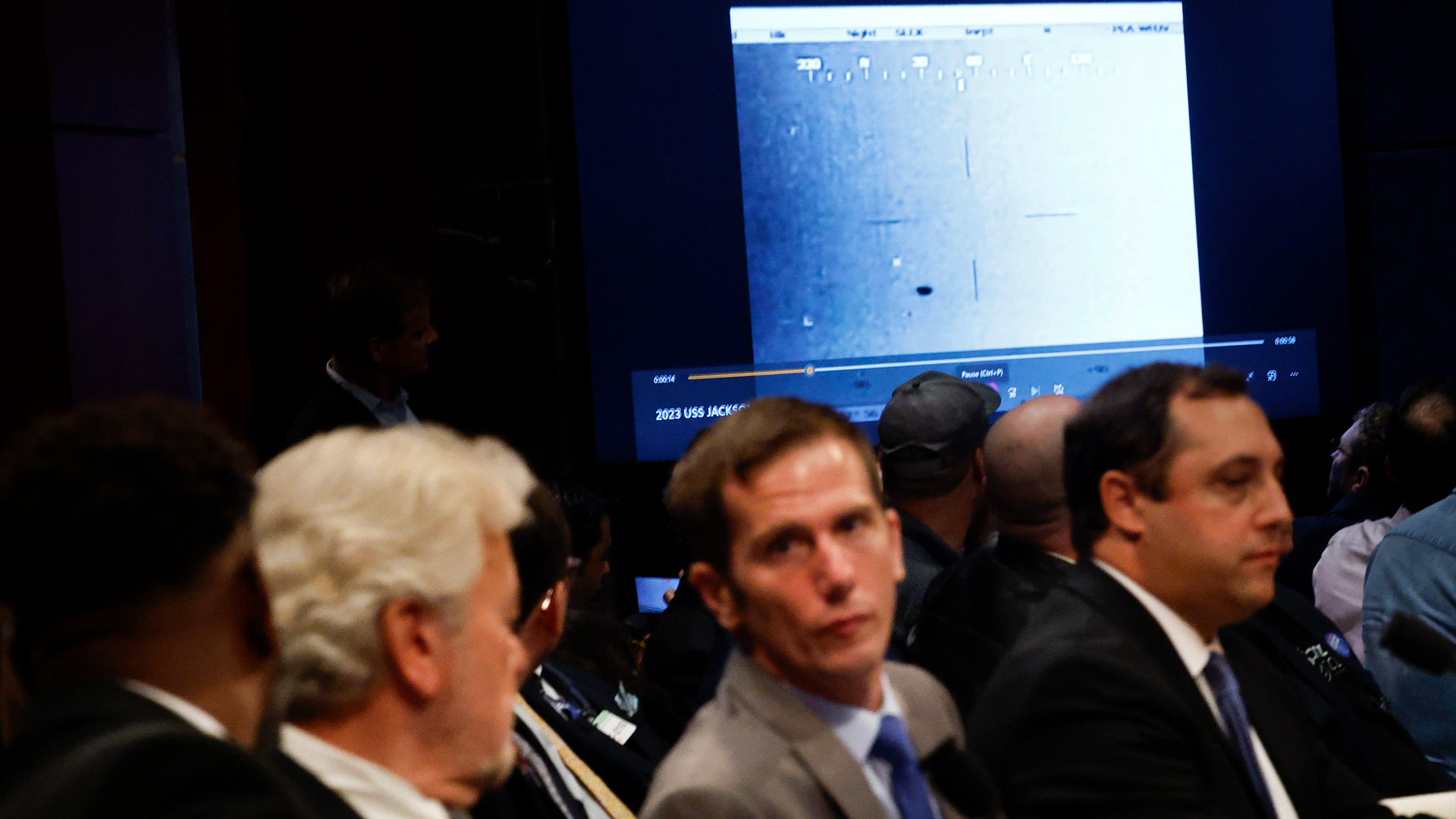
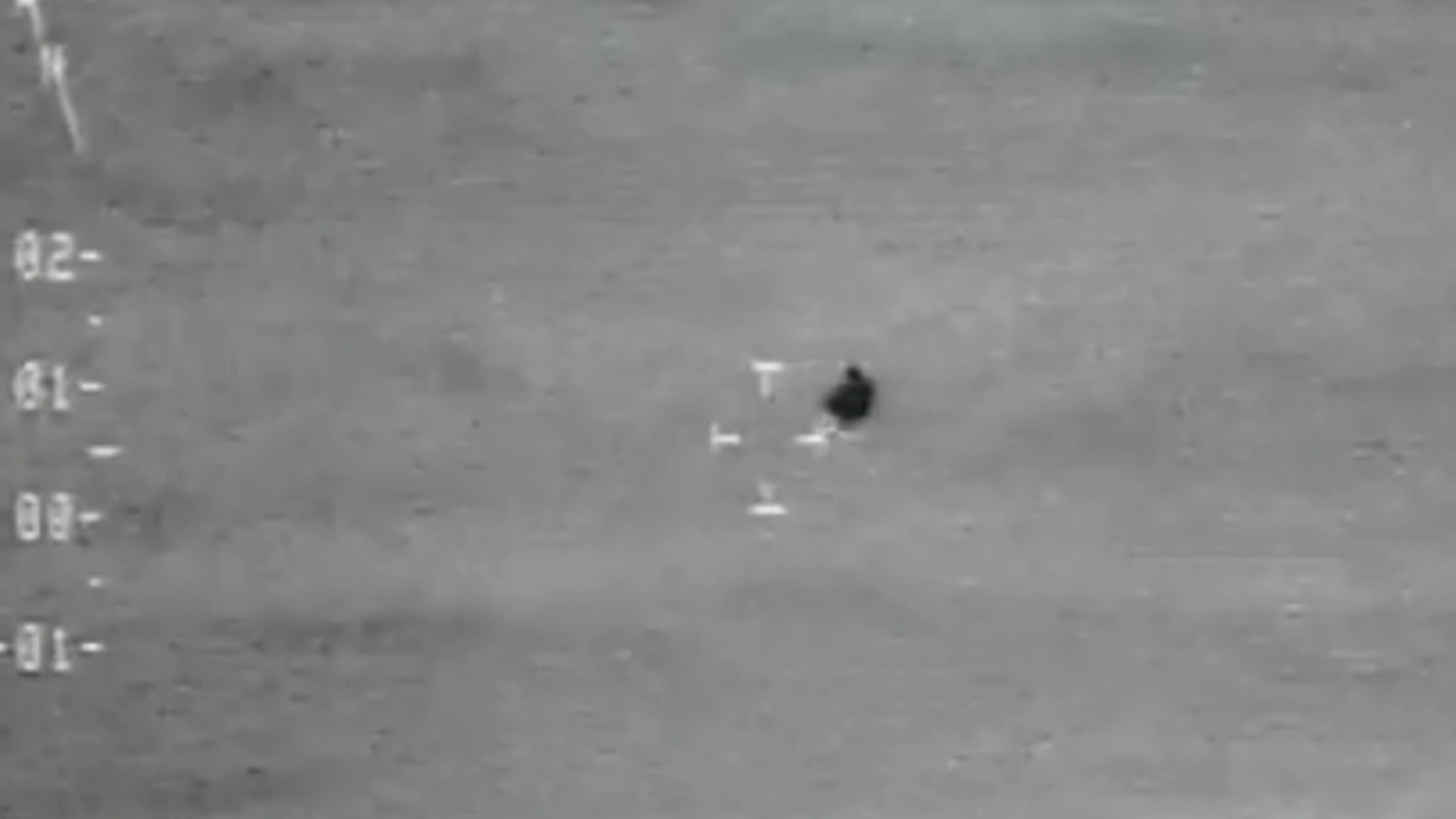
Separately, in 2015, pilots and radar operators aboard the USS Roosevelt recorded two high-speed UFO encounters, nicknamed GoFast and Gimbal.
The objects were captured on advanced infrared cameras and displayed capabilities beyond known human technology, including sudden accelerations and rotation mid-flight.
The incidents were documented in Pentagon-released videos, fueling renewed interest in unidentified aerial phenomena.
Former Navy pilot Ryan Graves testified alongside Fravor to Congress that the GoFast and Gimbal encounters represent serious flight safety and national security risks.
Based on his experience and reports from over 30 crew members, Graves said these objects were routinely seen, often stationary in high winds or moving at hypersonic speeds, with many incidents remaining unexplained.
In 2015, pilots and radar operators aboard the USS Roosevelt recorded two high-speed UFO encounters, nicknamed GoFast (pictured) and Gimbal
However, Dr Jon Kosloski, director of the Defense Department's All-Domain Anomaly Resolution Office (AARO), testified under oath in a 2024 hearing held by the Armed Services Committee, that the infrared UFO video showed nothing more than 'a trick of the eye.'
He attributed the UFO's apparent high-speed skimming over the ocean to an optical illusion, called 'parallax,' but the office did not otherwise identify the object.
'President Trump will announce immediate steps toward declassification of related files, expanded scientific study through a new interagency task force, and international cooperation with allied nations,' Lee told the Daily Mail.
Lee said Trump will call the new studies 'an opportunity to unite humanity in understanding our place in the universe.'
Lee claims he was told the disclosure speech would fall on the anniversary of the mysterious crash near Roswell, New Mexico. The object was initially reported as a 'flying disc.'
The military quickly retracted its statement, claiming the debris was from a weather balloon, but eyewitness accounts of unusual materials and structures persisted.
Major Jesse Marcel (pictured), who recovered debris from the 1974 Roswell crash, described the scene as 'a large area heavily scattered with metallic debris from a single impact point that scarred the earth.' He said the debris could not melt or heat up and could not be punctured
The local paper's front page story reported that the Roswell Army field recovered a flying saucer on a New Mexico Ranch after metallic-looking, light but strong material was scattered across the land
The Roswell incident became the world's most famous UFO case, forming the foundation of modern extraterrestrial lore.
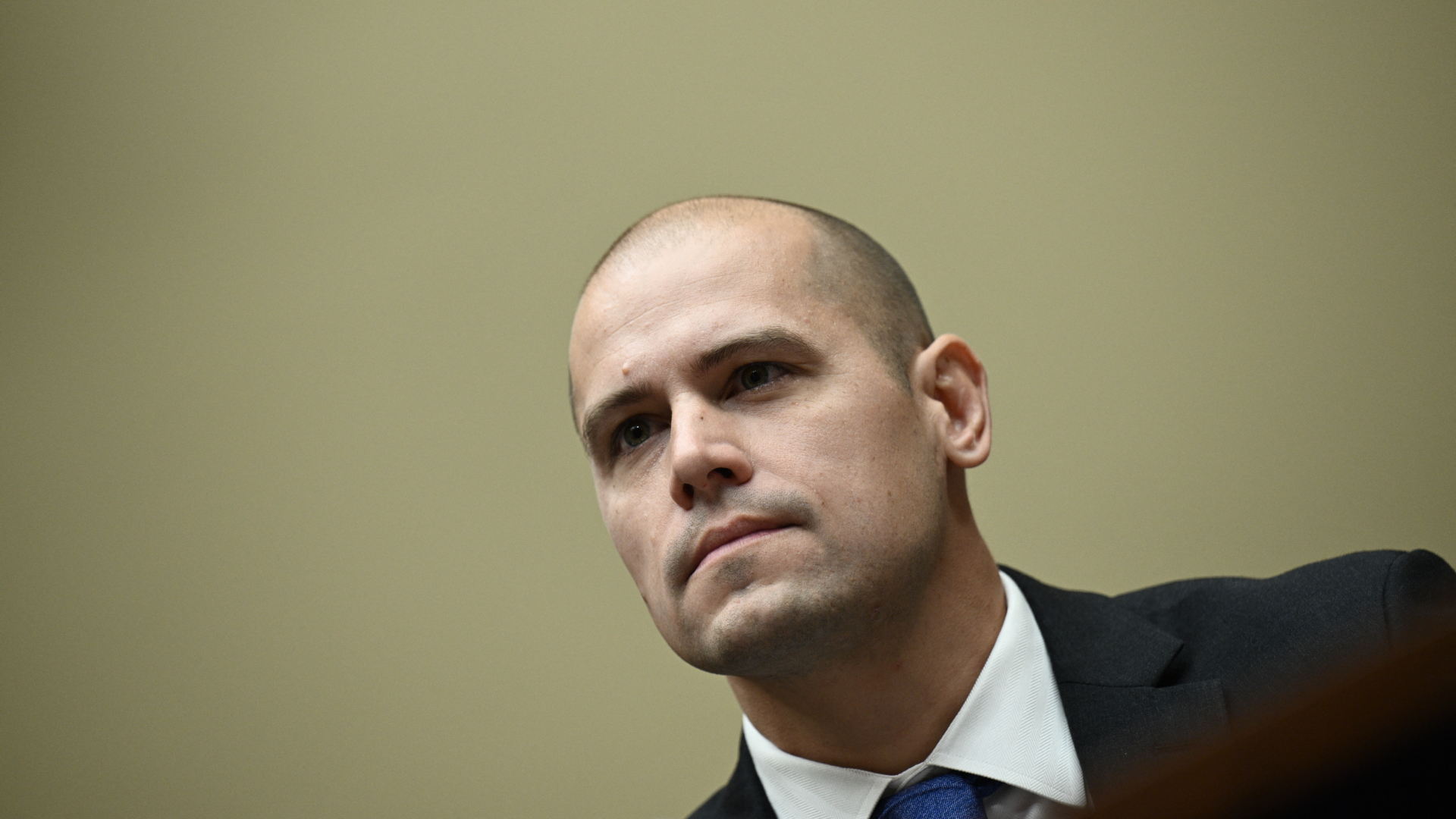
Retired US Air Force Major David Grusch, a current advisor to Congress's UAP Task Force, claimed last month that Trump has received reports on crashed spacecraft, non-human remains retrieved by the US, the origins of these beings and their intentions.
Grusch also said the president could soon become the 'most consequential leader in world history' by publicly disclosing what America has kept hidden about extraterrestrials.
Until now, previous White Houses, the US military and even NASA have all denied that humans have made contact with alien life or ever recovered extraterrestrial technology from crashed UFOs.
No physical evidence has ever been presented publicly to back up the stories shared over decades by civilians, scientists and military personnel claiming to have seen or interacted with beings from another world.
However, Grusch said the US military has not only recovered UFOs and alien bodies, but he claimed he personally viewed intelligence reports, data and even pictures of non-human bodies with his own eyes.
The whistleblower also allegedly told members of Congress that Trump was briefed during his first term about the existence of multiple alien races, and that one species has been crossbreeding with humans.
The White House declined to comment on the matter.
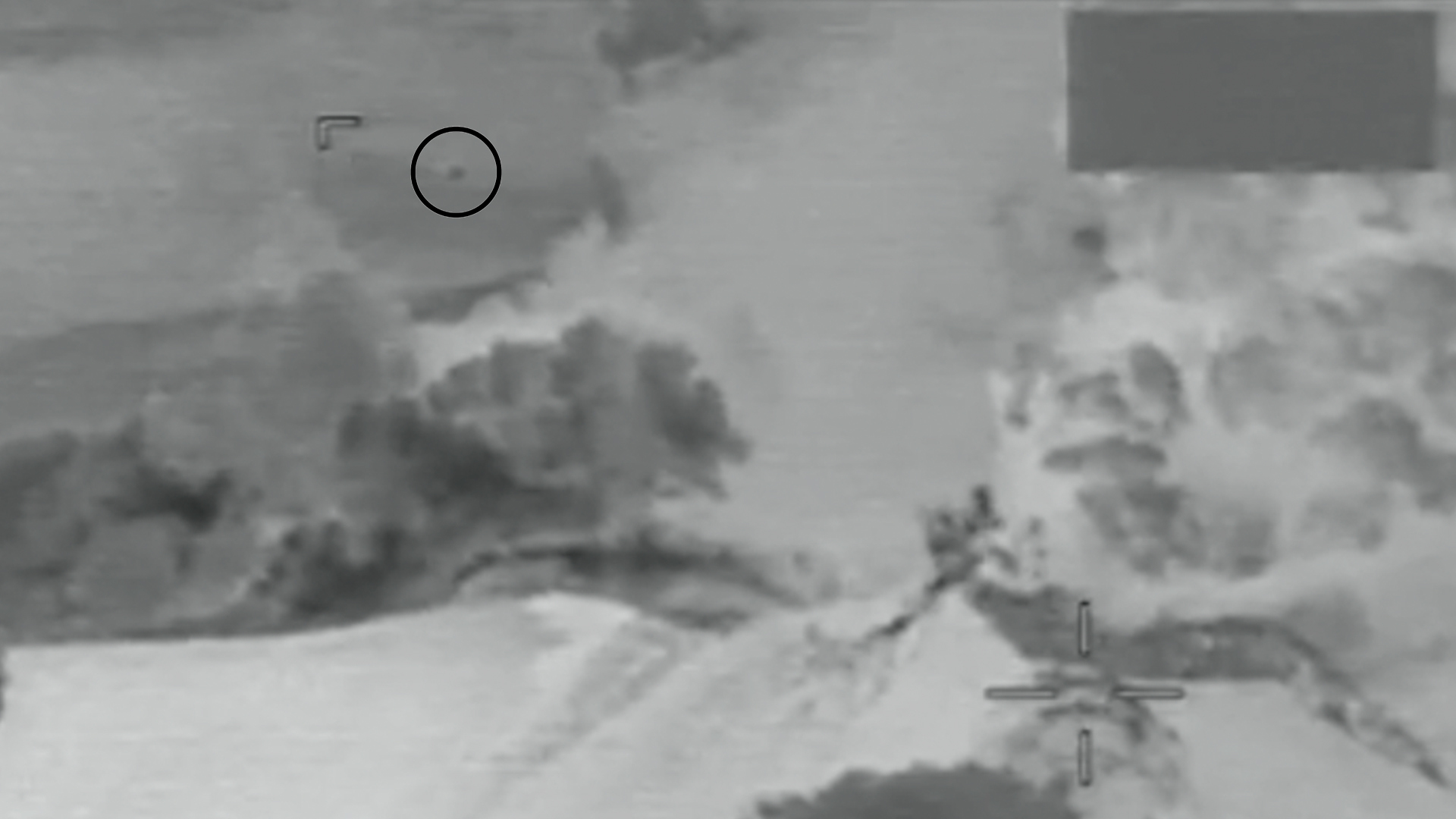
Investigative journalists Jeremy Corbell and George Knapp have released, for the first time, a classified video captured by a U.S. Air Force‑directed MQ‑1 Predator drone on 23 August 2012 over the Persian Gulf. The thermographic (FLIR) footage shows three luminous “orbs” moving in a tight triangular formation at 18:21 UTC, performing abrupt directional changes without any discernible propulsion plume or heat signature. The material, now catalogued by the United States intelligence community as “UAP orbs,” adds to a growing body of evidence that the Department of Defense is formally acknowledging the presence of Unidentified Anomalous Phenomena in operational airspace.
Key Details
The video, recorded at coordinates 28°27′17.0″ N, 50°33′37.0″ E, was obtained from a high‑confidence source within the Predator’s data archive. Analysts note that the objects were actively tracked by the drone’s sensors, indicating that the platform’s operators recognized them as distinct contacts rather than sensor artifacts. Throughout the 30‑second clip, the orbs execute rapid, angular turns and maintain formation despite the absence of conventional aerodynamic surfaces or exhaust plumes. The FLIR imagery registers no thermal contrast against the surrounding sea and sky, a factor that has puzzled both military and civilian experts tasked with evaluating the phenomenon.
Context within UAP Investigations
Since the 2020 release of the UAP Task Force report, the intelligence community has steadily de‑classified sightings that meet stringent criteria for “unidentified.” The Pentagon’s All‑Domain Anomaly Resolution Office (AARO) now maintains a database that includes over a thousand such events, many of which involve radar‑visible objects that evade visual identification. The 2012 Persian Gulf incident aligns with prior reports of triangular formations—notably the 2004 “Nimitz” encounter—yet distinguishes itself by the exclusive reliance on infrared imaging, eliminating visual‑light bias. Researchers such as Dr. Jacques Vallée have long argued that formation flight suggests a level of coordinated control, a point reinforced by the Predator’s on‑board tracking logs indicating intelligent maneuvering rather than random drift.
Expert Commentary
Corbell, whose documentary work has previously highlighted Navy pilot testimonies, emphasized the strategic implications:
“No matter where UFOs are from – it is now openly admitted by our Department of War that they are appearing with an increased frequency worldwide. It’s time to acknowledge the UFO problem – as this case reveals that incursions by UAP pose a significant challenge for our collective defense apparatus.”
George Knapp, a veteran investigative reporter on aerospace anomalies, added that the footage “provides a rare, high‑resolution glimpse of an event that was previously known only through anecdotal accounts.” Both journalists stress that the release aims to foster transparency and reduce the stigma that has historically hampered scientific inquiry into UAPs.
Implications for Defense and Policy
The emergence of a high‑confidence, sensor‑verified record of coordinated, propulsion‑less flight raises several questions for national security planners. If the objects possess capabilities beyond current aerospace technology, they could represent a potentially adversarial system or an unknown natural phenomenon with strategic relevance. Congressional oversight committees, which have recently pushed for more rigorous reporting requirements, may now have concrete data to justify increased funding for AARO’s analytical tools. Moreover, the incident underscores the need for inter‑agency data sharing, as the original flight logs were reportedly generated under Air Force command but are now being examined by intelligence analysts, civilian scientists, and the broader public.
The Persian Gulf triangle formation footage marks a significant milestone in the ongoing effort to document and understand UAP activity. By making the video publicly accessible, Corbell and Knapp hope to encourage a rational, evidence‑based dialogue that bridges the gap between classified military observations and open‑source scientific research. As the Department of Defense continues to refine its approach to unidentified aerial phenomena, incidents like this will likely shape both policy and public perception for years to come.
It must be a thrilling time, for what remains of the ‘60s counterculture: first tie-dye went mainstream, then psychedelics, and now the belief in UFOs. The videos lately leaked by the government purporting to show mysterious and possibly alien-linked aerial phenomena has incited maybe the most serious reckoning with the possibility of alien life in America’s history, with more or less respectful news articles and TV segments and, now, a Congressional hearing. But is what we’re seeing now really substantially different from what we’ve seen in the past? What exactly is going on in all those videos? For this week’sGiz Asks, we reached out to a number of experts—as much as anyone can be an expert in things that are unidentified—to find out.
This new report is different from past discussions on Unidentified Flying Objects (UFOs) or Unidentified Aerial Phenomena (UAP) in that it involved documented evidence collected by military personnel based on detection by multiple instruments (radar, infrared cameras, optical cameras), indicating the possible existence of objects which behave in ways that cannot be explained by the technologies we possess. Past top-level government officials who had access to this data (including former President Obama, former Intelligence Director John Ratcliffe, former CIA Director James Woolsey and former Senator Harry Reid) made statements recently that they believe these are real objects but they do not understand their nature. It is possible, and likely, that most of the past reports on UFOs from the general public can be explained by human-made or natural phenomena, or as illusions, but we need to pay special attention to the small number of reports where the evidence is strong and undisputable. The key is to collect more evidence with our best recording devices.
It would be prudent to progress forward with our finest instruments, rather than examine past reports. Instead of declassifying documents that reflect decades-old technologies used by witnesses with no scientific expertise, it would be far better to deploy state-of-the-art recording devices, such as cameras installed on wide-field telescopes or audio sensors, at the sites where the reports came from, and search for unusual signals.
They show a variety of different things. Consistent only in their variety, the videos that have leaked out of the US Navy herald little more than disappointment for the UFO enthusiasts who hope that alien technology is just around the corner.
The most dramatic video, code name “Gimbal,” seems to show an actual flying saucer skimming over the clouds. It comes to a stop and rotates 90 degrees in an aerodynamically impossible manner. Surely this is the evidence we’ve been looking for? Sadly, no—close examination reveals the shape on the screen is rotating when other faint shapes rotate, showing it’s an optical artifact, not actually saucer-shaped, just the shape of a thermal glare, probably from the engines of a distant, human, jet. The rotation? An artifact of the gimbal-mounted camera—hence the code name.
The other videos likewise disappoint. “Go Fast,” when put under the magnifying glass of a little high-school math, turns out to not be going fast at all. More like balloon speed. The Tic-Tac, supposedly pulling impossible g-forces, is instead plodding along with the movement again reflecting only motion of the camera. Then there’s the “Green Pyramid”—lauded as the greatest UFO footage of all time for a few days, until it was pointed out that it looked exactly like an out-of-focus 737 which also happened to be flying overhead at that same time.
There are unknowns in the sky. Some of them represent real issues—foreign threats, or challenges of identification, or recalcitrant radar. But, exciting though the prospect might be, very little points to possible advanced technology, and none of them point to aliens.
Associate Professor, Physics, University of Richmond
I think in terms of three levels of consideration for videos like those that recently came out related to the Pentagon report on unexplained aerial phenomena.
At the first level, one needs to assume that any video, on any topic, that is shared over social media, or on a show that monetizes clicks or ratings, has been deceptively edited in some way. In the case of purported UFO sightings, a video you are seeing may have been sped up, slowed down, or spliced together to make objects appear to move in strange ways, or cropped to remove objects that could provide a sense of [scale], for example.
At the second level, if we are still intrigued after considering that we may be misled by deceptive video edits, we should consider mundane explanations for what we are seeing. These videos are usually amateur and often low resolution, and lack good context such as readily identifiable objects for scale such as buildings or trees, and other moving objects to gauge speeds. Are we sure we aren’t just seeing objects like kites, frisbees, or spotlights? What about drones?
Finally, even if we think that a mundane explanation is not enough, we have to remind ourselves that the atmosphere is a strange and amazing place. For example, it makes tornadoes so powerful that they can pick up and throw a car, and hailstones as big as softballs. We’ve seen clouds and colors so crazy that nobody could have painted them. Given that, should we really rule out that atmospheric processes could make some apparently strangely shaped clouds or reflections that move strangely for a few minutes? Just because something in the sky is strange doesn’t mean it is from another planet.
These recent videos are coming at a time when our scientific understanding of the possibilities for life elsewhere in the Universe has exploded due to the discovery of many habitable exoplanets around other stars. However it is a big leap from considering that life may be out there trillions of miles away to concluding that they are visiting us secretly, based on grainy amateur videos.
The past few years of credulous, uncritical reporting of UFO videos by the popular media have been frustrating for many science writers. While the media only wants to interview people who have been career believers in alien visitation and who will promote the “mystery” perspective, the science experts have been largely left out, leaving the claim that these videos show something extraordinary to go largely unchallenged.
In fact, there’s a very good reason why these UFO videos have only been reported in the mass media, and hardly mentioned at all in the science, aviation, or military press: there’s simply nothing very interesting in the videos. All of them show mundane targets consistent with conventional air traffic (in some cases proven to be specific commercial flights) or objects such as mylar party balloons or parachute flares, albeit distorted by well-known and well-understood camera and lens effects.
We’re frustrated because nobody wants to report the truthful, sober version of this, only the sensational view that there’s some alien mystery afoot. It’s bad journalism, and it’s harmful to the public intellect.
A big part of the problem communicating this to the public is the popular belief that Navy pilots can’t be mistaken, that they’re somehow immune to the types of perceptual errors that are endemic to our human neurology. What we’re seeing are simple optical illusions, aided in most of the videos by artifacts caused by the lenses. We’ve all seen optical illusions and we all know how easily our brains can be fooled by them. Yet, when the same thing happens to a pilot, many people believe—with no clear reason—that these human limitations have somehow been “trained” out of them. We know for a fact this is not the case. In at least one of the videos, called GOFAST, the numbers on the ATFLIR screen prove, with no room for doubt, that what’s being displayed is very different from what the pilot interpreted, and what the mass media has amplified.
Bottom line is that if the Earth is indeed being invaded by aliens, we don’t yet have the evidence of it. It’s certainly not in these decade-and-a-half old videos. Remember, even the Navy itself said “the authorized release of these unclassified videos does not reveal any sensitive capabilities.”
Professor of Physics and Astronomy at University of Rochester
We don’t have the data we’d need to begin a real scientific analysis. The videos are certainly interesting and deserve more study. But there is nothing about them that would lead a scientist to jump to the extraordinary conclusion that the videos tell us something about life elsewhere in the Universe. My colleagues and I are deeply involved in the search for life (simple and otherwise) on planets orbiting distant stars (i.e. exoplanets). The whole field is undergoing a revolution now because we have discovered so many of these exoplanets and we’re working on developing the capacities to detect biospheres and “technospheres” on them. But if and when we claim that we’ve found evidence for such life using telescopic data, you can bet we’d get hammered by the rest of the scientific community. They would want to check for every possible source of error and try to exhaust every possible alternative, simpler explanation before they accepted that we’d answered humanity’s oldest question (i.e. are we alone). This is how science works and it’s the reason why we have working cell phones in our pockets rather than inert bricks. So, as of now, those videos show something that is unidentified. That’s it. If we want to know more we’ll have to do some science!
Professor, Physics and Astronomy, University of Nottingham
These new videos and sightings show that there are observations that have no obvious explanation. However, that does not mean that these events are from aliens or visitors from other planets. They almost certainly have a natural explanation and are likely due to optical effects, atmospheric effects, or perhaps some physical effects we do not fully understand quite yet. The latter however is simply due to the fact that these observed phenomena are seen through complex systems and perhaps unique circumstances leading to interesting features that are rarely seen.
Professor, Religious Studies, University of North Carolina, Wilmington, whose research is concerned with the links between technology environments and spiritual and religious belief. Author of American Cosmic: UFOs, Technology, and Religion
To scholars of religious studies, reports of unidentified luminous objects that fly around in the sky is nothing new. Historical records reveal copious testimonial accounts of flying objects, some of which appear to carry humanlike beings, and others which are described as flying ships or houses. However, there are significant differences between historical accounts, some over one thousand years old, and current testimonies from pilots and people whose job is to fly planes and drones and observe the sky. Pilots and naval crew have radar, video, and proximity to unidentified aerial phenomenon (UAPs). They have captured mysterious objects with recording devices that were not invented when people from previous eras wrote about their testimonies. Basically, the difference is that our senses, that of seeing and hearing, have been extended by our technology, and that gives us more and better data. Yet, what does this really show or reveal about these events?
Initial reports from a recent Pentagon sponsored study of UAPs is that military authorities do not know what they are; they are technically “mysterious.” This conclusion, which is an apparently honest one, is much different from most of the conclusions made by people from foregone eras about aerial phenomenon. In the past, these events were subsumed, for the most part, within a religious narrative. In the Catholic tradition, they were sometimes called souls from purgatory, or angels. The point is not what they were called, but that people felt the need to name them. Naming them made them less mysterious and provided people with a handy way to shut down further examination of these events.
What is new—or at least modern, as the government has concluded that UAPs are mysterious at least twice before (see Project Bluebook and the Robertson Panel)—is that the report refrains from making conclusions about these events—that is, to call them extraterrestrial. To conclude that we do not know what these objects are is a step in the direction of making some progress toward a fledgling, yet honest study of what they could be. That’s the good news. Other news is that the U.S. government has admitted to engaging in controlling the education of the public about this phenomenon since at least the 1950s. This should at least inspire some level of credulity with respect to any media, fiction or nonfiction, regarding these events.
Do you have a burning question for Giz Asks? Email us at tipbox@gizmodo.com.
illustration Image: VICTOR HABBICK VISIONS/SCIENCE PHOTO LIBRARY/Getty Images
Big Talk
A UFO whistleblower and ex-Pentagon official who claims that the government is hiding its knowledge of extraterrestrials is doubling down on his claims in a new memoir.
As the Daily Beast and other outlets report, whistleblower Luis Elizondo’s new book, “Imminent: Inside the Pentagon’s Hunt for UFOs,” contains in more detail the same kinds of contentions he has long put forth with the help of the New York Times and Blink-182’s Tom DeLonge.
In an interview with the Daily Mail, Elizondo said he’s finally been cleared by the Pentagon to tell the full truth about his claims, which include his assertion that he’d seen glowing green orbs in his house after he began leading a secretive Army office looking into what the government calls “unidentified anomalous phenomena” or UAPs.
As he said in his interview with the British tabloid, the ex-official was also privy to knowledge of “traps” the government set up to catch and capture UAPs.
“We had a plan to set up a real big nuclear footprint,” Elizondo said, “something we knew would be irresistible for these UAP.”
Once these unwitting ETs fell for the ruse, “the trap would be sprung,” he continued.
In a thread on r/UFOs where his Daily Mail interview was posted, for instance, an incredulous Redditor pointed out just how ridiculous the crux of that claim really is.
“Setting up honey pots for UFOs sounds like a terrible idea,” the user commented. “Who knows what type of thing you could end up attracting?”
Indeed, if any members of an extraterrestrial race were sophisticated enough not only to travel untold lightyears to Earth but also to hide themselves from us, it seems almost humorous that our human attempts at deception would work.
As ever, we very much do want to believe — but in the case of Elizondo’s new book, the only thing that seems provable is that he’s on a book tour, with all the pressure to drive sales that process typically entails.
The SETI@home project narrows down billions of signals to 100 unexplained events after decades of data and studies published in 2025.
After more than two decades of distributed data collection and processing from the Arecibo Observatory, researchers at the University of California, Berkeley, have narrowed down approximately 12 billion radio detections to just 100 unexplained signals, consolidating in 2025 one of the most sensitive analyses ever conducted in the scientific search for extraterrestrial intelligence.
The SETI@home project, led by researchers at the University of California, Berkeley, has reduced approximately 12 billion radio signals collected since 1999 to just 100 unexplained events after decades of distributed processing, with results consolidated in two scientific articles published in 2025. The Astronomical Journal.
Decades of data collection and the closing of a scientific cycle.
Created in 1999, SETI@home transformed millions of home computers into a distributed scientific network dedicated to analyzing radio signals captured by the Arecibo Observatory.
The goal was to identify potential signs of extraterrestrial intelligence amidst a volume of data that grew faster than the capacity for human interpretation.
For years, the accumulation of detections has exceeded the tools available for in-depth analysis.
According to David Anderson, a computer scientist at UC Berkeley and co-founder of the project, until approximately 2016 there was no clarity on how to conduct the final stage of interpreting the signals accumulated over time.
The publication of the studies in 2025 marks the culmination of this effort, detailing how researchers were able to move from simple detection to a systematic and comparative analysis of patterns across large portions of the sky.
Methodology for filtering billions of radio signals.
The articles describe the process that examined billions of candidate detections in search of features consistent with a non-natural origin. The analyzed signals appeared as momentary energy spikes at specific frequencies, originating from specific points in the sky, requiring methods capable of separating potential events of interest from known interference.
To achieve this, the team developed new filtering and classification algorithms designed to eliminate signals associated with satellites, radar, and other ground-based sources. This refinement allowed them to reduce the original dataset to approximately 100 signals considered promising for follow-up observations.
Even with these advances, the volume of data remained a significant obstacle. Astronomer Eric Korpela, also from UC Berkeley, highlighted that a complete investigation of all possible signals still depends on direct human analysis, which limits the speed and scope of the process.
Published results and the range of sensitivity achieved
The first article, published in 2025, focuses on data acquisition and processing, detailing the systems of computing The first study addresses the distributed distribution and filtering techniques that have characterized SETI@home throughout its existence. The second study addresses the final analysis and conclusions drawn from this material.
Both studies emphasize methodological transparency, with the availability of open datasets and refined code, allowing other researchers to reproduce or expand the analyses independently
The authors state that the project represents the most sensitive search for narrowband signals ever conducted over large areas of the sky.
Anderson stated that, even without a conclusive detection of extraterrestrial intelligence, the project established a new level of sensitivity.
According to him, any signal above a certain power would have been identified by the methods used, which more precisely defines what can be discarded.
Limitations, technical choices, and potential historical flaws.
Despite the progress, researchers acknowledge limitations stemming from decisions made early in the project. In the late 1990s, computational capacity constraints influenced choices in data processing, which may have led to the exclusion of potentially relevant signals.
Anderson pointed out that it is still difficult to accurately measure what was discarded during the initial filtration stages.
He questioned whether some criteria may have eliminated important information along with the noise, acknowledging that these decisions were deliberate, given the technological limitations available in 1999.
The scientist stated that, with additional resources, it would be possible to reanalyze the entire dataset more thoroughly. He acknowledged that errors occurred along the way, a direct result of the technical conditions at the time, which leaves room for uncertainty in the final results.
Persistent uncertainties and the legacy of SETI@home
Even after the drastic reduction of the dataset, the possibility remains that signals of unidentified origin may have gone unnoticed. Anderson admitted that there is still a chance that an indication of extraterrestrial intelligence is present in the analyzed data, but was not captured by the applied filters.
This uncertainty keeps the scientific debate open and reinforces the need for new analytical approaches. The final set of approximately 100 signals itself remains without a definitive explanation, making it a focus of interest for future investigations and complementary observations.
The work conducted by Anderson and Korpela establishes a technical and methodological foundation for the next generation of SETI projects. Future initiatives should incorporate machine learning-assisted signal recognition and expanded telescope networks, broadening analytical capabilities.
The legacy of SETI@home remains as a large-scale scientific experiment that connected public curiosity, distributed computing, and radio astronomy.
Even with mixed feelings among researchers, including a slight disappointment at not having a confirmed detection, the project marks a milestone in the history of the systematic search for extraterrestrial intelligence, leaving behind a body of data and methods that will continue to be explored.
For decades, the international Search for Extraterrestrial Intelligence (SETI) program has focused on technological signatures familiar to us: radio signals or chemical traces of industrial emissions. However, this approach may suffer from “anthropocentric bias” — we only look for things that resemble our own civilization. A new hypothesis offers a radically different approach: what if advanced civilizations communicate with each other in the Universe not through radio waves, but through flashing bursts of light, similar to Earth’s fireflies?
Fireflies have given scientists clues about how extraterrestrial civilizations might communicate with each other. Photo: Unsplash
The firefly beacon hypothesis
Researchers at Arizona State University proposed this thought experiment. On Earth, fireflies use a sequence of flashes to communicate, particularly to find a mate. Although the signal is simple, it is effective.
Scientists suggest that a technologically advanced alien civilization could use similar but more complex light codes as a kind of beacon to announce its existence. This could be a logical step for civilizations that have moved from broadband radio to more precise and possibly optical methods of communication.
Lessons from pulsars
To understand what such signals might look like, scientists analyzed more than 150 pulsars — neutron stars that emit strictly periodic radio waves. Although no signs of artificiality were found, pulsars demonstrate that the Universe is full of regular cosmic “flashes.” Distinguishing between technological and natural signals is a key task.
Interestingly, humanity itself demonstrates a tendency that makes this hypothesis plausible. We are becoming increasingly “radio-quiet” to outside observers due to the transition to satellite communications and fiber optics. Therefore, it is natural to assume that older civilizations may also have abandoned “loud” radio in favor of more sophisticated methods, such as optical ones.
Think differently
The authors emphasize that their work is not a discovery, but merely an invitation to think outside the box. “Communication manifests itself in an astonishing variety of forms. Taking non-human communication into account is extremely important if we want to broaden our understanding,” notes study co-author Estelle Janin.
This hypothesis is just one example of what alternative means of communication might look like. It calls on the scientific community to avoid human biases and creatively rethink what other forms intelligent life might take in the infinity of space. Perhaps this approach will one day help us finally receive the signal: “We are here!”
0
1
2
3
4
5
- Gemiddelde waardering: 0/5 - (0 Stemmen) Categorie:ALIEN LIFE, UFO- CRASHES, ABDUCTIONS, MEN IN BLACK, ed ( FR. , NL; E )
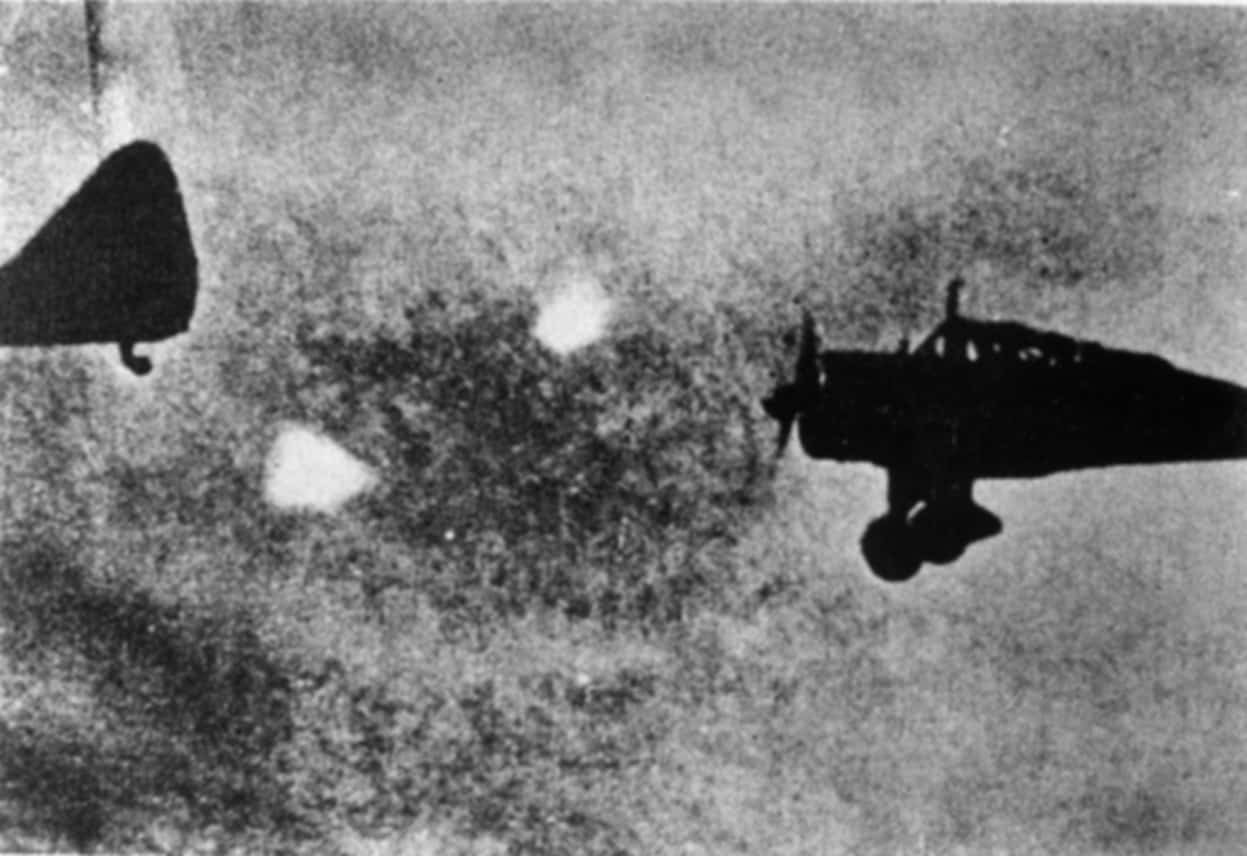
Did the Red Baron shoot down an UFO during WWI?
Was Baron Manfred von Richthofen, the Red Baron, the first to shoot down an alien spacecraft?
“He not only brought down 80 enemy planes to Germany during the First World War. He was also the first to shoot an alien spacecraft”, according to former German pilot Peter Waitzrik.
Who was The Red Baron
Born May 2, 1892, Manfred Albrecht Freiherr von Richthofen was a German fighter pilot with the Luftstreitkräfte, Imperial German Army Air Service, during World War I.
After starting the war as a German cavalry officer on the Eastern Front, Richthofen served in the infantry before seeking his pilot’s license. He transferred to the Air Service in 1915. In 1917 he became the leader of a squadron known as the Flying Circus, by his habit of moving the company, tents, and equipment from base to base.
Richthofen was a very skilled pilot, and on January 1917, he first painted his Albatros D.III in a bright red color; in this airplane, he earned his name and reputation.
By 1918, he was regarded as a national hero in Germany and respected and admired even by his enemies.
He is considered the ace-of-aces of the war, officially credited with 80 air combat victories. But many of his victims came thru joint efforts but were credited to the Red Baron to enhance his stature as a national hero and create a legend to scare the enemies.
Did the Red Baron shoot down a flying saucer?
Unidentified flying objects have been observed among almost the most critical military conflicts in history, from the earliest years by Alexandre the Greatest to Gulf War.
In this book, Mr. Watson published an interview with German Air Force ace Peter Waitzrick, who not only witnessed but confirmed that the Red Baron shot down a spacecraft himself.
“It’s been over 80 years, and you ordered me not to say anything. But I’m already at the end of life, and I want my children and grandchildren to know the truth”, said Peter Waitzrick.
On the morning of March 13, 1917, while patrolling over western France, coming from an airfield in Belgium, they spotted an object of about 40m (120 feet) in diameter, similar to two overlapping silver plates and orange lights.
Even not recognizing the aircraft, the Red Baron decided to open fire on the slowly hovering UFO; at that time, the United States had just entered the war, so it might have been an unknown American weapon.
“We were terrified. We’d never seen anything like it,” recalled Peter Waitzrick. “The Baron immediately opened fire, and the thing went down like a rock, shearing off tree limbs as it crashed into the woods.”
He witnesses two minor occupants survive the crash and leave the wreckage, running into the woods.
What the facts say about the Red Baron shooting down the flying saucer
Baron Manfred von Richthofen kept the description of 80 enemy planes he brought down on record.
But he never mentioned anything about the unknown American craft like he believed when he opened fire that spring morning.
Peter Waitzrick told me he was ordered not to say anything. Maybe the Red Baron received the same order.
Regarding the date, Peter Waitzrick describes that von Richthofen was flying with a” Fokker triplane,” the Fokker Dr.I, the earliest Fokker triplane to be seen in combat, only on August 22, 1917.
Peter Waitzrick was 105 years old at the time of his interview. Maybe he was confused by the dates.
If they had shot down a flying saucer, it is undoubtedly that the German troops would have searched the wreckage and its occupants in North France. But there were no records found.
“There’s no doubt that what the Baron shot down that day was no U.S. reconnaissance plane. It was some craft from another planet. Those who ran off into the woods weren’t Americans.”
Richthofen received a fatal wound just after 11:00 am on April 21, 1918, while flying over Morlancourt Ridge, near the Somme River, France.
Beste bezoeker, Heb je zelf al ooit een vreemde waarneming gedaan, laat dit dan even weten via email aan Frederick Delaere opwww.ufomeldpunt.be. Deze onderzoekers behandelen jouw melding in volledige anonimiteit en met alle respect voor jouw privacy. Ze zijn kritisch, objectief maar open minded aangelegd en zullen jou steeds een verklaring geven voor jouw waarneming! DUS AARZEL NIET, ALS JE EEN ANTWOORD OP JOUW VRAGEN WENST, CONTACTEER FREDERICK. BIJ VOORBAAT DANK...
Druk op onderstaande knop om je bestand , jouw artikel naar mij te verzenden. INDIEN HET DE MOEITE WAARD IS, PLAATS IK HET OP DE BLOG ONDER DIVERSEN MET JOUW NAAM...
Druk op onderstaande knop om een berichtje achter te laten in mijn gastenboek
Alvast bedankt voor al jouw bezoekjes en jouw reacties. Nog een prettige dag verder!!!
Over mijzelf
Ik ben Pieter, en gebruik soms ook wel de schuilnaam Peter2011.
Ik ben een man en woon in Linter (België) en mijn beroep is Ik ben op rust..
Ik ben geboren op 18/10/1950 en ben nu dus 75 jaar jong.
Mijn hobby's zijn: Ufologie en andere esoterische onderwerpen.
Op deze blog vind je onder artikels, werk van mezelf. Mijn dank gaat ook naar André, Ingrid, Oliver, Paul, Vincent, Georges Filer en MUFON voor de bijdragen voor de verschillende categorieën...
Veel leesplezier en geef je mening over deze blog.