The purpose of this blog is the creation of an open, international, independent and free forum, where every UFO-researcher can publish the results of his/her research. The languagues, used for this blog, are Dutch, English and French.You can find the articles of a collegue by selecting his category. Each author stays resposable for the continue of his articles. As blogmaster I have the right to refuse an addition or an article, when it attacks other collegues or UFO-groupes.
Druk op onderstaande knop om te reageren in mijn forum
Zoeken in blog
Deze blog is opgedragen aan mijn overleden echtgenote Lucienne.
In 2012 verloor ze haar moedige strijd tegen kanker!
In 2011 startte ik deze blog, omdat ik niet mocht stoppen met mijn UFO-onderzoek.
BEDANKT!!!
Een interessant adres?
UFO'S of UAP'S, ASTRONOMIE, RUIMTEVAART, ARCHEOLOGIE, OUDHEIDKUNDE, SF-SNUFJES EN ANDERE ESOTERISCHE WETENSCHAPPEN - DE ALLERLAATSTE NIEUWTJES
UFO's of UAP'S in België en de rest van de wereld Ontdek de Fascinerende Wereld van UFO's en UAP's: Jouw Bron voor Onthullende Informatie!
Ben jij ook gefascineerd door het onbekende? Wil je meer weten over UFO's en UAP's, niet alleen in België, maar over de hele wereld? Dan ben je op de juiste plek!
België: Het Kloppend Hart van UFO-onderzoek
In België is BUFON (Belgisch UFO-Netwerk) dé autoriteit op het gebied van UFO-onderzoek. Voor betrouwbare en objectieve informatie over deze intrigerende fenomenen, bezoek je zeker onze Facebook-pagina en deze blog. Maar dat is nog niet alles! Ontdek ook het Belgisch UFO-meldpunt en Caelestia, twee organisaties die diepgaand onderzoek verrichten, al zijn ze soms kritisch of sceptisch.
Nederland: Een Schat aan Informatie
Voor onze Nederlandse buren is er de schitterende website www.ufowijzer.nl, beheerd door Paul Harmans. Deze site biedt een schat aan informatie en artikelen die je niet wilt missen!
Internationaal: MUFON - De Wereldwijde Autoriteit
Neem ook een kijkje bij MUFON (Mutual UFO Network Inc.), een gerenommeerde Amerikaanse UFO-vereniging met afdelingen in de VS en wereldwijd. MUFON is toegewijd aan de wetenschappelijke en analytische studie van het UFO-fenomeen, en hun maandelijkse tijdschrift, The MUFON UFO-Journal, is een must-read voor elke UFO-enthousiasteling. Bezoek hun website op www.mufon.com voor meer informatie.
Samenwerking en Toekomstvisie
Sinds 1 februari 2020 is Pieter niet alleen ex-president van BUFON, maar ook de voormalige nationale directeur van MUFON in Vlaanderen en Nederland. Dit creëert een sterke samenwerking met de Franse MUFON Reseau MUFON/EUROP, wat ons in staat stelt om nog meer waardevolle inzichten te delen.
Let op: Nepprofielen en Nieuwe Groeperingen
Pas op voor een nieuwe groepering die zich ook BUFON noemt, maar geen enkele connectie heeft met onze gevestigde organisatie. Hoewel zij de naam geregistreerd hebben, kunnen ze het rijke verleden en de expertise van onze groep niet evenaren. We wensen hen veel succes, maar we blijven de autoriteit in UFO-onderzoek!
Blijf Op De Hoogte!
Wil jij de laatste nieuwtjes over UFO's, ruimtevaart, archeologie, en meer? Volg ons dan en duik samen met ons in de fascinerende wereld van het onbekende! Sluit je aan bij de gemeenschap van nieuwsgierige geesten die net als jij verlangen naar antwoorden en avonturen in de sterren!
Heb je vragen of wil je meer weten? Aarzel dan niet om contact met ons op te nemen! Samen ontrafelen we het mysterie van de lucht en daarbuiten.
17-03-2026
An Engineering Analysis and Review of the Film Project Hail Mary
An Engineering Analysis and Review of the Film Project Hail Mary
The film Hail Mary leaves a very positive impression overall. If someone likes science fiction, they might really enjoy this movie. This is exactly the kind of film that not only shows beautiful images of space but also keeps you on the edge of your seat for almost the entire runtime. The plot constantly throws in new twists, and the characters’ decisions keep you hooked on the story.
Ryan’s acting deserves special mention. Everything is portrayed very naturally: the characters feel like real people, not just vehicles for the plot. This makes it easier to believe both the story itself and the characters’ emotional reactions. Another important plus is the attention to detail. It was particularly pleasing that the film accurately depicts one of the basic principles of space: there is no sound in outer space. For a sci-fi film, this might seem like a minor detail, but it is precisely these details that greatly enhance the film’s believability.
Poster for the film Project Hail Mary
Hail Mary is a fantastic film that works on several levels: as a suspenseful adventure, as a story of survival, and as a film that strives to respect scientific logic. That’s exactly why the film resonates not only emotionally but also intellectually.
It is also interesting to compare it to the film U Are the Universe. One gets the sense that these films resonate with each other in some ways: both use space not merely as a backdrop, but as a realm of solitude, connection, hope, and human vulnerability. But while U Are the Universe is a more intimate, lyrical, and existential story, Hail Mary is a larger-scale, technically sophisticated, and plot-driven science fiction film. And there is an interesting point here: if the creators of U Are the Universe had delayed the film’s release just a little longer, and it had come out after Hail Mary, some viewers would surely have accused them of plagiarism. In reality, that would have been unfair: the Ukrainian film had already been released earlier as an independent work. And even Andy Weir’s book Hail Mary was not published until 2021.
Technical Analysis with Spoilers
From an engineering perspective, the film is particularly interesting because it invites analysis rather than just watching. And for the most part, this is a plus: if, after watching it, there is a desire to discuss fuel, the atmosphere, materials, and manufacturing technologies, then the science fiction has done its job.
The first – and perhaps the most controversial – point concerns the logistics of the protagonist’s return journey. This is the film’s weakest point. Even with full tanks – roughly two million liters of astrofuel – the return trip would take about four years, so questions about the mission’s supplies arise at this stage. Based on the plot’s logic, there was enough food for about two years, and after subsequent events, the available fuel supply is further reduced by two sections. As a result, the return mission begins to look less like an engineering-driven scenario devised by the protagonist and more like a very optimistic hope for a miracle. This does not ruin the film entirely, but it is here that the tension between the drama and the real-world logistics of interstellar flight is felt most acutely.
The docking of two spacecraft via a folding airlock was performed using an additive method. Source: Hail Mary trailer
The second point of contention is taumeba and xenonite. Conceptually, this is a very striking idea, but it raises the most questions precisely from the perspective of the world’s internal physics. If xenonite is presented as a reliable structural and airtight material, then taumeba’s ability to pass through it requires a very serious explanation. It is not enough here to say that this is unusual biology; there needs to be a clear mechanism that explains exactly how it happens, under what conditions, and due to which properties of the material and the organism. That is why this particular plot point raises the most scientific doubts for me. It works as a dramatic twist, but as a hard sci-fi premise, it looks noticeably weaker than many of the film’s other ideas.
That said, the atmosphere on the ship and the final dome actually struck as quite plausible. Here, the film, on the contrary, enters the realm of logical engineering solutions. When it comes to a pressurized environment for humans, the basic principles are quite clear: controlling pressure, gas composition, temperature, humidity, removing carbon dioxide, and maintaining a safe environment. In this sense, the dome in the finale can be seen as a development of the same ideas used in space life support systems (e.g., the ISS), only adapted to a different technological platform. Therefore, this aspect should be defended rather than criticized.
The protagonist’s interaction with an alien life form through a wall made of xenonite. Source: Hail Mary trailer
The idea of highly advanced 3D printing on an alien spacecraft struck as particularly compelling. The way tunnels, structures, and various objects are formed is an extremely advanced form of 3D printing or programmable manufacturing. And this is precisely one of those ideas that, in science fiction, does not seem like magic but rather a logical progression of real-world technologies. If a civilization is capable of building complex structures directly within the required environment, with high precision, using readily available materials, and tailored to a specific task, then this seems very realistic for a highly advanced engineering culture.
The same applies to the translator. The film presents him not as a magic button, but as the result of a gradual search for patterns, the comparison of signals, learning, and the development of a common language. It is precisely this approach that makes the idea convincing. This is no longer a fairy-tale “universal understanding of aliens,” but an engineering problem of communication that is solved step by step. And within the realm of science fiction, it makes perfect sense.
Rock-like alien Rocky is the protagonist’s main companion and new friend. Source: Hail Mary trailer
Ultimately, what makes Hail Mary great for me is that it can be viewed in two different ways. The first is simply a powerful, intense, and emotional science fiction film. The second is a film that invites technical analysis. And even its controversial moments are not so much a drawback as a reason for discussion. Because the most interesting sci-fi films are not the ones that leave no questions, but the ones that make viewers want to debate trajectories, materials, atmosphere, biology, and technology.
What differences and nuances did you notice? Let’s discuss them in the comments.
The Applied Physics Laboratory (APL) at Johns Hopkins University has officially begun assembling one of the most unusual spacecraft in the history of space exploration. TheDragonfly unmanned helicopter, whose design resembles the legendary ornithopters from Frank Herbert’s Dune universe, is preparing for a mission to Titan.
Dragonfly is a drone-based mission under NASA’s New Frontiers program designed to utilize Titan’s unique environment to collect material samples and determine the composition of the surface under various geological conditions. Image: dragonfly.jhuapl.edu
Although it is not the barren Arakis, Saturn’s largest moon will greet the explorer with vast expanses of sand dunes. And while the chances of encountering a sandworm there are practically nonexistent, the scientific potential of this mission is truly impressive.
Drone Lab
The Dragonfly drone from NASA’s New Frontiers program on the surface of Titan. Illustration: dragonfly.jhuapl.edu
Dragonfly isn’t just a drone. It’s a fully-fledged autonomous robot about the size of a small car. Unlike rovers, which take years to cover just a few dozen kilometers, the flying probe will be able to “hop” vast distances, exploring various regions of Titan in a single flight.
Once it reaches the moon’s surface in 2034, the spacecraft will conduct a comprehensive analysis, ranging from studying the composition of the atmosphere to taking seismic measurements. The chemical composition of the surface is of particular interest. Beneath Titan’s thick layer of ice lies a global ocean of salty water, making this world one of the most promising places to search for extraterrestrial life.
A slow and cold world
The Dragonfly drone landing on Titan’s surface as part of NASA’s New Frontiers program. Illustration: dragonfly.jhuapl.edu
Titan is truly an amazing place. It is the only moon in the Solar System with a dense atmosphere. The air there is four times denser than Earth’s, and gravity is seven times weaker. This creates some amazing conditions: if you were there in the rain, the methane droplets would fall extremely slowly, as if in slow motion.
However, waiting for such a downpour is no easy task, since centuries can pass between precipitation events on Titan. Such a stable, albeit cold, chemical environment is the ideal place for the formation of organic compounds. Scientists consider Titan to be “Earth in the freezer”—it looks just like our planet before the first living organisms appeared on it.
A costly mission
Exploring Titan is no cheap project. The total cost of the mission is estimated at $3 billion. Previous attempts to peer beneath the moon’s thick, foggy veil have been extremely limited: in 2005, the Huygens probe lasted only a few hours on the surface due to a lack of power.
Since Dragonfly is designed for long-term operation, solar power is not an option — there is too little light penetrating Titan’s thick haze. Therefore, Dragonfly will be powered by nuclear energy. The spacecraft will be equipped with a multi-mission radioisotope thermoelectric generator (MMRTG). Fuel rods containing plutonium will generate heat, which will be converted into electricity to power electronics, servos, and scientific instruments. This technology has already proven itself on the Curiosity and Perseverance rovers.
Beginning of the journey
The mission is scheduled to be launched in 2028 using a SpaceX Falcon Heavy rocket. After launch, the spacecraft will spend six long years traveling through the Solar System. When Dragonfly finally spreads its rotors over the lakes and rivers of liquid ethane in 2034, humanity will get its clearest view of this mysterious world yet.
In the meantime, engineers continue to assemble this nuclear-powered ornithopter, keeping in mind the golden rule for travelers across the dunes: “The spice must flow,” and science must move forward.
A terrifying study has predicted exactly how many people will die by 2050 if we don't take urgent action to curb climate change.
Researchers from the Catholic University of Argentina set out to understand how rising temperatures will affect physical activity – and as a result, premature deaths.
The team analysed data from 156 countries between 2000 and 2022, and used it to predict what the coming decades will look like.
Worryingly, their findings suggest that by 2050, each additional month with an average temperature above 27.8°C will increase physical inactivity by 1.5 per cent globally.
This translates to a predicted 470,000 to 700,000 additional premature deaths every year – and up to $3.68 billion in productivity losses.
Based on the findings, the researchers are calling for urgent action.
'Rising temperatures are projected to increase the prevalence of physical inactivity, translating into additional premature deaths and productivity losses, especially in tropical regions,' they said.
'Prioritising heat–adaptive urban design, subsidised climate–controlled exercise facilities, and targeted heat–risk communication is essential to mitigate these emerging health and economic burdens, in addition to ambitious emissions reductions.'
The team analysed data from 156 countries between 2000 and 2022, and used it to predict what the coming decades will look like
Climate change is making the world hotter, with the last three years confirmed to be the hottest on record.
As a result, exercising in many parts of the world is becoming more difficult.
Writing in their study, published in The Lancet Global Health, the researchers, led by Christian García–Witulski, explained: 'Heat exposure imposes physiological constraints through elevated cardiovascular strain and heightened perceived exertion, creating substantial barriers to outdoor physical activity.'
To understand how rising temperatures might impact the ability to exercise, the team analysed data from 156 countries from 2000 to 2022.
Their results paint a bleak picture of what's to come – particularly in low– and middle–income countries.
By 2050, each additional month with an average temperature above 27.8°C will increase physical inactivity by 1.5 per cent globally, and by 1.85 per cent in low– and middle–income countries, but with no clear impact in high–income countries.
Unsurprisingly, the biggest increase in inactivity will be in hotter regions, according to the researchers.
This includes Central America, the Caribbean, Eastern Sub–Saharan Africa, and Equitorial Southeast Asia – where inactivity could increase by as much as four per cent per month spent above 27.8°C.
Unsurprisingly, the biggest increase in inactivity will be in hotter regions, according to the researchers
'The implications for global health are immediate,' the researchers wrote.
'Without stronger mitigation, rising temperatures alone could undermine – or even reverse – a substantial share of WHO's target of cutting global physical inactivity by 15% by 2030, while simultaneously slowing economic growth through heatrelated drops in worker productivity.'
The researchers also provide several ideas for measures that could be taken to ease the impact of rising temperatures.
Heat–risk messages could be integrated into exercise guidelines, they suggest, while money could be funneled towards cooler exercise facilities.
'Treating physical activity as a climate–sensitive necessity – rather than a discretionary lifestyle choice – will be essential to prevent a heat–driven sedentary transition and its accompanying surge in cardiometabolic diseases and economic losses,' they concluded.
The Paris Agreement, which was first signed in 2015, is an international agreement to control and limit climate change.
It hopes to hold the increase in the global average temperature to below 2°C (3.6ºF) 'and to pursue efforts to limit the temperature increase to 1.5°C (2.7°F)'.
It seems the more ambitious goal of restricting global warming to 1.5°C (2.7°F) may be more important than ever, according to previous research which claims 25 per cent of the world could see a significant increase in drier conditions.
The Paris Agreement on Climate Change has four main goals with regards to reducing emissions:
1) A long-term goal of keeping the increase in global average temperature to well below 2°C above pre-industrial levels
2) To aim to limit the increase to 1.5°C, since this would significantly reduce risks and the impacts of climate change
3) Governments agreed on the need for global emissions to peak as soon as possible, recognising that this will take longer for developing countries
4) To undertake rapid reductions thereafter in accordance with the best available science
A former US Air Force missile launch officer has detailed the terrifying moments when UFOs allegedly shut down America's nuclear weapons without firing a shot.
Robert Salas, now 85, claimed that 20 of the military's Minuteman I intercontinental ballistic missiles were disabled by an unknown force which was able to break through all of the shielding at Montana's Malmstrom Air Force Base in 1967.
On March 16 and 24 of that year, Salas said guards at the base reported seeing strange, fast-moving lights in the sky that could stop and hover instantly, and emitted a bright red glow right before the US ICBMs hidden underground went offline.
Salas, who was one of two officers inside the underground launch control capsule during the Cold War, added that the guards calling for help were convinced the craft were not Soviet airplanes launching an attack.
The Air Force veteran told the Danny Jones Podcast he is convinced intelligent non-human civilizations visited Earth and attempted to prevent World War III from causing a nuclear holocaust.
Salas claimed: 'It's another civilization out there that is visiting us and are concerned about us destroying this planet through nuclear war, for many reasons, probably some we don't even understand.'
The former nuclear missile officer added that an investigation led by aerospace company Boeing could not determine what shut down the warheads because US missile complexes were specifically built to keep out jamming signals like this.
'They had no idea how this signal could have been injected into each of the missiles. The cabling system that we had was triply shielded against electromagnetic interference from the outside,' Salas explained.
US Air Force ICBM launch officer Robert Salas (Pictured) has testified before Congress about the UFO that disabled 10 warheads at Malmstrom Air Force Base in March 1967
Pictured: Malmstrom Airforce Base, home to 10 nuclear warheads which went offline after a strange craft approached the base and the missile silos
According to Salas, the first UFO sighting took place on March 16, 1967, when 10 ICBMs were simultaneously disabled without warning by the mystery swarm of UFOs.
Eight days later, Salas said the encounter started when the topside security guard called down to him in the underground launch control room around 10pm MT to report multiple strange lights flying in the sky over the nuclear weapons base.
The guards claimed these lights could reverse direction, make sharp 90-degree turns and were completely silent, making no engine noises.
After dismissing the guard's story, Salas would soon receive another frantic call from security saying a pulsating reddish light was being emitted from the UFO hovering right above the front gate of Malmstrom AFB.
After ordering security to prevent the UFO from entering the missile complex, guards reported seeing the same or similar lights hovering right above two of the missile silos about a mile away from the control room.
'All of a sudden, we get a large horn go off and we know what that means. That means that there's an issue with one of the missiles. Look at the board and sure enough, one of them went from green to red. No go. No launch, no ability to launch,' Salas told Jones during the March 13 episode.
'Very quickly thereafter, bing, bing, bing, bing, all 10 of them went down. They all went red.'
Salas revealed that incursion lights had also gone off, meaning something or someone had entered the fenced area where the missiles were kept.
A guard closing the gate to entrance of the control center of the missile base at Malmstrom, Montana, where the ballistic missile 'Minuteman' were kept, in December 1962
When he called on the guards to investigate the missile silos, they reported that the UFO had flown off just as they arrived.
Following his encounter, Air Force Office of Special Investigations (AFOSI) personnel ordered Salas and his commander to sign strict non-disclosure agreements threatening prison time if they ever discussed the event.
However, the veteran officer went public decades later after reading about a similar incident in a publicly available UFO book and deciding the information had already been leaked.
The Boeing engineers tasked with investigating the missile complex concluded that an external electromagnetic signal had somehow disrupted the guidance and control systems of the missiles, specifically affecting a device called the logic coupler in each one.
Despite discovering the likely cause, Boeing also noted it was impossible for any normal device or test to affect all 10 missiles at once because each missile was independently housed in a silo designed to block electromagnetic interference.
Officially, the Pentagon has maintained for decades that there is no proof UFOs or extraterrestrial beings exist and have visited Earth.
However, President Trump has ordered Secretary of War Pete Hegseth to release all government files related to the search for these unidentified craft so the public can examine the evidence for themselves.
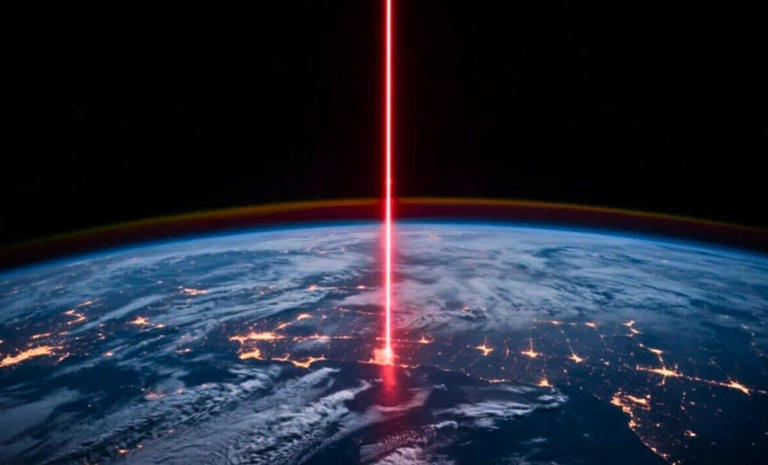
Humanity has received a mysterious signal, described as a 'mega-laser' beam, from a violently merging galaxy more than 8 billion light-years away.
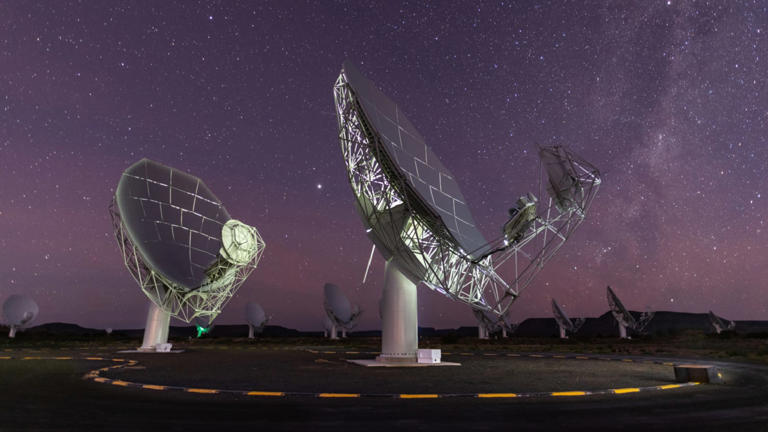
The signal, deemed the most distant hydroxyl megamaser ever detected, was intercepted by the MeerKAT radio telescope inSouth Africa, which features 64 antennas.
A hydroxyl megamaser is a giant natural laser in space. When galaxies full of gas collide, molecules called hydroxyl smash together and release very strong radio waves.
These waves behave like a laser, but instead of visible light, they produce radio signals that astronomers can detect with telescopes.
Because these signals are extremely bright, they can be seen from very far across the universe.
In this case, the object is so powerful that scientists said it may actually be a 'gigamaser,' which is even stronger than a megamaser.
The system, called HATLAS J142935.3–002836, is so far away that we are seeing it as it looked more than 8 billion years ago, when the universe was less than half its current age.
Dr Thato Manamela, SARAO-funded postdoctoral researcher at the University of Pretoria and lead author of the new study, said: 'This system is truly extraordinary. We are seeing the radio equivalent of a laser halfway across the universe.'
Humanity has received a mysterious signal, described as a 'mega-laser' beam, from a violently merging galaxy more than 8 billion light-years away
Manamela added that as the radio waves traveled toward Earth, they were also strengthened by a separate galaxy positioned directly along the line of sight.
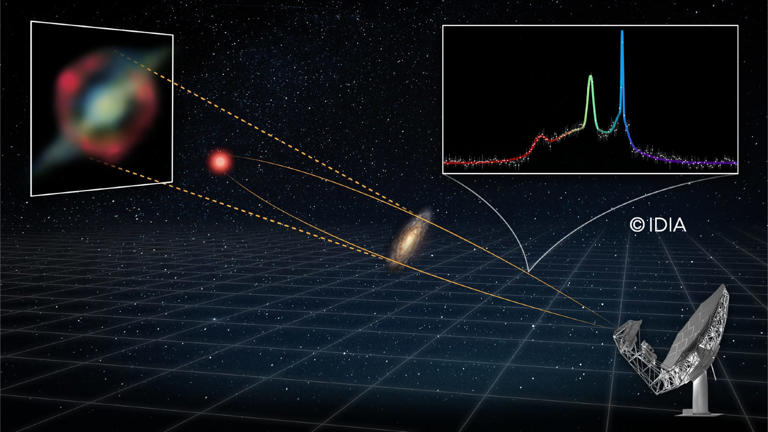
'This galaxy acts as a lens, the way a water droplet on a window pane would, because its mass curves the local space-time,' he said.
'So we have a radio laser passing through a cosmic telescope before being detected by the powerful MeerKAT radio telescope – all together enabling a wonderfully serendipitous discovery.'
The radio signal contained four separate components, meaning it is coming from multiple regions within the galaxy system.
At least two of these areas appear to be strongly magnified by gravitational lensing, which makes the signal more than ten times brighter than it would normally appear.
In this case, a massive foreground galaxy sits between Earth and the distant system.
Its gravity bends space-time and acts like a cosmic magnifying glass, boosting the brightness of the radio emission.
This amplification allowed the signal to be detected by the MeerKAT radio telescope even though the source is over 8 billion light-years away.
Pictured is the galaxy system where astronomers said is the source of the signal
The signal, deemed the most distant hydroxyl megamaser ever detected, was intercepted using the MeerKAT radio telescope in South Africa (PICTURED), which consists of 64 antennas
Normally, signals from objects this far away are too weak for telescopes to detect.
But the powerful radio signal coming from HATLAS J142935.3–002836 was boosted by a rare effect called gravitational lensing, a phenomenon predicted by Albert Einstein.
Gravitational lensing happens when a massive object, such as a galaxy, sits between Earth and a distant source.
Its strong gravity bends space-time, which changes the path of the light or radio waves traveling through it.
This makes the distant signal appear brighter and magnified, allowing telescopes like the MeerKAT radio telescope to detect it even from billions of light-years away.
From Earth, this effect can sometimes create a ring-shaped halo of light around the foreground object, called an Einstein ring, named after the famed physicist.
The same effect also magnifies the distant source, in this case a radio or microwave signal, making it much easier for astronomers to study objects that would normally be too faint to detect.
A thin, stubbornly bright line showed up in data from the MeerKAT radio telescope that did not fit the usual rules of distance. The feature sat in a familiar part of the radio spectrum, but it was coming from so far away that signals like it typically fade into the background. Instead of smearing out, it stayed sharp enough to measure. That was the first hint that something was amplifying it.
The source already had a survey name that sounded more like a serial number than a destination: HATLAS J142935.3–002836. Astronomers had seen it before as a distorted, stretched-looking galaxy system, the kind that suggests gravity has bent the view. A report from Live Science described it as a “mega-laser,” but the real curiosity was why the line stayed detectable at all.
When the team calculated the distance, the scale became clearer. The system sits at redshift z = 1.027, placing it more than 8 billion light-years away in light-travel time. That means the radio waves began their journey when the universe was much younger than it is now. The MeerKAT radio telescope was effectively catching a signal that left long before Earth existed.
The 18-Centimeter Fingerprint
The crucial clue was the wavelength: about 18 centimeters. That specific “color” of radio light is strongly associated with the hydroxyl molecule (OH), a simple pairing of oxygen and hydrogen that can exist in vast clouds of gas. Under the right conditions, hydroxyl can behave like an amplifier, strengthening radiation at a very specific frequency.
Related video:James Webb Just Saw Something That Shouldn't Exist at Our Solar System's Boundary
That amplification works like a laser in principle, but at radio wavelengths. Astronomers call it a maser, short for microwave amplification by stimulated emission of radiation. When a maser is powerful enough to be seen in other galaxies, it becomes a hydroxyl megamaser. In this case, the team argues the signal is bright enough to push beyond that label into a proposed new tier: gigamaser.
A photo of two radio dishes pointed up at the night sky
The paper, published in arXiv, describes the emission as coming from the two main hydroxyl lines near 1667 MHz and 1665 MHz, which are the standard signatures astronomers look for. What mattered most was not just the presence of those lines, but how strong they appeared at this distance. That is what set this detection apart from earlier hydroxyl surveys.
A Merger Powering the Natural Amplifier
The host system is described as a violently merging galaxy. That matters because the brightest hydroxyl megamasers are often found where galaxies collide and gas becomes dense and chaotic. Mergers can compress clouds, stir turbulence, and create thick, dusty regions where molecules pile up. Those are exactly the conditions that can “pump” hydroxyl into the right state to amplify radio emission.
“This system is truly extraordinary,” said Dr Thato Manamela of the University of Pretoria. “We are seeing the radio equivalent of a laser halfway across the universe.” The phrasing is dramatic, but the mechanism is straightforward: a merger creates dense, energized gas, and hydroxyl molecules amplify radio emission at the 18-centimeter wavelength.
Diagram showing how the megamaser was observed via gravitational lensing
The researchers from the South African Radio Astronomy Observatory also point to signs of intense activity in the host. Earlier studies of the same system suggest a very high rate of star formation, consistent with a merger that is rapidly converting gas into new stars. That context helps explain why the hydroxyl signal could be so bright in the first place, even before any extra help from gravity along the line of sight.
The Foreground Galaxy Acting like a Lens
Distance alone still does not explain everything. The signal looks bright because it had help on the way to Earth. Between us and the merger sits an unrelated galaxy positioned almost perfectly along the same line of sight. Its gravity bends space-time and focuses the background emission, boosting what arrives at Earth.
This effect is called strong gravitational lensing. It does not create new light, but it redirects more of the existing light toward us, like a natural magnifying glass. That is why the same system looks distorted in images and unusually intense in radio data. In an explainer, Universe Today described the foreground galaxy as a kind of “cosmic telescope,” which matches how astronomers talk about lensing in practice.
Side by side images of the Einstein ring from the study taken by different telescopes
Because lensing boosts the brightness, the team is careful about what “brightest” means. The paper emphasizes how luminous the signal appears to us, not what it would look like without the lens. The proposed gigamaser label is tied to this observed power, combining an extreme environment in the background galaxy with a fortunate alignment in the foreground.
What Meerkat Saw, and What Comes Next
The detection did not require a long campaign. The team reports confirming the signal with only a few hours of observing time, using dozens of dishes working together as the MeerKAT radio telescope array. That short integration is one reason the find is being treated as a proof of capability, not just a one-off curiosity. It shows that wide surveys could uncover more distant hydroxyl systems if the telescope looks in the right way.
The same dataset also contained an additional clue: a separate absorption feature from neutral hydrogen (H I), another common gas tracer. That matters because it suggests the system contains multiple layers of gas, not just the molecular material producing hydroxyl emission. Together, the features help build a more complete picture of what a gas-rich merger looked like at this point in cosmic history.
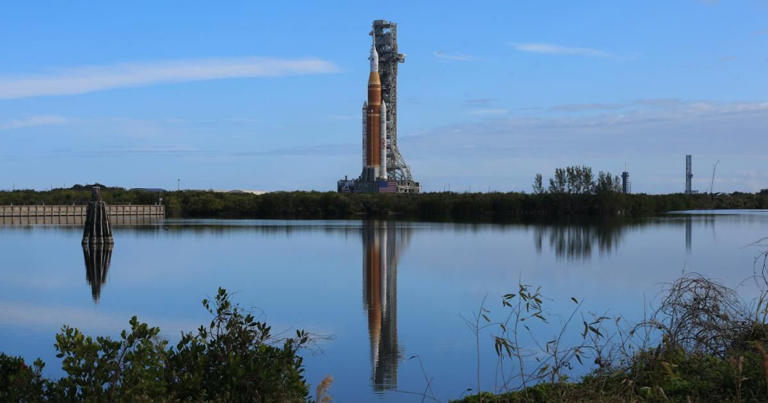
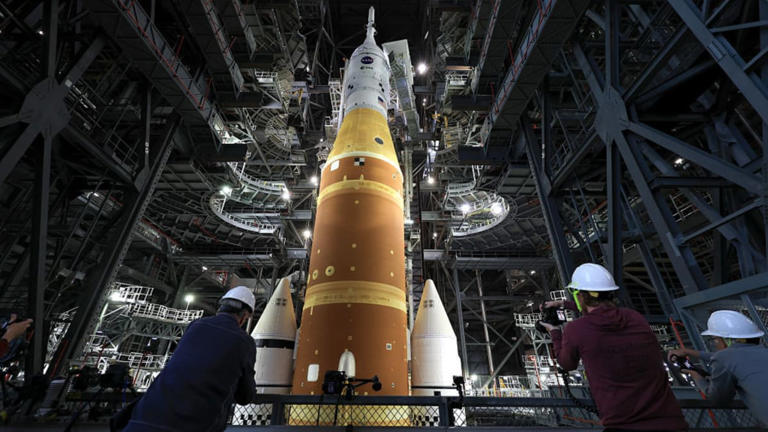
Artemis II: NASA now targets March 20 for SLS rocket rollout to launchpad
Artemis II: NASA now targets March 20 for SLS rocket rollout to launchpad
Story by Pranjal Nath
Artemis II: NASA now targets March 20 for SLS rocket rollout to launchpad
The rollout of theArtemis II SLS rocket from the Vehicle Assembly Building (VAB) to Launch Pad 39B at the Kennedy Space Center in Florida has been postponed,NASA announced. The 4-mile crawl of the rocket stack atop the Crawler-Transporter 2 will now take place on March 20, 2026, at the earliest, instead of March 19. "A rollout on March 20 would still preserve the possibility of launching at the beginning of the April launch window, though teams also are keeping a close eye on the weather in the coming days," the space agency added. A total of 7 launch windows are available in the month starting with April 1, with April 2 having been added to the previous list oflaunch opportunities.
NASA attributed the delay to an electrical harness for the flight termination system on the SLS core stage that needed replacement. While teams have addressed the situation, preparations to ready the rocket for the move are still underway. The Exploration Systems team will handle the rollout, which could potentially take up to 12 hours.
NASA's Artemis II sits in the Vehicle Assembly Building at NASA’s Kennedy Space Center on January 16, 2026, in Cape Canaveral, Florida.
(Image Source: Getty Images | Joe Raedle)
The SLS rocket stack reached the VAB on February 25, 2026, so that teams could look into the helium flow issue that had surfaced after the second wet dress rehearsal. This rollback came as a disappointment to many because of how successful the second wet dress rehearsal was deemed to be, given how the agency had managed to keep the hydrogen leak well within safety limits. Once the rocket reached the VAB, engineers traced the issue to a quick-disconnect seal through which helium flows from the ground to the rocket.
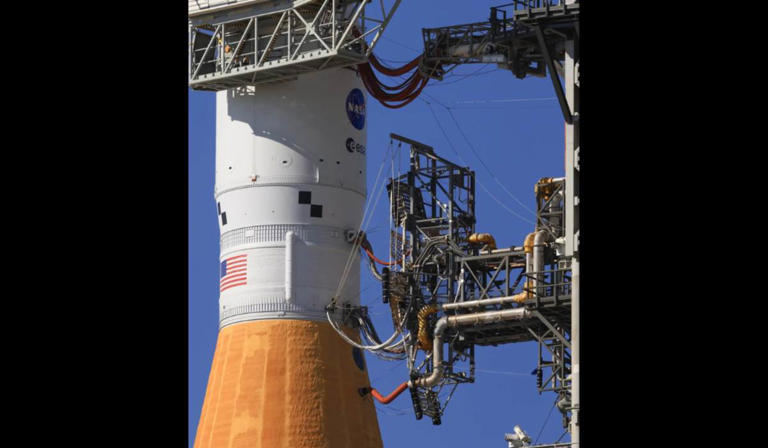
The ICPS has two umbilicals. The lower, larger aft plate supplies liquid hydrogen and liquid oxygen and has a helium quick disconnect and hazardous gas sensing.
(Image Source: NASA; Image Edited by Starlust Staff)
"Our combined engineering teams across our ground systems and SLS teams came up with a design fix," explained Exploration Ground Systems Program Manager Shawn Quinn during the press briefing held on Thursday. That design fix was implemented on a test article, and we have successfully tested it, and we have qualified it for use on Artemis II, and the modified QD is already on the upper stage."
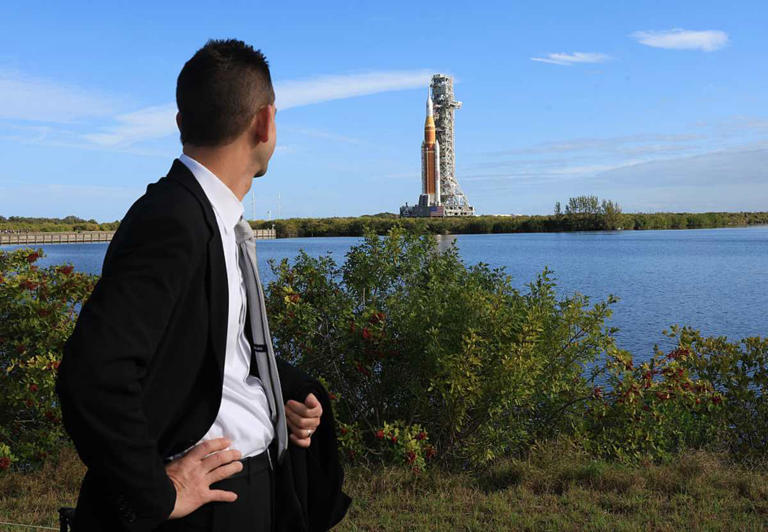
NASA Administrator Jared Isaacman looks out as NASA's Artemis II is rolled from the Vehicle Assembly Building to Launch Pad 39B at NASA’s Kennedy Space Center on January 17, 2026.
(Cover Image Source: Joe Raedle/Getty Images)
With the Artemis program, the aim is to restore a “golden age of innovation and exploration" to reach the Moon and eventually Mars with human explorers. Beginning with the launch of this particular mission, NASA hopes to increase its launch cadence to allow itself and its partners to make steady incremental steps towards reaching its goals, as opposed to steep learning curves with fewer launches. Owing to the numerous delays since Artemis I took off in 2022, many of the aspects of the program were called into question. This led NASA to make sweeping changes to its plans, which assigned the objective of human lunar touchdown to Artemis IV, slated for 2028.
The story of Moses is central to Jewish, Christian, and Islamic traditions.
He led the Israelites out of Egypt, received the Ten Commandments on Mount Sinai, and guided a wandering nation toward the Promised Land.
Yet, one of the most enduring mysteries about Moses is the fate of his body. According to the Bible, Moses died at the age of 120 on Mount Nebo, but “no one knows his burial place” (Deuteronomy 34:6).
This unique detail has sparked centuries of speculation, debate, and legend. Unlike other key figures whose tombs became sites of veneration, Moses’ grave remained hidden.
Scholars, theologians, and historians have suggested a variety of reasons for this secrecy.
Here are five compelling explanations for why Moses’ body was never found, each reflecting religious, symbolic, and historical interpretations of his life and death.
The Bible explicitly states that God Himself buried Moses and that no one knew the location of his grave.
Many scholars suggest this was deliberate to prevent idolatry or inappropriate veneration.
In ancient times, the graves of great leaders often became pilgrimage sites or places for offerings, and hiding Moses’ burial may have prevented such practices.
Another possible reason Moses’ body was never found relates to political concerns. The Israelites were a nomadic people entering a complex, often hostile region.
A known burial site of such a revered leader could have become a rallying point for rebellion or power struggles.
Rival factions might have attempted to use Moses’ remains to legitimize claims to leadership or to influence the community.
By hiding the grave, God may have protected the Israelites from internal division and external threats.
The absence of a physical tomb prevented the misuse of Moses’ authority for personal gain or political manipulation.
This explanation frames the hidden burial as a strategic act that preserved social cohesion and prevented exploitation of Moses’ symbolic status.
Moses’ significance lies primarily in his spiritual achievements and leadership, not in his physical presence.
Hiding his body ensured that future generations would focus on his teachings and the law rather than becoming fixated on relics or physical remains.
This approach aligns with the broader biblical pattern of emphasizing faith, obedience, and divine covenant over material objects.
By removing the possibility of a shrine or tomb, God ensured that Moses’ influence would remain rooted in moral guidance, scripture, and leadership principles.
The hidden burial shifts attention from the tangible to the eternal, reinforcing the idea that spiritual legacy matters more than earthly remains.
It serves as a reminder that Moses’ authority and inspiration were intended to be transmitted through teaching, story, and obedience to God’s commands.
Some theologians interpret Moses’ unmarked grave as highly symbolic.
It may represent humility, the impermanence of life, or the separation between human achievement and divine destiny.
Unlike kings or heroes who sought lasting monuments, Moses’ hidden burial emphasizes that ultimate honor comes from God rather than public recognition.
It also highlights the mysterious nature of divine intervention: even the greatest leader’s end can be concealed, reminding humanity of the limits of human understanding.
This symbolism has inspired interpretations in literature, art, and religious thought, suggesting that the unknown burial place serves as a metaphor for faith, mystery, and the eternal nature of God’s plan.
By keeping his grave secret, the narrative conveys lessons about humility, trust, and the ephemeral nature of earthly life.
From a historical perspective, some scholars suggest practical reasons for the absence of Moses’ tomb.
The Israelites were wandering in a desert environment, with limited capacity to perform elaborate burials.
Mount Nebo is steep and remote, which would have made marking or preserving a grave difficult.
Additionally, oral traditions and early record-keeping may have intentionally avoided specifying locations to protect sacred spaces from desecration.
Over time, any physical markers may have been lost due to natural erosion, human movement, or intentional concealment.
This practical explanation complements theological and symbolic interpretations, showing how environmental, cultural, and historical factors could have contributed to the enduring mystery of Moses’ unlocated burial.
It demonstrates that faith and historical circumstances often intersect to create lasting enigmas.
Has Steven Spielberg ever had his own alien encounter? The Disclosure Day director says…
Has Steven Spielberg ever had his own alien encounter? The Disclosure Day director says…
Story by Josh Weiss
You'd think that a man who has made four theatrical movies about contact with extra-terrestrial life, both benevolent and malevolent, would have had at least one close encounter in his lifetime.
Sadly, that hasn't been the case for Steven Spielberg, who is preparing for the release of his fifth alien-centric movie, Disclosure Day, which stars Emily Blunt (A Quiet Place), Josh O’Connor (Wake Up Dead Man), Colin Firth (Kingsman: The Secret Service), Eve Hewson (Behind Her Eyes), and Colman Domingo (The Running Man).
But if any non-human entities outside of Earth are interested in giving the director that experience ahead of the film's June 12 release, the storied Hollywood icon is more than ready to accept the invitation.
Disclosure Day director Steven Spielberg wants to see a real UFO
“I made a movie called Close Encounters of the Third Kind—I haven’t even had a close encounter or the first or second kind!” Spielberg said at a SXSW panel in Austin, Texas March 13 (via The Hollywood Reporter). “Why haven’t I seen anything? Half of my friends have seen UFOs or UAPs. Where’s the justice of that? If you’re listening out there..."
Based on an original story by Spielberg and written by the director's longtime collaborator David Koepp (Jurassic Park, War of the Worlds), Disclosure Day centers around the concept of humanity being made aware of the fact that it is not alone in the universe.
“I don’t know any more than any of you do, but I have a very strong suspicion that we are not alone here on Earth right now—and I made a movie about that,” the filmmaker said. "Because no one should ever think that we are the only intelligent civilization in the entire universe. So I’ve been thinking as a kid that we were not alone ... The big question is: Are we alone now? And have we been alone over the last 80 years? Have we been alone over the last few thousand years?”
As much as the government might want to cover things up (à la the infamous Roswell incident of 1947), people have the right to know the truth—even if that truth obliterates every preconceived notion they've ever held about their own existence.
“I’m not afraid of any aliens," Spielberg continued. "I have no fears about that whatsoever. I think our movie does take into consideration that social dislocation that could occur. If it was announced there is interaction [with aliens] that have been going on for decades, it’s going to cause a disruption in a lot of belief systems. But I don’t think it is a lethal disruption at all."
For decades, conversations about UFOs—now often referred to as unidentified anomalous phenomena (UAP)—have occupied an unusual place in public life. Many people are curious about the possibility of extraterrestrial intelligence, yet most people are cautious about discussing them with others because of stigma and fear of being judged.
New research suggests that this hesitation may reflect our psychology rather than skepticism.
Most Believe in Extraterrestrial Intelligence
A recent study by Avi Loeb at Harvard University, and colleagues, surveyed 6,060 participants recruited through the Prolific research platform, which is widely used in behavioral research [1]. The sample consisted largely of highly educated adults, many holding college or graduate degrees.
Instead of asking a simple yes-or-no question about extraterrestrial intelligence, participants were asked to estimate the probability that intelligent extraterrestrial life exists somewhere in the universe. Respondents provided numerical estimates between 0% and 100%.
When researchers averaged the responses, participants’mean estimate was about 67%, suggesting that on average people believe intelligent extraterrestrial life is more likely than not to exist.
Another way of examining the results highlights how widespread this belief is. The researchers found that about 95% of participants gave probability estimates greater than 50%, meaning they believed it is more likely than not that intelligent extraterrestrial life exists somewhere in the universe [1].
In other words, nearly everyone in the sample leaned toward believing intelligent life beyond Earth probably exists, even if their degree of certainty varied.
The Cosmic Closet: A Massive Perception Gap
The most striking finding in the study was not simply what people believed—it was what they thoht others believed.
After reporting their own probability estimate, participants were asked to estimate the probability that people in their social circles believed intelligent extraterrestrial life exists.
The difference was dramatic. Participants’ average personal estimate was about 67%. Their estimated belief of others was about 21%.
This produced a 46-percentage-point gap between personal belief and perceived social belief [1].
In other words, many people believed intelligent extraterrestrial life was plausible but assumed others were far more skeptical.
The researchers referred to this phenomenon as the “cosmic closet.” People privately hold a belief but assume it is socially unpopular, leading them to underestimate how widely it is actually shared.
The Psychology of Pluralistic Ignorance
This pattern closely resembles a well-known concept in social psychology called pluralistic ignorance.
Pluralistic ignorance occurs when individuals privately hold a belief but mistakenly assume that most other people disagree. Because individuals want to avoid social embarrassment or reputational risk, they often remain silent about their views. That silence then reinforces the illusion that the belief is uncommon even when many people privately share it [2].
Classic research demonstrates this dynamic in areas such as college drinking norms. Students often believe their peers are more comfortable with heavy drinking than they themselves are, even though most students privately feel similar reservations. Because everyone assumes others approve of the behavior, few people challenge the perceived norm [3].
The same mechanism may help explain the “cosmic closet.” If individuals assume curiosity about extraterrestrial intelligence will be dismissed as irrational, they may keep their views to themselves even when many others privately share that curiosity.
When Perception Shapes Reality
Norm misperception can have real consequences. When people underestimate how widely a belief is shared, they may hesitate to discuss it publicly, explore it academically, or pursue it professionally.
Psychologists have observed similar dynamics in other domains. Research shows that many people underestimate how common experiences such as anxiety, depression, or loneliness actually are, which can make individuals reluctant to talk about their own struggles. Fear of being judged or stigmatized often leads people to stay silent even though many others are experiencing similar challenges [4].
Researchers have also found that people frequently overestimate how extreme the views of political opponents are, contributing to perceptions of deeper polarization than survey data actually shows [5]. When individuals believe their views differ sharply from the perceived majority, they may stay silent to avoid social conflict.
This creates a feedback loop.
When people remain silent because they believe their views are uncommon, that silence prevents others from realizing how widely the belief is actually shared. As a result, skepticism appears more widespread than it really is.
In effect, people remain quiet to conform to a social norm that may exist largely because everyone else is also remaining quiet.
Expert Opinion Barely Changed People’s Views
The researchers also tested whether revealing expert opinion would influence participants’ beliefs.
Some respondents were shown survey results indicating that many astrobiologists—scientists who study the origins and distribution of life in the universe—consider extraterrestrial life plausible.
Interestingly, this information had only a small effect on participants’ probability estimates [1]. Even after seeing expert opinions, participants’ beliefs changed very little.
This suggests that people’s beliefs about extraterrestrial intelligence may not depend strongly on expert authority. Instead, individuals may rely more on intuitive reasoning about the vastness of the universe or broader worldview assumptions when forming their judgments.
Implications for UAP Disclosure
The “cosmic closet” may also have implications for how society responds to discussions about UFOs and UAP.
If people consistently underestimate how many others share their curiosity about extraterrestrial intelligence, public conversations may remain more constrained than public opinion actually warrants.
Research on pluralistic ignorance shows that when individuals learn their views are more widely shared than they assumed, they often become more willing to express them openly [2].
If that pattern holds here, the biggest barrier to open discussion may not be skepticism about extraterrestrial life itself.
It may simply be the widespread assumption that curiosity about the topic is socially stigmatized.
A Psychological Mirror
The biggest surprise in the study was not how many people thought extraterrestrial intelligence might exist.
It was how dramatically people misjudged what others believe.
The “cosmic closet” reminds us that social reality is shaped not only by what people believe—but by what they believe others believe.
Sometimes the strongest social norms are the ones that exist mostly in our assumptions about each other.
References
Loeb, A., Eldadi, O., & Tenenbaum, G. (2025). Surveys on the existence of extraterrestrial intelligent life and the effects of revealing expert beliefs. arXiv. https://arxiv.org/abs/2512.00364
Miller, D. T. (2023). A century of pluralistic ignorance: What we have learned. Frontiers in Social
Clement, S., Schauman, O., Graham, T., et al. (2015). What is the impact of mental health-related stigma on help-seeking? Psychological Medicine, 45(1), 11–27. https://doi.org/10.1017/S0033291714000129*
Ahler, D. J., & Sood, G. (2018). The parties in our heads: Misperceptions about party composition and their consequences. Journal of Politics, 80(3), 964–981. https://doi.org/10.1086/697253
The disappearance of a retired Air Force general who once oversaw billions of dollars in military research has drawn federal investigators into the search and fueled a wave of online conspiracy theories about classified programs and unidentified flying objects.
Retired Maj. Gen. William “Neil” McCasland, a former commander of the Air Force Research Laboratory, has been missing since Feb. 27, when he disappeared from his home in Albuquerque, New Mexico. Local authorities are leading the investigation, but federal agencies, including the FBI, have joined the search as the case continues to attract national attention.
While investigators have not identified a clear explanation for his disappearance, McCasland’s background overseeing some of the Air Force’s most advanced science and technology programs has made the case a magnet for speculation online.
Authorities say the investigation remains active and have urged anyone with information to contact law enforcement.
The Air Force Research Laboratory showcases Collaborative Combat Aircraft in its booth during the Air, Space and Cyber Conference at the Gaylord National Resort and Convention Center in National Harbor, Maryland, Sept. 18, 2024.(U.S. Air Force photo by Matthew Clouse)
A Career at the Center of Air Force Research
McCasland spent more than three decades in the Air Force and ultimately served as commander of the Air Force Research Laboratory (AFRL), one of the military’s most influential science and technology organizations.
AFRL manages research programs that shape the future of air and space power, including advanced propulsion systems, directed energy weapons, aerospace materials and satellite technologies.
At the time of his leadership, the laboratory oversaw roughly $2.2 billion in Air Force science and technology programs, along with additional externally funded research and development projects.
The role placed McCasland among the Air Force’s most senior science leaders, responsible for guiding long-term research investments and coordinating efforts across the Pentagon, universities and defense industry partners.
Programs developed through AFRL help transition experimental technologies into operational military capabilities used by service members around the world.
During McCasland’s tenure, AFRL played a central role in developing technologies that later became key components of modern U.S. military capability. The laboratory helped advance work on directed-energy weapons, advanced satellite systems, hypersonic research and next-generation sensors, while partnering with universities and defense contractors to transition experimental technologies into operational systems used by the Air Force and Space Force today.
Leaders of AFRL often interact with classified programs and emerging technologies years before they become publicly known, which helps explain why the disappearance of a former commander has drawn unusual attention online.
Local authorities in Bernalillo County, New Mexico, are leading the investigation, but federal agencies have provided additional resources as the search expanded.
The FBI’s Albuquerque field office has joined the effort to assist with investigative support and search coordination.
Federal agencies often provide specialized resources in missing-person cases, including forensic analysis, digital investigations and coordination across jurisdictions.
Authorities have conducted extensive search operations around Albuquerque, including neighborhood canvassing, drone flights and searches with trained K-9 teams.
Volunteers and neighbors have also assisted with the search effort, helping distribute information and examine areas near McCasland’s home where he might have traveled.
So far, investigators have not publicly identified evidence of foul play.
Official photo of Maj Gen Neil McCasland (www.af.mil)
Timeline of the Day He Disappeared
Some of the clearest details about the day McCasland vanished have come from his wife, Susan McCasland Wilkerson.
According to information she shared publicly, a repairman visited their home around mid-morning on Feb. 27. Wilkerson later left for a doctor’s appointment, and when she returned about an hour later, McCasland was gone (KRQE News, Albuquerque).
Investigators say his phone and glasses were left behind in the house, while several other items were missing, including his wallet, hiking boots and a .38-caliber revolver.
The disappearance prompted authorities to issue a Silver Alert and launch a large search effort across the surrounding area.
Wife Pushes Back on Conspiracy Theories
As the case spread online, Wilkerson has repeatedly pushed back against speculation linking her husband’s disappearance to UFO secrets or classified military programs.
In a public Facebook post addressing the rumors, she wrote that her husband had no secret knowledge about extraterrestrial technology or materials.
“Neil does not have any special knowledge about the ET bodies and debris from the Roswell crash stored at Wright-Patt,” she wrote. (People Magazine; Newsweek)
She also said that while McCasland once had access to classified programs during his military career, he retired more than a decade ago and his knowledge would now be outdated.
“It seems quite unlikely that he was taken to extract very dated secrets from him,” she wrote.
Frustrated by the speculation, she later used humor to address the rumors circulating online.
“Though at this point with absolutely no sign of him, maybe the best hypothesis is that aliens beamed him up to the mothership,” she wrote, adding that no sightings had been reported over the nearby Sandia Mountains.
Her comments highlight how quickly misinformation can spread online when high-profile individuals become the focus of missing-person cases.
The Bernalillo County Sheriff's Office put out a Silver Alert for Neil McCasland (Photo courtesy of the Bernalillo County Sheriff's Office).
Why Conspiracy Theories Are Spreading
Much of the speculation surrounding McCasland’s disappearance stems from his past role overseeing advanced Air Force research programs.
One of the most widely circulated theories online suggests his disappearance could somehow be tied to classified UFO or unidentified aerial phenomena (UAP) programs. The speculation has been amplified by McCasland’s brief involvement with a company connected to former Blink-182 musician Tom DeLonge that explored public discussion of UAPs.
Other theories circulating on social media suggest that McCasland may have had knowledge of secret aerospace or weapons programs that made him a target.
There is currently no evidence supporting those claims, and investigators have not indicated that his former work is connected to his disappearance.
Experts say speculation around national security programs is common whenever high-profile military figures are involved in unexplained events.
The combination of McCasland’s rank, his leadership role in the Air Force’s primary research laboratory and the secrecy that often surrounds advanced defense technology has created a perfect environment for online rumors.
The Search Continues
For now, investigators say their focus remains on locating McCasland and determining what happened after he left his home in late February.
Authorities continue to ask the public to report any information that might assist the investigation.
The disappearance of a retired senior military leader is rare, and for many who once worked alongside him in the defense science community, the unanswered questions surrounding the case remain troubling.
Until authorities uncover new information, the search for McCasland continues, along with the hope that the mystery surrounding his disappearance will soon be resolved.
In what sounds like a scene from a science fiction thriller, a humanoid robot has been arrested by police after terrifying an elderly woman inChina.
According to local authorities, the 70–year–old woman was startled by the robot when she suddenly noticed it standing behind her.
A viral clip shows the woman yelling and waving her bag at the diminutive bot, which repeatedly raises its arms in the air.
Footage then shows two police officers escorting the Unitree G1 down the road, with one leading the robot by its shoulder.
Police told reporters that the woman had stopped to check her phone when the robot halted behind her, waiting for her to clear the path.
The elderly pedestrian was then 'frightened' to discover that the robot was silently following her down the road.
Following the incident, the woman told police that she was feeling unwell and was taken to hospital for a check–up and treatment.
After doctors confirmed there was no physical altercation between her and the robot, the unnamed woman said that she wouldn't be filing a complaint against the bot's operator.
A bizarre video shows the moment a humanoid robot is arrested by police after terrifying an elderly woman in China
The altercation occurred at 21:00 local time outside a residential complex in Macau, China.
In the video, according to a translation by the Macau Post, the woman can be seen yelling: 'You're making my heart race!
'You've got plenty to do, so what's the point of messing around with this? Are you freaking crazy?'
While the robot was not officially arrested, police did remove it from the scene and returned it to its operator, a man in his 50s, who was reminded to exercise caution.
However, on social media, the short clip of a robot being escorted away by police has sparked a wave of memes, as commenters joke that this is the 'first robot arrest in history'.
On X, one commenter joked: 'Looks like the robot needs a lawyer or some basic rights.'
'We are rapidly approaching a new wacky timeline,' added another.
One asked: 'Did the robot have a mugshot? Did the robot go to court?'
A viral clip shows the woman yelling and waving her bag at a Unitree G1 robot, which repeatedly raises its arms in the air
Unitree G1: Key Specs
Height: 4.3ft (132cm)
Price: $16,000/£12,000
Weight: 35kg
Arm span: 1.4ft
Speed: 2m/s (5mph)
Power supply: Lithium battery
Manual controller: Yes
While one chimed in: 'This is exactly how the matrix started.'
However, others were far less sympathetic, blaming the elderly woman for overreacting to the robot's presence.
One commenter coldly wrote: 'Clearly the woman is the problem, not the robot.'
'Lock that woman up for impeding a robotic lifeform,' another added.
Authorities revealed that the robot belonged to a nearby education centre, which had been using the Unitree G1 robot as part of a promotion.
Towin Mak, a spokesperson for the education centre, told local broadcaster Teledifusão de Macau (TDM) that the robot was leaving the area when it encountered the elderly woman.
Mr Mak added that it was being guided by a mix of autonomous programming and remote supervision at the time.
The robot's operator has apologised for causing distress.
Following the incident, the 70–year–old woman told police that she was feeling unwell and was taken to hospital for a check–up and treatment. She later decided to bring a complaint against the robot's operator
While this may be the first time that the police have had to bring a robot into custody, police forces are already making robots part of their approach to fighting crime.
Professor Ivan Sun, from the University of Delaware, previously predicted that robotic police officers would be patrolling our streets in just five years.
These real–life robocops will be able to detect, pursue and apprehend suspects – likely working alongside human supervisors.
Meanwhile, countries like China and Singapore have begun trialling robotic police robots, with varying degrees of success.
For example, the Xavier robot in Singapore patrols public spaces to detect 'undesirable social behaviours' such as smoking before relaying the information to human officers.
While in China, AI–powered robots such as the AnBot have been integrated into security systems to conduct surveillance, verify identities and patrol transport hubs. In the UAE, robots have been used in more service–oriented roles such as greeting tourists or providing multilingual assistance during large events.
The federal government holds shocking evidence of UFOs which proves we are not alone — including satellite imagery of out-of-this world craft that look like nothing “we have built,” an expert with knowledge of the documents told The Post.
The government’s trove of UFO docs is massive and includes stunning photos and videos, according to Christopher Mellon, the former deputy assistant secretary of defense intelligence during the Clinton and Bush administrations.
Publicly disclosing the information would take UFO discourse “to another level,” he added.
President Trump announced the upcoming release of UFO files last week — and the contents could take alien discourse “to another level.”Rob Jejenich / NY Post Design
While the announcement spurred federal agencies, including the White House and the Pentagon, to scramble, there has been no official word on what will be released and when.
The most compelling piece of data, Mellon claimed, are clear satellite photos of craft in space above the Earth that are obviously not manmade.
“We have satellite imagery of craft that sure don’t look like anything that we have built or constructed,” Mellon said.
Those same convincing images of craft engaging in “actions that are difficult to explain” were referenced by ex-director of national intelligence and current CIA director John Ratcliffe in a 2021 Fox News interview.
Chris Mellon, former Deputy Assistant Secretary of Defense Intelligence, told The Post the government has many videos and photos of UFOs which have yet to be released to the public.
News Nation
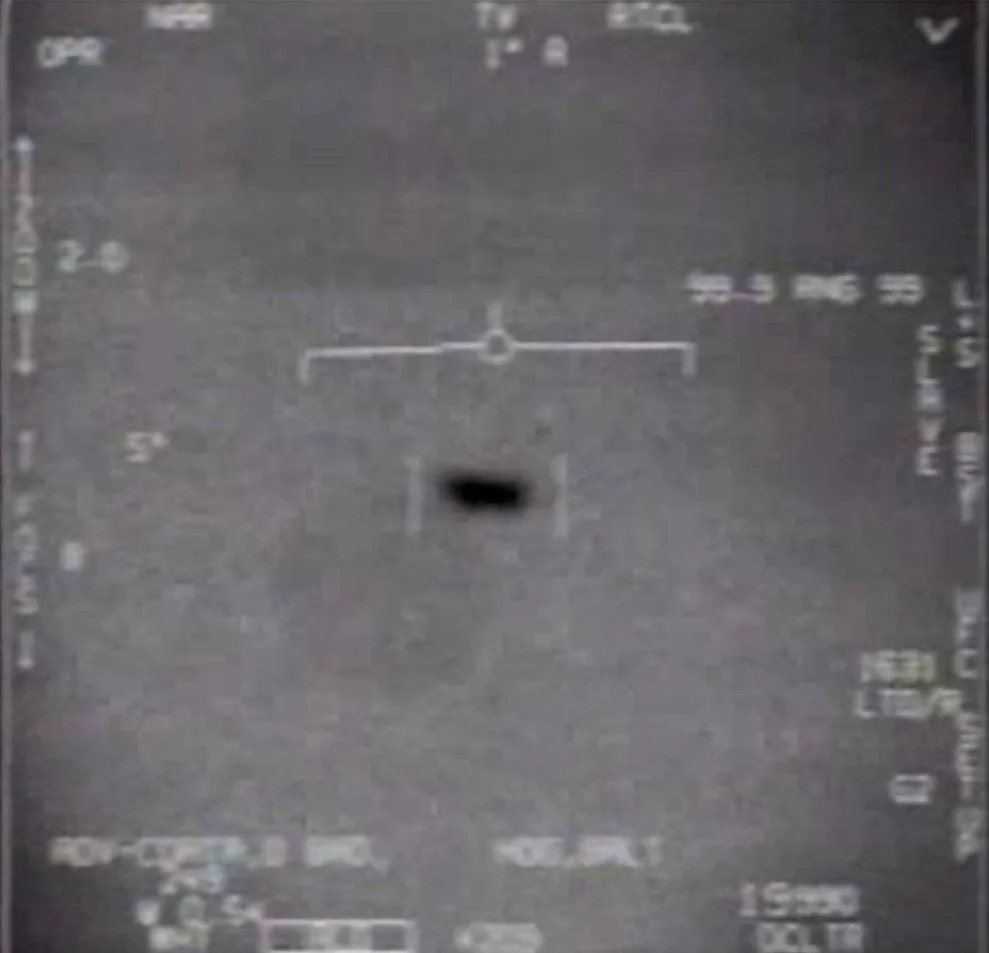
Radar footage released by the Pentagon on April 27, 2020, shows a UFO commonly referred to as the Gimbal video.DoD/AFP via Getty Images
The government now prefers the term “UAP,” or Unidentified Aerial Phenomena, to “UFO.”
“There’s a significant number of videos from the same sources that were judged unclassified in 2018 — gun cameras on F18s, [Forward Looking Infrared Radar] videos — that have been withheld from the public,” he said.
“I know there are because I’ve seen some of them,” said Mellon, adding, “And there’s no rational reason that I can think of why those videos are being withheld.”
Though some provocative images should be included in the release, Mellon said he has no expectation for files that confirm the existence of, or contact with, alien civilizations.
The Department of War, the Department of National Intelligence, the National Security Agency, the Defense Intelligence Agency, the Department of Energy, and the National Nuclear Security Administration all have UFO files that would be relevant to the Trump-ordered release, Mellon said.
Releasing classified and sensitive materials is an “unnatural act” for intelligence agencies, he said.
“I have a feeling bureaucracy is going to react slowly and I don’t think they’re gonna put the best stuff out quickly, if they do at all,” he said. “Congressional vigilance is needed to ensure a thorough and effective process.”
President Trump announced last week he would release the UFO files, putting Sec. of War Pete Hegseth in charge of the operation.Getty Images
Sen. Mike Rounds (R-South Dakota), senior member of the Senate Armed Service Committee, who introduced the UAP Disclosure Act with Minority Leader Chuck Schumer in 2023, is hoping for a broad release that ensures US military secrets are preserved.
Rounds hopes for “as much disclosure as we can get with regard to just being honest to the American people about what we see that we either don’t know about or that we’re learning about.
“And I just want to make sure that whatever we put out, we do not impact our own national security capabilities.”
A Fast-Moving Mystery in Space: NASA Tracks Object Traveling at 1 Million Miles Per Hour Astronomers working with NASA data have identified an unusual object speeding through space at roughly 1 million miles per hour, a velocity so extreme that it could eventually escape the Milky Way entirely. The object, labeled CWISE J124909.08+362116.0, was spotted through a citizen-science project that analyzes telescope data for moving objects. Scientists say the discovery is remarkable not only because of its incredible speed but also because the object’s nature is still being studied, raising questions about how it was launched across the galaxy so quickly.
A Discovery Made by Citizen Scientists The object was first detected by volunteers participating in NASA’s Backyard Worlds: Planet 9 citizen-science program. Participants examine images from the Wide-field Infrared Survey Explorer telescope, searching for objects that move across the sky over time. Careful analysis of the data revealed the mysterious object traveling unusually fast compared with typical stars or planets.
Meet CWISE J1249 Scientists identified the object as CWISE J124909.08+362116.0, often shortened to CWISE J1249. It appears to be a very small and faint celestial body that does not fit neatly into common categories. Researchers say it may be a low-mass star or a brown dwarf, a type of object that sits somewhere between a planet and a star.
Traveling at a Mind-Bending Speed The object’s speed is estimated at around 1 million miles per hour, far faster than most stars orbiting within the Milky Way. At this velocity, scientists believe it is traveling fast enough to escape the gravitational pull of the galaxy. Hypervelocity objects like this are extremely rare and often require powerful cosmic events to reach such speeds.
A Possible Runaway Star One explanation is that CWISE J1249 could be a runaway star, meaning it was violently ejected from its original location. This can happen when stars interact gravitationally with other massive objects or when a companion star explodes in a supernova. These events can fling a star across the galaxy at extraordinary speeds.
Another Theory Involves Black Holes Another possible explanation is that the object had a close encounter with a black hole system. If two black holes are orbiting each other, their powerful gravity can act like a slingshot. A nearby star that passes too close may be accelerated dramatically and thrown outward at extreme velocity.
Why Scientists Are Studying Its Chemistry Researchers are now examining the object’s chemical composition to determine where it originated. By studying the light emitted from the object, astronomers can identify elements in its atmosphere. These clues may reveal whether the object was launched by a supernova explosion or originated from a dense star cluster.
What Makes the Object So Unusual Hypervelocity objects are extremely rare because most stars remain gravitationally bound to the Milky Way. For an object to break free, it must reach extraordinary speeds that overcome the galaxy’s gravitational pull. Scientists say CWISE J1249 appears to be traveling fast enough to eventually leave the Milky Way and wander into intergalactic space.
A Reminder of How Dynamic the Galaxy Is Discoveries like this highlight how dynamic and sometimes violent our galaxy can be. Stars, planets, and other objects are constantly moving and interacting through gravity. Occasionally, those interactions produce dramatic events capable of launching objects across vast cosmic distances.
Powerful Forces Reshaping The Milky Way The mysterious object racing through space at nearly 1 million miles per hour is giving astronomers a rare glimpse into the powerful forces shaping the Milky Way. While scientists are still determining exactly what CWISE J1249 is and how it gained such incredible speed, the discovery demonstrates how much remains unknown about our galaxy. Continued observations may eventually reveal the cosmic event that launched this stellar traveler on its extraordinary journey.
An unidentified anomalous phenomena researcher discusses the stigma faced by similar experts conducting their studies into other UAP events while the government continues to release reports on the topic.
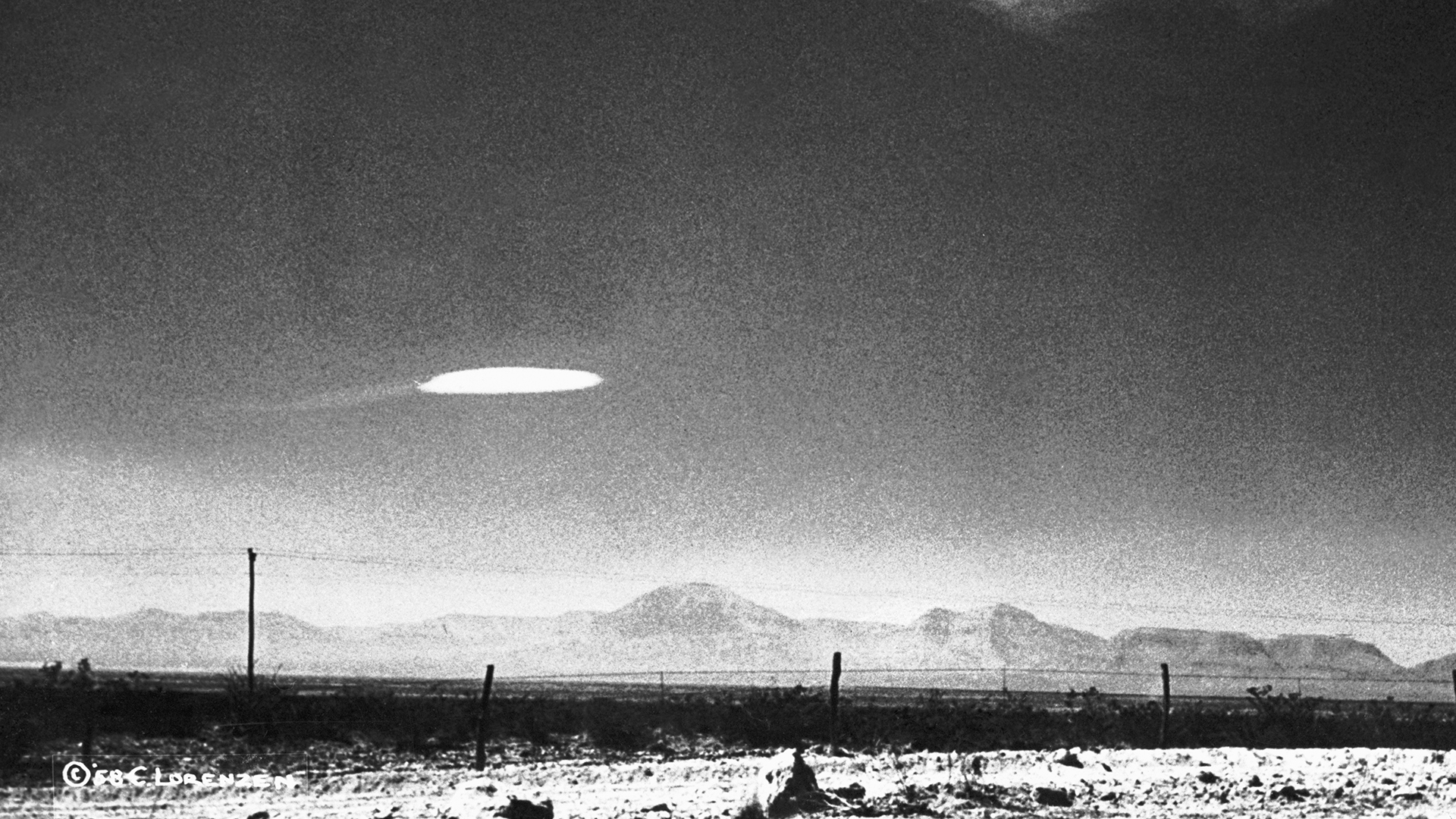
A photo of a UFO taken in 1957 near Holloman Air Development Center, Alamagordo, New Mexico.
Congress formally mandated UAP investigations through the National Defense Authorization Act in December 2022. The Pentagon's official UAP investigative body, the All-domain Anomaly Resolution Office, AARO, now carries a caseload exceeding 2,000 reports dating back to 1945. Defense Secretary Pete Hegseth confirmed this figure earlier this year.
The cases were submitted by military personnel, pilots and government employees describing aerial objects that could not be explained as known aircraft, drones or weather phenomena. Governments in Japan, France, Brazil and Canada also have their own formal UAP investigation programs.
Yet modern research universities remain almost entirely absent from this conversation. No major university has established a dedicated UAP research center. No federal science agency offers competitive grants for UAP inquiry. No doctoral programs train researchers in UAP methodology. The gap between what governments openly acknowledge and what universities are willing to study is, at this point, difficult to explain on purely intellectual grounds.
I have navigated this gap while conducting my own UAP research. My work developing the temporal aerospace correlation tool, a standardized framework for correlating civilian UAP sighting reports with documented rocket launch activity from Cape Canaveral, is currently under peer review at Limina: The Journal of UAP Studies.
Designing that framework meant making methodological decisions without community standards, without institutional funding and without the professional infrastructure many researchers in established fields take for granted. What is missing is not interest or data — it is the shared scaffolding that turns isolated curiosity into cumulative science.
Stigma is measurable
The most rigorous evidence for the gap between faculty interest in UAP and faculty willingness to study it comes from peer-reviewed studies by Marissa Yingling, Charlton Yingling and Bethany Bell, published in the scholarly journal Humanities and Social Sciences Communications.
Across 14 disciplines at 144 major U.S. research universities, 1,460 faculty responded to their 2023 national survey. Most surveyed believed UAP research was important. Curiosity outweighed skepticism in every discipline that was part of the study. Nearly one-fifth had personally observed something aerial they could not identify. Yet fewer than 1% had ever conducted UAP-related research.
The gap was not explained by intellectual dismissal, but it was in part explained by fear. Researchers were not primarily deterred by intellectual skepticism because they doubted the topic's merits. Instead, they feared they might lose funding, face ridicule from colleagues or find their careers quietly derailed. Faculty reported being told to "be careful."
A 2024 follow-up study found that roughly 28% said they might vote against a colleague's tenure case for conducting UAP research, even when they personally believed the topic warranted study.
Historian and philosopher of science Thomas Kuhn argued that scientific communities suppress anomalous questions not because those questions are unanswerable, but because they fall outside the boundaries the community has collectively decided are worth investigating.
For UAP researchers, the data and tools to study the phenomenon exist. What may not exist is social permission to use them without professional consequence.
Creating an academic discipline
Academic disciplines do not emerge spontaneously. They require dedicated journals, agreed-upon methods, graduate programs and professional societies.
The history of cognitive neuroscience demonstrates how disciplines emerge. Before the 1980s, researchers at the intersection of neuroscience and cognitive psychology faced resistance from both parent disciplines.
These fields achieved mainstream acceptance only after targeted funding from the Alfred P. Sloan Foundation, new brain-imaging tools and the gradual formation of academic programs that created career pathways for researchers. Researchers at the nexus of these fields did not wait for central questions to be resolved. They built infrastructure, and the infrastructure made progress possible.
UAP studies as a discipline is developing some of these elements, but largely outside universities. The Society for UAP Studies, a nonprofit of scholars and researchers, operates Limina as a double-blind, peer-reviewed journal and has convened international symposia drawing researchers from physics, philosophy of science and the social sciences. But a nonprofit scholarly society without tenured faculty does not constitute a discipline.
To turn UAP studies into a recognized academic field would require three things.
First, funding. The Yingling studies found that competitive research grants would do more to unlock faculty participation than any other single factor. Without grants, researchers cannot hire students to assist them, maintain instruments or sustain the multiyear projects that produce meaningful results.
Second, shared methodological standards — these would entail agreed-upon procedures for collecting, recording and evaluating UAP reports — would mean findings from one research group can be compared and built upon by others.
Third, institutions could publicly affirm that they will evaluate appropriately rigorous UAP scholarship on its scientific merits during tenure reviews. Several universities have already done this for gun violence research and psychedelic-assisted therapy studies.
These are not isolated examples. Research into near-death experiences and adverse childhood experiences followed similar trajectories, moving from being a professional liability to mainstream legitimacy after the removal of institutional barriers.
The international comparison
This gap in UAP scholarship is unique to the United States. France's GEIPAN, a dedicated investigation unit within its national space agency, has operated since 1977. It has publicly archived approximately 5,300 French UAP cases, of which about 2% to 3% remain unexplained after rigorous analysis.
None of these actions has produced a corresponding response from American research universities. Universities provide independent, peer-reviewed analyses that government programs structurally cannot.
New Details Emerge About Jimmy Carter’s Alleged 1977 UFO Briefing
New Details Emerge About Jimmy Carter’s Alleged 1977 UFO Briefing
Nearly five decades after Jimmy Carter entered the White House, a new claim has reignited debate about what U.S. presidents may know about unidentified flying objects. Physicist Dr. Eric Davis recently stated that Carter received a classified UFO briefing in June 1977 that allegedly contained information about contact between the United States government and non-human beings.
The claim, discussed during a podcast conversation involving Davis, Eric Weinstein and host Jesse Michaels, adds fresh details to a long-circulating story about Carter’s early presidency and his interest in the UFO phenomenon. While the claim has not been independently verified, it has drawn renewed attention to a period when UFOs briefly became a subject of serious discussion inside the White House.
The Alleged 1977 UFO Briefing
According to Davis, the briefing occurred only months after Carter took office in January 1977. What reportedly began as a routine meeting in the National Security Council conference room allegedly shifted location when the topic of UFOs emerged.
Davis claims the discussion moved to the Oval Office, where Carter was informed about classified information regarding UFOs and possible interactions between government agencies and extraterrestrial entities.
Another intriguing detail concerns the documentation of the meeting. Davis says records exist in the Jimmy Carter Presidential Library that include an attendee list. All participants are visible in the document except for two individuals whose names and affiliations remain redacted nearly fifty years later.
The existence of those redactions has fueled speculation among UFO researchers about who might have attended the meeting and what agencies they represented.
Confirmation Claims From Carter Staff
Davis also stated that the briefing was later confirmed by Alonzo McDonald, who served as a senior staff member in the Carter White House.
According to Davis, McDonald reportedly investigated the matter after hearing about the meeting and spoke directly with Carter and other participants. After doing so, McDonald allegedly concluded that the briefing did indeed occur.
If accurate, this would suggest that discussions about UFOs were occurring at the highest levels of government during Carter’s first year in office.
Links to the Controversial “Project Aquarius”
The story has also been linked to a rumored classified program known as Project Aquarius, a name that has appeared in UFO documents since the early 1980s.
Davis suggested that officials attending the meeting were given briefing documents that had to be returned afterward. Later, some of those participants allegedly reconstructed the briefing from memory. That reconstruction supposedly became known among researchers as the Aquarius document.
The document refers to a highly restricted intelligence program and mentions oversight by a small group sometimes associated with the controversial MJ-12 documents, which have long been debated within UFO research circles.
However, historians note that the Aquarius material may contain a mixture of authentic terminology and deliberate misinformation. Some versions of the documents were clearly altered over time, casting doubt on their reliability.
Carter’s Personal Interest in UFOs
The renewed attention on the story is partly due to Carter’s own history with UFO sightings.
Before becoming president, Carter publicly reported witnessing a strange object in the sky in 1969 while attending a Lions Club meeting in Georgia. During the 1976 presidential campaign, he spoke openly about the experience and promised that, if elected, he would help release UFO information to scientists and the public.
This statement created enormous public interest. Once Carter entered office, the White House reportedly received large volumes of letters from citizens asking for UFO disclosure or sharing their own sightings.
Attempts to Reopen UFO Research
Inside the administration, officials explored the possibility of creating a new scientific investigation of UFO sightings. One idea was to have NASA lead a civilian research program that would replace the U.S. Air Force’s Project Blue Book, which had been shut down in 1969.
The proposal quickly encountered resistance.
NASA officials argued that UFO reports did not justify launching a major research program. According to accounts from the period, intelligence agencies were also reluctant to reopen the issue, and the plan ultimately stalled.
By the end of 1977, the public effort to study UFOs had effectively faded away.
The United Nations UFO Proposal
The UFO topic also surfaced in international diplomacy during Carter’s presidency.
In September 1977, Carter met with Eric Gairy, the prime minister of Grenada. Gairy had a personal interest in UFO sightings and proposed that the United Nations create an international investigation into the phenomenon.
Grenada later attempted to push for a UN resolution encouraging global cooperation on UFO research. The initiative failed to gain support, with both the United States and the United Kingdom opposing the effort.
Nevertheless, the episode illustrates how visible the UFO issue had become during Carter’s first year in office.
A Moment When UFOs Reached the Political Mainstream
Despite Carter’s earlier interest, the administration eventually stopped pursuing the issue publicly. Researchers have long wondered why a president who had promised transparency on UFOs appeared to abandon the subject so quickly.
If the briefing described by Eric Davis did occur, it could provide one possible explanation. According to some accounts circulating in UFO research circles, Carter was reportedly deeply troubled after learning classified information about the phenomenon.
However, without official confirmation or newly declassified documents, the true details of what the president may have been told remain unknown.
Renewed Interest in a Historical Mystery
The recent claims from Dr. Eric Davis have prompted historians and UFO researchers to revisit the events of 1977, a year when the UFO question briefly came close to the center of American political life.
Whether the alleged briefing actually took place remains uncertain. Still, the story highlights how the subject of unidentified aerial phenomena has repeatedly intersected with government secrecy, intelligence agencies, and political decision-making.
With growing public interest in UAPs and ongoing discussions in governments around the world, the Carter era may yet reveal new insights into how leaders have privately confronted one of the most enduring mysteries of the modern age.
NASA on February 19, 2026, formally classified Boeing’s 2024 Crewed Flight Test of the CST-100 Starliner spacecraft as a Type A mishap, the agency’s most serious safety designation. The findings, drawn from a year-long independent investigation, point to hardware failures, qualification gaps, and cultural breakdowns at both Boeing and NASA that left two astronauts stranded at the International Space Station and created what investigators called the potential for a significant mishap. The report lands as Congress demands answers and as the agencies restructure the commercial crew contract to prevent a repeat.
What a Type A Classification Signals
In NASA’s mishap taxonomy, a Type A event involves either loss of life, permanent disability, destruction of a major asset, or damage exceeding a set dollar threshold. Applying that label to a crewed mission that returned its spacecraft intact but failed to perform as designed is itself a statement: the agency concluded the flight came close enough to catastrophe to warrant its highest investigative response. In February 2025, NASA chartered an independent Program Investigation Team to examine the technical, organizational, and cultural dimensions of the flight, as detailed in the agency’s official summary of the inquiry. That team delivered its final report on February 19, 2026, and NASA accepted it the same day, committing to corrective actions across the program.
The distinction matters for readers tracking U.S. human spaceflight because the classification triggers mandatory follow-up. NASA cannot simply file the report and move on; the agency must now implement and track each corrective action to close the investigation. For Boeing, the designation adds formal institutional weight to what was already a reputational crisis, binding the company to remediation milestones under NASA oversight. It also places Starliner’s future flights under a brighter spotlight than routine anomaly reviews, signaling that the program will not return to business as usual until independent safety officials are satisfied.
The investigation centered on propulsion system anomalies that surfaced during the Crewed Flight Test. While astronauts Butch Wilmore and Suni Williams remained aboard the ISS, NASA and Boeing ran ground hot-fire tests at White Sands to replicate the thruster behavior observed in orbit; those engine tests confirmed problems serious enough that NASA ultimately decided to return Starliner without its crew rather than risk a crewed reentry.
The PIT report, dated February 5, 2026, stated in its conclusion section that the mission, “while ultimately successful in preserving crew safety, revealed critical vulnerabilities” in the spacecraft’s propulsion architecture. Hardware failures and qualification gaps were among the primary findings. Qualification gaps refer to scenarios where components were certified for flight based on testing that did not fully replicate the stresses they would encounter in actual mission profiles. That disconnect between test conditions and real-world performance is a systemic issue, not a one-off parts failure, and it raises questions about whether similar gaps exist in other subsystems or programs that followed the same certification logic.
Investigators traced some of the anomalies to how thrusters behaved under extended duty cycles and thermal conditions that had not been adequately modeled. In practice, that meant Starliner’s propulsion system did not respond as expected when the flight profile deviated from nominal assumptions. The crew was never in immediate danger of losing life support on station, but the margin for a safe, controlled deorbit narrowed enough that managers judged the risk unacceptable. Returning the capsule empty was an extraordinary step, underscoring how far actual performance had diverged from the qualified envelope.
Oversight Model Under Strain
A separate NASA Office of Inspector General audit of the Commercial Crew Program had previously flagged management weaknesses and control deficiencies in how the agency supervised its commercial partners; those concerns are laid out in the watchdog’s program review. The PIT report’s findings echo those earlier warnings, suggesting that known risks went unresolved long enough to contribute to the 2024 mishap.
The commercial crew model was designed to shift development risk to private companies while NASA played a lighter oversight role than it did during the Space Shuttle era. That approach worked well with SpaceX’s Crew Dragon, which has flown multiple operational missions with relatively few major anomalies. But the Starliner investigation suggests the model’s success depends heavily on the contractor’s internal safety culture. When that culture degrades, a lighter-touch oversight framework may not catch problems early enough.
The PIT report’s emphasis on organizational and cultural factors, alongside hardware failures, points to a breakdown that was not purely technical. Boeing’s internal processes did not consistently elevate propulsion concerns to the level of formal risk acceptance, and NASA’s own management practices failed to compensate for gaps on the contractor’s side. The result was a misalignment between the level of risk NASA leadership believed it had approved and the actual vulnerabilities embedded in the system. That mismatch is precisely what the Inspector General had warned could happen if commercial partners were allowed too much autonomy without corresponding transparency.
Contract Restructured, Next Flight Changed
The fallout has already reshaped the program’s near-term future. In late 2025, NASA and Boeing modified the commercial crew contract, converting the next planned Starliner mission, designated Starliner‑1, from a crewed rotation flight to a cargo and in-flight validation mission; NASA described the revision in a contract update that emphasized risk reduction. That change means Boeing must demonstrate that its propulsion fixes work in orbit before NASA will put astronauts back on the vehicle. Propulsion issues remained under active investigation at the time of the contract modification, and the restructured mission profile reflects how far confidence in the spacecraft had fallen.
For the broader U.S. human spaceflight program, the delay compresses an already tight schedule. NASA has relied on maintaining two independent crew transportation providers to avoid single-point-of-failure dependence on any one vehicle. With Starliner sidelined from crewed duty for at least one more flight cycle, SpaceX’s Crew Dragon remains the sole American vehicle carrying astronauts to the ISS. That concentration of capability is exactly the scenario the dual-provider strategy was supposed to prevent, and it adds pressure to keep Dragon flights on time while Starliner works through its remediation plan.
The contract restructuring also has financial and industrial implications. Boeing must now absorb additional costs associated with redesign, new testing, and an uncrewed validation flight that generates no ticket revenue from NASA crew rotations. For NASA, the changes may require rebalancing manifest priorities, including how many seats it purchases and when, to ensure continuous U.S. access to orbit while honoring existing agreements with international partners.
Congressional Pressure and Accountability Demands
The report triggered immediate political scrutiny. Ranking Member Zoe Lofgren of the House Committee on Science, Space, and Technology issued a statement describing the findings as evidence of a safety-culture breach with catastrophic potential, according to her public comments. That language goes further than the agency’s own framing and signals that at least some members of Congress view the incident as more than a contained engineering problem.
NASA’s administrator also publicly criticized leadership and management failures at both Boeing and NASA, according to Associated Press coverage of the press event. Lawmakers are likely to seize on those remarks in upcoming hearings, pressing for details on who approved key risk trades, how dissenting technical opinions were handled, and whether any personnel actions are warranted. The Type A classification gives Congress a clear hook to demand regular progress reports on corrective actions rather than one-time briefings.
Beyond formal oversight, the mishap has become a touchstone in debates over how far NASA should go in outsourcing critical human spaceflight functions. Supporters of the commercial model argue that the system ultimately worked: anomalies were caught, astronauts were kept safe, and the agency is now enforcing accountability. Critics counter that the near-miss underscores the limits of relying on corporate governance structures that may prioritize schedule and cost over conservative engineering judgment.
Rebuilding Confidence and Communicating Risk
Rebuilding confidence in Starliner will require more than technical fixes. The PIT report calls for strengthened safety reporting channels, clearer lines of authority for risk acceptance, and more robust cross-checks between NASA and contractor engineering teams. Implementing those recommendations will take time, and both organizations will be judged on how transparently they share progress with the public.
NASA has increasingly turned to digital platforms to explain complex missions and risks, including its streaming series and other content on the broader NASA+ service. How the agency uses those channels to discuss the Starliner mishap—balancing candor about past failures with confidence in future flights—will shape public perception as much as the engineering milestones themselves.
For the astronauts who will eventually fly on a redesigned Starliner, the Type A classification is both a warning and a promise. It acknowledges that the 2024 mission came unacceptably close to disaster, but it also commits NASA and Boeing to a level of scrutiny and reform commensurate with that risk. Whether the program emerges as a safer, more resilient second leg of America’s crewed launch capability will depend on how fully both institutions absorb the lessons now laid out in the investigation’s pages.
This article was researched with the help of AI, with human editors creating the final content.
Een geschiedenis van beroemde primeurs in de ruimte Hoewel de ruimte de mens al lange tijd fascineert, duurde het tot de tweede helft van de 20e eeuw voordat ruimtevaart werkelijkheid werd, waardoor mensen verder dan onze planeet konden kijken. Vanaf de eerste vrouw in de ruimte tot de eerste beelden van de aarde hebben wetenschappers, astronauten en astronomen over de hele wereld hard gewerkt om de kosmos te verkennen.De Koude Oorlog tussen de VS en de Sovjet-Unie was een belangrijke factor die de vooruitgang van de ruimtevaart beïnvloedde. Beide landen streden om dominantie in de ruimte, en veel van de primeurs die in de ruimte werden bereikt, waren te danken aan de wens van beide landen om 'de eersten' te zijn.Klik dus verder om de opmerkelijke primeurs in de ruimtegeschiedenis te ontdekken.
2021: Eerste helikopter op Mars NASA's Perseverance-rover landde op 18 Februari 2021 met succes op Mars, samen met het eerste vliegtuig dat ooit op een andere planeet landde: de Ingenuity-helikopter.
2015: Eerste succesvolle Pluto-missie De scheervlucht kwam tot op een afstand van 12.874 km van het oppervlak van Pluto en maakte close-upbeelden van het terrein.
2012: Eerste commerciële ruimtemissie Elon Musk's SpaceX bracht het eerste commerciële bezoek aan het internationale ruimtestation in 2012. Het bedrijf stond onder contract van NASA om het station te bevoorraden.
2001: 's Werelds eerste ruimtetoerist Op 30 April 2001 arriveerde de Amerikaanse miljonair Dennis Tito (links) via een Russische Sojoez-raket bij het internationale ruimtestation en werd daarmee de eerste ruimtetoerist ter wereld.
2000: Eerste bemanning van het Internationale Ruimtestation Een combinatie van Amerikaanse en Russische astronauten, de eerste bemanning ging in 2000 aan boord van het internationale ruimtestation.
1995: Eerste ontmoeting tussen Atlantis en Mir Een teken dat de Koude Oorlog eindelijk voorbij was, was dat het Amerikaanse ruimtestation Atlantis en het Russische ruimtestation Mir elkaar voor het eerst in de ruimte ontmoetten.
1995: Eerste vrouw leidt ruimteveermissie De Amerikaanse Eileen Marie Collins werd de eerste vrouw die het bevel voerde over een Space Shuttle-missie. Ze bestuurde ook een ontmoeting met het Russische ruimtestation Mir.
1991: Eerste Britse astronaut bezoekt de ruimte Helen Sharman was de eerste Britse astronaut en de eerste vrouwelijke bezoeker van het Mir-ruimtestation in 1991.
1988: Eerste ruimteveervlucht sinds de ramp met de Challenger In 1988 werd de Discovery de eerste space shuttle die vertrok na de ramp met de Challenger in 1986. De Challenger ontplofte bij het opstijgen, waarbij alle zeven aan boord omkwamen.
1985: Eerste koninklijke ruimtevaart De Saoedische sultan bin Salman Al-Saud (rechts) werd de eerste koninklijke man in de ruimte. Als lid van de Saoedische luchtmacht had hij 1.000 uur vliegervaring toen hij in 1985 deelnam aan de Discovery-missie van NASA.
1983: Eerste Afro-Amerikaan in de ruimte Guion S. Bluford was de eerste Afro-Amerikaan die in 1983 de ruimte in ging. De eerste zwarte persoon in de ruimte was echter de Cubaanse astronaut Arnaldo Tamayo Mendez in 1980. Hij maakte deel uit van een Sovjetprogramma om niet-Sovjet-astronauten aan boord van een Sovjet-ruimtevaartuig te vliegen.
1983: Eerste Amerikaanse vrouw in de ruimte Sally Ride werd in 1983 de eerste Amerikaanse vrouw in de ruimte. Ze was ook de jongste Amerikaanse astronaut die in de ruimte heeft gevlogen, op 32-jarige leeftijd.
1975: Eerste internationale bemande ruimtevlucht De twee landen waren tientallen jaren verwikkeld in een ruimterace en werkten in 1975 samen voor de eerste internationale bemande ruimtevlucht. Een Amerikaans Apollo-ruimtevaartuig ontmoette een Sovjet-Sojoez en hun bemanningen voerden samen verschillende experimenten uit.
1973: Eerste skylab Gelanceerd door NASA, bezochten drie bemanningen in de loop van de volgende twee jaar, terwijl enorme hoeveelheden ruimtegegevens werden teruggestuurd naar de missiecontrole in Houston.
1971: Eerste sterfgevallen in de ruimte In een tragische ruimte werden de Sovjet-astronauten Georgi Dobrovolsky, Vladislav Volkov en Viktor Patsayev op 30 Juni 1971 de eersten die in de ruimte omkwamen. Een kapotte ademhalingsautomaat veroorzaakte een drukval in hun ruimtevaartuig, waardoor ze binnen enkele seconden verstikten.
1969: Eerste mens op de maan Neil Armstrong werd in 1969 de eerste man op de maan. Hij en Buzz Aldrin liepen 2,5 uur rond de maan, onderzochten en verzamelden monsters voordat ze terugkeerden naar de aarde met Michael Collins, die in een baan om de Apollo 11 was gebleven.
1966: Eerste foto van de volledige aarde vanuit de baan van de maan De eerste foto van de aarde werd op 23 Augustus 1966 vanuit de baan van de maan genomen door een NASA-shuttle.
1966: Eerste bemande docking in de ruimte Op 16 Maart 1966 maakte een bemand ruimtevaartuig zijn eerste koppelingsuitwisseling in de ruimte. De Gemini VIII, bemand door Armstrong, sloot zich aan bij het onbemande Agena-doelvoertuig, waardoor het de eerste keer was dat twee ruimtevaartuigen buiten de baan van de aarde met elkaar verbonden waren.
1965: Eerste ruimtewandeling Sovjet-astronaut Alexei Leonov was de eerste persoon die in Maart 1965 de ruimte in liep. Leonovs eerste woorden bij het verlaten van het ruimtevaartuig waren: "De aarde is rond!"
1962: Eerste Amerikaan draait in een baan om de aarde John Glenn werd in 1962 de eerste Amerikaan die in een baan om de aarde draaide. Glenn was lid van de Mercury 7 en cirkelde in minder dan vijf uur drie keer om de aarde.
1961: Eerste langdurige ruimtevlucht In tegenstelling tot de veel kortere vluchten eerder dat jaar duurde de vlucht van Sovjet-astronaut Gherman S. Titov (rechts) meer dan 25 uur. Zo werd Titov ook de eerste persoon die in de ruimte sliep.
1961: Eerste persoon in de ruimte Minder dan een maand voordat Shepard de ruimte in ging, versloeg de Sovjet-Unie de VS in de ruimterace door 's werelds eerste mens de ruimte in te sturen. Yuri Gagarin werd een internationale beroemdheid na zijn terugkeer naar de aarde.
1959: Amerika's eerste astronauten De eerste Amerikaanse astronauten werden in 1959 geïntroduceerd. De leden van de groep waren finalisten van een competitief proces dat begon met meer dan 500 kandidaten. Deze "Originele Zeven" werden uiteindelijk de "Mercury Seven" genoemd, naar de naam van het ruimteproject, het Mercury-programma.
1958: Eerste Amerikaanse man-in-ruimteprogramma Project Mercury had tot doel een bemand ruimtevaartuig rond de aarde te laten draaien en te onderzoeken hoe mensen in de ruimte konden functioneren. Het project maakte tussen 1961 en 1963 zes bemande vluchten.
1957: Het eerste dier in de ruimte Het eerste dier dat een orbitale ruimtevlucht rond de aarde maakte, was de hond Laika, aan boord van het Sovjet-ruimtevaartuig Spoetnik 2 op 3 November 1957. Ze stierf uren na de vlucht door oververhitting, tijdens de vierde baan van het vaartuig.
While Atlantis and Lemuria are well-known tales of lost continents, Kumari Kandam adds another layer to the mystery, specifically tied to Tamil history and mythology.
Deep beneath the waves of the Indian Ocean, legends whisper of a sunken land that once flourished with life, culture, and unparalleled knowledge. Known as Kumari Kandam, this mythical continent is said to have existed south of present-day India, serving as the cradle of the Tamil people—a civilization renowned for its ancient language, rich traditions, and far-reaching influence.
While modern science has found no evidence of this lost landmass, the story of Kumari Kandam continues to intrigue, blending elements of mythology, cultural pride, and historical speculation. Some say the Tamil people, facing a cataclysm that swallowed their homeland, spread across the globe, planting seeds of civilization in far-off lands.
Similar to the tales of Atlantis or Lemuria, Kumari Kandam invites us to explore the boundaries between myth and reality. Is it purely a creation of folklore, or does it carry echoes of forgotten history? Regardless of its factual basis, this captivating tale provides a fascinating glimpse into humanity’s enduring quest to understand its origins and preserve its stories for generations to come.
The Myth of Kumari Kandam: A Tale of Lost Civilizations
1. A South Indian Atlantis?
Kumari Kandam is often likened to the legendary Atlantis. Both are said to have been advanced civilizations that were lost to the sea, leaving only whispers of their existence in ancient texts.
2. The Tamil Connection
The Tamil people, one of the world’s oldest known cultures, are believed to have called Kumari Kandam their home. Legends suggest they migrated globally, establishing other civilizations after the catastrophic loss of their homeland.
3. More Than Atlantis and Lemuria
While Atlantis and Lemuria are well-known tales of lost continents, Kumari Kandam adds another layer to the mystery, specifically tied to Tamil history and mythology.
4. Location Below the Indian Ocean
The mythical land is said to have been located south of modern India, beneath the Indian Ocean.
Ancient Texts and Historical Claims
5. A Name from Sacred Texts
The term “Kumari Kandam” first appeared in a 15th-century version of the Skanda Purana, a major Hindu text. It was authored by Kachiappa Sivacharyar and remains central to Tamil cultural identity.
6. Etymological Roots
Contrary to popular belief, the name derives from the Sanskrit term Kumarika Khanda, emphasizing its connection to ancient Hindu traditions.
7. The Cradle of Civilization
Kumari Kandam is described in Tamil texts as the origin of human civilization, where humanity and culture first flourished.
8. Geological Theories of Lemuria
The continent was initially theorized in the 19th century to explain geological and biological similarities between India, Africa, and Madagascar, sparking connections with ancient Tamil legends.
Controversies and Modern Perspectives
9. Continental Drift vs. Myth
Modern geology dismisses the idea of Kumari Kandam as a landmass, citing the theory of continental drift, which explains the distribution of continents without invoking submerged continents.
10. Ancient Texts Speak of Submerged Lands
Despite scientific skepticism, Tamil and Sanskrit writings consistently refer to lands submerged in South India, fueling the legend of Kumari Kandam.
11. Rama’s Bridge: A 1.7-Million-Year-Old Clue?
A structure known as Rama’s Bridge, or Adam’s Bridge, in the Palk Strait has been cited as potential evidence for the lost land. Some claim this natural formation was a man-made link to Kumari Kandam.
Cultural and Historical Legacy
12. The Tamil Diaspora
Many believe the Tamil people’s migrations post-catastrophe were responsible for founding other ancient civilizations, making their cultural impact global.
13. A Tale Interwoven with Myth and Reality
Kumari Kandam blends mythological lore with historical speculation, capturing the imagination of those intrigued by ancient mysteries.
14. A Symbol of Tamil Pride
For the Tamil people, Kumari Kandam represents their ancient heritage and enduring legacy, celebrated through stories, texts, and art.
15. Unraveling the Mystery
While modern science may refute its existence, Kumari Kandam continues to be a subject of fascination, bridging the gap between legend and
The tale of Kumari Kandam taps into our fascination with ancient mysteries and lost civilizations. Much like the stories of Atlantis or Lemuria, it blurs the line between history and myth. While there’s no scientific evidence to confirm its existence, such legends continue to capture imaginations, reflecting how cultures across the world create narratives to explain their past. Kumari Kandam, like many other myths, serves as a reminder of our collective desire to make sense of the unknown.
The search continues for a missing U.S. Air Force official in New Mexico, as authorities prepare to enter their third week investigating the baffling disappearance with few leads.
Friday officially marks two weeks since 68-year-old William “Neil” McCasland, a retired USAF Major General and resident of the Sandia Heights area in greater Albuquerque, New Mexico, was reported missing.
According to McCasland’s wife, Susan McCasland Wilkerson, he was last seen on the morning of February 27, 2026, before she left home shortly before 11 a.m. for a scheduled medical appointment. By the time she returned home, Neil was no longer at the residence.
Reaching out to family members and friends, none provided any information indicating his whereabouts, and shortly after 3 p.m. on the same afternoon, his wife reported him missing to the Bernalillo County Sheriff’s Office.
On Thursday, the Office released an updated timeline of events involving the search for McCasland, along with an updated description of what he is believed to have been wearing at the time he disappeared.
The Disappearance of Neil McCasland: What We Know
McCasland was last seen at or near his home near Quail Run Court NE in Sandia Heights on Friday, February 27, 2026.
According to the Bernalillo County Sheriff’s Office (BCSO), a Silver Alert remains in effect as authorities continue searching for the missing retired official, amid requests for any leads members of the public may be able to provide.
McCasland is described as 5’ 11”, approximately 160 lbs, with blue eyes and white hair. He is 68-years-old.
“As the investigation has progressed, BCSO has identified items believed to be unaccounted for from the residence,” the Sheriff’s Office said on Thursday. These items include a light green, long-sleeve button-up “outdoor shirt,” a pair of hiking boots, McCasland’s wallet, and “a .38 caliber revolver with a leather holster.”
The BCSO released an image with Thursday’s announcement in which McCasland was seen wearing the shirt now believed to be among the items missing from his residence.
The BCSO continues to lead the investigation in cooperation with its partner agencies, which include the New Mexico Department of Public Safety, the New Mexico State Police Search and Rescue system, and the FBI Albuquerque Field Office.
Volunteer search teams are also assisting in the search, the BCSO said.
Timeline of Events in the Disappearance of Neil McCasland
According to a verified timeline released by the BCSO this week, a repairman at McCasland’s residence interacted with him on the morning of his disappearance at around 10:00 a.m. local time, making this individual the last person apart from McCasland’s wife to see him before he was reported missing later that afternoon.
At 11:10 a.m., McCasland’s wife left for her medical appointment and returned within a period of one hour, noticing her husband was gone at approximately 12.04 p.m. that afternoon.
Left behind were McCasland’s personal phone and wearable devices, as well as the prescription glasses he is seen wearing in many recent photos released by the BCSO since he was reported missing. With no information about his whereabouts, Mrs. McCasland Wilkerson reached out to friends and family members, none of whom had seen or could provide information about Neil.
Shortly after 3:00 p.m. on Feb. 27, Mrs. McCasland Wilkerson reported Neil missing. According to the BCSO, “the investigation began immediately,” and a Silver Alert was issued.
Silver Alert for William “Neil” McCasland, who was reported missing to the Bernalillo County Sheriff’s Office on February 27, 2026 (Image Credit: Bernalillo County Sheriff’s Office)
At the time of McCasland’s disappearance, BCSO stated that “due to his medical issues law enforcement is concerned for his safety.” Since that time, the Sheriff’s Office has affirmed that information it obtained early in the investigation “indicated Mr. McCasland could be at some level of risk” prompting requests for assistance from the public in locating him, although adding that in accordance with privacy laws “BCSO will not release medical details or speculate about his state of mind.”
According to the New Mexico Department of Public Safety, all reports of missing persons are investigated regardless of age or other criteria. “Particular care will be exercised in cases of persons who may be considered endangered, mentally or physically impaired, under a doctor’s care, on life-sustaining medication or have been abducted,” a document outlining the Department’s policies and procedures states.
“Additionally, the department holds that every person reported as missing will be considered ‘at risk’ until significant information to the contrary is confirmed,” the document adds.
On March 3, 2026, BCSO issued an update confirming that it was coordinating closely with multiple agencies, as well as “partners at Kirtland Air Force Base to expand outreach and speed information-sharing that may assist in locating Mr. McCasland.”
“Sheriff John Allen, an Honorary Base Commander at Kirtland, is assisting with those coordination efforts,” the March 3 update stated. “Over the past several days, BCSO has utilized significant resources and has conducted extensive efforts that include neighborhood canvassing, follow-up interviews, and coordinated search operations.”
“Specialized assets have been deployed and additional partner agencies are providing assistance,” the March 3 update said, adding that “A full canvas of the neighborhood is underway, and investigators are following up on every credible tip.”
“It is unlike Neil to be out of touch from his family and friends for this length of time,” the BCSO said in an update three days later on March 6, 2026, marking one week since McCasland was first reported missing, adding that “we have not given up hope.”
In its March 6 update, the BCSO added that authorities believed McCasland “to have left his residence on foot,” adding that he is known to be “an avid outdoorsman” and to frequently “hike, run, and cycle in the Northeast Heights and the Sandia foothills.”
The following day, on Saturday, March 7, a gray U.S. Air Force sweatshirt was found by investigators assisting in the search at a location approximately 1.25 miles east of McCasland’s residence. Authorities said the item was collected and processed, and that there was no sign of blood, indications of foul play, or anything that immediately linked the article of clothing to McCasland that could be discerned at that time.
“The sweatshirt has not been confirmed by family or friends to be associated with Mr. McCasland,” the BCSO said, although adding that its discovery “prompted an additional targeted search effort in the area.”
Current State of the Search
According to the BCSO’s Thursday update, the Sheriff’s Office continues to follow any leads it receives, and the case remains active entering the third week of investigations.
“Investigators have expanded a neighborhood canvass to more than 700 homes, requesting security video and information,” the BCSO statement read. “Additional search efforts have included drone operations, helicopter support, ground searches with Search and Rescue teams, and K 9 searches.”
Despite the widespread search effort, BCSO confirmed on Thursday that it has received no confirmed sighting reports of McCasland, nor any video that appears to show him leaving the vicinity of his home, or providing any indications of where he might have gone.
“Search efforts and investigative follow up are ongoing,” The BCSO statement added.
Presently, authorities are asking the public to review footage obtained by home security cameras or other surveillance systems in the Sandia Heights and surrounding areas, particularly that which was obtained on Friday, February 27, and Saturday, February 28, with a focus on footage recorded between the hours of 9:00 a.m. and 2:00 p.m. on those dates. Authorities have requested footage from around the vicinity of Quail Run Court NE “and routes leading away from the neighborhood.”
Additional requests for video footage obtained by hikers, recreational cyclists, drone operators, or others in the area have also been requested.
“If you were in the foothills or on trails February 27 to 28, please review any GoPro or phone footage and submit anything that may help,” the BCSO said on Thursday.
Speaking last week, Bernalillo County Sheriff John Allen said that his teams have worked around the clock searching for clues that could lead to information about McCasland’s whereabouts.
“Our priority is finding Mr. McCasland safely,” Allen said, adding that “investigators and search teams are working continuously, and we’re coordinating closely with our local, state, and federal partners.”
“We will share confirmed updates as soon as we can while protecting the integrity of the investigation,” Allen said.
Speculations Complicate the Investigation
While requesting any information from members of the public that may lead to information about McCasland’s whereabouts, authorities have also repeatedly warned against premature conclusions and speculation about the retired USAF official’s disappearance.
“There are people who attempt to develop their own theories based on the limited information available to the public and this makes finding Neil harder,” a BSCO statement dated March 6, 2026, read.
In the past, McCasland was known to have had brief associations with individuals involved in transparency efforts related to what the military now calls unidentified anomalous phenomena, or UFOs.
Specifically, in 2016, a collection of emails from the account of John Podesta—then chairman of Hillary Clinton’s presidential campaign—was published by WikiLeaks following a data breach attributed to the Russian-linked hacking group Fancy Bear. Among the messages was an email sent by musician and UFO advocate Tom DeLonge to Podesta, discussing the possibility of bringing McCasland to Podesta’s office to discuss UFO-related topics.
“[McCasland] not only knows what I’m trying to achieve, he helped assemble my advisory team,” DeLonge told Podesta. “He’s a very important man.”
The information conveyed by DeLonge in Podesta’s leaked emails generated significant public interest, especially considering McCasland’s time overseeing the Air Force Research Laboratory, a role that placed him at the center of some of the U.S. military’s most sensitive scientific and technological initiatives.
William Neil McCasland (Credit: USAF)
McCasland completed graduate studies at the Massachusetts Institute of Technology, after which he served in the Secretary of the Air Force’s Office of Special Projects at Los Angeles Air Force Base, where he worked on highly classified payload and satellite programs. He later returned to MIT to complete his doctorate before continuing his work in advanced space and defense technologies. In the 1990s and early 2000s, his work included a position as chief engineer with the Navstar GPS Joint Program Office at Los Angeles AFB, before leading the Space Based Laser program office and directing the Space Vehicles Directorate at the Air Force Research Laboratory at Kirtland Air Force Base. Several of these assignments involved collaboration with agencies such as the National Reconnaissance Office.
McCasland went on to hold senior oversight roles at the Pentagon, which included serving as executive secretary of the Special Access Program Oversight Committee, supervising some of the nation’s most highly classified programs. His final assignment came in 2011 when he assumed leadership of the Air Force Research Laboratory at Wright-Patterson Air Force Base, where he oversaw billions of dollars in advanced research and development before retiring in 2013.
McCasland’s Wife Speaks
Given his past official work and short association with Tom DeLonge, it is not hard to understand why unfounded speculations have circulated online about whether McCasland’s leadership position overseeing some of the United States military’s most sensitive programs could be related to his disappearance.
In a statement released by McCasland’s wife on social media, Mrs. McCasland Wilkerson said that while it was true that her husband had been associated with UFOs through his brief work with Tom DeLonge, this had occurred after his retirement from the Air Force, at which time she says Neil merely provided consultation “on military and technical/scientific matters to lend verisimilitude to Tom’s fiction book and media activities.” At the retired official’s request, McCasland was not compensated for these consultations, Mrs. McCasland Wilkerson added.
“After the Russians hacked John Podesta’s emails … there was less contact with Tom and the community pushing for release of UFO information,” Mrs. McCasland Wilkerson’s statement added. “This connection is not a reason for someone to abduct Neil.”
McCasland’s wife also addressed the speculations that her husband may have been targeted due to his alleged knowledge of high-level U.S. military secrets related to UFOs.
“Neil does not have any special knowledge about the ET bodies and debris from the Roswell crash stored at Wright-Patt,” Mrs. McCasland Wilkerson said, though that “at this point with absolutely no sign of him, maybe the best hypothesis is that aliens beamed him up to the mothership.”
Authorities Continue Seeking Information
As the search continues, authorities have reiterated their hope that there may be residents in the Sandia Heights area who observed McCasland around the time of his disappearance, or who otherwise could have information that may prove crucial to locating him.
“We are asking for your help in finding him,” the BCSO said. “We believe there are people who have information valuable to locating Neil who have not yet spoken to law enforcement.”
“Sometimes people have information but do not come forward because they feel it may not be important,” the BSCO added in its statement last week.
“Regardless of how insignificant you think your information might be, or whether you think we are already aware of it, please contact us and allow us to make that determination.”
Law enforcement has asked anyone with information to contact the sheriff’s office Missing Persons Unit or submit tips through official reporting channels.
Anyone with information related to McCasland’s disappearance is advised to text BCSO to 847411, or you to contact the sheriff’s Missing Persons Unit directly by phone at 505-468-7070.
Micah Hanks is the Editor-in-Chief and Co-Founder of The Debrief. A longtime reporter on science, defense, and technology with a focus on space and astronomy, he can be reached atmicah@thedebrief.org. Follow him on X @MicahHanks, and at micahhanks.com.
Beste bezoeker, Heb je zelf al ooit een vreemde waarneming gedaan, laat dit dan even weten via email aan Frederick Delaere opwww.ufomeldpunt.be. Deze onderzoekers behandelen jouw melding in volledige anonimiteit en met alle respect voor jouw privacy. Ze zijn kritisch, objectief maar open minded aangelegd en zullen jou steeds een verklaring geven voor jouw waarneming! DUS AARZEL NIET, ALS JE EEN ANTWOORD OP JOUW VRAGEN WENST, CONTACTEER FREDERICK. BIJ VOORBAAT DANK...
Druk op onderstaande knop om je bestand , jouw artikel naar mij te verzenden. INDIEN HET DE MOEITE WAARD IS, PLAATS IK HET OP DE BLOG ONDER DIVERSEN MET JOUW NAAM...
Druk op onderstaande knop om een berichtje achter te laten in mijn gastenboek
Alvast bedankt voor al jouw bezoekjes en jouw reacties. Nog een prettige dag verder!!!
Over mijzelf
Ik ben Pieter, en gebruik soms ook wel de schuilnaam Peter2011.
Ik ben een man en woon in Linter (België) en mijn beroep is Ik ben op rust..
Ik ben geboren op 18/10/1950 en ben nu dus 75 jaar jong.
Mijn hobby's zijn: Ufologie en andere esoterische onderwerpen.
Op deze blog vind je onder artikels, werk van mezelf. Mijn dank gaat ook naar André, Ingrid, Oliver, Paul, Vincent, Georges Filer en MUFON voor de bijdragen voor de verschillende categorieën...
Veel leesplezier en geef je mening over deze blog.