The purpose of this blog is the creation of an open, international, independent and free forum, where every UFO-researcher can publish the results of his/her research. The languagues, used for this blog, are Dutch, English and French.You can find the articles of a collegue by selecting his category. Each author stays resposable for the continue of his articles. As blogmaster I have the right to refuse an addition or an article, when it attacks other collegues or UFO-groupes.
Druk op onderstaande knop om te reageren in mijn forum
Zoeken in blog
Deze blog is opgedragen aan mijn overleden echtgenote Lucienne.
In 2012 verloor ze haar moedige strijd tegen kanker!
In 2011 startte ik deze blog, omdat ik niet mocht stoppen met mijn UFO-onderzoek.
BEDANKT!!!
Een interessant adres?
UFO'S of UAP'S, ASTRONOMIE, RUIMTEVAART, ARCHEOLOGIE, OUDHEIDKUNDE, SF-SNUFJES EN ANDERE ESOTERISCHE WETENSCHAPPEN - DE ALLERLAATSTE NIEUWTJES
UFO's of UAP'S in België en de rest van de wereld Ontdek de Fascinerende Wereld van UFO's en UAP's: Jouw Bron voor Onthullende Informatie!
Ben jij ook gefascineerd door het onbekende? Wil je meer weten over UFO's en UAP's, niet alleen in België, maar over de hele wereld? Dan ben je op de juiste plek!
België: Het Kloppend Hart van UFO-onderzoek
In België is BUFON (Belgisch UFO-Netwerk) dé autoriteit op het gebied van UFO-onderzoek. Voor betrouwbare en objectieve informatie over deze intrigerende fenomenen, bezoek je zeker onze Facebook-pagina en deze blog. Maar dat is nog niet alles! Ontdek ook het Belgisch UFO-meldpunt en Caelestia, twee organisaties die diepgaand onderzoek verrichten, al zijn ze soms kritisch of sceptisch.
Nederland: Een Schat aan Informatie
Voor onze Nederlandse buren is er de schitterende website www.ufowijzer.nl, beheerd door Paul Harmans. Deze site biedt een schat aan informatie en artikelen die je niet wilt missen!
Internationaal: MUFON - De Wereldwijde Autoriteit
Neem ook een kijkje bij MUFON (Mutual UFO Network Inc.), een gerenommeerde Amerikaanse UFO-vereniging met afdelingen in de VS en wereldwijd. MUFON is toegewijd aan de wetenschappelijke en analytische studie van het UFO-fenomeen, en hun maandelijkse tijdschrift, The MUFON UFO-Journal, is een must-read voor elke UFO-enthousiasteling. Bezoek hun website op www.mufon.com voor meer informatie.
Samenwerking en Toekomstvisie
Sinds 1 februari 2020 is Pieter niet alleen ex-president van BUFON, maar ook de voormalige nationale directeur van MUFON in Vlaanderen en Nederland. Dit creëert een sterke samenwerking met de Franse MUFON Reseau MUFON/EUROP, wat ons in staat stelt om nog meer waardevolle inzichten te delen.
Let op: Nepprofielen en Nieuwe Groeperingen
Pas op voor een nieuwe groepering die zich ook BUFON noemt, maar geen enkele connectie heeft met onze gevestigde organisatie. Hoewel zij de naam geregistreerd hebben, kunnen ze het rijke verleden en de expertise van onze groep niet evenaren. We wensen hen veel succes, maar we blijven de autoriteit in UFO-onderzoek!
Blijf Op De Hoogte!
Wil jij de laatste nieuwtjes over UFO's, ruimtevaart, archeologie, en meer? Volg ons dan en duik samen met ons in de fascinerende wereld van het onbekende! Sluit je aan bij de gemeenschap van nieuwsgierige geesten die net als jij verlangen naar antwoorden en avonturen in de sterren!
Heb je vragen of wil je meer weten? Aarzel dan niet om contact met ons op te nemen! Samen ontrafelen we het mysterie van de lucht en daarbuiten.
17-01-2026
Ancient DNA Reveals a Virus That Learned to Live Inside the Human Genome
(Image Credit: Mirerek8/Pixabay)
Ancient DNA Reveals a Virus That Learned to Live Inside the Human Genome
A virus thatinfectsnearly all children early in life has, in rare cases, been present withinhuman DNA for thousands of years. Recent research indicates that this relationship extends back to the Iron Age and that some people today still carry inherited copies of the virus in every cell of their bodies.
Arecent studypublished in Science Advances describes how scientists reconstructed ancient genomesof Human betaherpesvirus 6 (HHV-6) from archaeological remains found across Europe. This research offers the first direct geneticevidencethat HHV-6 has coevolved with humans for at least 2,500 years. These findings reveal a long-standing, close relationship between humans and a virus most people first encounter in early childhood.
A Common Virus With an Uncommon Ability
HHV-6 comes in two closely related forms, HHV-6A and HHV-6B. HHV-6B infects roughly 90 percent of children by age two. It causes roseola infantum, also called “sixth disease,” a leading cause of febrile seizures in young children. After the initial infection, the virus typically remains dormant in the body for life.
HHV-6 is unusual among common human viruses because it can integrate its genetic material into human chromosomes. Occasionally, the virus integrates into reproductive cells, enabling transmission from parent to child as part of the human genome. Today, about one percent of the population carries this genetically inherited virus.
Scientists suspected these inherited viral sequences originated in ancient times but lacked direct genetic evidence until now.
Mining Ancient DNA for Viral Genomes
To investigate this anomaly, an international team from the University of Vienna and the University of Tartu analyzed DNA from almost 4,000 human skeletal remains found at archaeological sites across Europe. The team was able to identify and reconstruct 11 ancient HHV-6 genomes from these samples.
Researchers found the oldest viral genome in the remains of a young girl who lived in Iron Age Italy between 1100 and 600 BCE. Other samples came from medieval sites in England, Belgium, Estonia, early historic Russia, and Italy. Both HHV-6A and HHV-6B were present in medieval remains, but only HHV-6B was found in the earlier samples.
“While HHV-6 infects almost 90% of the human population at some point in their life, only around 1% carry the virus, which was inherited from your parents, in all cells of their body,” said Meriam Guellil, lead researcher of the study at the University of Vienna’s Department of Evolutionary Anthropology. “These 1% of cases are what we are most likely to identify using ancient DNA, making the search for viral sequences quite difficult.”
Tracing Viral Evolution Across Millennia
The researchers traced the evolution of HHV-6 over more than 2,500 years by comparing ancient viral genomes with modern genetic data. Their analysis indicated that some viral integrations happened thousands of years ago and have persisted for generations.
The study also uncovered a key difference between the two types of the virus. HHV-6A appears to have lost its ability to integrate into human DNA early in its history, while HHV-6B has kept this unusual trait.
Modern Health Connections With Ancient Origins
These inherited HHV-6 sequences are more than genetic anomalies. Earlier research has linked chromosomally integrated HHV-6B to a higher risk of certain heart-related diseases.
“Carrying a copy of HHV6B in your genome has been linked to angina-heart-disease,” said Charlotte Houldcroft of the University of Cambridge’s Department of Genetics. “We know that these inherited forms of HHV6A and B are more common in the UK today compared to the rest of Europe, and this is the first evidence of ancient carriers from Britain.”
A New Perspective on Human and Virus Coevolution
Although HHV-6A and HHV-6B were first identified in the 1980s, modern genetic data had already suggested that these viruses may have evolved alongside humans since early migrations out of Africa. The discovery of ancient genomes now provides direct, time-stamped evidence of this long-standing relationship.
“This research traces their presence back to the Iron Age,” Guellil said. “These ancient genomes now provide first concrete proof of their presence in the deep human past.”
Beyond HHV-6, this study shows how ancient DNA can reveal the hidden history of infectious diseases. Infections that occur in childhood and seem to disappear can leave lasting traces, turning viruses into inherited parts of the human genome. Therefore, DNA can serve as a partial record of ancient epidemics that once moved quietly through entire populations.
Austin Burgess is a writer and researcher with a background in sales, marketing, and data analytics. He holds a Master of Business Administration, a Bachelor of Science in Business Administration, and a Data Analytics certification. His work combines analytical training with a focus on emerging science, aerospace, and astronomical research.
In the 21st century battlefield, unmanned aerial vehicles (UAVs) are increasingly part of the enemy arsenal. “Drone Killers” have become significantly more important, as these drone platforms move beyond surveillance and into lethal systems. These remote-controlled vehicles can tasked as strike craft and bombers, deployed in “swarms,” operating as a wingman for human-piloted fighters, or operating autonomously using AI.
This expanding range of abilities makes UAVs a growing threat to allied military forces. As Acting Secretary of Defense, Chris Miller told The Debrief in January, “Small unmanned aircraft systems (sUAS) were previously viewed as hobbyist toys, but today it is evident that the potential for hazards or threats has the ability to impact the Joint Force.”https://thedebrief.org/pentagon-releases-new-counter-drone-strategy/
Not surprisingly, this has led to a new wave of counter-drone tools and strategies, many of which are at the very edge of current technology. Some are already being tested, and others are still on the drawing board, but all seem more like science fiction than reality. However, at The Debrief, we focus not only on the cutting edge of science and tech but also on the future. Therefore, here are:
The Top 7 “Drone Killers” Currently In Development
Ground to Air Missile: SkyKnight
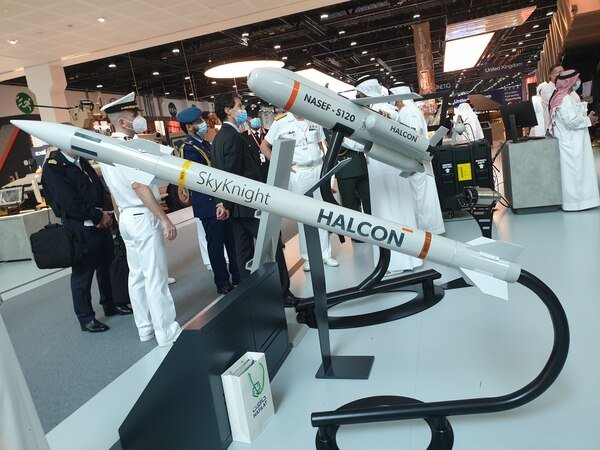
At the 2021 International Defense Expo (IDEX), Emirati defense company Halcon unveiled their radar-equipped anti-aircraft missile SkyKnight. Integrated into the German Oerlikon air defense system, made by Rheinmetall, SkyKnight is specifically designed to neutralize a whole host of airborne threats, including UAVs. As Defense News previously reported, “the counter-drone system was designed to mitigate modern threats such as rotary-wing aircraft, UAVs, rockets, artillery, mortars and other fixed-wing aircraft at a range of up to 10 kilometers.”
“The system is able to detect, track and neutralize small-sized threats,” Halcon CEO Saeed Al Mansoori told Defense News in that report. “It is not a joint venture, we are not participating in the technology; they already have air defense systems, and we already have our missile and canister…We are just integrating the systems together.”
The first such ground-based missile system to be designed and manufactured in the United Arab Emirates, SkyKnight is expected to begin field tests in 2024.
SkyKnight is a radar-equipped missile made by Emirati defense company Halcon. (Image: Defense News/Agnes Helou)
High Energy Lasers
Due to their high level of accuracy and lack of additional munitions, lasers have consistently been developed and tested against several enemy targets, including drones.
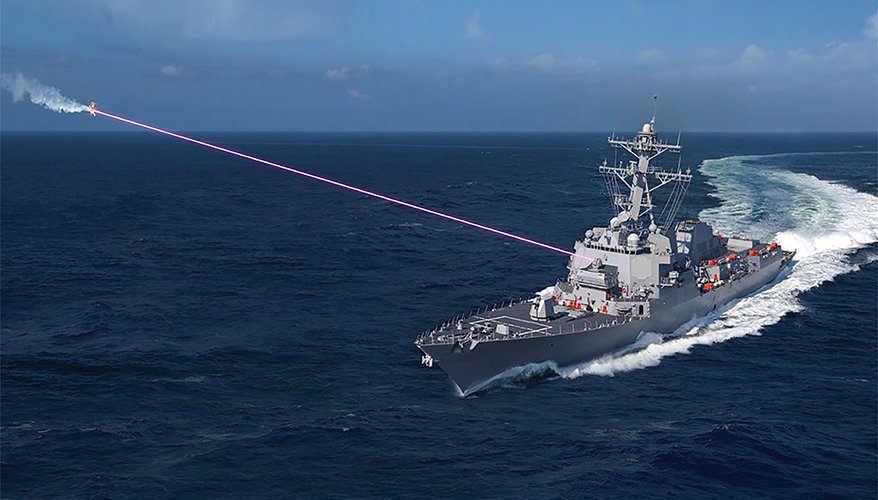
The U.S. Navy has one such system, the Lasers Weapon System (LaWS), already mounted on the USS Ponce and has recently deployed the new Optical Dazzling Interdictor, Navy (ODIN) on the USS Dewey. As The Debrief reported at the time, that system can interfere with unmanned aerial system sensors. In that same report, we noted the Navy also plans to deploy Lockheed Martin’s HELIOS system aboard the USS Preble this year.
Not to be outdone, both the U.S. Air Force and the Army are developing drone killer laser systems of their own.
For the USAF, Raytheon’s High-Energy Laser Weapon System (HELWS) is already undergoing field testing to identify and neutralize enemy drones. As Jeff Newson, the company’s director for high-energy laser systems, explained to Defense News, “Raytheon has updated the tracking algorithms and the advanced electro-optical targeting system that helps to identify the drones, with a limitless magazine. The cost per shot is what two people can pay for a cup of coffee, hence the advantages for customers who are going to target very small, cheap drones.”
The Army’s system is an even more complicated, six-layer concept, composed of the Ballistic, Low-Altitude Drone Engagement (BLADE), the Multi-Mission High-Energy Laser (MMHEL), the Next-Generation Fires Radar; Maneuver Air Defense Technology (MADT), the High-Energy Laser Tactical Vehicle Demonstrator (HEL-TVD), and the LowCost Extended Range Air Defense (LOWER AD) systems. Like the Navy and Air Force systems, this array is designed to track, attack, and neutralize airborne targets, primarily missiles and drones, using the power of various types of lasers.
An artist’s rendering of the High Energy Laser with Integrated Optical-dazzler and Surveillance (HELIOS) system at work. (Image: Lockheed Martin)
Hunter-Killer Drones
In 2017, the Air Force Research Lab unveiled a pair of airborne systems (or “spirals” in AFRL parlance) designed to counter enemy drones.
According to a report by Defense Daily, the first spiral, which is the size of a microwave oven and has already been deployed overseas for months, “is designed to precisely disrupt radiofrequency communications between a drone and its operator and push the drone away from protected areas.”
That same report notes that unlike current jamming systems that can inadvertently interfere with friendly communications, this system is more targeted.
The AFRL also unveiled a second system that is essentially a “hunter-killer” drone with a net attached. The system was tested back in 2016 at Robins Air Force Base, where it successfully captured a Phantom 3 drone in mid-flight. Both systems work on entirely different concepts but support the notion that one method for countering enemy drones is deploying drones explicitly designed for that purpose.
A hunter-killer drone with attached net, part of the unmanned aerial system solution developed by the team from Robins Air Force Base, Ga., captures a Phantom 3 drone in mid-flight during the 2016 Air Force Research Laboratory Commander’s Challenge at the Nevada National Security Site, Las Vegas. (Image: U.S. Air Force photo by Wesley Farnsworth)
AsThe Debrief reported at the time, the company brochure says, “the SMASH 2000 Plus is a sophisticated electro-optical target acquisition and tracking system designed to be attached to small-arms weapons systems. Using advanced proprietary algorithms and sophisticated image processing software, the SMASH 2000 Plus dramatically increases a shooter’s ability to hit their intended target in all-weather and lighting conditions. Based on the original SMASH 2000 system, the SMASH 2000 plus offers an additional advanced counter-unmanned aerial systems mode, giving individual ground troops an accurate hard-kill capability to counter emerging drone threats.”
The company crystalized this point further, stating, “With a unique ‘One Shot – One Hit’ capability, SMASH allows the operator to quickly and effectively neutralize any ground or airborne target, manned or unmanned.”
_
(Image Source: Smart Shooter)
Microwaves: The Power of THOR
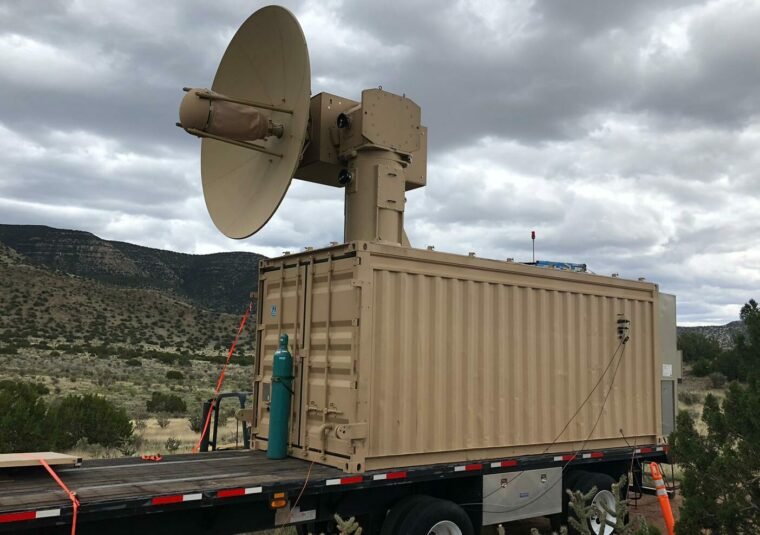
Also on the docket for testing in 2024, a weapon named after the Norse God of Thunder brings an entirely different approach to downing an attacking drone: microwaves. The Tactical High Power Operational Responder (THOR), built at Kirtland Air Force Base, offers a benefit other systems can’t. Specifically, it can spread a wide field of electromagnetic radiation to counter several targets at once.
In an interview with the Albuquerque Journal, Army Lt. General L. Neil Thurgood said, “The Army’s directed-energy capabilities will need to provide a layered defense with multiple ways to defeat incoming threats. High-energy lasers (only) kill one target at a time, and high-powered microwaves can kill groups or swarms, which is why we are pursuing a combination of both technologies.”
Working with a budget of $15 million, the Air Force Research Lab’s Directed Energy Directorate built THOR with help from Verus Research, an Albuquerque-based engineering firm, BAE Systems, and Leidos.
As far as a timeline and plans for actual deployment of this drone killer system, AFRL’s Directed Energy Directorate head Kelly Hammett told the Albuquerque Journal. “They intend to procure enough systems for a platoon unit in 2024 to do experimentation with a mix of weapons. They will put microwaves and lasers together in a single unit to assess how to deploy it all.”
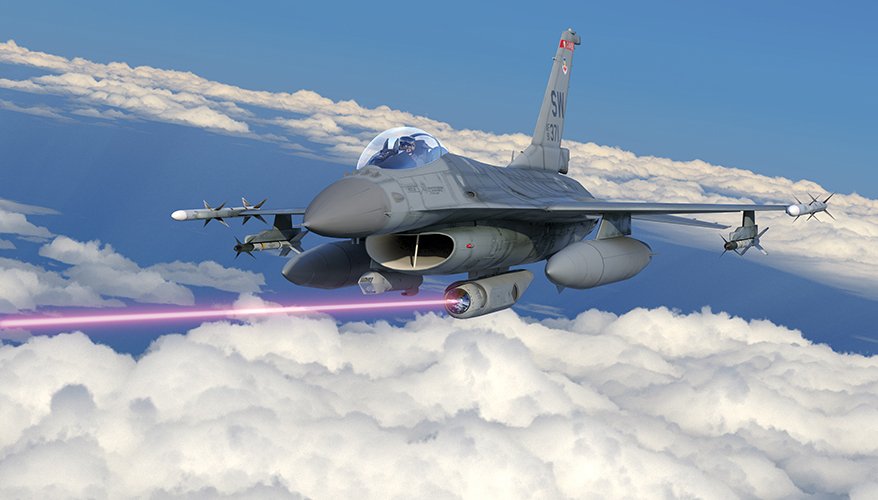
Unlike ground-based or even ship-based laser systems, lasers mounted directly on aircraft have long been a dream for military engineers. Now, Lockheed Martin is setting a 2025 timeline for reaching that goal.
“We’re committing to putting a laser pod equipped with a high-energy laser in the air within five years,” Mark Stephen, business development lead for strategic technology development at Lockheed Martin’s missiles and fire control division told National Defense Magazine back in 2020.
A crucial part of the Air Force Research Laboratory’s Self-Protect High Energy Laser Demonstrator, or SHiELD, program, Lockheed Martin indicated that the system results from many years of research and development. “The beam director is the optical system that puts the high-energy light on the target and keeps it there with enough precision to defeat the threat. We spent several years developing producible, low [size, weight, and power] and low-cost tactical beam directors in-house.”
Because the lasers are pod mounted, they are likely poor fits for Stealth aircraft like the F-22 or F-35 Joint Strike Fighter, and therefore will most likely be integrated into larger aircraft like F-15s, F-16s, or even the A-10c Warthog.
Rendering of a Lockheed Martin producible tactical airborne laser weapon. Image: Lockheed Martin
Super Laser
If tactical lasers, killer drones, and microwave jammers aren’t sci-fi enough, the Army recently posted a request for proposals for a Tactical Ultrashort Pulsed Laser.
Unlike conventional continuous wave (CW) laser systems which are mostly designed to interfere with an incoming drone or missile’s optics, the ultrashort pulsed laser (USPL) would pack enough energy into a short blast to completely disable an attacker’s electronic systems or even blow the thing out of the sky.
“USPL systems are able to neutralize threats via three distinct mechanisms,” the Army’s posting states, “ablation of material from the target, the blinding of sensors through broadband supercontinuum generation in the air, and the generation of a localized electronic interference used to overload a threat’s internal electronics.”
To accomplish this goal, the proposal indicates that the laser must operate in the incredibly powerful terawatt range (current systems only operate in the kilowatt range) and be able to fire all of that energy in a shockingly brief 200 femto-second pulse. For comparison, a terawatt is a trillion watts, as opposed to a kilowatt which is a comparatively paltry 1,000 watts, and a femto-second is essentially a quadrillionth of a second.
Packing that much power into such a short burst means this laser system will be three orders of magnitude more powerful than even the most powerful systems currently in use, and can offer an ultra-precise, ultra-potent option for forces hoping to counter the increasing threat from UAVs.
Outlook: How To Shoot Down A Drone?
Although most of the advanced weapons systems listed above are still in development, even those platforms appear only a few years away from real-world implementation. Until then, UAVs will continue to see an increase in use, as they offer a low-cost option for militaries and other military-style organizations worldwide. Fortunately for the U.S. and its allies, the growing list of “drone killers” now in development appears to offer a veritable array of tactical countermeasures to even the most sophisticated 21st century UAVs.
As Venezuelan dictator Nicolas Maduro heads to a New York court to face drug charges, the first images of a top-secret US drone sent to capture him have emerged.
Footage shared online captured a US Air Force RQ-170 Sentinel coming in for a landing at sunrise at a Puerto Rico base after the January 3 raid.
Reports suggested that at least one RQ-170 Sentinel took part in the overnight operation to arrest the Venezuelan president and his wife, who the US has said it does not recognize as the legitimate leader of the South American nation.
Although the Sentinels have reportedly been in service for the last 20 years, the Air Force has only acknowledged their existence since December 2009, when it supported missions in Afghanistan.
During the operation, the drone or drones were operating overhead in Venezuelan airspace, particularly around Caracas, though exact paths haven't been detailed due to their top-secret nature.
Unnamed government officials said the CIA quietly deployed stealth drones over Venezuela for months, using them to track President Maduro’s movements and build an intimate picture of his daily routines ahead of the operation, the New York Times reported.
While the location of the footage is unconfirmed, the airfield could be Roosevelt Roads Naval Air Station in Puerto Rico, which shuttered in 2004.
Images posted online by Air Force Southern appeared to show unit patches worn by military personnel, indicating the RQ-170 Sentinel may have been operating in Latin America since December.
The RQ-170 Sentinel has been in service in the US Air Force since around 2007, and it is believed to have been flying over Caracas during the strike on Venezuela
Military analysts suggested the RQ-170’s likely contribution was long-term, covert monitoring of Maduro’s compound.
They compared it to the weeks of silent intelligence collection that preceded the 2011 operation against Osama bin Laden, when US forces depended on continuous surveillance of a single, high-value location.
The clips captured the growl of the jet engines and blinking lights on the rear fuselage as the drone soared over the US territory.
Along with the RQ-170 Sentinels, over 150 aircraft took part in Maduro's arrest, launching from multiple bases in the region.
The drone was designed by Lockheed Martin's Skunk Works division exactly for this type of mission, providing surveillance of high-value targets inside hostile territory and support for special operations teams like Delta Force, who captured Maduro.
According to The War Zone, there are only about 20 to 30 RQ-170 drones in service, operating from bases like Creech Air Force Base in Nevada.
The 432nd Wing, headquartered at Creech AFB, is the Air Force's primary wing for remotely piloted drones and is believed to be the main operator of the RQ-170.
Creech is also less than 100 miles from the Area 51 base in Nevada, which has become notorious for its development and testing of top-secret aircraft for decades.
The unmanned aircraft is believed to have advanced sensors for mapping and tracking moving targets, infrared cameras to provide nighttime video, and high-tech intelligence tools for intercepting enemy communications.
US forces struck Fuerte Tiuna on Saturday, capturing Nicolas Maduro and his wife without suffering casualties
About 20 to 30 RQ-170 Sentinels are believed to be in use by the Air Force, providing surveillance and tracking targets during military operations
At the same time, military technology experts believe US cyberwarfare units also played a role in the attack, sending the entire target area into a blackout as the raid began.
Part of the strike appeared to have included a massive power outage around Fuerte Tiuna, Venezuela's largest military complex in Caracas.
DigitalWarfare.com's James Knight told the Daily Mail before the military operation that US cyber forces had been mapping out targets to strike digitally in Venezuela and other hostile nations for years.
That process included meticulously making sure civilian facilities, such as hospitals, did not lose power if American forces hacked into the country's electrical grid.
As Knight assessed in December, the US appeared to focus its efforts on Venezuela's military C2 networks - the communication systems for the country's troops.
US Air Force Gen. Dan 'Razin' Caine, the Chairman of the Joint Chiefs of Staff, said: 'As the force began to approach Caracas, the Joint Air Component began dismantling and disabling the air defense systems in Venezuela, employing weapons to ensure the safe passage of the helicopters into the target area.'
'The goal of our air component is, was, and always will be to protect the helicopters and the ground force and get them to the target and get them home.'
President Trump appeared to confirm that US cyber units blacked out the area during Operation Absolute Resolve, saying: 'It was dark, the lights of Caracas were largely turned off due to a certain expertise that we have, it was dark, and it was deadly.'
This is the moment deep sea explorers captured an incredibly elusive creature on camera – the giant phantom jellyfish.
Eerie footage shows the rare animal, which has only been filmed around a dozen times, gently pulsing and swirling its way through the water off the coast of Argentina.
It was captured on film by scientists at the Schmidt Ocean Institute, whose remotely operated vehicle (ROV) was on its descent to explore the Colorado-Rawson submarine canyon wall.
At 253 metres (830 feet) down, they came across the enormous ghostly jellyfish, which was first discovered in 1899.
It boasts arms that can reach more than 10 metres (33 feet) long and a main body that measures over a metre (3.3 feet) wide.
It lives anywhere from surface level to 21,900ft deep, but mostly sticks to an area called the twilight zone which is too deep for most light to reach.
In the clip, the jellyfish is lit up by the ROV's lights and appears to be swimming downwards, slowly pulsing as small fish swim around it.
Most impressive are its four long ‘mouth arms’, which scientists believe are used to grab and trap prey, trailing up above it.
Eerie footage shows the rare animal, which has only een filmed around a dozen times, gently pulsing and swirling its way through the water off the coast of Argentina
According to the scientists, giant phantom jellyfish appear to live in all oceans except for the Arctic.
It is assumed they feed on plankton and small fishes, but very little is known about how the jellyfish survives.
It has only been documented around 100 times since it was first discovered, and is thought to be one of the largest invertebrate predators in the deep sea ecosystem.
Two previous sightings of it in the Gulf of Mexico suggest the species might hunt by clinging to subsea structures.
This means its arms would be freed up to trap food, but that sort of behaviour has never been directly witnessed.
Before underwater robots were invented, experts used trawling nets to study deep sea creatures such as this species of jellyfish, known as Stygiomedusa gigantea.
However, when one is captured and brought to the surface, researchers said its silky-looking frame turns to 'gelatinous goo'.
That makes underwater robots the best way to observe the species and learn more about how it survives.
At 253 metres (830 feet) down, they came across the enormous ghostly jellyfish, which was first discovered in 1899
In the clip, the jellyfish appears to be swimming downwards, slowly pulsing as small fish swim around it
While the first specimen was collected 127 years ago, it took 60 years to recognise it as a new species.
A separate research organisation – the Monterey Bay Aquarium Research Institute (MBARI) – say their ROVs have logged ‘thousands of dives’ deep into the ocean, but have only seen the spectacular species nine times.
‘MBARI’s observations of Stygiomedusa gigantea have helped illuminate its ecological role in the ocean’s depths,’ they write on their website.
‘During an expedition to the Gulf of California, MBARI’s ROV Tiburon recorded a fish - the pelagic brotula - alongside a giant phantom jelly. Researchers watched the brotula hover above the bell of its host and swim in and out of the jelly’s voluminous oral arms.
‘The wide-open waters of the midnight zone offer little shelter, so many creatures find refuge in the gelatinous animals that are abundant in this environment.’
What is the giant phantom jellyfish?
Stygiomedusa gigantea is a type of giant deep sea jellyfish that is rarely seen but believed to be widespread throughout the world.
It is thought to be one of the largest invertebrate predators in the deep sea ecosystem.
The jellyfish has an umbrella-shaped bell that can be up to a 3.3ft (1 metre) wide.
It also has four 'paddle-like' arms up to 32ft (10m) long, which, as scientists believe may be used to trap prey because they lack stinging tentacles.
Giant Stygiomedusa have been observed and filmed off the Pacific coast of the United States by and by deepwater robots off the coast of Japan and in the Gulf of Mexico.
The reddish purple coloured creature lives anywhere from surface level to 21,900 feet, but mostly sticks to an area called the twilight zone, which is too deep for most light to reach.
It is assumed they feed on plankton and small fishes, but very little is known about how the jellyfish survives.
The Amazon rainforest is shifting into a 'hypertropical state' that has not been seen for tens of millions of years, scientists have warned.
This new, hotter climate could be commonplace by 2100, and will see the rainforest experience more frequent and intense droughts.
Worryingly, experts from the University of California, Berkeley, say this could lead to widespread tree die–off.
In turn, this will impair Earth's ability to remove carbon dioxide in the atmosphere, since tropical rainforests absorb more carbon emissions than any other biome.
The only way to prevent the hypertropical state from occurring is to curb greenhouse gas emissions, according to Jeff Chambers, lead author of the study.
'It all depends on what we do,' he said.
'It's up to us to what extent we're actually going to create this hypertropical climate.
'If we're just going to emit greenhouse gasses as much as we want, without any control, then we're going to create this hypertropical climate sooner.'
The Amazon rainforest is shifting into a 'hypertropical state' that has not been seen for tens of millions of years, scientists have warned. This new, hotter climate could be commonplace by 2100, and will see the rainforest experience more frequent and intense droughts
Usually, the dry season in the Amazon lasts from July to September and brings hotter–than–normal conditions.
However, in hypertropical conditions, the dry season is extended – putting more stress on trees.
'When these hot droughts occur, that's the climate that we associate with a hypertropical forest, because it's beyond the boundary of what we consider to be tropical forest now,' explained Professor Chambers.
Worryingly, the study found that by 2100, hot drought conditions could occur as many as 150 days each year.
In turn, this could increase tree mortality by 0.55 per cent.
'We showed that the fast–growing, low wood–density trees were more vulnerable, dying in greater numbers than high wood–density trees,' Professor Chambers said.
'That implies that secondary forests might be more vulnerable to drought–induced mortality, because secondary forests have a larger fraction of these types of trees.'
Since the annual tree mortality is slightly more than one per cent, an extra 0.55 per cent may not seem like much.
Usually, the dry season in the Amazon lasts from July to September and brings hotter–than–normal conditions. However, in hypertropical conditions, the dry season is extended – putting more stress on trees
However, Professor Chambers explained that it has a cumulative impact on the forest – meaning over time, it could be catastrophic.
What's more, the researchers say that hypertropical conditions are also likely to appear outside the Amazon in rainforests in western Africa and across Southeast Asia.
As global temperatures continue to rise, extreme droughts will increasingly occur throughout the entire year, the researchers added.
'Present–day hot droughts are harbingers of this emerging climate, providing windows of opportunity to better understand tropical forest responses to increasingly extreme future conditions,' the authors wrote.
The Paris Agreement, which was first signed in 2015, is an international agreement to control and limit climate change.
It hopes to hold the increase in the global average temperature to below 2°C (3.6ºF) 'and to pursue efforts to limit the temperature increase to 1.5°C (2.7°F)'.
It seems the more ambitious goal of restricting global warming to 1.5°C (2.7°F) may be more important than ever, according to previous research which claims 25 per cent of the world could see a significant increase in drier conditions.
The Paris Agreement on Climate Change has four main goals with regards to reducing emissions:
1) A long-term goal of keeping the increase in global average temperature to well below 2°C above pre-industrial levels
2) To aim to limit the increase to 1.5°C, since this would significantly reduce risks and the impacts of climate change
3) Governments agreed on the need for global emissions to peak as soon as possible, recognising that this will take longer for developing countries
4) To undertake rapid reductions thereafter in accordance with the best available science
Things You Only Notice In The Fifth Element The Second Time Around
Things You Only Notice In The Fifth Element The Second Time Around
Uncover hidden details, clever Easter eggs, and subtle references in The Fifth Element that even die-hard fans might have missed. Dive deeper into this sci-fi classic with fresh insights and fun facts.
Though it bombed at the box office back in 1997, "The Fifth Element" has become the ultimate sci-fi cult classic. There's a story behind that transformation, but it really comes down to the incredible amount of work that dozens of people put into making the movie a reality. Director Luc Besson set out to create one of the most imaginative and funny sci-fi films to date, and without a doubt, he succeeded.
"The Fifth Element" centers on taxi driver Korben Dallas (Bruce Willis) and resurrected perfect being Leeloo (Milla Jovovich). The unlikely couple have a chance meeting that leads them out into deep space and on a quest to save the world from a galactic-scale evil threat. In the background of their grand adventure is a deeply intriguing world filled with alien opera singers, incompetent government officials, and capitalist villains willing to sacrifice Earth for power.
Besson's film is the kind of movie that warrants multiple viewings. Plenty of its fans were kids in 1997 and are just now realizing how many details in "The Fifth Element" were just for adults. It's not all raunchy humor and political satire, though. If you haven't seen "The Fifth Element" in a while, there's plenty of good and bad to be discovered on a second viewing.
Was that Luke Perry?
Gaumont Buena Vista International
"The Fifth Element" has a truly star-studded cast. It's not every day you see people like Bruce Willis, Milla Jovovich, Ian Holm, and Gary Oldman all sharing the screen. Even the movie's smaller characters are played by excellent actors like Brion James and Tom Lister Jr. — and then of course there's Chris Tucker's character, Ruby Rhod.
The first time you watch the movie, it's easy to be so starstruck that you actually miss one or two big stars who get featured in the movie. On a second pass, though, you'll notice that even extremely minor characters are played by recognizable actors.
There's a reason, for instance, why Billy looks so familiar in the beginning of the movie. Billy is a research assistant who witnesses aliens landing on Earth in 1914. He's got a very small part to play in the movie, which is a little strange considering he's played by Luke Perry. By 1997 Perry was an established star, with seven years of "Beverly Hills 90210" and plenty of other roles under his belt. Perry is the kind of actor who regularly showed up in unexpected places, but even when he doesn't have that much to do in a movie, he brings a certain level of charm to a character.
The score is even better than you remember
Gaumont Buena Vista International
People pay plenty of attention to the visual effects in "The Fifth Element," and they should: Everything from model work to murals to prosthetics got used to make the sci-fi world of Luc Besson's imagination come to life. The visual style of "The Fifth Element" sticks with you long after you watch the film, and revisiting it down the road, you'll realize that the movie looks just as good today as it did in 1997. The visuals are so good, in fact, that they just might distract you from how incredible the movie's score really is.
The first time, it's easy to lose track of the music and get lost in the action, but watching the movie a second time makes the score really stand out. At every step of the way the music supports what's happening on screen, but there are some moments that are even more striking than the visual effects. The passage playing during Leeloo's initial escape into Korben's taxi is a particular highlight.
Of course, the biggest musical moment comes during Diva Plavalaguna's performance. Composer Eric Serra knew that creating an alien opera was a tall order, and he wrote the piece to purposely include notes beyond the reach of the human voice. Opera singer Inva Mula recorded the vocal performance, and she was actually able to sing a majority of what Serra had written. Some careful digital editing took care of the rest and perfected Plavalaguna's otherworldly song.
2263 desperately needs police reform
Gaumont Buena Vista International
At its heart, "The Fifth Element" is an adventure story. Korben's chance encounter with Leeloo sends his life spiraling in a new direction, and the two of them end up racing across deep space to save the universe from evil. The movie introduces some dazzling locations and sci-fi concepts, but it doesn't spend nearly as much time developing them as it does rushing through the plot. That's why every time you rewatch the movie, you'll notice new small details about the world — and sometimes they're a little concerning.
By the end of the movie, we don't know all that much about New York City circa 2263, but we've gotten enough details to learn that the city is a borderline dystopia. Korben's life as a taxi driver gives us a glimpse into the capitalist nightmare that seems to have taken over this version of the future, and his chase with the police lets us know that New York really needs to consider some drastic reform measures.
As Korben's taxi races past a police hover car early in the movie, we see that the NYPD of 2263 wears full metal body armor at all times, even if they're at a fast food drive-thru. When the police start to pursue Korben, it quickly becomes clear that collateral damage isn't a concern for them. They all but tear apart the city trying to get Korben, and they don't even succeed. Life as a pedestrian in this future NYC has to be a bit scary.
Leeloo speaks a real language
Gaumont Buena Vista International
When Leeloo lands in the back of Korben's taxi, she doesn't know where she is, and she definitely doesn't know how to speak English. Considering that she's just been essentially resurrected and brought into the future from thousands of years in the past, she learns how to communicate remarkably quickly. Though she picks up more and more English as the movie progresses, most of the time Leeloo speaks a language beyond anyone's comprehension.
At least, most of the people in the movie have a hard time understanding her. In reality, the language that Leeloo speaks is entirely real, and it was created by director Luc Besson just for this movie. Besson spent 15 years developing the world of "The Fifth Element," and in all that time he also spent some effort creating a dictionary for the Divine Language. Besson invented around 400 words so that Leeloo could, in theory, say everything she needs to say through the entire movie in a real language. Besson and Milla Jovovich both became so fluent in the Divine Language that they even used it to communicate with each other while filming.
Did Korben work for Zorg?
Gaumont Buena Vista International
"The Fifth Element" gets more mileage than most movies out of playing with tropes and character archetypes. The story has a traditional big evil and a chosen one destined to defeat it. Leeloo and Korben both get to play out different takes on the hero archetype, while Zorg (Gary Oldman) stands in for the movie's real villain. The movie sets up a story that's initially familiar, but it subverts the usual formula whenever it can.
One of the oddest parts about "The Fifth Element" is that the heroes and the villains never actually see each other face to face. Obviously the big space evil is a kind of amorphous entity that would probably have trouble standing on the surface of Earth, but Leeloo and Korben never even meet Zorg, the evil's human representative. They save the day without ever properly squaring off against Zorg, but that doesn't mean they have no connection to Zorg whatsoever.
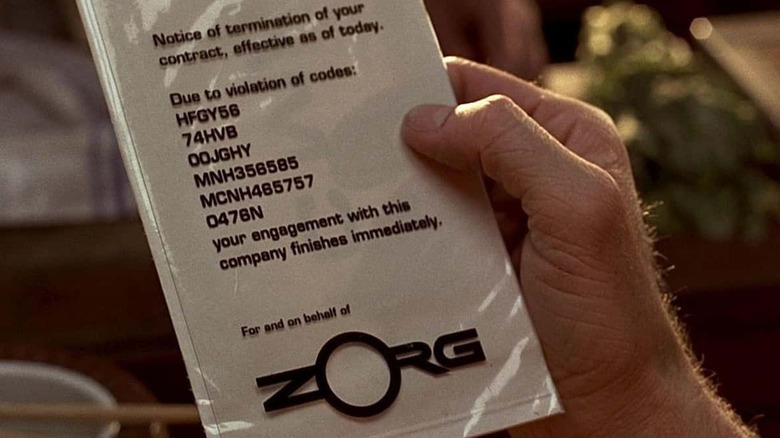
After using his taxi to escape from the police, Korben loses his job, and that's actually Zorg's first strike against our heroes. The first time they watch the movie, most people probably miss a small detail on Korben's termination notice. Zorg owns the company that fires Korben, so even though the two never directly meet, their conflict is still personal.
The future's military needs better leadership
Gaumont Buena Vista International
According to "The Fifth Element," by 2263 humanity will have spread out to the stars and made contact with alien civilizations. Earth will be filled with sprawling cities, hover cars, and the kind of technology that lets you regrow life from tissue samples. The future sounds amazing, but when you really think about the people who are in charge of the planet, you might have second thoughts about that.
Earth's military has a big role to play in "The Fifth Element." They're the ones who make first contact with the great evil that employs Zorg, and they eventually help send Korben and Leeloo on their journey to save the world. It might be fair to say all's well that ends well, but the movie shows us over and over again how incompetent the future leadership of Earth really is.
The President, played by Tom "Tiny" Lister Jr., never seems to have any idea what's really going on. He's willing to take advice from Ian Holm's Cornelius, despite having very little evidence that the priest knows what he's talking about when it comes to epic space evils. The military, on the other hand, is represented by Brion James's character General Munro. You'd want a general to have a sound tactical mind, but Korben manages to outsmart Munro, leaving him trapped in a freezer in his apartment while he escapes with Leeloo. The movie is definitely saying something about people in power, but it's also depicting a future we'd all be better off avoiding.
Even the characters are surprised by Chris Tucker
Gaumont Buena Vista International
"The Fifth Element" is filled with great performances, but Chris Tucker's appearance as Ruby Rhod is one of the most memorable parts of the entire movie. From clothing to hair, Ruby's sense of style is something that you won't forget after seeing it. Tucker brings a tremendous amount of energy to the role, transforming Ruby into an unbelievably entertaining powerhouse entertainer. Ruby immediately steals the scene, and even the characters in the movie seem to be a bit stunned by Tucker's performance.
It turns out that everyone on set probably was just as surprised by Tucker as anyone who's ever watched "The Fifth Element." Tucker told EW that when he took the part, hardly anyone knew what the role was supposed to be. "They were really protective of the script," he recalled. "They didn't let anyone know what the part was." Even Tucker himself was kept mostly in the dark. All he knew was that Prince was supposed to play the role, but he passed it up because the costumes were too outlandish. Tucker didn't know what to think, until he saw the costume for himself.
"I was kind of like 'Whoof, this is a deep, deep character,'" Tucker said, adding, "But all that stuff really helped me get into character." Get into character Tucker did, and the movie's other actors couldn't help but let their genuine reactions to Tucker's performance bleed into their own work.
Zorg might be Gary Oldman's scariest villain
Gaumont Buena Vista International
Gary Oldman is one of the greatest character actors of his generation. He's played some heroic characters, like Detective Jim Gordon in the "Dark Knight" trilogy and Sirius Black in the "Harry Potter" films, but Oldman really shines as a villain. Whether he's playing a shapeshifting vampire in "Bram Stoker's Dracula" or the crazed mayor of a post-apocalyptic town in "The Book of Eli," Oldman brings a chilling energy to all his baddies.
Amidst all the aliens and shiny scenery, it can be easy to lose track of Oldman's character Zorg in "The Fifth Element," but the second time through you'll realize how terrifying he really is. What makes Zorg so scary isn't that he's working for a terrible evil, but that communicating with his evil boss seems to shake Zorg to his very core. On the phone with the evil entity, Zorg's head spontaneously starts bleeding, and his own terror is very apparent. Despite his fear, he keeps trying to help the evil grow in power.
Oldman's performance in the movie is even more impressive if you know the context surrounding it. In an interview with Role Recall, Oldman admitted that he only took the role as a favor to Luc Besson. He didn't even read the script before agreeing to be in the movie, and it doesn't sound like he's a huge fan of the finished product. When told that "The Fifth Element" has become a cult classic, Oldman just laughed and said, "That's the wacky world we live in."
Leeloo may have inspired another sci-fi hero
Gaumont Buena Vista International
As a character, Leeloo is obviously based on "chosen one" tropes that are as old as time itself. The movie repeatedly says that she's supposed to be a perfect being. It's not just that Leeloo is destined to save the world, but also that she has some borderline magical abilities. She's an incredibly fast learner, and all but a champion fighter with little to no training whatsoever. Korben plays a central role in the story, but it's really Leeloo who's the hero of "The Fifth Element."
As much as she's based on mythological heroes from stories that came before her, Leeloo has also gone on to inspire other sci-fi heroes. Her influence can easily be seen in characters like River from "Firefly" and "Serenity," but she has a very particular similarity with another major '90s sci-fi "chosen one." In the movie Leeloo learns how to fight — and a majority of human history — by watching video feeds on a small screen. She basically downloads the knowledge into her head. Two years after the debut of "The Fifth Element," Neo learns his own fighting techniques using a very similar method in "The Matrix."
There's no replacement for practical effects
Gaumont Buena Vista International
There are plenty of '90s sci-fi movies that don't hold up visually today. CGI has come a long way in the past three decades, and movies that went all in on the technology back then are really starting to show their age. "The Fifth Element" has no shortage of special effects, but the movie still looks fantastic today because so much of what happens on screen was created practically.
Luc Besson knew that his movie was going to demand an excessive amount of visual effects. It took more than 160 people to create the 220 visual effects shots that made it into the movie, and the team filmed plenty more that didn't survive the editing room. Besson employed model makers and artists to make his world as realistic as possible. The spaceships shown in the movie are real models. So is Korben's taxi, and even some of the New York City streets that he flies it down. A second viewing gives one plenty of time to really appreciate the level of effort that went into making "The Fifth Element" as visually engaging as it is.
The movie is plagued by stereotypes
Gaumont Buena Vista International
Unfortunately, not everything that you notice about "The Fifth Element" when watching it again is good. There are plenty of things to praise about the movie, from the performances to the music to the visual effects, but decades later it also stands out for being filled to the brim with misogynist stereotypes.
There's no way around it: "The Fifth Element" does a terrible job depicting women. Leeloo is basically the only human woman on screen the entire movie, and even though she's a hardcore action hero, she still ends up falling into the damsel in distress role more than once. As badass as Leeloo may be on her own, the movie doesn't let her be a hero without the help of Korben. She's also wearing little more than some strategically placed bandages for the first third of the film.
It's the other women in the movie that get a really problematic portrayal. Korben's mother and ex-wife — heard only as voices talking to Korben over the phone — are depicted as greedy nags who won't let Korben live his life in peace. They call Korben to ask him for money or berate him for supposedly going on vacation, and the movie plays these moments for laughs as Korben rolls his eyes and desperately tries to avoid interacting with them as much as possible. Those cringe-worthy moments don't ruin the film by any means, but they may tarnish your memories of it on that second viewing.
A study has laid bare the shocking true cost of climate change as heatwaves, wildfires, droughts and storms cause havoc around the world.
The 10 most costly climate disasters alone cost the world more than $120 billion (£88.78 billion) in 2025, according to a report from Christian Aid.
Each was made significantly more likely and more devastating by the effects of human-caused climate change.
And scientists warn that these calculations only reflect insured losses, with the true cost of climate-influenced disasters likely to have been even higher.
This devastating fire alone caused more than $60 billion (£44.4 billion) in damages and killed 40 people.
This was followed by the cyclones which struck Southeast Asia, causing $25 billion (£18.5) in damage and killing more than 1,750 people across Thailand, Indonesia, Sri Lanka, Viet Nam and Malaysia.
The 10 most costly climate disasters cost the world more than $120 billion (£88.78 billion) in 2025. The most damaging were January's Los Angeles Wildfires, which caused more than $60 billion (£44.4 billion) in damages and killed 40 people
Scientists have gathered a vast amount of evidence showing a clear, incontrovertible connection between a warming climate and more intense climate disasters.
It is not that human-caused climate change creates extreme weather events, but it does make them more likely to occur and more intense when they do.
Dr Davide Faranda, Research Director in Climate Physics in the Laboratoire de Science du Climat et de l'Environnement (LSCE), who was not involved in the report, says: 'The events documented in this report are not isolated disasters or acts of nature.
'They are the predictable outcome of a warmer atmosphere and hotter oceans, driven by decades of fossil fuel emissions.'
In this report, researchers have tallied the total costs of the biggest disasters that have been intensified by the changing climate.
Even though extreme weather events in rich countries where property prices are higher typically incur greater costs, the worst-affected countries have been poorer.
Of the six most costly climate disasters in 2025, four hit Asia for a combined cost of $48 billion (£35.5 billion).
Four of the six most costly climate disasters were in Asia, including cyclones that struck Southeast Asia, causing $25 billion (£18.5) in damage and killing more than 1,750 people. Pictured: People flee flood waters in Hat Yai, Southern Thailand
China experienced some of the most severe flooding in recent history, as rising waters killed more than 30 people and created $11.7 billion (£8.6 billion) of damage. Pictured: Flood-affected areas in Congjiang, southwestern China
Since hurricanes are driven by warm ocean waters, humans' continued creation of planet-warming greenhouse gases directly contributes towards making these storms more frequent and more powerful.
But in today's climate, with 1.3°C warming, it has become four times more likely – with such an event now expected once every 1,700 years.
Professor Joanna Haigh, an atmospheric physicist from Imperial College London, who was not involved in the report, says: 'These disasters are not "natural" - they are the inevitable result of continued fossil fuel expansion and political delay.
'The world is paying an ever-higher price for a crisis we already know how to solve. While the costs run into the billions, the heaviest burden falls on communities with the least resources to recover.'
However, no inhabited continent on Earth was unaffected by climate disasters this year.
Jamaica was hit by the 'storm of the century' as Hurricane Melissa made landfall, costing at least $8 billion (£5.9 billion).
Pictured: Destroyed houses in St. Elizabeth, Jamaica
Scientists say that climate change warmed the waters over which Hurricane Melissa (pictured) formed, making the deadly storm four times as likely
Besides the 10 most destructive events, Christian Aid also analysed 10 other extreme weather incidents that have lower financial cost but are equally concerning.
Across England, Scotland, Wales, and Northern Ireland, fire crews responded to the highest number of wildfire incidents on record, with over 1,000 separate outbreaks by early September.
Early estimates suggest that more than 47,000 hectares (184 square miles) of forest, moorland, and heath were burned - the largest annual area since records began.
According to climate and wildfire researchers, the increased intensity and frequency of these blazes were a direct product of climate change.
An exceptionally wet winter followed by one of the hottest, driest springs on record led to an unusually large amount of dead, dry plant matter that fuelled the fires.
Likewise, the report points to the Iberian Wildfires, which were caused by record-breaking extreme temperatures.
Outside of the 10 most expensive events, the report also tracked a number of notable climate incidents. These included the record-breaking wildfires, which destroyed 47,000 hectares (184 square miles) of forest, moorland, and heath in the UK. Pictured: Wildfires rage in the Isle of Arran, Scotland
Spain and Portugal were also hit by the Iberian Wildfires, which were caused by record-breaking extreme temperatures. Pictured: Fires burning in Vesu, Portugal
Weeks of extreme heatwaves, with temperatures exceeding 40°C (104°F), combined with low humidity, created explosive fire conditions.
Scientists estimate that climate change made this event around 40 times more likely and increased the intensity of fire conditions by about 30 per cent.
The report also analysed Japan's year of extreme weather, after the country was battered by back-to-back snowstorms and heatwaves.
Unusually heavy snowstorms and winds killed 12 people and destroyed several houses at the start of the year, followed by the hottest summer ever recorded, with average temperatures 2.36°C (4.25°F) above the average.
Scientists call this phenomenon 'climate whiplash', and research shows that it is likely to become more common as climate change alters global weather patterns.
The most costly climate disasters in 2025
Palisades and Eaton Fires, USA: $60 billion
South & Southeast Asia Cyclones, Thailand, Indonesia, Sri Lanka, Viet Nam, Malaysia: $25 billion
Growing up, most of us learned about the five senses: sight, hearing, smell, taste, and touch.
But it's time to rewrite the science textbooks – at least if one scientist has anything to do with it.
Professor Barry Smith, Director of the Institute of Philosophy at the University of London, claims that humans don't just have five senses.
Instead, he says there are anywhere between 22 and 33 senses.
'Aristotle told us there were five senses,' he explained in an article for The Conversation.
'But he also told us the world was made up of five elements and we no longer believe that.
'And modern research is showing we may actually have dozens of senses.'
Scroll down for the full list of hidden senses – and how you can harness their powers.
Professor Barry Smith, Director of the Institute of Philosophy at the University of London, claims that humans don't just have five senses. Instead, he says there are anywhere between 22 and 33 senses (artist's impression)
Professor Smith's reasoning is that all almost everything we do is multisensory.
'What we feel affects what we see and what we see affects what we hear,' he explained.
'Different odours in shampoo can affect how you perceive the texture of hair.
'The fragrance of rose makes hair seem silkier, for instance.
'Odours in low–fat yogurts can make them feel richer and thicker on the palate without adding more emulsifiers.
'Perception of odours in the mouth, rising to the nasal passage, are modified by the viscosity of the liquids we consume.'
While the exact number of senses humans have remains unclear, Professor Smith says it could be as many as 33.
This includes proprioception (by which we know where our limbs are without looking at them) and interoception.
Interoception operates through a network of neural pathways (artist's impression), deep within the body. For this reason, the researchers have dubbed it the 'hidden sixth sense'
What is the sixth sense?
The sixth sense is known as 'interoception'.
It helps us to feel and interpret internal signals that regulate vital functions in our bodies.
This includes things like hunger, thirst, body temperature and heart rate.
Problems with interoception are linked with a range of conditions, including autoimmune disorders, chronic pain, and high blood pressure – as well as mental health issues.
Interoception is an 'understudied process', by which your nervous system continuously receives and interprets your body's physiological signals to keep vital functions running smoothly.
It helps to explain how your brain knows when to breathe, when your blood pressure drops, or when you're fighting an infection.
Professor Smith also highlights 'gustation' – the sense when we taste something.
'When we taste something we are actually experiencing a combination of three senses: touch, smell and taste – or gustation – which combine to produce the flavours we perceive in food and drinks,' he said.
'Gustation covers sensations produced by receptors on the tongue that enable us to detect salt, sweet, sour, bitter and umami (savoury). What about mint, mango, melon, strawberry, raspberry?
'We don’t have raspberry receptors on the tongue, nor is raspberry flavour some combination of sweet, sour and bitter.
'There is no taste arithmetic for fruit flavours.
'We perceive them through the combined workings of the tongue and the nose. It is smell that contributes the lion’s share to what we call tasting.'
While this might all sound a bit overwhelming, Professor Smith hopes his idea will actually bring comfort to you.
He concluded: 'There are always plenty of things around you to show how intricate your senses are, if you only pause for a moment to take it all in.
'So next time you walk outside or savour a meal, take a moment to appreciate how your senses are working together to help you feel all the sensations involved.'
A rogue robotic oceanographic instrument that drifted away from the Totten Glacier accidentally collected data on one of Antarctica’s most inaccessible regions, offering researchers an unexpected trove of new insights.
The Totten Glacier, located in eastern Antarctica, has long kept its mysteries. After two and a half years, the lost robot—an autonomous device known as an Argo ocean float—began an unplanned journey that led it beneath the Denman and Shackleton ice shelves, which had never been measured before.
With its temperature and salinity sensors, the float collected new data over a period of nine months under the ice, providing rare insight into Antarctic ice melt and sea-level rise.
The Argo float’s remarkable journey was recently documented by scientists involved in the research, who detailed the new findings at The Conversation.
Argo Floats and Ice Shelves
Reaching depths of up to two kilometers, Argo floats are essential tools for understanding the Antarctic region. These devices are free-floating robots that drift through the ocean, rising and falling, until they surface roughly every 10 days to send their data to satellites.
Ocean data is also essential for tracking global warming, as 90% of the heat increase over the last 50 years has been stored in the ocean. The difficult-to-measure regions beneath ice shelves provide some of the most critical data for calculating sea-level rise. These temperature and salinity readings, collected at five-day intervals, are the first of their kind ever collected beneath the East Antarctic ice shelf.
Ice shelves are floating glaciers that mark where Antarctica’s ice mass meets the sea, departing from the frozen continent’s solid bedrock. They prevent continental ice from entering the sea, yet remain vulnerable to warm water flowing beneath them, which melts the ice shelves.
The collapse of these ice shelves hastens sea level rise, and as such, scientists are very interested in monitoring them. Yet, one of the most critical factors, the warm water entering the ice shelves from below, is notoriously difficult to observe directly. In the past, scientists have at times relied on drilling holes and lowering sensors into them to obtain data, though this is costly and is therefore rarely done.
A Journey Through Antarctica
The Totten Glacier, which the researchers originally studied, contains enough ice to raise the global sea level by 3.5 meters if it were to melt completely. Their previous investigation of Totten suggested that sufficient warm water lay beneath the ice shelf, placing it at significant risk of rapid melting. Given the global ecosystem’s obvious concern, the team was displeased when their Argo float drifted away from its target.
Fortunately, they did not have long to wait before the Argo ran into another suitable target: the Denman glacier, capable of producing a 1.5-meter sea-level rise if completely melted. Previous analyses of radar data suggest that Denman may be unstable, but collecting corroborating oceanic data has proven challenging. The wayward Argo, however, discovered that warm water can indeed penetrate beneath the shelf.
After nine months lost beneath the ice, the team began to suspect that their Argo float may have ended beneath a glacial mass, never to transmit again. But then, most unexpectedly, there Argo emerged from beneath Denman and Shackleton, sending the researchers data from never-before-visited regions beneath the Antarctic ice.
Analyzing the Antarctic Data
One major snag for the researchers was that without the Argo float regularly surfacing, the data could not be tagged with GPS locations. Still, the team managed to overcome this hurdle in their analysis. Each time the robot approached the surface and encountered ice, it recorded an essential measurement of ice thickness at the point of contact. By collating those readings with known ice thickness measurements obtained from satellites, the team could then chart the Argo floats ‘path beneath the ice shelf.
Fortunately, the data indicates that warm water is not currently penetrating the Shackleton Ice Shelf, meaning that at least the ice in this area is relatively stable, for now. However, the discovery of warm water beneath Denman remains a serious concern, as even a slight increase in the amount of warm water there could accelerate melt, and thereby drive further instability.
Ryan Whalen covers science and technology for The Debrief. He holds an MA in History and a Master of Library and Information Science with a certificate in Data Science. He can be contacted at ryan@thedebrief.org, and follow him on Twitter @mdntwvlf.
Brits have been left baffled by a rare weather phenomenon that has turned the December skies a brilliant rose colour.
'Pink fog' occurs when sunlight passes through fine material such as dust or moisture in the air, according to meteorologists at theMet Office.
'When the sunlight comes through lots of layers, it filters out the blue and scatters it, leaving the red to come through,' said Met Office spokesman Graham Madge.
'It’s effectively a sunrise filtered through the atmosphere and through the fog, giving it that pinkish hue.'
On social media, Brits posted their snaps of the spectacular sight, which has blanketed the sky in regions across the southeast of England.
TikTok user @crazytailsuk insisted that their video clip had 'no filter' as the sky appeared as a brilliant Barbie-style shade.
One person replied to say 'it was soooo pink this morning in Hertfordshire', while another wrote: 'Sunrise pink fog…….. I would have been thrilled.'
Another TikToker joked that she was 'up in the mountains' and needed to be rescued as she walked down a residential street.
No filter: On social media, Brits posted their snaps of the spectacular sight, which depends on local conditions
'Pink fog' occurs when sunlight passes through fine material such as dust or moisture in the air, according to meteorologists at the Met Office
This shot from west London on Wednesday morning (December 17) showed the bizarre pink fog over traffic on Wednesday morning
According to Mr Madge, pink fog – effectively a sunrise filtered through the atmosphere – depends on local conditions and can be easily missed.
One January morning last year, a 'surreal' pink fog hit parts of British Columbia in Canada, according to a CBC report.
Darius Mahdavi, climate specialist and science communicator at the network, called pink fog 'an incredibly rare phenomenon'.
'Sunlight has to pass through more layers of atmosphere – or in this case, the suspended water droplets that make up the fog,' he said.
'Some of the colours, especially the blues, [then] get scattered out, leaving the reds and oranges and pinks to reach your eyes.
'But the conditions have to be just right and are near impossible to predict, so it's really a matter of being in the right place at the right time.'
At the time, one Kelowna resident said it lasted somewhere between 10 and 15 minutes, rising up into the sky then coming down before dissipating into a normal grey.
A pink fog previously covered parts of England's southwest in February 2019, including Somerset and Shropshire.
Pink fog refers to a natural atmospheric phenomenon where sunlight filtering through particles (dust, moisture) scatters blue light, leaving reds and pinks. Pictured, Dunsden, Oxfordshire this morning (December 17)
According to an expert at the Met Office, pink fog is 'effectively a sunrise filtered through the atmosphere'. Pictured, Dunsden, December 17
The beautiful natural occurrence provides a stunning - and rare - photo opportunity for early morning photographers and dog walkers. Pictured, Dunsden, December 17
Why does fog go pink?
'Pink fog' is a phenomenon that occurs when sunlight passes through layers of fog during sunrise or sunset, a Met Office spokesperson says.
Fog is essentially a cloud at ground level made up of tiny water droplets. When the sun is low on the horizon, its light travels through more of the atmosphere. Shorter wavelengths (blue and green light) are scattered out, leaving the longer red wavelengths to dominate. When this filtered light shines through fog, it gives the fog a pink or rosy hue.
Pink fog is purely an optical effect; it does not indicate any unusual weather hazard beyond normal fog risks, such as reduced visibility.
Mr Madge added that the spectacular sight would have likely been seen by a lucky few who were in the right place at the right time.
'It will depend on the local conditions, and those conditions were optimal for a few lucky people to have witnessed it,' he told the Sun at the time.
According to today's outlook from the Met Office, London and the southeast endured a 'foggy and frosty start', colder than previous mornings recently.
But freshening winds and increasing cloud cover through the morning are allowing the fog and frost to slowly clear.
There is, however, a chance of rain in the afternoon and this evening is set to be cloudy with the odd outbreak.
Rain and fog could cause flooding and travel disruption on Wednesday in parts of south Wales and south-western, central and eastern England.
The Met Office said: 'A period of rain, heavy at times, especially over high ground, will move slowly east across this region during Wednesday.
'Coming off the back of recent very wet weather, some travel disruption and flooding is likely across much of the warning area.'
The rarely-seen weather phenomenon depends on local conditions and can be easily missed. Pictured, Dunsden, December 17
According to today's outlook from the Met Office, London and the southeast endured a foggy start on Wednesday which triggered the effect
Also this week, meteorologists have confirmed that it has been unseasonably warm in Britain in the lead-up to Christmas.
In some parts of the country, temperatures have risen as high as 15°C (59°F), while conditions have rarely fallen below freezing.
Jim Dale, senior meteorologist at British Weather Services and co–author of 'Surviving Extreme Weather', told Daily Mail that the UK is currently facing an unusually energetic jet stream.
This is the system of fast–moving air flowing about five to seven miles above the ground that steers weather fronts and low–pressure systems towards the UK.
Since November, Mr Dale says that the jet stream has been 'more or less over us', causing a wave of warm, wet, and windy weather.
Weird weather and climate phenomena
Pink fog - the sky appears to go pink due to fog scattering light
Anticyclonic gloom- persistent grey, dull, and foggy conditions that make the sun disappear for days or even longer. One referred to by travel writer Bill Bryson as 'like living inside Tupperware'
Thundersnow- snowfall accompanied by thunder and lightning
Ice halo- bright rings caused by sunlight reflecting and refracting off of tiny ice crystals in the atmosphere
Sprites- large, reddish-orange electrical fleshes that occur at an altitude of around 30-55 miles up, above large thunderstorms
Diamond dust - ground-level cloud composed of tiny ice crystals
Northern lights- colourful light display caused by charged solar wind particles colliding with Earth's atmosphere
From historic homes in Edinburgh to towering skyscrapers in Shanghai, you can now explore every building in the world from the comfort of your home.
An incredible new map charts the location and size of 2.75 billion buildings in incredible 3D detail.
Dubbed the GlobalBuildingAtlas, it contains over a billion more houses than the previous biggest dataset.
And you can use it for yourself by using the interactive map below.
The GlobalBuildingAtlas was created by researchers from the Technical University of Munich (TUM) in Germany using a vast trove of satellite data.
The scientists combined nearly 800,000 satellite images captured in 2019 with an AI algorithm to predict the size of missing buildings based on the heights of the neighbours.
Lead author Professor Xiaoxiang Zhu says: '3D building information provides a much more accurate picture of urbanization and poverty than traditional 2D maps.
'With 3D models, we see not only the footprint but also the volume of each building, enabling far more precise insights into living conditions.'
An incredible new map charts the location and size of 2.75 billion buildings in incredible 3D detail. Pictured: the Forbidden City in Beijing
In London, the satellite data that was used to create the map even picks up details like the shape of bridges and boats on the Thames
To find your home on the map, or explore anywhere else in the world, all you need to do is search in the 'input address' bar at the top of the map.
The database will then reveal a 3D model of any area in the world, using data recorded by orbiting satellites.
These 3D models are exceptionally accurate in urban areas, where the researchers say the resolution is 30 times finer than comparable databases.
The researchers say that their site has received over 280,000 visits since it launched a few days ago.
This unexpected popularity far exceeds what the site was built for, so the map may be slow to load at times.
Besides being fascinating to explore, this detailed map has an important scientific function.
Creating detailed maps of the world's buildings has been extremely difficult in the past because it requires specialised satellites to scan the ground with lasers.
This makes it challenging to cover the entire globe with scans that have a high enough fidelity.
Creating detailed maps of the world's buildings has been extremely difficult in the past because it requires specialised satellites to scan the ground with lasers. Pictured: New York's towering skyscrapers
Besides being fascinating to explore, this detailed map has an important scientific function. Pictured: the exact layout of the animal enclosures inside Edinburgh Zoo
Here you can see the tall buildings of London's Canary Wharf financial district and the iconic shape of the O2 stadium
The map doesn't just record modern structures. Here you can see the layout of the different walls of the Tower of London
The European countries with the most buildings
Finland:3,967 cubic metres
Estonia:2,689 cubic metres
Sweden,2,159 cubic metres
Denmark: 1,996 cubic metres
Latvia: 1,666 cubic metres
Lithuania: 1,602 cubic metres
Belgium:1,263 cubic metres
Netherlands: 1,250 cubic metres
Ireland: 1,228 cubic metres
Austria:1,215 cubic metres
Building volume per capita
The researchers' solution was to combine laser-scanning data with artificial intelligence to fill out the gaps in the map.
The result is a detailed map of the world that can be used to study development, prepare for disasters, and plan new city developments.
According to their analysis of the dataset, Asia is home to 1.22 billion buildings, almost half of the world's total supply of buildings.
Africa follows with around 540 million buildings, coming in ahead of Europe with 403 million buildings.
North and South America have significantly fewer buildings, with 295 million and 264 million buildings respectively, while Oceania has only 14 million.
Using that data, the researchers have even created a new way of measuring social and economic development: building volume per capita.
The general idea is that the more space there is per person, the more well off that country is likely to be.
By zooming out, you can see the distribution of building volume over the whole world. Red areas show towns and cities where the concentration of buildings is highest
Asia is home to 1.22 billion buildings, almost half the world's total. This image shows the towering skyline of Shanghai's Bund district
The map doesn't only show cities, and the satellite data is sensitive enough to pick up tiny settlements like the town of Lajamanu, deep in Australia's Northern Territories
The researchers found that Finland, which is often rated as the happiest country in the world, has over six times more building volume per person than Greece and hundreds of times more than many African nations
Greece, on the other hand, which has faced decades of economic stagnation, has six times less building volume per person.
In the future, the researchers hope that this data could be used to help plan additional housing or public facilities in areas that need it most.
At the same time, the model could also be extremely useful for disaster prevention by showing which areas are the most at risk.
The German Aerospace Center, for example, is already examining how it can use the GlobalBuildingAtlas as part of its disaster support work around the world.
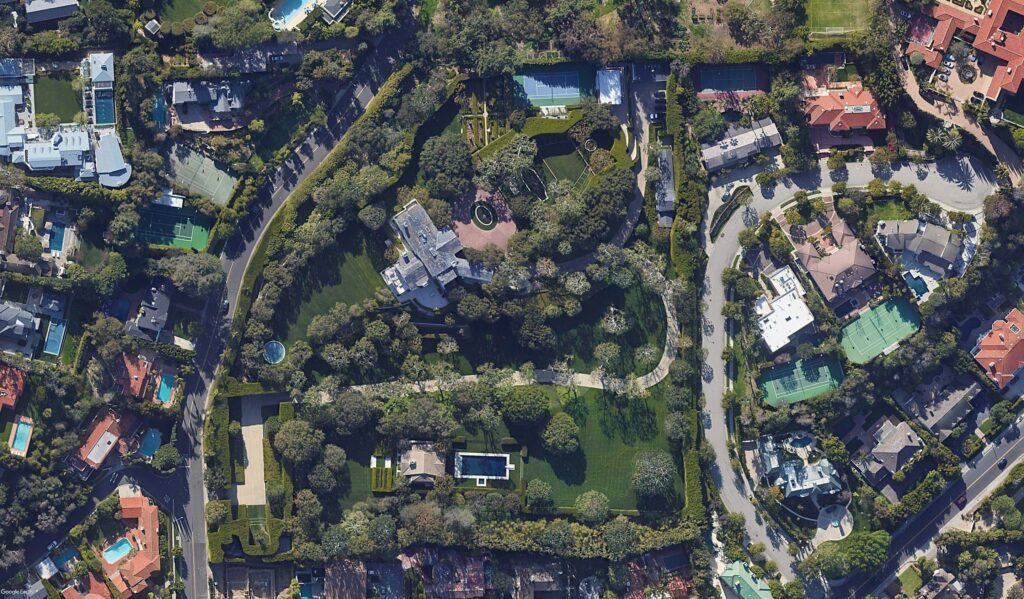
And now his $175 million Beverly Hills mega-mansion is brought vividly to life - complete with UFO-inspired structures, sea-themed pools and lush landscaping touching every part of the terrain - in these exclusive Daily Mail photos.
The completion of the mansion comes just six months after Bezos and his bride Lauren Sanchez tied the knot in Venice in what was hailed as the most jaw-dropping wedding of 2025.
The ten-acre California estate, once owned by media mogul David Geffen, has been transformed into a sprawling luxury compound, combining two neighboring properties, linked by a striking raised bridge.
Bezos bought the main mansion in 2020 in what became one of the priciest real estate transactions in Los Angeles history at a staggering $165 million price tag. He snagged the neighboring building for just $10 million.
And now, five years later, the full extent of his transformation can be revealed, marking yet another milestone in Bezos's ever-expanding real estate empire.
The historic Benedict Canyon property was originally designed in the 1930s by world-renowned architect Roland Coate for Jack L Warner, the co-founder of Warner Bros.
Regarded as one of the last true symbols of Hollywood's Golden Age, the Georgian-style three-story mansion has retained its old-world charm, including its signature Greek portico - a grand architectural nod to the temple entrances of ancient Greece.
But Bezos has stamped his own absurdist vision onto the estate, installing an aquatic-core pool adorned with painted stingrays, an octopus, a sea turtle and a whole cast of other marine creatures.
Jeff Bezos and Lauren Sanchez's $175 million historic Beverly Hills mansion is finally complete six months after their fairytale wedding and after five years of renovations - transforming into a Hollywood Golden Age oasis with an absurdist twist
Bezos's five-year transformation starkly contrasts the property's former state after he purchased it in 2020 for $165 million, one of Los Angeles' priciest real estate deals
The ten-acre estate was originally designed in the 1930s by world-renowned architect Roland Coate for Jack L Warner, the co-founder of Warner Bros, before it was bought by media mogul David Geffen and then sold to the Amazon billionaire
In a separate nod - presumably to both the 1947 Roswell incident in New Mexico and his own space venture, Blue Origin - he's added a humorous flourish: a classic UFO-style sauna with a clear plastic observation dome, planted in the middle of a cactus garden and encircled by a firepit and teak furniture.
Overlooking the aquatic-themed pool is a ginormous wraparound balcony with four separate seating areas offering sweeping views of the estate - including two spots positioned directly in front of sliding doors, presumably leading into bedrooms.
The front of the estate boasts a broad, brick-paved motor court centered around a perfectly manicured circular fountain, ringed with bright red blooms and dense greenery that creates a dramatic, garden-island effect.
It's one of the few areas that still shows signs of ongoing work, with a ring of green cones marking off a section of the herringbone brick pavement that appears to be undergoing a small patch repair.
To the left of the front of the house is the second property that appears to act as a guest house.
Connected by a paved bridge, the other side also has a large rectangular pool, a hot tub, a lush green lawn and a full-sized beach volleyball court with a firepit and seating tucked to the side.
Fitness fanatic Bezos also made sure to install three pickle ball courts on the main property with a large viewing deck so players can compete in a professional environment.
Other features include a covered banquet table that seats more than 20 people beneath a long pergola beside the pickleball courts, along with a small vegetable garden in raised beds.
While retaining its Georgian style, Bezos has added his own absurdist touch, including an aquatic pool decorated with stingrays, an octopus, a sea turtle and other marine creatures
Overlooking the aquatic pool, a massive wraparound balcony features four seating areas with sweeping estate views, including two positioned outside bedroom sliding doors
In a playful nod to the 1947 Roswell incident and his company Blue Origin, Bezos added a UFO-style sauna with a clear dome in the cactus garden, surrounded by a firepit and teak furniture
The estate's front boasts a brick motor court with a circular fountain and lush red blooms, while a small section of herringbone brickwork remains cordoned off for repairs
To the left of the front of the house is the second property that appears to act as a guest house, set with a full-sized beach volleyball court, a pool and a firepit with seating tucked to the side
On the main property, Bezos also added three pickleball courts with a large viewing deck, creating a professional style playing area on the main property
To the side of the pickleball courts is a long banquet table that appears to have a capacity of 20 seats under a long pergola
A fleet of golf carts, tucked along the long driveway behind the pickleball courts, allows the couple to easily traverse the sprawling property
To isolate the property from the outside world, Bezos made sure to keep the marital home surrounded by high-security tall hedgerows.
A fleet of golf carts will make it easy for the couple to traverse around the property and are tucked away in the long driveway the ends behind the pickle ball court.
The road to completion wasn't without setbacks. In April 2023, it emerged that work on the mega-mansion had been halted indefinitely after Bezos failed to complete a planning application for a new 'game court fence.'
He had also planned to extend the estate with a pool house, powder room and new retaining walls.
The initial permits were granted in 2021, but when Bezos submitted a revised request in January 2023 to add a 'game court fence with lighting', it was denied due to incomplete paperwork.
The original plans sought to add roughly 1,000 square feet to the 28,000-square-foot mansion. Still, within a month, construction was back underway.
The mega mansion is just one piece of Bezos's sprawling real estate empire, estimated at around $600 million, as he and Sanchez split their time between luxury properties across the country - and around the world if you consider that mega yacht.
He recently transformed his ultra-exclusive Indian Creek Island retreat in Florida's famed 'Billionaire Bunker' into a real-life Amazon, complete with a dazzling canopy of tropical trees and a multimillion-dollar landscaping overhaul.
The couple $600 million property portfolio also includes a reported $78 million mega mansion in Maui, Hawaii
Bezos's $60 million Lake Washington estate in Seattle, Washington, which was his main stronghold before he decided to relocate to the East Coast to be closer to family in 2023
Beyond his land holdings, he also boasts a $500 million superyacht, Koru, recently seen in Florida, the Caribbean and off the coast of Ibiza in August
Exclusive Daily Mail photos revealed how the tech mogul, 61, packed the grounds of his $90 million estate with towering oaks, royal palms and dense greenery, turning the property into an exotic botanical garden worthy of a rainforest.
He also owns four separate apartments inside an art-deco block on Manhattan's Upper West Side.
Three of the apartments inside the complex at 25 Central Park West were bought back in 2019 for a reported sum of $80 million.
He then shelled out $16 million this spring for a fourth unit at the height of the pandemic in 2020.
The Amazon boss also owns a Texas ranch and homes in Washington, DC and Maui.
Beyond his land holdings, he also boasts a $500 million superyacht, Koru, recently seen in Florida, the Caribbean and off Ibiza in August.
The one-of-a-kind vessel is a 417-foot, three-masted sailing yacht that was built in the Netherlands by Oceanco in 2021.
Millions of buildings and even more Americans could be at risk of sinking underwater by the end of the century.
Researchers from McGill University in Canada warned rising sea levels, resulting from continued greenhouse gas emissions, threaten to wipe out coastal cities worldwide.
Sea level rise measures the ocean's surface height over time. Level increases can cause flooding in areas that sit near or below the waterline.
Greenhouse gas emissions, such as carbon dioxide from cars and factories, trap heat in the Earth's atmosphere, making the planet warmer. Those increased temperatures melt ice caps and glaciers, and also cause ocean water to expand as it heats up.
The McGill team revealed that even in the best-case scenarios, where sea levels rise just 1.6 feet by 2100, three million buildings in the Southern Hemisphere alone would be underwater by then.
The study is the first large-scale, building-by-building assessment of how long-term sea level rise could affect coastal infrastructure across the Global South, including Africa, Southeast Asia and Central and South America.
Researchers used satellite imagery and elevation data to map how many buildings could be inundated under different scenarios, providing critical insights for urban planners and policymakers.
While the estimate didn't account for potential damage in the US, Europe and much of northern Asia, where over two billion people live, maps have provided people with the worst-case scenarios for their hometowns.
The Sea Level Submergence Explorer map revealed how 65 feet of sea level rise could impact New York in a doomsday climate scenario
Major cities, including Washington, DC, (pictured) could see historic landmarks submerged by rising sea levels over the next 75 years
The data suggested that if emissions are unchecked, sea levels could rise by as much as 65 feet in the examined timeframe.
In this doomsday climate scenario, major cities like New York, Washington, Baltimore, Miami, New Orleans, Houston, Oakland and Sacramento could be submerged within the next 75 years.
Millions would be impacted in New York City and Washington, DC
While the McGill team did not focus on Earth's Northern Hemisphere, its Sea Level Submergence Explorer map painted a grim picture for America's most famous metropolis.
New York City would see much of Manhattan, Brooklyn, Queens, Staten Island and the Bronx end up below the higher sea level.
More than 8.5 million people live and work in over a million buildings in New York, all of which could be severely impacted by a dramatic increase in flood risks.
The nation's capital, Washington, DC, would also be dramatically affected by out of control sea level rise.
The map estimated that the White House and other government buildings would be submerged if sea levels rose by 65 feet over the next century.
Professor Natalya Gomez, a study co-author from McGill University, said in a press release: 'Sea level rise is a slow, but unstoppable consequence of warming that is already impacting coastal populations and will continue for centuries.
'People often talk about sea level rising by tens of centimeters, or maybe a meter. But, in fact, it could continue to rise for many meters if we don't quickly stop burning fossil fuels.'
Even if the global emissions reduction goals of the Paris Agreement are met, researchers found sea levels would still rise by three feet and flood five million buildings in Africa, Southeast Asia and South America by 2100.
The worst case scenario from the Sea Level Submergence Explorer map warned that more than half of the state of Florida could end up underwater by 2100
The entire state of Delaware was submerged in a map showing sea level rise reaching its estimated peak of 65 feet over the next century
Florida and Delaware would be devastated
This worst-case scenario also projected that several East Coast states, including the Carolinas, Virginia, Maryland and New Jersey, would have their beachfront communities wiped off the map.
In Delaware, a small state along the Atlantic with roughly one million residents and 200,000 buildings, the damage was projected to be even worse, with almost the entire state falling below sea level.
Farther south, Florida's landmass would shrink to just a tiny fraction of what it is today. Cities like Miami, Tampa, Fort Myers, Fort Lauderdale, Boca Raton, West Palm Beach and Jacksonville would be submerged by the rising Atlantic.
Eric Galbraith, another McGill professor involved in the study, said in a statement: 'Everyone of us will be affected by climate change and sea level rise, whether we live by the ocean or not.'
In the Gulf, both New Orleans, Louisiana, and Houston, Texas, would be submerged by catastrophic sea level rise
Although the West Coast did not see as much flooding in models of sea level rise, California's capital of Sacramento along with the Bay Area were still pictured as casualties in flooding maps
The Gulf states and California would be crippled by floods
New Orleans and Houston, two major cities along the Gulf Coast, would also become submerged in this projected nightmare climate situation.
New Orleans, home to more than 360,000 people, has already been devastated by regular flooding during hurricane season.
A 2024 study published in the Hydrogeology Journal discovered that a large portion of the city sits on soft, squishy soils (peat and clay) that sink when drained or built on.
Much of this soil has already rotted after being exposed to the air or has been compacted under the weight of local buildings and roads.
Houston has also been significantly affected by flooding during hurricane season on multiple occasions - most notably during Hurricane Harvey in August 2017.
The record-breaking rainfall caused catastrophic flooding that inundated over 160,000 homes, killed 68 people and caused $125 billion in damage across southeast Texas.
On the West Coast, the Sea Level Submergence Explorer found much less damage even if sea levels rose by the map's maximum estimates.
However, California's capital, Sacramento, would be in an area devastated by climate-related floods.
The doomsday scenario showed the city of more than 500,000 people would be completely submerged.
Nearby coastal cities in the Bay Area, such and San Francisco and San Jose, would also be severely affected.
Scientists have used satellite maps to work out how many buildings would be destroyed if sea levels rise between 0.5 metres (red) and 20 metres (yellow). In the worst-case scenario, over 100 million buildings would be flooded in the global south alone
The US has been heavily impacted by both flash floods and coast flooding in recently years, particularly in areas near or below sea level. Pictured: A drone view of vehicles partially submerged in flood water following flash floods along the Concho River in San Angelo, Texas, on July 4, 2025
A separate team launched a detailed map revealing US counties most at risk of flooding, pollution, chronic illness and other factors linked to climate change
Study authors noted that this would be an extreme situation that could also take much longer to fully play out than anticipated - possibly taking until the year 2300.
However, they warned that meeting emissions goals may be the only way of slowing this potential global flooding event.
Lead study author Maya Willard-Stepan said in a press release: 'There is no escaping at least a moderate amount of sea level rise.
'The sooner coastal communities can start planning for it, the better chance they have of continuing to flourish.'
Climate change advocates think sea level rise can be prevented by using cleaner energy sources like wind or solar power, planting more trees to absorb carbon dioxide, and building sea walls to protect flood-prone areas.
Gigantic sinkholes hundreds of feet deep have been opening up throughout Turkey, mirroring a biblical prophecy.
The Book of Numbers, Chapter 6, describes the earth opening up and swallowing people as divine punishment for rebellion, a connection that some are drawing after the massive collapses in the Konya Plain, a key wheat-growing region.
Many have interpreted the growing phenomenon as a sign that 'God is on the move.'
However, scientists point to far more earthly causes. Turkey's Disaster and Emergency Management Authority has reported 648 massive sinkholes in the Konya Plain, primarily the result of severe drought and excessive groundwater pumping.
Researchers at Konya Technical University have discovered more than 20 new sinkholes in the past year alone, adding to the nearly 1,900 sites already mapped by 2021 where the ground was slowly sinking or starting to cave in.
Before 2000, only a handful of sinkholes appeared each decade, but climate change and prolonged drought are blamed for the dramatic increase over the past 25 years.
Today, dozens of enormous collapses occur annually, some more than 100 feet wide.
Falling groundwater tables are driving the problem, causing drier wells, stressed ecosystems, dwindling crops, and land subsidence. Farmers pumping more water to save sugar beet and corn crops are further exacerbating the situation.
Scientists warn that similar risks could emerge in parts of the US, Asia, the Middle East, the Mediterranean, and Australia, where declining groundwater levels threaten communities and ecosystems.
A massive sinkhole in Turkey. Researchers have discovered nearly 700 similar-sized openings in the country's Konya Plain caused by drought and groundwater pumping
Turkey Today reported that some farmers have already lost crops or had to abandon fields deemed too dangerous
According to NASA's Earth Observatory, Turkey's water reservoirs reached their lowest levels in 15 years in 2021.
The groundwater table in parts of Konya has dramatically dropped over the past few decades, according to Turkish geological studies.
The same issues are plaguing the US, with major declines seen in the Great Plains, Central Valley and Southeast.
Parts of Texas, Florida, New Mexico, and Arizona could be affected by major sinkholes if drought conditions worsen and groundwater pumping is not carefully regulated.
The US Drought Monitor noted that pockets of Washington, Oregon, Idaho, Utah, Colorado, and Wyoming have also reached this severe level of drought.
Massive sinkholes form in drought-ridden areas when farmers and cities pump massive amounts of groundwater from limestone rock layers to survive the dry years, emptying the underground caves that were once filled with water.
When that water support vanishes, the cave roofs collapse, creating huge holes that swallow farmland and roads overnight, just like in Turkey and parts of Texas, Arizona, and New Mexico.
The sinkholes in Turkey (Pictured) have opened up near many farms, which have been battling drought conditions believed to be intensified by climate change
Currently, the nation's Drought Monitor system found that the worst conditions in 2025 were found along the US-Mexico border in western Texas, measuring at 'D4' - the most severe drought rating.
Several other regions in northern Florida and southern Georgia, New Mexico, Arizona, Colorado, and Utah were all graded in December 2025 as being in severe drought (D2) or extreme drought (D3).
US officials have revealed that several areas of the Southwest are at risk of similar sinkholes as severe drought conditions worsen in the coming century
In Upton County, Texas, a massive sinkhole formed around an abandoned 1950s oil well near McCamey, measuring about 200 feet wide and 40 feet deep in March.
In southeastern Arizona's Cochise County, land subsidence (ground sinking) from groundwater pumping has led to multiple fissures and sinkholes this year.
These sinkholes have varied from 10 to 30 feet across, with local areas reportedly sinking by more than six inches per year across hundreds of acres, creating pockets of unstable ground in farming areas.
In southern New Mexico, a 30-foot-deep sinkhole opened in May 2024 near homes in Las Cruces, swallowing two cars and forcing nearby homes to evacuate.
Officials cited unstable soil from recent droughts as the key factor, though no statewide pumping cutbacks were enacted in response.
In Texas, over 100 public water systems have imposed restrictions on groundwater pumping this year, as new drought rules have limited groundwater pumping for agriculture and in cities across central Texas.
A US military transport aircraft was spotted in Japan on Thursday as tensions with China and Russia continue to escalate.
Flight tracking data shows a US Boeing C-40 Clipper stationed at Naval Air Facility Atsugi, the largest US Navy base in the Pacific, briefly departed the base at 5.21am ET before returning after just over three minutes.
Aviation observers noted the unusually short flight, sparking questions about its purpose.
The Clipper is a VIP-configured aircraft, specially designed for the secure, reliable, and comfortable transport of high-ranking military and government officials.
While it is unclear who was aboard, such flights are typically associated with urgent missions or strategic coordination.
The flight comes just a day after US strategic bombers joined a fleet of Japanese fighter jets in a joint exercise meant to showcase military cooperation around Japan's airspace.
This show of force followed Chinese and Russian bombers flying together near western Japan on Tuesday, prompting Tokyo to scramble fighter jets, though no airspace violations were reported.
Tensions between Japan, China and Russia stem from historical disputes and overlapping military interests, including Taiwan, Japan's growing defense ties with the US and territorial disputes.
A US Boeing C-40 Clipper made a short flight, just over three minutes, while in Japan
The Clipper is a VIP-configured aircraft, specially designed for the secure, reliable, and comfortable transport of high-ranking military and government officials
These issues create a complex security dynamic in which China and Russia view Japan's military resurgence as a threat.
The Tuesday incident also followed a separate threat in which Chinese military aircraft locked radar onto Japanese jets over international waters last Saturday, further straining Tokyo-Beijing relations.
According to the Japanese Joint Staff, the exercise on Wednesday was conducted 'as the security environment surrounding our country is becoming even more severe,' underscoring growing concerns about regional stability.
The Clipper is a military variant of the commercial Boeing 737-700, serving as a medium-lift transport aircraft for the US Navy.
It supports can be configured to carry up to 121 passengers, eight cargo pallets up to 40,000 pounds or a combination of both. The aircraft has a range of approximately 3,682 miles unrefueled, a top speed of about 530 mph, and is typically crewed by three flight crew members plus five to ten mission crew.
As of 2025, the US Navy operates 17 active C-40As, with squadrons like VR-57 'Conquistadors' handling Pacific operations.
Production ran from 2001 to 2019, delivering 17 units at an average cost of around $70 million each.
Flight tracking data shows a US Boeing C-40 Clipper stationed at Naval Air Facility Atsugi, the largest US Navy base in the Pacific, briefly departed the base at 5:21 a.m. ET before returning after just over three minutes
The Clipper was previously used to escort Volodymyr Zelensky to Washington in 2022.
The Ukrainian president was stashed in a US Air Force Boeing C-40 Clipper as part of the delicately planned cloak-and-dagger operation to avoid any Russian sabotage on his first foreign visit since Vladimir Putin sent troops over the border.
But now the US has deployed the jet to assist another ally.
The Japanese Joint Staff said the allies 'reaffirmed the strong resolve to prevent unilateral attempts to change the status quo by force and the readiness between the SDF and the U.S. forces.'
Two U.S. B-52 strategic bombers and three Japanese F-35 stealth fighter jets and three F-15 jets conducted their joint flight drills near Japan´s western airspace, above the waters between the country and South Korea, officials said.
The Joint Staff denied that the exercise was conducted in response to a specific incident, but acknowledged Chinese military aircraft´s recent radar-locking on Japanese jets and the China-Russia joint bomber exercises on Tuesday as examples of a worsening security environment around Japan.
Relations between Japan and China have deteriorated after Japan´s Prime Minister Sanae Takaichi said in early November that Japan's military could get involved if China were to take action against Taiwan, the self-governing island that Beijing claims as its own.
Scottish beachgoers have been left dumbfounded by a rare 'seven-legged' octopus that washed up on a local beach.
The creature, also known as septopus, was found in fragments along the Ythan estuary near Forvie National Nature Reserve, Newburgh, Aberdeenshire.
Due to its impressive size – its arms alone reach about 20 inches – researchers think the deep sea creature was a female.
Dr Lauren Smith, a marine biologist at research organisation Saltwater Life, called it 'an extraordinary find' – but how it got there is 'a bit of a mystery'.
It's possible the unfortunate specimen was attacked by hungry whales before its remains washed along the shore.
'It may have been trawl-caught and thrown back, or predated on by a whale,' she told the Daily Mail.
'Or somehow it found its way into the shallow waters and become disoriented then predated on.
'Specimens are being sent various labs and museums. It's very rare to get this species to work with so everyone is exited.'
The final missing piece of the creature to be found was the beak and the three arms (pictured) which washed onto shore last Thursday
The discovery has now been confirmed as Haliphron atlanticus, commonly known as the giant gelatinous octopus or seven-arm octopus a species typically found in waters deeper than 1,600 feet (500 metres)
Dr Smith found out about the remains when a friend sent her photos that were circulating online following the sighting by beachgoers on November 30.
The final 'missing piece' of the creature to be found was the beak and the three arms, which washed onto shore last Thursday (December 4).
'All parts and photographs will be from the same individual,' Dr Smith said.
Photos and measurements taken at the scene quickly ruled out any of Scotland’s native coastal octopus species.
It had been initially thought the remains might be of a giant squid (Architeuthis dux) – a species with a few historic records in Aberdeenshire, including Newburgh in 1998.
However, the absence of the characteristic 'toothed' suckers seen in the giant squid suggested otherwise.
Instead, it has been confirmed as Haliphron atlanticus, a species formally identified in the 19th century, also known as blob octopus or septopus.
This species is found in tropical and temperate waters worldwide, from the Azores west of Portugal, Puget Sound at Washington State and Chatham Rise, New Zealand.
Experts think the unfortunate septopus might have been attacked by hungry whales before its remains washed along the shore
It had been initially thought the remains (pictured) might be of a giant squid (Architeuthis dux) - a species with a few historic records in Aberdeenshire, including Newburgh in 1998. However, the absence of the characteristic toothed suckers seen in the Giant Squid suggested otherwise
The identification has been agreed upon by researchers in California, New Zealand and Natural History Museum London
What is the septopus?
The seven-arm octopus (Haliphron atlanticus), also known as the blob octopus and septopus, is a species of octopus found worldwide.
It lives in the ocean’s twilight zone - 660 to 3,280 feet down, where sunlight can barely penetrate.
The seven-arm octopus actually has eight arms.
As is typical of octopuses, male Haliphron atlanticus have a specialized hectocotylus arm for transferring sperm during mating.
But they tend to keep this arm tucked into a sac beneath their eye, giving the appearance of only seven arms.
Source: MBARI
Septopus is typically found in waters deeper than 1,600 feet (500 metres) – known as 'the twilight zone' due to lack of sunlight that penetrates so far down.
Males of the species are quite small, typically only reaching 8 inches (21 cm) long, but females are comparatively enormous, reaching 13 feet (4 metres).
Despite their name, the seven-arm octopus actually has eight arms like other octopuses – but there is a reason why it's known as such.
As is typical of octopuses, male Haliphron atlanticus individuals have a special modified arm (a 'hectocotylus') for transferring sperm during mating.
But the species tends to keep this arm tucked into a sac beneath their right eye, giving the appearance of only seven arms.
'Likely the first specimen was just observed to have seven arms and the name stuck,' Dr Smith told the Daily Mail.
Nevertheless, this is a 'remarkable and rarely documented' species, which has even fewer recorded appearances in northeast Scotland than the giant squid.
For now, the remains of the deep-water giant gelatinous octopus are in Dr Smith's freezer, where they will stay until 'the not too distant future', she said.
Remains of the deep-water giant gelatinous octopus (aka the blob octopus) washed ashore in Newburgh, Aberdeenshire. Arms measure about 20 inches
Following outreach to cephalopod specialists worldwide and the sharing of images on social media, the identification was confirmed as Haliphron atlanticus
They will be studied and preserved at Aberdeen University, TRACE Wildlife Forensics Network, National Museum Scotland and Natural History Museum London.
'To have a deep-water species like Haliphron atlanticus appear here is incredibly rare and offers a valuable opportunity for further study,' Dr Smith added.
'The recovered remains have been frozen down for further study, with some potentially being preserved as museum specimens.'
Dr Steve O’Shea, a marine biologist, environmentalist and world expert on cephalopod (octopus and squid), helped verify the species.
The identification has been agreed upon by researchers in California, New Zealand and Natural History Museum London.
The world's largest invertebrates
Invertebrates are animals that neither develop nor retain a vertebral column (a spine or backbone).
The largest living invertebrates (and most likely of all time) are two species of mega-squid.
Based on length, the record holder is the giant squid (Architeuthis dux) which can grow to at least 42ft 8in (13 metres).
However, most of this length is in its tentacles with the main body (mantle) reaching up to 7ft 5in (2.25 metres).
The heaviest entire specimen of giant squid on record was approximately 220 kg (485lb).
Colossal squid (Mesonychoteuthis hamiltoni), on the other hand, take the record based on weight.
They have a similar-sized mantle (up to 8ft 2in/2.5 metres) but shorter tentacles.
The biggest intact colossal squid to date measured 17ft 9in (5.4 metres).
Colossal squid are much heftier, weighing up to 495kg (1,091 lb).
Het gebruik van landbouwplastic kan een schadelijk effect hebben op het bodemleven doordat er microplastics achterblijven.
Er wordt steeds meer landbouwplastic gebruikt. Een goed voorbeeld daarvan is mulchfolie, waarmee de bodem wordt afgedekt om het gebruik van bestrijdingsmiddelen, water en meststoffen te verminderen. Inmiddels wordt er elk jaar wereldwijd genoeg mulchfolie gebruikt om heel Nederland tien keer te bedekken.
Een deel van deze plastics blijft in de bodem achter en valt dan uit elkaar in microplastics. Dit zijn deeltjes van tussen de 5 millimeter en een duizendste van een millimeter groot. Ecotoxicoloog Sam van Loon onderzocht wat de effecten van deze microplastics zijn op het bodemleven.
Methode
Voor het onderzoek voerde Van Loon experimenten uit in het laboratorium, waar hij springstaarten blootstelde aan microplastics in natuurlijke grond. Springstaarten zijn kleine zespotige insecten die in de bovenste lagen van de bodem leven. Ze voeden zich daar voornamelijk met rottend organisch materiaal en schimmels en spelen daarmee een grote rol bij de omzetting van natuurlijk materiaal.
Meerdere soorten springstaarten kregen korter of langer verschillende concentraties microplastics te verduren. Hierbij keek de onderzoeker naar de overleving en voortplanting van de dieren. Daarnaast deed hij tests met gesimuleerde ecosystemen, waarbij niet alleen springstaarten, maar ook regenwormen en planten werden blootgesteld aan microplastics.
Geen direct risico voor springstaarten, wel voor het brede bodemleven
Het onderzoek laat zien dat de microplastics niet direct giftig zijn voor sommige bodemdieren, zoals springstaarten, zelfs bij langdurige blootstelling aan hoge concentraties. De microplastics lijken echter wel schadelijk te zijn voor het bodemleven in de bredere zin.
Bij hogere concentraties zijn er effecten te zien op de zuurgraad, het waterhoudend vermogen en de dichtheid van de bodem. Van Loon en zijn medeonderzoekers zien veranderingen in de microbiële soortensamenstelling en activiteit. Ook lage concentraties hebben al schadelijke effecten op planten en er zijn verschuivingen in hoe het ecosysteem zich als geheel gedraagt.
De concentraties waarbij de onderzoekers de effecten van de microplastics op het bodemleven en de bodemeigenschappen vonden, worden momenteel al gemeten in landbouwgrond in Europa. Dit betekent dat er een risico is voor het bodemleven en daarmee voor de productiviteit van de grond. Dit risico wordt mogelijk nog beïnvloed doordat de bodem ook andere giftige stoffen kan bevatten, zoals bestrijdingsmiddelen en PFAS. In het onderzoek is namelijk vastgesteld dat de microplastics ook invloed kunnen hebben op de giftigheid van die stoffen.
Update 3 december: Wat is ‘erger?’
Dan is de volgende grote vraag: wat is er een groter probleem? Het mulchfolie wordt gebruikt bij het afdekken van de grond, waardoor minder bestrijdingsmiddelen, water en meststoffen nodig zijn. Wegen deze goede effecten dan op tegen de slechte effecten van microplastics in de bodem?
We legden dit voor aan hoofdonderzoeker Van Loon, die de vraag goed begrijpt. “De complexiteit van het vraagstuk is echter heel groot en kan helaas enkel beantwoord worden met een uitgebreid vervolgonderzoek, bijvoorbeeld in de vorm van een zogenaamde levenscyclusanalyse”, vertelt hij aan Scientias.nl. “Hiermee zouden dan alle voor en nadelen van het gebruik van pesticiden tegenover alle voor en nadelen van mulchfolie moeten worden gezet. Dit lag helaas buiten het bereik van mijn onderzoek. “
Hij benadrukt dan ook het belang van een vervolgonderzoek. “Het zou wel heel waardevol zijn om die vraag te beantwoorden en hopelijk wordt dit in de nabije toekomst ook mogelijk, naarmate we een steeds beter beeld krijgen van de effecten van het gebruik van mulchfolies.”
Alternatieven voor het gebruikte mulchfolie
Toch is er hoop. “Er zijn uiteraard alternatieven, het gebruik van mulch gebeurt volgens sommige bronnen immers al voor 2500 jaar. Toen gebruikte men bijvoorbeeld stenen, vulkanisch as of stro”, vervolgt Van Loon. “Het zou interessant kunnen zijn om de technieken van vroeger mee te nemen in zo’n levenscyclusanalyse, om te kijken hoe die opwegen tegen moderne alternatieven.”
Van Loon benadrukt ook dat dit onderzocht moet worden. Het gebruik van bijvoorbeeld stro klinkt een stuk duurzamer dan het gebruik van plastic mulchfolie, “maar stro zal tegenwoordig niet alleen duurder zijn dan een plastic mulchfolie en maar bijvoorbeeld ook minder lang te bewaren zijn.”
We schreven vaker over deze onderwerpen, lees bijvoorbeeld ook
China introduceert helikopterdrone voor extreem landschap
China introduceert helikopterdrone voor extreem landschap
China introduceert helikopterdrone voor extreem landschap
Key takeaways
De “Meyu Arrow” is een Chinese helikopterdrone die ontworpen is voor extreme omgevingen en moeilijk terrein.
Het heeft indrukwekkende capaciteiten, waaronder een vliegtijd van acht uur, een bereik van 900 kilometer en een maximaal operationeel plafond van 7.000 meter.
Deze drone vult een cruciaal gat in China’s onbemande arsenaal door de wendbaarheid van roterende vleugels te combineren met een gewapende precisieslag over extreem terrein.
China heeft zijn nieuwste onbemande luchtvaartuig onthuld, de Meyu Arrow helikopterdrone. De geavanceerde drone, ontwikkeld door Tengden Technology uit Sichuan, onderging onlangs zijn eerste live raketafvuurtest op meer dan 4.000 meter hoogte.
Bestrijding van extreme omgevingen
Volgens China Central Television (CCTV) is de Meyu Arrow ontworpen voor extreme omgevingen en moeilijk terrein. Na een succesvolle eerste raketlancering gaat de helikopter nu een nieuwe fase van testvluchten in. Tengden Technology wil de mogelijkheden verder uitbreiden en plant tests voor besturing buiten de zichtlijn op hoogtes boven 6.000 meter.
De Meyu Arrow heeft een aantal indrukwekkende technische kenmerken. Hij is 7,87 meter lang en heeft een rotordiameter van 6,4 meter, kan tot acht uur in de lucht blijven en heeft een bereik van 900 kilometer. Het operationele plafond is een indrukwekkende 7.000 meter.
Demonstratie
Tengden Technology heeft eerder de prestaties van de drone gedemonstreerd door het bereiken van een snelheid van 135 km/u op 6.500 meter en een werkelijke snelheid van 178 km/u tijdens een afdaling naar 4.500 meter. Deze tests tonen het vermogen van de helikopterdrone om de controle te behouden in moeilijke windomstandigheden en in ijle lucht.
De Meyu Arrow is ontworpen voor verkennings- en aanvalsmissies, gewapende escorte en precisiedoelen. Hij blinkt uit in bergachtige gebieden waar traditionele UAV’s met vaste vleugels beperkt zijn. Dankzij de mogelijkheden voor verticaal opstijgen en landen kan het toestel opereren vanuit krappe ruimtes. Die zijn ontoegankelijk voor bemande vliegtuigen, zoals smalle valleien of hooggelegen posities.
Nieuw schakelpunt in China’s dronecapaciteit
Deze helikopter vult een cruciaal gat in China’s onbemande arsenaal door de wendbaarheid van roterende vleugels te combineren met een bewapende precisieslag over extreem terrein. De mogelijkheid om op 6.000 meter hoogte te opereren met behulp van satellietcommunicatie zou het operationele bereik vergroten tot buiten de gezichtslijn, een eigenschap die meestal geassocieerd wordt met grotere UAV’s met vaste vleugels.
Dergelijke drones op grote hoogte zijn bijzonder nuttig voor het beveiligen van betwiste grenszones, hoogvlakten en bergcorridors. Ze krijgen daardoor een strategische rol binnen China’s defensiebeleid, vooral langs de grens met India.
Scientists have come up with an unusual way to stop the Gulf Stream collapsing and plunging Europe into another Ice Age - and it involves MELTING an ice sheet
Scientists have come up with an unusual way to stop the Gulf Stream collapsing and plunging Europe into another Ice Age - and it involves MELTING an ice sheet
The vast icy mass in the southern hemisphere contains around 750,000 cubic miles of ice – enough to fill Wembley Stadium nearly three billion times.
As it melts, the West Antarctic Ice Sheet sends salty water towards the North Atlantic, which helps the water stay dense enough to keep the crucial ocean current moving, the study authors reveal.
However, the scientists stress that in other ways the melting of the West Antarctic Ice Sheet would be a total disaster.
If the ice sheet melted, it would raise sea levels by up to 14 feet (4.3 metres) – causing flooding, fatalities, infrastructure damage and more.
The findings suggest we may have to choose between saving the Gulf Stream (which would stop Europe from entering a deep freeze) and saving the West Antarctic Ice Sheet (which would prevent global flooding).
According to study author Dr Sacha Sinet, climate scientist at Utrecht University, which terrifying scenario is worse is 'hard to tell'.
Ultimately, reducing greenhouse gas emissions might be the only way to save both the Gulf Stream and the ice sheet – and avoid both eventualities.
There are two ice sheets on Earth: the Greenland Ice Sheet in the Northern Hemisphere and the Antarctic Ice Sheet in the Southern Hemisphere (divided into east and west). According to the study's findings, melting of the West Antarctic Ice Sheet could keep the AMOC from collapsing
The Gulf Stream is only a small part of a much wider system of currents, officially called the Atlantic Meridional Overturning Circulation or AMOC.
A 'conveyor belt of the ocean', AMOC moves warm water near the ocean's surface northwards – from the tropics to the northern hemisphere.
When the warm water reaches the North Atlantic (Europe and the UK, and the US east coast), it releases the heat and then freezes.
As this ice forms, salt is left behind in the ocean water.
Due to the large amount of salt in the water, it becomes denser, sinks, and is carried southwards – back towards the tropics – in the ocean depths below.
Eventually, the water gets pulled back up towards the surface and warms up ('upwelling'), completing the cycle.
Experts think AMOC brings enough warmth to the northern hemisphere to keep temperatures there relatively mild, so if the AMOC were to slow down or collapse, large parts of Europe and the US could enter a deep freeze.
But according to the Utrecht University researchers, the West Antarctic Ice Sheet is potentially the AMOC's unlikely saviour.
The researchers used a complex computer model, CLIMBER-X to examine how the AMOC would respond to different speeds and timing of ice sheet collapse
Scientists think AMOC brings enough warmth to the northern hemisphere that without it, large parts of Europe could enter a deep freeze. This remarkable satellite picture showing the extent of snow across Britain on January 7, 2010 gives an idea of what this could be like
The world's ice sheets
Ice sheets are masses of glacial ice extending more than 19,000 square miles (50,000 square kilometers).
There are two ice sheets on Earth - the Greenland Ice Sheet and the Antarctic Ice Sheet - and together they contain about 99 per cent of the freshwater on Earth.
As the name suggests, the West Antarctic Ice Sheet is the western segment of the latter – and is more strongly affected by climate change.
Unlike its eastern counterpart, the West Antarctic Ice Sheet largely rests on the sea bed.
In other words, the West Antarctic Ice Sheet is sitting in water – and today this water is getting warmer and warmer due to global warming.
The team used a computer model called CLIMBER-X to predict what would happen if both Greenland and Antarctica started melting rapidly in the future due to continuing global warming.
CLIMBER-X simulates the response of the Earth to changes in different climate-related factors, such as changes in greenhouse gas concentrations.
Amazingly, the model revealed that the West Antarctic Ice Sheet's melting water didn't always increase the risk of an AMOC collapse.
Under some conditions, such as when its melting was rapid and began to slow down as Greenland's melt peaked, it could prevent a total collapse.
The effect happens because Antarctic meltwater changes how layers of water behave in the Southern Ocean, which eventually sends slightly saltier water toward the North Atlantic.
Over time, this helps the water stay dense enough to keep the AMOC moving, at least according to the computer model.
Previous studies have already shown that melting of the Greenland Ice Sheet destabilises the AMOC. When its meltwater pours into the North Atlantic, it can slow down or stop the sinking of dense water that helps drive it.
Amazingly, the study, published in Science Advances, seems to suggest the opposite for West Antarctic Ice Sheet.
An ice sheet is a mass of glacial land ice extending more than 50,000 square kilometers (20,000 square miles). The West Antarctic Ice Sheet is the western segment of the Antarctic Ice Sheet - and is more strongly affected by climate change
Greenland melt generally destabilises the AMOC, whereas, as we have shown, West Antarctic Ice Sheet's melt may, under certain conditions, stabilise it,' Dr Sinet told the Daily Mail.
However, if the timing is wrong, such as if the West Antarctic Ice Sheet's melt peaks too late or is too slow, its stabilising effect vanishes.
In fact, the West Antarctic Ice Sheet's meltwater could even accelerate the AMOC's tipping point.
Dr Sinet stressed that greenhouse gas emissions need to be curtailed to avoid both collapse of the AMOC and melting of the West Antarctic Ice Sheet.
But the new findings may be helpful to understand the nuances of a warming world.
'If emissions remain too high to preserve the stability of key tipping elements, then understanding whether the AMOC collapses or not becomes essential for anticipating the climate impacts that societies will need to prepare for,' he told the Daily Mail.
'The important distinction is that the Greenland effect is well established and broadly accepted, whereas the influence of West Antarctic melt remains poorly understood and lacks consensus, and will likely continue to be debated for some time.'
How does global warming affect global currents?
Scientists think melting glaciers could cause the collapse of the Atlantic Meridional Overturning Circulation or AMOC, the system of ocean currents.
Described as 'the conveyor belt of the ocean', the AMOC transports warm water near the ocean's surface northwards – from the tropics up to the northern hemisphere.
When the warm water reaches the North Atlantic (Europe and the UK, and the US east coast), it releases the heat and then freezes. As this ice forms, salt is left behind in the ocean water.
Due to the large amount of salt in the water, it becomes denser, sinks, and is carried southwards – back towards the tropics – in the depths below.
Eventually, the water gets pulled back up towards the surface and warms up in a process called upwelling, completing the cycle.
Scientists think AMOC brings enough warmth to the northern hemisphere that without it, large parts of Europe could enter a deep freeze.
Prior studies have already shown that due to climate change, the AMOC is weakening (meaning the movement of heat is slowing down)
The engine of this conveyor belt is off the coast of Greenland, where, as more ice melts from climate change, more freshwater flows into the North Atlantic and slows everything down.
Why could the AMOC collapse?
Scientists think melting glaciers could cause the collapse of the AMOC, the system of ocean currents.
Described as 'the conveyor belt of the ocean', the AMOC transports warm water near the ocean's surface northwards – from the tropics up to the northern hemisphere.
Prior studies have already shown that due to climate change, the AMOC is slowing down.
The engine of this conveyor belt is off the coast of Greenland, where, as more ice melts from climate change, more freshwater flows into the North Atlantic and slows everything down.
Mind control weapons may sound like something from a dystopian science fiction film, but experts now say they are becoming a reality.
Scientists have issued an ominous warning over mind-altering 'brain weapons' that can target your perception, memory, and even behaviour.
In a newly published book, Dr Michael Crowley and Professor Malcolm Dando, of Bradford University, argue that recent scientific advances should be a 'wake-up call'.
Professor Dando says: 'The same knowledge that helps us treat neurological disorders could be used to disrupt cognition, induce compliance, or even in the future turn people into unwitting agents.'
Nations including the US, China, Russia, and the UK have been researching so-called central nervous system (CNS)-acting weapons since the 1950s.
Now, Dr Crowley and Professor Dando argue that modern neuroscience has become so advanced that truly terrifying mind weapons could be created.
Professor Dando says: 'We are entering an era where the brain itself could become a battlefield.
'The tools to manipulate the central nervous system – to sedate, confuse, or even coerce – are becoming more precise, more accessible, and more attractive to states.'
Scientists have issued an ominous warning that developments in neuroscience could see powerful 'brain weapons' become a reality (stock image)
Just like the fictional drug 'Soma' from the science-fiction classic 'Brave New World' (pictured), scientists warn that new chemicals could be used as a powerful form of mind control
Throughout the 1950s and 1960s, most of the world's major powers 'actively sought' to develop their own mind-controlling weapons.
Their goal was to create devices that could incapacitate large numbers of people through unconsciousness, hallucination, disorientation, or sedation.
Most famously, the American military developed the compound 'BZ', which produces a powerful sense of delirium, hallucinations, and cognitive dysfunction.
The US manufactured approximately 60,000 kilograms of the potent drug and used it to create a 340-kilogram (750 lbs) cluster bomb.
Although the bomb was intended to be used in Vietnam, and BZ was tested intensively on US soldiers, there's no evidence that the weapon was ever used.
Meanwhile, the Chinese military has developed a 'narcosis-gun' designed to shoot syringes of incapacitating chemicals.
However, Dr Crowley and Professor Dando point out, the only time that a CNS-targeting weapon has ever been used in combat was by Russian security forces during the 2002 Moscow theatre siege.
After armed Chechen militants took 900 civilians hostage, security forces used a fentanyl-derived 'incapacitating chemical agent' to disable the attackers.
Since the 1950s, major world powers have been attempting to create chemical weapons that target the brain. These include the US military's BZ bomb filled with hallucination-inducing gas (right) and the Chinese 'Narcosis-gun' (right)
The only time that so-called central nervous system (CNS)-targeting weapons have been used was by the Russian security services during the 2002 Moscow theatre siege (pictured). A gas containing fentanyl derivatives was used to knock out the gunmen inside
While the chemical weapon did break the siege, the gas killed 120 of the 900 hostages and an undetermined number more to face long-term health issues and premature death.
However, since then, the mind-warping potential of these weapons has extended far beyond simply knocking out attackers or triggering hallucinations.
'That's the dual-use dilemma we face,' says Professor Dando.
For example, scientists are investigating parts of the brain's 'survival circuits', which are the neural pathways that control fear, sleep, aggression, and decision making.
Understanding how these circuits work is critical for treating neurological conditions, but also opens the door to weaponising these regions of the brain.
In fact, Dr Crowley and Professor Dando are so concerned about this possibility that they are travelling to the Hague for a key meeting of states to argue the case for urgent action.
The issue, the researchers warn, is that CNS-targeting weapons currently sit within a 'loophole' in the rules governing the use of chemical weapons.
While the gas did break the siege, it also killed 120 of the 900 hostages in the theatre and left an unknown number with life-long illnesses. Pictured: Vladimir Putin visits survivors of the theatre siege
This comes amid growing concern that future armies could be made up of cyborgs with neurological enhancements allowing them to see, hear and fight better than current soldiers
The Chemical Weapons Convention prohibits the use of harmful chemicals in war, but there is a grey area allowing the use of some chemicals in certain circumstances, such as law enforcement.
That leaves a potential legal justification for the development and use of powerful mind-control weapons within the current scope of the law.
Professor Dando says: 'There are dangerous regulatory gaps within and between these treaties. Unless they are closed, we fear certain States may be emboldened to exploit them in dedicated CNS and broader incapacitating agent weapons programmes.
'We must act now to protect the integrity of science and the sanctity of the human mind.'
Rumours of governments experimenting with pyscho-electronic weapons have long abounded among conspiracy theorists.
Also known as pscyhotronic or mind-control weapons, it is claimed they use electromagnetic forces to achieve a variety of results.
This includes mind-reading and mind control, as well as torture and harassment.
The basis for these claims does have some origin in fact.
In 1953, the then director of Central Intelligence officially approved project MKUltra.
It was intended to help the US government keep up with experiments they believed the Soviets were conducting during the Cold War.
They hoped to achieve this aim through 'the use of biological and chemical materials in altering human behavior,' CIA director Stansfield Turner testified in 1977.
Footage has since emerged of experiments conducted into the potential of weaponising LSD as a method of controlling or subduing enemy forces.
Since that time, conspiracy theorists have expanded their claims about the kinds of techniques agencies like the CIA or others may have experimented with.
Some individuals say they have been targeted with pscyhotronic weapons, leading to a variety of unpleasant side effects.
That includes transmitting thoughts and sounds into people's minds, although most medical professionals agree this is likely the result of psychiatric disorders.
Beste bezoeker, Heb je zelf al ooit een vreemde waarneming gedaan, laat dit dan even weten via email aan Frederick Delaere opwww.ufomeldpunt.be. Deze onderzoekers behandelen jouw melding in volledige anonimiteit en met alle respect voor jouw privacy. Ze zijn kritisch, objectief maar open minded aangelegd en zullen jou steeds een verklaring geven voor jouw waarneming! DUS AARZEL NIET, ALS JE EEN ANTWOORD OP JOUW VRAGEN WENST, CONTACTEER FREDERICK. BIJ VOORBAAT DANK...
Druk op onderstaande knop om je bestand , jouw artikel naar mij te verzenden. INDIEN HET DE MOEITE WAARD IS, PLAATS IK HET OP DE BLOG ONDER DIVERSEN MET JOUW NAAM...
Druk op onderstaande knop om een berichtje achter te laten in mijn gastenboek
Alvast bedankt voor al jouw bezoekjes en jouw reacties. Nog een prettige dag verder!!!
Over mijzelf
Ik ben Pieter, en gebruik soms ook wel de schuilnaam Peter2011.
Ik ben een man en woon in Linter (België) en mijn beroep is Ik ben op rust..
Ik ben geboren op 18/10/1950 en ben nu dus 75 jaar jong.
Mijn hobby's zijn: Ufologie en andere esoterische onderwerpen.
Op deze blog vind je onder artikels, werk van mezelf. Mijn dank gaat ook naar André, Ingrid, Oliver, Paul, Vincent, Georges Filer en MUFON voor de bijdragen voor de verschillende categorieën...
Veel leesplezier en geef je mening over deze blog.