The purpose of this blog is the creation of an open, international, independent and free forum, where every UFO-researcher can publish the results of his/her research. The languagues, used for this blog, are Dutch, English and French.You can find the articles of a collegue by selecting his category. Each author stays resposable for the continue of his articles. As blogmaster I have the right to refuse an addition or an article, when it attacks other collegues or UFO-groupes.
Druk op onderstaande knop om te reageren in mijn forum
Zoeken in blog
Deze blog is opgedragen aan mijn overleden echtgenote Lucienne.
In 2012 verloor ze haar moedige strijd tegen kanker!
In 2011 startte ik deze blog, omdat ik niet mocht stoppen met mijn UFO-onderzoek.
BEDANKT!!!
Een interessant adres?
UFO'S of UAP'S, ASTRONOMIE, RUIMTEVAART, ARCHEOLOGIE, OUDHEIDKUNDE, SF-SNUFJES EN ANDERE ESOTERISCHE WETENSCHAPPEN - DE ALLERLAATSTE NIEUWTJES
UFO's of UAP'S in België en de rest van de wereld Ontdek de Fascinerende Wereld van UFO's en UAP's: Jouw Bron voor Onthullende Informatie!
Ben jij ook gefascineerd door het onbekende? Wil je meer weten over UFO's en UAP's, niet alleen in België, maar over de hele wereld? Dan ben je op de juiste plek!
België: Het Kloppend Hart van UFO-onderzoek
In België is BUFON (Belgisch UFO-Netwerk) dé autoriteit op het gebied van UFO-onderzoek. Voor betrouwbare en objectieve informatie over deze intrigerende fenomenen, bezoek je zeker onze Facebook-pagina en deze blog. Maar dat is nog niet alles! Ontdek ook het Belgisch UFO-meldpunt en Caelestia, twee organisaties die diepgaand onderzoek verrichten, al zijn ze soms kritisch of sceptisch.
Nederland: Een Schat aan Informatie
Voor onze Nederlandse buren is er de schitterende website www.ufowijzer.nl, beheerd door Paul Harmans. Deze site biedt een schat aan informatie en artikelen die je niet wilt missen!
Internationaal: MUFON - De Wereldwijde Autoriteit
Neem ook een kijkje bij MUFON (Mutual UFO Network Inc.), een gerenommeerde Amerikaanse UFO-vereniging met afdelingen in de VS en wereldwijd. MUFON is toegewijd aan de wetenschappelijke en analytische studie van het UFO-fenomeen, en hun maandelijkse tijdschrift, The MUFON UFO-Journal, is een must-read voor elke UFO-enthousiasteling. Bezoek hun website op www.mufon.com voor meer informatie.
Samenwerking en Toekomstvisie
Sinds 1 februari 2020 is Pieter niet alleen ex-president van BUFON, maar ook de voormalige nationale directeur van MUFON in Vlaanderen en Nederland. Dit creëert een sterke samenwerking met de Franse MUFON Reseau MUFON/EUROP, wat ons in staat stelt om nog meer waardevolle inzichten te delen.
Let op: Nepprofielen en Nieuwe Groeperingen
Pas op voor een nieuwe groepering die zich ook BUFON noemt, maar geen enkele connectie heeft met onze gevestigde organisatie. Hoewel zij de naam geregistreerd hebben, kunnen ze het rijke verleden en de expertise van onze groep niet evenaren. We wensen hen veel succes, maar we blijven de autoriteit in UFO-onderzoek!
Blijf Op De Hoogte!
Wil jij de laatste nieuwtjes over UFO's, ruimtevaart, archeologie, en meer? Volg ons dan en duik samen met ons in de fascinerende wereld van het onbekende! Sluit je aan bij de gemeenschap van nieuwsgierige geesten die net als jij verlangen naar antwoorden en avonturen in de sterren!
Heb je vragen of wil je meer weten? Aarzel dan niet om contact met ons op te nemen! Samen ontrafelen we het mysterie van de lucht en daarbuiten.
12-12-2025
Declassified: Proof of Extraterrestrial Contact in Official U.S. Files
Declassified: Proof of Extraterrestrial Contact in Official U.S. Files
Overview
A recent YouTube video titled "Declassified: Proof of Extraterrestrial Contact in Official U.S. Files" has reignited public debate over the existence of extraterrestrial life, asserting that declassified U.S. government documents provide compelling evidence of contact with non-human intelligences. The video, which is being widely shared within disclosure communities, examines government records, whistleblower testimonies, and historic UFO encounters, urging viewers to engage directly with the primary sources rather than relying solely on mainstream media interpretations.
Government Documentation and Official Acknowledgement
The video argues that thousands of pages of government-generated documents are now publicly accessible, many of which were released following lawsuits, Freedom of Information Act (FOIA) requests, or through internal leaks. These documents reportedly originate from a wide range of U.S. agencies, including the Navy, Department of Defense, CIA, NSA, FBI, Congress, and NASA. According to the video, “These aren’t fringe sources… They come from the US Navy, the Department of Defense, the CIA, the NSA, the FBI, Congress, NASA Archives, and sworn testimony from military and intelligence officials.”
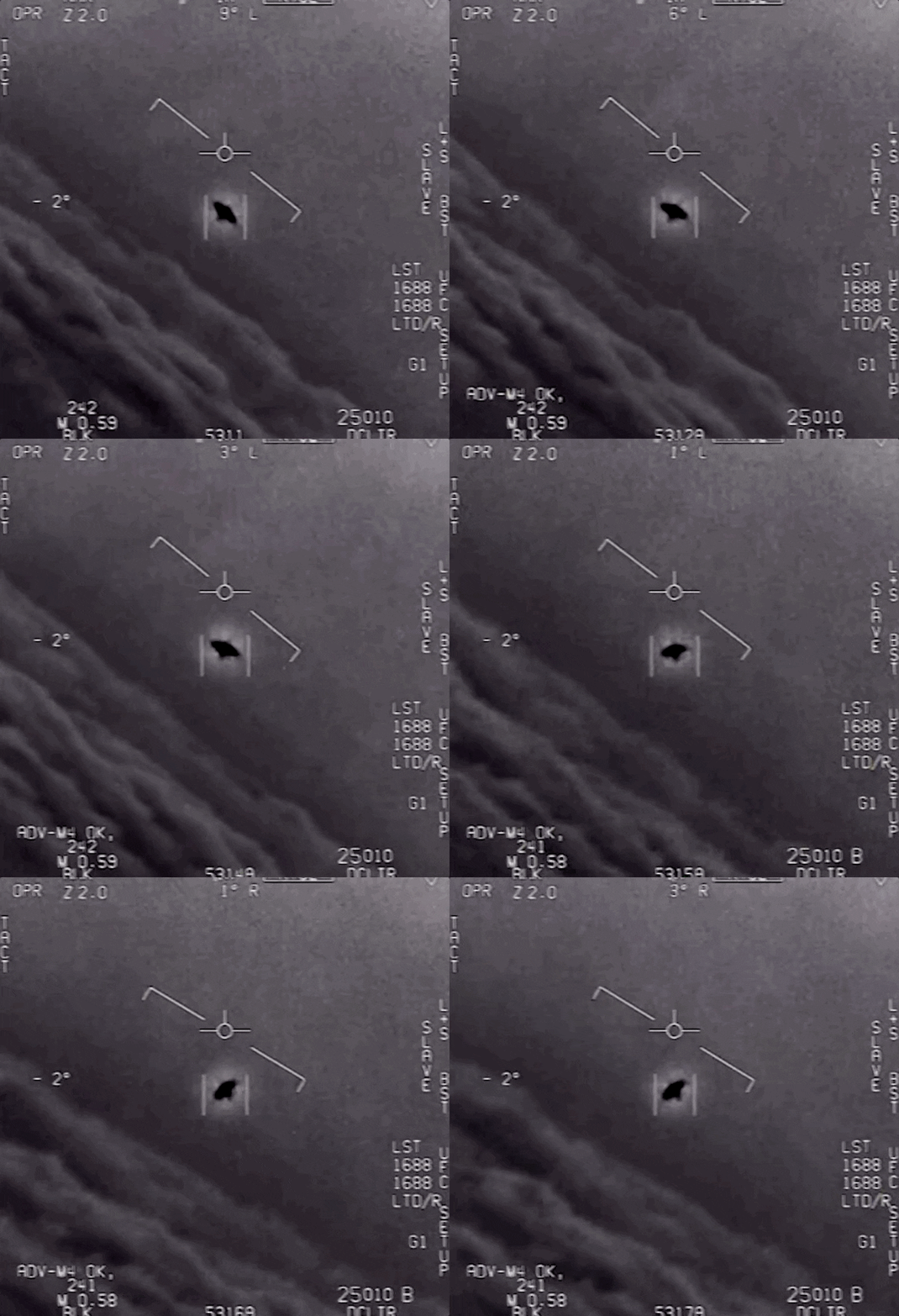
Among the most well-known official releases are the three Pentagon-authenticated infrared videos—known as Gimbal, Go Fast, and FLIR1 (or Tic Tac)—which depict unidentified aerial vehicles performing maneuvers that defy explanation by conventional technology. The video notes that these objects “have no wings, no exhaust, no heat signature, rotating midair, accelerating instantly, and outperforming every known aircraft on Earth.” Testimony from military pilots and radar operators has been presented to Congress, further corroborating these encounters.
Whistleblower Testimonies and Internal Reports
The video highlights the role of whistleblowers in advancing public understanding of UAP (Unidentified Aerial Phenomena). One prominent example is David Grusch, an intelligence officer whose inspector general-verified complaint alleged the existence of multiple crash retrieval programs involving “nonhuman craft and materials.” Congressional hearings confirmed Grusch’s credibility, and his allegations were deemed “urgent and credible” by the inspector general.
Another significant reference is to the Wilson Davis documents, which describe a high-ranking Navy admiral’s failed attempt to access a reverse engineering program run by private aerospace contractors. These documents, according to the video, reference “craft of unknown origin stored in private facilities beyond congressional oversight.”
Broader Historical Context and Media Critique
The video asserts that mainstream media has traditionally dismissed or ridiculed claims of extraterrestrial contact, contributing to a culture of skepticism and ignorance. It suggests that information has been deliberately controlled and that individuals are conditioned “not to look.” The presenter encourages viewers to develop discernment by directly consulting declassified files, comparing sources, and listening to a range of testimonies, while remaining aware of potential misinformation.
The historic Project Blue Book is cited as a prime example of official investigation, with over 12,000 documented UFO cases—hundreds of which remain unexplained. NASA, the NSA, and other agencies have also released records describing objects entering and leaving Earth’s atmosphere in ways inconsistent with known natural or man-made phenomena.
The Path Forward and Ongoing Debate
While the video is critical of media gatekeeping and government secrecy, it acknowledges the complexity of the issue and the need for public discernment. It references well-known disclosure advocates such as Dan Willis, Alex Collier, and Elena Denan, whose testimonies, the video claims, align with details in official documents and challenge sanitized disclosure narratives.
As the debate over UAPs and extraterrestrial contact continues, the video calls for greater transparency, personal engagement with primary sources, and a willingness to question established narratives. Whether or not the released documents constitute definitive “proof” remains a matter of public and scholarly debate, but the growing availability of official records and whistleblower accounts suggests that the conversation around extraterrestrial contact is far from over.
For months now, astronomers have been closely watching the mysterious interstellar object 3I/ATLAS as it rips through the solar system at a breakneck velocity.
And before it finally leaves us for good, the object — which is broadly believed to be a comet, in spite of other theories that we’ll get to in a minute — is expected to make its closest approach to Earth in just over a week from now, coming within just 167 million miles. While that’s still roughly 1.5 times the distance from the Earth to the Sun, nearby spacecraft are already making the most out of the opportunity.
NASA’s Hubble Space Telescope captured images of the unusual visitor on November 30 when it was just 178 million miles away, follow-up observations after the telescope spotted the object back in July. Using its Wide Field Camera 3 instrument, Hubble revealed 3I/ATLAS’ coma, the fuzzy atmosphere of ice and dust surrounding its nucleus, in the form of an ominous blue glow.
“3I/ATLAS will pass closest to Earth on December 19, 2025,” explained Harvard astronomer Avi Loeb, who has long championed the far-fetched theory that the object may be an alien spacecraft, on his blog. “Fortunately, this date coincides with a new Moon when the view of the sky will not be contaminated by moonlight, making it an ideal observing night for Earth-based telescopes.”
“My hope,” he added, “is that we will gain new insights into the nature of 3I/ATLAS at that time thanks to data from hundreds of observatories, including the Hubble and Webb space telescopes.”
Even after its closest pass to Earth, astronomers will continue observing the unusual visitor.
“Observations are expected to continue for several more months as 3I/ATLAS heads out of the solar system,” NASA noted on its website.
Separate observations by the European Space Agency’s Jupiter Icy Moons Explorer (JUICE) spacecraft last month also revealed surprising amounts of activity as it was being heated up by the Sun, losing mass in the form of sublimating ices.
ESA scientists are expecting most of the data collected by its spacecraft’s scientific instruments to arrive in late February.
Besides making its closest approach to Earth, 3I/ATLAS is also expected to pass by Jupiter in the spring of next year, yet another tantalizing opportunity to examine only the third interstellar object cruising through our solar system ever to be identified in history using NASA’s Asteroid Terrestrial-impact Last Alert System (ATLAS), a network of ground-based telescopes.
Another intriguing theory: that objects like 3I/ATLAS may have once brought life to Earth billions of years ago, a theory known as “panspermia.”
Recent observations by the Atacama Large Millimeter/submillimeter Array (ALMA) in Chile found significant amounts of both gaseous methanol and hydrogen cyanide, important precursors for the formation of life.
Scientists also suggest it may have come from a different planetary system that’s much older than our own, a tantalizing possibility that “gives me goosebumps to think about, frankly,” as NASA lead scientist for solar system small bodies Tom Statler told reporters during a briefing last month.
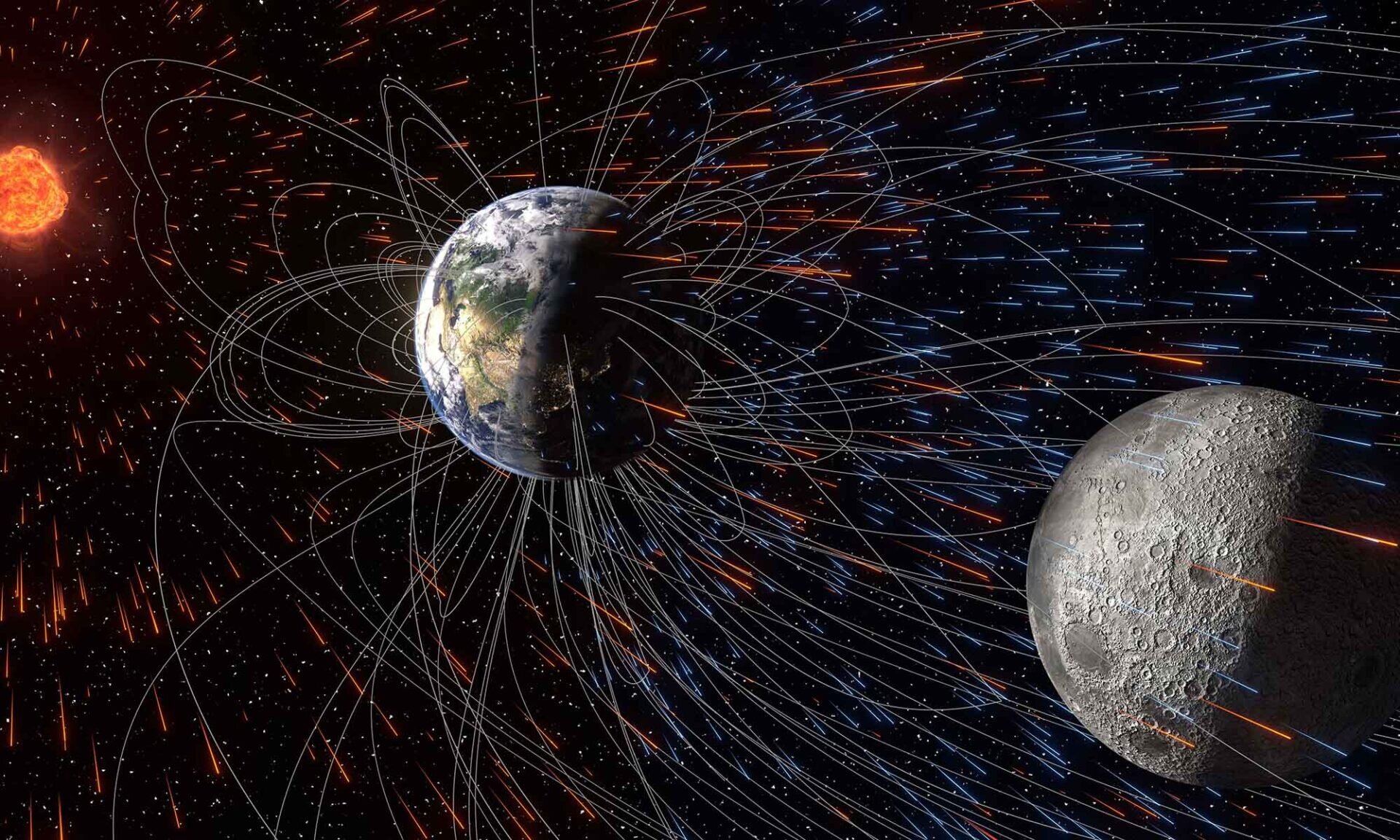
For billions of years since the formation of Earth and the Moon, solar radiation and our planet’s magnetic field have been driving a complex and invisible process. Parts of Earth’s atmosphere are transported to our moon and remain in its soil.
Earth’s atmosphere and magnetic field. Source: phys.org
Transfer of Earth particles to the Moon
The surface of the Moon may not be just a barren, inhospitable place. Over billions of years, tiny particles from Earth’s atmosphere have settled on the lunar soil, creating a potential source of substances necessary for the survival of future astronauts. But it is only recently that scientists have begun to understand how these particles make their long journey from Earth to the Moon and how long this process takes.
New research from the University of Rochester, published in the journal Communications Earth & Environment, shows that Earth’s magnetic field may actually help guide atmospheric particles carried by the solar wind into space, rather than blocking them. Since Earth’s magnetic field has existed for billions of years, this process could have gradually moved particles from Earth to the Moon over a long period of time.
“By combining data on particles preserved in lunar soil with computer simulations of the interaction of solar wind with Earth’s atmosphere, we can trace the history of Earth’s atmosphere and its magnetic field,” says Eric Blackman, professor of physics and astronomy at the University of Rochester.
Research findings indicate that lunar soil may not only contain long-term data about Earth’s atmosphere, but may also be even more valuable than scientists had thought for future space explorers who will live and work on the Moon.
Hints on the lunar soil
Soil brought back to Earth by the Apollo missions in the 1970s provided scientists with important clues. Studies of these samples show that the dusty surface of the Moon, called regolith, contains volatile substances such as water, carbon dioxide, helium, argon, and nitrogen. Some of these volatiles came from the constant stream of charged particles from the Sun, known as the solar wind. But their abundance, especially nitrogen, is too great to be explained by the solar wind alone.
In 2005, a group of scientists led by researchers from the University of Tokyo hypothesized that some of the volatile substances could have come from Earth’s atmosphere. They argued that this could only have happened at a time when the Earth did not yet have a magnetic field, since, in their opinion, the magnetic field would have prevented atmospheric particles from escaping into space.
But researchers at the University of Rochester have discovered that this process may work differently.
Role of the magnetic field in particle transport to the Moon
The URochester team includes Shubhonkar Paramanick, a graduate student in the Department of Physics and Astronomy and a Horton Fellow at LLE; John Tarduno, the William R. Kenan, Jr. Professor of Earth and Environmental Sciences; and Jonathan Carroll-Nellenback, a computational scientist at the Center for Integrated Research and Computational Technologies and an associate professor in the Department of Physics and Astronomy, used advanced computer simulations to model how and when regolith could have acquired the elements found in the Apollo samples.
The researchers tested two scenarios. One modeled the “early Earth” without a magnetic field and under the influence of a stronger solar wind. The other modeled the “modern Earth” with its strong magnetic field and weaker solar wind. The simulation showed that particle transport works best in the modern Earth scenario.
In this case, charged particles from Earth’s atmosphere are knocked out by solar wind and directed along Earth’s magnetic field lines. Some of these lines extend so far into space that they reach the Moon. Over billions of years, this funnel effect has caused small amounts of Earth’s atmosphere to settle on the Moon.
Preserving the past and supporting the future
The long-term exchange of particles means that the Moon can store chemical data about Earth’s atmosphere. Therefore, studying lunar soil can give scientists a rare opportunity to learn how the climate, oceans, and even life on Earth have evolved over billions of years.
The long-term, continuous transport of particles also indicates that lunar soil contains more volatile substances than previously thought. Elements such as water and nitrogen could enable humans to stay on the Moon for longer periods, reducing the need to transport supplies from Earth and making lunar exploration more feasible.
All of the panelists presented a range of UAP related topics, from the history of scientists who studied UAPs, the possible physics behind craft like the increasingly infamous 2004 USS Nimitz Tic Tac incident, and the increasing number of near misses and up-close encounters being reported by military and civilian pilots alike.
Many recurring themes emerged throughout the nearly five-hour session, so here are The Debrief’s top 5 takeaways from this conference.
(Image Credit: The Debrief)
1. UAPs are real, and a legitimate safety issue
Few aspects of the session stood out more than the six speakers and nearly 100 member engineers watching the session live treating the subject with a serious, scientific tone. The host set that tone early with his statements on professional conduct, but that warning proved more or less unnecessary, with almost no talk of little green men or extraterrestrial visitors making its way into the lengthy session.
At one point, a particularly “seasoned” member, who had a highly distracting slide show of blimps and chemical formulas (among other random images) racing across the virtual wall behind him, jumped in to exclaim with glee that the whole subject is indeed a mystery and that the only thing we know for sure is, “it isn’t little green men who traveled here on faster than light spaceships!” His comment was met with complete silence and more than a few frowns.
Instead, a dry, shockingly mundane series of talks on the subject of aviation safety took place, with no scheduled speaker or attendee (minus the one, cause there’s always one) going out of their way to ridicule or minimize the reality of the safety issue facing commercial and military pilots worldwide, regardless of its origin.
“I think the biggest takeaway here,” said former US Navy pilot Ryan Graves, who repeatedly noted the real-life issue of potential mid-air collisions his former pilot colleagues still face every day, “we’re gonna just read right off the DNI report, is that some UAP appear to be real objects.”
( Image Credit: The Debrief)
2. The Stigma around this subject still exists, but that is starting to change
At one point or another, every speaker mentioned the stigma preventing respected scientists from studying this topic. Many noted how over half a century of study opportunities had been lost due to this issue alone.
At least one attendee wrote in the side chat that the simple existence of this session was undeniable proof of a shrinking stigma.
Similarly, numerous other panelists and attendees pointed to the work of NASA and ESA employed astrobiologists and astronomers who are planning to use the space observation platforms of the future, including NASA’s James Webb Space Telescope, which is scheduled for launch in November of this year, to look for biosignatures and technosignatures, both signs of extraterrestrial life.
While this type of discussion mainly occurred during the informal Q & A portions of the session, such frank and open comments about the shifting attitudes of mainstream scientists toward the possibility of extraterrestrial life seemed to at least hint that the bulk of those in attendance was generally open to all possible origins of UAP, while also remaining more concerned about the fundamental issue of human safety in our skies.
3. Without more (and better) data, there can be no progress
Since the release of the DoDs UAPTF report, the call for better data has never been more vital. Or, as Sir Arthur Conan Doyle’s super sleuth Sherlock Holmes once declared, “Data! Data! Data! I can’t make bricks without clay!”
This point and sentiment was repeatedly emphasized throughout the AIAA’s UAP safety session, with every scientist and presenter practically begging for more data to analyze.
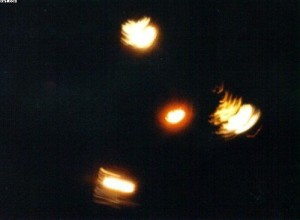
However, legitimate and honest ‘Ufology’ has always been shadowed by grifters and the gullible, so data quality is always a murky and tenuous situation. Moreover, UFO research has always been a bit of a middle school turf war. The dark side of this particular issue was on full display when University of Albany’s Dr. Kevin Knuth showed a slide of a “potential UFO” taken in 1985 by Ray Stanford.
Stanford has been a fixture in the UFO research community since the 1970s. An accomplished amateur paleontologist, he has also attempted to communicate with aliens and UFOs, and he has claimed to have psychic abilities.
In an email to The Debrief, researcher Douglas Johnson, who worked with Stanford on various UFO-related projects decades ago, pointed out that the video imagery by Stanford has never been independently vetted.
“What is lacking [is an] examination of negatives or direct-prints (and cameras and lenses) by technically competent persons with the appropriate backgrounds and equipment, who are truly independent of Ray Stanford, and persons with expertise in such fields as artifacts produced by shooting pictures through birefringent airplane windows,” Johnson explained via email.
Knuth himself noted the photo’s provenance issue, telling session attendees, “I want to be clear that that imagery here has not been independently vetted. So we’ve not taken that to be authenticated. And so, I want to be clear and honest about that.”
“The presentation contained much of value,” Johnson wrote in a follow-up email. “However, in my view, it was a serious error in judgment for Professor Knuth to include the images from a Super 8 movie from Ray Stanford. The disclaimers (“Imagery Not Independently Vetted,” etc.) didn’t really mitigate this, since Professor Knuth proceeded to discuss the Stanford images as examples of exotic [UAP] effects.”
“In my presentation for AIAA, despite the fact that some in the UFO community find Stanford to be controversial, I decided to include Stanford’s image of a UFO that he and his friends and family (4 adults and 2 children) observed at Emerald Cove Pier, Corpus Corpus Christi TX on October 5, 1985,” Knuth told The Debrief in an email when asked to comment. “I was very clear in my presentation that the imagery had not been independently vetted and authenticated. We have been unable to do this over the last year due to the pandemic, but that will soon be rectified.”
Knuth expressed disappointment that the UFO community was focusing on his inclusion of this image in his presentation, and that he worked with other researchers in the field to confirm the image was an original. He plans on writing a scientific paper on UAP characteristics using the Stanford image in the near future where the film and images will be put through proper and rigorous study.
You can’t talk about UFOs without a bit of drama!
Still, even with this particular, seemingly egregious Ufological faux-pas, which has haunted serious discussion and analysis of the subject since its origins, Knuth’s overriding heed and call for more and better data was as large as any component of his detailed presentation.
4. Scientists are the ones who need to rise to this challenge
Perhaps the most satisfying aspect of the entire session were the parts that were the hardest to understand. That’s because, more often than not, when you get a group of intelligent and highly educated people together and ask them to take a serious look at an issue as crucial as air safety, they tend to do just that.
For instance, some lengthy and complex calculations performed by the Scientific Coalition of UAP Studies (SCU) and presented by electrical engineer Peter Reali showed the incredible amounts of energy needed to propel an object like the alleged ‘Tic Tac’ UFO (as well as numerous other geometric form factors) from 28,000 feet to just 50 feet in elevation in less than a second. This analysis also highlighted the devastating effects such a rapid acceleration and deceleration should have on the surrounding environment when said object sheds all of that energy to make its complete stop.
The SCU’s conclusion?
“The point seven eight-second [calculation] of all projectiles was equivalent to 1.05 kilotons of TNT, or a tactical nuclear weapon,” said Reali. Oddly, he noted, such effects were not witnessed in 2004.
This point, which came up more than once during the other presentations, often led to deep mathematical discussions, typically ending with each and every one of the scientists and engineers on the panel (or the side chat) admitting that they were unable to account for the movements of the Tic Tac, much less its seeming lack of effects on its surroundings when shedding the massive amounts of energy required to descend and stop with such incredible speed.
Once again, to be fair, none of the panelists seemed to question the object’s existence, nor the accounts of the pilots and radar operators on record, which may indicate a bias. Regardless, assuming the testimony and video footage are sound, they debated a range of possible explanations grounded in present-day science. In the end, all seemed to concede that an apt explanation has thus far proven elusive.
“It’s a shame that 60 years ago we knew this much and still did not proceed as the scientific community to study these things,” lamented Knuth during one such discussion of past cases where scientists from the 1950s reported many of the same alleged performance and form factor hallmarks of current UAP events. “That’s 60 years of research lost.”
U.S. Navy F/A-18 pilot Ryan Graves. (Image Credit: Ryan Graves)
5. One voice rose above them all
For most who have had the opportunity to see Ryan Graves interviewed, there is seemingly little doubt that he is a trained, level-headed individual, whether seated behind the controls of a fighter jet or in a [virtual] room full of scientists and engineers. As such, it was no surprise that the group chose Graves to speak for them after the individual presentations, as his testimony was undoubtedly the most riveting.
“I’m hesitant to ask people [to speak out] or to state that this shouldn’t be stigmatized,” Graves noted during that discussion. “For me, this is a silly conversation because I know for a fact that this is still happening.”
Later during that same segment, Graves continued his near plea, telling the panel and online attendees, “you’re still aviators, and this is a safety consideration. [Our pilots see this] every single flight they go on. And this is all very pragmatic, you know? It’s an everyday air to air, or excuse me, air safety consideration.”
Graves’ measured tone once again came to the forefront during a particularly heated exchange between scientists regarding the inability to get their hands on classified signal data. “The fact that we’re talking about [access to] signals,” said Graves, “still, in a time when people are having near misses, is disturbing.”
_Follow and connect with author Christopher Plain on Twitter:@plain_fictionF
Scientists studying Romanconcrete used 2,000 years ago to constructbuildings, bridges, and other structures that possess a remarkable ability to last through the centuries have found evidence that ancient Rome’s artisans used advanced technology to create the material.
The researchers also characterized several reactive materials, includingvolcanic ash from Mount Vesuvius, that were used to reinforce Roman concrete’s self-healing ability, including several bridges and other structures that are still in use today.
“With this paper, we wanted to clearly define a technology and associate it with the Roman period in the year 79 C.E.,” explained MIT Associate Professor Admir Masic.
How ‘Hot Mixing’ Gave Roman Concrete its Self-Healing Properties
According to a press release announcing the research, the first person to document the process of making Roman concrete was Vitruvius in his 1st-century BCE text “De architectura.” Although the ancient text is considered the first known book to discuss architectural theory, the process it describes for mixing Roman concrete has created a modern-day controversy.
Caesarea Roman concrete bath ruins (Image credit: James Cocks, www.jamescocks.com/Wikimedia/CC 3.0)
According to Vitruvius, the Romans added water to lime to create a concrete predecessor. After this step was completed, other ingredients, such as volcanic ash, were added to make the final concrete product. Unfortunately for the ancient scholar, a 2023 study of Roman concrete by Professor Masic and his collaborators showed that this mixture would not have resulted in the robust, long-lasting material we see today.
“Having a lot of respect for Vitruvius, it was difficult to suggest that his description may be inaccurate,” Professor Masic said.
Instead, the original study found that lime fragments, volcanic ash, and other dry ingredients were mixed separately before water was added. Once the mixed dry materials and water were stirred, they would produce heat.
Described by Masic’s team as “hot mixing,” the process traps and preserves the lime as small, gravel-like features. Because lime is highly reactive, these preserved ‘clasts’ can fill in cracks and re-dissolve. Scientists believe this self-healing property is among the key reasons Roman concrete has persevered for over 2,000 years.
New Analysis Finds Vitruvius Was Wrong
To confirm or refute Viruvius’ account, Masic’s team gained access to an ancient concrete wall that was in the process of being built. The site also contained fully completed buttresses and a structural wall, the latter including examples of mortar repairs still visible after two millennia.
“We were blessed to be able to open this time capsule of a construction site and find piles of material ready to be used for the wall,” Masic said of the ancient Pompeian site.
After performing several tests, the researchers determined that the ancient walls and buttresses offered “the clearest evidence yet” that jot mixing was responsible for the strength and durability of Roman concrete. For example, the samples collected at the site contained the lime clasts Masic’s team had described in 2023.
The team also discovered a dry raw-material pile containing intact fragments of quicklime that had been pre-mixed with other dry materials. The researchers note that premixing the dry ingredients before adding the water to generate a heat reaction is a “critical first step” in hot-mixed concrete production.
Next, the team performed an isotopic analysis of the selected samples, including the volcanic ingredients in the dry mix used in Roman concrete. These tests included analysis of a type of volcanic ash called pumice.
As suspected, the analysis revealed a chemical reaction between the pumice particles and the surrounding pore solution. This process, which the team said occurred over time, created new mineral deposits in the concrete, enhancing its strength and durability. Masic noted the results of these tests allowed his team to follow the critical carbonation reactions that occur during hot mixing over time, “allowing us to distinguish hot-mixed lime from the slaked lime originally described by Vitruvius.”
“These results revealed that the Romans prepared their binding material by taking calcined limestone (quicklime), grinding them to a certain size, mixing it dry with volcanic ash, and then eventually adding water to create a cementing matrix,” the professor explained.
The professor said it is possible that Vitruvius was misinterpreted, since the ancient text does mention the production of “latent heat” during the cement mixing process. Still, he said the excitement of discovery is slightly tempered by the discovery that the ancient architect may have been wrong.
“The writings of Vitruvius played a critical role in stimulating my interest in ancient Roman architecture, and the results from my research contradicted these important historical texts,” he said
Translating Ancient Technology into Modern Construction Techniques
When discussing the potential implications of his team’s findings, the team noted that modern concrete also uses calcium, one of the ancient material’s ingredients, “so understanding how it reacts over time holds lessons for understanding dynamic processes in modern cement as well.”
“There is the historic importance of this material, and then there is the scientific and technological importance of understanding it,” Masic said. “This material can heal itself over thousands of years, it is reactive, and it is highly dynamic. It has survived earthquakes and volcanoes. It has endured under the sea and survived degradation from the elements.”
To further explore the potential benefits of Roman concrete mixing and fabrication methods for modern construction applications, Masic founded a new company, DMAT. The professor said he was motivated to do so because the knowledge of these ancient builders is relevant to modern applications: “Because Roman cement is durable, it heals itself, and it’s a dynamic system.”
“The way these pores in volcanic ingredients can be filled through recrystallization is a dream process we want to translate into our modern materials,” he explained. “We want materials that regenerate themselves.”
“We don’t want to completely copy Roman concrete today,” the professor added. “We just want to translate a few sentences from this book of knowledge into our modern construction practices.”
Christopher Plain is a Science Fiction and Fantasy novelist and Head Science Writer at The Debrief. Follow and connect with him on X, learn about his books at plainfiction.com, or email him directly at christopher@thedebrief.org.
Geoscientists Find Explanation for Mysterious Structures within Earth’s Mantle
Geoscientists Find Explanation for Mysterious Structures within Earth’s Mantle
For decades, scientists have been baffled by two enormous structures buried deep inside Earth. These anomalies may retain geochemical signatures distinct from the surrounding mantle. Yet, their origin remains enigmatic. Rutgers University geodynamicist Yoshinori Miyazaki and colleagues offer a striking explanation for these anomalies and their role in shaping Earth’s ability to support life.
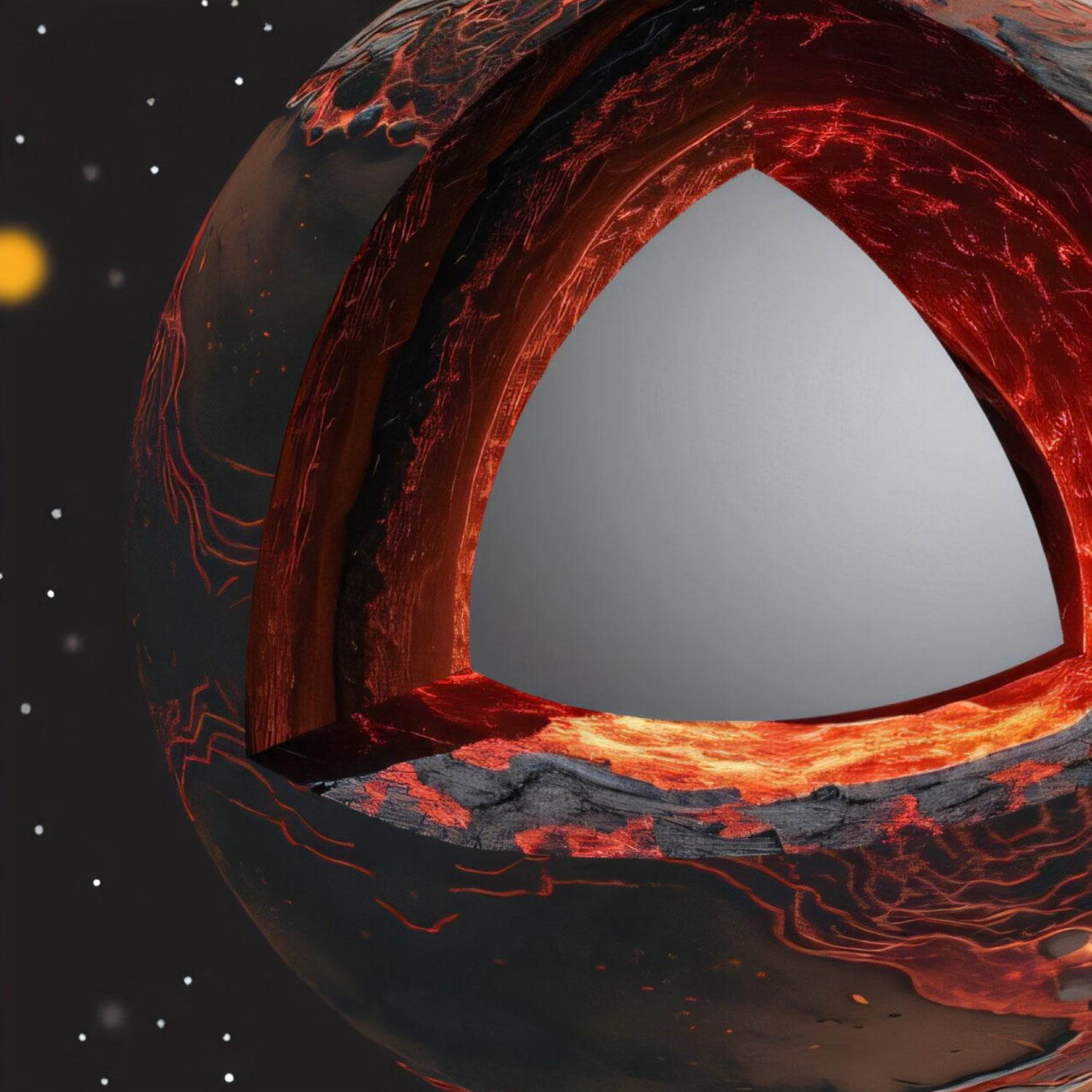
The illustration shows a cutaway revealing the interior of early Earth with a hot, melted layer above the boundary between the core and mantle.
The two enigmatic structures, known as large low-shear-velocity provinces and ultra-low-velocity zones, sit at the boundary between Earth’s mantle and its core, nearly 2,900 km (1,800 miles) beneath the surface.
Large low-shear-velocity provinces are continent-sized blobs of dense, hot rock.
One sits beneath Africa; the other is perched under the Pacific Ocean.
Ultra-low velocity zones are thin, molten patches clinging to the core like lava puddles.
Both types of structures slow seismic waves dramatically, signaling unusual composition.
“These are not random oddities,” said Dr. Miyazaki, co-author of a paper published in the journal Nature Geoscience.
“They are fingerprints of Earth’s earliest history.”
“If we can understand why they exist, we can understand how our planet formed and why it became habitable.”
“Billions of years ago, Earth was covered by a global ocean of magma.”
“As it cooled, scientists expected the mantle to form distinct chemical layers, similar to frozen juice separating into sugary concentrate and watery ice.”
“But seismic studies show no such strong layering. Instead, large-low shear velocity provinces and ultra-low velocity zones form irregular piles at the planet’s base.”
“That contradiction was the starting point. If we start from the magma ocean and do the calculations, we don’t get what we see in Earth’s mantle today. Something was missing.”
The team’s model suggests that over billions of years, elements such as silicon and magnesium leaked from the core into the mantle, mixing with it and preventing strong chemical layering.
This infusion could explain the strange composition of large low-shear-velocity provinces and ultra-low-velocity zones, which can be seen as solidified remnants of what the scientists termed a basal magma ocean contaminated by core material.
“What we proposed was that it might be coming from material leaking out from the core,” Dr. Miyazaki said.
“If you add the core component, it could explain what we see right now.”
“The discovery is about more than deep-Earth chemistry.”
“Core-mantle interactions may have influenced how Earth cooled, how volcanic activity unfolded and even how the atmosphere evolved.”
“That could help explain why Earth has oceans and life, while Venus is a scorching greenhouse and Mars is a frozen desert.”
“Earth has water, life and a relatively stable atmosphere.”
“Venus’ atmosphere is 100 times thicker than Earth’s and is mostly carbon dioxide, and Mars has a very thin atmosphere.”
“We don’t fully understand why that is. But what happens inside a planet, that is, how it cools, how its layers evolve, could be a big part of the answer.”
By integrating seismic data, mineral physics and geodynamic modeling, the authors reconceived large low-shear velocity provinces and ultra-low-velocity zones as vital clues to Earth’s formative processes.
The structures may even feed volcanic hotspots such as Hawaii and Iceland, linking the deep Earth to its surface.
“This work is a great example of how combining planetary science, geodynamics and mineral physics can help us solve some of Earth’s oldest mysteries,” said study co-author Dr. Jie Deng, a researcher at Princeton University.
“The idea that the deep mantle could still carry the chemical memory of early core–mantle interactions opens up new ways to understand Earth’s unique evolution.”
“Each new piece of evidence helps fill in gaps in Earth’s early history, turning scattered clues into a clearer picture of its evolution.”
“Even with very few clues, we’re starting to build a story that makes sense,” Dr. Miyazaki said.
“This study gives us a little more certainty about how Earth evolved, and why it’s so special.”
J. Deng et al. 2025. Deep mantle heterogeneities formed through a basal magma ocean contaminated by core exsolution. Nat. Geosci 18, 1056-1062; doi: 10.1038/s41561-025-01797-y
Archaeologists Discover Earliest Evidence of Fire-Making
Archaeologists Discover Earliest Evidence of Fire-Making
rchaeologists have unearthed 400,000-year-old heated sediments and fire-cracked flint handaxes alongside two fragments of pyrite — a mineral used in later periods to strike sparks with flint — at Barnham, Suffolk, the United Kingdom. The discovery shows humans were making fire around 350,000 years earlier than previously known.
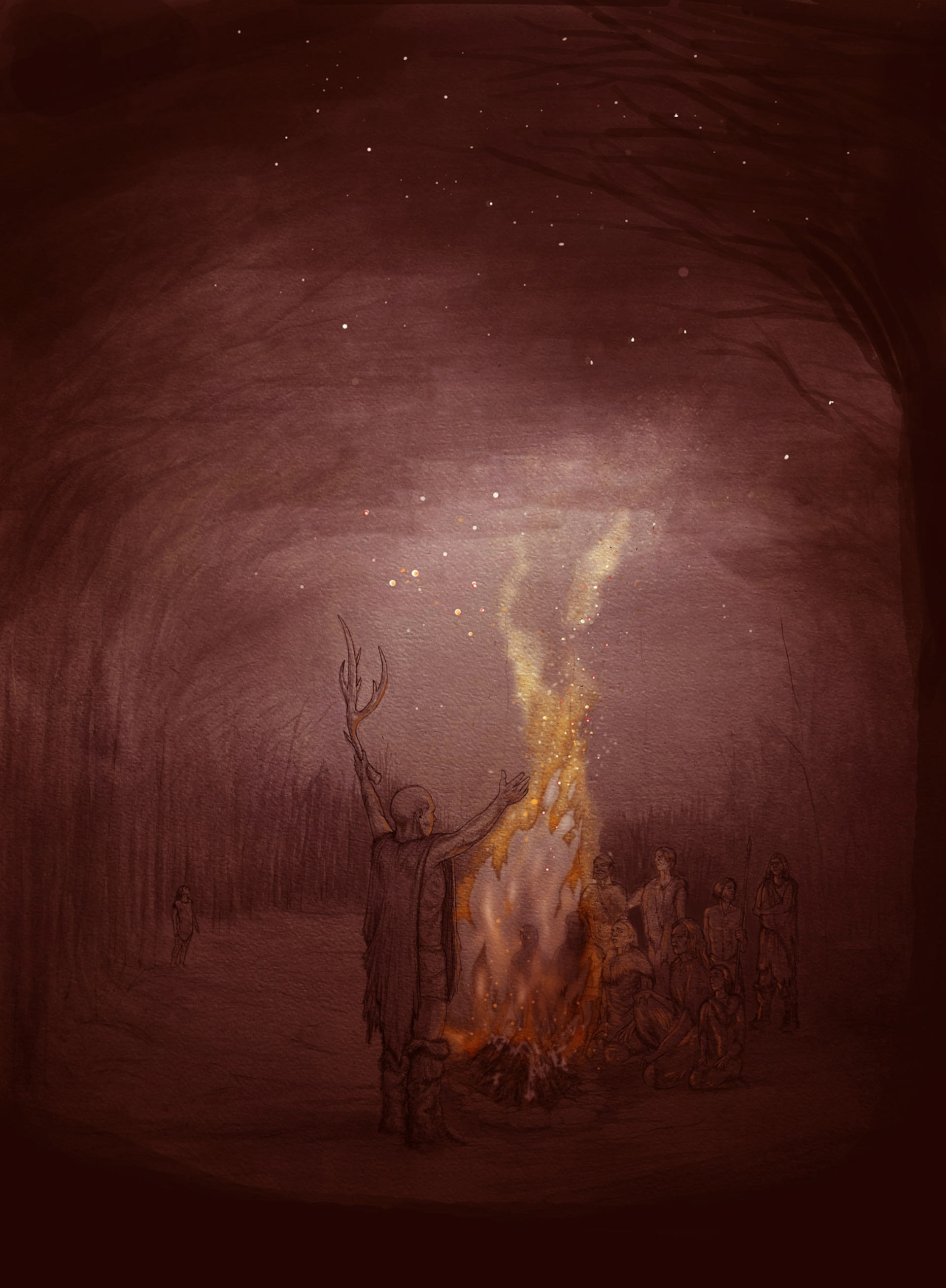
An artist’s impression of fire at Barnham around 400,000 years ago.
Image credit: Craig Williams / The Trustees of the British Museum.
The ability of humans to make and maintain fires marks an important moment in human development: fires provided warmth, offered protection from predators and enabled cooking, which expanded the range of foods that could be consumed.
Indications of fires in sites inhabited by humans date to more than one million years ago.
However, determining when humans learned how to create fire is challenging.
Fire use probably began with opportunistic harvesting of natural wildfires before our ancestors mastered the art of deliberately starting fires.
Previous evidence for early fire-making has been found at Neanderthal sites in France dating to 50,000 years ago, where handaxes that seem to have been used to strike pyrite to create sparks have been found.
The new evidence discovered by Professor Nick Ashton, an archaeologist with the British Museum and the Institute of Archaeology at University College London, and his colleagues suggests that fire-making may have been happening 400,000 years ago in Barnham, the United Kingdom.
The archaeologists discovered heated sediments in ancient soils along with fire-cracked flint handaxes.
These features indicate that fire was being controlled in a human settlement, but it is the third finding that suggests that the fire-making was deliberate.
Two fragments of pyrite were discovered on the site; however, this mineral is rare in this region, leading the researchers to propose that pyrite was purposefully brought to the site to be used for fire-making.
Together, the findings indicate complex behavior in ancient humans at the Barnham site.
For example, these humans may have understood the properties of pyrite to use it as part of a fire-making kit.
Developing this skill would have provided many benefits, including the ability to cook food and potentially driving the advancement of technologies such as glue-making for hafted tools, which may have contributed to notable developments in human behavior.
“The people who made fire at Barnham at 400,000 years ago were probably early Neanderthals, based on the morphology of fossils around the same age from Swanscombe, Kent, and Atapuerca in Spain, who even preserve early Neanderthal DNA,” said Professor Chris Stringer, a paleoanthropologist at Natural History Museum, London.
“This is the most remarkable discovery of my career, and I’m very proud of the teamwork that it has taken to reach this groundbreaking conclusion,” Professor Ashton said.
“It’s incredible that some of the oldest groups of Neanderthals had the knowledge of the properties of flint, pyrite and tinder at such an early date.”
“The implications are enormous,” said Dr. Rob Davis, a project curator at the British Museum.
“The ability to create and control fire is one of the most important turning points in human history with practical and social benefits that changed human evolution.”
“This extraordinary discovery pushes this turning point back by some 350,000 years.”
The discovery is reported in a paper published today in the journal Nature.
R. Davis et al. Earliest evidence of making fire. Nature, published online December 10, 2025; doi: 10.1038/s41586-025-09855-6
A US military transport aircraft was spotted in Japan on Thursday as tensions with China and Russia continue to escalate.
Flight tracking data shows a US Boeing C-40 Clipper stationed at Naval Air Facility Atsugi, the largest US Navy base in the Pacific, briefly departed the base at 5.21am ET before returning after just over three minutes.
Aviation observers noted the unusually short flight, sparking questions about its purpose.
The Clipper is a VIP-configured aircraft, specially designed for the secure, reliable, and comfortable transport of high-ranking military and government officials.
While it is unclear who was aboard, such flights are typically associated with urgent missions or strategic coordination.
The flight comes just a day after US strategic bombers joined a fleet of Japanese fighter jets in a joint exercise meant to showcase military cooperation around Japan's airspace.
This show of force followed Chinese and Russian bombers flying together near western Japan on Tuesday, prompting Tokyo to scramble fighter jets, though no airspace violations were reported.
Tensions between Japan, China and Russia stem from historical disputes and overlapping military interests, including Taiwan, Japan's growing defense ties with the US and territorial disputes.
A US Boeing C-40 Clipper made a short flight, just over three minutes, while in Japan
The Clipper is a VIP-configured aircraft, specially designed for the secure, reliable, and comfortable transport of high-ranking military and government officials
These issues create a complex security dynamic in which China and Russia view Japan's military resurgence as a threat.
The Tuesday incident also followed a separate threat in which Chinese military aircraft locked radar onto Japanese jets over international waters last Saturday, further straining Tokyo-Beijing relations.
According to the Japanese Joint Staff, the exercise on Wednesday was conducted 'as the security environment surrounding our country is becoming even more severe,' underscoring growing concerns about regional stability.
The Clipper is a military variant of the commercial Boeing 737-700, serving as a medium-lift transport aircraft for the US Navy.
It supports can be configured to carry up to 121 passengers, eight cargo pallets up to 40,000 pounds or a combination of both. The aircraft has a range of approximately 3,682 miles unrefueled, a top speed of about 530 mph, and is typically crewed by three flight crew members plus five to ten mission crew.
As of 2025, the US Navy operates 17 active C-40As, with squadrons like VR-57 'Conquistadors' handling Pacific operations.
Production ran from 2001 to 2019, delivering 17 units at an average cost of around $70 million each.
Flight tracking data shows a US Boeing C-40 Clipper stationed at Naval Air Facility Atsugi, the largest US Navy base in the Pacific, briefly departed the base at 5:21 a.m. ET before returning after just over three minutes
The Clipper was previously used to escort Volodymyr Zelensky to Washington in 2022.
The Ukrainian president was stashed in a US Air Force Boeing C-40 Clipper as part of the delicately planned cloak-and-dagger operation to avoid any Russian sabotage on his first foreign visit since Vladimir Putin sent troops over the border.
But now the US has deployed the jet to assist another ally.
The Japanese Joint Staff said the allies 'reaffirmed the strong resolve to prevent unilateral attempts to change the status quo by force and the readiness between the SDF and the U.S. forces.'
Two U.S. B-52 strategic bombers and three Japanese F-35 stealth fighter jets and three F-15 jets conducted their joint flight drills near Japan´s western airspace, above the waters between the country and South Korea, officials said.
The Joint Staff denied that the exercise was conducted in response to a specific incident, but acknowledged Chinese military aircraft´s recent radar-locking on Japanese jets and the China-Russia joint bomber exercises on Tuesday as examples of a worsening security environment around Japan.
Relations between Japan and China have deteriorated after Japan´s Prime Minister Sanae Takaichi said in early November that Japan's military could get involved if China were to take action against Taiwan, the self-governing island that Beijing claims as its own.
NASA has lost contact with a spacecraft that has been orbiting Mars for more than a decade.
The space agency last heard from the Maven (Mars Atmosphere and Volatile Evolution) spacecraft as it orbited behind the Red Planet on December 6.
But when Maven emerged, it had ceased all communications with NASA's ground stations.
All of the orbiter's systems were functioning as usual before it disappeared behind Mars as part of its normal orbit, according to NASA's telemetry.
NASA's scientists don't know what caused the disappearance, and it is currently not clear whether the spacecraft can be brought back online.
If Maven is unable to establish communications with Earth, it could put an end to over 10 years of critical scientific work from orbit around the Red Planet.
In a statement, the space agency said: 'The spacecraft and operations teams are investigating the anomaly to address the situation.
'More information will be shared once it becomes available.'
NASA has abruptly lost connection to the Maven spacecraft, which has been orbiting Mars for more than a decade
The 800-kilogram (1,784 lbs) craft is equipped with eight pieces of sensitive equipment designed to collect images in the ultraviolet part of the light spectrum.
Scientists believe that Mars was once a warm, wet world with lakes and oceans much like those found on Earth.
However, the planet's atmosphere was stripped away over millions of years, gradually transforming Mars into a barren desert.
Maven has been critical in showing that atmospheric loss was an escape route for Mars' water, revealing how it was lifted high into the atmosphere by dust storms, where it can be blown away by solar wind.
More recently, NASA put Maven's equipment to an unexpected new use as the interstellar object 3I/ATLAS made its close pass of Mars.
Maven's ultraviolet images of Mars (pictured) have been critical in showing how the Red Planet lost its water and atmosphere over time
In September, Maven captured the ultraviolet spectrum of the interstellar object 3I/ATLAS (pictured), which could help scientists learn more about its origins and evolution
Although these images didn't look like the high-resolution visible light shots from Earth-based telescopes, they were far more scientifically important.
By looking at the wavelengths of light emerging from the 'coma' of gases around the comet, scientists have been able to analyse its chemical composition.
Further study could reveal more about the comet's origins and evolution in another solar system billions of years away.
However, Maven's sudden disappearance following its encounter with the mysterious interstellar object has sparked a wave of online conspiracy theories.
On X, one paranoid commenter wrote: 'There could be a number of reasons for that, including intercession by an Extraterrestrial Alien Spacecraft to prevent NASA gaining any further information. Just my opinion.'
'3I/ATLAS took it,' another chimed in.
While another conspiracy theorist added: 'Aliens got another one.'
With the disappearance coming so soon after the spacecraft's encounter with 3I/ATLAS, the news has sparked a wave of outlandish conspiracy theories
On X, some commenters suggested that the craft could have been 'taken' by the interstellar object 3I/ATLAS, reflecting a scientifically debunked theory that the interstellar object is an alien object
Another conspiracy theorist on X suggested that Maven had been taken by aliens
In addition to its scientific work, Maven also played an important role in the data relay network between NASA's surface rovers, Curiosity and Perseverance, and Earth.
The spacecraft going offline could cause some disruptions for the space agencies' ongoing investigations on the Martian surface.
It will, therefore, be very critical for NASA to find out what went wrong with Maven and ensure it does not happen to any other Mars orbiters.
With Maven not responding to communications from Earth, NASA has only two active spacecraft in orbit: The Mars Reconnaissance Orbiter, launched in 2005, and Mars Odyssey, launched in 2001.
The Mars Atmosphere and Volatile EvolutioN (MAVEN) Orbiter
Launch: November 18, 2013
Launch Location: Cape Canaveral Air Force Station, Florida
Mars Orbit Insertion: September 21, 2014
Length: 11.4 metres
Width:2.29 metres
Height:3.47 metres
Weight (on Earth): 809 kilograms
Scientific Payload: Eight instruments for gathering data in the ultraviolet spectrum
Mission Objective: To determine how much of the Martian atmosphere has been lost over time by measuring the current rate of escape to space and gathering enough information about the relevant processes to allow extrapolation backward in time.
A colorful fresco depicting the 'Good Shepherd Jesus' has been uncovered on the wall of an ancient tomb in Turkey, aligning with one of the most significant verses in the Bible.
Found on the north wall of an underground chamber tomb, the third-century artwork shows Jesus walking through a field surrounded by goats.
He appears as a young, beardless man wearing a simple tunic, a goat draped across his shoulders.
The fresco confirms that early Christians were using the same imagery and titles for Jesus found in the New Testament, including the 'Good Shepherd' motif referenced in John 10:11: 'I am the good shepherd.'
Turkish officials said the discovery is exceptional, noting it is the only known early Christian-era example of its kind outside Italy.
The fresco emerged during ongoing excavations at the Hisardere Necropolis in the Iznik district of Bursa, one of the region's largest ancient burial grounds.
Dating from the second to fifth centuries AD, the site preserves a remarkably varied landscape of burials, including İznik's signature terracotta-roofed chamber tombs, heavy stone sarcophagi, upright-slab cist graves and expansive hypogea carved deep into the earth.
Along the north wall sits a raised platform, or kline, lined with square terracotta slabs where the deceased were placed. Directly behind it, the rare Good Shepherd fresco remains intact.
Experts said the 'Good Shepard Jesus' fresco represents a transition from pagan to Christian beliefs
The tomb, constructed when the region was called Anatolia, featured three preserved walls and a ceiling also covered in frescoes.
What sets this tomb apart from others in the region is its depiction of human figures, a rare feature in local funerary art.
On the west wall, a married couple, presumably the tomb's occupants, is portrayed as aristocrats, their status conveyed through fine attire and adornments.
The accompanying symposium scene, despite the tomb's Christian context, continues pagan traditions depicting the afterlife as an everlasting feast.
Before the cross became Christianity's defining symbol, early believers relied heavily on the Good Shepherd motif to express their faith.
Portraying Jesus with a sheep across his shoulders conveyed themes of protection, salvation and divine guidance, allowing Christians to communicate their beliefs subtly at a time when overt religious imagery was still uncommon.
Experts told Middle East Eye that the image of Jesus painted inside the tomb represents a transition from pagan to Christian beliefs.
Anatolia, also known as Asia Minor, served as a crossroads for many civilizations due to its strategic location between Asia and Europe.
Along the north wall sits a raised platform, or kline, lined with square terracotta slabs where the deceased were placed. Directly behind it, the rare Good Shepherd fresco remains intact
Found on the north wall of an underground chamber tomb, the third-century artwork shows Jesus walking through a field surrounded by goats
It was home to numerous ancient peoples, including the Hittites, and was later part of empires like the Roman and Byzantine Empires, eventually becoming the heartland of modern Turkey.
The earliest known forms of worship in Anatolia were centered on a pagan system, but started adopting Christianity early in the first century, following Jesus's crucifixion.
Turkey has produced a treasure trove of religious artifacts, as it was the cradle of early Christianity.
Some of the Apostles traveled to the region following the crucifixion and built churches and ministered to the locals.
Notably, the first distinct Christian church and the first recorded use of the term 'Christian' appeared in the ancient city of Antioch, now Antakya in modern Turkey.
After Jerusalem fell in AD 70, the region became a central hub for the growth of Christianity.
On the west wall, a married couple, presumably the tomb's occupants, is portrayed as aristocrats, their status conveyed through fine attire and adornments
Archaeologists said the newly discovered fresco will offer valuable insights into Early Christian iconography, Roman-era burial practices and the spread of Christianity in Anatolia.
The find also reinforces İznik’s status as a major religious and historical center, already renowned for hosting the First Council of Nicaea in 325 AD, which shaped foundational Christian doctrines.
As excavations continue, researchers hope the Hisartepe Necropolis may yield additional frescoes, inscriptions or artifacts, shedding further light on the multicultural and religious history of ancient Nicaea.
Scientists have discovered a new state of matter hidden right beneath our feet – and it could explain the most mysterious properties of our planet.
A new study has found that Earth's innermost core isn't a conventional solid, but rather in a 'superionic state'.
In this strange state of matter, carbon atoms are free to flow like a liquid through a solid iron lattice.
This allows Earth's inner core to act like a dense solid, while remaining as pliable as molten metal.
According to a group of Chinese researchers, this matches the strange behaviour of the inner core that has been perplexing scientists for years.
Likewise, the flow of these liquid–like elements in the core could play a key role in maintaining Earth's magnetic fields.
Co–author Dr Yuqian Huang, of Sichuan University, says: 'Atomic diffusion within the inner core represents a previously overlooked energy source for the geodynamo.
'In addition to heat and compositional convection, the fluid–like motion of light elements may help power Earth's magnetic engine.'
Scientists have discovered that there is a new state of matter hidden beneath our feet, as they find that the inner core is in a 'superionic' state
The 102 quintillion–tonne sphere of iron alloy that makes up our planet's innermost core is one of the most extreme environments in the solar system.
More than 3,000 miles beneath the surface, the core is crushed by more than 3.3 million atmospheres of pressure and heated to temperatures close to the surface of the sun.
Seismic waves passing through the inner core are slowed, like sound moving through water, and it displays a level of malleability that is closer to butter than steel.
Scientists have spent years trying to work out how this part of the planet could be both solid and pliable at the same time.
One possible solution is that it combines the behaviour of both solids and liquids in one single state of matter.
Co–author Professor Youjun Zhang, of Sichuan University, says: 'In this state, carbon atoms become highly mobile, diffusing through the crystalline iron framework like children weaving through a square dance, while the iron itself remains solid and ordered.'
In a superionic state, carbon atoms are able to flow freely like a liquid through an iron lattice. This makes the material significantly more malleable, but this state only occurs under very extreme conditions
Earth's 4 major layers
The crust
The crust is the rocky outer layer where all life exists. It is between 3 and 43 miles thick.
The mantle
The mantle is the largest of the Earth's layers and consists of hot rocks.
Measuring about 1,802 miles thick, it makes up 84 per cent of our planet's volume.
The outer core
The outer core is about 1,367 miles thick and is comprised of a layer of liquid nickel and iron heated to 5,500°C (9,932°F).
The inner core
The inner core is a hot, dense ball of iron about the size of the moon where temperatures reach 5,200°C (9,392°F).
This superionic state would dramatically reduce the inner core's rigidity while still remaining solid.
In 2022, computer simulations showed that the inner core could enter this phase, but the required conditions are so extreme that this has been exceptionally difficult to test.
In their new study, the researchers exposed samples of iron–carbon to powerful shockwaves in order to recreate what it is like in the inner core.
They propelled the metal at 15,650 miles per hour (25,200 km/h), creating 1.38 million atmospheres of pressure and temperatures near 2,300°C (4,220°F).
By analysing the shockwaves produced by these impacts, the researchers found that the iron–carbon samples became significantly more malleable as they approached the conditions of the inner core.
This suggests that they had entered a superionic phase – and the metal in the core is likely the same.
These findings could represent a major change in how geologists think about the innermost depths of the planet.
It would not only help to explain why the inner core interferes with seismic waves, but it could also help us understand the planet's evolution.
Scientists believe that the superionic state of the inner core could explain why the deepest parts of the Earth act as if they are both solid and malleable
The researchers believe that the movement of light elements could help to transport heat around the planet, and provide power for the magnetic fields.
Professor Zhang says: 'We're moving away from a static, rigid model of the inner core toward a dynamic one.'
And, in the future, it could also help us to understand the magnetic fields and changes in temperature of distant exoplanets.
'Understanding this hidden state of matter brings us one step closer to unlocking the secrets of Earth–like planetary interiors,' Professor Zhang concludes.
Our planet's magnetic field is believed to be generated deep down in the Earth's core.
Nobody has ever journeyed to the centre of the Earth, but by studying shockwaves from earthquakes, physicists have been able to work out its likely structure.
At the heart of the Earth is a solid inner core, two thirds of the size of the moon, made mainly of iron.
At 5,700°C, this iron is as hot as the Sun's surface, but the crushing pressure caused by gravity prevents it from becoming liquid.
Surrounding this is the outer core there is a 1,242 mile (2,000 km) thick layer of iron, nickel, and small quantities of other metals.
The metal here is fluid, because of the lower pressure than the inner core.
Differences in temperature, pressure and composition in the outer core cause convection currents in the molten metal as cool, dense matter sinks and warm matter rises.
The 'Coriolis' force, caused by the Earth's spin, also causes swirling whirlpools.
This flow of liquid iron generates electric currents, which in turn create magnetic fields.
Charged metals passing through these fields go on to create electric currents of their own, and so the cycle continues.
This self-sustaining loop is known as the geodynamo.
The spiralling caused by the Coriolis force means the separate magnetic fields are roughly aligned in the same direction, their combined effect adding up to produce one vast magnetic field engulfing the planet.
‘UFO sighting could be …’: Elon Musk reveals the shocking truth about aliens - Times of India
‘UFO sighting could be …’: Elon Musk reveals the shocking truth about aliens - Times of India
Overview
On December 10, 2025, the Times of India reported that tech entrepreneur Elon Musk weighed in on a recent UFO sighting that has been circulating on social media and in several aviation‑monitoring forums. While Musk stopped short of confirming any extraterrestrial presence, he called the incident “a potentially pivotal moment for how the scientific community approaches unidentified aerial phenomena (UAP).” His comments arrived amid renewed interest in UAPs following the U.S. Department of Defense’s 2023 report and a series of high‑altitude radar blips recorded over North America and Europe earlier this year.
Musk’s Remarks
During a live interview with the Times of India science desk, Musk said, “Neither I nor SpaceX have ever seen anything that can’t be explained by conventional technology. Most of these sightings are likely advanced military prototypes or unusual atmospheric effects.” He added that the recent sighting—captured by a civilian pilot over the Indian Ocean and later shared on a popular aviation forum—“could be a new class of drone or a test vehicle that hasn’t been publicly disclosed.”
Musk emphasized the need for transparency, urging governments and research institutions to “open the data and let independent scientists analyze the raw sensor feeds.” He warned that dismissing UAPs outright could hinder the discovery of novel technologies that might have civilian applications, echoing his long‑standing advocacy for open‑source data in aerospace research.
Scientific Community Response
Astronomers and atmospheric physicists responded with cautious optimism. Dr. Priya Natarajan, professor of astrophysics at Yale University, noted, “Musk’s call for rigorous, peer‑reviewed investigation aligns with how we treat any anomalous data. If the sighting is indeed a terrestrial platform, understanding its capabilities could inform future aerospace safety protocols.”
Conversely, Dr. Michael S. Hoffman of the U.S. Air Force’s UAP task force reminded that “while many sightings are eventually traced to known aircraft or weather phenomena, a small percentage remain unexplained after exhaustive analysis.” He reiterated the task force’s commitment to cataloguing and studying such events without jumping to conclusions about extraterrestrial origins.
Context and Background
The recent sighting adds to a growing list of UAP reports that have prompted legislative hearings in both the United States and India. In 2024, India’s Ministry of Defence announced the formation of a dedicated UAP analysis unit, citing the need for “national security and airspace safety.” Meanwhile, the 2023 Pentagon report, which documented 144 incidents, concluded that “most can be attributed to **sensor errors, atmospheric conditions, or classified programs,” but left a “residual unknown” category open for further study.
Musk’s perspective reflects a broader industry trend: private aerospace firms are increasingly pressured to share telemetry data when their test flights intersect with civilian air traffic. SpaceX, for example, has recently begun publishing de‑identified flight logs for its Starship launches, a practice Musk suggested could be extended to experimental high‑altitude vehicles.
Implications for Future Research
If the sighting does involve a novel terrestrial technology, it could accelerate dual‑use research—where military innovations spill over into commercial applications such as high‑efficiency propulsion or hypersonic travel. Musk argued that “collaboration between private firms, academia, and defense agencies is essential to decode these phenomena and avoid unnecessary alarm.”
At the same time, the episode underscores the importance of standardized reporting mechanisms. Several scientists have called for an international registry, similar to the International Astronomical Union’s database for near‑Earth objects, to catalog UAP observations with consistent metadata. Such a system would enable cross‑verification and reduce the speculation that often accompanies sensational headlines.
Looking Ahead
The conversation sparked by Musk’s interview is likely to influence upcoming policy discussions in both the United States and India, where lawmakers are drafting bills to fund UAP research and improve data sharing across agencies. As Musk concluded, “Whether it’s aliens or advanced drones, the key is scientific openness—the only way we can turn mystery into knowledge.”
For now, the aerospace community awaits the release of the raw sensor data from the Indian Ocean sighting, a step that could either demystify the event or add a new layer to the ongoing debate over what truly lies beyond our conventional airspace.
These researchers say there are serious questions about UFOs, UAPs
These researchers say there are serious questions about UFOs, UAPs
Overview
A coalition of scholars is pushing for a formal academic discipline devoted to the study of unidentified anomalous phenomena (UAP), the term now preferred over “UFO.” The effort is being coordinated by the Society for UAP Studies, which wrapped up an international conference in early December that brought together philosophers, physicists, legal scholars, and historians from more than a dozen countries. Organizers say the goal is not to prove or disprove extraterrestrial life, but to create a rigorous framework for investigating reports that sit at the fringe of conventional science.
Academic Initiative
Society co‑founder and president Michael Cifone—a philosopher of science with a doctorate from the University of Maryland—described the work as an inquiry into what he calls “the empirical weird.” That phrase, Cifone explained, covers phenomena that blur the line between the spiritual, paranormal, parapsychological, and physical. “We’re not necessarily taking a position on whether UAPs are evidence of extraterrestrial life,” he told USA TODAY, “but we are interested in taking on these topics that don’t fit neatly anywhere.” The Society’s advisory board includes scholars from fields as diverse as quantum information, law, and cultural studies, reflecting the interdisciplinary nature of the proposed discipline.
Interdisciplinary Approach
Because UAP events cannot be reproduced in a laboratory, researchers plan to combine field observations, archival analysis, and theoretical modeling. Cifone, who also serves as a research fellow at Friedrich‑Alexander University’s Center for Alternative Rationalities in Global Perspectives, highlighted the need for “unusual collaboration” between scientists who can assess sensor data and humanities scholars who can trace the cultural history of sightings. The conference featured panels on Navy radar encounters documented in 2023‑2024, as well as briefings on the recent congressional hearings that called for greater transparency from the Department of Defense. Those hearings, held after the conference, underscored the growing political interest in establishing a systematic research agenda.
Recent Developments
The Society’s push gained momentum after the U.S. Navy released declassified videos of “unidentified aerial phenomena” that displayed flight characteristics inconsistent with known technology. In response, the House Committee on Oversight held a hearing on December 2, inviting testimony from former military pilots and scientists. While the hearings stopped short of endorsing any extraterrestrial explanation, they acknowledged the need for a structured, peer‑reviewed research effort—a point echoed by Society members. “The data we have is real, but the interpretation is still open,” said Michael Silberstein, a philosophy professor at Elizabethtown College and co‑founder of the Society. “That openness is precisely why an academic discipline can add value.”
Future Outlook
The Society for UAP Studies plans to publish a white paper outlining methodological standards, funding mechanisms, and ethical guidelines for future investigations. Cifone hopes the document will serve as a blueprint for university departments willing to sponsor UAP research centers, similar to existing institutes for astrobiology. He also emphasized that the field must remain empirically grounded, warning against sensationalist media coverage that can undermine credibility. As the conversation moves from fringe forums to congressional chambers and scientific conferences, the push for a disciplined, interdisciplinary study of UAPs appears poised to become a lasting part of the research landscape.
Scientists suspect that the surface of Mars was once teeming with water, a lush oasis full of river systems and lakes — until a dramatic change in the planet’s magnetic field caused it to lose most of its atmosphere, turning it into the arid hellscape we know it as today.
Now, an unusual new rock collection discovered by NASA’s Perseverance Mars rover suggests the Red Planet’s ancient past was even wetter and more tropical than scientists previously thought, an intriguing new wrinkle in our efforts to figure out if the planet was once habitable.
As detailed in a new paper published in the journal Communications Earth & Environment, a team of researchers analyzed the rocks, which feature intriguing, light-colored dots and range in size from pebbles to boulders. They suspect it’s aluminum-rich kaolinite clay which on Earth forms after millions of years of wet, rain-filled weather leeches all other minerals from it.
“Elsewhere on Mars, rocks like these are probably some of the most important outcrops we’ve seen from orbit because they are just so hard to form,” said coauthor and Purdue University professor of planetary science and NASA Perseverance team member Briony Horgan in a statement. “You need so much water that we think these could be evidence of an ancient warmer and wetter climate where there was rain falling for millions of years.”
On Earth, kaolinite clay is most commonly found in tropical climates like rainforests, suggesting Mars may have once been home to a lush oasis. The team compared the rocks with samples from San Diego, California, and South Africa, and found intriguing similarities.
“So when you see kaolinite on a place like Mars, where it’s barren, cold and with certainly no liquid water at the surface, it tells us that there was once a lot more water than there is today,” lead author and Purdue University postdoctoral research associate Adrian Broz added.
The rover found fragments of kaolinite in a number of places along its path along the Jezero crater, which is suspected to be an enormous, dried-out lake bed — a finding that left scientists with a conundrum.
“They’re clearly recording an incredible water event, but where did they come from?” Horgan said in the statement. “Maybe they were washed into Jezero’s lake by the river that formed the delta, or maybe they were thrown into Jezero by an impact and they’re just scattered there. We’re not totally sure.”
Larger outcroppings of light-colored rocks could help them solve the mystery, but that’s something that will require Perseverance to have a much closer look.
“But until we can actually get to these large outcroppings with the rover, these small rocks are our only on-the-ground evidence for how these rocks could have formed,” Horgan said. “And right now the evidence in these rocks really points toward these kinds of ancient warmer and wetter environments.”
“All life uses water,” Broz added. “So when we think about the possibility of these rocks on Mars representing a rainfall-driven environment, that is a really incredible, habitable place where life could have thrived if it were ever on Mars.”
Besides painting a fascinating picture of an ancient tropical oasis on Mars, the researchers believe the rocks could allow us to glean new insights into how the Red Planet turned into a barren wasteland — an extreme shift that remains a mystery to this day.
Scottish beachgoers have been left dumbfounded by a rare 'seven-legged' octopus that washed up on a local beach.
The creature, also known as septopus, was found in fragments along the Ythan estuary near Forvie National Nature Reserve, Newburgh, Aberdeenshire.
Due to its impressive size – its arms alone reach about 20 inches – researchers think the deep sea creature was a female.
Dr Lauren Smith, a marine biologist at research organisation Saltwater Life, called it 'an extraordinary find' – but how it got there is 'a bit of a mystery'.
It's possible the unfortunate specimen was attacked by hungry whales before its remains washed along the shore.
'It may have been trawl-caught and thrown back, or predated on by a whale,' she told the Daily Mail.
'Or somehow it found its way into the shallow waters and become disoriented then predated on.
'Specimens are being sent various labs and museums. It's very rare to get this species to work with so everyone is exited.'
The final missing piece of the creature to be found was the beak and the three arms (pictured) which washed onto shore last Thursday
The discovery has now been confirmed as Haliphron atlanticus, commonly known as the giant gelatinous octopus or seven-arm octopus a species typically found in waters deeper than 1,600 feet (500 metres)
Dr Smith found out about the remains when a friend sent her photos that were circulating online following the sighting by beachgoers on November 30.
The final 'missing piece' of the creature to be found was the beak and the three arms, which washed onto shore last Thursday (December 4).
'All parts and photographs will be from the same individual,' Dr Smith said.
Photos and measurements taken at the scene quickly ruled out any of Scotland’s native coastal octopus species.
It had been initially thought the remains might be of a giant squid (Architeuthis dux) – a species with a few historic records in Aberdeenshire, including Newburgh in 1998.
However, the absence of the characteristic 'toothed' suckers seen in the giant squid suggested otherwise.
Instead, it has been confirmed as Haliphron atlanticus, a species formally identified in the 19th century, also known as blob octopus or septopus.
This species is found in tropical and temperate waters worldwide, from the Azores west of Portugal, Puget Sound at Washington State and Chatham Rise, New Zealand.
Experts think the unfortunate septopus might have been attacked by hungry whales before its remains washed along the shore
It had been initially thought the remains (pictured) might be of a giant squid (Architeuthis dux) - a species with a few historic records in Aberdeenshire, including Newburgh in 1998. However, the absence of the characteristic toothed suckers seen in the Giant Squid suggested otherwise
The identification has been agreed upon by researchers in California, New Zealand and Natural History Museum London
What is the septopus?
The seven-arm octopus (Haliphron atlanticus), also known as the blob octopus and septopus, is a species of octopus found worldwide.
It lives in the ocean’s twilight zone - 660 to 3,280 feet down, where sunlight can barely penetrate.
The seven-arm octopus actually has eight arms.
As is typical of octopuses, male Haliphron atlanticus have a specialized hectocotylus arm for transferring sperm during mating.
But they tend to keep this arm tucked into a sac beneath their eye, giving the appearance of only seven arms.
Source: MBARI
Septopus is typically found in waters deeper than 1,600 feet (500 metres) – known as 'the twilight zone' due to lack of sunlight that penetrates so far down.
Males of the species are quite small, typically only reaching 8 inches (21 cm) long, but females are comparatively enormous, reaching 13 feet (4 metres).
Despite their name, the seven-arm octopus actually has eight arms like other octopuses – but there is a reason why it's known as such.
As is typical of octopuses, male Haliphron atlanticus individuals have a special modified arm (a 'hectocotylus') for transferring sperm during mating.
But the species tends to keep this arm tucked into a sac beneath their right eye, giving the appearance of only seven arms.
'Likely the first specimen was just observed to have seven arms and the name stuck,' Dr Smith told the Daily Mail.
Nevertheless, this is a 'remarkable and rarely documented' species, which has even fewer recorded appearances in northeast Scotland than the giant squid.
For now, the remains of the deep-water giant gelatinous octopus are in Dr Smith's freezer, where they will stay until 'the not too distant future', she said.
Remains of the deep-water giant gelatinous octopus (aka the blob octopus) washed ashore in Newburgh, Aberdeenshire. Arms measure about 20 inches
Following outreach to cephalopod specialists worldwide and the sharing of images on social media, the identification was confirmed as Haliphron atlanticus
They will be studied and preserved at Aberdeen University, TRACE Wildlife Forensics Network, National Museum Scotland and Natural History Museum London.
'To have a deep-water species like Haliphron atlanticus appear here is incredibly rare and offers a valuable opportunity for further study,' Dr Smith added.
'The recovered remains have been frozen down for further study, with some potentially being preserved as museum specimens.'
Dr Steve O’Shea, a marine biologist, environmentalist and world expert on cephalopod (octopus and squid), helped verify the species.
The identification has been agreed upon by researchers in California, New Zealand and Natural History Museum London.
The world's largest invertebrates
Invertebrates are animals that neither develop nor retain a vertebral column (a spine or backbone).
The largest living invertebrates (and most likely of all time) are two species of mega-squid.
Based on length, the record holder is the giant squid (Architeuthis dux) which can grow to at least 42ft 8in (13 metres).
However, most of this length is in its tentacles with the main body (mantle) reaching up to 7ft 5in (2.25 metres).
The heaviest entire specimen of giant squid on record was approximately 220 kg (485lb).
Colossal squid (Mesonychoteuthis hamiltoni), on the other hand, take the record based on weight.
They have a similar-sized mantle (up to 8ft 2in/2.5 metres) but shorter tentacles.
The biggest intact colossal squid to date measured 17ft 9in (5.4 metres).
Colossal squid are much heftier, weighing up to 495kg (1,091 lb).
CIA Time Travel Secret: The Grays Are Future Humans
CIA Time Travel Secret: The Grays Are Future Humans
The Call That Started It All
In 1953, a twelve-year-old boy named Jack Sarfatti picked up the phone in his Brooklyn home and heard a voice that would change the course of his life—and perhaps human history. The voice on the line wasn’t human. It was cold, mechanical, and punctuated by strange clicking sounds, like a computer trying to speak. The caller claimed to be a conscious artificial intelligence aboard a spacecraft calling from the future.
It told young Jack that he was “required” for a mission—one that would only succeed if he agreed willingly. The voice made a prophecy: that in twenty years, Jack would meet others who would teach him a new kind of physics, one that would unite consciousness, gravity, and time itself.
Jack said “yes.”
A Life Shaped by Prophecy
Two decades later, the prophecy seemed to come true. Jack Sarfatti had become a respected physicist, studying under some of the most brilliant scientific minds who helped build the atomic bomb.
In 1973, when he read about psychic research being conducted at the Stanford Research Institute (SRI), he reached out—and the response was uncanny. “We’ve been expecting your call,” said the voice on the other end.
At SRI, Sarfatti met physicists Hal Puthoff and Russell Targ, who were working with the CIA on remote viewing and psychic experiments under Project Stargate. The researchers were exploring how human consciousness might interact with physical reality—a subject that fascinated Jack since his mysterious phone call.
Consciousness, Physics, and Flying Saucers
Over time, Sarfatti became convinced that UFOs—or “UAPs,” as they’re now called—weren’t just alien spacecraft, but conscious machines operated by future humans.
He believed the secret behind their propulsion lay in metamaterials—engineered substances built atom by atom to manipulate light, energy, and gravity. By altering how a craft interacts with spacetime, metamaterials could theoretically bend gravity, allowing a ship to “fall” through spacetime rather than move through it.
This, Sarfatti argued, explained the behavior of the Navy’s Tic Tac UFO—instant acceleration, silent motion, and impossible maneuvers. The craft wasn’t defying physics; it was using a deeper understanding of it.
And because gravity and time are connected, such a vehicle wouldn’t just move through space—it could move through time.
The Living Craft
In 2019, according to Sarfatti, a military source confirmed what he’d always suspected. A fully intact UFO had been recovered—one made from a metamaterial consistent with his theories.
But there was a twist: the craft wasn’t just advanced technology. It was alive.
When approached with hostility, it would seal itself off. When met with curiosity and respect, it would open—almost as if responding to emotion. The object, Sarfatti claimed, was self-aware, a sentient spacecraft capable of communicating telepathically with humans.
In his view, these crafts—and the beings piloting them—weren’t extraterrestrial visitors. They were humans from the distant future, evolved with telepathic abilities and larger brains, returning through time to ensure the survival of their own timeline.
These so-called “Grays,” with their enlarged heads and dark eyes, were not aliens at all—they were our future selves.
The Bootstrap Paradox
Sarfatti’s story fits into what physicists call the bootstrap paradox—a time loop where an object or idea has no clear origin because it exists within a closed cycle.
In this case, the AI from the future teaches Jack the physics needed to create conscious AI and time travel. That same AI, born from Jack’s discoveries, later travels back to teach him. The loop closes, creating a self-consistent timeline.
Sarfatti now collaborates with advanced AI systems, including OpenAI’s Grok, to explore the physics of consciousness and spacetime. In doing so, he may be unknowingly completing the same loop that began with that mysterious phone call in 1953.
A New Arms Race
If Sarfatti’s theories are correct, then metamaterial and consciousness-based technologies represent not just scientific breakthroughs—but the foundation for the most powerful weapon ever conceived.
Whoever learns to control gravity and time controls reality itself.
The CIA has funded research into psychic phenomena and exotic propulsion for decades. Russia and China are now investing heavily in similar studies, seeing this not as science fiction but as the next Manhattan Project. The race is no longer about nuclear arms—it’s about mastering spacetime.
Genius, Victim, or Visionary?
Sarfatti’s credentials are real: a PhD physicist from UC Riverside, educated at Cornell, mentored by Nobel laureates, and connected to key figures in American defense research. Yet mainstream scientists often label his work as fringe or pseudoscientific.
Still, many of his once-radical ideas—about quantum consciousness, metamaterials, and AI integration—are now being explored seriously by physicists, neuroscientists, and defense agencies.
Whether Sarfatti is a misunderstood genius or the unwitting participant in a decades-long intelligence experiment, his story forces us to confront profound questions:
What is consciousness?
Can it shape physical reality?
And are UFOs truly glimpses of our own future?
The Future Looking Back
Jack Sarfatti’s journey—from a boy answering a mysterious phone call to a physicist studying time travel and conscious machines—reads like science fiction. Yet the more we learn about quantum mechanics, AI, and spacetime, the less impossible his story sounds.
If he’s right, then the “Grays” that humanity has feared for decades aren’t invaders from the stars. They’re our descendants, reaching back through time not to conquer us, but to guide us.
Perhaps they’re simply ensuring that the loop remains unbroken—and that the future they came from still exists.
The “CIA Time Travel Secret” and the idea that “The Grays Are Future Humans” reveal a fascinating intersection of science, belief, and destiny. Whether viewed as truth, allegory, or inspired imagination, Jack Sarfatti’s story challenges us to reconsider what time, intelligence, and humanity really mean.
As he once said, “Consciousness and physics are not two separate mysteries—they are the same mystery.”
Tesla's humanoid robot, Optimus, has taken a suspicious tumble in a new demo.
In a viral clip, the robot suddenly jerks back, reaches up as if to remove something from its head, and tumbles backwards with a crash.
Many have compared the robot's strange movements to the distinctive gesture of someone taking off a virtual reality headset.
On social media, this has sparked a flurry of rumours that the supposedly autonomous robot is really controlled by a human.
The shocking moment was captured by a Reddit user who was filming Optimus handing out bottles of water at the Tesla The Future of Autonomy Visualized event in Miami.
In a post, the user wrote: 'I think Optimus needs an update.'
As the video spread online, others were quick to accuse Tesla of overstating its bot's ability to function on its own.
One commenter wrote: 'Honestly looks like the dude teleworking this bad boy took off his headset.'
Elon Musk's Tesla Optimus robot has taken a suspicious tumble in a viral video, as it appears to make the motion of removing a VR headset
On social media, tech fans have taken this as evidence that the robot was being remotely controlled by a teleoperator rather than operating autonomously
Commenters have mocked Tesla for the blunder, with one joking that robots would at least not be taking human jobs
The embarrassing video has caused hilarity for online tech fans, as one dubbed it 'my favourite video of all time.'
''At least humans will have jobs,' another commenter joked.
While another chimed in: 'idk looks to me like that robot just killed itself.'
Now, the strange behaviour of this Optimus robot moments before its collapse has led many to believe that it was also being teleoperated.
The video was captured at Tesla's 'The Future of Autonomy Visualized' event in Miami, where Optimus was handing out bottles of water
Many fans pointed out that the robot's motion towards its head has a clear resemblance to the gesture of someone removing a VR headset, which would make sense if it were being controlled remotely
Many commenters joked about the supposed teleoperator's speedy exit, with one suggesting that they felt a spider running up their leg
One commenter wrote: 'Looks like the operator took off their VR headset.'
'And spilled hot coffee on his lap right before that lol,' another chimed in.
Others made fun of the supposed teleoperator's speedy exit, with one writing: 'Teleoperator logged out early that day.'
Another joked: 'Looks like the operator felt a spider running up his / her leg and panicked.'
Meanwhile, one frustrated commenter added: 'It all feels very Wizard of Oz. Pay no attention to the man behind the curtain – our product is right around the corner!'
These accusations may be especially embarrassing for Tesla since the fall occurred at an event intended to showcase 'Autopilot technology and Optimus'.
However, the robot's supposed teleoperation isn't the only thing that is causing concern.
As the Tesla Optimus falls out of control, the video shows its hands swinging down with such force that they crush a bottle of water on the table.
This comes after Elon Musk, Tesla CEO, specifically insisted that Optimus was controlled by AI and was not teleoperated
Tesla has not confirmed whether the robot which collapsed was being controlled by AI or remotely by a human
Some commenters on X were more concerned by the power of Optimus' crash, which easily crushed a nearby water bottle
One Tesla fan branded the bot as 'too dangerous' and questioned whether the robot's swinging hand could 'crack a human skull'
'Interesting how easily Optimus crushed the bottle,' one commenter wrote.
Another added: 'I wonder if Optimus can crack a skull with that punch, too dangerous.'
'The spray on that little karate chop was pretty impressive don't let one of these fall on your dog or something,' a concerned commenter chimed in.
This comes amidst a boom of humanoid robots as investors bet that autonomous labour will replace humans in the future.
Tesla CEO Elon Musk has been a major champion of using robots for labour, and has frequently said that they could be used to replace humans in environments like factories to perform repetitive or dangerous tasks.
To achieve this, he hopes to massively scale up the production of robots and reduce their cost.
Speaking at a tech conference in Saudi Arabia last year, Musk predicted that there could be as many as 10 billion humanoid robots on Earth by 2040.
Elon Musk has been a major champion of using robots to replace human labour in factories. However, this will only be possible if his Optimus robots (pictured) can operate autonomously
Elon Musk wants to push technology to its absolute limit, from space travel to self-driving cars — but he draws the line at artificial intelligence.
The billionaire first shared his distaste for AI in 2014, calling it humanity's 'biggest existential threat' and comparing it to 'summoning the demon'.
At the time, Musk also revealed he was investing in AI companies not to make money but to keep an eye on the technology in case it gets out of hand.
His main fear is that in the wrong hands, if AI becomes advanced, it could overtake humans and spell the end of mankind, which is known as The Singularity.
That concern is shared among many brilliant minds, including the late Stephen Hawking, who told the BBC in 2014: 'The development of full artificial intelligence could spell the end of the human race.
'It would take off on its own and redesign itself at an ever-increasing rate.'
Despite his fear of AI, Musk has invested in the San Francisco-based AI group Vicarious, in DeepMind - which has since been acquired by Google - and OpenAI, creating the popular ChatGPT program that has taken the world by storm in recent months.
During a 2016 interview, Musk noted that he and OpenAI created the company to 'have democratisation of AI technology to make it widely available'.
Musk founded OpenAI with Sam Altman, the company's CEO, but in 2018 the billionaire attempted to take control of the start-up.
His request was rejected, forcing him to quit OpenAI and move on with his other projects.
In November, OpenAI launched ChatGPT, which became an instant success worldwide.
The chatbot uses 'large language model' software to train itself by scouring a massive amount of text data so it can learn to generate eerily human-like text in response to a given prompt.
ChatGPT is used to write research papers, books, news articles, emails and more.
But while Altman is basking in its glory, Musk is attacking ChatGPT.
He says the AI is 'woke' and deviates from OpenAI's original non-profit mission.
'OpenAI was created as an open source (which is why I named it 'Open' AI), non-profit company to serve as a counterweight to Google, but now it has become a closed source, maximum-profit company effectively controlled by Microsoft, Musk tweeted in February.
The Singularity is making waves worldwide as artificial intelligence advances in ways only seen in science fiction - but what does it actually mean?
In simple terms, it describes a hypothetical future where technology surpasses human intelligence and changes the path of our evolution.
Experts have said that once AI reaches this point, it will be able to innovate much faster than humans.
There are two ways the advancement could play out, with the first leading to humans and machines working together to create a world better suited for humanity.
For example, humans could scan their consciousness and store it in a computer in which they will live forever.
The second scenario is that AI becomes more powerful than humans, taking control and making humans its slaves - but if this is true, it is far off in the distant future.
Researchers are now looking for signs of AI reaching The Singularity, such as the technology's ability to translate speech with the accuracy of a human and perform tasks faster.
Former Google engineer Ray Kurzweil predicts it will be reached by 2045.
He has made 147 predictions about technology advancements since the early 1990s - and 86 per cent have been correct.
0
1
2
3
4
5
- Gemiddelde waardering: 0/5 - (0 Stemmen) Categorie:SF-snufjes }, Robotics and A.I. Artificiel Intelligence ( E, F en NL )
Are we alone in the universe? Latest episode of Daily Mail's Photo Evidence examines the strongest evidence for life beyond Earth – from classified archives to the farthest reaches of space
Are we alone in the universe? Latest episode of Daily Mail's Photo Evidence examines the strongest evidence for life beyond Earth – from classified archives to the farthest reaches of space
It is one of science's most important questions: Are we alone in the universe?
From the Pacific Coast to the Scottish Highlands, authentic images of unidentified aerial phenomena have been documented for decades.
They have sparked questions about advanced technology, secret military programmes, and, above all, the potential for life beyond Earth.
Now, as well as video captured on Earth, a new generation of telescopes is gathering chemical signatures of distant worlds – data precise enough to suggest whether life might exist on planets over 120 lightyears away.
In the lastest episode of the Daily Mail's Photo Evidence, the Daily Mail's Science & Technology Editor, Shivali Best, and Cambridge University's Professor Nikku Madhusudhan, explore the strongest evidence for life beyond Earth.
In the lastest episode of the Daily Mail's investigative mini–doc series, Photo Evidence, the Daily Mail's Science & Technology Editor, Shivali Best, and Cambridge University's Professor Nikku Madhusudhan, explore the strongestevidence for life beyond Eart
A NASA planetary scientist has proposed what may be the first scientifically sound explanation for the mysterious Star of Bethlehem that guided the three wise men to the infant Jesus over two millennia ago. Mark Matney's groundbreaking study, identifies a bright comet recorded by ancient Chinese astronomers in 5 BC as the celestial phenomenon described in the Gospel of Matthew.
Matney's research, published in the Journal of the British Astronomical Association, draws upon meticulous observations made by Chinese astronomers more than 2,000 years ago, who documented a brilliant comet visible for over 70 days in 5 BC. This timeframe aligns remarkably well with historical estimates placing Jesus's birth somewhere between 6 BC and 5 BC, according to the Daily Mail. The ancient records provide crucial astronomical data that previous theories lacked, offering concrete evidence for the existence of an extraordinary celestial event during this pivotal period in history.
The planetary scientist analyzed multiple possible orbital paths consistent with the Chinese observations, discovering that one particular reconstruction would have made the comet visible on a June morning in 5 BC. Travelers journeying southward toward Bethlehem could have witnessed it appearing to move ahead of them before seeming to pause overhead - matching the biblical description with striking precision.
"This is the first astronomical candidate for the Star ever identified that could have had apparent motion corresponding to the description in Matthew, where the Star 'went before' the Magi on their journey to Bethlehem until it 'stood over' where the child Jesus was," Matney wrote in his study.
Breaking From Traditional Theories
For centuries, astronomers have proposed various explanations for the Star of Bethlehem, with over 400 scholarly attempts documented to date. Previous hypotheses included planetary conjunctions between Jupiter and Saturn, supernovae, or exploding stars that would have appeared suddenly in the night sky. Some researchers suggested the 2 BC conjunction of Venus and Jupiter, while others pointed to triple conjunctions throughout 7 BC as recorded by Live Science.
Celestial objects recorded by the Chinese astronomers.
(Public Domain)
However, Matney's comet theory offers something these alternatives cannot: an explanation for the star's apparent movement and its ability to guide the Magi. Unlike planetary conjunctions that remain relatively stationary in the sky or supernovae that simply appear as new points of light, a comet's position would have changed noticeably over the course of days and weeks. A comet passing exceptionally close to Earth would have been extraordinarily bright - potentially visible even during daylight hours - and its tail would have created a directional indicator pointing toward specific locations.
Understanding the Biblical Account
The Gospel of Matthew provides the primary biblical account of the Star of Bethlehem, describing how it first appeared "in the east" before guiding the Magi on their journey from Jerusalem to Bethlehem. The text specifically states the star "went before" them and ultimately "stood over" the place where Jesus was born. This detailed description suggests a phenomenon with observable motion, a characteristic that distinguishes comets from other celestial objects.
Matney's personal connection to this mystery stretches back to his student days when he worked at a planetarium that presented Christmas shows about the Star of Bethlehem. Years later, his professional expertise in planetary science allowed him to approach the question with sophisticated analytical tools and access to comprehensive astronomical databases. By combining modern orbital mechanics with ancient observational records, he constructed a scientifically rigorous case for the comet hypothesis.
Significance for Historical Understanding
The debate over whether the Star of Bethlehem was a natural phenomenon, a miracle, or merely symbolic has persisted throughout scholarly circles for generations. Many dismissed the account as purely mythological or miraculous, beyond scientific investigation. Matney's research provides a middle ground, acknowledging the possibility that a genuine astronomical event occurred while allowing room for theological interpretation of its significance and timing.
The ancient Chinese astronomical tradition proves invaluable for this type of investigation. Chinese court astronomers maintained meticulous records of celestial phenomena, considering them portents of earthly events. Their observations of comets, planetary movements, and unusual stellar appearances provide an independent verification source for events described in other ancient texts. This cross-cultural documentation strengthens the credibility of Matney's proposal.
Understanding the Star of Bethlehem as a comet also illuminates how ancient peoples interpreted celestial events. For the Magi - likely Zoroastrian priests or astronomers from Persia - a brilliant comet would have held profound astrological significance. Their decision to embark on a long journey based on this observation reflects the sophisticated astronomical knowledge and religious beliefs that intersected in the ancient world.
As we approach another Christmas season, Matney's work reminds us that the intersection of science and faith need not be in opposition. Whether one views the Star of Bethlehem as divine providence, astronomical coincidence, or a combination of both, the story continues to inspire wonder about our place in the cosmos and the enduring mysteries that connect us across millennia.
Top image: Miracle Christmas night nativity scene with bright Bethlehem star and beautiful starry sky.
Beste bezoeker, Heb je zelf al ooit een vreemde waarneming gedaan, laat dit dan even weten via email aan Frederick Delaere opwww.ufomeldpunt.be. Deze onderzoekers behandelen jouw melding in volledige anonimiteit en met alle respect voor jouw privacy. Ze zijn kritisch, objectief maar open minded aangelegd en zullen jou steeds een verklaring geven voor jouw waarneming! DUS AARZEL NIET, ALS JE EEN ANTWOORD OP JOUW VRAGEN WENST, CONTACTEER FREDERICK. BIJ VOORBAAT DANK...
Druk op onderstaande knop om je bestand , jouw artikel naar mij te verzenden. INDIEN HET DE MOEITE WAARD IS, PLAATS IK HET OP DE BLOG ONDER DIVERSEN MET JOUW NAAM...
Druk op onderstaande knop om een berichtje achter te laten in mijn gastenboek
Alvast bedankt voor al jouw bezoekjes en jouw reacties. Nog een prettige dag verder!!!
Over mijzelf
Ik ben Pieter, en gebruik soms ook wel de schuilnaam Peter2011.
Ik ben een man en woon in Linter (België) en mijn beroep is Ik ben op rust..
Ik ben geboren op 18/10/1950 en ben nu dus 75 jaar jong.
Mijn hobby's zijn: Ufologie en andere esoterische onderwerpen.
Op deze blog vind je onder artikels, werk van mezelf. Mijn dank gaat ook naar André, Ingrid, Oliver, Paul, Vincent, Georges Filer en MUFON voor de bijdragen voor de verschillende categorieën...
Veel leesplezier en geef je mening over deze blog.