The purpose of this blog is the creation of an open, international, independent and free forum, where every UFO-researcher can publish the results of his/her research. The languagues, used for this blog, are Dutch, English and French.You can find the articles of a collegue by selecting his category. Each author stays resposable for the continue of his articles. As blogmaster I have the right to refuse an addition or an article, when it attacks other collegues or UFO-groupes.
Druk op onderstaande knop om te reageren in mijn forum
Zoeken in blog
Deze blog is opgedragen aan mijn overleden echtgenote Lucienne.
In 2012 verloor ze haar moedige strijd tegen kanker!
In 2011 startte ik deze blog, omdat ik niet mocht stoppen met mijn UFO-onderzoek.
BEDANKT!!!
Een interessant adres?
UFO'S of UAP'S, ASTRONOMIE, RUIMTEVAART, ARCHEOLOGIE, OUDHEIDKUNDE, SF-SNUFJES EN ANDERE ESOTERISCHE WETENSCHAPPEN - DE ALLERLAATSTE NIEUWTJES
UFO's of UAP'S in België en de rest van de wereld Ontdek de Fascinerende Wereld van UFO's en UAP's: Jouw Bron voor Onthullende Informatie!
Ben jij ook gefascineerd door het onbekende? Wil je meer weten over UFO's en UAP's, niet alleen in België, maar over de hele wereld? Dan ben je op de juiste plek!
België: Het Kloppend Hart van UFO-onderzoek
In België is BUFON (Belgisch UFO-Netwerk) dé autoriteit op het gebied van UFO-onderzoek. Voor betrouwbare en objectieve informatie over deze intrigerende fenomenen, bezoek je zeker onze Facebook-pagina en deze blog. Maar dat is nog niet alles! Ontdek ook het Belgisch UFO-meldpunt en Caelestia, twee organisaties die diepgaand onderzoek verrichten, al zijn ze soms kritisch of sceptisch.
Nederland: Een Schat aan Informatie
Voor onze Nederlandse buren is er de schitterende website www.ufowijzer.nl, beheerd door Paul Harmans. Deze site biedt een schat aan informatie en artikelen die je niet wilt missen!
Internationaal: MUFON - De Wereldwijde Autoriteit
Neem ook een kijkje bij MUFON (Mutual UFO Network Inc.), een gerenommeerde Amerikaanse UFO-vereniging met afdelingen in de VS en wereldwijd. MUFON is toegewijd aan de wetenschappelijke en analytische studie van het UFO-fenomeen, en hun maandelijkse tijdschrift, The MUFON UFO-Journal, is een must-read voor elke UFO-enthousiasteling. Bezoek hun website op www.mufon.com voor meer informatie.
Samenwerking en Toekomstvisie
Sinds 1 februari 2020 is Pieter niet alleen ex-president van BUFON, maar ook de voormalige nationale directeur van MUFON in Vlaanderen en Nederland. Dit creëert een sterke samenwerking met de Franse MUFON Reseau MUFON/EUROP, wat ons in staat stelt om nog meer waardevolle inzichten te delen.
Let op: Nepprofielen en Nieuwe Groeperingen
Pas op voor een nieuwe groepering die zich ook BUFON noemt, maar geen enkele connectie heeft met onze gevestigde organisatie. Hoewel zij de naam geregistreerd hebben, kunnen ze het rijke verleden en de expertise van onze groep niet evenaren. We wensen hen veel succes, maar we blijven de autoriteit in UFO-onderzoek!
Blijf Op De Hoogte!
Wil jij de laatste nieuwtjes over UFO's, ruimtevaart, archeologie, en meer? Volg ons dan en duik samen met ons in de fascinerende wereld van het onbekende! Sluit je aan bij de gemeenschap van nieuwsgierige geesten die net als jij verlangen naar antwoorden en avonturen in de sterren!
Heb je vragen of wil je meer weten? Aarzel dan niet om contact met ons op te nemen! Samen ontrafelen we het mysterie van de lucht en daarbuiten.
27-01-2026
Researchers Use AI To Find Astronomical Anomalies Buried In Archives
Researchers Use AI To Find Astronomical Anomalies Buried In Archives
These six galaxies were among the almost 1,400 anomalous objects buried in the Hubble Legacy Archive. Researchers used AI tools to comb through the vast archive and detect anomalous objects. The discovered objects include a ring-shaped galaxy, a bipolar galaxy, a group of merging galaxies, and three galaxies with warped arcs created by gravitational lensing. Image Credit: ESA/Hubble & NASA, D. O’Ryan, P. Gómez (European Space Agency), M. Zamani (ESA/Hubble)
AI faces daily criticism from people worried about its ill-effects. But the type of AI that draws this ire are Large Language Models (LLMs). There are other types of AI with specialized functions that don't make it onto the front pages. Combing through vast troves of astronomical data is a perfect task for AI that is unlikely to be replicated by human minds.
Our powerful collection of astronomical telescopes are creating a mass of data. The JWST contributes about 57 GB of data every day, depending on what observations are scheduled. The Vera Rubin Observatory, with the largest digital camera ever built, will vastly outpace that. It will generate about 20 terabytes of raw data each night and requires special infrastructure just to handle it. With powerful new telescopes like the Giant Magellan Telescope and Extremely Large Telescope coming online soon, the amount of astronomical data needing scientific scrutiny is growing into a deluge.
These vast quantities of data are bound to hold many hidden surprises. Our technology has outpaced the capacity of organic brains to process it all. But technological AI is catching up to astronomy's mass data-generation capability.
“Archival observations from the Hubble Space Telescope now stretch back 35 years, providing a treasure trove of data in which astrophysical anomalies might be found,” said co-lead author O’Ryan.
"Astronomical archives contain vast quantities of unexplored data that potentially harbour rare and scientifically valuable cosmic phenomena," the authors write. "We leverage new semi-supervised methods to extract such objects from the Hubble Legacy Archive."
Astrophyscial anomalies are important because they can be outliers that present a different side of nature. A trained scientist might be attuned to them and find them relatively easy. But there's just too much data.
The researchers used a recently-developed anomaly detection framework named AnomalyMatch to rapidly search through almost 100 million image cutouts from the Hubble Legacy Archive. The archive contains images going back aboutt 35 years.
AnomalyMatch is different AI than the type the techno-oligarchs are trying to cram into every piece of consumer software. It's a neural network, a machine learning tool inspired by the human brain. "AnomalyMatch is tailored for large-scale applications, efficiently processing predictions for ≈100 million images within three days on a single GPU," the authors wrote in a previous paper that presented the AnomalyMatch tool.
It took AnomalyMatch only 2 to 3 days to process this much data, a fraction of the time it would take human minds. It's the first time the Hubble Legacy Archive has undergone such a systematic search for anomalies. AnomalyMatch generated a list of likely anomalies. That list contained almost 1,400 anomalous objects, a number that's handled much more easily by human minds. O'Ryan and Gomez went through these 1,400 objects manually and determined that 1,300 of them were in fact anomalies, and that more than 800 of them have never been documented.
Merging and interacting galaxies were the most common type of anomaly detected in the Archive. There were 417 of them.
This group of gravitationally interacting galaxies is one of the anomalous the researchers found in the Hubble Legacy Archive. The distorted shapes and tidal tails illustrate the gravitational effects.
Image Credit: ESA/Hubble & NASA, D. O’Ryan, P. Gómez (European Space Agency), M. Zamani (ESA/Hubble)
The researchers also found 86 new potential gravitational lenses. These are important because they bring objects that are otherwise too distant to observe into reach. They also help scientists study the distribution of dark matter in the Universe, measure distances and cosmic expansion, and test general relativity. "We identify many gravitational lenses that are already identified in the literature – but many candidate new lenses," the authors write.
This is one of the gravitational lenses found in the Hubble Legacy Archive. The reddish elliptical galaxy is the foreground lens and a blue spiral galaxy in the background is magnified and distorted by the elliptical galaxy. These types of alignments bring distant objects into observational reach.
Image Credit: ESA/Hubble & NASA, D. O’Ryan, P. Gómez (European Space Agency), M. Zamani (ESA/Hubble)
There were other anomalies in the Archive, too. AnomalyMatch found other rare objects like jellyfish galaxies. These are found in galaxy clusters where ram pressure is stripping gas from the galaxy, leaving a long tail lit up with star formation. There were 35 of them found in the Archive.
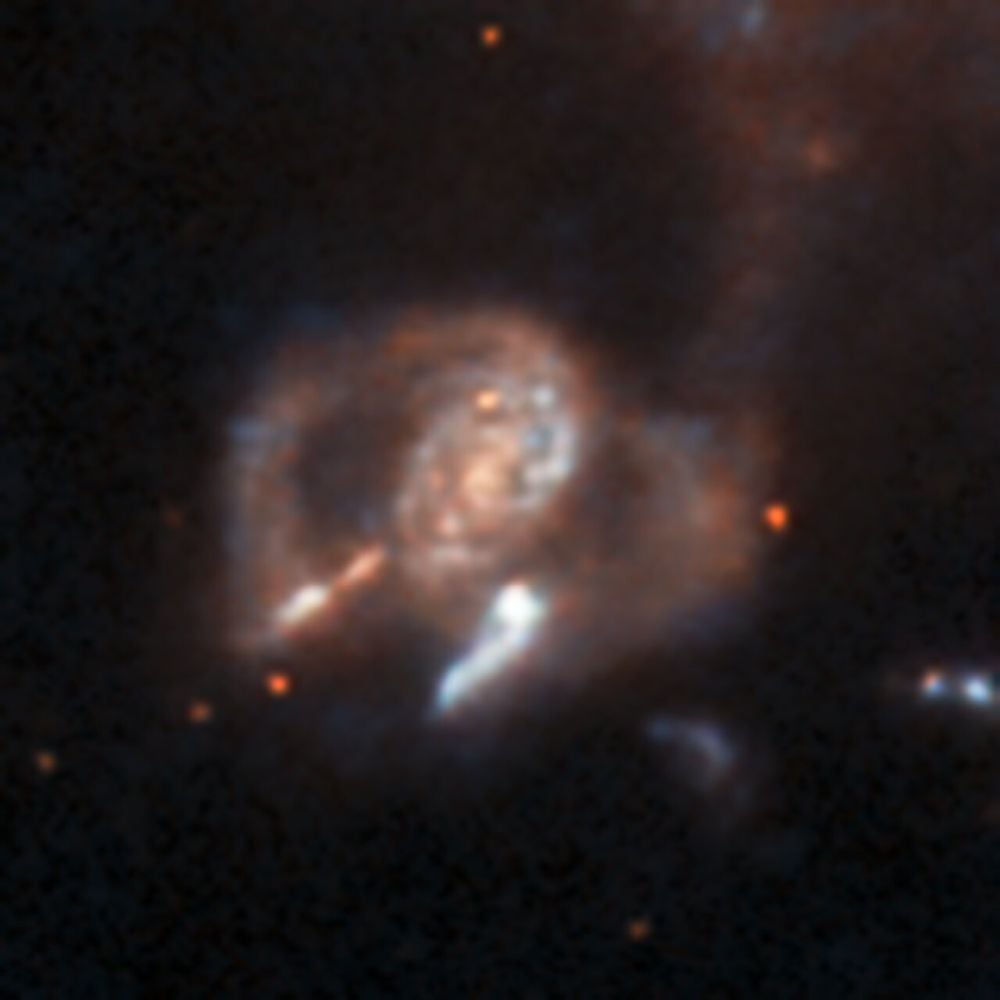
The research also turned up some anomalies with uncertain natures. One of them is a strange sight, a galaxy with a swirling core and open lobes.
This galaxy highlights the anomalous nature of some difficult-to-categorize objects. It's a bi-polar galaxy with a compact swirling core and an open lobe at each side. This object was newly-discovered and previously unknown. It's not clear what type of galaxy it is, and if it's strange morphology is related to a merger. Its discovery highlights the utility of AI tools to search through astronomical archives.
Image Credit: ESA/Hubble & NASA, D. O’Ryan, P. Gómez (European Space Agency), M. Zamani (ESA/Hubble)
Finding hidden surprises in vast quantities of astronomical data is an admirable use of AI. Along with the previously mentioned anomalies, the researchers also uncovered overlapping galaxies, clumpy galaxies, ring galaxies, and even high-redshift galaxies so close to detection limits they're difficult to discern. They also found jetted galaxies and AGN-hosting galaxies.
*This figure from the research shows five examples of every anomaly sub-class for which we found at least five objects, not including lensed quasars. These were selected as representative of each sub-class.
Image Credit: O'Ryan and Gomez 2026. A&A*
If all astronomical observations stopped tomorrow, the discoveries wouldn't stop. Capable AI tools are destined to become more and more powerful. Massive existing datasets from the Hubble and from other missions like the ESA's Gaia are feeding grounds for future tools.
Who knows what's waiting to be discovered in all that data?
“This is a powerful demonstration of how AI can enhance the scientific return of archival datasets,” Gómez said. “The discovery of so many previously undocumented anomalies in Hubble data underscores the tool’s potential for future surveys.”
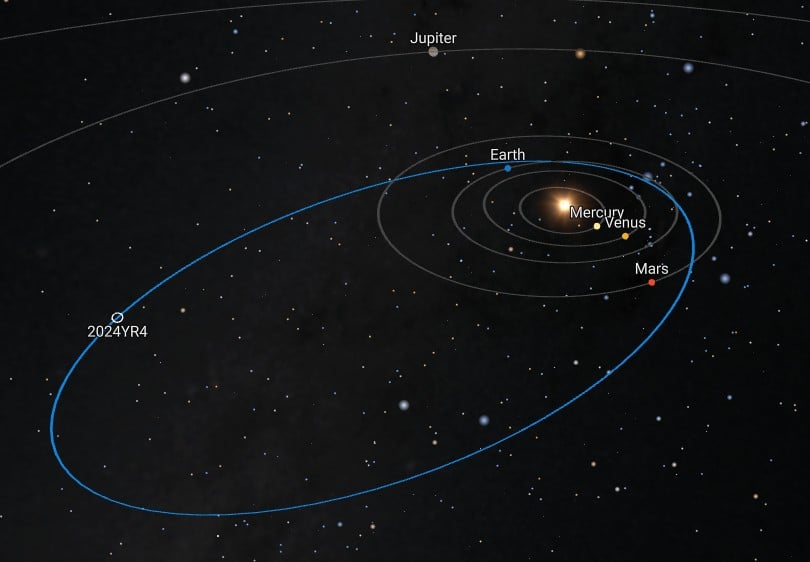
Oribtal path of Asteroid 2024 YR4. Credit - ESA Orbit Visualization Tool
There’s a bright side to every situation. In 2032, the Moon itself might have a particularly bright side if it is blasted by a 60-meter-wide asteroid. The chances of such an event are still relatively small (only around 4%), but non-negligible. And scientists are starting to prepare both for the bad (massive risks to satellites and huge meteors raining down on a large portion of the planet) and the good (a once in a lifetime chance to study the geology, seismology, and chemical makeup of our nearest neighbor). A new paper from Yifan He of Tsinghua University and co-authors, released in pre-print form on arXiv, looks at the bright side of all of the potential interesting science we can do if a collision does, indeed, happen.
On December 22nd, 2032, Asteroid 2024 YR4 has a 4% chance of actually striking the Moon. If it does, it will release enough energy to be the equivalent of smacking our nearest neighbor with a medium-sized thermonuclear weapon. It would be 6 orders of magnitude more powerful than the last major impact on the Moon, which happened back in 2013 and was caused by a much smaller meteoroid.
If it does hit the Moon, it will prove a serendipitous event for physicists who study high energy impacts. While they can simulate models of how the impact will go all they want, monitoring it as it happens will provide them with never-before collected actual data that is infeasible to get any other way. The impact will vaporize rock and plasma, and clearly be visible from the Pacific region, where it will be night during the impact.
Fraser discusses whether we should simply destroy Asteroid 2024 YR4.
Even days after the impact, the melt pool of the impacted material will still be cooling, allowing infrared observers like the James Webb Space Telescope to capture plenty of data on how that cooling process works, as well as how craters are actually formed on the Moon. It should form a crater roughly 1 km wide and 150-260 m deep, with a 100m pool of molten rock at the center. Comparing it in size to other craters scattered around the Moon will help us understand its bombardment history.
The impact will also set off a global “moonquake” of magnitude 5.0. That would be the strongest moonquake yet detected by any seismometer on the Moon, and there expected to be plenty more before that impact timeline as space agencies rush back to the Moon and begin to cover it with scientific equipment. Watching the propagation of the moonquake caused by the impact will shine a light on the Moon’s interior and help researchers understand its composition without having to blast it with anything artificial.
A final piece of the scientific puzzle will be the debris field created by the blast. Up to 400kg of it is expected to survive reentry to Earth, creating essentially a free “large scale” lunar sample return mission for astronomers. Despite the fact that the samples would be charred to a crisp by their atmospheric reentry. But if you’ve ever seen the episode The Eye in the show Andor or read the book Seveneves by Neal Stephenson, then you know how spectacular such a display can be. At its peak right around Christmas of 2032, simulations expect up to 20 millions meteors per hour to hit our atmosphere, and least on the “leading edge” of the planet - most of them with naked-eye visibility. Those would include some 100-400 fireballs (i.e. larger pieces) per hour.
VideofromSpace video showing the orbits of Asteroid 2024 YR4.
Credit - VideofromSpace YouTube Channel
But there is a downside to all of this. That 400kg of meteors have to land somewhere, and it looks like the cross-hairs fall squarely on South American, North Africa, and the Arabian peninsula. Not exactly the most built up areas of the world, but a few kg of space rock falling on Dubai could certainly cause some damage. But perhaps more dangerous is the risk to the satellite mega-constellations that plan such an important role in our modern-day navigation and internet systems. Such an event could trigger “Kessler Syndrome” and bring the entire network down over the span of a few short years, while also locking us out from being able to get anything else safely into orbit for much longer.
Due to the risks, some space agencies are already considering a deflection mission that would bump Asteroid 2024 YR4 out of the way of a potential lunar collision, but that has not been set in stone yet. Neither, for that matter, has the actual impact itself. It will only have a 4% chance of happening - not the same astronomical odds as winning the lottery, but not as high as a chance of rolling a Nat 20 in a D&D game. If the odds of that increase over the coming years, eventually we as a species will have to decide whether it's worth the effort to deflect it or not. And if we do, we might miss out on a whole bunch of cool science - but we almost might save our entire orbital infrastructure and a few lives directly to boot.
A bipartisan measure aiming to disclose U.S. government records related to UFOs has come under fire from top politicians in Washington, as advocates continue working against time to save the imperiled transparency effort, The Debrief has learned.
Earlier this year, Senate Majority Leader Chuck Schumer (D-NY) united with Senator Mike Rounds (R-SD) to introduce a 64-page proposal to bring about the disclosure of official information on what the U.S. government now calls unidentified anomalous phenomena (UAP). Dubbed the Unidentified Anomalous Phenomena Disclosure Act of 2023 (UAPDA), the proposal was cut from the same mold of an earlier law in 1992, which outlined the disclosure of records related to the JFK assassination in 1963.
The act was introduced as part of the National Defense Authorization Act (NDAA), an annual piece of legislation that authorizes funding for the U.S. Armed Forces and outlines the budget and operations for the Department of Defense in accordance with Article 1 Section 8 of the U.S. Constitution. Among the key components included in the legislation is a provision concerning eminent domain, whereby the U.S. government could effectively confiscate and appropriate any UAP technologies that are revealed to exist, as well as the creation of a presidential records review board similar to the one outlined in the 1992 law.
Senate Majority Leader Charles Schumer, who co-sponsored the UAP Disclosure Act
(Credit: Perisha Gates/Wikimedia Commons CC 2.0).
In July, the Senate version of the bill, which included the UAP legislation, was approved in an 86-11 vote, following a House vote that approved its version by a 219-210 vote. After each version of the bill was passed, the two chambers entered a formal conference process to negotiate between the two versions of the bill.
However, late last week, it was learned that Representatives Mike Turner (R-OH) and Mike Rogers (R-AL) were ramping up efforts to eliminate or significantly change the wording in the UAP Disclosure Act during negotiations in the NDAA conference.
The new developments, first reported by the Liberation Times last week, indicated that Turner, Chair of the House Permanent Select Committee on Intelligence, and Rogers, Chair of the House Armed Services Committee, had leveraged support from Senate Minority Leader Mitch McConnell (R-KY) and Speaker of the House Mike Johnson (R-LA), a move which cast significant doubts over whether the UAP Disclosure Act would make its way into the final version of the NDAA signed into law by President Biden.
A source close to the negotiations tells us that the NDAA conference is wrapping up. The outcome of The UAP Disclosure Act is uncertain and key terms like the civilian review board are at risk. The time to contact Congress is NOW.
Despite the grim forecast that emerged over the weekend, concerted efforts by a bipartisan coalition of advocates in recent days have resulted in a final push to leverage pressure against lawmakers to save the UAP Disclosure Act. The result has been a uniting of forces between players on opposite ends of the political spectrum, who are now fighting for a common goal: ending decades of U.S. government stonewalling on the issue of UAP.
The UAP Disclosure Act: ‘Must-Pass Legislation’
“The Schumer-Rounds UAPDA is must-pass legislation,” says Kevin Wright, Founder of Solve Advocacy, a Washington-area public relations and issue advocacy consulting firm. For more than two decades, Wright has worked in public relations involving everything from national issue campaigns and nonprofit statewide ballot initiatives to Presidential Super PACs.
However, with the introduction of the UAP Disclosure Act earlier this year, Wright, who also works as a volunteer with the Scientific Coalition for UAP Studies (SCU), a nonprofit group of scientists and other professionals devoted to the scientific investigation of UAP, has devoted most of his time to advocacy related to aerial mysteries.
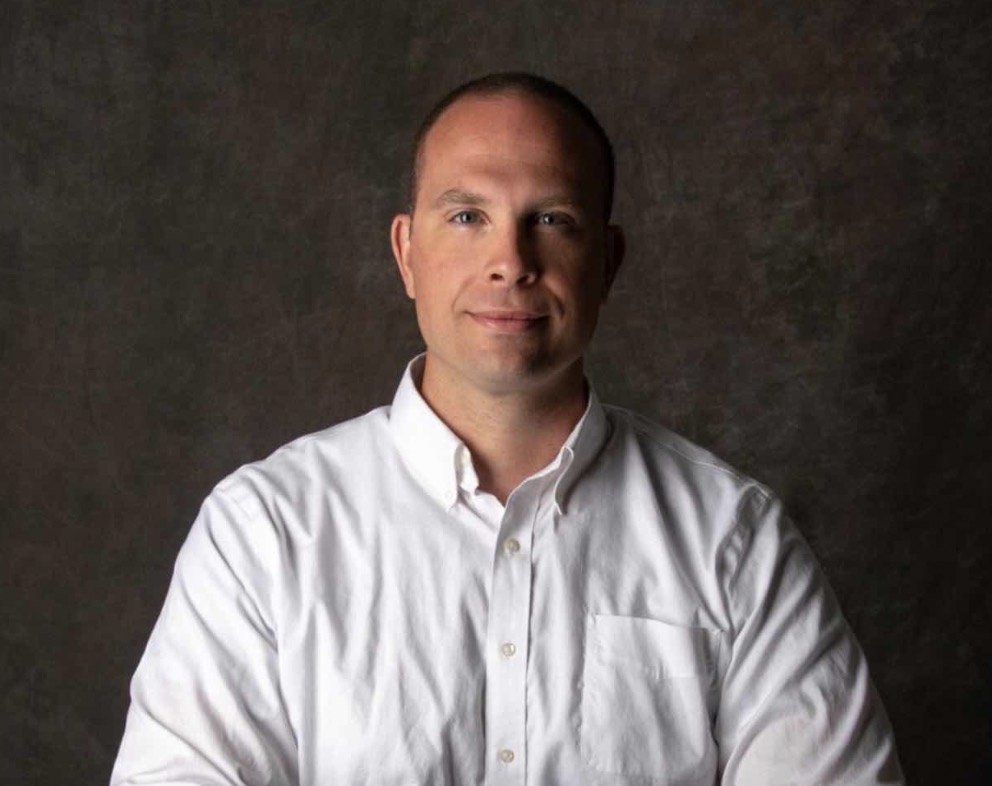
Kevin Wright, founder of Solve Advocacy
(Credit: K. Wright/X).
“The UAPDA provides a pathway for the government to finally free itself of what it has discovered over the past 80 or more years,” Wright told The Debrief. “It is a win for the public, thirsty for an honest and transparent government, and it is a win for a return to Constitutional constraints, providing elected officials and authorities delegated through public law to regain control of the government, including appropriate Congressional oversight.”
However, for Wright and the like-minded advocates he works with, the UAP Disclosure Act, if it were to pass, would not represent the end of the transparency campaign.
“As with any legislation, there are several foreseeable problems. We will all have to continue to advocate for greater transparency,” Wright says, no matter the outcome of the current battle, which many believe could significantly impact the Senate’s UAP provision if not halt it altogether.
The circumstances involving the embattled UAP Disclosure Act have led Wright, who in his professional career has worked mainly for Republican candidates, to join forces with colleagues on the opposite end of the political spectrum in their efforts to push for recognition among lawmakers of the significance of UAP transparency.
Fortunately for Wright, he finds himself in very good company.
Constitutional Law and UAP
A Harvard College, Harvard Law School, and Harvard Divinity School–trained Constitutional Litigation and Appellate Attorney, the events spanning Daniel Sheehan’s five decades as a constitutional and public interest lawyer read almost like a textbook on U.S. history, if not a Hollywood screenplay.
From the Pentagon Papers and Watergate to the Karen Silkwood case, the La Penca bombing, and the Iran Contra affair, Sheehan has litigated several of the 20th century’s landmark American legal cases. However, Sheehan’s advocacy involving what the U.S. government now calls unidentified anomalous phenomena has been his primary focus in recent years.
Attorney Daniel P. Sheehan is one of the leading advocates fighting for the UAP Disclosure Act and its inclusion in the 2024 National Defense Authorization Act
(Credit: www.danielsheehan.com).
Arguably, tat unwavering focus on applying constitutional law toward resolving mysteries in the skies also may never have been quite so significant as it has become in 2023, a year of similar landmarks in the effort to advance government transparency on UAP, all of which now appear to hang in the balance.
Sheehan’s professional journey began in 1968 when he co-founded the Harvard Civil Rights Law Review. Early in his career, alongside co-founder Mark Greene, Sheehan also initiated a case that would have significant ramifications for the way journalists report on government issues.
“One of the first cases that we actually did was the case that ended up establishing the rights of journalists to protect their confidential sources,” Sheehan told The Debrief. “This went all the way to the United States Supreme Court while we were still in law school. And because of that, I was retained by one of the top Wall Street corporate litigation law firms.”
That firm represented NBC News, a development that helped cement Sheehan’s role in several pivotal moments in U.S. legal history, including the 1971 leak of the Pentagon Papers and the Watergate scandal.
“We ended up being the ones that got called when The New York Times got the Pentagon Papers,” Sheehan remembers. “We had all the meetings and discussions with the New York Times board of editors about how we would go about publicly revealing what had been registered as top secret by the government, and over the top of the active resistance on the part of the Nixon administration, to stop us from getting the right to publish this.”
“Because of that, I developed a very positive relationship with a lot of investigative journalists,” Sheehan said. “And they began to reveal things to me.”
It was through his involvement with the Pentagon Papers and Watergate that Sheehan was exposed to the darker side of operations within the U.S. government, primarily the use of government authority to wage covert wars and maintain access to strategic raw materials for American corporations, often in violation of constitutional and ethical principles.
Seeking to address these systemic issues, he leveraged his background in foreign policy and comparative social ethics, ultimately becoming General Counsel at the U.S. Jesuit Headquarters. This role put him at the center of policy development in response to major government departments and agencies. His work also led to involvement with the Carter administration. At that time, Sheehan says he was tasked with working on classified UFO studies for the President, whose interest in the subject stemmed from a sighting of an unusual light one evening near Leary, Georgia, in 1969.
“I was contacted by the head of the Science and Technology Division of the Congressional Research Service, Dr. Marsha Smith, who had been asked by President Carter to prepare two originally classified reports to him,” Sheehan said. “One was on the potential likelihood of there being an extraterrestrial civilization, and the second one was whether or not any of at least some of these UFO encounters in sightings might actually be a vehicle from an extraterrestrial civilization.”
Sheehan said it had been in that context that he was given access to classified portions of Project Blue Book, the United States Air Force’s investigation into UFOs during the 1950s and 1960s.
“It was there that I saw actual photographs of a crash retrieval project that was underway,” Sheehan says.
Although the images would be the most compelling thing he observed during his time working with the Carter Administration, it was only the beginning of Sheehan’s professional involvement with UFOs. He would go on to represent the late Dr. John Mack at Harvard University, who, prior to his untimely death in 2004, had been one of the most prominent proponents of human encounters with the unexplained. Sheehan also became counsel for the Disclosure Project, the Citizens Hearings on UFO Disclosure, and more recently, he has represented individuals like Lue Elizondo, who came forward with information about the U.S. government’s secret UFO programs and faced retaliation.
For Sheehan, the efforts to bring transparency and constitutional oversight to the issue of UFOs and the possible existence of extraterrestrial life have benefited greatly from the involvement of figures like Senator Marco Rubio (R-Fl) and Senator Kirsten Gillibrand (D-NY), two of the more prominent elected officials within a bipartisan coalition aiming to protect whistleblowers and, more fundamentally, help to broaden our view of the world around us.
“What we’re experiencing right now is a coalition of true patriots and true Americans who are trying to resuscitate and reestablish the constitutional oversight authority of our government over this extraordinary issue of whether or not we actually exist in the midst of a much larger interstellar culture,” Sheehan told The Debrief.
From civil rights advocacy and challenging covert government operations to the question of whether the U.S. government is withholding significantly more about its involvement with UFOs than has been publicly acknowledged, the common threads running throughout all of Sheehan’s work are a dedication to constitutional governance, ethical transparency, and the pursuit of a more informed and expansive human perspective.
“This is an extraordinary subject, which requires the development of a new human worldview,” Sheehan says. “That’s why our New Paradigm Institute is been designated as one of the groups that is to recommend nominees for a presidential panel to be appointed to oversee this process.”
“And that’s where we find ourselves today.”
Trouble on Capitol Hill
Despite the efforts of advocates like Sheehan, Wright, and countless others on the issue of UAP transparency, the fate of the UAP Disclosure Act currently remains in question.
During a recent appearance on The Joe Rogan Experience, David Grusch, a former intelligence officer turned whistleblower who alleges the U.S. has recovered craft of non-human origin and illegally withheld that information from Congress, as first reported by The Debrief in June, addressed the current pushback from House lawmakers on the UAP Disclosure Act.
Former U.S. intelligence official David Grusch came forward with allegations about U.S. involvement in the retrieval of a craft of unknown origin in June 2023
(Credit: David Grusch).
“For one, they’re saying it duplicates the DoD AARO’s activities,” Grusch told Rogan during the podcast, naming Representatives Mike Rogers and Mike Turner among those who are blocking the UAP Disclosure Act. Grusch also emphasized Turner’s proximity to Wright Patterson Air Force Base, the headquarters of the Air Force Materiel Command with a deep history in aerospace innovation in Dayton, Ohio. Notably, Wright Patterson had also been the home of Project Bluebook, the Air Force’s official investigation into UFOs throughout the 1950s and 1960s.
According to data made available by OpenSecrets.org, the website of the Center for Responsive Politics, a non-profit, non-partisan research group that tracks money in U.S. politics, Rep. Mike Turner’s largest 2023-2024 campaign contributors are listed as “Misc Defense” at $62,350, followed by “Defense Aerospace” at $46,300.
During the 2022 election cycle, Rep. Mike Rogers was the largest recipient of funding from the defense sector by a wide margin, according to data made available by OpenSecrets.org (see below). Similarly, listed among the largest contributions to Rep. Rogers in 2023-2024 were “Misc Defense” at $121,200, down significantly from the $282,350 he received in the previous election cycle, during which the largest contribution from a single contributor had been $60,750 from Lockheed Martin.
“So, I have a problem with Mike and Mike right now,” Grusch told Rogan on the podcast. Grusch also specifically named Lockheed Martin as a possible recipient of portions of the exotic technologies that he learned of during his tenure as an intelligence officer, further describing visits with the late Nevada Senator Harry Reid, who had expressed similar views in the past.
“I was told for decades that Lockheed had some of these retrieved materials,” Reid told The New Yorker in April 2021. “And I tried to get, as I recall, a classified approval by the Pentagon to have me go look at the stuff. They would not approve that.” Reid, speaking with journalist Gideon Lewis Krauss, said he was repeatedly denied clearance to view these materials. Attempts by The New Yorker to obtain a statement from Lockheed Martin about the alleged issue at that time were declined.
In July, following a Congressional hearing where Grusch testified alongside former U.S. Navy pilots David Fravor and Ryan Graves about U.S. government issues related to UAP, Rep. Turner expressed doubts when asked by Fox News host Maria Bartiromo to comment on testimony Grush provided about biologics he said were recovered along with alleged past acquisitions of exotic craft.
“Maria, I always love it when you have somebody who comes forward and testifies about things that they don’t know anything about,” Turner told Bartiromo on July 30, 2023. “I mean… the most striking aspect of all the testimony was, repeatedly over and over again, the whistleblowers had to say, actually, I don’t have any knowledge of this. Somebody else told me that.”
Rep. Mike Turner during a visit to Ukraine in April
(Public Domain).
“I mean, really, this would take thousands and thousands of people for such an unbelievable coverup to be occurring, and for people to speak with such, um, you know, confidence over something that they do not know is, I think, something that certainly everybody needs to be concerned about,” Turner added.
“I certainly can’t tell you that there are no aliens here,” Turner told Bartiromo. “I can tell you that, certainly, there’s no evidence that what the gentleman is testifying about he has, he said himself personally, he has no direct knowledge of.”
Rep. Turner has consistently downplayed the UAP issue in interviews and, in some instances, appears to have refused to respond to questions about the subject altogether. However, while insinuations that pressure from defense contractors could be motivating lawmakers like Turner and Rogers to work against the current UAP legislation, it is noteworthy that several other House Republicans have continued to demand funding cuts to portions of the bill that are unlikely to pass the Senate, which include items unrelated to UAP such as climate, environment and nuclear energy programs.
Whatever the true motivations of lawmakers who are currently working to block the UAP disclosure provisions in the Senate version of the bill might be, Sheehan argues that the recent allegations made by whistleblowers like David Grusch nonetheless point to the existence of a bureaucratic element within the U.S. government, which has effectively worked to conceal the full extent of the U.S.’s involvement with the acquisition of UAP materials over the decades.
If the UAPDA were to pass, Sheehan says the nine-person panel it would establish would “have the power to extract this information from the deep state elements that have it and bring it into the hands of the United States Congress.”
“There appears to be solid and believable evidence that somehow this technology has been secretly and unlawfully turned over to private industry,” Sheehan told The Debrief. “[It] has been turned over to the high-tech aerospace industries, such as Lockheed Martin and Raytheon.”
“This is an extraordinarily important issue that our American people need to weigh in on, about whether or not we believe that that’s an appropriate use of this information,” Sheehan says.
Sheehan also says that two specific provisions within the UAPDA—those involving eminent domain and subpoena power—were key targets for those in the House who have recently opposed the amendment.
“Mike Turner first attacked those two elements,” Sheehan told The Debrief. “[He said] we want the eminent domain provision out of here, and we want the subpoena power out of here. And when our people that were working on this responded to the statute by saying, ‘Why would you be so worried about the eminent domain provision if you don’t have any of the technology, as you keep on insisting?’ At which point they retreated to an abstract argument on behalf of libertarian values of not having to state, you know, overreach, and to be able to seize private property.”
“Our response was, how many other issues have you raised on this on, you know, being opposed to the entire concept of eminent domain?”
“None. Just this one,” Sheehan told The Debrief. “Then they retreated and said, ‘Okay, well, then we’re going to take a position to oppose completely allowing anything in this bill to be put into the National Defense Authorization Act.’”
“What we’ve got to do is concentrate on not only all of the other members of the House Intelligence Committee, virtually all of whom support this bill other than the chairman, who comes from the Wright Patterson Air Force Base, basically. And then there’s one other person who is Michael Rogers, the head of the House Armed Services Committee. And he’s from the second congressional district down in Alabama, right next door to the Redstone Arsenal.”
Rep. Mike Rogers of Alabama
(Public Domain).
“People in both of those districts, the 10th Congressional District in Ohio, and the Second Congressional District down in Alabama, need to write to them, send cables to them, send emails to them… go sit in their office to talk to them, you know, to get them to back off this,” Sheehan told The Debrief.
“They have a constitutional duty, as the chairs of those committees in the Congress, to get this information, and they are absolutely placing their own personal financial campaign contributions above getting this information into the hands of the Congress, which is constitutionally mandated to exercise oversight over this program.”
“So that’s where the bill is right now.”
The UAP Disclosure Act: An Unprecedented Bipartisan Issue
For UAP advocates like Sheehan and Wright, as well as several members of Congress and others in Washington, efforts toward achieving broader government transparency on the UAP issue have helped to unite individuals from opposing political backgrounds in an unprecedented way, bringing them together to focus on a common cause.
“Government transparency is an issue that cuts across party lines,” Wright told The Debrief. “Regardless of political persuasion, people expect their government to be honest and transparent.”
“That is also true for lawmakers,” Wright says. “In fact, it might be even more important for them, regardless of party, when they find out they are being lied to and denied proper oversight. The UAP angle makes it even more compelling given the subject matter of possible non-human intelligence (NHI), [of] which polls show a heightened level of interest and a high level of distrust when it comes to the government.”
“What difference does it make if you are a Republican or a Democrat, if the government knows more than it has admitted, and if there is an NHI involved? People simply want, and have a right, to know,” Wright says.
Wright admitted that his work with Sheehan might never have occurred if had not been for their mutual advocacy of UAP, given the usual partisanship that occurs in Washington; a divisiveness in American politics that now could well prevent the UAP Disclosure Act from ever becoming law.
“There would likely never be an issue or cause that would find Danny and me working together,” Wright tol The Debrief.
“We stand at different ends of the political spectrum in most instances, except for government transparency, and believing the people have a right to know the truth about UAP and NHI.”
“And this issue is too important to let political affiliations get in the way.”
The Doomsday Clock, which has been ticking down to the end of the world for decades, is now officially closer to annihilation than ever before.
On Tuesday, scientists with the Bulletin of Atomic Scientists moved the symbolic clock four seconds forward to85 seconds to midnight.
It's also the closest the clock has ever been to midnight in its 79-year history, meaning experts believe humanity has never faced a more dire threat of a world-ending catastrophe than it does in 2026.
The group, which decides where the hands are set annually, cited multiple threats to global stability, including nuclear weapons, climate change, disruptive technologies like AI, and the creation of synthetic biological substances called 'mirror life.'
Alexandra Bell, president and CEO of the Bulletin of Atomic Scientists, said: 'Every second counts and we are running out of time. It is a hard truth that this is our reality. This is the closest our world has ever been to midnight.'
The Chicago-based nonprofit created the Doomsday Clock in 1947 during the Cold War as tensions between the US and the Soviet Union brought the constant fear of a nuclear apocalypse.
This is the second year in a row that the Doomsday Clock has moved closer to midnight - the hypothetical point where the world will end. Until 2020, the clock had never been closer than two minutes to midnight.
Daniel Holz, chair of the Bulletin's Science and Security Board, said: 'Last year, we warned that the world was perilously close to catastrophe and that countries needed to change course towards international cooperation and action on the most critical and existential risks. Unfortunately, the opposite has happened.'
The Bulletin of Atomic Scientists moved the 'Doomsday Clock' four seconds closer to midnight - the theoretical point of world annihilation
The US, Israel, Iran, and Russia all warned in 2025 that a catastrophic global war could be nearing as the crisis in the Middle East and Ukraine reached a breaking point
Holz added that nuclear-armed nations became even more adversarial and nationalistic in 2025 and influenced the four-second jump, the largest move forward since 2023 when scientists cut it from 100 to 90 seconds to midnight.
'The latest remaining treaty governing nuclear weapon stockpiles between the US and Russia expires next week. For the first time in over half a century, there will be nothing preventing a runaway nuclear arms race,' Holz revealed.
Any time the Doomsday Clock has moved forward has been said to signify humanity's failures to make progress in solving the global threats of the past 12 months.
Every year, the Doomsday Clock has been updated based on how close humanity theoretically is to total annihilation.
If the clock goes forward and gets a few minutes or seconds closer to midnight (compared with where it was set the previous year), it suggests humanity has moved closer to self-destruction.
If it moves further away from midnight, it suggests humanity has lowered the risks of global catastrophe since the same point last year.
In some years, the hands of the clock don't move at all, suggesting global tensions and threats worldwide haven't changed for better or worse.
It has been moving steadily closer to the predicted end of the world since 2011, when it was still six minutes from midnight.
In 2025, the US, Iran, and Israel were involved in a deadly conflict in the Middle East, with the US sending a precision bombing mission to attack Iran's nuclear facilities
Rhe Bulletin's Science and Security Board added that climate change has also escalated over the last year, with global sea levels reaching record highs.
'Droughts, floods, fires, and storms continue to intensify and become more erratic, and this will only get worse,' Holz predicted.
Additionally, the expert warned of 'mirror life,' which are synthetic organisms built completely backwards compared to normal DNA, which scientists believe could help develop advanced medicines.
However, many scientists fear the threat posed by these lab-made substances, as they are totally incompatible with normal DNA, raising the threat of an unstoppable pandemic.
'Despite repeated warnings from scientists worldwide, the international community has no coordinated plan and the world remains unprepared for potentially devastating biological threats,' Holz said.
As for so-called 'disruptive technologies,' the security board's chair singled out artificial intelligence (AI) for 'supercharging mis- and disinformation.'
Dr Leonard Rieser, Chairman of the Board of the Bulletin of the Atomic Scientists, moves the hand of the Doomsday Clock back to 17 minutes before midnight at offices near the University of Chicago on November 26, 1991
Last year, the Bulletin moved the clock to 89 seconds to midnight, citing the ongoing Russia-Ukraine war, conflicts in the Middle East, the threat of nuclear war, climate change, a potential bird flu pandemic, and the so-called 'arms race' to develop AI.
Russia's 2022 invasion of Ukraine has led to Europe's bloodiest conflict since World War II, with unconfirmed estimates estimating the death toll reaching one million people in 2026.
Meanwhile, multiple conflicts involving the US broke out in the last year, as the Trump Administration launched a bombing of Iran's nuclear facilities and arrested Venezuelan leader Nicolás Maduro and his wife during a covert raid in Caracas.
Tensions have even flared between the US and its allies in NATO, as President Trump vies to take control of Greenland, a current territory of Denmark, citing its importance to national security against Russia and China.
'If the world splinters into an "us versus them" zero-sum approach, it increases the likelihood that we all lose,' Holz warned.
Although symbolic and not an actual clock, the Bulletin of the Atomic Scientists unveiled a physical 'quarter clock' model at an event on Tuesday when they delivered the news of their estimate for 2026.
After the unveiling, the model can be found located at the Bulletin offices in the Keller Center, home to the University of Chicago Harris School of Public Policy.
The Doomsday Clock goes back to June 1947, when US artist Martyl Langsdorf was hired to design a new cover for the Bulletin of the Atomic Scientists journal
Every January, the Bulletin of Atomic Scientists reveals its annual update to the Doomsday Clock – even if the hands are not moved.
The Doomsday Clock officially came into existence in June 1947, when US artist Martyl Langsdorf was hired to design a new cover for the Bulletin of the Atomic Scientists journal.
With a striking image on the cover, the organization hoped to 'frighten men into rationality' as the Cold War seemed destined to go nuclear, according to Eugene Rabinowitch, the first editor of the journal.
The clock was initially set at seven minutes to midnight because 'it looked good to my eye,' Langsdorf later said.
On the cover of later issues, the hands of the clock were adjusted based on how close civilization was estimated to be to catastrophe.
After the Soviet Union successfully tested its first atomic bomb in 1949, Rabinowitch reset the clock from seven minutes to midnight to three minutes to midnight.
Since then, it has continued to move forward and backwards, now moving within a minute and a half of total destruction.
In 2009, the Bulletin ceased its print edition, but the clock has still been updated once a year on its website and is now a much-anticipated highlight of the scientific community.
A new AI app is helping to rewrite the evolution of flight.
The app, developed by researchers from the University of Edinburgh, has been used to analyse footprints made by dinosaurs more than 200 million years ago.
The results show that several tracks share 'uncanny' features with both extinct and modern birds.
According to the researchers, this suggests that birds could have originated 60 million years earlier than we thought.
'This study is an exciting contribution for paleontology and an objective, data–driven way to classify dinosaur footprints – something that has stumped experts for over a century,' said Professor Steve Brusatte, an author of the study.
'It opens up exciting new possibilities for understanding how these incredible animals lived and moved, and when major groups like birds first evolved.
'This computer network might have identified the world's oldest birds, which I think is a fantastic and fruitful use for AI.'
A new AIapp is helping to rewrite the evolution of flight. The app, developed by researchers from the University of Edinburgh, has been used to analyse footprints made by dinosaurs more than 200 million years ago
While dinosaur footprints are an important indicator of our evolution, they've proved difficult to interpret.
Until now, scientists have largely relied on manual methods, which introduce an element of bias.
To rectify this issue, the team developed a new AI app dubbed the DinoTracker, which uses advanced algorithms to recognise dinosaur footprints.
To train the app, the researchers fed it nearly 2,000 fossil footprints alongside millions of variations to mimic changes such as compression and edge displacement.
Amazingly, tests have revealed that DinoTracker can now identify dinosaur footprints with 90 per cent accuarcy – even for contentious species.
One of the most interesting discoveries by the app was the resemblance between several dinosaur tracks and those left by birds.
According to the researchers, this either suggests that birds originated tens of millions of years earlier than thought, or that some dinosaurs had feet that resembled birds by coincidence.
The researchers also fed the AI app images of footprints from the Isle of Skye in Scotland, which have left scientists baffled.
One of the most interesting discoveries by the app was the uncanny resemblance between several dinosaur tracks and those left by birds
Its analysis suggests that the tracks may have been left around 170 million years ago by some of the oldest relatives of duck-billed dinosaurs.
Looking ahead, the researchers hope the tool will help to improve our understand of how dinosaurs lived and moved around the Earth.
Dr Gregor Hartmann of Helmholtz–Zentrum research centre, and co-author of the study, said: 'Our method provides an unbiased way to recognize variation in footprints and test hypotheses about their makers.
'It's an excellent tool for research, education, and even fieldwork.'
A poem written over 120 years ago by a revered religious figure has resurfaced as some fear its prediction of an apocalyptic event could be coming true today.
Hazrat Mirza Ghulam Ahmad, also known as the Promised Messiah and the Imam Mahdi, wrote a 1905 poem describing massive earthquakes and destruction across the world, which some have now interpreted as awarning of World War III.
In the poem, published around the time of his death in 1908, Ahmad predicted streams of blood flowing from widespread death, entire regions being wiped out, a massive earthquake, and even strange sky events beyond scientific explanation.
It mentions of calamity befalling the Czar of Russia has been seen by some as foreshadowing modern conflicts involving Russia, such as the war in Ukraine and continued tensions with the US and NATO.
'A sign will come some days hence, which will turn over villages, cities and fields. Wrath of God will bring a revolution in the world, the undressed one would be unable to tie his trousers,' Ahmad's 1905 poem described.
'Suddenly, a quake will severely shake, mortals, trees, mountains and seas, all. In the twinkling of an eye, the land shall turn over, streams of blood will flow like rivers of water.'
Ahmad, born in 1835 in Qadian, India, founded the Ahmadiyya Movement in Islam and dedicated his life to defending his faith against criticisms from other religions, such as Christianity. He also claimed to receive multiple divine revelations.
Ahmad's followers believe he was divinely appointed as the guided leader expected in Islamic End Times prophecies.
A 1905 poem and prophecy of global destruction by Hazrat Mirza Ghulam Ahmad has resurfaced as some believe it is close to coming true
(Stock Image)
The poem described a devastating earthquake which would shake 'mortals, trees, mountains and seas,' just as recent natural disasters, like the March 2025 quake in Myanmar
(Pictured)
There is some skepticism about the potential ties to current world tensions, as Russia no longer has a Czar in 2026 and some believers have suggested that Ahmad's predictions referred to a major earthquake in India before his death.
In his book Barahin-e-Ahmadiyya, written in the late 1800s, Ahmad wrote that a 'warner came unto the world, but the world accepted him not,' which believers have suggested meant disasters and wars would break out after a divine messenger was rejected by the people.
'There will be death on such a large scale that streams of blood will flow. Even birds and grazing animals will not escape this death,' the religious leader foretold.
'Those days are near, indeed they are at the door, when the world shall witness the spectacle of a doomsday.'
He also spoke of 'mighty assaults' from God and heaven that seemed to depict the launching of missiles in a global war, and the immense distress this would cause the leader of Russia.
'The terror of it will exhaust everyone, the great and the small, even the Czar will be at that hour in a state of the utmost distress,' Ahmad wrote in the poem.
'It will be a glimpse of wrath, that heavenly sign, the sky shall draw its dagger to attack.'
The poem also described the wrath of God assaulting from heaven and the sky drawing 'its dagger to attack,' similar to the image of a missile flying through the air (Stock Image)
Hazrat Mirza Ghulam Ahmad (Pictured) was the founder of the Ahmadiyya Movement in Islam and promoted the religion as a peaceful and tolerant faith
Despite his dire warnings of the future, Ahmad's main goal for the founding of the Ahmadiyya Movement was to present Islam as a peaceful, tolerant, and rational religion based on the Quran and the example of the Prophet Muhammad.
After Ahmad's death in 1908, the Ahmadiyya movement split into two main branches due to disagreements over their late leader's exact religious status.
Ahmadiyya Muslim Community sees him as a subordinate prophet under Muhammad, while the Lahore branch views him strictly as a reformer without prophethood.
However, both acknowledge the existence of the 1905 poem and its prophecy of a cataclysmic event following Ahmad's death, which both branches suggest includes events that have already taken place.
Specifically, Lahore interpreted Ahmad's warning to be about World War I, which began in 1914. Meanwhile, the Ahmadiyya Muslim Community has suggested that the quake mentioned by Ahmad described major seismic events in India.
However, the prophecy has resurfaced in 2026 as scientists in the US prepare to update the so-called Doomsday Clock, which is said to show how close the world is to a man-made global catastrophe, such as nuclear war.
As of last year, the clock has sat at 89 seconds to midnight, the closest it has ever come in its 78-year history of reaching the presumed End Times.
High-resolution map shows dark matter's gravity pulled normal matter into galaxies
High-resolution map shows dark matter's gravity pulled normal matter into galaxies
The James Webb Space Telescope in space near Earth.
Credit: NASA/dima_zel
Scientists have created the highest resolution map of the dark matter that threads through the universe—showing its influence on the formation of stars, galaxies and planets.
The research, including astronomers from Durham University, UK, tells us more about how this invisible substance helped pull ordinary matter into galaxies like the Milky Way and planets like Earth.
The findings, using new data from NASA's James Webb Space Telescope (Webb), are published in the journal Nature Astronomy.
The study was jointly led by Durham University, NASA's Jet Propulsion Laboratory (JPL), and the École Polytechnique Fédéral de Lausanne (EPFL), Switzerland.
In 2007, astronomers produced the first detailed map of the hidden dark matter of the COSMOS field. By measuring how gravity from unseen matter bends the light of background galaxies, the map shows how dark matter is distributed and acts as the hidden framework on which visible galaxies are built.
Credit: NASA, ESA and R Massey (California Institute of Technology).
The new map confirms previous research and provides new details about the relationship between dark matter and the normal matter from which we—and everything we can touch or see—are made.
When the universe began, dark matter and normal matter were probably sparsely distributed.
Scientists think dark matter clumped together first and then pulled in normal matter, creating regions where stars and galaxies began to form.
How dark matter shaped the universe
Using data from the James Webb Space Telescope, astronomers have produced one of the most detailed maps to date of dark matter. By measuring how gravity from unseen matter bends the light of background galaxies, the map shows how dark matter acts as the hidden framework on which visible galaxies are built. The overlaid contours mark regions of equal dark-matter density, highlighting where this invisible matter—shown here in a blue color—is most strongly concentrated.
Credit: Dr. Gavin Leroy/COSMOS-Webb collaboration.
In this way, dark matter determined the large-scale distribution of galaxies we see in the universe today.
By prompting galaxy and star formation to begin earlier than they would have otherwise, dark matter also played a role in creating the conditions for planets to eventually form. Without it we might not have the elements in our galaxy that allowed life to appear.
Using data from the James Webb Space Telescope, astronomers have produced one of the most detailed maps to date of dark matter. By measuring how gravity from unseen matter bends the light of background galaxies, the map shows how dark matter acts as the hidden framework on which visible galaxies are built. Here the Dark matter map from the JWST telescope is framed inside the original HST map from 2007.
Credit: Dr. Gavin Leroy/Professor Richard Massey/COSMOS-Webb collaboration.
Research co-lead author Dr. Gavin Leroy, of the Institute for Computational Cosmology, Department of Physics, Durham University, said, "By revealing dark matter with unprecedented precision, our map shows how an invisible component of the universe has structured visible matter to the point of enabling the emergence of galaxies, stars, and ultimately, life itself.
Using data from the James Webb Space Telescope, astronomers have produced one of the most detailed maps to date of dark matter. By measuring how gravity from unseen matter bends the light of background galaxies, the map shows how dark matter acts as the hidden framework on which visible galaxies are built.
Credit: Dr. Gavin Leroy/Professor Richard Massey/COSMOS-Webb collaboration.
"This map reveals the invisible but essential role of dark matter, the true architect of the universe, which gradually organizes the structures we observe through our telescopes."
Understanding dark matter's elusive nature
This map shows the Dark Matter distribution in the COSMOS field observed by the Hubble Space Telescope (left) and by the James Webb Space Telescope (right). The overlaid contours mark regions of equal dark-matter density, highlighting where this invisible matter—shown here in a blue color—is most strongly concentrated.
Credit: Dr. Gavin Leroy/Professor Richard Massey/COSMOS-Webb collaboration.
Dark matter does not emit, reflect, absorb, or block light, and it passes through regular matter like a ghost.
However, it does interact with the rest of the universe through gravity, something the new map shows with a new level of clarity.
Evidence for this interaction lies in the degree of overlap between maps of dark matter and normal matter.
According to the research, Webb's observations confirm that this close alignment cannot be a coincidence. Instead, the astronomers say it is due to dark matter's gravity pulling normal matter toward it throughout cosmic history.
The Dark Matter distribution in the COSMOS field observed by the Hubble Space Telescope (left) and by James Webb Space Telescope (right).
Credit: Dr. Gavin Leroy/Professor Richard Massey/COSMOS-Webb collaboration.
Research co-author Professor Richard Massey, in the Institute for Computational Cosmology, Department of Physics, Durham University, said, "Wherever you find normal matter in the universe today, you also find dark matter.
"Billions of dark matter particles pass through your body every second. There's no harm, they don't notice us and just keep going.
"But the whole swirling cloud of dark matter around the Milky Way has enough gravity to hold our entire galaxy together. Without dark matter, the Milky Way would spin itself apart."
Mapping the universe with Webb
The area covered by the new map is a section of sky about 2.5 times larger than the full moon, in the constellation Sextans.
Webb peered at this region for a total of about 255 hours and identified nearly 800,000 galaxies, with many detected for the first time.
The scientific team then looked for dark matter by observing how its mass curves space itself, which in turn bends the light traveling to Earth from distant galaxies—as if the light of those galaxies has passed through a warped windowpane.
The map contains about 10 times more galaxies than maps of the area made by ground-based observatories and twice as many as the Hubble Space Telescope.
It reveals new clumps of dark matter and captures a higher-resolution view of the areas previously seen by Hubble.
Sharper images and future research
Research co-lead author Dr. Diana Scognamiglio, of NASA's Jet Propulsion Laboratory, said, "This is the largest dark matter map we've made with Webb, and it's twice as sharp as any dark matter map made by other observatories.
"Previously, we were looking at a blurry picture of dark matter. Now we're seeing the invisible scaffolding of the universe in stunning detail, thanks to Webb's incredible resolution."
To refine measurements of the distance to many galaxies for the map, the team used Webb's Mid-Infrared Instrument (MIRI).
Durham University's Center for Extragalactic Astronomy was involved in the development of MIRI, which was designed and managed through launch by JPL.
The wavelengths detected by MIRI make it adept at detecting galaxies obscured by cosmic dust clouds.
The team next plans to map dark matter throughout the entire universe, using the European Space Agency's (ESA) Euclid telescope and NASA's upcoming Nancy Grace Roman Space Telescope.
They will learn more about dark matter's fundamental properties and how dark matter might have changed over cosmic history.
However, that patch of sky studied in this latest research will be the reference on which all future mapping will be fine-tuned and compared.
More information:
Diana Scognamiglio, An ultra-high-resolution map of (dark) matter, Nature Astronomy (2026).
Underground shelters for the chosen, silence for the masses
Underground shelters for the chosen, silence for the masses
Back in 2013, we reported on the so-called elite survival bunkers and the notorious Deep Underground Military Bases — the D.U.M.B.s. Curiously, the rumors never faded. If anything, they feel more relevant today than ever.
Despite the public silence, world powers may already be aware of a looming global crisis, yet choose to say nothing. While the masses are distracted, preparations appear to continue behind closed doors.
Mainstream media keeps its spotlight fixed on geopolitical tension, conveniently ignoring escalating environmental and planetary risks. Governments offer no clear explanation. Scientists remain reserved. The pattern speaks for itself.
Evidence suggests the world’s major governments have been preparing for catastrophe far longer than most people realize.
Across continents, state agencies, defense contractors, and major corporations have accelerated underground construction to unprecedented levels. In the United States, massive subterranean complexes are being excavated in remote and restricted regions, well beyond public oversight. China has quietly built unusually deep subway networks beneath key cities, resembling a crash infrastructure program. Russia went public in 2011 with plans for roughly 5,000 new nuclear shelters for Moscow alone, while newer metro lines were designed to double as hardened bunkers.
More recently, former HUD official Catherine Austin Fitts alleged that the U.S. has been covertly constructing an underground “breakaway” civilization for the elite, designed for near extinction-level scenarios. She claimed trillions in unaccounted federal funds were diverted into subterranean infrastructure, including an underground command grid for continuity of government during nuclear war or worse, as well as advanced transit systems.
One acknowledged D.U.M.B. is the Cheyenne Mountain Complex, arguably America’s most secure and secretive military fortress. Imagine what else they've built. ( Video : take a look at the inside the Cheyenne Mountain Complex.)
Economist Mark Skidmore of Michigan State University reviewed federal financial discrepancies and concluded in 2017 that roughly $21 trillion in “unauthorized expenditures” occurred between 1998 and 2015 within the Department of Defense and the Department of Housing and Urban Development. One Army report alone listed $6.5 trillion in unsupported adjustments for fiscal year 2015 — fifty times its official budget.
After examining the missing trillions, Fitts estimated that at least 170 underground installations exist within U.S. territory, some rumored to extend beneath oceans and interconnect via classified high-speed transit systems. According to her, these would function as sanctuaries if governments anticipated a civilization level collapse.
Hollywood has long been accused of predictive programming, quietly introducing future technologies, events, or disclosures into films and entertainment well before they surface in reality. In the context of underground survival infrastructure, the film Greenland is frequently cited. Its storyline depicts an extinction-level disaster in which ordinary citizens are abandoned while selected individuals are quietly evacuated to fortified subterranean facilities, including a base beneath Greenland.
Confirmed or not, the pattern is hard to ignore: powerful institutions appear to be preparing for contingencies the public is not being informed about. And if the worst comes, one uncomfortable possibility emerges, the general population may be left to fend for itself.
In 2026, NASA will move from long-running development and testing into a phase defined by action, readiness, and progress. After years shaped by delays, redesigns, and risk reductions, many of NASA's most ambitious programs are finally lining up for execution. The result will be a year that could redefine how humans explore space and how science missions are delivered. Human spaceflight is once again the central focus.
After more than 50 years, humans are planning to return to the Moon. At the same time, the agency is testing new ways to communicate across deep space, manage crews, and operate complex systems from Earth. Meanwhile, the next-generation Nancy Grace Roman telescope is finished and preparing to launch, while NASA continues to build strong partnerships with commercial companies to improve its means to search for life outside Earth. Together, these efforts make 2026 more than just another year of planning. It represents a moment when planning turns into progress.
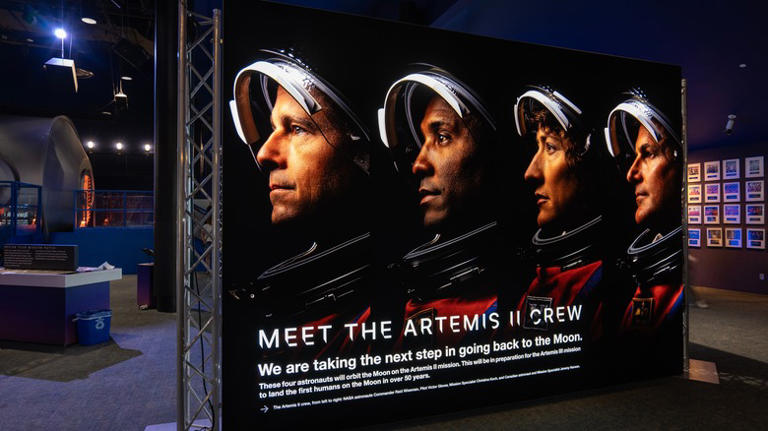
In 2026, NASA plans to take a major step in returning humans to the Moon with the Artemis II mission. This flight will be the first time astronauts reach the moon since the final Apollo mission concluded in 1972. A crew of four astronauts aboard NASA's Orion spacecraft will leave Earth from the Kennedy Space Center in Florida. The mission is planned to launch no later than April 2026, but NASA is actually aiming for a possible launch even sooner.
The trip will last only 10 days, during which the spacecraft will loop around the Moon and return to Earth. The astronauts won't land on the Moon because the true purpose of the Artemis II mission is to test life support, navigation, communication, and other systems with humans aboard in a deep-space environment. That said, Artemis II is more than just a technical tryout. It's a confidence builder for the later Artemis missions planned to take astronauts to the lunar surface, Mars' surface, and beyond. The excitement for Artemis II is global. NASA invited the public to sign up and have their names fly around the Moon during the mission. Projects like this can help people around the world feel more connected to space exploration in 2026.
2. NASA hones in on search-for-life missions
Artist's concept of the Habitable Worlds Observatory
In early January 2026, NASA announced that it was hearing proposals from companies who could help advance technology on the successor to James Webb, the Habitable Worlds Observatory (HWO). NASA plans to have HWO serve as a space telescope designed to image Earth-like planets orbiting distant suns and analyze their atmospheres for signatures of life. This new flagship telescope will push beyond what Hubble and James Webb can do. While these existing telescopes also have coronagraphs, or devices that block starlight so that scientists can get a better look at orbiting planets, HWO is expected to have one that is thousands of times more powerful.
NASA awarded three-year contracts to seven companies to build the technical foundations for HWO. Among these are some major players including Lockheed Martin, Northrop Grumman, and BAE Systems. In a statement, NASA administrator Jared Isaacman said humanity is ready to find life beyond Earth and that he believes developing such technology is a matter of urgency. HWO is NASA's boldest step yet in answering the question: Are we alone in the universe?
3. Laser-based communication is implemented
Illustration depicting transmits between NASA's Psyche spacecraft and Earth-based observatories
In recent years, NASA has been pushing the limits of how space communication works. Until now, spacecraft were using traditional radio waves to communicate with Earth. Now, new technologies are laser-based. They use pulses of light to send information, packing far more data in each transmission. This breakthrough could transform how missions share high-definition images, video, and scientific data across millions of kilometers.
NASA already successfully demonstrated how Deep Space Optical Communication (DSOC) works. The Psyche spacecraft, launched in October 2023, is equipped with this new technology, and it already received laser-encoded data over record-breaking distances. The first stream was, funnily enough, a video of a cat chasing a laser pointer. Throughout 2024 and 2025, the DSOC onboard Psyche continued to beat distance records.
This successful demonstration lays the groundwork for the operational use of laser communication in crew-supported missions like Artemis II. NASA will fly the Orion Artemis II Optical Communication System (O2O) aboard the Orion spacecraft. The Artemis crew will be able to send 4K ultra-high definition video, voice, procedures, images, and science data for the duration of the mission.
The Nancy Grace Roman telescope finishes its final tests
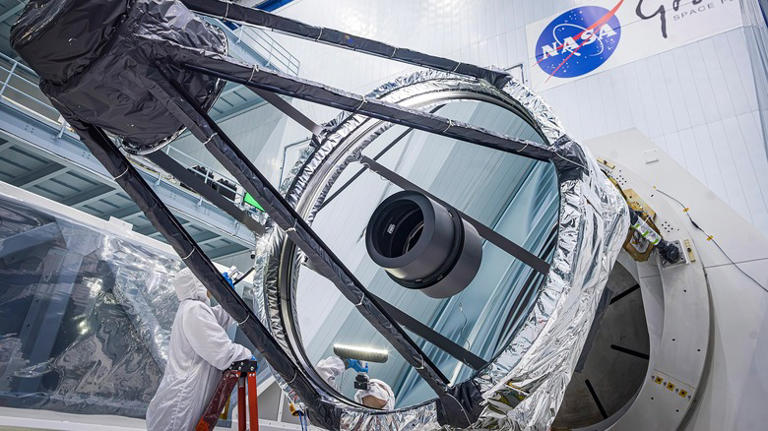
An engineer inspecting the primary mirror for NASA's Nancy Grace Roman Space Telescope
NASA's next great space telescope, the Nancy Grace Roman Space Telescope has officially moved from construction to completion. After years of development, the spacecraft's physical build is finished, and all major components have been assembled and integrated. Roman is NASA's next flagship telescope that combines Hubble-like resolution with a field view 100 times larger. That means it's capable of capturing huge cosmic areas in a single image.
The next step is to launch this space telescope. Final testing and preparations are ongoing as engineers simulate the launch vibrations, cold of space, and long-term operations far from Earth to make sure this next-generation telescope will be fully operational before the launch. The telescope is scheduled to go online in May 2027, but as the work progresses fast, there are indications that the launch could be moved to September 2026. While the launch preparations continue, the scientific community is already gearing up. In 2025, NASA ca }ed for research proposals using the Ronan telescope. It could be that 2026 sees some of these come to life.
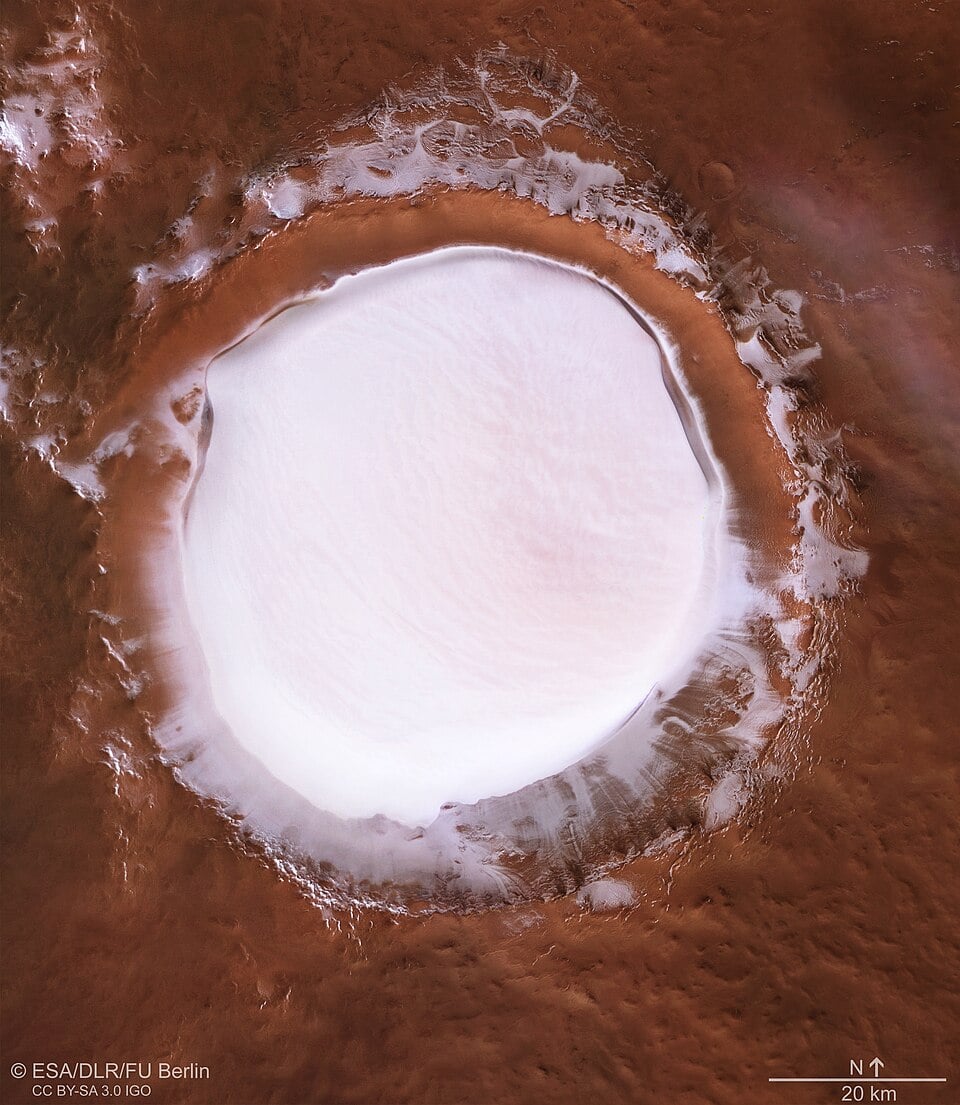
Mars contains water, though mostly as subsurface permafrost. Surface water is readily visible at some places, such as the ice-filled Korolev Crater, near the north polar ice cap (Credit : ESA/DLR/FU)
Scientists have known that Mars has water for some years, documenting ice beneath the surface, moisture locked in soil, and vapour drifting through the thin atmosphere. The challenge facing future human missions isn't finding water on the Red Planet, it’s figuring out how to actually extract and use it.
Dr Vassilis Inglezakis at the University of Strathclyde has tackled this practical problem in a new study that compares the various technologies capable of recovering Martian water. While previous research focused on identifying where water exists, this analysis examines the crucial next step which is the evaluation of how effectively each extraction method would work under authentic Martian conditions.
Reliable water access would prove essential not just for drinking but for producing oxygen and fuel, dramatically reducing dependence on supplies shipped from Earth at enormous expense. A self sufficient Mars base needs local water, and it needs extraction systems that actually function in an environment far harsher than anywhere on Earth.
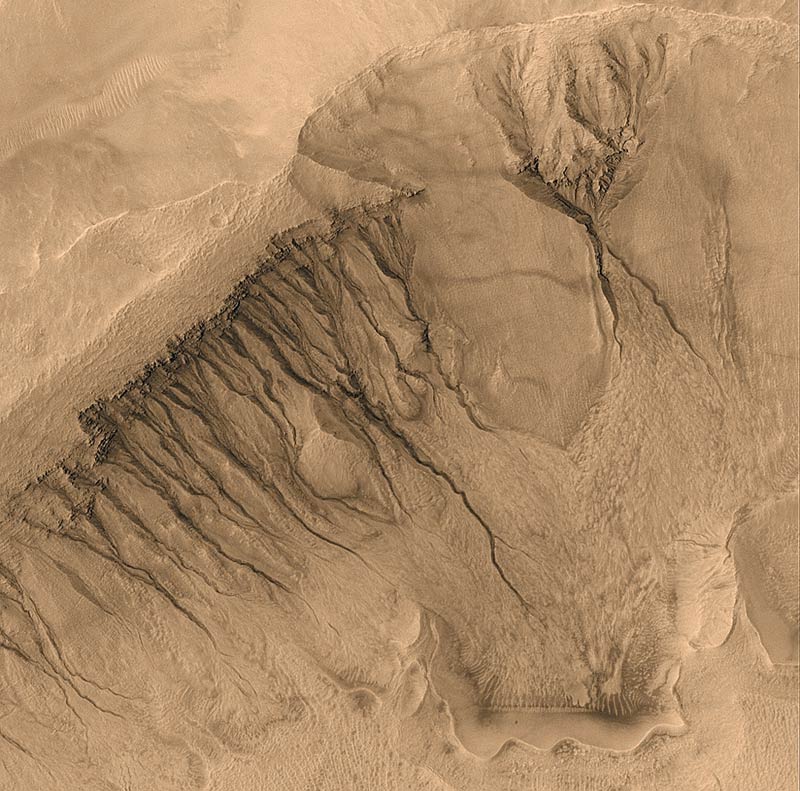
Gullies, similar to those formed on Earth, are visible on this image from Mars Global Surveyor and are thought to be formed by transient running water on the surface of Mars.
Inglezakis compared three primary water sources and their associated technologies. Subsurface ice emerges as the most promising long term option, offering substantial quantities of relatively pure water once drilling or excavation equipment reaches deposits typically buried beneath meters of dry soil and rock. The energy costs of melting ice pale in comparison to the water yield, making this approach economically viable for permanent settlements.
Soil moisture presents a trickier proposition. Martian regolith contains water molecules chemically bound to minerals, which can be liberated through heating. However, the process demands significant energy to extract relatively modest amounts of water, making it better suited as a supplementary source or emergency backup rather than a primary supply.
Atmospheric water harvesting represents perhaps the most intriguing possibility, particularly for missions exploring regions far from known ice deposits. Mars's atmosphere contains water vapour, though in concentrations far lower than Earth's driest deserts. The study proposes new harvesting approaches that could capture this atmospheric moisture, offering a potentially valuable water source when nothing else is accessible. The technology would need to operate continuously, compensating for the atmosphere's stinginess through persistent collection over extended periods.
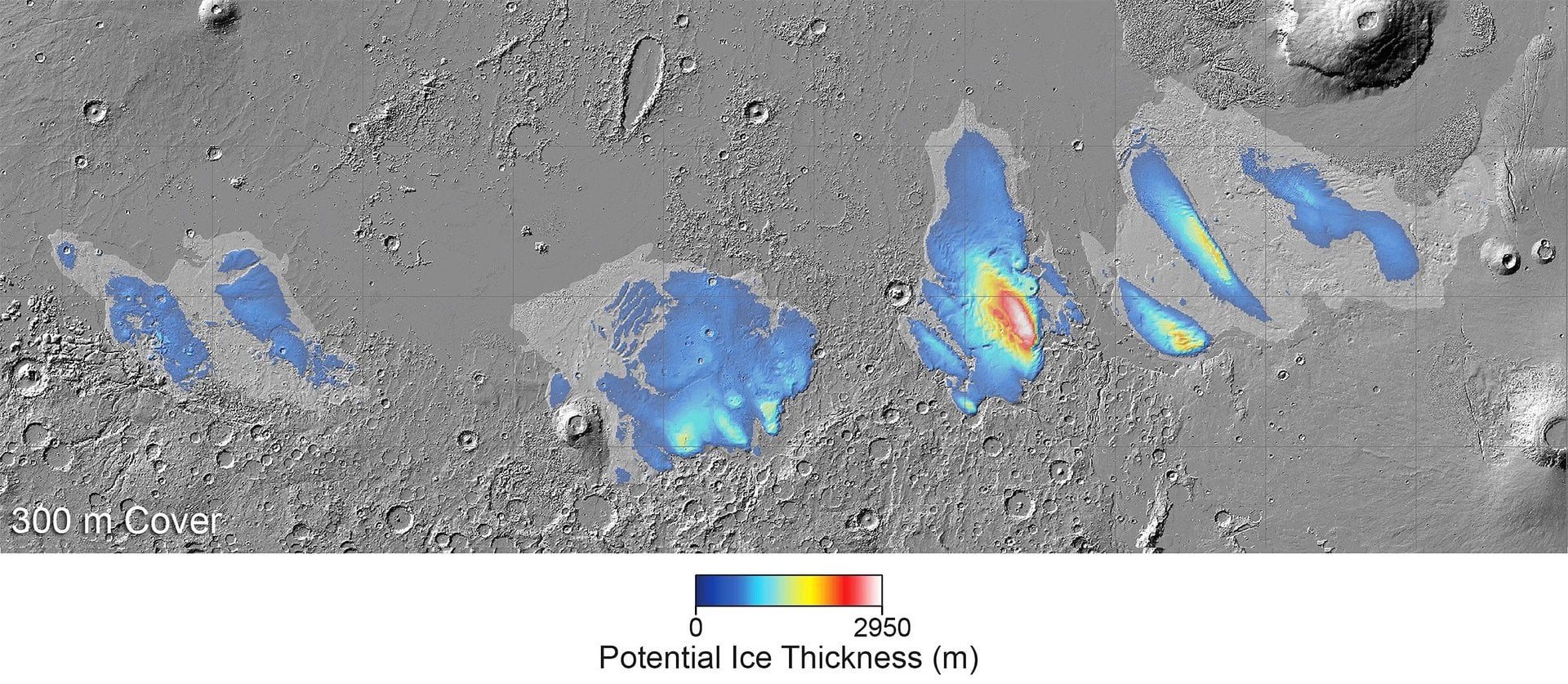
This map shows the ice thickness at Mars’s Medusae Fossae Formation (MFF) if we assume that the dust is 1000 feet thick. In this case, the total volume of water ice contained within the MFF deposits, if it melted, would be enough to cover Mars in an ocean of water approximately 3 metres deep (Credit: ESA)
The analysis evaluates each method across multiple criteria; energy requirements, equipment complexity, scalability from small exploration missions to large settlements, and reliability under varying Martian conditions. Temperature extremes, dust storms, and equipment degradation from the planet's corrosive soil all factor into determining which technologies would prove practical rather than merely theoretically possible.
As Inglezakis notes, much of Mars remains unexplored, and the search for accessible water continues. But understanding which extraction technologies could realistically function on the Red Planet proves equally crucial for planning sustained missions and eventual permanent settlement. The research provides a roadmap for making future Mars missions more self sufficient, transforming the planet's scattered water resources from tantalising discoveries into practical assets for human survival.
Moisture extracted from the atmosphere of Mars could provide a valuable alternative water supply if humans are ever to inhabit the red planet, a study has found.
However, the research from a Strathclyde University academic found that ice located beneath the surface of Mars would provide the most viable long-term solution.
Dr Vassilis Inglezakis examined the various ways of obtaining water on Mars in a paper in the Advances In Space Research journal.
The planet has several potential sources of H2O - including underground ice, soil moisture, and atmospheric vapour.
While underground ice could provide a long-term solution, Dr Inglezakis's research noted there are unlikely to be any accessible deposits near locations where explorers would land.
Harvesting water from the atmosphere is challenging as it requires more power and energy - but he suggested it could provide an alternative in areas were subsurface ice is inaccessible, or as a backup supply.
Dr Inglezakis, from the university's Department of Chemical and Process Engineering, said: 'Reliable access to water would be essential for human survival on Mars, not only for drinking but also for producing oxygen and fuel, which would reduce dependence on Earth-based supplies.
'This study is one of the first to compare the various technologies that could be deployed to recover water in a Martian environment.
Mars has several potential sources of H20 - including underground ice, soil moisture, and atmospheric vapour
'It also puts forward new ideas for atmospheric water harvesting, offering potentially valuable alternatives where other sources are inaccessible.'
The paper discusses each method in terms of energy demands, scalability, and suitability for different Martian conditions.
The analysis suggests subsurface ice is the most viable long-term water source.
The study examined ways of obtaining water on Mars
Nasa/ESA
Dr Inglezakis added: 'While the search for water continues and much of Mars remains unexplored, a clear understanding of available technologies and their realistic applications will be key to supporting sustained missions and eventual settlement.
'The research offers insights for future space exploration missions, supporting efforts to make them more self-sufficient and sustainable.'
Joe Rogan's latest podcast guest delved into controversial scans showing an enormous underground structure beneath the Great Pyramid of Giza, potentially rewriting ancient history.
The scans were conducted by Italian scientist Filippo Biondi and the Khafre Project team using synthetic aperture radar. This satellite imaging technology maps subsurface features by bouncing radio waves off the ground.
More than 200 scans from multiple satellites, including Italy's Cosmo-SkyMed and the US-based Capella Space, showed uniform results suggesting massive pillars about 65 feet in diameter wrapped in spirals and plunging nearly 4,000 feet deep.
Those pillars appear to end in 260-foot cubic chambers beneath all three pyramids and the Sphinx, which Biondi described as 'huge chambers' measuring roughly 260 feet in length and width.
The scans also highlighted shafts descending about 2,000 feet that intersect horizontal corridors roughly 10 feet tall, leading Biondi to speculate the pyramids may not be tombs but ancient power plants or vibration devices for out-of-body experiences.
Rogan echoed the radical implications, saying: 'They're not tombs,' and adding that if the data is accurate, the pyramids may be 'just the tip of the iceberg.'
Biondi dated the underground structures to 18,000 to 20,000 years ago, linking them to Zep Tepi, the mythic 'First Time' when gods first ruled and civilization began.
He also pointed to salt residues from ancient seawater flooding as evidence of a great flood event that could support the theory of a far older civilization beneath Giza.
The researcher team has released a model of the structures hiding below the Giza plateau, which includes three pyramids and the Great Sphinx
Italian scientist Filippo Biondi was the latest guest on the Joe Rogan Experience, where he discussed the scans showing the hidden megastructure
However, the Khafre Pyramid team believes the structures are much older and are hiding an underground world built by a lost civilization.
The key driver of the controversy is the credibility of the technology, which Biondi said he developed through 'top secret projects for the Italian military' and has applied to sites like the Mosul Dam and Italy's Grand Sasso laboratory.
It's patented, peer-reviewed, and built for precision, yet when the scans are applied to Giza, the reaction is fierce. Mainstream archaeologist Dr Zahi Hawass has called the scans 'This is bulls***.'
Biondi admitted that he and Armando Mei, who is part of the team, initially doubted the data, holding the results for six months, suspecting processing artifacts.
'My opinion was that it was not real. I was thinking that maybe it was noise or some artifacts due to our processing procedures,' he said.
Confirmation came from multiple satellite systems and benchmarks, including exact mapping of Italy's Grand Sasso particle collider, which lies about 4,600 feet deep inside a mountain.
Biondi said the consistency across datasets was what ultimately convinced him the findings were real.
The scans captured enormous shafts descending from the pyramids
The Giza complex consists of three pyramids, Khufu, Khafre and Menkaure, built 4,500 years ago on a rocky plateau on the west bank of the Nile River in northern Egypt
After initially relying only on Italy's Cosmo-SkyMed satellites, the team expanded its analysis to US-based Capella Space satellites and others, seeking confirmation through diversity of sources.
'Once we had the same results while we were using American satellites… and also other satellites always the same results, we decided to disclose,' he said.
In total, more than 200 scans returned the same structural patterns.
Rogan pointed out that the technology has already been validated elsewhere, including its ability to precisely map Italy's underground Gran Sasso laboratory, a particle physics facility buried roughly 4,600 feet inside a mountain. '
We know it's accurate, we know it works,' Rogan said, calling resistance to the findings 'confirmation bias.'
Biondi emphasized that his work does not involve penetrating the ground with radar beams, a common online criticism.
Hawass has used that argument to dismiss the claims, telling the Daily Mail: 'They used topographic radar.
'They claim it reaches more than 1,000 feet down to a city. But any scientist who understands tomographic radar knows it only reaches about 60 feet. Their theory is completely wrong.'
However, Biondi explained that the method analyzes mechanical vibrations naturally present on Earth's surface and reconstructs subsurface features through tomographic inversion.
'We are not penetrating anything,' he said. 'We are just grabbing the entropy that is on the surface of the earth.'
The scans indicated not only vertical structures but horizontal corridors roughly nine feet tall that connect the shafts and chambers beneath the plateau.
The scans also captured large rooms at the bottom of the shafts
After gathering the data, researchers used a special algorithm that turned the information into vertical images of the ground beneath the pyramid, capturing the first look at the hidden structures. Pictured are the eight wells under the pyramid
According to Biondi, existing shafts between the pyramids, currently blocked by debris, may already provide access points to the underground system.
'Those shafts go down, down, down… and they reach chambers that are below,' he said, estimating depths of about 1,968 feet.
Biondi argued that physical excavation may not even be necessary to confirm the findings.
He has proposed a project to Egyptian authorities that would focus on clearing debris from existing shafts and deploying robotic drones, rather than digging new tunnels.
'We want to use machines, not humans,' he said, estimating the cost of such an effort at roughly $20 million.
Rogan repeatedly returned to the scale of the implications. If the data holds up, he said, the pyramids, long considered among humanity's greatest architectural achievements, may be only the visible remnants of something far larger.
'Those immense structures that have baffled mankind forever are just the tip of the iceberg,' Rogan said.
Biondi agreed, stressing that the measurements are the only subsurface data currently available for the Giza Plateau.
'What we found is something that has been confirmed by our measurements,' he said. 'At the moment, these are the only data that we have.'
Despite the controversy, Biondi said he welcomes replication by other research groups and remains open to scrutiny.
'I am happy if somebody can replicate things,' he said. 'If other research groups can replicate the things that I'm showing, I'm happy.'
For now, the scans remain unverified by direct exploration, suspended between radical possibility and entrenched skepticism.
But as Rogan put it, ignoring the data outright would be a mistake. 'If you're skeptical, we should probably explore it,' he said. 'And if it's wrong, okay. But if it's right, it's a crime not to investigate.'
See dark matter like NEVER before: NASA reveals one of the most detailed maps of the elusive substance yet – confirming its vital influence on the universe
See dark matter like NEVER before: NASA reveals one of the most detailed maps of the elusive substance yet – confirming its vital influence on the universe
NASA has revealed one of the most detailed maps of dark matter yet.
Taken by the James Webb Space Telescope, the map suggests the elusive substance acts as a hidden framework on which entire galaxies are built.
According to researchers from Durham University, it could help to unravel the mystery of the formation of our Milky Way – as well as planet Earth.
'Wherever you find normal matter in the Universe today, you also find dark matter,' explained Professor Richard Massey, co–author of the study.
'Billions of dark matter particles pass through your body every second.
'There's no harm, they don't notice us and just keep going.
'But the whole swirling cloud of dark matter around the Milky Way has enough gravity to hold our entire galaxy together.
'Without dark matter, the Milky Way would spin itself apart.'
NASA has revealed one of the most detailed maps of dark matter yet. Taken by the James WebbSpace Telescope, the map suggests the elusive substance acts as a hidden framework on which entire galaxies are built
Dark matter is described as the 'glue' that holds the universe together.
However, because it's invisble, understanding exactly what it is or what is does has proved difficult.
Scientists have previously suggested that when the universe began, dark matter and normal matter were sparsely distributed.
Dark matter clumped together first, before pulling in normal matter, creating regions where stars and galaxies began to form.
By prompting this formation, dark matter also played a role in creating the conditions for planets to form – eventually allowing life to appear.
To prove this is the case, the research team turned to NASA's James Webb – the largest and most powerful telescope ever launched to space.
This allowed them to map dark matter with 'unprecedented precision'.
Because dark matter is invisible, the team looked for it by observing how its mass curves space itself, which in turn bends the light travelling to Earth from distant galaxies.
Because dark matter is invisible, the team looked for it by observing how its mass curves space itself, which in turn bends the light travelling to Earth from distant galaxies
The research team turned to NASA's James Webb – the largest and most powerful telescope ever launched to space
The map shows that dark matter interacts with the rest of the universe through gravity – seen by the degree of overlap between maps of dark and normal matter.
'By revealing dark matter with unprecedented precision, our map shows how an invisible component of the Universe has structured visible matter to the point of enabling the emergence of galaxies, stars, and ultimately life itself,' explained Dr Gavin Leroy, co–author of the study.
'This map reveals the invisible but essential role of dark matter, the true architect of the Universe, which gradually organises the structures we observe through our telescopes.'
In total, the area covered by the map is a section of sky about 2.5 times larger than the full moon, in the constellation Sextans.
It includes nearly 800,000 galaxies – about 10 times more than Webb's predecessor, Hubble, was able to observe.
Dr Diana Scognamiglio, co–author of the study from NASA's Jet Propulsion Laboratory, said: 'This is the largest dark matter map we've made with Webb, and it's twice as sharp as any dark matter map made by other observatories.
Created using data from NASA’s Webb telescope in 2026 (right) and from the Hubble Space Telescope in 2007 (left), these images show the presence of dark matter in the same region of sky. Webb’s higher resolution is providing new insights into how this invisible component influences the distribution of ordinary matter in the universe.
'Previously, we were looking at a blurry picture of dark matter.
'Now we're seeing the invisible scaffolding of the Universe in stunning detail, thanks to Webb's incredible resolution.'
The team now plans to map dark matter through the entire universe, using the European Space Agency's Euclid telescope alongside NASA’s upcoming Nancy Grace Roman Space Telescope.
Dark matter is a hypothetical substance said to make up roughly 85 per cent of the universe.
The enigmatic material is invisible because it does not reflect light, and has never been directly observed by scientists.
Astronomers know it to be out there because of its gravitational effects on known matter.
The European Space Agency says: 'Shine a torch in a completely dark room, and you will see only what the torch illuminates.
Dark matter is a hypothetical substance said to make up roughly 27 per cent of the universe. It is thought to be the gravitational 'glue' that holds the galaxies together (artist's impression)
'That does not mean that the room around you does not exist.
'Similarly we know dark matter exists but have never observed it directly.'
The material is thought to be the gravitational 'glue' that holds the galaxies together.
Calculations show that many galaxies would be torn apart instead of rotating if they weren't held together by a large amount of dark matter.
Just five per cent the observable universe consists of known matter such as atoms and subatomic particles.
An Egyptologist has proposed a new theory that the Ark of the Covenant was not merely a sacred container for the Ten Commandments, but a radical reimagining of ancient religious symbols.
David Falk, who holds a PhD in Egyptology from the University of Liverpool, argued the Ark was modeled on Egyptian ritual furniture, specifically shrines designed to hold a statue or idol.
But unlike Egyptian shrines, the Ark contained no idol, meaning it was built to show that God's presence did not require a physical representation, Falk suggested.
In ancient Egypt, sacred chests and shrines were often decorated with uraeus cobras that spat fire, symbols meant to protect and sanctify holy space.
Winged goddesses also appeared on Egyptian thrones and shrines, their outstretched wings signifying protection and divine power.
Falk argued the Ark borrowed this visual language but flipped it, creating sacred space not inside the box but above it, between the wings of the cherubim on the mercy seat.
If Falk is correct, the Ark's design reveals a deliberate theological innovation: a sacred object built to reject the religious norms of its time, while still using their symbols to mark it as holy.
The theory implies that the Israelites did not just abandon Egyptian religion, but they intentionally weaponized its symbols against it through the Ark.
A new theory has suggested that the Ark was built using ancient Egyptian religious symbols as a theological rebuke, a statement that the Israelite God was superior to Egyptian gods because he required no idol, and because his presence was not confined to a statue
The Bible states that the Israelites spent generations in Egypt, which would have led to absorbing all aspects of its culture and religious imagery.
Falk's theory suggested that, rather than simply abandoning these influences, the Israelites intentionally borrowed and reworked them.
The biblical relic would then function as a theological rebuke, a statement that the Israelite God was superior to Egyptian gods because He required no idol, and because His presence was not confined to a statue.
According to scripture, Moses placed the Ten Commandments inside the Ark, which was kept in the Tabernacle, a sanctuary built shortly after the Israelites' Exodus from Egypt, traditionally dated by some scholars to around 1445 BC.
The Book of Exodus describes the Ark as a gold-covered acacia wood chest with precise dimensions and carrying poles.
Its lid was topped with two cherubim facing one another, their wings outstretched to form a sacred space known as the 'mercy seat,' where God would commune with Moses.
The theory pointed to ancient Egyptian chests, noting how similar they are to the Ark
Falk noted in Biblical Archaeology that 'the Ark was constructed using a visual language that everyone knew 3,300 years ago, but is mostly lost to us today.'
His theory centers on the idea that the Ark was intentionally modeled on Egyptian 'shrine' furniture, which was often built to house a statue or idol of a deity.
These shrines were typically gold-covered and decorated with protective imagery.
The most common protective figures were the uraeus cobra, often depicted spitting fire, and winged goddesses, whose outstretched wings signified divine protection and power.
Falk argued that these symbols were not mere decoration, but active markers of sanctity, a way of announcing that a sacred presence was contained within.
However, rather than containing a physical god, the Ark may have been designed to create a holy space above its lid, between the wings of the cherubim on the mercy seat.
The mercy seat, a golden cover placed atop the Ark, featured two cherubim facing each other.
Their wings form a protective canopy, suggesting a sacred 'throne room' in the space between them. This, Falk argued, is a deliberate rejection of idol worship, a way of saying that God's presence cannot be captured in a statue.
According to scripture, Moses placed the Ten Commandments inside the Ark , which was kept in the Tabernacle, a portable sanctuary built shortly after the Israelites' Exodus from Egypt , traditionally dated by some scholars to around 1445 BC
The Ark's carrying poles also support Falk's argument, as in the Exodus description, the Ark was transported using poles that ran through rings attached to its sides.
Falk noted that this is consistent with Egyptian ritual chests, which were similarly designed to be carried by poles.
However, the Egyptian versions were built to carry idols, while the Ark was built to carry nothing inside.
This, Falk said, is the key difference: it retains the form of Egyptian sacred furniture, but removes its defining function.
If Falk's interpretation is correct, the Ark becomes a powerful symbol of Israelite identity and resistance.
Scientists Reveal Lightning Can Spawn UFO-Like Plasmoids in Shocking Experiments
Scientists Reveal Lightning Can Spawn UFO-Like Plasmoids in Shocking Experiments
New research shows self-organising plasma fireballs that resemble flying objects can emerge naturally from extreme electrical conditions
ByCrisnel Longino
A picture portraying a UFO flying.
A crack of lightning, a burst of heat, and suddenly a glowing sphere hangs in the sky like a craft from another world. Scientists now say this is not fantasy or folklore, but hard physics, after a growing body of peer reviewed experiments revealed that lightning and plasma can spontaneously create floating fireballs known as plasmoids.
Ball lightning has baffled witnesses for generations. During violent thunderstorms, people have reported silent glowing spheres drifting through streets, rolling along power lines, or even passing through walls. Local police and military authorities have logged hundreds of accounts each year, yet the phenomenon remained deeply mysterious because it appears randomly and vanishes within seconds.
From Storm Clouds to Strange Sightings
These shimmering orbs behave in ways that closely resemble famous UFO sightings, including the so called tic tac object filmed by the US Navy, raising dramatic questions about what people have really been seeing for centuries.
A major scientific book on the phenomenology of lightning now includes an explicit chapter on UFO-like events, arguing that many reports could be rooted in real atmospheric plasma rather than extraterrestrials. On page 68, the description of lightning born fireballs is so precise that it mirrors modern footage of the tic tac object struck by a missile and seemingly unharmed.
Laboratory research shows that under the right conditions, electricity can organise chaos into structure. Scientists call this the auto assemblage of ionospheric research instruments, a technical way of saying that giant plasmoids can self assemble in the sky. When electrons are pushed far from thermal equilibrium, they begin to behave like organisers of matter, transforming random sparks into stable glowing bodies. This process involves complex quantum effects such as Bose Einstein condensation, electron tunnelling and Josephson effects. Instead of being simple blobs of light, plasmoids act like dynamic systems that evolve step by step as energy changes around them.
Researchers have successfully recreated plasmoids inside laboratories, producing luminous spheres that look strikingly similar to natural ball lightning. One of the most dramatic experiments took place at the Heavy Ion Collider in New York, where beams of gold nuclei were smashed together at near light speed. The collision created a fireball of plasma 300 times hotter than the surface of the Sun. Remarkably, the fireball survived longer than the moment of impact itself. Scientists observed particles being absorbed into its core and re-emerging as thermal radiation, a process compared to how matter might fall into a black hole and reappear as Hawking radiation.
Are They Alive or Just Light?
The big question remains whether these plasmoids are merely exotic physics or something closer to proto intelligence. Some researchers suggest the structures show signs of organised behaviour, adapting to energy flows rather than dissolving instantly.
Critics argue they are simply electromagnetic shapes, no more sentient than foam or smoke. The debate is far from settled, and experts admit that much of the scientific literature is so technical that only a handful of specialists can fully interpret it. What is clear is that nature can create floating luminous objects without any need for alien pilots.
Taken together, the evidence suggests that many historical UFO encounters may have been misidentified plasmoids born from lightning, plasma or extreme energy events. Yet the findings do not entirely close the door on extraterrestrial possibilities. Instead, they deepen the mystery, showing that our own planet can generate phenomena that look, move and behave like something straight out of science fiction.
An invasion of small metallic orbs has been spotted hovering over the US in recent years, leaving the Pentagon scrambling to identify these mysterious UFOs.
A new report from the crowdsourced platform Enigma, which allows people to report sightings of unidentified flying objects (UFOs), reveals more than 8,000 sightings across the US between December 2022 and June 2025.
Among these, 422 reports specifically describe metallic orbs, with the majority observed between 1am and 4am near military installations in New York, California, and Arizona.
Eyewitnesses, including civilians, pilots, and military personnel, reported seeing the spheres hover silently before moving at extreme speeds, leaving no trace of their departure.
Some of the sightings have been captured on video or radar, though many remain unexplained.
'I was walking into work when I looked up and saw two metallic liquid-like objects hovering for about two minutes,' said one witness over Brooklyn's Fort Hamilton in June 2024.
Another in California described seeing a metallic orb above Los Angeles shortly after a squadron of planes flew by.
Military drone footage from the Middle east in 2022 revealed a metal sphere flying through the sky in broad daylight (circled in purple)
The crowdsourced platform Enigma reported that over 8,000 orbs have been seen over the US since December 2022
However, some cases have remained unsolved, reportedly due to a lack of data. Of the 757 UFO cases between May 2023 and June 2024 released in AARO's annual report, 21 cases were classified as unresolved sightings.
Although the Pentagon and civilian groups like the National UFO Reporting Center (NUFORC) have also been cataloging these incidents, many have continued to baffle military officials, who have no way of explaining what was seen.
While the new report focused on the thousands of sightings in the US over the last three years, strange orbs have been documented all over the world, from Puerto Rico to the Middle East.
Moreover, these tiny craft have apparently been visiting our skies for decades, with pilots during World War II reporting similar orbs over the skies of Europe.
Enigma revealed that more than 360 'metallic orb' reports took place within a few miles of military bases here on US soil.
In three of those cases, witnesses revealed that the orbs got within five miles of Fort Hamilton in New York, Papago Military Reserve in Arizona, and Los Angeles Air Force Base on multiple occasions.
These mystery orb sightings include one shocking encounter revealed by Dr Sean Kirkpatrick, the former director of AARO, which was captured on a MQ-9 Reaper drone's camera in the Middle East in 2022.
Enigma revealed that witnesses spotted strange orbs flying above Fort Hamilton military base in New York multiple times
Even more close calls were documented around Los Angeles Air Force Base in California between 2022 and 2025
Kirkpatrick warned that if these videos didn't prove that aliens exist, then they're evidence that a rival foreign power could be 'doing stuff in our backyard.'
Some theories have suggested these orbs could be surveillance devices from foreign powers like China or Russia.
Government officials believed they might be advanced drones, due to their tremendous agility and ability to avoid radar, according to a 2022 report in the New York Times.
As for Enigma's report, many of the orb sightings have been concentrated in Texas and Florida.
In fact, visitors at Disney World's Epcot in Florida got an unexpected sight this month, when a glowing orb appeared over the amusement park.
After searching online and finding no information about drones or satellites in the area, Morgan Huelsman, digital director of The Bobby Bones Show, described the object as a 'UFO,' adding, 'definitely a UFO with aliens.'
The Enigma platform has also received sightings from all over the US, over critical infrastructure such as power plants, and over naval vessels at sea.
The Buga Sphere recovered in Colombia (pictured) remains one of the only pieces of physical evidence tied to metallic orb sightings worldwide
The 'Buga Sphere' has become a major topic of discussion among UFO researchers, with scientists claiming the object contains a maze of fiber-optic wires that suggest it can send and receive signals.
After striking a power line and crashing to the ground, the object also appeared to have somehow dehydrated the field it landed in, killing all the grass and soil where it touched down.
Scientists suggested this was proof that the object produced some kind of energy field, but researchers had not attempted to forcibly cut the object open so far. The sphere has since been taken to Mexico for further analysis.
However, UFO researcher Dr Julia Mossbridge from the University of San Diego is among the many who doubt the authenticity of the Buga Sphere, calling it a 'man-made art project.'
America's most sensitive nuclear sites have been secretly invaded by thousands of unidentified flying objects, a stunning new report has revealed.
Crowdsourced platform Enigma revealed to the Daily Mail that there have been more than 2,800 'unidentified aerial sightings' over 90 US nuclear plants or nuclear weapons facilities over the last eight decades.
The new report detailed sightings of objects often described as glowing orbs, disks, spheres, cylinders, or triangles hovering or flying in precise patterns within 25 miles of these nuclear sites.
One of the most recent reports from April 2025 captured video of a glowing orange ball changing shape while flying over Bear, Delaware, which is located near the Salem Nuclear Power Plant and Hope Creek Nuclear Generating Station in New Jersey.
'It just kept getting bigger, disappearing, bigger, disappearing. I thought it was just a star at first, or just a plane from a distance. Then I realized it got a lot, lot closer and kept getting closer and bigger. Then it started flashing,' the witness described.
'It wasn't a drone. It wasn't mechanical. It would actually morph into different shapes.'
One witness in California from April 2023 said: 'After hovering, it arched sideways and disappeared in the blink of an eye. I felt it was observing Diablo Canyon Nuclear plant.'
More than 70 of these reports specifically referenced UFOs with metallic or reflective surfaces flying over bases in broad daylight during the early dawn hours.
Over 1,800 UFO sightings have been reported near US nuclear power plants, while more than 1,000 sightings have been documented at military nuclear weapons sites
An image taken in February 2024 in Salem, New Jersey captured multiple small objects merging with a larger object near the local nuclear plant
Enigma added that nuclear sites and missile bases in Pennsylvania, North Carolina, and Florida saw the biggest clusters of sightings.
Moreover, these incidents exploded during the mysterious drone surge over the East Coast between November 2024 and February 2025.
Enigma said: 'Many of these sightings described structured, light-emitting objects that pulsed or changed color before disappearing - characteristics that closely resemble those attributed to the unidentified drones reported across the region at the time.'
One witness near the Salem nuclear power plant claimed that several small objects hovering over the facility seemed to combine into one large UFO in February 2024.
'I was coming up to the Salem hospital and saw these four lights in a square hovering over the building, it looked like, but the closer I got, they seemed to disappear,' the witness revealed.
'So I started recording, and you see all these little lights going into the big bright one and not coming back out.'
Although the Pentagon's All-domain Anomaly Resolution Office is charged with investigating reports of UFOs, the military has maintained that there has never been any physical evidence that proves extraterrestrials or UFOs exist.
The new report also detailed how many of the thousands of objects easily violated restricted airspace, raising concerns about how safe America's national security sites really are.
Enigma Labs has revealed that more than 2,800 UFO sightings have taken place directly over or nearby nuclear power plants and military bases
The sightings were reported over several years and sent to the crowdsourced platform by eyewitnesses, including civilians, pilots, and military personnel
'If these objects belong to foreign intelligence or advanced programs, they expose vulnerabilities in national defense,' Enigma researchers wrote in a statement.
'If they are something unknown to science, they may represent new physics or technology. Either possibility demands improved detection, data sharing, and protective measures.'
Enigma, which allows people to report sightings and share pictures or videos of UFOs on an app, noted that these incidents include the strange craft seen over Malmstrom Air Force Base in Montana in 1967, just as several Minuteman missiles shut down.
The sightings of strange craft and unidentifiable objects over nuclear plants weren't limited to just the US.
Researchers detailed how witnesses claimed they saw UFOs over two major nuclear disasters - the 1986 reactor meltdown in Chernobyl, Ukraine and the 2011 accident in Fukushima, Japan.
In Chernobyl, a bright cylindrical object was reportedly seen hovering near the burning remnants of the nuclear plant's Reactor 4. There has never been any confirmation that the radiation dipped after the sighting, as some have claimed.
During the Japanese meltdown, similar glowing objects were allegedly flying over the damaged reactor; however, these sightings were later suggested to be foreign drones conducting surveillance of the accident.
In 1967, multiple nuclear missiles were disabled during alleged UFO encounters over Malmstrom Airforce Base in Montana (Pictured)
Limerick Generating Station nuclear energy plant in Pottstown, Pennsylvania (Stock Image)
In the US, the sightings go all the way back to the dawn of the US nuclear program in the late 1940s, with Enigma detailing how 'bright green fireballs' were reported near Kirtland and Sandia Air Force Bases in New Mexico.
Overall, Enigma Labs has collected over 1,800 reports of UFOs flying and hovering near 53 nuclear power plants in the US.
Another 1,000 reports specifically mentioned incidents that allegedly took place over 37 US military bases linked to nuclear weapons research or missile launch sites.
Half of these sightings claimed that the objects were able to hover or seemed to float through the air, and one-third mentioned suddenly disappearing or vanishing into thin air.
New Report Finds Alarming Increase in UFO Sightings at Nuclear Facilities | Andrew Bustamante
Warning Issued That Alien Revelations Could Spark Financial Crisis
Warning Issued That Alien Revelations Could Spark Financial Crisis
A financial crisis could be triggered by an announcement that aliens exist, according to Helen McCaw, a former policy expert of the Bank of England.
McCaw told The Times of London that politicians and bankers can’t afford to dismiss alien life, and wrote to the governor of the Bank of England, urging him to organize a contingency plan in case the White House confirms alien existence.
Why It Matters
A 2021 study from the Pew Research Center found that nearly two-thirds of Americans believe that intelligent life exists beyond Earth. Some Americans, meanwhile, believe that there is proof of UFOs and alien life being concealed from the public by global governments. However, this belief is held by a significant minority.
Planet Earth visitor looks at an immersive presentation of Antarctica at the "Polar Experience" exhibition at the Arena venue on December 16, 2025 in Berlin, Germany.
McCaw was a senior analyst in financial security at the Bank of England for ten years, until 2012.
She told The Times, "The United States government appears to be partway through a multiyear process to declassify and disclose information on the existence of a technologically advanced non-human intelligence responsible for Unidentified Anomalous Phenomena (UAPs)."
"If the UAP proves to be of non-human origin, we may have to acknowledge the existence of a power or intelligence greater than any government and with potentially unknown intentions. It is entirely possible that government leadership and their central banks have not been properly briefed on the topic. UAP disclosure is likely to induce ontological shock and provoke psychological responses with material consequences," she said.
McCaw said there could be price volatility in the financial markets, and a collapse in confidence, in addition to a potential rush to safe assets such as gold.
She also told the outlet that the authorities should be prepared for unrest.
The report has quickly made an impact online.
Mario Nawfal, a podcast host, said in a post on X viewed over 100,000 times, "WAIT…WHAT?! A former Bank of England policy analyst is warning the UK’s central bank to prepare for a financial crisis…caused by aliens."
What People Are Saying
Holly Wood, a researcher and public speaker sharing The Times piece, in a post on X viewed over 100,000 times: "And at the centre of it is my friend, Helen McCaw. A former Bank of England senior analyst in financial security. A Cambridge graduate. Someone whose actual job was to think about state-level risk, stability, and what breaks systems. I’m incredibly proud of her. She inspires me regularly. The question is no longer "is it real?" It’s "what happens when it’s confirmed?"
The YouTuber Hustle B****, in a post on X sharing The Times report, viewed over 100,000 times, which read in part: "READ THIS TWICE - THE GLOBAL FINANCIAL SYSTEM IS PREPARING FOR ALIENS. This is not a meme. This is not a fringe blog. This is an actual newspaper article reporting that the Bank of England has been urged to prepare for financial collapse if aliens are officially confirmed."
What Happens Next?
There is a continued interest in the idea of intelligent life beyond Earth. The documentary The Age of Disclosure made a significant impact online, with the trailer amassing millions of views and the documentary prompting a discourse about aliens.
The upcoming fictional film Disclosure Day, directed by Steven Spielberg, has also prompted significant interest, with the trailer fast amassing more than a million views on X. Disclosure Day is set for release in the U.S. on June 12, 2026.
There is currently no proof that the universe is home to other intelligent life forms aside from the ones that inhabit Earth, and evidence to the contrary would be a very big deal. There’s no telling how people would react to that development, but one expert has warned the Bank of England to be prepared for a financial crisis triggered by that revelation.
Humans have been debating the existence of extraterrestrial life for thousands of years. Thinkers in ancient Greece floated the notion of a “plurality of worlds” like the one we inhabit, and arguments for (and against) the probability of so-called “aliens” being real have gotten increasingly sophisticated as our knowledge of the universe has grown over the millennia.
The odds of Earth being the only planet in the universe to boast some sort of life are infinitesimally small, and the same can be said for the notion that humans are responsible for cultivating the most advanced society in existence.
With that said, we’re still waiting for the day when we’re treated to incontrovertible proof concerning alien life. It’s difficult to predict the impact that kind of discovery would have, but one economic expert is warning a major institution to be prepared for some negative ramifications if that information comes to light.
A former security analyst at the Bank of England is sounding the alarm about the economic ramifications of alien life being confirmed
Aliens have been a staple of science fiction for centuries, and while plenty of people have come forward with claims that they were abducted and ferried away to an unknown part of outer space in a UFO, they’ve been largely dismissed as crackpots.
The same can be said for the conspiracy theorists who are convinced the United States government (and others around the world) has engaged in a massive cover-up concerning aliens who’ve already visited Earth and UFOs that are purportedly being stored in a warehouse in Area 51.
A number of whistleblowers have come forward in recent years to support those claims, and Congress itself added some fuel to the fire with a series of hearings concerning the UFOs the military officially refers to as “unidentified anomalous phenomena.”
Those proceedings did not produce any concrete evidence concerning alien life, but according to The Times, the Bank of England has been warned to prepare for what would be one of the most monumental days in human history if that ends up changing.
Helen McCaw, who formerly served as a senior analyst specializing in financial security for that institution, recently sent a letter to Bank of England Governor Andrew Bailey to warn him about the potentially disastrous ramifications of alien life coming to light, saying:
“It is entirely possible that government leadership and their central banks have not been properly briefed on the topic. UAP disclosure is likely to induce ontological shock and provoke psychological responses with material consequences.
There might be extreme price volatility in financial markets due to catastrophising or euphoria, and a collapse in confidence if market participants feel uncertain on how to price assets using any of the familiar methods.”
McCaw warned the price of precious metals like gold and silver could either skyrocket or plummet, saying people may turn to those historically trusted assets or dump them out of fears that alien technology could cause their value to drop.
She also said digital currency like Bitcoin could end up being attractive if people lose their faith in government-backed funds and predicted it wouldn’t take long for chaos to reign if alien life is confirmed, adding, “I would say that in a matter of hours, you are going to have total financial instability….Even if you feel it’s very unlikely, it’s madness not to consider it and plan accordingly.”
The super-heavy Space Launch System rocket is what allows the Orion spacecraft not only to go into space, but also to fly to the Moon. The history of their creation was not easy, and the design deserves to be described in detail.
The SLS rocket and Orion spacecraft
The dream of returning to the Moon
Soon, four astronauts may embark on a journey around the Moon as part of the Artemis II mission. If this happens, it will be a great success not only for the United States but for all of humanity. But most of all, it will be a success for the NASA engineers who created the super-heavy Space Launch System rocket and the Orion spacecraft, as well as their European colleagues who developed the service module for the latter.
All these devices are true works of engineering genius. However, their path to space flight was extremely difficult and long. It all began in 2003, when the Columbia shuttle disaster forced the US to reconsider how and by what means it planned to explore space in the future. At that time, the main focus was on returning to the Moon. However, the giant Saturn-V rocket, which was used to send the Orion spacecraft there in the 1960s and 1970s, was no longer available, and it proved impossible to resume its production.
The response to this was the Constellation program, adopted in 2004. It involved the creation of two rockets: Ares I and Ares V. The first was larger and two-stage. With a height of 94 m, it was designed to carry 25.4 tons of payload into orbit. It was intended to carry the Orion manned spacecraft together with the Altair landing module.
Comparison of the Ares I and Ares V rockets with other space systems. Source: Wikipedia
Ares V was supposed to be smaller, also two-stage, and was supposed to launch the Orion upper stage into orbit. In space, both parts were supposed to connect and fly to the Moon. Outwardly, everything looked quite realistic, but in 2010, it was acknowledged that the program had failed due to underfunding, and of all the above, only the Orion spacecraft is at some stage of readiness.
Constellation was canceled, but plans to return to the Moon were not abandoned. In 2011, a new program called Artemis was adopted, in which only the Orion spacecraft remained from Constellation. Only now, instead of two large rockets, one giant rocket was to send it to the Moon. It was named the Space Launch System, or SLS.
SLS design
The Space Launch System is a three-stage rocket that can exist in several variants, depending on the tasks assigned to it. For the first three missions carried out under the Artemis program, a smaller variant called Block 1 is used. Its height is 98 m, and its mass when fueled is 2,610 tons.
SLS rocket. Source: Wikipedia
The “zero” stage in SLS is a pair of solid-fuel boosters. They are a modification of similar accelerators that were used for the Space Shuttle program. However, while the space shuttle used four segments connected in series, each with a diameter of 3.71 m, the lunar rocket has five, so each booster is actually over 50 m long.
A mixture of ammonium perchlorate, aluminum, and iron oxide enclosed within plastic is used as fuel. Segments containing this material burn out sequentially, propelling the SLS away from Earth and providing its initial acceleration.
After they have worked and separated, the main stage begins to operate. It is a huge metal tank with a diameter of 8.4 meters and a height of 65 meters. For comparison, this is equivalent to two nine-story residential buildings placed one on top of the other. Inside are tanks of liquid hydrogen and liquid oxygen, a cryogenic unit for their maintenance, and four RS-25 engines at the bottom. These were also used on the shuttle.
The central block of the SLS rocket. Source: Wikipedia
The upper stage of the rocket is called the Interim Cryogenic Propulsion Stage (ICPS). It is essentially a modified upper stage of the Delta III rocket.
It is 8.8 m high and 4 m in diameter. Inside are tanks containing liquid hydrogen and liquid oxygen. There is only one engine. In the Artemis I mission, it was an RL10B-2. In the second mission, it was replaced with a more powerful RL10C-2. The engine is designed for launch in the upper layers of the atmosphere.
Above all, this is the Orion spacecraft. It consists of two parts: a command module built by Lockheed Martin and a service module built in Europe by Airbus Defence and Space.
Orion spacecraft. Source: phys.org
The command module is a truncated cone with a diameter of 5.03 m and a height of 3.3 m. Inside, there is room for a crew of four astronauts, control systems, and scientific equipment. Attached to the bottom is a service module in the form of a cylinder with a diameter of 4 m and a height of 4 m. Its main purpose is to propel the spacecraft through space and supply its systems with electricity. To do this, it is equipped with an engine, its own fuel tanks, and folding solar panels. All of this is an adaptation of the systems used on the European ATV cargo spacecraft.
The long road to space
As you can easily see, most of the SLS components are not new, but are already used versions. This was done to make its creation cheaper and faster.
However, it was still not possible to complete everything on time. The Artemis program was supposed to begin with an unmanned flight around the Moon. Initially, it was planned that this would happen in 2017. But as time went on, it became increasingly clear that there would simply not be enough time to quickly assemble and test this most complex puzzle in the world.
Orion spacecraft. Source: Wikipedia
Many components could not even be manufactured on time. Therefore, the Artemis I mission dates kept getting pushed back. First to 2019, then to 2020. At the same time, the rest of the plans had to be changed as well.
The SLS and Orion, designed for the Artemis I mission, were first transported to the launch pad in March 2022. But that was not the end of the horror that accompanied its first launch. The rocket was refueled several times, a launch simulation was conducted, technical problems were found, and it was returned to the assembly shop. This continued until November, when it was finally launched.
Overall, the Artemis I mission was successful in terms of the flight to the Moon itself. There were problems with the spacecraft that were launched together with Orion as an additional payload, but this did not interfere with the plans to explore the Moon.
Launch of the Artemis I mission. Source: Wikipedia
Much more attention was paid to the Orion spacecraft, which, upon returning to Earth, was found to have problems with its heat shield, designed to protect it from atmospheric friction. The problem was not unsolvable, but it did require attention.
But then it turned out that while the first SLS was being prepared for launch, the schematics used to manufacture its components were compromised, and many things had to be redesigned. Therefore, it will not be possible to launch the second mission as quickly as possible.
At one point, delays in the Artemis II launch schedule led to fears that it would never happen. Criticism reached its peak in February 2025, when Elon Musk himself joined in. He stated that the SLS should be recognized as a non-viable concept and that instead of the Moon, it should fly to Mars.
The Artemis II mission crew. Source: Wikipedia
For a while, it seemed as if this idea would prevail. But then Starship, which was supposed to fly to the fourth planet from the Sun, suffered several accidents, and the technical staff of the Artemis project managed to solve the problem and complete the assembly of the rocket.
And now it has been delivered to the launch pad. This means that at least this launch will not be canceled due to technical problems. Another issue is that the procedure that took everyone involved six months of work and a lot of nerves in 2022 may now begin. Before launch, engineers must ensure that everything is working properly, and to do this, they will fuel the rocket and carry out all the procedures that will take place during launch. Except for the actual ignition of the engines.
Everything may work as it should the first time around. However, it is more likely that it will not. And then, the rocket will have to be brought back, and the launch postponed. After all, no one promised that it would be easy. But the rocket will only fly when everyone is confident that the technology is working as it should and the people on board are safe.
Beste bezoeker, Heb je zelf al ooit een vreemde waarneming gedaan, laat dit dan even weten via email aan Frederick Delaere opwww.ufomeldpunt.be. Deze onderzoekers behandelen jouw melding in volledige anonimiteit en met alle respect voor jouw privacy. Ze zijn kritisch, objectief maar open minded aangelegd en zullen jou steeds een verklaring geven voor jouw waarneming! DUS AARZEL NIET, ALS JE EEN ANTWOORD OP JOUW VRAGEN WENST, CONTACTEER FREDERICK. BIJ VOORBAAT DANK...
Druk op onderstaande knop om je bestand , jouw artikel naar mij te verzenden. INDIEN HET DE MOEITE WAARD IS, PLAATS IK HET OP DE BLOG ONDER DIVERSEN MET JOUW NAAM...
Druk op onderstaande knop om een berichtje achter te laten in mijn gastenboek
Alvast bedankt voor al jouw bezoekjes en jouw reacties. Nog een prettige dag verder!!!
Over mijzelf
Ik ben Pieter, en gebruik soms ook wel de schuilnaam Peter2011.
Ik ben een man en woon in Linter (België) en mijn beroep is Ik ben op rust..
Ik ben geboren op 18/10/1950 en ben nu dus 75 jaar jong.
Mijn hobby's zijn: Ufologie en andere esoterische onderwerpen.
Op deze blog vind je onder artikels, werk van mezelf. Mijn dank gaat ook naar André, Ingrid, Oliver, Paul, Vincent, Georges Filer en MUFON voor de bijdragen voor de verschillende categorieën...
Veel leesplezier en geef je mening over deze blog.