The purpose of this blog is the creation of an open, international, independent and free forum, where every UFO-researcher can publish the results of his/her research. The languagues, used for this blog, are Dutch, English and French.You can find the articles of a collegue by selecting his category. Each author stays resposable for the continue of his articles. As blogmaster I have the right to refuse an addition or an article, when it attacks other collegues or UFO-groupes.
Druk op onderstaande knop om te reageren in mijn forum
Zoeken in blog
Deze blog is opgedragen aan mijn overleden echtgenote Lucienne.
In 2012 verloor ze haar moedige strijd tegen kanker!
In 2011 startte ik deze blog, omdat ik niet mocht stoppen met mijn UFO-onderzoek.
BEDANKT!!!
Een interessant adres?
UFO'S of UAP'S, ASTRONOMIE, RUIMTEVAART, ARCHEOLOGIE, OUDHEIDKUNDE, SF-SNUFJES EN ANDERE ESOTERISCHE WETENSCHAPPEN - DE ALLERLAATSTE NIEUWTJES
UFO's of UAP'S in België en de rest van de wereld Ontdek de Fascinerende Wereld van UFO's en UAP's: Jouw Bron voor Onthullende Informatie!
Ben jij ook gefascineerd door het onbekende? Wil je meer weten over UFO's en UAP's, niet alleen in België, maar over de hele wereld? Dan ben je op de juiste plek!
België: Het Kloppend Hart van UFO-onderzoek
In België is BUFON (Belgisch UFO-Netwerk) dé autoriteit op het gebied van UFO-onderzoek. Voor betrouwbare en objectieve informatie over deze intrigerende fenomenen, bezoek je zeker onze Facebook-pagina en deze blog. Maar dat is nog niet alles! Ontdek ook het Belgisch UFO-meldpunt en Caelestia, twee organisaties die diepgaand onderzoek verrichten, al zijn ze soms kritisch of sceptisch.
Nederland: Een Schat aan Informatie
Voor onze Nederlandse buren is er de schitterende website www.ufowijzer.nl, beheerd door Paul Harmans. Deze site biedt een schat aan informatie en artikelen die je niet wilt missen!
Internationaal: MUFON - De Wereldwijde Autoriteit
Neem ook een kijkje bij MUFON (Mutual UFO Network Inc.), een gerenommeerde Amerikaanse UFO-vereniging met afdelingen in de VS en wereldwijd. MUFON is toegewijd aan de wetenschappelijke en analytische studie van het UFO-fenomeen, en hun maandelijkse tijdschrift, The MUFON UFO-Journal, is een must-read voor elke UFO-enthousiasteling. Bezoek hun website op www.mufon.com voor meer informatie.
Samenwerking en Toekomstvisie
Sinds 1 februari 2020 is Pieter niet alleen ex-president van BUFON, maar ook de voormalige nationale directeur van MUFON in Vlaanderen en Nederland. Dit creëert een sterke samenwerking met de Franse MUFON Reseau MUFON/EUROP, wat ons in staat stelt om nog meer waardevolle inzichten te delen.
Let op: Nepprofielen en Nieuwe Groeperingen
Pas op voor een nieuwe groepering die zich ook BUFON noemt, maar geen enkele connectie heeft met onze gevestigde organisatie. Hoewel zij de naam geregistreerd hebben, kunnen ze het rijke verleden en de expertise van onze groep niet evenaren. We wensen hen veel succes, maar we blijven de autoriteit in UFO-onderzoek!
Blijf Op De Hoogte!
Wil jij de laatste nieuwtjes over UFO's, ruimtevaart, archeologie, en meer? Volg ons dan en duik samen met ons in de fascinerende wereld van het onbekende! Sluit je aan bij de gemeenschap van nieuwsgierige geesten die net als jij verlangen naar antwoorden en avonturen in de sterren!
Heb je vragen of wil je meer weten? Aarzel dan niet om contact met ons op te nemen! Samen ontrafelen we het mysterie van de lucht en daarbuiten.
02-02-2026
Long-lost Egyptian scroll fuels debate over real-life biblical giants
Long-lost Egyptian scroll fuels debate over real-life biblical giants
By ROB WAUGH
An ancient Egyptian papyrus held by the British Museum has been cited as possible evidence supporting some of the Bible's most controversial claims about giants.
The 3,300-year-old document, known as Anastasi I, has been in the museum's collection since 1839 and has recently resurfaced on the Associates for Biblical Research, renewing interest in its possible links to biblical accounts.
The papyrus describes encounters with the Shosu people, said to stand 'four cubits or five cubits' tall, up to eight feet in height.
Supporters of the theory say the text provides rare non-biblical corroboration of Old Testament accounts of giants, which appear repeatedly beyond the familiar story of David and Goliath.
An Egyptian cubit measured roughly 20 inches, meaning the Shosu would have towered over most people of the era.
The papyrus takes the form of a letter written during a time of war, detailing hostile terrain and military challenges.
Critics argue the text is a satirical instructional letter from scribe Hori to another scribe, Amenemope, mocking his lack of knowledge of geography, military strategy, and logistics.
The late Bible scholar Dr Michael Heiser noted that heights of six feet eight inches or more would be comparable to tall individuals today, rather than evidence of supernatural beings.
A papyrus (known as 'Anastasi I' sold by merchant and antiquities trader Giovanni d'Anastasi contains references to Shosu people who are 'of five cubits' in height
Scholars noted that the papyrus likely dates to the New Kingdom period of Egypt, roughly the 13th century BCE, providing historical context for these encounters.
Several passages describe entire races or tribes of exceptionally large people, some of whom were said to have terrified the Israelites.
In Genesis chapter 6, the Bible states, 'There were giants in the earth in those days; and also after that, when the sons of God came in unto the daughters of men, and they bare children to them, the same became mighty men which were of old, men of renown.'
The Hebrew word used in this passage, Nephilim, is commonly translated as either 'giants' or 'fallen ones.' According to biblical tradition, the Nephilim were wiped out in the Flood, though later texts describe their descendants appearing in future generations.
One such account appears in Numbers 13:33, which describes the Israelites encountering enormous people during their journey: 'And there we saw the giants, the sons of Anak, which come of the giants: and we were in our own sight as grasshoppers, and so we were in their sight.'
Advocates of the giant theory argue that the Anastasi I papyrus provides evidence outside the Bible that such people may have existed.
The papyrus was sold by merchant and antiquities trader Giovanni d'Anastasi and is written as a letter from one scribe to another.
In the text, the writer Hori warns of danger along a narrow mountain pass, stating: 'The narrow defile is infested with Shosu concealed beneath the bushes; some of them are of four cubits or of five cubits, from head to foot, fierce of face, their heart is not mild, and they hearken not to coaxing.
'Thou art alone, there is no helper with thee, no army behind thee.'
David and Goliath, one of the smaller giants in the Bible (1650-1660)
Associates for Biblical Research highlighted this passage as evidence that the Shosu, who may have been Canaanites, were of exceptional size.
'This would mean that the height of those encountered varied from at least six feet eight inches to eight feet six inches,' the researchers wrote.
'This is particularly interesting when you consider that a main point in the letter regards the need for accuracy.'
Other experts noted, however, that the Shosu (or Shasu) are widely understood by historians to have been a nomadic group in the Levant, suggesting the papyrus may reflect military observations rather than literal claims of supernatural giants.
Other ancient Egyptian texts have also been cited in support of biblical giant narratives.
The Egyptian Execration Texts, which list enemies on clay vessels, reference 'ly anaq,' or 'people of Anak,' a name linked to giants mentioned in the Bible.
Some Egyptologists caution that while these inscriptions demonstrate awareness of foreign tribes, their interpretations as literal giants remain speculative.
Additional claims point to Egyptian wall reliefs from the Battle of Kadesh, dated to around 1274 BCE, which depict captured Shasu spies who appear unusually large.
Another biblical figure often cited is Og, king of Bashan, described in Deuteronomy 3.
The carving seems to show extremely large Shasu people being carried by the Egyptians
The Bible states:' For only Og king of Bashan remained of the remnant of the giants. Indeed his bedstead was an iron bedstead. (Is it not in Rabbah of the people of Ammon?) Nine cubits is its length and four cubits its width, according to the standard cubit.'
Some Bible archaeologists have argued that references to Og align with ancient Near Eastern texts.
A Canaanite tablet reads: 'May Rapiu, King of Eternity, drink wine … the god enthroned in Ashtarat, the god who rules in Edrei.'
The names correspond to the Rephaim and cities Og is said to have ruled.
Christopher Eames of the Armstrong Institute of Biblical Archaeology wrote: 'The combination of names Rapia, Ashtaroth and Edrei is a remarkable link to the biblical account of Og and the Rephaim.
'Could it even be a reference to this king himself? It has been suggested that 'Og' was simply a regnal title meaning 'man of valor,' paralleling other Ugaritic and Canaanite titles. The list of extra-biblical parallels could go on.'
Skeptics, including Dr Heiser, remain unconvinced. They note there is no archaeological evidence of giants, such as skeletal remains or oversized dwellings.
The British Museum has described the papyrus as a historical document illustrating military life and geographic awareness, without concluding supernatural beings. The existing evidence consists entirely of inscriptions and textual references, with no physical proof to support the existence of a race of giants.
Bermuda Triangle mystery deepens as new theory suggests strange forces once lurked beneath the sea
Bermuda Triangle mystery deepens as new theory suggests strange forces once lurked beneath the sea
By ROB WAUGH
A new theory may finally explain why the Bermuda Triangle has long been linked to mysterious disappearances of ships and planes.
Researchers have long suggested that unusual environmental conditions, such as rare combinations of methane gas releases from the ocean floor, may have temporarily disrupted buoyancy and engines.
According to Ronald Kapper of 'What If Science,' the phenomenon may have been active in the past but has since disappeared, which could explain why incidents in the area have declined in recent decades.
The theory does not involve aliens, portals or curses, but rather natural forces that could briefly create dangerous conditions.
Some scientists speculate that the Bermuda Triangle may have once been prone to clusters of accidents due to these unique conditions.
If true, this could resolve centuries of speculation while keeping the region's mystique intact. While the new explanation is gaining attention on forums and social media, experts caution that evidence remains limited.
The US Coast Guard emphasized that there is no recognized geographic hazard, and many incidents may have been exaggerated or misreported.
Researchers have suggested that gases in the water disrupted boat buoyancy and engines. Now, a new theory says those gases have dissipated
The Bermuda Triangle has fascinated the public for more than 500 years, beginning with Christopher Columbus' report of strange lights on his voyage in 1492
The Bermuda Triangle is a loosely defined, roughly 500,000-square-mile region in the western part of the North Atlantic Ocean.
It is commonly described as a triangular area connecting three points: Miami, Florida, Bermuda and San Juan, Puerto Rico.
The study has suggested that methane eruptions from the seafloor are a plausible explanation for sudden ship sinkings or engine failures in the area.
These gas releases could have lowered water density, causing ships to lose buoyancy, and may even have affected small aircraft flying low over the ocean.
Kapper noted that similar methane hazards occur elsewhere, but if the Bermuda Triangle experienced a temporary 'active field,' it could explain the cluster of disappearances reported during certain periods.
'More speculative voices suggest something even stranger: that the Triangle was briefly affected by an unknown natural phenomenon that no longer exists,' he wrote for What if Science, an educational website that explores complex scientific theories, physics, and history by applying them to absurd or hypothetical scenarios.
'Not aliens or portals, but rare combinations of environmental forces. Methane gas released from the ocean floor, for example, has been proposed as a hazard capable of disrupting buoyancy and engines.
'While evidence remains debated, such releases are known to occur in other regions. If an active field once existed beneath the Triangle and later quieted, it could explain a rise and fall in incidents.'
The sinking of the U.S.S. Cyclops has never been fully explained (Getty)
Other experts are more skeptical, such as Nigel Watson, author of Portraits of Alien Encounters Revisited, who said: 'Some think it is a doorway to different dimensions allowing UFOs to zip in and out of this area, others think that odd magnetic anomalies and energies are causing these events.
'We have to consider a cluster of possibilities. We must take into consideration that many of the events in the Bermuda Triangle have been over-hyped and manipulated to make them sound more mysterious, and there are other so-called mystery triangles in other parts of the world. Certainly, it is puzzling that we look for and 'find' weird phenomena in triangular patterns!'
Was there once a strange phenomenon beneath the Bermuda Triangle, but it has left the area?
The Bermuda Triangle has fascinated the public for more than 500 years, beginning with Christopher Columbus' report of strange lights on his voyage in 1492.
Paranormal enthusiasts have long suggested the area is cursed or linked to alien activity, time portals, or lost civilizations.
The region roughly forms a triangle from Bermuda to southern Florida and east to the Bahamas.
Charles Berlitz's 1974 book The Bermuda Triangle popularized the idea that more than 1,000 lives were lost, with planes and ships disappearing 'without a trace.'
Notable cases, such as the unexplained sinking of the USS Cyclops in 1918 with all 306 crew members aboard, remain unsolved. Theories about the ship's loss have ranged from a manganese explosion to mutiny, giant octopus attacks, or a German submarine strike, which the German navy denied. Scientists have also proposed natural causes like unbalanced cargo or mechanical failures.
Other proposed explanations for Bermuda Triangle incidents have included rogue waves, unusual magnetic fields, and extreme weather.
Yet insurers such as Lloyds of London and the U.S. Coast Guard say there is no evidence that the area is uniquely dangerous, and many of the reported disappearances have been exaggerated or misreported.
Despite this, the Triangle continues to intrigue both the public and researchers alike, and the new methane theory could finally offer a grounded explanation for centuries of mystery.
What happens if NASA's moon mission goes wrong? The 5 worst-case scenarios for Artemis II, revealed - from a fireball on the launchpad to a medical crisis 250,000 miles away from Earth
What happens if NASA's moon mission goes wrong? The 5 worst-case scenarios for Artemis II, revealed - from a fireball on the launchpad to a medical crisis 250,000 miles away from Earth
The moment space fans have waited more than 50 years for is almost upon us, as NASA prepares to launch its Artemis II mission to the moon.
But as the space agency counts down to the historic launch, experts have revealed everything that might go wrong.
From a devastating fire on the launch pad to the sudden loss of power mid–flight, the astronauts – Reid Wiseman, Victor Glover, Christina Koch, and Jeremy Hansen – must be prepared for every eventuality.
While NASA has previously demonstrated that the mission is possible with the uncrewed Artemis I flight, adding a human crew brings entirely new risks.
To keep the crew safe, Artemis II has been designed to include advanced systems for evacuation and escape at any point in the mission.
At the heart of this strategy is the Launch Abort System (LAS), a 13.4–metre–tall (44 feet) tower strapped to the top of the Orion spacecraft that can pull the crew to safety in milliseconds.
In addition, as we recently found out when NASA dramatically evacuated the ISS due to a medical crisis, even a small health issue could become critical in space.
From a catastrophic fireball on the launchpad to burning up on re–entry, here are the seven worst–case scenarios for the upcoming Artemis II mission.
From a devastating fire on the launch pad to the sudden loss of power mid–flight, the astronauts – Reid Wiseman (bottom), Victor Glover (top), Christina Koch (left), and Jeremy Hansen (right) – must be prepared for every eventuality
1. Emergency on the launch pad
NASA has identified three possible launch windows for Artemis II in the coming months: From February 6 to February 11, from March 6 to March 11, and from April 1 to April 6.
The Space Launch System is a 98–metre (322–foot) behemoth, filled with over two million litres of supercooled liquid hydrogen, chilled to –252°C (–423°F).
NASA says that potential dangers include fire, propellant leaks, structural failure, or critical system malfunctions.
If that were to happen, the crew might have just minutes to escape from the top of the 83–metre–tall (247–foot) launch tower.
The first moment something could go wrong is on the launch platform. If a propellant leak is detected, the crew will need to evacuate via the emergency slide–wire baskets
The 5 worst–case scenarios for Artemis II
Propellant leak or fire on the launch pad
Structural failure during launch
Systems failure during lunar flight
Medical emergency
Heatshield failure during re–entry
If possible, the astronauts will climb out of Orion's hatch and flee the tower via the high–speed 'emergency egress slide–wire baskets'.
The crew will strap themselves into baskets and hurtle down a cable connected to the ground 365 metres (1,200 feet) away in just 30 seconds.
However, if something goes seriously wrong, the crew might not have time to make it into the slide–wire baskets, which is where Orion's Launch Abort System (LAS) comes in.
The LAS is made up of two parts: the launch abort tower, containing three solid rocket motors, and the fairing assembly containing four protective panels.
If the tower detects that something is going wrong with the launch, the rockets will fire, producing 181,400 kilograms of thrust (400,000 lbs).
This will tear Orion's crew module away from the rest of the rocket, accelerating to speeds over 100 miles per hour in five seconds.
If Artemis II has to abort while on the ground, the LAS will blast Orion 1,800 metres (6,000 feet) into the air and over a mile away from the launch pad before levelling out.
The parachutes will then deploy, dropping the crew safely down into the Atlantic Ocean, having travelled five to 12 miles (8–19 km) in just three minutes.
The Space Launch System Rocket is a 98–metre (322–foot) behemoth, filled with over two million litres of supercooled liquid hydrogen, chilled to –252°C (–423°F). NASA is prepared to evacuate the rocket at a moment's notice should something go wrong
2. Failure during ascent
Once the rocket engines start to fire and the SLS starts to lift off the ground, Artemis II will enter one of the most dangerous phases of the whole mission.
Chris Bosquillon, co–chair of the Moon Village Association's working group for Disruptive Technology & Lunar Governance, told the Daily Mail: 'During launch and ascent, the SLS large rocket engines, cryogenic fuels, and complex systems must work perfectly.
'Abort systems exist, but the highest dynamic forces on the crew occur here.'
Mr Bosquillon says that this launch will be riskier than a typical flight to the International Space Station, and about as dangerous as past Apollo missions.
About 90 seconds after take–off, the spacecraft will hit 'maximum dynamic pressure' as the combination of acceleration and air resistance puts the maximum strain on the vehicle.
A structural failure at this moment would result in the rocket simply tearing itself apart under the immense forces of launch.
Luckily for the Artemis II crew, the LAS system can still bail them out if something goes wrong.
If something goes wrong during launch, NASA will fire the Launch Abort System rocket on top of the Orion spacecraft, pulling the crew module away from the rocket in milliseconds
The Artemis II crew
Reid Wiseman – Commander
A US Navy aviator and test pilot with 27 years of experience.
Wiseman has previously spent 165 days in space onboard the ISS
Victor Glover – Pilot
A US Navy aviator and test pilot with 3,500 flight hours in more than 40 aircraft
Glover served as Flight Engineer on the ISS during a 168–day mission
Christina Koch – Mission specialist
An engineer and scientist specialising in electrical engineering
Holds the record for longest spaceflight by a woman, spending consecutive days on the ISS
Jeremy Hansen – Mission specialist
Selected by the Canadian Space Agency to join Artemis II
A Canadian Armed Forces fighter pilot, physicist, and experienced aquanaut
According to NASA, escaping the rocket will be much harder at this moment since the LAS needs to pull Orion to safety without being torn apart in the supersonic airflow.
If something goes wrong during launch, the LAS will fire for around four seconds before Orion jettisons the engines and opens its parachute, landing anywhere within a few to a few hundred miles of the launch site.
While this should keep the crew alive, it will not be a comfortable ride as the astronauts could experience forces 15 times the acceleration of gravity, or 15G.
For reference, the maximum force a trained fighter pilot can typically sustain without passing out is 9G, while the average human typically can't handle more than 6G.
3. Critical systems failure
Part of what makes Artemis II riskier than NASA's standard missions is that it is testing relatively new technology.
Compared to a spacecraft like the Crew Dragon, which has been used dozens of times, the Orion spacecraft has only been used once, during Artemis I.
'Orion's life support and deep–space systems have never been flown with a crew before,' says Mr Bosquillon.
If the Launch Abort System has to fire during the launch, the astronauts will be catapulted to safety up to 100 miles away as the acceleration causes forces 15 times stronger than gravity. Pictured: The launch of Artemis I in 2022
This creates a risk that one of the critical systems might fail once Orion has already left the atmosphere.
If something goes wrong during the first day, while Orion is still in low–Earth orbit, the crew can simply fire the engines to make an early return to Earth.
But if part of the engines or life–support system were to fail once the trip to the Moon had begun, things would be much more complicated.
The absolute worst–case scenario would involve multiple systems failing, including the propulsion system, leaving Orion unable to alter its course.
Mr Bosquillon says: 'During the lunar flyby, Artemis II is dependent on onboard systems; contrary to orbital space stations, there is no option for rapid crew rescue.'
To mitigate this issue, NASA will put Orion on what is known as a 'free return trajectory'.
This means the spacecraft will naturally swing around the moon and be tossed back towards the Earth by lunar gravity, without needing to fire its engines at all.
'This is the solution that provides a built–in safe return baseline if major propulsion fails,' says Mr Bosquillon.
If systems fail during flight, Artemis II may have to wait for its trajectory to carry it around the moon and back to Earth. For this reason, Orion (pictured) is stocked with enough food, water, and air to last longer than the 10 expected days
In case of emergency, Orion is stocked with more food, water, and air than is needed for the planned 10 days and contains multiple redundant systems to keep the crew alive long enough to return home.
Living outside Earth's gravitational pull can have devastating effects on the body, causing prolonged periods of nausea, muscle and bone atrophy, and cardiovascular issues.
However, the bigger problem for Artemis II is simply how far the crew will be from health should something go wrong.
Dr Myles Harris, an expert on health risks in remote settings at UCL and founder of Space Health Research, told the Daily Mail: 'Space is an extreme remote environment, and astronauts react to the stressors of spaceflight differently.
'It follows that many of the challenges of healthcare in space are similar to the challenges of providing healthcare in remote and rural environments on Earth.'
Artemis II will follow the first–ever medical evacuation of the ISS, showing how health issues in space can quickly become critical. Left to Right: Russian cosmonaut Oleg Platonov, NASA astronauts Mike Fincke and Zena Cardman, and Japanese astronaut Kimiya Yui during the evacuation
Just like an Antarctic expedition here on Earth, the astronauts will have limited medical equipment, unreliable access to expert opinion, and will be days away from the nearest hospital.
If a crew member were to experience a medical problem, these factors mean that small issues can become critical.
5. Heatshield failure
Once Orion has completed its lunar flyby and the return flight to Earth, the crew will still have to face the single most dangerous part of the mission.
As Orion hits Earth's atmosphere at around 25,000 miles per hour (40,000 km/h), friction will cut that speed to just 300 miles per hour (482 km/h) in just minutes.
The result is an incredible amount of heat, as the front of the spacecraft reaches temperatures of around 2,760°C (5,000°F).
At this point, the only thing standing between the crew and instant destruction will be about four centimetres of thermal–resistant material called the heatshield.
The problem is that some experts and former astronauts don't believe Orion's heatshield is up to the task.
The most dangerous moment will occur during re–entry, as Orion's heatshield is subjected to enormous temperatures due to friction with the atmosphere. Pictured: Orion's heatshield after re–entry during Artemis I
During the Artemis I test, NASA found that Orion's heatshield was cracked and cratered with unexpected damage.
The heatshield material, known as Avcoat, is designed to burn away during re–entry to help dissipate the heat, but this damage was well beyond what NASA had expected.
While the heat shield didn't fail, and the crew would have been safe, the heatshield wasn't performing as NASA had expected.
Following the mission, Dr Danny Olivas, a former NASA astronaut who served on a space agency–appointed independent review team that investigated the incident, told CNN: 'There's no doubt about it: This is not the heat shield that NASA would want to give its astronauts.'
The problem was that the Avcoat layer wasn't permeable enough, so gases built up in pockets and blasted off entire chunks.
NASA has decided not to change the heatshield going into Artemis II, but has made some important changes to the mission.
Mr Bosquillon says: 'NASA decided to adjust the Artemis II re–entry trajectory so as to reduce the time spent in extreme speed and thermal conditions that triggered the issue.'
Artemis II will make a 'skipping' re–entry as it returns to Earth, meaning it acts like a stone bouncing on water as it dips and lowers itself into the atmosphere.
The heatshield coating is designed to burn away during re–entry, however, NASA found that the coating had chipped and deteriorated far more than expected during Artemis I
NASA has not altered the heatshield for Artemis II, but has adjusted the trajectory so that Orion will spend less time at critical temperatures
This helps the craft spread out the heat caused by decelerating and target a precise splashdown area.
With the new tractor, the craft won't bounce as high on each skip and will just loft slightly.
NASA says this is intended to create 'a steeper descent angle to reduce exposure time at peak heating, thus minimising further char loss.'
If NASA's modelling proves correct, this should ensure that the Avcoat keeps the crew safe, without switching to an untested heatshield technology
'NASA identified the root cause, updated its models, and adjusted operations to preserve crew safety without rushing to redesign, which in fact would have been a major risk factor since largely untested,' says Mr Bosquillon.
UFO in Brazil: The Shocking Truth The Government Tried to Hide
UFO in Brazil: The Shocking Truth The Government Tried to Hide
In the 1980s, Brazil was the backdrop for a spine-tingling tale of UFOs, a gruesome discovery, and a government conspiracy.
We disclose the unsettling events surrounding a 10-year-old boy named Francisco's shocking find near a mysterious man-made lake in Southern Brazil.
What he stumbled upon was beyond anyone's imagination.
Watch the eerie story of Francisco's discovery and how the Brazilian government desperately tried to keep it hidden due to the chilling nature of the incident.
In 1994, a brave whistleblower within the Brazilian government exposed a trove of shocking documents, including never-before-seen photographs and autopsy reports, revealing the true extent of the horrifying mutilations on the body found near the lake in 1988.
What the public learned was.... Let's get started!
UFOs in Brazil, the official story
Reports on the more than 700 unidentified flying objects investigated by the Air Force for more than 60 years are available at the National Archives for researchers and the curious.
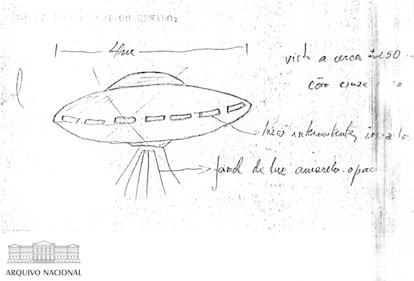
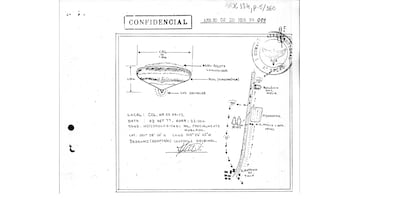
An image from reports about unidentified flying objects, which have been investigated by the Brazilian Air Force for more than 60 years.
One day in May of 1986, the head of the Brazilian Air Force – Lieutenant General Octávio Júlio Moreira Lima – summoned the press to Brasilia, the capital. He gave them a briefing about the extraordinary events that had occurred the previous Monday, which led him to order the deployment of five fighter jets. He sent them to pursue and intercept 21 UFOs, which had been sighted by hundreds of civilian and military witnesses – and detected by radar – in four states. Unfortunately, none of the aircraft managed to reach the luminous objects, which escaped with unthinkable twists and speeds.
The minister – who appeared with the five military pilots and air traffic controllers who monitored the sightings – promised a detailed report about the frenetic hours within a month. It took him much longer, but finally, many years later, it was published. And anyone can read it, as it’s been made available by the National Archives of Brazil, either in-person at the headquarters in Brasilia, or online.
NASA’s recent decision to adopt a methodology to study what it calls “unidentified anomalous phenomena” has brought the UFO collection of the National Archives of Brazil to the fore. Prepared more than six decades ago by the Air Force, it contains some 20,000 pages of reports – many with confidential seals – and drawings, as well as audios, videos, photographs, correspondence and press clippings related to the 743 incidents recorded by Brazil’s military between 1952 and 2016.
The US space agency has also announced the appointment of a director to lead the investigations… something that has a peculiar precedent in Brazil. From 1969 until 1972, a soldier – Commander Giberto Zani de Mello – oversaw a unit that was created within the Armed Forces to systematically monitor these unexplained phenomena that, for so many people, evoke the possibility of extraterrestrial life. It was called the Unidentified Aerial Object Investigation System (SIOANI) and its headquarters were based in a central neighborhood of São Paulo.
In the midst of the last Brazilian military dictatorship (1964-1985), the fact that a team of uniformed men were being asked by the high command to gather information about UFO-related events generated both alarm and curiosity. Officials from SIOANI traveled around the country to interview witnesses, writing up reports that included sketches – some of which portrayed a wide variety of flying saucer models – and producing a bulletin.
The Brazilian authorities emphasize – like their US colleagues – that UFOs aren’t synonymous with spacecraft or aliens. Brasilia notes that the 743 archived records “don’t mean that 743 flying saucers have been spotted, but rather, [they refer to] any object in the sky whose natural origin could not be immediately discovered. In other words, a UFO can be a drone, a star, a satellite, a weather balloon, or even a natural phenomenon.”
Reports on the more than 700 unidentified flying objects investigated by the Air Force can be viewed (in-person or online) in the National Archives of Brazil.
Brazil is a country with deep-rooted superstitions, where the third-largest religion is spiritualism. Consulting psychics isn’t atypical; some institutions even sign contracts with spirits to avoid rain during special events. It’s difficult to forget the scene with dozens of Bolsonaro supporters – camped in front of the Army barracks in Porto Alegre after their leader lost his re-election bid – who were recorded demanding help from extraterrestrials to carry out a coup.
The most famous UFO-related incident was what occurred on that Monday in 1986, when 21 UFOs invaded Brazilian airspace. It entered the history of ufology as “The Official Night of the UFOs.” The military’s subsequent report – in a dry tone – concluded the following about the hours that shocked the country: “The phenomena are solid and reflect, in some ways, intelligence, due to the ability [of the objects] to maintain distance from observers, as well as to fly in formation, [although they are] not necessarily manned.”
The first to detect those luminous dots was an air traffic controller from São José dos Campos, the Brazilian city that hosts the National Institute for Space Research and other strategic facilities. Pilots who witnessed the events testified that the flying objects could move in a zigzag pattern, stop in the sky, make sharp right turns, change color and reach supersonic speeds.
The sound recordings of the frenetic conversations between the controllers and the pilots can be heard on the National Archives’ website, which, from time to time, posts excerpts on social media. A ufologist named Marco Antonio Petit explained to BBC Brazil how the Brazilian military approached the phenomenon: “For years, I had the opportunity to interview high-ranking soldiers who told me: ‘UFOs aren’t shot down in Brazil because [we don’t know] if they pose a threat. How will they react if they’re attacked?”
As the UFOs were spotted during the Cold War, the uniformed men didn’t rule out that some of the strange objects sighted over Brazil – a country with a tradition of neutrality – were spy satellites sent by either the Soviet Union or the United States.
The UFO collection is one of the most popular ones in the National Archives. Other major collections include the bulk of documentation on the last military dictatorship
(1964-1985) – which is the most-consulted – as well as records on slavery, the arrival of white immigrants who replaced slave labor, Carnival, censorship, or the construction of Brasilia.
Brazil is a country where transparency is the norm: all official documents are public, except those declared secret. This is a policy that is often more advanced than developed nations in the Global North. And, thanks to that spirit of transparency (along with a formal request filed by the Brazilian Federation of Ufology), the archive on UFOs – gathered since the 1950s and guarded by the Air Force in Brasilia – began to be transferred to the National Archives of Brazil in 2008, during the second term of Luiz Inácio da Silva, who is currently serving his third term. They were subsequently made open to the public.
A little over a year ago, the Senate of Brazil invited local and foreign ufologists to a solemn session – as Mexico recently did – in an event that even included a supposed “non-human being.” Those present in Brasilia welcomed the fact that many countries – such as Brazil, or even the Vatican – are partially opening their archives on this subject. The senator who organized the unique session – Eduardo Girão – was pleased that Brazil was the first country to officially admit that UFOs exist and have extraterrestrial origins.
The UFO collection is one of the most-consulted ones in the National Archive
Een oud raadsel De Nazcalijnen zijn enorme geogliefen die tussen 100 en 600 na Christus door de Nazca-cultuur in het zuiden van Peru zijn aangebracht. Ze beslaan meer dan 500 vierkante kilometer en zijn alleen volledig herkenbaar vanuit de lucht, waardoor hun doel een van de grootste archeologische mysteries ter wereld is
Een ontworpen landschap De Nazca-woestijn biedt uitzonderlijke bewaarcondities: vrijwel geen regen en milde winden. Hierdoor zijn de geulvormige lijnen, die tussen 10 en 30 centimeter diep zijn, meer dan 1500 jaar nagenoeg ongeschonden gebleven.
Moderne herontdekking Hoewel Spaanse veroveraars destijds al melding maakten van ‘tekens op de grond’, begon het wetenschappelijke onderzoek pas in 1927. Volgens National Geographic werd de ware omvang van de geogliefen toen zichtbaar tijdens de eerste commerciële vluchten, wat leidde tot een radicale herinterpretatie van hun betekenis.
De astronomische hypothese In de jaren dertig stelde historicus Paul Kosok dat de lijnen een enorme astronomische kalender vormden. Hij merkte op dat sommige lijnen samenvielen met de zonsondergang tijdens de winterzonnewende, een belangrijk moment voor de precolumbiaanse landbouw in de Andes.
María Reiche en toegewijde wetenschap De Duitse wiskundige María Reiche wijdde meer dan vijftig jaar aan het onderzoek van de woestijn. Zij stelde dat figuren zoals de kolibrie en de aap sterrenbeelden vertegenwoordigden die zichtbaar zijn aan de zuidelijke hemel, waarbij ze astronomie en landbouwrituelen combineerde.
De rituele wending Sinds de jaren tachtig hebben nieuwe opgravingen geleid tot een verschuiving van de puur astronomische visie. Volgens National Geographic stelde archeoloog Johan Reinhard dat de lijnen verbonden waren met ceremonies om water te vragen, een essentieel element in een regio met minder dan 25 mm regen per jaar.
Water als symbolisch middelpunt De Nazca ontwikkelden geavanceerde ondergrondse watersystemen, de zogenaamde puquios. Veel geogliefen zijn gericht op deze bronnen, wat ondersteunt dat het landschap ritueel was vormgegeven om het collectieve overleven in een extreem klimaat te waarborgen.
Figuren met betekenis Dieren zoals de spin, de aap en de orka zijn niet louter decoratief. Volgens Reuters komen deze voorstellingen overeen met motieven in Nazca-keramiek en textiel, wat wijst op een samenhangende visie op kunst, territorium en religie.
Heilige wegen Sommige kaarsrechte lijnen van meerdere kilometers lang lijken te zijn gebruikt als ceremoniële routes. Sporen van slijtage tonen aan dat deze paden vaak werden belopen, wat de hypothese van rituele processies versterkt.
Een complex systeem Tegenwoordig overheerst het idee van een meervoudig gebruik: ritueel, symbolisch en sociaal. De lijnen zouden niet slechts één functie hebben gehad, maar verschillende praktijken weerspiegelen die door diverse gemeenschappen over eeuwen heen zijn ontwikkeld.
Tegen sensatiezucht In de twintigste eeuw verspreidden auteurs als Erich von Däniken volgens verschillende bronnen pseudowetenschappelijke theorieën die de Nazcalijnen verklaarden als landingsbanen voor buitenaardse schepen, een hypothese die nu door de archeologische gemeenschap wordt verworpen.
Hoe ze werden gemaakt De gebruikte techniek was eenvoudig, maar doeltreffend: het verwijderen van donkere stenen van het oppervlak om de lichtere ondergrond zichtbaar te maken. Sommige lijnen zijn tot 275 meter lang en slechts enkele meters breed.
Nieuwe technologieën In het afgelopen decennium hebben drones, luchtfotografie en kunstmatige intelligentie het onderzoek naar de Nazcalijnen ingrijpend veranderd. Volgens recente internationale berichtgeving heeft de Universiteit van Yamagata ongeveer 300 nieuwe geogliefen geïdentificeerd, wat bijna een verdubbeling betekent van het tot dan toe bekende aantal.
Kleinere geogliefen Veel van de nieuw ontdekte figuren zijn klein en abstract, wat suggereert dat het Nazca-symbolensysteem veel uitgebreider en hiërarchischer was dan eerder werd aangenomen.
Een niet-geïsoleerde cultuur De lijnen houden verband met het ceremoniële centrum Cahuachi, waar offers, textiel en sporen van collectieve rituelen zijn gevonden die hun religieuze functie bevestigen.
Het mysterie blijft bestaan Ondanks bijna een eeuw van modern onderzoek is er geen definitieve consensus. Elke nieuwe technologie brengt nieuwe interpretaties, maar ook nieuwe vragen.
Bescherming en bedreiging Sinds 1994 staat het gebied op de UNESCO-werelderfgoedlijst. Toch vormen stadsuitbreiding en ongecontroleerd toerisme nog altijd een bedreiging voor het behoud ervan.
Wetenschap in ontwikkeling Volgens National Geographic is het onderzoek naar Nazca een voorbeeld van hoe hedendaagse archeologie academische traditie en digitale hulpmiddelen combineert om het verleden opnieuw te begrijpen.
Een open nalatenschap De Nazcalijnen bieden geen eenduidig antwoord. Hun kracht ligt juist in de ambiguïteit: een oeroud bericht dat moderne wetenschap blijft uitdagen.
De beste manier om niet neergeschoten te worden is om nooit gezien te worden. Voor gevechtsvliegtuigen betekent dit detectie door radar (en andere sensoren) vermijden. Dankzij een zorgvuldige vorm en zorgvuldig gebruik van materialen zijn stealthvliegtuigen moeilijk te detecteren op radar, waardoor ze een belangrijk voordeel hebben. Stealthvliegtuigen minimaliseren idealiter ook de kans op detectie door infraroodsensoren door hun warmtesignatuur onder controle te houden en door hun eigen verklikkeremissies van elektromagnetische energie via radio's en sensoren zorgvuldig te beheren.
Hoewel stealth moeilijk te onderhouden en duur is en andere compromissen met zich meebrengt, kan het een beslissende voorsprong bieden. Hier zijn tien van 's werelds beste stealth-gevechtsvliegtuigen:
10: Sukhoi Su-57 ‘Felon’ Het stealth tactische gevechtsvliegtuig van Rusland is de Sukhoi Su-57, bij de NAVO bekend als de 'Felon'. Voor sommige waarnemers worden de beweringen van de fabrikant en de Russische staatsmedia tegengesproken door de kleine vloot, de waarschijnlijke stealth-capaciteiten en het beperkte bewijs van daadwerkelijk gevechtsgebruik.
De Felon is gebouwd op de ervaring die is opgedaan met de succesvolle Su-27 Flanker serie van grote multifunctionele gevechtsvliegtuigen van Sukhoi, en voegt grote interne baaien toe. Net als de Flanker heeft het toestel een grote hoeveelheid brandstof aan boord, waardoor het waarschijnlijk een groter bereik heeft dan de F-22 Raptor. Wapens die niet intern worden meegevoerd, kunnen de radarstealth ruïneren, maar een groot binnenruim betekent een groter vliegtuig.
10: Sukhoi Su-57 ‘Felon’ Met een combinatie van geavanceerde aerodynamica, stuwkrachtvectoring en een hoge vermogen-gewichtsverhouding is de Su-57 bijzonder wendbaar. Of de Su-57 een voldoende grote sprong in capaciteit biedt ten opzichte van de oudere Su-35 om de veronderstelde veel hogere kosten te rechtvaardigen, valt nog te bezien. De Su-57 moet nog op grote schaal worden geïntroduceerd en wordt misschien zelfs geannuleerd vanwege een gebrek aan geld.
9: Boeing X-32 Het Joint Strike Fighter-programma leidde tot de huidige F-35 Lightning II, maar niet voordat het een commerciële rivaal versloeg. Twee technologiedemonstratiemodellen gingen de strijd met elkaar aan voor deze enorm lucratieve deal om een nieuw gevechtsvliegtuig te leveren: de bizar lelijke Boeing X-32 en de wat conservatievere X-35. De X-32 is niet alleen stealthy, maar ook stealthy.
De X-32B en X-35 moesten niet alleen stealth zijn, maar ook aantonen dat ze verticaal konden opstijgen en landen. De Boeing X-32B gebruikte twee vectored straalbuizen om zijn stuwkracht naar beneden te sturen om verticaal te kunnen opstijgen en landen, maar had moeite met verticaal opstijgen vanwege de relatief slechte verhouding tussen stuwkracht en gewicht.
9: Boeing X-32 Toen de eisen voor het nieuwe vliegtuig bleven veranderen, had de X-32 moeite om zich aan te passen; de Amerikaanse marine eiste bijvoorbeeld een nieuwe verbeterde mogelijkheid om een hoger gewicht aan wapens mee terug te nemen na een missie. Terwijl het concurrerende X-35/F-35 ontwerp kon worden aangepast om aan de nieuwe eisen te voldoen, kon de X-32 de vereiste nieuwe stuurvlakken niet in de vleugels plaatsen zonder een enorme gewichtstoename.
Met de veranderende eisen, problemen met nieuwe geavanceerde kunststoffen en hele vliegtuigen die te zwaar waren, was de X-32 een moeizaam project. De X-32B kon zelfs niet verticaal opstijgen zonder onderdelen te verwijderen om het gewicht te verminderen.
8: Chengdu J-20 Toen de J-20 in 2017 in gebruik werd genomen, was het toestel controversieel. Veel waarnemers twijfelden aan zijn stealth-credentials, hoewel het waarschijnlijk veel minder zichtbaar is voor radar dan conventionele vliegtuigen. Hoewel sommigen het ermee eens zijn dat de configuratie minder stealthy is dan die van de F-22, is het belangrijkste voordeel van deze opstelling het vervoer van aanzienlijk meer brandstof, wat wordt gecombineerd met de mogelijkheid om een langer wapencompartiment te gebruiken.
8: Chengdu J-20 Het resultaat zou een opmerkelijk multifunctioneel vliegtuig kunnen zijn. Een groot bereik is van vitaal belang voor een gevechtsvliegtuig dat opereert in de uitgestrekte Stille Oceaan. Naast luchtdoelraketten zal het waarschijnlijk ook anti-scheepsraketten dragen.
De grote brandstoflading van het ontwerp kan zorgen voor een groter bereik of een langere gevechtsduur en dit suggereert dat het, als het bewapend is, een lange-afstands lucht-lucht rol zou hebben in de strijd tegen vroege waarschuwingsvliegtuigen en tankers die bijtanken.
7: Lockheed F-117 Nighthawk Ondanks dat het strikt genomen geen 'fighter' is, staat de F-117 bij velen bekend als de 'Stealth Fighter'.
Het ontwerp van de F-117 weerkaatste radarenergie weg van waar de vijandige radar het wilde hebben. Om de geometrie van elk extern onderdeel van het vliegtuig strak te kunnen controleren, mochten er geen onregelmatige vormen zijn, zoals externe bommen of een ronde neuskegel, en het resultaat was een nogal sinister uiterlijk.
7: Lockheed F-117 Nighthawk De Lockheed F-117 Nighthawk werd in het geheim ontwikkeld. Het werd pas onthuld, met het tonen van een zwaar bewerkte foto, op een persconferentie in 1988. Tijdens de geallieerde campagne tegen de invasie van Koeweit door Saddam Hoessein in 1991 werd de F-117 wereldberoemd door zijn precisiebombardementen op Bagdad.
Het neerschieten van een F-117 boven Joegoslavië in 1999 zou zijn onkwetsbare reputatie een flinke deuk geven. Hoewel de F-117 in 2008 officieel met pensioen werd gestuurd, blijft hij in dienst om Amerikaanse gevechtspiloten en grondverdedigingstroepen te trainen in het bestrijden van stealthvliegtuigen.
6: Boeing Bird of Prey Geen enkel vliegtuig heeft er ooit zo futuristisch uitgezien als de uiterst geheime, gestroomlijnde en bizarre Bird of Prey. Het was zo geheimzinnig dat het, ondanks dat het in 1996 vloog (vanuit Area 51), pas in 2002 publiekelijk werd onthuld.
De configuratie was extreem vreemd, met een extreem gezwenkte meeuwvleugel aan de achterkant van het vliegtuig en de motorinlaat verborgen voor radars.
6: Boeing Bird of Prey Na taxiproeven weigerde de eerste testpiloot met de Bird of Prey te vliegen omdat hij dacht dat het onveilig was. De tweede testpiloot nam het over en maakte de eerste vlucht op 11 september 1996.
De Bird of Prey bood een fascinerend inzicht in een heel andere oplossing voor het maken van laag-waarneembare vliegtuigen. De afwezigheid van staartvlakken is noodzakelijk voor de hoogste graad van radarstealth, bij afwezigheid van een staart zorgt de meeuwenvleugel voor richtingsstabiliteit en controle.
5: Northrop/McDonnell Douglas YF-23 Ondanks het feit dat het een van de stealthiest en snelste gevechtsvliegtuigen ooit gemaakt is, bestaan de twee YF-23's nu alleen nog in musea. De gestroomlijnde vorm, staart en kenmerkende vleugel van de YF-23 zijn heel anders dan die van latere stealth-vliegtuigen en laten een andere richting zien die het ontwerp van stealth-jagers had kunnen nemen.
In een poging om de F-15 Eagle van de Amerikaanse luchtmacht te vervangen, werden twee ontwerpen gekozen om hun waarde te bewijzen: de YF-22 van Lockheed, Boeing en General Dynamics en de YF-23 van Northrop en McDonnell Douglas. Met Northrop als wereldleider in het ontwerpen van laag-waarneembare vliegtuigen zoals de B-2 bommenwerper, en McDonnell Douglas als maker van wat toen 's werelds beste gevechtsvliegtuig was, de F-15, leek het een 'dream team' te worden.
5: Northrop/McDonnell Douglas YF-23 De YF-23 vloog voor het eerst op 27 augustus 1990 en toonde zich al snel een opmerkelijk briljant ontwerp. Het demonstreerde op bekwame wijze de mogelijkheid om efficiënt op supersonische snelheid te vliegen zonder het gebruik van een naverbrander en het zou extreem moeilijk te traceren zijn op radar. De YF-23 had het potentieel om formidabel te zijn.
De USAF vroeg om een stealthy gevechtsvliegtuig en Northrop en McDonnell Douglas voldeden aan dit verzoek. Maar de YF-23 legde misschien iets te veel nadruk op stealth, wat waarschijnlijk ten koste ging van de wendbaarheid en manoeuvreerbaarheid van het gevechtsvliegtuig in vergelijking met de F-22 Raptor.
4: Lockheed Martin F-35 Lightning II Door Lockheed Martin's ervaring met de F-117 en F-22 bevond het bedrijf zich in een sterke positie om het Joint Strike Fighter-programma te winnen om een nieuw tactisch gevechtsvliegtuig te maken voor de Amerikaanse luchtmacht, marine en marinierskorps. Ze zouden zeker alle mogelijke expertise nodig hebben, want de F-35 was een van de technologisch meest geavanceerde projecten ooit bedacht.
Naast de noodzaak van stealth moest de F-35 ook beschikbaar zijn in een versie die kon opereren vanaf vliegdekschepen (de F-35C met grote vleugels) en die verticaal kon opstijgen en landen (de F-35B).
4: Lockheed Martin F-35 Lightning II Deze combinatie van kwaliteiten was ontmoedigend ambitieus en werd toch bereikt. De aanvankelijke wens om het toestel goedkoop, betrouwbaar en gemakkelijk te onderhouden te maken, werd echter geen werkelijkheid.
Met meer dan 1000 gebouwde F-35's vertegenwoordigt het een enorm percentage van alle stealthvliegtuigen wereldwijd.
3: Lockheed Martin F-22 Raptor Terwijl eerdere vliegtuigen zoals de B-2 en F-117 langzaam en niet erg wendbaar waren, was de F-22 het eerste operationele vliegtuig dat snelheid en wendbaarheid combineerde met stealth. Dit was op zich geen gemakkelijke opgave en de F-22 heeft de grenzen zo verlegd dat het sinds zijn ingebruikname in 2005 de onbetwiste grootste jager is.
Het toestel combineerde een ongeëvenaard niveau van omgevingsbewustzijn en sensorfusie met verpletterende prestaties. Het toestel gebruikt vectored thrust om schijnbaar onmogelijke manoeuvres uit te voeren en kan met extreem hoge snelheden vliegen zonder gebruik te maken van een naverbrander.
3: Lockheed Martin F-22 Raptor Het toestel wordt algemeen beschouwd als het beste gevechtsvliegtuig en domineert gesimuleerde luchtgevechtsoefeningen. De F-22 werd voor het eerst gebruikt in de strijd, in de rol van grondaanvaller, in 2014 in Operation Inherent Resolve tegen Islamitische Staatstroepen. De eerste 'air-to-air kill' was in 2023 tegen een Chinese verkenningsballon zonder bemanning.
De ontwerpconfiguratie van de F-22 is zeer invloedrijk geweest; de Chinese J-20, de Amerikaanse F-35, de Koreaanse KF-21 en andere vliegtuigen delen allemaal verschillende ontwerpkenmerken die door de F-22 zijn gepionierd.
2: Northrop B-2 Spirit Het bedrijf Northrop was al bezig met het onderzoeken van vliegtuigen met alle vleugels voordat de Northrop N-1M in 1940 vloog. De voordelen waren duidelijk: elk onderdeel van het vliegtuig droeg bij aan de lift en het ontwerp kon heel eenvoudig worden gehouden. Een vliegende vleugel zou waarschijnlijk efficiënter zijn en daardoor een groter bereik hebben dan een gelijkwaardig conventioneel ontwerp.
In Duitsland was er ook grote belangstelling voor het ontwerp van de vliegende vleugel en aan het einde van de oorlog vloog het bedrijf Horten met een prototype van een vliegende straaljager-bommenwerper, de Ho 229. Het bedrijf Northrop bood na de oorlog grote vliegende bommenwerpers aan de Amerikaanse luchtmacht aan, maar deze werden afgewezen. De moeite was echter niet voor niets geweest, want uiteindelijk werd er wel een vliegende-vleugelbommenwerper geselecteerd. Het staartloze Flying Wing ontwerp, met zijn afwezigheid van een verticale staart (een opvallend onderdeel van een vliegtuig voor nieuwsgierige radars) bleek uitstekend geschikt voor stealth vliegtuigen.
2: Northrop B-2 Spirit Alles werd in het werk gesteld om de B-2 stealth te maken, inclusief het gebruik van extreem exotische materialen en productietechnieken. Deze inspanning was niet goedkoop en elke B-2 kostte ongeveer $ 2 miljard. Met het einde van de Koude Oorlog en de stijgende kosten werden er in totaal slechts 21 toestellen gemaakt.
Met een intercontinentaal bereik en de mogelijkheid om meer dan 18.000 kg aan wapens mee te nemen, gecombineerd met een hoge mate van overlevingsvermogen tegen moderne luchtverdediging, blijft de B-2 een belangrijk onderdeel van de Amerikaanse luchtmacht. Samen met de B-52's zijn de B-2's Amerika's enige langeafstandsbommenwerpers die kernwapens kunnen droppen. In juni 2025 vielen zeven B-2-bommenwerpers samen met 120 andere Amerikaanse vliegtuigen vermeende nucleaire installaties in Iran aan.
1: Northrop B-21 Raider Toen de Northrop B-21 Raider in 2023 zijn eerste vlucht maakte, was het de eerste nieuwe Amerikaanse bommenwerper in 34 jaar. Dat het toestel zo sterk leek op de bommenwerper die 34 jaar eerder vloog, de Northrop B-2, is een bewijs van de degelijkheid van het 'vliegende vleugel'-ontwerp.
De belangrijkste verschillen tussen de B-21 en de B-2 zijn dat de B-2 versterkt is voor missies op lage hoogte. Dit was geen vereiste voor de B-21, dus kan het kleiner en lichter zijn.
1: Northrop B-21 Raider Het maximale gewicht van de B-2 wordt geschat op 170.600 kg, terwijl dat van de B-21 slechts 81.647 kg is. De spanwijdte van de B-21 is 40 meter vergeleken met de 52 meter van de B-2.
De B-21 is een langeafstandsbommenwerper die is gebouwd om zowel conventionele als nucleaire wapens in te zetten. De B-21 is nog niet in operationele dienst, maar er zijn momenteel drie testvliegtuigen, twee voor werk in de lucht en één voor testen op de grond. Men hoopt het vliegtuig rond 2027 in gebruik te kunnen nemen, een datum die al is uitgesteld, maar geavanceerde militaire vliegtuigprojecten lopen nooit volgens schema.
The Amazing But Controversial Piri Re’is Map of 1531
The Amazing But Controversial Piri Re’is Map of 1531
Overview
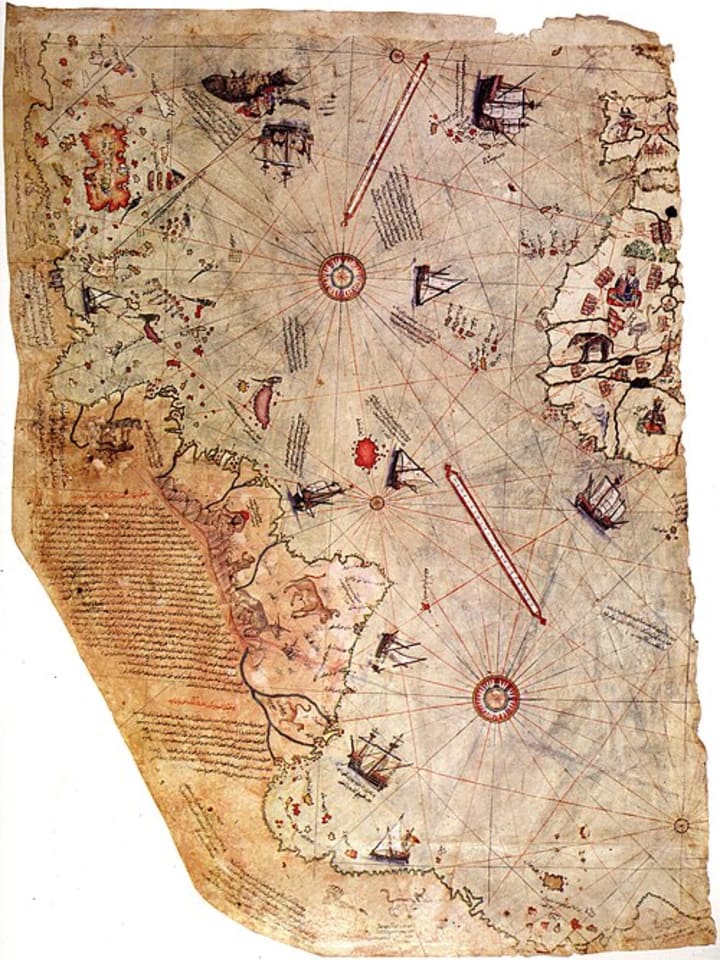
The Piri Re’is map, drawn in 1513 by Ottoman admiral‑cartographer Piri Re’is, has resurfaced as one of the early‑modern period’s most debated cartographic artifacts. Rediscovered in 1929 during renovations at Istanbul’s Topkapi Palace, only a third of the original gazelle‑skin parchment survives, showing the western coast of Europe, North Africa, parts of the Atlantic, and a surprisingly detailed stretch of South America’s eastern shoreline. The map’s precision—especially along the Brazilian coast—has sparked scholarly debate over whether it reflects advanced 16th‑century navigation, the reuse of older source material, or something more speculative.
Public domain picture
Discovery and Provenance
Piri Re’is, an Ottoman admiral who also served as a navigator and cartographer, recorded in marginal notes that his map synthesized about 20 earlier charts, ranging from ancient Greek maps to Arab and Portuguese charts, and even a map attributed to Christopher Columbus. The surviving fragment was found hidden behind a wall in the Topkapi Palace, preserved on delicate gazelle skin. “The parchment’s condition suggests it was valued enough to be stored securely, yet it was eventually forgotten until the palace’s 20th‑century restoration,” notes Dr. Leyla Şahin, a historian of Ottoman maritime science at Boğaziçi University.
What Makes the Map Extraordinary
The most striking feature is the accuracy of the South American coastline. The Brazilian shore is rendered with a level of detail that rivals maps produced decades later, prompting speculation that Piri Re’is accessed source material far more precise than the typical Portuguese or Spanish charts of his day. Additionally, the map includes a southern landmass that some early 20th‑century writers, most famously Charles Hapgood, interpreted as an ice‑free Antarctica. Hapgood argued that this depiction could be evidence of a lost civilization possessing global geographic knowledge. Modern cartographers, however, point out that the shape aligns more closely with an exaggerated extension of South America—a distortion common in early portolan charts, which prioritized coastal navigation over accurate inland projection.
Public domain picture
Scholarly Controversies
The Antarctica hypothesis remains the map’s most sensational claim. Proponents cite the landmass’s outline and its apparent lack of separation from South America as clues to a pre‑Ice‑Age, ice‑free continent. Critics counter that geological evidence shows Antarctica has been ice‑covered for at least 34 million years, far predating any known human civilization. Dr. Michael O’Leary of the University of Cambridge argues, “When you overlay a 16th‑century portolan onto a modern globe, the inevitable projection errors can make unrelated coastlines appear connected.”
Beyond Antarctica, fringe theories suggest the map proves ancient global exploration or the survival of advanced knowledge from the Library of Alexandria. Mainstream historians dismiss these ideas as speculative, emphasizing the map’s own admission of composite sourcing. “Piri Re’is was transparent about using multiple, unevenly accurate charts,” says Şahin. “The resulting inconsistencies are expected when you stitch together data from different eras and cultures.”
Implications for Cartographic History
Regardless of the more exotic interpretations, the Piri Re’is map offers valuable insight into Ottoman engagement with worldwide maritime knowledge. Its blend of Mediterranean, Arab, and early Atlantic sources illustrates a sophisticated network of information exchange long before the era of standardized global mapping. The map also underscores the importance of portolan chart traditions, which could achieve remarkable coastal accuracy without modern longitude measurements—a testament to the skill of early navigators. As researchers continue to digitize and compare the surviving fragment with contemporary charts, the map remains a focal point for understanding how early modern empires synthesized and transmitted geographic data across cultural boundaries.
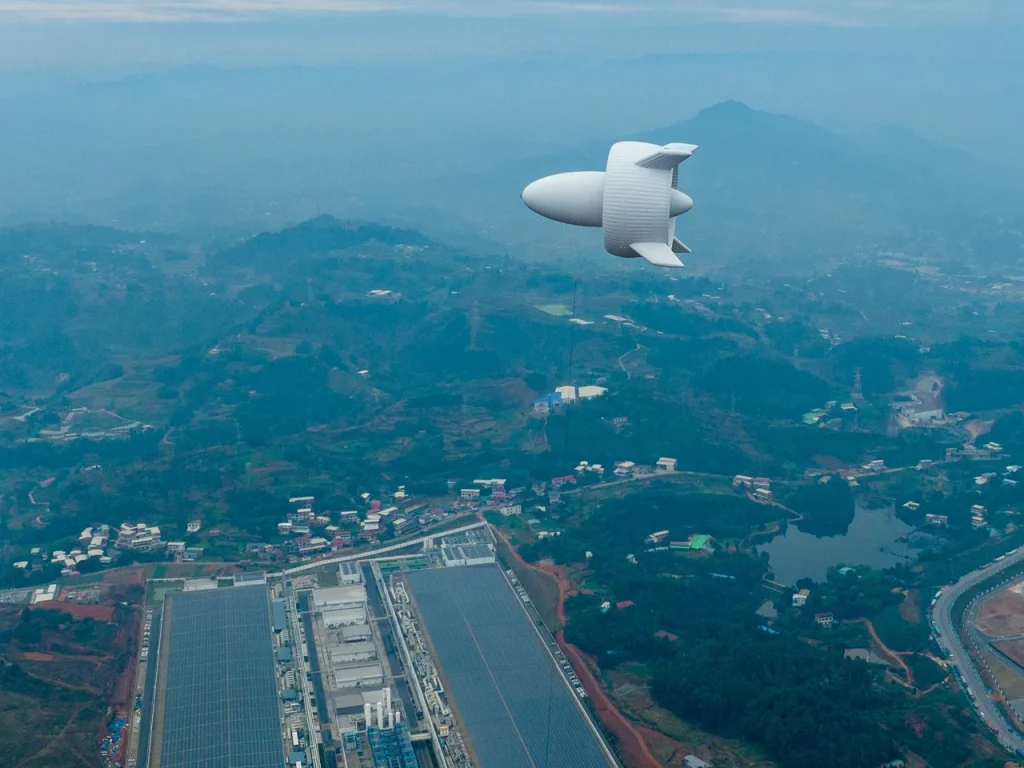
Locals in Yibin, in Sichuan Province, China, spotted a giant blimp-like object that could have been a UFO floating overhead and did a double-take.
It looked like something straight out of a sci-fi movie, silently hovering above the city.
Social media quickly lit up with theories, but the truth was far more surprising than aliens.
Whatever it was, this strange craft was not just floating for fun.
UFO sighting in China
The mysterious object appeared during a major energy test in early January 2026, climbing to around 2,000 meters above the ground and holding a steady hover.
From below, it looked like a huge futuristic airship, a blimp or UFO, and completely out of place in the sky, but in fact, it was a snazzy piece of tech.
At that altitude, winds are typically stronger and more consistent than those closer to the surface.
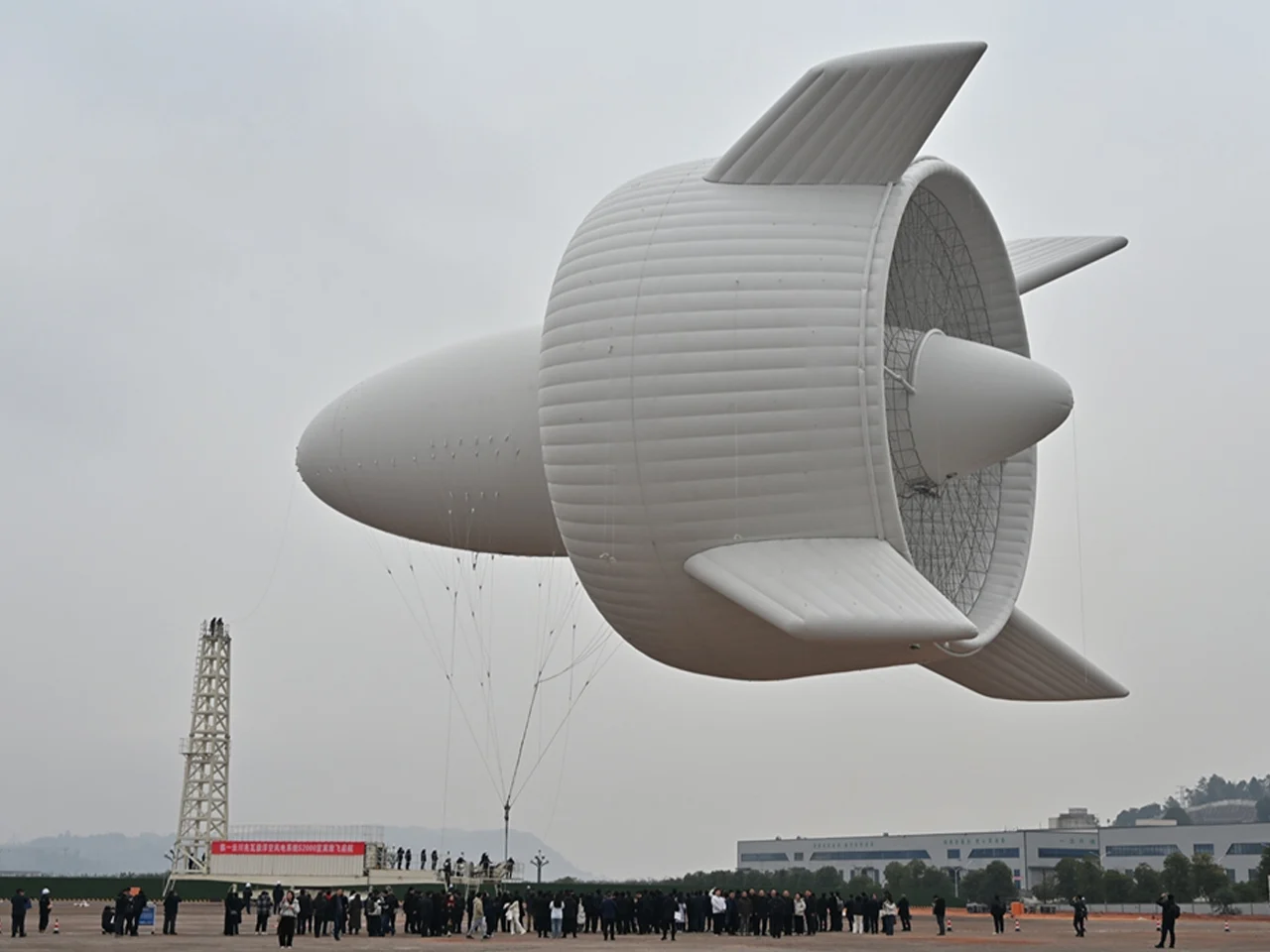
The aircraft was tethered to the ground by a cable, keeping it stable as it hovered.
But the tether was not just for control; it also served another key purpose: connecting whatever was happening in the sky back down to Earth.Yanko Design
It’s a bird, it’s a plane, no, it’s a S2000 Stratosphere Airborne Wind Energy System!
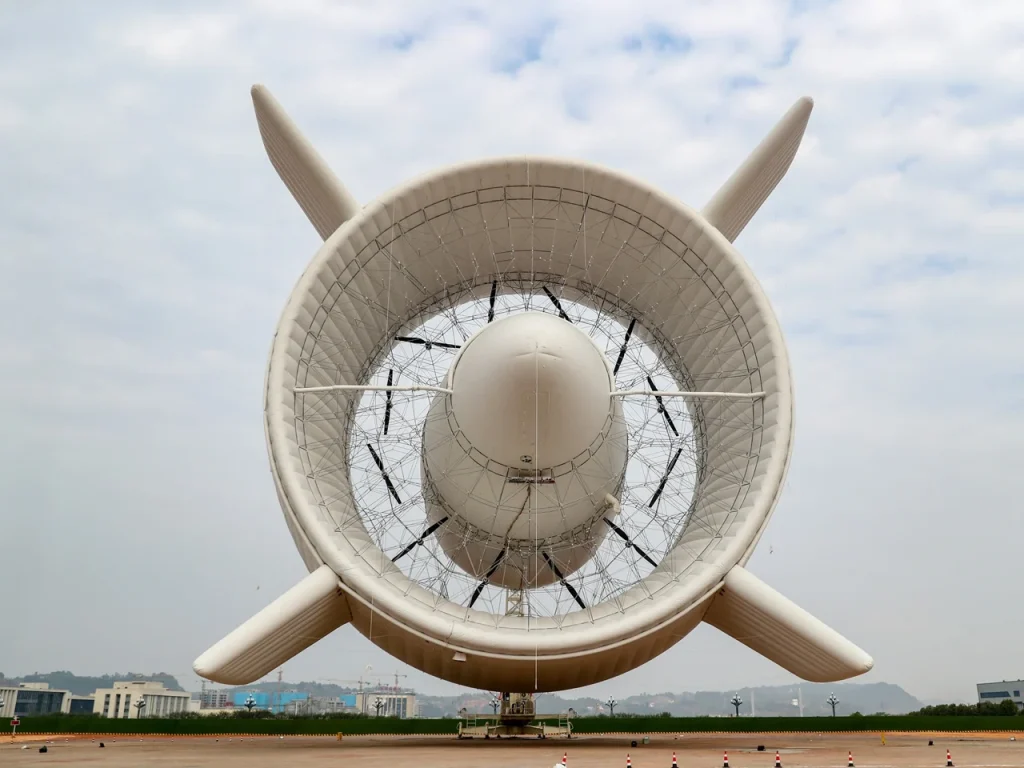
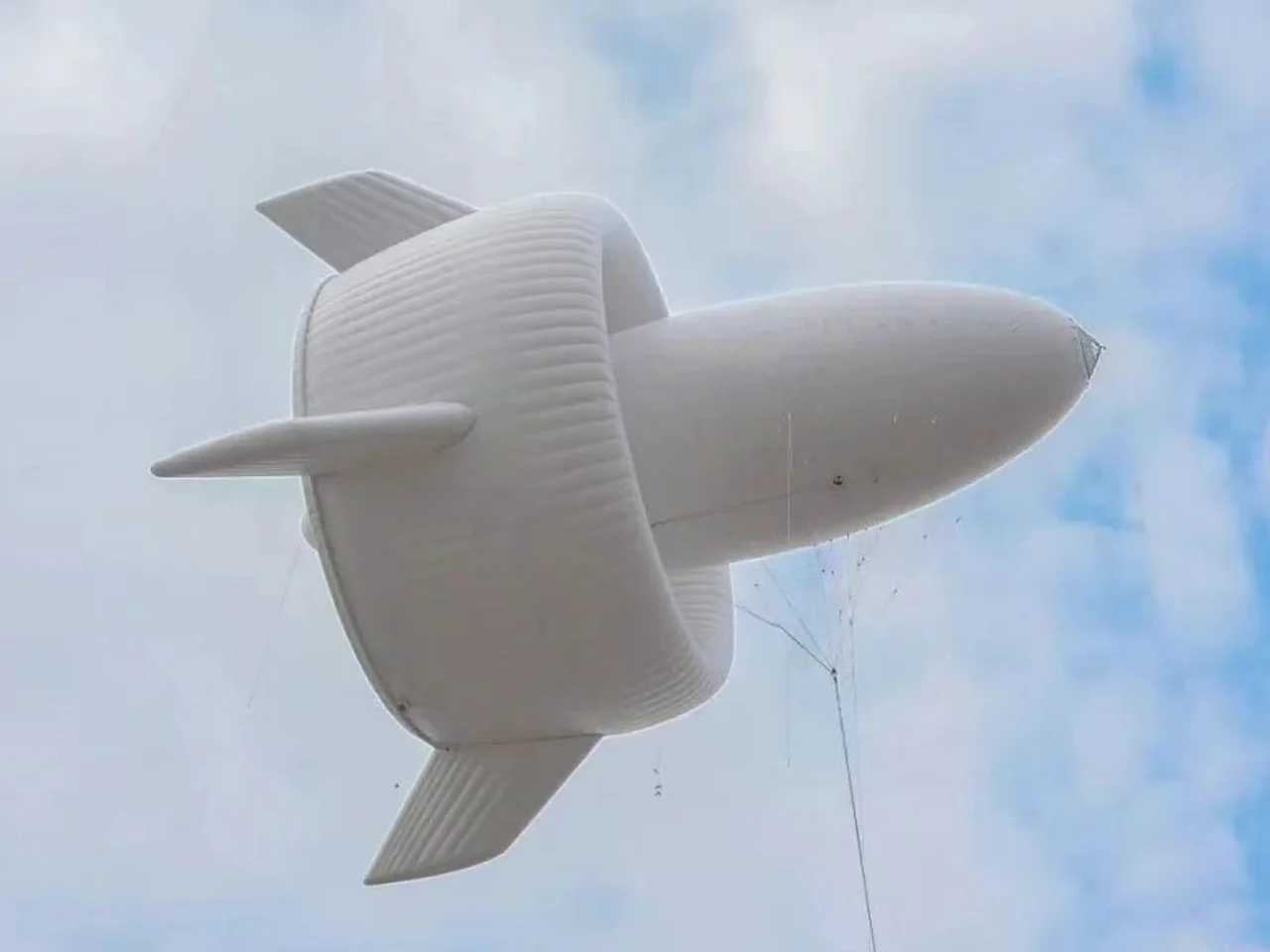
The so-called UFO was actually the S2000 Stratosphere Airborne Wind Energy System, a next-generation airborne wind turbine designed to send electricity directly into the grid.
Instead of giant towers planted on land, the S2000 uses a helium-filled airship platform with turbines built into its structure, allowing it to harvest wind power high in the atmosphere.
Yanko Design
During the test, the platform successfully delivered 385 kilowatt hours of electricity into the local power network, which is a crazy efficient number for airborne wind energy.
The size is wild, too; the S2000 has a reported volume of about 20,000 cubic meters, measures around 60 meters long, and stands roughly 40 meters tall and wide.
Yanko Design
It also has a maximum rated capacity of three megawatts, with developers already moving towards producing a small batch.
Sometimes, a UFO is actually an unidentified flying object, not aliens.
EXCLUSIVE - Trump insiders told me the president has a bombshell speech revealing DECADES of UFO secrets ready to go... here's when he will finally tell the world the truth
EXCLUSIVE - Trump insiders told me the president has a bombshell speech revealing DECADES of UFO secrets ready to go... here's when he will finally tell the world the truth
President Donald Trumpreportedly has a historic speech ready that could finally provide the world with UFO disclosure, according to a filmmaker.
Mark Christopher Lee, a UK-based writer, director, producer and ufologist, said 'an advisor to the Trump administration' told him that the president 'has been given authority by the other major world leaders to make this announcement.'
The speech is said to reveal decades of evidence, recovered materials and credible military eyewitness accounts showing that some UFO incidents cannot be explained by any known human technology.
Lee told the Daily Mail that Trump's remarks will highlight several high-profile cases, including the 2004 USS Nimitz Tic Tac encounter, the 2015 USS Roosevelt GoFast and Gimbal incidents and the 1947 Roswell event.
'He will confirm that forensic analysis of recovered off-world vehicles and non-human biologics has established their extraterrestrial origin, marking the first official acknowledgment of this reality by any world leader,' he added.
The speech was initially planned for the United Nations General Assembly in September, but Lee said it has been moved up to coincide with Roswell's 79th anniversary on July 8. He told the Daily Mail that 'new intelligence developments have made it a matter of urgency.'
'I do feel that President Trump likes to act spontaneously and may not want to wait until July 8,' Lee added.
'He might also suspect that Russia or China could jump the gun, but I'm fairly confident it will happen sooner rather than later.'
A filmmaker has claimed that President Donald Trump (pictured) has already written a historic speech for UFO disclosure, and will deliver it on July 8
Trump has expressed support for increased transparency and 'disclosure' regarding UFOs, though his personal interest in the subject has historically been described as skeptical or limited.
'Am I a believer? No, I probably can't say I am. But I have met with people who are serious people who say there are some really strange things that they see flying around out there,' Trump said during an appearance on YouTuber-turned-WWE star Logan Paul's podcast last year.
Lee told the Daily Mail that his insider is 'a successful business person acting as an advisor to the Trump administration officials, who has been responsible for reviewing archive UFO evidence in preparation for' the disclosure event.
'The president will explain that previous administrations maintained secrecy due to national security concerns, technological uncertainty and fear of public reaction,' Lee said he was told.
'He will emphasize that he is the first president to authorize full disclosure because the American people deserve transparency, current geopolitical stability allows it, and recent bipartisan congressional efforts have created the necessary framework for responsible revelation.'
The high-profile incidents reportedly set to be discussed have captivated the world for decades and have been brought to Congress by whistleblowers who gave testimonies under oath.
Those included statements from fighter pilot David Fravor. Fravor was flying a training exercise off the coast of San Diego when he was rerouted to investigate a strange object spotted on radar by warships protecting his aircraft carrier, the USS Nimitz.
This has since become known as the November 2004 'Tic Tac' encounter, which Fravor described as a roughly 40-foot white object with no windows or wings, shaped like a Tic Tac candy, flitting about above the sea that was roiling below it, seemingly disturbed by something large submerged beneath the surface.
Trump is set to pull the curtain on high-profile UFO reports, such as the the 2004 USS Nimitz Tic Tac encounter (pictured)
Fravor told Congress in 2023 that as he circled the object, it turned to mirror his movements. He said it then shot off past him at thousands of miles per hour, somehow stopping a second later 60 miles away, at a secret pre-designated rendezvous point that only a handful of Navy staff were given.
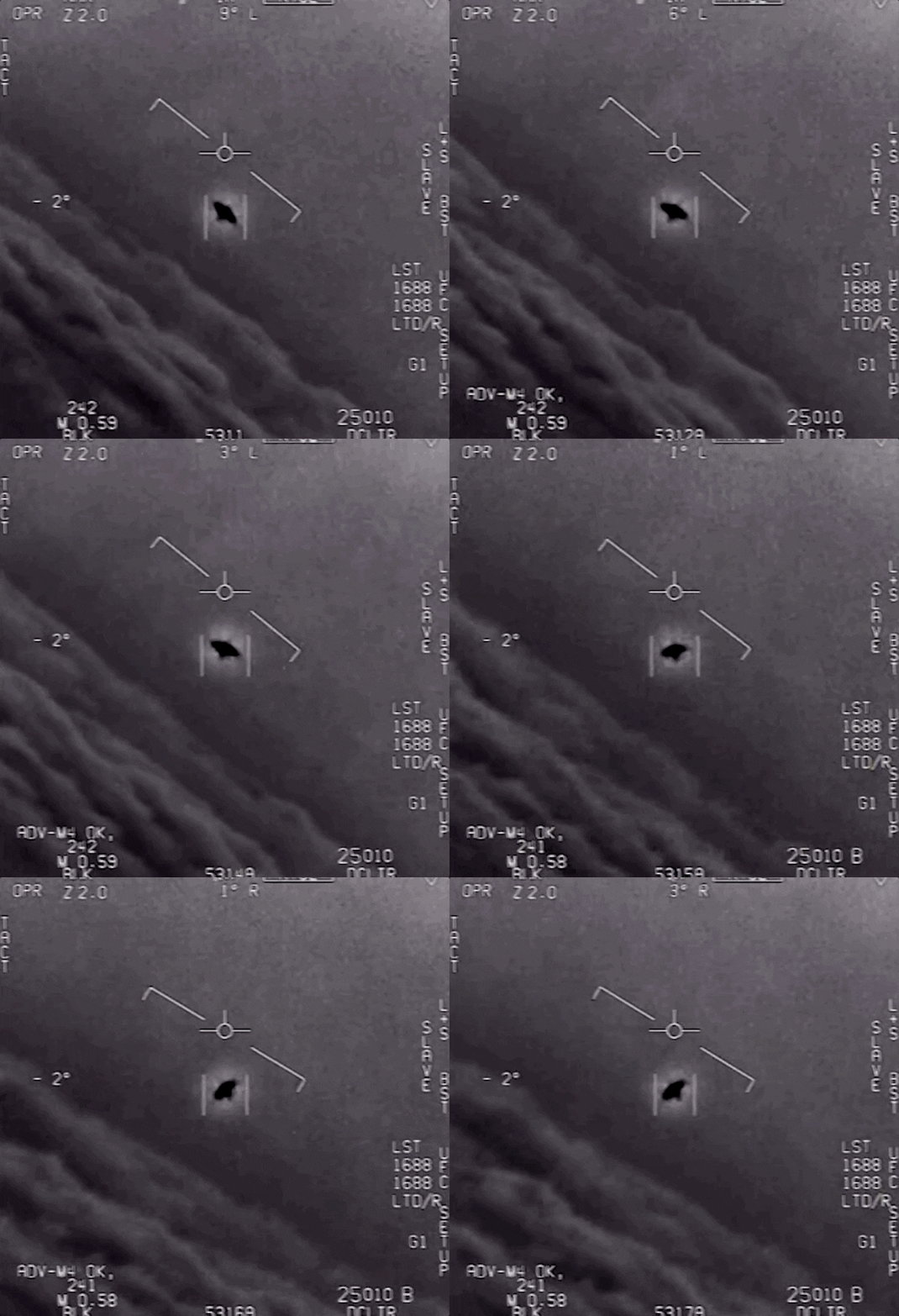
Separately, in 2015, pilots and radar operators aboard the USS Roosevelt recorded two high-speed UFO encounters, nicknamed GoFast and Gimbal.
The objects were captured on advanced infrared cameras and displayed capabilities beyond known human technology, including sudden accelerations and rotation mid-flight.
The incidents were documented in Pentagon-released videos, fueling renewed interest in unidentified aerial phenomena.
Former Navy pilot Ryan Graves testified alongside Fravor to Congress that the GoFast and Gimbal encounters represent serious flight safety and national security risks.
Based on his experience and reports from over 30 crew members, Graves said these objects were routinely seen, often stationary in high winds or moving at hypersonic speeds, with many incidents remaining unexplained.
In 2015, pilots and radar operators aboard the USS Roosevelt recorded two high-speed UFO encounters, nicknamed GoFast (pictured) and Gimbal
However, Dr Jon Kosloski, director of the Defense Department's All-Domain Anomaly Resolution Office (AARO), testified under oath in a 2024 hearing held by the Armed Services Committee, that the infrared UFO video showed nothing more than 'a trick of the eye.'
He attributed the UFO's apparent high-speed skimming over the ocean to an optical illusion, called 'parallax,' but the office did not otherwise identify the object.
'President Trump will announce immediate steps toward declassification of related files, expanded scientific study through a new interagency task force, and international cooperation with allied nations,' Lee told the Daily Mail.
Lee said Trump will call the new studies 'an opportunity to unite humanity in understanding our place in the universe.'
Lee claims he was told the disclosure speech would fall on the anniversary of the mysterious crash near Roswell, New Mexico. The object was initially reported as a 'flying disc.'
The military quickly retracted its statement, claiming the debris was from a weather balloon, but eyewitness accounts of unusual materials and structures persisted.
Major Jesse Marcel (pictured), who recovered debris from the 1974 Roswell crash, described the scene as 'a large area heavily scattered with metallic debris from a single impact point that scarred the earth.' He said the debris could not melt or heat up and could not be punctured
The local paper's front page story reported that the Roswell Army field recovered a flying saucer on a New Mexico Ranch after metallic-looking, light but strong material was scattered across the land
The Roswell incident became the world's most famous UFO case, forming the foundation of modern extraterrestrial lore.
Retired US Air Force Major David Grusch, a current advisor to Congress's UAP Task Force, claimed last month that Trump has received reports on crashed spacecraft, non-human remains retrieved by the US, the origins of these beings and their intentions.
Grusch also said the president could soon become the 'most consequential leader in world history' by publicly disclosing what America has kept hidden about extraterrestrials.
Until now, previous White Houses, the US military and even NASA have all denied that humans have made contact with alien life or ever recovered extraterrestrial technology from crashed UFOs.
No physical evidence has ever been presented publicly to back up the stories shared over decades by civilians, scientists and military personnel claiming to have seen or interacted with beings from another world.
However, Grusch said the US military has not only recovered UFOs and alien bodies, but he claimed he personally viewed intelligence reports, data and even pictures of non-human bodies with his own eyes.
The whistleblower also allegedly told members of Congress that Trump was briefed during his first term about the existence of multiple alien races, and that one species has been crossbreeding with humans.
The White House declined to comment on the matter.
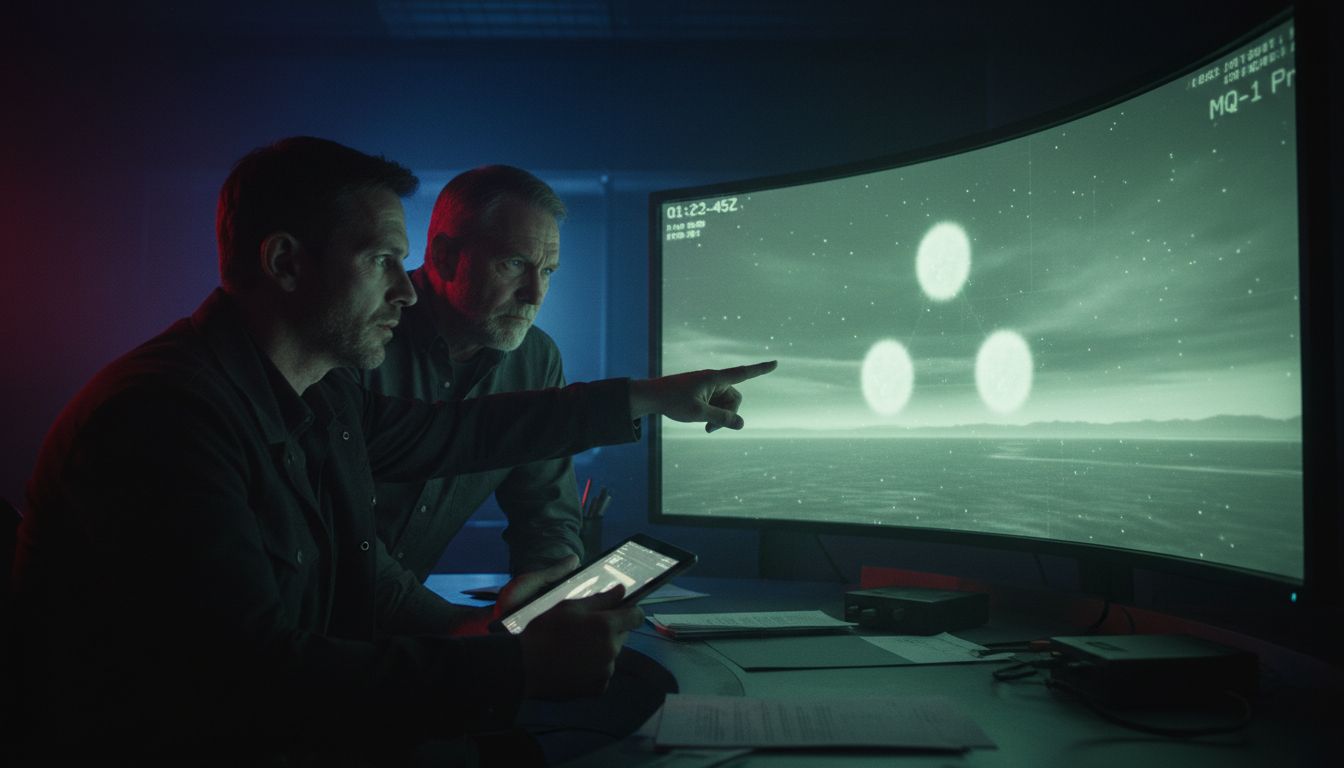
Investigative journalists Jeremy Corbell and George Knapp have released, for the first time, a classified video captured by a U.S. Air Force‑directed MQ‑1 Predator drone on 23 August 2012 over the Persian Gulf. The thermographic (FLIR) footage shows three luminous “orbs” moving in a tight triangular formation at 18:21 UTC, performing abrupt directional changes without any discernible propulsion plume or heat signature. The material, now catalogued by the United States intelligence community as “UAP orbs,” adds to a growing body of evidence that the Department of Defense is formally acknowledging the presence of Unidentified Anomalous Phenomena in operational airspace.
Key Details
The video, recorded at coordinates 28°27′17.0″ N, 50°33′37.0″ E, was obtained from a high‑confidence source within the Predator’s data archive. Analysts note that the objects were actively tracked by the drone’s sensors, indicating that the platform’s operators recognized them as distinct contacts rather than sensor artifacts. Throughout the 30‑second clip, the orbs execute rapid, angular turns and maintain formation despite the absence of conventional aerodynamic surfaces or exhaust plumes. The FLIR imagery registers no thermal contrast against the surrounding sea and sky, a factor that has puzzled both military and civilian experts tasked with evaluating the phenomenon.
Context within UAP Investigations
Since the 2020 release of the UAP Task Force report, the intelligence community has steadily de‑classified sightings that meet stringent criteria for “unidentified.” The Pentagon’s All‑Domain Anomaly Resolution Office (AARO) now maintains a database that includes over a thousand such events, many of which involve radar‑visible objects that evade visual identification. The 2012 Persian Gulf incident aligns with prior reports of triangular formations—notably the 2004 “Nimitz” encounter—yet distinguishes itself by the exclusive reliance on infrared imaging, eliminating visual‑light bias. Researchers such as Dr. Jacques Vallée have long argued that formation flight suggests a level of coordinated control, a point reinforced by the Predator’s on‑board tracking logs indicating intelligent maneuvering rather than random drift.
Expert Commentary
Corbell, whose documentary work has previously highlighted Navy pilot testimonies, emphasized the strategic implications:
“No matter where UFOs are from – it is now openly admitted by our Department of War that they are appearing with an increased frequency worldwide. It’s time to acknowledge the UFO problem – as this case reveals that incursions by UAP pose a significant challenge for our collective defense apparatus.”
George Knapp, a veteran investigative reporter on aerospace anomalies, added that the footage “provides a rare, high‑resolution glimpse of an event that was previously known only through anecdotal accounts.” Both journalists stress that the release aims to foster transparency and reduce the stigma that has historically hampered scientific inquiry into UAPs.
Implications for Defense and Policy
The emergence of a high‑confidence, sensor‑verified record of coordinated, propulsion‑less flight raises several questions for national security planners. If the objects possess capabilities beyond current aerospace technology, they could represent a potentially adversarial system or an unknown natural phenomenon with strategic relevance. Congressional oversight committees, which have recently pushed for more rigorous reporting requirements, may now have concrete data to justify increased funding for AARO’s analytical tools. Moreover, the incident underscores the need for inter‑agency data sharing, as the original flight logs were reportedly generated under Air Force command but are now being examined by intelligence analysts, civilian scientists, and the broader public.
The Persian Gulf triangle formation footage marks a significant milestone in the ongoing effort to document and understand UAP activity. By making the video publicly accessible, Corbell and Knapp hope to encourage a rational, evidence‑based dialogue that bridges the gap between classified military observations and open‑source scientific research. As the Department of Defense continues to refine its approach to unidentified aerial phenomena, incidents like this will likely shape both policy and public perception for years to come.
It must be a thrilling time, for what remains of the ‘60s counterculture: first tie-dye went mainstream, then psychedelics, and now the belief in UFOs. The videos lately leaked by the government purporting to show mysterious and possibly alien-linked aerial phenomena has incited maybe the most serious reckoning with the possibility of alien life in America’s history, with more or less respectful news articles and TV segments and, now, a Congressional hearing. But is what we’re seeing now really substantially different from what we’ve seen in the past? What exactly is going on in all those videos? For this week’sGiz Asks, we reached out to a number of experts—as much as anyone can be an expert in things that are unidentified—to find out.
This new report is different from past discussions on Unidentified Flying Objects (UFOs) or Unidentified Aerial Phenomena (UAP) in that it involved documented evidence collected by military personnel based on detection by multiple instruments (radar, infrared cameras, optical cameras), indicating the possible existence of objects which behave in ways that cannot be explained by the technologies we possess. Past top-level government officials who had access to this data (including former President Obama, former Intelligence Director John Ratcliffe, former CIA Director James Woolsey and former Senator Harry Reid) made statements recently that they believe these are real objects but they do not understand their nature. It is possible, and likely, that most of the past reports on UFOs from the general public can be explained by human-made or natural phenomena, or as illusions, but we need to pay special attention to the small number of reports where the evidence is strong and undisputable. The key is to collect more evidence with our best recording devices.
It would be prudent to progress forward with our finest instruments, rather than examine past reports. Instead of declassifying documents that reflect decades-old technologies used by witnesses with no scientific expertise, it would be far better to deploy state-of-the-art recording devices, such as cameras installed on wide-field telescopes or audio sensors, at the sites where the reports came from, and search for unusual signals.
They show a variety of different things. Consistent only in their variety, the videos that have leaked out of the US Navy herald little more than disappointment for the UFO enthusiasts who hope that alien technology is just around the corner.
The most dramatic video, code name “Gimbal,” seems to show an actual flying saucer skimming over the clouds. It comes to a stop and rotates 90 degrees in an aerodynamically impossible manner. Surely this is the evidence we’ve been looking for? Sadly, no—close examination reveals the shape on the screen is rotating when other faint shapes rotate, showing it’s an optical artifact, not actually saucer-shaped, just the shape of a thermal glare, probably from the engines of a distant, human, jet. The rotation? An artifact of the gimbal-mounted camera—hence the code name.
The other videos likewise disappoint. “Go Fast,” when put under the magnifying glass of a little high-school math, turns out to not be going fast at all. More like balloon speed. The Tic-Tac, supposedly pulling impossible g-forces, is instead plodding along with the movement again reflecting only motion of the camera. Then there’s the “Green Pyramid”—lauded as the greatest UFO footage of all time for a few days, until it was pointed out that it looked exactly like an out-of-focus 737 which also happened to be flying overhead at that same time.
There are unknowns in the sky. Some of them represent real issues—foreign threats, or challenges of identification, or recalcitrant radar. But, exciting though the prospect might be, very little points to possible advanced technology, and none of them point to aliens.
Associate Professor, Physics, University of Richmond
I think in terms of three levels of consideration for videos like those that recently came out related to the Pentagon report on unexplained aerial phenomena.
At the first level, one needs to assume that any video, on any topic, that is shared over social media, or on a show that monetizes clicks or ratings, has been deceptively edited in some way. In the case of purported UFO sightings, a video you are seeing may have been sped up, slowed down, or spliced together to make objects appear to move in strange ways, or cropped to remove objects that could provide a sense of [scale], for example.
At the second level, if we are still intrigued after considering that we may be misled by deceptive video edits, we should consider mundane explanations for what we are seeing. These videos are usually amateur and often low resolution, and lack good context such as readily identifiable objects for scale such as buildings or trees, and other moving objects to gauge speeds. Are we sure we aren’t just seeing objects like kites, frisbees, or spotlights? What about drones?
Finally, even if we think that a mundane explanation is not enough, we have to remind ourselves that the atmosphere is a strange and amazing place. For example, it makes tornadoes so powerful that they can pick up and throw a car, and hailstones as big as softballs. We’ve seen clouds and colors so crazy that nobody could have painted them. Given that, should we really rule out that atmospheric processes could make some apparently strangely shaped clouds or reflections that move strangely for a few minutes? Just because something in the sky is strange doesn’t mean it is from another planet.
These recent videos are coming at a time when our scientific understanding of the possibilities for life elsewhere in the Universe has exploded due to the discovery of many habitable exoplanets around other stars. However it is a big leap from considering that life may be out there trillions of miles away to concluding that they are visiting us secretly, based on grainy amateur videos.
The past few years of credulous, uncritical reporting of UFO videos by the popular media have been frustrating for many science writers. While the media only wants to interview people who have been career believers in alien visitation and who will promote the “mystery” perspective, the science experts have been largely left out, leaving the claim that these videos show something extraordinary to go largely unchallenged.
In fact, there’s a very good reason why these UFO videos have only been reported in the mass media, and hardly mentioned at all in the science, aviation, or military press: there’s simply nothing very interesting in the videos. All of them show mundane targets consistent with conventional air traffic (in some cases proven to be specific commercial flights) or objects such as mylar party balloons or parachute flares, albeit distorted by well-known and well-understood camera and lens effects.
We’re frustrated because nobody wants to report the truthful, sober version of this, only the sensational view that there’s some alien mystery afoot. It’s bad journalism, and it’s harmful to the public intellect.
A big part of the problem communicating this to the public is the popular belief that Navy pilots can’t be mistaken, that they’re somehow immune to the types of perceptual errors that are endemic to our human neurology. What we’re seeing are simple optical illusions, aided in most of the videos by artifacts caused by the lenses. We’ve all seen optical illusions and we all know how easily our brains can be fooled by them. Yet, when the same thing happens to a pilot, many people believe—with no clear reason—that these human limitations have somehow been “trained” out of them. We know for a fact this is not the case. In at least one of the videos, called GOFAST, the numbers on the ATFLIR screen prove, with no room for doubt, that what’s being displayed is very different from what the pilot interpreted, and what the mass media has amplified.
Bottom line is that if the Earth is indeed being invaded by aliens, we don’t yet have the evidence of it. It’s certainly not in these decade-and-a-half old videos. Remember, even the Navy itself said “the authorized release of these unclassified videos does not reveal any sensitive capabilities.”
Professor of Physics and Astronomy at University of Rochester
We don’t have the data we’d need to begin a real scientific analysis. The videos are certainly interesting and deserve more study. But there is nothing about them that would lead a scientist to jump to the extraordinary conclusion that the videos tell us something about life elsewhere in the Universe. My colleagues and I are deeply involved in the search for life (simple and otherwise) on planets orbiting distant stars (i.e. exoplanets). The whole field is undergoing a revolution now because we have discovered so many of these exoplanets and we’re working on developing the capacities to detect biospheres and “technospheres” on them. But if and when we claim that we’ve found evidence for such life using telescopic data, you can bet we’d get hammered by the rest of the scientific community. They would want to check for every possible source of error and try to exhaust every possible alternative, simpler explanation before they accepted that we’d answered humanity’s oldest question (i.e. are we alone). This is how science works and it’s the reason why we have working cell phones in our pockets rather than inert bricks. So, as of now, those videos show something that is unidentified. That’s it. If we want to know more we’ll have to do some science!
Professor, Physics and Astronomy, University of Nottingham
These new videos and sightings show that there are observations that have no obvious explanation. However, that does not mean that these events are from aliens or visitors from other planets. They almost certainly have a natural explanation and are likely due to optical effects, atmospheric effects, or perhaps some physical effects we do not fully understand quite yet. The latter however is simply due to the fact that these observed phenomena are seen through complex systems and perhaps unique circumstances leading to interesting features that are rarely seen.
Professor, Religious Studies, University of North Carolina, Wilmington, whose research is concerned with the links between technology environments and spiritual and religious belief. Author of American Cosmic: UFOs, Technology, and Religion
To scholars of religious studies, reports of unidentified luminous objects that fly around in the sky is nothing new. Historical records reveal copious testimonial accounts of flying objects, some of which appear to carry humanlike beings, and others which are described as flying ships or houses. However, there are significant differences between historical accounts, some over one thousand years old, and current testimonies from pilots and people whose job is to fly planes and drones and observe the sky. Pilots and naval crew have radar, video, and proximity to unidentified aerial phenomenon (UAPs). They have captured mysterious objects with recording devices that were not invented when people from previous eras wrote about their testimonies. Basically, the difference is that our senses, that of seeing and hearing, have been extended by our technology, and that gives us more and better data. Yet, what does this really show or reveal about these events?
Initial reports from a recent Pentagon sponsored study of UAPs is that military authorities do not know what they are; they are technically “mysterious.” This conclusion, which is an apparently honest one, is much different from most of the conclusions made by people from foregone eras about aerial phenomenon. In the past, these events were subsumed, for the most part, within a religious narrative. In the Catholic tradition, they were sometimes called souls from purgatory, or angels. The point is not what they were called, but that people felt the need to name them. Naming them made them less mysterious and provided people with a handy way to shut down further examination of these events.
What is new—or at least modern, as the government has concluded that UAPs are mysterious at least twice before (see Project Bluebook and the Robertson Panel)—is that the report refrains from making conclusions about these events—that is, to call them extraterrestrial. To conclude that we do not know what these objects are is a step in the direction of making some progress toward a fledgling, yet honest study of what they could be. That’s the good news. Other news is that the U.S. government has admitted to engaging in controlling the education of the public about this phenomenon since at least the 1950s. This should at least inspire some level of credulity with respect to any media, fiction or nonfiction, regarding these events.
Do you have a burning question for Giz Asks? Email us at tipbox@gizmodo.com.
illustration Image: VICTOR HABBICK VISIONS/SCIENCE PHOTO LIBRARY/Getty Images
Big Talk
A UFO whistleblower and ex-Pentagon official who claims that the government is hiding its knowledge of extraterrestrials is doubling down on his claims in a new memoir.
As the Daily Beast and other outlets report, whistleblower Luis Elizondo’s new book, “Imminent: Inside the Pentagon’s Hunt for UFOs,” contains in more detail the same kinds of contentions he has long put forth with the help of the New York Times and Blink-182’s Tom DeLonge.
In an interview with the Daily Mail, Elizondo said he’s finally been cleared by the Pentagon to tell the full truth about his claims, which include his assertion that he’d seen glowing green orbs in his house after he began leading a secretive Army office looking into what the government calls “unidentified anomalous phenomena” or UAPs.
As he said in his interview with the British tabloid, the ex-official was also privy to knowledge of “traps” the government set up to catch and capture UAPs.
“We had a plan to set up a real big nuclear footprint,” Elizondo said, “something we knew would be irresistible for these UAP.”
Once these unwitting ETs fell for the ruse, “the trap would be sprung,” he continued.
In a thread on r/UFOs where his Daily Mail interview was posted, for instance, an incredulous Redditor pointed out just how ridiculous the crux of that claim really is.
“Setting up honey pots for UFOs sounds like a terrible idea,” the user commented. “Who knows what type of thing you could end up attracting?”
Indeed, if any members of an extraterrestrial race were sophisticated enough not only to travel untold lightyears to Earth but also to hide themselves from us, it seems almost humorous that our human attempts at deception would work.
As ever, we very much do want to believe — but in the case of Elizondo’s new book, the only thing that seems provable is that he’s on a book tour, with all the pressure to drive sales that process typically entails.
The SETI@home project narrows down billions of signals to 100 unexplained events after decades of data and studies published in 2025.
After more than two decades of distributed data collection and processing from the Arecibo Observatory, researchers at the University of California, Berkeley, have narrowed down approximately 12 billion radio detections to just 100 unexplained signals, consolidating in 2025 one of the most sensitive analyses ever conducted in the scientific search for extraterrestrial intelligence.
The SETI@home project, led by researchers at the University of California, Berkeley, has reduced approximately 12 billion radio signals collected since 1999 to just 100 unexplained events after decades of distributed processing, with results consolidated in two scientific articles published in 2025. The Astronomical Journal.
Decades of data collection and the closing of a scientific cycle.
Created in 1999, SETI@home transformed millions of home computers into a distributed scientific network dedicated to analyzing radio signals captured by the Arecibo Observatory.
The goal was to identify potential signs of extraterrestrial intelligence amidst a volume of data that grew faster than the capacity for human interpretation.
For years, the accumulation of detections has exceeded the tools available for in-depth analysis.
According to David Anderson, a computer scientist at UC Berkeley and co-founder of the project, until approximately 2016 there was no clarity on how to conduct the final stage of interpreting the signals accumulated over time.
The publication of the studies in 2025 marks the culmination of this effort, detailing how researchers were able to move from simple detection to a systematic and comparative analysis of patterns across large portions of the sky.
Methodology for filtering billions of radio signals.
The articles describe the process that examined billions of candidate detections in search of features consistent with a non-natural origin. The analyzed signals appeared as momentary energy spikes at specific frequencies, originating from specific points in the sky, requiring methods capable of separating potential events of interest from known interference.
To achieve this, the team developed new filtering and classification algorithms designed to eliminate signals associated with satellites, radar, and other ground-based sources. This refinement allowed them to reduce the original dataset to approximately 100 signals considered promising for follow-up observations.
Even with these advances, the volume of data remained a significant obstacle. Astronomer Eric Korpela, also from UC Berkeley, highlighted that a complete investigation of all possible signals still depends on direct human analysis, which limits the speed and scope of the process.
Published results and the range of sensitivity achieved
The first article, published in 2025, focuses on data acquisition and processing, detailing the systems of computing The first study addresses the distributed distribution and filtering techniques that have characterized SETI@home throughout its existence. The second study addresses the final analysis and conclusions drawn from this material.
Both studies emphasize methodological transparency, with the availability of open datasets and refined code, allowing other researchers to reproduce or expand the analyses independently
The authors state that the project represents the most sensitive search for narrowband signals ever conducted over large areas of the sky.
Anderson stated that, even without a conclusive detection of extraterrestrial intelligence, the project established a new level of sensitivity.
According to him, any signal above a certain power would have been identified by the methods used, which more precisely defines what can be discarded.
Limitations, technical choices, and potential historical flaws.
Despite the progress, researchers acknowledge limitations stemming from decisions made early in the project. In the late 1990s, computational capacity constraints influenced choices in data processing, which may have led to the exclusion of potentially relevant signals.
Anderson pointed out that it is still difficult to accurately measure what was discarded during the initial filtration stages.
He questioned whether some criteria may have eliminated important information along with the noise, acknowledging that these decisions were deliberate, given the technological limitations available in 1999.
The scientist stated that, with additional resources, it would be possible to reanalyze the entire dataset more thoroughly. He acknowledged that errors occurred along the way, a direct result of the technical conditions at the time, which leaves room for uncertainty in the final results.
Persistent uncertainties and the legacy of SETI@home
Even after the drastic reduction of the dataset, the possibility remains that signals of unidentified origin may have gone unnoticed. Anderson admitted that there is still a chance that an indication of extraterrestrial intelligence is present in the analyzed data, but was not captured by the applied filters.
This uncertainty keeps the scientific debate open and reinforces the need for new analytical approaches. The final set of approximately 100 signals itself remains without a definitive explanation, making it a focus of interest for future investigations and complementary observations.
The work conducted by Anderson and Korpela establishes a technical and methodological foundation for the next generation of SETI projects. Future initiatives should incorporate machine learning-assisted signal recognition and expanded telescope networks, broadening analytical capabilities.
The legacy of SETI@home remains as a large-scale scientific experiment that connected public curiosity, distributed computing, and radio astronomy.
Even with mixed feelings among researchers, including a slight disappointment at not having a confirmed detection, the project marks a milestone in the history of the systematic search for extraterrestrial intelligence, leaving behind a body of data and methods that will continue to be explored.
For decades, the international Search for Extraterrestrial Intelligence (SETI) program has focused on technological signatures familiar to us: radio signals or chemical traces of industrial emissions. However, this approach may suffer from “anthropocentric bias” — we only look for things that resemble our own civilization. A new hypothesis offers a radically different approach: what if advanced civilizations communicate with each other in the Universe not through radio waves, but through flashing bursts of light, similar to Earth’s fireflies?
Fireflies have given scientists clues about how extraterrestrial civilizations might communicate with each other. Photo: Unsplash
The firefly beacon hypothesis
Researchers at Arizona State University proposed this thought experiment. On Earth, fireflies use a sequence of flashes to communicate, particularly to find a mate. Although the signal is simple, it is effective.
Scientists suggest that a technologically advanced alien civilization could use similar but more complex light codes as a kind of beacon to announce its existence. This could be a logical step for civilizations that have moved from broadband radio to more precise and possibly optical methods of communication.
Lessons from pulsars
To understand what such signals might look like, scientists analyzed more than 150 pulsars — neutron stars that emit strictly periodic radio waves. Although no signs of artificiality were found, pulsars demonstrate that the Universe is full of regular cosmic “flashes.” Distinguishing between technological and natural signals is a key task.
Interestingly, humanity itself demonstrates a tendency that makes this hypothesis plausible. We are becoming increasingly “radio-quiet” to outside observers due to the transition to satellite communications and fiber optics. Therefore, it is natural to assume that older civilizations may also have abandoned “loud” radio in favor of more sophisticated methods, such as optical ones.
Think differently
The authors emphasize that their work is not a discovery, but merely an invitation to think outside the box. “Communication manifests itself in an astonishing variety of forms. Taking non-human communication into account is extremely important if we want to broaden our understanding,” notes study co-author Estelle Janin.
This hypothesis is just one example of what alternative means of communication might look like. It calls on the scientific community to avoid human biases and creatively rethink what other forms intelligent life might take in the infinity of space. Perhaps this approach will one day help us finally receive the signal: “We are here!”
0
1
2
3
4
5
- Gemiddelde waardering: 0/5 - (0 Stemmen) Categorie:ALIEN LIFE, UFO- CRASHES, ABDUCTIONS, MEN IN BLACK, ed ( FR. , NL; E )
Did the Red Baron shoot down an UFO during WWI?
Did the Red Baron shoot down an UFO during WWI?
Was Baron Manfred von Richthofen, the Red Baron, the first to shoot down an alien spacecraft?
“He not only brought down 80 enemy planes to Germany during the First World War. He was also the first to shoot an alien spacecraft”, according to former German pilot Peter Waitzrik.
Who was The Red Baron
Born May 2, 1892, Manfred Albrecht Freiherr von Richthofen was a German fighter pilot with the Luftstreitkräfte, Imperial German Army Air Service, during World War I.
After starting the war as a German cavalry officer on the Eastern Front, Richthofen served in the infantry before seeking his pilot’s license. He transferred to the Air Service in 1915. In 1917 he became the leader of a squadron known as the Flying Circus, by his habit of moving the company, tents, and equipment from base to base.
Richthofen was a very skilled pilot, and on January 1917, he first painted his Albatros D.III in a bright red color; in this airplane, he earned his name and reputation.
By 1918, he was regarded as a national hero in Germany and respected and admired even by his enemies.
He is considered the ace-of-aces of the war, officially credited with 80 air combat victories. But many of his victims came thru joint efforts but were credited to the Red Baron to enhance his stature as a national hero and create a legend to scare the enemies.
Did the Red Baron shoot down a flying saucer?
Unidentified flying objects have been observed among almost the most critical military conflicts in history, from the earliest years by Alexandre the Greatest to Gulf War.
In this book, Mr. Watson published an interview with German Air Force ace Peter Waitzrick, who not only witnessed but confirmed that the Red Baron shot down a spacecraft himself.
“It’s been over 80 years, and you ordered me not to say anything. But I’m already at the end of life, and I want my children and grandchildren to know the truth”, said Peter Waitzrick.
On the morning of March 13, 1917, while patrolling over western France, coming from an airfield in Belgium, they spotted an object of about 40m (120 feet) in diameter, similar to two overlapping silver plates and orange lights.
Even not recognizing the aircraft, the Red Baron decided to open fire on the slowly hovering UFO; at that time, the United States had just entered the war, so it might have been an unknown American weapon.
“We were terrified. We’d never seen anything like it,” recalled Peter Waitzrick. “The Baron immediately opened fire, and the thing went down like a rock, shearing off tree limbs as it crashed into the woods.”
He witnesses two minor occupants survive the crash and leave the wreckage, running into the woods.
What the facts say about the Red Baron shooting down the flying saucer
Baron Manfred von Richthofen kept the description of 80 enemy planes he brought down on record.
But he never mentioned anything about the unknown American craft like he believed when he opened fire that spring morning.
Peter Waitzrick told me he was ordered not to say anything. Maybe the Red Baron received the same order.
Regarding the date, Peter Waitzrick describes that von Richthofen was flying with a” Fokker triplane,” the Fokker Dr.I, the earliest Fokker triplane to be seen in combat, only on August 22, 1917.
Peter Waitzrick was 105 years old at the time of his interview. Maybe he was confused by the dates.
If they had shot down a flying saucer, it is undoubtedly that the German troops would have searched the wreckage and its occupants in North France. But there were no records found.
“There’s no doubt that what the Baron shot down that day was no U.S. reconnaissance plane. It was some craft from another planet. Those who ran off into the woods weren’t Americans.”
Richthofen received a fatal wound just after 11:00 am on April 21, 1918, while flying over Morlancourt Ridge, near the Somme River, France.
When it comes to how much more advanced extraterrestrial civilizations may be than us, the Kardashev scale is often mentioned. It suggests the possibility of civilizations that can control the energy of entire galaxies. But does that mean they are truly advanced?
How powerful could extraterrestrial civilizations be?
Aliens
The science of extraterrestrial civilizations is still in its infancy. This is not surprising, given that no representative of such civilizations has ever been seen or heard. However, several concepts have already been developed in this field, which are widely used both in research and in popular presentations of the state of affairs in this area.
One of them is the Kardashev scale, which describes how advanced civilizations we may encounter. They are divided into three types based on the total power of all their activities (machines, power plants, etc.). Type I – those that operate with all the energy of their own planet, 1.74·1017 W. Type II – those that operate with energy comparable to a star (3.828·1026 W for the Sun). Type III – those that operate with energies comparable to an entire galaxy, 8·1036 W.
As you can easily see, the difference between types I and II is nine orders of magnitude, or approximately one billion times, and between types II and III it is ten orders of magnitude, or 10 billion times. Earth’s civilization does not even reach the first type, and this always shocks people who see this picture for the first time.
Kardashev scale. Source: Wikipedia
The Kardashev scale is often presented as something that really helps us understand how far ahead of us aliens whose civilizations existed millions or even billions of years ago might be. But is this really the case? Let’s figure it out together.
Signal transmission over distance
The main thing to know about where the scale of civilization development came from and why it is the way we know it is that Nikolai Kardashev, its author, was an astrophysicist. He was not a historian, a robotics expert, or a biologist, but rather a person who was accustomed to looking at distant lights in the sky and constructing theories about what they were.
The scale itself was presented in the report “Transmission of information by extraterrestrial civilizations,” presented at the 1964 Byurakan Conference, which took place at the observatory of the same name in Armenia. On the one hand, this meant that the concept very quickly became known to all leading world experts in the study of extraterrestrial life. On the other hand, it was a report read by an astrophysicist for astrophysicists.
Nikolai Kardashev. Source: kardashev.fandom.com
Kardashev began by asking himself at what distance an extraterrestrial civilization could send a signal to everyone else in such a way that a meaningful response could be heard, and what would be required to do so. To do this, he uses the Shannon-Hartley theorem, which links the speed of information transmission to the signal-to-noise ratio. In simpler terms, it describes how many bits can be transmitted per second so that most of them are not lost on the way to the recipient.
Kardashev showed that the noise level in a signal traveling through millions of light-years of space is related to the temperature of background radiation. And it depends on the frequency at which the transmission is carried out. That is why the lowest noise level and the highest channel capacity are possible in the centimeter and decimeter ranges. That is, approximately where radio, television, and Wi-Fi operate, and slightly into the operating range of microwave ovens. It is no coincidence that the latter have played a cruel joke on alien hunters at least once.
In fact, it was this part of Kardashev’s Burakan report that had the greatest impact on the search for extraterrestrial civilizations, as it determined the frequencies at which it is best to send signals in space, regardless of biological origin and way of thinking. The most popular wavelength turned out to be 21 cm, but scientists have not yet heard anything about it.
Noise levels for different frequencies. Source: Kardashev, Nikolai S. (1964). “Transmission of information by extraterrestrial civilizations”
The original Kardashev scale
However, Kardashev did not stop there and moved on from the question of frequency to the required transmitter power. He did not delve into the technical details of its design, simply setting its upper limit as all the energy available to civilization – almost the only figure on Earth that can be estimated without speculation, not only in absolute terms, but also in terms of annual growth.
During Kardashev’s time, these figures were 4×10¹² W and 3-4%, respectively. Currently, the total amount of energy used by humans is approximately 24×1013, which is still very little compared to the 1.74·1017 W that our planet receives from the Sun. As for the growth rate of Earth’s civilization, it has changed several times since the Byurakan Conference, but now, with Asia and Africa in a phase of active industrial growth, it is roughly the same as in the 1960s.
Be that as it may, Kardashev resorted to linear extrapolation of the figures available to him in his work and found that with steady growth in energy consumption, in 3,200 years, we will reach a level of energy consumption comparable to that of the Sun, and in 5,800 years, to that of the entire Milky Way. He called these states civilizations of types II and III and continued to consider them, because we were talking about truly cosmic distances.
The Milky Way galaxy. Source: phys.org
Kardashev calculated that if a Type II civilization used all its energy to transmit a signal, useful information from it could be received at any point in our galaxy, even with the antennas that were available to humans in the second half of the 20th century.
At the same time, the maximum speed of information transfer, calculated using the Shannon theorem, is so high that aliens could transmit 10,000 medium-sized volumes of their scientific knowledge every 100 seconds. A Type III civilization could do the same for the entire visible part of the universe.
Where to look for aliens
Based on his own calculations, Kardashev even gives recommendations on how other astrophysicists should search for extraterrestrials. In his opinion, attention should be paid to very powerful but point sources of radiation, i.e., those whose area in the sky is tiny, but which emit an extremely large amount of energy.
Of course, the peak of this energy should fall precisely in the centimeter and decimeter ranges, meaning that it should be best visible using radio telescopes. In addition, the radiation must be polarized, meaning that its oscillations will occur in a single plane.
Scientists now know that CTA 102 is an active galactic nucleus. Source: phys.org
Kardashev himself was convinced that if not Type II, then Type III civilizations must exist in places where we can currently receive their signals. In particular, he considered the recently discovered CTA 102 source, which was extremely powerful and demonstrated variability, as a candidate for their transmitter.
Unfortunately, Kardashev underestimated the diversity of cosmic objects. We now know of many point sources that exhibit the behavior he described and are completely natural. In particular, STA 102 turned out to be an active galactic nucleus – a quasar that absorbs matter and changes brightness due to the unevenness of this process.
Will energy consumption really grow at a constant rate?
The Kardashev scale became popular thanks to American astrophysicist Carl Sagan. We also owe him the fact that it has changed from a purely rank-based scale, i.e., one with three marks, to a discrete scale, i.e., one that can accept fractional values.
This helped, in particular, to reconcile the numbers named by Kardashev with the amount of energy that the Earth receives from the Sun. It is now believed that humanity has a rating of 0.73 on the energy consumption scale. On the one hand, this makes the situation clearer, but on the other hand, it creates the impression that we are almost three-quarters of the way to reaching “one,” but in reality this is not the case, because the scale is logarithmic, meaning that the further you move, the more watts of power you need to add to the total treasury to add another hundredth. Therefore, in reality, all of human civilization still consumes a fraction of a percent of what the Earth receives from the Sun.
Carl Sagan. Source: Wikipedia
All this raises a much more important question: can our civilization’s energy consumption really reach the levels predicted by Kardashev? Observations of its growth rates over the 60 years since the astrophysicist made his report do not provide a clear answer to this question.
Now scientists, including renowned futurologist Michio Kaku, say that we are still 100-200 years away from Type I civilization, a millennium away from Type II, and hundreds of thousands of years away from Type III. For comparison, it is worth noting that only 10,000 years have passed since the beginning of the Neolithic Revolution, when agriculture began to play a greater role than hunting for people in the Middle East for the first time on Earth. So it turns out that our civilization is at the very beginning of an incredibly long journey.
Does development really mean an increase in power?
In fact, nothing is surprising in the fact that the path to Type III civilization can take hundreds of thousands or even millions of years. Kardashev himself suggested that for some time (thousands of years) the exchange of information would be one-sided, i.e., signals from Type III to Type I would reach their destination, but not vice versa. But eventually, all intelligent beings will get to the point where they can signal across the entire galaxy like a flashlight.
Growth in energy consumption on Earth. Source: Wikipedia
But this view is very one-sided, as Sagan himself pointed out. It is clear that Kardashev was an astrophysicist and, of all the models of extraterrestrial civilization behavior, he chose the one that would be easiest for him and his colleagues to detect. Because if aliens do not use most of their civilization’s power to signal to the entire universe that they are here and they are intelligent, then they remain invisible.
On the other hand, this view of the essence of civilization was very characteristic of the 1950s and 1960s in general. The Cold War was in full swing, and the US and the USSR were spending a lot of resources on demonstrating their power. After all, the Tsar Bomb was tested just three years before the Byurakan Conference.
But as time went on, the situation where an overdeveloped civilization spent most of its enormous power on sharing knowledge with other forms of life that were millions of years behind it seemed increasingly strange. This was because questions arose about the expediency of such activity.
The explosion of the Tsar Bomb. Source: Wikipedia
Currently, Liu Cixin’s “dark forest” theory is considered one of the main antitheses to Kardashev’s idea and a possible explanation for the Fermi paradox. Civilizations sit silently because telling everyone around you that you exist and are intelligent means inviting attacks from all sides, because there are no friends in space, only competitors.
In fact, the dark forest theory is no better than Kardashev’s idea of civilizations gushing knowledge throughout the universe, because instead of peaceful megalomaniacal projects, they envisage spending most of a civilization’s power on military projects of no less absurd scale.
In reality, it is much simpler: neither the first nor the second civilizations are really necessary, because most of their members live their own lives and are not interested in other civilizations. Even large-scale projects such as generation ships, space stations for millions of inhabitants, or even terraforming planets require a lot of power, but significantly less than that needed to support Type II and Type III civilization transmitters.
The activities of Type II and Type III civilizations will almost certainly be accompanied by the creation of megastructures similar to Dyson spheres. Source: www.space.com
Ultimately, even the very thesis of increasing machine power as the essence of civilization’s development can be questioned. The fact is that 60 years have passed since the Burakan Conference, and the Tsar Bomb remains the most powerful explosion ever created by humans. Moreover, the increase in the power of nuclear reactors essentially stopped several decades ago.
Instead of power, technological development specialists are increasingly talking about efficiency. And in most cases, this means “emitting less energy where it is not needed.” This is particularly evident in the example of information transmission systems. In the 1960s, the main devices used for this purpose were television and radio towers.
The principle behind their effectiveness was simple: raise the most powerful transmitter as high as possible. However, the advent of communication satellites made transmitters capable of sending signals further than 500 km unnecessary. Then, the emergence of various cable networks and automatic data routing systems revolutionized the field of information transmission. Modern cellular networks are generally based on transmitters with a range of several hundred meters. Why would you need more than that if data packets can simply be passed along like a baton?
Kardashev made his calculations for undirected signal radiation, and his followers have long since calculated that it is extremely ineffective at cosmic distances. Our terrestrial television is difficult to receive even near Alpha Centauri, and beyond that, it is lost in noise. But a directional signal can travel much greater distances with less transmitter power.
A mesh network does not require tall towers and powerful transmitters. Source: pervasivecomputinginfo.blogspot.com
That is why space communications now increasingly rely on messages sent by a narrow beam, ideally a laser beam, and the problem is that it is practically impossible to intercept them accidentally in space. The argument that “aliens must communicate with each other somehow, and we will definitely hear it” falls away by itself.
Every day, on any city bus, dozens of people communicate with someone outside the bus, and other passengers have no idea what they are talking about. They only know that their neighbor, like themselves, is looking at a smartphone screen.
And in other industries, everything is moving in the same direction. A quadcopter has ridiculous power compared to a ballistic missile from the 1960s. At the same time, to the designers of that missile, it would have looked like a true creation of an extraterrestrial civilization. This is because it uses automatic control and feedback systems that were considered impossible just a couple of decades ago, especially on such a small machine.
All our experience over the past decades shows that power is not unnecessary. It is not the main thing. It is much better to improve the efficiency, reliability, and sophistication of our machines. In many ways, the fact that energy consumption continues to grow is explained by the fact that the world’s population continues to grow, and now even in countries that we are accustomed to calling the “third world,” people want to live according to energy consumption standards that even residents of developed countries in the 1960s would have considered luxurious.
A quadcopter is significantly less powerful than a rocket, but it can do things that a rocket cannot. Source: phys.org
No one knows how energy consumption will change when people across the planet satisfy their needs for the wonders of consumer electronics and electrical engineering, and when these technologies themselves become even more efficient. It is entirely possible that in the coming centuries we will not even reach Type I on the Kardashev scale.
It is quite possible that the future is not a stairway to heaven powered by clean energy, but a house built, at first glance, in the same way as houses were built centuries ago, but in fact filled with clever technology that surpasses a smartphone in functionality as much as a smartphone surpasses a rotary dial telephone.
Ultimately, Kardashev’s theory does not take into account even a more traditional scenario for the development of civilization: settlement within its own star system and beyond. In that case, intelligent beings could indeed have a total machine power comparable, if not to all solar radiation, then to the fraction that reaches Earth. But it would be scattered across a dozen star systems and mainly concentrated on ships flying between them. And there would be no question of any megastructures.
However, Kardashev himself should not be blamed for anything. He was a man of his time and, from the very beginning, did not claim to be anything more than a describer of the characteristics of civilization, the signals of which he could pick up as an astrophysicist. All other interpretations of his scale are later interpretations, and who is to blame for the fact that people continue to repeat them even though the experience of the development of Earth’s civilization increasingly diverges from his assumptions?
For the first time in more than half a century, NASA will soon be sending an intrepid crew of astronauts toward the Moon with the launch of the Artemis II mission.
By as soon as the first few days of February, four astronauts will become the first visitors to the vicinity of Earth’s natural satellite since the Cold War years. Although the crew will not touch down on lunar soil, the excitement surrounding Artemis II involves its role in propelling an exciting and long-awaited new era in lunar exploration, with a long-term focus on establishing an ongoing human presence on the Moon.
As NASA’s astronaut crew, engineers, and mission specialists prepare to make history with the forthcoming launch, here are five things you should know about Artemis II, its crew, and what its scientific missions will include while in orbit.
The Artemis II Mission
A focal point of the Artemis II mission involves the fact that this will be the first time NASA has launched a crew aboard its foundational deep space rocket, the SLS (Space Launch System), and the agency’s new Orion spacecraft.
NASA’s Artemis II Space Launch System (SLS) rocket and Orion spacecraft are seen illuminated by lights at Launch Complex 39B, Saturday, Jan. 17, 2026, at NASA’s Kennedy Space Center in Florida(Image Credit: NASA/Keegan Barber).
While in orbit, the mission will provide NASA with the first real opportunity to test the operability of the spacecraft’s systems while having a space-bound crew on board. Not only that, but the mission’s trajectory will carry its astronaut crew farther than any human has traveled into space.
Fundamentally, Artemis II will offer a proving ground for NASA’s most state-of-the-art space exploration capabilities, while setting the pace for future missions that will travel to the lunar surface and, if all goes according to plan, establish a long-term presence on the Moon. This will not only support ongoing lunar science and exploration but will mark an important steppingstone on the path toward eventual crewed explorations of Mars.
The Crew: First of “The Artemis Generation”
NASA has selected a team of four astronauts for the Artemis II mission. The crew consists of Commander Reid Wiseman, a former Naval aviator and Chief of the Astronaut Office; Pilot Victor Glover, also a former Naval aviator who previously served as a pilot on the SpaceX Crew-1 mission; Mission Specialist Christina Koch, who currently holds the record for the longest single spaceflight by a woman; and Mission Specialist Jeremy Hansen, a Canadian Space Agency astronaut.
(Left to Right): CSA (Canadian Space Agency) astronaut Jeremy Hansen, NASA astronauts Victor Glover, Reid Wiseman, and Christina Koch, will comprise the Artemis II crew (Image Credit: NASA/Kim Shiflett).
Notably, this foursome will be the first crew to carry NASA’s Space Launch System rocket and Orion spacecraft in a journey around the Moon, offering the first full systems test of the spacecraft’s capabilities in a full-scale space mission.
Astronaut Health Experiments
The Artemis II crew will perform a range of science experiments during their mission, many of which will focus on astronaut health to provide NASA with an unprecedented look at the impact of deep space travel on humans. Here’s a quick look at several of the health-related experiments the Artemis II crew will be conducting.
ARCHeR: NASA’s Artemis Research for Crew Health and Readiness (ARCHeR) will focus on monitoring the crew’s sleep patterns, activity while on board, and overall well-being, which will inform future planning efforts to ensure optimal human health and performance in space.
NASA image depicting the actigraphy device that certain Artemis II astronauts will wear during their mission around the Moon. The device will measure the crew members’ motion, sleep patterns, and exposure to light
(Image Credit: NASA/Helen Arase Vargas).
AVATAR: The A Virtual Astronaut Tissue Analog Response (AVATAR) study will comprise investigations into the effects of increased exposure to radiation and microgravity that the Artemis II crew will experience, monitored using organ-on-a-chip devices.
Immune Biomarkers: During Artemis II, blood and saliva samples will also be monitored to study the impact of deep space travel on the immune system.
Artemis II Standard Measures: Ongoing health information will be provided by each Artemis II astronaut, which will be stored in a data bank for use in future studies related to astronaut health.
Radiation Studies: Additional monitoring of radiation levels within and outside the Orion capsule will allow NASA’s science team to characterize the deep space environment.
Lunar Science Studies
Since Artemis II marks the first time humans have journeyed to the Moon in more than 50 years, marking what NASA has dubbed “The Artemis Generation” of space exploration, the mission will collect large volumes of data related to lunar science.
During the crew’s passage by the far side of the Moon, the NASA astronauts will perform a three-hour analysis and image collection operation to photograph the Moon’s ancient lava flows, impact craters, and geological features.
Preparation for this portion of their mission included studies on Earth in moonlike environments like deserts and rocky landscapes, which help to inform them about many of the features they will document.
Above: Cindy Evans (left), the Artemis geology training lead at NASA’s Johnson Space Center in Houston, appears alongside NASA astronaut and Artemis II mission specialist Christina Koch, as they study geologic features in Iceland during Artemis II crew geology training in August 2024 (Image Credit: Robert Markowitz / NASA-JSC).
Other Artemis II Mission Objectives
CubeSats: A range of other scientific studies will during the Artemis II mission, which will enable further studies that will be undertaken remotely by several of NASA’s international partners around the world, which include the transport of CubeSats aboard Artemis II.
“Space agencies from Germany, South Korea, Saudi Arabia, and Argentina will fly CubeSats aboard Artemis II,” NASA’s Artemis II website states. “The CubeSats, which have their own distinct objectives from NASA’s primary mission of sending four astronauts around the Moon, will be deployed in high Earth orbit.”
“In addition to the CubeSats, the German Aerospace Center (DLR) will conduct radiation research,” NASA’s statement reads.
Payload Management: While the Artemis II astronauts are hard at work in deep space, back on Earth at the Payload and Mission Operations Division at NASA’s Marshall Space Flight Center in Huntsville, Alabama, NASA’s flight control team will be continuously monitoring the crew’s progress, while also managing several additional science priorities aboard the spacecraft from the facility’s Lunar Utilization Control Area.
Real-Time Science Operations: Additionally, NASA will have a team specializing in the study of impact craters, lunar ice, tectonic activity, and volcanism on hand to provide real-time analysis and additional resources to the Artemis crew, all of which will be transmitted from the Science Evaluation Room located in the mission control facility at NASA’s Johnson Space Center in Houston, Texas.
Space Weather Studies: Since Artemis II will be carrying humans far beyond Earth’s magnetosphere, the magnetic bubble that shields our planet from potentially harmful space weather emanating from the Sun, scientists at NASA, as well as its partners at NOAA, will be offering ongoing space weather forecasting to the Artemis II mission manager, flight director, and console operators throughout the duration of the mission.
Earth’s aurora as seen from space (Image Credit: NASA).
Specifically, the NASA and NOAA teams will be watching for potential coronal mass ejections (CMEs) and solar flares, which have the potential to impact not only certain capabilities of the systems on board the spacecraft but also could potentially have a harmful impact on human health.
One Step Beyond
Once the official launch window for Artemis II has been determined, NASA will begin final preparations for launching the astronaut crew on its roughly 10-day mission from Launch Complex 39B at NASA’s Kennedy Space Center.
From there, the Artemis II crew will spend its first couple of days testing Orion’s systems, as well as undertaking a targeting demonstration while still close to Earth. From there, the team will begin their journey toward the Moon.
A burn from Orion’s European-built service module will propel the spacecraft into a four-day-long outbound trajectory, which will carry the Artemis II astronauts around the Moon’s far side on a figure-eight path that will extend more than 230,000 miles from Earth, and about 4,600 miles beyond the Moon at its farthest point.
Following the crew’s loop around the Moon, the mission will then enter a fuel-efficient free-return path that will rely on the gravitational properties of the Earth and the Moon to help bring Orion back home, which will eliminate any significant requirement for propulsion on the crew’s way home.
Official NASA portrait of the Artemis II astronauts (Image Credit: NASA).
In the final phase of their return, the crew will endure a high-speed, high-temperature reentry not unlike past crewed missions have undergone before they splash down in the Pacific Ocean off the coast of San Diego. There, recovery teams comprised of NASA and Department of Defense personnel will retrieve the Artemis II astronauts.
In the days ahead, NASA will provide ongoing details as its teams continue preparations for the forthcoming launch, marking a major leap for human space exploration in the twenty-first century, and the initiation of the Artemis Generation of crewed deep space missions to study the Moon and beyond.
Micah Hanks is the Editor-in-Chief and Co-Founder of The Debrief. A longtime reporter on science, defense, and technology with a focus on space and astronomy, he can be reached atmicah@thedebrief.org. Follow him on X @MicahHanks, and at micahhanks.com
An out-of-control Chinese rocket has crashed into the Southern Pacific Ocean, after Britain readied the emergency alert system over fears of falling debris.
However, the rocket has now safely landed in the ocean some 1,200 miles (2,000 km) southeast of New Zealand.
The rocket, a Chinese Zhuque–3 launched in early December, crashed to Earth at 12:39 GMT, according to the US Space Force.
With an estimated mass of 11 tonnes, the EU's Space Surveillance and Tracking (SST) agency had cautioned that ZQ–3 R/B was 'quite a sizeable object deserving careful monitoring.'
While the vast majority of space debris which falls on Earth either burns up in the atmosphere or is never found, experts say we can be certain this rocket fell safely.
Dr Marco Lanbroek, a debris tracking expert from the Delft University of Technology, says he 'strongly suspects' that the US Space Force observed the re-entry fireball using a space-based satellite.
This puts an end to intense uncertainty over the rocket's potential landing site, after predictions suggested it could hit Northern Europe and the UK.
The government asked mobile network operators to ensure the national emergency alert system is ready, as an out–of–control Chinese rocket (pictured) hurtles to Earth
The rocket was launched by private space firm LandSpace from the Jiuquan Satellite Launch Center in China's Gansu Province on December 3, 2025.
The experimental rocket, dubbed ZQ–3 R/B, successfully reached orbit, but its reusable booster stage, modelled after the SpaceX Falcon 9, exploded during landing.
The upper stages and its 'dummy' cargo, in the form of a large metal tank, have been slowly slipping out of orbit.
The rocket's shallow angle of re–entry had made it extremely difficult to predict exactly where any of the pieces might fall.
At the time, Professor Jonathan McDowell, an astronomer from the Harvard–Smithsonian Center for Astrophysics and expert on tracking space debris, told the Daily Mail: 'It will pass over the Inverness–Aberdeen area at 1200 UTC, so there's a small – a few per cent – chance it could re–enter there, otherwise it won't happen over the UK.'
It is not uncommon for pieces of rocket and satellite debris to fall to Earth, with debris passing over the UK about 70 times a month.
The overwhelming majority of the material is burned up upon re–entry due to friction with the atmosphere.
Despite earlier predictions that the rocket could land over Europe and the UK, observations now show that it has landed safely in the ocean
The UK government asked mobile network providers to ensure the alert system is operational, in preparation for the possibility of an alert being issued
In some cases, very large pieces of debris or fragments of heat–resistant materials, such as stainless steel or titanium, can make it to Earth.
However, these pieces generally disperse over the oceans or unpopulated areas.
The government also stresses that the 'readiness check' conducted by the mobile network providers is a routine practice that does not indicate that an alert will be issued.
A UK government spokesperson told the Daily Mail: 'It is extremely unlikely that any debris enters UK airspace.
'As you'd expect, we have well rehearsed plans for a variety of different risks including those related to space, that are tested routinely with partners.'
While there is almost no chance that this falling rocket will cause damage to life or property, researchers have warned that the risk of space debris is increasing.
The only recorded case of someone being hit by space debris occurred in 1997, when a woman was struck but not hurt by a 16–gram piece of a US–made Delta II rocket.
The rocket was launched by private space firm LandSpace from the Jiuquan Satellite Launch Center in China's Gansu Province on December 3, 2025. It has been slowly falling out of orbit since and has now crashed back to Earth
This is not the first time that a Chinese rocket has fallen to Earth. In 2024, fragments of a Long March 3B booster stage fell metres from homes in China's Guangxi province
As the number of commercial launches increases, so too does the volume of 'uncontrolled' re–entries.
Likewise, researchers have increasingly warned that falling debris could pose a threat to air travel, with a 26 per cent chance of something falling through some of the world's busiest airspace in any given year.
There are an estimated 170 million pieces of so-called 'space junk' - left behind after missions that can be as big as spent rocket stages or as small as paint flakes - in orbit alongside some US$700 billion (£555bn) of space infrastructure.
But only 27,000 are tracked, and with the fragments able to travel at speeds above 16,777 mph (27,000kmh), even tiny pieces could seriously damage or destroy satellites.
However, traditional gripping methods don't work in space, as suction cups do not function in a vacuum and temperatures are too cold for substances like tape and glue.
Grippers based around magnets are useless because most of the debris in orbit around Earth is not magnetic.
Around 500,000 pieces of human-made debris (artist's impression) currently orbit our planet, made up of disused satellites, bits of spacecraft and spent rockets
Most proposed solutions, including debris harpoons, either require or cause forceful interaction with the debris, which could push those objects in unintended, unpredictable directions.
Scientists point to two events that have badly worsened the problem of space junk.
The first was in February 2009, when an Iridium telecoms satellite and Kosmos-2251, a Russian military satellite, accidentally collided.
The second was in January 2007, when China tested an anti-satellite weapon on an old Fengyun weather satellite.
Experts also pointed to two sites that have become worryingly cluttered.
One is low Earth orbit which is used by satnav satellites, the ISS, China's manned missions and the Hubble telescope, among others.
The other is in geostationary orbit, and is used by communications, weather and surveillance satellites that must maintain a fixed position relative to Earth.
Few topics stir as much curiosity, fear, and misunderstanding as hell, with movies exaggerating it, social media joking about it, and some sermons weaponizing it.
Yet when you return to the Gospels themselves, Jesus speaks about hell in a far more serious, thoughtful, and compassionate way than most people expect. He never used the subject for shock value. He used it to call people toward reflection, responsibility, and hope.
Hell is a real spiritual consequence, not a fictional threat Jesus referred to hell using the word Gehenna, a well-known valley outside Jerusalem associated with destruction and rejection. His audience recognized it as a powerful symbol of loss and judgment.
By using this term repeatedly, Jesus made clear that He spoke about a genuine spiritual outcome, not a poetic metaphor meant to entertain. He wanted people to understand that life carries eternal significance and that human choices ripple beyond the present moment.
Jesus treated hell as a serious reality tied to moral responsibility.
Every day choices quietly shape a person’s eternal direction Jesus consistently connected behavior to destiny. He taught that love for others, forgiveness, honesty, humility, and obedience matter deeply. Spiritual life was never just about belief in the mind, but transformation in action.
He warned that selfishness, cruelty, and persistent rejection of God slowly harden the heart and redirect a person’s path.
God’s desire is rescue, not punishment Throughout His teachings, Jesus described God as a Father who runs toward lost children, searches for missing sheep, and welcomes those who turn back home.
Warnings about hell always appeared alongside invitations to repentance and renewal. Judgment existed, but it was never God’s first choice.
A religious image cannot replace a changed heart Jesus confronted religious leaders who looked holy on the outside but lacked compassion, justice, and humility on the inside. He warned that rituals, titles, and public reputation offer no protection when the heart resists truth.
For Jesus, faith meant a life shaped by love, integrity, and obedience, not by religious performance.
The deepest pain of hell is separation from God Jesus described judgment primarily as exclusion from God’s kingdom, resulting in the loss of joy, peace, and wholeness found in God’s presence.
The tragedy was relational before anything else. To be cut off from the source of life itself was the ultimate loss.
Jesus warned people because He cared deeply about them He spoke firmly, sometimes urgently, because He loved. Just as a doctor speaks plainly about a deadly illness, Jesus spoke honestly about spiritual danger to protect people, not to control them.
Forgiveness always remained possible Jesus never portrayed anyone as beyond hope. He welcomed sinners, doubters, failures, and outsiders. As long as someone was willing to turn back, grace remained available.
Hell was never described as God’s desire, only the result of persistent refusal to accept life with Him.
Key Takeaways Jesus did not preach fear; he preached responsibility wrapped in mercy. His teachings about hell pointed people toward a better path, one marked by love, humility, and reconciliation with God.
The message was never, “Be afraid”, it was, “Come home.”
Disclosure: This article was developed with the assistance of AI and was subsequently reviewed, revised, and approved by our editorial team.
Disclaimer: This list is solely the author’s opinion based on research and publicly available information. It is not intended to be professional advice.
Were aliens watching nuclear testing sites in the 1950s? New study finds that it’s likely enough to not rule out.
Were aliens watching nuclear testing sites in the 1950s? New study finds that it’s likely enough to not rule out.
Opinion by Michael Levanduski
strange light in the sky
Shutterstock
Humans’ learning about nuclear concepts that led to nuclear energy and nuclear bombs was one of the most important turning points in human history.
This represented the first time that humanity started ‘playing’ with technology that could literally destroy our whole species (not to mention the whole world). In addition, nuclear technology meant the potential for almost limitless clean energy, even if we haven’t yet taken full advantage.
So, if nuclear technology is such an important point in our evolution, it would make sense if aliens (if they exist) would take an interest.
Since the earliest days of nuclear testing and development, there have been reports of strange lights and unidentified objects up in the atmosphere around nuclear facilities. A group of researchers decided to gather up all the data on this subject (there is a lot) and put it together to try to see if it could be determined what was really causing the unidentified aerial phenomena.
UAP in the air
Shutterstock
The study was published in Scientific Reports, and while they definitely cannot confirm that it was aliens, they also can’t completely rule it out.
The team looked at transient ‘star-like’ objects that were reported or even seen in images, often taken from cameras at these facilities. The Vanishing & Appearing Sources During a Century of Observations project has been around since 2017, working on compiling all of these reports.
In the paper, the team writes:
“These short-lived transients (lasting less than one exposure time of 50 min) have point spread functions and are absent in images taken shortly before the transients appear and in all images from subsequent surveys. In some cases multiple transients appear in a single image, exhibiting characteristics not easily accounted for by prosaic explanations (e.g., gravitational lensing, gamma ray bursts, fragmenting asteroids, plate defects).”
Given the fact that this all happened over half a century ago makes it hard to identify exactly where the lights or sightings came from. The researchers wrote in the paper:
“From 1951 until the launch of Sputnik in 1957, at least 124 above-ground nuclear tests were conducted by the United States (US), Soviet Union, and Great Britain. In some circumstances, nuclear radiation is known to cause a visible glow (i.e., Cherenkov radiation). […] Consistent with this concept, glowing ‘fireballs’ in the sky were reported in multiple instances to occur shortly after nuclear tests in locations where significant nuclear fallout was expected.”
There is no confirmed explanation for these events. Not surprisingly, many will say that they could be either aliens or drones sent by aliens to investigate the fact that humans have entered a nuclear age.
UAP in the clouds
Shutterstock
Another option is that nuclear tests could cause an atmospheric phenomenon that is not yet fully understood. Since nuclear tests are pretty rare (thankfully), it is not something that is easy to study.
While they may not know what caused these types of signings, it does seem clear that something happened around the nuclear testing sites during that time period, given all the evidence.
James Webb Just Spotted City Lights on a Nearby Alien Planet
Beste bezoeker, Heb je zelf al ooit een vreemde waarneming gedaan, laat dit dan even weten via email aan Frederick Delaere opwww.ufomeldpunt.be. Deze onderzoekers behandelen jouw melding in volledige anonimiteit en met alle respect voor jouw privacy. Ze zijn kritisch, objectief maar open minded aangelegd en zullen jou steeds een verklaring geven voor jouw waarneming! DUS AARZEL NIET, ALS JE EEN ANTWOORD OP JOUW VRAGEN WENST, CONTACTEER FREDERICK. BIJ VOORBAAT DANK...
Druk op onderstaande knop om je bestand , jouw artikel naar mij te verzenden. INDIEN HET DE MOEITE WAARD IS, PLAATS IK HET OP DE BLOG ONDER DIVERSEN MET JOUW NAAM...
Druk op onderstaande knop om een berichtje achter te laten in mijn gastenboek
Alvast bedankt voor al jouw bezoekjes en jouw reacties. Nog een prettige dag verder!!!
Over mijzelf
Ik ben Pieter, en gebruik soms ook wel de schuilnaam Peter2011.
Ik ben een man en woon in Linter (België) en mijn beroep is Ik ben op rust..
Ik ben geboren op 18/10/1950 en ben nu dus 75 jaar jong.
Mijn hobby's zijn: Ufologie en andere esoterische onderwerpen.
Op deze blog vind je onder artikels, werk van mezelf. Mijn dank gaat ook naar André, Ingrid, Oliver, Paul, Vincent, Georges Filer en MUFON voor de bijdragen voor de verschillende categorieën...
Veel leesplezier en geef je mening over deze blog.