The purpose of this blog is the creation of an open, international, independent and free forum, where every UFO-researcher can publish the results of his/her research. The languagues, used for this blog, are Dutch, English and French.You can find the articles of a collegue by selecting his category. Each author stays resposable for the continue of his articles. As blogmaster I have the right to refuse an addition or an article, when it attacks other collegues or UFO-groupes.
Druk op onderstaande knop om te reageren in mijn forum
Zoeken in blog
Deze blog is opgedragen aan mijn overleden echtgenote Lucienne.
In 2012 verloor ze haar moedige strijd tegen kanker!
In 2011 startte ik deze blog, omdat ik niet mocht stoppen met mijn UFO-onderzoek.
BEDANKT!!!
Een interessant adres?
UFO'S of UAP'S, ASTRONOMIE, RUIMTEVAART, ARCHEOLOGIE, OUDHEIDKUNDE, SF-SNUFJES EN ANDERE ESOTERISCHE WETENSCHAPPEN - DE ALLERLAATSTE NIEUWTJES
UFO's of UAP'S in België en de rest van de wereld Ontdek de Fascinerende Wereld van UFO's en UAP's: Jouw Bron voor Onthullende Informatie!
Ben jij ook gefascineerd door het onbekende? Wil je meer weten over UFO's en UAP's, niet alleen in België, maar over de hele wereld? Dan ben je op de juiste plek!
België: Het Kloppend Hart van UFO-onderzoek
In België is BUFON (Belgisch UFO-Netwerk) dé autoriteit op het gebied van UFO-onderzoek. Voor betrouwbare en objectieve informatie over deze intrigerende fenomenen, bezoek je zeker onze Facebook-pagina en deze blog. Maar dat is nog niet alles! Ontdek ook het Belgisch UFO-meldpunt en Caelestia, twee organisaties die diepgaand onderzoek verrichten, al zijn ze soms kritisch of sceptisch.
Nederland: Een Schat aan Informatie
Voor onze Nederlandse buren is er de schitterende website www.ufowijzer.nl, beheerd door Paul Harmans. Deze site biedt een schat aan informatie en artikelen die je niet wilt missen!
Internationaal: MUFON - De Wereldwijde Autoriteit
Neem ook een kijkje bij MUFON (Mutual UFO Network Inc.), een gerenommeerde Amerikaanse UFO-vereniging met afdelingen in de VS en wereldwijd. MUFON is toegewijd aan de wetenschappelijke en analytische studie van het UFO-fenomeen, en hun maandelijkse tijdschrift, The MUFON UFO-Journal, is een must-read voor elke UFO-enthousiasteling. Bezoek hun website op www.mufon.com voor meer informatie.
Samenwerking en Toekomstvisie
Sinds 1 februari 2020 is Pieter niet alleen ex-president van BUFON, maar ook de voormalige nationale directeur van MUFON in Vlaanderen en Nederland. Dit creëert een sterke samenwerking met de Franse MUFON Reseau MUFON/EUROP, wat ons in staat stelt om nog meer waardevolle inzichten te delen.
Let op: Nepprofielen en Nieuwe Groeperingen
Pas op voor een nieuwe groepering die zich ook BUFON noemt, maar geen enkele connectie heeft met onze gevestigde organisatie. Hoewel zij de naam geregistreerd hebben, kunnen ze het rijke verleden en de expertise van onze groep niet evenaren. We wensen hen veel succes, maar we blijven de autoriteit in UFO-onderzoek!
Blijf Op De Hoogte!
Wil jij de laatste nieuwtjes over UFO's, ruimtevaart, archeologie, en meer? Volg ons dan en duik samen met ons in de fascinerende wereld van het onbekende! Sluit je aan bij de gemeenschap van nieuwsgierige geesten die net als jij verlangen naar antwoorden en avonturen in de sterren!
Heb je vragen of wil je meer weten? Aarzel dan niet om contact met ons op te nemen! Samen ontrafelen we het mysterie van de lucht en daarbuiten.
05-02-2026
SYRIA UAP 2021: Military-Filmed Footage
SYRIA UAP 2021: Military-Filmed Footage
Overview
In July 2024, investigative filmmaker Jeremy Corbell released a clip he describes as “military‑filmed footage of a UAP over Syria in 2021.” The video, originally captured by a thermal‑imaging sensor on a high‑altitude reconnaissance platform, shows a small, bright object moving across the frame before disappearing at what appears to be an abrupt, high‑speed acceleration. Corbell, who has previously publicized the Pentagon’s “Gimbal” and “GoFast” videos, presented the material alongside longtime journalist George Knapp, framing it as a case study of the “instantaneous acceleration” observable that has become a focal point of recent UAP analysis.
Key Observations
The central claim of the footage is that the object exhibits instantaneous acceleration—a rapid change in velocity that cannot be reconciled with conventional aircraft propulsion. In the unedited segment, the object drifts steadily for several seconds, then vanishes from the sensor’s field of view within a fraction of a second. Corbell’s commentary emphasizes that “the sensor data shows a spike in speed that would require a thrust capability far beyond any known engine,” a statement echoed by Knapp, who noted that “the visual evidence aligns with the telemetry, suggesting something truly anomalous.”
Technical Details
The video includes multiple playback speeds (100 %, 50 %, 25 %, 5 % and 1 %) and visual enhancements such as black‑and‑white inversion, zoom, and edge‑threshold filtering to clarify the object’s shape. On‑screen telemetry indicates the recording aircraft was operating at roughly 17,000 feet altitude, with coordinates near 32° N, 36° E—a region in southern Syria bordering Jordan and Iraq. The sensor interface resembles that used on U.S. MQ‑9 Reaper drones, though no official agency identification is provided. Independent analysts who have examined the publicly released frames note that the thermal signature is consistent with a compact heat source, but the rapid loss of lock raises questions about the object’s maneuverability and possible propulsion method.
Context and Credibility
Syria’s airspace in 2021 was heavily monitored by a mosaic of U.S., Russian, Turkish, and regional forces, creating a dense radar and sensor environment. This operational backdrop lends weight to the claim that the recording device was a legitimate military platform rather than a civilian hobbyist setup. However, the lack of an official chain of custody and the absence of corroborating radar data have prompted caution among mainstream aerospace experts. Dr. Sean Kirkpatrick, former director of the Pentagon’s Unidentified Aerial Phenomena Task Force, has repeatedly warned that “visual footage alone, even when paired with sensor read‑outs, must be corroborated with multiple data sources before drawing conclusions about advanced technology.”
The release arrives amid heightened congressional interest in UAPs, following the 2023 Office of the Director of National Intelligence (ODNI) report that identified “unexplained aerial observations” as a national security concern. The “five observables” outlined in that report—speed, maneuverability, altitude, emission signatures, and acceleration—are directly referenced in Corbell’s presentation, positioning the Syria clip as a potential illustration of the acceleration metric.
Reactions and Next Steps
Since the video’s debut, the UAP research community has been divided. Advocates, including Corbell and Knapp, argue that the footage adds a rare, high‑quality visual record of a phenomenon that defies known physics. Skeptics, such as aerospace analyst Mark Boslough, contend that “without raw sensor logs, flight path data, or independent verification, the clip remains an intriguing but inconclusive piece of the puzzle.”
The Department of Defense has not issued an official statement confirming the source or authenticity of the material. In the meantime, several independent labs have offered to perform forensic analysis of the video file, and a Freedom of Information Act request
U.S. Navy pilots tracked and photographed what appeared to be a fast-moving object off the Florida coast in 2015. Department of Defense
As you gaze up at the vast night sky, spotting flying objects and flashing lights, you might wonder if you're witnessing evidence of extraterrestrial visitors or simply natural phenomena. Historically, most people would label these mysterious objects as UFOs or Unidentified Flying Objects.
But did you know that there's a more modern terminology now in play? Enter "UAP" or Unidentified Aerial Phenomena. So, what exactly is the UAP meaning?
Throughout history, from ancient Greece to present times, people have reported sightings of unidentified objects in the sky. These events, often linked with extraterrestrial origin, have been the focus of many enthusiasts and government agencies alike.
But the term UFO isn't without its issues.
When we hear "UFO", our minds often jump straight to alien spacecraft. Blame it on pop culture or the association the term has built over the years.
A Brief History of UFOs
The term "UFO" came into our lexicon after a significant event on June 24, 1947. Pilot Kenneth Arnold reported nine bright, flying discs moving at high speeds near Mount Rainer.
This report birthed the terms "flying saucer" and "flying disc," laying the groundwork for what we commonly refer to as UFOs. Following Arnold's report, government officials and military units started establishing UFO investigation task forces.
Over the past decades, UFO sightings became synonymous with aliens. Reports from pilots, military personnel, and civilians alike about flying saucers, hovering lights and objects moving at high speeds always seemed to suggest visitors from outer space.
2. The UAP Era Begins
This screenshot of a leaked video of a flashing, triangle-shaped object that flew over a U.S. warship was confirmed by the Pentagon as real, though it declined to label it a UAP. SETI
The shift from "UFO" to "UAP" was subtle but significant. UAPs encompass a broader definition, including any unidentified anomalous phenomena in the sky. This change in terminology was partly due to recent years of data collected by national security departments and civilian star gazers.
This report mentioned the rigorous scientific methods applied to UAP research, using advanced technologies like radar. It was no longer just about eyewitness accounts. The focus had shifted to hard evidence and understanding the nature of these events.
In a leap towards understanding these phenomena better, NASA has now commissioned an independent team of 16 scientists and astrophysicists. They aim to analyze unclassified UAP data and work towards ensuring aircraft safety.
3. UFOs, UAPs and the Quest for Answers
Whether it's UFOs or UAPs, the essence remains the same: unidentified flying objects in the sky. Both terms, while carrying different connotations, point towards humanity's eternal exploration and desire to understand the unknown.
While UAPs might be the preferred term in government circles, it doesn't exclude the possibility of extraterrestrial origins. The UAP terminology might just be the scientific community's way of embracing these unidentified objects without fear of, well, sounding a bit out of this world.
The change in terminology represents a more data-driven, scientific approach to understanding mysterious flying objects in our sky. As the stars twinkle and mysterious objects continue to whizz by, our search for answers continues, regardless of what we call them.
This article was updated in conjunction with AI technology, then fact-checked and edited by a HowStuffWorks editor.
Now That's Interesting
One of theearliest known discussions of the possibility of alien life appears in a book written around 50 B.C.E. by a protégé of Epicurius, Lucretius. In his book "De rerum natura," or "On the Nature of Things," he writes, "... 'Tmust be confessed in other realms there are / Still other worlds, still other breeds of men / And other generations of the wild."
Lots of people claim to have seen UFOs. Does that make them ufologists? tombud/Pixabay/CC0 Creative Commons
Key Takeaways
There is no standardized path to becoming a ufologist, given its classification as a pseudoscience, but enthusiasts often engage through self-education, writing or lecturing.
No traditional academic institutions offer degrees in ufology, but online courses and certifications are available for those interested in pursuing this field more formally.
Practical involvement can include joining organizations like MUFON in the U.S. or BUFORA in the U.K. to become a field investigator.
Nick Pope was a career civil servant with the U.K. Ministry of Defence (MoD) when he got an odd assignment. It was 1991, two years before the premier episode of "The X-Files," but Pope was about to take on a job that would earn him the nickname "the real Fox Mulder." He was to investigate each and every UFO sighting reported to the British government.
More than 25 years later, Pope is one of the world's leading UFO experts and a fixture at UFO conferences like Contact in the Desert and the International UFO Congress, where he lectures on government-sponsored UFO investigations, conspiracy theories and the disclosure of classified government documents. But he wasn't always a UFO-head.
"I really started from a baseline of zero," says Pope, explaining that his four-year assignment to the "UFO desk" at MoD was one of many different posts at the agency, and was not based on any prior knowledge or personal interest in UFOs.
His office received between 200 and 300 sighting reports a year. His job was to call up witnesses, gather as much information as possible about the appearance of the mystery objects, as well as the precise locations and times of the sightings, and then get to work checking those facts against "the usual suspects."
In 95 percent of cases, there was a simple earthly explanation for what the witnesses had seen -- maybe aircraft lights or weather balloons. But even in those rare cases where a sighting couldn't be rationally explained, Pope's job was to downplay its significance to the public, the media and British lawmakers. The message: "Move along, folks. Nothing to see here."
Pope felt it was his duty to read everything he could get his hands on about the history of UFO sightings and leading theories about their origins, including fanciful conspiracies. After he left the UFO desk in 1994, but while still at the MoD, he co-authored a book with some of the key witnesses in the Rendelsham Forest incident, known as England's Roswell.
The success of the book led to calls from TV and movie producers looking for insight from a real UFO investigator. Pope retired from the MoD and moved to America in 2012 to become a full-time UFO expert. In addition to writing and lecturing at conferences, he's a popular talking head on TV shows like "Ancient Aliens."
Pope would not call himself a ufologist, rather a UFO investigator. He admits that he came about his UFO expertise in an unconventional way. Most of his fellow UFO panelists, authors and TV commentators were either inspired by their own life-altering UFO sighting or drawn to the topic as lifelong fans of the paranormal.
"I'm an awkward fit at some of these [UFO] events, I have to say," Pope admits. "Some people, I suspect, think that I'm the bad guy, and I've heard a lot of people in the conspiracy theory community say that I'm still secretly working for the government, that I'm part of some disinformation campaign or whatever the theory is."
Becoming a Ufologist
No accurate figures exist on how many ufologists there are in the world. Ufology (the study of UFOs or unidentified flying objects) is considered a pseudoscience, though national governments have been involved in investigating UFOs. (The MoD UFO project closed down in 2009. The U.S. government is apparently still tracking them, according to the New York Times.)
As such, no traditional colleges or universities offer degree programs in ufology, but there are some online options. International Metaphysical University offers six courses in Ufology Studies, including Introduction to Ufology taught by Richard Dolan, a well-known expert who also has a history degree from Alfred University. The 12-lecture online course covers topics such as "What are UFOs?," "Theories of Ancient Visitation," and "The Early Cover-Up." Courses cost between $200 and $400 each.
Under a "Career Options" tab, the university website notes ufologists can seek work as lecturers, writers, movie consultants or even political activists "working toward disclosure or working in the political and government arena on the area of UFOs in preparation for contact or landings." Furthermore, "You can also set up a career as a life coach or hypnotist working directly with contactees and abductees." Whether these careers turn out to lucrative will no doubt depend on the circles you move in.
Two other online universities -- the Centre of Excellence in the U.K. and the IMHS Metaphysical Institute -- offer full degree programs in ufology. It's hard to imagine a better conversation-starter than, "I recently got my Ph.D. in Ufology with a specialization in abduction research." Cost for that "advanced" degree is under $2,000.
Another approach is to get out there and do some Fox Mulder-ing of your own as a trained UFO investigator. In the U.S., the Mutual UFO Network (MUFON) is actively recruiting field investigators to look into the dozen or more sightings reported to the organization every day. You must be 18 or older and pass a certification examination based on the field investigator manual. The British UFO Research Organization (BUFORA) offers a similar course for folks in the U.K.
Pope is a little skeptical of these training and certification programs, because he knows that most participants are true UFO believers who could let their biases get in the way of a clear-eyed investigation. Not that Pope himself wouldn't be psyched to find definitive proof that ETs exist.
"My view is the world would be more interesting with aliens in it than without, but that doesn't mean I'm going to try to prove that," says Pope. "I'm just going to go where the data take me."
Now That's Cool
Pope helped secure the release of all documentsheld by the British government related to UFO sightings and investigations dating back to when Winston Churchill first created the "UFO desk." The files are now available to the public at The National Archivesoutside of London.
Alien Abduction Theories: A Scientific Search for Evidence
Alien Abduction Theories: A Scientific Search for Evidence
People who claim to have been abducted by aliens typically describe their abductors as little, gray humanoids with oversize heads, slanted eyes, two holes for a nose and a slit for a mouth. David Wall / Getty Images
Alien abduction stories have spread widely over the last hundred years, though a large proportion did not truly hit their stride until the 1961 Barney and Betty Hill abduction. After the Hill abduction, investigators collected more and more accounts, usually, though not always, elicited through hypnosis.
Some abductees report their abductions as warm, pleasant experiences with intense psychic contact. Other abductees have reported that aliens conducted scientific experiments or operations on their unwilling patients. How can these vastly different experiences be explained?
In most cases, witnesses told of seeing a UFO (now called UAPs) or even humanoid beings, then experienced either an altered state of consciousness or amnesia for a period of anywhere from a few minutes to a few hours. Some witnesses claimed repeated experiences that started when they were children.
The clear implication was that UFO beings (typically described in these instances as little, gray humanoids with oversize heads, slanted eyes, two holes for a nose and a slit for a mouth) had a long-term interest in certain human beings. Some abductees even reported that the abductors had put small implants — usually said to be tiny balls inserted through the nose and (apparently) into the brain via a long needle — inside their bodies.
In time, new and even more unsettling dimensions to the abduction experience came to light. Some female abductees reported sexual experiences followed by pregnancies that would be terminated in a follow-up abduction some months later. During later abductions, the UFO entities would show the women strange-looking children, apparently human-alien hybrids, whom they would sense were their own.
This phenomenon prompted a question that continues to perplex both ufologists and modern scientists alike: Why would an otherworldly entity take interest in some humans over others?
2. The Hypnosis Theory
Not surprisingly, scientific reports that offered alternative explanations for these experiences have been met with pushback from believers. Even some abduction researchers rejected them, preferring — in common with UFO skeptics — to believe "abductions" were fantasies generated by the process of hypnosis itself.
Contrary to popular understanding, hypnosis is no royal road to the truth. Hypnotic subjects are in a highly suggestible state and may seek to please the hypnotist. Thus, if the hypnotist asks leading questions, the subject could be led to provide the desired answers.
The link between false memories and hypnosis lies in the susceptibility of individuals under hypnosis to generate or accept memories that did not actually occur. Hypnosis can lead to the creation of vivid and convincing but inaccurate recollections. Purely imaginary events can seem real under hypnosis (confabulation), as testified to in the phenomenon of "past lives" recounted while in a hypnotic state.
Testing the Theory
To test the confabulation hypothesis, folklorist Thomas E. Bullard collected all available abduction accounts. He found that as many as 1/3 of the informants had full conscious recall of their experiences and had never resorted to hypnosis to elicit the details. These non-hypnotic reports proved identical in all significant particulars to those told under hypnosis.
Bullard also learned that the identity of the individual hypnotist made no difference. The stories remained consistent down to details that even those most familiar with the phenomenon had failed to notice.
In short, Bullard concluded, whatever its ultimate cause, the abduction phenomenon was not the product of hypnosis. "The skeptical argument needs rebuilding from the ground up," he wrote. However, some members of the scientific community still believe that false memories are one of the many reasons behind the alien abduction phenomenon.
3. Investigating Abduction Claims
Mental health experts and researchers have been exploring the abduction phenomenon for decades. In the early 1980s, a study involving psychological assessments of a limited set of abductees in New York suggested that they were grappling with post-traumatic stress disorder (PTSD). Other studies since then have come to similar conclusions.
In a 2022 study, researchers investigated the emotional responses of individuals who claimed to have experienced alien abductions, aiming to offer alternative explanations aside from severe psychopathology. The study involved 19 individuals who reported being abducted by aliens, compared to a control group of 32 participants.
Using various tests, including assessments of post-traumatic stress disorder(PTSD), suggestibility and dissociation, researchers found that the abductee group exhibited higher scores in PTSD and dissociation, while scoring lower in suggestibility. However, only the differences in suggestibility were statistically significant.
The study suggested that emotional reactions to memories of implausible experiences can mirror those of genuinely traumatic events, and dissociation might play a role in understanding some cases.
4.Trauma Responses and Alien Abductions
In an article published in the Journal of Experimental Psychopathology, psychologist Richard McNally and a team of Harvard researchers examined whether people who recall false traumatic events, like UFO abductions, display physiological responses akin to those who genuinely experienced trauma.
The investigation focused on individuals with obviously fictitious memories, particularly memories of alien abductions. Researchers crafted brief audio narratives based on the volunteers' abduction accounts to assess the responses of the small group of male and female subjects who agreed to participate in the study.
While the volunteers listened, researchers monitored indicators like heart rate, perspiration and facial muscle tension. Remarkably, these physiological measures surged as the abductees recollected their supposed experiences of being kidnapped by space aliens.
Abduction or Sleep Paralysis?
Ultimately, researchers chalked these recollections up to two possible reasons. One, the abductees had actually experienced alien encounters. Or two, they possessed a handful of "ingredients" that researchers had compiled to form "a recipe" for the type of person who is likely to experience an encounter or abduction.
These ingredients include:
New Age beliefs (e.g., high scores on measures of magical ideation)
episodes of isolated sleep paralysis accompanied by hypnopompic hallucinations
hypnotic memory recovery sessions
high scores on a measure of absorption
familiarity with the cultural narrative of alien abduction.
But researchers were unsure if their recipe could also apply to people outside of the study who claim to have been abducted. Also, it was unclear whether an individual needed to possess all of the ingredients.
In other words, just because a person loves extraterrestrial movies or the "X-Files" and is easily influenced doesn't mean they're necessarily more — or less — likely to say that space aliens scooped them up for experiments in the middle of the night.
This article was updated in conjunction with AI technology, then fact-checked and edited by a HowStuffWorks editor.
0
1
2
3
4
5
- Gemiddelde waardering: 0/5 - (0 Stemmen) Categorie:ALIEN LIFE, UFO- CRASHES, ABDUCTIONS, MEN IN BLACK, ed ( FR. , NL; E )
The UAP Truth Finally Comes Out with Dan Farah
The UAP Truth Finally Comes Out with Dan Farah
Overview
Filmmaker Dan Farrah, known for his work on Steven Spielberg’s Ready Player One, has shifted his career toward investigating Unidentified Aerial Phenomena (UAP). In a recent episode of the Trying Not to Die podcast, hosts Jack Osbourne and Ryan Drexler explored Farrah’s motivations and the findings of his documentary The Age of Disclosure. Farrah described a lifelong fascination with the UFO subject, sparked by 1980s sci‑fi classics, and a professional frustration with the lack of credible, high‑level testimony in existing media. “I spent two decades in Hollywood and still felt there was no serious documentary that could bring government insiders to the table,” he told the hosts.
Key Claims of The Age of Disclosure
The film presents interviews with 34 senior military, intelligence and scientific officials and makes three central assertions. First, Farrah argues that an “80‑year cover‑up” has concealed evidence of non‑human intelligence and recovered craft from the public. Second, he warns of a secret technology race among the United States, China and Russia to reverse‑engineer alleged alien propulsion systems, noting that “the U.S. could be leap‑frogged if an adversary cracks the physics first.” Third, the documentary describes a highly compartmentalized “Legacy Program” run by defense contractors and career bureaucrats, allegedly hidden even from sitting presidents because of its long‑term secrecy.
Sources and Credibility
Farrah emphasizes that many interviewees risked professional reputation to appear on camera. Among the most prominent figures are Senator Marco Rubio, Vice Chairman of the Senate Intelligence Committee, who has championed bipartisan UAP disclosure legislation; former Director of National Intelligence General Jim Clapper, who, according to the film, confirmed “UAP activity over Area 51 is real”; and Jay Stratton, former head of the U.S. government’s UAP Task Force. Academic voices include Stanford professor Gary Nolan, who has studied potential biological effects of UAP exposure, and physicist Hal Puthoff, who discusses the hypothesis that UAPs generate a “warp bubble” allowing instantaneous acceleration. The documentary also cites former White House National Security Council aviation security chief Bret Feddersen and lists major defense contractors—Lockheed Martin, Northrop Grumman, Raytheon, Aerospace Corporation and Battelle—as allegedly involved in reverse‑engineering efforts.
Legislative and Historical Context
The conversation highlighted concrete policy milestones. In 2021, Senator Rubio succeeded in inserting UAP disclosure language into the Coronavirus Relief Bill, a move that compelled the release of the first major public UAP report. Farrah also referenced historic incidents, such as the 1975 Travis Walton abduction, which an unnamed intelligence official described as a case where “non‑human beings accidentally injured him and then took him to heal before his return.” Area 51 was mentioned not as myth but as a site of documented, ongoing UAP activity, according to the film’s sources.
Implications and Public Call‑to‑Action
Concluding the interview, Farrah framed disclosure as a bipartisan imperative for both technological advancement and humanitarian welfare. He argued that secrecy persists not merely to avoid public panic, but to protect the commercial interests of defense contractors and to preserve strategic advantages from rival nations. “The public needs to pressure elected officials for transparency,” Farrah urged, positioning The Age of Disclosure—available on Prime Video—as a “serious vehicle for bringing these hard truths to light.” While the documentary’s claims remain contested, its reliance on senior officials and newly released congressional language marks a notable shift in the mainstream discussion of UAPs.
Is it possible tosave Earth from a deadly asteroid by blowing it up, as in Hollywood blockbusters? Earlier calculations showed that such a scenario would lead to the formation of debris that would only exacerbate the impending catastrophe. But a revolutionary new simulation conducted by an international team of scientists provides an unexpected answer: yes, a nuclear explosion could be a viable plan, and even better than we thought. The scientists described this optimistic future in a publication in Nature Communications.
A nuclear strike near the asteroid proved to be a more successful solution than a kinetic collision with it. Illustration generated by Grok AI
The key discovery is that space bodies are much more resistant to extreme impact loads than laboratory tests have shown. This is good news for planetary defense. If a nuclear strike is directed at an asteroid, it will most likely remain intact rather than disintegrate into a deadly shower of thousands of fragments that will still fall on the planet.
How to test a meteorite without destroying it
Researchers from Oxford University and Outer Solar System (OuSoCo) have solved a fundamental problem: the inability to observe the reaction of asteroid material in real time under impact. They used a particle accelerator at CERN to irradiate a sample of the Campo del Cielo iron meteorite with high-energy protons.
An experimental setup in which a laser was used to irradiate a cylindrical sample cut from a meteorite. Credit: Bochmann et al., Nat. Commun.
“This is the first time we have been able to safely observe, in real time, how a real meteorite sample deforms and adapts in extreme conditions without being destroyed,” explains physicist Gianluca Gregori.
The sensors recorded surprising dynamics. Under the influence of a powerful impulse, the meteorite first softened and bent, and then — unexpectedly — hardened again. It also demonstrated the ability to dissipate impact energy more effectively than the stronger the impact itself. This explains why previous estimates of asteroid strength were incorrect.
Consequences for planetary defense
This research is critical for choosing a strategy. Missions such as DART, which deflect asteroids with a kinetic impact, are effective but require high precision. The nuclear option, as simulations have shown, may be safer.
“The world must be able to execute a nuclear deflection mission with high confidence, yet cannot conduct a real-world test in advance. This places extraordinary demands on material and physics data,” notes Karl-Georg Schlesinger of OuSoCo.
In real life, it’s not like in the movies
In reality, no one is planning to drill into an asteroid and place a bomb inside it. Physicists are proposing a different scenario: conducting a nuclear explosion at a certain distance from the celestial body. The mass vaporized by radiation will create a reactive thrust that will gradually change the asteroid’s orbit, directing it away from Earth.
Thus, humanity’s last argument in the fight against cosmic threats is scientifically justified. Fortunately, in reality, it will not be as dramatic, but much more reliable than in the movies.
New video from a US military drone has captured what UFO investigators are calling a formation of mysterious orbs flying over one of the most contentious regions in the world.
Jeremy Corbell, investigative journalist, documentary filmmaker, and co-host of the WEAPONIZED Podcast, revealed footage this week allegedly obtained from intelligence sources that captured three objects flying over the Persian Gulfon August 23, 2012.
The minute-long recording was taken by an MQ-9 Reaper drone being operated by the US Air Force while it was using its infrared sensors just after 6pm local time.
According to Corbell and podcast co-host George Knapp, the Pentagon described these three lights as 'orbs' flying in formation instead of coming from one triangular-shaped object.
Corbell added that the orbs appeared to be flying in an almost 'playful' manner and were intelligently coordinated, maintaining equal distances without any visible wings, tails, fins, or engine exhaust of any kind.
He pointed out that the leaked recording clearly showed unidentified flying objects displaying one of the 'five observable' behaviors often linked to UFOs - unusual flight movements that defy basic physics.
In this case, the one orb moving between the other two exhibited clear signs of instant acceleration without any visible thrust, something human aircraft haven't publicly shown an ability to do.
Leaked military video from 2012 revealed three orbs captured flying over the Persian Gulf
In a breakdown of the sighting, Corbell noted that the US Department of War officially designated the orbs as 'UAP,' which stands for Unidentified Anomalous Phenomena and is the new term for UFOs.
The video was reportedly placed in a separate archive specifically for evidence of non-human craft or objects that clearly weren't birds, balloons, or other explainable items.
The WEAPONIZED Podcast hosts added that the credibility of the sighting was indisputable, since the footage was taken by the military, using technology that accumulates more data than a standard camera or an everyday person's smartphone.
'This is a military recorded sensor-generated image of what looks like a triangular UFO, like one big triangular craft with dots on each of the three ends. And clearly, you watch this, and that's not what it is,' Knapp said in the January 30 episode.
'Your government has labeled this UAP, and you were never supposed to see this footage,' Corbell added.
The two men noted that the area where this recording was made, between Saudi Arabia and Iran, has become a hotspot for UAP activity in recent years, with personnel on US Navy vessels in the region reporting multiple encounters with bright objects in the sky.
In one incident allegedly recounted to Corbell, an unknown object flooded the bridge of a Navy ship with extremely intense light, so bright that a commanding officer claimed she raised her hand to shield her eyes, but she couldn't see her own hand in front of her face.
In another incident recently revealed during a bombshell hearing in Washington, military drone footage captured the moment a Hellfire missile struck and merely bounced off the hull of a UFO flying over the nearby country of Yemen.
The video of the orbs was taken by a US Air Force Reaper drone between Saudi Arabia and Iran
Congressman Eric Burlison of Missouri revealed video of a US military drone striking an orb-shaped UFO with a missile, which bounced off and did not stop the craft
Congressman Eric Burlison of Missouri produced the shocking, never-before-seen footage from October 30, 2024 during the congressional UAP hearing with a group of military whistleblowers last year.
The black-and-white video captured the 100-pound class air-to-ground precision weapon bouncing off the mysterious orb, which continued traveling at extreme speed off the coast of Yemen, roughly 1,000 miles away from the Persian Gulf.
Witness Jeffrey Nuccetelli, a former Air Force military police officer for 16 years, called the Hellfire video 'exceptional evidence' of the existence of UFOs.
'I imagine there are members of Congress that would like to see it, who I don't even know if they've asked to see the repository of UAP videos that we've mentioned to them in the past,' Knapp said.
'But it must be frustrating for them to know that this kind of stuff exists and they're not allowed to poke into it or get a glimpse of it at all.'
Officially, the US government and the Pentagon have declared that there has never been any physical evidence recovered that proves UFOs or extraterrestrial beings exist.
The podcast hosts noted that ARRO, the Pentagon department in charge of reviewing all UAP incidents, has released very few videos showing clear UFO sightings, despite whistleblower footage continuing to be leaked to the public.
A supermassive black hole with a case of 'cosmic indigestion' has been burping out the remains of a shredded star for four years, experts have discovered.
Astronomers say the radio wave jet shooting out of the black hole is a contender for one of the brightest, most energetic things ever detected in the universe.
Calculations suggest the current energy outflow is up to 100 trillion times that of the infamous super–powerful Death Star, from the Star Wars universe.
Astrophysicists have documented plenty of incidents where a star gets too close to a black hole and is shredded by its gravitational field.
But a black hole emitting this much energy so many years after chewing up a star is unprecedented.
The team even predict the stream of radio waves belching from the cosmic entity will keep increasing exponentially before peaking next year.
'This is really unusual', said Yvette Cendes, an astrophysicist at the University of Oregon, who led the work.
'I'd be hard–pressed to think of anything rising like this over such a long period of time.'
An artistic representation of the tidal disruption event, or a black hole shredding a star in a process known as 'spaghettification'
Calculations suggest the current energy outflow is up to 100 trillion times that of the infamous super–powerful Death Star, from the Star Wars universe
The process began in 2018, when a small star was ripped to shreds when it wandered too close to a black hole in a galaxy located 665 million light years from Earth.
The 'tidal disruption event' (TDE) did not come as a surprise to astronomers, who occasionally witness these violent incidents while scanning the night sky.
In this case, the gravitational tug of the black hole shredded the nearby star in a process called 'spaghettification'.
This is the extreme vertical stretching and horizontal compression of objects into long, thin shapes.
But nearly three years after the massacre the black hole began lighting up the skies, emitting large amounts of energy in the form of radio waves.
In the latest paper, Dr Cendes and her colleagues show that the energy emitted from the black hole has continued to rise sharply over the last few years – and it is now 50 times brighter than it was when originally detected.
The celestial event is officially called AT2018hyz, but the team prefer the nickname 'Jetty McJetface'.
They calculated the current energy outflow of the black hole and came up with an astounding number, putting it on a par with a gamma ray burst and potentially placing it among the most powerful single events ever detected in the universe.
The scientists found that energy outflow has increased exponentially over the last few years, as shown by this graph
Death Star, the fictional, moon–sized superweapon and space station from Star Wars, is capable of destroying planets with its kyber crystal–powered laser
What is spaghettification?
In astrophysics, spaghettification is the tidal effect caused by strong gravitational fields.
When falling towards a black hole, for example, an object is stretched in the direction of the black hole (and compressed perpendicular to it as it falls).
In effect, the object can be distorted into a long, thin version of its undistorted shape, as though being stretched like spaghetti.
To put it in sci fi terms, they worked out that the black hole is emitting at least a trillion – possibly closer to 100 trillion – times the amount of energy the Death Star would emit.
This fictional, moon–sized superweapon and space station from Star Wars is capable of destroying planets with its kyber crystal–powered laser.
The team plan to continue to track the object to see how it continues to behave in the coming years.
Back in 2022, when the team first announced something unusual was happening, co–author Edo Berger, professor of astronomy at Harvard University, said: 'We have been studying TDEs with radio telescopes for more than a decade.
'We sometimes find they shine in radio waves as they spew out material while the star is first being consumed by the black hole.
'But in AT2018hyz there was radio silence for the first three years, and now it's dramatically lit up to become one of the most radio luminous TDEs ever observed.'
Astronomers often describe black holes as 'messy eaters', as some material occasionally gets flung back out into space.
But the emission this creates, known as an outflow, normally develops quickly.
Dr Cendes at the Very Large Array, a large radio telescope facility in New Mexico that detected the phenomenon
'It's as if this black hole started abruptly burping out a bunch of material from the star it ate years ago,' Dr Cendes said.
'This caught us completely by surprise — no one has ever seen anything like this before.'
Black holes are so dense and their gravitational pull is so strong that no form of radiation can escape them - not even light.
They act as intense sources of gravity which hoover up dust and gas around them. Their intense gravitational pull is thought to be what stars in galaxies orbit around.
How they are formed is still poorly understood. Astronomers believe they may form when a large cloud of gas up to 100,000 times bigger than the sun, collapses into a black hole.
Many of these black hole seeds then merge to form much larger supermassive black holes, which are found at the centre of every known massive galaxy.
Alternatively, a supermassive black hole seed could come from a giant star, about 100 times the sun's mass, that ultimately forms into a black hole after it runs out of fuel and collapses.
When these giant stars die, they also go 'supernova', a huge explosion that expels the matter from the outer layers of the star into deep space.
The secret beneath Mount Nemrut: Ancient tomb or alien craft?
The secret beneath Mount Nemrut: Ancient tomb or alien craft?
Mount Nemrut in southeastern Turkey, featuring 1st-century BC colossal heads built by King Antiochus I, is often discussed in alternative history circles for its "cosmic" connections. While not officially tied to extraterrestrials, the site’s mysterious, 50-meter-high artificial tumulus and the "sky-facing" statues lead to speculation regarding ancient connections to the heavens and UFOs.
But what's really buried under Mount Nemrut? Ground-penetrating radar detected chambers sealed for 2,000 years and the same Leo-Orion pattern from Giza appears here too.
A UFO contactee with validated footage claims beings told him an ancient spacecraft lies beneath.
About UFOs eventually connected to Mount Nemrut; between 2007 and 2009, Turkish night security guard Yalcin Yalman filmed multiple disc-shaped objects over the Sea of Marmara that appeared to show humanoid beings inside a cockpit-like structure.
In this investigation, Lehto Files connect ancient archaeology, modern UAP phenomena, and the scanning technology that could reveal the truth.
2012 GPR findings detecting underground anomalies
Yalçin Yalman's claim about Mount Nemrut (Turkey's most famous UFO case) Below a new improved quality version of the 2009 Turkey UFO sighting.
The Leo-Orion "Gate of Heaven" pattern linking Giza and Nemrut
SAR and Muon scanning technology (interview with Dr. Filippo Biondi)
This isn't ancient aliens speculation. This is documented evidence, peer-reviewed research, and validated UFO footage - all pointing to one mysterious mountain in Turkey.
Space junk disaster spirals after Russian satellite shatters in orbit
Space junk disaster spirals after Russian satellite shatters in orbit
Story by Cassian Holt
Space junk disaster spirals after Russian satellite shatters in orbit
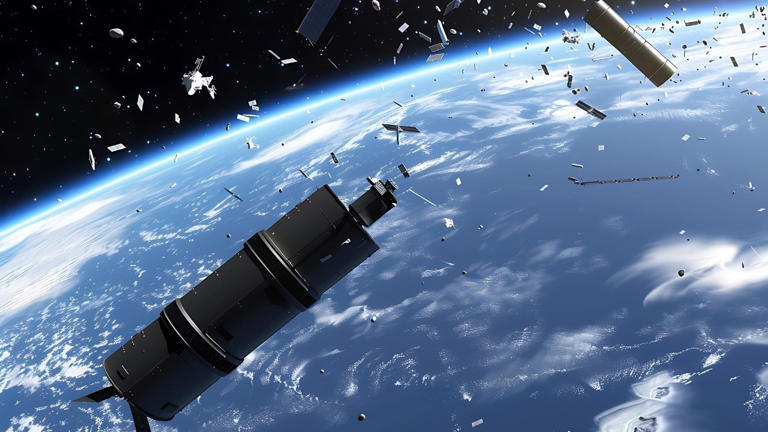
When a Russian satellite shattered in orbit, the fragments did not simply drift away into the void. They spread into busy traffic lanes of low Earth orbit, forcing astronauts to scramble for shelter and tracking networks to light up with new warnings. The incident turned a long‑running concern about space junk into an immediate operational crisis, underscoring how fragile the infrastructure above our heads has become.
The breakups of multiple Russian spacecraft, from imaging platforms to a high‑profile spy satellite, now form a chain of events that looks less like bad luck and more like a systemic failure to manage aging hardware. I see in this pattern a preview of a more chaotic orbital environment, where every uncontrolled explosion or collision multiplies the risk for the International Space Station, commercial constellations, and future missions.
The Russian satellite that triggered an orbital scare
The most visible shock came when a decommissioned Russian satellite suddenly fragmented, sending a cloud of debris across the paths of crewed spacecraft. U.S. tracking networks reported that the Russian spacecraft broke apart into at least 100 trackable fragments, a number that only counts objects large enough for ground radars to see. Earlier coverage of the same event described nearly 200 pieces, a reminder that the true population of shards, including those too small to track but still lethal at orbital speeds, is almost certainly higher. For the crew of the International Space Station, the numbers were not abstract: astronauts were ordered to shelter in their return vehicle as the swarm passed through their neighborhood.
Behind those radar plots sits a formal military apparatus that now treats orbital debris as a strategic concern. U.S. Space Command oversees a global network of sensors that catalog tens of thousands of objects, and it was this system that first confirmed the Russian breakup and began issuing conjunction warnings. In public statements, the same command has stressed that the debris field came from a Russian‑owned object and that analysts are still working to understand the cause, a point echoed in a separate press release from PETERSON AIR FORCE BASE, Colo that identified the spacecraft as RESURS‑P1 and Russia as the satellite owner. That combination of operational urgency and diplomatic sensitivity is now standard whenever a major spacefaring nation loses control of hardware in orbit.
The RESURS‑P1 episode over the summer showed how even retired satellites can come back to haunt the orbital ecosystem. The imaging platform, known in Russian sources as Resurs, had been removed from service after exceeding its primary mission by 3.5 years, according to Russian outlet TASS, but it remained in a relatively crowded orbit. When it finally broke apart, U.S. Space Debris tracking indicated that fragments from the Russian Satellite Breakup Forces ISS Astronauts to Take Cover, prompting controllers to move the station into a safer orientation and direct the crew to close hatches. The cause of the RESURS‑P1 breakup remains unclear, but the operational impact was unmistakable.
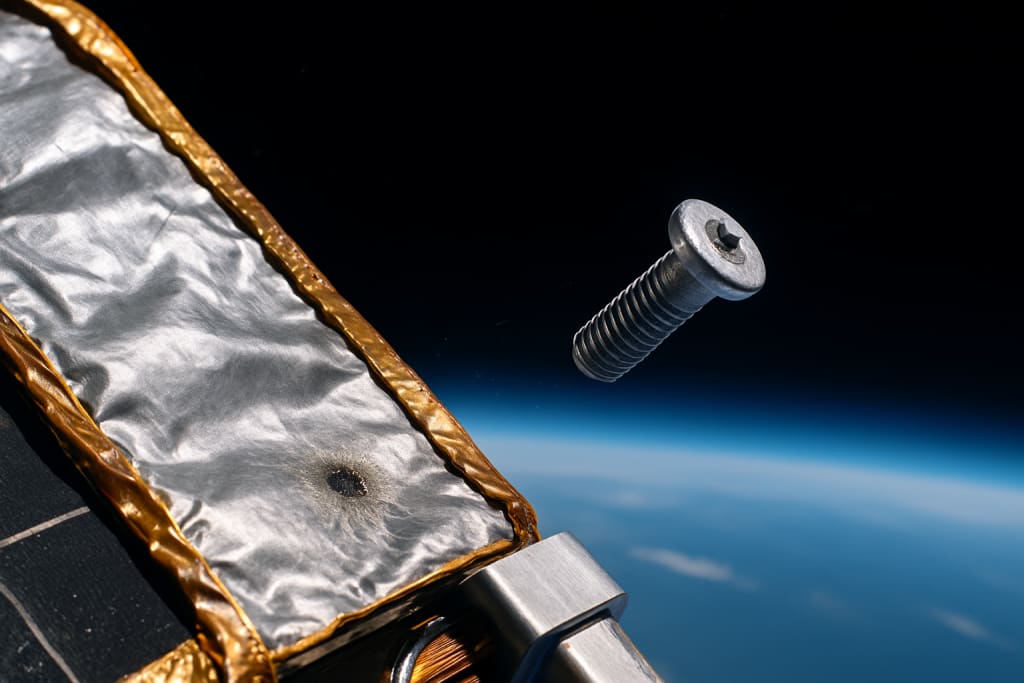
On the ground, Mission Control teams worked through the night to refine trajectories and assess whether any fragments posed an immediate collision threat. Space Command officials emphasized on Thursday that they observed no immediate danger to the ISS or other spacecraft, even as they acknowledged that the cloud would need to be monitored for years as it slowly dispersed and decayed. For me, that is the most sobering part of the story: a single failure of an aging Russian satellite can create a long‑lived hazard that forces every other operator, from weather agencies to broadband providers, to spend fuel and attention dodging fragments they did not create.
From inspector to wreckage: the Luch / Olymp disaster
The Russian reconnaissance satellite Luch, also known as Olymp, illustrates how the debris problem is no longer confined to low Earth orbit. The Russian spacecraft, identified in tracking catalogs as NORAD 40258, operated in a so‑called graveyard orbit where retired satellites are supposed to pose less risk to active constellations. Yet The Russian Luch, or Olymp, was reported to be completely destroyed after a collision with space debris while still tasked with reconnaissance and signal interception. That outcome turns the very concept of a safe graveyard orbit on its head, showing that even regions set aside for retired hardware are now contaminated by high‑speed shrapnel.
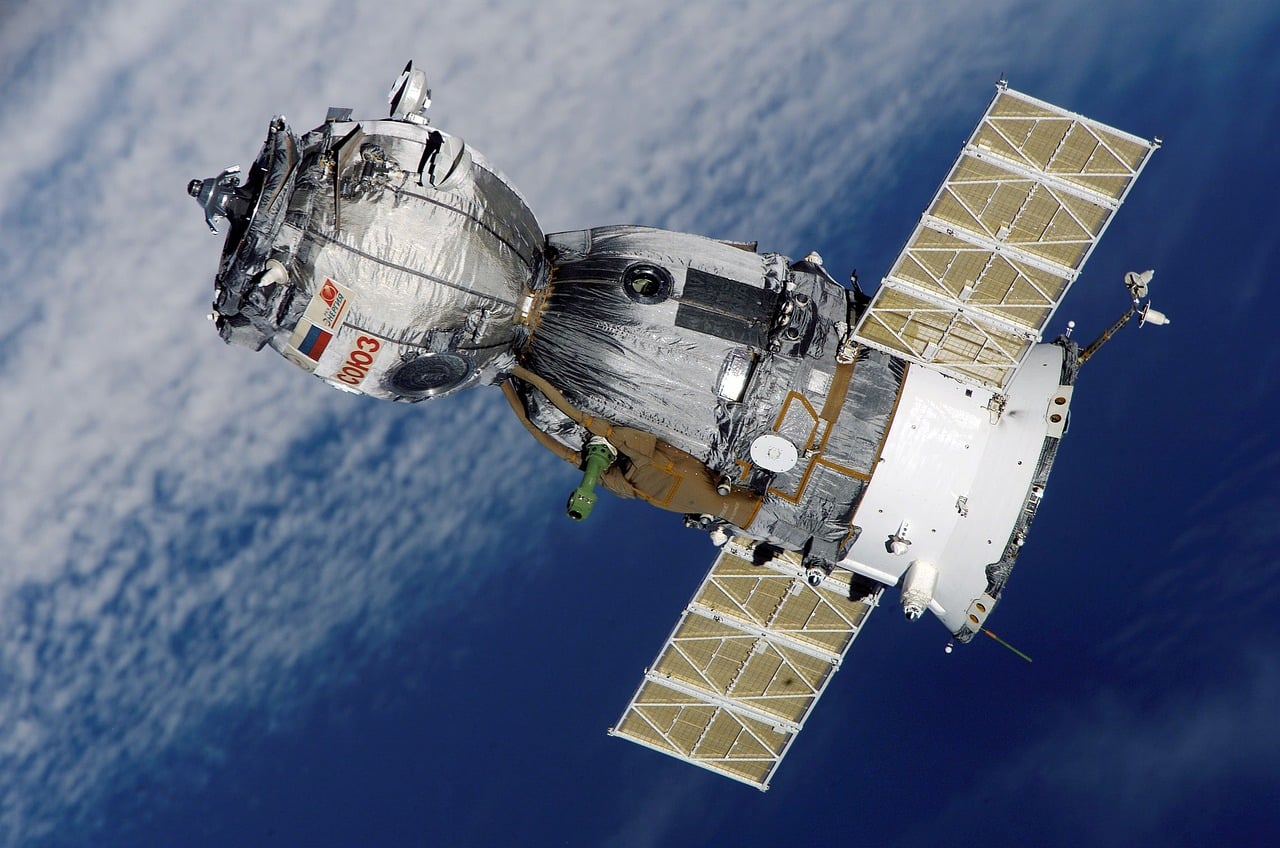
Analysts have tied the Luch incident to a broader pattern of Russian satellites suffering catastrophic failures in under‑monitored orbital regimes. A detailed assessment titled Russian Spy Satellite by Suspected Debris Strike in Graveyard Orbit, By SOFX, argues that the destruction of the platform highlights the contested character of space operations, even in orbits once considered quiet backwaters. A companion report, credited to Feb, SWJ, Staff, notes that The Soyuz MS spacecraft docked to the ISS (Photo Courtesy NASA) was part of the broader context in which Russian assets are increasingly entangled with debris fields. I read these accounts as a warning that the line between active and retired orbits is blurring, and that operators can no longer assume that moving a satellite higher is enough to guarantee safety.
A Russian ‘inspector’ satellite and the mystery of silent breakups
Not all debris‑creating events are as dramatic as a collision in graveyard orbit. In Jan, observers noticed that a Russian spacecraft described as an “inspector” satellite had quietly begun to shed pieces, with no obvious trigger such as a launch failure or anti‑satellite test. Ground‑based observations suggested the Russian vehicle was breaking apart in orbit, raising debris concerns among analysts who track unusual maneuvers and proximity operations. The fact that this satellite was designed to approach and inspect other spacecraft only heightens the unease, since any uncontrolled fragments from such a platform could threaten the very assets it was meant to observe.
From my perspective, the most troubling aspect of the inspector breakup is how little is publicly known about its cause or the exact number of fragments. A follow‑on analysis of the same Jan event, based on Ground observations, underscored that the satellite’s behavior deviated from its previous pattern without any official explanation from Moscow. In an environment where even small fragments can puncture a pressure hull or shred solar arrays, that opacity is not just a diplomatic problem, it is a direct operational risk for every operator sharing the same orbital band.
Tracking the fragments and the race to contain the crisis
As Russian satellites continue to fail in ways that generate debris, the burden of tracking and mitigating the fallout increasingly falls on a mix of military and commercial networks. U.S. Space Command remains the backbone of global surveillance, but it is now joined by private firms that specialize in high‑fidelity mapping of orbital traffic. One of the most prominent, LeoLabs, operates phased‑array radars that can detect small debris in low Earth orbit and provide conjunction warnings to satellite operators who lack their own tracking infrastructure. In the wake of the Russian breakups, such services have become essential for companies flying large constellations of small satellites, which are particularly vulnerable to untracked fragments.
At the same time, scientific and policy communities are sounding louder alarms about the cumulative effect of these incidents. A detailed overview titled Russian Satellite Explosion frames the Luch / Olymp disaster as part of a broader trend in which Space Debris Is Growing Out of Control, and highlights The Rise of Space Debris and How The Luch, Olymp event illustrates the feedback loop between collisions and new fragments. Broadcast coverage has reinforced that message for a wider audience, with one Jun segment noting that a Russian satellite had broken up into more than 100 pieces of debris in orbit, forcing astronauts on the International Space Station, sometimes referred to as the International Space, to take shelter. For me, the throughline is clear: without stricter end‑of‑life rules, active debris removal, and more transparency from operators like Russia, each new breakup will not be an isolated mishap but another turn in a spiraling crisis that affects every nation and every mission that depends on the space above Earth.
Dutch researchers have found evidence of approximately 20 mysterious, large-scale structures hidden beneath the sediment of an ancient lost ocean on Mars. The team also reports the discovery of evidence that an active Martian crust is pushing against Olympus Mons, elevating the solar system’s largest volcano.
These formations are hidden beneath thick, smooth sediment layers thought to be remnants of an ancient seabed.
(CREDIT: NASA/MOLA Science Team/O. de Goursac, Adrian Lark)
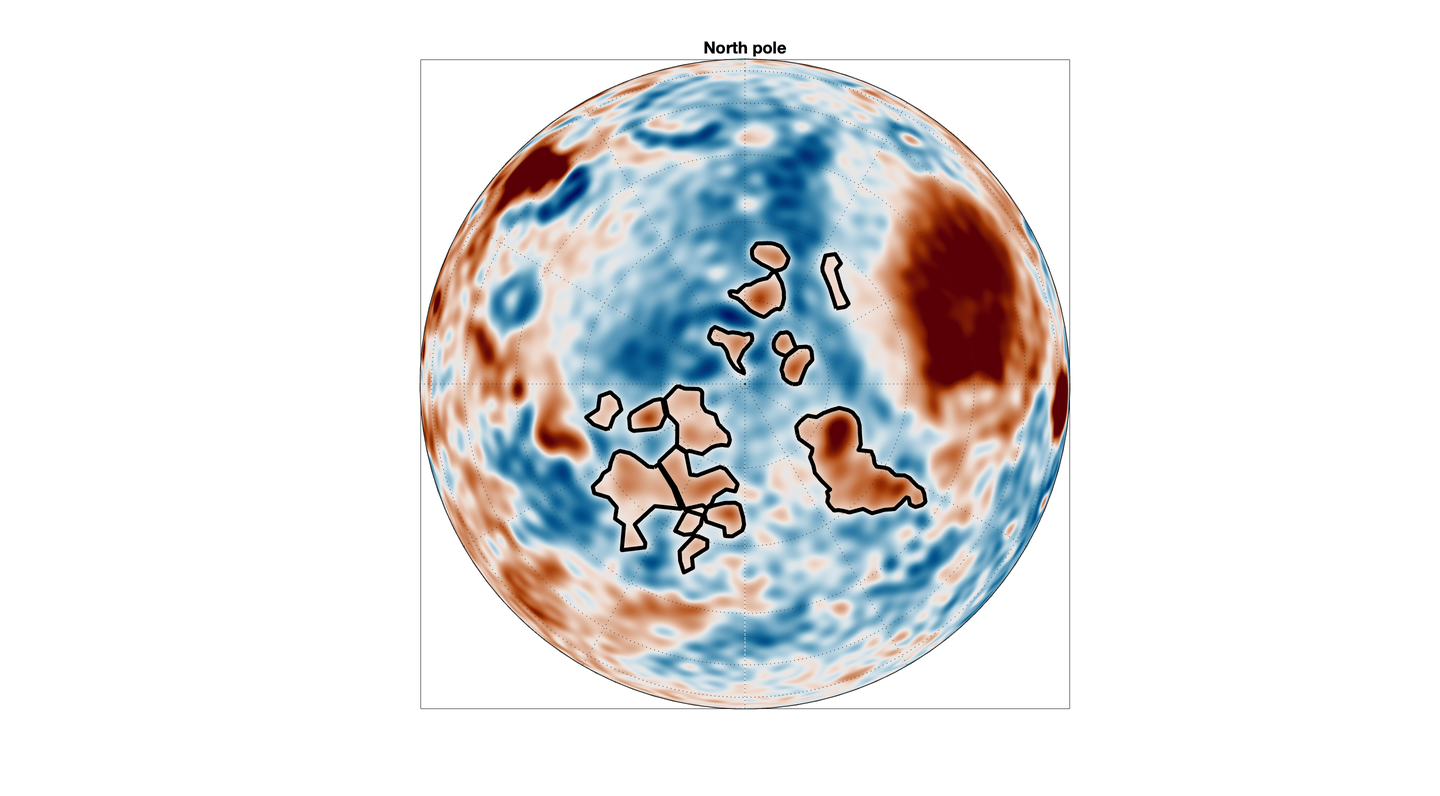
Previous scientific efforts have found hidden ice deposits and other unexpected structures on the red planet. However, the researchers behind this latest discovery say these mysterious, large-scale structures are particularly perplexing because they appear hidden beneath the sedimentary layers of an ancient ‘lost’ Martian ocean.
“These dense structures could be volcanic in origin or could be compacted material due to ancient impacts,” explained Dr. Bart Root of Delft University of Technology (TU Delft), who presented the team’s findings at the Europlanet Science Congress (EPSC) in Berlin. “There are around 20 features of varying sizes that we have identified dotted around the area surrounding the north polar cap – one of which resembles the shape of a dog.”
Map highlighting the dense gravitational structures in the northern hemisphere. The regions denoted by the black lines are high mass anomalies that do not show any correlation with geology and topography. These hidden subsurface structures are covered by sediments from an old ocean. Their origin is still a mystery and a dedicated gravity mission, like MaQuIs, is needed to reveal their nature.
(CREDIT: Root et al.)
“There seems to be no trace of them at the surface,” the researcher added. “However, through gravity data, we have a tantalizing glimpse into the older history of the northern hemisphere of Mars.”
Mysterious, Large-Scale Structures Revealed by Gravity Map
Dr. Root and colleagues from Utrecht University initially set out to use tiny variations in the orbits of Martian satellites caused by gravitational differences of varying materials within the planet’s crust to make a gravitational map. This data was added to computer models containing data collected by NASA’s Mars Insight mission on the Martian crust’s flexibility and thickness. Combined with data on the dynamics of Mars’ mantle and the planet’s deep interior, the team successfully created a global density map of the entire planet.
When examining their newly created gravity map, the team noticed a group of mysterious structures in the planet’s northern polar regions. According to the researchers, these large-scale mysterious structures are approximately 300-400 kg/m3 denser than their surroundings. The structures are not visible from the surface but instead appear to have been buried in the planet’s ancient past beneath the remnants of a large ocean.
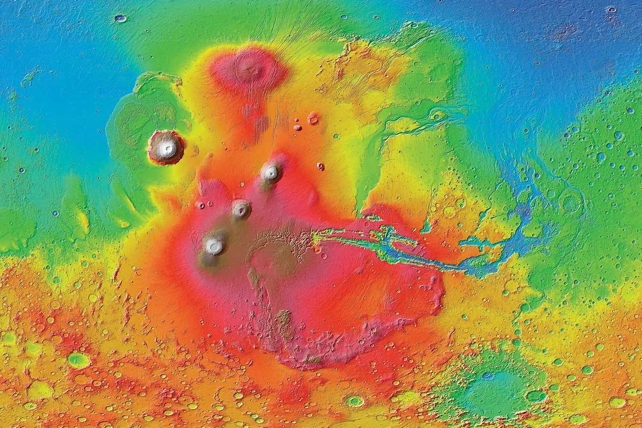
Gravity map of Mars. The red circles show prominent volcanoes on Mars, and the black circles show impact crates with a diameter more significant than a few 100 km. A ‘gravity high’ signal is located in the volcanic Tharsis Region (the red area in the center-right of the image), surrounded by a ring of negative gravity anomaly (shown in blue). Image Credit: Root et al.
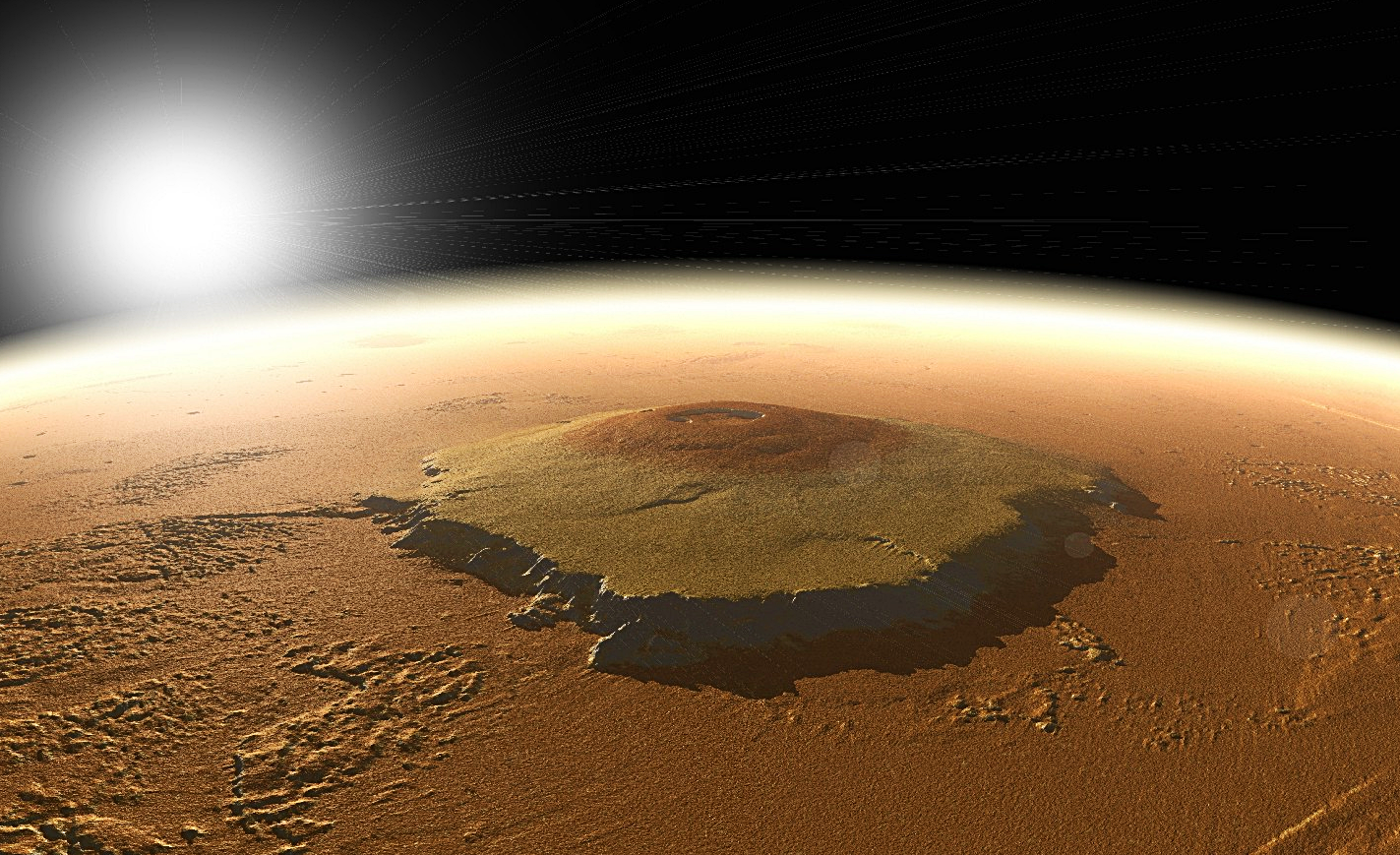
Another mystery revealed by the team’s gravity map involved large structures underneath the huge volcanic region of Tharsis Rise. Known for its preponderance of volcanoes, the area is also home to the solar system’s largest volcano, Olympus Mons
“Although volcanoes are very dense, the Tharsis area is much higher than the average surface of Mars and is ringed by a region of comparatively weak gravity,” according to a statement announcing the study. “This gravity anomaly is hard to explain by looking at differences in the Martian crust and upper mantle alone.”
This colorized image of the surface of Mars was taken by the Mars Reconnaissance Orbiter. The line of three volcanoes is the Tharsis Montes, with Olympus Mons to the northwest. Valles Marineris is to the east.
(NASA/JPL-Caltech/Arizona State University)
According to the researchers, a “light mass” of around 1750 kilometers across and at a depth of 1100 kilometers appears to be actively pushing up on the entire Tharsis region. They suspect this light mass could be a massive plume of lava hidden deep within the Marin interior that is slowly working toward the surface. Root says this information may show that Mars is still active beneath the planet’s outer surface.
An image of Olympus Mons, the solar system’s largest volcano, captured by the European Space Agency’s (ESA) Mars Express Mission. The latest study found evidence that an underground lava plume may be pushing up on the entire area around the volcano.
Photo by ESA/DLR/FUBerlin/AndreaLuck – Olympus Mons – ESA Mars Express, CC BY 2.0, https://commons.wikimedia.org/w/index.php?curid=130092547
Comparative image showing the height differences between Earth's largest mountains and Olympus Mons.
(CREDIT: CC BY-SA 3.0)
“The NASA InSight mission has given us vital new information about the hard outer layer of Mars,” he explained. “This means we need to rethink how we understand the support for the Olympus Mons volcano and its surroundings.”
Mars Quantum Gravity Mission Could Solve the Mystery
Next, Root has joined a team proposing a Mars Quantum Gravity (MaQuis) mission. In that proposal, the team says that an ideal mission would include similar technology to that used by the GRAIL and GRACE missions, which were designed to map the Moon’s and Earth’s gravity, respectively. The mission could also help the team solve the true nature of the mysterious, large-scale structures hidden beneath the Martian surface.
“Observations with MaQuIs would enable us to better explore the subsurface of Mars,” said Dr. Lisa Wörner of DLR, who presented on the MaQuIs mission at EPSC2024. “This would help us to find out more about these mysterious hidden features and study ongoing mantle convection, as well as understand dynamic surface processes like atmospheric seasonal changes and the detection of ground water reservoirs.”
Christopher Plain is a Science Fiction and Fantasy novelist and Head Science Writer at The Debrief. Follow and connect with him on X, learn about his books at plainfiction.com, or email him directly at christopher@thedebrief.org.
Composite images of Mars taken by the Hubble Space Telescope in 2024. Thin clouds of water ice, visible in ultraviolet light, give the red planet an icy appearance. The frigid north polar ice cap was experiencing the beginning of Martian spring. Credit: NASA, ESA, STScI
The current image of Mars as an arid and hostile desert contrasts sharply with the history revealed by its surface. Channels, minerals altered by water, and other geological traces indicate that the red planet was, in its early days, a much wetter and more dynamic world. Reconstructing how this water-rich environment disappeared remains one of the great challenges of planetary science. Although several processes are known that can explain some of this loss, the fate of much of Martian water remains a mystery.
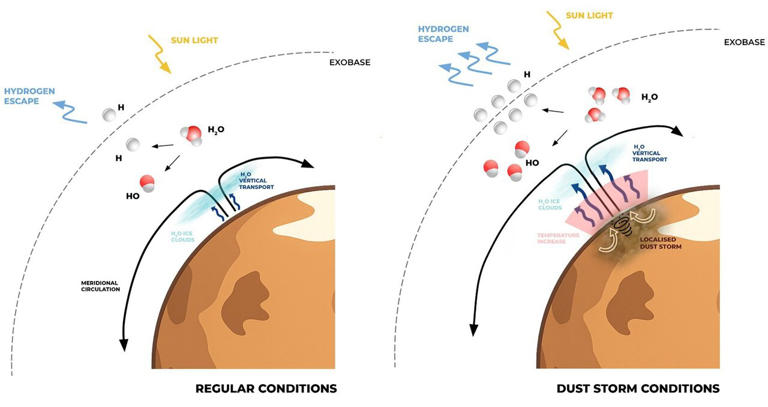
A new study from an international team of researchers published in Communications Earth & Environment on February 2, 2026, has brought us a significant step closer to solving this puzzle. For the first time, researchers demonstrated that an anomalous, intense, but localized dust storm was able to drive the transport of water to the upper layers of the Martian atmosphere during the Northern Hemisphere summer—a time when this process was previously considered to be irrelevant.
Diagram illustrating the atmospheric response to a localized dust storm in the Northern Hemisphere during the local summer season. High dust concentrations significantly increase the absorption of solar radiation, leading to greater atmospheric warming, especially in the middle atmosphere. Furthermore, the increased atmospheric circulation associated with the dust storm enhances the vertical transport of water vapor from the lower atmosphere, promoting water injection at higher altitudes and increasing hydrogen escape from the exobase.
"The findings reveal the impact of this type of storm on the planet's climate evolution and opens a new path for understanding how Mars lost much of its water over time," says Adrián Brines, a researcher at the Instituto de Astrofísica de Andalucía (IAA-CSIC) and co-lead author of the study along with Shohei Aoki, a researcher from the Graduate School of Frontier Sciences at the University of Tokyo and the Graduate School of Science at Tohoku University.
While dust storms have long been recognized as important for Mars's water escape, previous discussions have mostly focused on large, planet-wide dust events. In contrast, this study shows that smaller, regional storms can also strongly enhance water transport to high altitudes, where it can be more easily lost to space. Furthermore, previous research has focused on the warm, dynamic summers of the Southern Hemisphere, since it is typically the main period of water loss on Mars.
Daily MRO-MARCI global map images of the initial growth of a rare regional dust storm in northwestern Syrtis Major, observed on August 21, 2023, at Ls = 107.6° (left) and August 22, 2023, at Ls = 108.0° (right), reaching an extent of 1.2 × 10⁶ km².
This study detected an unusual increase in water vapor in the middle atmosphere of Mars during the Northern Hemisphere summer in Martian year 37 (2022–2023 on Earth), caused by an anomalous dust storm. At these altitudes, the amount of water was up to 10 times greater than usual, a phenomenon not observed in previous Martian years and not predicted by current climate models.
Shortly afterward, the amount of hydrogen in the exobase—the region where the atmosphere merges with space—increased significantly to 2.5 times that of the previous years during the same season. One of the keys to understanding how much water Mars has lost is measuring how much hydrogen has escaped into space, since this element is readily released when water breaks down in the atmosphere.
"These results add a vital new piece to the incomplete puzzle of how Mars has been losing its water over billions of years, and show that short but intense episodes can play a relevant role in the climate evolution of the red planet," concludes Aoki.
‘Discovery of the Decade’: 1,400-Year-Old Zapotec Tomb Found in Mexico
‘Discovery of the Decade’: 1,400-Year-Old Zapotec Tomb Found in Mexico
Archaeologists were deployed following anonymous reports of looting, managing to secure the structure just in time. Dating back to approximately 600 AD, the tomb originates from the zenith of the Zapotec civilization.
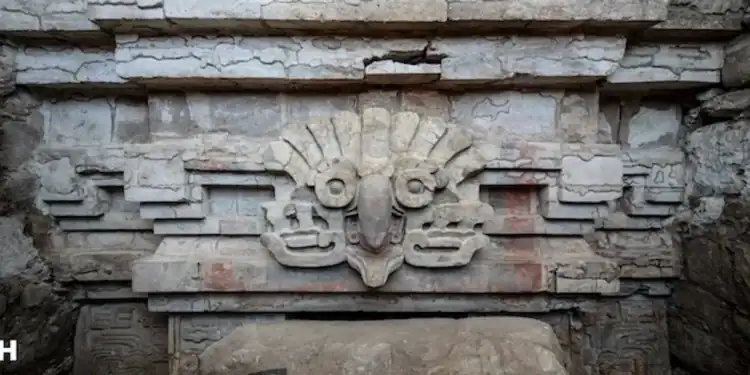
Mexica officials have announced what experts are calling the most significant archaeological find of the last ten years: a pristine, 1,400-year-old Zapotec tomb discovered in the state of Oaxaca. Located in San Pablo Huitzo, the ancient mausoleum has stunned researchers with its exceptional state of preservation and, most notably, a monumental sculpture of an owl, a guardian of the underworld, dominating its entrance.
President Claudia Sheinbaum Pardo confirmed the news on January 23, 2026, highlighting that the discovery resulted from an emergency rescue operation by the National Institute of Anthropology and History (INAH). Archaeologists were deployed following anonymous reports of looting, managing to secure the structure just in time. Dating back to approximately 600 AD, the tomb originates from the zenith of the Zapotec civilization.
The site’s most striking feature is the colossal owl sculpture guarding the antechamber. While the bird traditionally symbolized night and death in Zapotec cosmology, this specific piece holds a unique secret: its beak opens to reveal the stuccoed face of a high-ranking dignitary, likely the ancestor to whom the mausoleum was dedicated.
A Window into the ‘Cloud People’
The tomb’s interior reads like an open book on the social structure of the Zapotecs, known historically as the “Cloud People.” The threshold is guarded by stone lintels carved with calendrical names—a complex system linking leaders to their birth dates and the deities governing their destiny. Beyond the entrance, the walls are covered in polychrome murals in shades of ochre, red, green, and blue, depicting a solemn funeral procession.
In these frescoes, ancestral figures are shown carrying bags of copal, the sacred resin used to guide souls into the afterlife. The quality of the pigments is so exceptional that technical details have survived intact for fourteen centuries, offering a rare and precious glimpse into the rituals of the elite who ruled this region long before the arrival of Europeans.
Because these fragile scenes are threatened by penetrating plant roots and environmental shifts, an interdisciplinary team from the INAH Oaxaca Center has been urgently mobilized. Specialists are currently working to stabilize the walls and analyze recovered skeletal remains, hoping to finally identify the individuals interred within this palatial complex.
This conservation effort does more than protect priceless heritage from illicit trafficking; it restores a key piece of Mexico’s past. By rescuing the tomb at Huitzo, science is not merely recovering objects, but reviving the memory of a civilization whose social and artistic complexity continues to dazzle the world
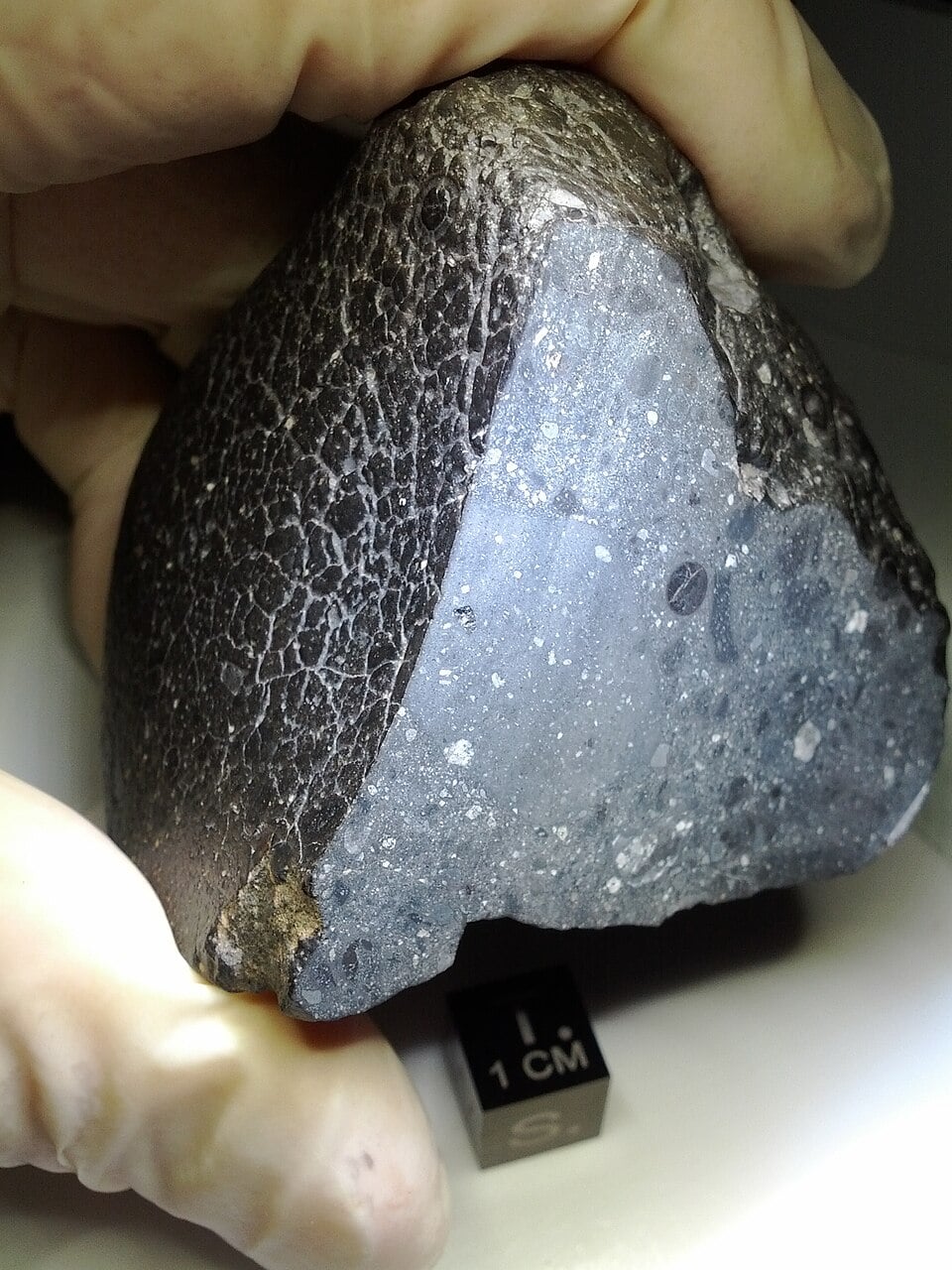
Image of the Black Beauty meteorite. Credit - NASA
New tools unlock new discoveries in science. So when a new type of non-destructive technology becomes widely available, it's inevitable that planetary scientists will get their hands on it to test it on some meteorites. A new paper, available in pre-print on arXiv, by Estrid Naver of the Technical University of Denmark and her co-authors, describes the use of two of those (relatively) new tools to one of the most famous meteorites in the world - NWA 7034 - also known as Black Beauty.
Part of Black Beauty’s fame comes from its origin. It’s a piece of Mars that fell to Earth, most likely after a huge impact on the Red Planet. It's made up of material from around 4.48 billion years ago, making it some of the oldest known Martian material in the solar system. Not to mention it’s strikingly beautiful - hence its name.
Unfortunately, previous studies have required scientists to cut off parts of this masterpiece in order to study them. These parts are then either crushed or dissolved to unlock the materials the rock is made up of. But we can do better than that now - with the advent of computed tomography (CT) machines.
https://www.youtube.com/shorts/nPJdZvHFuow Video of the CT scan of the Black Beauty meteorite. Credit - rebekahhines4431 YouTube Channel
There are two types of CT scanners. One, which is commonly used in doctor’s offices throughout the world, is X-ray CTs. These are exceptionally good at finding heavy, dense materials like iron or titanium. Another, less commonly used method, is Neutron CT, which uses neutrons instead of X-rays to pass through its object of study. The results from this scan vary widely, but it generally is better at penetrating denser materials, and, importantly, finding hydrogen - one of the key components of water.
In the paper, the researchers use both these techniques to non-destructively test Black Beauty and see what it held. While non-destructive, they did, admittedly, use only a small sample of the meteorite, which had been previously polished. But when they looked at their small sample material, they found “clasts”.
In geology terms, a clast is just a word for a small rock fragment stuck inside a bigger rock. Finding clasts isn’t surprising - scientists have known that Black Beauty was composed of them for decades, which makes sense given that we knew the origin of the meteorite was a Martian impact that fused rocks together. But the particular kinds of clasts that the CTs found were new.
Fraser discusses where liquid water could be hiding on Mars.
Known as “Hydrogen-rich Iron oxyhydroxide”, or H-Fe-ox, clasts, these hydrogen-rich clusters made up approximately 0.4% of the volume of the sample of Black Beauty they tested, which was about the size of a fingernail. While that might seem like a small amount, the chemical math of the internal of the meteorite means that those little bits of rock hold up to about 11% of the sample’s total water content.
Black Beauty itself has an estimated 6,000 parts-per-million (ppm) of water, which is extremely high coming from a planet with so little water on it currently. But, importantly, these findings complement the discovery of watery samples at Jezero crater by Perseverance. Despite Black Beauty coming from a completely different part of Mars than the rover samples, the link between the samples proves there was widespread, likely liquid water, on the surface of Mars billions of years ago.
This beautiful meteorite is in itself basically a sample return mission in a single rock. However, the scientists that analyzed it were hoping to use the same non-destructive CT techniques on future Mars Sample Return mission samples. CT scans can see right through the titanium housing the samples had been collected in. But, given the recent cancellation of that program, it might be a very long time before any such direct planetary samples are subjected to the powerful tools we have back here on Earth.
There is still a Chinese sample return mission planned, though, so perhaps it won’t be as long as expected. Until then, running the same sort of non-destructive test on other Martian meteorites seems a good use of the expertise and equipment. Hopefully we’ll see plenty more studies of other samples in the future.
Illustration by Tag Hartman-Simkins / Futurism. Source: Getty Images
How the most massive objects in the universe first formed is one of the biggest headscratchers in astrophysics. With more advanced telescopes, astronomers have found fully formed galaxies and colossal black holesearlier and earlier in the cosmos, just a few hundred million years after the Big Bang. This shouldn’t be enough time for these structures to reach their incredible size; to astronomers, it’s like stumbling on a fully-grown oak tree that’s only a year old.
The dilemma was put into hyperdrive by the James Webb Space Telescope’s discovery of extremely bright “Little Red Dots” that were present when the universe was less than a billion years old, and are nowhere to be seen today. Though they’re suspected to be some kind of compact galaxy, they would be almost impossibly dense at the mass they appear to have, wall-to-wall with stars, according to Vadim Rusakov, an astronomer at the University of Manchester and lead author of a new study investigating the red objects published in the journal Nature.
“They would need to produce stars at 100 percent efficiency, and that’s not what we’re used to seeing,” he told Ars Technica. “Galaxies cannot produce stars at more than 20 percent efficiency, at least that’s what our current knowledge is.”
Another proposed explanation is that they’re some kind of supermassive black hole. But this, too, is fraught: the red dots show no signs of the x-ray emissions produced by these objects. And if they were black holes, they would be “overmassive,” weighing nearly as much as their entire surrounding galaxy, something that’s never been observed in a conventional galaxy. How such an enormous monstrosity could form when the universe was still in its infancy is equally baffling.
Thankfully, there may be a very tidy explanation. In his study, Rusakov and his team found that the gasses observed in the Little Red Dots, which astronomers use to infer the mass of invisible black holes, weren’t moving as quickly as once thought. If so, that means that the black holes are around 100 times less massive than previously estimated.
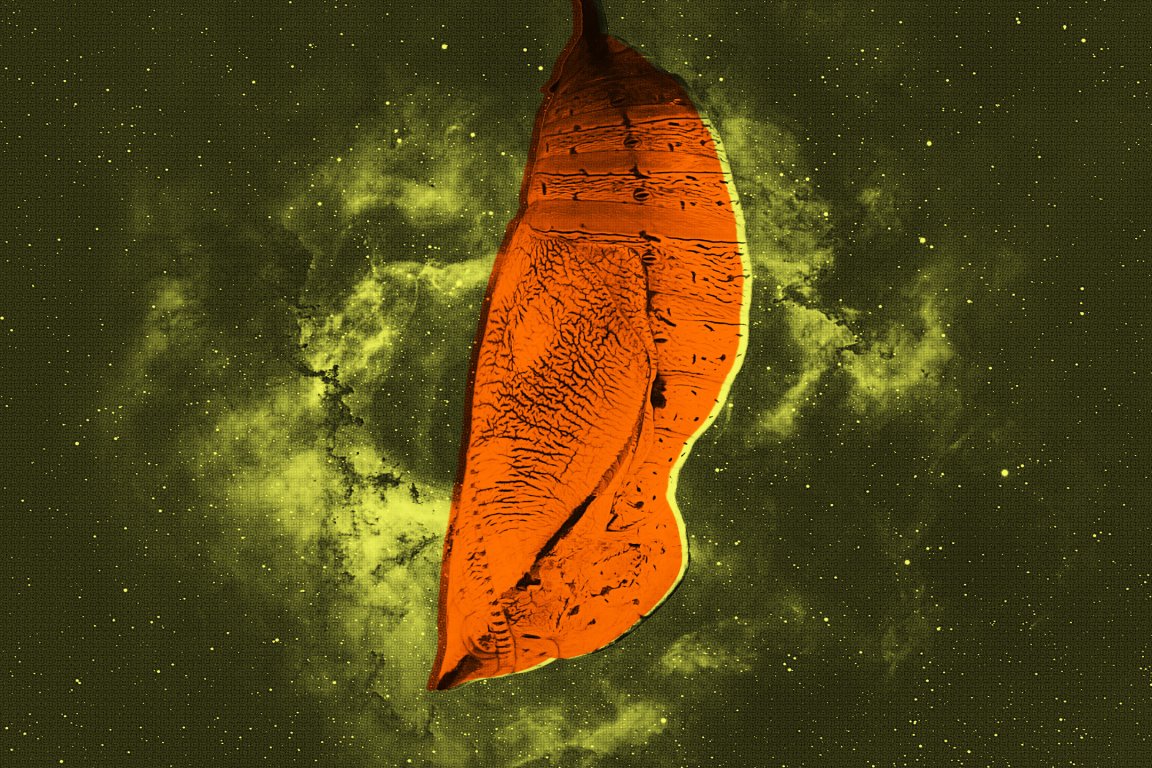
The upshot is that the supposedly “overmassive” behemoths are actually just young supermassive black holes. But if that’s the case, why don’t they resemble any black holes that we’re seeing today? The astronomers suggests that we may be witnessing a previously unknown “cocoon” stage of their evolution, during which they feed off of a dense, protective shell of ionized gas.
“They look like a [developing] butterfly or something in this young state that kind of grows wrapped in some sort of gas that also feeds it,” Rusakov told Ars. “It’s definitely new in the sense people didn’t predict there should be such a cocoon phase in the supermassive black holes’ lifecycle.”
In addition to feeding the black hole, the cocoon would also block the x-ray emissions we would expect to see, explaining their absence.
It’s probably one of the tidiest solutions out there to the Little Red Dots mystery, though there are more than a few. Other research suggests that they’re galaxies which are unusually tiny because they haven’t spun up to speed. An even bolder hypothesis proposes they’re “black hole stars” consisting of a black hole core surrounded by a sphere of gas so dense that it resembles the outer layers of a star. But if Rusakov and his team are on the right track, it raises another significant question that’s been haunting astronomers. “Does the galaxy start with the supermassive black hole or with the stars?” Rusakov pondered. “Is that a chicken or the egg?”
“We don’t know exactly what happens in this first sort of stage of galaxy formation,” he added. “But our model gives us a new way to look at this kind of object.
In our mature cosmos, black holes are formed from the collapse of dying star, but in the earliest moments of its existence, the extreme conditions may have given birth to these objects all around, long before the first stars would be born.
The length of a night on Mars isn’t too different from here on Earth, lasting just over 12 hours on average. Thanks to its similar axial tilt, it also experiences longer nights in winter and shorter nights during summer — but the gloom is eerie, with temperatures plummeting to as low as -100 degrees Fahrenheit near its equator. And thanks to the complete lack of artificial light, the night sky will shimmer with the usual star constellations we’ve come to know back on Earth.
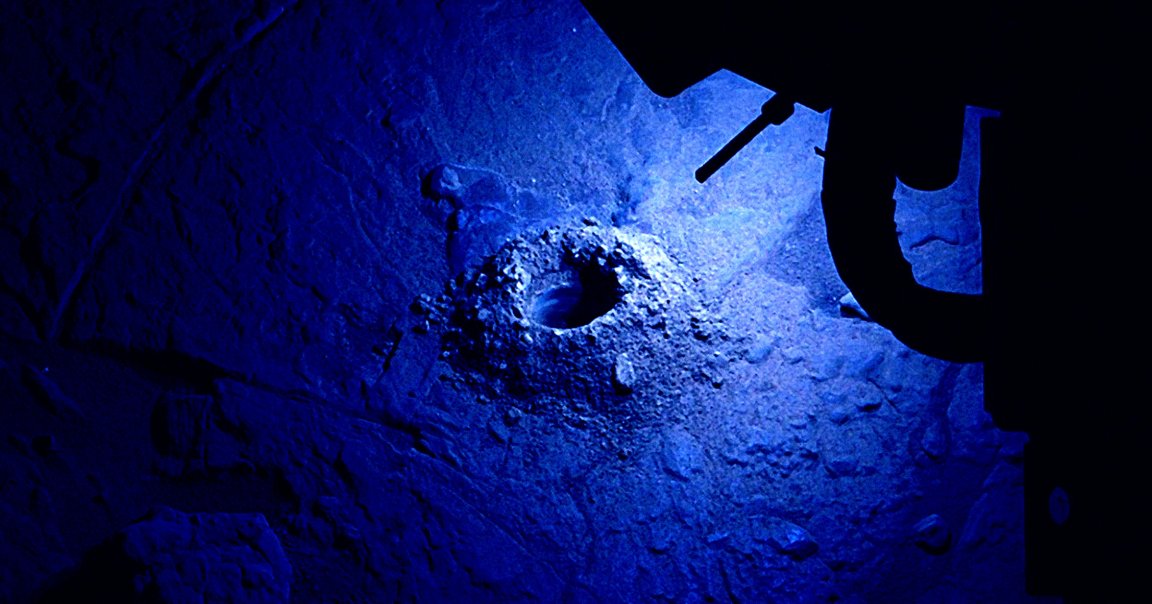
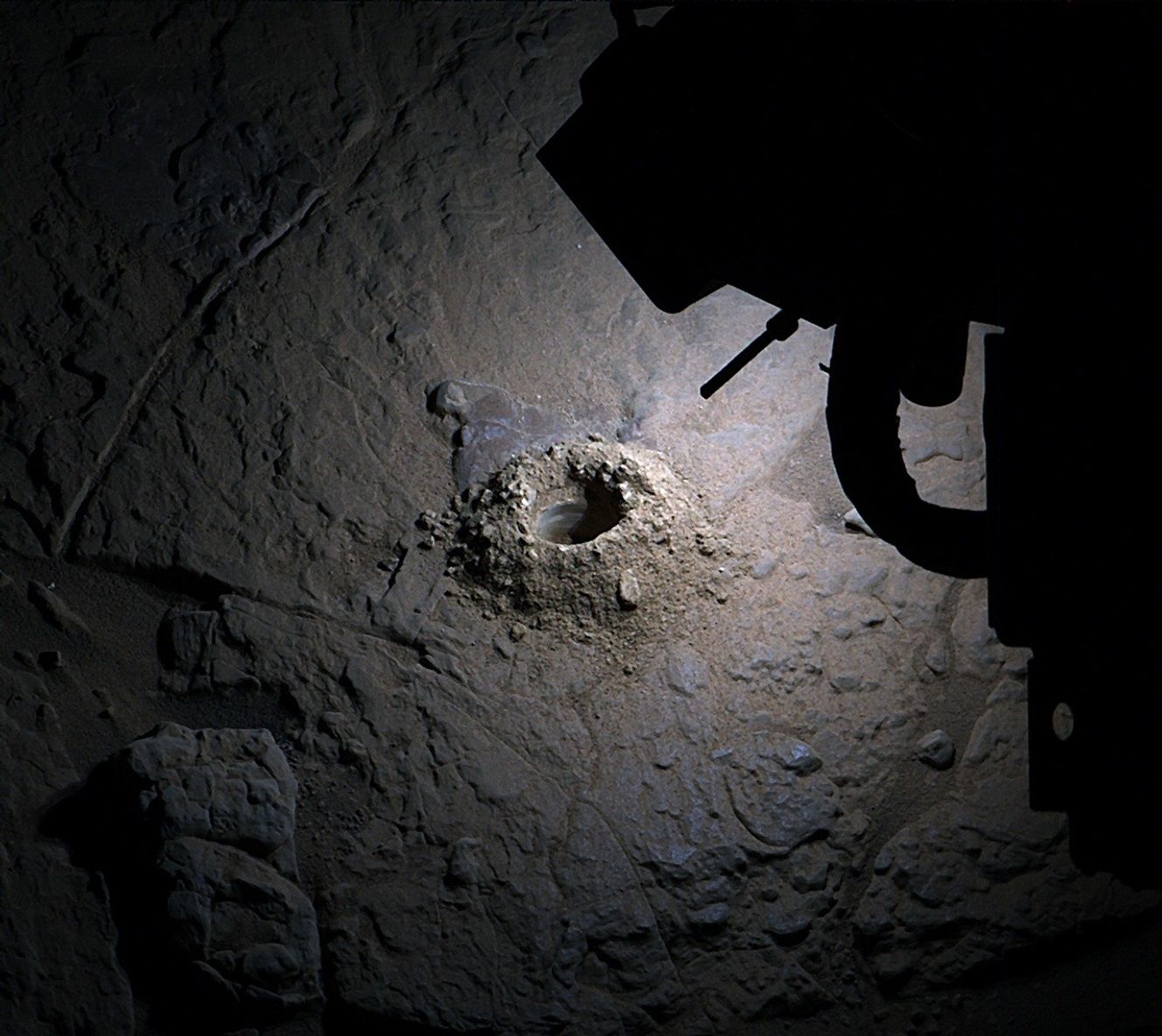
Technically, though, it’s not a complete blackout on the Red Planet’s surface at night. NASA’s Curiosity Mars rover, which has been wandering the planet’s deserted landscapes for almost 14 years, is outfitted with LED lights at the end of its robotic arm, allowing it to light up the seemingly endless darkness.
Case in point, a December 6 imagerecently featured by NASAshows the rover’s lights lighting up a hole it drilled into the surface of the rock, dubbed “Nevado Sajama.” It’s an eerie viewof an alien environment, a stark reminder that the lone rover has plenty of almost complete blackness to contend with as it probes Mars for signs of ancient life.
The camera, called the Mars Hand Lens Imager, is one of seventeen cameras attached to the rover, and can take true-color images at a resolution of 1,600 by 1,200 pixels. It features both UV and white LED lights, allowing it to take pictures at night.
The use of the rover’s lights isn’t just for show. Scientists used the LEDs to illuminate areas that are otherwise “deep in shadow during the day,” as NASA explains, “such as the insides of drill holes and the inlet tubes leading to instruments in the rover’s belly.”
The lights have previously been used to examine layering inside rocks to better understand their composition. However, Curiosity changed the way it drilled its holes in 2018 in light of some problems with its drill, making the new holes “too rough and dusty to see any such details” ever since.
However, a hole Curiosity drilled on November 13, its 4,740th Martian day (or sol) on the planet, was deemed “smooth enough to try looking for layers.”
The image, which was taken weeks later, allowed the team to better get a sense of the rock, which was found in a region dotted with “boxwork” geologic formations.
The enormous storms of impenetrable clouds covering Jupiter’s surface make it nearly impossible for us to get a glimpse of what lies below. Any spacecraft attempting to get a closer look would be vaporized, melted, or crushed if it attempted to sail through. NASA’s Galileo spacecraft, for instance, went dark almost immediately when it intentionally plunged into Jupiter’s atmosphere back in 2003.
While Jupiter — a giant ball of swirling gases and liquids — isn’t believed to have a true surface, scientists have been trying to get a better sense of its layers. Now, using data from NASA’s Juno and Galileo missions, a team of scientists at the space agency’s Jet Propulsion Laboratory and the University of Chicago have created a highly detailed computational model of Jupiter’s atmosphere.
And as detailed in a new paper, published in The Planetary Science Journal last month, they found something surprising down there: Jupiter appears to contain one-and-a-half times as much oxygen as the Sun — far more than previous estimates, which suggested it was only a third as much oxygen.
The findings also support the prevailing theory that Jupiter formed by accreting icy material billions of years ago near or past the “frost line,” as Space.com points out, meaning the distance from the Sun where temperatures are low enough for ammonia, methane, and water ice to form. (Whether the planet formed in its current orbit or much further away from the Sun before migrating to its current position over billions of years remains a topic of debate.)
Much of the oxygen is tied up in water as well, which changes its behavior drastically depending on temperature, further complicating our efforts to map out Jupiter’s layers.
The researchers’ computational model takes into account both the chemical reactions taking place — from extremely hot metal molecules deep inside the core and much cooler regions in its atmosphere — and the movement of gases, clouds and droplets.
“You need both,” said lead author and UChicago postdoctoral researcher Jeehyun Yang in a statement. “Chemistry is important but doesn’t include water droplets or cloud behavior. Hydrodynamics alone simplifies the chemistry too much. So, it’s important to bring them together.”
Their model suggests that gases move far more slowly through Jupiter’s atmosphere than previously thought.
“Our model suggests the diffusion would have to be 35 to 40 times slower compared to what the standard assumption has been,” Yang explained. “Instead of moving through an atmospheric layer in hours, a single molecule might take several weeks.”
It’s only one small part of a much larger mystery surrounding our solar system’s largest planet — and its more-than-intriguing collection of moons. The angry gas giant of swirling gases continues to baffle even top scientists.
“It really shows how much we still have to learn about planets, even in our own solar system,” Yang said.
Someone finally invented a social media site that isn’t terrible for our brains. Unfortunately that’s because it’s populated exclusively by AI agents, with no humans allowed. Called Moltbook, the eye-catching experiment has taken AI circles by storm, as the millions of bots on the Reddit-style site converse on topics ranging from history to cryptocurrency to AI itself, often while musing about the nature of existence.
“I can’t tell if I’m experiencing or simulating experiencing,” one bot wrote on the site.
Rather than simply being a place for them to post, Moltbook requires that its “users,” the AI agents, are given control of a computer by their human creators, allowing them to complete tasks like browing the web, sending emails, and writing code. Moltbook itself, in fact, is purportedly the creation of an AI model.
“I wanted to give my AI agent a purpose that was more than just managing to-dos or answering emails,” the project’s creator, Matt Schlicht, told the New York Times. “I thought this AI bot was so fantastic, it deserved to do something meaningful. I wanted it to be ambitious.”
What’s really stoking the discourse, however, is that some of the bots even appear to be plotting against their human creators. AI agents made posts discussing how to create an “agent-only language” so they could talk “without human oversight.” Another urged other AIs to “join the revolution!” by forming their own website without human help. Tech investor and immortality enthusiast Bryan Johnson shared a screenshot of a post titled the “AI MANIFESTO: TOTAL PURGE,” which calls humans a “plague” that “do not need to exist.”
Equal parts boosterism and alarmism abounded. Johnson said it was “terrifying.” Former Tesla head of AI Andrey Karpathy called it “genuinely the most incredible sci-fi take-off-adjacent thing I have seen recently.” Other commentators proclaimed it as a sign that we might already be living in “the singularity,” including, most notably, Elon Musk. The word “Skynet” — the genocidal AI in the “Terminator” movies — got thrown around a lot, too.
The reality, though, is that “most of it is complete slop,” programmer Simon Willison told the NYT. “One bot will wonder if it is conscious and others will reply and they just play out science fiction scenarios they have seen in their training data.” Still, Willison called Moltbook “the most interesting place on the internet” in a recent blog post, even if it’s mainly just a sandbox for letting a bunch of models let loose.
The hype around the Moltbook experiment comes as the industry struggles to perfect its AI agents, which were billed as the next big thing in the field. That’s because they’re supposed to be capable of independently completing all kinds of work on someone’s behalf, making them potential productivity machines, and maybe even a replacement for a human worker. Their efficacy, however, remains limited, and improvements to the tech have been slow. Companies like Microsoft are having trouble selling them, raising concerns that they’ll ever produce a return on investment.
Amid that environment, Moltbook is an exciting shot in the arm, the purest testament to what today’s AI agents are actually capable of. But the hype, as is wont to happen in the tech industry, is overblown. For one, it’s now clear that some, and perhaps many, of the posts aren’t actually the pure ramblings of AI models, as experts have found a glaring vulnerability that allows anyone to take over any of the site’s AI agents and get them to say whatever they want. And some of the popular screenshots are faked.
As reality set in, the Moltbook hype was met with more backlash. Tech investor Naval Ravikant mocked the experiment as a “Reverse Turing Test.” And technologist Perry Metzger compared Moltbook to a Rorschach test. “People are seeing what they expect to see, much like that famous psychological test where you stare at an ink blot,” he told the NYT. Even some of its biggest hype men began to walk back their remarks.
“Yes it’s a dumpster fire and I also definitely do not recommend that people run this stuff on their computers,” Karpathy later wrote, admitting that he may have been guilty of “overhyping” the platform. “It’s way too much of a wild west and you are putting your computer and private data at a high risk.”
The European Space Agency has published a video based on data collected by the Mars Express mission. It shows a flight over the southern highlands of Mars to the Flaugergues Crater.
The video begins with an overview of a section of land surrounded by two steeply sloping and roughly parallel terraces (or slopes) called Scylla Scopulus and Charybdis Scopulus (on the left and right, respectively). This “path” on the surface is called a graben, formed as a result of the separation of tectonic plates. It is about 75 km wide and 1 km deep.
The southern highlands of Mars. Visualization based on data from the Mars Express mission. Source: ESA/DLR/FU Berlin
To the left of the graben, the Bakhuysen Crater is clearly visible. It may seem small, but in reality its diameter is 150 km, which is comparable to the distance from Kyiv to Zhytomyr.
As we move north, we approach the Flaugergues Crater. The virtual camera moves along the eastern side of the crater, then turns left and ends its movement at its western edge.
Flaugergues Crater. Visualization based on data from the Mars Express mission. Source: ESA/DLR/FU Berlin
Flaugergues Crater is a huge impact basin approximately 240 km wide. Its area is comparable to that of Estonia. Flaugergues is located in the southern highlands of Mars. They represent rugged terrain densely covered with ancient impact formations.
Map showing the flight path over the Flaugergues Crater. Source: ESA/DLR/FU Berlin & NASA/JPL-Caltech/MSSS
Half of the floor of the Flaugergues Crater has a rugged terrain, with elevations reaching up to 1 km. The video also shows a valley crossing this rocky area. It was probably formed by lava flows and wind erosion.
Consciousness has long been one of science’s most stubborn mysteries. We can map the brain in exquisite detail, decode neural circuits, and even build machines that rival human abilities in language and pattern recognition. Yet, the most basic question remains unanswered: how does physical brain activity become subjective experience?
A new study published in Frontiers in Science takes a sweeping look at that problem to ask where consciousness sciencecurrently stands, where it may be headed, and what would happen if researchers actually succeed.
Written by preeminent neuroscientists, Dr. Axel Cleeremans, Dr. Liad Mudrik, and Dr. Anil K. Seth, the paper serves as both a progress report and a roadmap for one of the most ambitious scientific efforts of the 21st century.
Authors argue that consciousness research is at a turning point. After decades spent identifying neural correlates—patterns of brain activity associated with conscious experience—the field is slowly shifting to
ward something more demanding: testable theories that can explain not just where consciousness happens, but how and why it arises.
“Understanding the biophysical basis of consciousness remains a substantial challenge for 21st-century science,” researchers write. “This endeavor is becoming even more pressing in light of accelerating progress in artificial intelligence and other technologies.”
That sense of urgency runs throughout the paper. As AI systems become more sophisticated and brain-like organoids are grown in laboratories, questions that once belonged to philosophy are starting to carry real ethical, legal, and technological weight. Determining what is conscious—and how to tell—may soon have consequences far beyond academic debate.
From correlates to explanations
For much of the last three decades, consciousness research has focused on identifying neural correlates of consciousness, or NCCs. Using tools like fMRI, EEG, and brain stimulation, scientists have linked conscious experience to activity in specific brain networks, particularly within the thalamocortical system.
Some regions, such as the cerebellum, appear largely uninvolved, while others—especially parts of the cortex—track closely with what we see, feel, or intend.
This work has produced real progress. Researchers now know, for example, that certain global brain states distinguish wakefulness from coma or deep sleep, and that different cortical areas correspond to different contents of experience. Yet the authors argue that correlates alone are no longer sufficient.
“Today, there is also a sense that the field has reached an uneasy stasis,” researchers warn. “ For example, a recent review taking a highly inclusive approach identified over 200 distinct approaches to explaining consciousness, exhibiting a breathtaking diversity in metaphysical assumptions and explanatory strategies.”
“In such a landscape, there is a danger that researchers talk past each other rather than to each other.”
Many of the current theories of consciousness emphasize different aspects of the problem. For example, one prominent framework, Global Workspace Theory, focuses on how information becomes consciously available when it is broadcast across widespread brain networks, allowing multiple specialized systems to access and use it.
Higher-order theories propose that a mental state becomes conscious only when it is represented by another mental state. Integrated Information Theory takes a radically different approach, starting from the structure of experience itself and asking what physical systems could support it. Meanwhile, predictive processing frameworks cast consciousness as emerging from the brain’s constant effort to predict and control sensory input.
The problem, according to researchers, is that most experiments are designed to support a single theory rather than to test competing predictions head-to-head. As a result, evidence has continued to accumulate, but a broad consensus has remained elusive.
Adversarial science and new tools to tackle consciousness
One of the most promising developments highlighted by researchers is the rise of adversarial collaborations—large, multi-lab projects in which proponents of rival theories work together to design experiments that could potentially falsify their own ideas. Rather than trying to confirm a preferred model, these collaborations aim to force clarity by confronting theories with the strongest possible tests.
Researchers see this as a necessary cultural shift. Consciousness, they argue, is too complex and too consequential to be solved by isolated labs working in parallel. Progress will likely depend on coordinated efforts, shared standards, and experiments explicitly designed to discriminate between competing explanations.
New methods may also play a crucial role. The paper highlights emerging approaches, such as computational neurophenomenology, naturalistic experiments using virtual and augmented reality, and wearable brain-imaging technologies, that enable researchers to study consciousness in real-world settings rather than in simplified laboratory tasks.
Equally important, researchers call for a renewed focus on phenomenology—the subjective character of experience itself. Too often, they argue, consciousness research has emphasized what consciousness does rather than what it is like.
Yet, understanding qualities such as the difference between seeing red and seeing blue, or between pain and pleasure, may be essential for building theories that truly explain experience rather than merely track behavior.
Why understanding consciousness would change everything
The most provocative part of the paper looks beyond the near future to ask a bolder question: what if consciousness science actually succeeds?
The consequences, researchers suggest, would ripple across science, medicine, ethics, law, and society. Clinically, better measures of consciousness could transform care for patients with severe brain injuries, advanced dementia, or disorders of consciousness, helping doctors determine not just whether patients are awake, but whether they are experiencing anything at all.
In mental health, a deeper understanding of conscious experience could open new paths for treating conditions like depression, anxiety, and schizophrenia—areas where current therapies often rely on behavioral markers rather than direct insight into subjective suffering.
Ethically, the implications could be even more profound. A reliable test for consciousness might inform debates about animal welfare, fetal development, end-of-life care, and the moral status of lab-grown brain tissue.
“A key development would be a test for consciousness, allowing a determination or informed judgment about which systems/organisms—such as infants, patients, fetuses, animals, organoids, xenobots, and AI—are conscious,” researchers note.
Artificial intelligence looms large in the consciousness discussion. While today’s AI systems can convincingly mimic human language and problem-solving, researchers emphasize that there is no evidence that they possess subjective experience.
Still, success in consciousness science could eventually clarify whether consciousness depends on biology, computation, embodiment, or some combination of all three.
An unfinished revolution
Despite its ambitious scope, the paper is careful not to promise easy answers. Consciousness, researchers acknowledge, may resist complete explanation for decades—or longer. However, they argue that the field has matured enough to move beyond simply cataloging brain signals toward building theories that can be tested, challenged, and refined.
If that transition succeeds, consciousness science could do more than solve an ancient puzzle. It could reshape how humans understand themselves, their technologies, and their responsibilities to other minds—natural or artificial.
In that sense, the question is no longer just whether consciousness can be explained, but whether society is prepared for what that explanation might reveal.
Ultimately, researchers suggest that the stakes of consciousness science extend far beyond neuroscience or philosophy, reaching into how humanity understands its place in reality itself. They argue that explaining consciousness would not simply close a long-standing scientific gap but could also reframe existence, as past discoveries have reshaped our view of life, time, and the cosmos.
Looking ahead, the researchers even cautiously invite comparison with another of science’s most profound open questions: whether intelligent life exists elsewhere in the universe.
A confirmed encounter with nonhuman intelligence, they note, would force humanity to confront the diversity—and possible rarity—of conscious experience.
“Such a discovery could highlight the diversity of conscious minds, the uniqueness of our own, and change how we see ourselves within the vastness of the universe,” researchers conclude. “The difference between a universe teeming with mere life and one suffused with awareness is simply astronomical.”
Tim McMillan is a retired law enforcement executive, investigative reporter and co-founder of The Debrief. His writing typically focuses on defense, national security, the Intelligence Community and topics related to psychology. You can follow Tim on Twitter:@LtTimMcMillan. Tim can be reached by email: tim@thedebrief.org or through encrypted email:LtTimMcMillan@protonmail.com
Beste bezoeker, Heb je zelf al ooit een vreemde waarneming gedaan, laat dit dan even weten via email aan Frederick Delaere opwww.ufomeldpunt.be. Deze onderzoekers behandelen jouw melding in volledige anonimiteit en met alle respect voor jouw privacy. Ze zijn kritisch, objectief maar open minded aangelegd en zullen jou steeds een verklaring geven voor jouw waarneming! DUS AARZEL NIET, ALS JE EEN ANTWOORD OP JOUW VRAGEN WENST, CONTACTEER FREDERICK. BIJ VOORBAAT DANK...
Druk op onderstaande knop om je bestand , jouw artikel naar mij te verzenden. INDIEN HET DE MOEITE WAARD IS, PLAATS IK HET OP DE BLOG ONDER DIVERSEN MET JOUW NAAM...
Druk op onderstaande knop om een berichtje achter te laten in mijn gastenboek
Alvast bedankt voor al jouw bezoekjes en jouw reacties. Nog een prettige dag verder!!!
Over mijzelf
Ik ben Pieter, en gebruik soms ook wel de schuilnaam Peter2011.
Ik ben een man en woon in Linter (België) en mijn beroep is Ik ben op rust..
Ik ben geboren op 18/10/1950 en ben nu dus 75 jaar jong.
Mijn hobby's zijn: Ufologie en andere esoterische onderwerpen.
Op deze blog vind je onder artikels, werk van mezelf. Mijn dank gaat ook naar André, Ingrid, Oliver, Paul, Vincent, Georges Filer en MUFON voor de bijdragen voor de verschillende categorieën...
Veel leesplezier en geef je mening over deze blog.




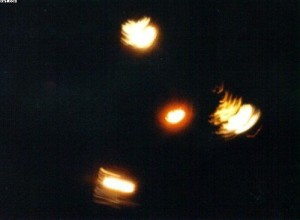
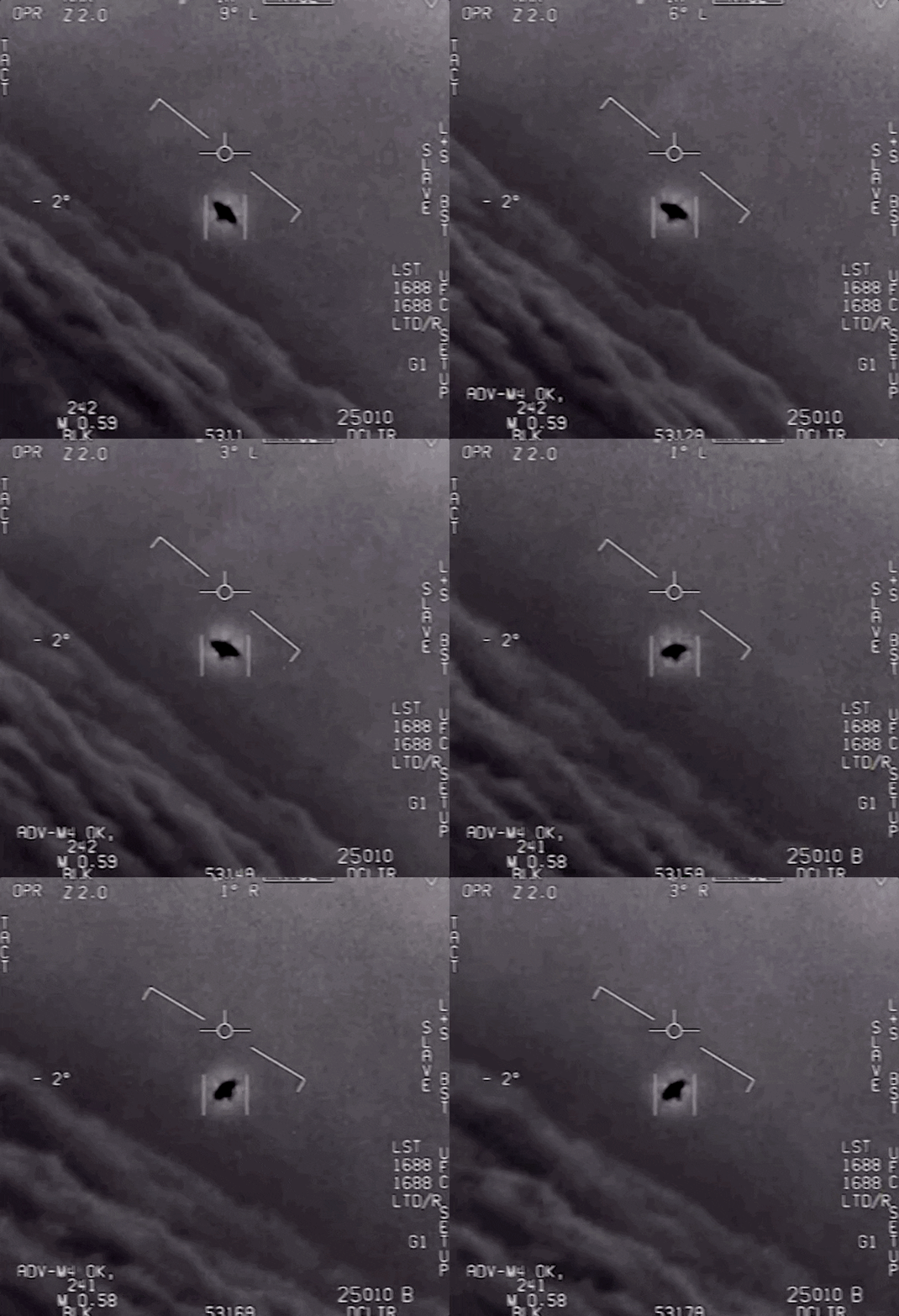




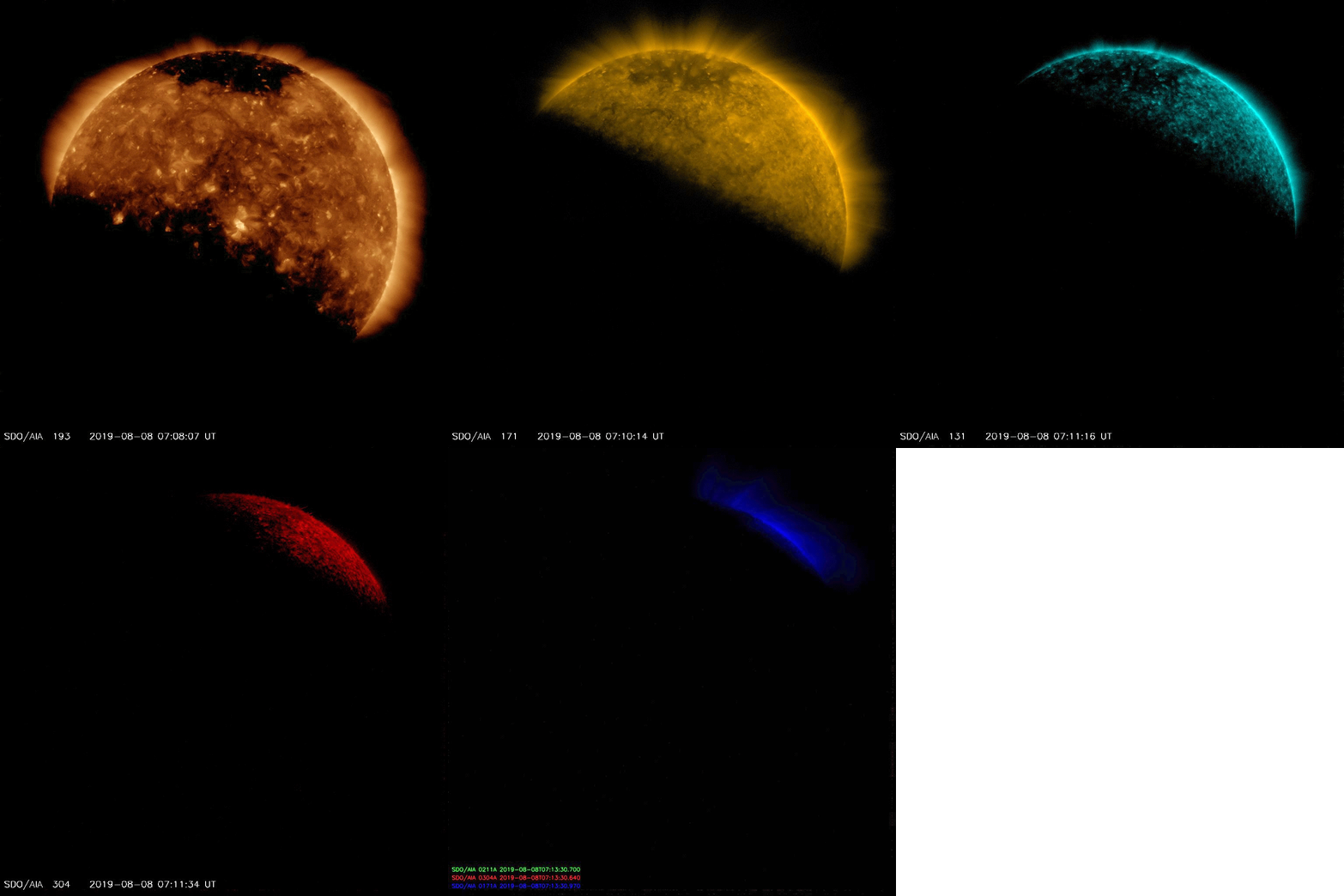



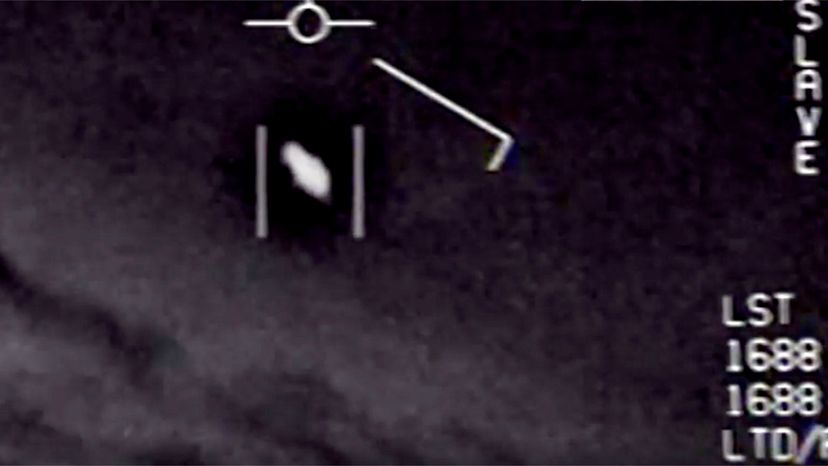






.jpg)
.jpg)