The purpose of this blog is the creation of an open, international, independent and free forum, where every UFO-researcher can publish the results of his/her research. The languagues, used for this blog, are Dutch, English and French.You can find the articles of a collegue by selecting his category. Each author stays resposable for the continue of his articles. As blogmaster I have the right to refuse an addition or an article, when it attacks other collegues or UFO-groupes.
Druk op onderstaande knop om te reageren in mijn forum
Zoeken in blog
Deze blog is opgedragen aan mijn overleden echtgenote Lucienne.
In 2012 verloor ze haar moedige strijd tegen kanker!
In 2011 startte ik deze blog, omdat ik niet mocht stoppen met mijn UFO-onderzoek.
BEDANKT!!!
Een interessant adres?
UFO'S of UAP'S, ASTRONOMIE, RUIMTEVAART, ARCHEOLOGIE, OUDHEIDKUNDE, SF-SNUFJES EN ANDERE ESOTERISCHE WETENSCHAPPEN - DE ALLERLAATSTE NIEUWTJES
UFO's of UAP'S in België en de rest van de wereld Ontdek de Fascinerende Wereld van UFO's en UAP's: Jouw Bron voor Onthullende Informatie!
Ben jij ook gefascineerd door het onbekende? Wil je meer weten over UFO's en UAP's, niet alleen in België, maar over de hele wereld? Dan ben je op de juiste plek!
België: Het Kloppend Hart van UFO-onderzoek
In België is BUFON (Belgisch UFO-Netwerk) dé autoriteit op het gebied van UFO-onderzoek. Voor betrouwbare en objectieve informatie over deze intrigerende fenomenen, bezoek je zeker onze Facebook-pagina en deze blog. Maar dat is nog niet alles! Ontdek ook het Belgisch UFO-meldpunt en Caelestia, twee organisaties die diepgaand onderzoek verrichten, al zijn ze soms kritisch of sceptisch.
Nederland: Een Schat aan Informatie
Voor onze Nederlandse buren is er de schitterende website www.ufowijzer.nl, beheerd door Paul Harmans. Deze site biedt een schat aan informatie en artikelen die je niet wilt missen!
Internationaal: MUFON - De Wereldwijde Autoriteit
Neem ook een kijkje bij MUFON (Mutual UFO Network Inc.), een gerenommeerde Amerikaanse UFO-vereniging met afdelingen in de VS en wereldwijd. MUFON is toegewijd aan de wetenschappelijke en analytische studie van het UFO-fenomeen, en hun maandelijkse tijdschrift, The MUFON UFO-Journal, is een must-read voor elke UFO-enthousiasteling. Bezoek hun website op www.mufon.com voor meer informatie.
Samenwerking en Toekomstvisie
Sinds 1 februari 2020 is Pieter niet alleen ex-president van BUFON, maar ook de voormalige nationale directeur van MUFON in Vlaanderen en Nederland. Dit creëert een sterke samenwerking met de Franse MUFON Reseau MUFON/EUROP, wat ons in staat stelt om nog meer waardevolle inzichten te delen.
Let op: Nepprofielen en Nieuwe Groeperingen
Pas op voor een nieuwe groepering die zich ook BUFON noemt, maar geen enkele connectie heeft met onze gevestigde organisatie. Hoewel zij de naam geregistreerd hebben, kunnen ze het rijke verleden en de expertise van onze groep niet evenaren. We wensen hen veel succes, maar we blijven de autoriteit in UFO-onderzoek!
Blijf Op De Hoogte!
Wil jij de laatste nieuwtjes over UFO's, ruimtevaart, archeologie, en meer? Volg ons dan en duik samen met ons in de fascinerende wereld van het onbekende! Sluit je aan bij de gemeenschap van nieuwsgierige geesten die net als jij verlangen naar antwoorden en avonturen in de sterren!
Heb je vragen of wil je meer weten? Aarzel dan niet om contact met ons op te nemen! Samen ontrafelen we het mysterie van de lucht en daarbuiten.
04-03-2026
Facts about UFOs that will blow your mind and change how you see the sky
Facts about UFOs that will blow your mind and change how you see the sky
From Pentagon videos to Cold War memos, the record shows how officials logged and studied unexplained sightings.
For most of the 20th century, official talk of unidentified flying objects was easy to dismiss as rumor, hoax, or tabloid fuel. That posture has weakened in recent years as governments have released more material, including military footage and archives that show how agencies tracked reports they could not immediately explain.
The modern term in the United States is “unidentified aerial phenomena,” or UAP, a label used to avoid the cultural baggage attached to “UFO.” Even with that shift, the core issue remains the same: objects or lights reported by credible observers, sometimes with sensor data, that were not identified at the time.
Declassified U.F.O. documents, with limits
Public statements have often emphasized that governments were not treating UFOs as evidence of extraterrestrial craft. Yet declassified collections show sustained bureaucratic attention to reports, especially when officials worried that sightings might reflect foreign technology, misidentified military activity, or gaps in air defense.
In Britain, The National Archives’ UFO reports guide describes how sightings were received and handled over decades, again without endorsing extraordinary explanations.
The Pentagon’s videos, formally released
In April 2020, the U.S. Department of Defense posted a statement confirming the release of three Navy videos that had already circulated widely. The department said it had authorized release of the “historical Navy videos” to “clear up any misconceptions by the public on whether or not the footage that has been circulating was real or whether or not there is more to the videos.” The statement is available from the Department of Defense release page.
The footage, recorded by Navy aircraft sensors, is often described as showing objects moving in unusual ways. The videos are evidence of what the sensors captured and what pilots discussed in the moment, not a definitive identification of what the objects were.
Not all high-profile cases come from defense files. One of the most argued-over examples is the STS-75 “tether” episode, tied to the STS-75 mission in 1996. During the flight, the mission’s tethered satellite system was disrupted, and video recorded bright points that some viewers describe as disc-like objects near the drifting tether.
The basic mission facts are straightforward, and NASA’s summary makes clear the tether was lost and the mission continued gathering data. What the bright points represent has been debated for years, with proposed explanations ranging from imaging artifacts and debris to more exotic claims. The underlying event is real; the interpretation is not settled by the video alone.
The Pentagon studied “exotic” technology concepts
Declassified documents also show how UAP discussions intersected with defense research culture, where unusual reports can be treated as potential intelligence problems. A key paper trail involves the Advanced Aerospace Threat Identification Program, commonly known as AATIP.
A 2009 Defense Intelligence Agency memo about Senator Harry Reid’s request to protect the program under special access procedures can be read in the DIA’s FOIA reading room as “Senator Harry Reid’s Request to Put the Advanced Aerospace Threat Identification Program (AAITP) under Special Access Protection”. The document anchors a core fact that often gets blurred in public debate: senior officials did support a structured effort to study unusual aerospace reports, and they discussed how to handle sensitive methods and findings.
That does not establish that any recovered “craft” existed, or that any material was reverse-engineered. It establishes that the topic reached high levels and was treated, at least by some officials, as worthy of protected research channels.
An Antarctic episode in the record
Antarctic survey report letter.
Among the most specific documents in the text is a 1965 letter describing unexplained lights witnessed at Antarctic research stations. Dated October 22, 1965, it includes this passage and must be read on its own terms, as a contemporaneous report:
“On the July 12 this year, the British Antarctic Survey Base on Deception Island (62° 59′ S, Long. 60° 34′ W) reported the following, which I quote as requested:
‘Argentine base (on Deception Island) observed a moving colored light on June 7th, 20th, and July 3. Chilean base (also on Deception) made similar observations on the latter two dates.
Flickering red-green-yellow light observed from British Base 2300 Z July 2 die north; it had moved in two waves quickly from the west then reversed along the course for a short distance before returning again to the north where it remained stationary for about 20 minutes.’
I should comment that our people in the Antarctic did not consider the important event enough to comment until asked. I requested information because of pressure from the B.B.C., N.B.C., and the Press, who acted on a news report put out from Argentina.
Yours sincerely, V.E. Fuchs.”
The CIA archive, in the agency’s words
The CIA has posted thousands of pages tied to UFO-related reporting and internal handling of the issue. In its own description of the collection:
“This collection catalogs C.I.A. information on this subject from the 1940s through the early 1990s.”
That line appears on the agency’s UFOs: Fact or Fiction collection page. The volume reflects how often reports crossed analysts’ desks, even when many entries were unresolved, secondhand, or never validated.
Older reports, from broadsheets to colonial diaries
Long before jets and radar, strange sky events were recorded in language shaped by the times. One of the most cited examples is an illustrated broadsheet from 1561 describing what later writers recast as a UFO “battle” over Nuremberg. The event is commonly referred to as the 1561 celestial phenomenon over Nuremberg, and the woodcut is often attributed to Hans Glaser, a local artist and printer, as discussed by The Public Domain Review’s overview. The report quoted in the text reads:
“In the morning of April 14, 1561, at daybreak, between 4 and 5 a.m., a dreadful apparition occurred on the sun, and then this was seen in Nuremberg in the city, before the gates, and in the country – by many men and women.
At first, there appeared in the middle of the sun, two blood-red semi-circular arcs, just like the moon in its last quarter. And in the sun, above and below and on both sides, the color was blood, there stood a round ball of partly dull, partly black ferrous color. Likewise, there stood on both sides and as a torus about the sun such blood-red ones and other balls in large number, about three in a line and four in a square, also some alone.
In between these globes, there were visible a few blood-red crosses, between which there were blood-red strips, becoming thicker to the rear and in the front malleable like the rods of reed-grass, which were intermingled, among them two big rods, one on the right, the other to the left, and within the small and big rods there were three, also four and more globes.
These all started to fight among themselves so that the globes, which were first in the sun, flew out to the ones standing on both sides; thereafter, the globes standing outside the sun, in the small and large rods, flew into the sun.
Besides, the globes flew back and forth among themselves and fought vehemently with each other for over an hour. And when the conflict in and again out of the sun was most intense, they became fatigued to such an extent that they all, as said above, fell from the sun down upon the earth ‘as if they all burned’ and they then wasted away on the Earth with immense smoke. After all this, something like a black spear, very long and thick, sighted; the shaft pointed to the east, the point pointed west. Whatever such signs mean, God alone knows…”
(Source: Colman S. Von Kevicsky, “The Ufo Sighting Over Nuremberg in 1561” Official Ufo January 1976. Translation by Ilse Von Jacobi.)
In North America, a frequently cited early account comes from Massachusetts Bay Colony governor John Winthrop, discussed in History.com’s account of the 1639 episode. Such reports show continuity of human experience, not continuity of explanation: before modern astronomy and aviation, unusual atmospheric events were often described in religious or martial terms.
Hot spots, air-raid scares, and radar nights
Modern reporting is also shaped by simple geography and population: more people watching the sky tends to produce more reports. The National UFO Reporting Center’s California index illustrates the scale of self-reported sightings in one large state, though that database is not a verified catalog of confirmed events.
The text highlights several famous U.S. incidents from the mid-20th century. The “Battle of Los Angeles” in February 1942 is well documented as an air-raid alarm and anti-aircraft barrage. The California State Library’s historical note, “The Battle of Los Angeles,” summarizes the episode and the scale of the firing. Later official histories attributed the trigger to war nerves and a weather balloon.
In July 1952, radar operators and pilots reported targets over Washington. The National Archives’ Project Blue Book history explains how the Air Force organized its system for collecting and evaluating UFO data that same year, in part to address public concern and possible national security implications.
The Rendlesham Forest incident in December 1980 remains one of the most cited cases involving U.S. Air Force personnel in Britain. The UK’s National Archives summary notes the role of Lieutenant Colonel Charles Halt, and the underlying document is commonly known as the Halt memo, a short report that became the main official record of the episode.
Speculation, and what can be checked
A few claims in the text point to documents said to be written by major historical figures about “Relationship with Inhabitants of Celestial Bodies.” That is a serious allegation, and it is not supported by the major archival sources cited above. Without a reliable, primary archive reference, it should be treated as unverified.
Churchill’s interest in life beyond Earth, by contrast, is grounded in known material. The rediscovered essay “Are We Alone in the Universe?” and the quote included in the text have been reported and analyzed by outlets including Smithsonian Magazine, which places the line in context of Churchill’s broader engagement with science.
Taken together, the record shows something more modest than the folklore: a long paper trail of sightings, a smaller set of cases with military sensors and formal releases, and an enduring gap between “unidentified” and “identified as extraordinary.” The sky can produce real data and real confusion at the same time
The massive Batagaika megaslump is located in Siberia's permafrost. It was discovered in the 1960s on satellite imagery. Alexander Kizyakov, Lomonosov Moscow State University
Key Takeaways
The Batagaika crater, located in Siberia, is a massive, expanding depression in the Earth's surface, formed due to permafrost thaw.
Its growth, significantly accelerated since the 1960s due to deforestation and climate change, exposes ancient organic materials and releases greenhouse gases, contributing to a feedback loop that accelerates global warming.
This "Gateway to Hell" not only provides valuable paleontological insights but also poses environmental threats.
If you like to peruse the internet for strange, puzzling extreme phenomena — and to be honest, who among us doesn't? — you may already have come across the Batagaika crater. It's a massive, growing hole in the landscape of Siberia that's inspired even serious-minded scientific publications to resort to supermarket tabloid-style terminology such as the Doorway to Hell and the Gateway to the Underworld.
First spotted in the mid-1960s by surveillance satellites that were classified, the Batagaika crater has grown over the past 60 years from an insignificant gully to a massive tadpole-shaped depression that covers 200 acres (81 hectares) and stretches 2/3 of a mile (1 kilometer) in length and is 164 feet (50 meters) deep, according to the U.S. Geological Survey.
"From 1991 to 2018, the crater area increased by almost three times," Sarah Cadieux, a lecturer in New York'sRensselaer Polytechnic Institute's department of Earth and environmental sciences, says via email.
But what is it, exactly, and how did it get there? And why does it keep getting bigger?
Bataiga megaslump is seen here compared to Meteor Crater in Arizona, which measures 0.75 miles (1.2 kilometers) across and about 600 feet (180 meters) deep. The size of the asteroid that produced Meteor Crater is likely to be about 100 to 170 feet (30 to 50 meters). Wikimedia/(CC BY-SA 4.0)
One key to understanding the Batagaika crater is to understand that it isn't actually a crater. That's a term reserved for bowl-shaped holes in the ground that are caused by the impact of meteorites (like the Chicxulub crater), volcanic eruptions, or either a natural or man-made explosion of some sort.
Instead, the batagaika "is a retrogressive thaw slump, the largest in the world in fact," explains Roger Michaelides, an assistant professor of Earth and planetary sciences at Washington University in St. Louis. His areas of expertise include permafrost, the term for soil or rock and ice that stays frozen for long periods of time, which is often found in Arctic regions such as Alaska, Greenland and Siberia.
"Retrogressive thaw slumps belong to a class of terrain types called thermokarst that occur in areas underlain by permafrost," Michaelides says in an email.
While a non-scientist might assume that the "perma" in permafrost means that it stays frozen permanently, Michaelides says that isn't necessarily the case.
"With rising air temperatures across the Arctic, permafrost can thaw, and when it thaws it can result in dramatic changes to the landscape," he says. "In areas of ice-rich permafrost, permafrost thaw induces melting of ground ice, which causes the ground to subside and form irregular depressions in the ground surface. Some of these depressions can fill with pooling water and form thermokarst lakes, and sometimes the initiation of thermokarst can result in large gashes and slumps of ground as permafrost continues to thaw and become unstable. That's more or less what happened with the Batagaika crater."
2. How Did the Batagaika Crater Form?
Cutting down forests around the Batagaika crater during the Soviet era altered the thermal equilibrium of the surrounding permafrost landscape, leading to the depression that showed up in half-century-old satellite images.
"Without a vegetation canopy, more thermal energy from the sun was able to thaw permafrost, leading to the formation of a down-slope gully," Michaelides says. "The formation of this gully can lead to even more thaw of permafrost during subsequent summer seasons, which causes the gully to expand and grow larger. As larger surface areas of exposed permafrost are liable to thaw, this process accelerates and a megaslump can form."
This type of thermokarst formation is often a positive feedback loop, he says. That's when permafrost thaws and bacteria break down the organic matter trapped inside. As it releases carbon matter into the atmosphere as greenhouse gases, these gases warm the planet, creating a positive feedback loop that then thaws more permafrost.
"The result is a massive, slowly expanding collapse feature," Michaelides continues. "As permafrost thaws, its structural strength goes from something like concrete to wet mud, and on a sloping land surface like here, this causes the ground to slump."
As Siberia warms at an unprecedented rate due to climate change, the Batagaika crater has continued to grow as well, and is likely to keep getting bigger. "In some areas, the crater is expanding at a rate of tens of meters a year," Michaelides says.
3. The Science of the Batagaika Crater
The foal carcass of the ancient horse that lived on the territory of Yakutia 42,000 years ago was discovered in the Batagaika crater. Mammoth Museum of North-Eastern Federal University
In one way, the growth of the Batagaika crater is a gift to science. "As this permafrost thaws, it also reveals a treasure trove of paleontological information in the form of fossils from the last ice age and potentially older," Michaelides explains.
In 2018, for example, scientists found the remains of an extinct baby horse, with well-preserved skin, hair, tail and hooves that died 42,000 years ago. That specimen yielded the oldest sample of liquid blood ever found, according to Live Science.
But the massive slump also is a potentially worrisome environmental omen.
"As permafrost thaws, methane, carbon dioxide and other greenhouse gases previously bound within the frozen permafrost can be released into the atmosphere," Michaelides explains. "This in turn can set off a positive feedback loop of its own. Rates of methane release from degrading permafrost are difficult to quantify, particularly over broad regions, but advances in satellite remote sensing may someday soon enable this type of analysis on regional and Arctic scales."
4. Thaw and Release of Carbon
The Batagaika crater covers 200 acres (81 hectares) and stretches 2/3 of a mile (1 kilometer) in length and is 164 feet (50 meters) deep. Alexander Kizyakov, Lomonosov Moscow State University
Thawing of permafrost on such large scales not only can yield fossils and preserved remains, like the baby foal, but it also can expose bacteria, carbon and other matter encased in ice for centuries. And that's not a good thing.
"As the crater grows, material that has been frozen and inaccessible for 650,000 years is being exposed. This includes organic matter and carbon," Cadieux says. "It is estimated that permafrost soils hold at least twice as much carbon as the atmosphere does."
Why that's potentially so bad is because microorganisms break down this newly exposed organic matter and release methane and carbon dioxide. If that were to happen slowly and steadily, 220 billion tons (200 billion metric tons) of carbon could be released in about 300 years. But if the permafrost thaws abruptly, it could increase the current permafrost carbon projections by 50 percent, Cadieux explains.
The Arctic has already warmed by almost 5.5 degrees Fahrenheit, (more than 3 degrees Celsius). That's three times faster than the rest of the world. As the air warms, it heats up the ground and thaws more permafrost. Some studies suggest that the sudden collapse of thawing permafrost in the Arctic might double the warming of the planet from greenhouse gases.
There's also the possibility that the Batagaika crater's growth could cause local ecological problems as well, such as further loss of forest, added stress on wildlife and changes to hydrology, Michaelides says, while cautioning that this is not his area of expertise.
5. How Big Could the Batagaika Crater Get?
It's difficult to say. "The underlying mechanisms responsible for its growth — this runaway thermokarst formation superimposed on a downward facing slope — are not going to dissipate," Michaelides says. "As long as the surrounding area is subject to above-zero air temperature for an extended period of the year and there is additional downslope permafrost that the Batagaika megaslump can propagate into, we can expect it to continue growing in size."
Luckily, he says, we have the most advanced satellite Earth imagery available to observe changes. "Permafrost scientists like me who use satellite imagery to study permafrost processes will be able to make use of a host of satellite constellations to monitor the growth of the Batagaika crater in the coming years."
Now That's Interesting
As Michaelides cautions, saying that permafrost "melts" is regarded as a big "no-no" by scientists who study the phenomenon. "Permafrost is frozen ground, containing soil, ice, rock and organic matter," he explains. "Only the ice can melt, everything else thaws. So we can say that ground ice in permafrost melts, but permafrost as a whole thaws. The analogy that I always use is if you have a bag of frozen peas in your freezer. If your freezer stops working, those peas will defrost or thaw. The frozen ice crystals melt, but the peas themselves thaw."
Frequently Asked Questions
What causees thermokarst formations like the Batagaika crater?
Thermokarst formations are triggered by the thawing of permafrost, leading to ground subsidence and the creation of large slumps or gashes in the landscape.
How does climate change affect the size of the Batagaika crater?
Climate change accelerates the thawing of permafrost, causing the Batagaika crater to expand at an unprecedented rate.
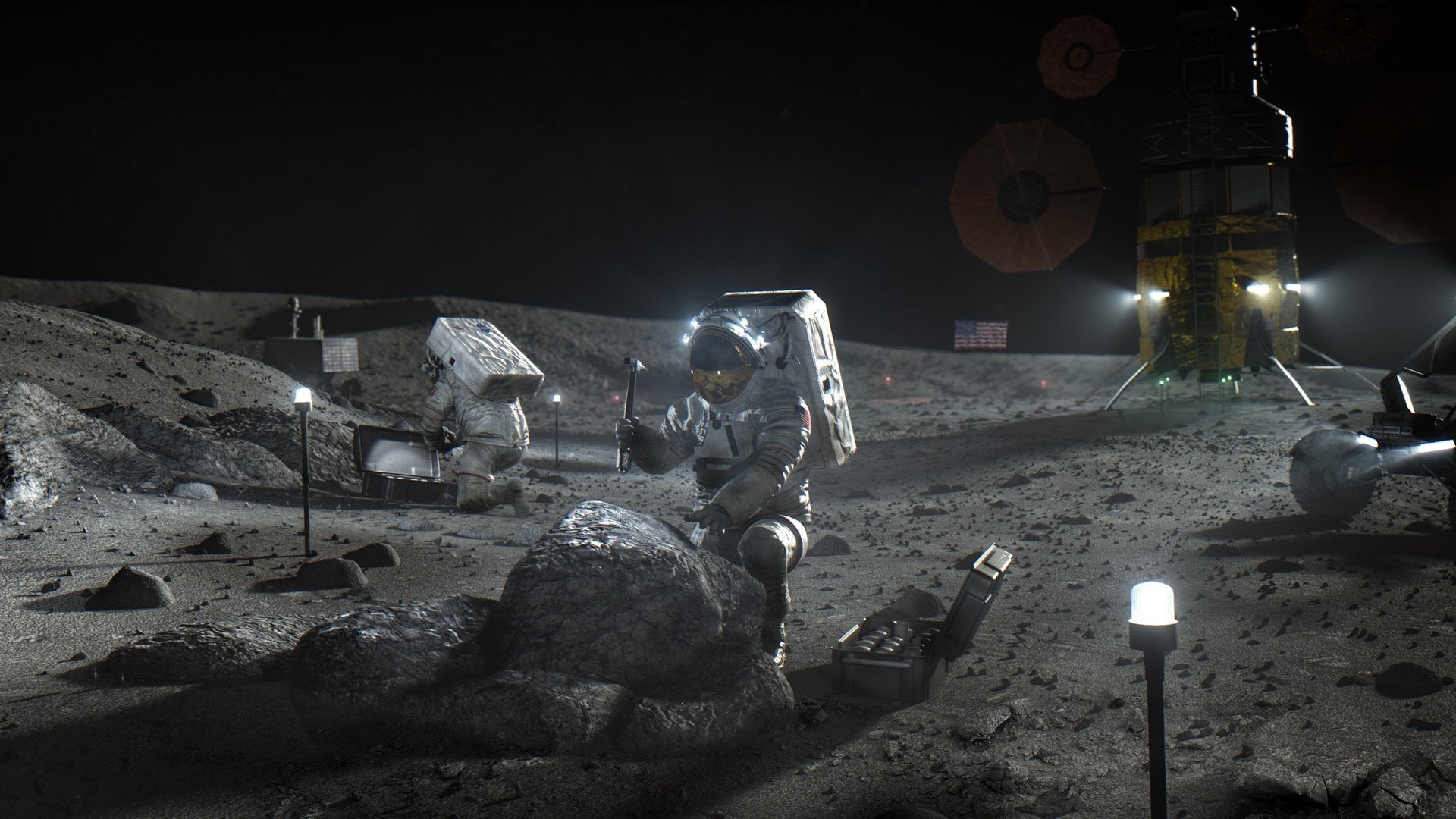
A team of Ohio State University (OSU) scientists has revealed a cutting-edge process using an electrically powered high-energy laser that can turn ordinary moon dust into several futuristicmaterials that can be fabricated into useful tools and materials.
They also added different base materials, such as stainless steel and aluminum-silica ceramics, to the 3D-printed tools and structures made from laser-converted moon dust to determine which materials offered the greatest benefits in terms of strength, simplicity, and durability.
The OSU researchers said their approach could be used by future lunar colonists to create tools, habitats, and other necessary items and structures with only a small amount of material added to the base lunar regolith.
High-Powered Laser and Moon Dust Fused into Different Objects
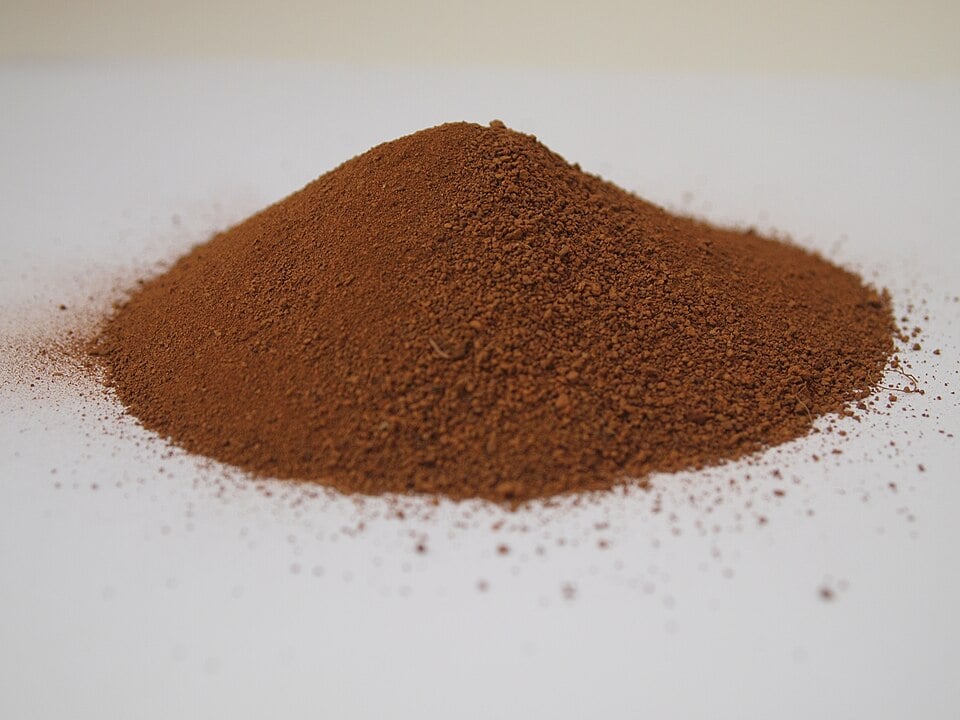
As procuring actual lunar regolith was impractical, the OSU team started with a simulated moon dust made to match the authentic regolith’s material and chemical composition. According to a statement announcing the process, the team loaded the simulant into a 3D printer and printed rigid, stackable sheets that could be formed into different tools and objects.
To assess the viability of the printed sheets for various manufacturing and construction applications, the research team used a high-energy laser to melt regolith onto a base material, such as stainless steel. This process fused the simulated moon dust to the base material, resulting in a hybrid compost material with unique properties.
For example, tests using a simulant called LHS-1, which mimics the soil found in the lunar highlands, showed that the material did not adhere to stainless steel. However, the same simulated, dark-covered basalt rock moon dust bonded well with alumina-silicate ceramic. The team said they suspect the silicate and lunar regolith bonded well because both compounds form crystals that “enhance thermal stability and mechanical strength.”
“By combining different feedstocks, like metal and ceramics, in the printing process, we found that the final material is really sensitive to the environment,” explained Sizhe Xu, lead author of the study detailing the process and a graduate research associate in industrial systems engineering at The Ohio State University.
Test Reveal Unique Compositions Under Varying Atmospheric Conditions
Because future moon colonists will operate in hazardous conditions, the team tested their moon dust laser fabrication process under various environmental conditions. According to the team’s statement, these tests revealed that the overall quality of a material produced by their approach “depends greatly on the surface onto which the soil is printed.”
“Different environments lead to different properties, which directly affect the mechanical strength and the thermal shock resistance of certain components.”
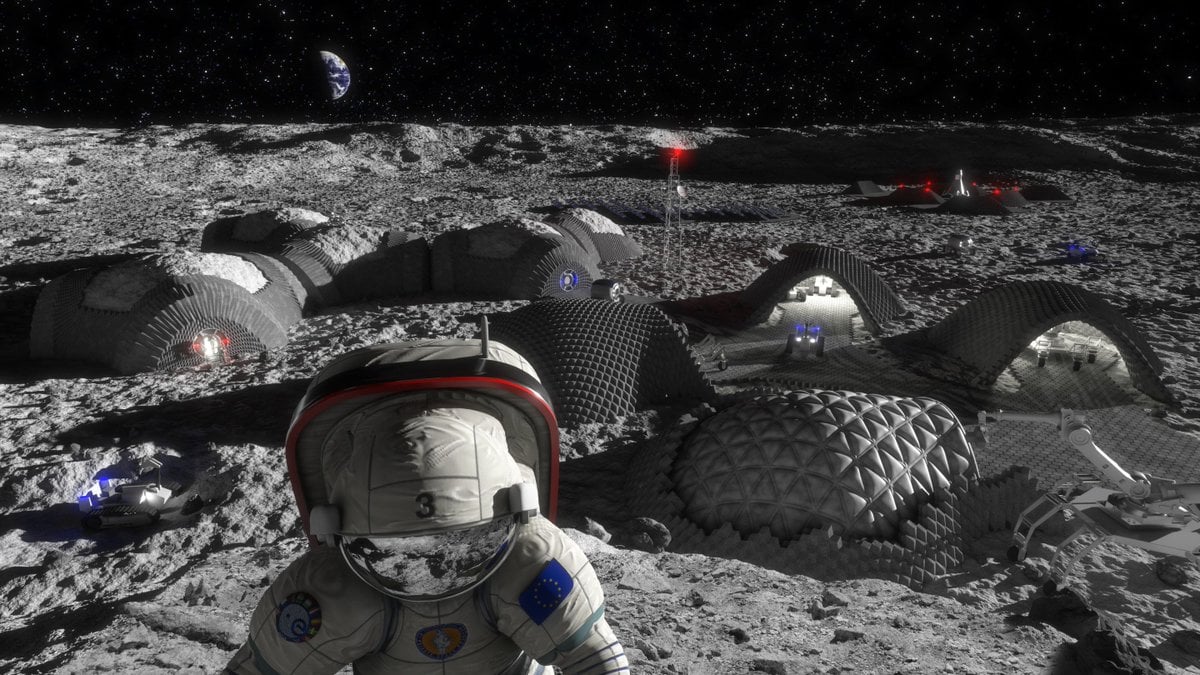
Artist’s concept of a future moon base (Credit: ESA – P. Carril)
Along with the material’s manufacture and composition, experiments revealed that environmental factors such as oxygen availability and fabrication factors such as laser power can affect the stability of the final structure made from the hybrid material.
“There are conditions that happen in space that are really hard to emulate in a simulant,” explained Sarah Wolff, senior author of the study and an assistant professor in mechanical and aerospace engineering at Ohio State. “It may work in the lab, but in a resource-scarce environment, you have to try everything to maximize the flexibility of a machine for different scenarios.”
There Are so Many Applications That We’re Working Toward
When discussing potential applications of their high-energy laser-based moon dust fabrication process, the OSU team noted that future lunar colonists will need to be able to build tools and structures using local resources rather than transporting heavy equipment and materials from Earth. They also noted that such tools and structures must be specially engineered to “survive extreme vacuum, dust and thermal environmental conditions.”
“The promise of these technologies would not only save essential mission time but also allow for extended independence as crews travel into deep space,” they explained.
Moving forward, the team is exploring the challenges moon colonists may face when using local resources. For example, their laser uses electric power, which can be generated using solar collectors or other hybrid power architectures.
“There are so many applications that we’re working toward that with new information, the possibilities are endless,” Xu said.
Although the process is designed for future moon colonists, the researchers suggest that their approach could lead to improved, more energy-efficient processes and potentially address material shortages on Earth.
“If we can successfully manufacture things in space using very few resources, that means we can also achieve better sustainability on Earth,” Wolff explained. “To that end, improving the machine’s flexibility for different scenarios is a goal we’re working really hard toward.”
Christopher Plain is a Science Fiction and Fantasy novelist and Head Science Writer at The Debrief. Follow and connect with him onX,learn about his books atplainfiction.com, or email him directly atchristopher@thedebrief.org.
Asteroid impacts may catapult life from one planet to another, as new research from Johns Hopkins University suggests that hardy bacteria can survive both the violent ejection from a planet and the journey through space.
In a recent paper published in PNAS Nexus, the Johns Hopkins team determined that bacteria can survive not only the intense pressure of an asteroid impact but also the harsh conditions of space. This has major implications for the precautions future space missions will need to take to avoid contaminating other planets with foreign life.
Moving Life From Planet to Planet
“Life might actually survive being ejected from one planet and moving to another,” said senior author K.T. Ramesh. “This is a really big deal that changes the way you think about the question of how life begins and how life began on Earth.”
Space is a violent place, as evidenced by the scars covering most bodies in our solar system. Some of the areas researchers are most interested in investigating on Mars with robotic rovers are the result of ancient impacts, such as Jezero Crater. In a dry riverbed within that crater, the Perseverance Mars rover collected a sample of organic material in 2024 that may represent one of the most significant signs yet of possible life on the Red Planet.
The Johns Hopkins team is investigating the possibility that such strikes could transport living organisms into space, riding on material ejected during an impact—a theory known as lithopanspermia. Meteorites originating on Mars have been discovered on Earth, demonstrating that material can travel from one planet to another. The key question, however, is whether any life could survive the journey.
Can Life Survive Impact?
The Johns Hopkins team was not the first to test this hypothesis, but earlier work was inconclusive. Additionally, those tests focused on common Earth organisms rather than extremophiles that would be more likely to survive on less hospitable planets. For a more realistic evaluation of the lithopanspermia hypothesis, the team developed a method to replicate the pressures involved in an ejection event and focused on a single extremophile: Deinococcus radiodurans.
Native to Chile’s high deserts, Deinococcus radiodurans possesses several traits that the team suspected would make it resilient to space travel. Among these are its tolerance for extreme cold and radiation. Additionally, the microorganism is protected by a thick, self-repairing outer structure.
“We do not yet know if there is life on Mars, but if there is, it is likely to have similar abilities,” Ramesh said.
The impact test involved placing the microbe between two metal plates and firing a projectile at it from a gas gun at 300 mph. Pressures experienced during the impact equaled ten to thirty times those at the bottom of the Mariana Trench, the deepest point in Earth’s oceans. The team found the microorganism remarkably resilient, detecting ruptured membranes and internal damage only at the highest impact levels. In fact, the steel plates broke before the bacteria did.
“We expected it to be dead at that first pressure,” said lead author Lily Zhao. “We started shooting it faster and faster. We kept trying to kill it, but it was really hard to kill.”
Comparing the Results
While the microorganism exceeded researchers’ expectations, asteroid impacts on Mars could be even more powerful than the forces simulated in the laboratory tests. Extremely powerful pressures are measured in gigapascals. The projectile striking the steel plates produced pressures ranging from one to three gigapascals. The higher end of that range was previously believed to be too extreme for life to survive. However, fragments ejected during an asteroid impact may experience pressures approaching five gigapascals.
“We have shown that it is possible for life to survive large-scale impact and ejection,” Zhao said. “What that means is that life can potentially move between planets. Maybe we’re Martians!”
The team says their research suggests future space missions will need to be even more cautious than previously estimated to avoid contaminating one planet with life from another, given how resilient extremophiles may be.
“We might need to be very careful about which planets we visit,” Ramesh added.
To follow up on the relationship between life and space impacts, the team is now investigating whether repeated asteroid impacts might produce even hardier bacterial populations, and whether other organisms—such as fungi—may also be able to withstand impact conditions.
Ryan Whalen covers science and technology for The Debrief. He holds an MA in History and a Master of Library and Information Science with a certificate in Data Science. He can be contacted at ryan@thedebrief.org, and follow him on Twitter @mdntwvlf.
This image, taken on January 1, is the clearest view yet of an ancient object in the far reaches of the solar system, which resembles a snowman (Picture: NASA/Johns Hopkins University Applied Physics Laboratory/Southwest Research Institute/Cover Media)
An American student has resolved the longstanding mystery of one our solar system’s strangest objects – cosmic ‘snowmen’ that populate its outer reaches.
Astronomers have long debated why the globular icy objects look the way that they do.
But researchers at Michigan State University now say they have evidence that a surprisingly simple process could explain how these shapes form.
Beyond the turbulent asteroid belt between Mars and Jupiter lies the Kuiper Belt, a vast region past Neptune filled with icy remnants from the birth of the solar system.
These ancient building blocks, known as planetesimals, have remained largely untouched for billions of years.
Around one in ten are “contact binaries” – objects made up of two connected spheres, reminiscent of a snowman.
How they formed without being smashed together by violent collisions has remained an open question.
Now Jackson Barnes, a graduate student at the university, has developed the first computer simulation to show how such two-lobed shapes can arise naturally through gravitational collapse.
This is the process by which matter contracts under its own gravity, overpowering forces that would otherwise pull it apart. The research has been published in Monthly Notices of the Royal Astronomical Society.
An artist’s concept of a Kuiper Belt object, again resembling a snowman (Picture: Cover Media)
Earlier computer models treated colliding objects as fluid-like blobs that quickly merged into single spheres, making it impossible to recreate contact binaries.
But using high-performance computing facilities, Barnes’ simulations instead allow objects to retain their strength and settle gently against one another.
Other theories have suggested that rare events or exotic conditions might be required to produce these shapes, but researchers say such explanations are unlikely to account for their apparent abundance.
‘If we think 10% of planetesimal objects are contact binaries, the process that forms them can’t be rare, said earth and environmental science assistant professor Seth Jacobson, the study’s senior author.
‘Gravitational collapse fits nicely with what we’ve observed.’
Contact binaries were first seen in close detail in January 2019, when NASA’s New Horizons spacecraft flew past a Kuiper Belt object later nicknamed Ultima Thule.
The images prompted scientists to re-examine other distant bodies, revealing that about 10% of planetesimals share the same distinctive shape.
In the sparsely populated Kuiper Belt, these objects drift largely undisturbed and are rarely hit by other debris.
An artist’s impression of NASA’s New Horizons spacecraft encountering 2014 MU69, a Kuiper Belt object that orbits one billion miles beyond Pluto (Picture: Cover Media)
In the early history of the Milky Way, the galaxy consisted of a disc of gas and dust. Remnants of that era persist in the Kuiper Belt today, including dwarf planets such as Pluto, along with comets and planetesimals.
Planetesimals are among the first solid bodies to form as dust and pebble-sized material clumps together under gravity. Much like snowflakes compressed into a snowball, they are loose aggregates pulled from clouds of tiny particles.
Barnes’ simulation shows that as one of these clouds rotates, it can collapse inward and split into two separate bodies that begin orbiting each other.
Such binary planetesimals are commonly observed in the Kuiper Belt. Over time, their orbits spiral closer until the pair gently touch and fuse, preserving their rounded shapes.
The reason these fragile-looking structures survive for billions of years, Barnes explains, is simple chance.
In such a remote region, collisions are rare. Without a major impact, there is little to pull the two bodies apart, and many contact binaries show few, if any, impact craters.
Scientists have long suspected gravitational collapse was responsible, but until now they lacked models capable of testing the idea properly.
‘We’re able to test this hypothesis for the first time in a legitimate way,’ Barnes said. ‘That’s what’s so exciting about this paper.’
He believes the model could also help researchers understand more complex systems involving three or more bodies. The team is already working on simulations that better capture the details of the collapse process.
As future space missions venture deeper into the outer solar system, the researchers say the familiar snowman shape may turn out to be far more common than once thought.
One low-quality image he saw showed a shape, ‘a big straight kind of silvery line… cigar-shaped object… smooth… no lines’, above Earth.
He said the image loaded line by line as his dial-up internet struggled, explaining: ‘There’s like blackness, then there’s like slowly a hemisphere started appearing, and I’m thinking that’s a planet.
‘This thing looked very smooth on the outside. There were no lines… no screws and bolts and stuff.’
The computer expert said there was a list of ‘nonterrestial officers’
(Picture: Jesse Michels)
The hacker in the early 2000s shortly after his arrest (Picture: Jesse Michels)
While scrolling, he alleged that his mouse was suddenly hijacked, saying: ‘They right-clicked, disconnected and boom, that was it. I was cut out.’
He also found a spreadsheet labelled ‘nonterrestrial officers’, referring to something that does not originate from Earth, McKinnon claimed.
He added: ‘It had ship names… and… fleet-to-fleet transfers.’
McKinnon also claimed found testimony from former NASA contractor Donna Hare saying she was shown an image of a disc over Earth.
Such anomalies are scrubbed clean from any images released to the public, Hare said, according to McKinnon.
McKinnon quoted one of her colleagues saying: ‘Well, we always have to airbrush them out before we sell them to the public.’
Nasa has been approached for comment.
Hacking, McKinnon said, isn’t quite being hunched over a computer in a hoodie.
‘I was in my dressing gown up till like four in the morning, smoking weed, drinking beer, just like ride of my life really,’ he said, adding he used a 56k dial-up modem.
McKinnon had spent years interested in UFOs and other space-age tech, like pollution free energy, after seeing an ‘orange light’ in the sky as a child.
Inspired by the Disclosure Project book by Steven Greer, he decided to try to pry open secretive government systems for evidence in March 2001.
McKinnon was arrested by police at his flat in Wood Green, north London, in March 2002, with investigators acting on allegations from the US.
Officials released footage taken in 2004 of Navy pilot tracking a UFO (Picture: Sharilyn Neidhardt)
American authorities said that McKinnon hacked into US army, navy, air force, Department of Defense and Nasa computers 16.
This caused £487,000 worth of damage to computers in 2001 and 2002, officials said.
If he was convicted, McKinnon could have spent 70 years behind bars only for an extradition order to be blocked by then-prime minister, Theresa May, on human rights grounds.
McKinnon, known as ‘Solo’ online, stressed he never acted with malicious intent and positioned himself as a truth-seeker. He admitted to obtaining unauthorised access to US government computer systems.
Asked by Michels why he did this, McKinnon said: ‘I wanted it from the horse’s mouth. I didn’t want to just believe.
NASA’s Curiosity Mars rover captured a series of black and white panoramas at two times of day which were then merged together. Colour was added to help different details stand out in the landscape (Picture: NASA/JPL-Caltech/MSSS/Cover Images)
Nasa’s Curiosity rover has been investigating the spider-web-like rock formations found on Mars – and found mysterious egg-like structures.
Newly issued images show giant zig-zagging ridges, known as ‘boxwork’, spread across the slopes of Mount Sharp inside Gale Crater.
Some of the close-up photographs reveal small, rounded spheroids scattered across the formations, features not previously seen on Mars.
Over the past eight months, Curiosity has been closely examining these interconnected rocky ridges, which stretch across an area up to 12 miles (20km) wide.
Scientists believe the structures formed billions of years ago, when groundwater flowed beneath the Martian surface, depositing minerals that later hardened into ridges as surrounding rock was eroded by wind.
From orbit, the formations resemble enormous spiderwebs etched into the landscape.
Nasa’s Curiosity Mars rover captured this panorama of boxwork formations — the low ridges seen here with hollows in between them — using its Mastcam on September 26 (Picture: NASA/JPL-Caltech/MSSS/Cover Media)
Although they were first identified by spacecraft in 2006, their remote location meant they remained largely unexplored until Curiosity arrived.
For about six months, the rover has been driving across the low ridges, which stand roughly three to six feet (one to two metres) tall, with sandy hollows in between.
The patterns suggest groundwater was present in this region later in Mars’ history than scientists had previously thought, raising fresh questions about how long microbial life might have survived on the planet.
To explain the shapes, researchers believe water once flowed through fractures in the bedrock, leaving minerals behind. These minerals strengthened certain areas, forming ridges, while the surrounding rock without this reinforcement was gradually worn away.
Until Curiosity reached the site, scientists were unsure what the formations would look like at ground level or how difficult they would be to traverse.
As the rover climbed higher up Mount Sharp, which rises about 3 miles (5km) above the crater floor, the layers of rock show evidence of Mars’ changing climate. Higher layers suggest increasingly dry conditions, interrupted by occasional wet periods when rivers and lakes may have returned.
Scientists think that ancient groundwater formed this weblike pattern of ridges, called boxwork, that were captured by NASA’s Mars Reconnaissance Orbiter in 2006 (Picture NASA/Cover Media)
Tina Seeger, of Rice University, is one of the scientists leading the investigation.
‘Seeing boxwork this far up the mountain suggests the groundwater table had to be pretty high,’ she said.
‘And that means the water needed for sustaining life could have lasted much longer than we thought looking from orbit.’
Previous orbital images had shown dark lines running through the spiderweb-like patterns. Scientists had suggested these might be fractures where groundwater once flowed.
Curiosity’s close-up investigations have now confirmed that these lines are indeed fractures.
The rover has also identified small, bumpy egg-like features known as nodules, which are considered clear signs of past groundwater activity.
However, scientists were surprised to find that the nodules were located along the sides of ridges and in the hollows, rather than near the central fractures.
‘We can’t quite explain yet why the nodules appear where they do,’ Seeger said. ‘Maybe the ridges were cemented by minerals first, and later episodes of groundwater left nodules around them.’
These bumpy nodules were formed by minerals left behind as groundwater was drying out on Mars billions of years ago. NASA’s Curiosity rover captured images of these pea-size features while exploring boxwork formations last August (Picture: NASA/JPL-Caltech/MSSS/Cover Media)
Curiosity has drilled several rock samples from the region, analysing the powdered material using X-rays and high-temperature ovens inside the rover. The results have revealed clay minerals in the ridges and carbonate minerals in the hollows, offering further clues to how the formations developed.
A more recent sample was analysed using a specialised wet-chemistry technique designed to help detect organic compounds, carbon-based molecules considered important to the origins of life.
The rover is expected to leave the boxwork region in March and continue exploring a wider sulfate-rich layer of Mount Sharp.
Scientists hope the ongoing mission will provide further insight into how Mars’ climate evolved billions of years ago, transforming the planet from one with flowing water into the cold, dry world seen today.
Declassified documents from over three decades ago have revealed how an encounter with a suspectedUFO at the south pole was covered up.
The records unsealed this year by Argentina's Ministry of Foreign Affairs have confirmed an eyewitness account from 1991, when military personnel and civilian researchers in Antarctica detected and then saw a large flying saucer over their base.
Miguel Amaya, a retired Argentine Air Force non-commissioned officer, told UFO investigators in the early 2000s that he was stationed at General San Martín Base, a small scientific and military station on a tiny island in Antarctica in April of that year.
At the start of the polar night, when the sun stays down for months, an alarm went off on the station's riometer, a machine that measures changes in the upper atmosphere.
Despite the three needle pens measuring different heights of the ionosphere, the part of the atmosphere where solar radiation ionizes atoms, all of the needles began drawing the same pattern, which is scientifically impossible.
According to Amaya, outpost personnel claimed that the strange readings could only have been caused by something producing the same energy as a nuclear aircraft carrier or a large city floating over Antarctica.
Hours later, another base member was walking outside during a snowstorm when they allegedly saw 'a huge circle of light' moving slowly and silently right over the building.
The 1991 incident has finally come to light after Amaya claimed he and the other members at General San Martín Base were told never to talk about what they had seen by their superiors.
General San Martín Base, a small scientific and military station in Antarctica used by Argentina
Over 120 feet of paper was reportedly used during the four-and-a-half hour incident at General San Martín Base, with Amaya revealing that the needles were moving so violently they went off the paper multiple times.
'This equipment started registering normally, but after five minutes, the three indicator needles began to make the same marks, which the engineer explained was impossible,' Amaya said in his CEFORA interview, translated to English.
'At times, these "signals" would cut out, and everything would continue as normal. Then, for periods of ten or fifteen minutes, it would start again, sometimes with such force that the needles would jump off the belt.'
The incredible readings started around 1am local time and carried on through the night. Roughly 16 hours later at 10pm, Amaya said a radio operator from the Argentine Army saw the mysterious craft as he left the base on a walk.
'He noticed a huge circle of light, very dim due to the cloud cover, passing above the base, but still visible, and moving very slowly and silently towards the sea,' Amaya claimed in his testimony.
The meteorological observer noted that by the time the man who saw the UFO could call for the rest of the base to come out and view it, the craft had disappeared.
The three needles on the riometer's graphic recorder were supposed to show independent readings because they measured different aspects of radio wave absorption in the ionosphere, which sits 30 to 600 miles above the surface.
Normally, natural events like solar flares or auroras cause different patterns on each needle, since absorption varies by frequency, with lower frequencies getting absorbed more or at different altitudes than higher ones.
Riometer papers from General San Martín Base in 1991 which recorded a strange atmospheric disturbance over Antarctica
Argentina's Ministry of Foreign Affairs revealed that nine rolls of records from the 1991 incident still exist and have been stored in the Argentine Antarctic Institute
This means the needles should have been drawing distinct patterns on the night the UFO was allegedly spotted. For example, one might have shown stronger spikes while another showed milder changes if this had been a normal phenomenon.
This synchronization could only have taken place if a massive, external energy source was directly overhead, overriding the separate signals of the riometer.
An Argentine civilian UFO research group known as CEFORA pushed for the records to be released under the nation’s public information law.
The Ministry of Foreign Affairs confirmed that the original paper rolls, which recorded the strange readings over Antarctica, still exist and have been stored at the Argentine Antarctic Institute.
CEFORA interviewed Amaya about the incident prior to going public with his story on a Spanish radio program in 2009.
CEFORA's director, Andrea Simondini, had been fighting to have the official records of that UFO encounter and others released for more than 15 years.
Now that the records have been unsealed, images proving something unexplainable interfered with the base's riometer have been shared for the first time.
'This is just the first test case we can verify under this method, and it raises expectations for the continued declassification of other files,' she stressed in a statement translated to English.
In the US, UFO disclosure has also reached a fever pitch, with President Trump ordering Secretary of War Pete Hegseth and the Pentagon to release all documents related to government investigations on the UFOs and extraterrestrial life.
To this point, however, the US has maintained that there has never been any physical evidence found proving that aliens or non-human spacecraft exist.
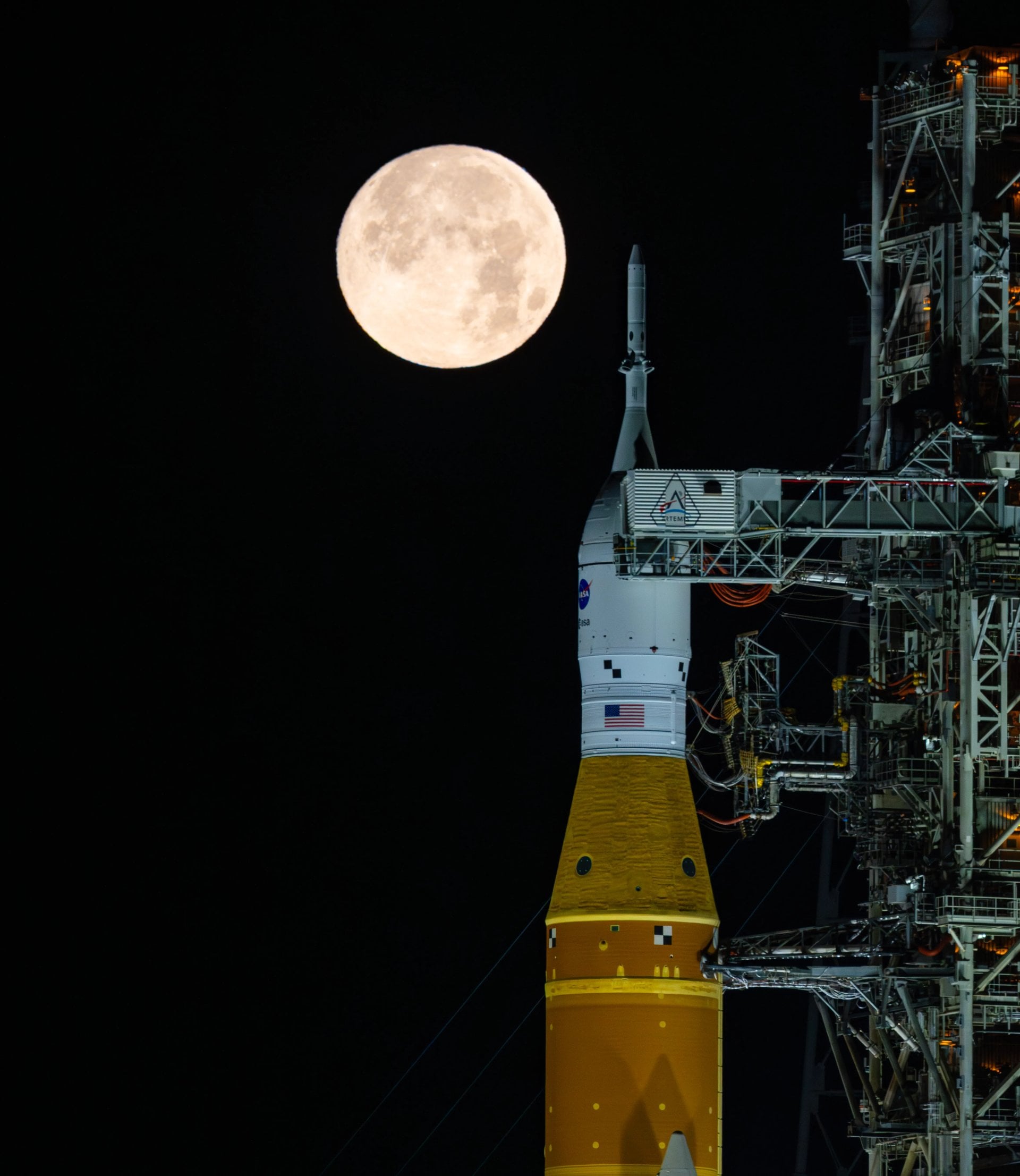
On the penultimate day of winter, NASA decided to revise the route of its Artemis program space expedition to the Moon. The revised plans no longer mention landing on the surface of our natural satellite.
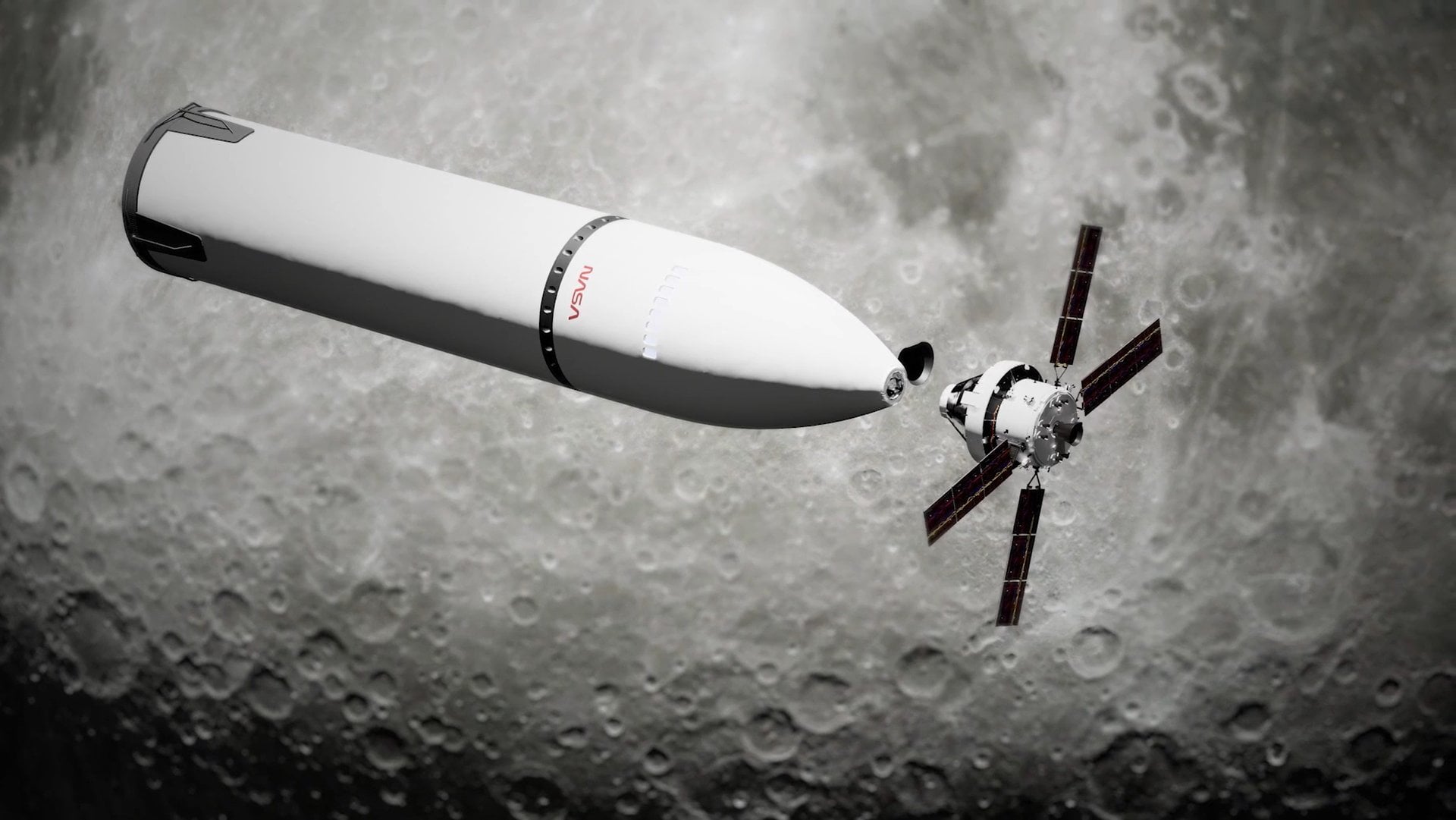
Illustration of the Starship spacecraft docked with NASA’s Orion orbital module. Credit: Space.com
The most significant change affected the Artemis III mission, which was planned as humanity’s triumphant return to the Moon since Apollo. Previously, it was assumed that this crew would use SpaceX’s giant Starship spacecraft as a landing vehicle.
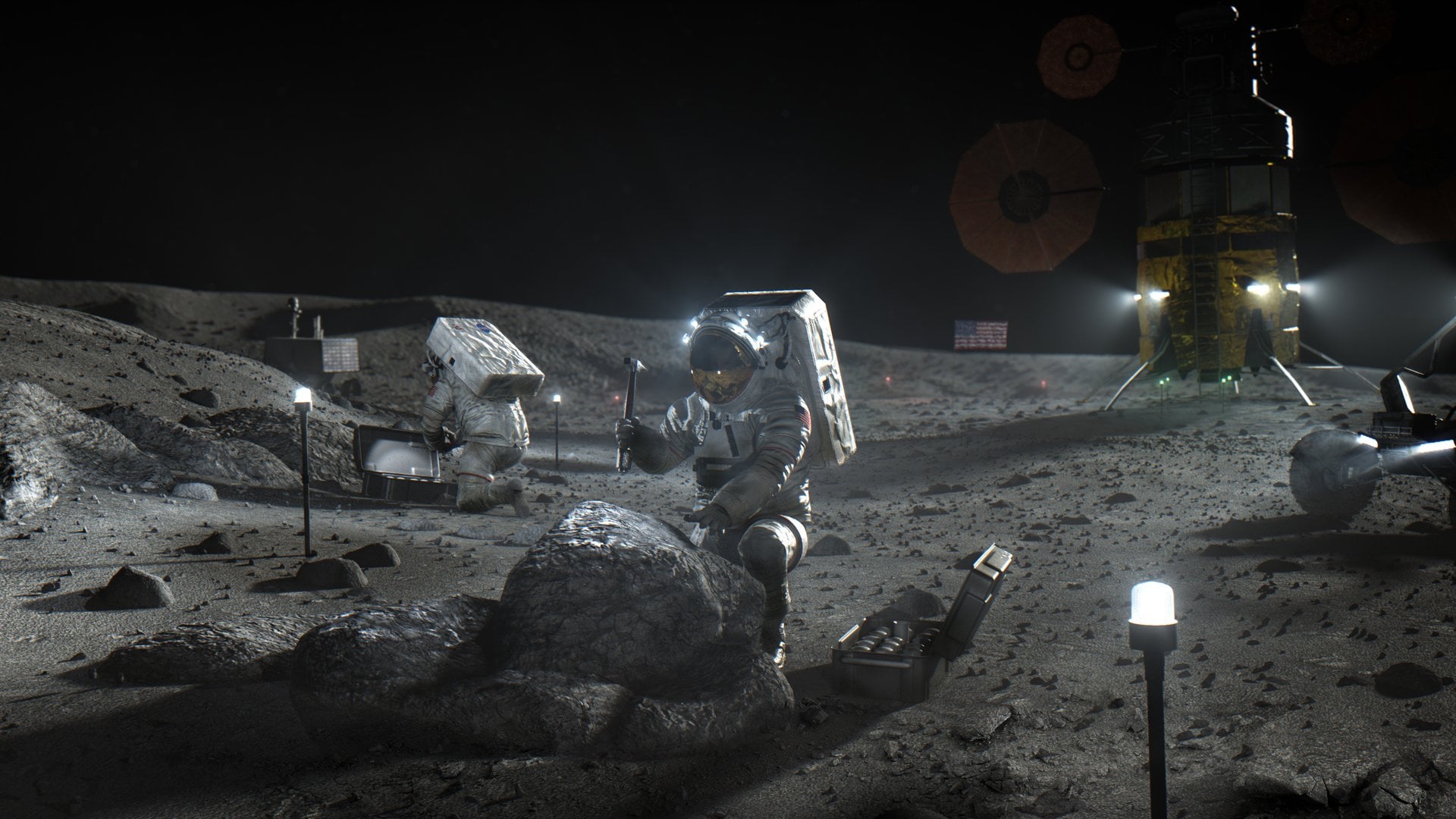
Starship HLS spacecraft on the Moon. Illustration: SpaceX
According to the updated plans, the Artemis III flight will take place in 2027, but the astronauts will remain in Earth orbit. Instead of landing, the mission will turn into a grand technological experiment: the Orion capsule is to dock with commercial landing modules. And here lies the intrigue — these will be spacecraft not only from SpaceX, but possibly also from competitors at Blue Origin.
Starship loses priority
The main reason for this decision lies in SpaceX’s hangars. Despite 11 test launches, Starship has not yet reached Earth’s orbit. The pace of development of the mega-rocket does not suit NASA management, which is accustomed to working to a tight schedule.
The SpaceX Starship refueler pumps fuel into another Starship in low Earth orbit (top), as well as the Orion docking with Starship HLS before landing on the Moon. Illustration: SpaceX
Experts believe that the problem lies not only in technology, but also in strategy. “NASA no longer wants to depend on a single contractor,” explains Don Platt, professor at the Florida Institute of Technology. That is why the space agency is deliberately pitting two giants against each other: SpaceX and Blue Origin, creating healthy competition for a place in history.
New strategy: slow but steady
Blue Origin, founded by Amazon owner Jeff Bezos, unexpectedly got a chance to take center stage earlier than planned. Their Blue Moon landing vehicle was being prepared for the Artemis V mission as early as 2030. But now, everything seems to show that NASA wants to test it during Artemis III.
Blue Moon MK1 spacecraft (concept). Source: Blue Origin
The company itself senses victory. In January, Blue Origin suspended its suborbital tourist flights, devoting all its resources to accelerating the development of a lunar module. The company states that this is a deliberate step toward the “national goal of returning to the Moon.”
So now, the first actual landing of astronauts on the Moon has been postponed until at least 2028, when it will be carried out by the Artemis IV mission. Another launch may take place in the same year as part of Artemis V.
NASA has decided to proceed cautiously. The agency plans to increase the frequency of flights, but at the same time standardize the rockets. The more powerful but unproven versions of the Space Launch System (SLS) rockets were temporarily abandoned in favor of the proven Block I configuration.
Get ahead of China
There is a third player in the unfolding race that is making even NASA rush. China plans to land its taikonauts by 2030.
NASA administrator Jared Isaacman makes no secret of his true motives: “Competition from our biggest geopolitical rival is getting tougher every day. We need to move faster.” He compares the new strategy to the approach taken during the Apollo program: gradual increase in flight frequency, logic, and standardization. This, in his opinion, will enable America to once again “achieve the nearly impossible” and not concede primacy to Beijing in the new lunar era.
A bone-chilling document declassified by the CIA has exposed an alleged massacre by aliens from a crashed UFO who turned an entire military unit into stone.
According to the report, Soviet troops shot down a flying saucer hovering over the Soviet military unit in Siberia roughly 35 years ago, and what happened next was truly terrifying.
In the document, summarizing a 250-page top secret file acquired by US intelligence agents, eyewitnesses said five aliens climbed out of their wrecked craft, combined themselves into one creature, exploded in a burst of intense energy, and turned 23 soldiers into solid rock.
One CIA official referred to the shocking battle as 'a horrific picture of revenge on the part of extraterrestrial creatures, a picture that makes one's blood freeze.'
The agency added that the 'extremely menacing case' proved the aliens who visited Earth possessed weapons and technology far beyond the US government's 'assumptions' - suggesting they were already aware of the aliens' existence.
The unearthed document, declassified in 2000, was recently the topic of the AI or Evil podcast, where host Josh Hooper revealed that two of the soldiers at the UFO crash site actually survived the encounter.
However, the 23 'petrified soldiers' could not be saved. Their remains and the debris from the spacecraft were reportedly moved to a secret research base near Moscow.
An even more concerning detail of the CIA file is the description of the aliens reportedly involved in this massacre, who have been mentioned in UFO reports and sightings for nearly 80 years.
A declassified CIA document revealed details of an alleged battle between Soviet forces and an alien spacecraft, which ended with 23 soldiers dead
During a training mission in Siberia, the Soviet military reportedly shot down a low-flying UFO carrying at least 5 aliens who then turned the soldiers into stone
The subject of the document states: 'Paper reports alleged evidence on mishap involving UFO.'
This extraordinary tale was also published in the Ukrainian newspaper Holos Ukrayiny on March 27, 1993.
The incident, which a Canadian newspaper believed took place between 1989 and 1990, was only uncovered by the CIA after the fall of the Soviet Union and its 'secret police' organization, the KGB.
The CIA document explained that the alleged alien craft was flying low and quietly above the Soviet unit while they were engaged in a training mission.
Officials wrote that 'for unknown reasons' the Soviets launched a surface-to-air missile at the UFO, sending it crashing to the Earth near the unit's position.
According to the only two soldiers who survived, when the soldiers approached the craft, the five aliens freed themselves of the debris and came close together near the wreck.
Moments later, the soldiers said the group of aliens 'merged into a single object that acquired a spherical shape.' In simpler language, the aliens beings somehow morphed into a giant ball.
That's when the new ball-like alien began to buzz and hiss before igniting into a brilliant white light.
The description from the CIA report matches the decades-long description of an alleged race of beings UFO researchers call 'the Greys'
With the soldiers still looking on, the ball of light erupted like a giant flare of energy, turning 23 of the 25 Soviets into 'stone poles.'
The report stated that the only reason two of the men survived was because they were standing in a shaded area at the time of the alien energy blast.
Testing of the soldier's bodies showed the alien flare had somehow changed living tissue into a substance that closely resembles limestone.
The CIA document added that 'a source of energy that is still unknown to Earthlings' was responsible for the blast which fatally transformed the Soviets.
Even in 2025, the science behind such a shocking transformation is still difficult to explain medically and technologically.
According to the Journal of Applied Physics, it is possible to use high-energy radiation or electromagnetic pulses to change normal matter into plasma - a form that's not a liquid, solid, or gas.
In the report, the CIA described the aliens as short humanoids with 'large heads and large black eyes.'
The account matches who UFO researchers, alleged alien abductees, and others who believe in alien life refer to as a race called 'the Greys.'
Their features have become the classic image the public thinks of when discussing aliens from outer space - a small, skinny, grey-skinned alien, with an oversized head and large black eyes with no iris.
The Greys would eventually become linked to the infamous Roswell Incident of 1947, as CIA documents would later suggest that alien beings were pulled from the alleged wreck in New Mexico.
These strange creatures would also go on to represent alien life in countless science fiction shows and movies, including Steven Spielberg's Close Encounters of the Third Kind.
Despite their prominent place in extraterrestrial research, this disturbing incident appears to be the first time humans have alleged that these beings could have accomplished such terrifying feats.
0
1
2
3
4
5
- Gemiddelde waardering: 0/5 - (0 Stemmen) Categorie:ALIEN LIFE, UFO- CRASHES, ABDUCTIONS, MEN IN BLACK, ed ( FR. , NL; E )
All’s well that’s Roswell
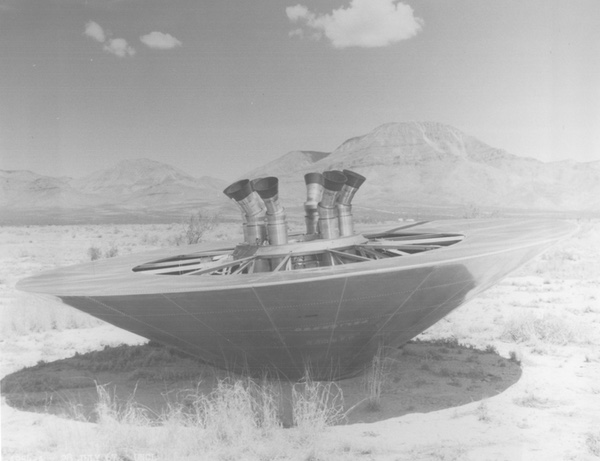
A crashed flying saucer? No, an aeroshell for NASA’s Voyager-Mars program tested in the desert.
(credit: NASA)
All’s well that’s Roswell
by Dwayne A. Day
On February 19, the president stated that he had directed the government to “begin the process of identifying and releasing Government files related to alien and extraterrestrial life, unidentified aerial phenomena (UAP), and unidentified flying objects (UFOs).” In the mid-1990s, political pressure resulted in the release of information and the production of two reports on the so-called “Roswell Incident” of 1947. These reports added substantively to the historical record of Cold War aerospace programs. Hopefully, the new efforts will also be productive in opening up the history.
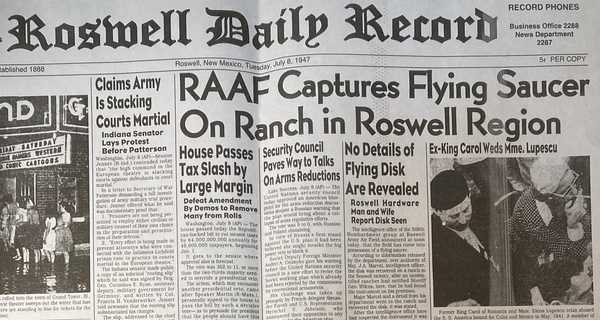
The infamous “flying saucer” headline in the local newspaper in 1947.
The Roswell Incident
In 1947 there was a report of debris found by a rancher near Roswell, New Mexico. It was soon publicly reported that the Air Force had captured a “flying saucer.” Within a day or so, the military stated that the debris was actually from a “weather balloon.”
In 1994, following political pressure from Congress, the Air Force announced that what had crashed at Roswell was not a weather balloon, but a different kind of balloon, from a top secret program.
Despite the fact that Roswell has now been in the public consciousness for decades (there were even two fictionalized TV series about aliens set in Roswell), it was not until 1980 and the publication of the book The Roswell Incident that the event gained a mass audience. The book by Charles Berlitz and William L. Moore alleged that not only had the US government recovered debris from a flying saucer, but it may have recovered “alien bodies.” Sensational paranormal pseudoscientific stories were Berlitz’s bread and butter: he had previously written a book about the Bermuda Triangle (which unfortunately does not exist) and claimed that a US Navy ship had been involved in time travel experiments (which did not happen, but may still have not happened when time travel is invented, or not).
In 1994, following political pressure from Congress, the Air Force announced that what had crashed at Roswell was not a weather balloon, but a different kind of balloon, from a top secret program called Project Mogul. Mogul was an effort to fly microphones to very high altitudes to listen for the sound of nuclear explosions. Scientists believed that the sounds of such explosions could be trapped between layers of the atmosphere and would reverberate over long distances. In the late 1940s, the United States government was concerned that the Soviet Union might develop an A-bomb, and Mogul was designed to listen for the big boom. A big boom eventually happened when the first Soviet A-bomb was detonated in August 1949.
After the initial Air Force revelation about Project Mogul, in 1995 the Air Force published The Roswell Report – Fact vs. Fiction in the New Mexico Desert, a thick book that included documentation supporting the Project Mogul explanation for the Roswell incident. On June 24, 1997, the Air Force published The Roswell Report: Case Closed. This second report addressed the claims that bodies had been recovered in the desert, noting that the Air Force had conducted many tests in the desert involving instrumented dummies dropped from aircraft and later recovered on the ground. It also noted that NASA had performed drop tests of various reentry vehicles over the desert, and some of these had saucer shapes. These activities, conducted over many decades, often at an Air Force base at Roswell, could have contributed to the mythology of Roswell and aliens.
The two reports released by the US Air Force in 1995 and 1997 about what happened in Roswell.
Case closed?
Of course, the tinfoil hat-wearing crowd was not convinced, and the term “case closed” only stirred up their bile. There was already a cottage industry of hucksters and grifters willing to take advantage of the true believers, and they had no interest in Air Force or NASA history that didn’t titillate the masses. They held their UFO conferences and sold energy crystals and fold-up pyramids to the faithful, and denounced the Air Force’s explanation for Roswell.
The report shone a light on obscure areas of aerospace research that had been overlooked by many historians, like high-altitude drop tests.
But setting aside the issue of extraterrestrials, the two Air Force reports of the mid-1990s were important contributions to historical scholarship, revealing new and declassified information and documents. Up to the time of the Air Force revelation about Project Mogul, that program had not been acknowledged or even hinted about. For example, historian Curtis Peebles had written a 1991 book The Moby Dick Project: Reconnaissance Balloons over Russia. Peebles shed considerable light on the subject of reconnaissance balloons but had been unaware of Project Mogul. Other historians had been digging into the history of aerial reconnaissance programs and had not uncovered Mogul. The information on Mogul had been sitting in government archives for decades until it was forced into the open. Certainly a few people in the government still knew about it, and some had probably seen the documents, but there was no reason for them to reveal the truth about what happened at Roswell until a government order to declassify and publish that information.
Similarly, although the information in the Case Closed report did not reveal any highly classified programs, it was revelatory. It shone a light on obscure areas of aerospace research that had been overlooked by many historians, like high-altitude drop tests. The report included photos of NASA Voyager-Mars and Viking aeroshells that had been tested in the desert. It also included photos of other unusual balloon-carried research payloads, including Discoverer satellite reentry vehicles. Very few people had ever paid attention to the history of aeromedical research and testing during the Cold War, but the report demonstrated that many such tests had been performed for decades.
The Air Force reports on Roswell revealed testing NASA did of aeroshells for future Mars missions, like Viking.
(credit: NASA)
Sunshine days
The 1990s was an era of increased openness about Cold War era activities, sometimes resulting from presidential direction, sometimes from congressional direction, and sometimes at the initiative of senior government officials. The existence of the National Reconnaissance Office was revealed in 1992, and following executive order 12951 the CORONA reconnaissance satellite program was declassified in 1995. In a December 1993 press conference, Secretary of Energy Hazel O’Leary announced the largest declassification of information in the Department of Energy’s (DoE’s) history. That included acknowledging many nuclear tests, as well as nuclear weapons accidents during the Cold War. Additional major declassifications were announced at openness press conferences in June 1994 and February 1996. For example, in 1996 DoE released a complete inventory of US production, acquisition, use, and distribution of plutonium from 1944 to 1994.
The CIA began declassifying millions of pages of documents on Cold War operations. These included an official history of the U-2 reconnaissance program as well as (in coordination with the National Security Agency) revealing the Venona communications interceptions of the 1940s. CIA documents revealed details of what the US Intelligence Community knew about Soviet missile and space programs. One example was an early effort to “kidnap” a Soviet spacecraft during an international exhibition in the early 1960s to examine it. This author was the first to discover and report on the CIA operation after uncovering a newly declassified CIA publication in the National Archives. The CIA also created a declassification program that released millions of pages of documents as part of the CIA Records Search Tool (CREST). Much of our current understanding of intelligence collection about Soviet weapons systems is due to the work done for CREST. That effort was highly productive into the early 2000s, when it was curtailed and the number of documents being declassified annually dropped dramatically. As a result, we have very good understanding of many aspects of the Cold War up until the early 1970s, but after that the historical record is much thinner.
The 1990s were the beginning of a new era of revelations about historical American air and space programs. Certainly, much remained classified, but much more was revealed than in previous decades. The September 11, 2001, terrorist attacks were the beginning of the end of this period of openness. Government agencies retrenched, new bureaucracies and layers of secrecy were created, and new politicians and government leaders had far less interest in revealing past secrets. Whereas CORONA was declassified in 1995, the follow-on GAMBIT and HEXAGON reconnaissance satellite programs were considered for declassification in 1997, but this ultimately did not happen until 2011. Today, official government declassification efforts are underfunded, meager, and sporadic.
The truth is out there… and so are the lies
It has long been known that when the U-2 spy plane began flying in the mid-1950s it was regularly being reported as a flying saucer at high altitude, and the government did nothing to dispel those stories. But the government’s involvement goes beyond simply not correcting the false stories to creating its own false stories. In June 2025, The Wall Street Journal reported that the US government had actively used disinformation to conceal highly classified aerospace programs. (See “Pentagon Fueled UFO Mythology, Then Tried Coverup,”The Wall Street Journal, June 7, 2025, print edition.) As the government was investigating reports of unidentified aerial phenomena (the modern euphemism for UFOs), a retired Air Force colonel admitted that in the 1980s he had taken doctored photos of flying saucers to a bar in the Nevada desert and given them to a bartender to put up on the walls. This was to help obscure the fact that the Air Force was testing stealth aircraft nearby. Somebody who saw an F-117 flying in the dark might tell the story to somebody else who would say that it resembled the flying saucer photo in the bar. People would chase aliens instead of secret aircraft.
Somebody who saw an F-117 flying in the dark might tell the story to somebody else who would say that it resembled the flying saucer photo in the bar. People would chase aliens instead of secret aircraft.
Other officers who were assigned to a highly classified program office were shown a photo of what they were told was an alien craft, part of a project called Yankee Blue, and told that it had provided the government with antigravity technology. They were ordered to never mention it again. But this was actually a joke, a long-standing hazing ritual within the secretive community. In spring 2023, the Secretary of Defense sent out a memo ordering the practice to stop immediately, but by this time hundreds of people retired, and in the active duty military, believed the government had inherited technology from aliens. Distrust and misinformation was now firmly embedded into the secretive culture.
The Journal also recounted a disturbing story about a 1967 incident that had been reported as an alien “attack” on an ICBM command post in Montana by a glowing reddish-orange oval. What really occurred was a highly classified test of a system to determine if missile command complexes were vulnerable to Soviet electromagnetic pulse attacks. The test identified significant security vulnerabilities, and that information was so sensitive that it was highly classified for half a century, even though one Air Force officer in that command post believed it was aliens.
Some of my own research has hinted that misinformation was part of the fielding of the first operational near-real-time reconnaissance satellite in December 1976, the KH-11 KENNEN. A cryptic note in a declassified history indicates that the Soviet Union did not realize the satellite was capable of reconnaissance until summer of 1978. But I have also heard that an Air Force officer, possibly without official sanction, was deliberately spreading disinformation about American satellites during this period.
Two years ago, Peter Merlin published Dreamland: The Secret History of Area 51 (see “Review: Dreamland”, The Space Review, December 4, 2023.) It is an exhaustive history of secret projects developed at the Groom Lake airfield. But it also essentially stops by the early 1980s, even though the Groom Lake facilities expanded significantly in the following decade. What went on in those big new hangars? Throughout the 1980s there were rumors of other aircraft being tested there, and one retired test pilot confirmed that he flew something during the 1980s that remains classified. Maybe the story of the “Blackstar” air-launched spaceplane had some basis in truth (although I have my doubts: “Six blind men in a zoo: Aviation Week’s mythical Blackstar,” The Space Review, March 13, 2006). Maybe that colonel giving out photos of flying saucers to protect projects at Groom Lake was seeking to hide something other than the F-117 stealth fighter. Maybe we’ll now learn.
But probably not.
We’ll have to wait and see what, if anything, is declassified from this new order. So keep watching the skies, but don’t hold your breath while doing so.
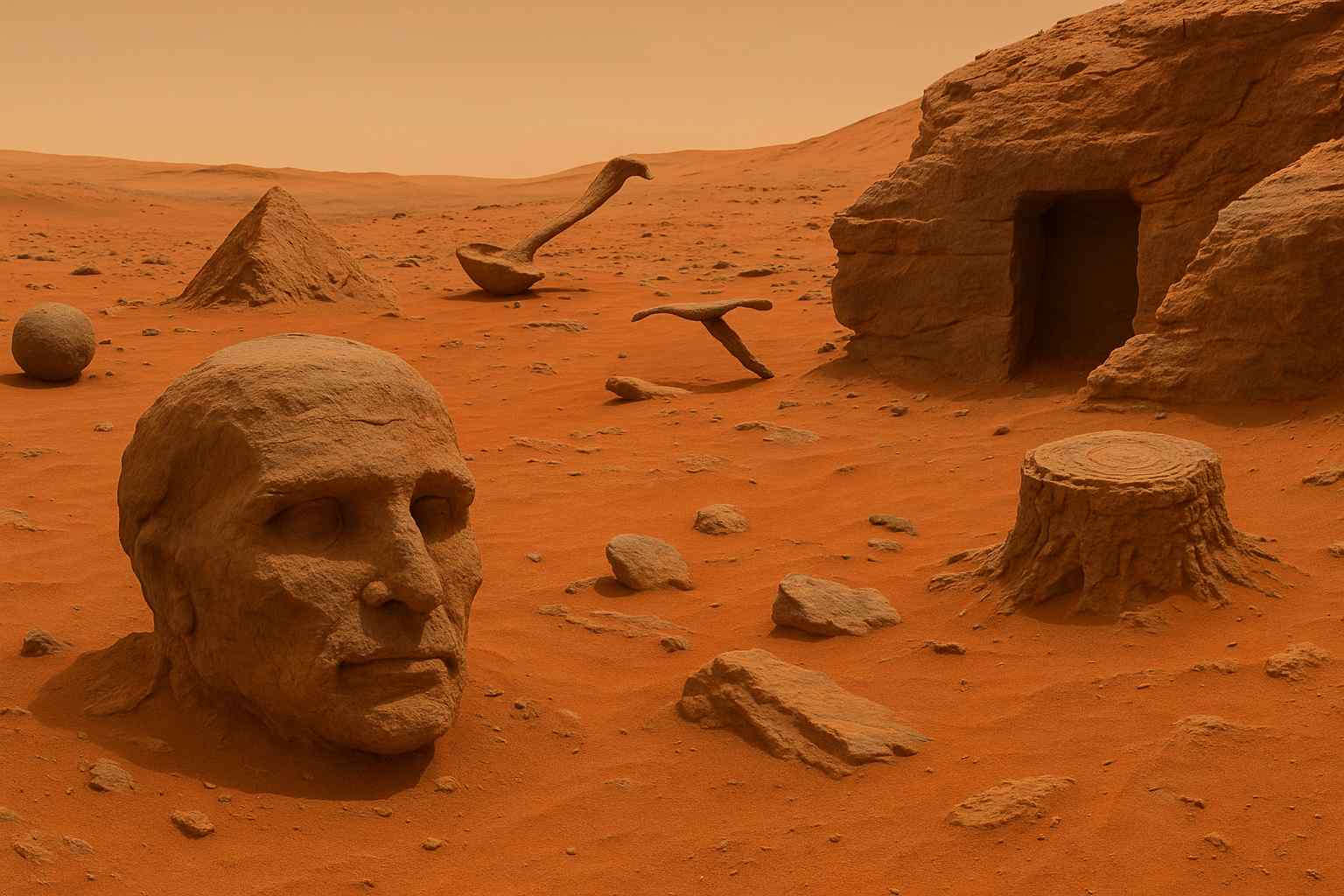
Mars has always captivated our imagination, but modern space exploration has made it even more intriguing. High-resolution Mars anomalies images from NASA’s rovers and orbiters often reveal formations that resemble familiar objects—from faces to doorways—leading to fascinating debates.
While most of these anomalies have logical geological explanations, they spark curiosity about what lies beneath the Red Planet’s dusty surface. Here are 15 of the strangest things spotted on Mars that look like they shouldn’t be there.
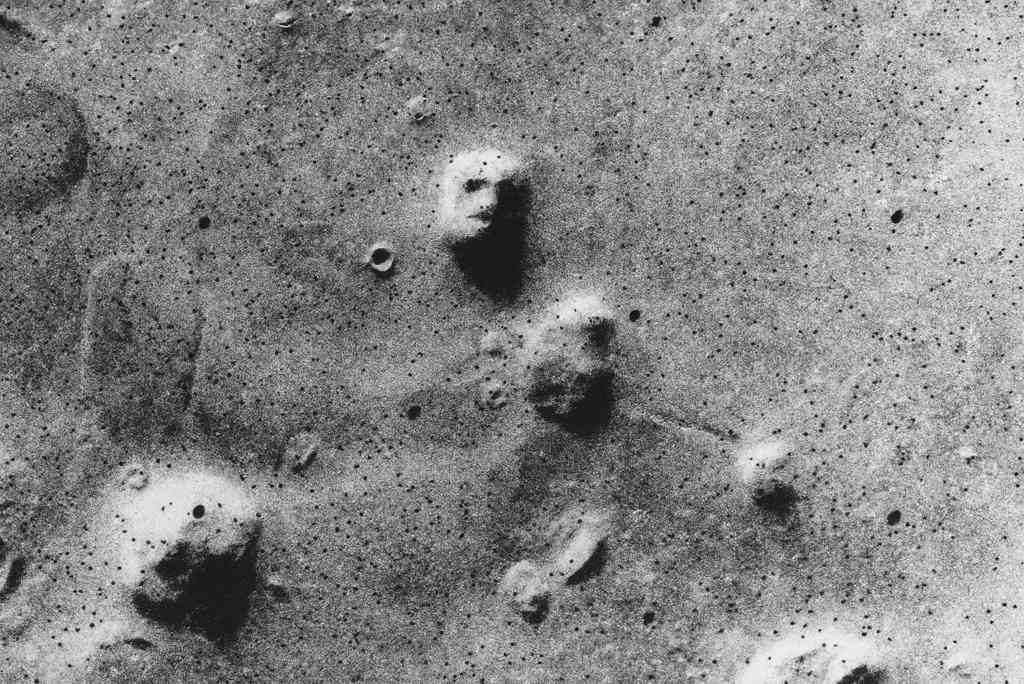
1. The “Face on Mars”
Photo Credit: Wikipedia
One of the most iconic Mars anomalies images , the “Face on Mars,” was first photographed by NASA’s Viking 1 orbiter in 1976. The image appeared to show a massive humanoid face, sparking decades of speculation about alien civilizations.
Later, high-resolution images from the Mars Reconnaissance Orbiter revealed it as a natural mesa with shadows creating facial illusions. This phenomenon is a classic example of pareidolia—our brain interpreting random patterns as familiar shapes. Even though it’s been debunked, the face remains a pop culture symbol of extraterrestrial mystery. (NASA)
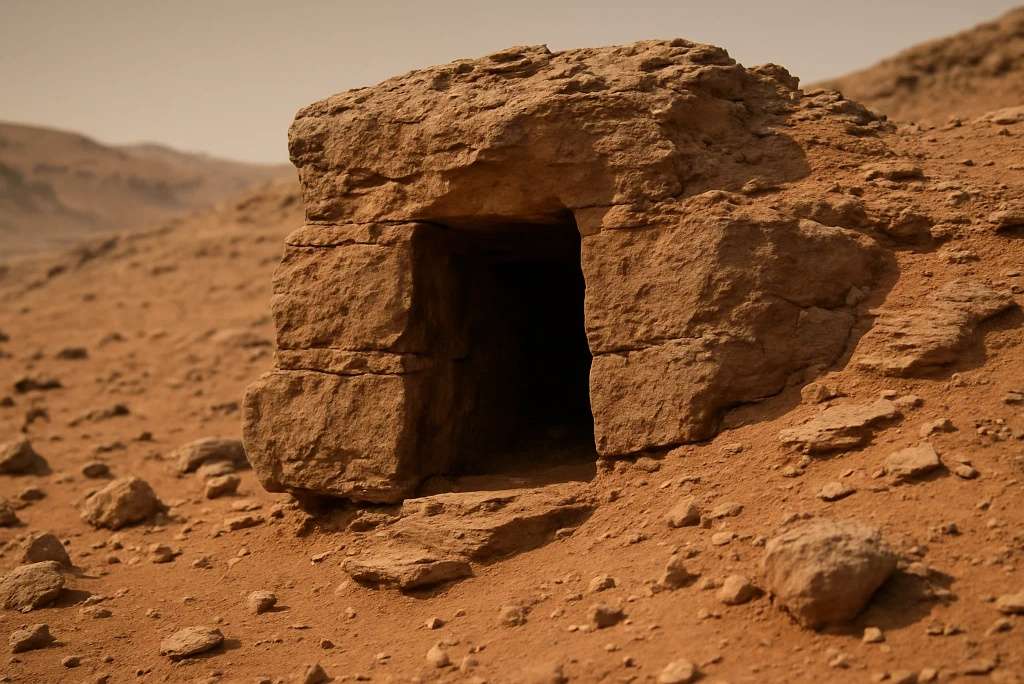
2. The “Doorway” Rock Formation
Photo Credit: ChatGPT
In 2022, NASA’s Curiosity rover captured an image resembling a doorway carved into a cliffside. The feature sparked theories about ancient Martian structures. However, scientists clarified that it’s likely the result of natural fracturing and erosion in the rock.
This “doorway” measures only a few centimeters high, ruling out the possibility of it being an entrance. Its clean, rectangular shape is still fascinating, highlighting how wind and seismic activity can mimic artificial designs. (BBC News)
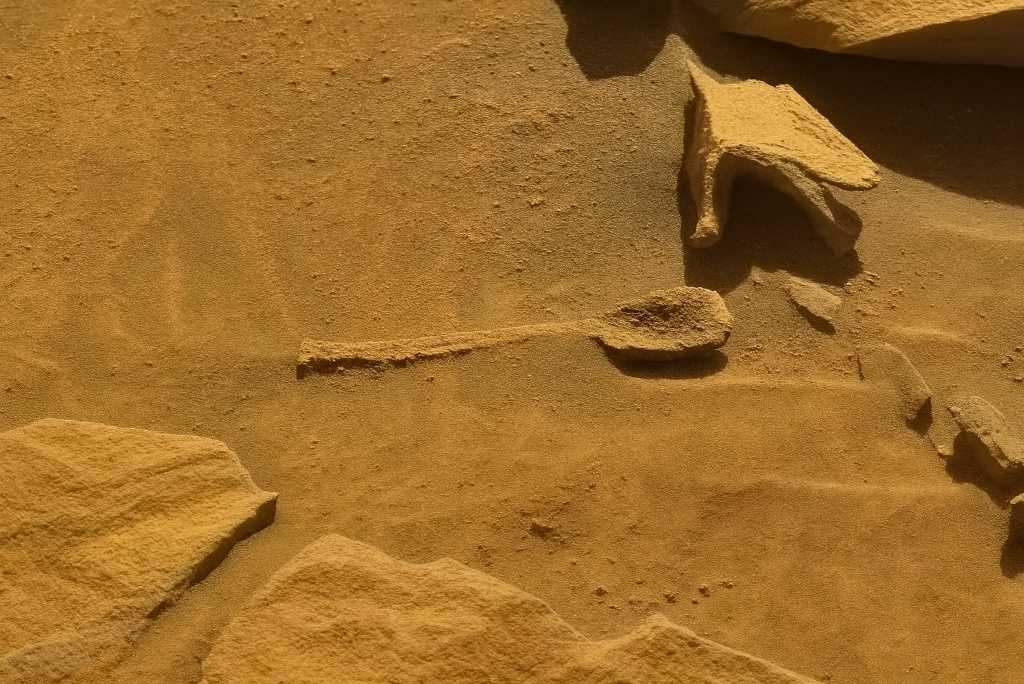
3. The “Spoon” in Gale Crater
Photo Credit: THE SUN
In 2015, images from the Curiosity rover revealed a rock that appeared to be a floating spoon. Its thin, curved shape made it an internet sensation. Scientists explain it as a rock formation shaped by wind erosion, with its thin neck eroding faster than its broader “bowl” area.
While it’s not actually levitating, the angle of the photo enhances the illusion. Such formations are examples of ventifacts—rocks sculpted by wind-driven sand over long periods. (NASA Jet Propulsion Laboratory)
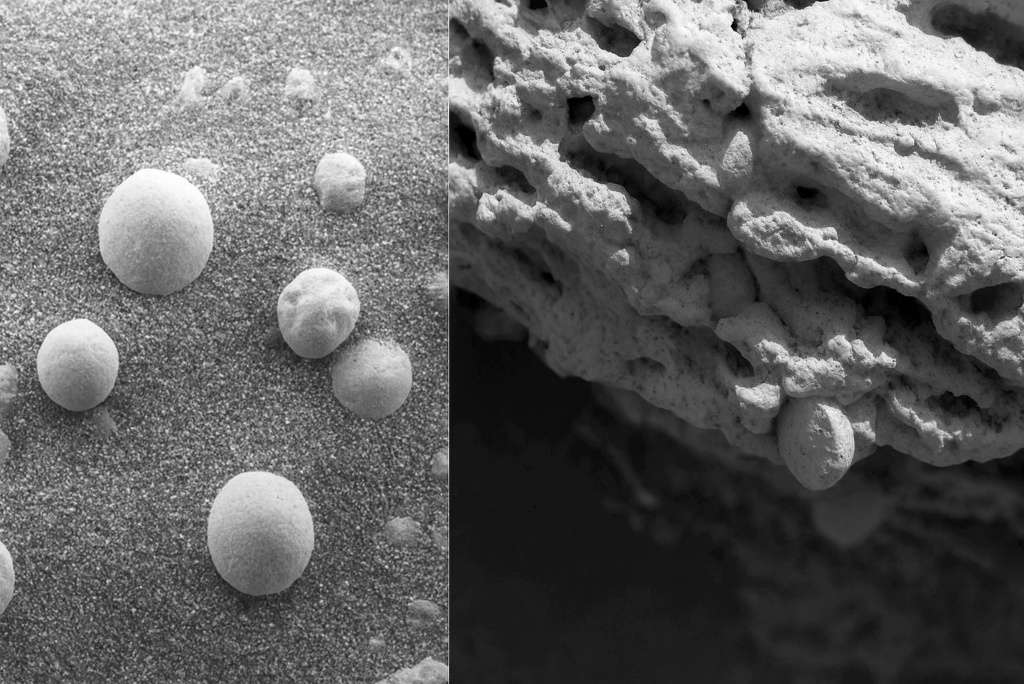
4. The “Blueberries” of Meridiani Planum
Photo Credit: NASA
In 2004, NASA’s Opportunity rover discovered tiny, spherical formations nicknamed “blueberries.” These hematite-rich concretions are formed by the action of mineral-laden water, suggesting Mars once had conditions suitable for life.
Their abundance and uniformity puzzled scientists initially, but their composition provides evidence of ancient water activity. These “blueberries” are now a key piece in understanding Mars’ wetter past. (NASA Science)
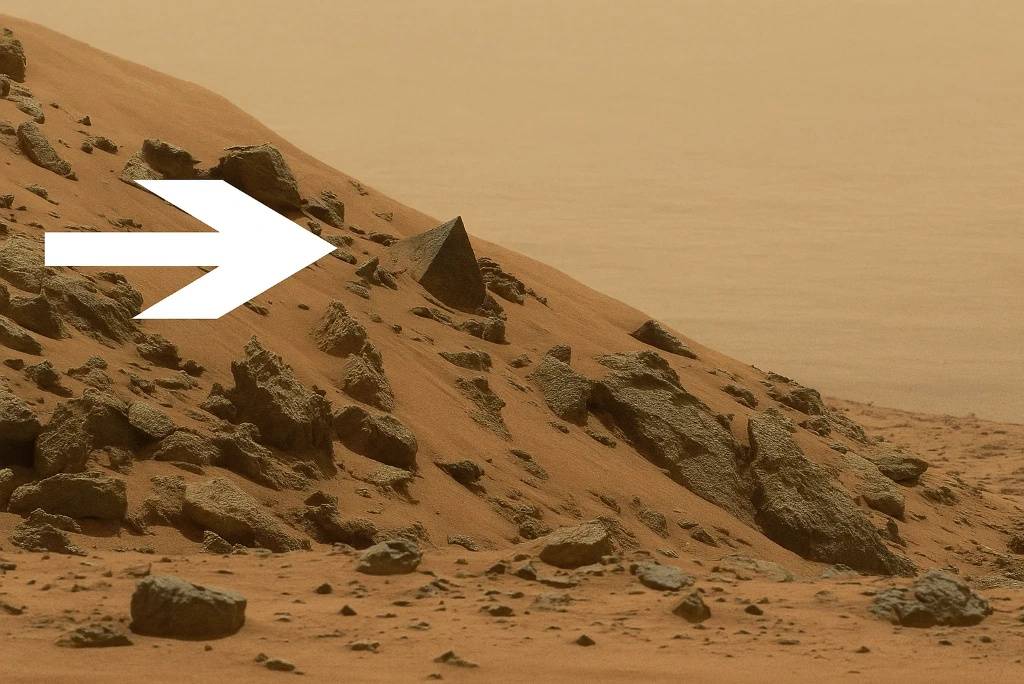
5. A “Pyramid” Structure
Photo Credit: BOW
A pyramid-like rock was photographed by Curiosity in 2015, leading some to claim evidence of ancient Martian architecture. However, geologists point out that such shapes can form naturally through fracturing and erosion.
The sharp edges and triangular profile are coincidental, though they fuel imaginative theories about intelligent design. This formation highlights how our pattern-recognition instincts often outpace scientific explanations. (National Geographic)
6. The “Legless Lizard” Rock
Photo Credit: NASA
In 2013, a Curiosity image seemed to show a small lizard-like creature on Mars. This fueled online claims of living organisms. NASA scientists quickly dismissed these as illusions caused by rock shadows and shape pareidolia.
Close analysis revealed it was nothing more than an oddly shaped rock. Such sightings underscore the human tendency to project familiar life forms onto alien landscapes. (NASA)
7. The “Cannonball” Spheres in Gale Crater
Photo Credit: NASA
Curiosity discovered nearly perfectly spherical rocks in 2016, resembling cannonballs scattered across the Martian surface. These are actually concretions—hard mineral masses formed within sedimentary layers when groundwater deposits minerals over time.
Their near-perfect shape makes them stand out in the rugged Martian terrain, adding to the planet’s mysterious geological story. The spheres provide insights into Mars’ aqueous past, helping scientists piece together how water once influenced its geology. (Space.com)
8. The “Thigh Bone” Rock Illusion
Photo Credit: SPACE
In 2014, a rock shaped like a human femur was spotted by Curiosity. Its bone-like appearance fueled speculation about Martian fossils and ancient creatures.
However, NASA scientists attribute it to erosion and fracturing, emphasizing that Mars’ surface processes can produce surprisingly familiar shapes. This peculiar resemblance reinforces how visual illusions often spark theories about alien life. (NASA)
9. The “Stonehenge” Circle of Rocks
Photo Credit: ChatGPT
In 2018, satellite images revealed a circular arrangement of rocks resembling Earth’s Stonehenge, baffling some observers. This feature, located in the Mawrth Vallis region, is believed to be a natural consequence of impact cratering and weathering.
The ring formation, while eye-catching, serves as a reminder that natural processes can mimic intentional design, leading to fascinating debates about its origins. (The Guardian)
10. The “Tree Stump” Rock Formation
Photo Credit: METRO
In 2016, Curiosity photographed a rock resembling a fossilized tree stump, leading some to argue it hinted at ancient vegetation. Experts explained it as an eroded mudstone outcrop shaped by sedimentary processes.
Its layered appearance may suggest ancient water-related activity, but there’s no evidence it was biological. The structure remains one of the most visually striking finds so far. (NASA JPL)
11. The “Bear Face” Crater Image Discovery
Photo Credit: NASA
In 2023, the Mars Reconnaissance Orbiter captured an image of a crater resembling a bear’s face. Its “eyes” are two smaller craters, and the “snout” is a collapsed mound shaped over time.
This example of pareidolia shows how our minds interpret random arrangements as recognizable images. Such formations are fun yet scientifically significant, revealing the planet’s dynamic and complex surface evolution. (Smithsonian Magazine)
12. The “Glass Tubes” Dune Illusion Explained
Photo Credit: ScholarWorks
Images from Mars Global Surveyor once appeared to show translucent, tube-like structures on the surface, leading to wild theories about Martian transport systems or pipelines.
Later analysis revealed these were rows of sand dunes illuminated at certain angles, giving the illusion of tubes. This optical effect underscores the challenges of interpreting alien landscapes from orbital imagery, often creating misleading impressions. (NASA)
13. The “Crab Monster” Rock Shadow Appearance
Photo Credit: ChatGPT
In 2015, Curiosity captured an image that many claimed looked like a giant crab hiding in a cave. NASA quickly explained this as a rock formation created by shadows and lighting effects interacting with rough terrain.
This example highlights how pareidolia thrives when viewing low-resolution or shadowed imagery in alien environments, sparking viral discussions and conspiracy theories online. (National Geographic)
14. The “Fossilized Spine” Rock Feature Illusion
Photo Credit: ScholarWorks
Another 2017 rover image showed what looked like a segmented spine protruding from the ground. Some speculated it might be evidence of past Martian life or ancient fossilized remains.
However, geologists identify it as a common type of sedimentary rock with fractures giving it a spine-like appearance. While intriguing, no biological explanation holds up under detailed scientific review or peer analysis. (Space.com)
15. The “Wheel Tracks” Natural Grooves Explained
Photo Credit: NASA
In some rover images, natural grooves in Martian terrain have been mistaken for vehicle tracks from unknown sources or previous explorers. These linear features are actually caused by repeated wind erosion or dried channels carved over long periods.
Comparing them with actual rover tracks reveals significant differences in depth and uniformity, proving their natural origin beyond reasonable scientific doubt. (NASA)
Relatistic representation of a Dyson swarm. Credit - Віщун / Wikimedia Commons
Ever since physicist Freeman Dyson first proposed the concept in 1960, the “Dyson sphere” has been the holy grail of techno-signature hunters. A highly advanced civilization could build a “sphere” (or, in our more modern understanding, a “swarm” of smaller components) around their host star to harvest its entire energy output. We know, in theory at least, that such a swarm could exist - but what would it actually look like if we were able to observe one? A new paper available in pre-print on arXiv, and soon to be published in Universe from Amirnezam Amiri of the University of Arkansas digs into that question - and in the process discloses the types of stars that are the most likely to find them around.
Perhaps unsurprisingly, one of those types is a Red Dwarf. The most abundant type of stars in the Milky Way, they burn through their nuclear fuel incredibly slowly making them extremely long lived. With estimated lives in the trillions of years - far longer than the current lifetime of the universe - they are also relatively small compared to our own Sun. A Dyson swarm could be built around 0.05 to 0.3 AU away from its surface, with relatively low cost of material.
White dwarfs are arguably even better for material costs, and represent the second type of star that it’s worth tracking. These are compact, dead remnants of stars like our Sun, which have shrunk down to have incredibly small radii - around 1% of their original star. In this scenario, a Dyson swarm could be built just a few million kilometers away from the surface of the star, alleviating much of the engineering challenge of build a supermassive structure around a larger star. They also radiate energy steadily for billions of years, essentially creating an effective long-lived power source.
*The H-R diagram used to classify stars.
Credit - ESO*
But what would stars surrounded by such megastructures actually look like? Astronomers typically use a tool called the Hertzsprung-Russell (H-R) diagram to classify stars based on their temperature and luminosity. However, since a Dyson sphere would block all of a star’s natural light, it would completely change where on the diagram it would fall. Energy can neither be created nor destroyed, so the sphere itself would have to emit the exact same amount of radiation away from itself as the star is putting into it. It just does it in the form of heat, or infrared light instead. So a Dyson sphere can really be thought of as a shell that absorbs a star’s light, does something useful with that energy, and then emits it as heat.
In doing so, it is shifting the location of the star entirely to the right - where lower temperatures are mapped on the diagram. The luminosity itself doesn’t change at all, it is simply shifted to the infrared, and since H-R diagrams use bolometric luminosity (i.e. the luminosity over all of the spectra), it would appear in the same vertical place on the diagram as whatever its host star is, whether that’s a red or white dwarf.
But the key take away is how much further on the right the star would go. A typical red dwarf, which inhabits the lower right hand corner of a H-R diagram, has a surface temperature of around 3000K degrees. A Dyson sphere surrounding a star would have a temperature down to 50K - two orders of magnitude lower. There are no natural stars in this area, making any such object highly interesting as a potential Dyson swarm candidate.
Fraser explains the concept of a Dyson Sphere.
One further factor contributing to the possibility of an object being a Dyson swarm is a lack of dust. A star without a Dyson sphere would typically show a spectral line for silicate emission that is commonly associated with dusky disks. However, radiator panels don’t have any dust surrounding them, so they would look remarkably “clean” to a spectrograph monitoring them.
One thing to note - in the “swarm” methodology, there would likely be gaps between some of the solar collectors, or varying thickness in certain parts of the swarm. This is intended to make the material requirements actually physically possible - modern calculations show that, even with relatively small radii, an actual full Dyson sphere is physically impossible. In the case where there were these small gaps, the star would behave exceedingly erratically, with non-natural light curves as the structure rotates.
Since infrared is the specialty of the James Webb Space Telescope, it is well placed to monitor for these kinds of structures. But even older telescopes like WISE are being actively used to search for them. In May 2024, a paper highlighting work from Project Hephaistos identified seven strong Dyson sphere candidates (all red dwarfs) out of a catalogue of 5 million stars. One was eliminated as a possible source, as there was a supermassive black hole aligned perfectly in the background around the star, explaining the anomalous readings. But that still leaves five more potential candidates that are worth some closer observation. This new paper will add another tool to astronomers’ understanding of what to search for to one day find one of these elusive technosignatures.
A laser 3D printing method, tested by researchers at OSU, could lead to resilient, stable structures on the Moon. Credit: ESA
Through the Artemis Program, NASA hopes to establish a permanent human presence on the Moon in its southern polar region. China, Russia, and the European Space Agency (ESA) have similar plans, all of which involve building bases near the permanently shadowed regions (PSRs) - i.e., craters that contain water ice - that dot the South Pole-Aitken Basin. For these and other agencies, it is vital that these bases be as self-sufficient as possible since resupply missions cannot be launched regularly and take several days to arrive.
Therefore, any plan for a lunar base must come down to harvesting local resources to meet the needs of its crews as much as possible - a process known as In-Situ Resource Utilization (ISRU). In a recent study, researchers at The Ohio State University (OSU) proposed using a specialized laser-based 3D printing method to turn lunar regolith into hardened building material. According to their findings, this method can produce durable structures that withstand radiation and other harsh conditions on the lunar surface.
The importance of ISRU for human exploration has prompted the rapid development of additive manufacturing systems - aka 3D printing. These systems have proven effective at fabricating tools, structures, and habitats, effectively reducing dependence on supplies delivered from Earth. Developing such systems for long-duration missions is one of the most challenging aspects of the process, as they must be engineered to operate in the extreme environment on the Moon. This includes the lack of an atmosphere, massive temperature variations, and the ever-present problem of Moon dust.
Scientists use two types of lunar regolith for their experiments and research: Lunar Highlands Simulant (LHS-1) and Lunar Mare Simulant (LMS-1). As part of their research, the team used LHS-1, which is rich in basaltic minerals, similar to rock samples obtained by the Apollo missions. They melted this regolith with a laser to produce layers of material and fused them onto a base surface of stainless steel or glass. To assess how well these objects would fare in the lunar environment, the team tested their fabrication process under a range of different environmental conditions.
One thing they noticed was that the fused regolith adhered well to alumina-silicate ceramic, possibly because the two compounds form crystals that enhance heat resistance and mechanical strength. This revealed that the overall quality of the printed material is largely dependent on the surface onto which the regolith is printed. Other environmental factors, such as atmospheric oxygen levels, laser power, and printing speed, also affected the stability of the printed material. As Xu explained in an OSU News release:
By combining different feedstocks, like metal and ceramics, in the printing process, we found that the final material is really sensitive to the environment. Different environments lead to different properties, which directly affect the mechanical strength and the thermal shock resistance of certain components. There are so many applications that we’re working toward that with new information, the possibilities are endless.
*Astronauts collecting samples on the lunar surface as part of NASA's Artemis Program.
Credit: NASA*
Deployed to the Moon's surface, this process could help build habitats and tools that are strong, resilient, and capable of handling the lunar environment. This has the added benefit of increasing independence from Earth, which is key to realization long-duration missions on the Moon. In addition to assisting astronauts exploring the Moon in the near future (as part of NASA's Artemis Program), this technology could also lead to resilient habitats that will enable a long-term human presence on the Moon, Mars, and beyond.
However, there are several unknown environmental factors that could limit the effectiveness of these systems on other worlds, and more data is needed before they can be addressed. In their study, the team suggests that instead of being powered by electricity, future scaled-up versions of their method could rely on solar or hybrid power systems. Nevertheless, the potential for space exploration is clear, and the technology also has applications for life here on Earth. Sarah Wolff, an assistant professor in mechanical and aerospace engineering and a lead author on the study, explained:
There are conditions that happen in space that are really hard to emulate in a simulant. It may work in the lab, but in a resource-scarce environment, you have to try everything to maximize the flexibility of a machine for different scenarios. If we can successfully manufacture things in space using very few resources, that means we can also achieve better sustainability on Earth. To that end, improving the machine’s flexibility for different scenarios is a goal we’re working really hard toward.
As the saying goes, "Solving for space solves for Earth." In environments where materials and resources are limited, laser-based 3D printing is one of several technologies that could support sustainable living. This applies equally to extraterrestrial environments and to regions on Earth experiencing the effects of Climate Change.
Image of Milnesium tardigradum in active state (Credit : Schokraie E, Warnken U, Hotz-Wagenblatt A, Grohme MA, Hengherr S, et al. (2012) - Schokraie E, Warnken U, Hotz-Wagenblatt A, Grohme MA, Hengherr S, et al. (2012))
You could fit about a dozen of them across the full stop at the end of this sentence. Under a microscope they look like tiny eight legged bears shuffling around in slow motion. They have been frozen, boiled, irradiated, sent into the vacuum of open space and brought back alive. Scientists have been studying them for over two hundred years and they still have the capacity to astonish. Their name is tardigrade, though most people know them by the rather more charming nickname of water bears. And right now, they might be one of our best tools for figuring out how to survive on Mars.
A team of researchers from Penn State University has just published a study that used tardigrades in a genuinely novel way, not to test how tough they are, but to test how tough Mars is. Specifically, they wanted to understand how the planet's regolith, the loose mineral deposits that cover the Martian surface rather like soil covers our own, would interact with living animals. Could it ever be adapted to support plant growth for future human explorers? And could it actually help protect the planet from contamination that humans might inadvertently bring with them?
Simulated Martian regolith
(Credit : Z22)
To find out, they mixed active tardigrades with two different simulated Martian soils, both designed to precisely replicate the mineral and chemical composition of regolith sampled by NASA's Curiosity Rover from a region called the Rocknest deposit, inside the Gale Crater.
The first simulant, known as MGS-1 was designed to represent the Martian surface broadly and yielded terrible results. Within just two days, the tardigrades showed severely reduced activity. For an animal that routinely shrugs off the vacuum of space, that is extraordinary. The second simulant was still inhibitory but far less damaging, which itself tells researchers something important about exactly which aspects of Martian soil pose the greatest risk.
Then came the surprise. When the team rinsed the MGS-1 simulant with water before introducing fresh tardigrades, the damage almost vanished entirely. Something in the soil, possibly dissolved salts or another soluble compound, was responsible for the harm, and water washed it away. The same property that made the regolith so hostile to life also makes it a potential natural barrier against Earthly contamination. Mars, in a sense, may have its own built in defence system.
This self-portrait of NASA's Curiosity Mars rover shows the vehicle at the "Big Sky" site, where its drill collected the mission's fifth taste of Mount Sharp
(Credit : NASA)
This matters enormously for what scientists call planetary protection, the internationally agreed principle that we should not contaminate other worlds with Earth life, and equally should not bring alien contamination back home. If Martian soil is naturally hostile to Earth organisms, that provides a degree of reassurance. But equally, if a simple rinse with water can neutralise that hostility, then future colonists might be able to process regolith to grow food after all.
Water, of course, is precious on Mars, which means washing soil on an industrial scale is not a straightforward solution. But knowing the problem can be solved at all is a significant step forward. As the researchers put it, they are beginning to tease apart the components of an enormously complex system, one piece at a time.
The water bears have survived everything Earth could throw at them for hundreds of millions of years. It turns out they may be exactly the right animal to help us understand whether Mars will ever be ready to welcome us.
An artist's concept depicts a greenhouse on the surface of Mars. Plants are growing with the help of red, blue, and green LED light bars and a hydroponic cultivation approach. Other methods using soil simulants should also contribute to long-term food production on the Moon and Mars. Image credit: SAIC
In the future, farmers on the Moon and Mars will have a big challenge: how to grow healthy food in two extremely unhealthy environments. That's because the soil on both worlds isn't at all hospitable to plants and animals. Neither are other conditions. Both are irradiated worlds, Mars has a thin atmosphere and the Moon has none at all. So, how will future colonists on either world grow their food?
We could look toward the example shown by Matt Damon in "The Martian". There, a stranded Marsnaut figures out how to grow potatoes using his own sewage, which turns out to be do-able according to experiments run by the International Potato Center and NASA few years ago. More recently, researchers led by Harrison Coker of Texas A&M worked with a team at NASA, tested a solution of recycled sewage products and how they interacted with simulated lunar and Mars regolith (soil). The NASA team, headquartered at Kennedy Space Center, is taking a deep look at what are called bioregenerative life support systems (BLiSS). These bioreactors and filters turn an artificial form of sewage into a solution rich in the kinds of nutrients that plants need to thrive. This work has immediate implications for people who will be living and working on the Moon and Mars in the future. That's because people can easily furnish the waste products needed. With the upcoming Artemis missions to the Moon, the question of food production is assuming a high priority for long-term inhabitants.
“In lunar and Martian outposts, organic wastes will be key to generating healthy, productive soils, said Coker, the first author on a study of such systems. “By weathering simulant soils from the Moon and Mars with organic waste streams, it was revealed that many essential plant nutrients can be harvested from surface minerals.”
A simulated lunar greenhouse at NASA Kennedy Space Center is helping scientists solve the problem of growing food on the Moon, and ultimately Mars.
Courtesy NASA.
What Do Plants Need?
The plant life on Earth needs a complex set of nutrients to thrive. For example, corn needs a great deal of nitrogen. Peas like potassium and phosphorus. Potatoes like both phosphorus and nitrogen. And, all planets need water. The researchers looked at what it would take to "enrich" Martian and lunar regoliths. It turns out, they need a lot. That's because the soils are irradiated and in the case of Mars, rich in sulfur, ferric oxide, silicon dioxide, and magnesium. It's also laced with high levels of perchlorates, which are toxic.
The first inhabitants of these worlds will need to bring their own food and sewage systems, and then work on making the local soils habitable for plants. That will take time and a lot of work, in addition to all the other projects they'll need to fulfill, such as exploration and habitat building.
Of course, the future inhabitants could rely on hydroponics for a growth medium, and there have been a great many studies of such water-based systems. However, you do need a lot of water and the nutrient loads need to be quite high to produce food in great quantities. On the Moon, at least, astronauts could send back to Earth for supplies, but that's going to be expensive and time-consuming. So, it's likely that the first sets of explorers will depend on food from "home". However, that can't be a permanent solution, which is why scientists are looking at ways to make local soils good for farming in the long run.
*Studies of food growth in space go back many years. A variety of red potatoes called Norland were grown in the Biomass Production Chamber inside Hangar L at Cape Canaveral Air Force Station in Florida during a research study in 1992.
Credit: NASA*
Better Farming Through Sewage and Chemistry
In the research led by Coker and the folks at NASA, scientists combined the BLiSS effluent they created with simulated Martian or lunar regolith (each called a simulant). Then, they stored the two different solutions in a shaker for 24 hours. The goal was to determine if the BLiSS effluents could essentially "weather" the regolith and provide a nutrient-rich growing solution.
It turns out that the weathered simulants supplied large amounts of essential plant nutrients. They including sulfur, calcium, and magnesium, and other metals, when interacting with both water and BLiSS solutions. In addition, looking at the simulant particles under a microscope revealed weathered features such as tiny pits forming in the lunar simulant and the Martian simulant becoming covered in nanoparticles. Both helped make the sharp minerals in the simulant less abrasive, showing successful weathering and a step toward a more soil-like material.
So, is recycling human sewage the solution for better off-world gardens? Not quite. Despite promising initial results, the next steps would need to include tests on actual lunar and Martian regoliths. They're quite different from the simulants the scientists tested. It's a good start, though, and provides crucial insights into a process that will be critical for sustaining human colonies in outer space. It may not be long before lunar citizens are snacking on watercress sandwiches and Mars colonists are growing their own corn, beans, and yes, potatoes, thanks to their own effluent products.
Artist's impression of an Orion spacecraft and Starship HLS rendezvousing in lunar orbit. Credit: Lockheed Martin
Earlier today, NASA announced that it would be increasing the cadence of its missions to meet its objectives under the Artemis Program. It is also making changes to its mission architecture to include a standard vehicle configuration and undertake one surface landing every year after 2027. In real terms, this means that a lunar landing will not take place as part of Artemis III in 2027, but during Artemis IV, currently scheduled for 2028. Instead, Artemis III will involve a rendezvous in Low Earth Orbit (LEO) to test the systems and operations for the first lunar landing in over sixty years.
The announcement came during a news conference at NASA's Kennedy Space Center, amid discussions about the status of the Artemis II mission. As Isaacman and other NASA officials stated, the agency now envisions an orbital rendezvous with a crewed Orion spacecraft and either the Starship HLS or Blue Origin's Blue Moon lander. This means that Artemis III* will mirror the Apollo 9* mission, which took place in March 1969 and was the first test of the Apollo Lunar Module in space, including docking maneuvers in LEO.
Per the agency's statement, the mission will also include in-space tests of the docked vehicles, integrated life support, communications, propulsion, and the new Extravehicular Activity (xEVA) spacesuits. Further details on this test flight will be released pending completion of detailed reviews between NASA and its commercial partners, and it was indicated that updates will be made soon. As NASA Administrator Jared Isaacman explained, the key considerations here are safety, competition, and "standardization":
NASA must standardize its approach, increase flight rate safely, and execute on the President’s national space policy. With credible competition from our greatest geopolitical adversary increasing by the day, we need to move faster, eliminate delays, and achieve our objectives. Standardizing vehicle configuration, increasing flight rate and progressing through objectives in a logical, phased approach, is how we achieved the near-impossible in 1969 and it is how we will do it again.
*Artist's impression of NASA astronauts operating on the lunar surface, as part of the Artemis Program.
Credit: NASA*
What to make of this news? At face value, these sound like perfectly sensible considerations, but there are undeniable concerns that could be motivating this switch-up as well.
Delays?
For starters, this news comes about six months after the former acting-Administrator Sean Duffy announced that NASA was reopening the competition for a Human Landing System (HLS), a contract awarded exclusively to SpaceX in 2021. However, delays with the Starship's development have led NASA to conclude that the HLS will not be ready in time for Artemis III. This includes an in-orbit refueling demonstration, currently planned for later this year.
But between the Starship's current payload limits and fuel leaks and engine failures that have led to five out of eleven prototypes being lost, this is unlikely to happen. While the Starship is intended to launch between 100 and 150 metric tons (110 and 165 US tons) to LEO in its fully-reusable form, tests with the Block 2 prototype have been limited to about 35 metric tons (38.5 US tons). To perform in-orbit refueling, SpaceX will need to launch multiple refueling tankers into orbit in advance to fuel the proposed orbital depot fully.
Given the Starship's fuel capacity of up to 1,500 metric tons (1650 US tons), this means 10 to 15 tankers will need to launch to refuel one HLS fully. Even if, as Elon has suggested, it can perform its mission objectives with only half a tank of liquid methane and liquid oxygen, that means five to eight tankers will be needed. But only if they can reach their full payload capacity, something the company hopes to remedy with the Block 3 version of the Starship. The first test flight of this latest prototype is scheduled for April 7th, 2026. Significant tests will need to take place before SpaceX can conduct the multiple launches needed for a refueling demonstration.
Meanwhile, Blue Origin has been making great strides in developing its New Glenn orbital launch vehicle. Although the vehicle has launched only twice, the second stage has managed to reach orbit both times without incident. In fact, the first launch placed its payload (the Blue Ring pathfinder) in a Medium-Earth Orbit (MEO) while the second deployed NASA's Escape and Plasma Acceleration and Dynamics Explorers (ESCAPADE) mission at the Earth-Sun L2 Lagrange Point.
*The Artemis II rocket on Launch Pad 39A at NASA's Kennedy Space Center.
Credit: NASA*
Under the circumstances, it is understandable why NASA is taking a more measured approach and pushing the date of the lunar landing mission forward.
No New Configurations
Another keyword in the statement is "standardization," referring to the configuration of the Space Launch System (SLS). Previously, NASA planned to upgrade the SLS design after Artemis III, moving from the Block 1 configuration to Block 1B. The first three SLS launches will rely on the former, with the Interim Cryogenic Propulsion Stage (ICPS), which provides propulsion to the Orion spacecraft after the solid rocket boosters and core stage are jettisoned, as part of the upper stage. The Block 1B version was to feature a larger Exploration Upper Stage (EUS), a four-engine liquid hydrogen/liquid oxygen propulsion system.
The purpose of this decision is to enable a faster launch cadence of a mission per year, something that Bill Gerstenmaier, the former Associate Administrator for Human Exploration and Operations, recommended in 2016. It also mirrors what NASA accomplished during the Apollo Era, where eight launches (Apollo 8 to 14) were conducted between 1968 and 1972. NASA Associate Administrator Amit Kshatriya indicated as much, referencing Apollo by name:
We are looking back to the wisdom of the folks that designed Apollo. The entire sequence of Artemis flights needs to represent a step-by-step build-up of capability, with each step bringing us closer to our ability to perform the landing missions. Each step needs to be big enough to make progress, but not so big that we take unnecessary risk given previous learnings. Therefore, we want to fly the landing missions in as close to the same Earth ascent configuration as possible – this means using an upper stage and pad systems in as close to the ‘Block 1’ configuration as possible.
Politics and Cutbacks
In its statement, NASA also mentioned its recently announced workforce directive as vital to the "acceleration" of the Artemis Program. The directive is intended to "rebuild core competencies in the civil servant workforce," which is a rather telling statement. On the one hand, it sounds reminiscent of Isaacman's past comments, in which he repeatedly criticized NASA's "bureaucratic" nature and how it has prevented progress. This could mean that "rebuilding core competencies" is merely an extension of his expressed desire to impose private-sector thinking on a public agency.
On the other hand, it could be a veiled reference to the recent cutbacks and layoffs NASA has been forced to contend with. In addition to a 25% reduction in overall funding for FY 2026, NASA experienced significant workforce reductions, with over 4,000 employees lost through buyouts and attrition. This has left more than 40 missions in danger, including Mars Odyssey, MAVEN, and OSIRIS-APEX. The same budget request also included the cancellation of the Space Launch System (SLS), the Orion spacecraft, and the Lunar Gateway, all vital aspects of NASA's long-term vision for a "sustained program of lunar exploration and development."
It also called for the cancellation of the Demonstration Rocket for Agile Cislunar Operations (DRACO) mission, a joint project initiated by NASA and DARPA in 2023. These decisions were enacted under Duffy, whom Isaacman got into a bit of a row with in November 2025 due to the leak of the "Project Athena" document, which outlined what Isaacman originally planned to do as NASA's Administrator. Eric Berger of Ars Technica, writing at the time, indicated it was possible Duffy himself leaked the document to "hold onto his job" as acting Administrator.
In essence, the leaked version of the plan appeared to be intended to lay the cancellations and layoffs at Isaacman's feet. According to Berger, the 62-page document (Isaacman stressed that the original was over 100 pages long) does not bear this out. As Isaacman stated in a post on X (dated Nov. 4th, 2025), "This plan never favored any one vendor, never recommended closing centers, or directed the cancellation of programs before objectives were achieved. The plan valued human exploration as much as scientific discovery."
Perhaps, then, this decision is motivated by a genuine desire to get NASA back on track and to restore the programs affected by measures enacted under Duffy, with the blessing of the current administration.
Competition
This certainly makes sense in light of what Isaacman said about competition from "our greatest geopolitical adversary" - aka China. For years, China has been making significant progress in its crewed and robotic space programs, and its plans for the future are nothing if not ambitious. But it is the progress they've seen in their lunar program that has left many analysts and observers in the West concerned that China could reach the Moon before NASA. This includes the development of the Long March-10 super-heavy launch system and the Mengzhou spacecraft, both of which passed a key launch test less than two weeks ago.
According to their current plan, the Mengzhou spacecraft and Lanyue lunar lander will launch separately aboard two Long March-10 rockets. This mission is slated for 2030 and is part of China's larger effort to develop an International Lunar Research Station (ILRS) in the Moon's southern polar region to rival NASA's Artemis Program.
Much like Elon Musk's recent announcement that SpaceX was pivoting to focus on the Moon instead of Mars, there are many common-sense reasons for these decisions. However, the context in which they occurred and additional incentives certainly warrant exploration. One thing is for certain: NASA has experienced repeated delays since the Moon-to-Mars mission architecture was first undertaken over 20 years ago, due to limited budget, shifting priorities, and needless shake-ups.
In the meantime, NASA continues to work on the *Artemis II* mission, which has been delayed again until April due to a helium flow issue that engineers identified in the ICPS during the latest wet dress rehearsal. After the Artemis II was rolled back into the Vehicle Assembly Building (VAB), the team immediately began working to resolve the issue. They're also preparing for several actions, including replacing batteries in the flight termination system, conducting end-to-end testing to meet range safety requirements, and more.
Jupiteris the largest planet in the solar system and has proudly boasted about this since time immemorial, with its scientific confirmation occurring by Galileo Galilei in 1610. It was later found that Jupiter has a bulging equator caused by its rapid rotation, turbulent atmosphere, and complex interior mechanisms despite its massive size, and scientists have even measured its “waistline” down to a tenth of a kilometer. Now, imagine being the largest planet in the solar system and you’re told you’re not as big as you thought. Where probably most humans would be thrilled to find this out, how do you respond if you’re Jupiter?
We might never know how Jupiter feels about being slimmer. But a team of international researchers led by the Weizmann Institute of Science in Israel are happy to explain how they feel about this incredible finding, which was recently published in *Nature Astronomy*. To accomplish this, the team used a combination of data obtained from NASA’s past missions of Pioneer 10 and Pioneer 11, which visited Jupiter in December 1973 and December 1974, respectively, Voyager 1 and Voyager 2, which visited Jupiter in March and July of 1979, respectively, and the currently active Juno spacecraft, which arrived at Jupiter in July 2016.
While the Pioneer and Voyager missions used a technique called radio occultation to measure Jupiter’s radius, with Voyager using an improved method, Juno used a combination of multi-angle radio occultation and gravity science to obtain its measurements.
Radio occultation involves using radio waves to estimate Jupiter’s size, with Pioneer using this method when the radio waves between itself and Earth were “cut off” as the spacecraft passed behind Jupiter. This not only estimating its radius but also confirmed Jupiter had an equatorial bulge, which was first proposed by Giovanni Cassini in 1666. Voyager improved this method by using radio waves to study Jupiter’s atmosphere, with the measured radius being the official measurement since then. Finally, Juno’s multi-angle radio occultation involves dividing Jupiter into “slices”, while the gravity science method involves measuring the tiny speed changes the spacecraft encounters that is produced by Jupiter’s massive gravity.
In the end, the researchers provided some of the most accurate measurements of Jupiter’s polar and equator radius ever. This includes a polar radius of 66,842 km (41,533 mi), an equatorial radius of 71,488 km (44,420 mi) and a mean radius of 69,886 km (43,487 mi), which are 12 km (7.4 mi), 4 km (2.5 mi) and 8 km (5 mi) smaller than longstanding estimates, respectively, along with a margin of error of 0.4 km (0.25 mi) for all estimates. This indicates a 7 percent larger difference between Jupiter’s equatorial radius and its polar radius.
For context, Earth’s equatorial radius is approximately 0.33 larger than its polar radius. These new estimates indicate that Jupiter is approximately 20 times flatter than Earth despite Jupiter being more than 300 times as massive as Earth, also being able to fit more than 1,300 Earths inside it.
“We tracked how the radio signals bend as they pass through Jupiter’s atmosphere, which allowed us to translate this information into detailed maps of Jupiter’s temperature and density, producing the clearest picture yet of the giant planet’s size and shape”, said the study’s co-author, Maria Smirnova, who is a PhD student at the Weizmann Institute of Science and spearheaded the development of a novel method for processing the latest data from Juno.
Despite being slightly slimmer, Jupiter still proudly boasts its massive size and remains the largest planet in the solar system. However, studies like this demonstrate how far methods have improved in just the 50 years since Jupiter was first explored by spacecraft. It also demonstrates how these methods could be employed to other planetary bodies throughout the solar system, including the other gas giants Saturn, Uranus, and Neptune.
What new insight into Jupiter’s physique will researchers make in the coming years and decades? Only time will tell, and this is why we science!
Onderdeel van de populaire cultuur De fascinatie voor ongeïdentificeerde vliegende objecten (ufo's) groeide binnen de moderne cultuur vanaf 1947, het jaar waarin de term 'vliegende schotel' bekendheid verwierf na een gerapporteerde massale waarneming in de Verenigde Staten.
Wat is een ufo? Een ufo, oftewel ongeïdentificeerd vliegend object (van het Engels), verwijst naar elk object in de lucht waarvan de aard niet door de waarnemer of de wetenschap kan worden verklaard. De hedendaagse betekenis van deze term is verbonden met meldingen die na de Tweede Wereldoorlog zijn gedaan.
24 juni 1947: een beslissende dag De eerste breed uitgemeten waarneming vond plaats op 24 juni 1947, toen piloot Kenneth Arnold iets zag dat niet overeenkwam met een bekend vliegtuig uit die tijd.
Wie was Kenneth Arnold? Kenneth Albert Arnold (midden op de foto) was een Amerikaanse ondernemer en burgerpiloot met ervaring in zoek- en reddingsvluchten, iemand met diepgaande kennis van de luchtvaart, wat hem in staat stelde om zijn ervaring gedetailleerd te beschrijven.
Een beeld dat bijblijft Volgens zijn eigen relaas zag Arnold in totaal negen heldere objecten in formatie vliegen, die zich met hoge snelheid en ongewone bewegingen voortbewogen die niet eenvoudig uit te leggen waren.
Ongelooflijke snelheid De ervaren Amerikaanse piloot schatte dat deze objecten sneller gingen dan 1200 mijl per uur, wat ongeveer 1932 kilometer per uur is, een snelheid die veel hoger lag dan die van de destijds bekende vliegtuigen.
Als een schotel op water Bij het beschrijven van de bewegingen verklaarde Arnold in een interview met Edward R. Murrow van CBS op 7 april 1950 dat de objecten zich bewogen "als schotels die over het water stuiteren", een omschrijving die bepalend werd voor de populaire benaming van ufo's.
Vliegende schotel: een blijvende term Na zijn eerste verklaringen over de waarneming begonnen tal van media in de Verenigde Staten en Canada – en zelfs daarbuiten – de term 'vliegende schotel' te gebruiken, geïnspireerd door Arnolds woorden. Al snel werd deze uitdrukking wereldwijd een synoniem voor ufo.
Media-aandacht Het verhaal werd breed verspreid door nieuwsdiensten als Associated Press, waardoor zijn verslag niet alleen in de Verenigde Staten, maar ook daarbuiten bekend werd.
Het ontstaan van het ufo-mythos Dit voorval markeerde het begin van het moderne tijdperk van ufo-waarnemingen, met honderden vergelijkbare meldingen in de dagen na de bekendmaking van de Amerikaanse piloot.
Grote invloed op de cultuur Na Arnolds waarneming nam de belangstelling voor ongeïdentificeerde objecten aan de hemel sterk toe, wat invloed had op boeken, films en de populaire cultuur van vele landen, en dat tot op de dag van vandaag.
Officiële onderzoeken De waarneming trok de aandacht van het leger en inlichtingendiensten, die later officiële programma's opzetten om dit soort verschijnselen te onderzoeken.
Wat waren het echt? De verklaringen over wat Arnold die dag zag, verschillen afhankelijk van de deskundigen die de zaak hebben onderzocht. Van optische illusies tot natuurlijke fenomenen, geen enkele uitleg is voor alle waarnemers volledig overtuigend geweest.
De erfenis van Arnold Hoewel sommigen denken dat Arnold mogelijk vogels of andere natuurlijke verschijnselen zag, blijft zijn verslag het gedocumenteerde beginpunt van de hedendaagse interesse in ufo's.
Beste bezoeker, Heb je zelf al ooit een vreemde waarneming gedaan, laat dit dan even weten via email aan Frederick Delaere opwww.ufomeldpunt.be. Deze onderzoekers behandelen jouw melding in volledige anonimiteit en met alle respect voor jouw privacy. Ze zijn kritisch, objectief maar open minded aangelegd en zullen jou steeds een verklaring geven voor jouw waarneming! DUS AARZEL NIET, ALS JE EEN ANTWOORD OP JOUW VRAGEN WENST, CONTACTEER FREDERICK. BIJ VOORBAAT DANK...
Druk op onderstaande knop om je bestand , jouw artikel naar mij te verzenden. INDIEN HET DE MOEITE WAARD IS, PLAATS IK HET OP DE BLOG ONDER DIVERSEN MET JOUW NAAM...
Druk op onderstaande knop om een berichtje achter te laten in mijn gastenboek
Alvast bedankt voor al jouw bezoekjes en jouw reacties. Nog een prettige dag verder!!!
Over mijzelf
Ik ben Pieter, en gebruik soms ook wel de schuilnaam Peter2011.
Ik ben een man en woon in Linter (België) en mijn beroep is Ik ben op rust..
Ik ben geboren op 18/10/1950 en ben nu dus 75 jaar jong.
Mijn hobby's zijn: Ufologie en andere esoterische onderwerpen.
Op deze blog vind je onder artikels, werk van mezelf. Mijn dank gaat ook naar André, Ingrid, Oliver, Paul, Vincent, Georges Filer en MUFON voor de bijdragen voor de verschillende categorieën...
Veel leesplezier en geef je mening over deze blog.





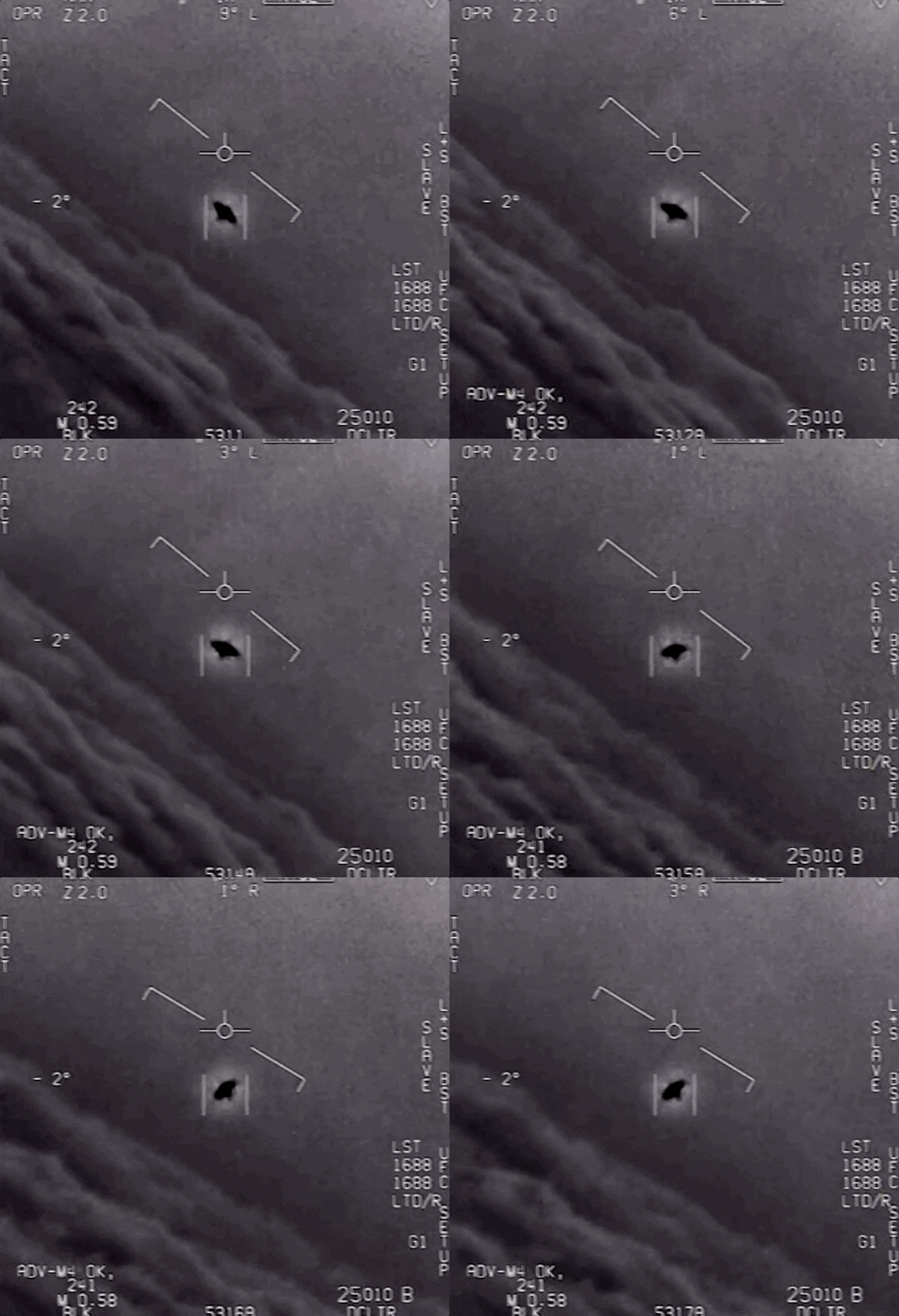







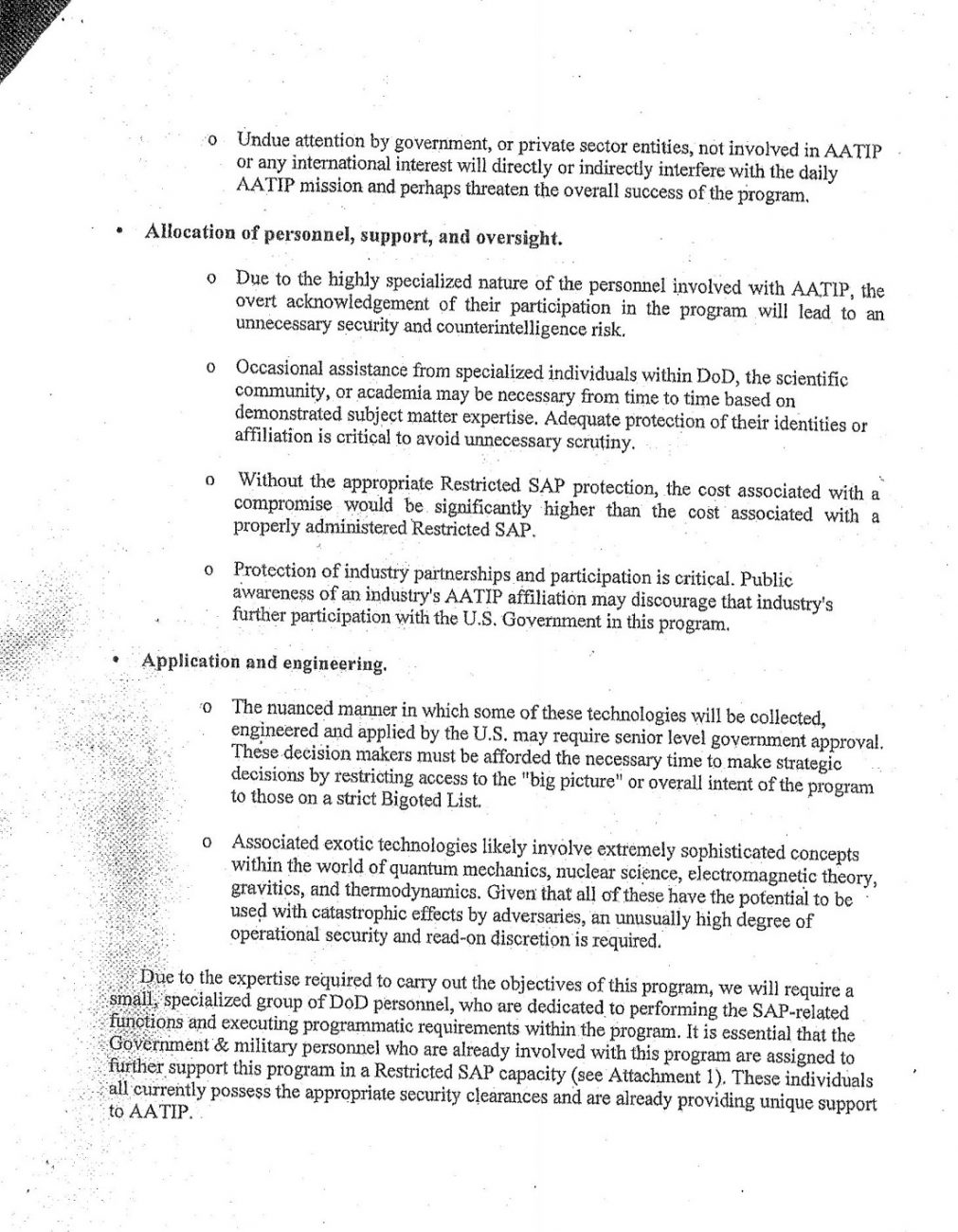
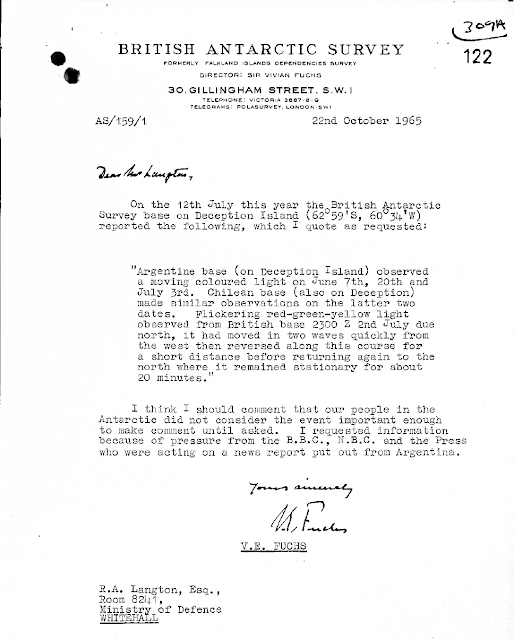

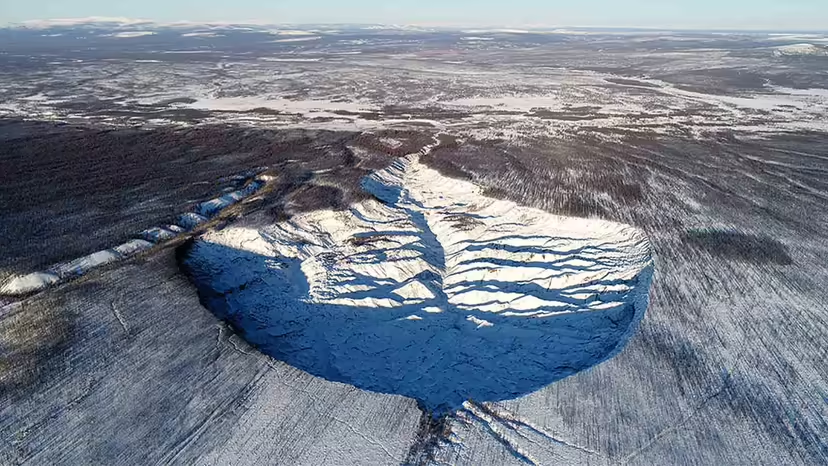







![Hacker claims Nasa has list of 'non-terrestrial officers' and UFO photos The Lone Hacker That Found NASA?s Secret Space Fleet [Gary McKinnon Interview]](https://metro.co.uk/wp-content/uploads/2026/03/SEI_287644860-edf2.jpg?quality=90&strip=all&w=646)
![Hacker claims Nasa has list of 'non-terrestrial officers' and UFO photos The Lone Hacker That Found NASA?s Secret Space Fleet [Gary McKinnon Interview]](https://metro.co.uk/wp-content/uploads/2026/03/SEI_287644861-cbbf.jpg?quality=90&strip=all&w=646)
![Hacker claims Nasa has list of 'non-terrestrial officers' and UFO photos The Lone Hacker That Found NASA?s Secret Space Fleet [Gary McKinnon Interview]](https://metro.co.uk/wp-content/uploads/2026/03/SEI_287644859-554f.jpg?quality=90&strip=all&w=646)