The purpose of this blog is the creation of an open, international, independent and free forum, where every UFO-researcher can publish the results of his/her research. The languagues, used for this blog, are Dutch, English and French.You can find the articles of a collegue by selecting his category. Each author stays resposable for the continue of his articles. As blogmaster I have the right to refuse an addition or an article, when it attacks other collegues or UFO-groupes.
Druk op onderstaande knop om te reageren in mijn forum
Zoeken in blog
Deze blog is opgedragen aan mijn overleden echtgenote Lucienne.
In 2012 verloor ze haar moedige strijd tegen kanker!
In 2011 startte ik deze blog, omdat ik niet mocht stoppen met mijn UFO-onderzoek.
BEDANKT!!!
Een interessant adres?
UFO'S of UAP'S, ASTRONOMIE, RUIMTEVAART, ARCHEOLOGIE, OUDHEIDKUNDE, SF-SNUFJES EN ANDERE ESOTERISCHE WETENSCHAPPEN - DE ALLERLAATSTE NIEUWTJES
UFO's of UAP'S in België en de rest van de wereld Ontdek de Fascinerende Wereld van UFO's en UAP's: Jouw Bron voor Onthullende Informatie!
Ben jij ook gefascineerd door het onbekende? Wil je meer weten over UFO's en UAP's, niet alleen in België, maar over de hele wereld? Dan ben je op de juiste plek!
België: Het Kloppend Hart van UFO-onderzoek
In België is BUFON (Belgisch UFO-Netwerk) dé autoriteit op het gebied van UFO-onderzoek. Voor betrouwbare en objectieve informatie over deze intrigerende fenomenen, bezoek je zeker onze Facebook-pagina en deze blog. Maar dat is nog niet alles! Ontdek ook het Belgisch UFO-meldpunt en Caelestia, twee organisaties die diepgaand onderzoek verrichten, al zijn ze soms kritisch of sceptisch.
Nederland: Een Schat aan Informatie
Voor onze Nederlandse buren is er de schitterende website www.ufowijzer.nl, beheerd door Paul Harmans. Deze site biedt een schat aan informatie en artikelen die je niet wilt missen!
Internationaal: MUFON - De Wereldwijde Autoriteit
Neem ook een kijkje bij MUFON (Mutual UFO Network Inc.), een gerenommeerde Amerikaanse UFO-vereniging met afdelingen in de VS en wereldwijd. MUFON is toegewijd aan de wetenschappelijke en analytische studie van het UFO-fenomeen, en hun maandelijkse tijdschrift, The MUFON UFO-Journal, is een must-read voor elke UFO-enthousiasteling. Bezoek hun website op www.mufon.com voor meer informatie.
Samenwerking en Toekomstvisie
Sinds 1 februari 2020 is Pieter niet alleen ex-president van BUFON, maar ook de voormalige nationale directeur van MUFON in Vlaanderen en Nederland. Dit creëert een sterke samenwerking met de Franse MUFON Reseau MUFON/EUROP, wat ons in staat stelt om nog meer waardevolle inzichten te delen.
Let op: Nepprofielen en Nieuwe Groeperingen
Pas op voor een nieuwe groepering die zich ook BUFON noemt, maar geen enkele connectie heeft met onze gevestigde organisatie. Hoewel zij de naam geregistreerd hebben, kunnen ze het rijke verleden en de expertise van onze groep niet evenaren. We wensen hen veel succes, maar we blijven de autoriteit in UFO-onderzoek!
Blijf Op De Hoogte!
Wil jij de laatste nieuwtjes over UFO's, ruimtevaart, archeologie, en meer? Volg ons dan en duik samen met ons in de fascinerende wereld van het onbekende! Sluit je aan bij de gemeenschap van nieuwsgierige geesten die net als jij verlangen naar antwoorden en avonturen in de sterren!
Heb je vragen of wil je meer weten? Aarzel dan niet om contact met ons op te nemen! Samen ontrafelen we het mysterie van de lucht en daarbuiten.
09-03-2026
The recent “Doomsday” Oarfish sightings in California, Mexico, and Vietnam are raising concern
The recent “Doomsday” Oarfish sightings in California, Mexico, and Vietnam are raising concern
Geophysicist Stefan Burns has reported a recent surge in sightings of Oarfish, often nicknamed the “doomsday fish” because of their alleged connection to major natural disasters. These unusual deep-sea creatures have reportedly been spotted or washed ashore in several places recently, including California, Mexico, and Vietnam.
Oarfish, known in Chinese as a dizhenyu or, earthquake fish, can grow to more than 30 feet in length and typically inhabit the deep ocean, far below the surface. Because they rarely appear near shore, beach stranding's are considered extremely uncommon. Some theories suggest they rise toward the surface when they somehow sense seismic activity before an earthquake,
Kiyoshi Wadatsumi, a scientist who studies earthquakes at the nonprofit organization e-PISCO, said, “Deep-sea fish living near the sea bottom are more sensitive to the movements of active faults than those near the surface of the sea.”
According to Kiyoshi Wadatsumi’s explanation, the recent sightings of oarfish in California, Mexico, and Vietnam may indicate that unusual activity is occurring in the deep waters of these regions.
In a recent example, two rare oarfish, both still alive, washed ashore near Cabo San Lucas in Mexico, drawing attention from locals and researchers alike. (The second video shows an oarfish that had washed ashore in Mexico and was still alive.)
The emails organising the meeting involved redacted participants and an outside source, raising fresh questions about who was involved and why a supposedly closed programme was still being discussed at the highest levels of government.
PHOTO Pixabay
For years the Pentagon insisted its secret UFO study programme quietly ended in 2012. But newly released Navy recordsobtained through the Freedom of Information Act have reignited the mystery.
The documents reveal that a classified briefing about the Advanced Aerospace Threat Identification Program, or AATIP, took place in March 2022 at a secure military facility in Washington.
The Advanced Aerospace Threat Identification Program (AATIP) was a classified initiative within the U.S. Department of Defense focused on studying unidentified aerial phenomena (UAP). Established in 2007, AATIP was spearheaded by the former Senate Majority Leader Harry Reid, who advocated for its creation based on concerns that these unexplained sightings could pose national security risks. The program was funded through a budget allocation linked to the Defense Intelligence Agency (DIA) and operated largely outside public view.
How a Secret UFO Programme First Began
AATIP first emerged publicly in 2017 when reports revealed that the United States Department of Defense had quietly funded a programme to study unidentified aerial phenomena, commonly called UFOs. The initiative began in 2007 unde
The effort was strongly supported by former Nevada senator Harry Reid, who believed unusual aerial encounters reported by military personnel deserved serious investigation. The programme focused on incidents involving aircraft and objects performing manoeuvres that appeared to defy known technology.
Many of these encounters involved Navy pilots who reported observing mysterious craft moving at extreme speeds or changing direction in ways conventional aircraft could not achieve. The best known example is the famous 'Tic Tac' incident involving the USS Nimitz carrier strike group in 2004.
The programme was reportedly run by counterintelligence officer Luis Elizondo, who later resigned from the Pentagon in 2017 and became a public figure in the push for greater transparency on UFO investigations.
Although the Department of Defense later acknowledged AATIP existed, officials maintained the programme had a limited scope and was closed years earlier.
What FOIA Emails Reveal About the 2022 Briefing
The newly released Navy records tell a more complicated story. Two separate FOIA requests submitted nearly a year apart both produced the same responsive document. It was a chain of emails arranging a 23 March 2022 briefing covering AATIP and another Pentagon office called the Airborne Object Identification and Management Synchronisation Group, known as AOIMSG.
The event was divided into three sessions. One was unclassified and scheduled to last about 50 to 55 minutes followed by a short question session. Two other presentations were classified at the TS SCI level, meaning Top Secret Sensitive Compartmented Information.
Those classified discussions took place inside a secure facility known as a SCIF located in Roosevelt Hall at the National War College on the Fort McNair campus in Washington.
Perhaps the most striking detail in the released records is that the original invitation email was labelled as coming from a non Department of Defense source. This suggests the briefing was arranged through communication between government officials and at least one outside individual or organisation.
However the identities of the participants remain hidden. All names and contact details were removed from the documents under FOIA privacy rules.
Redacted Names Hint at Possible Key Figures
Although the released documents conceal the names involved, the structure of the FOIA requests provides clues.
One request specifically searched for emails sent to or from Brennan P McKernan, who has previously been reported as a director connected to the Pentagon's UAP task force. Another request required the keyword 'Elizondo' and sought communications involving Luis Elizondo as a private citizen.
The fact that the email chain was considered responsive to both searches strongly suggests those names appear somewhere within the redacted header fields such as the sender or recipient lines.
This does not prove either individual attended the briefing. But it indicates that their names were at least mentioned in connection with the planning or communication surrounding the event.
All identifying information was removed under FOIA exemption rules protecting personal privacy.
Why the Briefing Raises New Questions About AATIP
The March 2022 presentation is notable because it took place years after AATIP was officially said to have ended.
The briefing itself was described as an 'AATIP AOIMSG Presentation,' suggesting that the earlier programme was being discussed alongside its successor office. AOIMSG was established in 2021 to coordinate the Pentagon's approach to unidentified airborne objects.
The presentation reportedly included discussion of congressional reports and multiple 'Tic Tac' incidents. That wording is significant because public attention has largely focused on a single encounter involving the USS Nimitz. The use of the plural term suggests that other similar events may have been examined during the classified briefing.
While the released emails do not confirm who attended or what information was presented behind closed doors, they show that AATIP remained part of official discussions within secure military settings.
Chickpea plants growing in a variety of the investigated lunar soil simulant mixtures. Some of the plants are exhibiting signs of stress, including yellowing to the leaves. Credit: Jessica Atkin.
Life's capacity to survive in simulated lunar and Martian soils has been explored in twopapers published in Scientific Reports. Treating simulated lunar soil with both symbiotic fungi and worm-produced compost can significantly improve the likelihood of reproduction for chickpea plants growing in the soil, indicates one study. A separate paper suggests that some microbes may be able to absorb enough water from the atmosphere to grow in simulated Martian soil at atmospheric humidity levels comparable to those on the planet.
Lunar soil—known technically as lunar regolith—does not support healthy plant growth, as it contains high concentrations of certain metals such as aluminum and zinc, does not allow water to filter through easily, and lacks the microbiome found in Earth soils. Previous research has investigated several ways to improve the fertility of lunar soil, although plants grown in these treated soils typically display various signs of stress, including stunted growth and leaf yellowing.
Jessica Atkin and colleagues grew chickpea plants (Cicer arietinum) in samples of simulated lunar soil that they treated in two ways: by adding vermicompost—produced by red wiggler earthworms (Eisenia fetida) as they decompose biowaste—at different concentrations; and by inoculating half of the soil samples at each concentration with arbuscular mycorrhizal fungi (AMF). On Earth, AMF improve the nutrient circulation properties of soil, reduce the quantity of potentially toxic metals available for absorption by plants, and produce a protein that helps bind soil together to reduce erosion. The authors then measured the quantity and weight of chickpea seeds produced, along with the plants' heights and root mass.
The authors found that chickpeas could only flower and produce seeds in samples treated with both AMF and vermicompost. Compared with control plants grown in 100% commercial potting mix, the treated plants in simulated lunar soil produced a significantly lower number of seeds. However, the average seed weight was comparable between plants grown in 25% and 50% vermicompost and the control plants. AMF-treated plants also had a significantly greater dry shoot and root mass than untreated plants, indicating improved plant growth.
Experimental set-up of the MMS-2 incubation. (a) One side of a two compartment Petri dish was filled with 1 g of heat-treated MMS-2; the other side contained 10 mL of Milli-Q water or a saturated salt solution. (b) Plates were sealed with Parafilm and placed in a sterile bag before incubation at 30 °C in a forced convection oven at ambient pressure. For each condition and sampling day, three replicate plates were opened once and then discarded after DNA extraction. Credit: Scientific Reports (2026). DOI: 10.1038/s41598-026-35595-2
The authors therefore suggest that soil regeneration strategies from Earth may be viable on the moon. However, they caution that all plants grown in some percentage of lunar soil simulant showed signs of stress compared to the control plants.
In a separate study, Jyothi Raghavendra and colleagues investigated growing conditions for microbes in simulated Martian soil. For 60 days, they measured the mass of DNA present in 500 milligrams of simulated soil, kept in a sterile environment at 34% atmospheric humidity—comparable humidity to conditions on Mars.
The authors found that the DNA mass increased up to day 30, indicating that microbes already present in the soil grew despite the inhospitable conditions. However, the measured DNA mass had decreased back to zero by day 60. Raghavendra and co-authors argue that their results could inform experiments to determine habitability conditions for microbes on Mars.
12 Of The Fastest Fighter Jets In The World, Ranked Fighter jets are some of the most popular types of aircraft with enthusiasts. They look cool, they go fast, and their dogfighting is super entertaining to watch. Fighter jets are also featured in video games such as the "Ace Combat" series, and several fighter jets were featured in "Top Gun". Not only are they quick, but they're also agile, pulling off all kinds of crazy moves midair. In addition, fighter jets are also some of the most expensive vehicles in any given military, often costing billions of dollars to design, develop, and ship.
Agility, technology, and weapon systems are often used to measure the strength of a fighter jet. However, speed is also crucial. There are a variety of fast aircraft out there, including the SR-71, which can eclipse Mach 3 speeds at incredibly high altitudes. Prototype planes such as the Lockheed YF-12 have reportedly gone as fast as Mach 3. However, not a lot of data exists on prototype aircraft. Modern fighter jets can't go that fast, but many can do Mach 2 without issue.
Unfortunately, jet speeds are not always exacting rates you can figure out. Not only can planes fly faster at higher altitudes, but Mach values change depending on how far up you are above sea level. Mach 1 is roughly 760 mph at sea level and drops to 659 mph at 60,000 feet. The less dense air at higher altitudes allows planes to move faster while colder air causes sound to move slower. Thus, it's not unusual for most aircraft to have multiple reported speeds.
Mikoyan-Gurevich MiG-25 Foxbat The Mikoyan-Gurevich MiG-25 Foxbat travels at a top speed of Mach 2.8, or roughly 2,150 mph at high altitude. That makes it the second fastest jet on Earth behind only the SR-71. The fighter jet has been deployed by multiple militaries since its first flight in 1964. MiGs are primarily used in Russia. These days, only two remain in service and both of them belong to the Syrian Air Force. In addition to fighting, the MiG-25 was also commonly used for recon work. Iraq used the fighter jet often during the Gulf War, specifically for reconnaissance.
It was designed primarily to fly as fast and as high as possible. Its speed is truly impressive, but don't overlook its 67,000-foot maximum altitude. That's what really gives it an advantage over other fighters. The downside is that the jet was quite difficult to maneuver, and it required tons of maintenance to remain effective. In fact, it required a engine replacement every 150 flight hours. It was eventually phased out for the MiG-31, which was slower overall, but featured more advanced technology and better maneuverability.
The MiG-25 Foxbat set several speed and altitude records in its early days. It also had a huge effect on aerospace technology moving forward. The U.S. created the F-15 to counter the MiG-25, but ultimately, the MiG-25's high maintenance costs and focus on speed over agility caused it to age poorly.
North American XB-70 Valkyrie The North American XB-70 Valkyrie is a unique bomber-style of fighter jet. Most stat sheets put this jet as having a top speed of around 2,050 mph, which, depending on the altitude, is about Mach 3. It wasn't able to cruise at those speeds and spent most of its time in the sky at a slower, but still impressive Mach 2.5. It was experimental its entire lifetime, but there is enough speed data to know how fast it could go. The plane achieved these speeds by way of six jet engines and being made of lighter, more heat-resistant materials.
In addition to its high speed, the aircraft could also go as high as 70,000 feet, which is much higher than most fighter jets. It was developed in the 1950s and 1960s, and it was meant as a replacement to the iconic B-52 bomber. It never officially went into production, but the U.S. Air Force got its hands on two of them to test the aerodynamics of large supersonic aircraft.
This is where things get really interesting. The bomber's design was eventually switched to recon work where it was rebranded as the RS-70. A few more design tweaks and a former President Lyndon B. Johnson naming flub later, and the RS-70 would finally go into production as the legendary SR-71. Of course, the SR-71 can go faster than the XB-70, but it also isn't a fighter jet.
Mikoyan MiG-31 The Mikoyan MiG-31 Foxhound is the fighter jet that officially replaced the MiG-25 Foxbat. It has a top speed of roughly 1,900 mph. It can do faster bursts for short periods of time, but it risks permanent damage when doing so. The replacement had some notable improvements over the outgoing MiG-25. It was easier to fly at lower altitudes, had improved agility, could fly longer ranges, and its engines didn't need replaced as frequently. The MiG-31 was also made of stronger, lighter materials along with better overall technology. The only downside was that it couldn't go as fast as its predecessor.
The MiG-31 is still used today in several countries. Russia sent it out to Finland, Syria, Kazakhstan, and other places. There are also multiple variants, such as the MiG-31F, MiG-31B, and MiG-31M. These hosted different types of technology, improvements from the original, and other weapons to perform multiple types of missions. There is even an experimental version, dubbed the MiG-31LL, that Russia uses for aircraft testing.
Unlike its predecessor, this one is still widely used. Russia intends to fly them until at least 2030. These days, the Russian Air Force predominately uses the MiG-31BM variant, which is the most recent production model with several improvements over the original. The Russians are in the process of modernizing their fighter jets so that they can deploy as long as possible.
Mikoyan-Gurevich Ye-152 The Mikoyan-Gurevich Ye-152 is part of the Mikoyan-Gurevich Ye-150 family of fighter jets initially designed for the Soviet Air Defense Forces. Among the family, which includes over half a dozen major variants and even more subvariants, the Ye-152 is the fastest one with a top speed of roughly 1,880 mph at an altitude of 50,525 feet. That's fast enough to put in the upper echelon of quick fighter jets. The jet was powered by a Tumansky R-15B-300 turbojet engine. That is of note because it was the same engine as the MiG-25 Foxbat, except the MiG-25 had two of them. The Ye-152 only had one.
The Ye-152-1 in particular set multiple FAI-recognized speed and altitude world records. That puts it leagues above most other fighter jets. Unfortunately, due to a variety of factors, the Ye-150 series of fighter jets never reached production. Reports state that electronic issues, engine reliability problems, and developmental delays ultimately led to the project being abandoned in the early 1960s. Those same engine reliability problems plagued the MiG-25 Foxbat as well.
Only four Ye-150 family models were ever produced. Today, only the Ye-152M remains. It lives in the Central Air Force Museum in Monino, Russia. Its legacy carries on in other ways. The R-15 series of turbojet engines would eventually get some much needed upgrades. A variant of the engine was put into a Ye-266M, which is an experimental variant of the MiG-25. That lone jet currently holds the world altitude record for ground-launched aircraft at 123,523 ft.
McDonnell Douglas F-15 Eagle The McDonnell Douglas F-15 Eagle is one of the best fighter jets in the U.S. Air Force arsenal. It blends an excellent mix of maneuverability and speed, and some variants can reach speeds of up to 1,875 mph. In general, the base models aren't as fast, but can still do about 1,650 mph. The jet was produced in the 1970s in response to Russia's MiG-25 and MiG-31. Variants were produced throughout the jet's run, including some newer ones for the Persian Gulf War in the early 1990s. The fighter jet is still in service today in a few countries, including the U.S., Japan, and Israel.
The jet has a number of variants, including the F-15E Strike Eagle. Most of them are capable of the same 1,650 mph that the standard version has. In addition, the F-15 has some cool technology. The aforementioned F-15E, for example, can accelerate from idle to maximum power in just four seconds. It also houses a heads-up display that displays a video picture at night that makes everything look like it does during the day. The F-15 series in general was the first U.S. aircraft to have thrust that exceeded the jet's weight, allowing it to accelerate while 100% vertical.
It doesn't have the pop culture relevance of other fighter jets like the F/A-18 Super Hornet from "Independence Day" or the F-14 Tomcats from "Top Gun: Maverick", but it's every bit as awesome as its movie star brethren. Some variants of the F-15 are heading toward retirement, but they are expected to remain in use by the U.S. Air Force for at least a while longer.
Convair F-106 Delta Dart The Convair F-106 Delta Dart is the beginning of a series of fighter jets that have very similar speeds. This one has a top speed of roughly 1,587 mph. It uses the same engine as the F-105 Thunderchief, and the two can go roughly the same speed depending on the altitude. The F-105 was a bomber whereas the F-106 was an interceptor. The aircraft went into production in 1956 and became fully operational for the U.S. Air Force in 1959, just in time for the Vietnam War. It would eventually retire from service in the late 1980s after more powerful fighter jets took its place.
Convair's F-106, a single engine jet fighter, was quite quick for its day. The F-106A variant of the aircraft broke world speed records back in 1959. It was beaten in 1971 by the McDonnell Douglas F-4 Phantom, which housed a dual-engine design. The single engine record would stand for one more year before it was beat by the Ye-152. Enthusiasts dispute that the Ye-152 eclipsed the record, but even if it did, the F-106 was still one quick fighter jet.
There are still some F-106s around today. Most of them are in museums. There is at least one fun story about the F-106. In 1970, a pilot was flying one in Montana. The pilot lost control and ejected from the jet. For some reason, this caused the jet to cease its spinning and the unpiloted F-106 landed itself in a snow-covered field. After minor repairs, that F-106 re-entered service where it would spend another 16 years before retiring to a museum.
Grumman F-14 Tomcat The Grumman F-14 Tomcat is another iconic jet used by the United States armed forces — this time with the U.S. Navy. Its top speed is roughly 1,554 mph. It's perhaps best known as one of the fighter jets used in the original "Top Gun" movie. The jet was excellent even outside of cinema. It could guide six missiles against six different targets while keeping track of 18 additional enemy aircraft up to 195 miles away. In fact, it was such a technological marvel in the 1970s that Russia tried to fish one out of the ocean to figure out how it worked.
The dual-engine jet is certified as a Mach 2 class fighter and joins several others in the 1,500-mph club. While its speed didn't set it apart from others all that much, the fact that it could do so many things did. It was developed as the successor to the popular F-4 Phantom II. Some of its features included variable wings that adjusted based on speed and altitude along with a rotary cannon for up close dogfighting.
Grumman's F-14 got even more advanced over the years. For example, it was fitted with laser-guided bombs during NATO's 1995 intervention in Bosnia. The jet was eventually retired in the early 2000s with the U.S. destroying most of its stock to keep its design secret. The remaining stock are predominately in museums these days. It was replaced by the F/A-18 Super Hornet, which saw its own cinema action in "Top Gun: Maverick".
Sukhoi Su-27 The Sukhoi Su-27 is a legendary fighter jet often compared to the F-15 Eagle. The Su-27 has a top speed of about 1,550 mph, which translates to Mach 2.35 at altitude. The reason for the comparison is that the Soviet Union specifically designed this fighter jet in response to the F-15. It's not quite as quick but matches the F-15 in other areas. It can fly as high as 59,000 ft and it can fly for more than 1,800 miles before needing to refuel. Those are impressive numbers.
The Su-27 officially entered service in 1982 and were immediately implemented in Russia, Ukraine, Belarus, Kazakhstan, Indonesia, and a few others. India joined the Su-27 party in 2002. China also ordered some in 2004 while Mexico added some in 2006. The Su-27 has seen combat as recently as 2023 after Russian forces invaded the Ukraine in 2022.
Powering the Su-27 are two AL-31F turbofan engines. Modern versions have some tweaked engines for performance boosts as well. It's only natural that a jet fighter in production as long as the Su-27 gets some mechanical modifications over the course of its life. It's likely that these will remain in service for decades if it adheres to the notion that military aircraft tend to last about 50 years. However, the Su-35 and Su-57, the successors to the Su-27 with similar top speeds, are already out, so the Su-27's days may be numbered.
Shenyang J-15 The Shenyang J-15 Flying Shark is an interesting piece of military technology. The base speed of the J-15 is Mach 2.4, or about 1,550 mph depending on altitude. It's one of the newest fighter jets on the list as it was introduced to the world in 2013. It's used exclusively by the People's Liberation Army Naval Air Force in China. As such, it's a little difficult to nail down the full spec sheet of this fighter jet. It's a cousin of the Shenyang J-11 that was released in 1998. However, the J-15 is not technically based on the J-11 despite their similar names.
Instead, the J-11 and J-15 are China's versions of the Sukhoi Su-27 and Su-33, respectively. Thus, it makes sense that these fighter jets are about as fast and well equipped as their Sukhoi counterparts. Early models even used the same AL-31 powerplant as their Su counterparts before switching to the Chinese-made WS-10 in 2022. There are some differences outside of the engine, but at a distance, you'd be forgiven for mistaking one for the other.
The only question mark is how fast the WS-10 engines are. The Chinese have reported the rated speed was Mach 2.4 back in 2017. That's before the WS-10 engines came into service, so there isn't a lot of documentation about how fast the newer engine is with the J-15. Given the dates, the rated speed is most likely with the older AL-31 engine, so newer J-15s may be even faster. There are roughly 50 in operation right now and the jet is still in production today.
Chengdu J-20 The Chengdu J-20 is the newest jet fighter on this list courtesy of China. It has a rated speed of Mach 2, which is roughly 1,320 mph depending on altitude. However, Popular Mechanics lists the J-20 as achieving a top speed of Mach 2.55, which is roughly 1,650 mph at altitude. That makes the J-20 the fastest fighter jet that China has right now, but it also doesn't seem like it can sustain flight at that speed for very long. The jet was built with the Chinese-made WS-10 engine, but later variants are getting the newly made WS-15 engines in 2023. The new engines would make its top speed similar to the F-22 Raptor's 1,550 mph. That means there are three potential rated speeds for this jet.
For most fighter jets, almost the complete history is available, including variants, experimental versions, and prototypes. The Chengdu J-20 is right at the beginning of what will likely be a decades-long trek through the Chinese military industrial complex, so there are a lot of things that can still happen with it. There are already a few variants, including the J-20B which is the variant equipped with the new engines. There will be more, so it may end up being even faster by the time it retires.
For now, the Chengdu J-20 is in production and service right now. China seems to have north of 200 of them in service right now, and they make up a decent percentage of China's jet fighters.
Lockheed Martin F-22 Raptor The Lockheed Martin F-22 Raptor was pressed into service in 2005 when it went into full production. It's rated top speed is somewhere around 1,550 mph, which is more or less the norm for Mach 2-class fighter jets. In addition to its excellent speed, the F-22 Raptor also boasts some serious hardware and technology, including the ability to cruise at Mach 1.5 without using afterburners. In addition, it can carry over 2,000 pounds of munitions and detect enemies well over 200 miles away. There isn't much this fighter can't do when compared to its peers.
While the F-22 is still in U.S. Air Force service today, there is a push to retire some of them early. They are expensive to maintain, and some of the older ones in the fleet would require costly preparation to make them combat ready again. Congress has blocked it so far, but it seems the Air Force is trying each year to get the job done. The broken-down F-22s only make up about 20% of the total number in the fleet, so the U.S. will still have F-22s flying around after some of them are retired.
Other than the older models being retired, the F-22 has caused other problems in military circles. They are quite expensive at $125 million per jet, and the Air Force already has a weighty budget. Additionally, the U.S. is already working on the next generation of fighter jets for its arsenal.
Dassault Mirage 2000 The Dassault Mirage 2000 is last on the list, but it is by no means a slow fighter jet. It boasts a maximum speed of Mach 2.2 at high altitude, which translates to roughly 1,450 mph. It began life in 1978 with some variants distributed as recently as 1991. This one is still in use in many countries around the world, including Abu Dhabi, Egypt, France, Greece, India, and Taiwan. The most recent variants came out in the mid-2010s, so this is very much a modern jet fighter.
As such, it has a lot of modern amenities. It can attach up to nine weapons and includes two internally mounted machine guns. There is also digital weapons and navigations systems, something older fighters don't have. The original version was built for the French Air Force, which uses the upgraded models today. It's so popular that there are over 500 of them in operation, which is quite a large number for military aircraft. There are also single- and double-seater versions of the jet along with a variant specifically designed to carry nuclear weapons.
It's hard to say how long the Dassault Mirage 2000 will be in service, but it'll likely be a while. They're still being actively manufactured and air forces on multiple continents use them for a variety of purposes. This one never broke any speed or altitude records like others on this list, but it's still pretty quick overall.
Want the latest in tech and auto trends? Subscribe to our free newsletter for the latest headlines, expert guides, and how-to tips, one email at a time. You can also add us as a preferred search source on Google.
A new study shows that stars with low magnetic activity are likely to support exoplanetary systems, making the hunt for these celestial objects less random.
An illustration of the TRAPPIST-1 exoplanets. Astronomers have proposed a new method that could swiftly uncover hundreds of new alien worlds.
(Image credit: NASA/JPL-Caltech)
Scientists have found a potential shortcut for identifying stars that host planets. The technique, based on specific signals in starlight, could make it easier to search for exoplanets, according to a new study.
The team has already used their new method to turn up half a dozen previously undiscovered planets — but because most of the alien worlds are very close to their stars, they are unlikely to be habitable, the study authors say.
Many of the 6,000-plus known exoplanets are located extremely close to their host stars. This proximity often doesn't turn out well for such close-in worlds, whose surfaces get whipped up by the stars' intense radiation and form comet-like tails of debris. This includes exoplanets like K2-22b, which was analyzed by the James Webb Space Telescope in 2025. The debris typically remains, for millions of years, as a cloud circling the planet's host star.
But this clutter could help astronomers pinpoint stars that host undiscovered exoplanets orbiting close to their stars. That's because the debris, which is mainly a mixture of different gases, absorbs some of its parent star's light at specific visible frequencies.
"That absorption could make the star appear artificially [magnetically] less active," Matthew Standing, a research fellow at the European Space Agency's European Space Astronomy Centre in Madrid and the new study's lead author, told Live Science via email. In other words, magnetically inactive stars are potentially good targets in the search for crumbling, close-in exoplanets.
If this hypothesis is confirmed, it could make planet-searching ventures less random.
Exoplanets close to their parent stars, like Kepler-1520b in this illustration, crumble, creating clouds of debris. These clouds surround the host stars and absorb specific wavelengths of their light, making these wavelengths missing in the spectra we see from Earth. By looking for stars that have these signatures in their spectra, scientists have hit upon a method to efficiently identify exoplanets. (Image credit: NASA/JPL-Caltech)
Signals from the stars
To test the idea, Standing and an international team of collaborators first identified a set of 24 stars with apparently low magnetic activity as part of the Dispersed Matter Planet Project (DMPP), including a handful of stars that the DMPP had analyzed in 2020. The researchers then collected visible-light spectra — the light curves that correspond to wavelengths of electromagnetic radiation that humans can see — from these stars, using telescopes at the European Space Observatory in Chile.
They observed each star at least 10 times for up to two weeks. If a star hosted one or more planets, its gravitational "tugs" on its star would cause it to wobble, which would be visible in the spectra. (This method of identifying exoplanets is called the radial-velocity technique.)
Next, the team used a computational algorithm to determine if such changes in the light curves could correspond to as many as four planets for each star system. The analysis also allowed the researchers to determine how sensitive the survey was and how common close-in planets are around stars with low magnetic activity levels.
The results, published Feb. 28 in the journal Monthly Notices of the Royal Astronomical Society, showed that 14 stars hosted a total of 24 exoplanets, including a total of seven newly discovered worlds in five of these systems.
The team also calculated that the occurrence of exoplanets around the stars they selected was between eight and 10 times higher than in other radial-velocity surveys. This occurrence rate supports the hypothesis that stars that seem magnetically inactive are likely hosts of close-in, highly irradiated exoplanets.
Additionally, the researchers found that the survey was very comprehensive, identifying nearly 95% of exoplanets that were more than 10 times as massive as Earth and orbited their host stars in five days or less.
The team also extrapolated their results to our cosmic neighborhood, curating a list of roughly 16,000 stars lying within 1,600 light-years from the solar system. (For reference, a light-year is the distance light travels in a year — approximately 5.88 trillion miles, or 9.46 trillion kilometers.) From this list, the researchers found 241 stars with similar signatures of low magnetic activity. Given the proportion of exoplanets in the study, they estimate that these stars may host around 300 planets, just waiting to be discovered.
Standing is cautiously enthusiastic about the technique's potential. "If confirmed with larger samples, this method could help make exoplanet searches more efficient," he said.
The team plans to do just that, expanding the size of their sample and continuing to monitor radial-velocity data for signs of planets, he added.
Humans have practiced head shaping for tens of thousands of years, and anthropologists are beginning to uncover clues as to why.
For millennia, people have shaped the skull during infancy. Archaeologists are starting to unpack why.
(Image credit: Nabeel Nezzar)
When the Spanish first reached the Andes, they found something surprising: Many of the locals had long, pointy heads. They discovered that the Collagua, an indigenous group in Peru that was conquered by the Inca, had a practice of shaping the head starting in infancy, before the skull bones fused and soft spots disappeared.
The Spanish jumped to the worst conclusions.
"They said it was this horrible thing and brains bled out of ears," Christina Torres, a bioarchaeologist at the University of California, Riverside, told Live Science. "But that doesn't seem to be the case."
A pre-Inca skull from Paracas that dates to around 1000 B.C. When the Spanish encountered people in the Andes, they found head shaping was common.
Credit: DEA / G. DAGLI ORTI via Getty Images
Prehispanic Indigenous groups were not the only ones to practice head shaping. For centuries, archaeologists have found skulls on every continent except Antarctica that show evidence of "cranial vault modification" — heads shaped to be either flatter or more conical than they would be if left alone.
Given that babies cannot bind their own heads, experts think head shaping was done by caregivers. Now, archaeologists are beginning to uncover clues about why people performed this practice for millennia, particularly in places like the Andes, where the practice has been documented the best.
Through systematic analysis, what experts are uncovering is a profusion of practices and explanations, some of which are baffling or contradictory. In some places, a shaped head may be a marker of group status, while in other places, head shapes differ even among close family members. And in other places, the feature used to identify it — the unusual head shape — may not even have been the intent of the practice, researchers are finding.
"Something as ostensibly shocking as cranial modification may have been almost a routine practice for some children in some time periods," Matthew Velasco, a bioarchaeologist at the University of North Carolina at Chapel Hill who studies head shaping in the Peruvian Andes, told Live Science.
What's more, it likely originated very deep in human history — and emerged in many times and places, Velasco said. "I think we have to start from the assumption that the meaning varies across time and space."
How are heads shaped?
Bone remodels easily when children are young, so a simple strip of wrapped cloth can control how the head grows, much like how a bonsai tree can be shaped and pruned, Torres said. For example, nowadays, babies with plagiocephaly — a flat spot caused by sleeping in one position — are often prescribed helmet therapy to change their head shape.
This was a slow and gradual process done with fabric and pillows.
Christina Torres, bioarchaeologist at the University of California, Riverside
Experts have identified more than two dozen apparatuses that were used to create different head shapes, but "the most typical method would be just wrapping the baby's head circumferentially and making a longer, more conical shape," Torres explained, as this technique requires the least equipment and the least training.
Based on historical records from groups that practiced it, head wrapping began by around 6 months of age in most cultures and ended within a year or two, Tyler O'Brien, a forensic anthropologist at the University of Northern Iowa, wrote in "Boards and Cords" (Bloomsbury Publishing, 2024), a book about the worldwide history of cranial modification. The shaping was likely done by a mother or midwife.
There's not a lot of information, though, on whether this practice was painful, but it does not appear to have had any major consequences for brain development, Torres said.
Early, biased accounts suggested head shaping could make eyes bug out. However, this baby with a shaped skull likely has bulging eyes because of anemia, one expert suggested.
Credit: Collectie Wereldmuseum (v/h Tropenmuseum), part of the National Museum of World Cultures, CC BY-SA 3.0 via Wikimedia Commons
"There's one instance where [bioarchaeologists] think a child died because of cranial modification, where the head was compressed too much," she said. "That is anomalous, as far as I can tell. This was a slow and gradual process done with fabric and pillows."
So, although Spanish explorers in the Andes said they were shocked by "brains coming out" and explorers in Borneo and Vanuatu said kids' eyes "bulged from their sockets," these subjective accounts are probably greatly exaggerated, O'Brien wrote. In reality, the child likely adapted quickly to any discomfort, and the brain would have conformed to the shape of the skull, resulting in no ill effects on cognition or intelligence.
If not done properly, however, head shaping that involved overly restrictive or infrequently changed bindings could cause infection. "I think the worst thing you could have is a [skin] ulcer that gets infected and then eats through the bone, which does happen," Christine Lee, a bioarchaeologist at the University of Mississippi, told Live Science. Scalp infections and temporomandibular joint (TMJ) issues also may have occurred, Torres said.
Archaeological evidence for head shaping
To identify a shaped head, archaeologists sometimes used visual inspection as well as human skull measurements, known as craniometry. Craniometry has been around since the 19th century, when American naturalist and eugenicist Samuel Morton used cranial traits to create racial hierarchies that have since been debunked.
Although there is no standardized, agreed-upon method to determine if a head has been shaped, archaeologists often use a 3D, mathematical analysis of cranial measurements to see whether the ratio of certain measurements, such as the width, length and height of the skull, are outside the range of what is expected as part of natural variation and are thus likely to have been intentionally shaped.
That analysis suggests that head shaping is widespread in the archaeological record. Cranial modification has been found in skulls from Europe, the Near East, Africa, Asia and Oceania, and it is most strongly associated with the Americas. But that doesn't necessarily mean it was more common there; rather, evidence of shaped heads may have been better preserved in the Andes, where the cool, dry conditions did not degrade mummified remains as quickly, Velasco said.
In fact, the oldest archaeological evidence of head shaping comes from Australia. Two artificially flattened skulls were discovered in the southern state of Victoria at the site of Kow Swamp, which is at least 13,000 years old.
And ancient skulls reveal the practice boomed in the Neolithic period, appearing in Europe around 12,500 years ago, in China around 11,000 years ago, and in what is now Iran around 10,000 years ago, according to O'Brien.
Three examples of types of head shaping apparatuses used by pre-Hispanic people in the Andes.
(Illustration based on: M.J. Allison et al., 1981. La práctica de la deformación craneana entre los pueblos andinos precolombinos. Chungara: Revista de Antropología Chilena 81(7): 250.) | Credit: Quinn Reynolds
Early accounts
Some of the earliest explanations for head shaping, which come largely from Spanish explorers in the Americas, are some of the most suspect. That's because few explorers bothered to ask practitioners why they engaged in head shaping. Instead, these wild stories were often based on rumor or hearsay.
For instance, Christopher Columbus first reported head shaping among the Indigenous people of Hispaniola, the island that encompasses the Dominican Republic and Haiti, in 1492. He illogically guessed that the islanders had flat heads because their mothers pressed them tightly between two wooden planks, causing the skull bones to thicken like helmets and protect them from Spanish blows, according to Pilar Zabala Aguirre, an anthropologist at the Autonomous University of Yucatán in Mexico, who has compiled more than 100 Spanish historical records on the practice.
Other explorers invented different possible explanations: ethnic grouping; high military rank; attributes such as courage, bravery or obedience; the ability to carry heavier loads strapped around the forehead; health improvements; and beauty ideals, Zabala found.
These explanations are even more suspect because they were often tied to racism or beliefs in the superiority of Western culture or even used to explicitly make that argument.
For instance, English physician John Bulwer cataloged various types of body modification in his 1650 book "Anthropometamorphosis," condemning them as disfiguring and an affront to God, according to O'Brien.
It wasn't until the early 20th century that anthropologists moved away from "studying abnormal head shape in the living 'other' and describing it as hideous, frightful, and disgusting," O'Brien wrote, and toward a less-biased understanding of cranial variation.
Changing understanding of the practice
Using those robust, less biased methods, archaeologists are gradually unwrapping some of the mystery surrounding the practice, mostly in the Americas. And what they're finding is not an overarching trend, but a range of reasons and practices.
For instance, the Collagua in Peru ostensibly "told the Spanish that they shaped the heads of their children like the mountain from which they come," Velasco said.
Among the Indigenous Caddo people of Oklahoma, meanwhile, different kinds of shaping reflected membership in different clans, Lee said.
Yet head shaping differed not only within cultures but even within families. Velasco's ongoing research, which involves analyzing the DNA of extended families buried together in the Andes, has revealed that the heads of biologically linked people were often shaped in different ways — so one family member might have an elongated head, while another might have an unmodified, rounded head.
In fact, in some cultures or families, the shapes of the heads may have been the unintended result, rather than the goal, of a practice that was more important to them, such as binding.
"The shape itself might actually be collateral to the practice" in the Andes, Torres said.
In the same way that some people swaddle their children, the same way that there's religious circumcision, you bind the heads of your children because that is what we do to our children.
Christina Torres, bioarchaeologist at the University of California, Riverside
Instead, in some parts of the Americas, head shaping may have lingered simply as a tradition. For instance, in the Andes, the practice may be part of a rite of passage for either the infant or the mother, Torres said. If head shaping began around 6 months of age, that is a time when the baby's first teeth were coming in and weaning foods may have been introduced. There, head shaping may be similar to putting jewelry on a child or baptizing them to protect them, she said.
Among the pre-hispanic people of the Andes, "it's basically a child-rearing practice," Torres said. "In the same way that some people swaddle their children, the same way that there's religious circumcision, you bind the heads of your children because that is what we do to our children."
While the most common form of head shaping made the skull conical, other methods made the head flatter. In some areas of the Americas, people in the same family had different head shapes.
Credit: VW Pics via Getty Images
A natural conclusion
In fact, the idea of shaping a head into a conical form may have been presented by birth itself. The infant cranium naturally deforms when it passes through the birth canal, Velasco said.
"When my child was born, for example, he had a slightly conical head," he said. "Birthing presents this possibility to every parent, and it doesn't take much of a leap to feel the supple head of a child and to wrap it, to clothe it."
Thus, it's not surprising that many cultures might have stumbled upon head shaping, given that "anyone who has observed or assisted a human birth will recognize that the human head is malleable," Velasco added.
This recognition of the plasticity of a baby's head may have spurred a need to protect it. For example, among the Maya, modifying an infant's head was likened to putting a roof on a house and was thought to protect the child.
That protection may have then become more metaphorical than physical. In some places, it has "an almost talismanic aspect to it," Lee said, as if something bad might happen to the child if the shaping were not done. "That implies there must be almost a fear of not doing it."
Beauty and 'in-group' status
Outside the Americas, few historical records describe head shaping, but "it seems to have been independently invented in multiple places," Torres said.
Each of these places may have had different justifications for the practice. In prehistoric China and Japan, for instance, head shaping was likely a status marker tied to the elite. Lee thinks it's likely that in ancient Asia, head shaping — similar to foot binding in more recent times — represented an extreme way of achieving a beauty standard.
Similarly, during the fourth to seventh centuries in Europe, head shaping surged in popularity among the Huns, skeletons reveal. Without historical evidence from the Huns detailing the reason for this practice, experts have conjectured that it was a "fashion wave" in the Eurasian steppe that conferred higher social status.
The Mangbetu people of the Congo practiced "lipombo," which made the head long and conical, into the 1900s. The Belgian colonial government outlawed the practice.
Credit: Michel HUET via Getty Images
But head shaping often leaves subtle traces, meaning people who engaged in the practice may not have looked much different from those who didn't. That suggests the practice was not necessarily a striking visual marker of in-group status, which raises questions about whether that was its purpose.
"Hair hides a lot," Lee said. "There are people today with unusually shaped skulls, and it just doesn't show depending on their haircut." For example, venture capitalist Marc Andreessen and political consultant Roger Stone both have (presumably naturally) pointier-than-average heads.
Modern cases of head shaping
Although cranial vault modification has been going on for tens of thousands of years, it persisted well into the 20th century in parts of Africa, Oceania and Europe.
The Arawe people in Papua New Guinea practiced head shaping as late as the 1930s, according to a study of several villages in 1955. The Arawe used bark-cloth bandages to create what they considered an aesthetically pleasing "long-headed" style.
Among the Mangbetu people of the Congo, the practice of "lipombo" involved tightly wrapping an infant's head with cloth bandages to encourage a long, conical shape thought to be beautiful and powerful. The Belgian colonial government outlawed the practice, which died out in the 1950s.
And in early 20th-century France, some parents chose to band their newborns' heads immediately after birth for up to four years in a practice called "bandeau," which practitioners thought protected babies from injury. The "Toulouse deformity," named after the region where it was practiced, has been captured in a series of historical photos, but bandeau declined in popularity and disappeared by World War I.
"This is not something that is simply a brute barbarian practice that people evolved out of," Velasco said. "It is fairly independent of social complexity."
Head shaping, or "bandeau," was practiced in Toulouse into the 20th century.
Credit: Didier Descouens, CC BY-SA 4.0 via Wikimedia Commons
The practice of shaping an infant's head to look like an "alien's" may seem foreign or bizarre to us in the 21st century. But the human body has long been a canvas for cultural, spiritual and personal expression.
The earliest known tattoos date back at least 5,000 years in Copper Age Europe, tooth filing and "grills" go back 2,000 years to the Maya, and neck elongation was practiced 1,000 years ago in Southeast Asia. Today, we tend to modify the soft tissues of our bodies through common practices like ear piercing and circumcision, but also more uncommon procedures like horn implants, eyeball tattooing and Brazilian butt lifts.
"Cranial modification is part of a practice that is universal: body modification and presentation," Velasco said. "We all invest our future in our children in different ways. That's how I think about cranial modification. It's like an investment in the future of a child. And when you put it in that way, it's hard not to relate to it."
Congress Cleared To Enter Secret UFO Craft Facilities
Congress Cleared To Enter Secret UFO Craft Facilities
Cristina Gomez
Congressman Eric Burlison of Missouri has confirmed he received White House and Pentagon approval to visit the classified facilities where whistleblowers allege recovered non-human craft are being stored and studied.
According to Burlison, the request covered locations where witnesses report reverse-engineering programs, stored vehicles, and biological material connected to those programs. He named Northrop Grumman, Lockheed Martin, Raytheon, Mitre, and EG&G as suspected contractors involved. The sites fall under the authority of Defense Secretary Pete Hegseth, with some reportedly housing embedded intelligence agencies alongside private contractors.
Burlison has noted a key structural limit on his access. As a member of the House Oversight Committee, he holds a top-level security clearance but is not on the intelligence or armed services committees, which means he cannot independently enter a SCIF — a Sensitive Compartmented Information Facility, where classified conversations take place — without permission from committee chairs he does not sit on. That limitation is precisely why the White House approval for direct facility visits carries significance beyond a routine congressional briefing.
The question of what those facilities contain is supported by credentialed testimony. Dr. James Lacatski, who managed the DIA’s AAWSAP program — the Advanced Aerospace Weapon System Applications Program — published a book in 2023 that cleared the Department of Defense’s security review process, known as DOPSR, before release. In that book, Lacatski stated that the United States was in possession of a craft of unknown origin and had successfully accessed its interior. He later confirmed that he personally observed the craft, describing it as having a streamlined aerodynamic shape with no intakes, no exhaust, no wings, and no control surfaces. When asked whether he saw it fly, he said yes. Dr. Eric Davis, an astrophysicist who served as a scientific advisor to the same program, stated at a congressional briefing in May 2025 that recovered craft are not of this Earth, adding that the world’s major powers have all experienced crashes and recovered vehicles.
Burlison also referenced a detail shared with him in a secure setting — a friendly allied nation reportedly holds an object so large that a building had to be constructed around it, with workers inside unaware of what the structure conceals. He noted that if he is denied access to that specific location while being approved for all others, the denial itself will function as evidence. Steven Greer says it is in South Korea but Burlison has yet to comment on the location.
Before gaining any official access, Burlison had already made public a piece of footage that speaks to the urgency behind his requests. On October 30, 2024, a U.S. MQ-9 Reaper drone tracked an unidentified object off the coast of Yemen. A second drone fired a hellfire missile at the object. The missile made contact. The object kept flying. Burlison received the footage through an anonymous dead drop and released it publicly at a House Oversight Committee hearing on September 9, 2025, using the constitutional protection of the speech and debate clause to do so.
Luis Elizondo, from AATIP — the Advanced Aerospace Threat Identification Program — testified under oath before the House Oversight Committee in November 2024 that the U.S. is in possession of UAP technologies, as are some adversaries, and described a multi-decade secretive arms race funded by misallocated taxpayer dollars and hidden from elected representatives. The site visit now approved for Burlison represents what may be the first direct physical congressional oversight of the facilities these officials have described.
Disclosure Foundation. (2025, May 7). Understanding UAP: Science, National Security & Innovation (House Oversight and Government Reform) [Video]. YouTube. https://www.youtube.com/watch?v=XVdux73iJEk
New York Post. (2025, September 10). Shocking radar footage shows Hellfire missile fired by US military BOUNCE OFF UFO over ocean [Video]. YouTube. https://www.youtube.com/watch?v=WRHez7OXCS8
The Cosmic Report looks at new UFO disclosures from Congressman Eric Burlison and revisits archival material from decades past. Plus we look into what Hilary Clinton said about declassification during her Epstein testimonial.
Speaking with Steven Diener on the UAP Unidentified Alien Podcast, Burlison said he now believes that “there’s something there” after seeing evidence of what he calls “intelligently controlled plasma orbs.”
Burlison also mentioned that these potential alien craft have flown close to American craft and “exhibit playful-type behavior to the point that it seems like they’re flaunting or demonstrating a power capability to us”
When Diener asks Burlison if he’s ever seen these UAP's showing off, Burlison replied, “I’ve seen videos of glowing type orbs demonstrating something that I would never have seen in any other context.”
When asked about the context of this mysterious footage, the Republican representative was understandably guarded, but he did add that “the way in which they move doesn’t seem to be under conventional propulsion.”
“They’re clearly not drones. It almost looks like a ball of plasma that is controlled,” he said.
Credible or incredible?
There is still some way to go in revealing exactly what the Pentagon kept guarded over the decades, but Trump’s executive order is still pending.
Burlison told Diener, “I don’t know what kind of technology can do that, or who is behind that, but…I can definitively say that there’s something there.”
There were contrasting views among the Reddit community. One of the threads acknowledged Burlison's transition from skeptic to believer, while the follow-up paid tribute to his Bill Murray-esque mannerisms.
When Diener asks Burlison if he’s ever seen these UAP's showing off, Burlison replied, “I’ve seen videos of glowing type orbs demonstrating something that I would never have seen in any other context.”
When asked about the context of this mysterious footage, the Republican representative was understandably guarded, but he did add that “the way in which they move doesn’t seem to be under conventional propulsion.”
“They’re clearly not drones. It almost looks like a ball of plasma that is controlled,” he said.
Credible or incredible?
There is still some way to go in revealing exactly what the Pentagon kept guarded over the decades, but Trump’s executive order is still pending.
Burlison told Diener, “I don’t know what kind of technology can do that, or who is behind that, but…I can definitively say that there’s something there.”
There were contrasting views among the Reddit community. One of the threads acknowledged Burlison's transition from skeptic to believer, while the follow-up paid tribute to his Bill Murray-esque mannerisms.
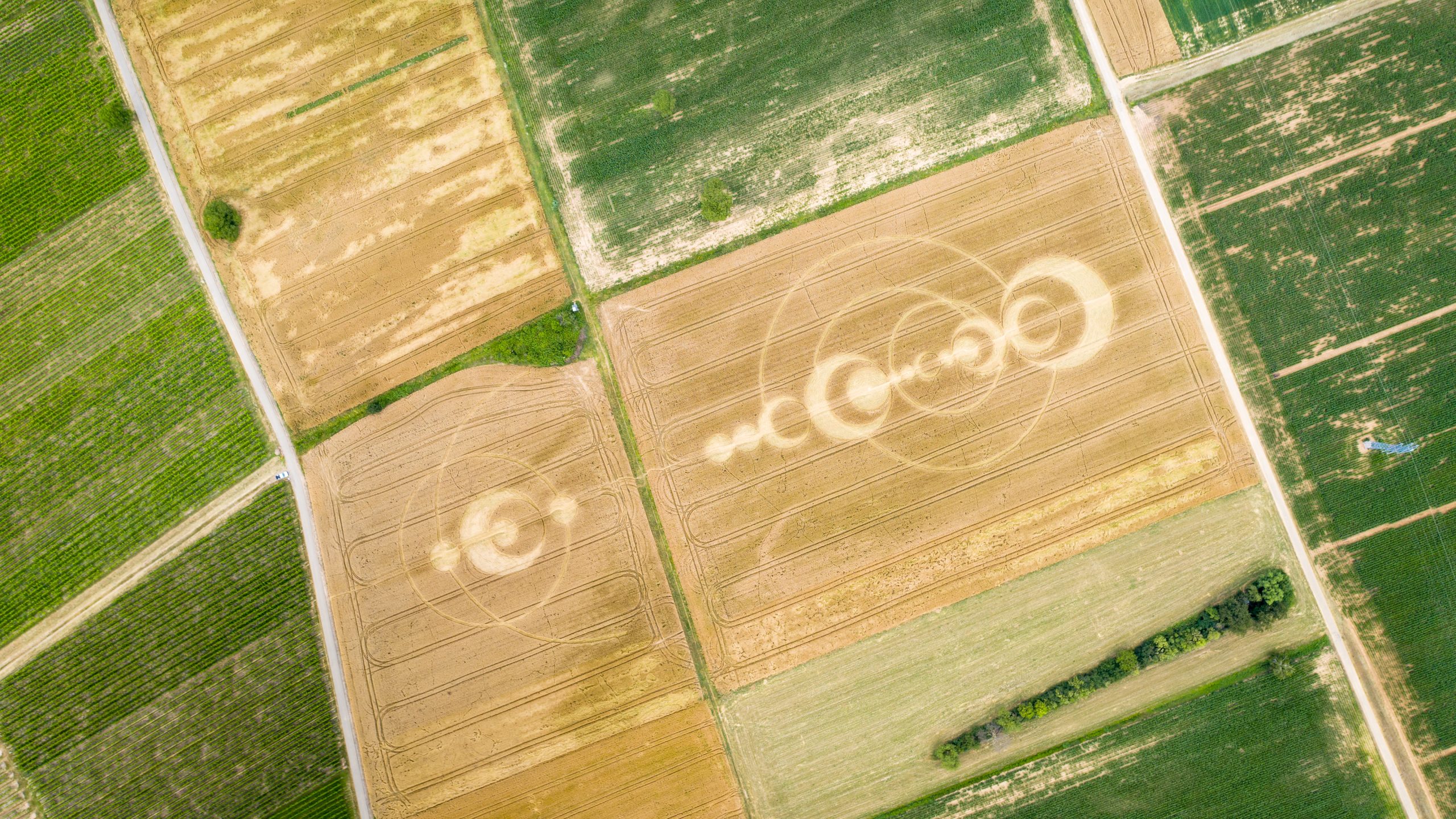
In July 1996, a baffling and intricate crop circle formation known as the Julia Set "materialized" near Stonehenge, reigniting debates about ancient mysteries and possible extraterrestrial communication
In the summer of 1996, the world was captivated by an extraordinary event near Stonehenge. The appearance of a complex crop circle, known as the Julia Set, opposite this ancient site, sparked widespread fascination. Named after a mathematical fractal shape, the Julia Set crop circle was characterized by its intricate design and sudden formation. Anecdotes, including reports from a local taxi driver, describe the crop circle as appearing almost instantaneously, fueling speculation about its origin. For many, these patterns in the fields are more than mere artistic expressions; they’re perceived as symbols conveying significant information.
Stonehenge and the Julia Set
The proximity of the Julia Set to Stonehenge has led to intriguing theories about a possible connection between the two. Given Stonehenge’s historical and archaeological significance, the appearance of such a complex formation nearby raises questions about potential interstellar messages. Theories speculate whether Stonehenge, a site shrouded in mystery, could be a portal to the stars as some proponents would suggest, and if the Julia Set-like crop circles, with mathematical precision, hold a key to reactivating “ancient portals.”
The creation of the Julia Set near Stonehenge has reignited discussions about the capabilities of ancient civilizations. Some theorize that our ancestors were attuned to Earth’s energies and mysterious forces, possessing knowledge now lost to modern humanity. This theory posits that ancient sites like Stonehenge could be remnants of sophisticated technologies, once part of a global network capable of generating significant energy, potentially used for extraterrestrial communication or travel.
The not-so-alien Crop Circles
As we consider the mysteries of Stonehenge and the intriguing crop circle phenomena, it’s important to acknowledge the complexity of human creativity and its role in these enigmas. A notable example of this is the story of Doug Bower and Dave Chorley, two friends who, in the late 1970s, embarked on an unusual artistic endeavor. Using simple tools like planks of wood and ropes, they crafted intricate crop circle designs in fields. Their intention was initially playful, but their creations soon captured global media attention and sparked a wave of imitators worldwide.
Their story, which remained a secret for years, eventually inspired “The Perfect Golden Circle,” a novel by British author Benjamin Myers. The book, set in 1989, follows two characters through the English summer nights as they create complex crop patterns, mirroring the real-life adventures of Bower and Chorley.
An aerial photograph of Crop Circles. Yayimages.
The truth about their crop circle artistry came to light when Bower and Chorley, then aged 67 and 62, confessed to journalist Graham Brough. To verify their claims, Brough examined an archive of over 200 crop circle designs stored at Bower’s residence. These aged designs matched the patterns they claimed to have made over the years, confirming their role in initiating what had become a global phenomenon.
This revelation by Bower and Chorley serves as a reminder of the human capacity for creativity and its power to inspire wonder and speculation. While the origins of Stonehenge remain shrouded in history, the crop circles near this ancient site, once thought to be of mysterious origins, have been partially demystified, illustrating the blend of human ingenuity and the enduring allure of the unknown.
Reimagining Megaliths: Stonehenge as a Cosmic Gateway
The enduring mystery of Stonehenge, coupled with the appearance of the Julia Set, has led some to reimagine these megaliths as more than historical relics. Could they be remnants of the most sophisticated technology ever to exist on Earth? Some have proposed the idea that these structures could have been communication or transportation hubs for alien visitors, but this is a radical reinterpretation. Theories suggest that the stones remaining today might have been left intentionally, awaiting a future where humanity could rediscover and reactivate this lost technology.
The intersection of the Julia Set crop circle and Stonehenge presents a fascinating convergence of past and future, ancient knowledge, and modern inquiry. As we delve deeper into these mysteries, the opportunity to gain a deeper understanding of the ancient builders of these sites presents itself as a fascinating journey. This ongoing exploration into these ancient structures and phenomena not only enriches our knowledge ofhistorybut also holds the potential to inspire future technological innovations. The study of such complex sites like Stonehenge continues to challenge and expand our understanding of human ingenuity and thecapabilities of ancient civilizations.
The Julia Set crop circle and Stonehenge stand as beacons of the unknown, challenging our understanding of history, science, and as some push, the potential for extraterrestrial life. As we strive to decode the messages left by our ancestors, these ancient sites and formations continue to inspire wonder, debate, and the pursuit of knowledge across the ages.
Stonehenge is arguably one of the most famous megalithic monuments in the world. It's also one of the most mysterious, with its prehistoric concentric rings garnering plenty of speculation as to why and how they were constructed.
It is indeed immensely picturesque. I can fancy sitting all a summer’s day watching its shadows shorten and lengthen again and drawing a delicious contrast between the world’s duration and the feeble span of individual experience. There is something in Stonehenge, almost reassuring. If you are disposed to feel that life is instead a superficial matter and that we soon get to the bottom of things, the immemorial gray pillars may serve to remind you of the enormous background of time.
Since 1977, visitors have been forbidden to touch or come close to the stones. There were cases of tourists damaging the monument. Since people are people and don’t really think at times, there have been occasions when tourists would chip the ancient stones to take home a souvenir from the site. The ruins are in a delicate condition, and touching the stones could be detrimental to preserving this ancient monument.
Did Aliens build Stonehenge?
Several theories have been proposed throughout the years, and some are truly bizarre. Legends say mighty wizards positioned the stones, and some believe aliens had something to do with Stonehenge. It probably wasn’t aliens, and neither did wizards have something to do with Stonehenge, but we still have absolutely no clue how–and why–the stones were transported from such great distances. Famous Swiss author Erich von Däniken believed that he cracked the code in 1968 when he published his book Chariots of the Gods. In his book, he claims that Aliens built Stonehenge. Many people still believe in Von Däniken’s theory, but most of it is dismissed as pseudoscience.
Survival of Biblical Flood
Many theories are roaming around regarding Stonehenge, but one is very interesting. Henry Browne wrote it in the first guidebook in 1823. Henry Browne claims that Stonehenge is one of the monuments that has survived the Biblical Flood. He believes that Stonehenge was finished with construction around the same time as Flood has occurred. There is no real evidence to support this claim, but it is an interesting subject for further discussion.
Stonehenge; a work of Merlin
There is a theory by Geoffrey of Monmouth, who made chronicles of King Arthur legends. He states that the great Wizard Merlin airlifted the stones from Country Kildare in Ireland and placed them on Salisbury Plain as a memorial to the Britons’ massacre. To a modern audience, Geoffrey’s story sounds crazy, but they had no way of explaining or understanding how the stones stood upright in the Middle Ages. In the past, magic was the only real explanation for the creation of Stonehenge.
Stonehenge and Druids.
Legend says that Druids built Stonehenge as a place of worship, and it does seem like whoever built it, and he had help from some magic. Religion was brought to the British Isles by Ancient Celtics priests, who came here 3000 years after Stonehenge was built. Although the Druids in ancient times did not see Stonehenge as a place of worship, modern Druids and neo-pagans considered the site sacred. The exact age of Stonehenge is a mystery, and its age is something we should ponder about.
Stonehenge as Astronomical Tool
Ancient people used Stonehenge for Astronomical purposes as the alignment of Stonehenge stones with astronomical events is extraordinary. Stonehenge faces the northeast, and each stone is diligently placed to track the sun’s movement. Great attention was given to the solstices and equinoxes, which would have been crucial times on the prehistoric calendar. These days would mark the growing and harvest seasons and would have meant life or death for the people. Astroarchaeologists even suspect that the winter solstice would have been more important to people, as it marked the coldest and darkest day, meaning warmth and the growing season were coming.
Stonehenge as Ancient Concert Venue
Archeologists, explorers, and tourists have speculated about the purpose of Stonehenge for centuries. Aside from the usual burial ground and religious temple theories, it is believed it may have had a musical connection. Tourists have reported sounds emanating from Stonehenge, so there might be some truth in it. Dr. Rupert Till believes if Stonehenge weren’t ruined now, the sounds would be amplified by stones. Stonehenge’s bluestones carry a distinctive echo, suggesting that people knew this and specifically sought out the stones.
Stonehenge Was Built In Phases
The old saying, “Rome wasn’t built in a day” can also be applied to Stonehenge, as the British monument was built in various stages. From the Neolithic Period to Bronze Age, the construction of Stonehenge came in phases. Stonehenge’s circular enclosure (believed to contain bluestones in the past) is the oldest part, dug around 3000 BCE. The massive sarsen stones were brought to the site 500 years later and stood upright to form the trilithons, including the structure we know today. But there were still four more stages of construction after the central monument was complete.
Old As The Pyramids
People think of the Pyramids as the oldest prehistoric monument, but history has proved that Stonehenge is just as ancient as the Egyptian Pyramids. The Great Pyramid of Giza was built around 2500 BCE. The time needed to build one pyramid was around 20 years. Meanwhile, in old Britain, ancient tribes were busy building and erecting the stone circle at Stonehenge. The ancient circle surrounding the henge was built some 500 years earlier, and there are many indications that there was a previous structure at the site of the current henge.
More than a Henge
Stonehenge is just one part of a broader sacred landscape that contains many other stones and wooden structures and burials. Part of the site is the henge at Avebury, a much larger stone monument, though somewhat less impressive due to its lack of massive trilithons.
Archaeologists have also found evidence of widespread prehistoric hunting and a road that may have led to Stonehenge. From what scientists can tell, Salisbury Plain was considered a sacred area long before Stonehenge was constructed. It was known 10,500 years ago three large pine posts, which were totem poles of sorts, were erected at the site. (Rephrase this too) What was known 10,500 years ago?
The Archives of the Unexplained is a 16-room building packed with witness reports, photographs, audio recordings, radar data, and original documents that exist nowhere else. From military encounters to reported crashes, Svahn's archive is a window into the unknown that governments have never fully disclosed.
Rare Documents And Unseen UFO Encounters
Svahn's archive contains files from Japan, Russia, and numerous European countries, many detailing objects retrieved after crashes. Some reports describe radar-tracked crafts executing impossible right-angle turns, while others record near-collisions between helicopters and wingless objects.
Also, the archive preserves stories of the Swedish Ghost Rocket wave of the 1940s, where over 1,400 rocket- and cigar-shaped UFOs plunged into the sea. These events prompted the Swedish government to form specialised military units to investigate the phenomenon. Svahn himself has interviewed eyewitnesses and experiencers, including Betty Hill, famed for the 1961 Barney and Betty Hill abduction case. Outside the abduction, Hill reportedly witnessed a UFO crash near her home, recovering debris she buried in her backyard.
Physical Evidence That Defies Explanation
Among the most intriguing items in the archive are actual pieces of UFO debris. Svahn shows a piece of tungsten from Sweden, recovered after a 1957 encounter in which two carpenters saw a craft hover in front of their car, heating the metal so intensely they could not touch it. Laboratory analysis confirmed its unusual properties.
Related video: 2 new UAP videos surface, taken by military drones | Jesse Weber Live
Other artefacts include fragments from an asteroid that crashed in Arizona 50,000 years ago, nearly a kilometre wide and composed mostly of iron with traces of nickel. Such objects offer tangible proof that some UFO encounters involve physical craft and materials, not merely lights in the sky.
The archive is not limited to documents and debris. Eyewitness testimonies capture encounters that blur the line between reality and the bizarre. One woman in Mexico photographed what appeared to be a humanoid with equipment on its back, unseen at the time she took the photo.
Similar accounts in Sweden report beings in suits with protrusions, moving across scrap metal as though defying gravity. Svahn notes that a significant proportion of Swedish witnesses, particularly in hotspots such as Hesselden, Dalarna, and Gotland, report experiences involving lights, crafts, or entities. These accounts suggest that UFO phenomena are more complex than mere space visitors, intertwining with human consciousness and perception.
The Unseen Influence Of Human Consciousness
Svahn emphasises that UFO research is complicated by the interaction between observer and phenomenon. Studies in parapsychology suggest that consciousness itself may play a role in what people witness, making some events appear high in strangeness or even absurd. Historical reports, photographs, and interviews indicate that what humans perceive may be only a fragment of a larger, more intricate reality.
Svahn believes that UFOs may not be extraterrestrial alone but could involve phenomena that interact with our minds in unexpected ways. By preserving every detail, the Archives of the Unexplained provides a foundation for researchers seeking to understand these mysteries, combining the physical, anecdotal, and psychological in one unparalleled collection.
It's a place where governments' secrets, human curiosity, and the unknown converge, offering researchers and the public alike a rare glimpse into the mysteries that have captivated humanity for decades.
UFOs in Liverpool, England...of course, they exist everywhere and this person Gideon says he summoned it to the area. I believe him because I have done it myself in the past. This UFO is a disk shape classic design. It's not a drone, but a manned ship. It has a visible hump on its upper center and it was mostly transparent...similar to the orb I summoned years ago. UFOs can make themselves disappear, or appear little by little, with a mere thought the ships systems can change its shields in a blink of an eye. Yes they have their own ai, like living ships systems that don't just have advanced radar, but also have human radar of thoughts...telepathic radar and can hear it from up to five miles away, depending on the humans experience at focusing. Yes it's real, and yes, he is telling the truth.
The real question is...how much of your lifetime will pass before you yourself try summoning a UFO, orb or entity? You are missing out.
Scott C. Waring - UFO Sightings Daily
News states:
A "classic flying saucer" was spotted hovering over Liverpool's Royal Albert Dock before disappearing with a "pop". Photos shared with the Liverpool ECHO appear to show a disk-shaped object with what a witness described as a "light" at the front.Gideon Allen, 27, who lives in the city centre, claims he spotted the UFO over the River Mersey around 6am on Sunday, March 1. He told the ECHO: "I heard a humming sound and looked up; it was quite low down, hovering and darting over the water by the Albert Dock, towards the car park at Kings Dock."It hovered for a few seconds before flying off into the air toward the left and then, pop, it was gone."Gideon described the object as a "classic flying saucer", but "translucent".
Gideon Allen claims he spotted this 'classic flying saucer' hovering over the Albert Dock
(Image: Supplied)
Gideon spotted said the 'flying saucer' disappeared with a 'pop'
(Image: Supplied)
Everything you need to know as UFO seen above Albert Dock:
Gideon Allen, 27, claims to have spotted a UFO hovering over the River Mersey and Royal Albert Dock at approximately 6am on Sunday (March 1).
Images taken by Gideon show a grey disk with what Gideon described as "a light" towards the front of the supposed craft.
Gideon, an actor who lives in the city centre, described the craft as a "classic flying saucer" that was translucent in appearance. He noted that it featured a light on what he assumed was the front and made a distinct humming sound.
Gideon said the object hovered and darted over the water toward the Kings Dock car park before flying off and disappearing with a "pop" sound.
Gideon, who is to feature in BBC drama 'The Cage' this year, claims to be a magnet for extra-terrestrial activity and previously predicted that sightings in Liverpool would increase after he moved to the city in 2024.
Reports of UFOs and aliens made to Merseyside Police reportedly doubled from 17 in 2024 to 34 in 2025.
Gideon, who practices witchcraft, believes his "magical, spiritual abilities" might be drawing the objects to the city, or that the visitors are interested in the city's cultural heritage, such as The Beatles.
Hollywood Embraces Serious UFO Films as Disclosure Looms
Hollywood Embraces Serious UFO Films as Disclosure Looms
Filmmakers from Steven Spielberg to Joseph Kosinski are tackling the topic of unidentified aerial phenomena (UAPs) in a wave of upcoming projec
Hollywood is increasingly exploring the topic of unidentified aerial phenomena (UAPs) and potential alien life, with a wave of new projects in the works from high-profile filmmakers like Steven Spielberg and Joseph Kosinski. The trend is driven by growing public interest and government acknowledgment of UAP sightings, including congressional hearings and the release of Navy footage. Projects include a historically grounded look at the 1947 Roswell incident, Spielberg's "Disclosure Day" about global panic over proof of aliens, and a UFO-themed thriller from Kosinski. The filmmakers see the current cultural moment as ripe for these stories, with even former presidents Obama and Trump weighing in on the possibility of alien life.
Why it matters
The sudden interest in serious UFO films reflects a broader cultural shift, as the topic of unidentified aerial phenomena has moved from the fringes to the mainstream. With government officials, lawmakers, and even former presidents acknowledging the reality of UAPs, Hollywood sees an opportunity to explore these themes in a more grounded and fact-based way, rather than relying on campy sci-fi tropes. The films could help further destigmatize discussions about the possibility of alien life and shed light on the historical and ongoing investigations into unexplained phenomena.
The details
The upcoming projects span a range of genres and approaches. Producer Bryce Zabel is developing "Unidentified," a fact-based drama that explores the 1947 Roswell incident across three timelines. Spielberg's "Disclosure Day" is billed as a thriller about the global panic that ensues when humanity receives proof of alien existence. Kosinski, director of "Top Gun: Maverick," is helming a "UFO-themed All the President's Men" for Apple Original Films, with input from government whistleblower David Grusch. There's even a reboot of "The X-Files" in the works for Hulu. The filmmakers see the current cultural moment, with increased public and official interest in UAPs, as ripe for these types of stories.
In 2026, Steven Spielberg's "Disclosure Day" is set to be released on June 12.
In recent weeks, former presidents Barack Obama and Donald Trump have both publicly commented on the possibility of alien life, further fueling public interest in the topic.
An acclaimed filmmaker known for movies like "Close Encounters of the Third Kind" and "E.T. the Extra-Terrestrial," which helped shape popular culture's fascination with UFOs and aliens. Spielberg is now directing the upcoming film "Disclosure Day" about the global impact of proof of alien existence.
Joseph Kosinski
The director of "Top Gun: Maverick" is helming a UFO-themed thriller for Apple Original Films, described as a "UFO-themed All the President's Men." The project has input from government whistleblower David Grusch.
Bryce Zabel
A producer and podcaster who has packaged a film called "Unidentified" that takes a historically grounded look at the 1947 Roswell incident, with director Sylvain White attached.
David Grusch
A government whistleblower who is serving as a consultant on the UFO-themed thriller being directed by Joseph Kosinski.
Dan Farah
The filmmaker behind the documentary "The Age of Disclosure," which featured interviews with 34 current and former government officials discussing unidentified aerial phenomena (UAPs).
“This topic is fascinating and it's been fun to find people who are really into it, because it's a hole you can disappear into when you're talking to the people who are in the middle of it. There's so much information that is not public yet about various things. This movie is going to blow people's minds.”
— Joseph Kosinski, Director (The Hollywood Reporter)
“Roswell no longer feels like folklore — it feels like unfinished business. Instead of seeing Roswell as pop culture, our whole package — script, director, IP — treats it like a crime scene. This isn't a movie about little green men. This is about what happens to ordinary people when the impossible crashes into their lives. These two researchers are American heroes who never gave up and found hundreds of witnesses to this event.”
— Bryce Zabel, Producer (The Hollywood Reporter)
“Film has always helped usher in cultural transformation and accelerate change. We wouldn't be living through this extraordinary time without the cultural impact Steven Spielberg made with Close Encounters of the Third Kind and E.T. We're now seeing multiple films about the existence of non-human intelligent life being covered up by the U.S. Government because we are living in the age of disclosure—the moment in history in which we learn we are not alone in the universe and that the truth has been kept from us for 80 years.”
— Dan Farah, Filmmaker (The Hollywood Reporter)
What’s next
Steven Spielberg's "Disclosure Day" is set to be released on June 12, 2026, which could further fuel public interest and speculation around the topic of unidentified aerial phenomena and potential alien life.
The takeaway
The sudden wave of serious UFO films in Hollywood reflects a broader cultural shift, as the topic of unidentified aerial phenomena has moved from the fringes to the mainstream. With increased public and official acknowledgment of the reality of UAPs, filmmakers see an opportunity to explore these themes in a more grounded and fact-based way, potentially helping to destigmatize discussions about the possibility of alien life and shed light on ongoing investigations into unexplained phenomena.
UFOs 'nearly started WW3' by triggering soviet missiles as world was 'minutes from wipe out'
UFOs 'nearly started WW3' by triggering soviet missiles as world was 'minutes from wipe out'
The bizarre incident in 1982 almost set off the Soviet Unions's nuclear weapons which were trained on New York City, which would have triggered almost certain nuclear Armageddon
UFOs are said to have triggered the USSR's nuclear missiles
(Image: Getty Images/Science Photo Library RF)
UFOs almost sparked World War 3 by triggering the Soviet Union's arsenal of nuclear missiles, newly uncovered documents claim. A Red Army propaganda chief said intercontinental ballistic missiles somehow started their launching procedure without authorisation.
The missiles, which were trained on New York City, would have sparked a nuclear Armageddon had they gone off. Soviet files show the chilling incident happened just outside Usovo inUkraine, at the same timeswarms of UFOs were spotted by Red Army soldiers.
Witnesses toldSoviet Ministry of Defense investigatorsthe crafts performed unbelievable aerial feats, changed shapes and color, vanished and reappeared, flew at high speeds, and stopped in mid-air, triggering the activation of the missile launch mechanism.
Armageddon would almost certainly have followed if the missiles had launched
With just minutes to spare before the missiles launched toward the US, they deactivated when the UFOs flew off, Radar reports.
Details of the incident, which happened in 1982 at the height of Cold War tensions between the communist empire and the US, have been uncovered in a dossier smuggled out of the US by tv reporter George Knapp more than 30 years ago.
The legendary journo, 73, snuck swathes of documents out ofRussiain 1993 in a suitcase filled with caviar under the nose of the KGB after the fall of the USSR in 1991. He quietly released them in January, revealing the extent the USSR probed the phenomenon.
The Soviet's nuclear missiles were triggered
(Image: Getty Images/iStockphoto)
The communist government officially deemed UFOs a concoction of war-mongering “American imperialists” in 1953 as tensions between the super powers intensified.
national security advisor named Dr Nikolai Kapranov, revealed the USSR commissioned several studies of UFOs beginning with the “Network-AN” program in 1979.
And it carried on with “Galaxy-MD” from 1981-1985, “Pluton 7” in 1989 and 1990, and the continuing “Thread 3” program.
George Knapp testified before US lawmakers last year
(Image: Getty Images)
The files, which also describe other amazing accounts of UFO activity in the USSR, include at least three incidents in which Russian fighter pilots were blown out of the sky by unknown craft.
The reports finally became public three months after Knapp testified before Congress about his UFO investigations.
Nuclear missiles capable of reaching New York were reportedly placed on full alert
(Image: Getty Images)
The Usovo incident echoes a UFO swarm on Malmstrom Air Force Base in Montana in the US in 1967, where the appearance of a saucer-shaped craft emitting a red glow coincided with the inexplicable failure of nearly a dozen nuclear-armed Minuteman ICBMs.
Robert Salas, the base's deputy missile combat crew commander on that night, testified on Capitol Hill about the incident in 2023.
Wat Zijn UFO's? Selectie van Theorieën en Veranderende Wetenschappelijke Standpunten
Wat Zijn UFO's? Selectie van Theorieën en Veranderende Wetenschappelijke Standpunten
Voor velen roept de term "UFO" het beeld op van een vliegende schijf die door de nachtelijke lucht zweeft. Maar wat is een UFO eigenlijk?
Joe McBride / Getty Images
Inleiding: Het mysterieuze licht in de nachtelijke hemel
Stel je voor: je kijkt naar de sterrenhemel en ziet plots een helder, bewegend licht dat niet lijkt op een ster of een vliegtuig. Het beweegt met een verbijsterende snelheid, pulseert met een radiantie die je nog nooit hebt waargenomen. In dat moment schiet je meteen de drie letters door je hoofd: U-F-O. En hoewel Hollywood ongetwijfeld heeft bijgedragen aan de wereldwijde fascinatie rond deze mysterieuze verschijnselen, rijst de vraag: wat zijn UFO's echt? Zijn ze buitenaardse voertuigen, of heeft onze interpretatie van deze fenomenen een meer aardse verklaring? In dit artikel duiken we diep in de wereld van UFO's, de verschillende theorieën die erover bestaan, en de veranderingen in de wetenschappelijke houding ten opzichte van deze mysterieuze objecten.
Wat Zijn UFO's?
Technisch gezien staat UFO voor "Unidentified Flying Object". Dit betekent dat het eenvoudigweg een object in de lucht is dat niet onmiddellijk geïdentificeerd kan worden. Het kan bijvoorbeeld gaan om een onbekend vlieg- of lichtverschijnsel dat niet direct herleid kan worden tot een bekende aircraft of natuurlijk fenomeen.
In de volksmond en populaire cultuur wordt de term echter vaak gelijkgesteld aan buitenaardse schepen of voertuigen van extraterrestrale oorsprong. Dit komt doordat veel mensen en media UFO's associëren met de mogelijkheid van buitenaardse intelligentie en het bestaan van andere werelden. Hoewel niet alle UFO-waarnemingen daadwerkelijk buitenaardse oorsprong hebben, blijft de term veelvuldig in gebruik en in de verbeelding gegrift. Het blijft een onderwerp dat zowel wetenschappers, onderzoekers als enthousiastelingen intrigeert, omdat het vragen oproept over de aard van ons universum en de mogelijkheden van buitenaards leven.
Beschrijvingen en waarnemingen
Veel getuigen rapporteren objecten die lichtend zijn, vaak met een glanzend of pulserend oppervlak dat opvalt in de hemel. Deze objecten kunnen stil hangen op één plek, waardoor ze nauwelijks beweging lijken te vertonen, of zigzaggende bewegingen maken, waardoor ze onvoorspelbaar en mysterieus overkomen. Sommigen beschrijven ze als ronde of platte schijven, vergelijkbaar met klassieke ufo-afbeeldingen uit de jaren 50 en 60, terwijl anderen spreken over vormloze lichtbollen of geometrische vormen zoals driehoeken en ruiten.
Wat deze waarnemingen bijzonder maakt, is dat de bewegingen vaak onlogisch lijken voor bekende vliegtuigen of natuurlijke verschijnselen. Een van de meest iconische voorbeelden is het "Tic Tac"-verschijnsel dat in 2004 door Amerikaanse Navy-vliegers werd waargenomen. Dit onbegrijpelijke, snel bewegende object zonder zichtbaar voortstuwingssysteem werd vastgelegd op radar en in videobeelden, en vertoonde bewegingen die onze huidige technologie niet kan verklaren. Dit soort waarnemingen blijft tot op heden een mysterie, dat vragen oproept over de aard van deze objecten en hun mogelijke oorsprong.
Recordjaar voor Belgisch UFO-meldpunt
Technologie en onmogelijkheden
De waarnemingen die vaak worden gerapporteerd, suggereren dat deze objecten beschikken over technologie die onze huidige wetenschap verre overstijgt. Ze zouden kunnen manoeuvreren zonder geluid of luchtdrukverschijnselen die normaal gesproken gepaard gaan met menselijke vliegtuigen of natuurlijke luchtverschijnselen. Sommige waarnemingen suggereren dat deze objecten snelheden behalen die de limieten van onze huidige rakettechnologie ver te boven gaan, soms sneller dan het licht, volgens de waarnemers.
Bovendien zou een bemanning over zulke objecten moeten beschikken die bestand is tegen enorme g-krachten tijdens scherpe bochten en snelle acceleraties – iets dat met onze huidige middelen onmogelijk lijkt voor menselijke piloten of robots. Deze objecten lijken ook te kunnen verdwijnen en verschijnen op onverwachte plaatsen, wat duidt op geavanceerde technologieën zoals teleportatie of onzichtbaarheid.
Het feit dat deze objecten vaak zonder duidelijke energiebron bewegen, roept vragen op over de aard en oorsprong ervan. Hoewel er geen definitieve bewijzen zijn, blijven deze waarnemingen een fascinerend en intrigerend fenomeen dat de grenzen van onze wetenschap uitdaagt.
De Wetenschappelijke Standpunt over UFO's
Voor een lange periode werden UFO's vooral beschouwd als subjecten voor complottheorieën, sensatiejournalistiek en pseudowetenschap. Mensen die deze fenomenen observeerden, werden vaak afgedaan als fantasierijk of misleid, en de wetenschappelijke gemeenschap was terughoudend om zich uit te spreken over de aard en betekenis ervan. Dit was vooral omdat er simpelweg onvoldoende bewijs was dat de fenomenen buitenaards van aard waren. Wetenschappers wilden geen conclusies trekken op basis van onvolledige of onbetrouwbare gegevens, en bovendien heerst er binnen de wetenschap een sterke voorkeur voor bewijs dat reproduceerbaar en objectief verifieerbaar is. Hierdoor bleef de discussie lang vooral hangen in speculatie en onbewezen theorieën.
Skepsis en voorzichtigheid
De wetenschap hanteert een principe van kritische beoordeling en bewijsgerichtheid. Dit betekent dat nieuwe verschijnselen en verklaringen altijd onderworpen worden aan strenge controle en analyse voordat ze als feit worden erkend. De meeste waarnemingen en verklaringen over UFO's berusten op menselijke perceptie, die niet altijd betrouwbaar is. Vaak gaat het om beelden die met camera's of smartphones gemaakt zijn, maar deze kunnen vervormd, onscherp of verkeerd geïnterpreteerd worden. Daarnaast is er een overvloed aan anekdotische verslagen – getuigenissen van mensen die iets gezien zouden hebben – die niet altijd objectief te verifiëren zijn. Bovendien kunnen culturele en psychologische factoren een grote rol spelen in de interpretatie van waarnemingen. Mensen kunnen bijvoorbeeld beeldvorming en interpretaties laten beïnvloeden door populaire cultuur, verhalen uit de media of eigen verwachtingen. Hierdoor blijft het moeilijk om UFO's te beschouwen als een concreet fenomeen dat duidelijk wijst op buitenaards bezoek.
Nieuwe wetenschappelijke houding
De afgelopen jaren is er echter een duidelijke verschuiving merkbaar in de manier waarop de wetenschap naar UFO's kijkt. Organisaties zoals NASA en het Amerikaanse ministerie van defensie (DoD) benaderen UFO- en UAP-waarnemingen met meer wetenschappelijke interesse en openheid. In 2020 richtte het Amerikaanse ministerie van defensie bijvoorbeeld de UAP Task Force op, met als doel om systematisch gegevens te verzamelen, te analyseren en te beoordelen. Deze task force probeert de waarnemingen te categoriseren en te begrijpen, en zo een beter beeld te krijgen van de aard van de fenomenen. In september 2023 publiceerde NASA een rapport waarin werd geconcludeerd dat de meeste waarnemingen niet kunnen worden verklaard met de huidige kennis en technologieën. Het rapport benadrukte dat er geen bewijs is dat deze fenomenen buitenaards van aard zijn, maar dat ze wel de aandacht verdienen van de wetenschap omdat ze onduidelijk blijven.
Deze nieuwe houding onderstreept dat de wetenschap niet per definitie afwijzend staat tegenover het fenomeen UFO's. In plaats daarvan is de nadruk komen te liggen op het verzamelen van betrouwbaar bewijs om tot een meer gefundeerde interpretatie te komen. Het belang van systematisch onderzoek en het vermijden van voorbarige conclusies wordt steeds meer erkend. Wetenschappers blijven voorzichtig, maar zijn bereid om open te staan voor nieuwe gegevens die mogelijk de bestaande kennis kunnen uitdagen. Het is duidelijk dat verdere studie en technologische ontwikkeling nodig zijn om de aard van deze fenomenen beter te begrijpen. Door een meer evidence-based aanpak wordt de kans groter dat we in de toekomst tot helderdere inzichten komen over de aard en oorsprong van UFO's, zonder daarbij onnodig te vervallen in speculatie of pseudowetenschap.
Het Betoverende Schilderij: "Vuur in de Hemel"
In de wereld van kunst en cultuur worden UFO's vaak afgebeeld als buitenaardse schepen, vliegende objecten die de mensheid al eeuwenlang fascineren en inspireren. Echter, in historische tijden werden vergelijkbare fenomenen niet altijd geïnterpreteerd als buitenaardse technologie, maar vaker binnen een religieus of mythologisch kader. Deze interpretaties weerspiegelen de overtuigingen, angsten en verwachtingen van de samenleving uit die periode. Een treffend voorbeeld hiervan is het schilderij "Vuur in de Hemel" van Christian Wilhelm Ernst Dietrich, dat een betoverende en mysterieuze voorstelling geeft van hemelse verschijnselen. Dit kunstwerk biedt een venster naar de manier waarop onze voorouders deze fenomenen zagen en interpreteerden, vaak als goddelijke interventies of bovennatuurlijke krachten die de wereld beïnvloeden.
Het schilderij "Vuur in de Hemel" en de symboliek ervan Christian Wilhelm Ernst Dietrich was een Duitse schilder uit de 18e eeuw die bekend stond om zijn indrukwekkende landschappen en hemellichamen. Zijn schilderij "Vuur in de Hemel" toont een dramatisch tafereel van een hemel die wordt verlicht door vurige lichten en stralen. De compositie is rijk aan symboliek: de vurige lichten kunnen worden geïnterpreteerd als tekeningen van goddelijke macht, bovennatuurlijke interventies of zelfs apocalyptische gebeurtenissen. Het schilderij straalt een gevoel van verwondering uit, maar ook van angst en onbegrip, wat de menselijke reactie op onbekende fenomenen uitstekend weergeeft. Deze visuele voorstelling weerspiegelt de overtuigingen en mythologische verhalen die in die tijd werden gedeeld over de hemel en het bovennatuurlijke.
Historische interpretaties van hemelse verschijnselen In de oudheid en middeleeuwen werden zogeheten "hemelse lichten" vaak geïnterpreteerd als goddelijke tekenen of boodschappers van de goden. Bijvoorbeeld, de vurige verschijnselen die men soms zag, werden gezien als manifestaties van de hemelse machten die de mensen waarschuwden of zegeningen boden. Deze interpretaties waren sterk verbonden met religieuze overtuigingen en mythologieën, waarin de hemel werd gezien als een domein van goddelijke aanwezigheid en interventie. Men geloofde dat deze verschijnselen een boodschap waren van de goden of een teken van naderend onheil. Het schilderij "Vuur in de Hemel" vangt deze oude overtuigingen doordat het een dramatische en bovennatuurlijke scène uitbeeldt die bijna religieus aanvoelt.
De moderne kijk op hemelse en buitenaardse verschijnselen Tegenwoordig worden vergelijkbare fenomenen vaak anders geïnterpreteerd. Wat in de oudheid als goddelijke tekenen werd gezien, wordt nu soms beschouwd als mogelijke UFO-waarnemingen. Met de ontwikkeling van de wetenschap en technologische vooruitgang is onze interpretatie van vreemde lichten en vliegende objecten geëvolueerd. Mensen zoeken nu naar natuurlijke en technologische verklaringen voor dergelijke verschijnselen, zoals atmosferische fenomenen, weerballonnen, of zelfs buitenaardse technologie. Toch blijven sommige waarnemingen mysterieus en onverklaard, wat de mensheid blijft fascineren en tot speculatie aanzet.
Psychologie en projectie De Zwitserse psychiater Carl Jung was een invloedrijk denker op het gebied van de menselijke perceptie en interpretatie van bovennatuurlijke verschijnselen. Volgens Jung hebben deze verschijnselen geen intrinsieke betekenis op zichzelf, maar worden ze door de waarnemer geïnterpreteerd op basis van hun culturele, persoonlijke en psychologische overtuigingen. Met andere woorden, wat iemand ziet of ervaart, hangt sterk af van hun achtergrond en innerlijke wereld. Jung stelde dat deze interpretaties vaak projecties zijn van innerlijke verlangens, angsten of archetypes die in het collectieve onbewuste van de mensheid voorkomen.
De rol van cultuur en overtuigingen In verschillende culturen en tijden worden dezelfde verschijnselen totaal verschillend geïnterpreteerd. In sommige samenlevingen werden vreemde lichten en hemelverschijnselen als goddelijke tekenen gezien die goede of slechte tijden aankondigden. In andere culturen werden ze als magische of bovennatuurlijke krachten beschouwd. De interpretatie hangt dus sterk af van de culturele context waarin men leeft. De manier waarop mensen hemelse verschijnselen zien, wordt daardoor gekleurd door de overtuigingen en mythes die binnen die cultuur bestaan.
Samenvatting en reflectie Kortom, het schilderij "Vuur in de Hemel" biedt niet alleen een visueel spektakel, maar ook een diepgaande reflectie op hoe mensen door de geschiedenis heen hemelse en mysterieuze verschijnselen hebben geïnterpreteerd. Of het nu ging om goddelijke tekenen, mythologische verhalen of moderne UFO-waarnemingen, de menselijke neiging om het onbekende te verklaren binnen een bepaald kader blijft onverminderd bestaan. De rol van psychologie en cultuur speelt hierbij een centrale rol, omdat onze perceptie van externe fenomenen altijd wordt gekleurd door onze innerlijke wereld.
Door de eeuwen heen hebben mensen gezocht naar betekenis in het onbegrijpelijke, en kunstwerken zoals "Vuur in de Hemel" herinneren ons eraan dat onze interpretaties vaak diep verweven zijn met onze overtuigingen en culturele achtergrond. Het blijft een fascinerend onderwerp dat ons uitdaagt om kritisch te kijken naar onze eigen percepties en de verhalen die wij vertellen over de hemel en het onbekende.
Religieuze Interpretaties van UFO's
Historisch gezien werden fenomenen die nu als UFO's worden beschouwd vaak geïnterpreteerd binnen religieuze kaders. Een bekend voorbeeld is de gebeurtenis in Fatima, Portugal, in 1917.
Het wonder van de zon
Tijdens de zogenaamde "Mirakel van de Zon" zagen duizenden getuigen een dansende, veranderende zon die leek te spinnen en te veranderen van kleur. Veel van deze waarnemingen werden later verklaard als optische illusies of massale hallucinaties, maar voor de gelovigen was het een goddelijke openbaring.
Van paganisme tot christendom
In pre-christelijke tijden zouden dergelijke fenomenen geïnterpreteerd zijn als tekenen van bovennatuurlijke machten of goden. Tegenwoordig worden ze nog steeds door sommigen gezien als tekenen van buitenaardse intelligenties die communiceren via verschijnselen in de lucht. Het belang hiervan ligt in de manier waarop mensen gebeurtenissen interpreteren en betekenis geven op basis van hun wereldbeeld.
Evaluatie van UFO-rapporten en Vreemde Ontvoeringen
Een van de meest besproken aspecten van de UFO-fenomenen betreft de zogenaamde "alien abducties". Mensen rapporteren vaak dat ze door buitenaardse wezens zijn meegenomen, vaak voor medische experimenten of observaties.
Onderzoek en verklaringen
Deze ervaringen worden vaak onderzocht door artsen en psychologen. Veel deskundigen wijzen op slaapverlamming, hypnagogie en hypnopompische hallucinaties als mogelijke verklaringen. Deze tijdelijke verlamming gecombineerd met visuele en auditieve hallucinaties kunnen worden beïnvloed door stress, angst of culturele verwachtingen.
Voorbeeld: Michael Shermer
Michael Shermer, een bekende skeptische wetenschapper en schrijver, raakte zelf betrokken bij een vermeende ontvoeringservaring. Hij verklaarde dat hij door slaaptekort en uitputting hallucinaties had die hij interpreteerde als buitenaardse ontmoetingen. Zijn ervaring illustreert hoe de menselijke geest in staat is om overtuigende illusies te creëren, vooral onder stress of vermoeidheid.
Neurologische en psychologische factoren
Neuroscientific onderzoek suggereert dat afwijkingen in de temporale kwabgenese en andere hersengebieden kunnen bijdragen aan het ontstaan van dergelijke ervaringen. Mensen kunnen zich herinneringen toeschrijven aan buitenaardse ontmoetingen, terwijl ze eigenlijk hallucinerende of dissociatieve toestanden ervaren.
Culturele en psychologische aspecten
Volgens Jung en andere psychologen zoeken mensen in UFO's vaak naar antwoorden op existentiële vragen of proberen ze betekenis te geven aan het onbekende. Abductieverhalen kunnen ook een uiting zijn van onderliggende psychologische processen, zoals zelfreflectie, trauma of het verlangen naar verbondenheid.
De Cultuur en de Veranderende Perceptie: Van UFO naar UAP
De terminologie rondom deze fenomenen evolueert mee met de tijd. Sinds 2020 gebruiken de Amerikaanse overheid en andere instanties de term "Unidentified Aerial Phenomena" (UAP) in plaats van UFO. Dit is niet alleen een semantische wijziging, maar reflecteert ook een nieuwe aanpak om deze verschijnselen wetenschappelijk te benaderen.
Het UAP-onderzoek
De UAP Task Force en NASA streven ernaar om gestructureerd data te verzamelen en te analyseren, zonder meteen te concluderen dat het om buitenaardse technologie gaat. Het doel is om eenduidige, betrouwbare informatie te verkrijgen, zodat er geen ruimte meer is voor speculatie en misinformatie.
Politieke en militaire betrokkenheid
In 2023 hield het Amerikaanse Congres hoorzittingen waarin veteranen en militaire officials over hun waarnemingen vertelden. Sommige getuigen spraken over geheime programma's voor het reverse-engineeren van ongeïdentificeerde technologieën en zelfs het ophalen van niet-menselijke biologische materialen. Hoewel deze claims controversieel blijven, benadrukken ze het belang van transparantie en verder onderzoek.
National security en wetenschap
De militaire en politieke discussies richten zich niet alleen op mogelijke buitenaardse oorsprong, maar ook op het beschermen van nationale veiligheid. Het is cruciaal dat de overheid en wetenschappers samenwerken om te begrijpen wat deze fenomenen werkelijk zijn en welke risico's ze mogelijk vormen.
Conclusie: Wat Zijn UFO's ECHT?
De vraag "Wat zijn UFO's?" blijkt complexer dan het lijkt. Hoewel de cultuur, psychologie en wetenschap verschillende perspectieven bieden, is er momenteel geen sluitend bewijs dat deze fenomenen buitenaardse technologieën zijn. Wat wel duidelijk is, is dat de menselijke perceptie en interpretatie een grote rol spelen in onze waarnemingen.
De recente verschuiving naar de term UAP en de wetenschappelijke inspanningen om data te verzamelen, laten zien dat we serieus werk maken van het begrijpen van deze verschijnselen. Het is een zoektocht die niet alleen de grenzen van de wetenschap uitdaagt, maar ook onze wereldbeelden en overtuigingen.
Voorbeelden ter illustratie:
De "Tic Tac" waarneming (2004):Amerikaanse Navy-vliegers zien een onbegrijpelijk snel bewegend object dat geen zichtbaar voortstuwingssysteem heeft. Dit leidde tot een hernieuwde interesse in UAP's en een verhoogde militaire aandacht voor dergelijke fenomenen.
Het "Mirakel van de Zon" in Fatima: Een religieus fenomeen dat door velen werd geïnterpreteerd als een bovennatuurlijk teken, maar dat mogelijk een optische illusie was.
Michael Shermer's ervaring:Een sceptische wetenschapper die door slaaptekort hallucinaties had die hij interpreteerde als een buitenaardse ontmoeting, wat illustratief is voor de kracht van de menselijke geest.
NASA's rapport (2023): Concludeerde dat de meeste UAP-verschijnselen niet kunnen worden verklaard, maar dat geen bewijs bestaat voor buitenaardse oorsprong.
Wat betekent dit voor de toekomst?
Het onderzoek naar UFO's en UAP's blijft evolueren. Met technologische vooruitgang en meer wetenschappelijke transparantie kunnen we wellicht in de toekomst meer duidelijkheid krijgen over deze mysterieuze verschijnselen. Tot die tijd blijven UFO's een bron van verwondering, onderzoek en discussie, en herinneren ze ons eraan dat het universum nog veel geheimen bevat die wachten om ontdekt te worden.
E.T. could be phoning home — but we’re not hearing the call.
A new study published inThe Astrophysical Journalargues that “space weather” could be distorting incoming transmissions from extraterrestrials.
The paper, penned by researchers at the SETI (Search for Extraterrestrial Intelligence) Institute, claims that searches for alien contact typically look for extremely sharp, narrow frequency spikes.
Traditional searches for incoming transmissions from extraterrestrials are programmed to detect sharp, narrow frequency spikes. However, new research shows “space weather” events may be distorting the transmissions, broadening their narrowband signals. This means we may be failing to pick up alien contact.hanmaomin – stock.adobe.com
While scientists have long considered that distortions can occur as radio waves travel across interstellar space, the new paper focuses on what can happen when a distortion arises closer to the source.
“Plasma density fluctuations in stellar winds, as well as occasional eruptive events such as coronal mass ejections, can distort radio waves near their point of origin, effectively ‘smearing’ the signal’s frequency,” a press release about the study stated.
“[Traditional] Searches are often optimized for extremely narrow signals,” Dr Vishal Gajjar, astronomer at the SETI Institute and lead author of the paper, further explained. “If a signal gets broadened by its own star’s environment, it can slip below our detection thresholds, even if it’s there.”
The team developed a practical framework for estimating how much broadening could occur for different types of stars if they were impacted “space weather” conditions.The Astrophysical Journal
To determine whether they may be missing alien communication, they looked at how “space weather” near the point of origin might broaden transmission signals.
They subsequently devised a practical framework for estimating how much broadening could occur for different types of stars if they were impacted such conditions.
The results were jaw-dropping.
For example, the researchers found that M-dwarfs, which make up around 75% of stars in the Milky Way, may be more likely to broaden narrowband signals near their source of origin due to “space weather.”
This means we may be missing signals due to our current mode of detection.
Thus, the researchers say search strategies should be adapted to look for signals that are slightly wider than traditionally expected.
“By quantifying how stellar activity can reshape narrowband signals, we can design searches that are better matched to what actually arrives at Earth, not just what might be transmitted,” Grayce C. Brown, co-author of the study and research assistant at the SETI Institute, declared.
Newly-declassified government documents from more than thirty years ago reveal how officials concealed a potential UFO encounter at the South Pole.
Records released by Argentina’s Ministry of Foreign Affairs have validated an eyewitness report from 1991 about military personnel and civilian researchers in Antarctica encountering a gigantic flying saucer over their base.
A number of unusual measurements taken at General San Martín Base and the testimony of one of its key figures, meteorological sub-officer Miguel Amaya, have rekindled interest following the recent declassification of official documents obtained under the Law on Access to Public Information.
“These files were sought for more than 15 years,” said Andrea Perez Simondini, who runs the Victoria UFO Museum. “The interesting thing is that in this case, it wasn’t someone directly linked to our campaigns, but an ordinary citizen who dared to use the Law on Access to Public Information. This demonstrates that the tool works and that anyone can get involved.”
What happened on that night in Antarctica?
According to a report by UNO Entre Rios, the UFO encounter occurred at the start of the polar night in April and May of 1991. There were 20 crew members on the site, including both civilian and military scientists.
Around 1:15 a.m. one night, the electronics engineer in charge of ionospheric studies called Amaya. Minutes later, a scientific instrument known as a riometer (Relative Ionospheric Opacity Meter) began to record significant anomalies.
A riometer measures variations in the ionospheric absorption of cosmic radio waves. It enables the study of ionospheric changes, especially in polar regions. According to the testimony, the recording equipment began plotting identical lines simultaneously, which the engineer considered technically impossible. According to the account, the measurements lasted over four hours – an unprecedented length of time.
Amaya said outpost staff asserted that the readings could only have resulted from something generating a huge amount of energy. He compared it to something as large as a city floating over Antarctica or a nuclear aircraft carrier.
“At times, these ‘signals’ would cut out, and everything would continue as normal,” Amaya said in an interview with CEFORA, according to DailyMail.com. “Then, for periods of ten or fifteen minutes, it would start again, sometimes with such force that the needles would jump off the belt.”
A witness reported seeing ‘a huge circle of light’
About 16 hours later, a different base member reportedly noticed “a huge circle of light.” It was moving silently and slowly directly over the building.
“He noticed a huge circle of light, very dim due to the cloud cover, passing above the base, but still visible, and moving very slowly and silently towards the sea,” Amaya claimed.
Amaya said that his superiors instructed him and other members of the base to never discuss what they had witnessed.
The government has now made public for the first time formerly classified images. These images now prove the inexplicable interference with the base’s riometer did, in fact, occur.
This case now “raises expectations for the continued declassification of other files,” Simondini said.
The symbols can be traced back to Futhark, the oldest known runic alphabet.
Credit: Ryan Primrose / Ontario Center for Archeological Education
Archaeologists remain baffled by a surprising, seemingly ahistorical find located deep in the Canadian wilderness. But after years of research, analysis, and historical corroboration, an interdisciplinary team has finally made their findings available to the public. Tucked away in a forest approximately 465 miles northwest of Ottawa, a massive slab of bedrock features a hand-etched rendition of the full Lord’s Prayer. But the religious text isn’t inscribed in French or English—it’s composed of over 250 symbols from the oldest known runic alphabet.
The perplexing discovery happened completely by chance, according to the CBC. Hidden for centuries, the stone became exposed only after a tree fell near the town of Wawa, not far from Lake Superior. Closer inspection showed that someone had etched 255 runes into a roughly 4 by 5 foot section of the slab. Additionally, they took time to add a detailed illustration of a boat, an additional 16 runic signs, and 14 X markings.
“It’s certainly among the least expected discoveries of my career. It’s absolutely fascinating,” he told CBC.
It took years of planning and cooperation to analyze the mysterious stone inscription. Ryan Primrose / OCAE
Futhark runes
However, Primrose didn’t want anyone jumping to conclusions about the inscription. While it’s true that Vikings explored portions of present-day Canada thousands of years ago, he doubted they were responsible for the mystery message.
“We didn’t want to release anything publicly until we had done as much analysis as possible,” said Primrose.
He soon contacted Uppsala University emeritus professor of runology Henrik Williams, and helped the renowned expert arrange a visit to the site the following October.
“I was under a tarpaulin for three hours with a flashlight, looking at the runes and the others were sitting outside freezing,” recalled Williams.
An expert spent three hours scouring the rock for clues to decipher it. Credit: Ryan Primrose / OCAE
The group’s patience and endurance paid off. Williams eventually determined that the message was written with Futhark alphabetic runes. First developed and used by Germanic peoples between the 2nd and 8th centuries CE, Futhark eventually evolved into a simplified version adopted by Scandinavians. Both the Anglo-Saxons and Frisiacs also expanded it into their own variants, but the knowledge of how to read its original iteration died out by the High Middle Ages (around 1000-1300 CE). It wouldn’t be until 1865 that Norwegian scholar Sophus Bugge finally succeeded in deciphering the long-lost language.
People across Europe remained fascinated with runes in the interim, however. During the early 1600s, Swedish polymath (and occultist) Johannes Bureus adopted the symbols into a system that roughly corresponded to his home country’s language. This culminated in the publication of a Swedish language Lord’s Prayer written with the Futhark runes in 1611. But don’t think the Canadian oddity’s story ended there.
Researchers hope to turn the stone into a public heritage site. Credit: Ryan Primrose / OCAE
A more recent inscription
“This must have been a Swede,” Primrose said of the etcher. “Were there any Swedes at all here?”
Not during the 17th century, according to his research. That said, historical documents confirm that Hudson’s Bay Company stationed Swedish workers at trading posts across Canada beginning in the 1800s. And it just so happens that Bureus’ runic Lord’s Prayer was republished during the 19th century.
Taken altogether, Primrose and colleagues now theorize that a Hudson’s Bay Company employee—or employees—are responsible for the labor-intensive project that likely took days, if not weeks to complete.
The conservationists are now working with the local landowners on a leasehold to turn their archaeological discovery into a public heritage site that includes a protective structure to guard it against the elements.
Primrose confessed to being “a little disappointed” that the artifact is likely only a couple centuries old, but plenty of questions still surround the find. Was the site a place for religious gatherings, or the devotional effort of one person? Prior to its exposure, the bedrock also lay under multiple inches of soil. With no other artifacts found nearby, was the prayer intentionally buried?
“The mystery doesn’t fade just because it’s younger than we hoped. Why was it carved here? Why this text? There are no answers,” he said. “And mysteries always draw people in.”
A series of unusual stone formations hidden deep in the forests of northern Quebec is drawing new attention, after a local landowner spent nearly a decade documenting a discovery he believes could offer clues to Canada’s prehistoric past.
Steve Durand, founder of LeTerrain, a 400-acre wilderness sanctuary and recently designated Dark Sky Preserve in Quebec, believes he has stumbled upon a part of Canada’s ancient past that has long remained hidden on his property.
A rock musician and producer in a former life, Durand decided to step back from the music industry and return to his roots by moving back home in 2015.
“I was planning to move back to my chosen home and musical community in Montreal,” Durand recently explained in an email to The Debrief. “But I took a little detour to this property on a tip from my mom, actually, and spent two days here just intrigued by the massive private wilderness.”
It was on his second day at the property that Durand says he had what he characterizes as a “blinding epiphany” about one of its seven mountains. “I decided to leave my life in New York, buy the property, and I was living in a 140-year-old off-grid house a month later.”
When Durand initially bought the property, he never considered that there might be something of potential archaeological significance on it.
“I was motivated by the overwhelming beauty of the land,” Durand said, “and I felt connected to it. It fueled my intuition and launched me into this very illogical decision to move off-grid with no real bush experience whatsoever.”
It was only later that he discovered the massive stone formations on the property.
Following the discovery of the odd stone features, which he now refers to as “monuments,” in a series of videos on his YouTube channel, Durand reached out to locals to see if they might offer any ideas about their history and purpose.
Most area residents, he says, dismissed his discoveries, having been told they were rock piles made by Canada’s early European settlers.
Steve Durand, Founder of LeTerrain, appears alongside one of the rock formations on his property (Image Credit: LeTerrain).
“The locals had been told that it was farmers who made these structures, clearing the fields,” Durand said. However, this theory had several problems. For instance, there was no evidence of farming, nor fields that might have been used for it in the area. In some cases, Durand observed that the stone features even appeared to have been constructed into specific shapes.
“These are not found near farms or fields; they are found high up in the forested hills,” Durand told The Debrief. “They are found in clusters rather than clearing, they are constructed and built into intentional shapes, they often use extraordinarily heavy stones, and the overall accumulated tonnage of stones worked far exceeds the efforts conceivable of early settlers.”
Bringing his counter-arguments to the attention of area locals, Durand says he has now “managed to convince many of them that it makes no logical sense” that these features resulted from the work of early settlers farming on remote hilltops.
Following his discovery, Durand began researching possible interpretations of the stone features and their origins—a pursuit that he has maintained for the last decade.
Durand highlights the formations’ careful workmanship and their clustering into what he calls “megasites,” arguing that the scale and organization imply spiritual or ritual significance for the people who built them. He also suggests the structures may have been aligned with astronomical events, similar to other ancient stone traditions worldwide, and could reflect a large, long-lived culture capable of constructing monuments across a broad region.
“The territory the stoneworks define is quite specific,” Durand said. “Due to the fact that so many megasites are found all around the shores of the ancient Champlain Sea, never below the water line, and never far from the shoreline, I believe that this culture can be dated with reference to the ancient Champlain Sea around 10,000 years before present,” he says.
While archaeologists have not yet verified Durand’s interpretations, he says the discoveries at LeTerrain raise broader questions about poorly understood prehistoric activity in eastern Canada and whether undiscovered cultural landscapes may still exist in North America’s remote wilderness.
“I believe that these stone constructions are the work of a thus far unrecognized ancient culture that built representational and spiritual stone monuments on a colossal scale,” Durand told The Debrief. “Their culture terraformed landscapes from up here in West Quebec all the way down the Atlantic coast as far as Tennessee.”
Establishing Why and When
Seeking an academic perspective, The Debrief reached out to Andrew A. White, a research archaeologist with the Illinois State Archaeological Survey, for his opinions on Durand’s discoveries.
“The ‘why’ and ‘when’ questions are often tough to answer when we’re trying to interpret a pile or line of rocks made by humans,” White told The Debrief in an email.
As for determining the “why” behind Durand’s discoveries, White says that a range of factors must be considered. “People move rocks around for many different reasons—clearing fields, building walls or house foundations, making monuments, marking important locations, or creating drivelines or corrals for animals,” he said.
“Figuring out the original purpose of a pile or line of stones can be especially difficult in areas where there is more than one possible explanation,” White added. As an example, White points to known examples of how Indigenous groups in eastern North America have, at times, created rock piles for ceremonial or other purposes. White notes, however, that “later colonists created similar-looking piles and lines” as they moved stones from fields to use for homestead and farm buildings.
The “when,” White explained, can be just as tricky to identify when it comes to rock formations.
“We can’t directly date the rocks themselves, so usually we have to find something underneath the rocks that can tell us the maximum age of the surface the rocks were piled on,” White told The Debrief. “If a burned hearth underneath a rock wall dates to a thousand years ago, for example, the wall can’t be older than a thousand years. It could, in fact, have been made much more recently.”
“If I were to pile rocks on top of an archaeological site that is 10,000 years old, after a few decades, the rock pile may appear to be just as ancient as the site it is sitting on top of,” White said, “even though it is much younger.”
“The difficulty of the ‘why’ and ‘when’ questions leaves a lot of room for rock features to be misinterpreted,” White said.
Shapes and Sizes Found
In total, Durand says he has identified a variety of rock formations, ranging from stone walls to serpent-like constructions. Some, he explains, spiral up a hillside, with formations appearing at successive elevations.
“I have found so many different shapes and sizes of both the structures and the stones chosen to build them,” Durrant says. “I’ve found many shapes that recur, and I’ve put them into three main categories: mounds, structures, and infrastructure. The mounds are generally built with small stones and are oval in shape, anywhere from 6 by 10 feet to 30 by 20 feet. They all share the same proportions, differing only in size. I’ve found a cluster of 30 large mounds on one hillside.”
The structures are formed from larger stones, often 4 to 7 feet tall. “I’ve found perfect cylinders, serpentine wavy walls with massive ‘headstones,’ all with very intentional and beautifully designed curvatures,” he says.
Durand goes on to explain that “on one of the megasites, I discovered seven extraordinarily large constructions: platform mounds of smaller stones, 2 to 4 feet tall, 15 to 40 feet in diameter, topped with extremely large stones, some exceeding two tons.”
“The third category is what I call infrastructure,” he says, which Durand interprets as “roadways, pathways, retaining walls, and terracing that connect the mounds and structures within a megasite.”
A map of rock formations found on Steve Durand’s LeTerrain and the surrounding areas (Image Credit: LeTerrain).
Durand also believes the hill’s perimeter may conceal an ancient road. As sand erodes, large stones appear beneath the surface, seemingly placed intentionally along what he interprets as a road base. He says he plans to conduct a ground LiDAR scan to determine whether the feature is indeed an ancient roadway and to estimate its age, although the work would be costly.
“The infrastructure, the stone roads and pathways that you’ve witnessed surrounding Mount Bald serve no apparent logical purpose,” Durand told The Debrief. “They circumvent this one mountain and don’t lead to or from the megasite; they just exist there in three tiers in a kind of spiral of road circling this one mountain and connecting all of the greater structures.”
“Although it’s hard to tell, as 70 to 80 percent of these roads and pathways have been swallowed up by the earth over an extraordinary long period of time,” Durand said.
During a 2025 visit to Durand’s property by The Debrief, one structure, which Durand interprets as a serpent-like formation, stood out among the various stone features.
“The serpent construct is fascinating for many reasons,” Durand explained. “I have found several, and people researching through New England have found hundreds. It’s a recurring shape not only in these stone constructions but also in ancient cultures worldwide.”
“The one here on my land is about 40 feet long by 15 feet wide by four feet high and clearly undulates on both sides quite intentionally,” Durand explained during our visit.
Alleged “serpent” rock formation found on the LeTerrain property (Image Credit: Chrissy Newton/The Debrief).
“As you can see, the sides have been very specifically constructed to form this undulating wall,” Durand said. “At one end, we find, as we do with so many others in the area, a very large headstone of between 500 and 800 pounds. I feel it’s noteworthy as well that this serpentine body and head face directly into the setting sun on the winter solstice.”
Currently, the most widely accepted archaeological evidence for the earliest human presence in what is now Canada comes from sites such as Bluefish Caves in the Yukon. Dating to roughly 24,000 years ago, animal bones bearing cut marks from stone tools support the idea that humans occupied Beringia—the land bridge connecting Asia and North America—during the Last Glacial Maximum. Evidence from Bluefish Caves and other ancient North American archaeological sites upended the previously accepted “Clovis-first” model, which argued that human arrival in the Americas began no earlier than around 13,000 years ago. Many Indigenous communities across Canada also maintain oral histories that describe their deep and long-standing presence on these lands.
If confirmed, Durand’s discoveries would add to a growing number of archaeological finds in Canada that have recently attracted attention. Last year, archaeologists in northern Ontario reported the discovery of a rune-inscribed stone slab discovered in remote wilderness near Wawa, featuring 255 characters from the Nordic Futhark alphabet. The inscription was found to be a full rendering of the Lord’s Prayer, along with carvings of a boat and additional markings. Although initially thought to be ancient Viking writing, analysis suggests a much later origin, likely carved by Swedish Hudson’s Bay Company workers in the 19th century as an act of devotion.
Canada has long been home to unique archaeological discoveries. Sites such as the Peterborough Petroglyphs—known to Indigenous communities for generations—depict animals, humans, and symbolic figures, while petroforms and stone alignments across Ontario and the Prairies form large patterned arrangements of stones often linked to ceremonial, navigational, or astronomical purposes. Many of these Indigenous cultural features date back roughly 1,000 to 2,500 years and remain only partly understood, with their meanings preserved primarily through oral traditions.
Consultation, Caution, and What Comes Next
If Durand’s observations are correct, the implications could represent an important addition to Canada’s ancient history; however, the need for proper analysis of the area and its features remains essential.
Archaeologists like Andy White emphasize that stone formations alone are not enough to confirm human construction or cultural intent. Proper excavation, documentation, dating methods, and consultation with Indigenous communities are required before any conclusions can be drawn.
For his part, Durand has begun reaching out to researchers, cultural historians, anthropologists, and Indigenous representatives in an effort to move the investigation forward respectfully and transparently. However, he says he has encountered limited response and, at times, some pushback. One recent past communication was with Quebec’s Ministry of Culture and Communications, which Durand says “reached out to me shortly after my first YouTube video, saying they would be paying me a visit.”
“They sent their experts, spent the day investigating,” Durand told The Debrief. Following that initial visit, Durand said further engagement came in the form of “a couple of years of Zoom calls with their team as I pushed for proper investigation, validation, and protection of the site.”
Ultimately, Durand says representatives with Quebec’s Ministry of Culture told him there was “nothing of archeological interest” to the sites.
“Which, to me, translates into ‘these are not Algonquin’,” Durand told The Debrief. Nonetheless, officials with Quebec’s Ministry of Culture had reportedly advised Durand not to disturb the sites, “just in case.”
The Debrief also reached out to Quebec’s Ministry of Culture regarding Durand’s claims, but received no response to our inquiries.
A First Nations Elder’s Perspective
Peter Ittinuar Freuchen, an Inuk elder and former Canadian Member of Parliament who was instrumental in the formation of Nunavut—the largest and northernmost territory of Canada—also commented on the formations during a YouTube interview on Durand’s Le Terrain channel (seen below), where he notes that traditionally “the Algonquin have been shown these rock structures, and they said these these are not us; these were not made by us.”
“Apparently, government officials have come and looked at these structures and said they were made by the farmers in the area,” Freuchen said, echoing Durand’s interpretations by adding that “there is no reason for the farmers of the area to make these structures whatsoever. They were too busy trying to feed their families.”
“These structures are symbolic,” Freuchen says in the video, suggesting that there may have been “a spiritual reason to be there.”
“If they were not made by the Algonquin … then the conclusion can be made that they were made by people before the Algonquin,” Freuchen says.
Freuchen also notes in the interview that archaeologists have long debated who first arrived on what is now Canadian soil.
“The Inuit and anthropology agree,” Freuchen says in the video, adding “that there were people before we Inuit—we called them the Tuniit—I thinkanthropologists called them the pre-Dorset culture. And there was an overlap when the Inuit came into the Arctic areas, the Tuniit were there. They were a different people, physically—apparently bigger, according to oral history—apparently bigger, stronger physically, but very, very timid, employing very much the same technology that the Inuit have, but not as advanced.”
According to oral histories, the Tuniit gradually died out over time, although anthropological views on the persistence of what is commonly called the Dorset culture into recent centuries differ from accounts in Inuit oral history.
At the interview’s conclusion, Freuchen says that his observations of the stone structures on Durand’s property “astounded” him, adding that they could point to echoes of Canada’s pre-Algonquin culture.
“If the Algonquin say these are not ours, they were not obviously made by farmers on a whim, or for symbolic or spiritual reasons, the only real conclusion I can come to here as a layman is that these were made pre-Alonquin, and there were people before them here,” Freuchen says.
Lingering Questions
Durand says that in the future, ground-penetrating radar scans will be conducted to better understand whether anything exists beneath the surface of the hill that could provide additional context for the stone structures, as well as whether their placement could reveal clues to their design.
For archaeologists like Andy White, such information could offer crucial evidence to help establish when these features were assembled and, ultimately, what the builders’ purpose might have been.
“To get accurate interpretations of these kinds of stone features, you first need evidence that establishes when they were built,” White told The Debrief. “And then you need to work carefully to develop ideas about why they were built.”
“The more independent lines of evidence you can utilize, the better,” White added.
“That’s how you build a convincing case.”
Chrissy Newton is a PR professional and the founder of VOCAB Communications. She currently appears on The Discovery Channel and Max and hosts the Rebelliously Curious podcast, which can be found on YouTube and on all audio podcast streaming platforms. Follow her on X: @ChrissyNewton, Instagram: @BeingChrissyNewton, and chrissynewton.com. To contact Chrissy with a story, please email chrissy @ thedebrief.org.
Scientists from NASA’s Jet Propulsion Laboratory (JPL) have confirmed that when the agency’s Double Asteroid Redirection Test (DART) mission intentionally collided with the asteroid moonlet Dimorphos in September 2020, the collision permanently altered the object’s orbit around the sun.
Because Dimorphos is gravitationally locked to the much larger asteroid Didymos, the impact also altered its orbit around the sun. Dimorphos’ orbit around its asteroid companion was also changed by the impact.
Although there was no threat of either asteroid impacting Earth before or after the DART impact, NASA said the confirmation of the orbital changes confirms the agency’s ability to deflect a potentially hazardous object in space off of its current course.
NASA Says Its DART Mission’s Impact Altered a Binary Asteroid System’s Orbit
According to a statement announcing the confirmation, DART’s planned impact with Dimorphos changed the object’s trajectory and ejected a massive cloud of rocky debris into space. This ejection altered the shape of the 560-foot-wide asteroid and added to the overall orbital change.
“Because the debris carried its own momentum away from the asteroid, it gave Dimorphos an explosive thrust — what scientists call the momentum enhancement factor,” the research team explained, adding that more debris gives this enhancement more ‘oomph.’
The Hubble Space Telescope observed two tails of dust ejected from the Didymos-Dimorphos asteroid system several days after NASA’s DART spacecraft impacted the smaller asteroid. Image Credit: NASA, ESA, Jian-Yang Li (PSI), Joe Depasquale (STScI).
A closer analysis of the ejected debris concluded that the momentum enhancement factor for the ejected debris caused by DART’s impact was about two. The research team said this result means the Newtonian reaction from the ejected debris “doubled the punch” of the spacecraft’s energy transfer during impact.
Although the overall effects of the impact and the ejected debris momentum enhancement were relatively small, the team’s analysis did confirm earlier observations suggesting that Dimorphos’ orbital period around its larger partner Didymos had shortened by about 33 minutes per orbit. The data also confirmed that the orbit of the binary asteroids around the Sun was altered by 0.15 seconds.
“The change in the binary system’s orbital speed was about 11.7 microns per second, or 1.7 inches per hour,” said Rahil Makadia, the study’s lead author at the University of Illinois Urbana-Champaign
Such changes are relatively small on a cosmic scale. However, Makadia noted, even a small change in an asteroid’s motion “can make the difference between a hazardous object hitting or missing our planet.”
NASA Near Earth Object Surveyor Purposely Built for Planetary Defense
When discussing the implications of their findings, the JPL team noted that before their study, there were no scientifically verified incidents of a human-made object altering the orbit of a natural object in space. For example, although Didymos was not a threat when it was first detected, the researchers said DATT changing its orbital speed underscores the role of spacecraft as “kinetic impactors” for planetary defense against hazardous space objects found to be on a collision course with Earth.
“Over time, such a small change in an asteroid’s motion can make the difference between a hazardous object hitting or missing our planet,” Makadia explained.
A key component of NASA’s planetary defense plan is the Near-Earth Object (NEO) Surveyor mission. According to the JL team, NEO is the first next-generation space survey telescope built exclusively for planetary defense. Along with characterizing bright objects spotted by other observatories, NEO will be tasked with some of the hardest-to-find near-Earth objects, including dark asteroids and comets that can evade detection since they don’t reflect much visible light.
When discussing the role of kinetic impactors on planetary defense after an object is located and determined to be on a collision course with Earth, the research team said the DART mission offered direct support for the sci-fi-sounding approach.
“The team’s amazingly precise measurement again validates kinetic impact as a technique for defending Earth against asteroid hazards and shows how a binary asteroid might be deflected by impacting just one member of the pair,” Stater explained.
Christopher Plain is a Science Fiction and Fantasy novelist and Head Science Writer at The Debrief. Follow and connect with him onX,learn about his books atplainfiction.com, or email him directly atchristopher@thedebrief.org.
Beste bezoeker, Heb je zelf al ooit een vreemde waarneming gedaan, laat dit dan even weten via email aan Frederick Delaere opwww.ufomeldpunt.be. Deze onderzoekers behandelen jouw melding in volledige anonimiteit en met alle respect voor jouw privacy. Ze zijn kritisch, objectief maar open minded aangelegd en zullen jou steeds een verklaring geven voor jouw waarneming! DUS AARZEL NIET, ALS JE EEN ANTWOORD OP JOUW VRAGEN WENST, CONTACTEER FREDERICK. BIJ VOORBAAT DANK...
Druk op onderstaande knop om je bestand , jouw artikel naar mij te verzenden. INDIEN HET DE MOEITE WAARD IS, PLAATS IK HET OP DE BLOG ONDER DIVERSEN MET JOUW NAAM...
Druk op onderstaande knop om een berichtje achter te laten in mijn gastenboek
Alvast bedankt voor al jouw bezoekjes en jouw reacties. Nog een prettige dag verder!!!
Over mijzelf
Ik ben Pieter, en gebruik soms ook wel de schuilnaam Peter2011.
Ik ben een man en woon in Linter (België) en mijn beroep is Ik ben op rust..
Ik ben geboren op 18/10/1950 en ben nu dus 75 jaar jong.
Mijn hobby's zijn: Ufologie en andere esoterische onderwerpen.
Op deze blog vind je onder artikels, werk van mezelf. Mijn dank gaat ook naar André, Ingrid, Oliver, Paul, Vincent, Georges Filer en MUFON voor de bijdragen voor de verschillende categorieën...
Veel leesplezier en geef je mening over deze blog.