The purpose of this blog is the creation of an open, international, independent and free forum, where every UFO-researcher can publish the results of his/her research. The languagues, used for this blog, are Dutch, English and French.You can find the articles of a collegue by selecting his category. Each author stays resposable for the continue of his articles. As blogmaster I have the right to refuse an addition or an article, when it attacks other collegues or UFO-groupes.
Druk op onderstaande knop om te reageren in mijn forum
Zoeken in blog
Deze blog is opgedragen aan mijn overleden echtgenote Lucienne.
In 2012 verloor ze haar moedige strijd tegen kanker!
In 2011 startte ik deze blog, omdat ik niet mocht stoppen met mijn UFO-onderzoek.
BEDANKT!!!
Een interessant adres?
UFO'S of UAP'S, ASTRONOMIE, RUIMTEVAART, ARCHEOLOGIE, OUDHEIDKUNDE, SF-SNUFJES EN ANDERE ESOTERISCHE WETENSCHAPPEN - DE ALLERLAATSTE NIEUWTJES
UFO's of UAP'S in België en de rest van de wereld Ontdek de Fascinerende Wereld van UFO's en UAP's: Jouw Bron voor Onthullende Informatie!
Ben jij ook gefascineerd door het onbekende? Wil je meer weten over UFO's en UAP's, niet alleen in België, maar over de hele wereld? Dan ben je op de juiste plek!
België: Het Kloppend Hart van UFO-onderzoek
In België is BUFON (Belgisch UFO-Netwerk) dé autoriteit op het gebied van UFO-onderzoek. Voor betrouwbare en objectieve informatie over deze intrigerende fenomenen, bezoek je zeker onze Facebook-pagina en deze blog. Maar dat is nog niet alles! Ontdek ook het Belgisch UFO-meldpunt en Caelestia, twee organisaties die diepgaand onderzoek verrichten, al zijn ze soms kritisch of sceptisch.
Nederland: Een Schat aan Informatie
Voor onze Nederlandse buren is er de schitterende website www.ufowijzer.nl, beheerd door Paul Harmans. Deze site biedt een schat aan informatie en artikelen die je niet wilt missen!
Internationaal: MUFON - De Wereldwijde Autoriteit
Neem ook een kijkje bij MUFON (Mutual UFO Network Inc.), een gerenommeerde Amerikaanse UFO-vereniging met afdelingen in de VS en wereldwijd. MUFON is toegewijd aan de wetenschappelijke en analytische studie van het UFO-fenomeen, en hun maandelijkse tijdschrift, The MUFON UFO-Journal, is een must-read voor elke UFO-enthousiasteling. Bezoek hun website op www.mufon.com voor meer informatie.
Samenwerking en Toekomstvisie
Sinds 1 februari 2020 is Pieter niet alleen ex-president van BUFON, maar ook de voormalige nationale directeur van MUFON in Vlaanderen en Nederland. Dit creëert een sterke samenwerking met de Franse MUFON Reseau MUFON/EUROP, wat ons in staat stelt om nog meer waardevolle inzichten te delen.
Let op: Nepprofielen en Nieuwe Groeperingen
Pas op voor een nieuwe groepering die zich ook BUFON noemt, maar geen enkele connectie heeft met onze gevestigde organisatie. Hoewel zij de naam geregistreerd hebben, kunnen ze het rijke verleden en de expertise van onze groep niet evenaren. We wensen hen veel succes, maar we blijven de autoriteit in UFO-onderzoek!
Blijf Op De Hoogte!
Wil jij de laatste nieuwtjes over UFO's, ruimtevaart, archeologie, en meer? Volg ons dan en duik samen met ons in de fascinerende wereld van het onbekende! Sluit je aan bij de gemeenschap van nieuwsgierige geesten die net als jij verlangen naar antwoorden en avonturen in de sterren!
Heb je vragen of wil je meer weten? Aarzel dan niet om contact met ons op te nemen! Samen ontrafelen we het mysterie van de lucht en daarbuiten.
11-03-2026
Manitoba AI Technology Enhances UFO Detection in 2025 Analysis
Manitoba AI Technology Enhances UFO Detection in 2025 Analysis
Manitoba AI enhances UFO detection in 2025, analyzing 1,052 sightings. Only 3% remain unexplained, promising new insights.
Chris Rutkowski, UFO researcher, stands with alien models in his Winnipeg office, highlighting his work on UFO sightings.
Based on coverage from Global News, CP24, National Observer, and Lethbridge News Now.
Canadians filed 1,052 reports of unidentified flying objects last year, ranging from simple “lights in the sky” to descriptions of discs, cylinders and glowing orbs. The latest Canadian UFO Survey says most cases have ordinary explanations, but a small slice, a little more than three per cent, still couldn’t be pinned down after review.
As advancements in AI technology promise to enhance UFO detection capabilities, ongoing infrastructure developments at the Winnipeg Airport, supported by a recent influx of funding, may also play a role in fostering innovative research in the region. For more on this, see our coverage of the airport's development funding efforts here.
The technology helps with more "sophisticated" detection, Rutkowski said.
Stefan Michalak made this sketch of a strange craft he encountered in the Falcon Lake woods in Manitoba on the May long weekend of 1967. The Falcon Lake incident is Canada's most famous UFO encounter.
(Submitted by Stan Michalak)
The survey’s longtime lead researcher, Winnipeg-based Chris Rutkowski of Ufology Research, says better tools are on the way to sort the mundane from the genuinely puzzling. The next big shift, he argues, is artificial intelligence that can quickly tell the difference between a bird, a plane, a satellite and something that does not match common patterns.
Canadian UFO Survey reports 1,052 sightings
The 2025 edition of the annual survey was released Monday and pulls reports from public submissions, UFO research groups, government agencies, an aviation incident database and even social media. Ufology Research uses a straightforward definition: a UFO is “an object seen in the sky which its observer cannot identify.”
The tally is a slight increase from 2024, when 1,008 reports were collected. Rutkowski has been compiling the annual survey for decades, and CTV News reports it has catalogued more than 26,000 Canadian UFO sightings since 1989.
Witnesses come from all walks of life, according to the survey: “from farmhands to airline pilots and from teachers to police officers.”
What Canadians say they saw
A big chunk of reports are the classic “nocturnal lights.” The Canadian Press story says about half of sightings fell into that category, often turning out to be satellites, aircraft or stars. CTV pegs it at 52 per cent of reports being lights.
Beyond that, CTV’s breakdown includes spheres (11 per cent), triangles (five per cent) and discs (five per cent). Nearly half of sightings (48 per cent) were described as white objects or lights, followed by “multicoloured” at 16 per cent. About 13 per cent of sightings happened during the day.
Rutkowski’s bottom line on the wilder descriptions is pretty restrained: the vast majority are explainable, and there’s “no proof aliens are responsible.” Even the “unknown” label comes with a warning in the report itself: unexplained doesn’t mean extraterrestrial, and some cases may still get solved with more investigation.
Where UFO reports happened in Canada
Reports came from every province and territory. Ontario led the country, with CTV citing 307 reports, followed by Quebec at 210 and British Columbia at 131.
The survey also connects sightings to population: bigger places tend to generate more reports. Past hot spots have included Toronto, Montreal and Vancouver, but the survey says Calgary topped the list for cities last year.
Rutkowski also notes a limitation that’s been around for years: the survey depends on co-operation from investigators and groups across the country, and it hasn’t always been comprehensive because some organizations withhold information.
AI and the Harvard Galileo Project
Rutkowski says UFO hobbyists and researchers are increasingly setting up observation stations that do more than eyeballing the night sky. These stations can collect more “scientific data,” and some are training AI to classify objects, spotting patterns and filtering out the usual suspects.
He points to the Galileo Project at Harvard University, which uses high-tech telescopes and cameras at monitoring sites, along with AI to classify and analyze what they capture. The pitch is simple: if you can reliably rule out birds, planes, satellites and other known objects faster, you’re left with a cleaner set of cases worth a closer look.
Federal call for a Canadian UAP office
The terminology is shifting, too. “UFO” is increasingly replaced in official circles by “UAP,” short for unidentified aerial (or anomalous) phenomena.
A report from Canada’s Office of the Chief Science Advisor recommended creating a public-facing federal agency to standardize, collect and study UAP reports. Rutkowski supports the idea, partly because of concerns about incursions into Canadian airspace and Canadian sovereignty, calling it something to take “very seriously” as part of Canada’s defence package.
Some reports already come from official channels. CTV says 18 cases were found in Transport Canada’s online aviation incident database, including a flight approaching Vancouver International Airport that reported “an unrecognizable flying object of mechanical nature, without lights,” and another over northern Alberta reporting a “cylinder-shaped object” at 39,000 feet. Transport Canada cautions those reports are preliminary and unconfirmed.
Rutkowski’s view is that stigma around reporting is fading, and that better data starts with more people documenting what they saw. He also offers a bit of reassurance for anyone who has looked up and wondered: he says one in ten Canadians believe they’ve seen a UFO.
Chris Rutkowski in his Winnipeg home, on Oct. 29, 2016.
(John Woods/THE CANADIAN PRESS)
Canadians reported more than 1,000 UFO sightings in 2025, including blinding lights, hovering orbs, airborne cylinders and disc-shaped objects.
According to the 2025 edition of the annual Canadian UFO Survey, the 1,052 UFO reports come from every Canadian province and territory. But while many sightings may seem strange at first glance, roughly three per cent were considered unexplained after analysis.
“The vast majority of reported UFO are easily explainable as stars, planes and satellites, but a small number didn’t have easy explanations,” lead researcher Chris Rutkowski told CTVNews.ca from Winnipeg.
Drawing from sources like public reports, UFO research groups and a government aviation incident database, Rutkowski’s annual survey has catalogued more than 26,000 Canadian UFO sightings since 1989. The latest version of the survey was released Monday.
“For this study, the working definition of a UFO is: ‘an object seen in the sky which its observer cannot identify,’” the survey explained. “UFO witnesses range from farmhands to airline pilots and from teachers to police officers.”
Lights, spheres, triangles and more
The 1,052 UFO reports made in 2025 was a slight increase from 2024, when 1,008 reports were collected. Just over half of the reports in 2025 were of lights in the sky (52 per cent) while other reported shapes included spheres (11 per cent), triangles (five per cent) and discs (five per cent). Nearly half of the sightings (48 per cent) were of white objects or lights, followed by “multicoloured” at 16 per cent. About 13 per cent of sightings were during the day. Ontario had the most reports at 307, followed by Quebec at 210 and B.C. at 131.
Rutkowski, who has authored 10 books on the subject, says he remains motivated by “scientific curiosity.” While he says “there’s no proof aliens are responsible” for UFO sightings, he continues to encounter “interesting cases that don’t seem to have good explanations.”
The 2025 survey includes several unexplained examples, such as a case from last December that was submitted via the UFO research group MUFON, which involv
ed an alleged witness driving near Hafford, Sask., who reported seeing a “domed, silver disc-shaped object hovering across the highway, 20 feet off the ground.” Another from last April in Sudbury, Ont., described a glowing “orange diamond” that “went higher and then became an orb.”
While most reports are submitted by the public and many remain unconfirmed, some are taken from official sources, including 18 that were found in Transport Canada’s online aviation incident database. They include a flight approaching Vancouver International Airport that reported “an unrecognizable flying object of mechanical nature, without lights” and another flight over northern Alberta that reported “a cylinder-shaped object” at 39,000 feet.
Transport Canada routinely cautions that such “reports contain preliminary, unconfirmed data which can be subject to change.”
From UFO to UAP
Short for “unidentified flying object,” the “UFO” acronym is increasingly being replaced by the term “UAP” in official circles, which stands for “unidentified aerial (or anomalous) phenomena.”
“Given that thousands of Canadians each year believe they have seen UFOs, and since there is a need to better understand incursions into Canadian airspace regardless of UAP origin, Canada should create an office dedicated to UAP research,” Rutkowski said.
“There still may be a bit of a stigma on admitting you have seen a UFO, but this is changing,” Rutkowski said. “In order to better understand the UFO phenomenon, we need more data, and that data comes from witnesses coming forward with their sighting reports.”
An alien figure is displayed during an exhibition held as part of the Indonesia UFO Festival in Yogyakarta, Indonesia,Friday, July 25, 2025. (AP Photo/Dita Alangkara)
Next time you are going for a walk outside, maybe take a look at the sky and see if you spot anything unusual.
The 2025 edition of the Canadian UFO Survey was released Monday, which says that the number of sightings of unidentified flying objects was at its highest point since the COVID-19 pandemic, but has not topped the number reported during 2020.
The 2025 numbers show 1,052 UFO reports were shared in Canada, involving “participating private organizations, and through social media.”
Those 1,052 sightings are in contrast to the 1,008 in 2024, 570 in 2023, 768 in 2022, 722 in 2021, and 1,243 in 2020, which was up from 849 in 2019.
Out of all those 2025 reports, 3.42 per cent were classified as “unexplained.”
“Most [cases] were having simple or easy explained configurations, such as many sightings being aircrafts, planes, satellites, planets, that type of thing,” said Chris Rutkowski, the research coordinator for the Canadian UFO Survey.
Rutkowski also stated that one in 10 Canadians believe they have seen a UFO.
“It cuts across all demographics, and all areas of Canada,” he said. “If you’ve seen a UFO, you are definitely in very good company.”
Number of sightings have increased over the years
Rutkowski stated that the number of reported cases had been declining as of 2012, which was the highest reported number of cases with 1,982 since the survey began in 1989.
However, this year’s 1,052 sightings are the highest since 2020, when 1,243 sightings were documented.
“Over the past few years and certainly after the pandemic, after that point people started taking a renewed interest and I would imagine some of that renewed interest came from some objects flying in the sky,” he said.
In 2023, the number of reported cases sat at 570, indicating a difference of 482 cases compared to 2025 reported cases.
“There certainly is a concern about people being a little watchful and wondering what’s going on up there,” Rutkowski said.
Where are the reports coming from?
Rutkowski also noted that there has always been a stream of reports from “coast to coast to coast” across Canada since 1989, surrounding all Canadian provinces and territories.
“The number of reports in a given area is related to population, of course we get more reports from Ontario, Quebec and B.C., but there are some irregularities,” he said.
“For example, Manitoba and Newfoundland had significant increases in UFO numbers, whereas in Alberta and B.C. we saw decreases in numbers. Why? We are really not sure, but it really proves that there is more to the UFO phenomenon that bears more understanding.”
In 2025, Ontario led the pack with 30 per cent of the total number of UFO reports, Quebec claimed about 20 per cent, B.C. had 13.5 per cent and Alberta had about 11 per cent.
Both Manitoba and Nova Scotia saw significant increases in numbers of reported UFOs in 2025, with 55 and 117 cases, respectively.
The report says that the higher number of reports in Nova Scotia was “likely because Nova Scotians have very active UFO-related social media where witnesses can report their UFO sightings easily.”
In terms of metropolitan cities in Canada, Toronto finished first with 53 UFO reports, Vancouver with 45, Montreal with 30, Calgary with 28 and Edmonton with 23.
What was also different in this year’s findings was the time of year in which these sightings were reported.
According to the survey, “reports were in the late summer and winter instead of mostly summer months as usual.”
UFO hearing: US has conducted secret crash retrievals for alien aircrafts, former DoD official says
“We’ve actually noticed for several years now that the peak in August has been more prevalent, and that’s not intuitive in Canada because of our winters that there would be more people outside in the middle of summer seeing and reporting things in the sky, and yet it’s not June and July, which are the warmest months but August had more reports of UFOs,” Rutkowski said.
“In the middle of winter in January 2025, there was a number of UFO reports compared to most other months as well, so it’s not just a matter of the weather.”
Duration of sightings also spiked
The survey also states that the average duration of Canadian UFO sightings was 47 minutes, a “very significant” increase over 2024 (36 minutes), 2023 (16 minutes), and 2022 (13 minutes).
The survey indicates that the length of time a UFO is detected is actually “one of the biggest clues to its explanation.”
“Experience in studying UFO reports has shown that short duration events are usually fireballs or bolides, and long duration events of an hour or more are very probably astronomical objects moving slowly with Earth’s rotation,” the survey reads.
The survey also states that the peak times in which sightings were documented “has usually followed a similar pattern every year, with a “peak at 2200 hours local and a trough around 0900 hours local.”
The Leicester Daily Mercury detailed a ‘mystery’ on Thursday, January 24, 1974
(Picture: Mirrorpix)
Ornaments rattled, walls shook and lights flickered. People spilled onto the streets and looked up at the dark hills, where strange lights darted across the sky.
Police switchboards became clogged as panicked residents called in some sort of ‘explosion’.
In the village of Llandderfel, Pat Evans was jolted to her feet as she watched television. Fearing an aircraft had crashed, the nurse hastily drove up the B4391 as mist rolled over the winding road.
‘We drove a fair way along the mountain road,’ Pat had told the press. ‘To our left we could see a huge orange ball sitting on the mountain. It was glowing.’
Ken Houghton, who lived on Royal Oak Farm in the village of Betws-y-Coed – 25 miles away from Llandderfel – also witnessed a strange occurrence on the hillside. He told reporters he saw ‘sheet lightning behind a cloud’ before ‘a sphere came down’ on the hills.
‘The Welsh Roswell’ - the Berwyn mountain UFO crash, Llandrillo, Wales, January 23, 1974
The Berwyn Mountains
An RAF search and rescue team was scrambled to investigate the incident. But a ground search was called off due to the blanket of darkness that made the terrain difficult to traverse.
Ancient Aliens: UFO Crash Site in Wales (Season 12) | History
Ancient Aliens: UFO Crash Site in Wales (Season 12) | History
In the coming weeks, scientists, police officers and villagers flocked to the Berwyn mountains, a sparsely populated area of moorland popular with walkers.
It was thought a meteor – or perhaps something else entirely – had crashed into the hills.
The official explanation for the commotion in the Berwyn mountains was that an earthquake had struck North Wales just as a meteor shower passed over the region.
This was confirmed by academics at Edinburgh University and Keele University who measured the earth tremors and tracked where the meteor could have been spotted from.
Swansea UFO Network interviewed Scott Felton a North Wales based UFO investigator who with Margaret Fry another investigator took a fresh look at the case.
The witnesses generally reported seeing a bright light in the north-west which seemed to fall towards the horizon.
An expert who carried out independent research into the Berwyn Mountains incident for the British Astronomical Society reported that a “fireball” was visible over most of the UK that night.
It descended from a height of about 120km to about 35km before disintegrating over Manchester, the expert found.
Then-junior RAF minister Brynmor John summed up the official position in a letter to MP Dafydd Elis Thomas in May 1974.
He wrote: “As suggested by the descriptions reported, it seems the phenomena could well have been caused by a meteor descending through the atmosphere burning up and finally disintegrating before it reached the ground. Such a hypothesis would also explain the absence of any signs of impact.
It has also been suggested that at 8.32 pm that evening there was an earth tremor in the Berwyn Mountains which produced a landslide with noises like detonations.”
Coverage of the incident in the Liverpool Echo on Thursday 24 January 1974
(Picture: Mirrorpix)
But the MoD’s conclusions did not convince many of those who witnessed the incident firsthand.
One wrote in a letter preserved in the files: “That ‘something’ came down in the Berwyn Mountains on that night I am certain ...”
UFO researcher Russ Kellett said he has spoken to a fisherman who said he saw flying saucers emerge from the Irish Sea before the incident on the Berwyn Mountains.
Mr. Kellett, 47, from North Yorkshire, said: “There’s no doubt whatsoever that it was more than just an earthquake.
“I’ve got an affidavit from a group of men who were coming home from Bala when they found this flying saucer at the side of the road and the military came and took it away on a flat-back vehicle.”
Journalist and UFO investigator Dr. David Clarke, who is a skeptic on the subject, says the Berwyn Mountains incident is the most intriguing sighting in Wales, and elements of it remain unexplained.
Eyewitness sketches from the National Archives
Eyewitness sketches from the National Archives
Dr. Clarke, 42, who lectures at Sheffield Hallam University, said: “What we know is that on that particular night there was a nurse who heard the explosion and thought something had crashed into the hillside.
A stone circle near Llandrillo, Wales, close to where the 1974 sighting was reported
Geraint Edwards of Llandderfel, Denbighshire, told a Channel Five documentary, how he stood in amazement as a flying saucer hovered for 10 minutes above the mountains.
He said at the time: “It was definitely a flying saucer. It was a pity I didn’t have a camera because it was there for at least 10 minutes, just hovering. We were on the way to play darts when something caught our eye in the south-east.
“It looked like a rugger ball, but the ends were more pointy. When it took off, it just went like lightning.
“I wrote it down in my diary. It was 6.45 pm on the Friday night.
“If we were coming back from the pub, people would be saying, ‘they’ve had one or two [drinks]’ but we were going to the pub.”
A document from the Maritime and Coastguard Agency revealed a military operation, codenamed Photoflash, was scheduled for that evening. It involved about 10 military aircraft and a series of powerful flashes across the North Wales coast and Liverpool Bay.
The MCA letter said:“During the late afternoon and early evening of 23rd January 1974 there was an exercise from Jerby Range on the Isle of Man. The exercise was called ‘Photoflash’ and coastguards were advised to expect at least 10 aircraft taking part and at least 80 flashes around the Liverpool Bay area and the North Wales coastline.”
There was no more information from official sources on that specific exercise and if it was connected to Berwyn. A spokesman at the RAF Museum Research Department suggested photoflash operations were used for training exercises to illuminate the ground below.
Nick Redfern's Cosmic Crashes has a another take on the alleged crash
The original account mentioned in Nicks book comes from investigator Tony Dodd. 'James Prescott' is a pseudonym; the person using it was not an official in the Welsh Armed Forces.
According to his account, he was stationed in South England before receiving orders to proceed to North Wales who claims he knew about live NHI bodies at the crash site... -
The bodies were about five to six feet tall, humanoid in shape, but so thin they looked almost skeletal with a covering skin.
- Sometime later we joined up with the other elements of our unit, who informed us that they had also transported bodies of alien beings to Porton Down, but said that their cargo was still alive.
Even Isaac Newton believed that God created the Universe, some 6,000 years ago.
Later, many scientists, including young Albert Einstein, assumed the Universe itself to be eternal and everlasting.
Einstein's theories of spacetime revolutionised our understanding of the Universe. Credit: Bettmann / Getty Images
The beginning of the Universe
But when cosmic expansion was discovered, Belgian cosmologist (and Jesuit priest) Georges Lemaître realised there must have been a beginning – a scientific version of Genesis, so to speak.
Not that everyone immediately agreed.
Well into the 1960s, Fred Hoyle’s steady-state theory was quite popular among iconoclastic scientists as well as lay people.
Instead, he assumed that a slow, continuous creation of new matter could keep the average density and the general properties of the Universe constant over time.
Popular in the 1950s, steady-state theory claimed matter is continuously created as the Universe expands, a theory overtaken by the Big Bang idea that density drops as galaxies move away from one another
The 1964 discovery of the cosmic microwave background was the major nail in the coffin of the steady-state theory.
Ever since, supporting evidence for the Big Bang origin of our Universe has accumulated to a point where there’s hardly any doubt left.
Still, no one has the final answer to the question "what happened before the Big Bang?".
Most scientists simply ignore the question, as it seems to be too hard a nut to crack.
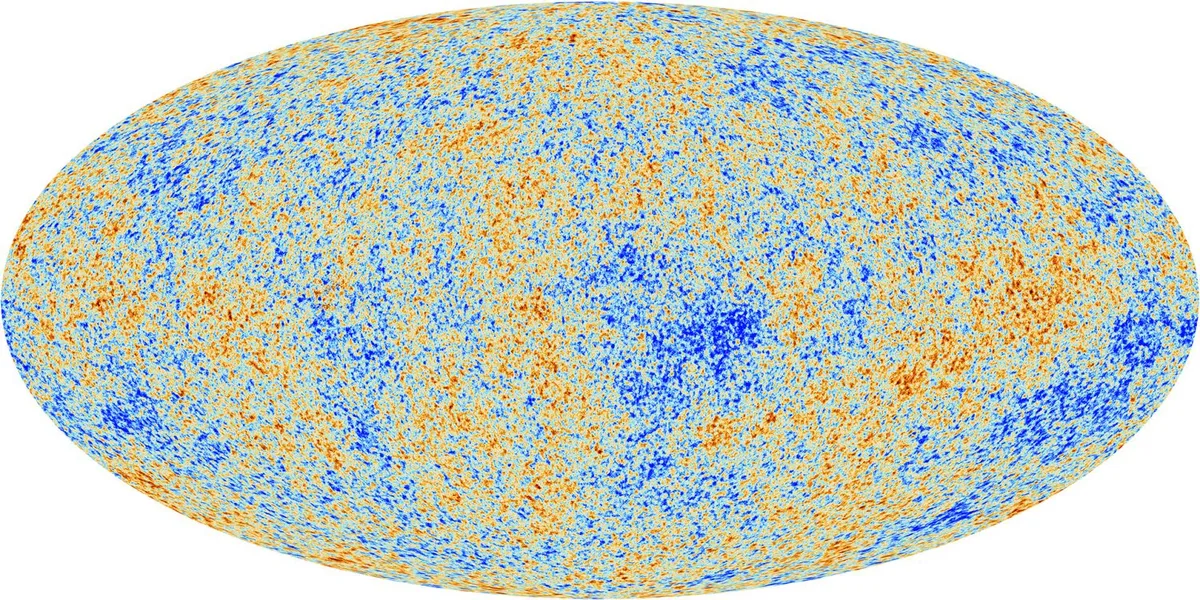
A snapshot of the Cosmic Microwave Background - heat left over from the Big Bang - when the Universe was just 380,000 years old. What came before? Credit: ESA and the Planck Collaboration
Beginning of time
When astronomers talk about the Big Bang, they usually do not refer to the very beginning of the Universe (time zero), but to the incredibly hot and compact state of the Universe in the first couple of minutes of its existence.
To some extent, this is because no one has a real clue about the true nature of time, let alone about the beginning of time.
British physicist Julian Barbour, for one, has argued that time doesn’t even exist, except as an illusion in our minds.
According to others (including Stephen Hawking), time came into existence together with the Universe, rendering the whole concept of the word ‘before’ meaningless.
Asking what happened before the Big Bang would be like asking what lies north of the North Pole, or what distance is shorter than zero.
Will all matter eventually crush back in on itself? Credit: NASA, ESA, H. Teplitz and M. Rafelski (IPAC/Caltech), A. Koekemoer (STScI), R. Windhorst (Arizona State University), Z. Levay (STScI)
Alternative theories
Then again, we simply don’t know whether or not there was time before the Big Bang.
According to the once-popular idea of the cyclic (or oscillatory) Universe, the current expansion of space could one day revert into a contraction, and the resulting Big Crunch could bounce into a new Big Bang, starting the next cycle of an eternal sequence.
It’s just one of many hypotheses in which our Universe is not unique, but part of a possibly infinite multiverse, one way or another.
And if the multiverse is also infinite in time, we’re back to the idea that everything has existed forever, conveniently circumnavigating the nagging question of a beginning.
Credit: NASA/JPL
Finally, South African physicist Neil Turok thinks the Big Bang not only spawned our Universe, but also an anti-Universe, composed of antimatter and running backward in time.
Again, an intriguing idea, but there’s also no chance of confirmation (or rejection!) via observations.
In the end, we have to admit we’re ignorant about the true beginning of the Universe.
And even if we lean towards an eternal multiverse with no real beginning at all, we don’t know why there is something (or, more to the point, why there is everything) instead of nothing.
This article originally appeared in the June 2023 issue of BBC Sky at Night Magazine.
Clues hidden in plain sight are reshaping its story. Across the quiet landscape of northeastern Louisiana, the sweeping ridges and towering mounds of Poverty Point rise with a presence that feels both deliberate and difficult to explain. For generations, archaeologists viewed the site as largely ceremonial, a place defined more by symbolism than daily life. Yet subtle clues buried in the soil have begun pointing toward a far more dynamic past. Patterns of movement, artifacts carried from distant regions, and the scale of construction hint at something larger unfolding here. As new research gathers momentum, the ancient earthworks appear less like silent monuments and more like the framework of an active human landscape.
1. Researchers now see gathering events shaping the ridges. Archeologists believe the concentric ridges supported large gatherings, according to the National Park Service. That possibility transforms the site from a quiet ceremonial zone into a dynamic place filled with people who traveled long distances. The scale begins to feel intentional because it fits the activity it may have once held. Travelers likely arrived with goods, stories and expectations that shaped the rhythm of the place.
Those repeated visits would have carved patterns into the land and created a shared identity linked to Poverty Point. The idea brings a lively pulse to a space once seen as still and symbolic.
2. Movement pathways appear built into the site’s design. Some researchers think the ridges guided how visitors moved, as reported by Smithsonian Magazine. The curved earthworks may have shaped footpaths that channeled people toward central areas. Once seen through that lens, the entire design becomes organized rather than mysterious. Walkways appear to sit quietly inside the broader landscape, waiting for someone to trace them again.
Such structure suggests the site functioned more like a coordinated gathering space than an empty monument. People may have followed predictable routes, creating a sense of flow that held the community together each time they returned to Poverty Point.
3. Massive community labor created the monumental mounds. Soil studies reveal that large communities helped build the mounds, as discovered by the Louisiana Office of State Parks. The work required immense cooperation and hints at a shared purpose that involved many groups. No single leader could have commanded labor on this scale without a unifying reason. That unifying force may have been gatherings, trade or seasonal events that encouraged participation.
This cooperative building effort suggests the site held meaning across broad regions. The sense of collective investment points to a place that functioned actively in the lives of those who constructed it, not a silent symbol removed from daily life.
4. Far reaching trade routes fed into Poverty Point’s economy. Artifacts found at the site originate from regions stretching from the Great Lakes to the Ohio River Valley. Items such as stone tools and copper pieces suggest people arrived carrying goods meant for exchange. These long distance connections give the site a wider influence than many expected and paint it as a major hub. Travelers may have returned because the location offered both opportunity and familiarity.
Trade would also explain why different groups were willing to invest effort into maintaining the site. A place that benefitted many people would naturally gather recurring attention and participation.
5. The central plaza likely hosted timed seasonal events. The massive open plaza appears flattened and maintained with great care. Researchers believe it may have supported events that followed seasonal patterns. Predictable gatherings could have guided travel and anchored cultural routines across many communities. People familiar with those cycles may have anticipated the journey each year and prepared for long trips to the site.
This kind of recurring schedule would create memories tied directly to the plaza. It becomes easier to imagine it filled with families, traders and visitors moving in sync with a rhythm that returned generation after generation.
6. The tallest mounds may have served as visual markers. Some scholars propose that the largest mounds operated as signals for travelers approaching from river routes. Their height and placement make them visible above the surrounding landscape, offering guidance to those arriving by water. That visibility gives the mounds a practical function beyond ceremony. They become landmarks meant to aid navigation across a region shaped by rivers.
Seeing them as markers makes the surrounding area feel more connected. Travelers could have relied on these reference points, making Poverty Point a familiar and welcoming destination even from far away.
7. Specialized activity areas reveal organized working zones. Excavations show clusters of tools and debris that suggest people worked in designated areas. These zones appear set apart from living or gathering spaces, hinting at intentional planning. Visitors may have crafted items, prepared supplies or exchanged goods in particular spots. Such organization points to a site designed to support different roles without chaos.
This separation of activity helps explain the impressive scale of the earthworks. A place that managed large groups needed order, and these areas show how that order may have been maintained by people who used the space regularly.
8. Shared meals created a sense of community identity. Food remains found throughout the site suggest many people ate together during gatherings. Bones, seeds and cooking residues show that meals were larger than simple subsistence activities. Shared eating often strengthens bonds, especially when groups reunite seasonally. These collective meals may have created traditions that tied people from distant regions to the same location.
That social unity helps explain why visitors returned. Meals shared across communities make a place feel familiar, weaving emotional ties into the land itself and anchoring Poverty Point deeper in cultural memory.
9. Water access points reveal careful planning for arrivals. The ridges near natural water sources suggest travelers accessed the site through predictable routes. People arriving by boat would have found convenient transitions from water to elevated ground. This layout indicates that the builders understood how movement worked across the region. Their planning made entry smooth, efficient and intuitive.
Such thoughtful design reinforces the idea that Poverty Point was built for repeated use. It may have been a dependable destination that generations trusted, knowing their arrival would be met with a landscape that welcomed them.
10. New interpretations reveal a site full of human motion. The emerging view of Poverty Point highlights people gathering, trading and working rather than standing in silent ceremony. The land carries the imprint of movement as much as construction. Travelers may have shaped the site as much as the builders did, adding layers of meaning each time they returned. The ridges and mounds feel less like rigid structures and more like traces of lives in motion.
Seeing the site this way brings warmth to its history. Poverty Point becomes a place built by many hands for many reasons, held together by shared purpose.
A series of UFO incidents occurred between 2007 and 2009 in the town of Kumburgaz, situated near Istanbul, Turkey. The events stunned the media and UFO enthusiasts after the images and videos of the sightings went viral on the Internet. The video evidence of UFOs shared by a nightwatchman named Yalcin Yalman could be another strong evidence of non-human technology.
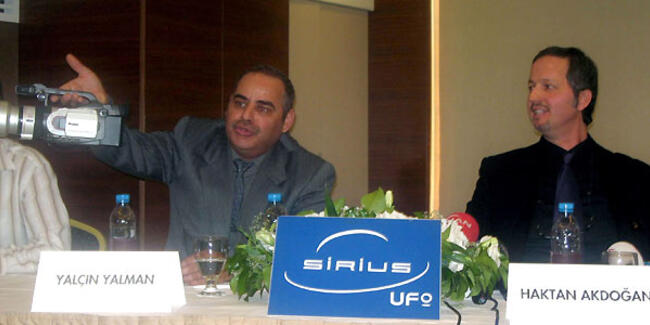
Back in 2008, Yalcin Yalman worked as a night watchman at the Yenikent facility from where he shot all these amazing videos of UFOs, hovering over the Marmara Sea near Kumburgaz. He even showed his second-hand camera to the media in a press conference held at the Dedeman Hotel in Istanbul.
Yalman said he started recording the strange crafts as a hobby to pass his time in the night. Due to the shaky videos, some skeptics claimed that the mysterious objects over the skies of Turkey could have been a US stealth drone or other aircraft. However, numerous experts confirmed that the videos were authentic. Besides, many people witnessed the same unknown crafts in the sky. The sightings gained attention from locals, national media, and even CNN. Several videos were recorded between June 8 and 12, 2009, showing mysterious objects and lights.
Originally, the video was analyzed and made public by the Sirius UFO Space Sciences Research Center led by researcher Haktan Akdoğan. Haktan said the UFOs were often seen by civilians and military pilots during an International UFO Congress in 2009. (Source)
n 2009, after the conference, there were witnesses of 8-10 people including UFOlogist Dr. Roger Leir, who also witnessed and verified the Kumburgaz UFO sighting. Dr. Leir was present during the filming of one video on May 17, 2009, and confirmed that as the UAP turned, it was similar to the “Roswell” shaped craft (more boomerang-shaped) rather than a traditional disc. Dr. Leir discussed this incident that happened with him after the conference on Coast to Coast with George Knapp.
Yalcin Yalman (Left) sitting next to Akdoğan (Right), showing his camera during a press conference in Istanbul in 2009
Dr. Leir told Knapp that he, Yalman and others went to Kumburgaz to film UFOs. The group stayed up from midnight to 4 o’clock in the morning to capture any possible sightings. The conditions were ideal, with clear skies and no obstructions. During the filming, they observed a bright object below the full moon, which initially appeared as a potential star or planet. As they focused on this object, they discovered a semi-circular craft with a multitude of lights, possibly shaped like a boomerang or a cylindrical saucer
Dr. Leir said, “You’d think, ‘Well, gee, a bright sky, bright moon, you’re not going to see anything.’ But in this case, the moon was a big help. It essentially lit up the exterior portion of the craft, which initially, when we saw it, looked a bit like a boomerang because we weren’t seeing it straight on, so we couldn’t tell the exact shape of the craft. But then we went to full film on it, and we could see that it was either a boomerang, or we were looking at a certain portion of a cylindrical craft or a saucer.
Till this day, I don’t know, and I don’t know what the analysts said about the shape. But it was either one of the two: either a boomerang shape with a round front or a complete saucer. It did turn a couple of times, so we were able to see the side, and it looked like it could have been saucer-shaped. But then we got the biggest shock of our lives because we could see light that was emanating from the internal portion of the craft in three areas. One was directly in front, and one was on either side.
This was a full-on front view, and folks can look at the Coast website and they can not only see the video but please go to the Chilean analysis because there are some still photos there which show what we saw when we looked in the central portion. That was a big shock to look and see, not a Rorschach-type thing, but actual entities that were, whatever they were doing, looking out the front of the craft, just the same as we were looking at them.”
Video Observation
From 2007 to 2009, Yalman recorded approximately 30 videos. The footage was taken with a MiniDV Canon DM-GR1-A based on the NTSC system with a diaphragm set at a maximum of 1.8. It is a 3CCD 20x optic 100x with a teleconverter mounted on a 58 mm adapter. The tele-objective is a Sony VCL HGD 1758 model lens, x 1.7. [2007 to 2009 Original Raw Footage]
The videos were examined by two influential state-sponsored organizations in Turkey, “The Scientific and Technology Research Board of Turkey” and “The TUG National Observatory.” Their objective was to identify any evidence of forgery, but the results supported the authenticity of the videos. The original film cassettes were also studied by individuals from Japan, Chile, Brazil, and Russia, and despite several attempts, no one has been able to conclusively demonstrate evidence of a hoax, fraud, or manipulation, leaving the case unidentified.
Yalman’s camera was equipped with a zoom option which allowed him to even capture the pilots, sitting in one of the crafts. The image is shaky due to the hand movements while zooming. However, with the editing software, the video was stabilized, and the result shocked everyone. Two humanoid figures could be seen in the image with large black eyes and oversized heads.
Haktan Akdoğan noted that these are the most important images in Turkey and in the world, saying: “After doing all the necessary analysis which went on for several weeks, the board came to a definite conclusion with no doubt that these are 100% genuine videos. The objects sighted in the aforementioned footage that have a structure that is made of specific material are definitely not made up by any kind of computer animation nor are they any form of special effects used for simulation in a studio or for a video effect therefore in conclusion it was decided that the sightings were neither a mock up or hoax. It is concluded that these objects in the sightings that have physical and material structures do not belong in any category such as; planes, helicopters, meteors, Venus, Mars, satellites, fireballs, Chinese lanterns, fireballs, weather balloons, natural or atmospheric phenomenon etc. and but rather fall into the category of UFOs.”
“We see the heads of not only one UFO but also of two beings in the images. This is the first in the world.” He further added that those images would have a great impact on UFOlogy. He had been researching UFOs for 22 years and had never seen something like this. He stated: “These are the most remarkable images taken in Turkish history.”
[In translation] Akdoğan stated that “these beings are generally seen in areas rich with resources, volcanic areas, and historical places. They started to come more frequently after nuclear tests. Maybe the released radiation also harms the cosmic neighbors, we disrupt the balance in the universe. Maybe they observe this dangerous process.” (Source)
The images were recorded in digital NTSC format by the above-mentioned camera.
The date on the video indicates that the recordings were made during 2007, 2008, and 2009.
The footage images of the object that visibly have a certain configuration are not computer animations, special video effects or studio-re-created images or models. The footage is genuine.
The first observation made from the footage is that some of the images were recorded in the nighttime sky at a certain altitude from the horizon. The footage also covers images of the moon in some parts which proves that the video was shot in the nighttime and open air. But, the fact that digital date displays show AM in certain frames and PM in others, raises suspicion about the validity of the time in which the recordings were made.
Since in some parts, there is no other object that can be featured as a reference in the close-up frames and no observable differences were found on background examination, the actual location, distance, dimensions and nature of the objects could not have been determined.
Through the examination of shootings of multiple dates, it is a strong possibility that 2-3 different objects were captured. However, it is difficult to determine whether the objects are moving or not. Their movement is slow even if they do so.
The reflections of light on the objects are sometimes caused by the moon which was in a convenient location at that time, and sometimes produced by some other sources of light.
The light reflection from the left side of the object which is seen on the August 10th shootings is not produced by the moon. At that time, the moon was in a phase that was pretty close to the “new moon” phase and located approximately at a 10-degree proximity/angle to the horizon. Moreover, the image processing analysis conducted on some parts of the footage revealed that the center of the object has the same density as its background, namely is of a transparent nature.
Not Debunked
Adam Goldstack of UAP Media UK mentions that many debunkers try to explain the craft as cruise ships but according to former F-16 fighter pilot and researcher Chris Letho, it does not add up. Letho analyzed the videos and case and calculated the object’s size, horizon distance, plus visual angles from the Marmara Sea. He concluded the logistics of a cruise ship did not match the reported UAP. (Source)
Goldstack writes, “From an analytical perspective, the Turkey Kumburgaz UFO case is unique with regards to the clear and multiple video footage obtained. Through this case, we also have sequential data that display behavioral patterns, times, and dates. We see all of the twenty-five video encounters/incidents at night-time/early morning (with one in the late evening), which is in keeping with the wider range of Ufology data that suggests UAP often appears at night-time.
We also see another significant pattern displaying the encounters around water – in this case, the Marmara Sea. The Sea of Marmara itself is a small sea with an area of 11,350 km2 (4,380 sq mi) and with dimensions of 280 km × 80 km (174 mi × 50 mi). The sea has a greatest depth of 1,370 m (4,490 ft). How significant the Sea of Marmara is to potential UAP has still not been explained. No connection to nuclear facilities or weapons has been linked in this case.”
Earth will travel right in front of the same Taurid meteor stream in 2032 that caused a mass extinction and worldwide flood ~12,800 years ago, plunging Earth into a mini-Ice Age for 1,300 years. Graham Hancock was right all this time but we did not listen to him.
Our solar system is a dangerous place, and every month Earth inches closer to one of its riskier places, the “Taurid swarm” of meteors. Our planet is predicted to pass directly through the “Taurid swarm” in November 2032.
(Image Credit: AstroStar/Shutterstock)
An ancient monument found in Turkey might be more than just a monument—it could be the world’s oldest solar calendar. Researchers from the University of Edinburgh studied symbols carved on the pillars of Göbekli Tepe, a large, ancient site in southern Turkey. They think these carvings were used to track days, seasons, and years, like a calendar. (Source)
The team noticed that each “V” shape carved on the pillars might represent one day. One pillar even had 365 “V”s, the same number as days in a year. They also found that a special “V” around the neck of a bird-like figure could represent the summer solstice—the longest day of the year. This might explain why the “V” symbol shows up on many other statues in the area, often around the necks of figures connected to time and creation.
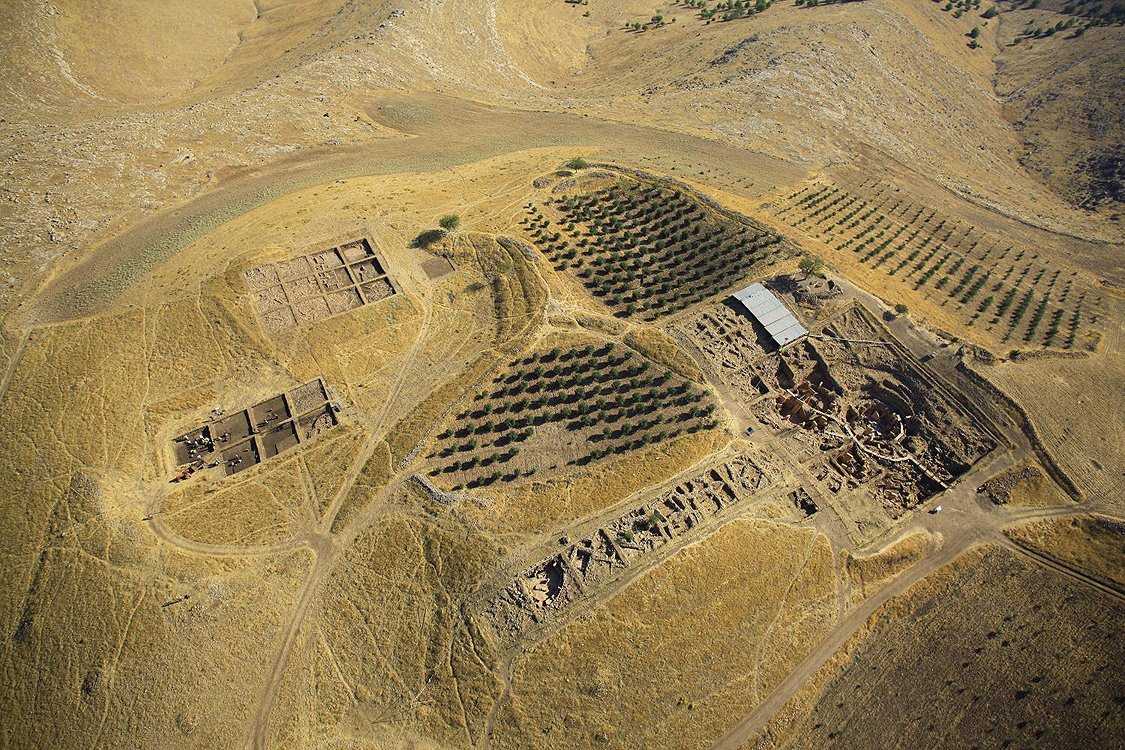
Göbekli Tepe aerial view
Mini Ice Age
The ancient calendar focused on tracking day, night, and seasonal changes, which might have become more important after a major comet hit Earth around 10,850 B.C. This event likely caused a mini-ice age that wiped out many species. According to Martin Sweatman, a researcher from the University of Edinburgh, the people at Gobekli Tepe were careful observers of the sky, possibly because the comet strike had changed their world.
This disaster may have sparked the beginning of civilization by starting new religious beliefs and pushing people to develop agriculture to survive the colder climate. Their carvings might be some of the earliest attempts at writing. These carvings also tracked the cycles of the Moon and Sun, long before similar calendars were made. They may have even shown for the first time that comet strikes are more likely to happen when Earth crosses the path of comet fragments, something that modern scientists have confirmed.
To help support this theory, the team points to another pillar at the site appearing to picture the Taurid meteor stream lasting 27 days, which was quite possibly the source of the ancient comet strike. The researchers believe that the temple carvings show the ancient civilization was recording dates precisely, noting how the movement of constellations across the sky differed based on the time of the year. This would be 10,000 years before Hipparchus of ancient Greece documented the wobble in the Earth’s axis in 150 BC, making this newfound calendar well ahead of its time.
The Younger Dryas boundary (YDB) cosmic-impact hypothesis suggests that around 12,800 years ago, Earth was hit by pieces of a large comet, which broke apart as it entered the inner solar system. This event likely caused a chain reaction, leading to an “impact winter” (a period of intense cold) and a climate change episode called the Younger Dryas (YD). (Source)
The collision is also believed to have caused massive wildfires, the extinction of large animals like mammoths, and changes in human cultures and population decline. Evidence of this impact includes unusually high levels of platinum foundat 26 sites across the Northern Hemisphere, including in ice cores from Greenland, which show platinum deposits over a 21-year period.
The start of the Younger Dryas also shows an increase in dust and chemicals linked to wildfires, like ammonium and other burning aerosols, found in ice cores from Greenland, Antarctica, and Russia. These signs point to one of the biggest wildfire events in over 120,000 years, with about 9% of Earth’s forests burned, covering 10 million square kilometers.
This large-scale burning and the cooling effect of the impact may have triggered the Younger Dryas climate change, according to the theory.
A 2021 study (Taurid complex smoking gun) found that 88 near-Earth asteroids, hidden in the debris that creates the Taurid Meteor Shower, likely came from the breakup of a single comet about 20,000 years ago. Astronomers at the University of Antioquia in Colombia studied the ‘Taurid complex’ to learn more about where these objects came from.
In the 1980s, scientists William Napier and Victor Clube noticed large asteroids in the Taurid stream. They suggested these asteroids had the same origin as Comet Encke, which orbits the Sun every three years. However, some asteroids are over a mile wide, meaning they couldn’t have come from Comet Encke itself. Scientists Ignacio Ferrín and Vincenzo Orofino reviewed old research and measured light reflected from the larger asteroids.
Comet Encke, first seen in 1786, left a trail of debris as it got closer to the sun, like other comets. This trail, made up of rocks, dust, and debris, sometimes comes close to Earth, leading to lots of scientific study. Some studies focus on larger asteroids.
Experts think impacts from the Taurid stream may have contributed to the extinction of ancient cultures and global cooling during the Younger Dryas period. The 1908 Tunguska event, where a small asteroid exploded above Russia, destroying millions of trees, is believed to be connected to this debris stream.
In 2013, the Chelyabinsk meteor, which injured over 1,500 people in Russia, may have also come from the Taurid stream. In 2005, NASA astronomer Rob Suggs observed a flash from a meteor hitting the moon, which was part of the Taurid meteor shower.
A team of Colombian researchers, along with astronomers from Italy’s University of Salento, reviewed many studies on space impacts. They confirmed that a group of space objects contains up to 88 large pieces. Using a method called secular light curves, they noticed changes in the brightness of these objects and found that 67% showed signs of “comet-like” activity. This supported the idea that these objects came from a common origin.
Napier, another scientist, supported their findings. He said that these asteroids, which have orbits like Comet Encke, could either be affected by unknown forces or are pieces of a larger, older comet that lost its gases. This original comet may have been a “rubble pile” – a mix of rocks and other materials held together by ice. Over time, this pile could have broken apart, possibly due to forces from the Sun or another object, creating smaller fragments.
One asteroid, Oljato, is an example of a rubble pile. It’s still held together by ice, which gives it comet-like activity, but it’s much smaller than its parent. Bigger inactive objects like Morpheus are similar, but their ice is trapped inside. Smaller objects, like 2006 SO198, might be the original rocky pieces. The team explained that even if an object looks like a regular asteroid, it could still have a comet-like origin.
Taurid meteors, part of this group, are usually larger than normal meteors. They shine brightly and go deeper into the Earth’s atmosphere, sometimes creating fireballs. While this is mostly harmless, the discovery of larger asteroids in one “dangerous” part of the meteor stream could be a real threat.
Earth passes through this risky area every few years, leading to more shooting stars and possibly large objects hitting Earth instead of burning up in the atmosphere. Future encounters are expected in 2022, 2025, 2032, and 2039.
In 2021, David Asher, Armagh Observatory astronomer predicted that in 2032 and 2036 we are likely to pass through the centre of the Taurid complex, where there will be a ‘noticeable enhancement of fireballs.’ According to study [Taurid complex smoking gun] authors Ignacio Ferrín and Vincenzo Orofino, outgassing from comet-like objects within the complex could be hiding smaller, but still potentially dangerous, asteroids that might hit the Earth.
‘The Tunguska cosmic body was 60 to 90 meters in diameter,’ he told Discover Magazine, adding that we ‘now believe the complex may contain many more objects of that size. It is not the tame, simple and innocent complex we thought it was.’
This Man, Who Worked on the Voyager Missions, Said He Discovered Enormous, Living, Electromagnetic Vehicles Inhabiting Saturn’s Rings Last updated: September 16, 2025 3:36 am By Vicky Verma 7 months ago
This Man, Who Worked on the Voyager Missions, Said He Discovered Enormous, Living, Electromagnetic Vehicles Inhabiting Saturn’s Rings
The Strangest thing about Saturn is that this Man, who worked on the Voyager missions, said he discovered Enormous, Living, Electromagnetic Vehicles inhabiting its Rings.
Dr. Norman Bergrun concluded, based on his analysis of Voyager 1 and 2 data, which he detailed in his 1985 book, Ringmakers of Saturn, that he discovered enormous, living, electromagnetic vehicles inhabiting the rings of Saturn.
Dr. Bergrun, who had worked for NASA, claimed that there were massive alien spacecraft proliferating in the rings of Saturn. He is the author of the books “Ringmakers of Saturn” and “Tomorrows Technology Today,” which document the existence of extraterrestrial vehicles of immense power. A scientist who pioneered the methodology of thermal ice prevention design, he is also credited with roll-stability laws for airplanes and missiles.
Dr. Bergrun was manager of test planning and analysis for the Polaris Underwater Launch Missile System and evaluated satellite system applications. Also a director of Information Systems, he founded his own company in 1971 and is cited in “Who’s Who in the World” and other reference works. He was an alumnus of Ames Research Laboratory, NACA (National Advisory Committee for Aeronautics), predecessor of Ames Research Center, NASA, where he worked for 12 years as a research scientist.
Dr. Norman Bergrun played a key role in the Voyager missions, the probes that were sent out to photograph Saturn, its rings, and its moons. There is a photo shown below from that mission, which he was able to obtain from the agency of a large unidentified flying object hovering just outside Saturn’s rings. It is huge, approximately the size of Earth, and is published in his book, “Ringmakers of Saturn.”
Dr. Bergrun claimed that these rings were not made of ice and rock as is commonly believed, but were actually the exhaust from these massive craft, which he calls “ringmakers.” He asserted that these vehicles are proliferating and are now also present at Jupiter and Uranus, creating new rings on planets that previously had none.
He suggested these vehicles had strong nuclear power sources and advanced electromagnetic technology. They appeared capable of creating massive electrical fields, lightning bolts larger than those on Earth, and disturbances across the entire ring system.
Dr. Bergrun recounted his professional history, mentioning his work at Lockheed on the first generation of the Polaris underwater launch vehicle. This had led him to work in a top-secret area behind closed doors, where he had been required to sign a 30-year non-disclosure agreement.
He explained that he eventually left this role due to “claustrophobia,” clarifying that it was not a fear of small spaces but rather the mental strain of being confined to the same secret room day after day.
It was during this period that he received his first clue about unusual things in space after being given a set of data that no one else could make sense of. When he plotted it, he realized that it showed something strange. (Source)
He claimed that he faced significant opposition and cover-ups from official bodies such as NASA. He recounted a story about a source allegedly connected to NASA who asked him how he had found a particular image from the moon, remarking, “I thought we darkened that enough that you wouldn’t find it.”
Dr. Bergrun also stated that his personal data and images, which he had stored in a supposedly impenetrable vault, were tampered with. He claimed that unknown parties had “garbled” his files on laptops and disks, sometimes erasing them completely. Despite this interference, he believed he did not need the old data because he was so familiar with the subject that he could reconstruct his work at any time.
He claimed that he faced significant opposition and cover-ups from official bodies such as NASA. He recounted a story about a source allegedly connected to NASA who asked him how he had found a particular image from the moon, remarking, “I thought we darkened that enough that you wouldn’t find it.”
Dr. Bergrun also stated that his personal data and images, which he had stored in a supposedly impenetrable vault, were tampered with. He claimed that unknown parties had “garbled” his files on laptops and disks, sometimes erasing them completely. Despite this interference, he believed he did not need the old data because he was so familiar with the subject that he could reconstruct his work at any time.
Regarding the purpose of these vehicles, Dr. Bergrun disagreed with the theory that they were mining the rings. Instead, he suggested that they were “nursing” from the rings, using them as a source of energy to power themselves and to create new, smaller vehicles that later grew, much like living organisms.
He was open to the idea that they might also fly close to the sun to “get pumped up” with energy, since their apparent ability to withstand extreme heat made that possible.
According to him, these could not be fully explained by natural processes. He suggested that the vehicles had electromagnetic capabilities and emitted streams of material, which then formed the rings and gaps seen around Saturn. He gave examples and measurements to support his claims, and pointed to historical observations by Galileo and others that showed unexplained phenomena.
Dr. Bergrun also claimed that similar effects were seen on some of Saturn’s moons. He described mysterious lighting and unusual markings, which he thought were possible “scars” left by the vehicles. He went even further, suggesting that Earth’s Moon, the Tunguska explosion in Siberia, and strange weather events might all be related to visits or actions by these powerful spacecraft.
He argued that these vehicles are evidence of a super-advanced intelligence in the universe and that they have been visiting our solar system for a long time. Bergrun warned that their power could pose risks if not understood, but also noted that they might not necessarily threaten humanity directly.
Dr. Bergrun believed that the situation was becoming “critical” because the activity was increasing, as evidenced by the new rings appearing around Uranus and Jupiter.
His urgency was not necessarily from the idea that the craft were coming to Earth, but from his sense that there was a strong possibility they could, and that the public and the scientific community had to be made to understand that these objects were real.
He noted that his conclusions were too controversial for his professional organization to address. He distinguished between his work, which he said was based on data, and the “theories” of others, such as John Lear’s idea that Saturn was a portal into another dimension.
He also touched on other topics, including his belief that humans were not capable of communicating with these entities, which rendered efforts by organizations like SETI ineffective.
He confirmed that plasma had been scientifically measured in Saturn’s rings, which he saw as supporting his claims. When asked about the hexagonal shape seen at Saturn’s north pole, he acknowledged it but regarded it simply as another geometric form that these advanced entities were capable of creating, rather than holding a special symbolic meaning.
Finally, he revealed that he had spent ten years earning a law degree so that he could better understand the mindset of the people “running the country,” whom he felt often made decisions without comprehending the underlying science.
He died on July 1, 2018, at Tracy Nursing and Rehabilitation Center at the age of 96. Unfortunately, Dr. Bergun was just another name on the list of NASA whistleblowers who are forgotten and ignored due to a lack of followers and media attention.
China launches Tiangong space station's first lab module (Credit : Space Program of the People's Republic of China)
The Chinese didn't invent the rocket but they came remarkably close. More than a thousand years ago, during the Song Dynasty, Chinese engineers were packing black powder into bamboo tubes and launching fire arrows that hissed across battlefields on jets of smoke and flame. Those crude devices were the distant ancestors of every launch vehicle that has ever punched through Earth's atmosphere and there's a pleasing symmetry in the fact that, today, China operates one of the most capable and ambitious space programmes on the planet. From its first satellite in 1970 to a fully operational crewed space station orbiting overhead right now, the journey has been extraordinary. And in 2026, it's about to get even more interesting.
The oldest depiction of rocket arrows. From the Huolongjing. The right arrow reads 'fire arrow,' the middle one is an 'arrow frame in the shape of a dragon,' and the left one is a 'complete fire arrow.'
China's Manned Space Agency has announced the mission schedule for the year ahead, and it reads like a programme firing on all cylinders. Two crewed Shenzhou missions are planned, along with a Tianzhou cargo resupply flight to keep the Tiangong space station stocked with supplies, equipment, and scientific payloads. That alone would make for a busy year.
There's also a genuinely significant scientific experiment buried in the schedule. One astronaut from the Shenzhou-23 crew will undertake a year long continuous stay aboard the station, a duration that pushes into territory previously explored only by Russian cosmonauts and a handful of NASA astronauts aboard the International Space Station. Keeping a human being healthy, functional, and psychologically resilient in microgravity for twelve months is one of the key challenges facing any agency planning deep space exploration. China wants to know what a year in orbit does to the human body, and this mission will generate data that feeds directly into its lunar ambitions.
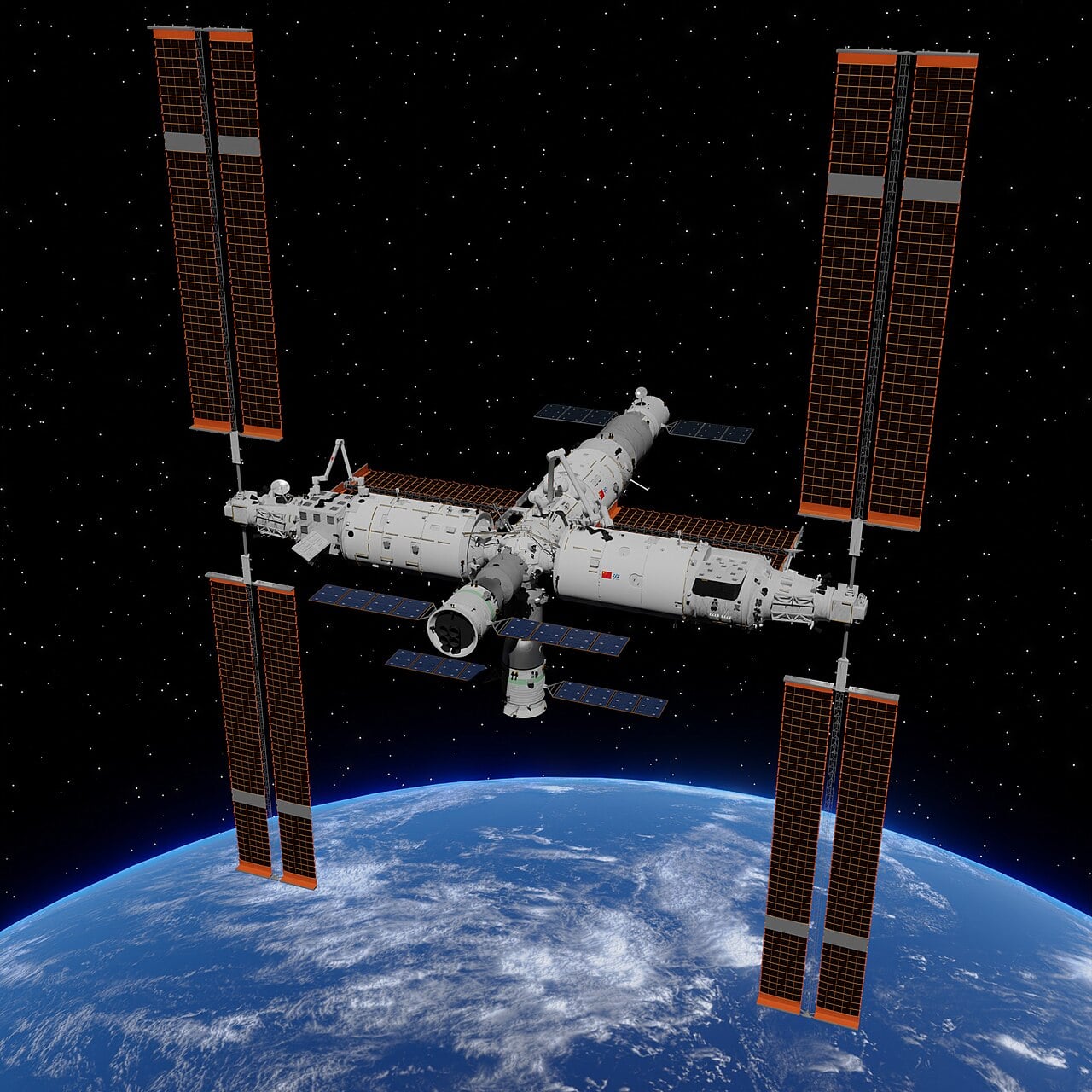
Artist impression of the completed maximum form of Chinese Tiangong Space Station
(Credit : Shujianyang)
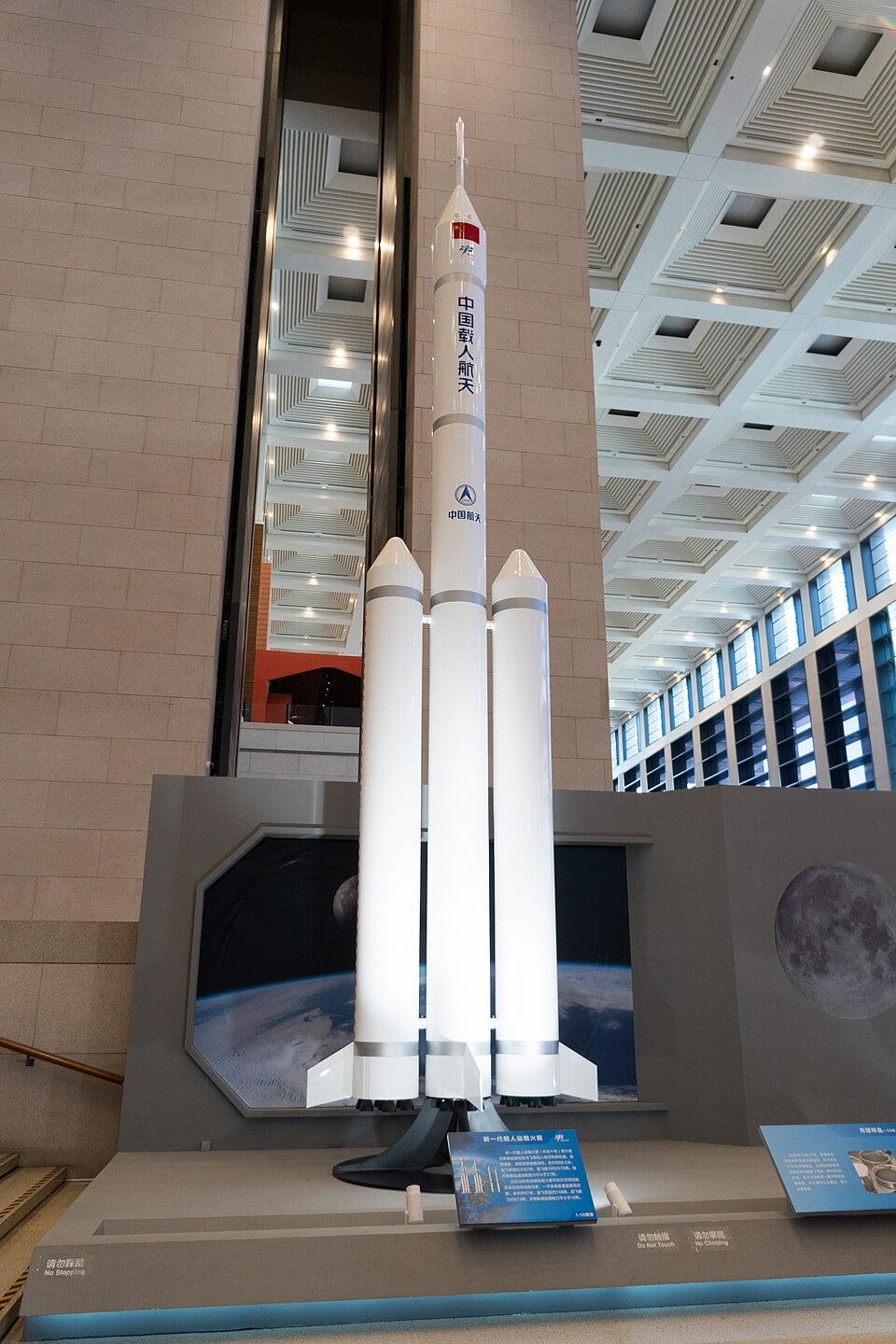
Because those ambitions are very real, and very close. China is targeting a crewed Moon landing by 2030, and the hardware to make it happen is taking shape. The Long March-10 rocket has completed its static fire test, with low altitude demonstration flights also ticked off the list. The Mengzhou crewed spacecraft, which will carry astronauts on the journey to and from the Moon, has passed both maximum dynamic pressure escape tests and zero-height abort tests (the kind of brutal safety validation that space agencies demand before they will trust a vehicle with human lives.) They have also completed landing and takeoff test on Earth of the Lanyue lunar lander, which will descend to the Moon's surface.
Long March 10 mockup displayed at the National Museum of China
(Credit : Shujianyang)
None of this is small. The engineering challenges involved in landing people on the Moon and returning them safely are immense, and the fact that China is systematically ticking off test milestones on all three of its major flight systems simultaneously suggests a programme that is genuinely on track rather than simply projecting confidence.
Beyond the technology, China is also expanding the human geography of its space programme. A Pakistani astronaut is set to fly as a payload specialist aboard Tiangong, following an agreement signed in 2025. It's part of a broader pattern of international partnerships that Beijing has been building steadily, positioning its space station as a genuinely global facility in the years ahead.
Fifty six years after the first humans walked on the Moon, a second nation is methodically building everything it needs to do the same… and the countdown has already started.
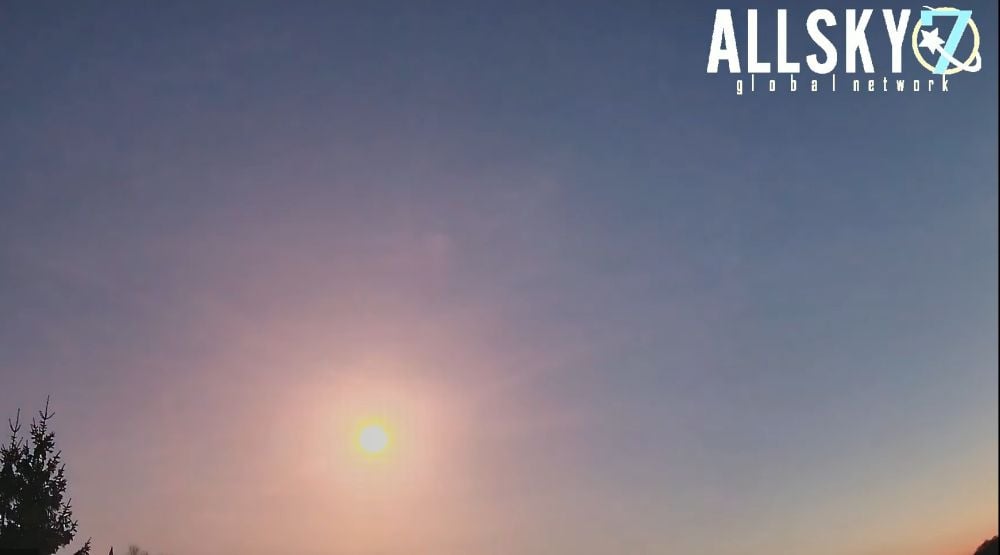
The fireball above Germany on Sunday March 8th, 2026. It glowed for about 6 seconds, and some observers even heard it from the ground. Image Credit: ALLSKY7 / Bernd Klemt – AMS76 Herkenrath/DE
On Sunday March 8th, people in Belgium, France, Germany, Luxembourg, and the Netherlands watched as a fireball crossed the sky. It travelled from the southwest to the northeast, flaming for several seconds. Dedicated meteor cameras, mobile phones, dashcams, and other cameras all captured the event. Some observers even heard the event from the ground. Fragments from the meteor struck homes and buildings in Germany.
The most recent fireball to capture international attention before this one was the Chelyabinsk Meteor in 2013. That was likely an asteroid that exploded in the air before it hit the ground. The ESA is analyzing the event, and they say that fireballs like this can happen from every few weeks to every few years.
The ESA has a planetary defence team, and they're gathering available data to determine how large it was. Their current assessment is that it was several meters in diameter.
It's unlikely that any dedicated survey telescopes saw the object before it entered the atmosphere because of its timing and the direction of its travel. We have only ever detected 11 impactors prior to them entering the atmosphere, so its non-detection isn't unusual. Of course, the Vera Rubin Observatory and its Legacy Survey of Space and Time (LSST) will soon add to that number.
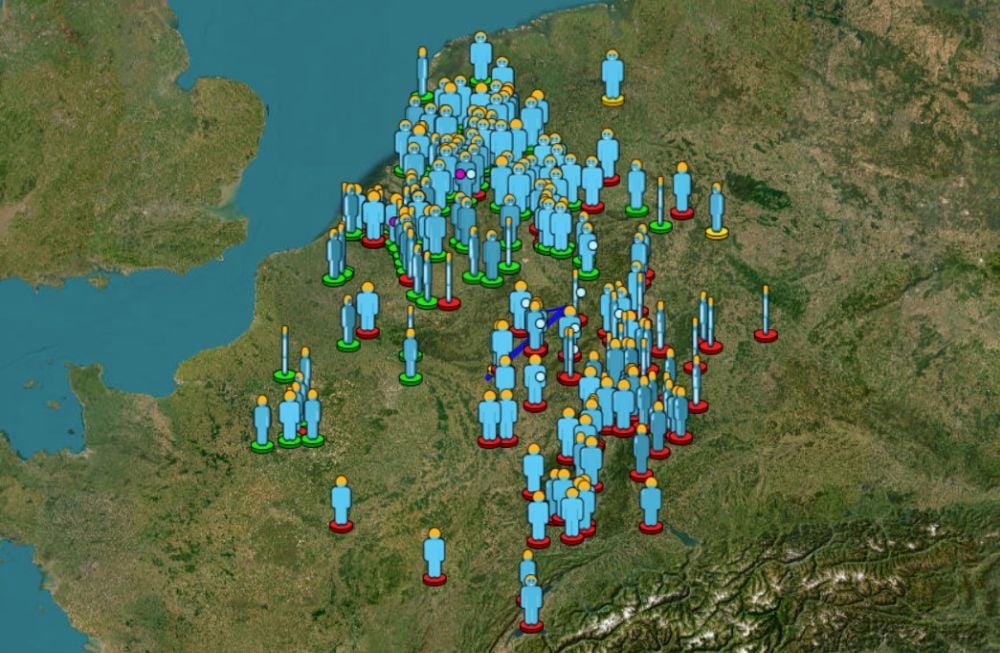
This map shows individual sightings of the fireball. The blue arrow shows the meteor's trajectory. A red circle under a person indicates the witness saw the phenomenon travelling from left to right. A green circle indicates the opposite. A light blue/grey smaller circle on a witness indicates they heard a delayed sound. A purple one indicates they heard a concurrent sound.
Image Credit: International Meteor Organization.
But many dedicated meteor cameras did capture it, including those in the AllSky7 fireball network.
News outlets are reporting that some fragments of the meteorite have already been recovered. Once they find their way to laboratories, analysis will reveal its chemical composition is and its classification. Meteorites are classified into groups according to their relationships to other recovered meteorites. Some meteorites come from the same parent body, and studying these relationships can reveal things about the early Solar System.
The ESA says they will provide an update as they learn more.
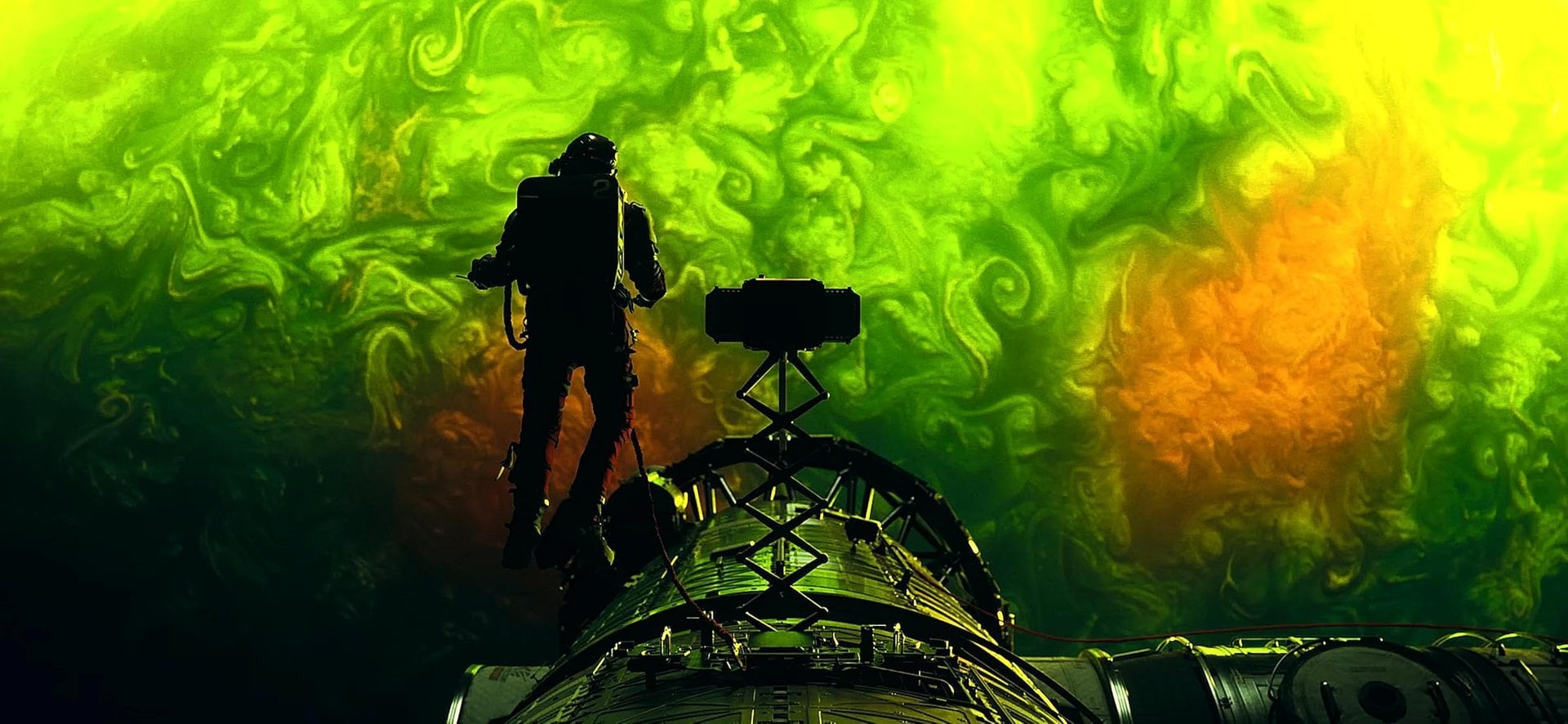
An astronaut ventures outside his ship near an alien planet in "Project Hail Mary." (Sony Pictures / Amazon MGM)
“Project Hail Mary,”a science-fiction novel that’s just been turned into abig-budget, big-screen movie, tells the story of an unlikely astronaut who unexpectedly encounters an alien during a desperate mission to save their respective civilizations.
The astronaut (played by Ryan Gosling in the movie) and the alien have to figure out on the spot whether they’re friends or foes. They also have to come up with a translation system that can accommodate two completely different ways of communicating.
That all makes for a do-or-die space drama reminiscent of “Apollo 13” — but the day is fast approaching when advances in astronomy and artificial intelligence could take a lot of the drama out of alien contact.
Seth Shostak, senior astronomer for the SETI Institute, says he wouldn’t be at all surprised if our first encounter with aliens came in the form of AI-to-AI contact.
“My guess is that the aliens are going to be machines, because that’s what we’re doing, right?” he says in the latest episode of the Fiction Science podcast. “We’re just in the early days of building machines that can do things that humans have had to do in the past. I’m sure that 100 years from now, the most capable intelligence on this planet will not be some sort of soft and squishy biological thing. That’s going to be a machine. And so, if we hear the aliens, I suspect that it’s more than likely that they, too, will be machines.”
If you’re worried that talking about AI and the search for aliens will require delving deeply into spoilers, never fear: Artificial intelligence doesn’t really play a role in the “Project Hail Mary” movie. It’s mentioned only once in the Andy Weir novel on which the movie is based — merely to explain why the planners of the do-or-die mission opted not to use AI. (We do get into spoilers toward the end of this post, however, so consider yourselves warned.)
For more than 65 years, astronomers have been searching the skies for radio signals that might have been sent out by extraterrestrial civilizations. “The usual approach is to build a receiver that can monitor thousands — well, today, millions of different channels simultaneously,” Shostak says. “And you can just look at how that capability has improved over time. It turns out it follows what’s called Moore’s Law … which says that the speed of electronics more or less doubles every two years.”
It takes a lot of computing power to monitor millions of channels, and Shostak says he’s certain that AI will accelerate the search for extraterrestrial intelligence, better known as SETI.
There’s already evidence of that: Last November, the Breakthrough Listen Initiative reported that an AI system developed in partnership with NVIDIA could process real-time data from telescopes searching for fast radio bursts at a rate more than 600 times faster than the current data pipeline. The system improved detection accuracy by 7% and reduced false positives by nearly an order of magnitude.
“This technology doesn’t just make us faster at finding known types of signals — it enables us to discover completely unexpected signal morphologies,” Andrew Siemion, principal investigator for the Breakthrough Listen Initiative, said in a news release. “An advanced civilization might use burst-like communications, modulated signals or transmission schemes we haven’t even imagined. This AI system can learn to recognize patterns that a human might miss entirely.”
AI tools could help astronomers overcome some of the obstacles facing the SETI quest. For example, one group of researchers recently reported that signals from alien civilizations could be scrambled by stormy space weather. Improved pattern-recognition software just might be able to pick out the signal hidden in the cosmic noise.
AI models could also come into play for interpreting alien messages once they’re found. But Shostak isn’t focusing so much on that challenge. “Even if we never understand what the aliens are saying, just the fact that we pick up the signal and can tell that it’s an artificial signal — in other words, made by some technology — that’s very interesting, because we’ve proved that they’re there,” Shostak says.
Understanding what the aliens are saying “would be interesting to know, but I would consider that a secondary benefit of finding their presence,” he says.
Seth Shostak is senior astronomer at the SETI Institute.
(SETI Institute Photo)
Shostak compares the challenge of deciphering alien messages to the challenge that archaeologists faced when they unearthed Egyptian hieroglyphs. “The best way to decipher the hieroglyphics is to have lots of people working on the problem, so just make them known,” he says. “I think the same sort of logic applies here.”
Douglas Vakoch, the president of METI International, has spent a lot of time working on the message translation problem. You can tell that from his organization’s acronym, which stands for “Messaging Extraterrestrial Intelligence.” He says AI can play a supporting role in detecting and decoding alien messages, but not the starring role.
“We need to realize that when we humans try to find patterns hidden in radio static, we may start out with some cut-and-dried guidelines that are very similar to the clear rules used by AI. But often we fail to realize exactly how our rules fall short, because we don’t lay them out clearly,” Vakoch told me via email. “AI forces us to get clear about how we are attempting to solve problems, and simply learning from AI how it is attempting to solve a problem can make us say, ‘You’ve missed something critical. You need to do this instead.’ ”
In his view, discovering an alien message is only half the battle.
“An even greater challenge will be understanding what it means. And that’s where humans will continue to play a role, even as AI becomes more computationally sophisticated in the years to come,” Vakoch said. “Deciphering a message from extraterrestrials will be much more ambiguous. AI might help us detect patterns in alien messages that humans would miss, but we’ll still need people to figure out what the message means.”
Now Shostak is acknowledging that he might have to pay up. “Next time I see you, I’ll buy you a cup of coffee,” he says. “We haven’t found them yet. … Maybe it was just wishful thinking, but honestly, I think that it was more based on the known rate of improvement in the experiments to find the aliens.”
Maybe SETI astronomers just need more time to take advantage of Moore’s Law and AI. Maybe it’ll take another 20 years, or 200 years, to follow through on the promise of “Project Hail Mary” and connect with alien travelers. But in the meantime, I’ll take that cup of coffee.
Here come the spoilers
If you haven’t already read “Project Hail Mary,” it can be tricky to keep track of the movie’s scientific twists and turns. Some of those plot twists have interesting parallels to real-world science, and I can’t resist pointing them out.
In the movie, the stars in our neighborhood are in trouble because of a type of infection that spreads between them. Andy Weir had to break the laws of physics to allow for the existence of organisms capable of soaking up high levels of solar energy. The good news is that real-world physics would rule out the threat that sets the plot of “Project Hail Mary” in motion. For more about the science behind the story, check out this interview with Weir, hosted by Leo Laporte. (Spoilers start at the 32-minute mark.)
One of the plot twists in “Project Hail Mary” allows Gosling’s character to travel to Tau Ceti at close to the speed of light. Thanks to Einstein’s theory of relativity, the interstellar traveler experiences the trip as lasting less than four years, even though Tau Ceti is nearly 12 light-years from Earth.
Mars endured an unprecedented solar superstorm, and European Space Agency (ESA) orbiters, the Mars Express and ExoMars Trace Gas Orbiter, captured the chaos, highlighting the Red Planet’s radiation dangers.
When the storm hit Earth in May 2024, it produced brilliant auroras remarkably close to the equator, and its impact on Mars was no less significant. ESA’s Mars orbiters recorded massive doses of radiation, delivering 200 days’ worth in a mere 64 hours, according to a new paper published in Nature Communications—far more than has ever been recorded before.
Mars Flooded with Solar Radiation
“The impact was remarkable: Mars’s upper atmosphere was flooded by electrons,” says lead author and ESA Research Fellow, Jacob Parrott. “It was the biggest response to a solar storm we’ve ever seen at Mars.”
The storm consisted of three separate events, all of which the team observed. These included a radiation flare, a high-energy particle burst, and a coronal mass ejection. As the high-energy, magnetized plasma and radiation from these events hit the Martian atmosphere, they stripped electrons from neutral atoms, filling the sky with charged particles.
The solar storm’s effects were most clearly felt in two layers of the Martian atmosphere, one at 110 kilometers above the surface and the other at 130 kilometers. The lower level saw a 45% increase in electrons, while the higher layer experienced an unprecedented 278% increase.
“The storm also caused computer errors for both orbiters – a typical peril of space weather, as the particles involved are so energetic and hard to predict,” adds Parrott. “Luckily, the spacecraft were designed with this in mind, and built with radiation-resistant components and specific systems for detecting and fixing these errors. They recovered fast.”
Radio Occultation
ESA is pioneering a technique called radio occultation, utilizing multiple platforms to investigate the Martian atmosphere. Presently, the technique is used with Earth-orbiting satellites, but the team is working to bring it to other planets in our solar system.
The radio occultation process begins with Mars Express sending a signal to the Trace Gas Orbiter just as it vanishes over the horizon. That disappearance is key to the process, bending the signal through layers of the atmosphere on its way to the Trace Gas Orbiter and providing information about those layers along the way. To complete the work, the team confirmed their electron density measurements using NASA’s MAVEN orbiter.
“This technique has actually been used for decades to explore the Solar System, but using signals beamed from a spacecraft to Earth,” said co-author Colin Wilson, ESA project scientist for Mars Express and TGO. “It’s only in the past five years or so that we’ve started using it at Mars between two spacecraft, such as Mars Express and TGO, which usually use those radios to beam data between orbiters and rovers. It’s great to see it in action.”
Earth and Mars
Analyzing the data brings differences between our world and its neighbor, Mars, into clearer focus. Earth’s magnetic field shields our planet, mitigating some of space weather’s strongest effects. That shielding minimized the effects of the 2024 storm in the upper atmosphere while diverting many particles either to the poles or away from the planet entirely.
“Being exposed to the solar flare covered in the article whilst being unprotected would be like getting the worst sunburn of your life in a couple of seconds,” Parrott explained to The Debrief. “However, people are not going to be walking around in short sleeves on the Martian surface for many centuries. So whilst we have our space suits, a thicker ionosphere doesn’t affect the safety of humans much.”
“However, the ionosphere is critical for communications. Sometimes our links to the surface are blocked by ionospheric phenomena,” Parrott continued. “So future missions must be equipped with relay equipment capable of totally different frequency bands, as the frequency of the transmission can affect how a signal travels through the ionosphere.”
“Possible other refinements might be implementing “solar flare blackout” periods in communication scheduling as there is no point using power to transmit to a rover or base on the surface when the ionosphere is going to block all the signals,” Parrott concluded.
“If Mars’s upper atmosphere is packed full of electrons, this could block the signals we use to explore the planet’s surface via radar,” Colin said, “making it a key consideration in our mission planning – and impacting our ability to investigate other worlds.”
With life support infrastructure necessary for mere survival on Mars, this highly radiation- and space-weather-susceptible environment will require further study ahead of any crewed missions.
Ryan Whalen covers science and technology for The Debrief. He holds an MA in History and a Master of Library and Information Science with a certificate in Data Science. He can be contacted at ryan@thedebrief.org, and follow him on Twitter @mdntwvlf.
3I/ATLAS, the unusual interstellar comet that continues to fascinate astronomers, appears to be keeping an intoxicating cosmic secret, new research has revealed.
The latest findings come courtesy of the Atacama Large Millimeter/submillimeter Array (ALMA), which has revealed evidence supporting an unusually large amount of methanol, a form of alcohol, hidden away within the ancient icy interstellar wanderer, which was first discovered last summer.
The discovery suggests that 3I/ATLAS may contain more of the organic molecule than any other comet known in our solar system.
Fingerprints of the Distant Cosmos
Nathan Roth, who led the recent research and is the primary author on a new study detailing his team’s findings, compares observing the oddball comet 3I/ATLAS to “taking a fingerprint from another solar system.”
“The details reveal what it’s made of, and it’s bursting with methanol in a way we just don’t usually see in comets in our own solar system,” said Roth, who is presently a professor at American University.
The recent detections were made possible with ALMA’s Atacama Compact Array in Chile, thanks to observations spanning several dates late last year while 3I/ATLAS approached its closest distance from the Sun.
As the comet’s surface grew warmer, gas and dust were released from its surface, which caused its surrounding coma to increase and brighten, forming a halo-like luminous appearance. Based on studies of the comet’s coma, Roth and his colleagues were able to collect information they liken to the chemical “fingerprints” of its material components—offering a rare look at an object that was assembled long ago by cosmic forces in a far-distant planetary system.
An Intoxicating Discovery
The team’s observations produced faint submillimeter fingerprints of the molecule hydrogen cyanide (HCN), which is a nitrogen-bearing organic molecule common in the composition of comets. That isn’t all the team’s observations revealed, however: there was also a surprising abundance of methanol (CH₃OH), a type of alcohol, present in the comet’s coma.
More specifically, ALMA’s observations indicate that the interstellar interloper seems to possess quite a lot of methanol in contrast to the amounts of hydrogen cyanide it carries, which Roth and his colleagues say is far greater than what “native” comets from within our solar system tend to display. Based on separate measurements on multiple dates, the team says that the methanol to hydrogen cyanide ratios they observed were about 70 and 120.
In short, 3I/ATLAS not only has a lot of methanol; it probably has a significant amount more than most other comets.
A Unique Formation Process
What the current evidence suggests is that 3I/ATLAS is very different from comets in our solar system, given that the conditions under which it was made appear to have been so alien compared with those which give rise to comets in our own solar system.
Based on past observations made by NASA’s James Webb Space Telescope, 3I/ATLAS appeared to possess a coma consisting mostly of carbon dioxide while it was still a significant distance from the Sun. The addition of the new ALMA data adds methanol into the mix, and a surprising abundance of it, at least as far as comets are concerned.
Additionally, the high-resolution imaging made possible by ALMA’s sensitive array of telescopes also helped to reveal the movement of molecules escaping from 3I/ATLAS, which pointed to some unique observations involving the differences between how the hydrogen cyanide and methanol molecules behaved during this process. Namely, while the former appears to originate mostly from the core of the comet, the methanol it produces seems to be abundant not only in its nucleus, but also in the ice particles populating its coma.
As 3I/ATLAS neared the sun, these individual ice particles each began to sublimate, effectively functioning like an untold number of miniature comets themselves, releasing their methanol stores in the process. While such processes are known from past observations of comets originating from within our solar system, these phenomena had never been observed in relation to an interstellar object before the historic journey of 3I/ATLAS.
As 3I/ATLAS neared the sun, these individual ice particles each began to sublimate, effectively functioning like an untold number of miniature comets themselves, releasing their methanol stores in the process. While such processes are known from past observations of comets originating from within our solar system, these phenomena had never been observed in relation to an interstellar object before the historic journey of 3I/ATLAS.
With the discovery of additional confirmed interstellar objects in the years ahead, astronomers hope that observations of their unique behavior and composition can help to unravel many of the existing mysteries associated with distant planetary systems, their origins, and their formation processes.
Roth and his colleagues’ recent paper, “CH3OH and HCN in Interstellar Comet 3I/ATLAS Mapped with the ALMA Atacama Compact Array: Distinct Outgassing Behaviors and a Remarkably High CH3OH/HCN Production Rate Ratio,” was accepted for publication in The Astrophysical Journal Letters.
Micah Hanks is the Editor-in-Chief and Co-Founder of The Debrief. A longtime reporter on science, defense, and technology with a focus on space and astronomy, he can be reached atmicah@thedebrief.org. Follow him on X @MicahHanks, and at micahhanks.com.
On Sunday, March 8, 2026, at 6:55 p.m. Central European Time (7:00 p.m. Kyiv time), as most Europeans were preparing to end their weekend, a dazzling flash lit up the night sky. The object, moving from southwest to northeast, was visible for approximately six seconds.
During this short period of time, the space traveler managed to leave behind a bright trail (“tail”) that was observed by thousands of people in Belgium, France, Germany, Luxembourg, and the Netherlands. The flight ended with a spectacular breakup into several fragments, accompanied by a sound effect similar to distant thunder or an explosion, which was clearly audible on the surface.
Thanks to an extensive network of special meteor observation cameras, in particular the European AllSky7 system, the flight was recorded with high accuracy. In addition to professional equipment, the internet is filled with hundreds of amateur videos shot on smartphones and dashcams.
VARIOUS CITIES, SPAIN – AUGUST 12: Meteors are seen along the Milky Way in the sky on August 12, 2024 in Madrid, Spain. The Perseid meteor shower is reaching peak visibility in the coming days.
(Photo by Aldara Zarraoa/Getty Images)
A spiralling smoke trail lingered in the sky for minutes after the blast.
Credit: Marcel W. via IMO
“Space landing” in Koblenz
Although most such objects burn up completely in the atmosphere, this case turned out to be special. Small pieces of debris — meteorites — were reported to have fallen in Koblenz-Güls (Germany). One of them pierced the roof of a private house, according to DW.
Found fragments of the meteorite. Photo: merkurist.deFragments of the meteorite collected by eyewitnesses to the explosion. Photo: merkurist.de
Despite the dramatic nature of the situation, there were no reports of casualties or significant damage. However, the very fact that the debris reached the surface in a densely populated area aroused great interest among meteorite researchers.
Why were the telescopes silent?
The most interesting question in this story is: why did none of the large survey telescopes that scan the sky around the clock for asteroid threats warn of the approach of this object?
The answer lies in the physics and geometry of lighting. The object approached Earth from the “bright part of the sky,” which made it virtually invisible to ground-based optical instruments. The situation was exacerbated by the time of the event — almost dusk, when atmospheric illumination is at its maximum for detecting dim celestial bodies.
To date, astronomers have only managed to detect 11 objects before they entered the atmosphere. This shows that small bodies measuring several meters remain an extremely difficult target for modern astronomy, especially if they are “hidden” in the sun’s rays.
The scale of the planetary defense problem
From a global security perspective, objects of this size (up to 5-10 meters) do not pose an existential threat. They usually disintegrate in the upper layers of the atmosphere, turning into dust and small debris. However, as the case in Koblenz shows, even small fragments can reach the ground.
Infographic explaining the scale of the disaster in comparison with the size of asteroids. Source: ESA
ESA notes that such events are part of the natural life cycle of our planet. Space rocks of this size enter Earth’s atmosphere quite frequently — from once every few weeks to once every few years. However, most of them fall into oceans or desert areas, remaining unnoticed.
Scientists are now collecting data from all available sensors to determine the mass and composition of the meteorite. The debris found in Koblenz will be sent for laboratory analysis. This will allow us to learn more about the object’s origin: whether it came from the main asteroid belt between Mars and Jupiter, or was a fragment of a comet.
Wow did you see that? This security cam footage caught a triangle UFO flying over the area of Slovakia toward the mountains. They heard it, but didn't see it...why? Because the infrared security camera can see things the human eye cannot. We can't see infrared, it's just a fact. This is not three orbs, it's a single craft and it's big! About the size of two city buses or more.
Scott C. Waring - UFO Sightings Daily, now back in Taiwan
Eyewitness states:
I was with two other friends on a hill in Prejta, and when I was next to the car, I heard something from the village that sounded like something disturbing the local geese. But when I walked towards the car, the sound grew louder and was still like geese, but it was also synchronized and artificial, and it passed over us and was loud, but we didn't see anything, even though we kept looking at the sky, we didn't see anything, even though it was a clear night and the moon was shining, so everything was clearly visible. This happened at 11:15 p.m. on February 25, 2026.
“Plots veegt een asteroïde je stad weg en niemand zag het aankomen”: waarom we volgende keer misschien minder geluk hebben
Zondag explodeerde een metersgroot stuk ruimterots onverwacht in onze atmosfeer. Een deel van deze meteoriet veroorzaakte zelfs schade in Duitsland. Maar het had erger kunnen aflopen. HLN-wetenschapsexpert Martijn Peters legt uit waarom niemand dit zag aankomen, hoe het komt dat wetenschappers de hemel halsstarrig afspeuren naar gevaarlijke asteroïden en wat de kans is dat zo’n exemplaar ons treft. “De ‘kleintjes’ vormen meer gevaar.”
Martijn Peters
Op zondag 8 maart trok een vuurbol – ook wel bolide genoemd – een vurig spoor door de hemel. Veel mensenwaren getuigen van dit zes seconden durende spektakel. Volgens ruimtevaartagentschap ESA was het stuk ruimterots dat in onze atmosfeer uiteenspatte en grotendeels opbrandde, groter dan een meter. Enkele brokstukken wisten de aarde te bereiken in Duitsland en zorgden voor schade aan huizen. Dit keer raakte niemand gewond, maar in de toekomst hebben we misschien minder geluk.
Want ons zonnestelsel is niet bepaald netjes: al miljarden jaren zweven er restjes rond. De meest tot de verbeelding sprekende zijn ongetwijfeld kometen. Die zijn honderden tot duizenden meters groot en bestaan uit stof, gruis en ijs. Wanneer ze in de buurt van de zon komen, verschijnt plots hun staart. Maar dat zijn er slechts enkele duizenden. Talrijker zijn de asteroïden. Wetenschappers schatten hun aantal op bijna anderhalf miljoen. Deze relikwieën van rots en metaal bestaan in alle maten en gewichten, van enkele meters tot honderden kilometers groot.
Bij verwoesting denken velen meteen aan reusachtige, kilometersgrote exemplaren. Dat is volkomen terecht. Een asteroïde van 1 kilometer veroorzaakt wereldwijde problemen. Eentje van 10 kilometer of meer, zoals degene die het einde van de dinosauriërs inluidde, vertelt haast niemand meer na. Maar over deze ‘joekels’ maken wetenschappers zich weinig zorgen. Dat heeft twee redenen. De kans op zo’n inslag is bijvoorbeeld ongelooflijk klein: minder dan één keer per half miljoen jaar, afhankelijk van de grootte. Daarnaast hebben we ze zo goed als allemaal (meer dan 90%) in kaart gebracht. Een wereldwijde ramp is dus extreem zeldzaam.
Waar astronomen eerder wakker van liggen en de hemel naar afspeuren, zijn de ‘kleintjes’. Die vormen het grootste gevaar voor ons. In de astronomie spreken we van een ‘potentieel’ gevaarlijk object als het aan twee voorwaarden voldoet. Zo moet het 140 tot 1.000 meter groot zijn, groot genoeg om een stad te verwoesten. De kans op zo’n inslag bedraagt niet langer honderdduizenden tot miljoenen jaren, maar slechts tienduizenden jaren. De andere voorwaarde is dat de ruimterots de aarde dicht genoeg nadert. Bij ‘gevaarlijk’ dichtbij spreken wetenschappers over 7,5 miljoen kilometer, knuffelafstand in ruimtejargon.
Op dit moment hebben astronomen wereldwijd 11.573 asteroïden van die grootte ontdekt. Een op de vijf (2.532) komt dicht genoeg bij de aarde en krijgt het label ‘gevaarlijk’ van ruimtevaartagentschappen. Gelukkig slaat meer dan 99% de komende 100 jaar met zekerheid niet in. Er is echter een grote ‘maar’ in dit hele verhaal. Volgens wetenschappers hebben we slechts 40% van de asteroïden tussen de 140 en 1.000 meter groot ontdekt. Met andere woorden, er zweven er duizenden rond die ‘gevaarlijk’ zijn en waarvan we het bestaan niet kennen.
Hoe komt dat? Wel, ze zijn goed in verstoppen. We nemen asteroïden waar met behulp van weerkaatst zonlicht. Vaak is dat bitter weinig. Een ruimterots van enkele honderden meters waarnemen tegen een donkere achtergrond is daarom een ware nachtmerrie voor wetenschappers.
Een ander probleem is dat we enkel de hemel afspeuren tijdens de nacht. Heel wat onontdekte asteroïden bevinden zich nabij de zon. Naderen ze ons van de dagkant, dan zien we ze pas voor het eerst als ze ons voorbijvliegen. Tot slot zijn er ook moeilijkheden door technische beperkingen van telescopen en onze atmosfeer. Wetenschappers hopen hier wel verandering in te brengen met nieuwe telescopen in de ruimte, zoals de NEO Surveyor van NASA en de NEOMIR van ESA.
Maar wat met asteroïden die 30 tot 140 meter groot zijn? Zijn die dan niet gevaarlijk? En hoeveel zijn er? Ook die kunnen een stevige impact hebben wanneer ze de atmosfeer binnenvliegen. Bestaan ze voor het grootste deel uit steen, dan barsten ze uit elkaar. Is het vooral ijzer en nikkel, dan overleven ze de tocht door de atmosfeer en slaan ze in. Maar zelfs bij een ontploffing hoog in de lucht ontstaat er schade op de grond door de schokgolf en de hitte. En het probleem bij deze asteroïden is dat we nog geen 3% van de naar schatting half miljoen exemplaren hebben ontdekt. Het risico op een inslag ligt hier op één per enkele honderden jaren.
Er zijn waarschuwingssystemen zoals ATLAS (Asteroid Terrestrial-impact Last Alert System) die de nachtelijke hemel in de gaten houden voor deze kleine onruststokers. Maar zij kunnen ons slechts enkele dagen tot weken voorbereidingstijd geven. De asteroïde van baan veranderen is niet meer mogelijk, maar we kunnen wel de impactzone evacueren. Tenminste, als de asteroïde ons niet vanaf de zon nadert. Nog niet zo lang geleden maakten we dit mee. Op 15 februari 2013 ontplofte onverwacht een asteroïde van 20 meter boven Tsjeljabinsk in Rusland. Duizenden gebouwen raakten beschadigd en 1.500 mensen raakten gewond.
De conclusie is duidelijk. Het zijn de kleine ruimterotsen waarvoor we moeten oppassen. We hebben wel een voordeel in dit hele verhaal: het grootste deel van de aarde is bedekt met water en slechts een klein deel van het landoppervlak is bewoond.
KIJK.
How Meteors and Meteorites Form: A Journey from Space to Earth
Comets, Asteroids, and Meteors | Learn all about what they are made of and how they differ
Vuurbal die gisteravond door de hemel kliefde, richtte ook ravage aan in Duitsland: wat was dat precies? En kan er nog iets volgen?
“Ik wist niet wat ik zag. Een fel brandend object met een witte staart aan de hemel.” Onze tiplijn 4040 stond zondagavond omstreeks 19 uur roodgloeiend. Van Langemark tot Lummen staarden Vlamingen vol ongeloof naar de hemel, waar een vuurbol te zien was. Wat was dat vreemde object? Is het gevaarlijk? En moeten we vrezen voor een nog grotere inslag? Marc Van den Broeck van Volkssterrenwacht Urania legt uit: “Mogelijk ging het om een steen ter grootte van een voetbal.”
Ingrid De Vos - Journalist bij HLN
“Dit was duidelijk geen klassieke vallende ster zoals we die in augustus zien. Dat is vaak maar een stofje van een komeet dat in een fractie van een seconde verdwijnt. Nu waren mensen getuige van een spektakel van vijf seconden, vol gloed en uiteenspattende lichtdeeltjes. Dat wijst erop dat een brokstuk ruimtepuin — een overblijfsel uit de tijd dat onze wereld miljarden jaren geleden werd gevormd — de dampkring is binnengedrongen. In eerste instantie dacht ik aan een kiezelsteentje, maar omdat er ook een luide knal is gehoord, gaan we er nu van uit dat het eerder een steen ter grootte van een voetbal was.”
Aanvankelijk werd gedacht dat het om een meteoor ging:
“Omdat die steen met een waanzinnige rotvaart op onze dampkring beukte. Ter vergelijking: de spaceshuttle remt af tot 10.000 kilometer per uur voor hij de atmosfeer induikt. Dit brokstuk vloog naar binnen met een snelheid van 100.000 kilometer per uur. Door de enorme wrijving met de lucht op 70 kilometer hoogte werd de steen zó heet dat hij begon te gloeien en uiteindelijk met een klap uiteenspatte. Dat is de flits die iedereen zag.”
“Deze vuurbol was uniek vanwege het tijdstip. Dergelijke vuurbollen zien we een paar keer per jaar, maar meestal ’s nachts, als iedereen nog in bed ligt, of in de vroege ochtend. Dat het zich ’s avonds voordoet, is veel zeldzamer. Voor mij is het al tien jaar geleden dat ik het nog eens meemaakte. Dat heeft te maken met de hoek waarin het ruimtepuin op ons af komt vliegen. Stel je de aarde voor als een auto die door een sneeuwstorm rijdt: als chauffeur zie je de vlokken op je voorruit afkomen, terwijl ze in je achterruit net van je wegvliegen. De ochtendhemel is de voorruit van de aarde, de avondhemel de achterruit. Gisteravond keken we dus door de achterruit en zagen we toch een voltreffer.”
“De lichtflits die we zagen was een stuk krachtiger dan we gewend zijn. En in Duitsland hebben ze het geweten: volgens de politie zijn daar meteorieten door daken geboord bij Koblenz, in de Hunsrück en in de Eifelin de regio Rijnland-Palts. Dat is voor onze contreien uiterst uitzonderlijk. Als er effectief brokstukken de grond raken, spreken we van een meteoriet. Meestal is zo’n steen al tot stof verpulverd voor hij de aarde raakt. Dan blijft het bij een mooi schouwspel en spreken we van een meteoor. Elke dag valt er zo’n ton kosmisch stof op onze planeet, maar dat gebeurt vrijwel altijd geruisloos.”
“Absoluut niet. Dit was puur gruis, materiaal dat al miljoenen jaren in de ruimte rondvliegt. Dat het gisteren onze baan kruiste, is puur toeval. Meteorieten die de grond raken, komen meestal in de oceaan of in onbewoond gebied terecht. Slechts 10 procent van de aarde is dichtbevolkt. We zijn gisteravond vooral getuige geweest van een zeldzaam en krachtig natuurverschijnsel.”
0
1
2
3
4
5
- Gemiddelde waardering: 0/5 - (0 Stemmen) Categorie:HLN.be - Het Laatste Nieuws ( NL)
DARPA Reveals the X-76: The X-Plane Aims to Combine Helicopter Freedom With Jet Speed
A DARPA artist’s concept for the X-76. The latest DARPA renderings likely incorporate a degree of artist’s license but make an interesting comparison with Bell renderings.
DARPA
DARPA Reveals the X-76: The X-Plane Aims to Combine Helicopter Freedom With Jet Speed
On modern battlefields, speed and unpredictability increasingly determine survival, and as we’ve seen in the current U.S.-Iran conflict, fixed airbases and long concrete runways that once enabled airpower are starting to look like strategic vulnerabilities.
On Monday, DARPA revealed its newest X-plane, the X-76, an experimental aircraft designed to combine the “go anywhere” flexibility of vertical lift with cruise speeds typical of conventional fixed-wing aircraft.
The X-76 is the centerpiece of DARPA’s Speed and Runway Independent Technologies program, or “SPRINT,” a joint effort with U.S. Special Operations Command. The program is designed to overcome one of aviation’s oldest trade-offs. Helicopters and other VTOL aircraft can reach tight spaces, but they are slower. Meanwhile, traditional fixed-wing aircraft are faster, but they require runways, which limit their operating range and survivability in contested environments.
DARPA has announced that, following a critical design review, Bell Textron has been selected to begin building the X-76 demonstrator, marking the program’s transition into manufacturing, integration, and ground testing ahead of a planned flight-test phase in early 2028.
“For too long, the runway has been both an enabler and a tether, granting speed but creating a critical vulnerability,” DARPA SPRINT program manager, Commander Ian Higgins, said in a press release. “With SPRINT, we’re not just building an X-plane; we’re building options.”
Concept art rendering of the X-76.
(Image Source: Bell Textron)
DARPA’s public renderings reveal the X-76 is not an operational aircraft meant to be fielded as-is. Rather, it is a proof-of-concept technology demonstrator meant to show that the underlying engineering can work at full scale, and to generate real-world data that could shape what comes next.
According to DARPA, the X-76 is intended to mature technologies needed for runway-independent operations while cruising at speeds exceeding 400 knots. The aircraft would also be capable of hovering and operating from unprepared surfaces. Together, those capabilities would blur the line between the roles traditionally filled by helicopters, tiltrotors, and fixed-wing aircraft.
SPRINT’s ambitions are also a window into how the U.S. military’s priorities have shifted as precision weapons and long-range surveillance proliferate.
As we saw in the opening days of the U.S.-Israeli war against Iran, fixed airfields can be mapped, targeted, and logistics hubs can become predictable choke points. Given this reality, having vertical lift capabilities is no longer about convenience. It is about dispersal, resilience, and keeping forces moving even when the infrastructure they once depended on becomes an enemy
The X-76 announcement is also notable for what it signals about the program’s maturity. SPRINT began Phase 1 in late 2023, then moved to Phase 1B in 2024 with contracts to two performers: Aurora Flight Sciences and Bell.
In 2025, DARPA selected Bell for the next stages, awarding it the contract for Phases 2 and 3 to complete design, build the X-plane, and move toward flight testing. The Critical Design Review completed this year marks a milestone that often separates promising concepts from hardware that can actually be assembled, tested, and flown.
In a release by Bell Textron, the company emphasized the symbolic and practical weight of the experimental plane’s designation. “Bell is honored to receive the X-76 designation and continue the spirit of American innovation, honoring the founding of the United States in 1776,” Bell’s senior vice president of engineering, Jason Hurst, said.
That 1776 reference is not subtle. DARPA says the X-76 designation was chosen specifically to coincide with the United States’ 250th anniversary, framing it as a “deliberate nod to the revolutionary spirit of 1776.”
Concept art rendering of the X-76. (Image Source: DARPA, Colie Wertz)
So what exactly is the X-76 trying to prove?
Publicly, DARPA and Bell are focused on the outcomes rather than the engineering schematics.
DARPA’s announcement highlights the aircraft’s target performance envelope. The demonstrator is designed to hover in austere environments and take off and land without prepared runways. At the same time, it is expected to sustain cruise speeds above 400 knots—roughly the territory of many turboprops and some regional jets, but far beyond conventional helicopter performance.
“The goal of the program is to provide these aircraft with the ability to cruise at speeds from 400 to 450 knots at relevant altitudes and hover in austere environments from unprepared surfaces,” DARPA’s SPRINT program description reads.
Bell, for its part, points to a specific enabling approach using “stop/fold” technology. In a statement, the company describes the X-76 build phase as a move toward a “brand-new X-plane with first-of-its-kind stop/fold technology,” intended to support runway independence with jet-like speeds.
A wind tunnel model of one of Bell’s fold-away rotor design concepts.
Bell
Concept art of the X-76 shows an aircraft equipped with folding rotor blades that can be stowed after transitioning to forward flight, reducing drag and enabling higher cruise speeds than traditional rotorcraft.
That basic idea—getting the lift of rotors without paying the aerodynamic penalty of carrying them through high-speed cruise—has been a recurring theme in vertical-lift engineering for decades. Rotors are incredibly efficient at hovering and low-speed flight, but they become a drag and vibration problem as speed climbs.
Crewed and uncrewed design concepts utilizing fold-away proprotor technology that Bell unveiled in 2024 as part of its work on DARPA’s SPRINT program.
Bell
Tiltrotors like the V-22 Osprey pushed that boundary, yet still live with compromises because the rotors remain a dominant feature at all speeds. If initial renderings are any indication, the X-76 demonstrator will be built around a more radical transition—vertical lift when you need it, streamlined cruise when you don’t—which could open a new design space.
DARPA’s own messaging puts it in operational terms. When Cmdr. Higgins calls the runway a “tether,” he is highlighting a modern vulnerability: speed is valuable, but speed tied to predictable basing can be strategically limiting.
By aiming for runway-independent operation, DARPA is implicitly pursuing a future in which aircraft can disperse, relocate, and operate from austere locations—complicating an adversary’s targeting problem while improving response times for time-sensitive missions.
The SPRINT’s partnership structure also hints at where this could matter first. Special operations forces routinely operate at the edge of infrastructure—short on time, long on distance, and often constrained by where aircraft can safely land.
A platform that could move people or critical cargo quickly without relying on long runways could, in theory, compress timelines for infiltration, resupply, or medical evacuation, while expanding the number of usable launch and recovery sites.
DARPA’s program description stresses that the demonstrator is meant to validate integrated concepts that “can be scaled to different-sized military aircraft,” suggesting that the endgame is not a single airframe, but a portfolio of possible derivatives.
An earlier (2021) Bell rendering showing three related design concepts with fold-away rotor blades.
Bell
There are good reasons DARPA is pursuing this as an X-plane effort rather than a direct acquisition program. “Runway-independent” and “high speed” are not especially difficult goals on their own. The challenge is combining them in a single aircraft with useful payload capacity, manageable complexity, and a transition mode that is both safe and repeatable.
The hardest part comes during the transition from hovering to fast forward flight. That is when mechanical stress, heat, and tricky aerodynamic forces all come into play at once. That is why the X-76 is being built as a test aircraft first. DARPA wants to find out what can actually be built, controlled, and reproduced reliably before considering large-scale production.
With its Critical Design Review now complete, DARPA says the SPRINT program is shifting to manufacturing, integration, assembly, and ground testing of the X-76 demonstrator. Flight tests under Phase 3 are scheduled to begin in early 2028.
For now, though, the X-76 is not really a new operational jet. It is a high-stakes experiment meant to answer a larger question: can the runway become optional without sacrificing speed or survivability?
A computer-generated image of a Bell future tiltrotor carrying out a personnel recovery mission over the sea. This was schemed under the HSVTOL project, which is closely related to SPRINT.
Bell
If the X-76 demonstrator succeeds, it will give the Pentagon something it increasingly values in an era of long-range precision fires and contested logistics: more ways to move fast without being predictable.
As SPRINT program manager, Cmdr. Higgins notes, “We’re working to deliver the option of surprise, the option of rapid reinforcement, and the option of life-saving speed, anywhere on the globe, without needing any runway.”
Tim McMillan is a retired law enforcement executive, investigative reporter and co-founder of The Debrief. His writing typically focuses on defense, national security, the Intelligence Community and topics related to psychology. You can follow Tim on Twitter:@LtTimMcMillan. Tim can be reached by email: tim@thedebrief.org or through encrypted email:LtTimMcMillan@protonmail.com
An artist's impression of 3I/ATLAS is shown as it passes near the sun, illuminating one side of the comet. On the side of the comet closer to the sun, the methanol gas is shown in blue, with icy dust grains still present in the gas. On the dark side of the comet, the hydrogen cyanide is shown in orange. Credit: NSF/AUI/NSF NRAO/M.Weiss
Comet 3I/ATLAS continues to make astonishing headlines, thanks to new findings from astronomers using the Atacama Large Millimeter/submillimeter Array (ALMA). This new research reveals that 3I/ATLAS is packed with an unusually large amount of the organic molecule methanol—more than almost all known comets in our own solar system.
"Observing 3I/ATLAS is like taking a fingerprint from another solar system," shares Nathan Roth, lead author on this research, and a professor with American University. "The details reveal what it's made of, and it's bursting with methanol in a way we just don't usually see in comets in our own solar system." The findings are posted on the arXiv preprint server.
ALMA observations of an interstellar visitor
Using ALMA's Atacama Compact Array in Chile, on multiple dates in late 2025, the team observed 3I/ATLAS as it approached our sun. As sunlight warmed its icy surface, 3I/ATLAS released gas and dust, forming a glowing halo (or coma) around its core. By analyzing this coma, astronomers revealed the chemical fingerprints of the material it is composed of, allowing them to study how objects might be made in another planetary system, without leaving our own.
The team focused on the faint submillimeter fingerprints of two molecules: methanol (CH₃OH), a type of alcohol, and hydrogen cyanide (HCN), a nitrogen-bearing organic molecule commonly seen in comets. The ALMA data reveal that 3I/ATLAS is heavily enriched in methanol compared to hydrogen cyanide, far beyond what is typically seen in comets born in our own solar system. On two observing dates, the team measured methanol-to-HCN ratios of about 70 and 120, placing 3I/ATLAS among the most methanol-rich solar system comets ever studied.
What the chemistry reveals about origins
These measurements imply that the icy material from 3I/ATLAS was formed by (or experienced) very different conditions than those that shape most comets in our own solar system. Previous work with the James Webb Space Telescope has shown that 3I/ATLAS had a coma dominated by carbon dioxide when it was far from the sun, and these new ALMA results add methanol as another unusual detail in its chemical inventory.
ALMA's high resolution for imaging also allowed the team to see how different molecules move away from the comet, revealing surprising differences between methanol and hydrogen cyanide. Hydrogen cyanide appears to come, for the most part, directly from the comet's core, or nucleus, which is typical for comets in our solar system. Methanol, on the other hand, appears to come from both the nucleus and from ice particles in the coma.
These tiny, icy grains act like mini-comets: as the object moves closer to the sun, where ice turns into gas, they also release methanol. Similar behavior has been observed in some solar system comets, but this is the first time the physics of such detailed outgassing has been traced in an interstellar object.
Comet 3I/ATLAS is only the third confirmed object ever seen passing through our solar system from interstellar space, after 1I/'Oumuamua and 2I/Borisov. Observations of these objects also revealed unusual properties. As astronomers continue to discover and study more interstellar objects, our understanding of planet formation in other planetary systems continues to grow more interesting.
Publication details
Nathan X. Roth et al, CH3OH and HCN in Interstellar Comet 3I/ATLAS Mapped with the ALMA Atacama Compact Array: Distinct Outgassing Behaviors and a Remarkably High CH3OH/HCN Production Rate Ratio, arXiv (2025). DOI: 10.48550/arxiv.2511.20845
Nathan X. Roth et al, CH3OH and HCN in Interstellar Comet 3I/ATLAS Mapped with the ALMA Atacama Compact Array: Distinct Outgassing Behaviors and a Remarkably High CH3OH/HCN Production Rate Ratio, The Astrophysical Journal Letters (2026). DOI: 10.3847/2041-8213/ae433b , iopscience.iop.org/article/10. … 847/2041-8213/ae433b
Beste bezoeker, Heb je zelf al ooit een vreemde waarneming gedaan, laat dit dan even weten via email aan Frederick Delaere opwww.ufomeldpunt.be. Deze onderzoekers behandelen jouw melding in volledige anonimiteit en met alle respect voor jouw privacy. Ze zijn kritisch, objectief maar open minded aangelegd en zullen jou steeds een verklaring geven voor jouw waarneming! DUS AARZEL NIET, ALS JE EEN ANTWOORD OP JOUW VRAGEN WENST, CONTACTEER FREDERICK. BIJ VOORBAAT DANK...
Druk op onderstaande knop om je bestand , jouw artikel naar mij te verzenden. INDIEN HET DE MOEITE WAARD IS, PLAATS IK HET OP DE BLOG ONDER DIVERSEN MET JOUW NAAM...
Druk op onderstaande knop om een berichtje achter te laten in mijn gastenboek
Alvast bedankt voor al jouw bezoekjes en jouw reacties. Nog een prettige dag verder!!!
Over mijzelf
Ik ben Pieter, en gebruik soms ook wel de schuilnaam Peter2011.
Ik ben een man en woon in Linter (België) en mijn beroep is Ik ben op rust..
Ik ben geboren op 18/10/1950 en ben nu dus 75 jaar jong.
Mijn hobby's zijn: Ufologie en andere esoterische onderwerpen.
Op deze blog vind je onder artikels, werk van mezelf. Mijn dank gaat ook naar André, Ingrid, Oliver, Paul, Vincent, Georges Filer en MUFON voor de bijdragen voor de verschillende categorieën...
Veel leesplezier en geef je mening over deze blog.