The purpose of this blog is the creation of an open, international, independent and free forum, where every UFO-researcher can publish the results of his/her research. The languagues, used for this blog, are Dutch, English and French.You can find the articles of a collegue by selecting his category. Each author stays resposable for the continue of his articles. As blogmaster I have the right to refuse an addition or an article, when it attacks other collegues or UFO-groupes.
Druk op onderstaande knop om te reageren in mijn forum
Zoeken in blog
Deze blog is opgedragen aan mijn overleden echtgenote Lucienne.
In 2012 verloor ze haar moedige strijd tegen kanker!
In 2011 startte ik deze blog, omdat ik niet mocht stoppen met mijn UFO-onderzoek.
BEDANKT!!!
Een interessant adres?
UFO'S of UAP'S, ASTRONOMIE, RUIMTEVAART, ARCHEOLOGIE, OUDHEIDKUNDE, SF-SNUFJES EN ANDERE ESOTERISCHE WETENSCHAPPEN - DE ALLERLAATSTE NIEUWTJES
UFO's of UAP'S in België en de rest van de wereld Ontdek de Fascinerende Wereld van UFO's en UAP's: Jouw Bron voor Onthullende Informatie!
Ben jij ook gefascineerd door het onbekende? Wil je meer weten over UFO's en UAP's, niet alleen in België, maar over de hele wereld? Dan ben je op de juiste plek!
België: Het Kloppend Hart van UFO-onderzoek
In België is BUFON (Belgisch UFO-Netwerk) dé autoriteit op het gebied van UFO-onderzoek. Voor betrouwbare en objectieve informatie over deze intrigerende fenomenen, bezoek je zeker onze Facebook-pagina en deze blog. Maar dat is nog niet alles! Ontdek ook het Belgisch UFO-meldpunt en Caelestia, twee organisaties die diepgaand onderzoek verrichten, al zijn ze soms kritisch of sceptisch.
Nederland: Een Schat aan Informatie
Voor onze Nederlandse buren is er de schitterende website www.ufowijzer.nl, beheerd door Paul Harmans. Deze site biedt een schat aan informatie en artikelen die je niet wilt missen!
Internationaal: MUFON - De Wereldwijde Autoriteit
Neem ook een kijkje bij MUFON (Mutual UFO Network Inc.), een gerenommeerde Amerikaanse UFO-vereniging met afdelingen in de VS en wereldwijd. MUFON is toegewijd aan de wetenschappelijke en analytische studie van het UFO-fenomeen, en hun maandelijkse tijdschrift, The MUFON UFO-Journal, is een must-read voor elke UFO-enthousiasteling. Bezoek hun website op www.mufon.com voor meer informatie.
Samenwerking en Toekomstvisie
Sinds 1 februari 2020 is Pieter niet alleen ex-president van BUFON, maar ook de voormalige nationale directeur van MUFON in Vlaanderen en Nederland. Dit creëert een sterke samenwerking met de Franse MUFON Reseau MUFON/EUROP, wat ons in staat stelt om nog meer waardevolle inzichten te delen.
Let op: Nepprofielen en Nieuwe Groeperingen
Pas op voor een nieuwe groepering die zich ook BUFON noemt, maar geen enkele connectie heeft met onze gevestigde organisatie. Hoewel zij de naam geregistreerd hebben, kunnen ze het rijke verleden en de expertise van onze groep niet evenaren. We wensen hen veel succes, maar we blijven de autoriteit in UFO-onderzoek!
Blijf Op De Hoogte!
Wil jij de laatste nieuwtjes over UFO's, ruimtevaart, archeologie, en meer? Volg ons dan en duik samen met ons in de fascinerende wereld van het onbekende! Sluit je aan bij de gemeenschap van nieuwsgierige geesten die net als jij verlangen naar antwoorden en avonturen in de sterren!
Heb je vragen of wil je meer weten? Aarzel dan niet om contact met ons op te nemen! Samen ontrafelen we het mysterie van de lucht en daarbuiten.
09-01-2026
Most People Have Never Heard of This Valley That Keeps Capturing UFOs! | Project Hessdalen
Most People Have Never Heard of This Valley That Keeps Capturing UFOs! | Project Hessdalen
Overview
Nestled in the remote Hessdalen Valley of Norway, a persistent mystery has captivated scientists and enthusiasts for over four decades. Project Hessdalen, an internationally recognized research initiative, has dedicated itself to studying the unexplained light phenomena that continue to appear above this quiet landscape. Since the early 1980s, locals and visitors have regularly reported seeing strange orbs, luminous anomalies, and inexplicable lights dancing across the night sky.
These sightings often occur with startling consistency, sometimes as frequently as 20 to 30 times per week, highlighting the persistent and puzzling nature of the phenomena. Despite numerous investigations, camera recordings, and scientific studies, the true origin and nature of the lights remain elusive and unexplained. Researchers have considered numerous theories, ranging from natural atmospheric phenomena to experimental aircraft or even extraterrestrial activity, but no definitive explanations have been confirmed. The Hessdalen lights have attracted researchers from around the world, eager to understand their mysterious origin. The local community has been both intrigued and impacted by these ongoing sightings, with tourism increasing as visitors come hoping to witness the phenomenon firsthand. Overall, the Hessdalen lights continue to challenge our understanding of atmospheric and environmental science, inspiring ongoing scientific exploration and debate. This enduring mystery keeps Hessdalen at the forefront of paranormal and scientific research, fueling curiosity and investigation into one of the most intriguing natural phenomena in modern times.
The Origins of Project Hessdalen
The origins of Project Hessdalen can be traced back to the early 1980s, specifically to the years 1981 and 1982, when Norwegian media outlets first began reporting on the mysterious lights appearing in the Hessdalen Valley. At that time, the sightings were primarily considered a local curiosity—something intriguing yet unworthy of serious scientific inquiry. The reports consisted of vivid descriptions of glowing orbs and strange luminous phenomena that seemed to dance across the night sky, capturing the imagination of local residents and visitors alike. These reports sparked curiosity and interest among the residents and gave rise to a sense of wonder surrounding the Hessdalen lights.
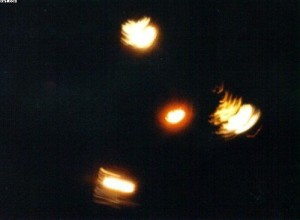
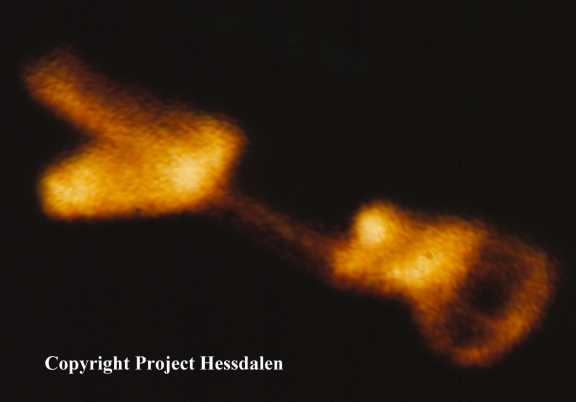
- Photo taken by Kurt Anderssen in 1982. It is taken close to the main road in Hessdalen, towards a flashing light above the mountain Finnsåhøgda. Kurt used a camera standing on a tripod, equipped with a 2000 mm lens, which he had borrowed from Arne P.Thomassen. Kurt managed to take a picture just when the light got in the view of the camera.
As local reports grew more frequent and consistent, the phenomenon began to attract the attention of scientists and researchers, who saw an opportunity to investigate a genuinely unusual natural occurrence. Fred Palisen, who is now the CEO of Project Hessdalen, recalls a pivotal experience from 1983. He explains, “In 83, there were two cars—maybe like six people—who went up the mountain to observe. Just one hour after they had parked and set up camp, they saw something extraordinary: a powerful light moving back and forth, sometimes dipping below the horizon, emitting beams, then moving again.” The sighting was so compelling that it encouraged further investigation.
This first-hand account underscored the need for systematic study rather than dismissing the phenomenon as mere hallucination or urban legend. An observer at the time insisted, “We are scientists. We should study this.” That statement marked a turning point; it demonstrated a shift from casual observation to a scientific approach. Despite initial skepticism from some academics who questioned whether such unexplained lights could be scientifically studied, these early explorers persisted in their efforts, driven by curiosity and a desire to understand what they had witnessed.
The commitment to rigorous observation laid the foundation for the eventual establishment of an ongoing research project in Hessdalen. Over the years, scientists and engineers have deployed sophisticated equipment, including cameras, spectrometers, and radar systems, to monitor and analyze the phenomenon. The project has grown into a collaborative effort involving local residents, international researchers, and technology experts. Today, Project Hessdalen continues to document the lights, striving to find scientific explanations for their origins—whether natural, electrical, or something currently beyond our understanding.
In summary, the origin of Project Hessdalen is rooted in early media reports, local curiosity, and a committed group of investigators who recognized the importance of studying these mysterious geological phenomena. Their efforts have transformed what was once considered a local curiosity into a serious scientific investigation that continues to intrigue researchers worldwide.
Scientific Methods and Technology
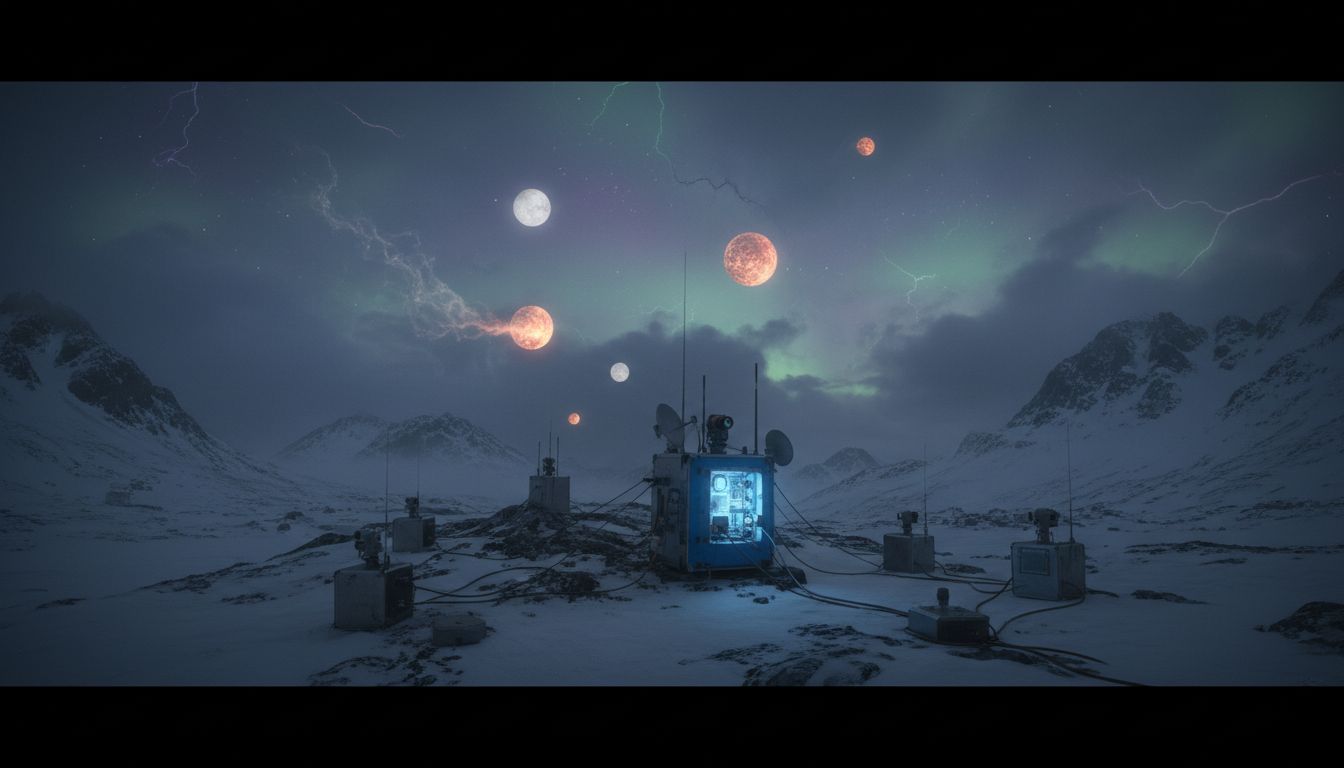
Central to Project Hessdalen’s mission is its unwavering dedication to collecting measurable and verifiable data. Since its inception in 1998, the project has pioneered innovative technological solutions to monitor and study the mysterious phenomena observed in the Hessdalen Valley in Norway. One of its most significant advancements is the development and deployment of the "Blue Box," a state-of-the-art autonomous multi-sensor anomaly detection system. This device is regarded as the world's first of its kind, capable of continuously surveilling the sky above Hessdalen without human intervention.
The Blue Box integrates various sensors—such as electromagnetic detectors, spectrometers, and infrared cameras—to capture a comprehensive dataset across multiple spectrums. This continuous monitoring enables researchers to track unusual light sightings, analyze their characteristics, and distinguish between natural and artificial phenomena. The data collected are stored in real-time and can be analyzed later to identify patterns or recurring behaviors, providing vital insights into the bizarre lights that have baffled scientists for decades.
As Palisen, a key researcher involved with the project, explains, the overarching goal is to promote "open science" — where all collected data can be shared openly with scientists worldwide and made accessible to the public. This transparency encourages collaboration and transparency, fostering a global scientific community that can verify findings and explore hypotheses without proprietary restrictions.
The project's approach combines cutting-edge technology with collaborative, hands-on research efforts. In addition to the Blue Box, the team utilizes high-definition video cameras strategically positioned around the valley to capture the phenomena from multiple angles. These video recordings, synchronized with sensor data, allow for detailed analysis of the phenomena in real time and after the events occur.
Moreover, the project actively engages students and international research teams through organized fieldwork, such as science camps and collaborative expeditions. These initiatives not only help gather diverse insights but also promote educational outreach and inspire the next generation of scientists. Overall, the combination of innovative sensors, video monitoring, and a collaborative scientific ethos forms the backbone of Project Hessdalen’s efforts to uncover the truth behind these enigmatic lights.
Theories and Global Interest
The persistent and enigmatic light phenomena observed in Hessdalen have captivated researchers, scientists, and enthusiasts worldwide for decades. These luminous displays, which often appear as bright, rapidly moving or stationary lights in the night sky, have inspired a diverse array of hypotheses attempting to explain their origin. At the more scientifically grounded end, some experts propose that these lights are caused by natural plasma formations resulting from unique atmospheric conditions. Others suggest they may be due to unusual electromagnetic phenomena, possibly related to ionization events in the Earth's ionosphere or interactions between meteorological processes and mineral-rich terrains in the valley.
Additionally, some researchers have explored the possibility that these lights originate from natural atmospheric discharges, similar to ball lightning or other rare electrical phenomena. These ideas are supported by observations of the lights changing speed, shape, and color, sometimes correlating with local weather patterns or atmospheric changes. Conversely, more speculative theories propose extraterrestrial origins, suggesting that the lights could be manifestations of UFO activity or alien visitors observing Earth. These claims, though popular in sensational media, remain fringe within the scientific community, which emphasizes thorough investigation and empirical evidence.
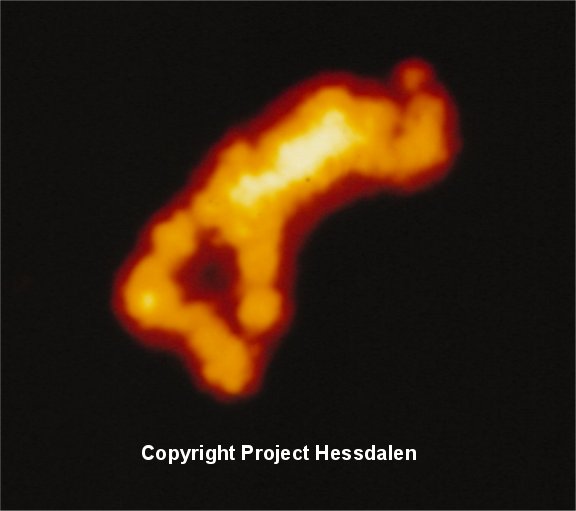
Photo taken by Arne P. Thomassen the 25. September 1982 between 19.00 and 20.00. It is taken from the mountain Finnsåhøgda south, towards east. This photo shows the same phenomena as in this picture, but it was taken some minutes after.
Despite the variety of hypotheses, the researchers involved in the Hessdalen project emphasize a cautious, scientific approach. They are committed to understanding the phenomena through material evidence rather than sensationalism. The core of their work involves extensive observation, data collection, and analysis of the lights using a combination of high-resolution cameras, spectrometers, and sensor arrays. To foster international cooperation and enhance their understanding, the team regularly hosts workshops and conferences that attract experts from around the world. These gatherings provide a platform for sharing footage, sensor readings, and hypotheses, encouraging interdisciplinary collaboration among physicists, meteorologists, astrophysicists, and engineers.
Over the years, peer-reviewed studies have been published based on data collected in Hessdalen, establishing a scientific framework to describe the events, even though the phenomenon itself remains elusive and not fully understood. This ongoing research aims to uncover the underlying causes of the lights, bridging the gap between curiosity and scientific rigor, and maintaining Hessdalen’s reputation as a unique natural laboratory for studying unexplained atmospheric phenomena on a global scale.
Community and Continued Mystery
For Fred Palisen and many involved in Project Hessdalen, the initiative is as much about community engagement as it is about scientific research. He describes his own entry into the project as almost incidental—a joke during a workplace presentation about conspiracy theories led to an unexpected leadership role. Yet, despite the humorous beginnings, the dedication of those involved remains unwavering. The lights of Hessdalen, with their mesmerizing and sometimes haunting displays, continue to inspire both skepticism and wonder. Palisen recalls observing the lights firsthand: "This is a light that was so strong. So it was obviously not a star... It was moving sideways and up and down and sometimes stopping, and then you would have a beam coming down." Such accounts fuel ongoing curiosity about what exactly causes these mesmerizing displays.
Despite decades of observation and technological advancements, the true nature of the Hessdalen lights remains unresolved. Some scientists postulate natural explanations, while others keep an open mind toward extraterrestrial hypotheses. The ongoing efforts of Project Hessdalen exemplify the enduring value of open-minded scientific investigation—demonstrating how persistent curiosity and rigorous methodology can keep a mystery alive. Ultimately, Hessdalen stands as a testament to humanity’s fascination with the unknown and the importance of exploring phenomena that challenge conventional understanding.
In essence, Hessdalen’s unexplained lights serve as a reminder that, sometimes, nature still holds secrets waiting to be unlocked—and that scientific curiosity remains a vital tool in uncovering the truth behind inexplicable mysteries.
MUFON Presentation Revealed First Authenticated UFO Contacts by They Fly Productions
MUFON Presentation Revealed First Authenticated UFO Contacts by They Fly Productions
Unprecedented physical evidence was analyzed and authenticated by US astronaut, USAF OSI/DoD case supervisor, NASA, JPL, IBM and USGS scientists, plus McDonnell Douglas defense industry, photographic, special effects, and other experts
SEDONA, Ariz., Jan. 7, 2026 /PRNewswire/ -- The formerly tabloid topic of UFOs is now making headlines worldwide, attracting Harvard scientists, military whistleblowers, and is the subject of frequent US government hearings. For almost 60 years, the MUFON organization has researched reports and sightings of UFOs but without finding conclusive, independently authenticated, scientific proof of extraterrestrials, until now.
MUFON Presentation Revealed First Authenticated UFO Contacts by They Fly Productions
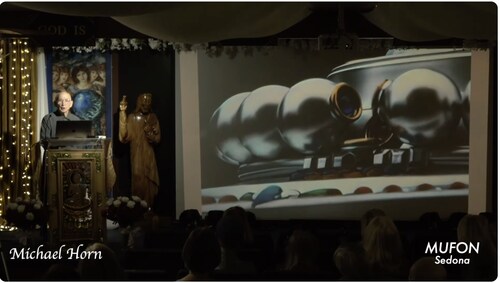
At his recent presentation for MUFON, in Sedona, Arizona, UFO expert and science researcher for 47 years, Michael Horn, showed dozens of still irreproducible, pre-digital, 35 mm UFO photos and an 8mm video of a spacecraft – now confirmed by independent scientific experts to be extraterrestrial in origin. Horn showed an example of a state-of-the art analysis of one of the photos that revealed never-before seen details that authenticated the UFO.
The clear and often close-up photos, including some of multiple craft – and two claimed to be from within a UFO above the Swiss countryside – were taken by Billy Meier, a reclusive Swiss man, and represented a small sampling of 617 of his remaining photos, which once numbered over 1,200.
The photographic evidence was followed by documentation of what Horn referred to as an even "higher standard of proof", i.e. information that would have required a technology still relegated to the realm of science fiction. Such information has been the subject of several episodes on Redacted, hosted by former News anchor, Clayton Morris, who pointed out that Meier has frequently published "verifiable, copyrighted material" on major international news stories – before the events occurred – which would require…time travel.
Horn showed video clips of Morris, including where he showed that – in 1987 – Meier predicted coming conflicts at the North Pole between the US and Russia, and in 2017 warned about America's "secret plans to attack Russia from Germany", both of which were recently confirmed and – verifiably – published decades ago.
Additionally, Meier's predictions, such as those from 1958 and 1987, specifically foretelling AI and the dangers it poses to humankind, are now being echoed by scientists. Horn said he has made all the documentation, including over 250 of Meier's predictions and the UFO evidence, freely available on his blog so that, like MUFON, everyone interested can determine the truth for themselves.
We publish non-theoretical, evidence-based, information, documentation, scientific analyses, etc., about the Billy M }eier contacts, still ongoing in Switzerland for 84 years, and evidence for which has been analyzed and authenticated by U.S. astronaut, USAF OSI/DoD case supervisor, NASA, JPL, IBM and USGS scientists, plus McDonnell Douglas defense industry, photographic, special effects, and other experts.
In its preliminary data release, taken from just seven nights of observations, the powerful Vera C. Rubin Observatory has discovered an enormous, fast-spinning asteroid that sets a new record.
An artist’s illustration of the massive, fast-spinning asteroid 2025 MN45, discovered in the first data from the Vera C. Rubin Observatory.
(Image credit: NSF–DOE Vera C. Rubin Observatory/NOIRLab/SLAC/AURA/P. Marenfeld)
Scientists analyzing the first images from the Vera C. Rubin Observatory have discovered the fastest-spinning asteroid in its size class yet.
The record-breaking space rock, called 2025 MN45, is larger than most skyscrapers on Earth at about 2,300 feet (710 meters) wide. The massive rock completes a rotation in about 113 seconds — making it the fastest-spinning known asteroid over 1,640 feet (500 meters) in diameter.
The research, published in The Astrophysical Journal Letters Wednesday (Jan. 7), is part of an asteroid survey aimed at improving our understanding of how these small bodies formed and evolved.
The study is the first peer-reviewed paper from the Rubin Observatory's LSST Camera — the largest digital camera in the world — which will repeatedly scan the Southern Hemisphere's night sky over 10 years to create an unprecedented time-lapse movie of the universe.
Rocks that roll
Asteroids are essentially large space rocks, and many are remnants of how our solar system appeared early in its 4.5 billion-year-old history, before the evolution of planets and moons. Therefore, by studying asteroids, scientists can figure out how our solar system changed over the eons.
Scientists found 2025 MN45 using the preliminary data release from the Rubin Observatory, which has already revealed thousands of previously unknown asteroids around the solar system after just seven nights of observations. (The 10-year LSST survey has yet to formally begin, but is expected to start in the next few months.)
The asteroid's remarkably fast spin excited the team, as it provides clues about the ancient rock’s composition.
"Clearly, this asteroid must be made of material that has very high strength in order to keep it in one piece," Sarah Greenstreet, an assistant astronomer at the National Science Foundation's National Optical-Infrared Astronomy Research Laboratory, said in a statement. "It would need a cohesive strength similar to that of solid rock."
"This is somewhat surprising," added Greenstreet, who also leads a Rubin working group about near-Earth objects and interstellar objects, "since most asteroids are believed to be what we call 'rubble pile' asteroids, which means they are made of many, many small pieces of rock and debris that coalesced under gravity during solar system formation or subsequent collisions."
This lightcurve shows how the asteroid’s brightness (x-axis) changes as it rotates (y-axis). Analyzing the curve allowed the team to calculate the asteroid's rotation speed, which sets a new record among asteroids of its size. (Image credit: NSF–DOE Vera C. Rubin Observatory/NOIRLab/SLAC/AURA/J. Pollard. Acknowledgement: PI: Sarah Greenstreet (NSF NOIRLab/Rubin Observatory))
Thousands more to come
In general, fast-spinning asteroids could have reached that state after a collision with another space rock, the study team said. It is also possible that 2025 MN45 is a remnant of a much larger asteroid that was shattered by a cosmic crash.
Most asteroids in the solar system are in the main asteroid belt between Mars and Jupiter. But most fast-spinning asteroids that astronomers have observed are much closer to Earth, simply because they are easier to see, the study authors noted. 2025 MN45 is a main-belt object, where most asteroids (as they are loose piles of rubble) must take at least 2.2 hours to rotate in order to avoid fragmentation. Anything that rotates faster than that "must be structurally strong," they wrote.
That said, 2025 MN45 is not the only fast spinner in the main asteroid belt. In addition to 2025 MN45, Rubin's first dataset includes 16 "super-fast" rotators, each of which has a rotational period of between 13 minutes and 2.2 hours, as well as two "ultra-fast" rotators with spins of less than two minutes each. All of these asteroids are also longer than 100 yards (90 m), and all but one of the newfound asteroids lives in the main belt.
The commissioning data from Rubin, which was released last June, underwent a deeper look in the new paper, which was also discussed Wednesday at a news conference at the 247th meeting of the American Astronomical Society in Phoenix.
The huge set of observations has about 1,900 never-before-seen asteroids, according to the statement. There will be many more to come when Rubin formally begins its 10-year survey of the sky in the coming months.
In particular, the initial results suggest that crashes may not be the only way asteroids reach extreme speeds, perhaps pressing astronomers to develop new explanations.
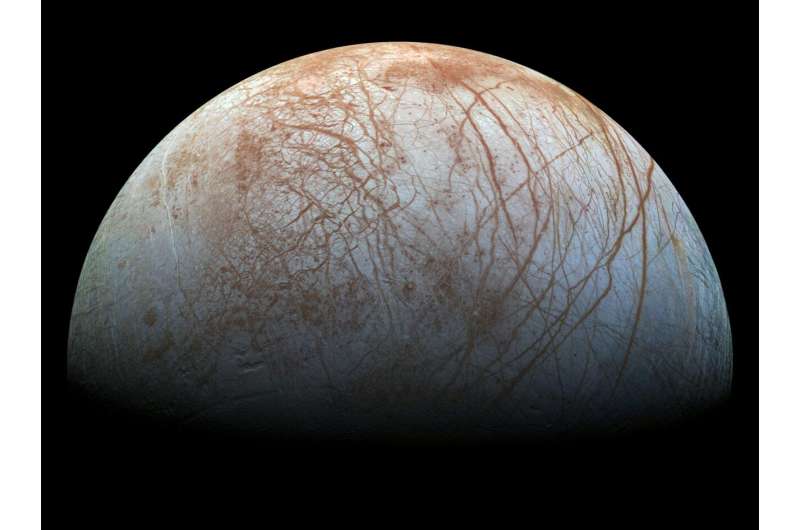
Europa, een van de vele manen van Jupiter, is een van de meest veelbelovende plekken om buitenaards leven te vinden in ons zonnestelsel. Onder een kilometers dikke ijslaag bevindt zich wellicht een oceaan van vloeibaar water. Maar uit een nieuwe studie blijkt dat de zeebodem mogelijk geologisch dood is en dat zet een flinke domper op de hoop dat Europa leven kan herbergen.
Op aarde wemelt het van het leven rond hydrothermale bronnen op de oceaanbodem. Dat zijn plekken waar scheuren in de aardkorst zeewater in contact brengen met vers gesteente. Bij die interactie komen allerlei chemische stoffen vrij die micro-organismen als energiebron kunnen gebruiken. Geen zonlicht nodig.
Wetenschappers koesteren al decennialang de hoop dat er zich onder de oppervlakte van Europa iets gelijkaardigs voordoet. De Jupitermaan heeft een oceaan die zo’n 97 kilometer diep is. Als er op de bodem breuken zouden ontstaan door tektonische activiteit, zou dat de perfecte omgeving kunnen zijn voor primitief leven.
Te weinig kracht om de bodem te breken
Maar daar zit nu het probleem. Amerikaanse onderzoekers hebben berekend hoeveel spanning er nodig is om breuken te laten bewegen op Europa’s zeebodem. Daarna keken ze naar alle bekende krachten die zulke spanning zouden kunnen veroorzaken.
De resultaten zijn ontmoedigend. De getijdenkracht van Jupiter, die Europa elke 84 uur een beetje uitrekt en samenperst, levert slechts ongeveer 3 procent van de benodigde spanning op. Zelfs als je aanneemt dat het gesteente al verzwakt is door miljarden jaren aan slijtage, blijft de getijdenkracht een factor tien tot twaalf te zwak.
Ook andere mechanismen schieten tekort. De stroming in Europa’s mantel (de laag onder de korst) zou in theorie breuken kunnen veroorzaken, maar zelfs in het meest optimistische scenario is die kracht honderden keren te zwak. En het krimpen van Europa’s binnenste door afkoeling? Daarvoor zou de rotsige kern met een hele kilometer moeten slinken voordat er iets zou breken.
Chemisch evenwicht: einde verhaal?
Zonder actieve breuken kan zeewater niet diep in de rotsbodem doordringen. Reacties tussen water en gesteente blijven dan beperkt tot hooguit de bovenste paar honderd meter. Na verloop van tijd bereikt die zone een chemisch evenwicht met de oceaan erboven en dan stopt de aanvoer van chemische energie.
Voor leven dat afhankelijk is van zulke chemische reacties is dat een probleem. Organismen die energie halen uit het mengen van vloeistoffen met verschillende chemische samenstellingen zouden op den duur zonder brandstof komen te zitten.
Is alle hoop verloren?
Niet helemaal. De onderzoekers wijzen op alternatieve energiebronnen die niet afhankelijk zijn van tektonische activiteit. Radioactief verval van uranium, thorium en kalium in het gesteente kan waterstof produceren, een proces dat radiolyse heet. Op aarde leven er micro-organismen in oude rotsformaties die precies dat doen, kilometers onder het aardoppervlak.
Of dit voldoende energie kan leveren voor een heel ecosysteem op Europa is nog onduidelijk. Maar het betekent wel dat de zoektocht naar leven niet per se ophoudt bij een geologisch stille zeebodem.
Europa Clipper gaat het uitzoeken
De NASA-missie Europa Clipper, die in 2024 is gelanceerd en in 2030 bij Jupiter aankomt, zal helpen om deze vragen te beantwoorden. Het ruimtevaartuig gaat onder andere meten hoe dik de ijslaag is, hoeveel warmte er vrijkomt door getijdenwerking en of er misschien waterpluimen uit de ijskorst spuiten die iets kunnen onthullen over de chemische samenstelling van de oceaan.
Toch zal zelfs deze missie wellicht geen definitief antwoord geven. Uiteindelijk zullen we de oceaan en misschien ooit de zeebodem rechtstreeks moeten onderzoeken om te weten of er leven is op Europa.
The smell of space has been described as similar to the smell of something cooking on a charcoal grill.
Rbkomar/Getty Images
Key Takeaways
Astronauts report that space has a distinct smell, often described as metallic or sweet.
These descriptions come from astronauts' experiences after returning from spacewalks and noticing the smell in the airlock, which suggests the scent clings to their suits and equipment.
The smell of space is thought to be due to the presence of polycyclic aromatic hydrocarbons, compounds that form in the dust and debris of space.
We all know space is empty, right? Most of space is completely absent of anything – not dust, not planets nor sun, not even air. So, why do many of the people who've been to space and spent time in it report that space has a smell?
It turns out that space does smell, and our solar system has a very particular smell. This is likely the result of several factors, but all are clear: Our corner of the universe is kind of stinky. If you're curious to learn what space smells like and why it smells that way, the explanation might surprise you.
While no astronaut has been unwise enough to unclasp and remove their helmet in the vacuum of space (which is very bad for longevity), astronauts have reported a smell upon returning from space. Specifically, many astronauts report different smells in the airlock after participating in spacewalks.
"The best description I can come up with is metallic; a rather pleasant sweet metallic sensation," wrote astronaut Don Pettit, according to Space.com. "It reminded me of my college summers where I labored for many hours with an arc welding torch repairing heavy equipment for a small logging outfit. It reminded me of pleasant sweet-smelling welding fumes. That is the smell of space." Pettit participated in several EVAs (extravehicular activities or spacewalks) during his NASA career, accumulating repeated experience with the smell.
Other astronauts have described it in similar yet varying ways: "burning metal," "a distinct odor of ozone, an acrid smell," "walnuts and brake pads," "gunpowder" and even "burnt almond cookie." Much like all wine connoisseurs smell something a bit different in the bottle, astronaut reports differ slightly in their "smelling notes" but have one thing in common: a burnt smell.
What might explain why space smells burnt? There are two possible explanations.
The Oxidation Explanation
One theory to explain the smell of space relates to the process that occurs in the airlock as astronauts return from space to the International Space Station or spacecraft they call home while orbiting Earth. During re-pressurization, the chemical reaction of oxidation occurs; atoms of oxygen in space attach to the astronaut's suit and float in during the de-pressurized time when the airlock is open and combine to form atmospheric oxygen (O2).
This process is similar to combustion without the flame and smoke – and smells similar too, which might explain the smoky, charred odor astronauts report.
The Stellar Explosion Explanation
A second hypothesis about what might explain the smell of space that astronauts report upon returning through the airlock relates to stellar explosions — that is, dying stars.
Though we've only been studying the night sky for a few centuries, the universe dates some 13.7 billion years old, and our solar system is estimated to be about 4.5 billion years old. This means that for literally billions of years before our solar system even formed, stars were being born and dying across the universe.
When stars die, it tends to be a dramatic affair, and this bombastic process creates a compound called polycyclic aromatic hydrocarbons (PAHs). PAHs are present throughout the solar system, including here on Earth; they can be found in some foods, coal and oil, among other materials. They also occur when coal, tobacco, wood, meat and other substances are burned. Perhaps part of the reason space has a distinctly burnt and charcoal smell is because it — like a grill on a summer evening — is emitting smelly PAHs.
Now That's Interesting
Outside our solar system, it's not as stinky! Other parts of the universe have other compounds and elements, which create different smells — though no human is likely to ever take a big whiff to confirm. For example, the dust cloud Sagittarius B2 has a high concentration of ethyl formate, which is the organic compound that gives both raspberries and rum their distinctive odors. If you love a good raspberry daiquiri, that's the corner of the universe for you!
President Donald Trump has allegedly been 'fully briefed' on what the US government has been keeping secret about UFOs and alien life living among humans.
In a recent interview, whistleblower and retired US Air Force Major David Grusch claimed that Trump has received reports on crashed spacecraft and non-human remains retrieved by the US, the origins of these beings, and their intentions.
Grusch, a current advisor to Congress's UAP Task Force, said the president could soon become the 'most consequential leader in world history' by publicly disclosing what America has kept hidden about extraterrestrials.
'Members of this current administration are very well aware of this reality. Certainly, the current president is very knowledgeable on this subject,' Grusch told Fox News.
To this point, previous White Houses, the US military, and even NASA have all denied that humans have made contact with alien life or have ever recovered extraterrestrial technology from crashed UFOs.
No physical evidence has ever been presented publicly that would back up the stories by countless civilians, scientists, and military personnel over the decades, who claim to have seen or interacted with beings from another world.
However, Grusch said the US military has not only recovered UFOs and alien bodies, but he personally viewed intelligence reports, data, and even pictures of non-human bodies with his own eyes.
The whistleblower also allegedly told members of Congress that Trump was even briefed during his first term about the existence of multiple alien races and how one species has been crossbreeding with humans.
David Grusch (Pictured) recently revealed that President Trump has been briefed on the existence of aliens and the effort to recover crashed UFOs
President Trump (Pictured) expressed skepticism that reports of UFOs and alien encounters were real during a June 2024 interview with Logan Paul
Grusch spent 14 years in the Air Force before working as an intelligence officer for the National Reconnaissance Office (NRO), which builds and lunches surveillance satellites for the Pentagon.
From 2019 to 2021, he represented NRO on the UAP Task Force, but eventually became a whistleblower after allegedly learning that elements of the US government had prevented Congressional oversight on matters related to extraterrestrials.
In 2023, he testified before Congress, claiming that secret government departments had been running UFO retrieval and reverse-engineering programs for decades.
When asked if he would declassify the files about aliens on the Lex Fridman Podcast in September 2024, then-candidate Trump said: 'Sure, I’ll do that. I would do that. I’d love to do that. I have to do that.'
Missouri congressman Eric Burlison previously echoed Grusch's statements, revealing the alleged existence of at least four alien species humans secretly know about.
Burlison added that Grusch had briefed the president on the existence of a race known as the 'Nordics,' which are generally human in appearance, with fair skin and blond hair, who have created alien-human hybrids.
'He [Grusch] said that the Nordic aliens are like a few hundred years more advanced than we are, but they're not super advanced,' Burlison said during an X space interview on June 27.
'He says that there are aliens that are crossbreeds living in the world,' the congressman added, noting that Grusch did not have an answer when asked how humans would be able to tell if someone was an alien hybrid.
In September, Congressman Eric Burlison of Missouri revealed video of a US military drone striking an orb-shaped UFO with a missile, which bounced off and did not stop the craft
Grusch described an alien race called 'the Greys' as being thousands of years more advanced than humans or other alien species humans know about (Stock Image)
Burlison, who appointed Grusch to the government's UAP committee, added that the Air Force veteran described another alien race called the Greys as being thousands of years more advanced than humans.
According to Grusch's reports, these aliens, who were shorter with grey skin and large black eyes, were responsible for sightings of craft that defied gravity and controlled technology using their minds.
As for whether these aliens were peaceful or coming to Earth with hostile intentions, Grusch revealed last month that the US has seen a 'mixed bag of activity.'
'We can't quite understand the intent of some of the sentients and why they're visiting. Could it be because we have interesting genetic material on Earth? We're a Jurassic Park tourist attraction for them. [It] could be a myriad of reasons,' he told Bret Baier of Fox News on November 21.
The UAP advisor added that the US was in a secret arms race with Russia and China, who have also captured and crashed alien spacecraft and have been working to reverse engineer the technology.
Although Grusch believed Trump may soon decide to release the classified reports on extraterrestrial programs and encounters, the president has previously said he was a skeptic when it comes to UFO conspiracies.
'People who are very smart and very solid have said they believe there is something out there, and you know it makes sense that there could be. I've never been convinced, even despite that, you know, I just for some reason it's not my thing,' Trump told the Impaulsive podcast in June 2024.
Despite the skepticism, Grusch claimed that the White House was motivated to 'do the right thing' in terms of disclosing all the whistleblower information Congress has been investigating regarding UFOs.
The Daily Mail has reached out to the White House for comment regarding the claims in Grusch's interview.
Grusch noted, however, that he and others have faced intimidation and threats of physical harm to stay quiet about the existence of alien life, but he did not name who has been behind the cover-up.
'I was physically threatened even before I sent in my intelligence community inspector general report under the previous administration,' the whistleblower alleged.
'I actually had to go and and seek legal protection that way because I was, you know, literally in fear both professionally and in my personal life.'
A shocking admission by the CIA has just reopened the mystery surrounding 3I/ATLAS, the interstellar object speeding through our solar system.
Although NASA has claimed the object is an ordinary comet, an icy rock with a long tail of gas and dust, intelligence officials have refused to answer whether they investigated the possibility that 3I/ATLAS is an extraterrestrial craft.
In response to a November 2025 Freedom of Information Act (FOIA) request regarding the supposed comet, the CIA said it could 'neither deny nor confirm the existence or nonexistence of records' regarding 3I/ATLAS.
The federal government had maintained that the object showed no signs of harboring alien life or that it was an artificially constructed spacecraft since it was detected in July 2025.
However, the CIA still decided to provide what is known as a 'Glomar response.' It's a way for the government to say, 'We're not going to tell you if we have information or not, because even admitting that could reveal sensitive secrets.'
Harvard professor Avi Loeb has continued to challenge NASA's claims, highlighting that 3I/ATLAS has exhibited at least 12 strange behaviors that scientists have not been able to explain as natural occurrences.
Those anomalies include the object having a bright 'anti-tail' pointing in the opposite direction of a normal comet, course changes that defy the laws of gravity, and a nickel shell, which is a metal typically used by spacecraft to deflect heat.
'That this information is treated as sensitive enough to be classified by the CIA is surprising, given that NASA officials stated decisively at a press conference on November 19, 2025, that 3I/ATLAS is definitely a comet of natural origin,' Loeb said.
Amateur stargazers have taken clear images of the interstellar object 3I/ATLAS (Pictured) using common telescopes during its journey through the solar system
The CIA has released a statement neither confirming nor denying any investigations into 3I/ATLAS, complying with a November 2025 FOIA request
As 3I/ATLAS nears Jupiter on March 16, the Harvard physicist said the new revelations by the US intelligence community suggest the government has secretly investigated the possibility that the object is a hostile threat, as he theorized last year.
The Daily Mail has requested comment from both the CIA and NASA and is awaiting a response.
The FOIA request was submitted by UFO and government conspiracy researcher John Greenewald Jr, who noted in a post on X that he was filing an appeal to get a clearer answer from the CIA.
Greenewald Jr added that he has filed the same request for information regarding 3I/ATLAS with NASA and other US agencies and is still waiting for them to reply.
FOIA requests are part of US law that lets anyone, including citizens, journalists, and researchers, ask government agencies for documents or records on a specific topic.
The agency must give a response, but it can withhold revealing details if the information is classified for national security reasons or falls under certain exemptions.
'Very interesting, apparently CIA [director John] Ratcliffe knows something,' one person on social media alleged.
The new revelations have come months after NASA completely dismissed the possibility of 3I/ATLAS being extraterrestrial in origin, with space agency administrator Nicky Fox saying they've found nothing 'that would lead us to believe it was anything other than a comet.'
3I/ATLAS is projected to reach its closest point to Jupiter in March 2026 before leaving the solar system for good
However, NASA's November announcement created more doubt about the object's origins than it solved, as the agency was widely mocked for the blurry images it released of 3I/ATLAS.
Many critics quickly pointed out that amateur astronomers with common telescopes had been taking much clearer photographs of the alleged comet as it approached Earth in December, despite being over 200million miles from the object.
In comparison, NASA Mars orbiters were less than 20million miles away from 3I/ATLAS in early October 2025, but still only returned heavily pixelated images of the visitor, which caused some to claim it was a cover-up.
'NASA officials were encouraged to deliver the likely scientific interpretation, while at the same time, the serious consideration of a black swan event by the CIA was hidden from public view to prevent panic from taking hold for no good reason,' Loeb speculated in a statement published Monday.
A black swan event is a rare, totally unexpected happening that's highly unlikely but could have huge, world-changing consequences for the Earth.
In the case of the interstellar comet 3I/ATLAS, Loeb said if the tiny chance that the object was artificial alien technology turned out to be true, it would be a massive shock with enormous implications for humanity, including proving aliens exist.
The cryptic response from the CIA adds another layer to the eight-decade conspiracy theory UFO believers have had, claiming that the US government has been concealing what it knows about extraterrestrial life.
Just days after Greenewald Jr's FOIA request was submitted in November, the hit documentary 'The Age of Disclosure' was released, interviewing 34 US government, military, and intelligence officials about their knowledge of an alleged UFO cover-up.
Despite the speculation, the US military and federal government have said there has never been any physical proof that UFOs or beings from other planets exist.
An award-winning psychic's concerning prediction for 2026 appears to have already come true, as a series of large earthquakes have rattled the globe.
Jill M Jackson, a spiritual teacher and author from Mississippi, had warned of increased earthquakes this year, especially along the US West Coast and inAsia, with 'major water events' being strengthened by the quakes and causing larger floods.
In just the first seven days of 2026, nearly 100 earthquakes greater than 4.5 in magnitude have been recorded worldwide, according to the US Geological Survey (USGS).
Moreover, 10 large earthquakes over magnitude 5.0 have struck the Pacific Rim in the last two days, impacting Japan, the Philippines, Indonesia, and Russia.
That wave of seismic activity included a major 6.4 magnitude quake that struck the Philippines just after 10pm ET Tuesday night.
Jackson warned Americans to get prepared now, including those living in states such as California, Oregon, and Washington, which could be impacted by several dangerous fault lines sitting along the West Coast.
'There's a lot of changes coming. There's a lot of earth changes coming. I see land shifting... And it's important for us to be in a place of preparation. Pay attention to water and things like that,' she revealed.
One major earthquake has already struck North America in 2026. A magnitude 6.5 quake rocked southern Mexico on January 2, sending shockwaves all the way to Mexico City and forcing hundreds of residents to evacuate buildings.
The US Geological Survey has recorded 95 earthquakes greater than 4.5 in magnitude since the start of 2026, with most centered along the Pacific Rim
Jill M Jackson (Pictured) issued several predictions for 2026, including an economic downturn in the US that would cost many people their jobs
Jackson, who has been named 'Psychic of the Year' twice, added in a recent interview that Earth would see an 'amplification' in the intensity of earthquakes, including in Japan, Indonesia, and Thailand.
She predicted stronger flooding risks would emerge for islands in the Caribbean, the Indian Ocean, and the Pacific this year as well.
In November 2025, Jackson accurately predicted the major 7.6 magnitude quake striking off Japan's Aomori Prefecture on December 8, 2025, causing injuries, damage, and tsunami alerts.
Her newest predictions come after a year where Californians were repeatedly rattled by significant tremors along the state's coastline and swarms of minor quakes which lasted for days at a time.
In November and December, more than 300 earthquakes rattled the same region in California, sparking fears among locals that the infamous 'Big One' could soon strike and devastate the West Coast.
San Ramon in the East Bay was the epicenter of this seismic activity, which sits on top of the Calaveras Fault, an active branch of the notorious San Andreas Fault system.
The Calaveras Fault is capable of producing a magnitude 6.7 earthquake, which would impact millions of people in the San Francisco Bay Area. USGS has previously estimated there is a 72 percent chance of this happening by 2043.
A rupture along the larger, 800-mile-long San Andreas fault would likely cause even more destruction, with the latest simulations of a magnitude 7.8 earthquake striking near Los Angeles predicting 1,800 deaths, 50,000 injuries, and $200 billion in damages, according to the Great California ShakeOut.
The Great California Shakeout predicted that a 7.8-magnitude earthquake could kill 1,800 people and cause $200 billion in damages in Southern California alone
Jackson (Pictured) has said she began seeing spirited at birth and was able to communicate with them since the age of 12
The psychic's forecast for the new year also included a plea for Americans to prepare for significant instability in the US economy, leading to many job losses.
'I do see a lot of polarity... A lot of ups and downs. It's going to feel like a roller coaster. Sadly, I do see a lot more people losing their jobs in 2026,' Jackson predicted during a December 26 interview on the Jeff Mara Podcast.
The psychic also ongoing wars, including the Russia-Ukraine conflict, would continue for several more years with no quick end in sight, although some conflicts like in Venezuela might 'fizzle out' by mid-2026.
While Jackson warned that many Americans could end up unemployed this year, the dramatic turn in the economy would actually benefit these workers, as she claimed the layoffs would force people to leave careers they were not spiritually aligned with.
'I do see a lot of people doing complete 180s and leaving jobs and careers that they have been in for years and years and starting over, starting something new. I also see a lot of new businesses being created, but it feels more local,' Jackson told the podcast.
'Once they go through that, they are going to have an opportunity to go within and realize that they were not on their soul's path anyway.'
Jackson added that these major shifts in the US will cause many to feel a sudden, unexplained urge to move away from homes they've lived in for 10, 15, or even 20 years.
Out in the depths of space, somewhere in between Mars and Jupiter, is a newly discovered asteroid that’s breaking records.
Astronomers have spotted a celestial rock the size of seven football pitches that is spinning faster than they’ve ever seen before.
The asteroid, named 2025 MN45, is 710 metres in diameter and completes a full rotation every 1.88 minutes.
The fact that it spins so rapidly has baffled experts, who say it must consist of solid rock in order to maintain its shape.
‘Clearly, this asteroid must be made of material that has very high strength in order to keep it in one piece as it spins so rapidly,’ Sarah Greenstreet, who leads the Rubin Observatory’s Solar System Science Collaboration’s Near-Earth Objects and Interstellar Objects working group, said.
‘We calculate that it would need a cohesive strength similar to that of solid rock.
‘This is somewhat surprising since most asteroids are believed to be what we call “rubble pile” asteroids, which means they are made of many, many small pieces of rock and debris that coalesced under gravity during Solar System formation or subsequent collisions.’
While it is currently out in the asteroid belt, hundreds of millions of kilometres away, asteroids and comets have previously been ‘nudged’ into Earth’s neighbourhood by the gravity of nearby planets.
This artist’s illustration depicts 2025 MN45 — the fastest-rotating asteroid with a diameter over 500 meters that scientists have ever found
The lightcurve of the asteroid - the y-axis shows the asteroid’s brightness, and the x-axis shows its phase, or where it is in its rotation
The sighting forms part of a much larger discovery, as scientists have detected 1,900 new asteroids cruising about our Solar System that have never been seen before.
Within this flurry are 19 super and ultra-fast rotating asteroids – with 2025 MN45 taking the new record for the fastest-spinning asteroid with a diameter over 500 meters that astronomers have found.
For their study, researchers collected data over the course of about 10 hours across seven nights in April and May of last year.
They used the Rubin Observatory’s LSST Camera – the largest digital camera in the world – to capture the night sky.
‘Discoveries like this exceptionally fast-rotating asteroid are a direct result of the observatory's unique capability to provide high-resolution, time-domain astronomical data, pushing the boundaries of what was previously observable,’ Regina Rameika, from the US Department of Energy, said.
As asteroids orbit the Sun, they also rotate at a wide range of speeds, the researchers explained.
These spin rates not only offer clues about the conditions of their formation billions of years ago but also tell us about their internal composition and evolution over their lifetimes.
In particular, an asteroid spinning quickly may have been sped up by a past collision with another asteroid, suggesting that it could be a fragment of an originally larger object.
Most asteroids can be found orbiting our Sun between Mars and Jupiter within the main asteroid belt
An illustration of the main asteroid belt, orbiting the Sun between Mars and Jupiter, where asteroid 2025 MN45 can be found
This image, one of the first released by Rubin Observatory, exposes a Universe teeming with stars and galaxies — transforming seemingly empty, inky-black pockets of space into glittering tapestries for the first time
‘Fast rotation also requires an asteroid to have enough internal strength to not fly apart into many smaller pieces, called fragmentation,’ the team said in a release.
‘Most asteroids are ‘rubble piles’, which means they are made of many smaller pieces of rock held together by gravity, and thus have limits based on their densities as to how fast they can spin without breaking apart.
‘For objects in the main asteroid belt, the fast-rotation limit to avoid being fragmented is 2.2 hours; asteroids spinning faster than this must be structurally strong to remain intact.
‘The faster an asteroid spins above this limit, and the larger its size, the stronger the material it must be made from.’
Within the main asteroid belt are space rocks ranging in size from 530km (329 miles) to just 10 metres (33 feet) in diameter.
‘Sometimes, asteroids and comets are nudged into Earth’s neighbourhood by the gravity of nearby planets,’ NASA says.
However, they explained that it is ‘highly unlikely’ an asteroid large enough to cause widespread damage will impact Earth for the next 100 years or more.
Currently, NASA would not be able to deflect an asteroid if it were heading for Earth but it could mitigate the impact and take measures that would protect lives and property.
This would include evacuating the impact area and moving key infrastructure.
Finding out about the orbit trajectory, size, shape, mass, composition and rotational dynamics would help experts determine the severity of a potential impact.
However, the key to mitigating damage is to find any potential threat as early as possible.
NASA and the European Space Agency completed a test which slammed a refrigerator-sized spacecraft into the asteroid Dimorphos.
The test is to see whether small satellites are capable of preventing asteroids from colliding with Earth.
The Double Asteroid Redirection Test (DART) used what is known as a kinetic impactor technique—striking the asteroid to shift its orbit.
The impact could change the speed of a threatening asteroid by a small fraction of its total velocity, but by doing so well before the predicted impact, this small nudge will add up over time to a big shift of the asteroid's path away from Earth.
This was the first-ever mission to demonstrate an asteroid deflection technique for planetary defence.
The results of the trial are expected to be confirmed by the Hera mission in December 2026.
A long-abandoned US military base known as Camp Century was recently rediscovered under the ice after a NASA pilot conducting airborne radar tests captured images of its underground remains.
The base, built in secret during the Cold War, lies about 118 feet below the surface and spreads across an area roughly 0.7 miles long and 0.3 miles wide.
Once described as a self-contained underground town, Camp Century housed a hospital, theater, church and shop, and was powered by a small nuclear reactor.
As Greenland's ice melts at accelerating rates, scientists have warned that hazardous waste left behind at the site could eventually be released into the environment.
That waste includes chemical pollutants, biological sewage, diesel fuel, and radioactive material once thought to be safely sealed in ice forever.
Researchers now say that assumption was deeply flawed. 'What climate change did was press the gas pedal to the floor,' said James White, a climate scientist at the University of Colorado Boulder.
Camp Century was constructed in the late 1950s with the knowledge of both the US and Danish governments under the 1951 Defense of Greenland Agreement.
NASA scientists captured an image of an abandoned US military base that has been hiding under ice in the
Camp Century was constructed in the late 1950s with the knowledge of both the US and Danish governments under the 1951 Defense of Greenland Agreement
Danish officials participated in planning and environmental monitoring, and historical reports indicate Denmark approved the disposal of some radioactive waste directly into the ice.
At the time, scientists and military planners believed Greenland's ice sheet would permanently entomb any contamination.
'That idea, that waste could be buried forever under ice, is unrealistic,' White said.
'The question is whether it's going to come out in hundreds of years, thousands of years, or tens of thousands of years. Climate change just means it's going to happen much faster than anyone expected.'
The environmental risk posed by Camp Century has taken on new urgency as geopolitical tensions in the Arctic intensify.
President Donald Trump renewed calls this week for US control of Greenland, citing national security concerns as Russian and Chinese activity in the region grows. 'It's so strategic,' Trump told reporters aboard Air Force One on Sunday.
But scientists said the buried base represents a very different kind of security threat, one tied not to military rivals, but to pollution unleashed by a warming climate.
Once described as a self-contained underground town, Camp Century housed a hospital, theater, church and shop, and was powered by a small nuclear reactor
Pictured are US soldiers climbing up to an escape hatch to enter Camp Century
A team of international researchers led by the Cooperative Institute for Research in Environmental Sciences (CIRES) at the University of Colorado Boulder estimated that Camp Century contains roughly 9,200 tons of physical waste, including abandoned buildings, tunnels, and rail infrastructure.
The site also holds about 200,000 liters of diesel fuel and significant amounts of polychlorinated biphenyls, or PCBs, toxic chemicals once widely used in paints and electrical equipment.
PCBs are especially concerning because they do not break down easily and are linked to cancer, immune system damage, and developmental problems.
The Arctic's cold climate has trapped these chemicals for decades, effectively turning the region into a global storage site for pollution released elsewhere.
As ice melts, however, scientists warned that glaciers could become a new source of toxic contamination.
Most former Arctic military sites have undergone cleanup efforts, but Camp Century is one of only five abandoned ice-sheet bases near Thule Air Base that have never been remediated, according to the 2016 study by the CIRES research team.
Camp Century is a US military base built in 1959 that consists of a network of 21 tunnels but just below the surface of the ice sheet ice
Pictured is the entrance to the base before it was decommissioned in 1967
At similar sites, PCB concentrations in some paints exceeded five percent by weight.
In addition to chemical and biological waste, Camp Century also contains radioactive material from the nuclear reactor's coolant system.
When it was buried in the early 1960s, the waste had a radioactivity of about 1.2 billion becquerels, roughly equivalent to the radiation used in a single medical scan.
While small compared to major nuclear accidents, researchers cautioned that its presence adds another layer of risk if containment fails.
The base's tunnel system twists and branches beneath the ice, making it difficult to fully map.
Airborne radar has detected strong reflections that align with known tunnel locations, but scientists say the technology cannot yet identify all buried waste.
Diesel fuel, stored in underground tanks, may still be liquid today, though researchers believe the tanks may have ruptured.
Models suggest that ice flow and snow accumulation could bury solid waste as deep as 220 feet and liquid waste around 305 feet by 2090.
While that means contamination may not surface for decades, scientists stressed that burial does not equal safety.
Camp Century was constructed in the late 1950s with the knowledge of both the US and Danish governments under the 1951 Defense of Greenland Agreement.
Beyond the environmental risks, Camp Century has become a source of political and legal uncertainty.
Responsibility for the cleanup remains disputed between the US, Denmark, and Greenland.
While the waste was left behind by the US, the original 1951 treaty did not account for climate change or Greenland's growing self-governance.
The agreement states that US property in Greenland may be removed or disposed of after consultation with Danish authorities.
But it remains unclear whether Denmark was fully consulted during Camp Century's decommissioning, raising questions about whether the abandoned waste is still legally US property.
Researchers said Camp Century may represent one of the first real examples of climate change triggering an international dispute over long-forgotten pollution, a preview of conflicts likely to emerge worldwide as rising seas and melting ice expose hazardous waste once thought safely buried.
NASA has just revealed that the crew of the International Space Stationwas being evacuated for the first time in history after one of the astronauts suffered a medical emergency.
NASA administrator Jared Isaacman said in a press conference Thursday that Crew-11 would not continue its missionuntil its scheduled return date in February, and that the steps for their safe return would be worked out over the next 48 hours.
'I've come to the decision that it's in the best interest of our astronauts to return Crew-11 ahead of their planned departure,' Isaacman revealed.
The announcement came less than a day after NASA cancelled a Thursday spacewalk due to the medical issue, with officials saying they were 'erring on the side of caution for the crew member'.
Crew-11 includes four astronauts: NASA's Zena Cardman and Mike Fincke, Japanese astronaut Kimiya Yui, and Russian cosmonaut Oleg Platonov.
The group was recently joined by Japanese astronaut Koichi Wakata and NASA astronaut Chris Williams, who arrived at the station aboard a Russian Soyuz spacecraft in November 2025.
Isaacman said that Williams will remain on the station with the Soyuz crew to maintain America's presence in space.
While the astronaut who suffered the medical issue was not revealed, NASA's chief medical officer Dr James Polk said the astronaut was not in any immediate danger and they were being cared for by their fellow crewmates until their return.
Crew-11 before launching to the ISS. Pictured (L to R): Roscosmos cosmonaut Oleg Platonov, NASA astronaut Mike Fincke, JAXA astronaut Kimiya Yui, and NASA's Zena Cardman
NASA cancelled a planned spacewalk on Thursday involving the crew of the International Space Station (Pictured) over an unspecified medical issue involving one of the astronauts
Dr Polk added that the medical issue the astronaut suffered had nothing to do with the upcoming spacewalk or any other operations on board the station.
'It's mostly having a medical issue in the difficult areas of microgravity,' Polk explained without going into specific medical details.
NASA officials noted that no special precautions would need to be taken to keep the ailing astronaut safe until their return and called their condition 'stable' until the evacuation plan is finalized.
NASA has never had to bring an astronaut home for medical reasons, but an evacuation plan has been built into every ISS mission, with crew return vehicles kept on standby.
'We are looking for the correct opportunity to use our existing landing sites,' Isaacman said when asked if NASA would be making an emergency landing to get Crew-11 home faster.
'I´m proud of the swift effort across the agency thus far to ensure the safety of our astronauts,' the NASA chief added.
The NASA administrator did note that the space agency did consider this a 'serious medical condition' which forced officials to conclude that the first ever evacuation was necessary.
However, Dr Polk stressed that the astronaut was not in immediate danger which would force NASA to consider rushing the evacuation into an unsafe flight window.
NASA administrator Jared Isaacman (Left) and NASA chief medical officer Dr James Polk (Center) revealed on Thursday that Crew-11 would be returning as soon as possible
JAXA astronaut Kimiya Yui (center) was helping NASA astronaut Zena Cardman (left) and Mike Fincke prepare for the spacewalk before it was postponed
'The crew member is absolutely stable, so I don't foresee massive changes to the timeline or their activities,' Polk said.
Crew-11 arrived at the ISS on August 1, 2025, meaning their return date had been scheduled for late February.
The four astronauts were supposed to leave after Crew-12 arrived on a SpaceX Dragon capsule no earlier than February 15.
Isaacman said that any decision to potentially move up the launch of Crew-12 would not impact the upcoming Artemis II mission planned for February 2026.
He called the two launches 'totally separate campaigns,' meaning there should be no issue in launching Artemis on time. Artemis II will be the first manned spaceflight to orbit the moon since 1972.
Meanwhile, the ISS is required to have astronauts aboard at all times, as they are essential to carry out maintenance, repairs, operate complex experiments, manage life support and perform spacewalks, tasks that automation cannot fully handle, ensuring constant human oversight for safety and scientific output.
Until now, there had never been a crew evacuated ahead of their scheduled departure time from the ISS, however, two spacewalks were recently cancelled because of various health issues among the astronauts.
A mission was cancelled in 2021 when Mark Vande Hei experienced a pinched nerve and was unable to travel outside the ISS.
Another spacewalk in 2024 was called off at the last minute because an astronaut experienced 'spacesuit discomfort'.
Chinese researchers have announced the creation of a new eye-tracking technology powered by the friction between the eye’s surface and the eyelid during blinking, eliminating the need for an external power source.
Currently operational in the lab setting, such a self-powered eye tracking capability could be used to assist people who rely on their eyes to operate electronics and other devices.
“We’ve developed a self-powered eye-tracking system that harvests energy from blinking and can be used to detect eye movements with high precision,” says Yun-Ze Long of Qingdao University.
In dystopian science fiction, tracking eye movements can be used for invasive, nefarious purposes. In the real world, eye-tracking devices allow people who can no longer move most or all of their bodies to control wheelchairs, browse the internet, or operate Internet of Things (IoT) electronic devices. Still, wider adoption of eye-tracking assistance technology has been limited by its size, weight, and power requirements.
According to the research team behind the new eye-tracking technology, currently available options designed to assist people with mobility impairments, such as amyotrophic lateral sclerosis (ALS), often degrade in low-light conditions or cause eye strain after prolonged use. Taken together, they challenged themselves to create a self-powered, wearable, more sustainable, and user-friendly device.
“We were particularly surprised by how well the friction layer retained its charge in a biological setting on a rabbit’s eye,” Long said of the TBN’s unexpected performance.
An analysis of the device’s accuracy revealed that its self-powered eye tracker could successfully detect eye movements as small as 2 degrees. This level of sensitivity was complemented with a measured precision of 99%. Long said this level of precision remained under challenging lab conditions meant to test the device’s operational limitations.
“We were also impressed by the system’s ability to maintain high accuracy even in noisy electromagnetic environments,” the researcher explained.
When discussing the implications of their self-powered eye-tracking technology, the Qingdao University research team said their work proves it is possible to harvest usable energy from very subtle body movements, such as blinking.
“It’s designed to be lightweight, comfortable, and helpful—especially for those who rely on eye movements to communicate or interact with the world.” Long said. “It’s an example of how technology can empower people and make daily life more accessible.”
Along with medical settings, the researchers suggested that eye-tracking technology powered by blinking or other subtle movements could be used in virtual reality (VR) settings. This included potential future applications in intelligent driving and space exploration, where monitoring eye movements could offer critical safety and performance advantages.
“The system works in the dark, requires no external power source, and is as lightweight and comfortable as everyday glasses and contact lenses,” Long said, adding that their eye tracker also “turns something as simple as a blink into a source of power and control.”
Christopher Plain is a Science Fiction and Fantasy novelist and Head Science Writer at The Debrief. Follow and connect with him onX,learn about his books atplainfiction.com, or email him directly atchristopher@thedebrief.org.
0
1
2
3
4
5
- Gemiddelde waardering: 0/5 - (0 Stemmen) Categorie:SF-snufjes }, Robotics and A.I. Artificiel Intelligence ( E, F en NL )
Oarfish washes ashore in California as rare planetary alignment unfolds — All signs point to a major Earthquake?
Oarfish washes ashore in California as rare planetary alignment unfolds — All signs point to a major Earthquake?
Regional and global earthquake patterns are raising concern that California may be the next major segment of the eastern Pacific Ring of Fire to release accumulated tectonic strain, potentially in a magnitude 6 to 7 earthquake, or even larger. It is important to note, however, that while seismic stress accumulation is well documented, the precise timing and location of earthquakes cannot be predicted with certainty by current science.
Adding to public speculation, a so-called “doomsday fish” (oarfish) washed ashore in Monterey Bay on December 30, 2025. Oarfish have been linked anecdotally and culturally to major earthquakes, particularly in Japanese folklore. A video and detailed article examining the “doomsday fish” sighting can be viewed here.
At the same time, some independent researchers are pointing to antipodal earthquake activity off the east coast of Africa as a possible indicator of stress redistribution across the planet. Mainstream geophysics acknowledges that large earthquakes can influence stress fields elsewhere on Earth.
Planetary conditions are also being discussed. A rare linear alignment involving Jupiter, Earth, the Sun, Mercury, Venus, and Mars is currently underway, along with a Saturn–Neptune conjunction occurring for the first time in 37 years. This same Saturn–Neptune alignment was active during the period surrounding the magnitude 6.9 Loma Prieta earthquake that struck the San Francisco Bay Area on October 18, 1989. See video here.
While geophysicist Stefan Burns reports that the convergence of these indicators suggests the possibility of a magnitude 6.0 or greater earthquake in California, this assessment represents an interpretation rather than a prediction.
As is almost always the case, no government agency or scientific institution supports deterministic earthquake forecasts. Residents are instead told to rely on official seismic monitoring and preparedness guidance, an approach that, for many, effectively means recognizing the danger only once the ground has already begun to move.
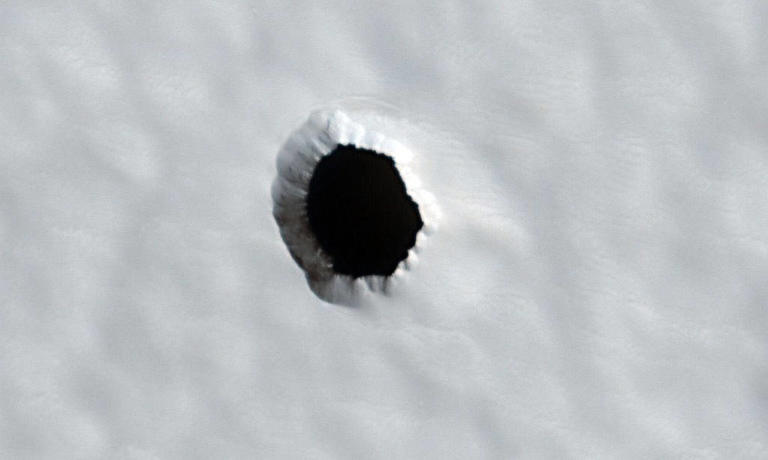
Scientists have discovered a mysterious hole on the surface of Mars, and they have no idea what lies inside it.
This pit, located in the Arsia Mons region — one of Mars’ giant volcanoes — could potentially be a skylight leading to a vast network of lava tubes.
Lava tubes are natural caverns formed by flowing lava. Here on Earth, they provide shelter for many life forms, and on Mars, they could offer human explorers much-needed protection from the harsh Martian environment.
So, is this hole the key to unlocking a potential Martian habitat?
A Mysterious Martian Pit — Leading to Where?
There’s no shortage of environmental hazards out to kill any astronaut bold enough to dare set foot on Mars. With Mars having only 0.7% of Earth’s sea-level pressure, humans would have to don a full pressure suit or live inside a specialized chamber. Without these precautions, oxygen wouldn’t circulate in the bloodstream, with potentially fatal consequences.
Radiation, however, remains the primary concern. Although Mars is farther from the Sun than Earth, the absence of a magnetic field and its thin atmosphere mean it’s exposed to much higher radiation levels than Earth. The Mars Odyssey probe has shown radiation levels on Mars are at least 2.5 times higher than what astronauts face on the International Space Station. Furthermore, besides regular exposure to cosmic rays and solar wind, it receives occasional, lethal radiation blasts due to solar flares.
The Photos NASA Sent To Aliens
Any attempt to colonize the Red Planet will require measures to ensure radiation exposure is kept to a minimum. Some of the proposed ideas thus far involve habitats built directly into the ground or even above-ground habitats using inflatable modules encased in ceramics.
However, a promising alternative lies in Mars’ natural landscape. The planet is scattered with deep pits, caves, and lava tube structures that can act as a shield against radiation.
Collapsed sections of these tubes, called skylights, could provide access to these subterranean refuges. This is what scientists believe this newly identified pit could be. It was recently imaged by the High-Resolution Imaging Science Experiment (HiRISE) camera on NASA’s Mars Reconnaissance Orbiter (MRO).
The Nature of Martian Pits
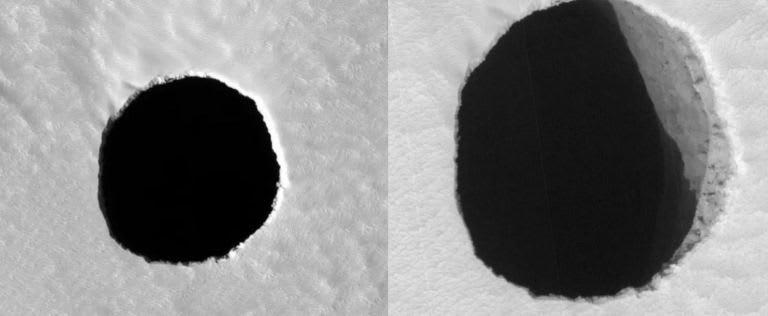
Two images of the pit in Arsia Mons. The one on the left was taken a couple of years ago. The one on the right is more recent and shows a side wall, which may mean the hole is not an entrance to a lava tube or cave.
The newly examined pit measures only a few meters across and resides in the Tharsis region — a vast volcanic plain, thousands of kilometers across and elevated about 10 km above the planet’s mean elevation. This area was once very volcanically active, so scientists’ best guess is that the pit is a skylight to a lava tube.
However, that’s not the only option. In another image, you can see an illuminated sidewall, indicating it might just be a cylindrical pit. This raises the possibility that the hole may simply be a pit crater, similar to those found in Hawaii.
These craters form when cracks in volcanic rock widen and collapse, offering no access to underground chambers. In Hawaii, pit craters range from 6 to 186 meters deep and 8 to 1140 meters wide. The Arsia Mons pit is about 178 meters deep, Universe Today reports.
Lessons from the Moon
So, the big question now is: does this hole on Mars lead to a larger underground cavern? We don’t have a straight answer yet. But with time, scientists might be able to study and understand Martian pits as well as they do those on the Moon.
We understand lunar lava pits and tubes much better than those on Mars. Some lunar tubes are thermally stable and have boulder-covered floors. There are even plans for robots to explore these lunar caves, potentially housing astronauts in inflatable habitats.
Mars, with its weaker gravity, should support even larger lava tubes. This would provide extremely valuable shelter on a very unforgiving planet. Perhaps this is not all that different from how the first human explorers made bases in caves as they traveled across uncharted territory, colonizing the world.
However, unlike the Moon, we lack conclusive evidence of their existence on Mars. This intriguing pit on Arsia Mons is part of an ongoing search for Martian lava tubes. Future robotic missions designed to explore these potential underground worlds will be crucial in unlocking the secrets they hold.
Renewed Interest and New Discoveries
In November 2024, a breakthrough study on Earth provided some supporting evidence that Martian caves could act as time capsules. Researchers exploring lava tubes in Lanzarote, Spain, found that the tubes shielded minerals and organic compounds from weathering, effectively preserving “biosignatures” of past microbial life. This confirms that if life ever existed on Mars, a lava tube would be the most likely place to find its fossilized remains, protected from the harsh radiation on the surface.
Meanwhile, the region hosting the pit, Arsia Mons, received a stunning visual update in May 2025.
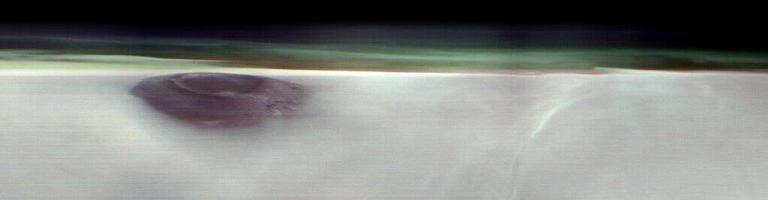
Arsia Mons, an ancient Martian volcano, was captured before dawn on May 2, 2025, by NASA’s 2001 Mars Odyssey orbiter while the spacecraft was studying the Red Planet’s atmosphere, which appears here as a greenish haze.
NASA’s Mars Odyssey orbiter captured a rare panorama showing the volcano’s summit poking through a vast blanket of morning clouds. This image highlighted the extreme altitude of the Tharsis region (where the pit is located), reminding us that any habitat here would need to contend with not just radiation, but unique atmospheric weather patterns distinct from the rest of the planet.
But there could be other, even more interesting caves.
In late 2025, when scientists identified a potential new class of caves in the Hebrus Valles region. Unlike the volcanic tubes of Arsia Mons, these new candidates appear to be “karstic”—caves formed by the dissolution of bedrock by water. If confirmed, these wouldn’t just be shelters; they would be remnants of ancient aquifers, making them the ultimate “holy grail” for both human habitation and the search for alien life.
This article was originally published in 31 May, 2024, and has been reedited to include additional information.
Does An Ancient Letter From Flavius Josephus Reveal That Jesus Was Real? Some people swear Jesus never existed. That he is just a fairytale or just a clever early-Christian marketing pitch that got out of hand. It’s a spicy claim, and if you only stick to “the Bible says so,” you’ll end up in a shouting match with someone who thinks every ancient text comes with a hidden agenda.
Here’s the part that tends to surprise people: you don’t need to start with the New Testament at all. You can start with a Jewish historian who didn’t write sermons, didn’t join a church, and still dropped Jesus into his history books.Flavius Josephus reveals that Jesus was a real person and that he did exist.
The “zero evidence” line falls apart When someone says there’s “zero evidence” for Jesus outside the Bible, what they’re really saying is, “I haven’t seen anything that looks like a modern blog.” Ancient history doesn’t work that way. You don’t get bylines or headshots from 30 AD. You sift through surviving texts, check motives, and notice who mentions Jesus without preaching. Roman and Jewish writers did exactly that. They were people referencing a real man tied to real events.
Flavius Josephus lived close to the action and the time of Jesus Josephus was born around 37 or 38 AD in Jerusalem, which puts him one generation away from people who remembered Jesus. By his twenties, Flavius Josephus had priestly credentials, political instincts, and a front-row seat to the Jewish revolt that exploded in 66 AD. He surrendered, switched patrons, and kept writing. In his mid-50s, around 93 AD, he finishedAntiquities of the Jews.
Josephus did not write his history as Christian propaganda By AD 71, Josephus had settled in Rome under the watchful eye of Vespasian, writing for Romans who cared about power, order, and what happens when leadership fails. Josephus drops names as cultural markers, not praise. When he does, you’re seeing what people accepted as public knowledge, even stuff they didn’t like admitting.
Josephus mentions Jesus The strongest Josephan reference sits in Antiquities Book 20, Chapter 9, 1, where Josephus talks about the high priest Ananus assembling the Sanhedrin and condemning James. He identifies the James in question as “the brother of Jesus, who was called Christ, whose name was James”.
Josephus doesn’t preach. He doesn’t stop to convince you that Jesus existed. He uses Jesus as a label to clarify which James he means, since “James” and “Jesus” were common names.
The James story also shows how power worked in Jerusalem around AD 62 Josephus places James’ death in the political gap after Porcius Festus died and while Lucceius Albinus traveled to take over, which lets Ananus act before Rome clamps down. Josephus says Ananus “assembled the sanhedrin of judges” and pushed through executions by stoning. People complained. They contacted the king. They even intercepted Albinus to say Ananus had no right to call the council without Roman consent.
King Agrippa removed Ananus after about three months and replaced him with Jesus, the son of Damneus.
The Testimonium Flavianum Josephus also mentions Jesus in Antiquities Book 18 in the passage people call the Testimonium Flavianum. The version preserved in Greek manuscripts includes lines that sound like a Christian confession of faith, including language that treats Jesus as the Messiah and hints at resurrection claims.
Most scholars don’t buy that Josephus, a Jew writing for Romans, suddenly started talking like he became a Christian. Instead, many accept a simpler idea: Josephus likely wrote something about Jesus, and later Christian copyists “touched up” parts of it over time. Or maybe they didn’t and he suddenly decided to join the faith.
Even if you strip away the praise, Josephus still talks about Jesus Once you strip out the lines that sound like worship, the remaining shape looks like something Josephus would write: Jesus as a teacher, a known figure, executed under Pontius Pilate, followed by a movement that kept going. Scholars disagree about the exact wording, because we don’t own Josephus’ original draft.
James D. G. Dunn’s reconstruction captures the kind of plain tone many scholars expect, and it flows into the later James reference in Book 20 without forcing Josephus to confess faith. You don’t need a perfect sentence-by-sentence recovery to see the bigger point. Even a modest reference from Josephus lands outside Christian storytelling.
The manuscript trail explains why people fight over wording We don’t have surviving manuscripts of Josephus from the first century. The oldest known Greek manuscript that contains the Testimonium comes from the eleventh century, the Ambrosianus 370 (F 128) in Milan. That gap invites debate, because Christian monks copied the texts that survived.
Still, you don’t need to panic and throw everything out. Josephus exists in about 120 Greek manuscripts, with dozens predating the fourteenth century, plus roughly 170 Latin translations, some reaching back to the sixth century. Scholars compare these traditions to catch copyist fingerprints, confirm names, and spot odd insertions.
A non-Christian author (Flavius Josephus) talks about Jesus Josephus won’t hand you a modern lab report for miracles or resurrection. Ancient history won’t work that way. Josephus does give you something more basic and more useful: an independent, non-Christian author tying early Christian leadership to a historical Jesus.
So if someone tells you Jesus was invented by a group of fishermen and tax collectors, you can now respond with the truth. Jesus existed. History says so. And here’s all the proof you need.
The giant planet Jupiter has nearly 100 known moons, yet none have captured the interest and imagination of astronomers and space scientists quite like Europa, an ice-shrouded world that is thought to possess a vast ocean of liquid salt water. For decades, scientists have wondered whether that ocean could harbor the right conditions for life, placing Europa near the top of the list of solar system bodies to explore.
A new study led by Paul Byrne, an associate professor of Earth, environmental, and planetary sciences, throws cold water on the idea that Europa could support life at the seafloor. The study was published in Nature Communications.
Co-authors from the Department of Earth, Environmental, and Planetary Sciences include Professor Philip Skemer, associate chair of the department; Professor Jeffrey Catalano; Douglas Wiens, the Robert S. Brookings Distinguished Professor; and graduate student Henry Dawson. Byrne, Skemer, Catalano, Wiens, and Dawson are also members of the McDonnell Center for the Space Sciences.
Study findings challenge life potential
Using calculations that consider the moon's size, the makeup of its rocky core, and the gravitational forces from Jupiter, Byrne and a team of scientists conclude that Europa likely lacks the tectonic motion, warm hydrothermal vents, or any other sort of underwater geologic activity that would presumably be a prerequisite for life.
"If we could explore that ocean with a remote-control submarine, we predict we wouldn't see any new fractures, active volcanoes, or plumes of hot water on the seafloor," Byrne said.
"Geologically, there's not a lot happening down there. Everything would be quiet." And on an icy world like Europa, a quiet seafloor might well mean a lifeless ocean, he added.
Europa's geology and tidal forces explained
For Byrne, a planetary scientist, Europa's appeal extends well beyond the question of life. "I'm really interested to know what that seafloor looks like," he said. "For all of the talk about the ocean itself, there has been little discussion about the seafloor."
Without a submarine, Byrne and co-authors had to combine known facts about Europa with inferences drawn from the geology of Earth and other bodies, including our own moon.
The ice shell on Europa is thought to be 15 to 25 km thick, and the ocean covers the entire moon to a depth of up to 100 km. Even though Europa is slightly smaller than our own moon, it likely holds much more water than Earth.
Beneath that ice and water lies a rocky core analogous to Earth's. While Earth's core still burns hot, Byrne and co-authors calculated that any heat from Europa's core would have escaped billions of years ago.
The team also calculated the gravitational forces from Jupiter, a pull that can be strong enough to keep a moon geologically alive. On its innermost large moon, Io, Jupiter's gravity roils tides and heats the rocks beneath the icy surface. Io, in fact, is the most volcanically active body in the solar system.
The tides on Io are especially violent because the moon has an erratic orbit that periodically takes it closer to Jupiter, but Europa's orbit is relatively stable and distant, lessening the chance for substantial tidal forces, Byrne explained.
"Europa likely has some tidal heating, which is why it's not completely frozen," Byrne said. "And it may have had a lot more heating in the distant past. But we don't see any volcanoes shooting out of the ice today like we see on Io, and our calculations suggest that the tides aren't strong enough to drive any sort of significant geologic activity at the seafloor."
Future missions and scientific curiosity
Europa's quiet seafloor geology doesn't provide much support for any contemporary life beneath the ice, Byrne said. "The energy just doesn't seem to be there to support life, at least today."
Byrne is still excited about future chances to explore Europa, especially the Europa Clipper spacecraft that will fly by the moon in the spring of 2031. That mission—conceived and championed in part by Bill McKinnon, the Clark Way Harrison Distinguished Professor in Arts & Sciences and interim director of the McDonnell Center for the Space Sciences—will take close-up pictures of Europa's surface and provide more precise measurements of its ice cap and ocean.
"Those measurements should answer a lot of questions and give us more certainty," Byrne said.
Even if, eventually, modern Europa is found to be lifeless, Byrne won't be disappointed.
"I'm not upset if we don't find life on this particular moon," he said. "I'm confident that there is life out there somewhere, even if it's 100 light-years away. That's why we explore—to see what's out there."
British military thought there was a ‘basis in fact’ to the UFO sightings (Picture: Getty Images/iStockphoto)
The British military thought there was ‘basis in fact’ toUFOsightings and wanted to get their hands on the ‘extraterrestrial’ technology, previously secret files show.
Confidential memos from the Defence Intelligence Staff (DIS) within the Ministry of Defencewarned that ‘unidentified aerial phenomena’ (UAP) were a ‘potential threat’ to the UK in the 1990s.
One internal correspondence from March 4, 1997 reads: ‘Logic would indicate that if significant numbers are reporting seeing strange objects in the sky then there may be a basis in fact.
‘It could be argued that UAPs pose a potential threat to the defence of the realm since we have no idea what they are!’
The report referenced reports in Belgium of low-flying back triangles (Picture: Getty Images)
Intelligence officers appeared particularly concerned about the reports of large, silent, low-flying black triangles which came out of Belgium in their thousands between November 1989 and April 1990.
The reports sparked calls for Britain to try get hold of the technology.
The document noted: ‘A supplementary issue is the possibility of technology acquisition.
‘UAPs do not appear to use conventional reaction propulsion.
‘The Belgian deltas (confirmed by the country’s MoD) hovered for long periods and accelerated quickly to supersonic speeds, outrunning F-16s.
‘If this represents real technology perhaps it should be acquired.’
Another briefing letter, marked ‘Secret UK Eyes B’, acknowledged that the British military did not have the ‘reported technology’.
It added: ‘No matter the origin, the determination of the technology, and possible acquisition, is a matter for Defence Intelligence Staff [DIS].’
The correspondence added that ‘some reports described objects in terms of manoeuvre, speed and shape which lie beyond our engineering knowledge and that which could be reasonably expected from hostile powers.’
The file also stressed that most UFO reports were tenuous, with only a small number that could not be explained immediately.
The documents jokingly dismissed the possibility of alien life as part of fringe conspiracy theories.
The file reads: ‘Mention of UAPs is guaranteed to generate mirth and Little Green Men jokes, possibly because of the fringe element of “crazies”.’
Rendlesham Forest UFO sightings ‘confirmed’
Rendlesham Forest was home to one of the world’s most famous UFO sightings (Picture: Shutterstock / RMC42)
A separate file from the British Military sheds new light on the Rendlesham Forest incident.
Dating back to December 1980, members of the US Air Force stationed at RAF Bentwaters and RAF Woodbridge in Suffolk, England, reported seeing unexplained lights and a craft in the forest.
Witnesses, including high-ranking officers, described seeing a glowing, metallic, triangular object hovering and emitting strange beams of light.
The document says that the Rendlesham Forest ‘landing’ was ‘confirmed by the US unit commander and others’.
It adds: ‘In both [Rendlesham Forest and Belgian] cases the UAP apparently did not use any conventional propulsion system and could hover as well as move at considerable speed.
‘The French have always had an interest in this topic … and I am aware that there is an informal intelligence grouping in the US.’
The sightings sparked front page news
The sighting has fuelled decades of speculation and conspiracy theories ranging from alien encounters to secret military tests.
One UFO expert, Philip Mantle, told Metro he is convinced something happened over those fateful nights in 1980 – but doesn’t necessarily think aliens were involved.
The former Director of Investigations for the British UFO Research Association speculated that soldiers could have come into contact with ‘strange plasma’ that caused ‘electromagnetic effects’.
The previously secret file also claimed to have a ‘Moscow report’ that suggested ‘two military scientists are responsible for UFOs’.
UFO-meldpunt ontving 44 procent meer meldingen: "2025 was rijk aan waarnemingen van vreemde luchtverschijnselen" Artikel door Michaël Torf
UFO-meldpunt ontving 44 procent meer meldingen: "2025 was rijk aan waarnemingen van vreemde luchtverschijnselen"
Artikel door Michaël Torf
De opvallende stijging kan volgens het meldpunt worden toegeschreven aan 2 specifieke categorieën. Enerzijds waren er heel wat meldingen die terug te brengen zijn tot dynamische lichtspots of zogenoemde skytracers.
Die zijn in ons land eigenlijk verboden vanwege lichthinder en gevaar voor het luchtverkeer, maar blijkbaar is die wetgeving niet waterdicht. Volgens het meldpunt kunnen er 30 meldingen aan worden gekoppeld.
Skytracers De stijging in het aantal meldingen kan verklaard worden door een toename van dynamische lichtspots, ook wel bekend als skytracers. Ook al wordt het gebruik daarvan beperkt door de VLAREM II-milieuwetgeving. Deze categorie vertegenwoordigt 30 meldingen.
Brandstoflozing Falcon 9
Een tweede factor die bijdroeg aan de toename was een aanzienlijk aantal meldingen van een brandstoflozing door een Falcon 9-rakettrap (NROL/69) op 24 maart (24 meldingen). Dit resulteerde in de waarneming van een voorbijdrijvende spiraalvormige wolk. Vooral in Limburg was die goed zichtbaar. Melders uit Dilsen-Stokkem, Hasselt, Hamont, en Alken sturen foto’s door.
Spiraalvormig licht
"Spiraalvormige wolk"
Een andere gebeurtenis leidde op 24 maart in haar eentje tot 24 meldingen. Het gaat om "een spiraalvormige verschijning" die iets weg had van een bijzondere wolk. De werkelijkheid was minder idyllisch: het ging om een brandstoflozing door een Falcon 9-rakettrap op 24 maart.
"Het resulteerde in de waarneming van een voorbijdrijvende spiraalvormige wolk", zegt Frederick Delaere, coördinator van het Belgisch UFO-meldpunt.
"Na de lancering van een satelliet werd de overtollige brandstof uit de rakettrap geloosd. Het zijn de kegelvormige gaspluimen, of beter de onverbrande brandstofdeeltjes in de uitgestoten wolken, die zichtbaar worden wanneer de zon erop schijnt. De spiraalvorm wijst erop dat de rakettrap langzaam rond zijn as draaide."
Het fenomeen deed ook in het buitenland het aantal meldingen stijgen.
Zoals in andere jaren waren ook de Starlink-satelliettreintjes van Elon Musk, die soms als heldere lichtjes te zien zijn aan de nachtelijke hemel, een bron van meldingen.
Bekijk hier een interactief kaartje met de verschillende plaatsen van waarneming en de beschrijving van het 'vreemde fenomeen':
Belgisch ufo-meldpunt kreeg afgelopen jaar 237 meldingen, slechts handvol ging over drones
Drones in november hadden amper effect
De plotse verschijning van onbekende drones boven de nationale luchthaven en militair domein in november deed de teller niet tilt slaan. Er kwamen vorig jaar maar 11 meldingen binnen die op de drones betrekking bleken te hebben, tegenover 4 in 2024.
"Bij het analyseren van specifiek beeldmateriaal dat veelvuldig op sociale media werd gedeeld, bleek dat de vermoedelijke drones niet altijd daadwerkelijk drones waren", luidt het.
"In de meeste gevallen werden mensen misleid door gewone vliegtuigen, helikopters, sterren en de Verhees-delta. Dat laatste is een klein, driehoekig, zelfgebouwd vliegtuigje dat al vele jaren regelmatig UFO-meldingen veroorzaakt. Sinds de oprichting van het meldpunt was de delta goed voor meer dan zestig meldingen."
Belgisch ufo-meldpunt kreeg afgelopen jaar 237 meldingen, slechts handvol ging over drones
Bijna-aanrijding met "gigantische vliegende schotel"
De vreemdste melding die het voorbije jaar werd onderzocht is een oudere waarneming uit Budel, net over de grens met Nederland. Daar zou een autobestuurster op 18 maart 2020 op klaarlichte dag tot 2 keer toe zijn belaagd door een schotelvormig voorwerp van 2,5 tot 3 meter groot.
De vrouw in kwestie woont in Bocholt (Limburg). Ze vertelde dat ze, toen ze met de auto op weg was naar haar werk in Eindhoven, op klaarlichte dag bijna een aanrijding had met een grote vliegende schotel met een crème-kleurige onderkant.
Het Belgische meldpunt ontving de waarneming in december 2024 en stelde een onderzoek in "vanwege de hoge vreemdheid". De bevindingen zijn gebundeld in een apart rapport van maar liefst 48 pagina's . Maar een sluitende verklaring is niet gevonden.
Vergeet UFO's: er is ook een 'USO' onderzocht
Tot slot nog dit: er is meer dan enkel vliegende voorwerpen. Het meldpunt boog zich voor het eerst over een zogenoemde U.S.O. (Unidentified Submerged Object of onbekend onderwaterobject). Plaats van waarneming: de Gavers bij Harelbeke, in november 2024 (het onderzoek bij het meldpunt liep vorig jaar).
Een getuige merkte "ongewone lichtverschijnselen" op onder het wateroppervlak. Uiteindelijk bleek het om een duiker te gaan. Ze gebruiken groene lampen onder water omdat dat het meest efficiënt zou zijn.
In de VS zijn vreemde waarnemingen in de zee, in rivieren en waterwegen al langer stof voor discussie. Nu is er ook België dus ook eentje onderzocht, weliswaar met "snel een rationele verklaring".
Belgisch UFO-meldpunt kreeg in 2025 fors meer meldingen!
Belgisch UFO-meldpunt kreeg in 2025 fors meer meldingen!
Geschreven door: Frederick Delaere
Foto: Belgisch UFO-meldpunt
2025 kan worden beschouwd als een rijk jaar aan waarnemingen van vreemde luchtverschijnselen. Het Belgisch UFO-meldpunt registreerde een toename van 44% in het aantal meldingen. Het totaal kwam daarmee op 237, vergeleken met 164 meldingen in 2024. Deze stijging kan worden toegeschreven aan twee specifieke categorieën waarnemingen. Zoals in voorgaande jaren, werd een aanzienlijk aantal meldingen ontvangen die betrekking hebben op dynamische lichtspots, ook wel bekend als skytracers, zulks ondanks de beperkingen opgelegd door de VLAREM II milieuwetgeving.
Deze categorie vertegenwoordigt 30 meldingen. Een tweede factor die bijdroeg aan de toename was een aanzienlijk aantal meldingen van een brandstoflozing door een Falcon 9 rakettrap (NROL/69) op 24 maart (24 meldingen). Dit resulteerde in de waarneming van een voorbijdrijvende spiraalvormige wolk. Tijdens de lancering werd een satelliet in een baan om de aarde geplaatst. Na het loslaten van de lading werd brandstof geloosd, wat leidde tot de vorming van de spiraalvormige structuur, een gevolg van de langzame rotatie van de raket om zijn as. Dit fenomeen leidde ook in andere delen van Europa tot een stijging van het aantal meldingen. Ook de inmiddels welbekende Starlink satelliettreintjes waren weer meerdere keren het onderwerp van verwarring.
Onze Franstalige collega’s van COBEPS (Comité Belge pour l’Etude des Phénomènes Spatiaux) hebben voor het jaar 2025 geen statistische gegevens gepubliceerd. In november 2025 werden talrijke meldingen van spionerende drones breed uitgemeten in de media. Deze drones werden waargenomen in de nabijheid van luchthavens, militaire installaties en kerncentrales. Bij het meldpunt bleef het aantal meldingen relatief beperkt. In totaal werden in 2025 slechts elf meldingen ontvangen die later konden worden geïdentificeerd als drones. In 2024 bedroeg dit aantal vier. Bij het analyseren van specifiek beeldmateriaal dat veelvuldig op sociale media werd gedeeld, bleek dat de vermoedelijke drones niet altijd daadwerkelijk drones waren. In de meeste gevallen werden mensen misleid door gewone vliegtuigen, helikopters, sterren en de Verhees-delta. Dit laatste betreft een klein, driehoekig, zelfgebouwd vliegtuigje dat reeds gedurende vele jaren regelmatig UFO-meldingen bij het meldpunt genereert.
Sinds de oprichting van het meldpunt veroorzaakte de delta reeds meer dan zestig meldingen. In het hoofdstuk “Uitgelicht”, verder in dit jaarverslag, wordt uitgebreider ingegaan op diverse interessante meldingen. Zo hebben wij ons voor het eerst sinds de oprichting van het meldpunt gebogen over een waarneming van een U.S.O. (Unidentified Submerged Object of onbekend onderwaterobject). In de Verenigde Staten bestaat reeds geruime tijd ophef rond dergelijke waarnemingen die plaatsvinden in zee, in rivieren en waterwegen. De medewerkers van het meldpunt waren echter in staat om deze U.S.O.snel van een rationele verklaring te voorzien.
Met stip de vreemdste melding die het afgelopen jaar werd onderzocht is een melding uit het plaatsje Budel, net over de Nederlandse grens. Daar zou op 18 maart 2020 een autobestuurder bij klaarlichte dag tot tweemaal toe zijn belaagd door een 2,5 tot 3 meter groot schotelvormig voorwerp. 2025 was tevens het jaar waarin het boek “UFO, Niet te geloven!” werd gepubliceerd. Dit werk, dat ondergetekende samen met Wim van Utrecht schreef, is een uitgave van Borgerhoff & Lamberigts. Meer informatie over het boek en de bestelprocedure is verderop in dit jaarverslag te vinden.
Naast het feit dat wij ons ook in 2026 zullen blijven richten op het onderzoek van UFO-meldingen (en in het bijzonder dan die gevallen met een hoge mate van vreemdheid), streven wij ernaar onze website nog informatiever te maken. De plannen voor de publicatie van een digitaal archief met Vlaamse, vaak vergeten, UFOtijdschriften liggen reeds klaar. Deze oude tijdschriften bevatten af en toe waardevolle artikelen, en het zou zonde zijn indien die verloren gaan. Meer informatie hierover volgt in de loop van 2026.
The year was 1637, and Georg Baresch, an alchemist and renowned collector of antiquities based in Prague, had a baffling mystery on his hands. For years now, he had been in possession of a most unusual item: a bizarre manuscript filled with strange imagery of plants, astrological diagrams, curious structures, human figures, and a range of other curiosities.
This “Sphinx,” as Baresch characterized it, was so strange that it prompted him to reach out to the Jesuit scholar Athanasius Kircher, known for his success in deciphering ancient Egyptian hieroglyphs, with hopes of obtaining information that might lead to a breakthrough in solving the mystery of the puzzling manuscript.
Today, the same bizarre treatise first obtained by Baresch in the seventeenth century is known throughout the world as the Voynich Manuscript, and despite the efforts of many since Baresch’s time who have sought to decode it, the document still refuses to give up its secrets. After more than a century of scrutiny, no one has convincingly explained who wrote it, what it says, or even whether its text carries any real meaning at all.
However, new research may finally offer scholars a fresh perspective on this confounding mystery. According to a recent peer-reviewed study, while the mystery of the Voynich Manuscript endures, a new theory strengthens the possibility that the text in a document often referred to as “the most mysterious book in the world” may have once served as a cipher system.
The hypothesis, detailed by researcher and science journalist Michael A. Greshko in the journal Cryptologia, indicates that the famous manuscript bears qualities that seemingly match the technological capabilities of scholars in the Middle Ages, potentially helping to reframe questions about the manuscript that have long perplexed researchers.
The Enduring Enigma of the Voynich Manuscript
Over the years, a range of theories has emerged as to what the purpose behind the Voynich Manuscript may be. One involves the notion that the manuscript could represent glossolalia—the purported phenomenon of speaking unknown languages, generally within the context of religious worship—or even more simply, purely unintelligible words that might have served as part of some form of fraudulent medieval operation.
Other theories hold that the Voynich Manuscript may represent an artificial language which does nonetheless conveys some sort of meaning, or that the language in the manuscript may be a legitimate unknown earlier language that its unknown author attempted to document.
However, another possibility involves the possible use of a cipher—one which may incorporate elements of a well-known language such as Italian, German, or even a “dead” language like Latin that is still widely known.
A portion of the famous Voynich Manuscript, which conveys information related to the healing properties of bathing in medicinal springs. The complete information conveyed in this portion of the text, as with the broader manuscript, remains undeciphered
(Image Credit: Public Domain).
For Greshko, the notion of the Voynich Manuscript as a ciphertext seemed the most appealing, since this approach offers potential avenues toward unraveling its more unusual properties with languages that would have been in use and potentially known to its prospective author(s) in the 15th century. Ultimately, Greshko’s efforts toward unraveling the mysteries of the Voynich Manuscript (VMS) culminated in a fundamental question.
“Is it possible to make a substitution cipher—the most advanced type of cipher available in early 15th-century Europe—that can often create VMS-like ciphertext?” Greshko asks in his recent Cryptologia paper.
Finding answers to this query led Greshko to the development of a method his study calls the “Naibbe cipher,” named after a medieval Italian card game. As opposed to trying to decode the manuscript outright, as has been attempted countless times in the past, Greshko’s cipher works in reverse by transforming ordinary Latin or Italian text into strings of glyph-like symbols resembling the manuscript’s unique language, known to scholars as “Voynichese.”
The system outlined by Greshko employs the substitution of short letter fragments with structured lookup tables, and then, going beyond the use of text alone, introduces elements of randomness with the use of objects that were widely available in 15th-century Europe, such as dice and playing cards.
Intriguingly, the resulting use of the Naibbe cipher produces outputs that Greshko says mirror several of the Voynich Manuscript’s idiosyncrasies, such as patterns in symbol frequency, similarities to typical word lengths that appear in the original text, and positional behaviors that can be associated with certain glyphs in the manuscript.
Additionally, Greshko’s method appears to preserve partial traces of the underlying language, albeit through the recurrence of micro-sequences, and even though no single glyph can be cleanly mapped onto any specific plaintext letters.
For Greshko, all this taken together strengthens the case for the cipher hypothesis, and strongly points to the use of a sophisticated method that would have significantly exceeded conventional substitution ciphers of the period.
Still, Greshko says alternatives cannot be ruled out, such as the notion that the manuscript actually could represent some kind of unknown language—whether that be a language that is now lost to history, which the author of the Voynich manuscript sought to preserve, or possibly some form of invented writing system that might have served a unique purpose.
Greshko also concedes that “in its current form, the Naibbe cipher fails in several major ways,” adding that due to its current limitations, “the Naibbe cipher invites future analysis to address whether and how modifications to the cipher’s general structure can achieve a more complete replication of VMS properties.”
Nonetheless, what Greshko’s work fundamentally succeeds in demonstrating is that a hand-executable cipher—one the likes of which could have been achieved centuries ago when the Voynich Manuscript is believed to have been produced—can indeed reproduce many of its statistical traits. This potentially important work helps to refine questions that will no doubt benefit future efforts toward unraveling “the world’s most mysterious book” by helping to narrow the range of plausible explanations.
Further, the new study provides a clearer framework for understanding how such a baffling text might have been constructed, and why it continues to defy simple explanation more than 500 years after it was written.
Greshko’s paper, “The Naibbe cipher: a substitution cipher that encrypts Latin and Italian as Voynich Manuscript-like ciphertext,” appeared in Cryptologia on November 26, 2025.
Micah Hanks is the Editor-in-Chief and Co-Founder of The Debrief. A longtime reporter on science, defense, and technology with a focus on space and astronomy, he can be reached atmicah@thedebrief.org. Follow him on X @MicahHanks, and at micahhanks.com.
Beste bezoeker, Heb je zelf al ooit een vreemde waarneming gedaan, laat dit dan even weten via email aan Frederick Delaere opwww.ufomeldpunt.be. Deze onderzoekers behandelen jouw melding in volledige anonimiteit en met alle respect voor jouw privacy. Ze zijn kritisch, objectief maar open minded aangelegd en zullen jou steeds een verklaring geven voor jouw waarneming! DUS AARZEL NIET, ALS JE EEN ANTWOORD OP JOUW VRAGEN WENST, CONTACTEER FREDERICK. BIJ VOORBAAT DANK...
Druk op onderstaande knop om je bestand , jouw artikel naar mij te verzenden. INDIEN HET DE MOEITE WAARD IS, PLAATS IK HET OP DE BLOG ONDER DIVERSEN MET JOUW NAAM...
Druk op onderstaande knop om een berichtje achter te laten in mijn gastenboek
Alvast bedankt voor al jouw bezoekjes en jouw reacties. Nog een prettige dag verder!!!
Over mijzelf
Ik ben Pieter, en gebruik soms ook wel de schuilnaam Peter2011.
Ik ben een man en woon in Linter (België) en mijn beroep is Ik ben op rust..
Ik ben geboren op 18/10/1950 en ben nu dus 75 jaar jong.
Mijn hobby's zijn: Ufologie en andere esoterische onderwerpen.
Op deze blog vind je onder artikels, werk van mezelf. Mijn dank gaat ook naar André, Ingrid, Oliver, Paul, Vincent, Georges Filer en MUFON voor de bijdragen voor de verschillende categorieën...
Veel leesplezier en geef je mening over deze blog.