Romenu is een blog over gedichten, literatuur en kunst Maar Romenu is ook een professionele freelance vertaler Du-Ne en Ne-Du http://www.roumen-vertalingen.nl/
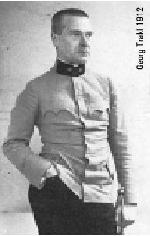
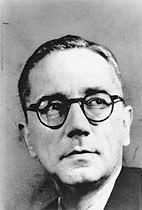
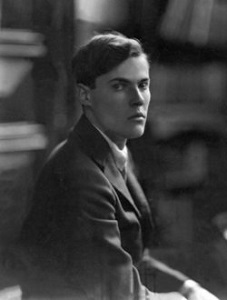
Georg Trakl werd op 3 februari 1887 in het conducteurshuis aan de Waagplatz 2 in Salzburg geboren. Zijn vader, Tobias Trakl, was een handelaar in ijzerwaren en zijn moeder, die ook psychische problemen had, was Maria Catharina Trakl, (meisjesnaam Halik). Voorts had hij nog drie broers en drie zussen. Margarethe (doorgaans Grethe genoemd) stond hem het naast, zelfs zodanig dat sommigen een incestueuze verhouding vermoeden. Zijn jeugd bracht hij door in Salzburg. Vervolgens bezocht hij van 1897 tot 1905 het humanistische gymnasium. Om toch een academische opleiding te kunnen volgen, werkte hij tot 1908 in de praktijk bij een apotheker. Sommigen vermoedden dat hij dit vooral deed om zichzelf opiaten te kunnen verschaffen. Bij het uitbreken van WO I werd Trakl als medicus naar het front in Galicië (heden ten dage in Oekraïne en Polen) gestuurd. Zijn gemoedsschommelingen leidden tot geregelde uitbraken van depressie, die verergerd werden door de afschuw die hij voelde voor de verzorging van de ernstig verwonde soldaten. De spanning en druk dreven hem ertoe een suïcidepoging te ondernemen, welke zijn kameraden nochtans verhinderden. Hij werd in een militair ziekenhuis opgenomen in Kraków, alwaar hij onder strikt toezicht geplaatst werd.Trakl verzonk daar in nog zwaardere depressies en schreef Ficker om advies. Ficker overtuigde hem ervan dat hij contact moest opnemen met Wittgenstein, die inderdaad op weg ging na Trakls bericht te hebben ontvangen. Op 4 november 1914, drie dagen voordat Wittgenstein aan zou komen, overleed hij echter aan een overdosis cocaïne
Paul Celan
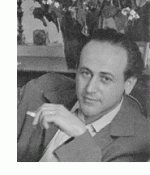
Paul Celan werd onder de naam Paul Antschel op 23 november 1920 geboren in Czernowitz, toentertijd de hoofdstad van de Roemeense Boekovina, nu behorend bij de Oekraïne. Paul Celans ouders waren Duitssprekende joden die hun zoon joods opvoedden en hem naar Duitse christelijke scholen stuurden. In 1942 werden Celans ouders door de Duitse bezetter naar een werkkamp gedeporteerd en daar vermoord. Hijzelf wist aanvankelijk onder te duiken, maar moest vanaf juli 1942 in een werkkamp dwangarbeid verrichten. Celan overleefde de oorlog. Via Boekarest en Wenen vestigde Celan zich in 1948 in Parijs. Daar was hij werkzaam als dichter, vertaler en doceerde hij aan de prestigieuze Ecole Normale Supérieure. Vermoedelijk op 20 april 1970 beëindigde hij zijn leven zelf door in de Seine te springen.
Gerard Reve
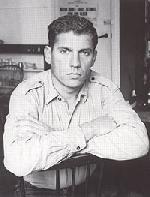
Gerard Reve over: Medearbeiders ”God is in de mensen, de dieren, de planten en alle dingen - in de schepping, die verlost moet worden of waaruit God verlost moet worden, door onze arbeid, aangezien wij medearbeiders van God zijn.” Openbaring ”Tja, waar berust elk godsbegrip op, elke vorm van religie? Op een openbaring, dat wil zeggen op een psychische ervaring van zulk een dwingende en onverbiddelijke kracht, dat de betrokkene het gevoel heeft, niet dat hij een gedachte of een visioen heeft, maar dat een gedachte gedachte of visioen hem bezit en overweldigt.”
Simon Vestdijk
Simon Vestdijk (Harlingen, 17 oktober 1898 – Utrecht, 23 maart 1971) was een Nederlands romancier, dichter, essayist en vertaler. Zijn jeugd te Harlingen en Leeuwarden beschreef hij later in de Anton Wachter-cyclus. Van jongs af aan logeerde hij regelmatig bij zijn grootouders in Amsterdam, waar hij zich in 1917 aan de Universiteit van Amsterdam inschrijft als student in de medicijnen. Tijdens zijn studie die van 1917 tot 1927 duurde, leerde hij Jan Slauerhoff kennen.Tot 1932 is hij als arts in praktijken door heel Nederland werkzaam. In 1932 volgt zijn officiële schrijversdebuut met de uitgave van de bundel Verzen in De Vrije Bladen. Doorslaggevend voor Vestdijks uiteindelijke keuze voor de literatuur is zijn ontmoeting in 1932 met Eddy Du Perron en Menno ter Braak. Deze ontmoeting had tot resultaat dat hij redactielid werd van het tijdschrift Forum Kort daarop, in 1933, wordt zijn eerste novelle, De oubliette, uitgegeven. In hetzelfde jaar schrijft hij Kind tussen vier vrouwen, dat, eerst geweigerd door de uitgever, later de basis zal vormen voor de eerste drie delen van de Anton Wachter-romans. In 1951 ontvangt Vestdijk de P.C. Hooftprijs voor zijn in 1947 verschenen roman De vuuraanbidders. In 1957 wordt hij voor het eerst door het PEN-centrum voor Nederland voorgedragen voor de Nobelprijs voor de Literatuur, die hij echter nooit zal krijgen. Op 20 maart 1971 wordt hem de Prijs der Nederlandse Letteren toegekend, maar voor hij deze kan ontvangen overlijdt hij op 23 maart te Utrecht op 72-jarige leeftijd. Vestdijk was auteur van ca. 200 boeken. Vanwege deze enorme productie noemde de dichter Adriaan Roland Holst hem 'de man die sneller schrijft dan God kan lezen'. Andere belangrijke boeken van Simon Vestdijk zijn: "Kind van stad en land" (1936), "Meneer Visser's hellevaart" (1936), "Ierse nachten" (1946), "De toekomst de religie" (1947), "Pastorale 1943" (1948), "De koperen tuin" (1950), "Ivoren wachters" (1951), "Essays in duodecimo" (1952) en "Het genadeschot" (1964).
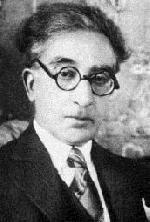
K.P. Kavafis K.P. Kavafis werd als kind van Griekse ouders, afkomstig uit Konstantinopel, geboren in 1863 in Alexandrië (tot vandaag een Griekse enclave) waar hij ook het grootste deel van zijn leven woonde en werkte. Twee jaar na de dood van zijn vader verhuist het gezin in 1872 naar Engeland om na een verblijf van vijf jaar naar Alexandrië terug te keren. Vanwege ongeregeldheden in Egypte vlucht het gezin in 1882 naar Konstantinopel, om na drie jaar opnieuw naar Alexandrië terug te gaan. In de jaren die volgen maakt Kavafis reizen naar Parijs, Londen en in 1901 zijn eerste reis naar Griekenland, in latere jaren gevolgd door nog enkele bezoeken. Op de dag van zijn zeventigste verjaardag, in 1933 sterft Kavafis in Alexandrië. De roem kwam voor Kavafis pas na zijn dood, dus postuum. Deels is dat toe te schrijven aan zijn eigen handelswijze. Hij was uiterst terughoudend met de publicatie van zijn gedichten, liet af en toe een enkel gedicht afdrukken in een literair tijdschrift, gaf in eigen beheer enkele bundels met een stuk of twintig gedichten uit en het merendeel van zijn poëzie schonk hij op losse bladen aan zijn beste vrienden.
Thomas Mann
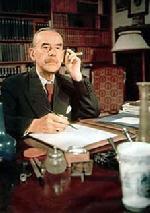
Thomas Mann, de jongere broer van Heinrich Mann, werd geboren op 6 juni 1875 in Lübeck. Hij was de tweede zoon van de graankoopman Thomas Johann Heinrich Mann welke later één van de senatoren van Lübreck werd. Zijn moeder Julia (geboren da Silva-Bruhns) was Duits-Braziliaans van Portugees Kreoolse afkomst. In 1894 debuteerde Thomas Mann met de novelle "Gefallen". Toen Thomas Mann met 21 jaar eindelijk volwassen was en hem dus geld van zijn vaders erfenis toestond - hij kreeg ongeveer 160 tot 180 goldmark per jaar - besloot hij dat hij genoeg had van al die scholen en instituties en werd onafhankelijk schrijver. Kenmerkend voor zijn stijl zijn de ironie, de fenomenale taalbeheersing en de minutieuze detailschildering. Manns reputatie in Duitsland was sterk wisselend. Met zijn eerste roman, Buddenbrooks (1901), had hij een enorm succes, maar door zijn sceptische houding tegenover Duitsland na de Eerste Wereldoorlog veranderde dit volledig. Stelde hij zich tot aan de jaren twintig apolitiek op (Betrachtungen eines Unpolitischen, 1918), meer en meer raakte hij bij het Politiek gebeuren betrokken. Zijn afkeer van het nationaal socialisme groeide, zijn waarschuwingen werden veelvuldiger en heftiger. In 1944 accepteerde hij het Amerikaanse staatsburgerschap. Tussen 1943 en 1947 schreef Mann Doktor Faustus (zie Faust), de roman van de 'Duitse ziel' in de gecamoufleerd geschilderde omstandigheden van de 20ste eeuw. In 1947 bezocht hij voor het eerst sinds de Oorlog Europa, twee jaar later pas Duitsland. In 1952 vertrok hij naar Zwitserland. Op 12 augustus 1955 stierf hij in Zürich. Twintig jaar na zijn dood, in aug. 1975, is zijn literaire nalatenschap geopend: dagboekaantekeningen van 15 maart 1933 tot 29 juli 1955, alsmede notities uit de jaren 1918 tot en met 1921.Belangrijke werken zijn: Der Zauberberg, Der Tod in Venedig, Dokter Faustus , Joseph und seine Brüder en Die Bekenntnisse des Hochstaplers Felix Krull.
Rainer Maria Rilke
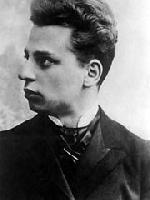
Rilke werd op 4 december 1875 geboren in Praag. Hij had al naam gemaakt als dichter met zijn bundels Das Stundenbuch en Das Buch der Bilder, toen hij de literaire wereld versteld deed staan en wereldfaam verwierf met de publicatie van zijn twee delen Neue Gedichte in 1907 en 1908. Hij verzamelde daarin het beste werk uit een van zijn vruchtbaarste periodes, die hij grotendeels doorbracht in Parijs. Rilke was daar diep onder de indruk gekomen van Rodin, bij wie hij een tijdlang in dienst was als particulier secretaris. Rodin, zei hij later, had hem leren kijken. Dit kijken kwam neer op intense concentratie, om het mysterie te kunnen zien ‘achter de schijnbare werkelijkheid'. Latere en rijpere werken als Duineser Elegien (1912-1923) en het ronduit schitterende Die Sonette an Orfeus (1924) illustreren Rilkes metafysische visie op het onzegbare, dat haar verwoording vindt in een hermetische muzikale taal. Op 29 december 1926 overlijdt Rilke in het sanatorium in Val-Mont aan de gevolgen van leukemie. Enkele dagen later wordt hij, overeenkomstig zijn wens, begraven op het kerkhof van Raron.
* * * * * * * * * * * * * * * *
Romenu
Over literatuur, gedichten, kunst en cultuur
14-04-2018
Michael Basse
De Duitse dichter, schrijver en vertaler Michael Bassegeboren op 14 april 1957 in Bad-Salzuflen / Nordrhein-Westfalen. Hij studeerde filosofie, psychologie en germanistiek in Regensburg en München, waarhij sinds 1984 woont. Sinds 1993 is hij werkzaam bij de redactie cultuurkritiek van de Bayerische Rundfunk. Hij schreef talrijke radioessays en schrijversportretten. Daarnaast vertaalde hij gedichten van o.a. Blaga Dimitrova, Ljubomir Nikolov, Boiko Lambovski (Bulgaars), Anise Koltz, Jean Portante (Frans) und John F. Deane (Engels). Bad-Salzuflen / Nordrhein-Westfalen. Zie ook alle tags voor Michael Basse op dit blog.
Uit:Ein einziges lyrisches Missverständnis
“Die Stoßrichtung ist alles andere als avantgardistisch. Und das gilt sowohl für die Sprachauffassung wie für den ideologisch-politischen Überbau. Der Vergleich mit Pound bietet sich hier geradezu an, zumal es in der Vita beider überraschende Parallelen gibt. Für beide ist die Poesie sprachlich auf den Hund gekommen. Während Borchardt die naturalistischen und neoromantischen Strömungen ebenso auf den Geist gehen wie der sich andeutende Expressionismus und später die neue Sachlichkeit, gegen die er einen hohen Ton restituieren will, der sich an klassischen Epochen vom Mittelalter bis zur Goethezeit messen lassen kann, wettert Pound gegen die gekünstelt anämische Stimmungs- und Gefühlsdichtung Londoner Salons, deren dekorativer Schwulst von sprachlicher Impotenz zeuge. Beiden geht es um ein fundamental anderes Verhältnis zur Sprache, eigentlich um ihre Wiederbelebung. Ernsthafte Auseinandersetzung mit Traditionen, echte Bildung und philologische Kenntnisse sind dabei selbstverständliche Voraussetzung, wenn nicht blind ins Blaue hinein gedichtet werden soll. Für Borchardt hatte sich Deutsch als Literatursprache geschichtlich verabschiedet; für den Wahleuropäer Pound, der sich je nach Lage englisch, französisch, italienisch und mitunter auch deutsch ausdrückte, hatte sich das Italienische als Literatursprache seit Dante und Cavalcanti - mit Ausnahme Leopardis - kaum weiterentwickelt. Beide übersetzten aus dem Italienischen, wurden aus Bewunderung für Mussolini auf der Oberfläche Faschisten, machten dem Duce ihre Aufwartung. Beide hofften auf eine kulturelle Erneuerung aus dem Geiste des Archipelagos. Beider Domizile - Lucca und Rapallo - lagen Luftlinie gerade mal 100 Kilometer entfernt.“
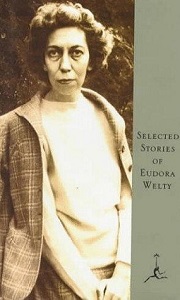
Nachoem Wijnberg, K. Michel, Alexander Münninghoff, Michel Faber, Jean-Marie Gustave Le Clézio, Samuel Beckett, Seamus Heaney, Tim Krabbé, Eudora Welty
De eerste keer dat je je herinnert dat je dat deed
Je bent hier lang niet geweest en kwam terug om nog een keer te kijken.
Had het niet meer veranderd moeten zijn?
Maar het is enkel voor een deel zoals je je kan herinneren, een groter deel zoals je denkt dat het was.
Je schuift dat wat je je herinnert verder uit elkaar, om nog een keer te zoeken.
Om daar met je heer herinnering rond te lopen, jij wijst hem iets aan alsof het van jou is en daarna wijst hij jou iets aan, maar waar is hij nu?
Een lege straat, einde van de middag.
Je weet niet meer welke maand het was, maar het was een lege, niet-koude middag.
Je zat in de bus van school naar huis en je stapte eerder uit om te lopen waar je liep toen je op een vorige school zat en je kon wat je je niet en wat je je wel herinnerde niet even zwaar maken.
Politiek als beroep, zegt Max Weber
Gedichten zijn nutteloos om de wereld te besturen, zegt Huang Tingjian, wiens gedichten wonderlijk zijn als ze lukken. Als het een doen beter is dan het ander, als ze allebei goed gedaan worden, is iets doen wat op het een lijkt beter dan iets wat op het ander lijkt? Kan ik dat niet korter zeggen? Een gedicht verspilt toch niet. Nu kom ik pas bij het belangrijkere probleem: genoegen nemen met wat op het betere lijkt omdat het op het betere lijkt?
Af en toe doe ik alsof ik iets goed kan, zegt Su Dongpo, zoals iets waaraan ik dan meteen daarna opnieuw moet beginnen
Na al het nieuws haal ik de heilige boeken uit de kast en schud daar de leeswijzers en de vrome praatjes uit
Van deze zuiverheid nastrevende stof kneed ik een sneeuwbal – haren en kruimels geen probleem – en steek daar een vulpen in tot de sneeuwbal zwart kleurt
Dan zet ik het machteloos mooie ‘vogels in bos en duin’ op schenk jou een glas rood in en wachten wij op het onbedaarlijke smelten
Domino
Er zwemt een barst door het huis Niemand die luistert
Uit de schaduw groeien schaduwen in het onderwaterlicht dat passerende auto's werpen op de muren rondom het bed
In de diepblauwe stilte herhaalt een jongetje lipzacht al wat gezegd is die dag en stopt woord voor woord de gaten in het geluid dat huwelijk heet
De vloer golft De deurklink is ver
En het jongetje houdt zijn handpalmen als een boek in zijn handen en ik lees 'kom terug, ga weg'
Een spreuk, een dominosteen die een ster slaat in het glas van mijn huis
“De Oude Heer geloofde het pas toen hij het van zijn zwager, Onkel Walter, nog eens bevestigd kreeg. Met een ernstig gezicht had deze de vellen met medische rapporten, die hij als Duits oncoloog van het Antoni van Leeuwenhoek-ziekenhuis ter inzage had gekregen, bestudeerd, en zijn conclusie was hard en duidelijk: 'Je hebt hooguit twee maanden, Joan. Je moet nu echt dingen gaan regelen.' Het was december 1953. Ik was negen en had zojuist van Mimousse gehoord wat ik al een tijdje bevroedde: Sinterklaas bestond niet. Ze vond het gek dat ik daar niet zelf al achter was gekomen. Dat Opa op sterven lag, hoorde ik pas aan de vooravond van 23januari1954, de dag dat hij definitief de ogen sloot, omringd door vrouw, kinderen, Onkel Walter en een geestelijke, pater Kolfschoten, die elke dag langskwam en hem vlak voor zijn dood de biecht afnam en het Heilig Oliesel toediende. 'Vaarwel, lieve broeder, grote vriend, tot ziens. In coelo quies,' hoorde ik de jezuïtische huisvriend, die hem nog uit Riga kende en die in de herenkamer meer dan wie ook instrumenteel was geweest in de besluitvorming in talloze zaken, met gesmoorde stem zeggen. Ikzelf stond, samen met Mimousse en Trees, in de deuropening van Opa's slaapkamer, die zijn sterfkamer was geworden: hij had me bij zich laten roepen, me over mijn hoofd geaaid en niets gezegd. En ook ik had zwijgend de laatste impressie van hem in me opgenomen: bleek, met tinten lichtgeel en lichtpaars, was zijn gezicht geweest. Geen zichtbare emotie viel er te bespeuren. Mijn grootvader was verstijfd tot een keurige man met voorname gelaatstrekken, en toen zijn hand krachteloos op het laken was teruggevallen, leefde hij alleen nog maar door zijn donkere ogen, die merkwaardig strak op mij gericht waren geweest terwijl ik achteruitschuifelde, totdat hij langzaam en eventjes knipperend, alsof hij opeens bedacht dat hij toch nog iets moest zeggen, zijn oogleden sloot. Toen dokter Van Tilburg het onomstotelijke eindvonnis geveld had — 'Hij is dood, lieve mensen' —, zeeg mijn grootmoeder, zoals dat hoort bij Russische vrouwen, krampachtig snikkend bij de Oude Heer neer. Dat had ik wel min of meer verwacht; wat me echter verbaasde was dat mijn vader meteen naar het raam liep dat op de achtertuin uitkeek en de gordijnen, die de hele week dag en nacht gesloten waren geweest, opende, waarna Xeno, die achter hem aan was gekomen, ze in een vloeiende, naadloos aansluitende beweging weer sloot.”
Alexander Münninghoff (Posen, 13 april 1944)
De Schotse, Engelstalige schrijver van Nederlandse herkomst, Michel Faberwerd geboren in Den Haag op 13 april 1960. Zie ook alle tags voor Michel Faberop dit blog.
Uit: The Crimson Petal and The White
“Watch your step. Keep your wits about you; you will need them. This city I am bringing you to is vast and intricate, and you have not been here before. You may imagine, from other stories you've read, that you know it well, but those stories flattered you, welcoming you as a friend, treating you as if you belonged. The truth is that you are an alien from another time and place altogether. When I first caught your eye and you decided to come with me, you were probably thinking you would simply arrive and make yourself at home. Now that you're actually here, the air is bitterly cold, and you find yourself being led along in complete darkness, stumbling on uneven ground, recognising nothing. Looking left and right, blinking against an icy wind, you realise you have entered an unknown street of unlit houses full of unknown people. And yet you did not choose me blindly. Certain expectations were aroused. Let's not be coy: you were hoping I would satisfy all the desires you're too shy to name, or at least show you a good time. Now you hesitate, still holding on to me, but tempted to let me go. When you first picked me up, you didn't fully appreciate the size of me, nor did you expect I would grip you so tightly, so fast. Sleet stings your cheeks, sharp little spits of it so cold they feel hot, like fiery cinders in the wind. Your ears begin to hurt. But you've allowed yourself to be led astray, and it's too late to turn back now. It's an ashen hour of night, blackish-grey and almost readable like undisturbed pages of burnt manuscript. You blunder forward into the haze of your own spent breath, still following me. The cobblestones beneath your feet are wet and mucky, the air is frigid and smells of sour spirits and slowly dissolving dung. You hear muffled drunken voices from somewhere nearby, but what little you can understand doesn't sound like the carefully chosen opening speeches of a grand romantic drama; instead, you find yourself hoping to God that the voices come no closer.”
« L'Afrique brûle comme un secret, comme une fièvre. Geoffroy Allen ne peut pas détacher son regard, un seul instant, il ne peut pas rêver d'autre rêve. C'est le visage sculpté des marques itsi, le visage masqué des Umundri. Sur les quais d'Onitsha, le matin, ils attendent, immobiles, en équilibre sur une jambe, pareils à des statues brûlées, les envoyés de Chuku sur la terre. C'est pour eux que Geoffroy est resté dans cette ville, malgré l'horreur que lui inspirent les bureaux de la United Africa, malgré le Club, malgré le Résident Rally et sa femme, leurs chiens qui ne mangent que du filet de bœuf et qui dorment sous des moustiquaires. Malgré le climat, malgré la routine du Wharf. Malgré la séparation d'avec Maou, et ce fils né au loin, qu'il n'a pas vu grandir, pour qui il n'est qu'un étranger. Eux, chaque jour, sur le quai, dès l'aube, attendent on ne sait quoi, une pirogue qui les emmènerait en amont, qui leur apporterait un message mystérieux. Puis ils s'en vont, ils disparaissent, en marchant à travers les hautes herbes, vers l'est, sur les chemins d'Awgu, d'Owerri. Geoffroy essaye de leur parler, quelques mots d'ibo, des phrases en yoruba, en pidgin, et eux, toujours silencieux, non pas hautains, mais absents, disparaissant vite à la file indienne le long du fleuve, se perdant dans les hautes herbes jaunies par la sécheresse. Eux, les Umundri, les Ndinze, les « ancêtres », les « initiés ». Le peuple de Chuku, le soleil, entouré de son halo comme un père est entouré de ses enfants. C'est le signe itsi. C'est lui que Geoffroy a vu, sur les visages, la première fois qu'il est arrivé à Onitsha. Le signe gravé dans la peau des visages des hommes, comme une écriture sur la pierre. C'est le signe qui est entré en lui, l'a touché au cœur, l'a marqué, lui aussi, sur son visage trop blanc, sur sa peau où manque depuis sa naissance là trace de la brûlure. Mais à présent il ressent cette brûlure, ce secret. Hommes et femmes du peuple Umundri, dans les rues d'Onitsha, ombres absurdes errant dans les allées de poussière rouge, entre les bosquets d'acacia, avec leurs troupeaux de chèvres, leurs chiens. Seuls certains d'entre eux portent sur le visage le signe de leur ancêtre Ndri, le signe du soleil."
Jean-Marie Gustave Le Clézio (Nice, 13 april 1940)
“Krapp remains a moment motionless, heaves a great sigh, looks at his watch, fumbles in his pockets, takes out an evelope, puts it back, fumbles, takes out a small bunch of keys, raises it to his eyes, chooses a key, gets up and moves to front of table. He stoops, unlocks first drawer, peers into it, feels about inside it, takes out a reel of tape, peers at it, puts it back, locks drawer, unlocks second drawer peers into it, feels about inside it, takes out a large banana, peers at it, locks drawer, puts keys back in his pocket. He turns, advances to edge of stage, halts, strokes banana, peels it, drops skin at his feet, puts end of banana in his mouth and remains motionless, staring vacuously before him. Finally he bites off the end, turns aside and begins pacing to and fro at edge of stage, in the light, i.e. not more than four or five paces either way, meditatively eating banana. He treads on skin, slips, nearly falls, recovers himself, stoops and peers at skin and finally pushes it, still stooping, with his foot over the edge of the stage into pit. He resumes his pacing, finishes banana, returns to table, sits down, remains a moment motionless, heaves a great sigh, takes keys from his pockets, raises them to his eyes, chooses key, gets up and moves to front of table, unlocks second drawer, takes out a second large banana, peers at it, locks drawer, puts back his keys in his pocket, turns, advances to the edge of stage, halts, strokes banana, peels it, tosses skin into pit, puts an end of banana in his mouth and remains motionless, staring vacuously before him. Finally he has an idea, puts banana in his waistcoat pocket, the end emerging, and goes with all the speed he can muster backstage into darkness. Ten seconds. Loud pop of cork. Fifteen seconds. He comes back into light carrying an old ledger and sits down at table. He lays ledger on table, wipes his mouth, wipes his hands on the front of his waistcoat, brings them smartly together and rubs them.“
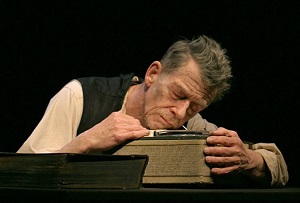
Samuel Beckett (13 april 1906 - 22 december 1989) John Hurt in de titelrol tijdens een uitvoering in New York, 2011
“Ineens was dat tafeltje leeg en kwam er een jongen in korte broek naast me zitten. Hij knikte me vriendelijk toe, sloeg een krantje open en begon te lezen. Ik herkende hem meteen, maar het duurde seconden voor ik kon geloven dat het echt Fignon was. Het zijn altijd vreemde confrontaties tussen twee mensen die allebei weten dat ze geen fabeldier zijn, maar waarvan er één dat voor de ander toch is. Ik voelde ook een lichte teleurstelling: Tourwinnaars horen zich niet op te houden met zaken als aan jou vragen of die stoel vrij is. Daar zaten we, hij met L 'Equipe, ik zonder vragen. Ach, had De Renner in het Frans vertaald mogen zijn, had hij het gelezen mogen hebben, wat zou ik graag zijn vragen over de Ronde van de Mont Aigoual hebben beantwoord. Waarschijnlijk heb ik gezegd dat ik Nederlander was, want ik zie hem nog grinniken, met glinsterende ogen, over een brief die een Nederlands meisje hem had geschreven. Ik vroeg of hij nog iets had gemerkt van de aanwezigheid van Dustin Hoffman in de Tour. Ja, hij was aan hem voorgesteld, dat was toch voor een film die misschien gemaakt zou worden, The Yellow Jersey? Fignon was vriendelijk en zachtbespraakt, en totaal onaanmatigend, maar het heeft toch geduurd tot hij fotografen die hem lastigvielen tegen de kloten begon te schoppen dat ik hem ben gaan noemen als de renner die ik misschien wel het meest bewonder. Grote kampioenen winnen soms grote wedstrijden vóór ze daar echt recht op hebben. De drieëntwintigjarige Hinault van de Tour van 1978 die eigenlijk voor Pollentier was, en de tweeëntwintigjarige Fignon die in 1983 won toen Pascal Simon in het geel met een schouderblessure moest uitvallen, zijn daar voorbeelden van. Maar ook grote kampioenen die eigenlijk al over hun hoogtepunt heen zijn, winnen soms ten onrechte. Zoetemelk 1980 (Hinault!) en Hinault 1985 (LeMond!) zijn dáár voorbeelden van. Fignon 1989 wordt een nieuw geval.”
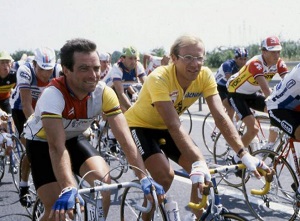
Tim Krabbé (Amsterdam, 13 april 1943) Bernard Hinault en Laurent Fignon in 1984
"Lord, yes, she's from New Orleans. Ever'body in New Orleans believes ever'thing spooky. One of 'em in New Orleans before it was raided says to Mrs. Pike one summer she was goin' to go from State to State and meet some grey-headed men, and, sure enough, she says she went on a beautician convention up to Chicago. . . . " "Oh!" said Mrs. Fletcher. "Oh, is Mrs. Pike a beautician too?" "Sure she is," protested Leota. "She's a beautician. I'm goin' to git her in here if I can. Before she married. But it don't leave you. She says sure enough, there was three men who was a very large part of making her trip what it was, and they all three had grey in their hair and they went in six States. Got Christmas cards from 'em. Billy Boy, go see if Thelma's got any dry cotton. Look how Mrs. Fletcher's a-drippin'." "Where did Mrs. Pike meet Mr. Pike?" asked Mrs. Fletcher primly. "On another train," said Leota. "I met Mr. Fletcher, or rather he met me, in a rental library," said Mrs. Fletcher with dignity, as she watched the net come down over her head. "Honey, me an' Fred, we met in a rumble seat eight months ago and we was practically on what you might call the way to the altar inside of half an hour," said Leota in a guttural voice, and bit a bobby pin open. "Course it don't last. Mrs. Pike says nothin' like that ever lasts." "Mr. Fletcher and myself are as much in love as the day we married," said Mrs. Fletcher belligerently as Leota stuffed cotton into her ears. "Mrs. Pike says it don't last," repeated Leota in a louder voice. "Now go git under the dryer. You can turn yourself on, can't you? I'll be back to comb you out. Durin' lunch I promised to give Mrs. Pike a facial. You know—free. Her bein' in the business, so to speak." "I bet she needs one," said Mrs. Fletcher, letting the swing-door fly back against Leota. "Oh, pardon me."
Tags:Nachoem Wijnberg, K. Michel, Alexander Münninghoff, Michel Faber, Jean-Marie Gustave Le Clézio, Samuel Beckett, Seamus Heaney, Tim Krabbé, Eudora Welty, Romenu
Antje Rávic Strubel, Alan Ayckbourn, Scott Turow, Tom Clancy, Agnes Sapper, Edward de Vere, José Gautier Benítez, Alexander Ostrovski, Guillaume-Thomas Raynal
“Postal clerk Erik M. Broda, retired for three weeks, though still working part-time, eagerly awaits his female superior Simona’s arrival, so he can give her a special wink as he slams his cancellation stamp on the wrong side of a postcard to Mainz. He doesn't like the card. He has read hundreds of postcards like it in his career. Whenever he doesn’t like a postcard, he stamps the postmark wrong side up. Bad postcards are like female superiors. They gab a lot and then forget the most important things. The most important things for a postcard are: first, the stamp, second, the postal code, and third, the signature. The signature is missing on this one. He covers the card with his left palm, sohe’s just able to read the message, and pulls over a stack of thick envelopes in need of postmarking. The stamp hovers in his fist halfway above the desk. That way he can slam it down if Simona came in by surprise. Ever since she started working here, everything has changed. Back then, he could be sure nobody would disturb him.
Dear Haschi, Unfortunately, I couldn’t find a funny postcard for you. All they’ve got are ones with sunsets or with Rübezahl, the mountain spirit, on the front. At least they’ve got super yummy dumplings and pancakes and gorgeous wild icicles. I’m drinking lots of mulled wine with Evy. I’d love to know what’s going on in her head, like you always knew with me. Bet she’d like that. But I don’t. Say hi to C., whoever he is. You’re a lot happier, since you’ve been together with him. Laughed more last time. Would love to be with you again, but could it work after all these years?
The card makes him angry. There was enough space for a signature. What angers him most, though, is that the card had obviously been written by a man. He admires women. They are completely perfect beings, right from the start, they help him differentiate one day from the next; they give him a rhythm, like Simona with her irregular visits to his office. But he doesn’t expect precision from women. They’ve overtaken us, he thinks, but they’ll never take over. He imaginesthey’ll just keep climbing higher than him in the future.”
„Lucy (as she goes) Sit still. Don't run around. I won't be a minute. (Lucy goes out into the kitchen. Rosemary sits nervously. She rises after a second, looks guiltily towards the kitchen and sits again. The door chimes sound. Rosemary looks towards the kitchen. There is no sign of Lucy. The door chimes sound again. Rosemary gets up hesitantly) Rosemary (calling) Mrs—er Lucy (off in the kitchen) Wait, wait, wait! I'm coming ... (The door chimes sound again Rosemary runs off to the front door. Lucy returns from the kitchen with a glass of orange juice) Here we are, Rosemary, I . (She looks round the empty room, annoyed. Calling) Rosemary! It's on the table. (Lucy puts the orange juice on the coffee-table and goes out to the kitchen again. Rosemary returns from the hall with Terry, a rather pudgy man in shirt sleeves) Rosemary (sotto voce) Come in a minute. Terry I'm watching the telly. Rosemary Just for a minute. Terry I wondered where you'd got to. I mean, all you had to do was give her the number ... Rosemary I want you to meet her. See what you think. I don't think she's well. Terry How do you mean? Rosemary She just seems ... Terry Is she ill? Rosemary I don't know ... Terry Well, either she's ill or she isn't.“
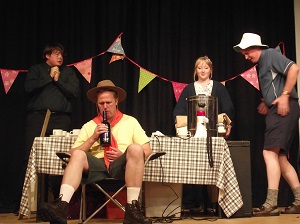
Alan Ayckbourn (Londen, 12 april 1939) Scene uit een opvoering in Shifnal, Shropshire, 2011
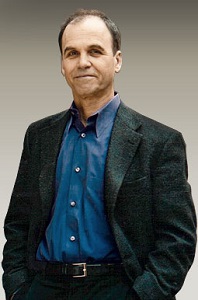
“All parents keep secrets from their children. My father, it seemed, kept more than most. The first clue came when Dad passed away in February 2003 at the age of eighty-eight, after sailing into a Bermuda Triangle of illness—heart disease, lung cancer, and emphysema—all more or less attributable to sixty years of cigarettes. Characteristically, my mother refused to leave the burial details to my sister and me and met the funeral director with us. She chose a casket big enough to require a hood ornament, then pondered each word as the mortician read out the proposed death announcement. "Was David a veteran?" he asked. The undertaker was the cleanest-looking man I'd ever seen, with lacquered nails, shaped eyebrows, and a face so smooth I suspected electrolysis. "World War II," barked Sarah, who at the age of fifty-two still raced to answer before me. The funeral director showed us the tiny black rendering of the Stars and Stripes that would appear in the paper beside Dad's name, but my mother was already agitating her thinning gray curls. "No," she said. "No war. Not for this David Dubin." When she was upset, Mom's English tended to fail her. And my sister and I both knew enough to keep quiet when she was in those moods. The war, except for the bare details of how my father, an American officer, and my mother, an inmate in a German concentration camp, had fallen in love, virtually at first sight, had been an unpleasantness too great for discussion throughout our lives. But I had always assumed the silence was for her sake, not his. By the end of the mourning visitation, Mom was ready to face sorting through Dad's belongings. Sarah announced she was too pressed to lend a hand and headed back to her accounting practice in Oakland, no doubt relishing the contrast with my unemployment. Mom assigned me to my father's closet on Monday morning, insisting that I consider taking much of his clothing. It was nearly all disastrously out of fashion, and only my mother could envision me, a longtime fatso, ever shrinking enough to squeeze into any of it. I selected a few ties to make her happy and began boxing the rest of his old shirts and suits for donation to the Haven, the Jewish relief agency my mother had helped found decades ago and which she almost single-handedly propelled for nearly twenty years as its Executive Director.“
Scott Turow (Chicago, 12 april 1949)
De Amerikaanse schrijver Tom Clancy werd geboren op 12 april 1947 in Baltimore County, Maryland. Zie ook alle tags voor Tom Clancyop dit blog.
Uit: De tanden van de tijger (Vertaald door Hugo Kuipers)
“David Greengold was geboren in de meest Amerikaanse gemeenschap die er was, Brooklyn, maar op zijn bar mitswa was er iets belangrijks veranderd in zijn leven. Nadat hij had uitgeroepen: ‘Vandaag ben ik een man’, was hij naar het feest gegaan en had daar een paar familieleden ontmoet die uit Israel waren overgekomen. Zijn oom Moses had daar veel succes als diamanthandelaar. Davids eigen vader had zeven juwelierszaken, waarvan het vlaggenschip zich in 40th Street in Manhattan bevond. Terwijl zijn vader en zijn oom het bij een glas Californische wijn over zaken hadden, was David aan de praat geraakt met zijn neef Daniel. Daniel, tien jaar ouder dan hij, werkte sinds kort voor de Mossad, de belangrijkste inlichtingendienst van Israel, en als een echte nieuweling vond hij het prachtig om zijn neef verhalen te vertellen. Daniel had zijn dienstplicht vervuld bij de Israelische para’s; hij had elf sprongen op zijn naam staan en ook enige actie meegemaakt in de Zesdaagse Oorlog van 1967. Voor hem was het een mooie oorlog geweest. In zijn compagnie had niemand ernstig letsel opgelopen en ze hadden genoeg treffers gescoord om het op een jachtpartij te laten lijken – jagers die achter gevaarlijk, maar niet te gevaarlijk, wild aan zaten, met een afloop die heel goed paste bij de ideeen en verwachtingen die hij voor de oorlog had gekoesterd. De verhalen hadden in sterk contrast gestaan met de sombere televisiebeelden van Vietnam waarmee in Amerika het journaal elke avond begon. Met het enthousiasme van zijn op die dag bevestigde religieuze identiteit had David onmiddellijk besloten meteen na zijn eindexamen naar zijn joodse thuisland te emigreren. Zijn vader, die in de Tweede Wereldoorlog in de Tweede Pantserdivisie van het Amerikaanse leger had gediend en over het geheel genomen weinig plezier aan dat avontuur had beleefd, had het helemaal geen prettig vooruitzicht gevonden dat zijn zoon naar een Aziatische jungle zou gaan om in een oorlog te vechten waarvoor zijn kennissen en hij geen enkel enthousiasme konden opbrengen, en dus vloog de jonge David na zijn eindexamen met El Al naar Israel om daar voorgoed te blijven. Hij spijkerde zijn Hebreeuws bij, vervulde zijn Israelische dienstplicht en werd toen net als zijn neef door de Mossad gerekruteerd.”
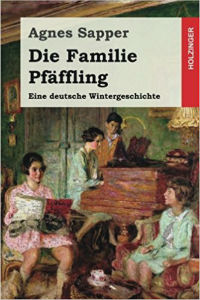
Uit: Die Familie Pfäffling. Eine deutsche Wintergeschichte
„Im Hause Pfäffling war nach dem lauten Abgang der sieben Familienmitglieder eine ungewohnte Stille eingetreten. Es blieb nur noch die Mutter zurück, und Elschen, das jüngste niedliche Töchterchen, sowie die treue Walburg, die in der Küche wirtschaftete. Frau Pfäffling atmete auf, die Stille tat ihr wohl. Was war das für ein Sturm gewesen, bis der letzte die Türe hinter sich zugemacht hatte, und was für eine Unruhe all die Ferienwochen hindurch! Während sie ordnend und räumend von einem Zimmer ins andere ging, war ihr ganz festtäglich zu Mute. Sie war von Natur eine stille, nachdenkliche Frau und gern in Gedanken versunken, aber das Leben hatte sie als Mittelpunkt in einen großen Familienkreis gestellt, und es drehten sich lauter lebhafte, plaudernde, fragende, musizierende Menschen um sie herum. Während nun die Mutter sich der Ruhe freute, wußte Elschen gar nicht, wo es ihr fehlte. Allein zu spielen hatte sie ganz verlernt. So ging sie hinunter in den Hof, wo die großen Balken lagen. Oft hatte sie sich in den letzten Wochen geärgert, wenn sie ängstlich auf den glatten Balken kleine Schrittchen machte, daß die Brüder das so flink konnten und sie ihnen immer Platz machen sollte. Jetzt hatte sie alle die Baumstämme allein zu ihrer Verfügung, aber nun machten sie ihr keine Freude. Sie ging weiter zu den Brettern, die übereinander aufgestapelt lagen. Dort oben, wo ein kleines dickes Brett querüberlag, war Frieders Lieblingsplatz, auf dem er immer mit der Ziehharmonika saß. Wenn er gar zu lang spielte und sie nicht beachtete, war sie manchmal ungeduldig geworden und hatte sogar einmal gesagt, die Harmonika sei eine alte Kröte. Aber jetzt, dachte an ihn. Es war so langweilig heute morgen – fast zum weinen! Da tat sich oben im Haus ein Fenster auf und der Mutter Stimme rief: »Elschen, flink, Essig holen!« Einen Augenblick später wanderte auch Else die Frühlingsstraße hinunter, zwar nicht mit den Büchern in die Schule, aber mit dem Essigkrug zum nächsten Kaufmann.“ wo es überall ganz still war, hätte sie auch die Harmonika gern gehört. Sie setzte sich auf Frieders Platz und
Agnes Sapper (12 april 1852 – 19 maart 1929) Cover
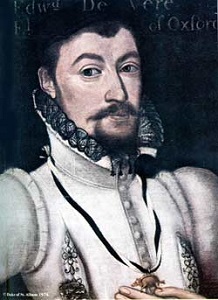
De Engelse hoveling, dichter en toneelschrijverEdward de Vere, 17e graaf van Oxford, werd geboren op 12 april 1550 in Castle Hedingham. Zie ook alle tags voor Edward de Vere op dit blog.
When I was fair and young
When I was fair and young then favour graced me; Of many was I sought their mistress for to be. But I did scorn them all, and answered them therefore, Go, go, go, seek some otherwhere, Importune me no more.
How many weeping eyes I made to pine in woe; How many sighing hearts I have no skill to show; Yet I the prouder grew, and answered them therefore, Go, go, go, seek some otherwhere, Importune me no more.
Then spake fair Venus' son, that proud victorious boy, And said, you dainty dame, since that you be so coy, I will so pluck your plumes that you shall say no more Go, go, go, seek some otherwhere, Importune me no more.
When he had spake these words such change grew in my breast, That neither night nor day I could take any rest. Then, lo ! I did repent, that I had said before Go, go, go, seek some otherwhere, Importune me no more.
Edward de Vere (12 april 1550 – 24 juni 1604) Portret door Marcus Gheeraedts, ca. 1590
A garden of enchantment, fountains playing Above the azure sea that round you swirls, A vase of many-colored flowers swaying Amid the foam and coral, scents and pearls.
You who at dusk, spilling your colors, came In all the hues of brilliant sunset dressed, Filling the ocean full of floating flame Till the last rays of sun died in the West. You who supply the air I breathe each day Inspiring my spontaneous song of praise, Accept the adoring tribute of my lay That as your inspired poet to you I raise! The sacred love that lies within my breast Would play for you its rustic harmony; For you I cast it to the wind's unrest: Your love compels the poet's heart to sing, And in his song his heart he sends to thee.
My island, hark! This possibly could be ]My lyre's last note; for soon I will depart For those far regions without memory.
My fleeing youth is weakening, wastes away, An aching, sad, a melancholy soul No longer in its jail content to stay.
Before I see that last day given me And my song is extinguished with my breath, Take, Homeland, my last lines of poetry: They're testament and sign of my love's depth! They're fond FAREWELL your singer sends to thee!
Vertaald door W. K. Jones en Roberto Màrquez
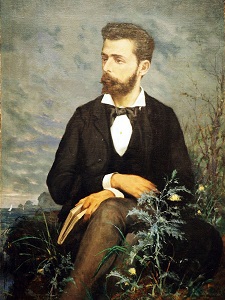
José Gautier Benítez (12 april 1848 – 24 januari 1880) Portret door Francisco Oller, 1886
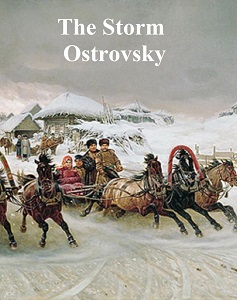
“KUDRIASH. Who could please him, when his whole life's spent in bullying people? Especially where money's at stake; no accounts are ever settled without storms of abuse. Often people are glad to go short of their due, if only he'll let them off quietly. Woe to us if anyone vexes him in the morning! He falls foul of everyone all day long. BORIS. Every morning my aunt entreats us with tears in her eyes: "Don't anger him, friends! Dear boys, don't anger him!" KUDRIASH. But you can never avoid it! If he goes to the bazaar, it's all up! He scolds all the peasants. Even if they ask him less than cost price they never get off without abuse. And then he's upset for the whole day. SHAPKIN. He's a bully—there's no other word for him. KUDRIASH. A bully? I should think he is! BORIS. And what's fatal is if some man offends him, whom he daren't be rude to. Then all his household have to look out for themselves! KUDRIASH. Bless my soul! That was a joke though. Didn't that hussar let him have it on the Volga, at the ferry! Oh, a lovely shindy he kicked up afterwards, too. BORIS. Ah, and didn't his family suffer for it! Why, for a fortnight after we were all hiding away in the attics and cupboards. KULIGIN. Surely that's not the folk coming back from vespers? [Several persons pass in the background. KUDRIASH. Come on, Shapkin, let's get a drink! It's no good stopping here. [They bow and exeunt.”
Alexander Ostrovski (12 april 1823 – 14 juni 1886) Cover
« Estimons-nous beaucoup les productions des colonies ?Je crois qu'on n'en fauroit douter. Pourquoi donc prenons -nous si peu d'intérêt à leur prospérité & à la conservation des colons? Que la fureur d'un ouragan ait enseveli des milliers de ces malheureux sous la ruine de leurs habitations , & le dégât de leurs possessions, nous nous en occupons moins que d'un duel ou d'un assassinat commis à notre porte. Qu'une vaste contrée de ce continent éloigné continue d'être dévastée par quelque épidémie, on s'en entretient ici plus froidement que du retour incertain d'une petite - vérole inoculée. Que les horreurs de la disette réduifent les habitant de Saint-Domingue ou de la Martinique à chercher leur nourriture dans la campagne, ou à se dévorer les uns les autres, nous y pren-drons moins de part qu'au fléau d'une grêle qui auroit haché les moissons de quelques-uns de nos villages. Il el assez naturel de penser que cette indifférence est un effet de l'éloignement , & que les colons ne font pas plus sensibles à nos malheurs que noix aux leurs. Mais, réplique-t-on, nos villes font contiguës à nos campagnes. Nous avons sans celle sous les yeux la misère de leurs habitans. Nous n'en desirons pas moins d'abondantes récoltes en tout genre, & l'on ne peut guère pousser plus loin le mépris pour l'encouragement , la multiplication & la conservation du cultivateur. »
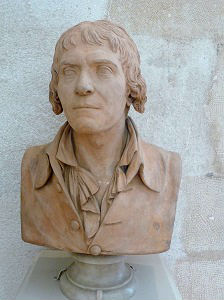
Guillaume-Thomas Raynal (12 april 1713 – 6 maart 1796) Borstbeeld in het Musée des Beaux Arts, Dijon
Tags:Antje Rávic Strubel, Alan Ayckbourn, Scott Turow, Tom Clancy, Agnes Sapper, Edward de Vere, José Gautier Benítez, Alexander Ostrovski, Guillaume-Thomas Raynal, Romenu
Ik ben niet gemaakt om 's avonds de trap op te gaan Naar het smalste bed van de wereld. Ik krijg het aan niemand verkocht.
Ik ben niet gemaakt om 's nachts het licht uit te doen En mijn ogen te sluiten alleen. Kon iemand dat maar in mijn plaats.
Ik ben niet gemaakt om wakker te worden 's ochtends Met een opgeschoonde kop. Ik doe alles verkeerd in mijn slaap.
Ik ben niet gemaakt om het huis uit te gaan, Om boven de hondenweide de blaffende zee te zien Van licht waaraan geen touw valt vast te knopen.
Ik ben niet gemaakt om in het vergezicht Van een kantoorlandschap te zitten zweten Onder de zon van een baas. Voor bredere bedden heeft hij geen geld.
Ik ben niet gemaakt.
Meeuwen voeren
1 Als herten in de verte dorstend naar land Burlen de schepen 's nachts en wekken mijn vriendin. Wij zijn ook nog maar pas naar hier gekomen Om nieuw leven. Oude liefde wou dat zo.
's Ochtends tilt het noorderlicht de slaapvertrekken Uit hun voegen, hemelt ons hier langzaam op In een machtig geheel, een helende verblinding. Daar kunnen wij in schuilen voor elkaar.
2 Wij staan op het terras te praten met een wolk Van af- en aanvliegende meeuwen, geven namen Aan kiftende snavels die ons brood betwisten, Ons vlees vliegen naar de stampende haven.
Zij houdt zo van hun magnifieke wreedheid, de zwevende Obsceniteit van al die malse zatgevreten lijven, Hun opvliegende natuur, hun vleesgeworden honger. Zo aards en zo gehemeld zijn ze zeer waarschijnlijk De krijsende gedachten van haar dode God.
Ze komen gulzig eten uit mijn lege handen Op het Zuid, het nieuwe huis dat zij me leert, Waar wij vanouds de werkelijkheid ten einde dromen Van liefde die dat burlen hoort en niet kan slapen.
Leonard Nolens (Bree, 11 april 1947)
De Amerikaanse dichter en schrijver Mark Strandwerd geboren op 11 april 1934 in Summerside, Prince Edward Island, Canada. Zie ook alle tags voor Mark Strandop dit blog.
The View
For Derek Walcott
This is the place. The chairs are white. The table shines. The person sitting there stares at the waxen glow. The wind moves the air around, repeatedly, As if to clear a space. ‘A space for me,' he thinks. He's always been drawn to the weather of leavetaking, Arranging itself so that grief - even the most intimate - Might be read from a distance. A long shelf of cloud Hangs above the open sea with the sun, the sun Of no distinction, sinking behind it - a mild version Of the story that is told just once if true, and always too late. The waitress brings his drink, which he holds Against the waning light, but just for a moment. Its red reflection tints his shirt. Slowly the sky becomes darker, The wind relents, the view sublimes. The violet sweep of it Seems, in this effortless nightfall, more than a reason For being there, for seeing it, seems itself a kind Of happiness, as if that plain fact were enough and would last.
XVI
It is true, as someone has said, that in A world without heaven all is farewell. Whether you wave your hand or not,
It is farewell, and if no tears come to your eyes It is still farewell, and if you pretend not to notice, Hating what passes, it is still farewell.
Farewell no matter what. And the palms as they lean Over the green, bright lagoon, and the pelicans Diving, and the glistening bodies of bathers resting,
Are stages in an ultimate stillness, and the movement Of sand, and of wind, and the secret moves of the body Are part of the same, a simplicity that turns being
Into an occasion for mourning, or into an occasion Worth celebrating, for what else does one do, Feeling the weight of the pelicans' wings,
The density of the palms' shadows, the cells that darken The backs of bathers? These are beyond the distortions Of change, beyond the evasions of music. The end
Is enacted again and again. And we feel it In the temptations of sleep, in the moon's ripening, In the wine as it waits in the glass.
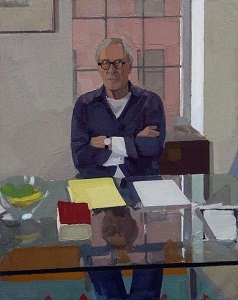
Mark Strand (11 april 1934 – 29 november 2014) Portret door John Dubrow, 2010 - 2015
Uit: Swimming to Elba (Vertaald door Antony Shugaar)
“It’s an entire zoo in here: pig iron everywhere, cranes of every species and variety. Rusted animals with horned heads… The dense black sludge of molten metal was bubbling in the crucibles, potbellied swiveling barrels running along on the mill trains. Giant tanks on wheels that looked like primordial creatures… Metal was everywhere, in the process of birth. Unceasing cascades of steel and glistening cast iron and viscous light. Torrents, rapids, estuaries of molten metal coursing through the flow lines, into the ampules of the ladles and pouring out into the tundishes to drain into the molds for furnaces and trains... Raw materials were being transformed at every hour of the day and night… You could feel the blood rushing through your arteries at a fantastic velocity in there, and from the arteries to the capillaries, while your muscles built up in tiny fractures: You were regressing to the animal state. Alessio was small and alive in this vast burgeoning organism. (...)
He could feel the pressure of it at the nape of his neck, the black tower of the A-Fo 4, a giant spider that digests, ruminates, and belches out... Bluish fluorescences, toxic clouds in volumes sufficient to poison not only the Val di Cornia, but all of Tuscany... tons of metal whirling like birds, yellow clouds of carbon smoke, black at the mouths of the smokestacks. It’s called continuous integrated steel production. As Alessio walked he crushed nettles and chunks of refractory brick underfoot. Metal saturated the ground and his skin... the elementary motion of machinery that is no different from life.”
Uit: Three hours in Fiumicino (Vertaald door Jason Casper)
“But before I could finish, it was announced over the loudspeaker that all travelers to Montreal were to get ready for boarding. And at that she said to me, “Too bad… this was a nice conversation.” But before rising to leave and say goodbye, she searched a moment in her handbag before taking out a small crystal souvenir in the shape of a dolphin, and presented it to me. “I’m sorry also… I don’t have anything else either to give you but this dolphin. It can serve as your reminder about Bella…” But before I took the souvenir from her hand she used it to take out a notebook from her coat pocket and quickly wrote her full name, address, and phone number. “I’m really happy to meet you… it’s too bad it’s gotten late... I’ll await your letter and respond without delay… there wasn’t enough time to take your address…” The designated gate for flights to Canada was quite a distance away, so Bella had to hurry. When she disappeared after leaving the cafeteria, I took time to admire the crystal dolphin she had given me. It seemed quite charming. Only a few moments passed until I heard the call over the loudspeaker for all passengers to Brussels to return to the airplane. I put the dolphin in my coat pocket, and held it as one might hold on to a precious piece of art.”
Walid Soliman (Tunis, 11 april 1975)
De Franse schrijver, essayist en uitgever Hubert Nyssen werd geboren in Boendael aan de rand van Brussel op 11 april 1925. Zie ook Zie ook alle tags voor Hubert Nyssen op dit blog.
Uit: Le Miroir Invisible
« Une fantasmagorie d’une troublante vraisemblance, un beau travail d’illusionniste. Mais cela suffisait-il pour expliquer le succès ? Non, il ne fallait pas l’oublier, pensait Rondier, il y avait aussi le talent et la réputation de Solange Vattier. Elle avait une carrière au cinéma, elle avait tourné pour Truffaut et Rohmer, elle avait des admirateurs, et la subtile essence venue de sa voix avait pu exercer une sorte de fascination contagieuse... Oui, certes, mais l'idée même de la pièce devait avoir sa part dans l'engouement. Cette idée, Serge Rondier l’avait eue un jour où il déjeunait seul dans une brasserie de la rue Racine. Il s'était pris à observer une inconnue dans un des miroirs de la salle, avec une insistance d'autant plus tranquille que, placée comme elle l'était, elle ne pouvait, pensait-il, surprendre son regard. C'était une femme de la quarantaine, d'une simple beauté, celle qui vient du fond de l'être et non de ses apprêts, visage magnifique en tout cas, mais le reste, d'où il était, Rondier ne le voyait pas. Cette femme était là, dans le miroir, plus inquiétante que désirable. L’imagination du dramaturge était partie à l'aventure avec la vieille idée que tout est dans tout car il avait repéré sur la joue de cette inconnue un grain de beauté d'une dimension inaccoutumée qui était pourtant posé là comme la chose la plus naturelle du monde, et il s'était dit que, disparue du miroir qui lui offrait son image, la femme resterait dans sa mémoire par cette apostille. Il n'en avait pas fallu davantage pour que son imagination vînt à lui suggérer que le grain de beauté contenait cette femme comme elle-même contenait le monde.Tout était bien dans tout... Et par une de ces petites illuminations que connaissent les créateurs, il avait eu l'idée puis le désir soudain d'écrire une pièce en forme de monologue où une telle femme, oui, celle-là précisément, serait aux prises avec un amant qui s'obstinerait à la convaincre qu’il voyait en elle la totalité du monde sensible. Une monade, quoi, une vraie monade ! Oui, mais cette femme ne comprendrait pas un amour qui la dépassait et dont les mots lui paraitraient destinés à une autre. Le malentendu engendrerait l'inquiétude puis la discorde et avec elle la désunion. Son amant parti, peut-être mort (mort ou parti, on verrait bien... mais c'était tout vu, et Rondier avait déjà décidé de flinguer le personnage), la femme aurait la révélation de la passion peu ordinaire dont elle avait été l'objet. Alors, Eurydice à contre rôle, elle repartirait à rebours dans sa vie pour tenter de dire à l’amant disparu ce qu'elle n'avait su lui dire quand, par ses illuminations, il l'effrayait. »
The women who, not knowing me, hate me mark my life, rise in my dreams and shake their loose hair throw out their thin wrists, narrow their already sharp eyes say Who do you think you are?
Lazy, useless, cuntsucking, scared, stupid What you scared of anyway? Their eyes, their hands, their voices. Terrifying.The women who hate me cut me as men can’t. Men don’t count. I can handle men. Never expected better of any man anyway. But the women, shallow-cheeked young girls the world was made for safe little girls who think nothing of bravado who never got over by playing it tough.
What do they know of my fear
What do they know of the women in my body? My weakening hips, sharp good teeth, angry nightmares, scarred cheeks, fat thighs, fat everything.
Don’t smile too wide. You look like a fool. Don’t want too much. You ain’t gonna get it.
Ain’t gonna get it. Goddamn.
Say goddamn and kick somebody’s ass that I am not even half what I should be full of terrified angry bravado.
BRAVADO. The women who hate me don’t know can’t imagine life-saving, precious bravado.
Ein dunkler Strom, der über Stufen rann, Und wie ein Wiegen hob es langsam an, Und wie ein Schatten aus dem Paradies Trat einer ein aus Nacht und Schlafes Bann.
Es war ein Knabe, der die Flöte blies, Er trug auf Schultern schmal das Purpur-Vlies, Und was er wirkte, was sein Wink beschwor, War Stolz und Traurigkeit und nichts als dies.
Wie Schlangen stand sein Sang vor deinem Ohr, Doch als die Lippe dann das Lied verlor, War Sanftheit bald in Wagemut verkehrt, Und Speere blitzten aus dem Rosenflor.
Ein Schein von Blut auf seinem Bronze-Schwert War dir Befehl zu folgen, und er lehrt: Wer so wie du den Wurf Apolls nicht scheut, Ist edlen Stamms und aller Weihen wert.
Sein Finger - war es gestern? War es heut? - Band Flechten aus Orakeln und Gekräut, So setz die Zeichen, Blut und Banner gib Dem Drifter, daß er deine Träume deut.
Ob er die Antwort in den Sand dir schrieb? Ob er dein Floß zu dunklen Ufern trieb? Und steht sein Licht noch über Tal und Teich, Wenn vom Gesagten kaum ein Hauch verblieb?
Hier sieh das Tor, hier endet sein Bereich, Und Flocken lösen sich und fallen weich Auf deine Stirn, verstoßen ins Gewog Von seinem Stab, dem deinen nicht mehr gleich.
Du weißt nicht, ob er lachte, ob er log, Ob er den Lorbeer dir zu Kronen bog, Nicht wer ihn ausgesandt noch wer er war, Nur daß er weilte und dann weiterzog.
Doch lag ein dunkler Glanz auf seinem Haar, Ein Widerschein von Größe und Gefahr, Und all dein Ruhm, novemberlich im Mai, Verweht vor ihm wie Asche vom Altar.
So schritt er leicht im Wind und ging vorbei, Du weißt, er liebt dich nicht, was immer sei, Und was auch wiederkehrt und was begann, Trägt ihn nicht her und gibt sein Bild nicht frei.
Nur dunkles Blut, das über Stufen rann, Und wie ein Wiegen hebt es manchmal an Und wird als Weinen laut und wächst zum Schrei Und stirbt in Schlafes Haft und Traumes Bann.
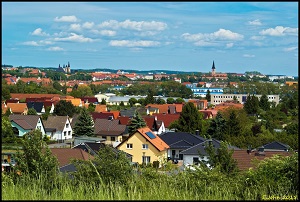
Rolf Schilling (Nordhausen, 11 april 1950) Nordhausen am Harz
“Until Alwyn Tower grew to manhood he never forgot that everyone was older than he. People remembered things not in existence now, and many of them had been born in houses which had vanished long ago. A cabin which had stood in the melon patch had been his father’s birthplace; and as a child, jumping over the heavy, downy vines, he tried in vain to find a trace of its foundations. His uncle Jim, the minister, on the other hand, had not been born in the garden, but in a building which was now the woodshed. Alwyn asked himself how anyone could have slept in that poor shack, whose floor was the ground, trodden and scattered with chips, where the snow sifted in winter on the woodpiles. Of course when his grandmother had lain there with a baby in her arms, it must have been warm, safe, and pink, in the firelight. Now she was a strong old woman with sandy-gray hair ; and only with difficulty, by calling to mind the family daguerreotypes, W'as he able to' imagine a young mother in that vanished bed. Alwyn’s father and mother shared with his grandparents the third house on the farm which his grandfather had bought from the government when Wisconsin was a wilderness. In that house his young aunt Flora had been born, in what was now his mother’s parlor, exactly below the spare bedroom papered with forget-me-nots where Alwyn himself had slept when he was a baby. The house had been rearranged frequently, and augmented by new rooms, porches, doors, and windows, as the family grew. Now the old people and Flora kept house by themselves in the south wing. In their sitting room the sunlight burned brightly on stiff patterns of wallpaper, on the red garlands of the carpet, the ripples painted on the woodwork in imitation of quarter-sawed oak, and the false-Nottinghara curtains looped up in the windows. A rack on the wall held a row of hand-painted plates, the work of his aunt and his great-aunt Nancy, decorated with birds, wild roses, and rosebuds. Beneath the plate rack stood a couch, upholstered in rows of yellow tapestry biscuits, with a green button at each intersection of the crevices. It had the proportions of a lion’s body — the legs carved in claws, the sloping back, the head uplifted under a mass of fringed pillows. In spite of its discomfort, Alwyn’s grandfather took his nap there every afternoon, his spectacles in his hand, an open newspaper over his face.”
Glenway Wescott (11 april 1901 - 22 februari 1987)
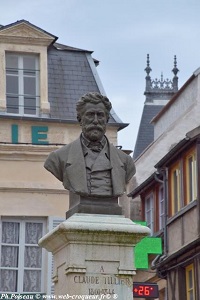
« Quand nous avons tous les appétits de la jeunesse, que notre sang est plein de fer et d’alcool, nous n’avons pas un écu ; quand nous n’avons plus ni dents, ni estomac, nous sommes millionnaires. Nous avons à peine le temps de dire à une femme : « Je t’aime ! » qu’à notre second baiser, c’est une vieille décrépite. Les empires sont à peine consolidés, qu’ils s’écroulent ; ils ressemblent à ces fourmilières qu’élèvent, avec de grands efforts, de pauvres insectes ; quand il ne faut plus qu’un fétu pour les achever, un bœuf les effondre sous son large pied, ou une charrette sous sa roue. Ce que vous appelez la couche végétale de ce globe, c’est mille et mille linceuls superposés l’un sur l’autre par les générations. Ces grands noms qui retentissent dans la bouche des hommes, noms de capitales, de monarques, de généraux, ce sont des tessons de vieux empires qui résonnent. Vous ne sauriez faire un pas que vous ne souleviez autour de vous la poussière de mille choses détruites avant d’être achevées. J’ai quarante ans ; j’ai déjà passé par quatre professions ; j’ai été maître d’études, soldat, maître d’école, et me voilà journaliste. J’ai été sur la terre et sur l’Océan, sous la tente et au coin de l’âtre, entre les barreaux d’une prison et au milieu des espaces libres de ce monde ; j’ai obéi et j’ai commandé ; j’ai eu des moments d’opulence et des années de misère. On m’a aimé et on m’a haï ; on m’a applaudi et on m’a tourné en dérision. J’ai été fils et père, amant et époux ; j’ai passé par la saison des fleurs et par celle des fruits, comme disent les poètes. Je n’ai trouvé dans aucun de ces états que j’eusse beaucoup à me féliciter d’être enfermé dans la peau d’un homme, plutôt que dans celle d’un loup ou d’un renard, plutôt que dans la coquille d’une huître, dans l’écorce d’un arbre ou dans la pellicule d’une pomme de terre. Peut-être si j’étais rentier, rentier à cinquante mille francs surtout, je penserais différemment."
Claude Tillier (11 april 1801 - 12 oktober 1844) Borstbeeld in Clamecy
De Poolse schrijver en literair historicus Stefan Chwinwerd geboren op 11 april 1949 in Gdansk. Chwin is een afstammeling van Litouwse Polen, die na de Tweede Wereldoorlog uit Litouwen werden verdreven. Zijn vader werd geboren in Vilnius en kwam in 1945 in een volledig verwoest Gdańsk terecht. Chwin volgde een opleiding aan de kunstacademie in Gdynia en studeerde Poolse taal- en letterkunde aan de universiteit van Gdańsk. Later promoveerde hij in de Poolse taal en letterkunde en sinds 1998 is hij hoogleraar in dit vak. Zijn voornaamste interesse als literatuuronderzoeker is de Poolse romantiek en de invloed ervan op moderne schrijvers. Hij heeft verschillende boeken gepubliceerd met literaire studies over auteurschap en tendensen in de Poolse literatuur. Chwin zat ook in de redactie van verschillende Poolse literaire tijdschriften. Chvin's werken zijn vertaald in twaalf verschillende talen. In de jaren tachtig deed Stefan Chwin zijn eerste poging als schrijver van fictie. Hij debuteerde met twee avonturenboeken voor kinderen onder het pseudoniem Max Lars.Zijn doorbraak als schrijver voor volwassenen was de verschijning van de roman “Hanemann” in 1995, waarvoor hij de Paszport Polityki, een Poolse cultuurprijs, ontving.In 1999 verscheen de roman “Esther”, gevolgd in 2003 door “Złoty pelikan“ (De gouden pelikaan). Verschillende romans spelen in de geboorteplaats van de auteur, Gdańsk, en thematiseren op verschillende manieren de multiculturele geschiedenis van die stad. Gdańsk was tot 1945 vooral Duitstalig onder de naam Danzig, toen de Duitse bevolking werd verdreven en vervangen door Polen, die werden verdreven uit de oostelijke grensregio's van Polen. De belangstelling voor de Duits-Poolse geschiedenis van de stad deelt hij met een andere vooraanstaande schrijver uit Gdańsk, Paweł Huelle.
Uit: Death in Danzig (Hanenemann, Vertaald door Philip Boehm)
“When Hanemann reached the gate in front of his house, he thought he saw a light flickering at Lessingstrasse 14, the house owned by the Bierensteins. He walked past the arborvitae and turned and crossed the street. He pushed open the heavy doors and stepped into the entrance hall, automatically scraping the snow off his feet on the iron grate. He struck a match and held it up until it singed his fingers. The little yellow flame wavered in the chilly darkness and went out. Hanemann wondered why he had come, if he was merely trying to assuage his heart—but what difference did it make now? Still, he had seen that light ... He wanted to go back to Number 17, through the double row of arborvitae to his own door, and he would have done so if he could have stopped thinking about the landing in Neufahrwasser, that white space between the warehouse and the brick wall round the yard. The scraps of paper, the black smudges in the snow, the landing, the suitcases, the crowd, the piles of clothing, the shouts, the gentle voice of Mrs Walmann. That was what kept him from leaving, what stopped him there, on the stairs, in the dark entry hall under the oval window, where the coloured panes muted the glare over Langfuhr into a feeble glow. Here, on the right—the Schultzes' apartment. He dragged another damp match across the edge of the box, there was a sulphurous flash, and he held the match high against the brown panelling, his palm cupped pink around the tiny flame. The darkly varnished door, with the floral ornamentation on its oak frame, glinted and glistened in the flickering light. Above it, a stucco relief emerged from the shadows that slanted across the wall—a Madonna and Child, nestled within a wreath of olive branches. But what he saw next ... deep gashes and gouges on the Schultzes' door, right along the jamb. Flashing bits of broken metal round the latch housing. Fresh yellow scratches, black dents and bruises, as if someone had tried to pierce the brass with a knife. So they're already here, they've already been here; while he waited by the waterfront at Neufahrwasser, they had been breaking into an apartment on Lessingstrassc, cursing under their breath as they grappled with the brass reinforcement, as they pried at the metal escutcheon beneath the latch before finally ramming the door with their shoulders and bursting inside, struggling to keep their balance on the slick linoleum with the white and yellow checkerboard pattern. He wanted to go back home, to avoid the sight of the ransacked wardrobes, the huge heaps of linens dragged off the shelves, the drawers ripped out of the chest and tossed into the middle of the room, the rug trampled by muddy boots and stained with clods of melting snow. But the thought of the Schultzes ... They had left at noon; he'd watched them turning onto Kronprinzenallee, just beyond the chestnut trees. Otthter with a little rucksack. A stroller. A wooden suitcase. Mrs Schultz's red hat. She had turned round. A brief glance at the building.... Hanemann grabbed the handle; the door yielded softly to his hand. Dark-red door curtains in the entry room. Tea-coloured wallpaper. Shadows. The match went out, he groped his way towards the kitchen, something crunched beneath his soles. When he could see the window—its rectangle glowing dimly in the dark, the thin cross of its frame—he again reached for a match.”
De Vlaamse dichter Marc Tritsmanswerd geboren in Antwerpen op 11 april 1959. Hij studeerde tandheelkunde en werkt als milieuambtenaar. Na publicatie van een aantal losse gedichten in diverse literaire tijdschriften debuteerde hij in 1992 met de bundel 'De wetten van de zwaartekracht'. Er volgden nog 10 dichtbundels, waaronder “Onder bomen” (1994), “Oog van de tijd” (1997), “Van aarde” (1999) en “Sterk water” (2000). In 1991 won hij de P.-G. Buckinxprijs met ‘Cyclus Alpen’, en in 1995 opnieuw met het gedicht ‘Blad’. In 2010 werd hij bekroond met de poëzieprijs Melopee van de gemeente Laarne voor het gedicht ‘Geen aanleg’. In 2011 kreeg hij de Herman de Coninckprijs voor 'Studie van de schaduw', en tevens de publieksprijs voor het beste gedicht met ‘Uitgesproken’. Tritsmans publiceert regelmatig in De Gids , Hollands Maandblad , Het Liegend Konijn en Poëziekrant .
Zeezicht
Dit uitzicht heeft zich dus honderd jaar eerder ook voor mijn overgrootvaders ogen ontvouwd. Toen hij in zijn zondagse pak met strohoed, vrouw in zwierige jurk aan de arm, op net zo'n warme julidag de dijk beklom en
haar daar zag liggen. Bij deze zee van millennia kan ik even weer naast hem op die bruinige foto. Hij knikt verstrooid als ik me voorstel en neuriet verder een liedje dat ik later nog wel van zijn kleindochter leer.
Rechtzetting Die me naar school bracht onder de kastanjebomen, die me nog als laatste bloedstollend
kon vertellen over Duitsers en onder kleren gesmokkelde boter. Die me steevast redde
als de wereld te groot werd. Haar nu, ondanks het late uur, nog even bellen en
zeggen dat het me spijt. Dat ik er had moeten zijn die nacht toen ze voorgoed vertrok.
Koeien
Het lijkt wel of ze staan te wachten maar ze wachten helemaal op niets. Voor hen volstaat het om te blijven waar ze grazen hun wereld moet niet groter dan
tot waar de ogen reiken: dit weiland dat gewoonweg ophoudt bij de bosrand het huis daar in de verte met de man die hen komt melken of hen meevoert
als het koud wordt ze kreunen snuiven het regent zon schijnt op hun vachten het wordt donker alles laat hen onbewogen nergens zit een einde aan de tijd
De Vlaamse dichter en schrijver Patrick Cornilliewerd geboren in Roeselare op 11 april 1961. Cornillie was leraar in het buitengewoon secundair onderwijs, daarna redacteur bij de Krant van West-Vlaanderen. In 1995 schreef hij over zijn ervaringen in het buitengewoon onderwijs een jeugdroman met de titel 'Buitengewoon'. In Lichtervelde staat aan de bibliotheek een bronzen beeld van een accordeonspeler, gegoten door Ron Deblaere met daaronder het gedicht "De Liedjeszanger" van Cornillie. Sedert 1998 is hij freelance journalist en auteur en leverde bijdragen aan diverse kranten en (wieler)tijdschriften.Van Cornillie verschenen gedichten en verhalen in 'De Muur', 'Deus Ex Machina', 'Dietsche Warande & Belfort', 'Dighter', 'Kreatief', 'Van Mensen en Dingen', 'Poëziekrant' en 'Vlaanderen'. Samen met Frank Pollet stond hij aan de wieg van de drukbezochte Tourblog GeelZucht (2010-2014). Eind 2016 verbleef Cornillie als writer in residence in het Streuvelshuis in Ingooigem. Het resulteerde in 'De zeer schone uren van Stijn Streuvels, cyclotoerist'. In 2017 verscheen zijn gedicht 'Ode aan de jonge flandriens' op 40.000 flesjes Kwaremont-bier. Ook leverde hij het script voor virtual reality-projecten in het Centrum Ronde van Vlaanderen in Oudenaarde en het Abdijmuseum Ter Duinen in Koksijde. Cornillie won diverse prijzen, waaronder de poëzieprijs van de stad Harelbeke in 1988, de Yang Poëzieprijs (1989), de Guido Wulmsprijs voor Poëzie in Sint-Truiden (2003), de poëzieprijs van de stad Halle (2006), de prozaprijs van de Universitaire Werkgroep Literatuur, WeL, Leuven in 2008, de poëzieprijs van de gemeente Keerbergen (2010) en de driejaarlijkse Hilarion Thans Poëzieprijs (Lanaken, 2014).
Een boom
Een boom heeft het recht te dromen. In de takken van zijn verleden laat hij onverstoord de seizoenen komen. En de draagwijdte van het heden
slaat hij op onder zijn huid. In zijn kruin plooit het licht met een zacht ruisend geluid. Van de aarde kent hij het evenwicht.
Geworteld, in handel en wandel - hoe een landschap zich naar hem richt
bepaalt hij elk vergezicht. Bewaart hij de tijd door zijn aanwezigheid.
Een huis
Muren met een teken aan de wand. Binnen de huid van deze ruimte gehuld en een raam dat verten verbant. Hoe aanwezigheid daar zichzelve invult.
Een huis lijkt eeuwig in evenwicht. Zoals de tijd binnenskamers blijft, opgehangen in een foto, een stilleven, een ansicht. Gezichten in een kader gevangen.
Een huis waakt in zijn voegen. Over het heden en het verleden
dat als een walm sigaretterook beslaat en vlekken op het behang achterlaat. Blanke foto's op vergeeld ongenoegen.