Romenu is een blog over gedichten, literatuur en kunst Maar Romenu is ook een professionele freelance vertaler Du-Ne en Ne-Du http://www.roumen-vertalingen.nl/
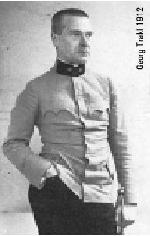
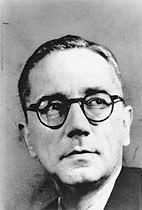
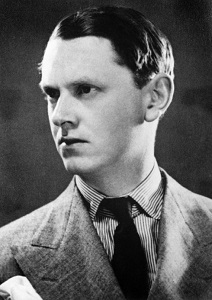
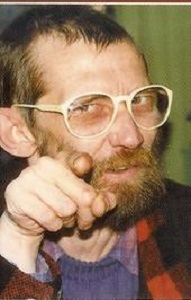
Georg Trakl werd op 3 februari 1887 in het conducteurshuis aan de Waagplatz 2 in Salzburg geboren. Zijn vader, Tobias Trakl, was een handelaar in ijzerwaren en zijn moeder, die ook psychische problemen had, was Maria Catharina Trakl, (meisjesnaam Halik). Voorts had hij nog drie broers en drie zussen. Margarethe (doorgaans Grethe genoemd) stond hem het naast, zelfs zodanig dat sommigen een incestueuze verhouding vermoeden. Zijn jeugd bracht hij door in Salzburg. Vervolgens bezocht hij van 1897 tot 1905 het humanistische gymnasium. Om toch een academische opleiding te kunnen volgen, werkte hij tot 1908 in de praktijk bij een apotheker. Sommigen vermoedden dat hij dit vooral deed om zichzelf opiaten te kunnen verschaffen. Bij het uitbreken van WO I werd Trakl als medicus naar het front in Galicië (heden ten dage in Oekraïne en Polen) gestuurd. Zijn gemoedsschommelingen leidden tot geregelde uitbraken van depressie, die verergerd werden door de afschuw die hij voelde voor de verzorging van de ernstig verwonde soldaten. De spanning en druk dreven hem ertoe een suïcidepoging te ondernemen, welke zijn kameraden nochtans verhinderden. Hij werd in een militair ziekenhuis opgenomen in Kraków, alwaar hij onder strikt toezicht geplaatst werd.Trakl verzonk daar in nog zwaardere depressies en schreef Ficker om advies. Ficker overtuigde hem ervan dat hij contact moest opnemen met Wittgenstein, die inderdaad op weg ging na Trakls bericht te hebben ontvangen. Op 4 november 1914, drie dagen voordat Wittgenstein aan zou komen, overleed hij echter aan een overdosis cocaïne
Paul Celan
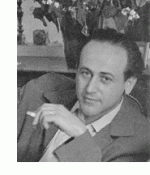
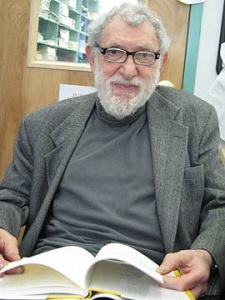
Paul Celan werd onder de naam Paul Antschel op 23 november 1920 geboren in Czernowitz, toentertijd de hoofdstad van de Roemeense Boekovina, nu behorend bij de Oekraïne. Paul Celans ouders waren Duitssprekende joden die hun zoon joods opvoedden en hem naar Duitse christelijke scholen stuurden. In 1942 werden Celans ouders door de Duitse bezetter naar een werkkamp gedeporteerd en daar vermoord. Hijzelf wist aanvankelijk onder te duiken, maar moest vanaf juli 1942 in een werkkamp dwangarbeid verrichten. Celan overleefde de oorlog. Via Boekarest en Wenen vestigde Celan zich in 1948 in Parijs. Daar was hij werkzaam als dichter, vertaler en doceerde hij aan de prestigieuze Ecole Normale Supérieure. Vermoedelijk op 20 april 1970 beëindigde hij zijn leven zelf door in de Seine te springen.
Gerard Reve
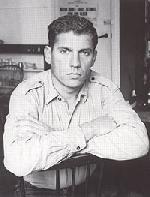
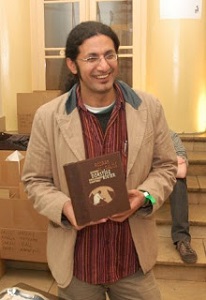
Gerard Reve over: Medearbeiders ”God is in de mensen, de dieren, de planten en alle dingen - in de schepping, die verlost moet worden of waaruit God verlost moet worden, door onze arbeid, aangezien wij medearbeiders van God zijn.” Openbaring ”Tja, waar berust elk godsbegrip op, elke vorm van religie? Op een openbaring, dat wil zeggen op een psychische ervaring van zulk een dwingende en onverbiddelijke kracht, dat de betrokkene het gevoel heeft, niet dat hij een gedachte of een visioen heeft, maar dat een gedachte gedachte of visioen hem bezit en overweldigt.”
Simon Vestdijk
Simon Vestdijk (Harlingen, 17 oktober 1898 – Utrecht, 23 maart 1971) was een Nederlands romancier, dichter, essayist en vertaler. Zijn jeugd te Harlingen en Leeuwarden beschreef hij later in de Anton Wachter-cyclus. Van jongs af aan logeerde hij regelmatig bij zijn grootouders in Amsterdam, waar hij zich in 1917 aan de Universiteit van Amsterdam inschrijft als student in de medicijnen. Tijdens zijn studie die van 1917 tot 1927 duurde, leerde hij Jan Slauerhoff kennen.Tot 1932 is hij als arts in praktijken door heel Nederland werkzaam. In 1932 volgt zijn officiële schrijversdebuut met de uitgave van de bundel Verzen in De Vrije Bladen. Doorslaggevend voor Vestdijks uiteindelijke keuze voor de literatuur is zijn ontmoeting in 1932 met Eddy Du Perron en Menno ter Braak. Deze ontmoeting had tot resultaat dat hij redactielid werd van het tijdschrift Forum Kort daarop, in 1933, wordt zijn eerste novelle, De oubliette, uitgegeven. In hetzelfde jaar schrijft hij Kind tussen vier vrouwen, dat, eerst geweigerd door de uitgever, later de basis zal vormen voor de eerste drie delen van de Anton Wachter-romans. In 1951 ontvangt Vestdijk de P.C. Hooftprijs voor zijn in 1947 verschenen roman De vuuraanbidders. In 1957 wordt hij voor het eerst door het PEN-centrum voor Nederland voorgedragen voor de Nobelprijs voor de Literatuur, die hij echter nooit zal krijgen. Op 20 maart 1971 wordt hem de Prijs der Nederlandse Letteren toegekend, maar voor hij deze kan ontvangen overlijdt hij op 23 maart te Utrecht op 72-jarige leeftijd. Vestdijk was auteur van ca. 200 boeken. Vanwege deze enorme productie noemde de dichter Adriaan Roland Holst hem 'de man die sneller schrijft dan God kan lezen'. Andere belangrijke boeken van Simon Vestdijk zijn: "Kind van stad en land" (1936), "Meneer Visser's hellevaart" (1936), "Ierse nachten" (1946), "De toekomst de religie" (1947), "Pastorale 1943" (1948), "De koperen tuin" (1950), "Ivoren wachters" (1951), "Essays in duodecimo" (1952) en "Het genadeschot" (1964).
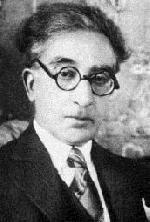
K.P. Kavafis K.P. Kavafis werd als kind van Griekse ouders, afkomstig uit Konstantinopel, geboren in 1863 in Alexandrië (tot vandaag een Griekse enclave) waar hij ook het grootste deel van zijn leven woonde en werkte. Twee jaar na de dood van zijn vader verhuist het gezin in 1872 naar Engeland om na een verblijf van vijf jaar naar Alexandrië terug te keren. Vanwege ongeregeldheden in Egypte vlucht het gezin in 1882 naar Konstantinopel, om na drie jaar opnieuw naar Alexandrië terug te gaan. In de jaren die volgen maakt Kavafis reizen naar Parijs, Londen en in 1901 zijn eerste reis naar Griekenland, in latere jaren gevolgd door nog enkele bezoeken. Op de dag van zijn zeventigste verjaardag, in 1933 sterft Kavafis in Alexandrië. De roem kwam voor Kavafis pas na zijn dood, dus postuum. Deels is dat toe te schrijven aan zijn eigen handelswijze. Hij was uiterst terughoudend met de publicatie van zijn gedichten, liet af en toe een enkel gedicht afdrukken in een literair tijdschrift, gaf in eigen beheer enkele bundels met een stuk of twintig gedichten uit en het merendeel van zijn poëzie schonk hij op losse bladen aan zijn beste vrienden.
Thomas Mann
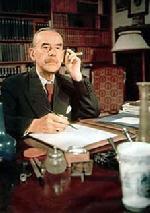
Thomas Mann, de jongere broer van Heinrich Mann, werd geboren op 6 juni 1875 in Lübeck. Hij was de tweede zoon van de graankoopman Thomas Johann Heinrich Mann welke later één van de senatoren van Lübreck werd. Zijn moeder Julia (geboren da Silva-Bruhns) was Duits-Braziliaans van Portugees Kreoolse afkomst. In 1894 debuteerde Thomas Mann met de novelle "Gefallen". Toen Thomas Mann met 21 jaar eindelijk volwassen was en hem dus geld van zijn vaders erfenis toestond - hij kreeg ongeveer 160 tot 180 goldmark per jaar - besloot hij dat hij genoeg had van al die scholen en instituties en werd onafhankelijk schrijver. Kenmerkend voor zijn stijl zijn de ironie, de fenomenale taalbeheersing en de minutieuze detailschildering. Manns reputatie in Duitsland was sterk wisselend. Met zijn eerste roman, Buddenbrooks (1901), had hij een enorm succes, maar door zijn sceptische houding tegenover Duitsland na de Eerste Wereldoorlog veranderde dit volledig. Stelde hij zich tot aan de jaren twintig apolitiek op (Betrachtungen eines Unpolitischen, 1918), meer en meer raakte hij bij het Politiek gebeuren betrokken. Zijn afkeer van het nationaal socialisme groeide, zijn waarschuwingen werden veelvuldiger en heftiger. In 1944 accepteerde hij het Amerikaanse staatsburgerschap. Tussen 1943 en 1947 schreef Mann Doktor Faustus (zie Faust), de roman van de 'Duitse ziel' in de gecamoufleerd geschilderde omstandigheden van de 20ste eeuw. In 1947 bezocht hij voor het eerst sinds de Oorlog Europa, twee jaar later pas Duitsland. In 1952 vertrok hij naar Zwitserland. Op 12 augustus 1955 stierf hij in Zürich. Twintig jaar na zijn dood, in aug. 1975, is zijn literaire nalatenschap geopend: dagboekaantekeningen van 15 maart 1933 tot 29 juli 1955, alsmede notities uit de jaren 1918 tot en met 1921.Belangrijke werken zijn: Der Zauberberg, Der Tod in Venedig, Dokter Faustus , Joseph und seine Brüder en Die Bekenntnisse des Hochstaplers Felix Krull.
Rainer Maria Rilke
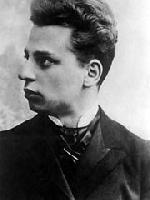
Rilke werd op 4 december 1875 geboren in Praag. Hij had al naam gemaakt als dichter met zijn bundels Das Stundenbuch en Das Buch der Bilder, toen hij de literaire wereld versteld deed staan en wereldfaam verwierf met de publicatie van zijn twee delen Neue Gedichte in 1907 en 1908. Hij verzamelde daarin het beste werk uit een van zijn vruchtbaarste periodes, die hij grotendeels doorbracht in Parijs. Rilke was daar diep onder de indruk gekomen van Rodin, bij wie hij een tijdlang in dienst was als particulier secretaris. Rodin, zei hij later, had hem leren kijken. Dit kijken kwam neer op intense concentratie, om het mysterie te kunnen zien ‘achter de schijnbare werkelijkheid'. Latere en rijpere werken als Duineser Elegien (1912-1923) en het ronduit schitterende Die Sonette an Orfeus (1924) illustreren Rilkes metafysische visie op het onzegbare, dat haar verwoording vindt in een hermetische muzikale taal. Op 29 december 1926 overlijdt Rilke in het sanatorium in Val-Mont aan de gevolgen van leukemie. Enkele dagen later wordt hij, overeenkomstig zijn wens, begraven op het kerkhof van Raron.
* * * * * * * * * * * * * * * *
Romenu
Over literatuur, gedichten, kunst en cultuur
29-10-2015
Lee Child
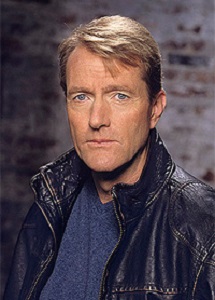
De Engelse schrijver Lee Child (pseudoniem van Jim Grant) werd geboren op 29 oktober 1954 in Coventry. Hij groeide echter op in Birmingham, waar hij de school bezocht waar onder andere J.R.R. Tolkien ook leerling geweest was. Hij studeerde rechten, maar ging na zijn studie in het theater werken. Hij werd in dienst genomen door Granada Television in Manchester en werkte in de 18 jaren die volgden onder andere aan series als “Brideshead Revisited”, “The Jewel in the Crown”, “Prime Suspect” en “Cracker”. In 1995 werd hij vanwege een reorganisatie ontslagen en besloot hij in zijn levensonderhoud te voorzien als schrijver. Hij schreef zijn eerste boek met de hand aan de eettafel omdat hij met de aanschaf van een computer wilde wachten tot hij succes had als schrijver. Dat succes kwam met dat eerste boek. “Killing Floor” en sindsdien is Child professioneel schrijver. Hij woont voornamelijk in Manhattan, maar heeft ook een huis in Zuid-Frankrijk. Alle boeken van Lee Child hebben de Amerikaanse ex-militair Jack Reacher als hoofdpersoon. Reacher, die uit eigen beweging het leger heeft verlaten, leidt een zwervend bestaan in de Verenigde Staten, waar hij zijn avonturen beleeft. Cilds roman "One Shot" werd verfilmd onder de titel “Jack Reacher” en de film is eind 2012 première gegaan met Tom Cruise in de rol van Jack Reacher..
Uit: Killing-Floor
“I was arrested in Eno's diner. At twelve o'clock. I was eating eggs and drinking coffee. A late breakfast, not lunch. I was wet and tired after a long walk in heavy rain. All the way from the highway to the edge of town. The diner was small, but bright and clean. Brand-new, built to resemble a converted railroad car. Narrow, with a long lunch counter on one side and a kitchen bumped out back. Booths lining the opposite wall. A doorway where the center booth would be. I was in a booth, at a window, reading somebody's abandoned newspaper about the campaign for a President I didn't vote for last time and wasn't going to vote for this time. Outside, the rain had stopped but the glass was still pebbled with bright drops. I saw the police cruisers pull into the gravel lot. They were moving fast and crunched to a stop. Light bars flashing and popping. Red and blue light in the raindrops on my window. Doors burst open, policemen jumped out. Two from each car, weapons ready. Two revolvers, two shotguns. This was heavy stuff. One revolver and one shotgun ran to the back. One of each rushed the door. I just sat and watched them. I knew who was in the diner. A cook in back. Two waitresses. Two old men. And me. This operation was for me. I had been in town less than a half hour. The other five had probably been here all their lives. Any problem with any of them and an embarrassed sergeant would have shuffled in. He would be apologetic. He would mumble to them. He would ask them to come down to the station house. So the heavy weapons and the rush weren't for any of them. They were for me. I crammed egg into my mouth and trapped a five under the plate. Folded the abandoned newspaper into a square and shoved it into my coat pocket. Kept my hands above the table and drained my cup. The guy with the revolver stayed at the door. He went into a crouch and pointed the weapon two-handed. At my head. The guy with the shotgun approached close. These were fit lean boys. Neat and tidy. Textbook moves. The revolver at the door could cover the room with a degree of accuracy. The shotgun up close could splatter me all over the window. The other way around would be a mistake. The revolver could miss in a close-quarters struggle and a long-range shotgun blast from the door would kill the arresting officer and the old guy in the rear booth as well as me. So far, they were doing it right. No doubt about that. They had the advantage. No doubt about that, either. The tight booth trapped me. I was too hemmed in to do much. I spread my hands on the table. The officer with the shotgun came near. "Freeze! Police!" he screamed.”
'It wasn't one of my party. It was someone from out of college.' 'Well, it's just as nasty clearing it up, whoever it was.' 'There's five shillings on the sideboard.' 'So I saw and thank you, but I'd rather not have the money and not have the mess, any morning.' I took my gown and left him to his task. I still frequented the lecture-room in those days, and it was after eleven when I returned to college. I found my room full of flowers; what looked like, and, in fact, was, the entire day's stock of a market-stall stood in every conceivable vessel in every part of the room. Lunt was secreting the last of them in brown paper preparatory to taking them home. 'Lunt, what is all this?' 'The gentleman from last night, sir, he left a note for you.' The note was written in conté crayon on a whole sheet of my choice Whatman H.P. drawing paper: I am very contrite. Aloysius won't speak to me until he sees I am forgiven, so please come to luncheon today. Sebastian Flyte. It was typical of him, I reflected, to assume I knew where he lived; but, then, I did know.
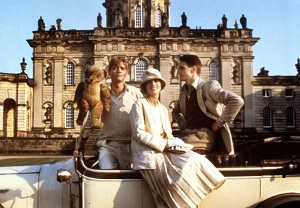
Anthony Anfrews (Sebastian), Diana Quick (Julia) en Jeremy Irons (Charles) in de tv-serie Brideshead Revisited uit 1981
'A most amusing gentleman, I'm sure it's quite a pleasure to clean up after him. I take it you're lunching out, sir. I told Mr Collins and Mr Partridge so—they wanted to have their commons in here with you.' 'Yes, Lunt, lunching out.' That luncheon party—for party it proved to be—was the beginning o f a new epoch in my life. I went there uncertainly, for it was foreign ground and there was a tiny, priggish, warning voice in my ear which in the tones of Collins told me it was seemly to hold back. But I was in search of love in those days, and I went full of curiosity and the faint, unrecognized apprehension that here, at last, I should find that low door in the wall, which others, I knew had found before me, which opened on an enclosed and enchanted garden, which was somewhere, not overlooked by any window, in the heart of that grey city."
„Den Rest des Abends verbrachten wir damit, die Klagen und Selbstvorwürfe unserer Freunde entgegenzunehmen. Ich lernte: Kinder, die du als liebenswürdige Geschöpfe voller Anmut und Charme in Erinnerung hattest, verwandeln sich innerhalb kurzer Zeit in stinkende Monster (Jungs) oder hysterische Amazonen (Mädchen). Wenn die Familie viel Glück hat, verlassen die Jugendlichen diese danger zone der Eiterpickel und befleckten Unterwäsche als lebenstüchtige Erwachsene. Einige jedoch verbleiben für immer im Schattenreich der Adoleszenz, machen aber dennoch manchmal Karriere. Zurück zu unseren armen Freunden, die immer sehr auf ein partnerschaftliches Verhältnis zu ihren Kindern gebaut hatten: Die Gespräche, eigentlich sind es Gebrülle, haben bei ihnen herrliche Themen wie Hygiene, Drogen, Umgangsformen, Ernährung und Faulheit. Ich bestand darauf, dass ich auch in Zukunft niemals Sätze sagen würde wie: «Ich kann nicht ertragen, wie du deine Zeit sinnlos verplemperst.» Oder: «Räum endlich diesen Saustall auf.» Ich fand, dass beide Angelegenheiten in das Selbstbestimmungsrecht der Kinder fallen und die Eltern nichts angehen. Mein Freund lachte bitter und goss sich einen Absinth ein. Auf dem Heimweg schwiegen wir. Ich stellte mir den Besuch von Carlas erstem Freund vor und wie ich ihm die Haustür öffnen würde. Eine Mischung aus Thor, dem Hammergott, und Catweazle steht vor mir und fragt, ob Carla zu Hause ist. Ich sage: «Aha, Kamerad, erst geht es mal zum Eignungstest.» Dieser beinhaltet Fragen nach dem Beruf des Vaters, dessen politischen Präferenzen und der Marke seines Autos.“
“Het aller, allereerste ogenblik, toen je uit die bittere, troosteloze kut die bittere, troosteloze aarde werd opgesmeten, bedacht je aan de snelheid van een elektron in een deeltjesversneller dat je er je hele verdere leven zou moeten over doen om die ene enkele metafoor te vinden, nu, met wat meeval een half leven later, maar met wat jij rookt en zuipt en snuift en spuit en neukt zonder kondoom, vorig weekend nog met die straalbezopen pothoer van 't Faboert, zal dat wel niet zo zijn, bon, zegt men hier, soit, veertig jaar later denk je dat er niet die ene enkele metafoor bestaat maar dat er honderdduizend metaforen voor bestaan en dat je ze allemaal moet boekstaven voor het te laat is, voor niemand er nog weet kan van hebben, voor ze nooit nog kunnen worden geopenbaard. Aan de wereld. Aan de mensheid. Aan het nageslacht, al is het niet het jouwe en zal het ook nooit meer het jouwe zijn want jij sterft uit, jij teert weg, jij verpietert zienderogen. Jij gaat zienderogen naar de bom. Na het avondeten, na het zwelgen van het varken aan de trog, valt mijn vader in slaap op de woonkamerstoel en kijk ik met mijn moeder naar het Rad van Fortuin. Alle dagen kijk ik met mijn moeder naar het Rad van Fortuin, terwijl mijn vader na het zwelgen hangt te slapen aan de woonkamertafel, het hoofd zwengelend van links naar rechts, beurtelings gesteund door z'n linker dan wel z'n rechterhand, af en toe uitbarstend in een apocalyptische hoest- en schetenbui. Maar verder slapen doet hij, nu hij verzadigd is. Hij slaapt en hoest en schijt en heeft nog weet van nougabollen. We letten er niet meer op. We raden kurketrekker en John Major een hele tijd voor de kandidaten, kurketrekker was makkelijk met al die k's, John Major was iets moeilijker maar we vonden 'em toch. Het woord van de superronde was kernenergie maar de trezebees kwam er niet op. Niks aanbouwkeuken. Morgen opnieuw proberen. Voor de auto of de eetplaats.”
JMH Berckmans (28 oktober 1953 - 31 augustus 2008)
Facing deep wine raised in the Tilted, earthen cup, the dark Opening into further Dark, eyes wide, he could perceive, Around the rim of the dark, Breathings of the afternoon; As, eyes shuttered, he could see Sleep, so, opened, they would show Him death-but now momently In the heart of the wine, far Away, the muses of waltz Moved, as if seen from a height Down a narrowing defile, In an unsliadowed meadow.
THE SAME QUESTION
1
ONE CREATURE TO BEAR THE WHOLE OF IT?
It is all here. It is all with us: Pools of water-well, we have our eyes. Mountains-well, a man is most human Standing up. Broad meadows-well, we sleep. Rivers- we do run on, but can come To join another. Oceans-we can Remember mothers of our mothers. Forests-we wander darkly in some Bright plaza of another; but night Falls. Sands-seconds of arc in the sets Of circles nested between our eye And the rhyming horizon. Deluge- The first tear of sweat our terror weeps. Landslide-hear the pestle of thighbonc Grinding away its mortar socket.
John Hollander (28 oktober 1929 – 17 augustus 2013)
Ze hebben de muur bezet, de zolder gegijzeld, het dak vermoord en het raam dichtgetimmerd. Ze dwongen het balkon zijn planten op de stoep te gooien en zelfmoord te plegen. Ze begroeven de kelder, ze bevalen de schuur haar rommel achter te laten en te verdwijnen en ik leef nog. Ik kook voor mijn vrienden, koop beltegoed voor mijn woorden en het belangrijkste: ik kan nog slapen, minstens zes uur per nacht en soms zelfs zonder slaaptabletten.
“- Die Bahnhofsuhren in den verästelten Trakten des Anatomischen Instituts ließen die Sekundenzeiger schleichen und auf der Zwölf zögern, bis der Minutenzeiger aus seiner Erstarrung ins nächste Fach fiel, wo er Haftanker auszuschießen schien, in denen er wie betäubt, gestaucht von den Puffern der vergangenen und der bevorstehenden Minute, hängenblieb; Omnia vincit labor, behauptete die Glocke auf dem Kroch-Hochhaus, von zwei Riesen mit Hämmern geschlagen, und die Gelehrten, die sozialistischen Glasperlenspieler, die ludi magistri an der Universität, die als geöffnetes steinernes Buch mit dem Karl-Marx-Kopf als Galions-Totem im Meer schwamm, beugten sich über den Geist der Goethezeit, luden die Revolution in den Zeugenstand, verkündeten das Prinzip Hoffnung, dozierten über das Klassische Erbe im Hörsaal 40, sezierten den menschlichen Körper in den Sälen unter der Liebigstraße: Hier steht der Tod im Dienst des Lebens, Anatomie: Schlüssel und Steuerruder der Medizin – Suchend, in der Nacht der Strom, ein ermüdetes krankes Tier, träumend in einem Schlafgehäuse, um das die Kälte steigt, und Straßenadern auf den Inseln, schütter beleuchtet, eingezwängt in den Frost und das Schweigen, Menschen mit biegsamen Schatten hasten über die Magistralen, wo am 1. Mai die Banner wehen, Marschmusik aus den Lautsprechermembranen spiralt wie Metallspäne von einem Werkstück in einer Drehbank, Sprengladungen, Meißel, Preßlufthämmer treiben Stollen in den Berg, schälen die Fingerspitzen des Flusses voran, die Stachanow-, die Hennekke-Bewegung, die Tunnelbohrer schürfen unter den Inseln, Zimmerleute fügen die Stützhölzer, der Fluß öffnet Hörrohre – Die Große Uhr schlug, und das Meer stieg vor den Fenstern, den Zimmern mit den Farntapeten und den Eisblumen an den Leuchtern, den Stuckdecken und schönen Möbeln, ererbt aus verschollener Bürgerlichkeit, worauf die Baskenmützen der Denkmalpfleger anspielten, die gemessenen Gesten törtchenessender Damen in den italienischen Cafés, die blumigen und chevaleresken Grußzeremonien der Dresdner Kunstausübung, die versteckten Zitate, die mandarinhaften, pädagogischen, anspielungsreichen Rituale des Freundeskreises Musik, die gravitätischen Küren schlittschuhlaufender älterer Herren in den Eisparks; übriggeblieben im sanfthügeligen Elbtal in Häusern unterm Sowjetstern, übriggeblieben wie die Hermann-Hesse-Ausgaben der Vorkriegszeit, die zigarrenbraunen Thomas-Mann-Bände des Aufbau-Verlags aus den fünfziger Jahren, eifersüchtig bewacht in Antiquariaten, deren unterseeisches Licht dem Eintretenden Andacht verordnete, Papierschiffe, in denen sich langsam an Erinnerungen vergiftende Fossile hausten, Topfpflanzen hegten und den Kompaß über den knarrenden Parketten unbeirrbar auf Weimar gerichtet hielten, übriggeblieben in den Rosen, die um die Insel wuchsen, über die Ziffernblätter der Uhren, die rosteten, und deren Perpendikel zwischen den Polen Stille und Unstille (es war eine, bloßer »Lärm« oder »Geräusch« war es nicht) durch unsere Leben schnitten.“
In sunless air, under pines Green to the point of blackness, some Founding father set these lobed, warped stones To loom in the leaf-filtered gloom Black as the charred knuckle-bones
Of a giant or extinct Animal, come from another Age, another planet surely. Flanked By the orange and fuchsia bonfire Of azaleas, sacrosanct
These stones guard a dark repose And keep their shapes intact while sun Alters shadows of rose and iris --- Long, short, long --- in the lit garden And kindles a day's-end blaze
Colored to dull the pigment Of azaleas, yet burnt out Quick as they. To follow the light's tint And intensity by midnight By noon and throughout the brunt
Of various weathers is To know the still heart of the stones: Stones that take the whole summer to lose Their dream of the winter's cold; stones Warming at core only as
Frost forms. No man's crowbar could Uproot them: their beards are ever- Green. Nor do they, once in a hundred Years, go down to drink the river: No thirst disturbs a stone's bed.
Doom of Exiles
Now we, returning from the vaulted domes Of our colossal sleep, come home to find A tall metropolis of catacombs Erected down the gangways of our mind.
Green alleys where we reveled have become The infernal haunt of demon dangers; Both seraph song and violins are dumb; Each clock tick consecrates the death of strangers
Backward we traveled to reclaim the day Before we fell, like Icarus, undone; All we find are altars in decay And profane words scrawled black across the sun.
Still, stubbornly we try to crack the nut In which the riddle of our race is shut.
Family Reunion
Outside in the street I hear A car door slam; voices coming near; Incoherent scraps of talk And high heels clicking up the walk; The doorbell rends the noonday heat With copper claws; A second's pause. The dull drums of my pulses beat Against a silence wearing thin. The door now opens from within. Oh, hear the clash of people meeting --- The laughter and the screams of greeting :
Fat always, and out of breath, A greasy smack on every cheek From Aunt Elizabeth; There, that's the pink, pleased squeak Of Cousin Jane, out spinster with The faded eyes And hands like nervous butterflies; While rough as splintered wood Across them all Rasps the jarring baritone of Uncle Paul; The youngest nephew gives a fretful whine And drools at the reception line.
Like a diver on a lofty spar of land Atop the flight of stairs I stand. A whirlpool leers at me, I cast off my identity And make the fatal plunge.
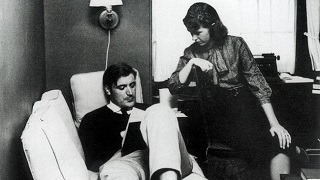
Sylvia Plath (27 oktober 1932 – 11 februari 1963) Hier met dichter en echtgenoot Ted Hughes
This bread I break was once the oat, This wine upon a foreign tree Plunged in its fruit; Man in the day or wine at night Laid the crops low, broke the grape's joy.
Once in this time wine the summer blood Knocked in the flesh that decked the vine, Once in this bread The oat was merry in the wind; Man broke the sun, pulled the wind down.
This flesh you break, this blood you let Make desolation in the vein, Were oat and grape Born of the sensual root and sap; My wine you drink, my bread you snap.
To Others Than You
Friend by enemy I call you out. You with a bad coin in your socket, You my friend there with a winning air Who palmed the lie on me when you looked Brassily at my shyest secret, Enticed with twinkling bits of the eye Till the sweet tooth of my love bit dry, Rasped at last, and I stumbled and sucked, Whom now I conjure to stand as thief In the memory worked by mirrors, With unforgettably smiling act, Quickness of hand in the velvet glove And my whole heart under your hammer, Were once such a creature, so gay and frank A desireless familiar I never thought to utter or think While you displaced a truth in the air,
That though I loved them for their faults As much as for their good, My friends were enemies on stilts With their heads in a cunning cloud.
Limerick
There was an old bugger called God, who got a young virgin in pod. This disgraceful behaviour begot Christ our Saviour, who was nailed to a cross, poor old sod.
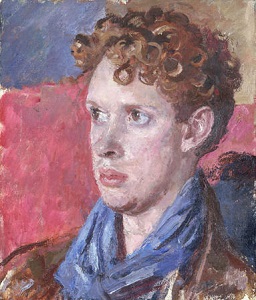
Dylan Thomas (27 oktober 1914 – 9 november 1953) Portret door Augustus John, 1937-38
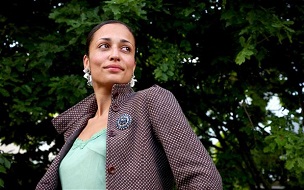
“Overhead, a gang of the local flying vermin took off from some unseen perch, swooped, and seemed to be zeroing in on Archie's car roof - only to perform, at the last moment, an impressive U-turn, moving as one with the elegance of a curve ball and landing on the Hussein-Ishmael, a celebrated halal butchers. Archie was too far gone to make a big noise about it, but he watched them with a warm internal smile as they deposited their load, streaking white walls purple. He watched them stretch their peering bird heads over the Hussein-Ishmael gutter; he watched them watch the slow and steady draining of blood from the dead things - chickens, cows, sheep - hanging on their hooks like coats around the shop. The Unlucky. These pigeons had an instinct for the Unlucky, and so they passed Archie by. For, though he did not know it, and despite the Hoover tube that lay on the passenger seat pumping from the exhaust pipe into his lungs, luck was with him that morning. The thinnest covering of luck was on him like fresh dew. Whilst he slipped in and out of consciousness, the position of the planets, the music of the spheres, the flap of a tiger-moth's diaphanous wings in Central Africa, and a whole bunch of other stuff that Makes Shit Happen had decided it was second-chance time for Archie. Somewhere, somehow, by somebody, it had been decided that he would live. ~ The Hussein-Ishmael was owned by Mo Hussein-Ishmael, a great bull of a man with hair that rose and fell in a quaff, then a ducktail. Mo believed that with pigeons you have to get to the root of the problem: not the excretions but the pigeon itself. The shit is not the shit (this was Mo's mantra); the pigeon is the shit. So the morning of Archie's almost-death began as every morning in the Hussein-Ishmael, with Mo resting his huge belly on the windowsill, leaning out and swinging a meat cleaver in an attempt to halt the flow of dribbling purple.”
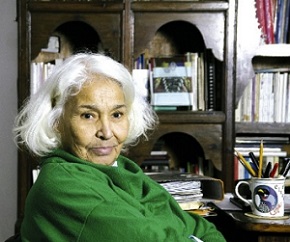
Uit:Memoirs of a Woman Doctor (Vertaald door Fedwa Malti-Douglas)
“And there was only one meaning for the word “girl” in my mind…that I was not a boy…I was not like my brother… My brother cuts his hair and leaves it free, he does not comb it, but as for me, my hair grows longer and longer. My mother combs it twice a day, chains it in braids, and imprisons its ends in ribbons… My brother wakes up and leaves his bed as it is, but I, I have to make my bed and his as well. My brother goes out in the street to play, without permission from my mother or my father, and returns at any time…but I, I do not go out without permission. My brother takes a bigger piece of meat than mine, eats quickly, and drinks the soup with an audible sound, yet my mother does not say anything to him… As for me…! I am a girl! I must watch my every movement…I must hide my desire for food and so I eat slowly and drink soup without a sound… My brother plays…jumps…turns somersaults…but I, whenever I sit and the dress rides up a centimeter on my thighs, my mother throws a sharp, wounding glance at me. » (…)
The Faculty of Medicine?! Yes medicine… The word has a fearful impression on me…it reminds me of white shining glasses under which are two penetrating eyes moving with amazing speed…and strong tapered fingers holding a sharp frightening long needle… The first physician I saw in my life… My mother was trembling in fear and looking at him with supplication and humility…And my brother was shaking from fear…And my father was lying in bed looking at him with imploration and a plea for mercy…“
Door woelig jonglingsleven, door bonte jonglingsdromen, gelijk ene Elve aan 't zweven in lichte morgendomen ontwaart de Man de Liefde - een toverachtig beeld dat, troostend en belovend, gedurig rond hem speelt.
Pas eerst in hare bloesem, het blozen op de wangen, de Vrouw voelt in de boezem een vreemd gedurig langen naar een aanbeden wezen dat, rustig in zijn macht, haar tederheden lonend, haar steunt en op haar lacht.
Eens daagt voor 's jonglings ogen zijn droom - een levend wezen. Hij spreekt - Zij spreekt bewogen, en laat hem in haar lezen - En Hij die schikt en zegent vereent een zalig Paar. Zij blijve met Hem zalig en zalig Hij met Haar!
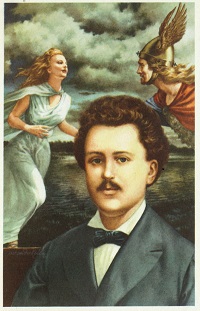
Albrecht Rodenbach (27 oktober 1856 – 23 juni 1880) Portret door J.-L. Huens in De Geïllustreerde Geschiedenis van België
A friend of mine met the son of a man who it seems was eaten by a polar bear in Iceland where the bear had stepped ashore rafted from Greenland on an ice-floe.
The father of the man who met my friend saw the bear who’d eat him loitering near the shore and hurried on and met another man who was walking the other way towards the bear.
He gave that other man his walking stick but the bear meanwhile had doubled back and reappeared on the path ahead of the man who now was unprotected-
There may be a moral in this story, for the man, his son, the man he met, for my friend, for me, or even for the bear, but if there is it’s better left unsaid.
Sky Nails
That first day, to break me in, my hardened comrades sent me scampering like a marmoset from the topmost parapet
to the foreman’s hut for a bag of sky nails. The foreman wondered which precise shade of blue I had in mind.
It’s still sky nails I need today with their faint threads and unbreakable heads
that will nail anything to nothing and make it stay.
“Met een vies gezicht zei ze dat ik mijn handen moest wassen, maar toen we naast elkaar door een van de kleine raampjes over de omgeving keken was ze dat al vergeten, want toen ik haar hand voorzichtig beetpakte trok ze die niet terug. Ze draaide hem om, omdat ik aan de verkeerde kant mijn vingers tussen de hare had gestoken en ging ineens met haar spitse nagels onder mijn afgebroken nagels. Ik rilde, zodat ze vroeg of ik het koud had. Ik wees haar een reiger die zo vlak langs de grond zweefde dat het leek of hij door zijn eigen schaduw achterna werd gezeten. En we zagen twee priesters in hun zwarte gewaden in het weiland achter het seminarie. Ze gaven elkaar een hand en bleven zo heel Iang staan alsof ze elkaar nooit meer zouden zien. Toen gingen ze allebei een andere kant op met fladderende rokken door het groene gras. Daar lagen we even later samen in aan de slootkant. Zij met mijn zwarte regenjas vol verfklodders onder zich omdat ze bang was dat haar nok vuil zou worden, want daar keken ze thuis altijd meteen naar als ze weg geweest was. Toen ik haar een kleverig zoentje gaf begon ze zo snel te ademen dat ik voorzichtig met mijn hand onder haar rok de warmte binnensloop. Met mijn vingertoppen op het elastiek in haar broekje bleef ik liggen, onhandig toen ik haar niet meer zoende, want toen werd mijn hand ineens een ding dat daar niet thuishoorde. Onwillekeurig keek ik naar het raampje in de toren waar wij net voor gestaan hadden, maar het weerspiegelde alleen de hemel. Ze drukte haar lippen op mijn mond en stak het puntje van haar tong naar binnen. Toen sloot ze haar ogen, zodat ik met mijn hand in haar broekje durfde te gaan. Haar gezicht was zo rood geworden dat je haar sproeten niet duidelijk meer kon zien. Ineens draaide ze wild met haar onderlichaam en deed haar dijen van elkaar, zodat ik met mijn vinger in haar wegzakte. Verschrikt trok ik mijn hand terug en ze keek me aan of ze plotseling wakker werd. En toen kwam de natuur mij te hulp want naast haar hoofd zat een zeldzame rugstreeppad die ik alleen van plaatjes kende.”
Jan Wolkers (26 oktober 1925 – 19 oktober 2007) In 1966
Uit: Wandelaar en zwartziener Het debuut van Martinus Nijhoff
“Ook uit de andere gedichten in de bundel komt het beeld naar voren van de dichter die slechts wandelaar kan zijn tussen de hem omringende dingen, waarvan hij ‘door een groote stilte’ (‘Lente’) vervreemd is. Soms kan weliswaar ‘alles schoon en goed’ zijn, bijvoorbeeld vanwege ‘een melodie/ Die in me dringt en mijn hart bersten doet’ - maar over het algemeen zijn ‘de dingen (...) niet meer dan hunne naam’ en de dichter ‘niet meer dan een ontdaan gelaat’ (‘De eenzame’). Wandelen is het enige wat rest, vervreemd en wel. Nu heb ik tot nog toe mooi alle religieuze verwijzingen weten te vermijden. Wat betreft het openingsgedicht kan ik daar ook nog wel mee wegkomen. In veel van Nijhoffs gedichten, ook in zijn debuutbundel, klinkt echter een religieuze ondertoon die wel degelijk verbonden is met een troostend visioen of een hemels verlangen. In 1926 verscheen de tweede editie van De wandelaar en daarin bracht Nijhoff nogal wat wijzigingen aan. Onder andere koos hij voor een ander openingsgedicht, ‘Het licht’, dat oorspronkelijk het tweede gedicht in de bundel was. Voorzover dit gedicht de overheveling verdraagt van woorden naar gedachten, draagt het twee overheersende ideeën uit: opoffering (‘En mijn ziel breekt zich als ze woorden spreekt’) en roeping (‘Mijn raam is open, open zijn mijn deuren -/ Hier is mijn hart, hier is mijn lichaam: breekt!’). En dan is er in de derde strofe opeens een zacht visioen, als wordt hier het offer gerechtvaardigd: ‘De grond is zacht van lente. Door de boomen/ Weeft zich een waas van groen, en menschen komen/ Wandelen langs de vijvers in het gras -’. In 1941 kwam de derde druk van De wandelaar uit, en daarin herstelde Nijhoff de oorspronkelijke volgorde: eerst ‘De wandelaar’, daarna ‘Het licht’. Over de diepere bedoeling van het een en ander kan eindeloos worden nagedacht.”
You think I must be asleep when you sit at my bedside and well might I be what with the late afternoon hush now the other residents have all retired to their rooms but no I am not asleep although you could say uncertain whether I am myself alone or the sum of those I remember whose voices have become mine along with their destination.
I can say this at least. I was born a Brixham girl and dad's ship was the pride of the fleet so every day when they came ashore I had my pick of the mackerel in their beautiful shiny blue suits. But then again I was stationed on the flying boats. Wasn't that a lovely time? The way they came in very low over the harbour and the deep green water lifted up to greet them or seemed to.
Ask yourself this question. Is it only when you become like me that you will hear what I have to tell you? Make your mind up.
Here's me when we were in Llandudno on our honeymoon. I painted my toenails red. If you cared to look you could see I still have my toenails red. I do this by myself with no help. And that's me dancing round the house – it was the fresh air kept me going, without a single brown penny in my purse.
You see what I am saying. I am living here among you and you pay no attention or decide what I am thinking which is not worth your attention. I am every single colour in the rainbow but you see no colour. You see the colour grey.
We have singing here at night or perhaps it has begun already. Can you hear them singing? You would not believe how old I am without feeling it. I tell myself that is because I have looked after everybody. When I go to the doctor now I find the door is closed. Do I knock? Once I'm inside it gets better. I say give me a minute.
“Het zou goed kunnen dat Marie het ook zo ziet, dat ze naar mij kijkt terwijl ik slaap, dat ze me aanraakt maar mij niet echt voelt, het glas is er altijd, ook als je geen glazenwasser bent. ‘James, nu ben jij aan zet,’ zegt Jos. ‘Je mag vertellen waarom je hier bent en wat je van ons wilt.’ ‘Ik heb niets te zeggen,’ zeg ik. ‘Ja,’ zegt Jos. ‘Ik bedoel dat dat de reden is waarom ik naar de praatgroep ben gekomen, ik heb niets te zeggen, begrijp je?’ ‘Ja,’ zegt Jos opnieuw. Hij vraagt wat ik voel. ‘Niet veel,’ zeg ik. ‘En ik vraag me af of dat normaal is.’ Wat wel en niet normaal is, is voor iedereen anders,’ zegt Jos. ‘Ik geef je een opdracht, je moet ervoor gaan zorgen dat je wel wat voelt, dat je wel iets te zeggen hebt. Je hebt iets te zeggen, Wij hebben allemaal iets te zeggen.’ Ik kijk naar Jos en dan naar de andere mannen. Leo heeft zijn tranen gedroogd, maar zijn lip trilt nog altijd. Ik zit in de gymzaal in een groep en het lijkt of mijn vader en moeder de telefoon hebben opgehangen en ik blijf luisteren naar de ruis, alsof daar het antwoord ligt op een nooit gestelde vraag. Ik weet dat het me niets helpt, deze bijeenkomst; als je met allerlei figuren bij elkaar gaat zitten die zich niet begrepen voelen, begrijp je elkaar nog minder. Niemand hoeft mij te begrijpen, ik hoef niet samen te werken, samenwerking is simpelweg nergens voor nodig. Midden in mijn beurt zeg ik dat het een vergissing is, dat ik helemaal niet eenzaam ben. Ik herhaal: ‘Het is een vergissing' (het is voor hen allemaal een vergissing) en vlucht naar buiten. Ik loop door de gang en geneer me.”
“The President was in one of his moods. He stood at the bedroom window, tugging the lace curtain aside with a finger, peering down onto East Capitol Street. Outside, Washington was dark. He picked up his bourbon, took a long pull, and rubbed at his lower back. Margo sensed that he would rather be pacing, except that he was in too much pain just now; he never complained, but she had spent enough time around him these last few days to tell. All the same, she marveled at the man’s aplomb, given that he was quite possibly presiding over the end of the world. “Long day, Miss Jensen,” he said finally. “Yes, Mr. President.” “I’ve got people telling me I have to invade.” His suit jacket was slung over the back of a chair. His tie was loose. The thick brown hair was mussy, and before he departed would be a good deal mussier. Margo wondered who owned this townhouse. The bedroom was plush to the point of decadence. Her grandmother, her beloved Nana, would have been appalled at the thought that Margo was in such a place with a man, even if he was the President of the United States. “Invade Cuba,” Kennedy clarified. He reached for his glass but didn’t drink. “My people keep telling me it’s my only choice. They seem to forget we tried already, just last year. And I don’t mean Keating and all those armchair generals on the Hill. I mean my own people. I’ve moved the troops to Georgia and Florida, just in case we decide to go in.” He let the curtain fall, turned half toward her, in profile tired but still dashingly young: the first President born in the twentieth century, as his supporters endlessly trumpeted.“
Mijn God en mijn waarheid zag ik op een bijzonder moment. Woorden en bevelen van de mensen zwegen. Goed en slecht vergat mijn ziel. Mijn God en mijn waarheid dronk ik op het moment van mijn angst.
Mijn god was zilte duisternis, mijn waarheid hard metaal. Tot diep vanbinnen beefde ik. Naakt stond ik, overspoeld door golven van koude waarheid, koude, sterke, verachtelijk waarheid - mijn Waarheid en mijn God.
In beweging
Tevreden dagen schieten steeds tekort. De beste dag, dat is een dag van dorst.
‘t Is waar dat onze reis een einddoel heeft - maar het is de weg zelf die er zin aan geeft.
Een nachtlang rust is wat men best beoogt, als brood gebroken wordt en vuur gedoofd.
Waar men blijft slapen voor maar één nacht lang slaapt men het diepst en droomt van zoete zang
Stap op, sta op! Daar komt het ochtenduur. Oneindig is ons grote avontuur.
Vertaald door Anke van den Bremt
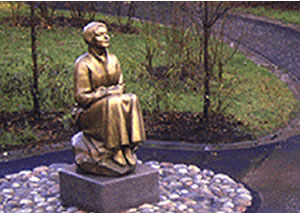
Karin Boye (26 oktober 1900 – 24 april 1941) Standbeeld in Huddinge
Kindje, slaap maar, kindje, 't was ook zo warm deze dag. In de schemer zit nu een kleine egel met zijn mooie stekels eenzaam in het gras.
Het gras wacht op regen. Geen takje beweegt er. Luister naar de merel, hoog op ons dak.
Avond vol verlangen. De maan maakt zich klaar voor de nacht. In de avondschemer komt strakjes onze egel nog een egel tegen, liefkoost haar vacht.
Van ver wordt de merel antwoord gegeven. Morgen komt de regen waar het gras op wacht.
Kindje, slaap maar, kindje, in de avondschemer. Hebt al slaap gekregen. Slaap maar mijn schat.
Uitreiking van diploma’s
Onder de meisjes menig stevig stuk, maar er zijn ook van die nog hele tere, onder de jongens veel in herenkleren, en allen, allen stralend van geluk.
Niet langer meer gebukt onder het juk van heel veel saais om uit het hoofd te leren: niemand zal ooit nog bij hen informeren naar passé défini of overdruk.
Maar ’t is meteen ook de examenklas, die vol saamhorigheid en warmte was, waarvan men zich zo zorgeloos ontdoet.
Nu slaat voor ’t laatst de grote schooldeur dicht, en kijk, daar gaan ze: blij en doelgericht een toekomst met veel heimwee tegemoet.
Willem Wilmink (25 oktober 1936 – 2 augustus 2003) Portret door Desirée Groot Koerkamp in Oostmarsum
“It took a total of five vehicles to carry them all to the beach. They could have managed with fewer, but Red insisted, as usual, on driving his pickup. How else could they bring everything they needed, he always asked—the rafts and boogie boards, the sand toys for the children, the kites and the paddle-ball racquets and the giant canvas shade canopy with its collapsible metal frame? (In the old days, before computers, he used to include the entire Encyclopaedia Britannica.) So he and Abby made the three-hour trip in the pickup, while Denny drove Abby’s car with Susan in the passenger seat and the food hampers in the rear. Stem and Nora and the three little boys came in Nora’s car, and Jeannie and Jeannie’s Hugh started out separately from their own house with their two children, though not with Hugh’s mother, who always spent the beach week visiting Hugh’s sister in California. Amanda and Amanda’s Hugh and Elise traveled on a whole different day—Saturday morning instead of Friday afternoon, since Amanda always had trouble getting away from her law office—and they stayed in a different cottage, because Amanda’s Hugh couldn’t tolerate what he called the hurly-burly. None of the dogs came. They were all boarding at Penpals. The house the Whitshanks rented every summer stood right on the beach—a comparatively uncrowded stretch of the Delaware coast—but it wasn’t what you’d call luxurious. The walls were tongue-and-groove, painted a depressing pea-soup green; the floor- boards were so splintery no one dared go barefoot; the kitchen dated from the 1940s. But it was big enough for all of them, and far homier than the glittering new mansions with giant Palladian windows that had popped up elsewhere along the shore. Besides, Red could always use a few fix-it jobs to keep him occupied. (He wasn’t a natural vacationer.) Even before Abby and Nora had unpacked the food, he had happily catalogued half a dozen minor household emergencies. “Will you look at this outlet!” he said. “Practically dangling by a thread!” And off he went to the truck for his tools, with Jeannie’s Hugh not far behind. “The next-door people are back,” Jeannie called, stepping in from the screen porch. Next door was almost the only house as unassuming as theirs was, and the people she was referring to had been renting it for at least as long as the Whitshanks had been renting theirs. Oddly enough, though, the two families never socialized.”
Anne Tyler (Minneapolis, 25 oktober 1941)
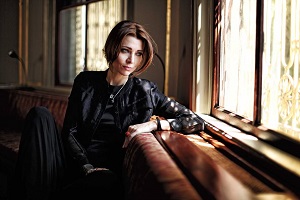
De Turkse schrijfster Elif Shafak (eigenlijk Elif Şafak) werd geboren in Straatsburg op 25 oktober 1971. Zie ook alle tags voor Elif Shafakop dit blog.
Uit: The Bastard of Istanbul
“At the moment, however, it was still pouring and Zeliha had little, if any, forgiveness in her heart. She did not have an umbrella, for she had promised herself that if she was enough of an imbecile to throw a bunch of money to yet another street vendor for yet another umbrella, only to forget it here and there as soon as the sun came back, then she deserved to be soaked to the bone. Besides, it was too late now anyway. She was already sopping wet. That was the one thing about the rain that likened it to sorrow: You did your best to remain untouched, safe and dry, but if and when you failed, there came a point in which you started seeing the problem less in terms of drops than as an incessant gush, and thereby you decide you might as well get drenched. Rain dripped from her dark curls onto her broad shoulders. Like all the women in the Kazancı family, Zeliha had been born with frizzy raven-black hair, but unlike the others, she liked to keep it that way. From time to time her eyes of jade green, normally wide open, and filled with fiery intelligence, squinted into two lines of untainted indifference inherent only to three groups of people: the hopelessly naïve, the hopelessly withdrawn, and the hopelessly full of hope. She being none of these, it was hard to make sense of this indifference, even if it was such a flickering one. One minute it was here, canopying her soul to drugged insensibility, the next minute it was gone, leaving her alone in her body.”
Some windless nights on Narragansett Bay, The deep inlet seems a meadow of fireflies As multitudes of the luminous jellyfish Called “comb-bearers” float to the surface For no evident purpose But to amaze the fishermen and scientists
Who know them only slightly, each one no more Than a pear-shaped living sack of liquid With skin thinner than cellophane, a sheer piece Of moonlight on the sea, so fragile The least ripple may tear it To bits. Calm evenings, the amber-green species
May spread out over a thousand yards square, An island made of bright individuals Who usually live in the depths, a zone where Wave movement ceases. Only on nights Like these do the comb-bearers Rise, when the bay lies still as a sheet of slate.
Loveliest of sea beings, the color Of wild geranium, rose-pink, or beach pea, As some pass beneath the surface of the water The effect is of rainbow glory More seductive than moonlight To the naturalist who might try to scoop one up
Ever-so-gently in his fine net and Hold it awhile in a clear beaker of brine- Perhaps the giant of the race, “Venus’s girdle,” Come from the Mediterranean- An iridescent ribbon Which vanishes en route to the laboratory.
Hope
In winter the crescent moon vanishes So quickly in the blue, down the horizon, Between the starry darkness and morning,
Like the hull of a ship without rigging That I was meaning to load with wishes, O not for me, my dear, wishes for you,
And you and you, my friends, all of us, Such cargo as could only ride upon The silver shell of that hallowed galleon. I daydreamed, got bewildered by my muse, Sun on the lace of frost, and fading Venus. I looked up, and the reckless moon had gone.
Wieviel Uhr? Es kommen auf einmal so viele fipsige Vögel auf, verflucht! Bald wird mir die Sonne ihr Zitronenlicht ins verkniffene Auge träufeln. . . Und keine Lehre wird mal daraus-nachhaus und kein Gedanke an Bewegung / Besserung.
Aufwachen? – Wozu? Es ist doch so, laut EMNID folgt für 44% aller Bundesbürger auf den Tod das Nichts. Von denen völlig zu schweigen, für die nach dem Nichts gleich der Tod kommt – Hab leider vergessen, was ich damit eigentlich aussagen wollte, achja: Wer das kapiert hat, den versteht bald keiner mehr.
Im Verhältnis kannst du natürlich nicht klagen (das nebenbei) – Man soll aber auch nicht glauben, hier läg noch derselbe rum wie damals im letzten Jahr. Oder wüßtest du grad ne Idee, für die du bedenkenlos deinen Kopf hinhalten würdenst? Na-bong, ein Präser hängt sich aus. . . Das muß aber ja nicht gleich Zustand werden.
Wie ich immer gesagt hab, in solcher Verfassung soll man eigentlich keine Gedichte schreiben. Da muß der Kunde doch unvermittelt denken, hier wär der Ausguck verstopft, beziehungsweise gar kein Leben mehr in dieser Rolle –
S o i s t e s a b e r n i c h t! Der Tag lehnt in der Drehtür: Wo es meine Lieblingsbouletten gibt, ist noch erleuchtet, mein Fuß schon unterwegs. . . Gleich wird – dein Telefon – im Schlaf – aufschrein! und dir den Aufbruch meiner Leiche feierlich eröffnen: - : - : -
„Die erste Zeile war immer gleich. sie lautete: »Jimmy Clitschi, der Mann ohne Knochen-« Auch die zweite Zeile kannte nur minimale Abweichungen. Es variierten lediglich die Tätigkeit und derKörperteil den sich Jimmy angeblich gebrochen hatte. Ein typisches Beispiel: Jimmy Glitschi, der Mann ohne Knochen, hat sich beim Furzen den Hintern gebrochen.« Trotz der stets tragisch endenden Geschichten entbehrten die Gedichte über Jimmy Clitschi nicht einer gewissen Komik. die sich vor allem Menschen unter acht Jahren erschloss. In meinen ersten Sommerferien verschifften mich meine Eltern ins Ferienlager. In einem Brief, den ich ihnen am zweiten Tag schickte, schrieb ich über das Ferienlager: »Alles Scheißdreck«, mein Befinden beschrieb ich mit den Worten: »Es geht mir scheiße.« Dann kam die erste Diskothek meines Lebens. Der dicke Harald hatte seinen Koffer mit Tonbandkassetten in den Esssaal getragen und zwei Kassettenrekorder mit den Lautsprechern auf volle Lautstärlke gedreht. Da brach es aus mir heraus: Ich bewegte meine Gliedmaßen im Takt der Musik. allerdings jeden meiner Arme. jedes Bein in seinem eigenen Rhythmus, die Augen hinter den Brillengläsern fest geschlossen und den Mund leicht geöffnet. Für einen Aufsenstehenden mag es vielleicht so ausgesehen haben, als hätte ich gerade einen KrampfanfalL aber ich tanzte den Jimmy Glitschi. All mein Heimweh und meine Wut ließ ich aus mir heraus und identifizierte mich in meinem Tanz mit dem berühmten Helden, der sich der Legende nach beim Beischlaf sein Geschlechtsteil gebrochen haben sollte. Ich sah bestimmt schrecklich aus, ich sah bestimmt lächerlich aus, ich sah erbärmlich aus, aber ich fühlte mich groißartig denn an diesem Nachmittag, hinter den geschlossenen Gardinen des Gemeinschattsraums, entdeckte ich die Kraft des Tanzes, wie Musik die Seele dazu bringen kann, in direkte Verbindung Zum Körper zu treten, um durch Bewegungen Dinge auszudrücken, die der Mund nicht sagen kann. Danach wurde alles besser. Als meine Eltern, aufgeschreckt durch meinen Brief, drei Tage später vor dem Ferienlager standen, um mich vorzeitig abzuholen, schaute ich sie nur verständnislos an.“
Schaamte van zoovele vrouwen, hoe zou wistet gij heden reeds al jet ontbladeren morgen, o roos, bij uw verouden het blozen vermeerderen van uwe aderen!
Uw blos, o roos, het wederbeeld van die mij steeg naar keel en wang, onthullend wat tot hun verheeld: hartstochtelijkheid en tegendwang.
Eenmaal ontplooid, o roos, verwacht geen wederkeer: diep in den nacht blijft heel uw hart ontbloot, en slaat uw geur mij tegen aan de kamerdeur.
Uw lippen willen alles, roos, verkonden, en ik moet zwijgende de mijne sluiten; alles verzwijgt gij woordloos met uw monden, al het verborgene wil ik uiten, uiten.
Een geil, o roos, een zeer geheime vergun mij voor mijn stil vervoeren: zij vinden slechts die u bezoeken volmaaktheid in uw omslagdoeken.
Uw lippen wil ik pletten tusschen tanden, u eten en uw geurig vleesch aanranden, dat zoeter is naarmate witter, het witte zoet, het roode bitter.
Vervulling overstelpend, volte van onverwoordbaarheid, geheel uw lichaam ligt rond en holten onthullend nauwlijks uw teveel.
Menschelijker dan andere bloemen omdat gij met meerdere lippen zwijgt: vegetaler ik door u niet te noemen.
Uw zilveren floers op purperlak Uw grein van fijne maas en twijn Uw ongefronst geglimd fustein Uw gouden huive en paarlen jak.
Gij uw gedorend halsje buigt door uw extremen overstelpt. Gij bergt uw fonklende overmoed deemoedig in uw bottelzoet.
Verbrand van regen is uw blad verrot uw kleedsel en verdord uw hart de storm vermorzelde u met overmacht geen letsel hebt gijzelf u toegebracht.
Orgasme o roos binnen zooveel lippen verborgen betooverd tot zooveel droom van zoovele oogleden slapend geloken met tranen bepareld hun zachtste zoom.
Christine D'haen (25 oktober 1923 – 3 september 2009)
There were strange gatherings. A vote would come that would be no vote. There would come a rope. Yes. There would come a rope. Men have their hats down. "Dancing in the Dark" will see him up, car-radio-wise. So many, some won't find a rut to park.
It is in the occasions, that-not the fathomless heart- the thinky death consists; his chest is pinched. The enemy are sick, and so is us of. Often, to rising trysts, like this one, drove he out
and gasps of love, after all, had got him ready. However things hurt, men hurt worse. He's stark to be jerked onward? Yes. In the headlights he got' keep him steady, leak not, look out over. This' hard work, boss, wait' for The Word.
Dream Song 14
Life, friends, is boring. We must not say so. After all, the sky flashes, the great sea yearns, we ourselves flash and yearn, and moreover my mother told me as a boy (repeatingly) ‘Ever to confess you’re bored means you have no
Inner Resources.’ I conclude now I have no inner resources, because I am heavy bored. Peoples bore me, literature bores me, especially great literature, Henry bores me, with his plights & gripes as bad as achilles,
who loves people and valiant art, which bores me. And the tranquil hills, & gin, look like a drag and somehow a dog has taken itself & its tail considerably away into mountains or sea or sky, leaving behind: me, wag.
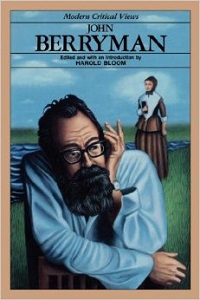
John Berryman (25 oktober 1914 – 7 januari 1972) Cover
Ik ben ziek van heimwee naar 't gele huis, In het lommer van groene linden, Waar zongen belovend hun neurie-geruis De dromige zomerwinden.
Nu wilde ik wel reizen naar 't gele huis En luistren naar 't suizlen der linden En dromen van liefde in mijn zonnige kluis En omhelzen wie trouw mij beminden.
Doch zo ik nu belde aan het gele huis, Wie zou ik er wedervinden? - In een zwarte kluis zijn mijn lieven thuis En geveld zijn de zingende linden.
Ik vond een vogel, stervende in de tuin Kinderjaren.
I Ik vond een vogel, stervende in de tuin. Geen koestren hielp, hij drinken wou noch eten. Gelijk een bloem, wier stengel werd gereten, Aan 't slappe halsje hing het kopje schuin.
Eén siddering - en dan, in niets meer weten, Verstrakte 't lijfje, als de aarde grijzigbruin. Wij hebben 't stil begraven in de tuin - Die kleine vogel kan ik nooit vergeten.
Zo zag 'k voor 't eerst het wonder van de dood - Nu moest die vogel zang en vliegspel derven, Weerloos vergaan tot aarde in aardeschoot.
Toen wist ik: - Nu nog zijn mijn wangen rood, Nog zing en dans ik, maar ook ik moet sterven - 'k Voel nog de kou, die héél mijn zijn doorvloot.
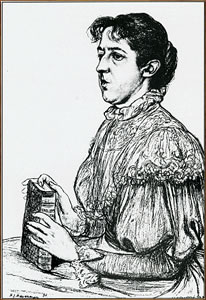
Hélène Swarth (25 oktober 1859 - 20 juni 1941) Portret door H.J. Haverman, 1896
“This morning I woke at dawn. and the place announced itself immediately even in the near dark through the windows of my room. water and facades. moored boats. boats at work upon the glimmering surface of dark water. I wake nowadays once or twice before I wake. I often dream I am waking and feel the half-dark air and myself as real when it isn't yet the real world . . . I'm not my age. I feel something like the silent clatter of my dreams. like horses on a shore. on the Lido. or the inland rim of the Lagoon. horses and armed men. often Oriental. usually silent. l have discussed this with myself. who the silent Orientals are - perhaps Huns. I am mean. hungry alter a night's sleep. But men of the East and not Lombards and the lumbering bombardment of the feudal wars of one's career. Of one's polities. Goths and Vandals Milanese. But Death. Or the dead. Or the barbarian young arriying in force during the night as Tartars and Mongols. And the sound of my ow n harsh breath is the snorting and clanging of war. of rage. left over from my night's dreams. from such invasion. Ruskin writes that Venice in the mid-nineteenth century was. at low tide. in the middle of a lagoon of mud. of seaweed and quaking. unstable muck, Desolation and uncrossability. There were miles of kreeks and rills and wandering channels of deeper water which when the tide changed rose and oyerflowed among the seaplants and stirred them and made the mud of the higher knolls gleam. and then it covered all of it w ith its own shiyering. reflectant symmetry. With reflections of the sky. Beauty arrives. The beauty of the city in the sea. In the dream I had just before waking. l was rescued from being hung on a gibbet in Carmaregro by masked figures. and then I fought in single combat like Sohrab and Rustum with my father or my brother Carlo on the edge of the Lagoon. swords elanging on metal. eyes mad with quarrelling. with neryes. The sky was deep red. maroon-termillion. dark crimson. and purple. flames or sunset And the dream. like most dreams. was shot through with emotion very clearly. with passion and fear. but this one was also full of contest and evidence of fatality. the fatality of close relationship.”
Harold Brodkey (25 oktober 1930 - 26 januari 1996)
„Dort also bin ich, wie gesagt, zur Welt gekommen, vorzeitig; meine arme Mutter war ja in tödlicher Angst und Sorge um den Gatten. Die Gefahr ging gnädig an ihm vorbei; schon im November war der Aufstand der Polen zu Ende, und sie konnte heimkehren. Man sieht, ich bin deshalb in Rußland zur Welt gekommen, weil mein Vater sich als Deutscher fühlte und danach handelte. Auch bei meiner Erziehung. Das deutsche Nationalgefühl, das mich erfüllt, das auch ich mein Leben lang betätigt habe, ist mir von Kindheit auf eingeprägt worden. Ich war noch nicht drei Käse hoch, als mir mein Vater bereits sagte: »Du bist deiner Nationalität nach kein Pole, kein Ruthene, kein Jude – du bist ein Deutscher.« Aber ebenso oft hat er mir schon damals gesagt: »Deinem Glauben nach bist du ein Jude.« Mein Vater erzog mich wie mein Großvater ihn erzogen, in denselben Anschauungen, sogar zu demselben Endzweck, ich sollte meine Heimat nicht in Galizien finden, sondern im Westen. Und auch die Gründe, die meinen Vater dazu bewogen, waren dieselben. Ich besuchte die einzige Schule des Städtchens, die im Kloster der Dominikaner; dort lernte ich Polnisch und Latein. Im Deutschen unterrichtete mich mein Vater selbst. Für das Hebräische hatte ich einen besonderen Lehrer. Dieser Mann war zugleich der einzige meiner Czortkower Glaubensgenossen, mit dem ich bis in mein zehntes Jahr in nähere Berührung kam. Meine Mitschüler, meine Spielgefährten waren Christen. Ich betrat selten ein jüdisches Haus, nie die Synagoge. Religiöse Bräuche sowie die Speisegesetze wurden im elterlichen Hause nicht gehalten. Ich wuchs wie auf einer Insel auf. Von meinen Mitschülern schieden mich Glaube und Sprache, und genau dasselbe schied mich von den jüdischen Knaben. Ich war ein Jude, aber von anderer Art als sie, und ihre Sprache war mir nicht ganz verständlich.“
Karl Emil Franzos (25 oktober 1848 - 28 januari 1904) Portret door P. Levy, 1893
« Je ne me souviens pas, pendant mes dix-huit premières années, d’avoir eu jamais un entretien d’une heure avec lui. Ses lettres étaient affectueuses, pleines de conseils, raisonnables et sensibles; mais à peine étions-nous en présence l’un de l’autre qu’il y avait en lui quelque chose de contraint que je ne pouvais m’expliquer, et qui réagissait sur moi d’une manière pénible. Je ne savais pas alors ce que c’était que la timidité, cette souffrance intérieure qui nous poursuit jusque dans l’âge le plus avancé, qui refoule sur notre coeur les impressions les plus profondes, qui glace nos paroles, qui dénature dans notre bouche tout ce que nous essayons de dire, et ne nous permet de nous exprimer que par des mots vagues ou une ironie plus ou moins amère, comme si nous voulions nous venger sur nos sentiments mêmes de la douleur que nous éprouvons à ne pouvoir les faire connaître. Je ne savais pas que, même avec son fils, mon père était timide, et que souvent, après avoir longtemps attendu de moi quelques témoignages d’affection que sa froideur apparente semblait m’interdire, il me quittait les yeux mouillés de larmes et se plaignait a d’autres de ce que je ne l’aimais pas. Ma contrainte avec lui eut une grande influence sur mon caractère. Aussi timide que lui, mais plus agité, parce que j’étais plus jeune, je m’accoutumai à renfermer en moi-même tout ce que j’éprouvais, à ne former que des plans solitaires, à ne compter que sur moi pour leur exécution, à considérer les avis, l’intérêt, l’assistance et jusqu’à la seule présence des autres comme une gêne et comme un obstacle. Je contractai l’habitude de ne jamais parler de ce qui m’occupait, de ne me soumettre à la conversation que comme à une nécessité importune et de l’animer alors par une plaisanterie perpétuelle qui me la rendait moins fatigante, et qui m’aidait à cacher mes véritables pensées. De là une certaine absence d’abandon qu’aujourd’hui encore mes amis me reprochent, et une difficulté de causer sérieusement que j’ai toujours peine à surmonter. Il en résulta en même temps un désir ardent d’indépendance, une grande impatience des liens dont j’étais environné, une terreur invincible d’en former de nouveaux."
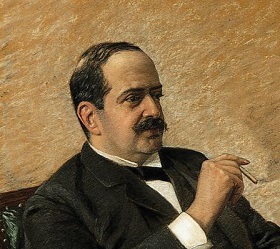
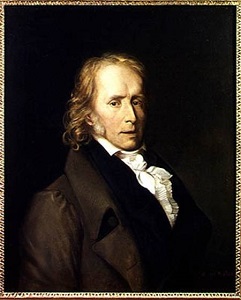
Benjamin Constant (25 oktober 1767 – 8 december 1830) Portret door Hercule de Roche. 1830
This carpenter hadde wedded newe a wyf, Which that he lovede moore than his lyf; Of eighteteene yeer she was of age. Jalous he was, and heeld hire narwe in cage, For she was wylde and yong, and he was old, And demed hymself been lik a cokewold. He knew nat catoun, for his wit was rude, That bad man sholde wedde his simylitude. Men sholde wedden after hire estaat, For youthe and elde is often at debaat. But sith that he was fallen in the snare, He moste endure, as oother folk, his care. Fair was this yonge wyf, and therwithal As any wezele hir body gent and smal. A ceynt she werede, barred al of silk, A barmclooth eek as whit as morne milk Upon hir lendes, ful of many a goore. Whit was hir smok, and broyden al bifoore And eek bihynde, on hir coler aboute, Of col-blak silk, withinne and eek withoute. The tapes of hir white voluper Were of the same suyte of hir coler; Hir filet brood of silk, and set ful hye. And sikerly she hadde a likerous ye; Ful smale ypulled were hire browes two, And tho were bent and blake as any sloo. She was ful moore blisful on to see Than is the newe pere-jonette tree, And softer than the wolle is of a wether. And by hir girdel heeng a purs of lether, Tasseled with silk, and perled with latoun.
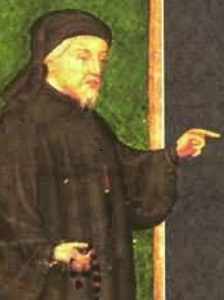
Geoffrey Chaucer (Ca. 1343 - 25 oktober 1400) Portret door de dichter Hoccleve