Mark Haddon, William Self, Jane Smiley, Vladimir Vojnovitsj

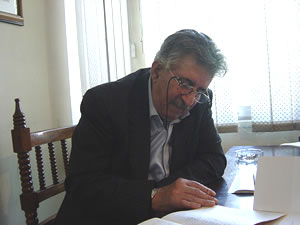
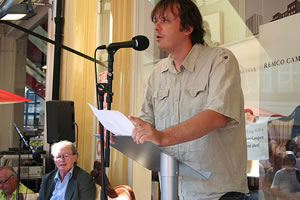
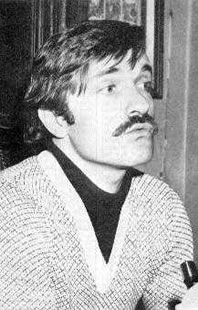
De Engelse schrijver Mark Haddon werd geboren op 26 september 1962 in Northampton. Hij volgder een opleiding aan de Uppingham School en het Merton College, Oxford, waar hij studeerde Engels.
In 2003 won Haddon de Whitbread Book of the Year Award en in 2004 de Commonwealth Writers' Prize Overall Best First Book voor zijn roman The Curious Incident of the Dog in the Night-time, een boek dat is geschreven vanuit het perspectief van een jongen met het syndroom van Asperger. Zijn tweede roman, A Spot of Bother, werd gepubliceerd in september 2006. Mark Haddon is ook bekend om zijn reeks van Agent Z boeken. Van een ervan, Agent Z en de Pinguïn van Mars, werd in 1996 een BBC sitcom voor kinderen gemaakt.
Uit: The Curious Incident of the Dog in the Night-Time
„It was 7 minutes after midnight. The dog was lying on the grass in the middle of the lawn in front of Mrs Shears' house. Its eyes were closed. It looked as if it was running on its side, the way dogs run when they think they are chasing a cat in a dream. But the dog was not running or asleep. The dog was dead. There was a garden fork sticking out of the dog. The points of the fork must have gone all the way through the dog and into the ground because the fork had not fallen over. I decided that the dog was probably killed with the fork because I could not see any other wounds in the dog and I do not think you would stick a garden fork into a dog after it had died for some other reason, like cancer for example, or a road accident. But I could not be certain about this.
I went through Mrs Shears' gate, closing it behind me. I walked onto her lawn and knelt beside the dog. I put my hand on the muzzle of the dog. It was still warm.
The dog was called Wellington. It belonged to Mrs Shears who was our friend. She lived on the opposite side of the road, two houses to the left.
Wellington was a poodle. Not one of the small poodles that have hairstyles but a big poodle. It had curly black fur, but when you got close you could see that the skin underneath the fur was a very pale yellow, like chicken.
I stroked Wellington and wondered who had killed him, and why.“
Mark Haddon (Northampton, 26 september 1962)
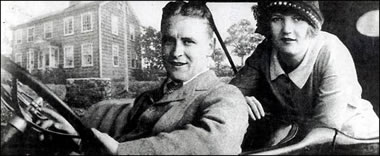
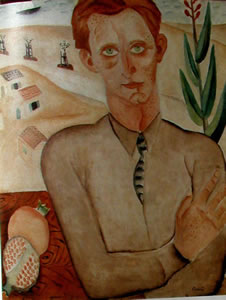
De Engelse schrijver, criticus en columnist William Self werd geboren in Londen op 26 september 1961. Zie ook mijn blog van 26 september 2007 en ook mijn blog van 26 september 2008. en ook mijn blog van 26 september 2009.
Uit: The Book of Dave
„The little kids who’d left the manor with Carl had run on ahead, up the slope towards the Layn, the avenue of trees that formed the spine of Ham. These thick-trunked, stunted crinkleleafs bordered the cultivated land with a dark, shimmering froth. Carl saw brown legs, tan T-shirts and mops of curly hair flashing among the trunks as the young Hamsters scattered into the woodland. Reedy whoops of joy reached Carl’s ears, and he wished he could go with them into Norfend, galumphing through the undergrowth, sloshing into the boggy hollows to flush out the motos, then herd them towards their wallows.
Up from the manor in a line behind Carl came the older lads – those between ten and fourteen years old – whose graft it was to oversee the motos’ wallowing, before assigning the beasts their day’s toil. Despite everything, Carl remained the acknowledged gaffer of this group, and, as he swerved off the path along one of the linchets dividing the rips, the other eight followed suit, so that the whole party were walking abreast, following the bands of wheatie as they rolled up the rise.“

William Self (Londen, 26 september 1961)
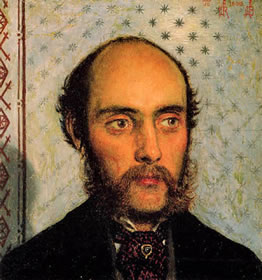
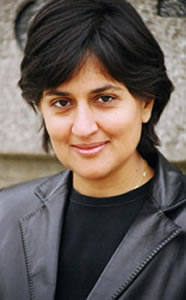
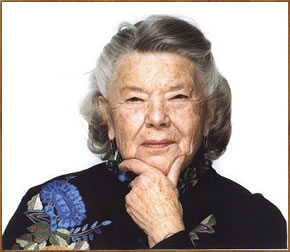
De Amerikaanse schrijfster Jane Smiley werd geboren op 26 september 1949 in Los Angeles. Zie ook mijn blog van 26 september 2008 en ook mijn blog van 26 september 2009.
Uit: A Thousand Acres
„At sixty miles per hour, you could pass our farm in a minute, on County Road 686, which ran due north into the T intersection at Cabot Street Road. Cabot Street Road was really just another country blacktop, except that five miles west it ran into and out of the town of Cabot. On the western edge of Cabot, it became Zebulon County Scenic Highway, and ran for three miles along the curve of the Zebulon River, before the river turned south and the Scenic continued west into Pike. The T intersection of CR 686 perched on a little rise, a rise nearly as imperceptible as the bump in the center of an inexpensive plate.
From that bump, the earth was unquestionably flat, the sky unquestionably domed, and it seemed to me when I was a child in school, learning about Columbus, that in spite of what my teacher said, ancient cultures might have been onto something. No globe or map fully convinced me that Zebulon County was not the center of the universe. Certainly, Zebulon County, where the earth was flat, was one spot where a sphere (a seed, a rubber ball, a ballbearing) must come to perfect rest and once at rest must send a taproot downward into the ten-foot-thick topsoil.
Because the intersection was on this tiny rise, you could see our buildings, a mile distant, at the southern edge of the farm. A mile to the east, you could see three silos that marked the northeastern corner, and if you raked your gaze from the silos to the house and barn, then back again, you would take in the immensity of the piece of land my father owned, six hundred forty acres, a whole section, paid for, no encumbrances, as flat and fertile, black, friable, and exposed as any piece of land on the face of the earth.
If you looked west from the intersection, you saw no sign of anything remotely scenic in the distance. That was because the Zebulon River had cut down through topsoil and limestone, and made its pretty course a valley below the level of the surrounding farmlands. Nor, except at night, did you see any sign of Cabot. You saw only this, two sets of farm buildings surrounded by fields. In the nearer set lived the Ericsons, who had daughters the ages of my sister Rose and myself, and in the farther set lived the Clarks, whose sons, Loren and Jess, were in grammar school when we were in junior high. Harold Clark was my father's best friend. He had five hundred acres and no mortgage. The Ericsons had three hundred seventy acres and a mortgage.“

Jane Smiley (Los Angeles, 26 september 1949)
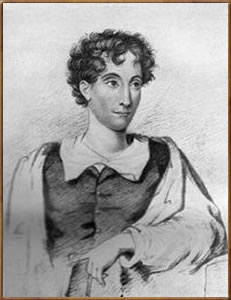
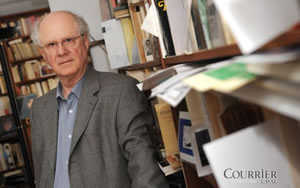
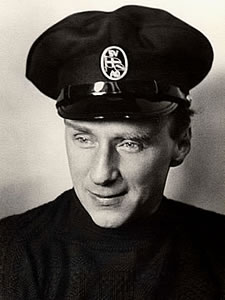
De Russische schrijver en dissident Vladimir Nikolajevitsj Vojnovitsj werd geboren in Doesjanbe op 26 september 1932. Zie ook mijn blog van 26 september 2008 en ook mijn blog van 26 september 2009.
Uit: Die denkwürdigen Abenteuer des Soldaten Iwan Tschonkin (Vertaald door Alexander Kaempfe)
„Ob das auf den Seiten dieses Buches Erzählte wirklich geschehen ist oder nicht, kann man heute nicht mehr mit Sicherheit sagen. Der Vorfall, mit dem die ganze Geschichte (die sich fast bis in unsere Tage hinzieht) ihren Anfang nahm, spielte sich im Dorf Krassnoje vor so langer Zeit ab, daß fast keine Augenzeugen übriggeblieben sind. Diese wenigen erzählen die Geschichte verschieden und einige können sich überhaupt nicht mehr daran erinnern. Um die Wahrheit zu sagen, war dieser Vorfall auch nicht wichtig genug, um ihn so lange im Gedächtnis zu behalten. Ich jedoch habe alles zusammengetragen, was ich zu dieser Sache in Erfahrung brachte. Dann habe ich von mir aus noch einiges hinzugefügt, vielleicht mehr als ich hörte. Zuletzt erschien mir die Geschichte so unterhaltsam, daß ich mich dazu entschloß, sie aufzuschreiben. Sollte sie Ihnen uninteressant, langweilig oder gar dumm erscheinen, sind Sie natürlich berechtigt, so zu tun, als hätte ich nichts erzählt.
Das nachfolgend Berichtete geschah unmittelbar vor dem Krieg: so etwa Ende Mai oder Anfang Juni 1941.
Es war an einem ganz gewöhnlichen, für die Jahreszeit typischen heißen Tag. Alle Kolchosbauern arbeiteten auf den Feldern, während Njura Beljaschowa, die bei der Post angestellt war und nicht in direkter Beziehung zum Kolchos stand, ihren freien Tag damit verbrachte, im Gemüsegarten Kartoffeln anzuhäufeln.
Es war so heiß, daß Njura schon völlig außer Atem war, als sie drei Beete hinter sich hatte. Ihr Kleid war auf dem Rücken und unter den Achselhöhlen durchgeschwitzt und wurde beim Wiedertrocknen salzig, weiß und hart. Der Schweiß rann ihr in die Augen. Njura richtete sich auf, um das widerspenstige Haar unters Kopftuch zu schieben. Bei dieser Gelegenheit blickte sie zur Sonne hoch, um festzustellen, ob bald Mittag sein würde. Doch Njura bekam die Sonne nicht zu sehen. Ein großer eiserner Vogel mit einem gekrümmten Schnabel hatte sich vor die Sonne und den Himmel geschoben und stürzte direkt auf sie herab.
»O weh!« rief Njura entsetzt, schlug die Hände vors Gesicht und ließ sich wie tot in eine Furche fallen.
Der Eber Borjka, der damit beschäftigt war, die Erde neben dem Haus aufzuwühlen, sprang zur Seite, vergewisserte sich indessen, daß ihm keine Gefahr drohte, und kehrte an seinen alten Platz zurück.“

Vladimir Vojnovitsj (Doesjanbe, 26 september 1932)