André Gide, George Eliot, Dirk van Weelden, Suresh en Jyoti Guptara, Viktor Pelevi

De Franse schrijver André Gide werd geboren op 22 november 1869 in Parijs. Zie ook alle tags voor André Gide op dit blog.
Uit: Si le grain ne meur
“Roger Martin du Gard, à qui je donne à lire ces Mémoires leur reproche de ne jamais dire assez et de laisser le lecteur sur sa soif. Mon intention pourtant a toujours été de tout dire. Mais il est un degré dans la confidence que l'on ne peut dépasser sans artifice, sans se forcer ; et je cherche surtout le naturel. Sans doute un besoin de mon esprit m'amène, pour tracer plus purement chaque trait, à simplifier tout à l'excès ; on ne dessine pas sans choisir ; mais le plus gênant c'est de devoir présenter comme successifs des états de simultanéité confuse. je suis un être de dialogue ; tout en moi combat et se contredit. Les Mémoires ne sont jamais qu'à demi sincères, si grand que soit le souci de vérité : tout est toujours plus compliqué qu'on ne le dit. Peut-être même approche-t-on de plus près la vérité dans le roman.
(…)
Nos actes les plus sincères sont aussi les moins calculés ; l'explication qu'on en cherche après coup reste vaine. Une fatalité me menait ; peut-être aussi le secret besoin de mettre au défi ma nature ; car, en Emmanuèle, n'était-ce pas la vertu même que j'aimais ? C'était le ciel, que mon insatiable enfer épousait ; mais cet enfer je l'omettais à l'instant même : les larmes de mon deuil en avaient éteint tous les feux ; j'étais comme ébloui d'azur, et ce que je ne consentais plus à voir avait cessé pour moi d'exister. Je crus que tout entier je pouvais me donner à elle, et le fis sans réserve de rien. A quelque temps de là nous nous fiançâmes.”
André Gide (22 november 1869 – 19 februari 1951)
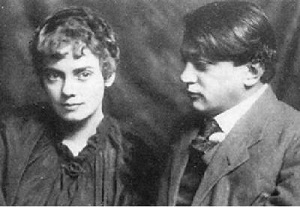
Op ongeveer 20-jarige leeftijd
De Engelse dichteres en schrijfster George Eliot werd geboren op 22 november 1819 in Nuneaton in Warwickshire. Zie ook alle tags voor George Eliot op dit blog.
Uit: Silas Marner
“In the early years of this century, such a linen-weaver, named Silas Marner, worked at his vocation in a stone cottage that stood among the nutty hedgerows near the village of Raveloe, and not far from the edge of a deserted stone-pit. The questionable sound of Silas's loom, so unlike the natural cheerful trotting of the winnowing-machine, or the simpler rhythm of the flail, had a half-fearful fascination for the Raveloe boys, who would often leave off their nutting or birds'-nesting to peep in at the window of the stone cottage, counterbalancing a certain awe at the mysterious action of the loom, by a pleasant sense of scornful superiority, drawn from the mockery of its alternating noises, along with the bent, tread-mill attitude of the weaver. But sometimes it happened that Marner, pausing to adjust an irregularity in his thread, became aware of the small scoundrels, and, though chary of his time, he liked their intrusion so ill that he would descend from his loom, and, opening the door, would fix on them a gaze that was always enough to make them take to their legs in terror. For how was it possible to believe that those large brown protuberant eyes in Silas Marner's pale face really saw nothing very distinctly that was not close to them, and not rather that their dreadful stare could dart cramp, or rickets, or a wry mouth at any boy who happened to be in the rear? They had, perhaps, heard their fathers and mothers hint that Silas Marner could cure folks' rheumatism if he had a mind, and add, still more darkly, that if you could only speak the devil fair enough, he might save you the cost of the doctor. Such strange lingering echoes of the old demon-worship might perhaps even now be caught by the diligent listener among the grey-haired peasantry; for the rude mind with difficulty associates the ideas of power and benignity. A shadowy conception of power that by much persuasion can be induced to refrain from inflicting harm, is the shape most easily taken by the sense of the Invisible in the minds of men who have always been pressed close by primitive wants, and to whom a life of hard toil has never been illuminated by any enthusiastic religious faith.”

George Eliot (22 november 1819 – 22 december 1880)
Ben Kingsley (Silas) en Elizabeth Hoyle (Eppie) in een verfilming uit 1985
De Nederlandse schrijver Dirk van Weelden werd geboren in Zeist op 22 november 1957. Zie ook alle tags voor Dirk van Weelden op dit blog.
Uit: Het laatste jaar
“David en Brent kwamen elkaar tegen in de late jaren zeventig. Twee slimme, nerveuze jongens, onzeker over hun verblijf op de universiteit (waar moest dat toe leiden?), maar gelijkgestemd in hun liefde voor literatuur, muziek en film. En hoe verschillend ze ook waren, ze hadden een gemeenschappelijk droombeeld, dat ze liever niet hardop benoemden: een schrijvend leven leiden. Hun vriendschap en samenwerking ontstonden in mijn geest, zou je kunnen zeggen. In de geest van de Olivetti Studio 44.
Dus als ik die kop van David zie, zo gretig als hij de beelden in zich opneemt waarin de kampioen ten onder gaat, dan weet ik dat hij denkt aan de luidruchtige pret die hij met Brent maakte als ze samen naar voetbal- en wielerwedstrijden keken. Aan hun liefde voor de vreemde schoonheid en mallotige tragiek die sport kan bieden, en natuurlijk aan Brent, zijn vriend, die op deze drukkende juniavond al meer dan een jaar onder een dikke grijze steen en een paar meter vochtige zwarte aarde ligt te vergaan.
Niet lang nadat ze elkaar hadden leren kennen, begonnen David en Brent elkaar regelmatig te zien. Een paar keer per week en altijd bij Brent thuis. David woonde in een studentenflat aan de rand van de stad, waar hij zich alleen 's nachts en 's avonds, verdiept in zijn boeken en schriften prettig voelde. De rest van de dag was hij in de stad. Brents kamer bevond zich boven een modelbouwwinkel in de binnenstad, aan het A-Kerkhof. Je liep vanaf de straat in een overdekte gang met aan weerszijden etalages. Alpendorpjes en zandwoestijnen, waarin goederentreintjes rondraasden en tanks van het Afrikakorps roerloos op Montgomery stonden te wachten. Boven dit alles bungelden plastic Spitfires en Heinkel-jachtbommenwerpers aan visdraad. Aan het eind van de gang was de ingang van de winkel. Haaks erop de brede deur van donker gelakt hardhout. Daarachter leidde een hoge steile trap naar een paar kamers, een keuken en een badkamer.”

Dirk van Weelden (Zeist, 22 november 1957)
De Brits-Indische schrijverstweeling Suresh en Jyoti Guptara werd geboren op 22 november 1988 in Frimley, Hants in het zuidoosten van Engeland. Zie ook alle tags voor Suresh en Jyoti Guptara op dit blog.
Uit: Conspiracy of Calaspia
“Suddenly Galar realised what must have happened. Poison! With a roar he cut down the nearest foe, before retreating to higher ground. He brought his shoulder to his mouth and desperately sucked at the wound. Along with the blood he drew into his mouth he thought he tasted something bitter. Galar spat in disgust and looked up in time to parry a downward blow. He kicked the beast in the stomach, briefly feeling coarse fur beneath his foot as it stumbled down the incline, and quickly removed throwing-axes from straps on his back. These had small heads, many times lighter than his golden axe, but with long handles. Before the Nurgor could get back to its feet, its skull was split with one swing of Galar's arm. The Dwarf's muscles knotted as he threw the other two axes at the nearest of his opponents, both of which hit the dust.
Sensing their victim's weakening power, the Nurgor surged up the rise in a triumphant assault. Galar struggled to fight off the first few blows before a heavy stave found its way through his defences and knocked him into darkness.
*
'Master, your humble servant reports: we have the Dwarf.'
It was a triumphant call, even if the figure who proclaimed this news looked in no condition to be happy. Though battered and bruised, he walked upright, without the least sign of pain, a grim smile twitching at the sides of his mouth. As the man drew nearer the hulking figure before him, the smile faded and he knelt humbly with outstretched arms.”

Suresh en Jyoti Guptara (Frimley, 22 november 1988)
De Russische schrijver Viktor Pelevin werd geboren op 22 november 1962 in Moskou. Zie ook alle tags voor Viktor Pelevin op dit blog.
Uit: Buddha's Little Finger (Vertaald door Andrew Bromfield)
“I did not feel any fear of death. Perhaps, I thought, it had already happened, and this icy boulevard along which I was walking was merely the threshold of the world of shadows. I had realized long before that Russian souls must be fated to cross the Styx when it is frozen, with their fare collected not by a ferryman, but by a figure garbed in grey who hires out a pair of skates — the same spiritual essence, naturally.
Suddenly I could picture the scene in the finest of detail: Count Tolstoy in black tights, waving his arms about, skates over the ice towards the distant horizon — his movements are slow and solemn, but he makes rapid progress, and the three-headed dog barking soundlessly in pursuit has no chance of overtaking him. I laughed quietly, and at that very moment a hand slapped me on the shoulder.
I stepped to one side and swung round sharply, feeling for the handle of the revolver in my pocket, when to my amazement I saw before me the face of Grigory Vorblei, an aquaintance from childhood. But, my God, his appearance! He was dressed from head to toe in black leather, a holster with a Mauser dangled at his hip, and in his hand he was clutching a ridiculous kind of obstetrician's travelling bag.
`I'm glad you're still capable of laughter,' he said.
`Hello, Grisha,' I said, `how strange to see you.'
`Why strange?'
`It just is strange.'
`Where have you come from?' he asked in a cheerful voice. `And where are you going?'

Viktor Pelevin (Moskou, 22 november 1962)
Zie voor nog meer schrijvers van de 22e november ook mijn vorige blog van vandaag.