Naar de inhoud

Romenu

Over literatuur, gedichten, kunst en cultuur
seniorennet.beseniorennet.be

Berichten van 6 april 2011

Jakob Ejersbo, John Pepper Clark, Günter Herburger, Uljana Wolf
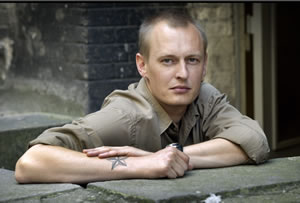
De Deense schrijver en journalist Jakob Ejersbo werd geboren in Rødovre op 6 april 1968. Zie ook mijn blog van 6 april 2009.


Uit: Exile (Vertaald door Don Bartlett)


„A metre and a half above me, as I kick off from the sandy bottom with my flippers, the surface of the water is living silvery blue. I turn onto my back and see the luminous underside of the small waves through my goggles. At my approach the small fish silently flee into the coral on the sea bed. It’s over. The summer holidays have come to an end. We’re going to drive my elder sister Alison to Kilimanjaro Airport – she’s catching the plane to England. In a few days I’ll be back at boarding school; without Alison. I kick my way to the surface and suck in air. The world is noisy. I remove my goggles and blink under the water. Salt water – so that no one can see I have been crying.
   I walk up the slope. Baobab Hotel is shrouded in silence – the main building with the reception area and the restaurant; bungalows scattered between the baobab trees. We don’t have many guests. Alison is at home packing. She’s going to live with my father’s sister and study hotel management at a school in Birmingham for six months, after which she will do her practical training at a hotel. I lean against the door frame to her bedroom.
   ‘Are you going to leave me all alone with the codgers?’ I ask.
   ‘Yes,’ says Alison.
   ‘They’ll do my head in,’ I say.
   ‘I’ve got to learn something,’ Alison says. Dad passes in the corridor. I turn my head after him.
   ‘I haven’t seen England for three years. We’ve lived here for twelve – I’ll end up as a Tanzanian,’ I say aloud. He continues on down the corridor.
   ‘You’ll get to England soon enough,’ he says without looking back.
   ‘I bloody need to go now,’ I say. Dad pulls up and eyes me.
   ‘Calm down now,’ he says. ‘I told you not to swear at home. You can go and visit Alison next year.’


888342-7c23943d8101594cc32431c71a75738d.jpg
Jakob Ejersbo (6 april 1968 - 10 juli 2008)


De Nigeriaanse dichter en schrijver John Pepper Clark werd geboren op 6 april 1935 in Kiagbodo, Nigeria. Zie ook mijn blog van 6 april 2007 en ook mijn blog van 6 april 2008 en ook mijn blog van 6 april 2009 en ook mijn blog van 6 april 2010.


Ibadan 


Ibadan,

running splash of rust

and gold-flung and scattered

among seven hills like broken

china in the sun.


Olokun 


I love to pass my fingers

(As tide thro' weeds of the sea

And wind the tall fern-fronds)

Thro' the strands of your hair

Dark as night that screens the naked moon:

I am jealous and passionate

Like Jehovah, God of the Jews,

And I would that you realise

No greater love had woman

From man than the one I have for you!

But what wakeful eyes of man,

Made of the mud of this earth,

Can stare at the touch of sleep

The sable vehicle of dream

Which indeed is the look of your eyes!

So drunken, like ancient walls

We crumble in heaps at your feet;

And as the good maid of the sea,

Full of rich bounties for men,

You lift us all beggars to your breast.


 888342-0f3d6f4399534aac8971b239209c4c9d.jpg

John Pepper Clark (Kiagbodo, 6 april 1935)


De Duitse schrijver en dichter Günter Herburger werd geboren op 6 april 1932 in Isny im Allgäu. Zie ook mijn blog van 6 april 2007 en ook mijn blog van 6 april 2008 en ook mijn blog van 6 april 2009  en ook mijn blog van 6 april 2010.


Uit: Emmental


“Schon im Zug nach Zürich begann Verklärung. Draußen regnete es, in den Abteilen hatte sich junges Volk breit gemacht, das Rucksäcke, Wimpel, Tennisschläger und, für welche Zwecke auch immer, kurzstielige Schaufeln bei sich hatte. Die Gesellschaft war zu Hütten und Landschulheimen über das verlängerte Wochenende unterwegs.
Sofort verliebte ich mich in ein protestantisch blondes Mädchen, dann in seine Nachbarin. Beide waren sehr groß, die Lippen dunkelrot geschminkt, die vielen Haare kunstvoll in Unordnung gebracht.
In Luzern, wo alle ausstiegen und wir vom Rapido zu einer Bummellinie wechselten, war selbst noch die Bahnhofshalle sexualisiert.
Helio Bechterew sagte, seit Stunden müsse er an Hepatitis-B denken, das Virus.
Warum?
Wegen der großartigen Frisuren.
Verstünde ich nicht.
Er sei an der Elfenbeinküste gewesen, behauptete er, die ebenfalls voller Haare sei. Er habe Gelbsucht bekommen, eine langweilige, monatelange Krankheit, gegen die nichts helfe. Schließlich habe ihm eine schwäbische Tante geraten, Schafsläuse zu essen. Und tatsächlich, es habe geholfen, täglich zwanzig, dreißig Stück in Quark oder Haferbrei. Der Tante sei es auch gelungen, Schafszüchter für die Läuse aufzutreiben, die sich Gabe und Transport allerdings teuer hätten bezahlen lassen. Die Breitband-Medizin wisse immer noch nicht, weshalb das alte Bauernmittel wirke.
Ich glaubte ihm jedes Wort, an die unbefangenen Mädchen denkend, ihre Fröhlichkeit und ihr Ungestüm, das sich, uns im Blick, in Gelächter ausgedrückt hatte.
In Trubschachen, einem düsteren Ort tief im Tal, stiegen wir aus und nahmen im Gasthaus »Bahnhof« ein Zimmer. Der Regen war heftiger und kälter geworden, ging allmählich in nassen Schnee über.”


 888342-b5ab997f5c20bc3d13b33743efa83598.jpg

Günter Herburger (Isny im Allgäu, 6 april 1932)


De Duitse dichteres Uljana Wolf werd geboren op 6 april 1979 in Berlijn. Zie ook mijn blog van 6 april 2007 en ook mijn blog van 6 april 2008 en ook mijn blog van 6 april 2009  en ook mijn blog van 6 april 2010.
 

Uit: falsche freunde: Prosa-Gedichte


“dust bunnies wir wollten über kleine tiere sprechen, wollten auf die knie gehn für die kleinen tiere, jene aus staub und schlieren, in ritzen und dielen, jene, die in grauen fellen frieren, unsere tiere aus nichts. wir wollten auch ganz nah in deiner sprache und in meiner hauchen, sag mir liebes, hast du heute schon gesaugt. nein, wir wollten unsere tiere nicht erschrecken, klein wie flecken, sind das flecken, haben sie nicht puschelschwänze, lange löffel, oder lange schwänze, tuschelohren, wollten wir nicht weniger rauchen, weniger husten, weniger entweder oder sein. gestern war die zimmerecke einsam in ihrer knarzenden öde. heute ist sie hort, heute zärtlichen horden ein port, wir wollen also still sein, auf den knien lauschen: unsere kleinen tiere, wie sie ihre wollenen, mondgrauen namen tauschen. »look on my card« wir wollten über diesen satz wie eine fremde stadt uns beugen, ort erzeugen, mundraum, traum vom hören, oder sagen: hier, in diesem netz aus zungen, ist ein weg gelungen, ein versehn, verstehn. auf unseren stirnen, die sich fast berührten, klebte lingua franca, eine briefmarke. wo am i, ein spiel, auf raten, aber was wir sprachen, passte nicht: die roten linien schnalzten, rollten sich in ihre eignen namen, kamen mit dem griechen chartis, carta aus italien und karte, also mir.”


888342-9231c477b01266868e45558f7b7a8abe.jpg
Uljana Wolf (Berlijn, 6 april 1979)


Zie voor nog meer schrijvers van de 6e april ook mijn vorige blog van vandaag en eveneens mijn eerste blog van vandaag.
Geschreven door Romenu om 19:45 Reageer op dit bericht

Dan Andersson, Erich Mühsam, Georges Darien, Jean-Baptiste Rousseau, Alexander Herzen, Nicolas Chamfort

De Zweedse dichter en schrijver Dan Andersson werd geboren op 6 april 1888 in Skattlösberg (Dalarna). Zie ook mijn blog van 6 april 2009 en ook mijn blog van 6 april 2010.


Uit: Svarta visor (Fragment, vertaald door Klaus-Rüdiger Utschick)


Um den Bettler von Luossa saß das ganze Dorf im Ring
und am Lagerfeuer hörte seinen Sang
über Bettler, über Tippler, über manches Wunderding
und seine Sehnsucht eine ganze Mondnacht lang:

„Irgendetwas hinter Bergen, jenseits Blumen und Gesängen,
irgendetwas hinter Sternen und dem heißen Herzen mein —
hört ihr? — etwas raunt und flüstert, will mich locken und bedrängen:
‘Komm zu uns, denn diese Erde kann dein Reich nicht länger sein.’

Oftmals lauschte ich ganz still dem leisen Wogenschlag am Strand,
und es rauschte still das wilde Meer im Traum,
und die Brandung warf mich sanft in jenes formenlose Land,
wo die Liebsten, die wir kannten, haben Raum.

Für ein ewig wildes Sehnen haben Mütter uns geboren,
aus den Wehen der Geburt stieg unser erster Jammerlaut,
und zu Gaukelspiel und Taumel hat die Erde uns erkoren,
als wir spielten Elch und Löwe, Bettler, Schmetterling und Gott.


 888334-f37fcb054ea16f07132335d71794dc86.jpg

Dan Andersson (6 april 1888 – 16 september 1920)


De Duitse schrijver, anarchist en activist Erich Mühsam werd geboren in Berlijn op 6 april 1878. Zie ook mijn blog van 6 april 2007 en ook mijn blog van 6 april 2008 en ook mijn blog van 6 april 2009 en ook mijn blog van 6 april 2010.


Ich möchte Gott sein ...

Ich möchte Gott sein und Gebete hören
und meine Schutz versagen können
und Menschenherzen zunichte brennen
und Seelenopfer begehren.
Und möchte Erde, Welt und All vernichten
und Trümmerhaufen über Trümmer schichten.
Dann müßte ein Neues entstehn -
und das ließ ich wieder vergehn.


Das Nichts

Ich sah durch ein hohes, goßes Loch.
Ist Nichts darin? - Doch! scholl es. - Doch!
Und ich suchte und suchte und grub nach dem Nichts. -
Da quoll aus dem Loch eine Garbe Lichts. -
Ich habe das Nichts gefunden, -
Und mir um die Stirn gewunden.


 888337-3037bf2276753f6548fab9c5baf00da2.jpg

 Erich Mühsam (6 april 1878 – 10 juli 1934)


De Franse, anarchistische, schrijver Georges Darien werd geboren als Georges Hippolyte Adrien op 6 april 1862 in Parijs. Zie ook mijn blog van 6 april 2009 en ook mijn blog van 6 april 2010.


Uit: La belle France


“Les pauvres croient que le travail ennoblit, libère. La noblesse d'un mineur au fond de son puit, d'un mitron dans la boulangerie, d'un terrassier dans une tranchée, les frappe d'admiration, les séduit. On leur a tant répété que l'outil est sacré qu'on a finit par les en convaincre. Le plus beau geste de l'homme est celui qui soulève un fardeau, agite un instrument, pensent-ils. "Moi, je travaille", déclarent-ils, avec une fierté douloureuse et lamentable. La qualité de bête de somme semble, à leur yeux, rapprocher de l'idéal humain. Il ne faudrait pas aller leur dire que le travail n'ennoblit pas et se libère point, que s'étiqueter travailleurs, restreint, par ce fait même, ses facultés et ses aspirations d'homme, que pour punir les voleurs et autres malfaiteurs et les forcer à rentrer en eux-mêmes, on les condamne au travail, on fait d'eux des ouvriers. Ils refuseraient de vous croire.”


888334-472accc66e782aa600294ffd24e95318.gif
Georges Darien (6 april 1862 – 19 augustus 1921)


De Franse dichter en schrijver Jean-Baptiste Rousseau werd geboren op 6 april 1671 in Parijs. Zie ook mijn blog van 6 april 2007 en ook mijn blog van 6 april 2008 en ook mijn blog van 6 april 2009 en ook mijn blog van 6 april 2010.


Ode tirée du Cantique d'Ézéchias (Fragment)


J'ai vu mes tristes journées
Décliner vers leur penchant ;
Au midi de mes années
Je touchais à mon couchant :
La Mort, déployant ses ailes,
Couvrait d'ombres éternelles
La clarté dont je jouis ;
Et, dans cette nuit funeste,
Je cherchais en vain le reste
De mes jours évanouis.

Grand Dieu, votre main réclame
Les dons que j'en ai reçus ;
Elle vient couper la trame
Des jours qu'elle m'a tissus :
Mon dernier soleil se lève
Et votre souffle m'enlève
De la terre des vivants,
Comme la feuille séchée,
Qui, de sa tige arrachée,
Devient le jouet des vents.

Comme un lion plein de rage,
Le mal a brisé mes os ;
Le tombeau m'ouvre un passage
Dans ses lugubres cachots.
Victime faible et tremblante,
A cette image sanglante
Je soupire nuit et jour ;
Et, dans ma crainte mortelle,
Je suis comme l'hirondelle
Sous les griffes du vautour.


888334-599ad3853e22bf54c6e437e1fbccb26d.jpg
Jean-Baptiste Rousseau (6 april 1671 – 16 maart 1741)


De Russische schrijver, filosoof en publicist Alexander Herzen werd geboren op 6 april 1812 in Moskou. Zie ook mijn blog van 6 april 2007 en  ook mijn blog van 6 april 2009 en ook mijn blog van 6 april 2010.


Uit: Letter to Michelet


„22 September 1851

...

No man is bold enough or ungrateful enough to deny the importance of France in the destinies of the European world. However you must allow me a frank confession: I cannot share your view that the participation of France is the sine qua non of historical progress. Nature never stakes all her fortune on one card. Rome, the eternal city -- which had no less right to the hegemony of the world -- tottered, fell into ruins, and vanished, while pitiless humanity walked over its grave.

On the other hand, unless one regards nature as madness incarnate, it is hard to call a people that has grown and spread out for ten centuries, has obstinately preserved its nationality, formed itself into an immense empire, and intervened in history far more than it perhaps should have label an "outcast race"; a "vast deception"; and "a casual rabble, human only through its vices."

What makes such a view all the more difficult to accept is the fact that this people, even according to its enemies, is far from being in a stagnant condition. It is not a race that has attained social forms roughly corresponding to its desires and has sunk into slumber in them, like the Chinese. Still less is it a people that has outlived its prime and is wasting away in senile impotence, like the people of India. On the contrary, Russia is quite a new state. It is an unfinished structure in which everything smells of fresh plaster, in which everything is at work and being worked out, in which nothing has yet attained its object, and in which everything is changing (often for the worse, but changing nonetheless). In brief, this is the people whose fundamental principle, to quote your opinion, is communism, and whose strength lies in the redistribution of the land....“


 888334-415fc05654c81b2d991b3884f439323d.jpg

Alexander Herzen (6 april 1812 – 21 januari 1870)


De Franse schrijver en aforist Nicolas Chamfort, pseudoniem van Sébastien Roch Nicolas, werd geboren op 6 april 1740 in Clermont - Ferrand. Zie ook mijn blog van 6 april 2007 en ook mijn blog van 6 april 2009 en ook mijn blog van 6 april 2010.


À celle qui n'est plus


Dans ce moment épouvantable,

Où des sens fatigués, des organes rompus,

La mort avec fureur déchire les tissus,

Lorsqu'en cet assaut redoutable

L'âme, par un dernier effort,

Lutte contre ses maux et dispute à la mort

Du corps qu'elle animait le débris périssable;

Dans ces moments affreux où l'homme est sans appui,

Où l'amant fuit l'amante, où l'ami fuit l'ami,

Moi seul, en frémissant, j'ai forcé mon courage

À supporter pour toi cette effrayante image.

De tes derniers combats j'ai ressenti l'horreur;

Le sanglot lamentable a passé dans mon cœur;

Tes yeux fixes, muets, où la mort était peinte,

D'un sentiment plus doux semblaient porter l'empreinte;

Ces yeux que j'avais vu par l'amour animés,

Ces yeux que j'adorais, ces yeux que j'ai fermés!


 888334-03545da6354282d8c226e4e32eaacb51.jpg

Nicolas Chamfort (6 april 1740 – 13 april 1784)

Clermont – Ferrand

Geschreven door Romenu om 19:38 Reageer op dit bericht

Brigitte Schwaiger, Julien Torma, Levon Shant, Aasmund Olavsson Vinje

De Oostenrijkse schrijfster Brigitte Schwaiger werd geboren op 6 april 1949 in Freistadt. Zie ook mijn blog van 6 april 2007 en ook mijn blog van 6 april 2009 en ook mijn blog van 6 april 2010.


Uit: Reisen mit dem Neunundvierziger


„Vielleicht noch zum Sacher und mich mit einer Gräfin verwechseln lassen, was mir einmal geschah. Es ist 1979 gewesen, als ich im Hotel Sacher etwas abzuholen hatte. Dort saß Paul Wittgenstein, der Cousin des Philosophen Ludwig Wittgenstein, im Foyer. Er trug keine Schuhe, denn die wurden gerade geputzt. Paul Wittgenstein litt an der manisch-depressiven Krankheit, womit wir beim Thema wären. Paul Wittgenstein soll seiner Familie auf die Nerven gegangen sein mit seiner Krankheit. In der Manie tut einer, was ihm gerade einfällt, und er hört nicht auf. Bis sie merken, dass er eine Manie hat, und dann zwingen sie ihn mehr oder weniger, ins Spital zu gehen. Früher hat man Zwangsjacken gegeben, Arme hineingesteckt, hinten zugebunden. Heute gibt man Medikamente. Dann tritt eine Phase der Beruhigung ein, und zur Sicherheit wird man meist auch "weggesperrt". Also, ein Beruhigungsmittel, dann ein spezielles Medikament, und die Patientin sabbert, wenn sie wieder herumgeht, es tropft ihr der Speichel von der Unterlippe, ich glaube, ich habe das schon beschrieben. Dann erfolgt eine Phase der Depression, das ist notwendig, sagt man, damit der Patient dann aus der Tiefe der Sinnlosigkeitsgefühle wieder in die Höhe kommt, aber eine Manie darf es nicht werden. Zu Hause soll er, soll sie dann brav die Medikamente nehmen. Jedem wäre die Manie lieber, nur endet sie halt so, dass einer oder eine nicht mehr Herr, Herrin seiner, ihrer Sinne ist.

Bei uns im Bezirk waren mehrere schon auf der Baumgartner Höhe. Man trifft einander in der Kaiserstraße, in der Westbahnstraße, Zieglergasse, Neubaugasse, man grüßt einander oder auch nicht: Es möchte nicht jeder, jede dadurch, dass er, sie alte Bekannte trifft, an Steinhof erinnert werden, es schauen also einige weg.“


 888331-630ea8d5da89a6f3fcb5dae510c7e445.jpg

Brigitte Schwaiger (6 april 1949 – 26 juli 2010)


De Franse schrijver, dramaturg en dichter Julien Torma werd geboren in Cambrai op 6 april 1902. Zie ook mijn blog van 6 april 2009.


Uit: Euphorismes


„L'homme est un oignon, le plus noble de la nature, mais c'est un oignon pelant -comme les autres.

Une peau ? Vous ne croyez pas si bien dire.

Mais si vous l'enlevez, vous en trouvez une autre et une autre... jusqu'au vide central ( pas bien grand d'ailleurs ).

Pleurons, pleurons, Crocodiles, mes frères.“

 
*******


„Les croyants sont bêtes parce que s'ils étaient intelligents, ils auraient déjà la bêtise de l'hypocrisie.

Il y a ceux qui ne pensent pas à croire et ceux qui découvrent qu'ils croient. Les premiers font les vrais croyants, comme les sauvages ou les sorciers. Les autres sont les jésuites ou les intellectuels, tous les cuisiniers qui accommodent les entremets de la certitude.

Ceux qui osent s'avouer ce qu' ils pensent savent très bien qu'on ne peut pas croire. S'ils s'obstinent, on assiste aux classiques tentatives désespérées ( avec manifestations frénétiques ) : le catholicisme de Péguy (...), la psychose fasciste, la < dialectique > bolchevique, et d'une façon générale, l'agitation de tous ces énergumènes qui croient faire le < bien >. La science est un opium dont on dit moins de mal, mais qui est très décevant, sauf pour les bureaucrates du cru.“


 888331-7d00b240c78a084efe83d65cbee8a3dc.jpg

Julien Torma (6 april 1902 - 17 februari 1933)


De Armeense dichter en schrijver Levon Shant werd geboren als Levon Seghposian in Konstantinopel op 6 april 1869. Zie ook mijn blog van 6 april 2009.


Uit: The Emperor (Vertaald door Anne T. Vardanian)


”
PRIEST

Is what I say untrue?  You do not eat meat four days of the week.  Since your wife died, three years ago, you have not known another woman.  Your soul has always been humble and merciful.  You have attributed your combat victories to your friends, and as a result, they all worship you.

NICEPHORUS

Indeed!  And I still say that it is dark!  That man’s soul is shrouded in darkness.  There it is!  If you have come to sing my praises, you have chosen an inopportune time for that.  It would be better to pray for me.

A GUARD

(Entering upstage center he announces:)

Isaac Phocas from the city of Caesarea!

NICEPHORUS

Oh, finally!  Let him in.  (Sending the PRIEST on his way.)  Very well.

(ISAAC PHOCAS enters.  He is a tall, healthy, grey-haired man, with a swarthy complexion.  NICEPHORUS hurries toward him and greets him with an embrace.)

ISAAC

I hope all is well, Nicephorus.  What’s going on?

NICEPHORUS

You’ll soon know what’s happening.  (Abruptly.)  First, tell me, did you see my army?

ISAAC

What?

NICEPHORUS

(Proudly.)  Didn’t you notice that endless sea of white tents out there?  Didn’t you observe the brave ranks of my countless regiments, and the bright faces of my courageous troops?  I ask you, did you see my army?”


 888331-09c3f10b4513ee86bd2d5119551d4afb.jpg

Levon Shant (6 april 1869 – 29 november 1951)


De Noorse dichter en journalist Aasmund Olavsson Vinje werd geboren op 6 april 1818 in Vinje, Telemark. Zie ook mijn blog van 6 april 2007 en
ook mijn blog van 6 april 2009.


At Rondane


Now again I see mountains and valleys

As I saw them in my early youth,

And the same wind cools my fevered brow;

And the gold gleams on the snow as it was before.


It is the voice of a child that speaks to me,

And makes me thoughtful, yet still happy.

Its talk is mixed with remembrances of youth;

They flow over me so that I can hardly breathe.


Yes, life flows over me as it flowed,

When I saw the green shoots beneath the snow.

Now I dream as I always dreamed before

When I saw such mountains in the blue air.


I forget the torments of the day, as I forgot them before,

When I caught a glimpse of the evening sun.

Surely I shall find a house to shelter me,

When the sun shall light my way home for the night.


888331-f5e457e95550ad60c10dec0b12beaa82.jpg
Aasmund Olavsson Vinje (6 april 1818 – 30 juli 1870)


Geschreven door Romenu om 19:25 Reageer op dit bericht

Kazim Ali

De Amerikaanse dichter, schrijver en essayist Kazim Ali werd geboren op 6 april 1971 in Croydon, Engeland. Hij behaalde zijn Bachelor of Arts (1993) en Master of Arts (1995) in Albany (NY) en zijn Master of Fine Arts aan de New York University in 2001. Kazim is Ali is de schrijver van twee bundels poëzie, The Far Mosque (2005) en The Fortieth Day (2008). Als vertaler publiceerde hij Water's Footfall door Sohrab Sepehri (2011). Verder schreef hij de romans Quinn’s Passage (2005) en The Disappearance of Seth (2009), Bright Felon: Autobiography and Cities (2009) en Orange Alert: Essays on Poetry, Art and the Architecture of Silence (2010), en Fasting for Ramadan, 2011. Hij is assistent-professor Creative Writing aan het Oberlin College en doceert aan de University of Southern Maine. Zijn werk is in vele tijdschriften, zoals Best American Poetry 2007, American Poetry Review en de Boston Review gepubliceerd. Daarnaast is hij medeoprichter van uitgeverij Nightboat Books.


Uit: The Disappearance of Seth 


„A week after the Manhattan sky revised itself and he had to abandon work on the building he was redesigning, a building that was now underneath tons of debris and ash, Saif meets Zel in a cafe near Washington Square, the air washing its hands with the thick quilt of ash, scraps of paper, dirt, a glittering net that billows. 

Flesh leaking into me.  A person casts themselves into the sky and dissolves.  A theory Saif remembers reading about: that a person falling from a great height dies before hitting the ground: scares himself to death. 

Unproveable. 

Or the soul is like smoke.  Likes that idea.  A person casts himself into the clouds and the soul disperses.  Maybe the soul is like water and once in the air, the soul can condense on any available surface, like a window, or a drinking glass. 

Can rain down again into him.

The night can rain down again into him. 

A night raining orange and ruin.  The blue day cut with it.

He was like that: drinking the air and letting it burn his inside. 

Zel doesn’t think it could happen like that.  “They didn’t jump, Saif.  I read in the paper that it was the change in air pressure due to the burning jet fuel.  The windows were blown out and the people were pulled from the building into the air.” 

Saif thnks two things at once, grotesque and sublime: first Gibreel and Saladin, falling from Rushdie’s airplane: bits of ash from the end of a cigar; and then: how strange that the sky pulled the people into itself. 

Is he still human that he can think poetically about monstrosity?“


 959322-6ebf1877de0df8b587c2b0024a483faa.jpg

Kazim Ali (Croydon, 6 april 1971)

Geschreven door Romenu om 00:00 Reageer op dit bericht

Meer van Romenu

↑ Terug naar de berichten