De Oostenrijkse schrijver Thomas Glavinic werd geboren op 2 april 1972 in Graz. Zie ook alle tags voor Thomas Glavinic op dit blog.
Uit: Das größere Wunder
“Für Jonas hatte jede Zeit ihren eigenen Geruch, so wie sie auch eine eigene Stimmung und einige charakteristische Bilder hatte. Die Zeit, als er sieben oder acht war und lernte, dass das Leben nicht einfach sein würde, roch nach dem starken Filterkaffee seiner Mutter.
Es war jene Zeit, in der er unglücklich war, wenn er in der Schule sitzen musste, weil er dann nicht auf seinen Bruder aufpassen konnte. Mike besuchte den Kindergarten, obwohl er gleich alt war wie Jonas, auf den Tag genau. Bei seiner Geburt war etwas schiefgegangen, die Nabelschnur hatte sich um seinen Hals gewickelt und ihm zu lange die Luft abgesperrt, und nun konnte er weder bis drei zählen noch einen Hund von einer Katze unterscheiden.
Es gab niemanden auf der Welt, den Jonas so sehr liebte, nicht einmal Werner. Er dachte Tag und Nacht daran, wie er Mike beistehen konnte, wie er ihn vor den Hänseleien anderer Kinder und vor der Wut seiner Mutter schützen konnte, der Wut seiner Mutter und der ihrer Freunde, die nichts übrig hatten für ein Kind, das dauernd in die Hose machte, mit dem Essen herumwarf und Haushaltsgeräte kaputtschlug. Und so kam Jonas jeden Morgen zu seiner Mutter in die Küche, wo es nach Kaffee roch, im Radio Volksmusik gespielt wurde und überall leere und halbleere Rotweinflaschen herumstanden.
»Mutti, ich habe gestern ein Glas aus dem Schrank genommen.«
»Na und? Stell’s wieder zurück.«
»Das kann ich nicht.«
»Wieso nicht? Hast du es zerbrochen?«
»Es ist mir runtergefallen. Tut mir leid.«
»Du bist ein Idiot, weißt du das? Das wirst du von deinem Taschengeld bezahlen.«
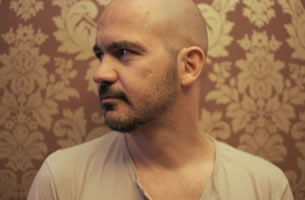
Thomas Glavinic (Graz, 2 april 1972)
De Franse schrijver Émile Zola werd geboren op 2 april 1840 te Parijs. Zie ook alle tags voor Émile Zola op dit blog.
Uit: The Belly of Paris (Le Ventre de Paris, vertaald door Mark Kurlansky)
“Come on, lady, let’s keep moving,” shouted one of the men who was kneeling in turnips. “It’s just some drunken idiot.”
But as she leaned over she thought she made out a dark patch of something blocking the road, about to be stepped on by the horse.
“You can’t just run people over,” she said, jumping down from her wagon.
It was a man sprawled across the road, his arms stretched out, facedown in the dust. He seemed extraordinarily long and as thin as a dry branch. It was a miracle that Balthazar had not stepped on him and snapped him in two. Madame François thought he was dead, but when she crouched over him and took his hand, she found it was still warm.
“Hey, mister,” she called softly.
But the drivers were growing impatient. The one kneeling in the vegetables shouted in a gruff voice, “Give it up, lady. The son of a bitch is plastered. Shove him in the gutter.”
In the meantime, the man had opened his eyes. He stared, motionless, at Madame François, with a look of bewilderment. She too thought that he must be drunk.
“You can’t stay there, you’re going to get yourself run over,” she told him. “Where were you going?”
“I don’t know,” the man replied in a feeble voice. Then, with great effort and a worried face, “I was going to Paris, and I fell. I don’t know . . .”
Now she could see him better, and he was pathetic with his black pants and black overcoat, so threadbare that they showed the contour of his bare bones. Underneath a hat of coarse black cloth that he had pulled down as though afraid of being recognized, two large brown eyes of a rare gentleness could be seen on a hard and tormented face. Madame François thought that this man was much too feeble to have been drinking.”
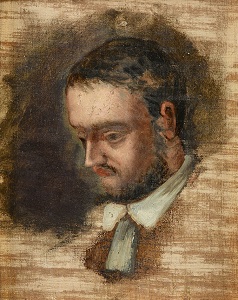
Émile Zola (2 april 1840 - 29 september 1902)
Portret door Paul Cezanne, 1864
De joods-Hongaarse schrijver György Konrád werd geboren op 2 april 1933 in Berettyóújfalu (bij Debrecen). Zie ook alle tags voor György Konrád op dit blog.
Uit: Glück (Vertaald door Hans-Henning Paetzke)
“Mein Vater saß mit geschlossenen Augen im Sonnenschein auf dem Balkon. Sein Geschäft hatte er schließen müssen, den eigenen Laden durfte er nicht mehr betreten. Er gehörte ihm nicht mehr. Auch die Eisentür war versiegelt. Alle Wertsachen, auch den Rundfunkempfänger, hatte er abliefern müssen. Zu dritt schliefen wir Burschen im Herrenzimmer, das heißt: Schlaf heuchelten wir nur vor, denn heimlich knipsten wir das kleine Licht an und vergingen uns an dem in der Kredenz stehenden Nußbranntwein, um für das nächtliche Politisieren entsprechend beseelt zu sein."
(…)
"Die Bewaffneten mit den Armbinden fanden reichlich Objekte, die sie zur Strecke bringen konnten, doch sie ahnten schon, daß sie es nicht schaffen würden, alle Juden zu erledigen. Wahrscheinlich konnten sie sich nicht jeden Tag in die entsprechende Stimmung versetzen, um auf Menschenjagd zu gehen."
(…)
„Daß auch ich unter ihnen sein würde, konnte ich mir vorstellen, und das war ein unangenehmes Gefühl, doch derartiges Phantasieren wurde durch das, was einem der Alltag abverlangte, überdeckt, in der Gefahr wird der Mensch praktisch. In Wirklichkeit wird er mit der Möglichkeit des Todes nur wenige Augenblicke konfrontiert, beispielsweise dann, wenn ihm eine Pistole an die Stirn gehalten wird. Dann spürt er, ja, das ist es, das ist jetzt möglich.“

György Konrád (Berettyóújfalu, 2 april 1933)
De Nederlandse dichteres en schrijfster Anneke Claus werd geboren op 2 april 1979 in Doetinchem. Zie ook alle tags voor Anneke Claus op dit blog.
BONSAI
een stad die mij
haar stratenplan niet
kenbaar wilde maken
twee spelemannen
in een parallelwereld
van strakroze hotelkamers
hun blotehoofden schimmenspel
mijn raadseltaal hun wenkgebaren
en kettingdolen flessenlezen
zoals snaren botsen steeds komt
wij ons sinds die dag weer tegen
alles in het klein is daar waar men bruikt
om te overleven: een dak, smeer
voor de droge keel en dekens
waaronder de nacht
in woedend tempo
voorthamert.
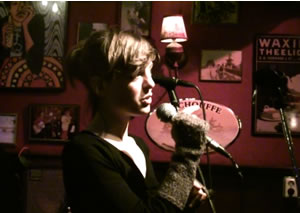
Anneke Claus (Doetinchem, 2 april 1979)
De Amerikaanse dichteres Anne Waldman werd geboren op 2 april 1945 in Millville, New Jersey. Zie ook alle tags voor Anne Waldman op dit blog.
Fast Speaking Woman (Fragment)
mouth is gaping
tongue is bleeding
everywhere suffering, as I go
I’m the celebrity woman
I’m the luminary woman
I’m the standout woman
I’m the braggart woman
I’m the shrew at the window woman
I’m the stigma woman
the beaten woman
the disgraced woman
hag woman
where will I go?
who will have me?
water clean me
water clean me, as I go
I’m the camouflaged woman
I’m the assuaged woman
I’m the ravenous woman
I’m the Kali Yuga woman
high-pitched woman
not a trifling woman
hissing woman
I’m the woman with the fangs
I’m the woman with the guns
I’m the woman with tomes
I’m the hook woman
I’m the stolen book woman
fire that burns as I go
woman was in the world was walking
woman was singing sounding the day away
sounds like a cranky old machine, someone said
(that someone was a mean man, mean child-man)
but she just ignored the cranky old machine part
& went on her way
woman took her haughty self out of the sky
she had a nose that tall
how tall?
that!
& stuck up it was
mincy mincy mincy mincy she cried
mincy mincy mincy
she was burning all right
her house (the one she carried on her head) was afire
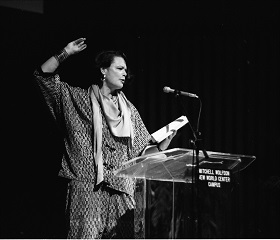
Anne Waldman (Millville, 2 april 1945)
In 1988
De Italiaanse schrijver en avonturier Giacomo Girolamo Casanova werd geboren in Venetië op 2 april 1725. Zie ook alle tags voor Giacomo Casanova op dit blog.
Uit:The memoirs of Jacques Casanova de Seingalt (Vertaald door Arthur Machen)
“On the morrow, just as we had finished our breakfast, Father Mancia made his appearance. Doctor Gozzi, followed by the whole family, escorted him to his sister's bedside. As for me, I was entirely taken up by the face of the monk. Here is his portrait. His figure was tall and majestic, his age about thirty; he had light hair and blue eyes; his features were those of Apollo, but without his pride and assuming haughtiness; his complexion, dazzling white, was pale, but that paleness seemed to have been given for the very purpose of showing off the red coral of his lips, through which could be seen, when they opened, two rows of pearls. He was neither thin nor stout, and the habitual sadness of his countenance enhanced its sweetness.
His gait was slow, his air timid, an indication of the great modesty of his mind.
When we entered the room Bettina was asleep, or pretended to be so. Father Mancia took a sprinkler and threw over her a few drops of holy water; she opened her eyes, looked at the monk, and closed them immediately; a little while after she opened them again, had a better
look at him, laid herself on her back, let her arms droop down gently, and with her head prettily bent on one side she fell into the sweetest of slumbers.”
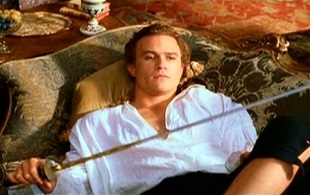
Giacomo Casanova (2 april 1725 – 4 juni 1798)
Heath Ledger als Casanova in de gelijknamige film uit 2005
De Deense schrijver en dichter Hans Christian Andersen werd geboren op 2 april 1805 in Odense. Zie ook alle tags voor Hans Christian Andersen op dit blog.
Uit:Kleine Klaas en grote Klaas
“In een dorp woonden eens twee mensen die allebei dezelfde naam hadden: ze heetten allebei Klaas, maar de een had vier paarden en de ander had er maar één.
Om ze uit elkaar te kunnen houden, noemden de mensen de man die vier paarden had, grote Klaas en de man die maar één paard had, kleine Klaas. En nu gaan we horen hoe het die twee verging, want dat is een waar verhaal!
De hele week moest kleine Klaas ploegen voor grote Klaas en hem zijn enige paard lenen. Daarna hielp grote Klaas hem dan weer met alle vier zijn paarden, maar niet vaker dan één keer in de week, en wel op zondag. Hopsa! Wat liet kleine Klaas zijn zweep over alle vijf de paarden knallen; ze waren zo goed als van hem, die ene dag. De zon scheen heerlijk en alle klokken in de kerktoren luidden voor de dienst. De mensen zagen er keurig uit, ze liepen met hun psalmboek onder hun arm naar de kerk om de dominee te horen preken en ze keken naar kleine Klaas, die met vijf paarden aan het ploegen was en zo tevreden was dat hij weer met zijn zweep knalde en riep: "Hop, al mijn paarden!"
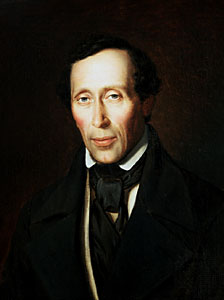
Hans Christian Andersen (2 april 1805 - 4 augustus 1875)
Portret door F.L. Storch, 1852
De Argentijnse schrijver Roberto Godofredo Arlt werd geboren op 2 april 1900 in Buenos Aires. Zie ook alle tags voor Roberto Arlt op dit blog.
Uit: The Mad Toy (Vertaald door Michele McKay Aynesworth)
« Irzubeta's face lit up with respect. "So that was you, huh? Nice work. The boy who cleans the pens at the dairy told me it fired like a Krupp."
While he was talking, I observed him.
He was tall and lean. Shiny black hair curled nobly over his round, bulging forehead, which was covered with freckles. He had eyes the color of tobacco, a bit slanted, and he wore a frayed brown suit altered to fit his body by hands that were not made for tailoring.
He leaned on the edge of the counter, resting his chin on his hand. He seemed to be thinking.
A resounding adventure was that of my cannon, and happy am I to recall it.
From some workers at the light and power plant I bought an iron tube and several pounds of lead to build what I called a culverin or "bombard." I proceeded as follows:
I inserted the iron tube in a hexagonal wooden mold lined with mud. The space between the two inner faces was filled with molten lead. After breaking the outside covering, I smoothed the base with a thick file, fastening the cannon by means of tin braces to a gun carriage made from the thickest boards of a kerosene keg.
My culverin was beautiful. I would load it with two-inch-wide projectiles in burlap bags filled with powder.”
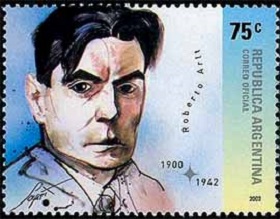
Roberto Arlt (2 april 1900 – 26 juli 1942)
Zie voor nog meer schrijvers van de 2e april ook mijn blog van 2 april 2012 deel 1 en ook deel 2.


 Gethsemane (Simon Vestdijk)

