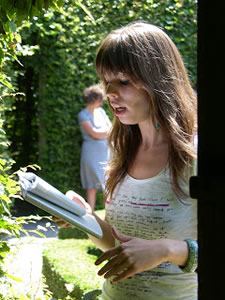
Alan Hollinghurst, Radwa Ashour, Hugo Raes, Maxwell Bodenheim, Isabella Nadolny

De Britse schrijver Alan Hollinghurst werd geboren op 26 mei 1954 in Stoud, Gloucestershire. Zie ook alle tags voor Alan Hollinghurst op dit blog.
Uit: The Line of Beauty
“When Gerald had won Barwick, which was Nick's home constituency, the arrangement was jovially hailed as having the logic of poetry, or fate.
Gerald and Rachel were still in France, and Nick found himself almost resenting their return at the end of the month. The housekeeper came in early each morning, to prepare the day's meals, and Gerald's secretary, with sunglasses on top of her head, looked in to deal with the imposing volume of post. The gardener announced himself by the roar of the mower outside an open window. Mr Duke, the handyman (His Grace, as the family called him), was at work on various bits of maintenance. And Nick was in residence, and almost, he felt, in possession. He loved coming home to Kensington Park Gardens in the early evening, when the wide treeless street was raked by the sun, and the two white terraces stared at each other with the glazed tolerance of rich neighbours. He loved letting himself in at the three-locked green front door, and locking it again behind him, and feeling the still security of the house as he looked into the red-walled dining room, or climbed the stairs to the double drawing room, and up again past the half-open doors of the white bedrooms. The first flight of stairs, fanning out into the hall, was made of stone; the upper flights had the confidential creak of oak. He saw himself leading someone up them, showing the house to a new friend, to Leo perhaps, as if it was really his own, or would be one day: the pictures, the porcelain, the curvy French furniture so different from what he'd been brought up with. In the dark polished wood he was partnered by reflections as dim as shadows. He'd taken the chance to explore the whole house, from the wedge-shaped attic cupboards to the basement junk room, a dim museum in itself, referred to by Gerald as the trou de gloire. Above the drawingroom fireplace there was a painting by Guardi, a capriccio of Venice in a gilt rococo frame; on the facing wall were two large gilt-framed mirrors. Like his hero Henry James, Nick felt that he could 'stand a great deal of gilt'.
Scene uit de tv-serie „The Line of Beauty“ uit 2006
Sometimes Toby would have come back, and there would be loud music in the drawing room; or he was in his father's study at the back of the house making international phone calls and having a gin-and-tonic - all this done not in defiance of his parents but in rightful imitation of their own freedoms in the place. He would go into the garden and pull his shirt off impatiently and sprawl in a deckchair reading the sport in the Telegraph. Nick would see him from the balcony and go down to join him, slightly breathless, knowing Toby quite liked his rower's body to be looked at. It was the easy charity of beauty. They would have a beer and Toby would say, 'My sis all right? Not too mad, I hope,' and Nick would say, 'She's fine, she's fine,' shielding his eyes from the dropping August sun, and smiling back at him with reassurance, among other unguessed emotions.”
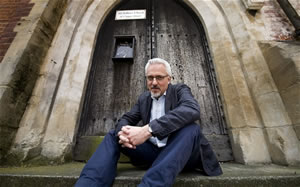
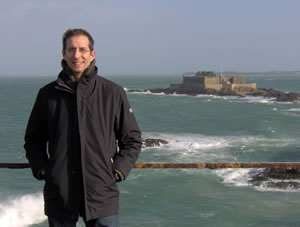
Alan Hollinghurst (Stoud, 26 mei 1954)
De Egyptische schrijfster en literatuurwetenschapster Radwa Ashour werd geboren op 26 mei 1946 in Caïro. Zie ook alle tags voor Radwa Ashour op dit blog.
Uit: A Clean Kill (Vertaald door Gretchen Head)
“In Death in the Afternoon, Hemingway says: "The only place where you could see life and death, i.e., violent death now that the wars were over, was in the bull ring and I wanted very much to go to Spain where I could study it. I was trying to learn to write, commencing with the simplest things, and one of the simplest things of all and the most fundamental is violent death."
R. hadn't yet read Hemingway's book that exhausting afternoon when she’d lost her way and ended up at the hotel Sultan, a different hotel than the one in which she had made a reservation earlier, before her arrival in the city. She secured a room for the night, dropped off her suitcase, then left the hotel and headed for her destination. She returned at six in the evening. She took off her clothes, bathed, settled down in front of the television, and watched a live broadcast of a bullfight on its screen. That was in the beginning of the nineties. R. watched the bull as it charged into the ring. She took note of its weight, its power, the arch of the taut muscles swelling behind its neck. She followed the team of bullfighters as they overcame it: The picador on the back of his horse pushing, with force, his spear into the bull's upper back. The three banderilleros leaping one after the other, each of them embedding colored arrows in its neck. The bull's repeated attempts to injure the bullfighters while they provoke it, tricking it with their bicolored capes. And finally the matador and the red cape, he plunges the sword deep into the bull's neck. She turned off the television and held her pen; she wrote "maqam 'iraq," then crossed it out and replaced it with "maqama 'iraqiyya." She wrote several lines. She read them. She muttered: "Bad writing, incomprehensible!" She tore up the paper.
She noticed that the air-conditioned room, virtually sealed shut, was filled with smoke. She put out her cigarette and carried the ashtray to the wastebasket. She emptied the cigarette butts in it and cleaned the ashtray. She walked to the window and opened it. The air was hot and thick in the summer evening, without the slightest breeze.”
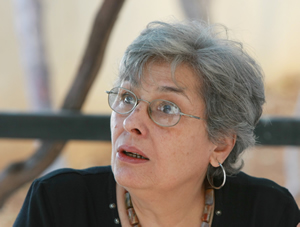
Radwa Ashour (Caïro, 26 mei 1946)
De Belgische schrijver Hugo
Raes werd geboren in Antwerpen op 26 mei 1929. Zie ook alle tags voor Hugo Raes
op dit blog.
Uit: Hemel en dier
‘Mijn prooi, mijn godin die ik koningin maak en slachtoffer. Zo is het: slachtoffer maken of slachtoffer zijn. En als je je ooit wegrukt van mij, dan onderga ik de aanval waaruit ik slechts half zal herrijzen, zoals een die verlamd is van de heupen tot de voeten toe, of met een hart dat nog slechts onregelmatig klopt, en zwakjes, en het niet lang meer zal kunnen volhouden.’ In de laatste bladzijden van het boek is een dergelijke toestand werkelijk ingetreden, en als een wanhoopskreet klinkt het dan: ‘En ik moet voort en moe en leeg ben ik maar ik wil blijven leven ...’ Ik meen daarom dat de twee polen van het boek inderdaad wel de mogelijkheid en onmogelijkheid van de liefde zijn, maar dan met een sterk accent op enerzijds de energieverwekkende kracht van de liefde en anderzijds de noodzaak van de energie om de liefde te kunnen beleven. In het laatste deel van de roman gaat het teloorgaan van de liefde essentieel gepaard met een totaal verlies van de energie, en één van de onloochenbare symptomen van dit teloorgaan is precies een angstige bedenking over het ouder worden.”
(…)
‘Want ik heb niet gewild dat je wegging. En jou treft geen schuld. Het was een tijdelijke verslapping, en die zijn altijd gevaarlijk, een verraderlijke vermoeidheid, de slijtage, die vanzelf, zelfstandig de splitsing van onze eenheid, van ons samenzijn bewerkt, zonder dat wij het wilden, maar de moeheid, de verminderde belangstelling, is een dekmantel, een kunstmatig mistgordijn dat dit verhult.’
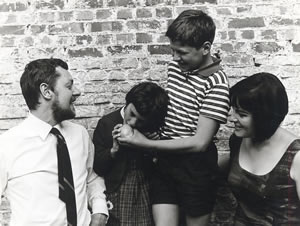
Hugo Raes (Antwerpen, 26 mei 1929)
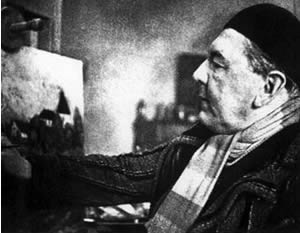
Hier met zijn familie op jongere leeftijd
De Amerikaanse dichter en schrijver Maxwell
Bodenheim werd geboren op 26 mei 1892 in Hermanville, Mississippi. Zie
ook alle tags voor
Maxwell Bodenheim op dit blog
Broadway
With sardonic futility
The multi-coloured crowd,
Hurried by fervent sensuality,
Flees from something carried on its back.
Endlessly subdued, a sound
Pours up from the crowd,
Like some one ever gasping for breath
to utter releasing words.
Through the artificial valley
Made by gaudy evasions,
The stifled crowd files up and down,
Stabbing thought with rapid noises.
Women strutting dulcetly,
Embroider their unappeased hungers,
And men stumble toward a flitting opiate.
Sometimes a moment breaks apart
And one can hear the knuckles
Of children rapping on towering doors:
Rapping on the highway
Where civilization parades
Its frozen amiabilities!
The Child Meditates
The oak-tree in front of my house
Smells different every morning.
Sometimes it smells fresh and wise
Like my mother's hair.
Sometimes it stands ashamed
Because it doesn't own the smell
It borrowed from our flower-garden.
Sometimes it has a windy smell,
As though it had come back from a long walk.
The oak-tree in front of my house
Has different smells, like grown up people.
My doll hides behind her pink cheeks,
So that you can't see when she moves,
But it doesn't matter because
She always moves when no one is looking,
And that is why people think she is still.
People laugh when I say that my doll is alive,
But if she were dead, my fingers
Wouldn't know that they were touching her.
She lives inside a little house.
And laughs because I cannot find the door.
The colours in my room
Meet each other and hesitate.
Is that what people call shape?
Nobody seems to think so,
But I believe that lines are dead shapes
Unless they fall against each other
And look surprised, like the colours in my room!
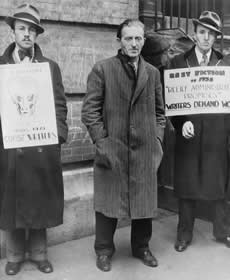
Maxwell Bodenheim (26 mei 1892 – 6 februari 1954)
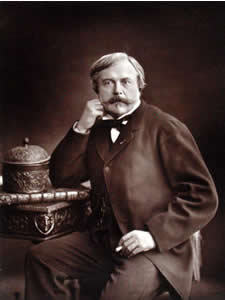
Hier in de jaren 1930
De Duitse schrijfster Isabella Nadolny (eig. Isabella Peltzer) werd geboren op 26 mei 1917 in München. Zie ook alle tags voor Isabella Nadolny op dit blog.
Uit: Ein Baum wächst übers Dach
„Mama nicht. Sie war nicht einmal verblüfft, sondern packte ihre Koffer, nahm den kleinen Leo,
die russische Kinderfrau, fuhr nach Bayern und suchte sich mit Papa eine Wohnung in Schwabing.
Eine hochherrschaftliche Wohnung mit Stuckdekken. Papa lernte malen, Mama, die bildschön war, wurde gemalt, und beide besuchten mit Erfolg die legendären Künstlerfeste jener Zeit, die man im ›Simplicissimus‹ älterer Jahrgänge abgebildet findet.
Als der Weltkrieg vorüber war und die all- jährlichen Rußlandreisen zur Familie für immer
aufhörten, kam ich zur Welt. Und just um diese Zeit begannen auch die ersten Vermögensschwierigkeiten und die ersten Sorgen. Papa malte weiter, ihm genügte es, von den leidigen Geldangelegenheiten nicht zu sprechen und alles damit Zusammenhängende zu ignorieren. Von Mamas Gefühlen und Erwägungen ist nichts bekannt, sie war eine echte Dame und ließ sich nichts anmerken. Nun zum erstenmal seit Jahren sahen wir die Hoffnung auf einen Hund zugleich mit dem Gedanken an ein Sommerhaus in ihrem Auge aufleuchten.
Bruder Leo zeichnete noch immer. Jetzt ergriff er ein Lineal und zog eine Linie.
»Wie viele Zimmer brauchen wir denn?« fragte er.
»Bloß nicht zu viele«, sagte Mama, die sich seit langem in der Wohnung mit einem Mädchen behelfen mußte.
Papa saß Papa saß am Schreibtisch und legte eine Patience. Er hatte noch den Malmantel an, mit dem er aus dem Atelier gekommen war, und an seinem Hosenbein klebte ein wenig Preußischblau. Er hatte Schwierigkeiten beim Durchzeichnen einer Birkengruppe in einem Abendhimmel und durfte sich eine Pause gönnen. Rein zufällig geriet er in das allgemeine Sinnen und Trachten.“
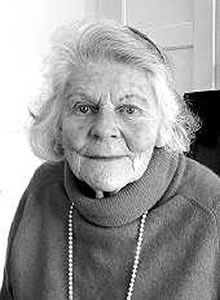
Isabella Nadolny (26 mei 1917 – 31 juli 2004)
Zie voor nog meer
schrijvers van de 26 mei ook mijn vorige
blog van vandaag.