

Naar de inhoud

Romenu

Over literatuur, gedichten, kunst en cultuur
seniorennet.beseniorennet.be

Berichten van 26 maart 2017

Tennessee Williams, Gregory Corso, Hwang Sun-won, Martin McDonagh, Robert Frost, Patrick Süskind

De Amerikaanse schrijver Tennessee Williams (eigenlijk Thomas Lanier Williams) werd geboren in Columbus, Mississippi, op 26 maart 1911. Zie ook alle tags voor Tennessee Williams op dit blog.

Uit: A Streetcar Named Desire

“STELLA : I don't want to hear any more!
STANLEY: She's not going back to teach school! In fact I am willing to bet you that she never had no idea of returning to Laurel! She didn't resign temporarily from the high school because of her nerves! No, siree, Bob! She didn't. They kicked her out of that high school before the spring term ended—and I hate to tell you the reason that step was taken! A seventeen-year-old boy—she'd gotten mixed up with!
BLANCHE: "It's a Barnum and Bailey world, Just as phony as it can be—"
[In the bathroom the water goes on loud; little breath-less cries and peals of laughter are heard as if a child were frolicking in the tub.]
STELLA : This is making me—sick!
STANLEY: The boy's dad learned about it and got in touch with the high school superintendent. Boy, oh, boy, I'd like to have been in that office when Dame Blanche was called on the carpet! I'd like to have seen her trying to squirm out of that one! But they had her on the hook good and proper that time and she knew that the jig was all up! They told her she better move on to some fresh territory. Yep, it was practickly a town ordinance passed against her! [The bathroom door is opened and Blanche thrusts her head out, holding a towel about her hair.]
BLANCHE: Stella!
STELLA [faintly]: Yes, Blanche?
BLANCHE: Give me another bath-towel to dry my hair with. I've just washed it.”


 2021372-a4ff30ecfd4e437b4bd549173b8fa848.jpg
Tennessee Williams (26 maart 1911 – 25 februari 1983)
Scene uit de gelijknamige tv-film uit 1984 met o.a.Treat Williams als Stanley Kowalski


De Amerikaanse dichter Gregory Corso werd geboren in New York op 26 maart 1930. Zie ook alle tags voor Gregory Corso op dit blog.


America Politica Historia, In Spontaneity (Fragment)

O this political air so heavy with the bells
and motors of a slow night, and no place to rest
but rain to walk—How it rings the Washington streets!
The umbrella’d congressmen; the rapping tires
of big black cars, the shoulders of lobbyists
caught under canopies and in doorways,
and it rains, it will not let up,
and meanwhile lame futurists weep into Spengler’s
prophecy, will the world be over before the races blend color?
All color must be one or let the world be done—
There’ll be a chance, we’ll all be orange!
I don’t want to be orange!
Nothing about God’s color to complain;
and there is a beauty in yellow, the old Lama
in his robe the color of Cathay;
in black a strong & vital beauty,
Thelonious Monk in his robe of Norman charcoal—
And if Western Civilization comes to an end
(though I doubt it, for the prophet has not
executed his prophecy) surely the Eastern child
will sit by a window, and wonder
the old statues, the ornamented doors;
the decorated banquet of the West—
Inflamed by futurists I too weep in rain at night
at the midnight of Western Civilization;
Dante’s step into Hell will never be forgotten by Hell;
the Gods’ adoption of Homer will never be forgotten by the Gods;
the books of France are on God’s bookshelf;
no civil war will take place on the fields of God;
and I don’t doubt the egg of the East its glory—
Yet it rains and the motors go
and continued when I slept by that wall in Washington
which separated the motors in the death-parlor
where Joe McCarthy lay, lean and stilled,
ten blocks from the Capitol—


 2021372-4ebe2157141d1e06ff0aa7aaa8eb40c4.jpg
Gregory Corso (26 maart 1930 – 17 januari 2001)
In 1994


De Zuid-Koreaanse dichter en schrijver Hwang Sun-won werd geboren op 26 maart 1915 in Taedong, Zuid-Pyongan, in het hedendaagse Noord-Korea. Zie ook alle tags voor Hwang Sun-won op dit blog.

Uit:A Shower (Vertaald door broeder Anthony van Taizé)

“They reached the point where the path divided. From here the girl has to go a mile or so downhill, the boy two or three miles uphill.
The girl stopped and said, ‘Have you ever been beyond that hill?’
She pointed beyond the end of the fields.
‘Never.’
‘Why don’t we go? Down here in the country, it’s so boring I can’t stand it.’ ‘It’s a long way, anyway.’
‘How far do you mean by far? Up in Seoul we used walk a long way on picnics.’ The girl’s eyes seemed to be saying, ‘Silly boy! Silly boy!’
They took a path between two paddy fields.
They passed close to where the autumn harvest was under way.
A scarecrow was standing there. The boy shook its straw rope. A few sparrows go flying off. The thought comes to him that he was supposed to go home early today to scare the sparrows from their main paddy field.
‘This is fun!’
The girl is holding the scarecrow’s rope and is tugging at it. The scarecrow sways, seems to be dancing. A light dimple appeared on the girl’s left cheek.A bit further away there is another scarecrow. The girl goes running toward it. The boy is running behind her. It’s as if he’s trying to forget that today he was supposed to go home early and help with the work.
He just runs on close beside the girl. Grasshoppers strike their faces and leave them stinging. The perfectly clear azure sky of autumn starts to turn before the boy’s eyes. He is dizzy. It’s because that eagle up there, that eagle up there, that eagle up there is turning.
Looking behind, the girl is shaking the scarecrow he has just run past. It sways better than the other one. At the place where the rice fields ended was a ditch. The girl jumped across it first.
From there as far as the foot of the hills was all fields.
They passed the top of a field where millet stalks were stacked together.”


 2021372-e87c88f78b1004e1cc67559a3b8b882c.jpg
Hwang Sun-won (26 maart 1915-14 september 2000)


De Engels-Ierse schrijver en regisseur Martin McDonagh werd geboren op 26 maart 1970 in Camberwell, Londen. Zie ook alle tags voor Martin McDonagh op dit blog.

Uit: The Lieutenant of Inishmore

“DONNY And was his since he was five years old. His only friend for fifteen year. Brought him out to me when he started moving about the country bombing places and couldn’t look after him as decent as he thought needed. His only friend in the world, now.
DAVEY Was he fond of him?
DONNY Of course he was fond of him.
DAVEY Oh he’ll be mad.
DONNY He will be mad.
DAVEY As if he wasn’t mad enough already. Padraic’s mad enough for seven people. Don’t they call him ‘Mad Padraic’?
DONNY They do.
DAVEY Isn’t it him the IRA wouldn’t let in because he was too mad?
DONNY It was. And he never forgave them for it.
DAVEY Maybe he’s calmed down since he’s been travelling.
DONNY They tell me he’s gotten worse. I can just see his face after he hears. And I can just see your face too, after he hears your fault it was. I can see him plugging holes in it with a stick.
DAVEY (dropping to his knees) Oh please, Donny, I swear to God it wasn’t me. Don’t be saying my name to him, now. Sure, Padraic would kill you for sweating near him, let alone this. Didn’t he outright cripple the poor fella laughed at that girly scarf he used to wear, and that was when he was twelve?!
DONNY His first cousin too, that fella was, never minding twelve! And then pinched his wheelchair!
DAVEY Please now, Donny, you won’t be mentioning my name to him?
Donny gets up and ambles around. Davey stands also.”


 2021372-cb7dc0a6946d9ca35d7c0cd2c422d28c.jpg
Martin McDonagh (Camberwell, 26 maart 1970)
Scene uit een opvoering in Berkeley, Californië, 2011


De Amerikaanse dichter Robert Lee Frost werd geboren op 26 maart 1874 in San Francisco. Zie ook alle tags voor Robert Frost op dit blog.


A Late Walk

When I go up through the mowing field,
The headless aftermath,
Smooth-laid like thatch with the heavy dew,
Half closes the garden path.

And when I come to the garden ground,
The whir of sober birds
Up from the tangle of withered weeds
Is sadder than any words

A tree beside the wall stands bare,
But a leaf that lingered brown,
Disturbed, I doubt not, by my thought,
Comes softly rattling down.

I end not far from my going forth
By picking the faded blue
Of the last remaining aster flower
To carry again to you.


The Birthplace

Here further up the mountain slope
Than there was every any hope,
My father built, enclosed a spring,
Strung chains of wall round everything,
Subdued the growth of earth to grass,
And brought our various lives to pass.
A dozen girls and boys we were.
The mountain seemed to like the stir,
And made of us a little while-
With always something in her smile.
Today she wouldn't know our name.
(No girl's, of course, has stayed the same.)
The mountain pushed us off her knees.
And now her lap is full of trees.


A Question

A voice said, Look me in the stars
And tell me truly, men of earth,
If all the soul-and-body scars
Were not too much to pay for birth.


 2021372-a1f16bf39fb7e4c754b5d5bc7ede2ded.jpg
Robert Frost (26 maart 1874 – 29 januari 1963)
Hier op zijn 85e verjaardag in 1959


De Duitse schrijver Patrick Süskind werd geboren in Ambach op 26 maart 1949. Zie ook alle tags voor Patrick Süskind op dit blog.

Uit: Das Parfum

„Man schaut nach, entdeckt unter einem Schwarm von Fliegen und zwischen Gekröse und abgeschlagenen Fischköpfen das Neugeborene, zerrt es heraus. Von Amts wegen wird es einer Amme gegeben, die Mutter festgenommen. Und weil sie geständig ist und ohne weiteres zugibt, dass sie das Ding bestimmt würde haben verrecken lassen, wie sie es im übrigen schon mit vier anderen getan habe, macht man ihr den Prozess, verurteilt sie wegen mehrfachen Kindermords und schlägt ihr ein paar Wochen später auf der Place de Grève den Kopf ab.
Das Kind hatte zu diesem Zeitpunkt bereits das dritte Mal die Amme gewechselt. Keine wollte es länger als ein paar Tage behalten. Es sei zu gierig, hieß es, sauge für zwei, entziehe den anderen Stillkindern die Milch und damit ihnen, den Ammen, den Lebensunterhalt, da rentables Stillen bei einem einzigen Säugling unmöglich sei. Der zuständige Polizeioffizier, ein gewisser La Fosse, war die Sache alsbald leid und wollte das Kind schon zur Sammelstelle für Findlinge und Waisen in der äußeren Rue Saint-Antoine bringen lassen, von wo aus täglich Kindertransporte ins staatliche Großfindelheim von Rouen abgingen. Da nun aber diese Transporte von Lastträgern vermittels Bastkiepen durchgeführt wurden, in welche man aus Rationalitätsgründen bis zu vier Säuglinge gleichzeitig steckte; da deshalb die Sterberate unterwegs außerordentlich hoch war; da aus diesem Grund die Kiepenträger angehalten waren, nur getaufte Säuglinge zu befördern und nur solche, die mit einem ordnungsgemäßen Transportschein versehen waren, welcher in Rouen abgestempelt werden musste; da das Kind Grenouille aber weder getauft war noch überhaupt einen Namen besaß, den man ordnungsgemäß in den Transportschein hätte eintragen können; da es ferner seitens der Polizei nicht gut angängig gewesen wäre, ein Kind anonymvor den Pforten der Sammelstelle auszusetzen, was allein die Erfüllung der übrigen Formalitäten erübrigt haben würde...“


 2021372-016857c610c93b3d062d7a5aa27b0917.jpg
Patrick Süskind (Ambach, 26 maart 1949)
Ben Whishaw als Jean-Baptiste Grenouille in de film uit 2006 


Zie voor nog meer schrijvers van de 26e maart ook mijn vorige blog van vandaag.
Geschreven door Romenu om 12:36 Reageer op dit bericht

A. E. Housman, Bettina Galvagni, Hai Zi, Erica Jong, Artur Landsberger

De Engelse dichter Alfred Edward Housman werd geboren op 26 maart 1859 in Fockbury, Worcestershire. Zie ook alle tags voor A. E. Housman op dit blog.


To An Athlete Dying Young

The time you won your town the race
We chaired you through the market-place;
Man and boy stood cheering by,
And home we brought you shoulder-high.

To-day, the road all runners come,
Shoulder-high we bring you home,
And set you at your threshold down,
Townsman of a stiller town.

Smart lad, to slip betimes away
From fields where glory does not stay
And early though the laurel grows
It withers quicker than the rose.

Eyes the shady night has shut
Cannot see the record cut,
And silence sounds no worse than cheers
After earth has stopped the ears:

Now you will not swell the rout
Of lads that wore their honours out,
Runners whom renown outran
And the name died before the man.

So set, before its echoes fade,
The fleet foot on the sill of shade,
And hold to the low lintel up
The still-defended challenge-cup.

And round that early-laurelled head
Will flock to gaze the strengthless dead,
And find unwithered on its curls
The garland briefer than a girl's.


Here Dead We Lie

Here dead we lie
Because we did not choose
To live and shame the land
From which we sprung.

Life, to be sure,
Is nothing much to lose,
But young men think it is,
And we were young.


 2021371-2cb36323fbe1e043de2931dd8f91b063.jpg
A. E. Housman (26 maart 1859 – 30 april 1936)
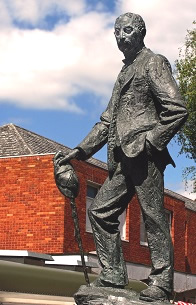
Standbeeld in Bromsgrove


De Italiaanse, Duitstalige, dichteres en schrijfster Bettina Galvagni werd geboren op 26 maart 1976 in Neumarkt. Zie ook alle tags voor Bettina Galvagni op dit blog.

Uit:Eine herumirrende jüdische Seele

“Ich heiße Guinevere und sehe ein wenig aus wie Anne Frank. Das heißt, manchmal sehe ich ihr wirklich ähnlich. Das sind die Tage, an denen man mich auf der Straße darauf anspricht.
Einmal bot man mir sogar an, in einer kleinen Off-Theaterproduktion in Passy Anne Frank zu spielen. Ich wollte es unbedingt tun, aber ich konnte nicht. Mit zwölf hatte ich Annes Tagebücher gelesen. Dazu sperrte ich mich ein, in einem Zimmer, wo man nur ein Fragment des Himmels sehen konnte.
Später, als ich älter war, sperrte ich mich wieder und wieder ein, und das dunkle Zimmer mit dem kleinen Himmelsausschnitt war voller Juden. Ich fing an, einmal in der Woche Sarah Kofmans Grab zu besuchen und dem Ritual gemäß ein mit einem Stein beschwertes Métroticket dort hinzulegen. An einem anderen Tag in der Woche ging ich zu meiner jüdischen Psychoanalytikerin. Sie hieß Rachel Zilberstein, und ich verehrte und liebte sie so sehr,daß ich ständig an sie dachte. Ich schloß mich ein, las Bücher jüdischer Schriftsteller und hörte Penderecki oder Górecki so laut, wie andere andere Musik laut hören. Nur De profundis und Tumbalalaika hörte ich leise. Leider hatte ich keine Katze mehr, die auf meinem Schoß gelegen wäre und die ich sanft gestreichelt hätte. Im Sommer besuchte mich oft eine Wespe und legte sich auf dem Fenstersims schlafen, das heißt, sie legte sich sterben.
In meinem Zimmer starben viele Wespen, ich hob sie alle auf und benutzte ein Medizinfläschchen als Urne. Ich empfand eine zärtliche Liebe für sie, denn sie besaßen eine wunderbare Form, und manchmal schliefen sie mit herausgestrecktem Stachel. Bevor sie sich schlafen legten, schwirrten sie ein paarmal psychotisch im Zimmer herum und pochten wie Spechte gegen die Wand. Es kam vor, daß ich dann von meinem Bett aufstand aus Angst, daß sie mich stechen könnten.“


 2021371-e96414abca02d707ccbd3f28d3d318f1.jpg
Bettina Galvagni (Neumarkt, 26 maart 1976)


De Chinese dichter Hai Zi (pseudoniem van de Chinese dichter Cha Haisheng) werd geboren op 26 maart 1964 in Huaining, een klein dorpje in de provincie Anhui. Zie ook alle tags voor Hai Zi op dit blog.


Elegy (II: picking sunflowers)
—for Van Gogh’s tale: the suicidal journey

The man stealing cattle in the stormy night
Crawled through my window
On my dreaming body
Picks sunflowers

I am still slumbering
On my sleeping dreamed body
Mottled sunflowers opened
Those two hands that pluck
In the sunflower field
Are like beautiful clumsy pigeons.

 The man stealing cattle in the stormy night
From mankind me
He pilfers from the body.
I am still slumbering

I am brought outside the body
Outside the sunflowers.
I am in the world
The first ewe      (death’s empress)
I feel myself beautiful
I am still slumbering.

The man steals cattle in the stormy night
And so is very happy
The self became another mottled ewe
In my body
Running filled with joy


Vertaald door Gerald Maa


 2021371-20a184cceb0c331d4a4d4c62d0e1e126.jpg
Hai Zi (26 maart 1964 – 26 maart 1989)
Huaining


De Amerikaanse dichteres en schrijfster Erica Jong werd geboren in New York op 26 maart 1942. Zie ook alle tags voor Erica Jong op dit blog.


Climbing You

I want to understand the steep thing
that climbs ladders in your throat.
I can't make sense of you.
Everywhere I look you're there--
a vast landmark, a volcano
poking its head through the clouds,
Gulliver sprawled across Lilliput.

I climb into your eyes, looking.
The pupils are black painted stage flats.
They can be pulled down like window shades.
I switch on a light in your iris.
Your brain ticks like a bomb.

In your offhand, mocking way
you've invited me into your chest.
Inside: the blur that poses as your heart.
I'm supposed to go in with a torch
or maybe hot water bottles
& defrost it by hand
as one defrosts an old refrigerator.
It will shudder & sigh
(the icebox to the insomniac).

Oh there's nothing like love between us.
You're the mountain, I am climbing you.
If I fall, you won't be all to blame,
but you'll wait years maybe
for the next doomed expedition.


The Man Giving Birth In The Dark

The man giving birth in the dark
has died
& come back
to life again,

is stretching out his arms
in the dark
as if to embrace
favorite ghosts.

His heart stops
& starts.
Once more
he has been pardoned

for nothing.
It is my father
making the darkness
into daughters.


 2021371-c60e8ce385dbf1ccf8b876f86e2d333b.jpg
Erica Jong (New York, 26 maart 1942)


De Duitse schrijver en criticus Artur Hermann Landsberger werd geboren op 26 maart 1876 in Berlijn. Zie ook alle tags voor Artur Landsberger op dit blog.

Uit: Bankhaus Reichenbach

„Das Bankhaus der Gebrüder Reichenbach & Co. am Berliner Gendarmenmarkt war eins der angesehensten Privatinstitute der Reichshauptstadt. Im Jahre 1778 von Ferdinand Reichenbach gegründet, den König Friedrich II. mit dem Titel Hofbankier auszeichnete, sah es bald der Feier seines hundertfünzigjährigen Bestehens entgegen. Auch gesellschaftlich spielte die Familie Reichenbach bis zum Weltkriege eine Rolle. Nicht durch geräuschvolle Feste und Hervortreten bei öffentlichen Veranstaltungen. Man sah sie weder bei den Premieren im Opernhaus, noch auf den Subskriptions- und Pressebällen, weder zu den Paraden auf dem Tempelhofer Feld, noch bei den Rennen in Hoppegarten und Karlshorst. Aber es galt für einen Vorzug, bei Reichenbachs zu verkehren, selbst für die Offiziere der Gardekavallerie, die sich bekanntlich nicht gerade in die bürgerlichen Salons drängten. Die Botschafter und Gesandten der fremden Staaten gaben bei ihnen die Karten ab, und zwar zuerst, was den Neid gesellschaftlich ehrgeiziger Familien, die sich mehr dünkten, erregte. Zu alledem taten Reichenbachs nichts. Darin gerade lag ihre Stärke. Sie suchten nicht, sie ließen sich suchen. Das taten viele. Aber von den vielen unterschieden sie sich dadurch: sie taten nichts dazu, daß man sie fand.
Die Umstellung nach dem Kriege und der Revolution bot Menschen ohne Tradition, selbst wenn sie Gewissen hatten, keine Schwierigkeit. Am allerwenigsten den Angehörigen des Bankgewerbes. Gerade ihnen hatte man Generationen hindurch den Staat als das Muster eines redlichen Kaufmanns vor Augen gehalten. Warum sollten sie sich da nicht auch jetzt auf ihn als Vorbild berufen, wenn sie Dinge taten, die, über das ungeschriebene Gesetz der guten Sitten hinaus, gegen Treu und Glauben verstießen. Wer sich wie Leonard Reichenbach aber die Frage vorlegte: wie hätte dein Vater, Groß- und Urgroßvater in einem solchen Falle gehandelt, der rettete zwar seinen guten Ruf, der um das Jahr 1928 herum nicht hoch im Preise stand, verlor aber sein Vermögen.
Als Leonard Reichenbach damals, um durch den Krieg unterbrochene Geschäftsverbindungen wieder anzuknüpfen, mit den Direktoren anderer Banken nach Neuyork fuhr, erwiesen sich Tradition und Charakter für ihn als schwere Belastung. Denn während jene Direktoren, die im Interesse der von ihnen geleiteten Banken reisten, in erster Linie an die Rettung ihres eigenen Vermögens dachten, sah Reichenbach seine Hauptaufgabe darin, die ihm anvertrauten Kapitalien seiner Kunden zu retten.“


 2021371-5ad55640154a9814b3b1b20d751e6814.jpg
Artur Landsberger ( 26 maart 1876 – 4 oktober 1933)
Cover

Geschreven door Romenu om 12:35 Reageer op dit bericht

Am vierten Sonntage in der Fasten (Annette von Droste-Hülshoff)


Bij de vierde zondag van de vasten


 2021369-e53dfe2bf2579d3ca314a2e916efe063.jpg
De droom van St. Jozef door Anton Raphael Mengs, ca. 1773/1774


Am vierten Sonntage in der Fasten

Josephsfest

Gegrüßt in deinem Scheine,
Du Abendsonne reine,
Du alter Lilienzweig,
Der du noch hast getragen
In deinen grauen Tagen
So mildes Blütenreich!

Je mehr es sich entfaltet,
Zum Ehrenkranz gestaltet,
Der deine Stirn umlaubt:
Je mehr hast du geneiget,
In Ehrfurcht ganz gebeuget
Dein gnadenschweres Haupt.

Wie ist zu meinem Frommen
Dein freundlich Fest gekommen
In diese ernste Zeit!
Ich war fast wie begraben;
Da kömmst du mich zu laben
Mit seltner Freudigkeit.

Zu dir will ich mich flüchten,
Mein scheues Leben richten,
O Joseph, milder Hauch!
Du hast gekannt die Fehle
In deiner starken Seele,
Und die Vergebung auch!

Was hast du nicht geduldet,
Da im Geheim verschuldet
Maria dir erschien?
Und konntest ihr nicht trauen,
Worauf die Himmel bauen,
Und hast ihr doch verziehn!

Und da du mußtest scheiden
Mit deinen lieben Beiden,
Wie groß war deine Not!
Die Wüste schien dir lange;
Doch war vom Untergange
Dein liebes Kind bedroht.

Und da Er glanzumkrönet,
Wie bist du nicht gehöhnet
Um seine Gotteskraft!
Wie mag, den Groll zu laben,
Dich nicht gelästert haben
Die arge Priesterschaft!

Und gar, wenn gottdurchdrungen
Dich grüßten fromme Zungen
Und priesen laut und weit:
Wie hast du nicht in Zagen
An deine Brust geschlagen
In deiner Sündlichkeit!

So hast du viel getragen,
Unendlich viele Plagen,
Mit freundlicher Geduld,
Und ist in all den Jahren
Manch Seufzer dir entfahren
Und manche kleine Schuld.

Du frommer Held im Glauben,
Den schrecklich dir zu rauben
Sich alle Welt verband,
Hast können nicht erhalten
Ein unbeflecktes Walten
An deines Jesu Hand.

Was soll ich denn nicht hoffen,
Da noch der Himmel offen,
Und meine Seele still?
Will sich die Gnade nahen:
Ich kann sie wohl empfahen,
So Gott mir helfen will.

Zerrissen in den Gründen
Bin ich um meine Sünden,
Und meine Reu' ist groß!
O hätt' ich nur Vertrauen,
Die Hütte mein zu bauen
In meines Jesu Schoß!


 2021369-5277ad231a2de335d9064cdcc889f87e.jpg
Annette von Droste-Hülshoff (10 januari 1797 – 24 mei 1848)
Friedhofskapelle Mariä Himmelfahrt in Meersburg, linker zijaltaar. Annette von Droste-Hülshoff werd in Meersburg begraven.

Geschreven door Romenu om 12:34 Reageer op dit bericht

Meer van Romenu

↑ Terug naar de berichten