

 100 Jaar Simon Carmiggelt, James Whitcomb Riley, Thomas Keneally
100 Jaar Simon Carmiggelt
De Nederlandse schrijver en dichter Simon Carmiggelt werd geboren op 7 oktober 1913 in Den Haag. Dat is vandaag precies 100 jaar geleden. Zie ook mijn blog van 7 oktober 2010 en eveneens alle tags voor Simon Carmiggelt op dit blog.
Uit: Dagboek van een lezer
“Jammer dat noodweer en overstromingen ons verhinderden met vakantie naar Zwitserland te gaan. Want ik had zo graag in Zürich een das willen kopen.
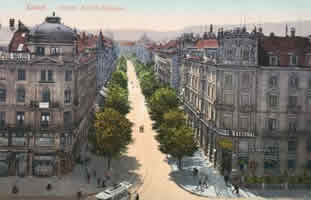
Ik wilde het doen in de winkel ‘London House’ in de Bahnhofstrasse. Niet omdat er dassen worden verkocht die je nergens anders kopen kunt. Maar om, met een geldig alibi, het decor te zien van een kleine, veelbetekenende gebeurtenis die zich daar aan het eind van de jaren dertig heeft afgespeeld. Op een boven-etage van het ‘London House’ stond de schrijver Thomas Mann een pak te passen. De chef verkoper kwam naar hem toe en zei: ‘Weet u wie er beneden is? Gerhart Hauptmann. Wilt u hem spreken?’
‘Och,’ antwoordde Thomas Mann, ‘we kunnen beter andere tijden afwachten.’ Waarop de verkoper sprak:
‘Dat zei meneer Hauptmann ook al.’
Deze anecdote staat in ‘Meine ungeschriebenen Memoiren’, die Katia, de weduwe van Thomas Mann op hoge leeftijd publiceerde.
In het Nederlands verscheen dit (alleraardigste) boek onder de titel ‘Herinneringen aan de tovenaar’. Waarom kwam de tovenaar van ‘De Toverberg’ en ‘Buddenbrooks’ niet naar beneden om de andere tovenaar, die ééns het opstandige toneelstuk ‘De wevers’ had geschreven, de hand te schudden? Ze kenden elkaar toch zo goed van vroeger. Maar in het ‘London House’ te Zürich versperde Hitler de trap tussen de etages. Thomas Mann had verkozen buiten het nationaal-socialistische Duitsland te leven. Hauptmann was er gebleven en had zelfs - volgens Alfred Kerr - op het kasteel dat hij bewoonde de hakenkruisvlag gehesen. Daarom ging Thomas de trap niet af en Gerhart de trap niet op.”
Zürich, Bahnhofstrasse, op een oude ansichtkaart
Uit: Brieven aan Gerard Reve
“15 juni 1971
(…) Je omgang met mijn onderkoning Alkohol vond ik hoogst aangenaam. Dat je, in deze, handelt onder de geruisloze en tactvolle regie van de jongens, lijkt me meer dan verstandig. Alle lust wil eeuwigheid. Maar de eeuwigheid is zo lang en moeilijk in flessen uit te drukken. Als je mensen die je dierbaar zijn toestaat je eeuwigheid te splijten in wat de Sterreclame voor hondevoer zo treffend ‘hapklare brokken’ noemt, zit je eigenlijk op fluweel. Maar je hebt gelijk: drink nooit in gezelschap van lieden, die je zó weerzinwekkend of alleen maar stomvervelend vindt, dat ze je doen verdwijnen in de damp uit je glas. Als ik, lang geleden, op de Kring kwam, waren een paar daar zittende smoelen, in staat me binnen twee minuten bezinningloos beschonken te maken, voordat ik één slok genomen had. De lucht die er hing maakte me al wankel ter been. Drank is een geheimzinnige vloeistof. Er bestaat niet zoiets als te veel drinken. Wel: ten ongepaste tijde, onder noodlottige omstandigheden en in verkeerd gezelschap drinken.
Je tijdens ons gesprek gedane mededeling dat je heftige woedeaan-vallen gewoon voortkomen uit een gebrek aan enige milligrammen vitamine b werkte, toen ik er over nadacht, op mij tegelijk opluchtend en ontluisterend. Dus geen edele verontwaardiging, doch gewoon een tekortschieten van de apotheek. Het lichaam manipuleert de geest. Ik herinner me ook eens een artikel te hebben gelezen van een medicus, waarin stond dat Marcellus Emants, die altijd over koude voeten klaagde, waarschijnlijk leed aan een ernstige stoornis in de bloedsomloop, die de bodemloze somberheid van zijn oeuvre verklaarde. Van een andere medicus heb ik, in mijn jeugd, eens gelezen dat het hele Marxisme voortkwam uit de maagzweer van Marx. Had hij alleen maar zweetvoeten gehad, dan zat vadertje Czaar dus nog waardig op zijn troon, zoals dat behoort.”
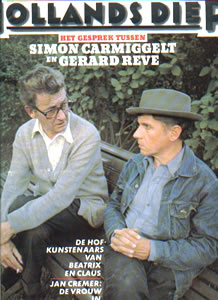
Simon Carmiggelt (7 oktober 1913 – 30 november 1987)
Simon Carmiggelt en Gerard Reve, cover Hollands Diep
De Amerikaanse dichter en schrijver James Whitcomb Riley werd geboren op 7 oktober 1849 in Greenfield, Indiana. Zie ook mijn blog van 7 oktober 2010 en eveneens alle tags voor James Whitcomb Riley op dit blog.
A Letter To A Friend
The past is like a
story
I have listened to in dreams
That vanished in the glory
Of the Morning's early gleams;
And--at my shadow glancing--
I feel a loss of strength,
As the Day of Life advancing
Leaves it shorn of half its length.
But it's all in vain to worry
At the rapid race of Time--
And he flies in such a flurry
When I trip him with a rhyme,
I'll bother him no longer
Than to thank you for the thought
That 'my fame is growing stronger
As you really think it ought.'
And though I fall below it,
I might know as much of mirth
To live and die a poet
Of unacknowledged worth;
For Fame is but a vagrant--
Though a loyal one and brave,
And his laurels ne'er so fragrant
As when scattered o'er the grave.
A Noon Interval
A deep, delicious
hush in earth and sky --
A gracious lull--since, from its wakening,
The morn has been a feverish, restless thing
In which the pulse of Summer ran too high
And riotous, as though its heart went nigh
To bursting with delights past uttering:
Now--as an o'erjoyed child may cease to sing
All falteringly at play, with drowsy eye
Draining the pictures of a fairy-tale
To brim his dreams with--there comes o'er the day
A loathful silence wherein all sounds fail
Like loitering sounds of some roundelay . . .
No wakeful effort longer may avail --
The wand waves, and the dozer sinks away.

James Whitcomb Riley (7 oktober 1849 – 22 juli 1916)
Label op een doos sigaren
De Australische schrijver Thomas Keneally werd geboren op 7 oktober 1935 in Sydney. Zie ook
mijn blog van 7 oktober 2010 en
eveneens alle tags voor Thomas
Keneally op dit blog.
Uit: Schindler's List
“Trying still to find, in the shadow of Himmler, some hint of Oskar's later enthusiasms, we encounter the Schindlers' next-door neighbor, a liberal rabbi named Dr. Felix Kantor. Rabbi Kantor was a disciple of Abraham Geiger, the German liberalizer of Judaism who claimed that it was no crime, in fact was praiseworthy, to be a German as well as a Jew. Rabbi Kantor was no rigid village scholar. He dressed in the modern mode and spoke German in the house. He called his place of worship a "temple" and not by that older name, "synagogue." His temple was attended by Jewish doctors, engineers, and proprietors of textile mills in Zwittau. When they traveled, they told other businessmen, "Our rabbi is Dr. Kantor—he writes articles not only for the Jewish journals in Prague and Brno, but for the dailies as well."
Rabbi Kantor's two sons went to the same school as the son of his German neighbor Schindler. Both boys were bright enough eventually, perhaps, to become two of the rare Jewish professors at the German University of Prague. These crew-cut German speaking prodigies raced in knee pants around the summer gardens. Chasing the Schindler children and being chased. And Kantor, watching them flash in and out among the yew hedges, might have thought it was all working as Geiger and Graetz and Lazarus and all those other nineteenth-century German-Jewish liberals had predicted. We lead enlightened lives, we are greeted by German neighbors—Mr. Schindler will even make snide remarks about Czech statesmen in our hearing. We are secular scholars as well as sensible interpreters of the Talmud. We belong both to the twentieth century and to an ancient tribal race. We are neither offensive nor offended against. Later, in the mid-1930s, the rabbi would revise this happy estimation and make up his mind in the end that his sons could never buy off the National Socialists with a German-language Ph.D.—that there was no outcrop of twentieth-century technology or secular scholarship behind which a Jew could find sanctuary, any more than there could ever be a species of rabbi acceptable to the new German legislators. In 1936 all the Kantors moved to Belgium. The Schindlers never heard of them again.

Thomas Keneally (Sydney, 7 oktober 1935)
Zie voor nog meer schrijvers van de 7e
oktober ook mijn vorige
blog van vandaag.


