Naar de inhoud

Romenu

Over literatuur, gedichten, kunst en cultuur
seniorennet.beseniorennet.be

Berichten van 24 oktober 2011

Zsuzsa Bánk, August Graf von Platen, Onno Kosters, Norman Rush

De Duitse schrijfster Zsuzsa Bánk werd geboren op 24 oktober 1965 in Frankfurt am Main. Zie ook mijn blog van 24 oktober 2009 en ook mijn blog van 24 oktober 2010.


Uit: Die hellen Tage


„Ich kenne Aja, seit ich denken kann. Ich habe kaum eine Erinnerung an eine Zeit vor ihr, an ein Leben, in dem es sie nicht gegeben hat, keine Vorstellung, wie sie ausgesehen haben könnten, Tage ohne Aja. Aja gefiel mir sofort. Sie sprach laut und deutlich und kannte Wörter wie Wanderzirkus und Schellenkranz. Zwischen anderen sah sie winzig aus, mit ihren kleinen Händen und Füßen, und als müsse sie dem etwas entgegensetzen, sprach sie in langen Sätzen, denen kaum jemand folgte, als wolle sie beweisen, dass sie laut reden konnte, ohne Pause und ohne Fehler. Sie zog in dem Jahr zu uns, in dem für uns Kinder nichts lustiger war, als unsere Namen rückwärts aufzusagen und uns laut Retep oder Itteb zu rufen. Aja hieß immer nur Aja.
Wir fanden uns, wie sich Kinder finden, ohne zu zögern, ohne Umstände, und sobald wir unser erstes Spiel begonnen, unsere ersten Fragen gestellt hatten, verbrachten wir unsere Tage miteinander, fädelten sie auf wie an einer endlosen Kette, und hielten jede Unterbrechung, mit der andere uns trennten, für eine Zumutung. Wenn Aja zu mir kam, öffnete sie unser Hoftor lautlos. Niemand konnte unser Tor lautlos öffnen und schließen, weil es ein großes Tor auf Rollen war, das jeden Besuch vor den letzten Schritten zur Haustür ankündigte, und dessen Geräusch wir bis unters Dach und bis in die hintersten Winkel des Gartens hören konnten. Nur Aja öffnete unser Tor so leise, dass es niemandem auffiel, auch nicht, dass sie über den Hof lief, und ich wunderte mich, wie still sie sein, wie unbemerkt sie kommen und gehen konnte.
Wir müssen uns im Sommer begegnet sein, im Sommer, der Aja umgab, als gehöre er ihr, als gehörten sein Licht, sein Staub, seine langen hellen Abende ihr, und durch den sie sich ohne Jacke und Schuhe, mit einem gelben Hut, den sie im Schrank ihrer Mutter gefunden hatte, bewegte wie durch ein großes, lichtes Haus, dessen Zimmer ohne Türen ineinanderliefen.”


 1017952-01580edc37fc46318c0559a1b39a87ab.jpg

Zsuzsa Bánk (Frankfurt am Main, 24 oktober 1965)


De Duitse dichter Karl August Georg Maximilian Graf von Platen-Hallermünde werd geboren op 24 oktober 1796 in Ansbach. Zie ook mijn blog van 24 oktober 2010 en eveneens alle tags voor August Graf von Platen op dit blog.


Schön wie der Tag und lieblich wie der Morgen


Schön wie der Tag und lieblich wie der Morgen,
Mit edler Stirn, mit Augen voll von Treue,
An Jahren jung und reizend wie das Neue,
So fand ich dich, so fand ich meine Sorgen.

O wär ich schon an deiner Brust geborgen,
Wo ich mich sammle, wenn ich mich zerstreue!
O wäre schon bezwungen diese Scheue,
Die unsern Bund vertagt von heut auf morgen!

Was fliehst du mich? Vermagst du mich zu hassen?
Was quälst du so durch deiner Huld Verschweigung
Den Liebevollen, der sich fühlt verlassen?

Beim ersten Zeichen deiner künft'gen Neigung
Wird eine bange Wonne mich erfassen,
Wie einen Fürsten bei der Thronbesteigung.


Des Glückes Gunst wird nur durch dich vergeben


Des Glückes Gunst wird nur durch dich vergeben,
Schön ist die Rose nur, von dir gebrochen,
Und ein Gedicht nur schön, von dir gesprochen.
Tot ist die Welt, du bist allein am Leben.

In diesen Lauben, die sich hold verweben,
Wird ohne dich mir jeder Tag zu Wochen,
Und dieser Wein, den warme Sonnen kochen,
Kann nur aus deiner Hand ein Herz beleben.

Von dir geschieden, trenn ich mich vom Glücke,
Das Schönste dient mir nur, mich zu zerstreuen,
Das Größte füllt mir kaum des Innern Lücke.

Doch drückst du mich an deine Brust, den Treuen,
Dann kehrt die Welt in meine Brust zurücke,
Und am Geringsten kann ich mich erfreuen.


Daß ich dich liebe, hast du nie vermutet


Daß ich dich liebe, hast du nie vermutet,
Nie konnten's Menschen um uns her beachten:
Mein ganzes Sein ist nur ein stilles Trachten,
Und leise pocht das Herz mir, weil es blutet.

Ob's ruhig in mir, oder ob es flutet,
Teilnehmend wolltest du das nie betrachten,
Und daß die Deinen mich für wenig achten,
Das hat mich oft geschmerzt, doch oft ermutet.

Denn meine Seele strebte warm nach oben,
Und was mir freundlich, feindlich trat entgegen,
Ein Traum erschien mir's, der mich rings umwoben.

Und also will ich auch der Liebe pflegen,
Mit einer Sinnesart, die nicht zu loben,
Doch, die zu schelten, mich bedünkt verwegen.


 1017952-7235d50b8cbfb2d16f748991771ac83b.jpg

August Graf von Platen (24 oktober 1796 - 5 december 1835)

Standbeeld in Ansbach


De Nederlandse dichter Onno Kosters werd geboren op 24 oktober 1962 in Baarn. Zie ook mijn blog van 24 oktober 2010 en eveneens alle tags voor Onno Kosters op dit blog. 


Systeem en verloop


In het systeem staat je stem als een huis.
Huis dat zich sluit, hek voor de deur.
Huis dat zich sluit, blind voor elk raam.
Huis dat zich sluit, wingerd in de muur.
Bel niet aan, breek niet in, kijk en sluit
uit dat de duisternis daar, onder de
lakens over de meubels, onder het stof
(ook dat nog) op die lakens, het stof
op het stof, ooit het daglicht zal zien.
In het systeem heb ik greep op je stem,
draag ik hem uit. Gaat het vervolgens
plat.
Verloop
is een kwestie van tijd, zei de aannemer mij.
Als de herbouw hier toeslaat, eenvoudigweg
omdat de aanleunwoning die je bouwde
wegzakt in zand (er was eens een mannetje)
bij gebrek aan een huis dat staat als je stem,
huis zonder blinden of hekken of wingerd,
herstelt zich het blikveld en slingert het
lood uit: schiet het vanzelf in het lood.
Verloop is een kwestie van tijd, zei de man
die mij die weerstaanbare offerte deed.
(Die mij ook nu nog onweerstaanbaar leek.)


 1017952-499612577484bb3fb9876b53de745fe6.jpg

Onno Kosters (Baarn,  24 oktober 1962)


De Amerikaanse schrijver
Norman Rush werd geboren op 24 oktober 1933 in San Francisco. Zie ook mijn blog van 24 oktober 2008 en ook mijn blog van 24 oktober 2009 en ook mijn blog van 24 oktober 2010


Uit: Mortals


„He’d had to push Iris into the house the first time they inspected it because she thought the floors were wet, they were waxed and buffed to such an insane lustre. They had the best plot on Kgari Close, the largest, at the apex of the horseshoe the close made. They had six rooms. He would admit that their moderne type furniture was on the ungainly and garish side. It was from South Africa. It seemed to be made for very large human beings. On the other hand it was provided free by the government of Botswana. Their bed was firm, and was vast. The corrugated iron roof, painted red to suggest terracotta tile, was a mistake, but only in the hottest part of the year, like now, when it converted the unshaded parts of the house into ovens, to which the answer was the airconditioners they had in their bedroom and living room, at least, at opposite ends of the house, except that unfortunately Iris saw herself as acquiring virtue by abstaining from using them exactly when the justification for using them was greatest. She always denied her attitude had anything to do with solidarity with Dimakatso and the other servants in the neighborhood out in their hot cubicles or with the un-airconditioned population in general, but he thought otherwise. She claimed it was because the airconditioners made too much noise for her. She was very sensitive to noise. Also she could be willful. For example, everything in the house could be locked up—regular closets, linen closets, cupboards, cabinets. The assumption was that you were going to be stolen from. The drill everywhere else was that the maid came to you to get the key when something had to be procured, and brought the key back to you afterward. But Iris kept everything unlocked even though their first maid had complained about it because she was worried that if anything went missing she’d be blamed. So nothing was locked, which was fine, she always did what she wanted. What was wrong now? He was tired of it.
Sometimes the yardman opened the gate, but usually it was the watchman, who came on duty at five. He overlapped the yardman’s tour by half an hour or so, but the yardman could be anywhere, doing anything, including napping someplace. The watchman would normally be at his post under the thorn tree to the right of the gate, sitting on a camp stool and having a cup of Joko tea and eating the very decent leftovers Iris provided—a chop, chicken thighs, and the sweets without which no meal is
complete, to a Motswana.“


1017952-fbb633f7ed05a388a12bfb4a1775ed47.jpg
Norman Rush (San Francisco, 24 oktober 1933)


Zie voor nog meer schrijvers van de 24e oktober ook
mijn vorige blog van vandaag en eveneens mijn eerste blog van vandaag.
Geschreven door Romenu om 19:04 Reageer op dit bericht

Denise Levertov, Ernest Claes, Robert Greacen, Yordan Radichkov

De Engels - Amerikaanse dichteres Denise Levertov werd geboren op 24 oktober 1923 in Ilford, Essex. Zie ook mijn blog van 24 oktober 2008 en ook mijn blog van 24 oktober 2009 en ook mijn blog van 24 oktober 2010


A Map Of The Western Part Of The County Of Essex In England


Something forgotten for twenty years: though my fathers

and mothers came from Cordova and Vitepsk and Caernarvon,

and though I am a citizen of the United States and less a

stranger here than anywhere else, perhaps,

I am Essex-born:

Cranbrook Wash called me into its dark tunnel,

the little streams of Valentines heard my resolves,

Roding held my head above water when I thought it was

drowning me; in Hainault only a haze of thin trees

stood between the red doubledecker buses and the boar-hunt,

the spirit of merciful Phillipa glimmered there.

Pergo Park knew me, and Clavering, and Havering-atte-Bower,

Stanford Rivers lost me in osier beds, Stapleford Abbots

sent me safe home on the dark road after Simeon-quiet evensong,

Wanstead drew me over and over into its basic poetry,

in its serpentine lake I saw bass-viols among the golden dead leaves,

through its trees the ghost of a great house. In

Ilford High Road I saw the multitudes passing pale under the

light of flaring sundown, seven kings

in somber starry robes gathered at Seven Kings

the place of law

where my birth and marriage are recorded

and the death of my father. Woodford Wells

where an old house was called The Naked Beauty (a white

statue forlorn in its garden)

saw the meeting and parting of two sisters,

(forgotten? and further away

the hill before Thaxted? where peace befell us? not once

but many times?).

All the Ivans dreaming of their villages

all the Marias dreaming of their walled cities,

picking up fragments of New World slowly,

not knowing how to put them together nor how to join

image with image, now I know how it was with you, an old map

made long before I was born shows ancient

rights of way where I walked when I was ten burning with desire

for the world's great splendors, a child who traced voyages

indelibly all over the atlas, who now in a far country

remembers the first river, the first

field, bricks and lumber dumped in it ready for building,

that new smell, and remembers

the walls of the garden, the first light.


 1017950-adf91ec4573861298a78cd0b77d14e28.jpg

Denise Levertov (24 oktober 1923 – 20 december 1997)


De Vlaamse auteur Ernest Claes werd geboren op 24 oktober 1885 te Zichem. Zie ook mijn blog van 24 oktober 2010 en eveneens alle tags voor Ernest Claes op dit blog.


Uit: De Witte


„Juist toen de Witte binnentrad kwam er boven in den ronden kop waar 't leven zat, onzichtbaar, een roezig ronken dat aanhield tot er acht helder metalen klanken uitsprongen, en dan begon weer het eenelijk effen tiktakken zonder verpoozen. Op de witglimmende wijzerplaat stak de kleine wijzer in 't volle zwart van de romeinsche acht, en de groote hing lamlullig naar de één gezakt, of 't hem verder niet meer aanging en hij 't zijne gedaan had.

De Witte keek naar de klok en mommelde: ‘Ziede wel dat et nog gien acht ure was,’ en dan zette hij zich aan tafel. Naast den koffiepot lagen drie boterhammen voor hem gereed gesneden. Hij schonk een tas koffie in, keek eens door de openstaande achterdeur den hof in of moeder niet afkwam - en haalde uit den suikerpot in de schapraai drie klontjes broodsuiker. Bedaard begon hij dan zijn boterhammen op te eten, zonder een kruiske te maken nu hem toch niemand zag. Hij lipte telkens proevend aan zijn koffie, en sloeg naar de vliegen die over heel de tafel, in gaatjes en spleetjes, aan broodkruimels en nattigbruine koffievlekken te peuteren zaten.

De drie boterhammen waren spoedig verorberd; hij sneed er nog een van 't brood, en toen die op was ging een halve, die van 's morgens was blijven liggen, ook nog achterna.

De Witte was slecht geluimd, zeer slecht geluimd. Eerst dat droomen, waar niets van aan was, dan de musch die wel nergens zou te vinden zijn, moeder met haar gewoon gezeur van elken morgen, te weinig boterhammen, die vuile koffietafel op den hoop toe, - als ze misschien dachten dat hij dien smerigen boel zou opruimen!... neê, hij kon het even goed laten staan!

Hoe de Witte er uit ziet? - Om met zijn kop te beginnen: sprietel-wit haar, ‘verkenshaar’ noemde hem de meester somtijds, om bij wijze van verkorting den heelen Witte te beduiden. Een laag voorhoofd, kleine bruine oogskens die overal te gelijk rondspiedden, een mager gezicht, groote wijd uitstaande ooren, een mond die tamelijk breed mocht genoemd worden, - iets wat Heinke, zijn oudsten broer, eens had doen zeggen: ‘Oan onze Witte ze bakkes es 't goed te zien dat èm beter kan frèten as werke.’ De Witte had dit als een beleediging opgenomen om den toon waarop het gezegd werd, maar beschouwde het overigens als iets zeer natuurlijks, zelfs zonder dat bakkes. - Ferme schouders had de Witte, een kloeke borst, stevige armen en beenen, die door frak en broek aan ellebogen en knieën heenwrongen, omdat die deelen het meest van zijn dagelijksche lichaamsoefeningen te verduren hadden.“


 1017950-1caa17d2d61f0a87d834d68be5ef6bc8.jpg

Ernest Claes (24 oktober 1885 - 2  september 1968)

Hier met de schrijver Jan Vercammen (rechts)


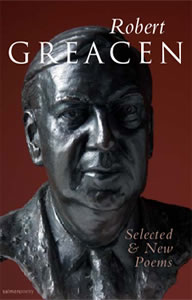
De Ierse dichter en essayist Robert Greacen werd geboren op 24 oktober 1920 in Derry. Zie ook mijn blog van 24 oktober 2008 en ook mijn blog van 24 oktober 2010


At Brendan Behan's Desk


Full seven years I've sat

And scribbled at this desk:

Cards,  letters, poems, autosnaps,

Diary entries, shopping lists,

While Beatrice  down below hoarded

Memories of Brendan in a clutter

Of paintings,  posters, photos,

With, for company, two dogs.


To Brendan's ghost I  must confess

My orderly grey days.

At moments I'd like to be  out

Emptying glasses in the pubs

Of Dublin town, blarneying

To  actors, poets, drunks,

Then taxi-ing back to Cuig*

Not earlier than  three a.m.,

Rousing the solid citizens,

Telling an uncaring world

How  'that old triangle

Went jingle-jangle

Along the banks of the Royal  Canal.'


Instead, I sit at Brendan's desk,

Reading, scribbling,  drinking coffee-

A Protestant without a horse


 1017950-324d8e3f6c396c19365b13964714ad69.jpg

Robert Greacen (24 oktober 1920 – 13 april 2008)


De Bulgaarse schrijver Yordan Radichkov werd geboren op 24 oktober 1929 in het dorp Kalimanitza, in de provincie Montana. Zie ook mijn blog van 24 oktober 2010


Uit: The Bowler-Hat


„Progressive and civilized countries opposed to the bowler-hat, the top hat made desperate attempts to stay and although its resistance it confined itself to the sphere of diplomacy. When they shot the Serbian king in the cab, the bowler-hat first hid the fear on the monarch’s face, because the face of a king must be smiling, or manly, or noble, but never - frightened. The Bowler-hat spread gradually in Europe, threw into   Danube Wallachian and Magyar felt hats, supplanted on North the perky Tyrol hat and made its way even into the British island, as it captured there the Englishmen to their great surprise. British people continued to smoke pipes at the fireplaces and to read Dickens and they accepted the bowler-hat with the smile of Mona Lisa, began to take it for a drive with their famous Rolls-Roices and they accepted the fact that with the same smile they also proved that Britain is a parliamentary state.

A, exactly at that time, when the one half of the Earth was under the shadow of the bowler-hat, and the other half was under the shadow of the iron soldier helmet, our Bulgarian bought The Bowler-hat in question from Italy, before he started on a journey to his homeland.“


 1017950-68919a865fb7c2dd1b81fff096174b0b.jpg

Yordan Radichkov (24 oktober 1929 - 21 januari 2004)

 
Geschreven door Romenu om 18:58 Reageer op dit bericht

Adrian Mitchell, Marghanita Laski, Dorothea von Schlegel, Sarah Josepha Hale, Hubert Aquin

De Engelse dichter , dramaturg en schrijver Adrian Christopher William Mitchell werd geboren in Hampstead Heath op 24 oktober 1932. Zie ook mijn blog van 24 oktober 2009 en ook mijn blog van 24 oktober 2010


There are not enough of us

How much verse is magnificent?
Point oh oh oh oh one per cent.
How much poetry is second-rate?
Around point oh oh oh oh eight.
How much verse is a botched hotch potch?
Ninety-eight per cent by my watch.
How much poetry simply bores?
None of mine and all of yours.


There are too many of us

Most poets are bad poets, the poor creatures.
Much worse than that: most teachers are bad teachers.


for mental patients

pull yourself together
that's what they always say
pull yourself together
throw your cares away
pull yourself together
but if they knew my heart
and how it kicks inside me
they'd say
pull yourself apart

all together now


 1017947-78f3bfa40c33d66a98e3d597ec06a150.jpg

Adrian Mitchell (24 oktober 1932 –  20 december 2008)


De Engelse schrijfster en journaliste Marghanita Laski werd geboren op 24 oktober 1915 in Manchester. Zie ook mijn blog van 24 oktober 2010


Uit: Little Boy Lost

„Her eyes flickered from one to the other, and she said briskly, "Well, have you introduced yourselves yet?" Jean, this is the English gentleman I was telling you about, Monsieur Wainwright. Go and shake hands with him at once. I don't know where your manners are."

The child came slowly forward, his eyes still fixed on Hilary's face. He put out his hand, and as Hilary touched its iciness, the intensity that had held them both was broken. The boy dropped his eyes to the ground and Hilary breathed deeply and felt half-dead with weariness.

The Mother Superior seemed to notice nothing. She went on in the same cheerful voice, "Monsieur is going to spend a few days here and then he's going back to Paris to tell Madame Quilleboeuf all about you." She added with a note of anxiety, "Jean, you remember Madame Quilleboeuf, don't you?"

The boy looked apprehensive. Hilary thought, He's become scared of questions, and an impulse to spare the child made him say quickly, with assurance not interrogation in his voice, "But of course you remember Grandmaman."

Miraculously the little expression changed. Now he looked at Hilary again, but this time his eyes were full of relief and gratitude as if he had already received what he was asking for. He said, "She had a clock. A bird jumped out and said, 'Cuckoo'." The words were tumbling over each other with excitement.

Hilary thought, How queer to hear him talking French, and simultaneously, That must be the clock that the old lady sold. The nun was saying, "I too had a clock like that when I was a little girl in Alsace," and the boy quickly turned to her the face of another child, a child vivid, eager, interested.

Now the Mother Superior was saying smoothly, "I mustn't keep you both indoors talking, when I am sure you want to set out on your walk. Come here, Jean," she said, and helped him into the heavy straight black coat, buttoned it tightly, and pulled the hood up over his head. Then she opened the door and stood quietly waiting beside it until Hilary and Jean had passed her, and then she closed the door behind them and left them together in the hall.

Hilary turned the handle of the front door, but the door wouldn't open. The boy darted forward and said eagerly, "Let me. I know how to." He stood on tiptoe to release a high latch then pulled the door open and proudly held it back for Hilary to pass through.“


 1017947-158c8369c1c7f2808c21c4a40cc98ec7.jpg

Marghanita Laski (24 oktober 1915 - 6 februari 1988)


De Duitse schrijfster Dorothea von Schlegel werd geboren op 24 oktober 1764 in Berlijn. Zie ook mijn blog van 24 oktober 2008 en ook mijn blog van 24 oktober 2009 en ook mijn blog van 24 oktober 2010


Mein Lied, was kann es Neues euch verkünden? (Fragment)
 
Mein Lied, was kann es Neues euch verkünden?
Und welche Weisheit, Freunde, fordert ihr?
Der Hohen meine Jugend zu verbünden,
Dies, wie ihr wißt, gelang noch niemals mir.
Noch Neu, noch Alt wußt' ich je zu ergründen;
Das Schicksal gönn im Alter Weisheit mir.
Wir irren alle, denn wir müssen irren,
Gelassen mag die Zeit den Knäul entwirren.
 
Der Waldstrom braust im tiefen Felsengrund,
Gar schroffe Klippen führen drüber hin,
Die furchtbar hängen überm finstern Schlund;
Wer strauchelt, dem ist sichrer Tod Gewinn!
Ein Müder wankt an Geist und Gliedern wund
Daher, schaut bang hinab, kalt graust der Sinn:
Am Felsen spielt ein Kind, sorglos bemühet
Ein Blümchen pflückend, das am Abgrund blühet.
 
Oft mühten sinnreich Dichter sich und Weise,
Das Leben mit dem Leben zu vergleichen.
Am glücklichsten geschah's im Bild der Reise!
Ein Tor eröffnet Armen sich, wie Reichen;
Früh ausgewandert auf gewohnten Gleise
Sieht er die Dämmrung kaum dem Licht entweichen,
So treibt der Wahn, ihm dürf's allein gelingen,
Rastlos in nie erreichte Fern' zu dringen.
 
Es türmen Felsen sich in seinen Wegen,
Des Mittags Strahlen glühn auf seinem Haupt,
In Wüsten Sands muß sich der Fuß bewegen,
Ein Ungewitter naht, der Sturmwind schnaubt,
Wo kommt ein sichres Dach dem Blick entgegen?
Es seufzt nach Ruh, wem stolzer Mut geraubt;
In später Nacht, nach tausendfält'ger Not
Kömmt er ans Ziel - und dieses ist - der Tod!


 1017947-4e7a50811a4fe4fdcfb28bf3d416d58e.jpg

Dorothea von Schlegel (24 oktober 1764 – 3 augustus 1839)


De Amerikaanse dichteres en schrijfster Sarah Josepha Buell Hale werd geboren op 24 oktober 1788 in Newport, New Hampshire. Zie ook mijn blog van 24 oktober 2008 en ook mijn blog van 24 oktober 2010


Uit: Northwood. A Tale Of new England


„She committed, in  faith, the care of her destitute child to her God,  and he did provide. The hearts of all who knew  the little orphan were softened to pity; and the  lady who finally adopted, and for six years treated  her with all the tenderness of a mother, was a woman capable of performing the duties she had thus  voluntarily assumed. Beneath her forming care,  the fair child grew a lovely, intelligent and accomplished young lady, realizing those expectations her  docility and early industry had inspired. There can  be no excellence attained without industry. The  mind of the idle, Hke the garden of the slothful, will  be overgrown with briars and weeds; and indolence,  under whatever fashionable name it may assume,  sensibility or nervous affections, delicacy or dyspepsia, is a more dangerous enemy to the practice of  virtue, and to moral and intellectual improvement,  than even dissipation or luxury. Those who tread  a devious path, may possibly retrace their steps, or  by a circuitous route finally reach the goal; but  those who never stir, how can they win the race!

It is a good thing to have habits of industry form-  ed early, and to be able to connect our first exertions

with the happiness or benefit they imparted to those  we loved. This Susan could do, and the pleasure

it gave 'her made employment, ever after, a privilege instead of a burden; and when she was released

from the necessity of labor, she was still ready to  receive every order, and attentive to fulfil every

wish of her benefactress.“


 1017947-d074c3baa310a02cb3a94bf176bc25c4.jpg

Sarah Josepha Hale (24 oktober 1788 – 30 april 1879)


Zie voor onderstaande schrijver ook mijn blog van 24 oktober 2010.


De Canadese schrijver, politiek activist, essayist en filmmaker Hubert Aquin werd geboren 24 oktober 1929, in Montreal, Quebec.

Geschreven door Romenu om 18:54 Reageer op dit bericht

Meer van Romenu

↑ Terug naar de berichten