

 Miklós Radnóti, Petra Else Jekel, Morton Rhue, Hans Werner Kolben, Christopher Morley, George Albert Aurier
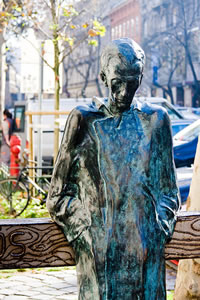
De Hongaarse dichter en schrijver Miklós Radnóti werd geboren op 5 mei 1909 in Boedapest. Zie ook mijn blog van 5 mei 2008 en ook mijn blog van 5 mei 2009 en ook mijn blog van 5 mei 2010.
Postcard 1
Out of Bulgaria, the great wild roar of the artillery thunders,
resounds on the mountain ridges, rebounds, then ebbs into silence
while here men, beasts, wagons and imagination all steadily increase;
the road whinnies and bucks, neighing; the maned sky gallops;
and you are eternally with me, love, amid all the chaos,
glowing within my conscience — incandescent, intense.
Somewhere within me, dear, you abide forever —
still, motionless, silent, like an angel stunned to complacence by death
or an insect inhabiting the heart of a rotting tree.
Postcard 4
I fell beside him — his body taut,
tight as a string just before it snaps,
shot in the back of the head.
"This is how you’ll end too; just lie quietly here,"
I whispered to myself, patience blossoming into death.
"Der springt noch auf," the voice above me said
through caked mud and blood congealing in my ear.
Vertaald door Michael R. Burch
Miklós Radnóti (5 mei 1909 – 9 november 1944)
Standbeeld in Boedapest
De Nederlandse dichteres Petra Else Jekel werd in Arnhem geboren op 5 mei 1980. Zie ook mijn blog van 5 mei 2007 en ook mijn blog van 5 mei 2008 en ook mijn blog van 5 mei 2009 en ook mijn blog van 5 mei 2010.
Verlepte bloemen
Verlepte bloemen, Rik, waar ben je.
Blijf je steken bij de steel, waar
ben je, glij je in troebel vrucht
water vallen, laken vallen,
fluisterbed met dekenslagen,
kreukelkussenbed. Jij met, met -
Ik ben bang in bed, weet je, dat
ik er niet uit kan komen om er
uit op te staan bij gevaar van
de man aan het raam mij wekte,
mij wenkte en mij wakker in
slapen deed, mijn lichaam zich op
gaf, mijn eten ontteerde, bleef
waar mijn kookritme het had,
onteerde mij mij, tilde
mij, zweefde bovenlangs bed; bad.
Moet ik je bellen, Rik, moet ik
je sturen naar het geheime
einde met bloemen, een einder,
helder water: 100 graden.

Petra Else Jekel (Arnhem, 5 mei 1980)
De Amerikaanse schrijver Morton Rhue (pseudoniem van Todd Strasser) werd geboren op 5 mei 1950 in New York. Zie ook mijn blog van 5 mei 2008 en ook mijn blog van 5 mei 2009 en ook mijn blog van 5 mei 2010.
Uit: Boot Camp
"Excuse me. M y hands are numb."
"So?" replies the man driving the car. His name is Harry.
"Maybe you could loosen the handcuffs?" I ask.
"Sorry blue blood."
"If you're sorry then why don't you help me?"
"No can do." Harry wears a cowboy hat and speaks with a western accent. From my seat in the back of the dark car I can only see the silhouette of his shoulders and thick neck beneath the wide-brimmed hat. My hands, locked behind me for the past two hours, have gone numb. I feel nothing but tingling from my wrists down.
"Would you at least tell me where you're taking me?" I ask.
Harry doesn't answer. The car bounces and lurches through the dark. Except for the short stretch of dusty reddish dirt road illuminated by the headlights, it is as black as blindness outside. Rocks kicked up by the tires clank against the car's underside. The air-conditioning murmurs. Now and then sudsy spray splashes against the windshield, and the wipers wash away dust and splattered bug carcasses.
With my hands joined by the handcuffs in the small of my back, there is no way to get comfortable, no way to relieve the pressure that has cut off the circulation.
"When my parents hired you, did they know that physical abuse was part of the deal?" I ask.
From the movement of his head, I sense that Harry is looking at me in the rearview mirror, but his eyes are hidden in the shadow from the r im of his hat. "That was some spread we picked you up from, blue blood. What's your father's business that he can afford a place like that?"

Morton Rhue/Todd Strasser (New York, 5 mei 1950)
De Tsjechische (Duitstalige) dichter en schrijver Hans Werner Kolben werd geboren op 5 Mei 1922 in Aussig an der Elbe. Zie ook mijn blog van 5 mei 2010.
Vorzeitiger Tod
Vom Wald her jauchzt des Waidmanns Horn,
Der Abendschatten kommt gezogen,
Dort draußen rauscht das reife Korn,
Es rauscht in weiten gelben Wogen,
Die ihren Opfertod erwarten.
Es ziehen Reiter durch die Flur,
Die Hufe treten reifes Leben,
Sie hinterlassen eine Spur,
Aus Toten, die uns nichts gegeben,
Die eines besseren Endes harrten.
Was tönst du denn so traurig, Horn,
Und klagst um ein paar gelber Garben;
Bald steht von Neuem reifes Korn,
Auf alten längst vergeßnen Narben,
Und alles, alles wird gesunden.
Aus tiefem Traum das Horn erschallt:
Du irrst, niemals wird neu geboren,
was nutzlos umkam durch Gewalt,
Was vor der Ernte ward verloren,
ist unersetzlich hingeschunden
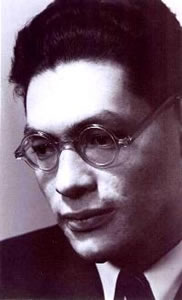
Hans Werner Kolben (5 mei 1922 – 23 maart 1945)
De Amerikaanse dichter, schrijver en journalist Christopher Morley werd geboren op 5 mei1890 in Haverford, Pennsylvania. Zie ook mijn blog van 5 mei 2007 en ook mijn blog van 5 mei 2008 en ook mijn blog van 5 mei 2009 en ook mijn blog van 5 mei 2010.
Hero and Leander
It lies not in our power to love or hate,
For will in us is over-rul'd by fate.
hen two are stript long ere the course begin,
We wish that one should lose, the other win;
And one especially do we affect
Of two gold ingots, like in each respect:
The reason no man knows; let it suffice,
What we behold is censur'd by our eyes.
Where both deliberate, the love is slight:
Who ever lov'd, that lov'd not at first sight.
To A Child
The greatest poem ever known
Is one all poets have outgrown:
The poetry, innate, untold,
Of being only four years old.
Still young enough to be a part
Of Nature's great impulsive heart,
Born comrade of bird, beast, and tree
And unselfconscious as the bee—
And yet with lovely reason skilled
Each day new paradise to build;
Elate explorer of each sense,
Without dismay, without pretense!
In your unstained transparent eyes
There is no conscience, no surprise:
Life's queer conundrums you accept,
Your strange divinity still kept.
Being, that now absorbs you, all
Harmonious, unit, integral,
Will shred into perplexing bits,--
Oh, contradictions of the wits!
And Life, that sets all things in rhyme,
may make you poet, too, in time--
But there were days, O tender elf,
When you were Poetry itself!

Christopher Morley (5 mei 1890 – 28 maart 1957)
De Franse dichter, schilder en criticus George Albert Aurier werd geboren op 5 mei 1865 in Châteauroux (Indre). Zie ook mijn blog van 5 mei 2008 en ook mijn blog van 5 mei 2009 en ook mijn blog van 5 mei 2010.
Uit: The Isolated Ones: Vincent van Gogh (Les Isolés : Vincent van Gogh)
“And yet, make no mistake, Vincent van Gogh has by no means transcended his heritage. He was subject to the effect of the ineluctable atavistic laws. He is good and duly Dutch, of the sublime lineage of Frans Hals.
And foremost, like all his illustrious compatriots, he is indeed a realist, a realist in the fullest sense of the term. Ars est homo, additus naturae, Chancellor Bacon said, and Monsieur Emile Zola defined naturalism as "nature seen through the temperament." Well, it is this "homo additus," this "through a temperament," or this molding of the objective unity into a subjective diversity, that complicates the question and abolishes the possibility of any absolute criterion for gauging the degrees of the artist's sincerity. To determine this, the critic is thus inevitably reduced to more or less hypothetical, but always questionable, conclusions. Nevertheless, in the case of Vincent van Gogh, in my opinion, despite the sometimes misleading strangeness of his works, it is difficult for an unprejudiced and knowledgeable viewer to deny or question the naive truthfulness of his art, the ingeniousness of his vision. Indeed, independent of this indefinable aroma of good faith and of the truly seen that all his paintings exude, the choice of subjects, the constant harmony between the most excessive colour notes, the conscientious study of character, the continual search for the essential sign of each thing, a thousand significant details undeniably assert his profound and almost childlike sincerity, his great love for nature and for truth--his own personal truth.”

George Albert Aurier (5 mei 1865 – 5 oktober 1892)
Vincent van Gogh, zelfportret
Zie voor nog meer schrijvers van de 5e mei ook mijn vorige blog van vandaag.


