

Naar de inhoud

Romenu

Over literatuur, gedichten, kunst en cultuur
seniorennet.beseniorennet.be

Berichten van 22 september 2011

Dannie Abse, Lodewijk van Deyssel, Fay Weldon, György Faludy
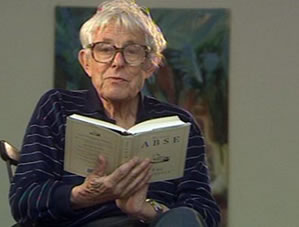
De Britse dichter en schrijver Dannie Abse werd geboren op 22 september 1923 in Cardiff, Wales. Zie ook mijn blog van 22 september 2010 en eveneens alle tags voor Dannie Abse op dit blog.


A Heritage


A heritage of a sort.

A heritage of comradeship and suffocation.


The bawling pit-hooter and the god’s  

explosive foray, vengeance, before retreating  

to his throne of sulphur.


Now this black-robed god of fossils

and funerals,

petrifier of underground forests

and flowers,

emerges with his grim retinue

past a pony’s skeleton, past human skulls,

into his half-propped up, empty, carbon colony.


Above, on the brutalised,

unstitched side of a Welsh mountain,

it has to be someone from somewhere else  

who will sing solo


not of the marasmus of the Valleys,  

the pit-wheels that do not turn,  

the pump-house abandoned;


nor of how, after a half-mile fall  

regiments of miners’ lamps  

no longer, midge-like,

rise and slip and bob.


Only someone uncommitted,  

someone from somewhere else,  

panorama-high on a coal-tip,  

may jubilantly laud

the re-entry of the exiled god  

into his shadowless kingdom.


He, drunk with methane,

raising a man’s femur like a sceptre;

she, his ravished queen,

admiring the blood-stained black roses

that could not thrive on the plains of Enna.


Lachrymae


Later

I went to her funeral.

I cried.

I went home that was not home.

What happened cannot keep.

Already there's a perceptible change of light.

Put out that light. Shades

lengthen in the losing sun.

She is everywhere and nowhere

now that I am less than one.

Most days leave no visiting cards behind

and still consoling letters make me weep.

I must wait for pigeon memory

to fly away, come back changed

to inhabit aching somnolence

and disguising sleep.

(ii) Winter

What is more intimate

than a lover's demure whisper?

Like the moment before Klimt's The Kiss.

What's more conspiratorial

than two people in love?

So it was all our eager summers

but now the yellow leaf has fallen

and the old rooted happiness

plucked out. Must I rejoice when

teardrops on a wire turn to ice?

Last night, lying in bed,

I remembered how, pensioners both,

before sleep, winter come,

your warm foot suddenly

would console my cold one.


 998036-e9c3077b5106884d767e6fc87cb81e1b.jpg

Dannie Abse (Cardiff, 22 september 1923)


De Nederlandse schrijver Lodewijk van Deyssel werd geboren op 22 september 1864 in Amsterdam. Zie ook mijn blog van 22 september 2010 en eveneens alle tags voor Lodewijk van Deyssel op dit blog.


Uit: Het leven van Frank Rozelaar


„17 Oktober 1897

Eer-gisteren heb ik in den tuin naar boven gekeken en voor 't eerst weêr iets moois gezien: lucht van een bizonder fijn licht blaauw en bleek-groen, met heele mooye blank-roode wolkjes er bij. Daar onder verhief zich het goud-bronzen eikgewas.

Ik stond aan den voorkant van mijn witte huis, onder de warande met zijn purper-rooden wingerd.

Het was juist alsof deze plek een beroemde plaats was, waarvan gezegd wordt, dat men in dít seizoen dáar moet zijn, wijl het dan nergends elders zóo mooi is.

Gisteren was ik om den zelfden tijd op een wijden heibaan in het bosch, waar veel lucht zichtbaar is. Het was vijf, zes uur 's middags, zons-ondergang. Práchtig, weêr. Dit lijkt mij het mooiste wat men in het Landschap zien kan. De Rhijnval te Schaff hausen is niet mooyer; ook de Golf van Napels kán niet mooyer zijn.

Ik ben gedrukt, in een ebbe van mijn Leven, ik heb dus tot heden geen diepe aandoeningen van de herfst mogen ontvangen; maar met gevoelige verstandelijkheid vond ik het prachtig.

De herfst is mooyer dan de zomer. Ik meen dit nu zoo-maar, zonder geestelijke bedoeling. In de herfst zijn het licht en de kleuren zóo anders dan in den zomer, dat de natuur eenvoudig gezegd kan worden in een hoogeren toestand te zijn.

Zij is in haar grootste mooiheid even als een Heilige die den dood nadert.

Duidelijk heb ik gisteren beseft dat de natuur in een hoogeren toestand is.

Er is een léven in, een langzaam bewégen van lichten en kleuren, een weidsch Tooneelspel der Schoonheid. Het is zóo mooi, dat men zelf niet zóo leelijk of zóo elders met zijn gedachten kan zijn, dat men het níet mooi zoû vinden.

Het is mooyer dan een ten-toon-stelling van de beste schilderten.

Het is of de heele natuur samen-gesteld is uit schildersontroeringen.

Het is éen groot schilderij, waarin men zelf staat.“


 998036-268cc481ea6c59913bff8bf9554497b3.jpg

Lodewijk van Deyssel  (22 september 1864 - 26 januari 1952)

Hier met P. C. Boutens (rechts)


De Britse schrijfster
Fay Weldon werd geboren op 22 september 1931 in Alvechurch, Engeland. Zie ook mijn blog van 22 september 2010 en eveneens alle tags voor Fay Weldon op dit blog


Uit: Darcy's Utopia


“Lack of money causes misery, anxiety, early death: the cramping of personality, the limiting of human potential. Lack of money prevents us eating properly when we are children, ruins our health, rots our teeth, makes our parents quarrel and take to drink, stops us having the clothes we want, the friends we like, the parties we long for, stops us having the tuition which would enable us to get an education - makes us end up street sweepers and not doctors; induces women to have babies because there is no money for travel or entertainment, or to leave the parental home any other way: lack of money humiliates us all our lives: lack of money makes us live with husbands or wives we no longer love: lack of money makes us age earlier than we need: makes our hands rough with toil and our brows creased with anxiety: keeps us weeping by day and sleepless by night: the terror in our lives is the bill through the door which can't be paid: our lives close in the knowledge of failure - we failed to make enough money. We never did what we wanted with our lives. How could we? We didn't have the money.”


 998036-38b1115a5c6e7b560b5e4ef0125dca51.jpg

Fay Weldon (Alvechurch, 22 september 1931)


De Hongaarse dichter en schrijver György Faludy werd geboren op 22 september 1910 in Boedapest. Zie ook mijn blog van 22 september 2009 en ook mijn blog van 22 september 2010


AURORA BOREALIS


Between clouds I looked up at the sky and down on the ground:
snow clouds, snow cover, the same above as below.
The freeze was sitting everywhere, busy at work:
its huge green needle had the whole Bering Sea to sew.


After landing we hunted Japanese soldiers for seven days.
I shared my army ration with seals at the watering hole.
I didn’t question the wisdom of it. I only saw Eskimos
and a painted top hat on the top of a totem pole.


In the hammock of fog, I was bundled up in fur coats
that swallowed up the body like the snow a heavy gun:
that’s how I lived from day to day. I hadn’t even thought
of you till yesterday evening when the patrol was done.


The light! The light! I heard the cook from the kitchen,
and when I stepped outside, there it was above the ice:
like a fluffy muslin curtain it billowed, swayed, and swung,
swimming closer and away, reminding me of something nice,


but what? I stood there pondering. Ruffled shadows were
rocking the light. With my hand on the doorknob behind,
I stared entranced. A hard voice from inside woke me up:
The door! Suddenly you spread your skirt over my mind.


Jewish Saying


A Hassidic rebbe was heard to say:

Good thing God doesn’t live

on earth. He’d get his windows

smashed every day.


 998036-d0c2a0a602472561ddfad1bf2f8e20a6.jpg

György Faludy (22 september 1910 – 1 september 2006)


Zie voor nog meer schrijvers van de 22e september ook mijn vorige blog van vandaag.
Geschreven door Romenu om 19:56 Reageer op dit bericht

Uri Zvi Greenberg, Rosamunde Pilcher, Hans Leip, Barthold Heinrich Brockes

De Israëlische Hebreeuwse en Jiddische dichter en politicus Uri Zvi Greenberg  werd geboren op 22 september 1896 in Bialikamin, Lviv, in Galicië, destijds behorend tot Oostenrijk-Hongarije. Zie ook mijn blog van 22 september 2010


Under the Tooth of their Plough


Once more the snows have melted there...and the murderers gone back to farming.
There they have gone out to plough their fields, for that is their name for my graveyards.
If the tooth of their plough, rolling skull-like over the furrow, should churn up
A skeleton of mine, the ploughman will not be saddened or shocked,
But will grin and recognize it, recognize the mark where his tools struck.

Spring anew over land: bud and bulb and lilac and warbling birds.
By the shining stream of shallow waters, the resting place of herds,
The roving Jews are no more: no more with their beards and side-curls.
They are no more in the inns with tallit and tsitsit over their shirts;
They are no more in the grocery store or the clothing store,
They are no more in their workshops and traincars now,
They are no more in the synagogue, even, or in the marketplace,
But under the tooth of the Christian plough.
For the Lord doth visit His goys with grace.

But spring will be spring- and summer comes fatly ever after,
The roadside trees are fruit-fat as garden trees, as never before.
The fruit has never been as red or juicy as it is now
That the Jews are no more.

The Jews didn't have any bells to beckon God by1
Blessèd are the Christians, for theirs are the bells on high,
Bells whose voice booms gravely through the plain there now in spring,
Thickly spewed through the breadth of lands that fragrance and colors cover.
It is almighty and master of all: there is nothing more to pass over
As once He passed over the roofs of the Jews.

Blessèd are the Christians, for theirs are the bells on high,
To honor a God who loves all Christians and all of humankind.
And all of the Jews are corpses under the tooth of their plough
Or under the grass of pastures.

Or in the forest's graves
On river banks, on river bottoms, or dumped along
The roads where they belong.

O praise ye your dear sweet Jesus
With the bang of your big bells:
Bing-bong.


Vertaald door A.Z. Foreman


 998026-34b97abb5cc51aa933d346aba8790b38.jpg

Uri Zvi Greenberg (22 september 1896 – 8 mei 1981)


De Britse schrijfster Rosamunde Pilcher werd op 22 september 1924 geboren in Lelant, Cornwall, Groot-Brittannië. Zie ook mijn blog van 22 september 2009 en ook mijn blog van 22 september 2010


Uit: Elfrida


„The next day, she took him to the local Poodle Parlour for a cut, shampoo, and blow-dry. He returned to her fluffy and fresh and smelling sweetly of lemonade. His response to all this sybaritic attention was a show of faithful, grateful, and loving devotion. He was a shy, even a timid, dog, but brave as well. If the doorbell rang, or he thought he spied an intruder, he barked his head off for a moment and then retreated to his basket, or to Elfrida's lap. It took some time to decide on a name for him, but in the end she christened him Horace.
Elfrida, with a basket in her hand, and Horace firmly clipped to the end of his lead, closed the front door of her cottage behind her, walked down the narrow path, through the gate, and set off down the pavement towards the post office and general store.
It was a dull, grey afternoon in the middle of October, with nothing much to commend about it. The last of autumn's leaves fell from trees, with an unseasonably icy breeze too chill for even the most ardent of gardeners to be out and about. The street was deserted, and the children not yet out of school. Overhead, the sky was low with clouds, that shifted steadily and yet never seemed to clear. She walked briskly, Horace trotting reluctantly at her heels, knowing that this was his exercise for the day and he had no alternative but to make the best of it.
The village was Dibton in Hampshire, and here Elfrida had come to live eighteen months ago, leaving London forever and making for herself a new life. At first she had felt a bit solitary, but now she couldn't imagine living anywhere else. From time to time, old acquaintances from her theatre days made the intrepid journey from the city and came to stay with her, sleeping on the lumpy divan in the tiny back bedroom that she called her work-room, which was where she kept her sewing machine and earned a bit of pin money making elaborate and beautiful cushions for an interior decorating firm in Sloane Street.“


998026-1f8f9cb236ca6456f2391fb0fdce4889.jpg
Rosamunde Pilcher (Lelant, 22 september 1924)


De Duitse dichter en schrijver Hans Leip werd geboren op 22 september 1893 in Hamburg. Zie ook mijn blog van 22 september 2008 en ook mijn blog van 22 september 2010


Blankenese


Ein Kleingebirg aus bunten Muscheln,
darüber dick die Wolken kuscheln.
Darunter Flaggen hin und her,
des Stromes Überseeverkehr.


Hoch auf schlanker Promenade
Haus über Haus das Grüngestade.
Ein kleines Nest, ein großes Bild.
Die Architekten lächeln mild.


Ein Dorf, das wie ein Eden liegt
und sanft nach Grog und Flundern riecht.
Von angenehmen Parks verschönt,
von einer Gastwirtsburg gekrönt.


Die stille Zuflucht - im Vertrauen -
zeitmüder Schlemmer, schöner Frauen.
Der Liebesstrand, das Sonntagsbad,
das Tanzlokal der großen Stadt.


Treppauf, treppab die Winkelgänge,
Schlafpuppengärten, Netzgehänge,
Boot, Abendbank und Fliesenkram,
versponnen, blond und tugendsam.


Solide Wäsche bauscht im Wind,
mit fremden Münzen spielt ein Kind,
ein Junge träumt von großer Fahrt,
ein Alter spinnt in seinen Bart.


Hoch über Baum und Schornsteindach
kommt man zu Atem allgemach.
Es brist herauf so meergeschwellt,
tief unten blitzt die weite Welt.


 998026-e7a5d4232db514ec4827f78afec44211.jpg

Hans Leip (22 september 1893 – 6 juni 1983)


De Duitse dichter Barthold Heinrich Brockes werd geboren in Hamburg op 22 september 1680. Zie ook mijn blog van 22 september 2010


Kirschblüte bei Nacht


Ich sahe mit betrachtendem Gemüte

Jüngst einen Kirschbaum, welcher blühte,

In kühler Nacht beim Mondenschein;

Ich glaubt', es könne nichts von größrer Weiße sein.

Es schien, ob wär ein Schnee gefallen.

Ein jeder, auch der kleinste Ast

Trug gleichsam eine rechte Last

Von zierlich-weißen runden Ballen.

Es ist kein Schwan so weiß, da nämlich jedes Blatt,

indem daselbst des Mondes sanftes Licht

Selbst durch die zarten Blätter bricht,

Sogar den Schatten weiß und sonder Schwärze hat.

Unmöglich, dacht ich, kann auf Erden

Was Weißers ausgefunden werden.

Indem ich nun bald hin, bald her

Im Schatten dieses Baumes gehe,

Sah ich von ungefähr

Durch alle Blumen in die Höhe

Und ward noch einen weißern Schein,

Der tausendmal so weiß, der tausendmal so klar,

Fast halb darob erstaunt, gewahr.

Der Blüte Schnee schien schwarz zu sein

Bei diesem weißen Glanz. Es fiel mir ins Gesicht

Von einem hellen Stern ein weißes Licht,

Das mir recht in die Seele strahlte.

Wie sehr ich mich an Gott im Irdischen ergetze,

Dacht ich, hat Er dennoch weit größre Schätze.

Die größte Schönheit dieser Erden

Kann mit der himmlischen doch nicht verglichen werden.


998026-6255d6f7dbfcfc379335d4b2cbe2a621.jpg
Barthold Heinrich Brockes (22 september 1680 - 16 januari 1747)

Geschreven door Romenu om 19:45 Reageer op dit bericht

Meer van Romenu

↑ Terug naar de berichten