

 Joost van den Vondel, Auberon Waugh, Dahlia Ravikovitch, Rebecca Walker, Christopher Paolini, Max Barthel, Pierre Véry
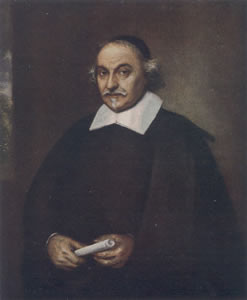
De Nederlandse dichter en schrijver Joost van den Vondel werd geboren op 17 november 1587 in Keulen. Zie ook Zie ook alle tags voor Joost van den Vondel op dit blog.
Op de Vijf Zinnen
’t Misbruik der zinnen werkt in ’t einde pijn en smart,
Doch ’t redelijk gebruik vernoegt des mensen hart;
Dat ’s aardse zaligheid. Wie wenst hier groter goed,
Als, in ’t gezonde lijf, een gans vernoegd gemoed?
HET GEZICHT.
De blinde, die weleer aanschouwde ’t lieve licht,
Kan tuigen, wat het zij te missen het gezicht,
Te wroeten, als de mol, in duisternisse en dromen.
De blinde is hallef dood; men leeft door ’t oog volkomen.
HET GEHOOR.
Het redelijk begrijp, in ons het Godlijk deel,
Veroorzaakt tussen mens en dier een groot verscheel;
Maar och! wat zou het zijn, ontbeerden wij de spraak?
En nog waar beide niet, zo ons ’t gehoor ontbraak’.
DE REUK.
D’ ontloken rode roos heeft niet dan blad en kleur,
Bij reukeloze neus, niet snuffende de geur;
De reuk des geurs verkwikt het kwijnend hart des zieken,
En bindt aan ’t lijf de ziel, die vlug was met haar wieken.
DE SMAAK.
De smakeloze tong wordt met geen lust gevoed,
Zij weet van wrang noch zout, noch bitterheid, noch zoet.
De zoete saus is smaak, al schafte zelf Jupijn;
Want, waar de smaak ontbreekt, daar kan niet lekkers zijn.
HET GEVOEL.
’t Gevoelen is de min, waar naar het alles jankt.
Het kittelt zelf Jupijn, zodat hij ’t zich bedankt.
Men neem ’t gevoelen weg, zo treurt het welig wicht,
Met fakkel zonder vlam, met koker zonder schicht.
Joost van den Vondel (17 november 1587 – 5 februari 1679)
Portret door Jan Lievens, 1660
De Britse schrijver journalist en polemist Auberon Alexander Waugh werd geboren op 17 november 1939 in Dulverton, Somerset. Zie alle tags voor Auberon Waugh op dit blog.
Uit: Will This Do? An Autobiography
„We sold Chilton Foliat rather well to an amiable businessman who has lived in it ever since. The money enabled Teresa to buy Combe Florey from my mother with enough left over to redecorate the main house. It also enabled my mother to refurbish the wing according to her particular requirements, with vast stone sinks which never let the water out and stank. But it was a happy enough arrangement while it lasted.
* * * *
Being a more intensely private person than Evelyn Waugh - who,despite all his protestations to the contrary, was in large part a public Figure - Laura Waugh was also, in her own way, more remarkable. As Laura Herbert, she grew up in three households -Pixton in Somerset, a large house in Bruton Street and Portofino -all crowded with guests from every corner of the earth. This gave her a pronounced distaste for social life.
My father had met her first at Portofino, when she was seventeen. A year later, he was in love with her, but his suit did not seem well starred. Laura’s family was Catholic. Evelyn, who had become a Catholic in 1930 after the failure of his first marriage, seemed in no position to declare himself a suitor while his annulment was held up, apparently sine die, by the Westminster and Vatican bureaucracy. A further complication was that by unhappy coincidence his first wife, Evelyn Gardner, was a niece of Aubrey Herbert and Laura’s first cousin. Feeling in the family was strongly against the match. Although Evelyn Waugh was already a successful novelist, and would have been a catch for most teenage brides of the period, the Herberts were not a family to be intimidated by smartness of that sort. Evelyn was thirteen years older than his bride, had already been married to one member of the family and, worst of all, came from a background which was distinctly middle class.”
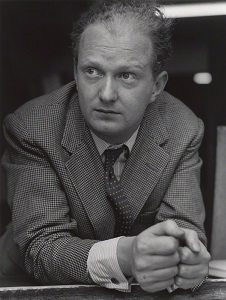
Auberon Waugh (17 november 1939 -16 januari 2001)
Auberon, Alexander en Evelyn Waugh in 1965.
De Israëlische dichteres en schrijfster Dahlia Ravikovitch werd geboren op 17 november 1936 in een voorstad van Tel Aviv. Zie ook alle tags voor Dahlia Ravikovitch op dit blog.
Clockwork Doll
I was a clockwork doll that night,
and I turned left and I turned right
and when I fell and broke to bits,
they recomposed my wax and wits.
I was a proper doll once more,
my manner carefully demure;
and yet a doll of another kind—
an injured twig that tendrils bind.
And when they asked me to a ball—
although my steps were rhythmical,
they partnered me with dog and cat.
My hair was gold, my eyes were blue.
I wore a dress where flowers grew.
Cherries blazed on my straw hat.
Vertaald door Robert Friend
Like Rachel
To die like Rachel
when the soul shudders like a bird,
wants to break free.
Behind the tent, in fear and dread,
Jacob and Joseph speak of her,
a-tremble.
All the days of her life
turn head over heels inside her
like a baby that wants to be born.
How grueling. How
Jacob’s love ate away at her
with a greedy mouth.
As the soul takes leave now,
she has no use for any of that.
Suddenly the baby screeches,
Jacob comes into the tent—
all this Rachel does not even sense.
Rapture washes over her face,
her head.
Then did a great repose descend upon her.
The breath of her nostrils would not stir a feather.
They laid her down among mountain stones
and made her no lament.
To die like Rachel,
that’s what I want.
Vertaald door Chana Bloch en Chana Kronfeld
Dahlia Ravikovitch (17 november 1936 – 21 augustus 2005)
De Amerikaanse schrijfster, uitgeefster en politiek activiste Rebecca Walker werd geboren op 17 november 1969 in Jackson, Mississippi. Zie ook alle tags voor Rebecca Walker op dit blog.
Uit: Baby Love
“For the last fifteen years I have told everyone—friends, family, hairdressers, editors, cabdrivers, doctors, and anyone else who would listen—that I wanted a baby. I want to have a baby, I would say with urgency or a wistful longing, or both. And I meant what I said, I really did, I just had no idea what I was talking about. I had almost no actual experience of babies, so the object of my wanting was abstract, the display of it ritualized. I want to have a baby was something I said, a statement that evoked a trajectory, a general direction for my life.
The truth is, I was wracked with ambivalence. I had the usual questions: When, with whom, and how the hell was I going to afford it? But there was something else, too, a question common—if not always conscious—to women of my generation, women raised to view motherhood with more than a little suspicion. Can I survive having a baby? Will I lose myself—my body, my mind, my options—and be left trapped, resentful, and irretrievably overwhelmed? If I have a baby, we wonder silently to ourselves, will I die?
To compound matters, I had a tempestuous relationship with my mother, and feared the inevitable kickback sure to follow such a final and dramatic departure from daughterhood. What if, instead of joy and excitement, my mother felt threatened by the baby, and pushed even further into the margins of my life? What if, then, out of jealousy and her own discontent, she launched covert or not-so-covert strikes against my irrefutable separateness, now symbolized so completely by becoming a mother myself?
Because mothers make us, because they map our emotional terrain before we even know we are capable of having an emotional terrain, they know just where to stick the dynamite. With a few small power plays—a skeptical comment, the withholding of approval or praise—a mother can devastate a daughter."
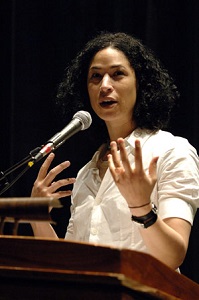
Rebecca Walker (Jackson, 17 november 1969)
De Amerikaanse schrijver Christopher Paolini werd geboren in Los Angeles County, California, op 17 november 1983. Zie ook alle tags voor Christopher Paolini op dit blog.
Uit: Eldest
“In the kitchen, Eragon brought a stone platter of food to a low table. Saphira watched him carefully in case he should have another attack. Several people tried to approach him, but she lifted a lip and growled sending them scurrying away. Eragon pretended to ignore the disturbances and picked at the food. Finally, trying to divert his thoughts from Murtagh, he asked, Who do you think has the means to take control of the Varden, now that Ajihad and the Twins are gone?
She hesitated. It's possible you could, if Ajihad's last words were interpreted as a blessing to secure the leadership. Almost no one would oppose you. However, that does not seem a wise path to take. I see only trouble in that direction.
I agree. Besides, Arya wouldn't approve, and she could be a dangerous enemy. Elves can't lie in the ancient language, but they have no such inhibition in ours-she could deny that Ajihad ever uttered those words if it served her purposes. No, I don't want the position. . . . What about Jörmundur?
Ajihad called him his right-hand man. Unfortunately, we know little about him or the Varden's other leaders. Such a short time has passed since we came here. We will have to make our judgment on our feelings and impressions, without the benefit of history.
Eragon pushed his fish around a lump of mashed tubers. Don't forget Hrothgar and the dwarf clans; they won't be quiet in this. Except for Arya, the elves have no say in the succession-a decision will be made before word of this even reaches them. But the dwarves can't be-won't be-ignored. Hrothgar favors the Varden, but if enough clans oppose him, he might be maneuvered into backing someone unsuited for the command.
And who might that be?
A person easily manipulated. He closed his eyes and leaned back. It could be anyone in Farthen Dûr, anyone at all.“

Christopher Paolini (Los Angeles County, 17 november 1983)
De Duitse dichter en schrijver Max Barthel werd geboren in Dresden-Loschwitz op 17 november 1893. Zie ook alle tags voor Max Barthel op dit blog en ook mijn blog van 17 november 2010.
Uit: Das unsterbliche Volk
“Der Mensch ist ein Geschöpf, das ja sagt und hofft. Jakob Bundschuh, ein Bauer mit kantigem Gesicht und kühner Nase über dem bartlosen, kräftigen Mund, kam vom Gemeindehaus und ging nachdenklich die breite, bestaubte Dorfstraße hinunter. Es war am 1. Mai, und der Redner mit den fahrigen Händen hatte halb russisch, halb deutsch vom Weltfeiertage der Arbeit gesprochen, vom Vermächtnis Lenins und vom Willen Stalins, der auch die Krim in paradiesische Landschaft verwandeln sollte.
Die Bauern des kleinen Dorfes Marienthal bei Simferopel in der Krim hatten schon viele Reden gehört, vor dem Krieg und nach dem Krieg, Reden und Versprechungen. Auch heute ließen sie mit unbeweglichen Gesichtern, die Augen waren wachsam, alles über sich ergehen. Der übliche Beifall fiel auf den Mann mit den flatternden Händen. Die vorgelegte Resolution wurde einstimmig angenommen. Und als dann der Redner verschwunden war, blieben die Bauern auf ihren Plätzen. Dann standen sie auf und stimmten die alten Lieder an, die von ihren Vorfahren vor hundert und noch mehr Jahren aus Deutschland mitgebracht und in den Steppen und Gebirgen von Geschlecht aus Geschlecht vererbt wurden.
Vom Meere wehte ein kühler Wind, tanzte aus der Straße und wirbelte den weißen Staub auf. Auch im Kaukasus hatte der Wind geblasen, aber es war ein andrer Wind gewesen, harscher, wilder und kälter, ein Wind von den Pässen und Gletschern, ein Sturm vom Kasbek und Elbrus. Und noch einen andern Sturm hatte der Dahinschreitende im Kaukasus erlebt. Im Herbst erhoben sich die Bergvölker.
Der Krieg war zu Ende.
Der Bürgerkrieg in Rußland begann.“
Max Barthel (17 november 1893 – 28 juni 1975)
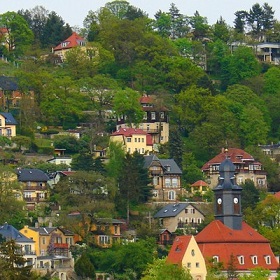
Dresden-Loschwitz
De Franse schrijver Pierre Véry werd op 17 november 1900 in Bellon geboren. Zie ook alle tags voor Pierre Véry op dit blog enook mijn blog van 17 november 2009.
Uit: Les Disparus de Saint-Agil
"...Une musique.
Un son de piano, lent et grave.
Cela venait des étages supérieurs, de la classe de sciences, sans aucun doute, puisque
là se trouvait le seul piano qu'il eût à la pension.
- Mais voyons..., dit M.Pointis, que l'incident amusait plûtôt et qui ne pouvait rien soupçonner des sentiments de ceux qui l'entourait. La phrase musicale se développait, majestueuse de gravité et de lenteur.
- Ce motif... C'est la marche funébre de Chopin!
Oh! voilà qui est cocasse!
Dans la classe de sciences, on ne trouva personne.
Ou, plutôt, si : Martin.
Le squelette était assis au piano, ses mains sur les touches. ..."
(…)
"Je nous vois, descendant du pullman-car à Washington, Cincinnati ou Philadelphie. Nous échangeons un farouche et chaud Shake-Hand. Et, tout de suite, c'est l'Aventure... Tour à tour interprètes, mécaniciens, balayeurs de rues, marchands de cacahuètes sur les bords de l'Hudson, aujourd'hui businessmen brassant des millions, demain vagabonds, vivant de pain et d'eau..."
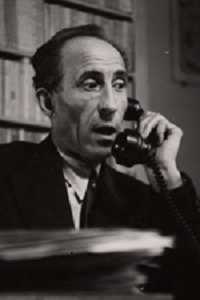
Pierre Véry (17 november 1900 - 12 oktober 1960)

