Naar de inhoud

Romenu

Over literatuur, gedichten, kunst en cultuur
seniorennet.beseniorennet.be

Berichten van 8 april 2011

Herinnering aan Gerard Reve, Hanz Mirck, Christoph Hein, Nnedi Okorafor, Barbara Kingsolver

Herinnering aan Gerard Reve


Vandaag is het precies 5 jaar geleden dat de Nederlandse dichter en schrijver Gerard Reve overleed. Zie over Reve o.a. ook mijn blog van 14 december 2006. en mijn blog van 9 april 2006 en ook mijn blog van 10 april 2006 en mijn blog van 14 december 2009 en mijn blog van 8 april 2010. Alle bijdragen over Reve zijn te vinden via de tag Gerard Reve.


In uw handen


Niemand die zeggen kan, wanneer en hoe.

Misschien wel met geheven glas,

terwijl hij proestend poogt iets uit te leggen

dat wordt weggespoeld

op bulderende branding van gelach.

Dan piept opeens zijn stem, als uit het stof,

en klauwt zijn lege hand naar ’t arme hart,

waar nu het mes in staat van God.

Een flits, van droevig speelgoed, droeve sneeuw

en droef lantarenlicht. Meer niet.

Ziezo, het is volbracht.

‘Zoals hij heeft geleefd, zo is hij ook gestorven.’


(1965)


 889692-928fcfda79c1689842cd20e6c3502889.jpg

Gerard Reve (14 december 1923 -  8 april 2006)

Jaren 1960


De Nederlandse dichter Hanz Mirck werd geboren op 8 april 1970 te Zutphen. Zie ook mijn blog van 8 april 2007 en mijn blog van 3 april 2007  en ook mijn blog van 8 april 2008 en ook mijn blog van 8 april 2009 en mijn blog van 8 april 2010


Aan het water


Steeds weer komt boven zij verdrinkt
in een droom. Aan haar navelstreng onder water
een steen. Aan de oever met een liefde die geen kinderen wil
een man die niet helpt. Die lacht. Die mijn gezicht heeft

Je vertelt het, je ogen vertellen het, je wimpers vechten
tegen opkomend tij. Ik koud en klein als een kiezel,
nooit groter vijand van hem met mijn gezicht
in jouw droom

die steeds bovenkomt, mij onderduwt
Blijven verdrinken, blijven lachen
terwijl ik niet lach. De steen malend

Geluidloos lied dat zinkt in mijn hoofd
Blijven roepen onder water
zonder dat er ochtend kwam


Take me to the river


Laat me je dragen uit het donker van de binnenplaats achter
je huis zo koel en stil waar nooit de zon komt waar je zachte stem
zo schor gezwegen op me heeft gewacht, laat me je door je keuken
en door de smalle gang langs het bed waar je slaapt en de tafel

waar je werkt en eet en laat me je door de voordeur naar licht en
uiterwaarden om diep te kunnen ademhalen ik zal voorzichtig
met je knieën en de muren, net niet het knopje van het licht
in je slaap, je ademt regelmatig, ligt zo licht met natte haren

in mijn armen, het gaat zo wonderbaarlijk goed terwijl ik zo onhandig
en de gang oneindig, je laat je door me dragen in het donker
terwijl ik alles zie, waar je fiets staat en het kastje voor de post

die nog wel wachten kan en pas zoveel later buiten waar de nacht is
zal ik merken: je laat je en het licht is toch al om je en ik laat je vallen maar
je valt niet terwijl hoor ik hoe jij me in de keuken deze droom voorleest


 889692-172db51f9aafcc0612ae6b08e3f7c292.jpg

Hanz Mirck (Zutphen, 8 april 1970)


De Duitse schrijver, essayist en vertaler Christoph Hein werd geboren op 8 april 1944 in Heinzendorf in Silezié. Zie ook mijn blog van 8 april 2007 en ook mijn blog van 8 april 2008.en ook mijn blog van 8 april 2009 en mijn blog van 8 april 2010
 

Uit: Willenbrock


“Er kauerte vor dem kleinen, gusseisernen Ofen und hielt ein Streichholz an das zusammengeknüllte Papier und die darüber geschichteten Holzspäne. Dann schloss er die Klappe und wartete. Als er das Knistern der Flamme hörte, öffnete er die obere Klappe und warf ein paar Scheite hinein. Er wischte sich die Finger an einem Lappen ab, der neben dem Schreibtisch lag, und setzte sich. Aus einem Schubfach holte er ein Magazin heraus und blätterte darin, während er sich mit einer Hand eine einzelne Zigarette aus seiner Jackettasche angelte und sie entzündete. In der Nacht hatte er geträumt, dass er auf einer eisernen Fußgängerbrücke, die über Eisenbahngleise führte, entlangrannte. Während er jetzt die nackten Mädchen betrachtete, überlegte er, wo er die endlos lange Brücke schon einmal gesehen haben könnte. Im Traum war er einem Mann gefolgt, der vor ihm herlief, ohne dass er ihn erreichen konnte. Er war ihm immerzu nur hinterhergelaufen, in einem sich nicht veränderndem Abstand. Er wusste nicht, warum er ihn verfolgte, er wuste nicht, ob sie sich kannten, ob sie einander verpflichtet waren, was ihn mit diesem Mann verband. Er wusste nicht einmal, wer dieser Mann war. Alles, woran er sich erinnerte, waren diese endlos lange Brücke und die diagonalen Verstrebungen, an denen er entlanglief, das metallene Klappern ihrer Schritte, der eigenen und der des Mannes, dem er hinterherlief. Die Brücke schien ihm vertraut zu sein. Im war, als wäre er irgendwann schon einmal auf ihr entlanggegangen, aber die undeutlichen, verschwommenen Bilder in seinem Kopf klärten sich nicht, so sehr er sich auch bemühte.

Nur ein dummer Traum, sagte er sich und betrachtete müde und enttäuscht die Mädchen, die ihm ihre Brüste entegegenstreckten und ihn einladend anlächelten. Er schlug das Magazin zu und verstaute es wieder in seinem Schreibtisch, in einem Fach, in dem ein Stapel der gleichen Hefte lag.“


 889692-12cec9cd01b58a68813cd28d0d651600.jpg

Christoph Hein (Heinzendorf, 8 april 1944)


De Afrikaanse-Amerikaanse schrijfster Nnedi Okorafor werd geboren op 8 april 1974 in Cincinnati, Ohio. Zie ook mijn blog van 8 april 2009 en mijn blog van 8 april 2010 

Uit: Who Fears Death


„My life fell apart when I was sixteen. Papa died. He had such a strong heart. Yet he died. Was it the heat and smoke from his blacksmithing shop? It’s true that nothing could take him from his work, his art. He loved to make the metal bend and obey him. But his work only seemed to strengthen him; he was so happy in his shop. So what was it that killed him? To this day I can’t be sure. I hope it had nothing to do with me or what I did back then.
Immediately after he died, my mother came running out of their bedroom sobbing and throwing herself against the wall. I knew then that I would be different. I knew in that moment that I would never again be able to fully control the fire inside me. I became a different creature that day, not so human. Everything that happened later, I now understand started then.
The ceremony was held on the outskirt of town, before the sand dunes. It was the middle of the day and terribly hot. His body lay on thick white cloth, surrounded by a garland of braided palm fronds. I knelt there in the sand before his body, saying my last goodbye. I’ll never forget his face. It didn’t look like Papa’s anymore. Papa’s skin was dark brown, his lips were full. This face had sunken cheeks, deflated lips and skin like grey brown paper. Papa’s spirit had gone elsewhere.

The back of my neck prickled. My white veil was a poor protection from people’s ignorant and fearful eyes. By this time, everyone was always watching me. I clenched my jaw. Around me, women were on their knees weeping and wailing. Papa was dearly loved, despite the fact that he’d married my mother, a woman with a daughter like me- an Ewu daughter. That had long been excused as one of those mistakes even the greatest man can make. Over the wailing, I heard my mother’s soft whimper. She had suffered the greatest loss.“


 889692-ef39fa7885cc2d07c3ad98c1c801e21e.jpg

Nnedi Okorafor (Cincinnati, 8 april 1974)


De Amerikaanse schrijfster Barbara Kingsolver werd geboren op 8 april 1955 in Annapolis, Maryland. Zie ook mijn blog van 8 april 2007 en ook mijn blog van 8 april 2008 en ook mijn blog van 8 april 2009 en mijn blog van 8 april 2010
 

Uit: The Lacuna


„Isla Pixol, Mexico, 1929

In the beginning were the howlers. They always commenced their bellowing in the first hour of dawn, just as the hem of the sky began to whiten. It would start with just one: his forced, rhythmic groaning, like a saw blade. That aroused others near him, nudging them to bawl along with his monstrous tune. Soon the maroon-throated howls would echo back from other trees, farther down the beach, until the whole jungle filled with roaring trees. As it was in the beginning, so it is every morning of the world.

The boy and his mother believed it was saucer-eyed devils screaming in those trees, fighting over the territorial right to consume human flesh. The first year after moving to Mexico to stay at Enrique’s house, they woke up terrified at every day’s dawn to the howling. Sometimes she ran down the tiled hallway to her son’s bedroom, appearing in the doorway with her hair loose, her feet like iced fish in the bed, pulling the crocheted bedspread tight as a web around the two of them, listening.

It should have been like a storybook here. That is what she’d promised him, back in the cold little bedroom in Virginia North America: if they ran away to Mexico with Enrique she could be the bride of a wealthy man and her son would be the young squire, in a hacienda surrounded by pineapple fields. The island would be encircled with a shiny band of sea like a wedding ring, and somewhere on the mainland was its gem, the oil fields where Enrique made his fortune.“


 889692-e0712afc0d7d50cd04faec49b76c5a5e.jpg

Barbara Kingsolver (Annapolis, 8 april 1955)


Zie voor nog meer schrijvers van de 8e april ook mijn vorige blog van vandaag.
Geschreven door Romenu om 17:32 Reageer op dit bericht

John Fante, Glendon Swarthout, Martin Grzimek, Hégésippe Moreau, Johann Christian Günther

De Amerikaanse schrijver John Fante werd geboren in Colorado op 8 april 1909. Zie ook mijn blog van 8 april 2007 en ook mijn blog van 8 april 2009 en ook mijn blog van 8 april 2010


Uit: The Road to Los Angeles


„I became a flunkie on a truck. All we did was move boxes of toilet tissue from the warehouse to the harbor grocery stores in San Pedro and Wilmington. Big boxes, three feet square and weighing fifty pounds apiece. At night I lay in bed thinking about it and tossing.
        My boss drove the truck. His arms were tattooed. He wore tight yellow polo shirts. His muscles bulged. He caressed them like a girl's hair. I wanted to say things that would make him writhe. The boxes were piled in the warehouse, fifty feet to the ceiling. The boss folded his arms and had me bring boxes down to the truck. He stacked them. Arturo, I said, you've got to make a decision; he looks tough, but what do you care?
        That day I fell down and a box bashed me in the stomach. The boss grunted and shook his head. He made me think of a college football player, and lying on the ground I wondered why he didn't wear a monogram on his chest. I got up smiling. At noon I ate lunch slowly, with a pain where the box bashed me. It was cool under the trailer and I was lying there. The lunch hour passed quickly. The boss came out of the warehouse and saw my teeth inside a sandwich, the peach for dessert untouched at my side.
        "I ain't paying you to sit in the shade," he said.
        I crawled out and stood up. The words were there, ready. "I'm quitting," I said. "You and your stupid muscles can go to hell. I'm through."
        "Good," he said. "I hope so."
        "I'm through."
        "Thank God for that."
        "There's one other thing."
        "What?"
        "In my opinion you're an overgrown sonofabitch."
        He didn't catch me.
        After that I wondered what had happened to the peach. I wondered if he had stepped on it with his heel. Three days passed and I went down to find out. The peach lay untouched at the side of the road, a hundred ants feasting upon it.“


 889686-64e9b0f682207d3f2991499e2909a75b.jpg

John Fante (8 april 1909 – 8 mei 1983)


De Amerikaanse schrijver
Glendon Fred Swarthout werd geboren op 8 april 1818 in Pinckney, Michigan. Zie ook mijn blog van 8 april 2007 en ook mijn blog van 8 april 2009 en ook mijn blog van 8 april 2010
 

Uit: The Shootist


„He thought: When I get there nobody will believe I could have managed a ride like this and neither by God will I. 

          It was noon of a bodeful day. The sun was an eye bloodshot by dust. His horse was fistulowed. Some friction saddle and hide, of thorn or stone or knot of thread, had created an abscess on the withers, deep and festering, the cure for which he knew was to cauterize and let the air heal by staying off the animal, but he could not stop. If the horse had suffered, he had suffered more. This was the ninth day of his ride, and the last. 

          He wore a gray Stetson, a black Prince Albert coat, gray vest and trousers, white shirt, gray bow tie, and boots of black lizard. 

          Between his backside and the saddle throat was stuffed a soft pillow of crimson velvet trimmed with golden tassels. He could not have endured the journey without the pillow. He had stolen it in Creede, Colorado, from a whorehouse.

          He rode below the Organs, a bleak range trending south and east, over sand flats wrinkled with dry washes. Tied on behind his saddle were a black valise and a porcelain coffeepot. The lid of the pot had clanked monotonously all morning. He stopped and turning slowly, untied the coffeepot, turned again and hurled it as high into the air as he was able. He meant to draw and fire and riddle it before it hit the ground, but the effort of hurling roused such pain in his groins that he could not draw. He slumped, gripped the pommel, as the pot hit the ground and tumbled down the side of a dry wash, clanking, clanking.

          There were many bosques, or thickets, now and he detoured them. But the trail required him to pass between two, and as he did, a man jumped from the brush and leveled an antiquated cap-and-ball pistol and croaked at him to throw down his wallet. The man was thin and elderly and reminded the horseman of his grandfather, who had been driven occasionally to desperate undertakings. He had a claw hand for a left hand, cocked perpetually at the wrist, the fingers stiff and splayed. Reining up, the rider reached inside his coat.“


 889686-42811cd6aa25b804a0582ff172044c69.jpg

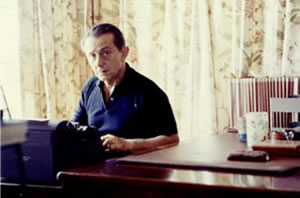
Glendon Swarthout (8 april 1918 – 23 september 1992)

Affiche voor de film (1976) met John Wayne 


De Duitse schrijver Martin Grzimek werd geboren op 8 april 1950 in Trutzhain, Hessen. Zie ook mijn blog van 8 april 2009 en ook mijn blog van 8 april 2010
 

Uit: Die unendliche Straße


»Hagen?«

Das war meine Mutter. Ich nahm meine Sporttasche, ließ Malte w 2iter durch die Luft sausen, hörte sein Schreien und Jammern und ging durch die Terrassentür ins Haus.

Ich wusste schon, was mich meine Mutter fragen würde. Und es kam prompt.

»Na, hast du heute ein paar Körbe geworfen?«

»Drei«, log ich.

Meine Mutter hatte damals ein ganz spitzes Gesicht. Sie hatte eine Diät gemacht und 'ne Menge

Kilos abgenommen. Sie war richtig zierlich, und ich war schon einen Kopf größer als sie. Immer trug sie Hosen, ich habe sie nie in einem Rock oder einem Kleid gesehen. Eigentlich sah sie aus wie ein

Junge, oder sie wollte zumindest einer sein, glaube ich heute.

Malte schrie immer weiter. Meine Mutter, die Maria hieß, von uns Kindern aber Mam genannt wurde, stand mit einem Messer in der Hand vor mir. Sie hatte Zwiebeln geschnitten und ihre Augen waren gerötet.

»Super — drei Körben«, sagte sie und sah mich an.

Ich blickte weg und wusste schon, dass sie mich durchschaut hatte.

Trotzdem log ich weiter: »Wir haben gewonnen.«


889686-687e09ef322ef86f6443cc242d5a95d2.jpg
Martin Grzimek (Trutzhain, 8 april 1950)


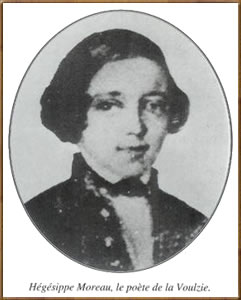
De Franse dichter en schrijver Hégésippe Moreau (eig. Pierre-Jacques Roulliot) werd geboren op 8 april 1810 in Parijs. Zie ook mijn blog van 8 april 2007 en ook mijn blog van 8 april 2009 en ook mijn blog van 8 april 2010


Si vous m'aimiez


Ménestrel, qui vais par le monde,

N'ayant rien que mon gai savoir,

Si vous m'aimiez, ô belle blonde,

Je me croirais un riche avoir ;

Comme Pétrarque aux pieds de son idole,

A vos genoux courbé bien bas, bien bas,

J'oublierais tout, voire le Capitole,

Si vous m'aimiez… mais vous ne m'aimez pas.


Si vous m'aimiez, ô belle blonde,

De vos baisers seuls j'aurais faim,

Et, sourd à son voisin qui gronde,

Mon cœur s'enivrerait enfin ;

Cœur mendiant, il va, de femme en femme,

Criant misère, et sans secours, hélas !

Le pauvret meurt : il renaîtrait, madame,

Si vous m'aimiez… mais vous ne m'aimez pas.


Et mes chansons fraîches écloses,

Au vent du matin et du soir,

Iraient à vous, comme les roses

Qui pleuvent devant l'ostensoir.

Purifiant l'air de Paris, madame,

Où vous iriez j'irais, et, sur vos pas,

Comme un parfum je brûlerais mon âme,

Si vous m'aimiez… mais vous ne m'aimez pas.


Sur vous, grand' dame que l'on flatte,

Un lorgnon d'or s'est promené,

Et par le nœud d'une cravate

Voilà votre cœur enchaîné.

D'un plus heureux que l'hommage vous plaise

Souriez-lui, marchez fière à son bras ;

Son bras ! demain je saurais ce qu'il pèse,

Si vous m'aimiez… mais vous ne m'aimez pas.


 889686-a89c0f8d8d7656b842b9e137d8e941a0.jpg

Hégésippe Moreau (8 april 1810 – 20 december 1838)


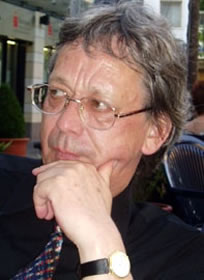
De Duitse dichter Johann Christian Günther werd geboren op 8 april 1695 in Striegau. Zie ook mijn blog van 8 april 2007. Zie ook mijn blog van 8 april 2007 en ook mijn blog van 8 april 2009 en ook mijn blog van 8 april 2010


Brüder, laßt uns lustig sein  


Brüder, laßt uns lustig sein,

Weil der Frühling währet

Und der Jugend Sonnenschein

Unser Laub verkläret.

Grab und Bahre warten nicht;

Wer die Rosen jetzo bricht,

Dem ist der Kranz bescheret.

Unsers Lebens schnelle Flucht

Leidet keinen Zügel,

Und des Schicksals Eifersucht

Macht ihr stetig Flügel.

Zeit und Jahre fliehn davon,

Und vielleichte schnitzt man schon

An unsers Grabes Riegel.


Wo sind diese, sagt es mir,

Die vor wenig Jahren

Eben also, gleich wie wir,

Jung und fröhlich waren?

Ihre Leiber deckt der Sand,

Sie sind in ein ander Land

Aus dieser Welt gefahren.


Wer nach unsern Vätern forscht,

Mag den Kirchhof fragen;

Ihr Gebein, so längst vermorscht,

Wird ihm Antwort sagen.

Kann uns doch der Himmel bald,

Eh die Morgenglocke schallt,

In unsre Gräber tragen.


Unterdessen seid vergnügt,

Laßt den Himmel walten,

Trinkt, bis euch das Bier besiegt,

Nach Manier der Alten!

Fort! Mir wässert schon das Maul,

Und, ihr andern, seid nicht faul,

Die Mode zu erhalten.


Dieses Gläschen bring ich dir,

Daß die Liebste lebe

Und der Nachwelt bald von dir

Einen Abriss gebe.

Setzt ihr andern gleichfalls an,

Und wenn dieses ist getan,

So lebt der edlen Rebe.


889686-3747010b19367ac50ad4833256664764.jpg
Johann Christian Günther (8 april 1695 – 15 maart 1723)

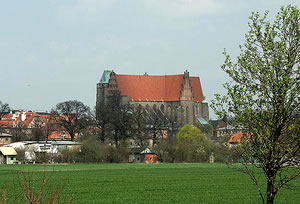
Striegau (tegenwoordig Pools Strzegom)

Geschreven door Romenu om 17:25 Reageer op dit bericht

Meer van Romenu

↑ Terug naar de berichten