Naar de inhoud

Romenu

Over literatuur, gedichten, kunst en cultuur
seniorennet.beseniorennet.be

Berichten van 4 mei 2013

Adriaan Roland Holst, Amos Oz, Christiaan Weijts, Monika van Paemel, Graham Swift


Bij 4 mei


1385791-2fac0887b7920e2b10e90005666b9b51.jpg 

Monument op de Dam met de tekst van Roland Holst


"Nimmer, van erts tot arend, was enig schepsel vrij onder de zon, noch de zon zelve, noch de gesternten. Maar geest brak wet en stelde op de geslagen bres de mens. Uit die eersteling daalden de ontelbaren. Duchtend zijn hoge blik deinsden hun zwermen binnen de wet terug en werden volkeren en stonden elkander naar het leven, onder nachtgewolkten verward treurspel, dat wereld heet. Sindsdien werd geen mens vrij dan ontboden van boven zijn dak, geen volk dan beheerst van boven zijn torens. Blijve ons dat bij, verlost als we werden uit het schrikbewind van een onderwereld. Niet onbeheerst, doch enkel beheerst van boven de wereld blijft vrijheid ons deel."


 1385791-b96926f57f11ab157c28d4bb9c2ee81d.jpg

Adriaan Roland Holst (23 mei 1888 - 5 augustus 1976)

Hier met prinses Beatrix en prins Claus bij zijn 80e verjaardag.


De Israëlische schrijver Amos Oz, (eig. Amos Klausner) werd geboren in Jeruzalem op 4 mei 1939. Zie ook alle tags voor Amos Oz op dit blog.


Uit: A Tale of Love and Darkness


“Consequently through the summer there was always a hint of winter in our home.
Visitors would say: It's always so pleasant here in a heat wave, so cool and fresh, really chilly, but how do you manage in the winter? Don't the walls let in the damp? Don't you find it depressing?
Books filled our home. My father could read sixteen or seventeen languages and could speak eleven (all with a Russian accent). My mother spoke four or five languages and read seven or eight. They conversed in Russian or Polish when they did not want me to understand. (Which was most of the time. When my mother referred to a stallion in Hebrew in my hearing, my father rebuked her furiously in Russian: Shto s toboi?! Vidish malchik ryadom s nami!-What's the matter with you? You can see the boy's right here!) Out of cultural considerations they mostly read books in German or English, and presumably they dreamed in Yiddish. But the only language they taught me was Hebrew. Maybe they feared that a knowledge of languages would expose me too to the blandishments of Europe, that wonderful, murderous continent.
On my parents' scale of values, the more Western something was, the more cultured it was considered. For all that Tolstoy and Dostoevsky were dear to their Russian souls, I suspect that Germany-despite Hitler-seemed to them more cultured than Russia or Poland, and France more so than Germany. England stood even higher on their scale than France. As for America, there they were not so sure: after all, it was a country where people shot at Indians, held up mail trains, chased gold, and hunted girls.
Europe for them was a forbidden promised land, a yearned-for landscape of belfries and squares paved with ancient flagstones, of trams and bridges and church spires, remote villages, spa towns, forests, and snow-covered meadows.”

 1385791-d38294db029bc1d7b4a2f1f38632cfa8.jpg

Amos Oz (Jeruzalem, 4 mei 1939)


De Nederlandse schrijver Christiaan Weijts werd geboren in Leiden op 4 mei 1976. Zie ook alle tags voor Christiaan Weijts op dit blog.

Uit: ART. 285b


“Agent 13706 gebruikt initialen in plaats van zijn voornaam, waarschijnlijk zodat hij op die manier zijn slachtoffers onder aan elke brief triomfantelijk in het gezicht kan uitlachen. Daarnaast moet het caps-lockvertoon in combinatie met wat rake archaïsmen het hele epistel van een dreigende klankkleur voorzien. Waar de schrijver, dat moet ik hem nageven, knap in geslaagd is, want volledig op mijn gemak voel ik me niet.
Op een ochtend lag ik in bed. Victoria kieperde een stapel kleren uit haar kast, en begon er enthousiast in te rommelen. Op nogal agressieve toon zei ze: 'Flikker toch op met je fifty ways to leave your lover.' Ze ging een van de vriendjes die haar leven passeerden voor het laatst zien. 'Er zijn er maar twee. Uit de trein springen of eerst wachten tot ie stilstaat. Luister je?'
Ik luisterde. Ze was, daar kwam het kort gezegd op neer, nu al zo vaak gesprongen, dat ze wel eens wilde proberen hoe het beviel om eerst aan de noodrem te trekken.
Ze poseerde voor zichzelf in de spiegelende schuifdeur van haar klerenkast, in een zwart jurkje dat ze weer uittrok. Ik ging rechtop zitten om haar borsten te kunnen zien. (Haar prachtige borsten, daarover hoop ik in de loop van dit relaas nog veel te zullen spreken).
'Ik ben daar geloof ik niet zo goed in,' zei ik, 'in dat springen.' Ze wurmde zich weer in een volgend model, dat sterke gelijkenissen vertoonde met het eerste, en zweeg.
'Jij kan dat,' drong ik aan, 'genadeloos zijn, en hard. Ik kan dat niet.'
'Dat komt,' zei ze, geërgerd, alsof het iets was waar allang algehele consensus over bestond, 'omdat jij een vrouw bent en ik een man.' En ze liep de deur uit om een relatie te gaan beëindigen.
Kennelijk beviel de nieuwe tactiek maar matig, want bij mij, niet veel later, ging ze weer terug op de springmethode. Het is een gekke gewaarwording als je coupégenoot ineens uit de trein is gesprongen. Je waagt dan toch nog maar een telefoontje naar degene die in het weiland ligt na te rollen.”


 1385791-fa895e14e6b3740eb77a1c877f885c8a.jpg

Christiaan Weijts (Leiden, 4 mei 1976)


De Vlaamse schrijfster Monika van Paemel werd geboren op 4 mei 1945 in Poesele in Oost-Vlaanderen. Zie ook alle tags Monika van Paemel op dit blog.


Uit: Een klomp met een zeiltje


“De Nederlandse ambassadeur in België verschijnt op de televisie. Clichés worden uitgewisseld. Of Nederlanders echt geloven dat Belgen dom zijn? Welnee, de ambassadeur kent zelfs een Belg die een winstgevend zaakje heeft opgezet met het verkopen van Nederlanders. Hoezo? Nou, hij koopt ze voor wat ze waard zijn, en verkoopt ze voor wat ze denken dat ze waard zijn. Terwijl de ambassadeur olijk in de camera blikt, merkt in de huiskamer een Belgische kijker op: ‘Als die Hollander denkt dat we daar intrappen...’

Buren verkeren niet met elkaar, maar met elkanders vooroordelen. Ik ben ouderwets opgevoed, als de oogkleppen te klein dreigden te worden werden ze vervangen door grotere, maar ik was nieuwsgierig en achterdochtig, en wilde alles zelf uitzoeken. Het zou met mij slecht aflopen. Dat klopt: ik ben schrijver geworden en mijn boeken worden in Nederland uitgegeven.

Nederlanders werden verondersteld zuinig zoniet schraperig te zijn, gewiekst dus zakelijk onbetrouwbaar, ze zagen eruit als doorgeschoten waterplanten en hun eten leek nergens op. Bovenal waren ze protestants, ze geloofden in het woord en lazen boeken. Hun zal veel vergeven worden, dacht ik.

Dat was het begin van een dubbelzinnige situatie die ik ruiterlijk wil toegeven voor ik me in het diepe stort. De uitgever koopt mijn werk voor wat het hem waard is, en verkoopt het voor veel minder dan het waard is, en door die leesafwijking van de Nederlanders worden we daar allebei beter van. Tenminste, dat is de bedoeling.

Kritiek is ondankbaar en lof onbetrouwbaar, maar laat het door de laatste der Belgen geschreven zijn: Goed dat het er is, Nederland!”


 1385791-7652413b856bd680ce3455ca68631d21.jpg

Monika van Paemel (Poesele, 4 mei 1945)


De Engelse schrijver Graham Swift werd geboren op 4 mei 1949 in Londen. Zie ook alle tags voor Graham Swift op dit blog.


Uit: The Light of Day


"Tea, I think, Reet. Nice and strong."

She's wearing the pale pink top, soft wool, above a charcoal skirt. Round her neck a simple silver chain. The small twinkly stud earrings, a waft of scent. She always gets herself up well, Rita. We have to meet the public, after all.

But the pale pink is like a flag, her favourite colour. A very pale pink—more like white with a blush. I've seen her wearing it many times. I've seen her wearing a fluffy bathrobe of the same soft pink colour, loosely tied, tits nuzzling inside. Bringing in morning tea.

I go into my office, leaving the door open. The sun is streaming through my first-floor window, the low, blinding sun of a cold November morning, the sun Rita never gets in her compartment, except through the frosted glass of my door.

She follows me in with the tea, and a mug for her- self, a bundle under her arm. There's always this morning conference—my office door open—even as I settle myself in, take off my coat, switch on my own computer, sit down. The sun's warm through the glass, even if outside the air's icy.

She puts down my tea, already sipping her own, eyeing me over the rim. She slips the bundle onto my desk, pulls round the other chair—the "client's chair." She steps through bars of bright light.

It's like a marriage really. We've both thought it. It's better than a lot of marriages (we know this). Rita—my assistant, my associate, my partner, or not-quite partner. Her job description has never exactly been set in stone. But I wouldn't dream of calling her my receptionist (though
 she is that too) or even my secretary.

"Be an angel, Reet."

"I am an angel, George."

Where would I be without her?


 1385791-ea8ca0fdb4db4e7453774d02d4791f11.jpg

Graham Swift (Londen, 4 mei 1949)


Zie voor nog meer schrijvers van de 4e mei ook mijn vorige twee blogs van vandaag.
Geschreven door Romenu om 13:32 Reageer op dit bericht

David Guterson, Jan Mulder, Werner Fritsch, Olia Lialina

De Amerikaanse schrijver David Guterson werd geboren op 4 mei 1956 in Seattle. Zie ook alle tags voor David Guterson op dit blog.


Uit: Snow Falling on Cedars


“Ishmael saw something else, too. On the far side of the car, with her own shovel in hand, Hatsue worked without looking up. She was digging through the snow to the black earth of the cedar woods and throwing spadefuls of it underneath the tires.
Fifteen minutes later the three of them walked down the road toward his DeSoto. The Willys station wagon's rear right tire had been perforated by a fallen branch still wedged up under both axles. The rear length of exhaust pipe had been crushed, too. The car wasn't going anywhere--Ishmael could see that--but it took Hisao some time to accept this truth. With his shovel he'd struggled defiantly, as if the tool could indeed change the car's fate. After ten minutes of polite assistance Ishmael wondered aloud if his DeSoto wasn't the answer and persisted in this vein for five minutes more before Hisao yielded to it as an unavoidable evil. He opened his car door, put in his shovel, and came out with a bag of groceries and a gallon of kerosene. Hatsue, for her part, went on with her digging, saying nothing and keeping to the far side of the car, and throwing black earth beneath the tires.
At last her father rounded the Willys and spoke to her once in Japanese. She stopped her work and came into the road then, and Ishmael was granted a good look at her. He had spoken to her only the morning before in the second-floor hallway of the Island County Courthouse, where she'd sat on a bench with her back to an arched window just outside the assessor's office. Her hair had been woven then, as now, into a black knot against the nape of her neck. She'd told him four times to go away.”

 1385787-079530f846b238bc9257c4d4b5043b7e.jpg

David Guterson (Seattle, 4 mei 1956)


De Nederlandse columnist, schrijver, ex-voetballer, en televisiepersoonlijkheid Jan Mulder werd geboren in Bellingwolde op 4 mei 1945. Zie ook alle tags voor Jan Mulder op dit blog.


Uit: Doodstil


“Stilte is prettig en goed zonder zoektocht door de geest. Je dient het te ervaren, kort en krachtig, lang en mooi als je wilt, op momenten die je overvallen. Hem opzoeken om jezelf te vinden gaat over een dwaalspoor. Ik ben nog nooit iemand tegengekomen die zichzelf had gevonden en de vindplaats glashelder kon aanwijzen.’

(…)


‘De ene stilte is de andere niet, zelfs wanneer ze uit dezelfde categorie komen: de stilte in de middag en die van ’s nachts. De stilte is ondefinieerbaar en bedrieglijk. Een moment denk je dat de stilte van een cirkel groter is dan die van een vierkant en vijf minuten later komt de twijfel: een vierkant is ook wel cool.’

(…)


‘Nergens is de woede verschrikkelijker dan in de stilte van een volmaakt vredig landschap. Ik kom daar later in dit verslag op terug met een verklaring uit de hemel die zal worden voorgelezen door mijn advocaat, mits hij nog in leven is.’


 1385787-1121c65b0558f2799218dfe7833139d1.jpg

Jan Mulder (Bellingwolde, 4 mei 1945)


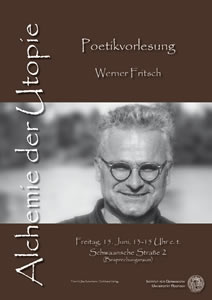
De Duitse schrijver Werner Fritsch werd op 4 mei 1960 in Waldsassen geboren. Zie ook alle tags voor Werner Fritsch op dit blog.


Uit: Faust Sonnengesang. Ein Filmgedicht (Fragment)


„I. FARADAYKÄFIG DES JETZT

FAUST: STIMME: WERNER FRITSCH

Dies ist ein Film des Jetzt

Gott Stein Herz ich

Über die Himmel

Dieser Seele hin

Über die Abgründe

Faust ins Jetzt

Zu übersetzen aus Atem

Geht alles hervor

Im Wind steigt

Alles empor alles

Fiel der Gottheit

Fließendes Licht dein Blut Elias

Dein Gott Stein Herz

Ich auf die Welt herab

Schwarzes Loch aus Mord

Und Mode und doch

Unter milderem Himmel

Lebte ich wie durch

Ein Wunder als Kind

Und wohin der Geist

Mich zu gehen hieß

Dahin flog ich und was

Ich sein wollte floß

Im Rauschen des Baches fort

Und von meinem Herzen

Gingen Blitze Gottes Augen

Aus mich überall zu begleiten

Im Bernstein im Gold

Im Schwarz deiner Pupillen

So sehe ich mich“


 1385787-46ed897830ed2e074cc04f3aa4da42b8.jpg

Werner Fritsch (Waldsassen 4, mei 1960)

Affiche voor een lezing


De Russische netkunstenares
Olia Lialina werd geboren op 4 mei 1971 in Moskou. Zie ook alle tags voor Olia Lialina op dit blog.


Uit: Invisible and Very Busy


“Computers are getting invisible. They shrink and hide. They lurk under the skin and dissolve in the cloud. We observe the process like an eclipse of the sun, partly scared, partly overwhelmed. We divide into camps and fight about advantages and dangers of The Ubiquitous. But whatever side we take — we do acknowledge the significance of the moment.

With the disappearance of the computer, something else is silently becoming invisible as well — the User. Users are disappearing as both phenomena and term, and this development is either unnoticed or accepted as progress — an evolutionary step.

The notion of the Invisible User is pushed by influential user interface designers, specifically by Don Norman a guru of user friendly design and long time advocate of invisible computing. He can be actually called the father of Invisible Computing.

Those who study interaction design read his “Why Interfaces Don’t Work” published in 1990 in which he asked and answered his own question: “The real problem with the interface is that it is an interface”. What’s to be done? “We need to aid the task, not the interface to the task. The computer of the future should be invisible!”

It took almost two decades, but the future arrived around five years ago, when clicking mouse buttons ceased to be our main input method and touch and multi-touch technologies hinted at our new emancipation from hardware. The cosiness of iProducts, as well as breakthroughs in Augmented Reality (it got mobile), rise of wearables, maturing of all sorts of tracking (motion, face) and the advancement of projection technologies erased the visible border between input and output devices. These developments began to turn our interactions with computers into pre-computer actions or, as interface designers prefer to say, “natural” gestures and movements.”


 1385787-535fffab43a7498ef65fcda3b8328022.jpg

Olia Lialina (Moskou, 4 mei 1971)


Zie voor nog meer schrijvers van de 4e mei ook mijn vorige blog van vandaag.

Geschreven door Romenu om 13:25 Reageer op dit bericht

Jacques Lanzmann, Ishita Bhaduri, Gerlind Reinshagen, Maxence Van der Meersch, Wilhelm Lehmann

De Franse schrijver, journalist en tekstschrijver Jacques Lanzmann werd geboren op 4 mei 1927 in Bois-Colombes. Zie ook alle tags voor Jacques Lanzmann op dit blog.


Uit: Le têtard


“J'avais quinze ans et je ne voulais pas mourir sans avoir fait l'amour et la Résistance, mais c'était bien plus facile de tuer un soldat allemand qu'une obses­sion sexuelle.
Il y avait soixante camions et je ne sais combien de bagnoles à gazogène pleins à ras bord de gars et de matériel.
Les camions étaient poussifs, mais les poitrines cognaient si fort et les gorges sous les drapeaux chantaient tellement que les moteurs semblaient marcher à l'enthousiasme.
En traversant Vieille-Brioude réveillée par l'événe­ment, j'ai aperçu les grands-parents qui se tenaient sur le pas de la porte. Anna et Léon, nés l'un en Lettonie, l'autre en Biélorussie, applaudissaient en Auvergnats cette longue colonne de maquisards motorisés qui transportaient leurs fils et leurs petits-fils, sang pogromisé et chair de victime, vers l'ultime étape de la francisation.
Moi, je m'étais toujours senti plus français que juif, mais aussi bien plus rouquin que français et juif. J'étais un rouquin-français-juif de parents divorcés-citadins transplanté-analphabète-et-paysan ; un vrai poil de carotte sans vraie famille, mais avec des fami­liers. Et, parmi les plus familiers, il y avait mon frère Claude, ma soeur Evelyne, le René et le Père Tavernier, la Mère Yvonne, le gars Bébette et la soeur de René Raymond. Dans le temps, il y avait eu ma mère : dans le présent, il y avait mon père. Mais, comme ils étaient séparés par les sentiments et l'Occupation, ça ne faisait pas une famille.
À Groutel, j'avais souffert de mes cheveux rouges, j'étais un dépigmenté, un poil de brique, un maudit petit rouquin qui avait pris le soleil à travers une passoire. À Melun, j'eus à faire face à ceux qui me reprochaient - et c'étaient généralement les mêmes -ma rouquinerie et ma juiverie. Chez les Bongrand, le poil avait de nouveau primé ; eux, ils ne savaient pas que j'étais juif, mais ils voyaient que j'étais rouge. Et, quand le Marcel ou l'Albert rentrant des champs s'atta­blaient en disant : «Dis donc, la mère, on se taperait bien un coup de rouquin», je me sentais visé et je l'étais.”


1385784-552ea9c44de0462e32d5e599879d61c2.jpg
Jacques Lanzmann (4 mei 1927 – 21 juni 2006)


De Indiase dichteres Ishita Bhaduri werd geboren op 4 mei 1961 in Kolkata in West-Bengalen. Zie ook alle tags voor Ishita Bhaduri op dit blog.


To Moon or Elsewhere


Let us go to Moon or to Mars


*


No empty space remains here.
On railway-tracks, in between the Gulmohors,
Atop coconut trees
How did so many skyscrapers spring up?


*


Even a small piece of land is not available here.
Let us leave the grasslands then,
and fly into the sky.
There we will build a thatched roof –
our own dream house.
That is better,
That is the best.


*


Despair be kept aside,


*


The whole sky is there for us.


Vertaald door Soma Roy


 1385784-8338ae974c0123edde6bf7412a8c9c1a.jpg

Ishita Bhaduri (Kolkata, 4 mei 1961)

Hier met dichter Samsur Rahman (links)


De Duitse schrijfster Gerlind Reinshagen werd geboren op 4 mei 1926 in Königsberg. Zie ook alle tags voor Gerlind Reinshagen op dit blog.


Uit: Nachts

“"Wenn Sie abends um sechs telefonieren, und sie haben lauter Singles dran, die telefonieren und telefonieren und telefonieren, ist immer besetzt. Es gibt so unendlich viele einsame Leute, Singles, und sie brauchen es alle, sie wollen sich nicht so bloßstellen mit ihrem Gerede, aber man merkt bis zum Schluss, sie sind auf den anderen angewiesen, um sich selber auch zu erklären, um selber erkannt zu werden. Das Wichtigste war mir bei dem alten Mann, dass er zu dem Schluss kommt, dass die meisten alten Leute weggehen müssen, ohne dass sie als etwas Besonderes erkannt worden sind, was jeder möchte. Das war für mich ganz wichtig, das Erkanntwerden, das beinahe wichtiger ist als eine Liebesbeziehung oder eine Freundschaft."

(…)


"Das ist auch eine Unzufriedenheit mit sich selbst, weil er will ja nicht reden, er geniert sich ja auch, er möchte was loswerden, er möchte Zuwendung, und er redet und er redet, und im Grunde ist es ihm ein bisschen peinlich, und dann sagt er, hören Sie auch zu, er kriegt sie immer ran, hören Sie, und bitte machen Sie nicht noch was anderes, Sie sollen genau zuhören, Sie können nicht nähen und zuhören zusammen."


 1385784-a2160b0b6a6007abd5843dd45654a5eb.jpg

Gerlind Reinshagen (Königsberg, 4 mei 1926)


De Franse schrijver van Vlaamse afkomst Maxence Van der Meersch werd geboren op 4 mei 1907 in Roubaix. Zie ook alle tags voor Maxence Van der Meersch op dit blog.


Uit: La maison dans la dune


“Sylvain allait de maison en maison proposer du tabac belge.

Il avait, pour sonner aux portes et faire ses offres à ses clients, une façon à lui, la façon des fraudeurs, qui ne savent jamais s’ils vont voir devant eux un ami ou un ennemi. Il appuyait sa bicyclette contre le mur, allait tirer la sonnette, et revenait à son vélo. Il l’enfourchait, posait le pied sur la pédale, se tenait prêt à démarrer. La porte s’ouvrait.

« Pas de tabac ? soufflait Sylvain.

– Pas cette semaine. »

La porte se refermait. Et Sylvain s’en allait plus loin, sonner à une autre porte.

Sylvain était un homme de trente ans, grand et large d’épaules, avec une tête qui plaisait par

quelque chose de naïf et de franc répandu sur ses traits. Il avait des cheveux châtains, mal plantés,

taillés en brosse et dominant son front haut. Son nez d’ancien boxeur était aplati et élargi à la base,

sans être pour cela complètement déformé. Ses yeux bruns étaient petits et brillants, – celui qu’on lui voyait, tout au moins, car l’autre était entièrement masqué par une énorme enflure violacée. ela l’enlaidissait, lui déformait le visage, sans parvenir à rendre antipathiques ses traits où se lisait une certaine douceur candide contrastant singulièrement avec son physique d’athlète. Il était vêtu en maçon. Il portait un lourd pantalon de velours d’Amiens, immense, descendant en vastes plis le long de ses jambes, et retenu à la taille par une ceinture de flanelle bleue. Sur le torse, il avait une espèce de gilet, taillé dans le même velours côtelé, et sur lequel étaient cousues des manches de lustrine noire solide. Aux pieds, des espadrilles blanches maculées.”


1385784-5612b346b3e182d011c4350fc32f764f.jpg 

Maxence Van der Meersch (4 mei 1907 - 14 januari 1951)


De Duitse schrijver en dichter Wilhelm Lehmann werd geboren op 4 mei 1882 in Puerto Cabello. Zie ook alle tags voor Wilhelm Lehmann op dit blog.


Atemholen

Der Duft des zweiten Heus schwebt auf dem Wege,
Es ist August. Kein Wolkenzug.
Kein grober Wind ist auf den Gängen rege,
Nur Distelsame wiegt ihm leicht genug.

Der Krieg der Welt ist hier verklungene Geschichte,
Ein Spiel der Schmetterlinge, weilt die Zeit.
Mozart hat komponiert, und Shakespeare schrieb Gedichte,
So sei zu hören sie bereit.

Ein Apfel fällt. Die Kühe rupfen.
Im Heckenausschnitt blaut das Meer.
Die Zither hör ich Don Giovanni zupfen,
Bassanio rudert Portia von Belmont her.

Auch die Empörten lassen sich erbitten,
Auch Timon von Athen und König Lear.
Vor dem Vergessen schützt sie, was sie litten.
Sie sprechen schon. Sie setzen sich zu dir.

Die Zeit steht still. Die Zirkelschnecke bändert Ihr Haus.
Kordelias leises Lachen hallt
Durch die Jahrhunderte. Es hat sich nicht geändert.
Jung bin mit ihr ich, mit dem König alt.


1385784-30d1e62b0e58ac8ec11d9b08897a2718.jpg 

Wilhelm Lehmann (4 mei 1882 – 17 november 1968)

Geschreven door Romenu om 13:21 Reageer op dit bericht

Meer van Romenu

↑ Terug naar de berichten