

Naar de inhoud

Romenu

Over literatuur, gedichten, kunst en cultuur
seniorennet.beseniorennet.be

Berichten van 23 november 2011

Paul Celan, Marcel Beyer, Jennifer Michael Hecht, Sipko Melissen, Henri Borel

De Duits-Roemeense dichter Paul Celan werd onder de naam Paul Antschel op 23 november 1920 geboren in Czernowitz, toentertijd de hoofdstad van de Roemeense Boekovina, nu behorend bij de Oekraïne. Zie ook alle tags voor Paul Celan op dit blog.


Schliere

Schliere im Aug:
von den Blicken auf halbem
Weg erschautes Verloren.
Wirklichgesponnenes Niemals,
wiedergekehrt.

Wege, halb - und die längsten.

Seelenbeschrittene Fäden,
Glasspur,
rückwärtsgerollt,
und nun
vom Augen-Du auf dem steten
Stern über dir
weiß überschleiert.

Schliere im Aug:
daß bewahrt sei
ein durchs Dunkel getragenes Zeichen,
vom Sand(oder Eis?) einer fremden
Zeit für ein fremderes Immer
belebt und als stumm
vibrierender Mitlaut gestimmt.


Tenebrae

Nah sind wir, Herr,
nahe und greifbar.


Gegriffen schon, Herr,
ineinander verkrallt, als wär
der Leib eines jeden von uns
dein Leib, Herr.


Bete, Herr,
bete zu uns,
wir sind nah.


Windschief gingen wir hin,
gingen wir hin, uns zu bücken
nach Mulde und Maar.


Zur Tränke gingen wir, Herr.


Es war Blut, es war,
was du vergossen, Herr.


Es glänzte.


Es warf uns dein Bild in die Augen, Herr
Augen und Mund stehn so offen und leer, Herr.
Wir haben getrunken, Herr.
Das Blut und das Bild, das im Blut war, Herr.


Bete, Herr.
Wir sind nah.


Spreektralie


Oogbol tussen de spijlen.

Trildiertje ooglid
roeit zich naar boven,
geeft een blik vrij.

Iris, zwemster, droomloos en dof:
de hemel, hartgrijs, moet nabij zijn.

Schuin, in de ijzeren houder,
de walmende spaander.
Aan de lichtzin
herken je de ziel.

(Was ik als jij. Was jij als ik.
Stonden we niet
onder één en dezelfde passaat?
We zijn vreemden.)

De plavuizen. Erop,
dicht bij elkaar, de beide
hartgrijze poelen:
twee
mondvol zwijgen.


Vertaald door Frans Roumen


1038055-42d263f8e9a1c9afb52e7526f7d2802d.jpg
Paul Celan (23 november 1920 – 20 april 1970)

Celan (rechts) met vriend Klaus Demus in Parijs, 1953 


De Duitse dichter, schrijver en essayist Marcel Beyer werd op 23 november 1965 in Tailfingen / Württemberg geboren. Zie ook alle tags voor Marcel Beyer op dit blog.


Uit: Spione


„Er hat sich gleich an sie erinnert. Ihren Namen hat er durch bloßen Zufall auf einem Plakat entdeckt, an einer Litfaßsäule. Ein Operngastspiel in der Heimatstadt. Sie waren Nachbarn und haben zusammen gespielt, meist nur sie beide weil die Nachbarskinder das Mädchen oft geärgert haben. Wegen der Augen, diesem Blick an ihr. Erst wurde sie, dann auch er ausgelacht. Doch ihm haben die Italieneraugen immer gefallen. Sie ist in ihrer Familie die einzige mit solchen Augen, die Eltern und Geschwister haben eine andere Augenfarbe, soweit er sich erinnert. Das alles ist mehr als zehn Jahre her.
Als er am Vormittag in der Stadt ihren Namen gelesen hat, ist es ihm gleich so vorgekommen, als hätte er immer nur nach diesen Augen gesucht. Der Vormittag war warm, die ersten Frühlingstage, er hat nicht lange überlegt, er ist ins nächste Blumengeschäft gelaufen und hat einen Strauß bestellt, noch ehe er wußte, ob er überhaupt eine Eintrittskarte bekommen würde.
Er wird sie nach der Vorstellung in ihrer Garderobe überraschen. Die Blumen werden dort schon stehen, wenn er kommt. Er ist auf der Suche nach ihren Augen. Am Abend wird er sie gefunden haben.
Vor einem Jahr noch hätte er das nicht getan. Der Arbeitslose, dann Gelegenheitsarbeiter wäre nicht in die Oper gegangen. Nicht der Hausierer über Land, der mit seinem Musterkoffer von Hof zu Hof gezogen ist, in ausgetretenen Schuhen. Nicht der Propagandist, der vor dem Kaufhaus Zauberputzmittel und Gemüseschäler angepriesen hat, neuartige Lockenwickler für die Wasserwelle daheim. Noch als Elektrohilfe wäre er seiner Kindheits- und Jugendfreundin nicht unter die Augen getreten, ein halbes Jahr lang hat er in einer neuen Siedlung Leitungen gelegt, oben hinter der Schanze, wo der Schießstand ist.”


 1038055-11a16d0edf9bc88524c335bf775ea3c7.jpg

Marcel Beyer (Tailfingen, 23 november 1965)


De Amerikaanse dichteres en schrijfster Jennifer Michael Hecht werd geboren op 23 november 1965 in New York. Zie ook alle tags voor Jennifer Michael Hecht op dit blog.


Chicken Pig


It’s like being lost

in the forest, hungry, with a

plump live chicken in your cradling

arms: you want to savage the bird,

but you also want the eggs.


You go weak on your legs.

What’s worse, what you need

most is the companionship,

but you’re too hungry to know that.

That is something you only know after

you’ve been lost a lot and always,


eventually, alit upon

your bird; consumed her

before you’d realized what

a friend she’d been, letting you

sleep-in late on the forest floor

though she herself awoke

at the moment of dawn


and thought of long-lost

rooster voices quaking

the golden straw. She

looks over at you, sleeping,

and what can I tell you, she loves

you, but like a friend.


Eventually, when lost

in a forest with a friendly chicken

you make a point of emerging

from the woods together,

triumphant; her, fat with bugs,

you, lean with berries.


Still, while you yet wander,

you can not resist telling her

your joke:


Guy sees a pig with three legs,

asks the farmer, What gives?

Farmer says, That pig woke  

my family from a fire, got us all out.

Says the guy, And lost the leg thereby?

Nope, says the farmer,

Still had all four when he took

a bullet for me when I had

my little struggle with the law.

Guy nods, So that’s where

he lost his paw? Farmer shakes

it off, says, Nah, we fixed him up.

A pause, guy says, So how’d he lose

the leg? Farmer says, Well, hell,

a pig like that

you don’t eat all at once.


 1038055-be5714d36f0fa41bdf64774598bb2d1d.jpg

Jennifer Michael Hecht (New York, 23 november 1965)


De Nederlandse dichter en schrijver Sipko Melissen werd geboren in Scheveningen op 23 november 1944. Zie ook mijn blog van 23 november 2010.


Uit: Spiegelpanden


"Als tijdens het werken op de computer een ernstige fout optreedt, bestaat de mogelijkheid terug te keren naar een zelfgekozen moment in het verleden, een moment waarop de fout zich nog niet heeft voorgedaan, het zogenaamde herstelpunt. Vanaf dat punt kan men opnieuw verder gaan, alsof er niets is gebeurd.
Welk moment zou hij als herstelpunt kiezen?"

(…)


" Of die vijf dagen Ameland precies zo waren geweest als beschreven in het boekje of dat zij zwaarder waren aangezet, wat deed dat ertoe? Uit het priegelschrift in het donkere boekje was Kars, de meest dode van allen, na meer dan twintig jaar opgestaan, in volle wapenrusting, een flesje pils in de ene hand, een sigaret in de andere, een beetje doorgezakte schouders, een houding tegenover het leven waarvoor de term cynisch in aanmerking kwam bij gebrek aan beter. In de stilte van de nacht was het of Paul door het leven van Kars kon kijken. Scherper dan ooit zag hij het dodelijk ongeluk, waar Kars zich verantwoordelijk voor had gevoeld, niet alleen de sleutel tot zijn leven, maar ook tot zijn dood.’


1038055-0de4b24af8821e0a05181c972eb4bbe5.jpg
Sipko Melissen (Scheveningen, 23 november 1944)


De Nederlandse schrijver en journalist Henri Jean Francois Borel werd geboren in Dordrecht op 23 november 1869. Zie ook mijn blog van 23 november 2010.


Uit: Vlindertje


„Ziezoo Pim, dat is dus uitgemaakt, wit serge zal het zijn, en natuurlijk tailor-made, dat waren we allebei ééns. Maar nu de voering, dat is altijd een heel ding, zie je, wat denk je dáár van, gele zij of wit satijn?...’

‘- Je weet wel dat je ze allebei kunt dragen, Ellie, wit en geel sta an je allebei goed... 't Is eigenlijk een lastig geval. ... Maar als je 't mij vraagt vind ik wit je toch nog 't beste staan. ... 't Is of dat geel eigenlijk altijd een beetje minder goed doet tegen je blonde haar. ... Maar je moet het natuurlijk zelf weten. ...’

‘- Zóó, vin je? ... Ja, daar is ook wel iets van aan. ... Ik had het anders al zoo héélemaal met dat geel bedacht. Als ik het costuumpje met gele zij had laten voeren, had ik er ook een geel zijden blouse bij genomen, gegarneerd weet je, met entre-deux van witte kant bijvoorbeeld. ... En dan een groote hoed van wit stroo er bij, óók met iets geels, gele rozen bijvoorbeeld, gele handschoenen, en een geelgevoerde parasol. ... Dat zou wel aardig kunnen worden ... je weet, die tailormade costuumpjes staan me zoo goed ... maar als je nu denkt dat al dat geel niet goed doet tegen mijn haar. ...’

‘- Ik ben geen orakel Ellie,’ - zei Pim - ‘en ik heb er ook eigenlijk geen verstand van, al beweer je altijd van wèl ... maar als je nu met alle geweld mijn opinie er over wilt hebben, moet ik je ook eerlijk zeggen wat ik vind, hè? ... Nu, léélijk vind ik dat geel niet, dat zég ik niet ... 't doet zelfs meestal juist héél goed bij blonden, dat weet ik wel ... maar joúw blond is zoo héél apart, dat wéét je heel goed, Ellietje, en 't is niet om je eens een complimentje te maken ... er is zooiets van de echte zonnestralen in, iets dat bijna brandt, zou ik zeggen ... ik vind dat het beter doet bij jou met wit....

‘- Nu, wat zou je dán willen, wijsneus?’

‘- Wit serge, net als je zegt, en tailor-made óók, maar ik zou het voeren met wit, met wit satijn, en géén zijde. ... En nu de blouse ... laat eens kijken ... die zou ik blauw nemen, kindje lief, een blauw-zijden blouse, zoo van dat licht-turquoise blauw ... dát vind ik iets voor jou, en je zult eens zien hoe je dat staat ... het mooiste strandfiguurtje wordt je er mee, wát ik je zeg ... je garneering vind ik goed, met witte entre-deux, uitstekend zelfs, en dan moet je de sluiting maken met van die knoopjes van kristal, die vind ik zoo aardig.... Zou je dat bevallen? ...’


1038055-f89fcbfa8fd264b826ef1bbaa3c1e4b7.jpg
Henri Borel (23 november 1869 - 31 augustus 1933)


Zie voor nog meer schrijvers van de 23e november ook mijn vorige blog van vandaag.
Geschreven door Romenu om 20:45 Reageer op dit bericht

Sait Faik Abasıyanık, Guy Davenport, Nigel Tranter, Marieluise Fleißer, Nirad C. Chaudhuri

De Turkse schrijver Sait Faik Abasıyanık werd geboren op 23 november 1906 in Adapazarı. Zie ook mijn blog van 23 november 2008 en ook mijn blog van 23 november 2010.


Uit: Hisht, Hisht!... (Vertaald door Ufuk Özdağ)


„I WAS WALKING. The more I walked, the better I started to feel about things. I’d left home with so much anger piled up inside me. Maybe it was the razor blade that made me so angry. Oh yes, certainly. The razor blade! For sure, that’s what got me so mad.

The green of the grass, the blue of the sea, cloudless clear skies . . . Well these, mind you, are things to ponder, certainly. Who on Earth would deny this? Foolishness! What if it rained . . . what if the green grass was purple . . . what if the blue sea was red . . . If that were the case, that would be a thing to worry about, indeed.

I saw a leaf the color of chocolate, a goat the color of green almond. Someone, from behind, called out:

Hisht!

I turned around to check. The still not-so-tall fresh thistles at the edge of the road and the French lavender stared at me with a plum-tasting look. My teeth squeaked. There was no one on the road, not a single soul. I saw the roof of a house, one or two birds flying in the distance, the sea through the leaves. As I continued walking, I heard:

Hisht, hisht!

I wanted to turn around and look. Maybe because I wanted to so much I could not. Well, that could be it. Maybe a bird flew overhead, sounding hisht hisht. Maybe a snake, a tortoise, or a hedgehog passed from behind me. Perhaps there is a certain beetle, sounding like hisht hisht.“


 1038052-aec0e21b93f70795b526df4fec7c4bba.jpg

Sait Faik Abasıyanık (23 november 1906 – 11 mei 1954)

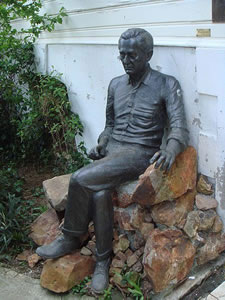
Standbeeld op het eiland Burgazada


De Amerikaanse schrijver, vertaler, schilder, illustrator
Guy Mattison Davenport werd geboren op 23 november 1927 in Anderson, South Carolina. Zie ook mijn blog van 23 november 2008 en ook mijn blog van 23 november 2010.


Uit: An Introduction to Archilochos


„Of the Greek poets of the seventh century BC we know almost nothing and none of their poems has come down to us entire. Archilochos was a professional soldier from the Aegean island of Paros; Sappho a member of a distinguished family on Lesbos, an island off the coast of Asia Minor; and Alkman was a slave and choirmaster in the Lydian city Sardis before he emigrated, or was sold to, Sparta, where he wrote the two hymns, to Artemis and Hera, which assure him a place all his own in literature.

        Archilochos is the second poet of the West. Before him the archpoet Homer had written the two poems of Europe; never again would one imagination find the power to move two epics to completion and perfection. The clear minds of these archaic, island-dwelling Greeks survive in a few details only, fragment by fragment, a temple, a statue of Apollo with a poem engraved down the thighs, generous vases with designs abstract and geometric.

        They decorated their houses and ships like Florentines and Japanese; they wrote poems like Englishmen of the court of Henry, Elizabeth and James. They dressed like Samurai; all was bronze, terra cota, painted marble, dyed wool, and banquets. Of the Arcadian Greece of Winckelmann and Walter Pater they were as ignorant as we of the ebony cities of Yoruba and Benin. The scholar poets of the Renaissance, Ambrogio Poliziano and Christopher Marlowe, whose vision of antiquity we have inherited, would have rejected as indecorous this seventh-century world half oriental, half Viking. Archilochos was both poet and mercenary. As a poet he was both satirist and lyricist. Iambic verse is his invention. He wrote the first beast fable known to us. He wrote marching songs, love lyrics of frail tenderness, elegies. But most of all he was what Meleager calls him, "a thistle with graceful leaves." There is a tradition that wasps hover around his grave. To the ancients, both Greek and Roman, he was The Satirist.“


 1038052-1f9b4e55689d8dff91de70a5c6a74c9b.jpg

Guy Davenport (23 november 1927 – 4 januari 2005)


De Schotse schrijver en historicus Nigel Tranter werd geboren op 23 november 1909 in Glasgow. Zie ook mijn blog van 23 november 2008 en ook mijn blog van 23 november 2010.
 

Uit: The Queen’s Scotland


„The first and second floors are vaulted, and the latter has a handsome pillared fireplace and a delightful little vaulted oratory, only seven feet square, with holy-water stoup, aumbry and pointed-arched window. Also a tiny laird's bedchamber above at half-floor level, with a private stair, and a squint-hole to look down unseen into the hall. The building is in the care of the Department of the Environment, and open to the public. The Auchinlecks or Afflecks of that Ilk were hereditary armour-bearers to the Earls of Crawford, and one did homage to Edward of England in 1306. The family provided a number of provosts for Dundee. The modern mansion stands near by, where the key is obtained. The last of the name to hold the lands disposed of them to one Robert Reid in the mid-17th century. Reid of Affleck was forfeited for his share in the Rising of 1745.


The village of Craigton is small, a scattered place but pleasant, lying at the other, east, end of the reservoirs. On the wooded Downie Hill to the south, within the large Panmure estate, are two features. One, highly obvious, is the tall chimney-like tower 105 feet high, rising out of curious small rustic chambers at ground level. This is known as the "Live and Let Live Monument", and was erected by the tenantry of Lord Panmure in 1839, in enduring testimony to the kindness and generosity of the laird, William Ramsay Maule, created 1st Lord Panmure after the forfeiture of his ancestor, the 4th Earl of Panmure, for his Jacobite activities. Seven counties can be seen from the parapet of the monument, which is a conspicuous landmark from the sea.“


 1038052-b167da26d3c9977fe6e79828eb3e8988.jpg

Nigel Tranter (23 november 1909 – 9 januari 2000)


De Duitse schrijfster Marieluise Fleißer werd geboren op 23 november 1901 in Ingolstadt. Zie ook mijn blog van 23 november 2008 en ook mijn blog van 23 november 2010.
 

Uit: Hiltrud Häntzschel: Marieluise Fleißer. Eine Biographie


„In Elaine Feinsteins Roman Loving Brecht (London 1993) tritt zwar keine Fleißer-Figur auf, aber im Kern erzählt er die Fleißer-Brecht-Episode, so wie sie durch die Rezeption von Fleißers Erzählung Avantgarde zur Legende geworden ist. Fleißers Übersetzerin ins Englische, TinchMinter, diente dieser Stoff als Vorlage zu einem Theaterstück: Growing herself some Armour. Johann Kresniks und Uschi Ottens choreographisches Theater Brecht (1998) schwelgt im Leiden der Geliebten und Mitarbeiterinnen durch den sexbesessenen Frauenhasser Brecht; Marieluise Fleißer spielt darin eine zentrale Rolle, und ihre Sprache hat den Ton vorgegeben. Die Theaterstücke Atzenköfls Töchter von Kerstin Hensel und Marieluise von Kerstin Specht (an den Münchner Kammerspielen aufgeführt unter dem Titel Die Rückseite der Rechnungen) waren Ingolstädter Auftragsarbeiten zum 100. Geburtstag der Dichterin 2001, beider Thema ist mehr oder weniger die Lebenserzählung Marieluise Fleißers. Sie ist eine Literatin, die zu Literatur geworden ist. In einer Zeit, da uns Dichter-Heroen und ihre Biographien suspekt sind und absichtsvoll unterlaufen werden, ein ungewöhnlicher Fall.
Jene 1971 von Kroetz geforderte Gesamtausgabe erschien bereits ein Jahr später und stellte einen gewaltigen Kraftakt dar. In einer konzertierten Aktion von Autorin, Herausgeber und Verleger entstand eine dreibändige, ausführlich kommentierte Ausgabe. Kaum ein Text blieb unbearbeitet, sozusagen in letzter Minute wurden neue Fassungen erstellt, neue Titel gefunden; zahlreiche Texte wurden aus dem Gesamtoeuvre ausgeschieden, Anmerkungen unterstützen und steuern die Lektüre, ein Essay des Herausgebers über Leben und Schreiben der Marieluise Fleißer aus Ingolstadt im ersten Band führt in die Lektüre ein und weist dieser die Richtung: "Da bei der Fleißer alles von Biographie ausgeht, da Biographie sich direkt in Literatur umsetzt, schlägt auch die Literatur bei ihr wieder in Biographie zurück."


 1038052-8ae4539ef528b89b35a941496578895a.jpg

Marieluise Fleißer (23 november 1901 – 2 februari 1974)

Omslag biografie 


De Bengaals-Indische schrijver
Nirad C. Chaudhuri werd geboren op 23 november 1897 in Kishoreganj. Zie ook mijn blog van 23 november 2008.


Uit: The Autobiography of an Unknown Indian


„My father and mother were bound to each other by certain common principles and standard of conduct, but otherwise, in appearance, temperament, and outlook, they were the reverse or, if one chooses to say the same thing in a different way, the complement of each other. My mother was as slight and fragile as my father was robust, while her face was as responsive as my father's was impassive. It rippled to emotions as waters to the wind. It was quite out of the question for her to try to hide any feeling.We always saw at a glance whether she was angry or pleased and regulated our movements accordingly. Altogether, she was always vivid and highstrung, if not hectic and electrical. Even when she was young there were two deep vertical wrinkles between her eyebrows, which in normal cases would have signified a bent for thought. But my mother was not intellectual, although when she chose to be argumentative she could be devastatingly logical. Her natural propensity was intuitive, and those wrinkles were produced by the frequent fits of introspective brooding into which

she fell.

She was not handsome, but no more was she plain. Her forehead was very well-shaped without being high, and the oval of her face was broad in its upper half but very quickly ing and tapering in the lower. Her eyes were large and liquid, her nose very regular and prominent, her lips well-cut but tending towards fullness in the lower one. The real weakness of the face was the chin, which though neatly shaped was not weighty enough for the upper part. Then in their entirety, her features give an impression of unsleeping alertness and inexhaustible animation. By nobody would that face have been

called a face of simple and honest goodness alone. The openness, goodness and generosity which were as obvious in that countenance were of an exteremely restless, positive, and winged type.:


 1038052-d9ebd2aea408fd1528cb52de240121e6.jpg

Nirad C. Chaudhuri (23 november 1897 – 1 augustus 1999)

Geschreven door Romenu om 20:39 Reageer op dit bericht

Meer van Romenu

↑ Terug naar de berichten