Naar de inhoud

Romenu

Over literatuur, gedichten, kunst en cultuur
seniorennet.beseniorennet.be

Berichten van 16 februari 2012

Elisabeth Eybers, Anil Ramdas, Ingmar Heytze, Iain Banks, Iris Kammerer, Alfred Kolleritsch
De Zuidafrikaanse dichteres Elisabeth Eybers werd geboren op 16 februari 1915 in Klerksdorp. Zie ook alle tags voor Elisabeth Eybers op dit blog.


Opsomming


Tot dusver kom dit eenvoudig hierop neer:

jy het verduur wat jy geprogrammeer

was om vanaf die aanvang te deurstaan

en benader nou die einde van jou baan.

’n Skroothoop nietighede skep ballas,  

daarmee sou jy ’n hele koffer vol

kon stop om sonder omkyk te verkas,

met rym – indien moontlik – steeds in ’n verfraaiende rol.


Poet as Housewife


Always a broom leaned against a wall,

meals never on time, if they come at all.


Days without dates through which she moves

empty and stubborn, slightly confused.


Ironing hung dejectedly over a chair,

gestures that come from who-knows-where.


Old letters unanswered, piled together,

papers and pills stuffed deep in a drawer.


Thankful to be part of your heart’s great whole

yet devoted to the limits of her own small skull.


O orderly biped, take heed,

leave her alone—let her read.


Vertaald door Jacquelyn Pope


The prayer of stiffening souls


Make us immortal for one single hour,

grant us the folly of one mindless deed!

The eye that for no lasting goal would scour

but, feverish and wide, would only heed

what’s caught in a pale face – the instant’s flare –

not mourning for the ashes when it’s spent,

a scream that hangs there in the listless air

like blood-red rose held in a haze of scent!


Our hearts have never been so still, so bare...

The darkness like a wall begins to tower,

dividing us from life-and-death, and there

we talk of it as late-night hours recede...

Make us immortal for one single hour,

grant us the folly of one mindless deed!


Vertaald door John Irons


 1095278-43512e245a1a0e27534e26100b38e9b1.jpg

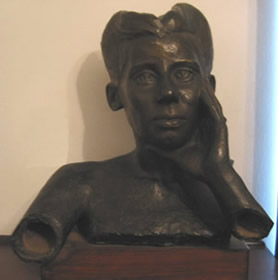
Elisabeth Eybers (16 februari 1915 – 1 december 2007)

Buste door Elsa Dziomba, 1944


De Surinaams-Nederlandse schrijver,columnist, essayist, programmamaker en presentator Anil Ramdas werd geboren in Paramaribo op 16 februari 1958 Zie ook alle tags voor Anil Randas op dit blog.


Uit: Badal


‘Iets wat het midden houdt tussen een kamer en een appartement,’ zei hij tegen de vrouw achter de balie. Een meisje nog maar, zo oud als zijn dochter misschien. Maar zijn dochter was kort en bruin en woonde nu in Londen. Zij was struis en blond en woonde hopelijk niet in Zandvoort. Zo veel ongeluk wenste hij niemand toe.
    ‘Wat het midden houdt…’ zei ze terwijl ze haar hoofd naar voren en naar achteren bewoog en een oog dichtkneep, zoals zwarte meiden deden in Amerikaanse videoclips.
    ‘Ertussenin,’ zei hij.
    Hij zweette. Toen hij het hotel in Amsterdam-Zuidoost verliet had hij het zo koud gehad, dat hij drie T-shirts over elkaar aantrok. Nu zag hij eruit alsof zijn magere lijf was opgeblazen en alsof hij dagen niet geslapen of gedoucht had. En alsof hij die zware koffer op wieltjes niet meer mee zou kunnen trekken en zeker niet op zou kunnen tillen naar de woonruimte die het meisje achter de balie van het makelaarskantoor hem toe zou wijzen.
    ‘O, tussen een kamer en een appartement in. Dat noemen we een studio, meneer,’ zei ze berispend, terwijl ze naar het computerscherm tuurde.
    Een studio, dat klonk gewichtig. Zo’n gewicht wilde hij eigenlijk niet aan zijn ballingschap geven.
    ‘Wanneer zou u het willen betrekken?’
    ‘Nu meteen, als het kan.’
    Ze bleef naar het scherm staren: ‘Gemeubileerd, neem ik aan,’ zei ze half in zichzelf. Het was geen drukke tijd, hij had onderweg overal ‘Zimmer Frei’-bordjes gezien, sommige voor zeventien euro per nacht, inclusief ontbijt.
    Ze liet hem zijn naam spellen. Badal, voorletter H. Ze doorzocht de computerfiles met aangeboden woonruimte en vond een studio voor 690 euro per maand. Dat was meer dan twee tientjes per dag, rekende hij snel uit. Maar dit was geen Zimmer met ontbijt, dit was een studio.”


 1095278-71678b2908c8d60a9d22cfd9618e75c3.jpg

Anil Ramdas ( Paramaribo, 16 februari 1958)


De Nederlandse schrijver en dichter Ingmar Heytze werd geboren op 16 februari 1970 in Utrecht. Zie ook alle tags voor Ingmar Heytze op dit blog.


Mission statement


Klein en geslepen wil ik leven,
een moerasplant die slechts groeit
op weinig licht en zieke lucht.

Ik wens geen verantwoordelijk werk
maar wel kantines vol kroketten
die mij statig uit doen dijen.

En koffie. Liters slappe koffie
tot ik bleek zie als een vis
en nodig op vakantie moet.

Ik wil een alg zijn,
even onbekend als onbekeken
traag vergroeien met bureau en stoel.


Solliciteren


Nog nooit zo tergend opgegeten
als tijdens dit gesprek
door een driedelige gedaste bidsprinkhaan.

Woorden stuiten op tafel, knikkers vallen
op een glasplaat. Hij neemt slokken
van mijn levensloop en boert onaangedaan.

Hij rolt mij in. Hij steekt mij aan
en rookt mij op. Dan mag ik gaan.

Later belt men mijn stoffelijk overschot.
Ik heb de baan.


Gulliver in Amsterdam


Ik kwam om reuzen te aanschouwen en vond dwergen.
Dwergen aan de bar, dwergen in de boekenkasten,
dergen met een praatprogramma,
dwergen zwervend door de hal.

En nergens kon je dansen want de vloeren stonden vol
met dwergen, springend in de sneeuw die stroomde
uit hun binnenzakjes. Met wilde, wijde oogjes
vierden ze kleingeestig feest.

Dwergen klommen op elkaar, zwaaiden met hun handjes
en piepten later in hun krantjes dat het prachtig was geweest.


 1095278-b5a22d0cda7b68577b329ae3b4981c0c.jpg

Ingmar Heytze (Utrecht, 16 februari 1970)


De Schotse schrijver Iain Menzies Banks werd geboren op 16 februari 1954 in Dunfermline, Schotland. Zie ook mijn blog van 16 februari 2009 en ook mijn blog van 16 februari 2010 en ook mijn blog van 16 februari 2011.


Uit: Matter


“A light breeze produced a dry rattling sound from some nearby bushes.  It lifted delicate little veils of dust from a few sandy patches nearby and shifted a lock of dark hair across the forehead of the woman sitting on the wood and canvas camp chair which was perched, not quite level, on a patch of bare rock near the edge of a low ridge looking out over the scrub and sand of the desert.  In the distance, trembling through the heat haze, was the straight line of the road.  Some scrawny trees, few taller than one man standing on another’s shoulders, marked the course of the dusty highway.  Further away, tens of kilometres beyond the road, a line of dark, jagged mountains shimmered in the baking air.

By most human standards the woman was tall, slim and well muscled.  Her hair was short and straight and dark and her skin was the colour of pale agate.  There was nobody of her specific kind within several thousand light years of where she sat, though if there had been they might have said that she was somewhere between being a young woman and one at the very start of middle age.  They would, however, have thought she looked somewhat short and bulky.  She was dressed in a pair of wide, loose-fitting pants and a thin, cool-looking jacket, both the same shade as the sand.  She wore a wide black hat to shade her from the late morning sun, which showed as a harsh white point high in the cloudless, pale green sky.“


1095278-56f609dde4e8618045366f7abb7d1fff.jpg
Iain Banks (Dunfermline, 16 februari 1954)


De Duitse schrijfster Iris Kammerer werd geboren op 16 februari 1963 in Krefeld. Zie ook alle tags voor Iris Kammerer op dit blog.


Uit: Wolf und Adler


„Gaius Cornelius Cinna näherte sich mit forschen Schritten dem Raum, zu dem ein hochnäsiger Tribun ihn geschickt hatte, nachdem er sich wie befohlen im Stabsgebäude des Legionslagers von Mogontiacum eingestellt hatte. Gedämpft drang eine helle Stimme auf den Gang, überschlug sich vor Zorn, als er die von zwei Wachtposten flankierte Tür erreichte. Einer der Soldaten öffnete ihm, Cinna trat ein, und der laute Redeschwall brach ab. Klirrend prallte etwas gegen die Wand dicht neben der Tür. Cinna zuckte zusammen, Tropfen sprühten ihm ins Gesicht. Scheppernd rollte ein zerbeulter Silberbecher vor seine Füße. Er blickte an sich herab, die weiße Tunica mit dem schmalen Purpurstreifen war gesprenkelt von gelblichen Spritzern, und ein dünner Geruch nach Wein stieg ihm in die Nase.
Erbost warf er den Kopf hoch, sah eine stattliche Anzahl hoher Offiziere rings um einen Tisch versammelt, hinter dem ein junger Mann stand, den Arm, der den Becher geschleudert hatte, noch immer erhoben. Alle waren verstummt, nur hier und da ertönte unterdrücktes Lachen.“


 1095278-f6bcea4bb5159bf89bf38dc5933a0624.jpg

Iris Kammerer (Krefeld, 16 februari 1963)


De Oostenrijkse dichter en schrijver Alfred Kolleritsch werd geboren op 16 februari 1931 in Brunnsee, Südsteiermark. Zie ook alle tags voor Alfred Kollertitsch op dit blog.


Anblick


Du am Nebentisch, das Haar
fiel dir so schwarz,
daß die dunklen Augen
sich erhellten.

So leichthin hervorgetreten,
warst du schön, rissen
deine Zähne uns zu dir,
das Spiel.

Auferstanden in den Blicken,
zeigtest du allzuviel,
stritten die Wünsche im Nachbild.


Geheimsprache für H.C.


Wie immer, du warst die Nähe

der Poesie, der Flug

der Wörter ins Weite.

Gewahrend und sanft

ist der Meister der Formen

für die Jüngeren der Jüngere.


 1095278-1a77ac7c59e97c9342cf84ac347f75e0.jpg

Alfred Kolleritsch (Brunnsee, 16 februari 1931)


Zie voor nog meer schrijvers van de 16e februari ook mijn vorige blog van vandaag en eveneens mijn eerste blog van vandaag.
Geschreven door Romenu om 18:21 Reageer op dit bericht

Aharon Appelfeld, Annie van Gansewinkel, Richard Ford, Karl Otto Mühl, Wiebke Lorenz, Vyacheslav Ivanov

De Israëlische schrijver Aharon Appelfeld werd geboren op 16 februari 1932 in Sadhora in de Oekraïne. Zie ook mijn blog van 16 februari 2009 en ook mijn blog van 16 februari 2010 en ook mijn blog van 16 februari 2011.


Uit: Until the Dawn's Light


„They moved from train to train, sped past little stations, stopped at level crossings, and set out again with a rush across broad, flat expanses. It all transpired quickly and with frightening precision, as though they were no longer their own masters but in the hands of the railways, which treated them mercifully and moved them from place to place, almost without pain.
Otto was already four, and his mother regarded him as a big boy. She spoke to him and explained things to him that he certainly couldn’t understand. Her long and convoluted sentences perplexed him, but Blanca was sure he grasped her intention, and she would go on and burden him with more words. True, Otto asked pertinent questions, not because he understood what was happening, but because he was frightfully logical. Blanca, who was proud of his consistent thinking, was afraid now that he would trip her up. To distract him, she told him about things that never were, toyed with his limited memory, and promised him that before long they would get to a magical place.
“Where are we going, Mama?” he kept asking.
“To the north.”
“Is it far from here?”
“Not very.”
“Is the north in the country or in the city?”
“The north is up above, my dear.”
In her heart she knew she mustn’t lie; the boy was sensitive to contradictions. Still, she deceived him, distracted him, and concealed information. Even worse: she made him promises she couldn’t keep. Thus she became the accomplice of the speeding trains: together they confused him.“


 1095269-e00ce77fb5f9ebf4dd0362bfa305d8ba.jpg

Aharon Appelfeld (Sadhora, 16 februari 1932)


De Nederlandse schrijfster Annie van Gansewinkel werd geboren in Weert op 16 februari 1954. Zie ook alle tags voor Annie van Gansewinkel op dit blog.


Uit: De helft van de route


„Het reisverhaal van de debutant naar de tropen lijkt bijna onvermijdelijk te moeten beginnen met de klamme deken die je al op het vliegveld omhult.
Mijn reisverhaal begint met de koude douche in Nederland waar ik enkele dagen eerder in Ivoorkust nog naar snakte. Tussen vertrek in Abidjan op 5 januari en aankomst op Schiphol op 6 januari ligt dertig graden: cold turkey.
De koude douche is Nederland, vrieskou, werk, kilte.
Het ligt niet aan de nieuwe collega's, die maandagochtend op 8 januari. Ze zijn vriendelijk en behulpzaam. Ze doen gewoon hun werk zoals ze dat altijd doen. Redactieoverleg om negen uur en voor het eerst ben ik er bij.
Onder tl-licht aan postformica vergadertafels wordt het landbouwblad voor de komende week gepland. Veel gaat inhoudelijk toch al langs me heen, maar ik ben nu helemaal terecht gekomen in een andere wereld. De mogelijke doorbraak in de bestrijding van aardappelvijand nummer 1: phytophtera en de dramatische prijsval van de nuka's. Ik voel me zelf een nuchter kalf. Volkomen gespeend van de moederlijke warmte. Terug in de werkelijkheid. Met beide voeten terug in de Hollandse klei.
Ik denk aan de woorden die ik tijdens de reis meermalen heb gehoord bij een afscheid. "Je vais vous donner la moitié de la route": Ik zal u de helft van de route wijzen. De andere helft is de terugweg, gezien vanuit de spreker. Hij bedoelt daarmee impliciet dat je terug moet komen.“


1095269-0d883ee313f37435ba3780c56be70f8b.jpg
Annie van Gansewinkel ( Weert, 16 februari 1954)


De Amerikaanse schrijver Richard Ford werd geboren op 16 februari 1944 in Jackson, Missisippi. Zie ook alle tags voor Richard Ford op dit blog.


Uit: The Lay of the Land


„Sponsor conversations address just such problems, often focusing on the debilitating effects of ill-advised impulse purchases or bad decisions regarding property or personal services. As a realtor, I know a lot about these things. Another example would be how do you approach your Dutch housekeeper, Bettina, who's stopped cleaning altogether and begun sitting in the kitchen all day drinking coffee, smoking, watching TV and talking on the telephone long-distance, but you can't figure out how to get her on track, or worst case, send her packing. Sponsor advice would be what a friend would say: Get rid of the boat, or else take some private lessons at the yacht club next spring; probably nothing's all that wrong with it for the time being — these things are built to last. Or I'll write out a brief speech for the Sponsoree to deliver to Bettina or leave in the kitchen, which, along with a healthy check, will send her on her way without fuss. She's probably illegal and unhappy herself.

Anybody with a feet-on-the-ground idea of what makes sense in the world can offer advice like this. Yet it's surprising the number of people who have no friends they can ask sound advice from, and no capacity to trust themselves. Things go on driving them crazy even though the solution's usually as easy as tightening a lug nut.

The Sponsor theory is: We offer other humans the chance to be human; to seek and also to find. No donations (or questions) asked.“


1095269-4391d95a349425ba48d734a898e4581a.jpg
Richard Ford (Jackson, 16 februari 1944)


De Duitse dichter en schrijver Karl Otto Mühl werd geboren op 16 februari 1923 in Nürnberg. Zie ook mijn blog van 16 februari 2009 en ook mijn blog van 16 februari 2010 en ook mijn blog van 16 februari 2011.


Uit: Stehcafé, Geschichten vom Sonntag und anderen Tagen


„Ich parke den Wagen, trotte los und begegne noch weiteren Menschen.
Ein Afrikaner, gefolgt von einer kleinen, klug aussehenden, bebrillten Frau, vielleicht eine Lehrerin, joggt an mir vorüber; kleine Gruppen von Frauen, nicht mehr ganz jung, aber so immer öfter zu sehen, walken mit ihren Stöcken eilig heran; einzelne Väter rennen vorbei, sie schieben dreirädrige Kinderwagen, die geländegängig sind. Männerblicke folgen niedlichen Radfahrerinnen, die von Begleithunden beschützt werden.
Und dann kommt der ersehnte Augenblick. Ich finde die kleine Bäckerei, die am Sonntagmorgen geöffnet hat, bekomme einen Pott Kaffee und ein belegtes Brötchen. Ich schlürfe gierig meinen Kaffee. Draußen ist es windig, aber auch sonnig zwischen weißen, rasch segelnden Wolken.
Aus knapper Entfernung sehe ich, wie der Wind die Bäume im Wald beutelt.
Zwischendurch kommt ein laut schreiender alter Mann herein: Er sei Rentner, habe darum keine Zeit, ob seine Frau da wäre, nein, dann müsse sie ihre Brötchen selber holen, Tschüss. Es ist lustig gemeint, wirkt jedoch ziemlich wichtigtuerisch.
Junge Männer und Mädchen in Gauloises-Sonntagskleidung kommen herein, kaufen Brötchen, abgelöst von einem gepflegten Mädchen, süß aussehend, süß plappernd.
Nacheinander zwei etwa achtjährige Jungen, festen Schrittes, offenen Blickes, präzise bestellend, bitte, danke, stimmt genau, Tschüss und einen schönen Sonntag. Mir bleibt der Mund offen stehen. Das hätte ich als Junge nicht gekonnt.
Wo wird man so gemacht? Ich will zurück, noch mal an den Anfang, auch so werden.“


1095269-53fca8f9071a4ee640863b21ea837f5c.jpg
Karl Otto Mühl (Nürnberg, 16 februari 1923)


De Duitse schrijfster en journaliste Wiebke Lorenz werd geboren op 16 februari 1972 in Düsseldorf. Zie ook alle tags voor Wiebke Lorenz op dit blog.


Uit: Allerliebste Schwester 


„So wird ihr Leben nun also sein. Jeden Tag. Bis ans Ende. Sie steht am Schlafzimmerfenster und sieht, wie Tobias den silbernen BMW-Geländewagen unten in der Auffahrt direkt hinter ihrem schwarzen Mini parkt. Den X5 hatten sie im Frühjahr gekauft und seinen Porsche dafür in Zahlung gegeben. An einem der ersten warmen Tage Anfang März, als sie bereits im vierten

Monat schwanger war.

Jetzt schimmert die Metallic-Lackierung des Autos im matten Licht der Oktobersonne, refl ektiert ein paar Strahlen und blendet sie, einen kurzen Moment ist sie wie blind. Tobias steigt aus, geht um den Wagen herum zur hinteren Tür auf der Beifahrerseite. Gedankenverloren streicht sie über ihren fl achen Bauch, reibt ihn stärker, so lange, bis sich die Haut unter ihrem T-Shirt erwärmt.

Tobias öffnet die Tür, beugt sich ins Auto und löst den Gurt vom Maxi Cosi, in dem der kleine Lukas

schläft. Selbst vom Fenster aus kann sie sehen, wie ihr knapp zwei Monate alter Sohn zuckt und hektisch an seinem Schnuller nuckelt, als würde er träumen. Jetzt ist ihre Haut ganz heiß, sie pulsiert, ihr Körper kribbelt, als wäre sie aus einer Wanne mit eiskaltem Wasser aufgetaucht. Seltsam leicht fühlt sie sich, schwerelos, als würde sie jeden Moment forttreiben.“


 1095269-fb10d2f75ef550feb4b15accfcafc793.jpg

Wiebke Lorenz (Düsseldorf, 16 februari 1972)


De Russische dichter, schrijver, criticus, vertaler en filosoof Vyacheslav Ivanovich Ivanov werd geboren op 16 februari 1866 in Moskou. Zie ook mijn blog van 16 februari 2009 en ook mijn blog van 16 februari 2010 en ook mijn blog van 16 februari 2011.


Poets Of Spirit


The snow is clothed in dawn

In the high desert,

We are oaths of Eternity

In the azure of Beauty.


We are splashes of scarlet foam

On the pallor of the seas.

Renounce your earthly chains

To sit among the kings!


Don't imagine we are dissolving in the sky,

Cut off from the earth: -

A holy path leads

Beyond the clouds into dreams.


1095269-6505f02857a49d08831eab9a0678f509.jpg 

Vyacheslav Ivanov (16 februari 1866 - 16 juli 1949)

Portret door Konstantin Yuon, 1920

Geschreven door Romenu om 18:13 Reageer op dit bericht

Octave Mirbeau, Joseph von Scheffel, Luigi Meneghello, Nikolaj Leskov, Hubert van Herreweghen, Marie Noël

De Franse schrijver, journalist, pamfletschrijver, kunstcriticus en toneelschrijver Octave Henri Marie Mirbeau werd geboren in Trévières (Calvados) op 16 februari 1848. Zie ook mijn blog van 16 februari 2009 en ook mijn blog van 16 februari 2010  en ook mijn blog van 16 februari 2011.


Uit: Le Calvaire


„Je suis né, un soir d’octobre, à Saint-Michel-les-Hêtres, petit bourg du département de l’Orne, et je fus aussitôt baptisé aux noms de Jean-François-Marie Mintié. Pour fêter, comme il convenait, cette entrée dans le monde, mon parrain, qui était mon oncle, distribua beaucoup de bonbons, jeta beaucoup de sous et de liards aux gamins du pays, réunis sur les marches de l’église. L’un d’eux, en se battant avec ses camarades, tomba sur le coupant d’une pierre, si malheureusement qu’il se fendit le crâne et mourut le lendemain. Quant à mon oncle, rentré chez lui, il prit la fièvre typhoïde et trépassa quelques semaines après. Ma bonne, la vieille Marie, m’a souvent conté ces incidents, avec orgueil et admiration.

Saint-Michel-les-Hêtres est situé à l’orée d’une grande forêt de l’État, la forêt de Tourouvre. Bien qu’il compte quinze cents habitants, il ne fait pas plus de bruit que n’en font, dans la campagne, par une calme journée, les arbres, les herbes et les blés. Une futaie de hêtres géants, qui s’empourprent à l’automne, l’abrite contre les vents du Nord, et les maisons, aux toits de tuile, vont, descendant la pente du coteau, gagner la vallée large et toujours verte, où l’on voit errer les bœufs, par troupeaux. La rivière d’Huisne, brillante sous le soleil, festonne et se tord capricieusement dans les prairies, que séparent l’une de l’autre des rangées de hauts peupliers. De pauvres tanneries, de petits moulins s’échelonnent sur son cours, clairs, parmi les bouquets d’aulnes. De l’autre côté de la vallée, ce sont les champs, avec les lignes géométriques de leurs haies et leurs pommiers qui vagabondent. L’horizon s’égaie de petites fermes roses, de petits villages qu’on aperçoit, de-ci, de-là, à travers des verdures presque noires. En toutes saisons, dans le ciel, à cause de la proximité de la forêt, vont et viennent les corbeaux et les choucas au bec jaune.“


 1095263-b76a3e5d8f8126180b5e1bf3edf0a2e7.jpg

Octave Mirbeau (16 februari 1848 - 16 februari 1917)


De Duitse dichter en schrijver Joseph Victor von Scheffel werd geboren op 16 februari 1826 in Karlsruhe. Zie ook mijn blog van 16 februari 2009 en ook mijn blog van 16 februari 2010 en ook mijn blog van 16 februari 2011.


Eine traurige Geschichte


Ein Hering liebt' eine Auster

Im kühlen Meeresgrund;

Es war sein Dichten und Trachten

Ein Kuß von ihren Mund.


Die Auster, die war spröde,

Sie blieb in ihrem Haus;

Ob der Hering sang und seufzte,

Sie schaute nicht heraus.

Nur  eines Tags erschloß sie

Ihr duftig Schalenpaar;

Sie wollte im Meeresspiegel

Beschauen ihr Antlitz klar.


Schnell kam der Hering geschwommen,

Streckt seinen Kopf herein

Und dacht' an einem Kuße

In Ehren sich zu freun!


O Harung, armer Harung,

Wie schwer bist du blamiert!

- Sie schloß in Wut die Schalen,

Da war er guillotiniert.


Jetzt schwamm sein toter Leichnam

Wehmütig im grünen Meer

Und dachte: "In meinem Leben

Lieb' ich keine Auster mehr!"


 1095263-6d551a99670a4359c7f62444350343ad.jpg

Joseph von Scheffel (16 februari 1826 – 9 april 1886)

Monument in Bad Säckingen


De Italiaanse schrijver Luigi Meneghello werd geboren op 16 februari 1922 in Malo. Zie ook mijn blog van 16 februari 2009 en mijn blog van 16 februari 2010.


Uit: Deliver Us


   „ On the Vernacular

     We'd laugh with the servant girls:

     Bianco rosso e verde

     color delle tre merde

     color dei panezèi

     la caca dei putèi.


     White, red and green

     the color of the tree turds

     diaper-color, like

     baby shit.


     This wasn't meant as a criticism of the tricolored national flag, not at all.  The flag was run up on Aunt Lena's balcony, it was described in "Thoughts" at school.  The three turds were lined up in the garden under the Count's wall, as shiny as paint, big flies buzzing around them, and Colomba came and tossed a wet diaper over them and mixed the colors together into a yellowish mess.

White, red, and green was just a phrase in Italian; all the rest was its counterpart in dialect.  But there was a polemical side to all of this: we sensed that dialect gave immediate, almost automatic access to a sphere of reality that for some reason adults wanted to contain and control.“


1095263-d42552966331feade872ae8d71070445.jpg
Luigi Meneghello (16 februari 1922 – 26 juni 2007)


De Russische schrijver Nikolaj Semjonovitsj Leskov werd geboren in Orjol op 16 februari 1831. Zie ook mijn blog van 16 februari 2007 en mijn blog van 16 februari 2010.


Uit: The Steel Flea  (Vertaald door Isabel F. Hapgood) 


“WHEN the Emperor Alexander Pavlovitch had finished the Congress of Vienna he took a fancy to

travel all over Europe and view the  marvels of the different realms. He  journeyed through all lands, and everywhere, by reason of his amiability, he always held the most internecined discussions with all men, and all amazed  him by one means or another and  sought to incline him to their side. But

he had a Cossack of the Don, named  Platoff, attached to his personal service, who did not like this inclination,  and, being homesick for his own hearth-stone, he constantly sought to lure the  Emperor to his home.

So, as soon as Platoff perceived that the Emperor took a deep interest in  any foreign thing and all his suite held  their peace, he began to say immediately: "Thus and so, and we- have the  same thing of our own at home, not  a whit worse," — and then he would  turn him aside in one way or another.

The English people were aware of  this, and had prepared various cunning  devices against the Emperor's arrival,  to the end that they might captivate  him with foreign things, and in many  cases they attained their obje<fl, especially in the great assemblies where  Platoff could not express himself perfectly in French ; but he did not mind  that over-much because he was a married man, and regarded all French conversation as mere emptiness, unworthy  of his imagination.

But when the English began to invite the Emperor to all their arsenals,  armories, shops, and soap-sawing factories, in order to demonstrate their superiority over us in all things, Platoff said to himself: " Come, there has  been enough of this sort of thing. Up to  this point I have endured in patience,  but beyond this 't is impossible. I may  manage to say the right thing or I may  not, but I won't betray my own people."


 1095263-72d42f4590d1abe04f18490af77f4832.jpg

Nikolaj Leskov (16 februari 1831 - 5 maart 1895)

In 1860


De Vlaamse dichter Hubert van Herreweghen werd geboren in Pamel op 16 februari 1920. Zie ook alle tags voor Hubert van Herreweghen op dit blog.


Er is een hemel...


Er is een hemel en een hel,
de rolkans van een teerlingsmete.
Ik die mijn leven heb gemeten,
zijn diepte hoogte lengte breedte,
zijn zorg, zijn dagelijks gekwel,
niets weet ik dan wat ik geweten
altijd en 'k weet het al te wel:
er is een hemel en een hel,
de rolkans van een teerlingsmete.
Al kan ik het een uur vergeten
bij haar zachte lijf, bij wijn en spel,
in Brabant in een bos gezeten,
hij die ik voed onder mijn vel
met adem, gulzige drank en eten,
de dood, zijn etter in 't gezwel,
krijzelt en maant: niets is van tel
dan wat gij altijd hebt geweten:
er is een hemel en een hel,
de rolkans van een teerlingsmete.


 1095263-bbe9aa8773587d45fd870d3cb034a8db.jpg

Hubert van Herreweghen (Pamel, 16 februari 1920)


De Franse dichteres en schrijfster
Marie Noël werd geboren op 16 februari 1883 in Auxerre. Zie ook mijn blog van 16 februari 2009 en ook mijn blog van 16 februari 2010 en ook mijn blog van 16 februari 2011.


La Morte et ses mains tristes


La Morte et ses mains tristes
Arrive au Paradis.
 
« D’où reviens-tu, ma fille,
Si pâle en plein midi
 ?
 
— Je reviens de la terre
Où j’avais un pays,
 
De la saison nouvelle
Où j’avais un ami.
 
Il m’a donné trois roses
Mais jamais un épi.
 
Avant la fleur déclose,
Avant le blé mûri,
 
Hier il m’a trahie.
J’en suis morte aujourd’hui.
 
— Ne pleure plus, ma fille
Le temps en est fini.
 
Nous enverrons sur terre
Un ange en ton pays,
 
Quérir ton ami traître,
Le ramener ici.
 
— N’en faites rien, mon Père
La terre laissez-lui.
 
Sa belle y est plus belle
Que belle je ne suis,
 
Las
 ! et faudra, s’il pleure
Sans elle jour et nuit
 
Que de nouveau je meure
D’en avoir trop souci. »


 1095263-11da4da793a561a4b6e2e6fac0579546.jpg

Marie Noël (16 februari 1883 – 23 december 1967)

Geschreven door Romenu om 18:08 Reageer op dit bericht

Meer van Romenu

↑ Terug naar de berichten