Naar de inhoud

Romenu

Over literatuur, gedichten, kunst en cultuur
seniorennet.beseniorennet.be

Berichten van 17 februari 2011

Shahrnush Parsipur, Sadegh Hedayat, Mo Yan,Yevgeni Grishkovetz, Frederik Hetmann, Emmy Hennings
De Iraanse schrijfster Shahrnush Parsipur werd geboren op 17 februari 1946 in Teheran. Zie ook mijn blog van 17 februari 2008 en ook mijn blog van 17 februari 2009 en ook mijn blog van 17 februari 2010.


Uit: The Story of the Men of Sialk Hills (Vertaald door Steve MacDowell en Afshin Nassiri)


„This was very strange. And they wanted to discuss this strange event with each other, but the people in the line started protesting and asked them to go stand at the end of the line. Hence the tar player and his fiancée started walking toward the end of the line. That is how they followed along the line and passed a few streets and corners. Then they walked along the main highway and reached Baghdad. At that time Baghdad was more or less like the Sialk Hills, hazy and full of dust, but the sound of music could be heard from a small deli around the corner. At this moment the tar player’s fiancée became angry and told him she had always felt that his love for her had never been real and that he only wanted to marry her because of his need for a servant. Otherwise, why would he make her borrow her own mother’s wedding ring? The tar player swore that it was not like that at all, that he sincerely loved her, and that he wanted to marry her. That is how, as they walked with the line, they kept arguing. It was hot, and a swarm of flies were flying around their heads. The man became increasingly irritated and furious. That was why when they got to Damascus he screamed, "What do you want from my life? Do you realize how long we have been arguing?"

At this moment a little event encouraged them to keep to their decision to see the film. That event was a fork in the line.

The man yelled, "You are shameless!"

The girl yelled, "Am I shameless, or are you?"

Without answering her, the man said, "What a slut!"

Red-faced from anger, the girl screamed, "You call me slut?" and she continued to go with the other branch of the line and went away. It was clear that for a long time after this event she did not look back. And in order to prove that he was his own man, he continued to go with the main branch of the line. After a while he stopped and asked one of the people in the line, "Excuse me, what film are you standing in line for?"

The man in the line said, "I want to see the last film of the great director, Edward Muntz, the director who recently passed away."


 854928-d2370c5db214751289d3babf1653abaa.jpg

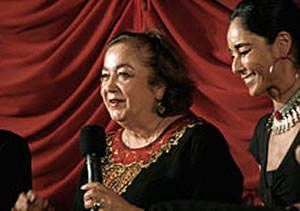
Shahrnush Parsipur (Teheran, 17 februari 1946)


De Iraanse schrijver Sadegh Hedayat werd geboren op 17 februari 1903 in Teheran. Zie ook mijn blog van 17 februari 2010.


Uit: Burried Alive (Vertaald door Carter Bryant)


„My breathing subsisdes. Tears pour from my eyes. My mouth tastes awful. I have fallen onto my bed, my heart convulsed, my body worn out, limp, weak. My upper arms are full of needle punctures from all those injections. The bed reeks of sweat and fever. I glance at the clock on the small table next to my bed; it is ten o´clock Sunday morning.

I look up at the ceiling from the center of which dangles a solitary electric bulb. I glance  around the room: there are small bushes and pink and red flowers on the wall paper and,  set at intervals, two black birds sit on a single branch facing each other. One of the birds  has his beak open as if he were chatting with the other. The designs on the wallpaper are  driving me crazy. I don´t know why, but
whether I roll to this side or that, there they are before my eyes. The single writing table in 
the room is covered with bottles and bolts of cotton and boxes of medicine. The odor of  burned alcohol pervades the room–the odor of a sickroom. I want to get up and open a  window, but an overwhelming feeling of indolence keeps me pinned to the bed. I´d like to  smoke a cigarette but really don´t feel like making the effort. Not even ten minutes have  passed since I shaved the stubble that had grown on my face. I came directly over and  fell onto the bed. When I looked into the mirror to shave I could see I had grown thin and  weak. I walked with great difficulty. The room is a mess. I am alone. A thousand different

thoughts swirl dizzily through my mind. I understand them all, but to convey in writing even the tiniest passing thought or feeling I  would have to tell my life story from beginning to end, and that is simply not possible.

These thoughts and feelings are all the result of some period in my life, the result of  some pattern instilled in me by something I have seen, heard, read, felt, or reflected  upon. All of these thoughts and feelings make up my fanciful, laughable existence.“


854928-e0cea4037f4b80049f0c7d262bf77dd2.jpg
Sadegh Hedayat (17 februari 1903 – 9 april 1951)


De Chinese schrijver Mo Yan werd geboren op 17 februari 1955 in Gaomi in de provincie Shandong. Zie ook mijn blog van 17 februari 2009 en ook mijn blog van 17 februari 2010.


Uit: Horse Talk (Vertaald door Aili Mu)


„It was like a big, thick, bristly brush whisking across my face, waking me from my dream. A lofty shadow swayed before my eyes like a massive black wall. A familiar smell made my heart pound. I suddenly came to my senses. The backdrop of modern life behind me quietly withdrew; the sun shown brightly over that dingy yellow earthen wall. On top of the wall, withered grass rustled; a brightly feathered rooster stretched its neck and crowed heartily. A haystack in front of the wall was crumbling. A flock of hens was digging for food in the scattered hay. There were also several oxen tethered to posts along the wall, all bending their heads and chewing their cud, as if deep in thought. The crooked wooden posts were coated in ox hair, the dirt wall covered with ox dung. I was sitting in front of the haystack. I could reach out and touch the hens; leaning over a little, I could also stroke the oxen. But I didn't touch the hens or stroke the oxen. I looked up at her—my close friend—that old mare, black, worry-laden, with "Z99" branded on her flank, blind, reportedly retired from a field army, currently the wheel horse for our production team, known throughout town for her limitless strength and "all-work, no-complaints" attitude.
"Horse, it’s you!" I jumped up from the haystack and wrapped my arms around her, embracing her strong, thick neck. The warmth and powerful smell of grease from her neck brought a surge of emotions and hot tears that rolled around on her smooth skin. The horse straightened her ears, which looked like whittled bamboo, and said, in a tone of experience and wisdom: "Don't cry, young man, don't cry. I don't like crying. There's no need to cry. Sit up and listen to me." As the horse clicked her neck, I was lifted from the ground like a feather and then landed on my backside by the haystack. I could reach out and touch the hens; leaning over a little I could stroke the oxen.“


 854928-61de2cc54dbec3d1fa1904f6210d01da.jpg

Mo Yan (Gaomi, 17 februari 1955)


De Russische schrijver, regisseur en acteur Yevgeni Grishkovetz werd geboren op 17 februari 1969 in Kemerovo. Zie ook mijn blog van 17 februari 2009 en ook mijn blog van 17 februari 2010.


Uit: Das Hemd (Vertaald door Beate Rausch)


„Obwohl klar ist, daß auf allen Sendern ungefähr das Gleiche läuft. Die Nachrichten sind ungefähr die gleichen, die Musik ... Aber es beunruhigt mich irgendwie ...«, er sprach langsam, ruhig. Man sah, daß er schon lange Leute durch Moskau fuhr. Er wird gefragt, er antwortet. Er wird nicht gefragt, er schweigt. »Übrigens, auch Moskau hat mich früher stark beunruhigt. Solange ich Moskau nicht gut studiert hatte, war ich unruhig, ich konnte nicht schlafen, hatte Angst, etwas zu verpassen. Aber jetzt kenne ich es ... nicht ausgezeichnet, aber eine gute Zwei würde ich mir schon geben. Jetzt habe ich mich beruhigt. Ich bin nicht mehr so zappelig.«

»Lieben Sie Jazz?« Jetzt fand ich es schon interessant, ihm irgendeine Frage zu stellen.

»Lieben wäre zuviel gesagt, ich höre einfach zu. Ich kann gar nicht ohne Musik. Aber jetzt gibt es so viel verschiedene Musik, das regt mich auch auf. Aber Jazz bleibt Jazz. Außerdem findet man bei uns in der Regel, daß Jazz ernsthafte und nicht einfache Musik ist. Jazz hören kluge und nicht einfache Menschen ... Und so behandelt man mich auch, aha, der Mann hört Jazz, also ist er ein ernsthafter Mann. Ohne Erlaubnis raucht hier niemand oder läßt seinen Abfall liegen.«

»Wenn Sie allein fahren, hören Sie dann auch Jazz? Oder gibt es eine Lieblingsmusik, nur für Sie selbst?« Ich war wirklich neugierig.“


 854928-27ae735d6f4b11ba098537b18302baef.jpg

Yevgeni Grishkovetz (Kemerovo, 17 februari 1969)


De Duitse schrijver Frederik Hetmann (eig. Hans-Christian Kirsch) werd geboren op 17 februari 1934 in Breslau. Zie ook mijn blog van 17 februari 2010.


Uit: Traumklänge


„Der Traum, den Izaak mit sich herumtrug, war es, einen großen Roman zu schreiben. Roman hätte er es nur genannt, wenn er nicht darum herumgekommen wäre, mit anderen darüber zu sprechen, was er aber vermied. Eigentlich stellte er sich eine lange Geschichte vor, mit der man lesend nicht so rasch zu Ende kam, eine Geschichte, die Bücher füllte, so dick wie die von Thomas Wolfe oder von Marcel Proust, eine Geschichte, in der man eine Woche Tag und Nacht schmökern konnte, die Welt vergessend, Essen, Trinken, Schlaf, Einsamkeit und die Liebe, und die nach der Lektüre immer noch nicht zu Ende war. Es war seine fixe Idee, dass eine solche Geschichte unbedingt nötig sei für diese Zeit, als Trost, Ermunterung, Freudenfeuerwerk der Fantasie, und er sei dazu ausersehen, sie zu erfinden. Dabei hatte er bisher noch nicht die leiseste Ahnung, wie sie konkret aussehen, von was sie handeln werde. Dennoch gab es sie im Grund genommen schon, und all sein Suchen und Trachten bestand nur darin, sich zu ihr hin zu tasten, sie zu entziffern, und was er selbst in diesen Gewölben und Höhlen, in denen sie lag, vorfand, dann für andere aufzuschreiben.

Freilich musste er auch Geld verdienen. Also arbeitete er als Journalist. Er schrieb über literarische und kulturgeschichtliche Themen für New Yorker Blätter. Er war ein guter Journalist, umfassend literarisch gebildet, und er verdiente nicht schlecht, jedenfalls genug, um bequem zu leben und die Alimente für seine Tochter Rosalie zu zahlen und. Aber in seinem Bewusstsein hielt sich eine Wolkenbank aus Unzufriedenheit. Wie angestrengt er auch nachdachte, sich umsah und meditierte, er

fand das Thema für seinen Roman nicht. Wie er es vor sich selbst ausdrückte: Er tappte in der Höhle, in der die Tafeln der großen Geschichte verborgen lagen, noch völlig im Dunkeln. Das war die ständige Malaise, und dann gab es hin und wieder noch die kleinen Ärgernisse. Ein solches stieß ihm just an diesem Tag, von dem wir erzählen, zu.“


 854928-474651e81295f2a2a1185fcebdac0b41.jpg

Frederik Hetmann (17 februari 1934 – 1 juni 2006)


De Duitse dichteres, schrijfster en caberetiere Emmy Hennings werd geboren op 17 februari 1885 in Flensburg. Zie ook mijn blog van 17 februari 2008 en ook mijn blog van 17 februari 2009 en ook mijn blog van 17 februari 2010.


Traum

Ich bin so vielfach in den Nächten.
Ich steige aus den dunklen Schächten.
Wie bunt entfaltet sich mein Anderssein.

So selbstverloren in dem Grunde,
Nachtwache ich, bin Traumesrunde
Und Wunder aus dem Heiligenschrein.

Und öffnen sich mir alle Pforten,
Bin ich nicht da, bin ich nicht dorten?
Bin ich entstiegen einem Märchenbuch?

Vielleicht geht ein Gedicht in ferne Weiten.
Vielleicht verwehen meine Vielfachheiten,
Ein einsam flatternd, blasses Fahnentuch...


 854928-bb0f087f59e44a06cccbccdb823b3c70.jpg

Emmy Hennings (17 februari  1885 – 10 augustus 1948)


Zie voor nog meer schrijvers van de 17e februari ook
mijn vorige blog van vandaag en eveneens mijn eerste blog van vandaag.
Geschreven door Romenu om 19:09 Reageer op dit bericht

Chaim Potok, Mori Ōgai, Gustavo Bécquer, Georg Britting, Andrew Paterson, Margaret Truman

De Amerikaanse schrijver Chaim Potok werd geboren in New York City op 17 februari 1929. Zie ook mijn blog van 17 februari 2007 Zie ook mijn blog van 17 februari 2008 en ook mijn blog van 17 februari 2009 en ook mijn blog van 17 februari 2010.


Uit: My name is Asher Lev


„My father's great-great-grandfather was in his early years the manager of the vast estates of a carousing Russian nobleman who when drunk sometimes killed serfs; once, in an act of wild drunkenness, he burned down a village and people died. You see how a goy behaves, I would be told by my father and mother. The people of the sitra achra behave this way. They are evil and from the Other Side. Jews do not behave this way. My father's great-great-grandfather had transformed those estates into a source of immense wealth for his employer as well as himself. In his middle years, he began to travel. Why did he travel so much? I would ask. To do good deeds and bring the Master of the Universe into the world, my father would respond. To find people in need and to comfort and help them, my mother would say. I was told about him so often during my very early years that he began to appear quite frequently in my dreams: a man of mythic dimensions, tall, dark-bearded, powerful of mind and body; a brilliant entrepreneur; a beneficent supporter of academies of learning; a legendary traveler, and author of the Hebrew work Journeys to Distant Lands. That great man would come to me in my dreams and echo my father's queries about the latest bare wall I had decorated and the sacred margins I had that day filled with drawings. It was no joy waking up after a dream about that man. He left a taste of thunder in my mouth.

My father's father, the man whose name I bear, was a scholar and recluse in his early and middle years, a dweller in the study halls of synagogues and academies. He was never described to me, but I pictured him as slight of body and huge of head, with eyelids swollen from lack of sleep, face pale, lips dry, the veins showing blue along his cheeks and temples. In his youth, he earned the name "ilui," genius, a term not lightly bestowed by the Jews of Eastern Europe. And by the time he was twenty he had come to be known as the Genius of Mozyr, after the Russian town in which he lived. Shortly before his fiftieth birthday, he abruptly and mysteriously left Mozyr and, with his wife and children, journeyed to Ladov and became a member of the Russian Hasidic sect led by the Rebbe of Ladov. He began to travel throughout the Soviet Union as an emissary of the Rebbe. Why did he travel so much? I once asked. To bring the Master of the Universe into the world, my father replied.“


 854921-aa09e7aaf084a406cdd5ac83d45ae51e.jpg

Chaim Potok (17 februari 1929 – 23 juli 2002)


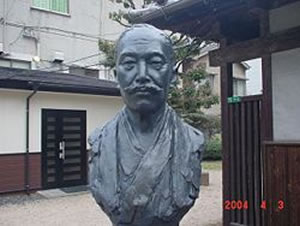
De Japanse schrijver Mori Ōgai werd geboren op 17 februari 1862 als Mori Rintaro in het dorpTsuwano in Iwami. Zie ook mijn blog van 17 februari 2010.


Uit: The Wild Geese (Vertaald door Kingo Ochiai en Sanford Goldstein)


„A good-looking face may influence others, but it alone  does not carry weight in a boardinghouse. Personal be-  havior must also be considered, and I doubt if many  students lived as well-balanced a life as Okada did. He  wasn't a bookworm who worked greedily for examination marks each term and who wanted to win a scholarship. Okada did the required amount of work and was  never lower than the middle of his class. And in his free time he always relaxed. After supper he would take a walk and would return without fail before ten. On Sun-days he rowed or set off on a long hike. Except for periods
of living with his crew before a match or of returning to his home in the country for summer vacations, the time never varied when he was in or out of his room. Often a boarder who had forgotten to set his watch by the signal gun at noon went to Okada's room to find out the time.
And occasionally even the office clock in the Kamijo was put right by Okada. The more we observed him, the stronger became our impression that he was reliable. Even though Okada didn't flatter the landlady or spend much money above his room and board, she began to praise him. Needless to say, the fact that he paid his rent regularly was one of the reasons for her attitude.

She often said: "Look at Mr. Okada!"

But, anticipating her words, some of the students would say: "Well, we can't all be like him."

Before anyone realized it, Okada had become a model tenant.

Okada had regular routes for his daily walks. He would go down the lonely slope called Muenzaka and travel north along Shinobazu Pond. Then he would stroll up the hill in Ueno Park. Next he went down to Hirokoji and, turning into Naka-cho--narrow, crowded, full of activity --he would go through the compound of Yushima Shrine and set out for the Kamijo after passing the gloomy Karatachi Temple. Sometimes he made a slight variation in a particular route, such as a right turn at the end of Naka-cho, so that he would come back to his room along the silence and loneliness of Muenzaka.“


 854921-51454202921edbb9f02047be1dfe2239.jpg

Mori Ōgai (17 februari 1862 – 9 juli 1922)

Beeld in Kokura Kita


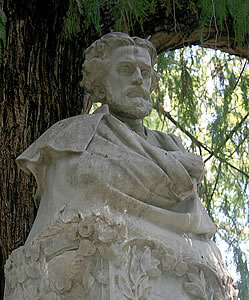
De Spaanse dichter Gustavo Adolfo Bécquer werd op 17 februari 1836 in Sevilla geboren. Zie ook mijn blog van 17 februari 2007 en ook mijn blog van 17 februari 2008 en ook mijn blog van 17 februari 2009 en ook mijn blog van 17 februari 2010.


Schwebende Wolke, duftig und rein


Schwebende Wolke, duftig und rein
Silberne Welle in Mondenschein
Inniges Lied,
Das aufwärts zieht,
Kosender Wind und sein Rauschen dazu,
- Ja - das bist du.

Ein Schatten, du, der aus Äther gesponnen,
Der, will ich ihn fassen, jählings zerronnen,
Wie zuckendes Leuchten, rauschendes Tönen,
Wallender Nebel, heimliches Stöhnen
Der blauen See.

Meer ohne Küste, treibender Schaum,
Irrender Stern im endlosen Raum,
Heiserer Laut
Der Windesbraut,
Sehnende Angst um ein Glück das verblich, -
 Ja - das bin ich.

Ich, der den brechenden Blick nicht vermag
Von dir zu wenden bei Nacht und bei Tag,
Der ein Nichts, ein Phantom, einen Schatten umwirbt,
Und heimatlos irrt und ruhelos stirbt,
- Um einen Traum!


Heut stieg der Himmel


Heut stieg der Himmel auf die Erde wieder, -
Heut kränkt mich nicht des Schicksals Hohn und Spott, -
Heut sah ich sie, und sie - sie sah mich wieder, -
Heut glaube ich an Gott! ...


Vertaald door Richard Jordan


 854921-56576a20551568c7f6b8a72606ef574e.jpg

Gustavo Adolfo Bécquer (17 februari 1836 – 22 december 1870)

Monument in Sevilla (Detail)


De Duitse dichter en schrijver Georg Britting werd op 17 februari 1891 geboren in Regensburg. Zie ook mijn blog van 17 februari 2007 en ook mijn blog van 17 februari 2009 en ook mijn blog van 17 februari 2010.


Uit: Eglseder


„Der kleine, schnellfüßige Mann mit den feurigen Augen war der uneheliche Sohn einer Dienstmagd aus dem Bayerischen Wald. Auf einem Einödhof, nahe der böhmischen Grenze, hatte er das Licht der Welt erblickt. »Das Licht ist aber ziemlich dunkel dort«, sagte er, »schon mehr eine Finsternis!« Maria Walburga Theresia Eglseder, die Mutter, die bald nach der Geburt gestorben war, am Kindbettfieber, hatte den Namen des Kindsvaters nicht zu nennen gewußt, oder sie hatte ihn nicht nennen wollen. »Vielleicht war der ein Böhmak«, vermutete Eglseder, »ein Mausefallenhändler oder ein wandernder Musikant.« Das war ohne Wichtigkeit für ihn, er hatte keinen Ahnenstolz. Daß seine Mutter gleich drei Vornamen gehabt habe! sagten wir. »So ists, so stehts in meinen Papieren«, antwortete er, »aber sonst hatte sie wenig, das heißt, sie hatte nichts. Sie war arm wie eine Kirchenmaus. Ich muß mich mit einem Vornamen durchs Leben schlagen, so sparsam war sie, in dieser Beziehung wenigstens, oder es war Bescheidenheit. Auf den Namen Georg bin ich christkatholisch getauft. Es hat aber nicht viel genützt«, sagte er, »das Wasser machte mich nur naß.« Er lachte.

 Die Frucht der Sünde, mit des Drachentöters Namen, wurde in einem Waisenhaus aufgezogen, fromm und fröstelnd, und lernte das Einmaleins und sein Bett selber zu machen und das Rosenkranzbeten. Mit vierzehn Jahren wurde Eglseder in die Schneiderlehre getan. »Man fragte mich nicht lange«, sagte er, »was ich Lust hätte zu werden, wir waren alle armer Leute Kinder, man verfuhr mit uns, wie man nur eben wollte, und zu einem Schmied, weiß Gott, hätte ich auch nicht getaugt! Ein schmächtiges Knäblein war ich, könnt ihr euch ausmalen, aber zum Zwirneinfädeln, dazu reichte es, und ich war dann sogar gern ein Schneider, und kein schlechter.«


 854921-78eb8c0cf9d54d5d6630657bfa9d4b3c.jpg

Georg Britting (7 februari 1891- 27 april 1964)


De Australische dichter Andrew Barton "Banjo" Paterson werd geboren op 17 februari 1864 in  Narambla in New South Wales. Zie ook mijn blog van 17 februari 2007 en ook mijn blog van 17 februari 2010.


At the Melting of the Snow 


There's a sunny Southern land,

And it's there that I would be

Where the big hills stand,

In the South Countrie!

When the wattles bloom again,

Then it's time for us to go

To the old Monaro country

At the melting of the snow.

To the East or to the West,

Or wherever you may be,

You will find no place

Like the South Countrie.

For the skies are blue above,

And the grass is green below,

In the old Monaro country

At the melting of the snow.


Now the team is in the plough,

And the thrushes start to sing,

And the pigeons on the bough

Sit a-welcoming the Spring.

So come, my comrades all,

Let us saddle up and go

To the old Monaro country

At the melting of the snow.


 854921-edaec9ea2a52bbf38da086a2cf251b72.jpg

Andrew Paterson (17 februari 1864 – 5 april 1941)  


De Amerikaanse schrijfster Margaret Truman werd geboren op 17 februari 1924 in Independence, Missouri. Zie ook mijn blog van 17 februari 2010.


Uit: The President's House


„Once, one of these brides married a president. I am speaking of Frances Folsom and Grover Cleveland. A century or so ago, when I was a twenty-something, I had the pleasure of meeting Mrs. Cleveland, who told me the reason she was married in the White House instead of in her family home: Nowhere else could she and the president have their privacy guaranteed.

The old house is, to put it mildly, a paradoxical place. People who think in straight lines have a very difficult time adjusting to it. And as history has shown again and again, many of them never do. Even so, I think everyone who has ever lived in the White House would agree that it's a special experience--a unique combination of history, tragedy, comedy, melodrama, and the ups and downs of ordinary living all under one roof.


II

Men bearing that unique title, president of the United States, the office my father called "the greatest in the history of the world," have paced the White House's darkened halls in periods of national crisis, gazing at portraits of their predecessors on the walls, seeking communion with their triumphs--or shuddering at their blunders. Women reached out to these men, trying to offer them guidance, or at the very least solace for their awesome burdens. My mother managed to play both roles in my father's presidency--a feat too many obtuse historians and biographers have failed to recognize.“


 854921-4556828eaba64f5ec8c6745bcdd7bbf0.jpg

Margaret Truman (17 februari 1924 – 29 januari 2008)

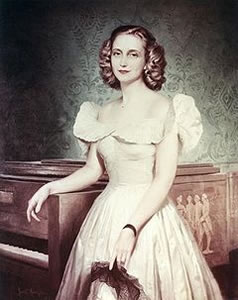
Portret door Greta Kempton

Geschreven door Romenu om 18:59 Reageer op dit bericht

Ruth Rendell, Fjodor Sologoeb, Pêr-Jakez Helias, Georg Weerth, Friedrich Klinger, Louisa Lawson, Maria Rossetti, Max Schneckenburger

De Britse schrijfster Ruth Rendell werd geboren als Ruth Grasemann in Londen op 17 februari 1930. Zie ook mijn blog van 17 februari 2007 en ook mijn blog van 17 februari 2008 en ook mijn blog van 17 februari 2009 en ook mijn blog van 17 februari 2010.


Uit: Some Lie and Some Die


'But why here? Why do they have to come here? There must be thousands of places all over this country where they could go without doing anyone any harm. The Highlands for instance. Dartmoor. I don't see why they have to come here.'
Detective Inspector Michael Burden had made these remarks, or remarks very much like them, every day for the past month. But this time his voice held a note which had not been there before, a note of bitter bewilderment. The prospect had been bad enough. The reality was now unreeling itself some thirty feet below him in Kingsmarkham High Street and he opened the window to get a better—or a more devastating—look.
'There must be thousands of them, all coming up from Station Road. And this is only a small percentage when you consider how many more will be using other means of transport. It's an invasion. God, there's a dirty-looking great big one coming now. You know what it reminds me of? That poem my Pat was doing at school. Something about a pied piper. If "pied" means what I think it does, that customer's pied all right. You should see his coat.'
The only other occupant of the room had so far made no reply to this tirade. He was a big, heavy man, the inspector's senior by two decades, being at that time of life when people hesitated to describe him as middle-aged and considered 'elderly' as the more apt epithet. His face had never been handsome. Age and a very nearly total loss of hair had not improved its pouchy outlines, but an expression that was not so much easy-going as tolerant of everything but intolerance, redeemed it and made it almost attractive. He was sitting at his rosewood desk, trying to compose a directive on crime prevention, and now, giving an impatient shake of his head, he threw down his pen.“


854915-e9b56601b4688c259b5dcfc2d18f9f95.jpg
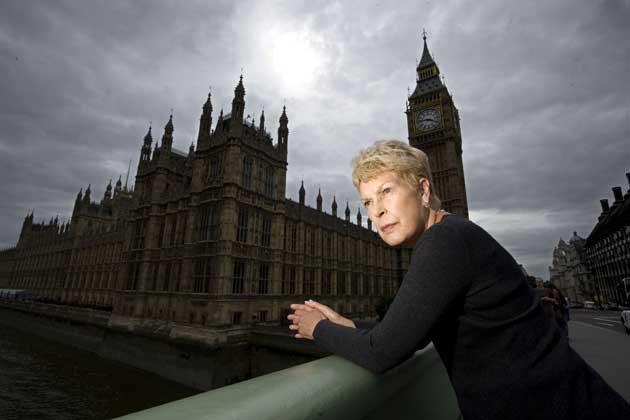
Ruth Rendell (Londen, 17 februari 1930)


De Russische dichter en schrijver Fjodor Sologoeb  (eig. Fjodor Koezmitsj Teternikov) werd geboren in Sint-Petersburg op 17 februari 1863. Zie ook mijn blog van 17 februari 2009 en ook mijn blog van 17 februari 2010.


A Son Was Born To A Poor Peasant 


A son was born to a poor peasant.

A foul old woman stepped inside

The hut, with trembling bony fingers

Clawing her tangled locks aside.


And when the midwife wasn't looking,

Across towards that babe she reached.

And with her gnarled, misshapen fingers

His cheek she very lightly touched.


Mumbling weird words and slowly tapping

Her crooked stick, she went away.

Nobody knew what charm she'd woven,

And so the years went duly by -


The secret spell came to fulfilment:

In life, much sorrow came to him

But happiness, and joy, and true love

Fled the dark sign upon the skin.


854915-c821219a150d1846a34099d22c1d92d5.jpg
Fjodor Sologoeb (17 februari 1863 - 5 december 1927)


De Franse dichter, schrijver en acteur Pêr-Jakez Helias werd geboren op 17 februari 1914 in Pouldreuzig, Penn-ar-Bed. Zie ook mijn blog van 17 februari 2009 en ook mijn blog van 17 februari 2010.


Uit: Légendes de la Mer


„Au pays de Saint-Malo, il y avait naguère plus de fées dans la mer et sur les grèves qu'on ne comptait de bergères dans les landes.
Un soir de lune, une troupe de fées se livraient à la danse ronde. Il arriva que douze jeunes gens étaient en fête, quand ils furent un peu chauds de boire, ils décidèrent d'aller inviter à la contredanse les belles fées de la grève.
Mais, au cours de la danse, elles s'aperçurent que les garçons avaient le souffle court et les jambes de laine, et elles entrèrent en fureur. D'un coup de leur baguette, elles changèrent les malappris en six gros matous noirs et six chattes blanches.
Quand elles virent les pauvres animaux miauler de détresse, la bonté naturelle des fées de Saint-Malo leur attendrit le coeur, et elles promirent aux farauds de les rétablir dans leur forme première aussitôt qu'ils auraient filé, pour chacune d'elles, un manteau d'or et une robe d'argent tissés dans le seul mica de la grève.
La tâche n'eut pas été longue si les fées n'avaient précisé qu'ils ne pourraient filer que durant les douze coups de minuit.
Les six matous et les six chattes se mirent au travail sans attendre. Lorsque toutes les fées furent habillées, elles frappèrent les chats de leur baguette et en refirent des humains. On ne dit pas si plusieurs siècles avaient passés sur leur tête.

Ce qui est sûr, c'est qu'il est très rare de voir de vrais chats s'égarer sur le sable de mer. A Saint-Malo, pourtant, "argent de chat" est le nom du mica gris. Quand ce mica s'allume d'un reflet blond, il devient "l'or de chat", dont se tissait jadis le manteau d'apparat des Dames de la Mer.“


 854915-1e281162bcca730520b4b1f978dc057e.jpg

Pêr-Jakez Helias (17 februari 1914 – 13 augustus 1995)


De Duitse dichter en schrijver
Georg Weerth werd geboren op 17 februari 1822 in Detmold. Zie en ook mijn blog van 17 februari 2010.


Der Wein ist mein Vergnügen!


Der Wein ist mein Vergnügen!

Ich wollt, das ganze Meer

Wär Wein und ich ein Walfisch,

Der schwömme drüber her.


Die Berge, Felsen, Inseln,

Die säuselten sich voll

Des kühlen Tranks und würden

All miteinander toll,


Und fingen an zu tanzen

In ihrer großen Kraft:

Der Nordpol und der Südpol,

Die tränken Bruderschaft.


In langen Zügen schlürfte

Die Sonne aus der Flut,

Verlöre die Balance

Und jagte fort in Wut,


Ergriffe bei den Schultern

Den alten Uranus,

Zu einem Riesenwalzer

Erhöben sie den Fuß.


Kometen, Monde, Sterne,

Die flögen hinterdrein –

Das würd am andern Tage

Ein Katzenjammer sein!


 854915-b44ac6b65f6afc82780ae366613df4e0.jpg

Georg Weerth (17 februari 1822 - 30 juli 1856)


De Duitse dichter en schrijver Friedrich Maximilian Klinger werd geboren op 17 februari 1752 in Frankfurt am Main. Zie ook mijn blog van 17 februari 2009 en ook mijn blog van 17 februari 2010.


Uit: Geschichte eines Teutschen der neusten Zeit


„Der teutsche Mann, dessen Geschichte ich, aus mir selbst aufgelegter Pflicht, zu schreiben unternommen habe, ist durch seine ihm eigne Denkungsart und besondre Stimmung des Herzens ebenso merkwürdig als durch sein Schicksal. Für mich war er eine Erscheinung in der moralischen Welt, einem Luftzeichen ähnlich, das durch seinen strahlenden Ausfluß die Augen so lange ergötzt, als es sich noch am fernen Horizont bildet; zieht es aber im düstern Dunstkreise den Bogen des Himmels herauf, so fliehet der Haufen vor der ihm zweideutigen Erscheinung, und nur der Kundige freut sich, wenn auch unter kleinem Schauder, eine nicht alltägliche Wirkung der Natur gesehen zu haben. Unter diesem Bilde stelle ich euch Ernst von Falkenburg als Jüngling und Mann dar. Als er in blühender Jugend die Bahn des tätigen Lebens betrat, zog er die Blicke der Menschen auf sich; als er aber die Mitte derselben kaum erreicht hatte und Bosheit und Wahnsinn seinen Glanz verdunkelten, ward er eben diesen Menschen ein Gegenstand des Schreckens, des Abscheus. Was er dem Kundigen werden wird, hängt von dieser Geschichte ab. Hier, wo nur Wahrheit spricht, wo nur sie Zweck ist, zieht sich der Schriftsteller zurück.

Von ihr allein geleitet, soll und muß ich dartun, warum, wie und wodurch Ernst von Falkenburg aus dem mildesten, freundlichsten und edelsten Jüngling ein Mann geworden ist, den man in den Gegenden seines Aufenthalts nur zu nennen braucht, um die Herzen erkalten oder ergrimmen zu sehen; den man nie nennt, ohne daß eben die Lippen, welche einst nie ermüdeten ihn lobzupreisen, den Spruch des Hasses und der Verwerfung über ihn aussprechen.“


 854915-a1a9fc562542afd96a30c92b9a1fb684.jpg

Friedrich Maximilian Klinger (17 februari 1752 – 25 februari 1831)


De Australische dichteres, schrijfster, uitgeefster en suffragette Louisa Lawson werd geboren op 17 februari 1848 in Mudgee, New South Wales. Zie ook mijn blog van 17 februari 2009 en ook mijn blog van 17 februari 2010.


A Child's Question


O, why do you weep mother, why do you weep

For baby that fell in the summer to sleep?

You say that you prayed, when she lingered in pain,

That God in His mercy would take her again.

He heeded your prayer, and a beautiful sleep

Stole over our darling; then why do you weep?

You tell how the angels sang paeans of love

To welcome her home to the mansions above,

356ഊWhere lovingly over her spirit they keep

A bright watch forever; then why do you weep?

And have you not told us again and again

That we will yet see her set free from all pain,

Beyond the bright sun where no dark shadows creep?

Then why do you weep, mother? Why do you weep?


 854915-34a240e33a9bca5efd9b9e88f53bf28a.jpg

Louisa Lawson (17 februari 1848 – 12 augustus 1920)


Zie voor onderstaande schrijvers ook mijn blog van 17 februari 2010.


De Engelse schrijfster  Maria Francesca Rossetti werd geboren in Londen op 17 februari 1827.


De  Duitse dichter Max Schneckenburger werd geboren op 17 februari 1819 in Talheim bij Tuttlingen. Zie ook mijn blog van 17 februari 2009.


Geschreven door Romenu om 18:53 Reageer op dit bericht

Meer van Romenu

↑ Terug naar de berichten