Ann De Craemer, Jean Christophe Grangé, Driss Chraïbi, Iris Murdoch, Richard Russo, Jacques Rivière, Rira Abbasi
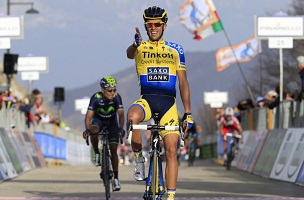
Bij de Tour de France
Alberto Contador
Uit: De seingever
“Hoe kon men op televisie na zijn dood nog vol lof beelden laten zien van zijn `heldhaftige' overwinning in 1999 in Luik-Bastenaken-Luik, als een groot deel van de wielerwereld toen al wist wat David Millar later in zijn boek Koersen in het duister schreef — dat VDB de avond voor La Doyenne elf slaappillen Stilnox had genomen en niet eens meer op zijn benen kon staan of praten? Hoe kon men deze man nog 'god' noemen als bleek dat hij renners uitlachte die geen verboden middelen durfden te nemen? Ik begon de verslaving, de zelfoverschatting, de list en het bedrog van VDB als symptomatisch te zien voor minstens een deel van de wielrennerij. Het moet vanaf dat moment geweest zijn dat ik met cynisme naar de koers begon te kijken. Renners leken wel goden die door hun aanbidders ook hun grootste zonden worden vergeven. Eventjes waren de fans kwaad, maar vervolgens werden de helden van alle verantwoordelijkheid ontslagen door die in de schoenen te schuiven van het geld, de roem, het gebroken sleutelbeen, de kapotte knie, de wielercoach of de media. Ik wist wel dat renners vaak pionnen waren in een groter spel van ploegleiders en commercie. Ik wist ook dat niet alle renners in hetzelfde bedje ziek waren en sommige het spel wel eerlijk speelden — maar waarnaar zat ik in dat geval te kijken? Sport, of slechte cinema? Ik betrapte mezelf erop dat ik steeds vaker cynische, harde opmerkingen maakte over een renner die een explosieve prestatie neerzette: er was vast weer iets aan de hand; wacht maar een paar maanden; we zullen er nog wel van horen. Vaak kreeg ik gelijk. Ik kon de beslissing van de Duitse zenders ARD en ZDF om de Ronde van Frankrijk in 2007 wegens dopingperikelen niet langer uit te zenden begrijpen, en zelf keek ik op een bepaald moment ook niet meer. De Ronde van Frankrijk van 2010 liet ik aan me voorbijgaan, en achteraf bleek dat er met winnaar Alberto Contador ook iets 'niet pluis' was.”
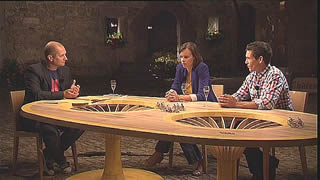
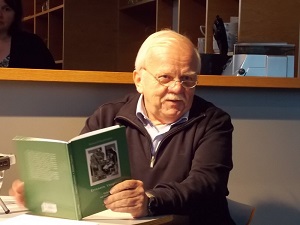
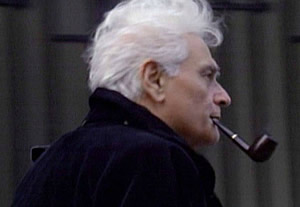
Ann De Craemer (Tielt, 1981)
Hier in het midden tijdens een uitzending van Vive le Vélo
De Franse schrijver Jean Christophe Grangé werd geboren op 15 juli 1961 in Parijs. Zie ook alle tags voor Jean Christophe Grangé op dit blog.
Uit: Congo Requiem
« Selon lui, Grégoire avait commis une erreur : la septième victime présumée de l'Homme-Clou, Catherine Fontana, avait été tuée par quelqu'un d'autre. Mais qu'en sais-tu, nom de dieu ? Il avait tout fait pour l'empêcher de se lancer dans cette vaine croisade mais quand il l'avait vu prendre un congé sans solde au 36 et acheter son billet d'avion, il avait compris que rien ne l'arrêterait. Il avait alors décidé de l'accompagner : après tout, lui aussi avait quelque chose à faire au Katanga... — On y va, patron ? Il se retourna. Michel se tenait au bord du tarmac, un gros trousseau de clés à la main, comme si l'aéroport dans son ensemble était sa propriété. C'était un petit Noir malingre au cou de girafe. Surnommé la Touffe, en raison de son énorme tignasse crépue, il portait un pantalon de tergal et une chemise aux motifs criards. Michel était l'homme de confiance de Morvan — ce qui demeurait à Lubumbashi une notion relative. Il suivit le Black sous le soleil accablant. On n'éprouvait plus rien ici sinon une asphyxie de lumière, une blancheur écrasante qui figeait toute pensée, tout espoir. Le matériel était remisé dans un hangar fermé à double tour, surveillé par des soldats. La Touffe déverrouilla la porte et la fit glisser sur son rail. — Et voilà ! La lumière révéla deux camions à benne Renault, trois 4 x 4 Toyota vidés de leurs sièges passagers — le tout racheté le mois précédent à d'autres groupes miniers. Morvan avait fait voter ce budget à l'assemblée générale de Coltano, compagnie minière qu'il avait lui-même fondée dans les années 90, prétextant une nécessaire remise à niveau des installations autour de Kolwezi. En réalité, il avait dans l'idée d'exploiter en douce de nouveaux filons découverts par ses experts géologues. Une vraie manne. Il s'approcha et vérifia que les roues, les volants et les moteurs étaient toujours en place. — Le carburant ? — Là-bas. Il n'alla pas jusqu'à vérifier les barils : il y avait plus important. »

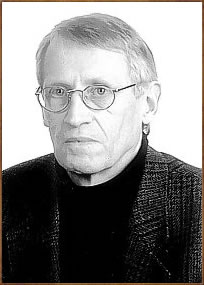
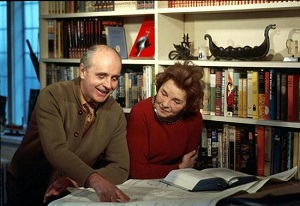
Jean Christophe Grangé (Parijs, 15 juli 1961)
De Marokkaanse schrijver Driss Chraïbi werd geboren in El Jadida op 15 juli 1926. Zie ook alle tags voor Driss Chraïbi op dit blog.
Uit: La Civilisation, ma Mère !...
« Nagib a remis la porte d’entrée sur ses gonds, a fait craquer ses doigts et nous a dit:
-Venez voir, mes agneaux, la splendeur des splendeurs.
Nous sommes montés et nous avons vu. Par terre, dans le salon, il y avait des planches, deux ou trois encore entières, les autres en éclats. Des morceaux de fil de fer, des clous tordus. Et au milieu de tout cela, quelque chose de noir, pesant, oblong, qui tenait du coffre et de l’armoire. Avec un cadran, deux boutons et une plaque de métal où était gravé en relief un mot que je ne comprenais pas : BLAUPUNKT.
Ma mère a considéré Nagib et a levé les bras au ciel. Puis elle a considéré le meuble, longuement ; a tourné tout autour, les mains dans le dos; a tapoté le cadran, tourné les boutons. Et comme le meuble ne réagissait pas, elle s’est arrêtée et m’a dit :
-Qu’est-ce que c’est, cette chose ?
-Blo Punn Kteu, ai-je répondu.
-Quoi ?
- Blo Punn Kteu.
Elle s’est mise tout de suite en colère, comme si le feu couvait depuis longtemps en elle.
-Quelqu’un dans cette maison veut-il m’expliquer de quoi il s’agit ?
-Ce qu’il a dit n’est pas tout à fait exact, a fait remarquer mon frère. Moi aussi, je sais lire. Il y a écrit : « Bla Upunn Kteu ».
Je me suis mis en colère à mon tour.
- Blo Punn Kteu !
-Non, monsieur, a dit Nagib. B-L-A, Bla, Upunn Kteu. C’est comme ça , mon petit !
-Seigneur Dieu ! s’est écriée ma mère en se tordant les mains. Qu’est-ce qu’ils me racontent, ces monstres que j’ai mis au monde ! Allez-vous m’expliquer à la fin ?
-C’est la radio, a répondu Nagib. La radio, quoi !”

Driss Chraïbi (15 juli 1926 – 1 april 2007)
De Iers-Britse schrijfster en filosofe Iris Murdoch werd geboren in Dublin op 15 juli 1919. Zie ook alle tags voor Iris Murdoch op dit blog.
Uit:The Black Prince
''Christian.'
This was the name, not pronounced now in my presence for very many years, of my former wife.
I opened the door wider and the person on the step, whom I now recognized, slipped, or dodged, into the flat. I retreated into the sitting-room, he following.
'You don't remember me.'
'Yes, I do.'
'I'm Francis Marloe, you know, your brother-in-law.'
'Yes, yes —'
'As was, that is. I thought you should know. She's a widow, he left her everything, she's back in London, back in your old place —'
'Did she send you?'
'Here? Well, not exactly —'
'Did she or didn't she?'
'Well, no, I just heard through the lawyer, She's back in your old place! God!'
'I see no need for you to come —'
'So she's written you? I wondered if she'd have written you.'
'Of course she hasn't written to me!'
'I thought of course you'd want to see her —'
'I don't want to see her! I cannot think of anyone I less want to see or hear of!'
I shall not attempt here to describe my marriage. Some impression of it will doubtless emerge. For the present story, its general nature rather than its detail is important. It was not a success. At first I saw her as a life-bringer. Then I saw her as a death-bringer. Some women are like that. There is a sort of energy which seems to reveal the world: then one day you find you are being devoured. Fellow victims will know what I mean. Possibly I am a natural bachelor. Christian was certainly a natural flirt. Sheer silliness can be attractive in a woman. I was, of course, attracted. She was, I suppose, a rather 'sexy' woman. Some people thought me lucky. She brought, what I detest, disorder into my life. She was a great maker of scenes. In the end I detested her."

Iris Murdoch (15 juli 1919 – 8 februari 1999)
Cover
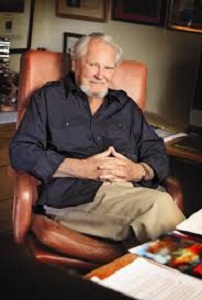
De Amerikaanse schrijver Richard Russo werd geboren op 15 juli 1949 in Johnstown, New York. Zie ook alle tags voor Richard Russo op dit blog.
Uit:Trajectory
“Thirty-two degrees, according to the dashboard thermometer, so . . . maybe. In warm weather the garage door duti-fully lumbered up and over the section of bent track, but below freezing it invariably stuck and you had to get out, remote in hand, and manually yank the door past the spot where it caught. Within a few degrees of freezing, though, it was anybody’s guess, so Ray pressed the remote and opened the driver’s-side door, pre-pared to get out if he needed to. When the door shuddered past the critical point and up along the ceiling, he closed the car door again, noticing as he did so that Paula, his wife, was watching him with her O ye of little faith expression.
Pulling inside, he made sure to leave her enough room to get out. Two-car was how the garage had been described when they bought the house. Ray, himself a realtor and all too familiar with such dubious representations, had squinted at the phrase in the listing information, then at the garage itself. It was probably true it could hold two small sedans, but with anything larger you’d need to pull the first car in at an angle to have enough space for the second vehicle. He’d considered calling Connie, the seller’s agent, on this, but he liked her, in particular how she confessed right up front that she’d just gotten her license. She seemed genu-inely terrified of saying the wrong thing, of disclosing something that by law wasn’t supposed to be mentioned or of failing to dis-close something else that was mandatory. She’d gone into real estate, she claimed, because she liked helping people find what they wanted, and she seemed blithely innocent of the fact that most people had no idea what that was, especially the ones who were defiantly confident they did. Ray doubted she would last long and wasn’t surprised when, a year later, he ran into her and was told she’d embarked upon a degree in social work.
Anyway, Paula had loved the house and didn’t want to see the not-quite-two-car garage as a problem, though she conceded they’d probably have to find someplace else for the lawn mower and the other stuff they usually stuck in there. She argued they’d be okay if they went slow and paid attention, especially at backing out. When for the record Ray expressed grave doubts about this as a long-term solution, she asked, “What are you saying? That we’re careless people?”

Richard Russo (Johnstown, 15 juli 1949)
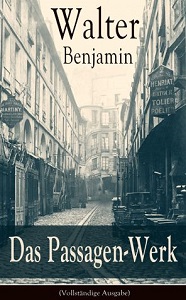
De Franse schrijver Jacques Rivière werd geboren op 15 juli 1886 in Bordeaux. Zie ook alle tags voorJacques Rivière op dit blog.
Uit: Un roman d’aventure : Le grand Meaulnes d’Alain-Fournier
« La paix ne tarde pas à se faire entre Meaulnes et le bohémien. C’est qu’il y a entre eux des liens secrets qu’ils découvrent. Le bohémien a été lui aussi dans le domaine merveilleux et il donne à son nouvel ami quelques indications - d’ailleurs encore insuffisantes - sur la route qui y conduit. Meaulnes pourtant ne le reconnaît que trop tard, qu’au moment où sans en rien dire à personne, il s’apprête à s’enfuir. C’était Frantz de Galais, le jeune fiancé de la fête, avec qui Meaulnes s’était rencontré le soir de la débandade. Hélas ! il a décampé trop tôt ; Meaulnes n’aura appris de lui que l’adresse à Paris de la jeune fille dont il est amoureux.
Muni de ce seul renseignement, Meaulnes laisse François et part pour Paris. Mais à l’adresse indiquée il n’y a personne : la maison est vide. Meaulnes reste dans la grande ville, oisif et désespéré, à la merci de toutes les tentations. Et c’est François que le hasard, longtemps après, met tout à coup sur la piste du domaine merveilleux. Il le retrouve sans aucune difficulté ; la jeune fille y est toujours ; il la voit ; il comprend qu’elle n’a cessé de penser à Meaulnes. Le rêve de toute leur adolescence se résout ainsi en éléments tout ordinaires, tout prochains, tout faciles à saisir.
Il semble qu’il n’y ait plus qu’à aller chercher Meaulnes et que l’aventure soit finie. Mais Meaulnes, que Seurel en effet ramène, est étrangement nerveux et rebelle ; il manque même de détruire par son humeur inexplicable le bonheur que son ami lui a préparé et qu’il n’a plus qu’à cueillir. Pourtant il se marie, son coeur sauvage semble dompté.
Hélas ! la chimère veille, l’esprit d’aventure et de rêve le guettent encore. Pendant le séjour de Frantz à Sainte-Agathe, au moment où leur amitié se nouait, lui et Meaulnes se sont mutuellement et solennellement juré d’accourir au premier appel l’un de l’autre. Le soir des noces de Meaulnes et d’Yvonne de Galais, du bois qui borde la maison, retentit l’appel de Frantz... »

Jacques Rivière (15 juli 1886 – 14 februari 1925)
Cover
Onafhankelijk van geboortedata
De Iraanse dichteres, schrijfster en vredesactiviste Rira Abbasi werd geboren in 1962 in Khorramabad, Iran. Zie ook alle tags voor Rira Abbasi op dit blog.
Poets of Peace (Fragment)
We, children of the world,
With USA, have a word,
We frown,
We demur,
We Protest:
No more war in the world:
It’s enough.
It’s enough.
What dreams, we have at nights!
What horror dreams!
What, if daddy is wounded?
What is our home in dull?
Dear Angela, say please now
O’ children of the world,
What Can I say to us?
I’m ashamed to say, where I come from.
They took daddy to the front
They forced daddy to fight
With whom is he fighting?
Who can answer my question?
Vertaald door M. Alexandrian

Rira Abbasi (Khorramabad, 1962)
Zie voor nog meer schrijvers van de 15e juli ook mijn vorige blog van vandaag.