Naar de inhoud

Romenu

Over literatuur, gedichten, kunst en cultuur
seniorennet.beseniorennet.be

Berichten van 23 april 2017

Thomas (Nel Benschop)


Bij Beloken Pasen


2029773-5a5a8601e5f6c209d990e9cd923afd3e.jpg
De ongelovige Thomas door Gerrit van Honthorst, 1620


Thomas

Ik was er niet, toen Jezus bij hen kwam
en hun de tekens toonde in Zijn handen,
toen Hij hun uitgedoofde vuur deed branden
en ieder uit Zijn handen 't brood aannam.

Ik wilde niet, zo volgzaam als een lam
mij bij de kudde trouwe schapen voegen
die van de herder alles maar verdroegen;
ik wilde zelf bepalen of ik kwam.

Ik wilde zien en voelen of ik niet
met dromen mij in slaap zou laten wiegen,
of mij door schone schijn laten bedriegen;
dat konden zij misschien doen, maar ik niet.

Toen zag ik Hem - en ik had geen verweer
maar kon slechts stamelen: "Mijn God, mijn Heer!"


 2029773-84766939708eb7c918487ba0c94893d1.jpg
Nel Benschop (16 januari 1918 – 31 januari 2005)
De Nieuwe Kerk in Den Haag. Nel Benschop werd in Den Haag geboren.


Zie voor de schrijvers van de 23e april ook mijn vorige twee blogs van vandaag.

Geschreven door Romenu om 11:56 Reageer op dit bericht

William Shakespeare, Pascal Quignard, Peter Horst Neumann, Andrey Kurkov, Halldór Laxness, Christine Busta, Adelheid Duvanel

De Engelse dichter en schrijver William Shakespeare werd geboren in Stradford-upon-Avon op, vermoedelijk, 23 april 1564. Zie ook alle tags voor William Shakespeare op dit blog.

Uit:Macbeth

“Enter MACBETH
MACBETH
How now, you secret, black, and midnight hags!
What is't you do?
ALL
A deed without a name.
MACBETH
I conjure you, by that which you profess,
Howe'er you come to know it, answer me:
Though you untie the winds and let them fight
Against the churches though the yesty waves
Confound and swallow navigation up
Though bladed corn be lodged and trees blown down
Though castles topple on their warders' heads
Though palaces and pyramids do slope
Their heads to their foundations though the treasure
Of nature's germens tumble all together,
Even till destruction sicken answer me
To what I ask you.
First Witch
Speak.
Second Witch
Demand.
Third Witch
We'll answer.
First Witch
Say, if thou'dst rather hear it from our mouths,
Or from our masters?
MACBETH
Call 'em let me see 'em.
First Witch
Pour in sow's blood, that hath eaten
Her nine farrow grease that's sweaten
From the murderer's gibbet throw
Into the flame.
ALL
Come, high or low
Thyself and office deftly show!
Thunder. First Apparition: an armed Head
MACBETH
Tell me, thou unknown power,--
First Witch
He knows thy thought:
Hear his speech, but say thou nought.
First Apparition
Macbeth! Macbeth! Macbeth! beware Macduff
Beware the thane of Fife. Dismiss me. Enough.
Descends
MACBETH
Whate'er thou art, for thy good caution, thanks
Thou hast harp'd my fear aright: but one
word more,--


 2029768-878365806d5b83d52e0ccae0a0611e78.jpg
William Shakespeare (23 april 1564 – 23 april 1616)
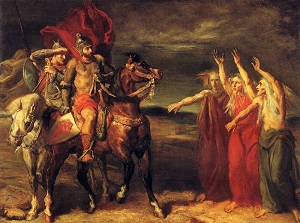
“Macbeth en Banquo ontmoeten de drie heksen” door Théodore Chassériau, 1855


De Franse schrijver Pascal Quignard werd geboren op 23 april 1948 in Verneuil-sur-Avre. Zie ook alle tags voor Pascal Quignard op dit blog.

Uit: Mourir de penser

« L’année 699 les Frisons consentirent à se convertir au christianisme. Au mois de mars 700, le premier jour de l’année, le premier d’entre eux, Rachord, roi des Frisons, devant l’ensemble de ses tribus, se prépara à recevoir le baptême. Déjà il était tout nu, il avait mis un pied dans les fonts quand, pris de doute, hésitant à plonger l’autre pied dans l’eau qui était sainte, il demanda, avec inquiétude, au prêtre qui s’apprêtait à l’ondoyer :
— Mais où sont les miens? Pas de réponse.
Alors le roi des Frisons leva les yeux. Il regarda le prêtre chrétien. Ce dernier restait immobile. Il avait commencé à lever sa main. Il s’apprêtait à jeter le sel autour de l’homme qui allait s’immerger pour faire crever les démons.
Le roi répéta sa question :
— Où se trouve la plus grande partie de mes ancêtres?
L’homme de Dieu, toujours silencieux, obstinément silencieux, garda sa main, pleine de sel blanc, levée en l’air au-dessus du cuveau, attendant que le roi des Frisons s’y accroupisse tout entier.
Rachord, courroucé, haussa la voix. Il répéta une troisième fois sa question en la précisant. Où ses aïeux se trouvaient-ils ? Ses aïeux se trouvaient-ils en enfer ? Se trouvaient-ils au paradis?
Le prêtre finit par tourner son visage vers Rachord. Il prononça le mot enfer.
Quand il apprit que tous les rois qui l’avaient pré- cédé et que la plupart des membres de sa parenté se trouvaient en enfer, le roi Rachord retira de la cuve le pied qu’il y avait glissé. Il s’éloigna du prêtre, des moines, de la piscine baptismale. Il alla trouver ses chevaliers qui se tenaient au premier rang de l’assemblée. Il leur dit tout bas :
— C’est chose plus sainte de suivre le plus grand nombre que le plus petit."


 2029768-16582a20bc0e425a5e54123a7ce93d8a.png
Pascal Quignard (Verneuil-sur-Avre, 23 april 1948)


De Duitse dichter, essayist en literatuurwetenschapper Peter Horst Neumann werd geboren op 23 april 1936 in Neisse. Zie ook alle tags voor Peter Horst Neumann op dit blog.

Uit:Laudatio auf Sarah Kirsch (n.a.v.de Peter-Huchel-Preis 1993)

„Erlkönigs Tochter - der Titel ist zauberhaft, in jeder Bedeutung diese Wortes. Er hat einen Zug ins Dämonisch-Verführerische und verführt auch zum Lesen. Zaubersprüche hieß ein früherer Band, und auch Titel wie Katzenleben oder Erdreich hatten die Aura des nicht ganz Geheueren. Dieser aber ist wie ein Wetterleuchten, hervorgerufen durch zwei zitierte Worte: ein poesiegeschichtlicher Horizont (dänische Volkspoesie, Herder, Goethe) leuchtet auf. Wenn man sie beim Lesen wiederfindet, sind diese zwei Worte so vollkommen ins Gedicht eingegangen, daß zwischen dem eigenen und dem Zitat kein Unterschied mehr besteht – ein Augenblick großer Poesie.
Nebel und Watt bezeichnen den düsteren Ort eines Zusammentreffens, ernsthafte Verabredung genannt, und es wird auch geritten: je ein Reiter bei Herder und Goethe; hier aber sind es zwei Reiter, die apokalyptischen, zu denen die Erlkönigstochter eine offenbar ernsthafte Beziehung unterhält. Naturmagie verbindet sich mit den biblischen Endzeitboten der Apokalypse. Der Boden ist unsicher, magischer Naturgrund, gewiß, aber er ist auch zugleich historische Landschaft des 20. Jahrhunderts, mit Bohrinsel, Seenotraketen und Colabüchsen im Schlick.
Die Stunde ist Geisterstunde: Silvestermitternacht, ausgerufen in typisch zeitgenössischem Deutsch: Happy Neujahr! Und der Junge aus Büsum, der niemals wieder gefunden wird, wo ist der wohl geblieben? Sollte der wirklich nichts mit Erlkönigs Tochter zu tun gehabt haben?
Eine solche Vergleichzeitigung gibt es nur in der Poesie, und Gedichte wie dieses gelingen nicht oft. Immer sind es welthaltige, oft wirklichkeitssatte Gedichte, und fast immer ist Magie im poetischen Spiel, Sprachmagie, Traummagie – es sind Gedichte von Erlkönigs nie ganz geheurer aufmüpfiger Tochter.“


 2029768-5162e9b13afe1c176889bcbd2fd4d629.jpg
Peter Horst Neumann (23 april 1936 – 27 juli 2009)
De cover van „Erlkönigs Tochter“


De Oekraïense schrijver Andrey Kurkov werd geboren op 23 april 1961 in Leningrad. Zie ook alle tags voor Andrey Kurkov op dit blog.

Uit: Death and the Penguin (Vertaald door George Bird)

“He looked more like an aged athlete than a man of the Press. And maybe that's how it was, except that his eyes betrayed a hint of irony born more of intellect and education than lengthy sessions in a gym.
« Have a seat. Spot of cognac?“ He accompanied these words with a lordly wave of the hand.
“I'd prefer coffee, if I may,”said Viktor, settling into a leather armchair facing the vast executive desk.
“Two coffees,” the Editor-in-Chief said picking up the phone. “Do you know,” he resumed amiably, “we'd only recently been talking about you, and yesterday in came our Assistant Arts Editor, Boris Leonardovich, with your little story. `Get an eyeful of this,' said he. I did, and it's good. And then it came to me why we'd been talking about you, and I thought we should meet.”
Viktor nodded politely. Igor Lvovich paused and smiled.
“Viktor Alekseyevich,” he resumed, “how about working for us?”
“Writing what?” asked Viktor, secretly alarmed at the prospect of a fresh spell of journalistic hard labour.
Igor Lvovich was on the point of explaining when the secretary came in with their coffee and a bowl of sugar on a tray, and he held his breath until she had gone.
“This is highly confidential,” he said. “What we're after is a gifted obituarist, master of the succinct. Snappy, pithy, way-out stuff's the idea. You with me?” He looked hopefully at Viktor.
“Sit in an office, you mean, and wait for deaths?” Viktor asked warily, as if fearing to hear as much confirmed.
“No, of course not! Far more interesting and responsible than that! What you'd have to do is create, from scratch, an index of obelisk jobs - as we call obituaries - to include deputies and gangsters, down to the cultural scene - that sort of person - while they're still alive. But what I want is the dead written about as they've never been written about before. And your story tells me you're the man.”
“What about payment?”
“You'd start at $300. Hours up to you. But keeping me informed, of course, who we've got carded. So we don't get caught on the hop by some car crash out of the blue! Oh, and one other condition: you'll need a pseudonym. In your own interest as much as anything.”


 2029768-a331ccb4f897757729ac4ae8f5e51bc7.jpg
Andrey Kurkov (Leningrad, 23 april 1961)


De IJslandse schrijver Halldór Laxness (eig. Halldór Guðjónsson) werd geboren in Reykjavik op 23 april 1902. Zie ook alle tags voor Halldór Laxness op dit blog.

Uit:Paradise Reclaimed (Vertaald door Magnus Magnusson)

“He seldom had to wait very long for a lump of butter if there were any available. It was a pleasure to lay one's face against his nose, which was softer than any maiden's cheek; but Krapi never liked being caressed for long. As soon as he had got what he wanted he trotted away along the path and then broke into a sudden gallop as if something had frightened him, and did not pull up until he had rejoined the herd.
The summers in Iceland were long in those days. In the mornings and evenings the meadows were so green that they were red, and during the day the horizon was so blue that it was green. But throughout this remarkable play of colours (which no one paid any attention to or even noticed, for that matter) HlÃ?dar in SteinahlÃ?dar went on being one of those south-country farms where nothing very eventful ever happened except that the fulmar went on sweeping along the cliffs just as in great-grandfather's day. On ledges and in crevices in the cliffs grew rose root and fern, angelica, brittle bladderfern and moonwort. The boulders kept on tumbling down as if the heartless cliff-troll were shedding stone tears. A good pony can occur on a farm once in a generation, with luck; but on some farms, never in a thousand years. From the sea, beyond the sands and marshes, for a thousand years, the murmur was always the same. Late in the hay-season, when the eggs were safely hatched, the oyster-catcher would arrive in red stockings and white shirt under a black silk jacket to strut aristocratically through the new-mown meadows, whistle, and depart. For all those centuries, Snati the farm-dog was just as full of his own importance as he trotted at the shepherd's side behind the milch-ewes every morning, newly fed and with his tongue lolling out. On still summer days the sound of a scythe being hammered sharp would drift over from the neighbouring farm. There was rain on the way if the cows lay down in the meadow, particularly if they were all lying on the same side; but if there were a dry spell on the way they would bellow eleven times in a row at sunset. Always the same story.”


 2029768-82ed84a3e43c029b9386125041253f65.jpg
Halldór Laxness (23 april 1902 – 8 februari 1998)
Portret door Einar Hakonarson, 1984


De Oostenrijkse dichteres Christine Busta werd geboren op 23 april 1915 in Wenen. Zie ook alle tags voor Christine Busta op dit blog.


Wo holt sich die Erde die himmlischen Kleider? 

Wo holt sich die Erde die himmlischen Kleider? 
Beim Wettermacher, beim Wolkenschneider.
Sie braucht keine eitlen Samte und Seiden, 
sie nimmt, was er hat, und trägt froh und bescheiden 
das Regenschwere, das Flockenleichte, 
das Schattenscheckige, Sonngebleichte, 
das Mondgewobne und Sternbestickte, 
das Windzerrissene, Laubgeflickte, 
das Gockelrote, das Igelgraue, 
das Ährengelbe, das Pflaumenblaue, 
das Gräserkühle, das Nesselheiße, 
das Hasenbraune, das Schwanenweiße -
und schlendert die Jahre hinauf und hinunter:
je schlichter, je lieber, je schöner; je bunter.


Stille Anweisung

Ruh dich aus,
Mir brauchst du das Gras nicht zu schneiden.
Lass es mitsamt dem unbändigen Unkraut
weiterwachsen auf meinem Hügel.

Horch lieber, ob dir nicht unter der Erde
eine schon dicht vergrünte Stimme
immer noch sagt:" Ich wachse dir zu..."


 2029768-99f2cc06333bea4681f7cbf1fa455dcf.jpg
Christine Busta (23 april 1915 – 3 december 1987)
Wenen,  Schloss Schönbrunn


De Zwitserse schrijfster Adelheid Duvanel werd geboren op 23 april 1936 in Basel. Zie ook alle tags voor Adelheid Duvanel op dit blog.

Uit: Inner Tumult (Vertaald door Patricia H. Stanley)

“Through the open balcony door I can see a yellow plastic lounge chair next to the banister. Wotanek, seated at the table nearby, is using the little finger of his left hand to massage his broken incisor with such fervor that you would think he anticipates some effect from this massage. I've known Wotanek for a long time; his hunched-over posture is typical for him. When he was a little kid no one wanted to play with him, because he always dropped the ball. Later, he acquired the name "Dopey Motion" from his wife Helga, a true ice princess. On their wedding day she kissed him on the tip of his nose, and it immediately froze. I've known Helga only a short time, so I don't know anything about her earlier life. She is a tall woman with hairy legs and always wears white gym shoes.
As a child Wotanek rebelled with a persistence that was astonishing. His rejection of the playing rules of our world was so effective that even his facial muscles gave up. In time he lived walled up, unrecognized, entirely in concealment. I suspect that this type of existence developed from an extraordinary sensitivity. He was an orphan and had never known his father, an apothecary, a man who, in his free time, filled lengthy strips of paper with attempts to solve a mathematical problem. Finally, taking the failure of his efforts to heart, he committed suicide. The mother had died some time before out of sorrow over this man. Because Wotanek was not able to mourn the death of his parents he secretly grieved when he saw bare branches that the wind swung about in front of the sky like pieces of a torn-up net unable to catch anything. Was there any prey besides the little Wotanek? Even the everlasting melancholy of the orphanage cat upset him, and there was no one with whom he would share his spiritual pain.
The boy's seemingly stony composure irritated his teachers. He understood their non-comprehension but regarded them blissfully as his enemies and secretly hated them. Sometimes, however, this single joy abandoned him; then he believed he was a wart that would have to be cauterized.”


 2029768-7b0074741a12841d575b8dcbfe59a966.jpg
Adelheid Duvanel (23 april 1936 – 8 juli 1996)
Joe Duvanel: Adelheid mit Fuchs, 1967


Zie voor nog meer schrijvers van de 23e april ook mijn vorige blog van vandaag.

Geschreven door Romenu om 11:55 Reageer op dit bericht

Maurice Druon, Egon Hostovský, Richard Huelsenbeck, Marion Titze, Friedrich von Hagedorn, Max Bolliger, J. P. Donleavy

De Franse schrijver en politicus Maurice Druon werd geboren op 23 april 1918 in Parijs. Zie ook alle tags voor Maurice Druon op dit blog.

Uit: Les Rois Maudits

« — Il arrive de France ? Alors vous allez être contente, Madame. — Je souhaite l'être... si les nouvelles qu'il me porte sont bonnes. Une autre dame de parage entra vivement, le visage animé d'un grand air de joie. Elle s'appelait de naissance Jeanne de Joinville et était l'épouse de sir Roger Mortimer, l'un des premiers barons d'Angleterre. — Madame, Madame ! s'écria-t-elle, il a parlé. — Vraiment, Madame ? répondit la reine. Et qu'a-t-il dit ? — Il a frappé la table, Madame, et il a dit : « Veux ! » Une expression d'orgueil passa sur le beau visage d'Isabelle. — Conduisez-le devers moi, dit-elle. Lady Mortimer sortit, toujours courant, et revint un instant après, portant un enfant de quinze mois, rond, rose et gras, qu'elle déposa aux pieds de la reine. Il était vêtu d'une robe grenat, brodée d'or, et fort lourde pour un si petit être. — Alors, messire mon fils, vous avez dit : « Je veux », dit Isabelle en se penchant pour lui caresser la joue. J'aime que cela ait été votre premier mot : c'est parole de roi. L'enfant lui souriait, en dodelinant la tête. — Et pourquoi l'a-t-il dit ? reprit la reine. — Parce que je lui refusais un morceau de galette, répondit lady Mortimer. Isabelle eut un sourire vite effacé.
— Puisqu'il commence à parler, dit-elle, je demande qu'on ne l'encourage point à bégayer et prononcer des niaiseries, comme on fait d'ordinaire avec les enfants. Peu importe qu'il dise « papa » ou « maman », je préfère qu'il connaisse les mots de « roi » et de « reine ». Elle avait dans la voix une grande autorité naturelle. — Vous savez, ma mie, continua-t-elle, quelles raisons m'ont fait vous choisir pour gouverner mon fils. Vous êtes petite-nièce de messire Joinville le grand, qui fut à la croisade auprès de mon aïeul Monseigneur Saint Louis. Vous saurez enseigner à cet enfant qu'il est de France autant que d'Angleterre. Lady Mortimer s'inclina. À ce moment, la première dame française revint, annonçant Monseigneur le comte Robert d'Artois. La reine s'adossa, bien droite, à son siège et croisa les mains sur la poitrine, dans une attitude d'idole. Le souci d'être toujours royale ne parvenait pas à la vieillir. Un pas de deux cents livres ébranla le plancher. L'homme qui entra avait six pieds de haut, des cuisses comme des troncs de chêne, des poings comme des masses d'armes. Ses bottes rouges, de cuir cordouan, étaient soufflées d'une boue mal brossée ; le manteau qui lui pendait aux épaules était assez vaste pour couvrir un lit. Il suffisait qu'il eût une dague au côté pour avoir la mine de s'en aller en guerre."


 2029765-230ce0e885a177cd5408123560d65454.jpg
Maurice Druon (23 april 1918 – 14 april 2009)


De Tsjechische schrijver Egon Hostovský werd geboren op 23 april 1908 in Hronov. Zie ook alle tags voor Egon Hostovský op dit blog.

Uit: Siebenmal in der Hauptrolle (Vertaald door Markus Sedlaczek)

“Ich hatte Einblick in die gedanklichen und emotionalen Quellen eines geheimen Ordens aufsässiger Teufel und titanischer Aufrührer, und ich begriff, daß ihre bislang unorganisierten Brüder zu Hunderttausenden unter uns herumirren. Damals konnte ich über das, was ich gesehen und gehört hatte, nicht öffentlich sprechen, weil niemand mir geglaubt hätte und der Tod mir auf den Fersen gewesen wäre. Das ist jedoch nicht das Entscheidende, verehrter Herr Präsident und hochlöbliche Regierung. Viel schwerwiegender ist das innere Geheimnis Josef Kavalskys, des Bruders des Europas von gestern. Er wußte, auf welche Spule unsere Wege bei jeder Umdrehung der Erde aufgewickelt werden. Er wußte es, und dennoch folgte er ihnen. Er sah die Abgründe und die Flammen, die auch Sie sehen müssen, wenn Sie Brücken darüber bauen wollen. Ich beschwöre Sie nun, da Josef Kavalsky gestorben ist, ein Mensch von nirgendwo und überall her, ein Weggefährte der vergeblich Suchenden, ein Leidenschaftlicher ohne Liebe, ein Weiser ohne Wahrheiten, ein Kämpfer ohne Kraft, ein Feuer ohne Glut - ich beschwöre Sie, mein
Zeugnis anzuhören. Obwohl es mit dem politischen Geschehen nur indirekt zusammenhängt, können Sie mit seiner Hilfe einen Blick auf die Brennpunkte vergangener wie heutiger Ereignisse werfen. Der zweite Babylonische Turm ist ins Wanken geraten, nichtsdestoweniger dauert die zweite Sprachverwirrung fort. Mit denen, die unter den Trümmern übrigbleiben, wird man vielleicht in einer neuen Sprache sprechen müssen, doch entdeckt man die neuen Wörter erst nach dem Tod der alten, die bislang ohne Widerhall und Harmonie um die Welt irren, erfüllt nur vom Dröhnen ihrer Leere und stummen Vergeblichkeit.“


 2029765-c765df4d575397dda6b5687ffa9ac5dd.jpg
Egon Hostovský (23 april 1908 – 7 mei 1973)


De Duitse dichter, schrijver, essayist en psychoanaliticus Richard Huelsenbeck (Hülsenbeck) werd geboren op 23 april 1892 in Frankenau. Zie ook alle tags voor Richard Huelsenbeck op dit blog.


To Ludwig the cocotte

Your leg hangs over me like a crescent moon
all clear: Your breasts breathe two small animals
behind the most exquisite Brussels lace
hey garçon: Café au lait – le matin please and a glass of water
Basically you are like your sisters who with bobbing bellies
creep along the sewers anxiously listening
for the vice squad whistle and meat-eating pimps
The cattle dealer whose pants and alligator leather wallet
you stole has taught me everything about your soul
hey – old pig: you've turned fifty but the high school
kids are still dreaming of you lots
They dream: you approach silently with the elastic cane
teaching their behinds what their heart desires
hey you old lechers and white slave traders you gypsies and hotel thieves
pray pray if you like that
Or drink yourselves stinko up the houses break open the gutter
let the fire brigade thunder flush the rivers out of their sleep
old scum I walk towards you bottle in arm you crazy specter
Is it you again delicious pig has the surgeon spied
your belly yet grapnel brandished torch and chloroform
Dada! Dada! only you are alive sweet love


Vertaald door Johannes Beilharz


 2029765-00caec6d7062f0e263150342295a42d2.jpg
Richard Huelsenbeck (23 april 1892 - 20 april 1974)
Collage door Richard Huelsenbeck


De Duitse schrijfster Marion Titze werd geboren op 23 april 1953 in Lichtenwalde/Chemnitz. Zie ook alle tags voor Marion Titze op dit blog.

Uit: Vom Mond das fehlende Stück

»Thomas Hürlimanns ›Einsiedler Welttheater‹ führt die ganze Farce des Dilemmas vor, das Apostatentum großen Stils, da es nichts als Stillosigkeit zu gebären scheint, da es sich weder selbst erkennt noch reflektiert. Bei Hürlimann richtet sich die Volksfrömmigkeit bröckelnder Evangelien ein chaotisch makaberes Fest. Dort, wo bei Calderón Die Stimme als verkapptes Gesetz der Gnade liturgieähnlich spricht, bringt Hürlimann gebetsmühlenartig Die Standfrauen zu Gehör:

›Madönneli und Kruzifix!
Häliböck und Wanderstöck!
Das Gaffen kostet nix!
Biberfladen, Bier und Rosenkränze
Schokoladen, Cola, Grittibänze
Sündenablass, Kelche und Monstränze
Prenez, venez, chaufid gschnell
Suscht chömid ier i d Höll!‹

Zwar sind, was sie feilbieten, Devotionalien, doch wir, in Metaphern nun einigermaßen versiert, erkennen darin die ganze hyperaktive global verzückte Warenproduktion, die ihre Exponenten nicht anders betrachten als einst der Klerus die Entfremdung der vormals geweihten Reliquie: Wirkungsvoller Kitsch sei besser als wirkungslose Kunst. Unumstößlich ist die Tendenz geworden, sich die Welt so umfassend wie möglich anzubequemen. Hat das Thomas Hürlimann dazu getrieben, noch einmal die Register der comedia zu ziehen?
Man wird sehen. Und neuerlich staunen wir über die geheime geschichtliche Energie, die alle hundert Jahre den Einfall zu haben scheint, ein Großes Welttheater zu inszenieren."


 2029765-d121f71c4086146b9e7f0989d643c290.jpg
Marion Titze (Lichtenwalde, 23 april 1953)
Lichtenwalde


De Duitse dichter Friedrich von Hagedorn werd geboren op 23 april 1708 in Hamburg. Zie ook alle tags voor Friedrich von Hagedorn op dit blog.


Die Einbildung und das Glück

Die Einbildung ist in das Glück verliebt,
Das sie so oft gesucht, das ihr so oft entgangen:
Des Glückes Sprödigkeit, die ihren Fürwitz übt,
Reizt ihre Hoffnung stets, und täuscht stets ihr Verlangen.

Als sie noch jung und unerfahren war,
Ging sie ihm seufzend nach bis in das Reich der Liebe.
Doch hier entfernten es bald schlüpfrige Gefahr,
Bald leichter Wankelmuth, bald eifersücht'ge Triebe.

Die Arme wächst, die Leidenschaft nimmt zu:
Sie wagt sich an den Hof, zu den geschmückten Höhen,
Wo Pracht und Ehrgeiz rauscht. Dort fehlen Treu' und Ruh',
Und Titel lassen sich, anstatt des Glückes, sehen.

Sie eilt darauf ins Land der Ueppigkeit,
Dort mit dem Glücke sich durch Reichthum zu verbinden;
Dort war auch Ueberfluß, Gepränge, Schwelgen, Neid,
Der bürgerliche Stolz, doch nicht das Glück, zu finden.

Sie rennt zurück, und kömmt auf eine Bahn,
Die ihren müden Fuß in niedre Gründe führet.
Die stille Gegend ist der Schönen unterthan,
Die sich mit keinem Schmuck, als Zucht und Demuth, zieret.

Die Gottesfurcht hat dort ihr Heiligthum,
Der Weisheit holdes Kind, die Lust der Ewigkeiten.
Der milde Himmel kennt und schützet ihren Ruhm,
Und Wahrheit, Lieb' und Recht weicht nicht von ihren Seiten.

Die Einbildung fragt nach dem Glück allhier;
Die fromme Schöne spricht: ich will dir Rath ertheilen.
Erwart' es; such' es nicht; geselle dich zu mir:
So wird dir schon das Glück von selbst entgegeneilen.

Ihr wird gefolgt; nichts konnte besser sein.
Bald sieht man einen Glanz das Heiligthum verklären.
Es stellet sich das Glück mit offnen Armen ein,
Umfängt die Hoffende, und sättigt ihr Begehren.


 2029765-d27ebc5c5b2503629a26f09bc2f0664b.jpg
Friedrich von Hagedorn ( 23 april 1708 – 28 oktober 1754)
Cover


De Zwitserse schrijver Max Bolliger werd geboren op 23 april 1929 in Schwanden / Braunwald, Kanton Glarus. Zie ook Zie ook alle tags voor Max Bollinger op dit blog.

Uit: Sonntag

„Wie alt bist du eigentlich?“
„Hundert!“, sagte Daniela.
„Nein, ehrlich...!“
„Das solltest du doch wissen. Du fragst mich jedesmal... Im Februar dreizehn.“
„Dreizehn!
Hast du einen Freund?“
„Nein!“, sagte Daniela.
„Das wundert mich. Du siehst hübsch aus!“
„Findest du?“
„So...erwachsen!“
Der schöne Herbstsonntag hatte unzählige Boote aufs Wasser hinausgelockt.
Der Vater war verstummt und schaute alle fünf Minuten auf seine Uhr.
„Ich habe um vier Uhr eine Verabredung.“
„Also, gehen wir doch“, sagte Daniela und erhob sich.
Der Vater schien erleichtert.
„Ich bringe dich nach Hause“, sagte er.
„Ach, du bist schon wieder da?“, sagte die Mutter.
Sie war noch immer im Morgenrock. Während der Woche arbeitete sie halbtags in einer Modeboutique.„Sonntags lasse ich mich gehen“, sagte sie zu ihren Freunden, „sonntags bin ich nicht zu sprechen.“


 2029765-469abca74cd8a5661cf5e916b3a7a0e5.jpg
Max Bolliger (23 april 1929 – 10 februari 2013)


De Amerikaans-Ierse schrijver James Patrick Donleavy werd geboren op 23 april 1926 in New York. Zie ook Zie ook alle tags voor J. P.Donleavy op dit blog.

Uit:The Ginger Man

"I'm up to my eyes already."
"And you don't look so hot in those clothes."
O'Keefe jumped on the floor of the drawing room. Pulled open the conservatory door, pinched the leaves of a dying plant and went out into the garden. Standing on the shaggy grass he gave a shrill whistle as he looked down precipitous rocks to the swells of sea many feet below. He went round the narrow back of the house, looking in the windows. In a bedroom he saw Dangerfield on his knees chopping a large blue blanket with an axe. He rushed back into the house.
"Jesus Christ, Dangerfield, what are you doing? Have you gone Asiatic?"
"Patience."
"But that's a good blanket Give it to me if you're going to chop it up"
"Now, Kenneth, watch me. See? Put this round the neck like this, tuck in the ragged edges and presto. Fm now wearing Trinity's rowing blue. Always best to provide a flippant subtlety when using class power. Now we'll see about a little credit."
"You shrewd bastard. I must admit it looks good"
"Make a fire in the stove. I'll be back"
"Get us a chicken"
"We'll see."
Dangerfield stepped out into a deserted Balscaddoon Road.
The counter was covered with rich sides of bacon and wicker baskets of bright eggs. Assistants, white aproned, behind the long counter. Bananas, green from the Canary Isles, blooming from the ceiling. Dangerfield stopping in front of a gray haired assistant who leans forward eagerly.
"Good day, sir. Can I be of any help?"
Dangerfield hesitating with pursed lips.
"Good day, yes. I would like to open up an account with you."
"Very good, sir. Will you please come this way."


 2029765-991ac51274180e0c2252121a54214843.jpg
J. P.Donleavy (New York, 23 april 1926)
Cover autobiografie 

Geschreven door Romenu om 11:52 Reageer op dit bericht

Roman Helinski

De Nederlandse schrijver en journalist Roman Helinski werd geboren in Nuth op 23 april 1983. Helinski verwierf enige bekendheid met publicaties in literaire tijdschriften als Bunker Hill (tijdschrift), Deus ex machina en De Brakke Hond. De laatste jaren publiceert hij regelmatig korte verhalen in het Hollands Maandblad. Ook schrijft hij columns en verhalen voor het literaire voetbaltijdschrift Hard gras. Helinski debuteerde in de lente van 2014 met de roman “Bloemkool uit Tsjernobyl”, ondertitel: een vadergeschiedenis. De roman werd veel en goed besproken in Nederlandse kranten. In het NRC Handelsblad kende Arjan Fortuin er vier van de vijf ballen aan toe. Trouw sprak van ‘een ode aan de vertelkunst.’ Ook waren er positieve besprekingen in de Volkskrant, Het Financieele Dagblad en de De Groene Amsterdammer.

Uit: Bloemkool uit Tsjernobyl

“Oma Mossel was dood. Ze was hard op haar gezicht gevallen en dat was het dan. Ik moest huilen, ook al kende ik de oude vrouw amper.
Mijn vader nam de telefoon mee naar de slaapkamer en kwam daar een paar uur niet meer uit. Tijdens het avondeten vroeg mijn moeder hem: ‘Waar was je de hele dag toch zo druk mee?’
‘De begrafenis van die arme vrouw regelen.’
‘Doet haar familie dat niet?’
‘Het was een eenzame vrouw,’ antwoordde hij zachtjes. Ook de dagen die volgden was hij druk met regelen.
‘Ga je mee kransen uitzoeken?’ vroeg hij mijn moeder daags voor de begrafenis.
‘Ik ken die vrouw helemaal niet.’
‘Goed,’ zei mijn vader. ‘Dan gaat Victor mee.’
Ook dat vond mijn moeder geen goed idee, maar hij deed het toch. ‘Neem dit van mij aan,’ zei hij daarover, ‘luister niet altijd naar je vrouw later. Ze hebben vaak gelijk, maar niet altijd.’
Voor de dienst had mijn vader een zwart pak voor me gekocht. Er zat een dunne, zwarte das bij, die we maar niet netjes omgeknoopt kregen. Als mijn vader niet keek, trok ik er steeds aan, zodat we er een hele tijd over deden.
In de kerk was het niet druk, er zaten ongeveer twintig oude mensen die alle liederen konden meezingen. Ze hingen aan mijn vaders lippen toen hij vertelde over zijn eerste ontmoeting met oma Mossel in het ziekenhuis, hoe charmant en lief ze was geweest, maar ook hoe ontzettend eenzaam ze al jaren was. Haar man, die in de olie had gezeten, was lang geleden overleden en haar twee zonen kwamen nooit op bezoek. Ze waren zelfs niet op de begrafenis. Dat vertelde hij in de auto na afloop.
De pastoor had zijn tekst niet goed voorbereid, want hij liet lange stiltes vallen, waarin mijn gedachten afdwaalden naar mijn laatste wedstrijd. Drie doelpunten had ik daarin gemaakt.
In een korte, trage stoet liepen we naar de begraafplaats. Ik hield mijn vaders hand vast, af en toe kneep hij in de mijne. Het was leuk dat de kransen bij de kist inderdaad dezelfde waren als die we de dag ervoor hadden uitgekozen. Na thuiskomst bracht mijn vader de hele avond door in de tuin, mijn moeder moest werken. Op het aanrecht stond zoals bijna elke avond wanneer mijn moeder weg was een bakje met paprikachips dat ik om halfacht mocht pakken. Niet één keer pakte ik het eerder dan dat tijdstip, meestal deed ik dat zelfs later.”


 2065604-4e03ae5eaac13e396e7f8d8de11db026.jpg
Roman Helinski (Nuth, 23 april 1983)

Geschreven door Romenu om 00:00 Reageer op dit bericht

Meer van Romenu

↑ Terug naar de berichten