Willem Wilmink, Anne Tyler, Daniel Mark Epstein, Peter Rühmkorf, Jakob Hein
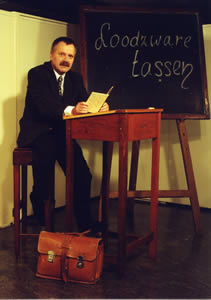
De Nederlandse dichter, schrijver en zanger Willem Andries Wilmink werd geboren in Enschede op 25 oktober 1936. Zie ook mijn blog van 25 oktober 2010 en eveneens alle tags voor Willem Wilmink op dit blog.
Huilen is gezond
Leg nu die krant maar even neer,
echt lezen doe je toch niet meer,
huil nou maar even.
Ja, tegen iemands lichaam aan
zou dat natuurlijk beter gaan,
maar huil nou even.
Dat jij de enige niet bent,
dat is een troost die je al kent,
dus huil maar even.
Een ander troosten voor verdriet
dat kan ook niet, dat kan ook niet,
maar huil toch even.
Altijd maar flink zijn is niet goed:
als je niet weet hoe 't verder moet,
huil dan toch even.
Straks, met nog tranen langs je kin
denk je ineens: ik heb weer zin,
om door te leven.
Huizen in de binnenstad
Die huizen in de binnenstad,
waarvan je eens de sleutel had.
Elk wonen voel je als voorgoed,
totdat je toch verhuizen moet.
Je naambord bij een andere bel
en na wat weken went het wel.
Je treft je oude huizen aan
en kunt er niet naar binnen gaan.
Ze staan er nog precies als toen
hun huiselijke plicht te doen.
Ondanks de reuma in hun hout
worden ze heel erg langzaam oud
en halen 't jaar 3000 wel
als 't goed blijft gaan met Stadsherstel.
Die huizen in de binnenstad,
waarvan je eens een sleutel had,
waar nu een ander slaapt en eet,
die nog van geen verhuizen weet.
Willem Wilmink (25 oktober 1936 – 2 augustus 2003)
De Amerikaanse schrijfster Anne Tyler werd geboren op 25 oktober 1941 in Minneapolis, Minnesota. Zie ook mijn blog van 25 oktober 2010 en eveneens alle tags voor Anne Tyler op dit blog.
Uit: The Beginner's Goodbye
“It was August. Early August of 2007, oppressively hot and muggy. I happened to have a cold. Summer is the very worst time for a cold, I always think. You can't just pile on the blankets and sweat it out the way you would in winter. You're already sweating, only not in any way that's beneficial.
I went in to work as usual, but the air conditioning made my teeth start chattering as soon as I got settled. I hunched over my desk shivering and shaking, sneezing and coughing and blowing my nose and heaping used tissues in my wastebasket, till Irene ordered me home. That was Irene for you. She claimed I was contaminating the office. The others—Nandina and the rest—had been urging me to leave for my own sake. "You look miserable, poor thing," our secretary said. But Irene took a more self-centered approach. "I refuse to sacrifice my health to your misguided work ethic," she told me.
So I said, "Fine. I'll go." Since she put it that way.
Nandina said, "Shall I drive you?" but I said, "I'm still able to function, thank you very much." Then I gathered my things and stalked out, mad at all of them and madder still at myself, for falling ill in the first place. I hate to look like an invalid.
Alone in the car, though, I allowed myself some moaning and groaning. I sneezed and gave a long drawn-out "Aaah," as if I were a good deal sicker than I was. I glanced in the rearview mirror and saw that my eyes were streaming with tears. My face was flushed and my hair had a damp and matted look.”

Anne Tyler (Minneapolis, 25 oktober 1941)
De Amerikaanse dichter, schrijver en biograaf Daniel Mark Epstein werd geboren op 25 October 1948 in Washington, D.C. Zie ook mijn blog van 25 oktober 2010 en eveneens alle tags voor Daniel Mark Epstein op dit blog.
Uit: Lincoln and Whitman
“Abraham Lincoln's
law partner William "Billy" Herndon, thirty-nine, loved the birds and
wildflowers of the prairie, pretty women, and corn liquor. He
also had an immoderate passion for new books, and for the transcendental
philosophizing of pastor Theodore Parker and poet Ralph Waldo Emerson. By
his own accounting he had spent four thousand dollars on his collection of
poetry, philosophy, and belles lettres-a fortune in those days, when a good
wood-frame house in Springfield, Illinois, cost half as much. Journalist
George Alfred Townsend called Herndon's library the finest in the West.
Herndon's narrow, earnest-looking face was fringed with whiskers in the Scots
manner, and his eyes were close-set, intense. His favorite philosopher-poet was
Emerson. Herndon so admired the Sage of Concord that he purchased Emerson's
books by the carton and gave them away to friends and strangers with the zeal
of an evangelist. A backwoods philosopher, Herndon even solicited Emerson's
endorsement for his tract "Some Hints on the Mind," in which he
claimed to have discovered the mind's fundamental principle, "if not its
law."
So when Emerson espoused a new book of poetry, calling it "the most
extraordinary piece of wit and wisdom that America has yet contributed,"
Herndon wasted no time in locating a copy, which could be found on the shelves
of R. Blanchard's, Booksellers, in Chicago, where he frequently traveled on
business.
Having held the olive-green book, its cover blind-stamped with leaves
and berries; having regarded with a twinge of envy the salutation "I Greet
You at the / Beginning of A / Great Career / R W Emerson," gold-stamped on
the spine, the bibliophile-lawyer plunked down his golden dollar for the second
edition of Whitman's Leaves of Grass.”

Daniel Mark Epstein (Washington, 25 oktober 1948)
De Duitse dichter en schrijver Peter Rühmkorf werd geboren op 25 oktober 1929 in Dortmund. Zie ook mijn blog van 25 oktober 2010 en eveneens alle tags voor Peter Rühmkorf op dit blog.
Sybillinisch
Ab mit Bruch, sic transit gloria mundi:
Fortschritt wälzt sich nicht wie Lava fort;
atmet lautlos wie ein Pflanzendarm…
Weimar, sicher, war erlebnisarm;
aber nehmen wir Botswanaland, Burundi,
was ist dort?
Abends, wenn die Sternemänner starten,
und die Glotze sprüht von Himmelsgischt,
hebt sich deiner Augen Doppellauf −
Komm, klapp zu, steck auf!
Aus sehr winzigen verstreuten Eigenarten
ist ein Individuum gemischt.
Wer das mitkriegt, wie du übertourig
ewig haltlos durch die Räume gurkst,
sieht nur gerade die Gestalt zerfließen −−−
Richtig Stil braucht Zeit, sich zu entschließen:
r o t f i g u r i g - s c h w a r z f i g u r i g:
welche Ruh! und kaum ein Strich vermurkst.
Wer du wirklich bist, ist gar noch nicht entdeckt:
etwas zwischen Einzelstern und Rude,
bißchen Kunstgeschmack und bißchen Hundsgeruch;
nicht mal klassisch-klarer Widerspruch.
A b e r m a n c h m a l
i n d e s R e g e n s W a h r g e s p r u d e l
strafft sich – unnachahmlich – dein Subjekt.

Peter Rühmkorf (25 oktober 1929 – 8 juni 2008)
De Duitse schrijver en arts Jakob Hein werd geboren op 25 oktober 1971 in Leipzig. Zie ook alle tags voor Jakob Hein op dit blog en ook mijn blog van 25 oktober 2010
Uit: Mein erstes T-Shirt
"Es begann bei mir wie bei den meisten, es begann mit einer Gitarre. Christian aus meiner Klasse hatte im Keller eine E-Gitarre gefunden und mußte uns allen davon erzählen. Er war der Typ, der immer jedem etwas echt Wertvolles borgen oder etwas weniger Wertvolles schenken wollte. Seit dem Kindergarten hatte er nicht gelernt, daß man so keine Freunde gewinnen konnte.Jetzt glaubte er wieder einen Grund gefunden zu haben, uns in der Raucherecke zu belästigen. Eigentlich rauchte er auch und hatte immer Zigaretten dabei, aber ob man in der Raucherecke stehen durfte oder nicht, hatte ja nichts mit Rauchen zu tun. Sogar manche Mädchen durften dabeisein, wenn sie zum Beispiel schwarz gefärbte Haare hatten, total auf diesen ganzen Schönheitskult schissen und außerdem nicht gerade stockhäßlich waren. Jedenfalls kam Christian in die Raucherecke und tönte groß herum, er habe eine Stromgitarre von seinem Vater gefunden. Wir sagten, daß er sich verpissen so ll.Nach der Schule ging ich immer ein Stück gemeinsamen Weg mit ihm. Wenn niemand anders mit war, vor allem keins von den Mädchen, die sich total nicht für Jungs und den ganzen Scheiß interessierten, unterhielt ich mich dann auch mit Christian. Ich fragte ihn, was das mit der Gitarre heute denn eigentlich gesollt habe. Sofort fing er an, die Gitarre zu beschreiben und wie er die seinem "Alten" klauen könnte und daß er so was schon öfter gemacht hat usw. Er war wirklich nicht besonders cool. Dann sagte ich ein paar Sätze, die ganz klarmachten, daß ich mich total gut mit E-Gitarren auskannte. Ich flocht Worte wie "Stratocaster" und "Plektron" in meine Sätze und sagte zum Beispiel: "Hat das Gerät zwei oder drei Tonabnehmer?" "Du kennst dich ja gut mit den Dingern aus, fast so wie Florian", sagte Christian.“

Jakob Hein (Leipzig, 25 oktober 1971)
Zie voor nog meer
schrijvers van de 25e oktober ook mijn blog van 25 oktober 2011 deel 1 en eveneens deel 2.