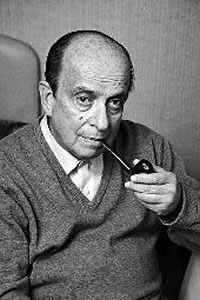
Flann O’Brien, Charlotte Link, José Donoso, Václav Havel
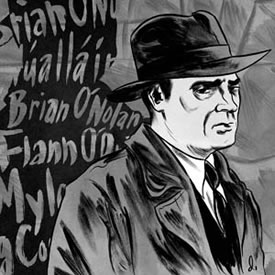
De Ierse schrijver Flann O’Brien werd geboren op 5 oktober 1911 in Strabane, County Tyrone. Zie ook mijn blog van 5 oktober 2008 en ook mijn blog van 5 oktober 2009 en ook mijn blog van 5 oktober 2010.
Uit: The Third Policeman
'Policeman MacCruiskeen put the lamp on the table, shook hands with me and gave me the time of day with great gravity. His voice was high, almost feminine, and he spoke with delicate careful intonation. Then he put the lamp on the counter and surveyed the two of us'Is it about a bicycle?' he asked.
'Not that' said the Sergeant. 'This is a private visitor who says he did not arrive in the townland upon a bicycle. He has no personal name at all. His dadda is in far Amurikey.'
'Policeman MacCruiskeen put the lamp on the table, shook hands with me and gave me the time of day with great gravity. His voice was high, almost feminine, and he spoke with delicate careful intonation. Then he put the lamp on the counter and surveyed the two of us.
'Is it about a bicycle?' he asked.
'Not that' said the Sergeant. 'This is a private visitor who says he did not arrive in the townland upon a bicycle. He has no personal name at all. His dadda is in far Amurikey.'
'Which of the two Amurikeys?' asked MacCruiskeen.
'The Unified Stations,' said the Sergeant.
'Likely he is rich by now if he is in that quarter,' said MacCruiskeen, 'because there's dollars there, dollars and bucks and nuggets in the ground and any amount of rackets and golf games and musical instruments. It is a free country too by all accounts.'
'Free for all,' said the Sergeant. 'Tell me this,' he said to the policeman, 'Did you take any readings today?'
'I did,' said MacCruiskeen.
'Take out your black book and tell me what it was like a good man,' said the Sergeant. Give me the gist of it till I see what I see,' he added.
MacCruiskeen fished a small black book from his breast pocket.
'Ten point six,' he said.
'Ten point six,' said the Sergeant. 'And what reading did you notice on the beam?'
'Seven point four.'
'How much on the lever?'
'One point five'
There was a pause here. The Sergeant put on an expression of great intricacy as if he were doing far-from-simple sums and calculations in his head. After a time his face cleared and he spoke again to his companion“.
Flann O’Brien (5 oktober 1911 – 1 april 1966)
Portret door Daniel Krall
De Duitse schrijfster Charlotte Link werd geboren op 5 oktober 1963 in Frankfurt am Main. Zie ook mijn blog van 5 oktober 2007 en ook mijn blog van 5 oktober 2008 en ook mijn blog van 5 oktober 2009 en ook mijn blog van 5 oktober 2010.
Uit: Das andere Kind
„Sie wusste, dass sie so schnell wie möglich verschwinden musste. Dass sie in Gefahr schwebte und dass sie verloren war, wenn die Leute, die auf dem einsamen Hof lebten, auf sie aufmerksam wurden. Der Mann stand plötzlich wie aus dem Boden gewachsen vor ihr, gerade als sie am Hoftor ankam und sich eilig auf den Weg hinunter zu ihrem Auto machen wollte. Er war groß und nicht so ungepflegt, wie man es von dem Bewohner eines so heruntergekommenen Gehöfts erwartet hätte. Er trug Jeans und einen Pullover. Seine grauen Haare waren sehr kurz geschnitten. Er hatte helle Augen, in denen nicht die Spur eines Gefühls zu erkennen war. Semira konnte nur hoffen, dass er sie nicht hinter den Stallgebäuden gesehen hatte. Vielleicht hatte er ihr Auto entdeckt und kam nun, um nachzuschauen, wer sich hier herumtrieb. Ihre einzige Chance bestand darin, ihm Harmlosigkeit und Unbefangenheit überzeugend vorzuspielen, und das, obwohl ihr Herz jagte und ihre Knie zitterten. Ihr Gesicht war feucht von Schweiß, trotz der beißenden Kälte des bereits dämmrigen Dezembernachmittags.
Seine Stimme war so kalt wie seine Augen. »Was tun Sie hier?« Sie probierte ein Lächeln und hatte den Eindruck, dass es zittrig ausfiel. »Gott sei Dank. Ich dachte schon, hier ist niemand …« Er musterte sie von oben bis unten. Semira versuchte sich vorzustellen, was er sah. Eine kleine, dünne Frau, keine dreißig Jahre alt, warm verpackt in lange Hosen, gefütterte Stiefel, einen dicken Anorak. Schwarze Haare, schwarze Augen. Dunkelbraune Haut“
.
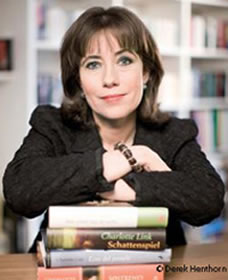
Charlotte Link (Frankfurt am Main, 5 oktober 1963)
De Chileense schrijver José Donoso (eigenlijk Jose Donoso Yáñez) werd geboren op 5 oktober 1924 in Santiago de Chile. Zie ook ook mijn blog van 5 oktober 2010.
Uit: Curfew (Vertaald door Alfred MacAdam)
„Finally, a year after Judit had returned from Caracas, they managed to pick up the trail of Medina, the man who had given her the passport so she could leave. He'd been discovered to be a leftist infiltrator in the passports section, had disappeared, and was assumed dead.... Medina was erased by the terror, gone forever for his wife and children. But in a certain sense less gone for Judit, since she would take vengeance for him as well when she eliminated the man with the nasal voice who had condemned them all to lives with no meaning more complex than the simplifications wrought by obsession. She put her hand in her bag: the shot would pass right through the two necks in front of her and hit the forehead of the guilty man, who was holding up Boris's snout and his stub of a tail, showing off the champion's unbeatable lines.
"He's skinny," commented Farias.
Skinny. My skinny. Nasal, yes, but it wasn't the same voice. Even so, doubts and all, she would have to kill him. Because what right did this man have to pardon her? From what improvised source did the legality of his power emanate, so that he could murder or pardon? That's why he would have to die. Judit took the pistol out of her bag. She clicked off the safety.
She raised her arm in the half-light, aiming first, tentatively, at the back of Manungo's neck. Death. That's what she wished for them in that instance. The consummation she'd never been capable of achieving. Except with that impotent shadow in the cell, who made her lie about pleasure and pain to save her. But it was no lie. It was the savage surprise of orgasm devoid of sex--physiological, sad, solitary--which a torturer with a nasal voice and moist hands had been capable of giving her. That's why he had to be eliminated.“
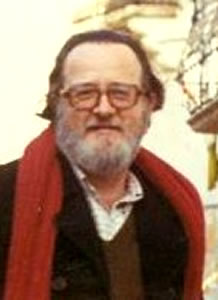
José Donoso (5 oktober 1924 - 7 december 1996)
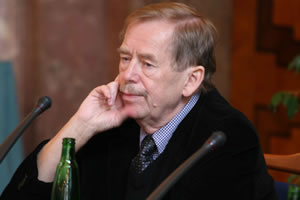
De Tsjechische schrijver en politicus Václav Havel werd op 5 oktober 1936 in Praag geboren. Zie ook mijn blog van 5 oktober 2006 en ook mijn blog van 5 oktober 2008 en ook mijn blog van 5 oktober 2009 en ook mijn blog van 5 oktober 2010.
Uit: A Word About Words (Vertaald door A. G. Brain)
„The prize which it is my honor to receive today is called a peace prize and has been awarded to me by booksellers, in other words, people whose business is the dissemina tion of words. It is therefore appropriate, perhaps, that I should reflect here today on the mysterious link between words and peace, and in general on the mysterious power of words in human history.
In the beginning was the Word; so it states on the first page of one of the most important books known to us. What is meant in that book is that the Word of God is the source of all creation. But surely the same could be said, figuratively speaking, of every human action? And indeed, words can bc said to be the very source of our being, and in fact the very substance of the cosmic life form we call man. Spirit, the human soul, our self awareness, our ability to generalize and think in concepts, to perceive the world as the world (and not just as our locality), and lastly, our capacity for knowing that we will die-and living in spite of that knowledge: surely all these are mediated or actually created by words?
If the Word of God is the source of God's entire creation, then that part of God's creation which is the human race exists as such only thanks to another of God's miracles-the miracle of human speech. And if this miracle is the key to the history of mankind, then it is also the key to the history of society. Indeed, it might well be the former just because it is the latter. For the fact is that if they were not a means of communication between two or more human "I"s, then words would probably not exist at all.
All these things have been known to us-or people have at least suspected them-since time immemorial. There has never been.a time when a sense of the importance of words was not present in human consciousness.“
Zie voor nog meer schrijvers van de 5e oktober ook mijn vorige blog van vandaag.