De Engels-Mexicaanse schrijfster Chloe Aridjis werd geboren in New York op 6 november 1971 (en dus niet op 14 november zoals eerder vermeld). Zie ook alle tags voor Chloe Aridjis op dit blog.
Uit: Book of Clouds
“When we arrived at the demonstration there were already thousands of people gathered on the west side of the Brandenburg Gate, young couples, old couples, scampering children, punks with dogs, Goths, women with buzz cuts, men in blue overalls — a cross section, looking back, of what West Berlin had been in those days. Most people remained standing but there were also large groups spread out on the pavement, singing and chanting and passing around bottles of beer. Two nights before, we'd heard, a human chain had started to form along the Wall with an aim to cover all 155 kilometers.
On the east side, meanwhile, men in grey uniforms and steel helmets were marching up and down Karl-Marx-Allee. I envisioned dramatic clashes between metal and flesh, order and chaos, homogeny and diversity, but I knew that in real life these clashes were far more abstract. My parents had wanted to take us across the border to show us "a true portrait of Communism" but there had been a mysterious problem with our visas so we'd stayed in the West all week, left to imagine as best we could what life was like on the other side, ever more intrigued by notions of "this side" and "beyond."
People continued to arrive. The singing and chanting grew louder and I could hardly hear when anyone in my family leaned over to say something, as though on that night our language had been put on hold and German was the only means of communication. But there were other ways of having a voice, and before long we had joined the lengthy chain following the Wall and I found myself clasping the hand of a man with a ponytail and a black leather jacket until one of my brothers insisted on changing places with me. I tried to imagine the thousands of people across West Berlin to whom we would be connected through this gesture of solidarity but the thought was dizzying so I focused instead on the punks playing nearby with their dogs, as they threw what looked like battered tennis shoes, which the dogs would race to retrieve. The punks would then throw the bait in another direction, every now and then missing and hitting someone on the head or shoulder, the sight of which triggered boisterous rounds of laughter.
Twilight came on. Some of the organizers walked through the crowd passing out white candles. A number of people declined and flicked on their lighters instead. Against the sea of lights the Reichstag looked even gloomier and more forsaken and the Brandenburg Gate, with its goddess of Victory and twelve Doric columns, doubly silenced by dusk. Not far from us an old punk with a torch jumped onto the Wall and screamed some words into the East, rabid words, though we couldn't understand what he was saying. On the other side, my mother told us, invisible eyes would be following his every movement. There didn't seem to be anyone in the watchtowers across the way yet we imagined men in round caps with cat slit eyes surveying the whole spectacle, ready to pounce should any of us trespass one inch into their territory.”
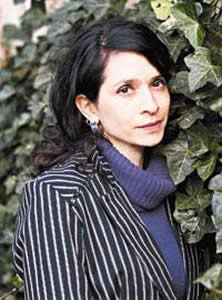
Chloe Aridjis (New York, 6 november 1971)
De Zweedse schrijfster Astrid Lindgren werd als Astrid Ericsson geboren op 14 november 1907 en groeide op op de boerderij Näs in Vimmerby in Småland. Zie ook alle tags voor Astrid Lindgren op dit blog.
Uit: Das entschwundene Land. Erinnerungen (Vertaald door Anna-Liese Kornitzky)
“Schließlich wurde es der 1. April, und es wurde Abend, ein naßkalter, unfreundlicher Abend mit Schneeregen, und am nächsten Tag sollte Hanna abfahren. Zum letztenmal trank Samuel August mit ihr Tee, und zum letztenmal führte er sie zu einem Spaziergang aus. Sie gingen und gingen, aber Samuel August fragte nicht. Schließlich wurde ihm klar, daß es jetzt sein Leben galt. »Mag's gehn, wie's will, schweigen kann ich nicht länger«, dachte er. Ja, es war auch bei Gott in der letzten Minute!
Er hatte seine Liebste zum Park an der Kirche geführt. Dort wuchs eine Traueresche, und darunter stand eine Bank, und auf diese Bank setzten sie sich. Am 1. April 1903 des Nachts um elf Uhr im wilden Schneetreiben - O Liebe! Wie recht hat doch der Apostel, wenn er sagt: Die Liebe, sie verträgt alles und duldet alles!
Jetzt endlich brachte es Samuel August über sich, mit seiner Frage herauszurücken.
»Meinst, daß du und ich zusammen glücklich leben könnten?« Darauf antwortete Hanna:
»Mit unserer Macht ist nichts getan!«
Sie kam aus einem tiefreligiösen Heim und glaubte wohl, daß bei einer so ernsten Sache Gottes Beistand vonnöten sei. Ihre Kinder aber sind mit der Antwort, die Samuel August damals erhielt, nie recht zufrieden gewesen. Er hätte doch einen eindeutigeren Bescheid gebraucht und auch verdient. Hanna jedoch war nicht bereit, uneingeschränkt ja zu sagen. Aber immerhin war es doch so, daß Samuel August die Bank unter der Traueresche zu Recht als »den Platz, wo mir der Stern der Hoffnung aufging«, bezeichnen konnte. Sogar einen Kuß bekam er im Schneegestöber, den allerersten.”
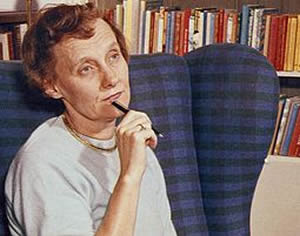
Astrid Lindgren (14 november 1907 - 28 januari 2002)
In 1960
De Nederlandse schrijver en columnist Jonathan van het Reve werd geboren op 14 november 1983 in Amsterdam. Zie ook alle tags voor Jonathan van het Reve op dit blog.
Uit: Het gevreesde mijmerlachje (Column)
“Het mijmerlachje, ook bekend als de peinsgrijns, reduceert zelfs de beste en mooiste dialogen tot pijnlijke, typisch Nederlandse toneelstukjes van soapniveau.
Het werkt als volgt. Neem de zinnen: “Pjotr doet nu zendingswerk in Mali. Hij was altijd al gek met kinderen.” Welnu. De eerste zin spreekt u heel normaal uit, terwijl u uw tegenspeelster aankijkt. “Pjotr doet nu zendingswerk in Mali.” Maar dan. Uw blik draait langzaam weg van het gezicht van uw tegenspeelster, maximaal een graad of dertig, en ietsje omlaag – het liefst tot aan een vensterbank (of de foto van Piet) schuin achter haar. Nu grijnst u lichtjes, terwijl u heel kort en subtiel uw hoofd schudt en eventjes hoorbaar uitademt door uw neus. Dan wacht u nog een seconde – nog altijd met grijns maar nu zonder schudden of uitademen – en dan spreekt u de tweede zin uit, liefst enigszins dromerig: “Hij was altijd al gek met kinderen...”
Dus: eerste zin, wegkijken, grijns, lichte hoofdschud, korte neusblaas, tweede zin. Dat is de mijmerlach. Oefent u gerust eens met de zinnen: “Al mijn bestanden weg. [ML] Als ik die hackertjes ooit te pakken krijg...” Of: “Ze heeft zich uiteindelijk doodgegeten. [ML] Ik weet nog dat ze haar eerste kroketje kreeg...”
Nu ja, u herkent het wel.
En het idiote is dus, dat werkelijk niemand in het echte leven ooit zo doet”.
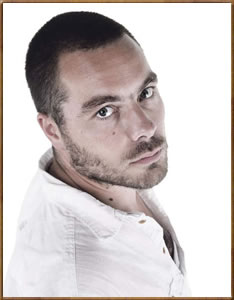
Jonathan van het Reve (Amsterdam, 14 november 1983)
Zie voor nog meer schrijvers van de 14e november ook mijn blog van 14 november 2011 deel 1 en eveneens deel 2.


 Norbert Krapf