

Naar de inhoud

Romenu

Over literatuur, gedichten, kunst en cultuur
seniorennet.beseniorennet.be

Berichten van 27 oktober 2011

Dylan Thomas, Sylvia Plath, Nawal el Saadawi
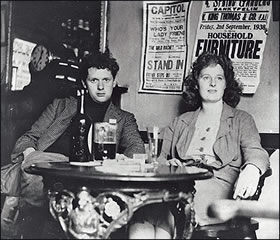
De Engelse dichter Dylan Thomas werd geboren op 27 oktober 1914 in Swansea in Wales. Zie ook mijn blog van 27 oktober 2010 en eveneens alle tags voor Dylan Thomas op dit blog.


Being But Men


Being but men, we walked into the trees

Afraid, letting our syllables be soft

For fear of waking the rooks,

For fear of coming

Noiselessly into a world of wings and cries.


If we were children we might climb,

Catch the rooks sleeping, and break no twig,

And, after the soft ascent,

Thrust out our heads above the branches

To wonder at the unfailing stars.


Out of confusion, as the way is,

And the wonder, that man knows,

Out of the chaos would come bliss.


That, then, is loveliness, we said,

Children in wonder watching the stars,

Is the aim and the end.


Being but men, we walked into the trees.


A Saint About To Fall


A saint about to fall,

The stained flats of heaven hit and razed

To the kissed kite hems of his shawl,

On the last street wave praised

The unwinding, song by rock,

Of the woven wall

Of his father's house in the sands,

The vanishing of the musical ship-work and the chucked bells,

The wound-down cough of the blood-counting clock

Behind a face of hands,

On the angelic etna of the last whirring featherlands,

Wind-heeled foot in the hole of a fireball,

Hymned his shrivelling flock,

On the last rick's tip by spilled wine-wells

Sang heaven hungry and the quick

Cut Christbread spitting vinegar and all

The mazes of his praise and envious tongue were worked in flames and shells.


Glory cracked like a flea.

The sun-leaved holy candlewoods

Drivelled down to one singeing tree

With a stub of black buds,

The sweet, fish-gilled boats bringing blood

Lurched through a scuttled sea

With a hold of leeches and straws,

Heaven fell with his fall and one crocked bell beat the left air.

O wake in me in my house in the mud

Of the crotch of the squawking shores,

Flicked from the carbolic city puzzle in a bed of sores

The scudding base of the familiar sky,

The lofty roots of the clouds.

From an odd room in a split house stare,

Milk in your mouth, at the sour floods

That bury the sweet street slowly, see

The skull of the earth is barbed with a war of burning brains and hair.


Strike in the time-bomb town,

Raise the live rafters of the eardrum,

Throw your fear a parcel of stone

Through the dark asylum,

Lapped among herods wail

As their blade marches in

That the eyes are already murdered,

The stocked heart is forced, and agony has another mouth to feed.

O wake to see, after a noble fall,

The old mud hatch again, the horrid

Woe drip from the dishrag hands and the pressed sponge of the forehead,

The breath draw back like a bolt through white oil

And a stranger enter like iron.

Cry joy that hits witchlike midwife second

Bullies into rough seas you so gentle

And makes with a flick of the thumb and sun

A thundering bullring of your silent and girl-circled island.


 1019894-f2c9c603e773f59a5ad026e70792d3f7.jpg

Dylan Thomas (27 oktober 1914 – 9 november 1953)

Hier met zijn vrouw Caitlin


De Amerikaanse dichteres en schrijfster Sylvia Plath werd geboren op 27 oktober 1932 in Jamaica Plain, een buitenwijk van Boston. Zie ook mijn blog van 27 oktober 2010 en eveneens alle tags voor Sylvia Plath op dit blog.


Black Pine Tree in an Orange Light


Tell me what you see in it :
The pine tree like a Rorschach-blot
black against the orange light :


Plant an orange pumpkin patch
which at twelve will quaintly hatch
nine black mice with ebon coach,


or walk into the orange and make
a devil's cataract of black
obscure god's eye with corkscrew fleck;


put orange mistress half in sun,
half in shade, until her skin
tattoos black leaves on tangerine.


Read black magic or holy book
or lyric of love in the orange and black
till dark is conquered by orange cock,


but more pragmatic than all this,
say how crafty the painter was
to make orange and black ambiguous.


Doomsday


The idiot bird leaps out and drunken leans
Atop the broken universal clock:
The hour is crowed in lunatic thirteens.
Out painted stages fall apart by scenes
While all the actors halt in mortal shock:
The idiot bird leaps out and drunken leans.


Streets crack through in havoc-split ravines
As the doomstruck city crumbles block by block:
The hour is crowed in lunatic thirteens.


Fractured glass flies down in smithereens;
Our lucky relics have been put in hock:
The idiot bird leaps out and drunken leans.


The monkey's wrench has blasted all machines;
We never thought to hear the holy cock:
The hour is crowed in lunatic thirteens.


Too late to ask if end was worth the means,
Too late to calculate the toppling stock:
The idiot bird leaps out and drunken leans,
The hour is crowed in lunatic thirteens.


Winter Trees


The wet dawn inks are doing their blue dissolve.
On their blotter of fog the trees
Seem a botanical drawing.
Memories growing, ring on ring,
A series of weddings.

Knowing neither abortions nor bitchery,
Truer than women,
They seed so effortlessly!
Tasting the winds, that are footless,
Waist-deep in history.

Full of wings, otherworldliness.
In this, they are Ledas.
O mother of leaves and sweetness
Who are these pietas?
The shadows of ringdoves chanting, but chasing nothing.


 1019894-467d4c6b47ba0cce15a36e81474e8588.jpg

Sylvia Plath (27 oktober 1932 – 11 februari 1963)

Hier met de dichter Ted Hughes


De Egyptische schrijfster, gynaecologe, moslimfeministe en politiek activiste Nawal el Saadawi werd geboren in Kafr Tahla op 27 oktober 1931. Zie ook mijn blog van 27 oktober 2008 en ook mijn blog van 27 oktober 2009 en ook mijn blog van 27 oktober 2010


Uit: The Circling Song (Vertaald door Marilyn Booth)


„...He filled his chest with the night air, and realized that he had been born motherless, that his paternal grandfather had been a soldier in the army of Muhammad Ali and that he had been slain in prison...

(…)


...She recognized the black stains on the finger, and whispered: 'Hamido!" But Hamido heard nothing, and remained stiffly upright, his head raised to the sky and one black finger to his ear. (Those travelling abroad used to see this memorial to the unknown soldier erected at the entrance to every capital city.) Hamida stretched out her had and grabbed his. His fingers were like hers, and the lines on his palm resembled hers. In a rush of sympathy - for their lot was a shared one - she tried to bend his arm downwards. But the stone arm, raised wearily, would not move. She raised her eyes and noticed that the wide ebony eyes shone with a real tear, a childlike one...

(…)


...When Hamido opened his eyes, daylight was filling the room. He thought for sure that what he had seen had been nothing but a dream. He jumped up from the mat and ran out into the street. His friends…were playing as usual in the narrow lane extending along the mud-brick façades. Each child grasped the next one's hand, forming a ring that circled round and round...Because they were circling and singing uninterruptedly, it was impossible to pick out the song's beginning or end by ear, just as it was impossible to tell by looking where the circle began and where it ended... „


 1019894-2b593ca185039a5c76d13db7563e4ef6.jpg

Nawal el Saadawi (Kafr Tahla, 27 oktober 1931)


Zie voor nog meer schrijvers van de 27e oktober ook mijn vorige blog van vandaag.
Geschreven door Romenu om 19:02 Reageer op dit bericht

Zadie Smith, Enid Bagnold, Albrecht Rodenbach, Fran Lebowitz, Reza Allamehzadeh, Kazimierz Brandys

De Engelse schrijfster Zadie Smith werd geboren op 27 oktober 1975 in Londen. Zie ook mijn blog van 27 oktober 2008 en ook mijn blog van 27 oktober 2009 en ook mijn blog van 27 oktober 2010


Uit: Changing My Mind


„My father had few enthusiasms, but he loved comedy. He was a comedy nerd, though this is so common a condition in Britain as to be almost not worth mentioning. Like most Britons, Harvey gathered his family around the defunct hearth each night to watch the same half-hour comic situations repeatedly, in reruns and on video. We knew the "Dead Parrot" sketch by heart. We had the usual religious feeling for Monty Python's Life of Brian. If we were notable in any way, it was not in kind but in extent. In our wood-cabinet music center, comedy records outnumbered the Beatles. The Goons' "I'm Walking Backwards for Christmas" got an airing all year long. We liked to think of ourselves as particular, on guard against slapstick's easy laughs — Benny Hill was beneath our collective consideration. I suppose the more precise term is "comedy snobs."

Left unchecked, comedy snobbery can squeeze the joy out of the enterprise. You end up thinking of comedy as Hemingway thought of narrative: structured like an iceberg, with all the greater satisfactions fathoms underwater, while the surface pleasure of the joke is somehow the least of it. In my father, this tendency was especially pronounced. He objected to joke merchants. He was wary of the revue-style bonhomie of the popular TV double act Morecambe and Wise and disapproved of the cheery bawdiness of their rivals, the Two Ronnies. He was allergic to racial and sexual humor, to a far greater degree than any of the actual black people or women in his immediate family. Harvey's idea of a good time was the BBC sitcom Steptoe and Son, the grim tale of two mutually antagonistic "rag-and-bone" men who pass their days in a Beckettian pile of rubbish, tearing psychological strips off each other. Each episode ends with the son (a philosopher manque, who considers himself trapped in the filthy family business) submitting to a funk of existential despair. The sadder and more desolate the comedy, the better Harvey liked it.“


1019887-6518600678e8dd3111096b9423624067.jpg
Zadie Smith (Londen, 27 oktober 1975)


De Belgische dichter en schrijver Albrecht Rodenbach werd geboren te Roeselare op 27 oktober 1856. Zie ook mijn blog van 27 oktober 2010 en eveneens alle tags voor Albrecht Rodenbach op dit blog.


Vrede


't Was winter en 't wierd avond. In de kerk was 't donkernacht.
Een broeder, de lanteern in hand, ging sluiten, als hem dacht,
met hoofd en lijf geleund lijk een die doodmoe is van reizen,
een spilde mansgestalte langs een pijler te zien rijzen.
Hij deed zijn sleutels rammelen en hij klutterde aan de poort.
Doch roerloos bleef het staan alsof het niets en had gehoord,
gelijk een dode of wel een spook. Zeer bang en zeer godvruchtig,
sloeg de arme broer een kruis drie vier, besproeide zich geduchtig,
met water uit 't gewijde vat, en stapte toe. Het licht
verschrok de dove. Hij keek op, en toonde een aangezicht
zo mager als de Honger, als het Lijden zo getrokken,
en toch zo onverklaarbaar schoon met zijne grijze lokken,
dat men er van bewondering wel bij gekresen had
zo prachtig, lijk een vlamme door een oud albasten vat,
doorstraalde die verstorvenheid de meesterschap der rede.
'Mijn broeder, wat begeert gij?' vroeg de lekebroeder. 'Vrede!'
verzuchtte diep die vreemde man, en leunde op de pilaar.
Gauw vezelde de broer de lijst der 'beste paters', maar,
alsof een pletterende overmacht hem langs die pijler plantte,
stond hij die vrede zocht daar doof en stom. Zijn naam was Dante.


 1019887-314c6b7b2a73e4f82e20643e9af2eab0.jpg

Albrecht Rodenbach (27 oktober 1856 – 23 juni 1880)


De Britse schrijfster Enid Algerine Bagnold werd geboren op 27 oktober 1889 in Rochester, Kent. Zie ook mijn blog van 27 oktober 2008 en ook mijn blog van 27 oktober 2009 en ook mijn blog van 27 oktober 2010


Uit: The Happy Foreigner


„A porter came out and swept the steps of the hotel, and a puff of his dust caught her in the face. He laid a fibre mat on each stone step, and clipped them with little metal clips.
"Are you for us?" asked a _sous-lieutenant_, looking first up and down the empty street and then at the car. He had blue eyes and a long, sad moustache that swept down the lower half of his face and even below his chin, making him look older than he should.
"I am for a Russian colonel," she said, liking his mild face.
"That's right. Yes, a Russian colonel. Colonel Dellahousse. But can you manage by yourself? Can you really? I will tell him...."
He disappeared up the steps and through the swing door of the hotel. A moment later he was out again.
"He will come to you himself, he will see you. But we want to go to Verdun! Could you drive so far? You could? Yes, yes, perhaps. Yet here he comes...."
In dark civilian clothes the Russian came down the hotel steps. He was tall, serious, upright, rich. His face beneath his wide, black hat was grave and well cared for. The sombre glitter of his eye was grave, his small dark beard shone in the well-controlled prime of its growth. From the narrow line of white collar to the narrower thread of French watchchain--from the lean, long feet to the lean, white hands she took him in, and braced herself, adjusted herself, to meet his stately gravity. If there was something of the Mephistopheles in fancy dress about him, it was corrected by his considerate expression.
"Have you had breakfast?" he began, speaking French with a softly nasal accent.
"How kind of you to think of it! Yes, thank you, monsieur."
"I have to go to Verdun," he put it to her. "I have business there." It was as though he expected that she would let him off without difficult explanations, would exclaim: "There is some mistake! Some other car, some other driver is intended for your work!"


1019887-503589d492575fef91fba8df701fdadc.jpg
Enid Bagnold ( 27 oktober 1889 – 3 maart 1981)


De Amerikaanse schrijfster Frances Ann "Fran" Lebowitz werd geboren op 27 oktober 1950 in Morristown, New Jersey. Zie ook mijn blog van 27 oktober 2008 en ook mijn blog van 27 oktober 2010


Uit: Fran Lebowitz, A Humorist at Work (Interview in The Paris Review, 1991)


“LEBOWITZ

That’s not writing. Talking is not writing. To me, it would be even a slower way to write. To me, dictating a book seems impossible. But what would also be impossible, would be to write on one of those word processors. There’s too much distance.

INTERVIEWER

What do you use then?

LEBOWITZ

A Bic pen. I’m such a slow writer I have no need for anything as fast as a word processor. I don’t need anything so snappy. I write so slowly that I could write in my own blood without hurting myself. I think if there were no such thing as men, there would be no word processors. Male writers like them because they have this sneaking suspicion that writing is not the most masculine profession. This is why you have so much idiotic behavior among male writers. There are more male writers who own guns than any other profession except police officers. They like machines because it makes them seem more masculine. Well, I work on a machine. It’s almost as good as being a mechanic.

I have a real aversion to machines. I write with a pen. Then I read it to someone who writes it onto the computer. What are those computer letters made of anyway? Light? Too insubstantial. Paper, you can feel it. A pen. There’s a connection. A pen goes exactly at your speed, whereas that machine jumps. And then, that machine is waiting for you, just humming “uh-huh, yes?”

It reminds me of when a choreographer I know was creating a ballet. He was stuck, and he asked me to come help.

I said, How could I help you choreograph a ballet?

He said, I’d like you to come and sit there while I’m doing it. You’re so judgmental I would find it helpful.

So I went to his studio several times while he was making the ballet. I saw the only job that was worse than writing. My idea of pure hell. The dancers sit there waiting for him to come up with something. It would be as if the letters were sitting there, or the words, smoking cigarettes, staring at you, as if to say, Well? OK, come on.

Plus they are paid by the minute. And a piano player is sitting there as well. Twenty-five people sitting in the room staring at you while you are thinking. I can’t believe anyone has ever made a ballet.


 1019887-d938dcdd8e9d08a86ce7509b959dee28.jpg

Fran Lebowitz (Morristown, 27 oktober 1950)


Zie voor onderstaande schrijvers ook mijn blog van 27 oktober 2008.


De Iraanse schrijver en filmmaker Reza Allamehzadeh werd geboren op 27 oktober 1943 in Sari, Mazandaran.


De Poolse schrijver Kazimierz Brandys werd geboren op 27 oktober 1916 in Lodz.

Geschreven door Romenu om 18:58 Reageer op dit bericht

Meer van Romenu

↑ Terug naar de berichten