

Naar de inhoud

Romenu

Over literatuur, gedichten, kunst en cultuur
seniorennet.beseniorennet.be

Berichten van 5 april 2012

Nicolaas Beets, Hugo Claus, Algernon Swinburne, Bora Ćosić


Bij Witte Donderdag


1129031-8667ed6e7deba2be5e46de5ac3bc0fa8.jpg
Het Laatste Avondmaal door Peter Paul Rubens, 1630 bis 1632


Het laatste avondmaal

Mark. XIV v. 22-24.


Toen hij zijn bijzijn was ontvloden,

Wien Jezus, in den laatsten nacht,

De bittre bete had geboden.

Die al zijn bloed aan 't gisten bracht;

Toen Judas, om, naar 't woord des Heeren,

Met haast te doen hetgeen hij deed,

Zijn heilig aangezicht vermeed,

Om met dien kus terug te keeren!


Toen de ijslijke ure was gekomen,

Waarin de kampstrijd aan zou gaan,

Werd op zijn wezen niets vernomen.

Dat angst of droef heid kon verraân;

Hij zag in wat Hij zou beginnen,

In ieder foltring Hem bereid,

Al zijn aanstaande heerlijkheid,

En in zijn strijden 't overwinnen.


Nog eens tot de Elve dan gesproken,

Van liefde en eendracht, moed en trouw!

Toen heeft Hij plechtig 't brood gebroken,

Daar elk van hen van eten zou.

Toen heeft Hij, aan dien heilgen dissche,

Den laatsten beker om doen gaan,

Zoo als 't nog heden wordt gedaan,

Ter maaltijd der gedachtenisse.


O Beeldspraak van de felste smart:

Gebroken brood, vergoten wijn!

Moet gij voor mijn geloovig harte

Van 's Heilands dood de teeknen zijn!

Gewis; zijn lichaam werd verbroken,

Om mij te redden van 't verderf,

Zijn hand doorgriefd, zijn zij' doorstoken,

Opdat ik Gods gena verwerf.


Als ik 't gebroken brood dan ete,

En proeve den vergoten wijn,

Mijn Heiland! dat ik nooit vergete

Hoe veel en groot mijn zonden zijn!

Opdat ik voor mijzelf mij schame,

Maar, overtuigd van Gods gena,

Van uw gewijde tafel ga,

Op nieuw versterkt in uwen name.


1129031-0f09170bbfab79bddaf64195a4a214c6.jpg
Nicolaas Beets (13 september 1814 – 13 maart 1903)

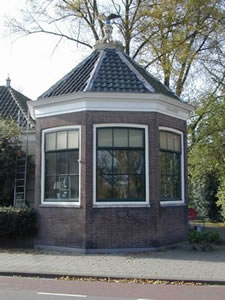
De theekoepel in Arendshof, waar Beets zijn verzen voorlas


De Vlaamse schrijver Hugo Claus werd in Brugge geboren op 5 april 1929. Zie ook alle tags voor Hugo Claus op dit blog.


Horizon


De horizon is de taal, de taal die ik word
geacht te delen met
het verminkte kind,
met de jongeling die soldaat geworden is
en zo fier op zijn laarzen,
met de grijsaard met zijn gescheurde darmen
in zijn armen.

Het regent fosfoor en sirenes

De stemmen van mijn land
meestal in de televisie.
Moordzuchtige families.
Misdadig gezang.

En alom de bloedslurpende goden


Ik draag van alles


Ik draag van alles, brood, kaas
een bom of een verminkte kat.
Dragen is mijn redding.

Ook van binnen draag ik,
vragen, tranen, gedaas
en een karrenvracht solaas.

Als ik niet draag
is er een gemis
dat niet te dragen is.

Het dood dier dat ik droeg
heeft mij gelikt
tot ik geen gezicht meer had.


De zon


De zon is een Antwerpse planeet
De aarde houdt op bij de Schelde
Cyclonen gaan liggen op de Groenplaats
Van alle machtige steden die vallen
Valt Antwerpen het laatst
Tot op het laatst autochtoon.


1129031-8fd24e9a5f0815c08bfc43e6d54585f7.jpg
Hugo Claus (5 april 1929 – 19 maart 2008)

Schrijvend 


De Engelse schrijver en dichter
Algernon Charles Swinburne werd geboren op 5 april 1837 in Londen. Zie ook alle tags voor Algernon Swinburne op dit blog.


A Leave-Taking

Let us go hence, my songs; she will not hear.
Let us go hence together without fear;
Keep silence now, for singing?time is over,
And over all old things and all things dear.
She loves not you nor me as we all love her.
Yea, though we sang as angels in her ear,
She would not hear.

Let us rise up and part; she will not know.
Let us go seaward as the great winds go,
Full of blown sand and foam; what help is here?
There is no help, for all these things are so,
And all the world is bitter as a tear.
And how these things are, though ye strove to show,
She would not know.

Let us go home and hence; she will not weep.
We gave love many dreams and days to keep,
Flowers without scent, and fruits that would not grow,
Saying, `If thou wilt, thrust in thy sickle and reap.'
All is reaped now; no grass is left to mow;
And we that sowed, though all we fell on sleep,
She would not weep.

Let us go hence and rest; she will not love.
She shall not hear us if we sing hereof,
Nor see love's ways, how sore they are and steep.
Come hence, let be, lie still; it is enough.
Love is a barren sea, bitter and deep;
And though she saw all heaven in flower above,
She would not love.

Let us give up, go down; she will not care.
Though all the stars made gold of all the air,
And the sea moving saw before it move
One moon?flower making all the foam?flowers fair;
Though all those waves went over us, and drove
Deep down the stifling lips and drowning hair,
She would not care.


Let us go hence, go hence; she will not see.
Sing all once more together; surely she,
She too, remembering days and words that were,
Will turn a little toward us, sighing; but we,
We are hence, we are gone, as though we had not been there.
Nay, and though all men seeing had pity on me,
She would not see.


1129031-f28335531719682e35af45b4d8e5eb41.jpg
Algernon Swinburne (5 april 1837 – 10 april 1909)

Portret door William Bell Scott, 1850


De Servische dichter en schrijver Bora Ćosić werd geboren op 5 april 1932 in Zagreb. Zie ook alle tags voor Bora Ćosić op dit blog.


Uit: My unrelenting vice


“Reading has only recently become a silent act. Two hundred years ago everyone read aloud. This was dictated by church ritual, in which one, or better said everyone, had to listen to the “holy” text. In the first cathedrals entire choruses of believers spoke aloud this reading material that they viewed as godly. This muttering was further practiced by those few people on earth who at the time were, by some miracle, able to read, as if everyone one of them fulfilled the role of today’s speakers and leaders. Then some anonymous Copernicus of reading came along, who brought the entire practice inside by following his text “in his mind”. Thus the letter-for-letter literalness of ecclesial or school reading was lost. Because what goes through my head when I do the work of reading is not necessarily the same as what someone else wrote.

One readily discovers this when undertaking a fresh reading of something that was once familiar. Not only do I rediscover what I had forgotten, but also I realise that “there” in the text I had read long ago there is nothing of what I expected to find! This is the valuable reading of a text, which the reader has created within himself by grinding up a mass of foreign material in his mill and transforming it into something different through unexpected combinations. Read again, many incidences that remained in one’s mind from before play out in a different way entirely.“


1129031-52fae96528f809d64f2a7c9500e382a6.jpg
Bora Ćosić (Zagreb, 5 april 1932)


Zie voor nog meer schrijvers van de 5e april ook mijn vorige blog van vandaag.
Geschreven door Romenu om 00:00 Reageer op dit bericht

Werner J. Egli, Michael Georg Conrad, Arthur Hailey, Paolo Ferrari

De Zwitserse schrijver Werner J. Egli werd geboren in Luzern op 5 april 1943. Zie ook alle tags voor Werner J. Egli op dit blog.


Uit: Dream Road


“Eine Welt ohne Krieg wäre eine Welt ohne Menschen, dachte er. Es würde still sein.
Und in dieser Stille würde ein Baby zur Welt kommen.
Es wäre der erste friedfertige Mensch sein, nachdem die Menschen sich gegenseitig fast ausgerottet hatten.
Noch lag die Welt in Trümmern. Noch schien die Sonne wie durch einen schmutzigen Nebel.
Es war kalt und es schneite schmutzigen Schnee. An der Oberfläche des Sees trieben tote Fische mit weiss schimmernden Bäuchen.
In der Nähe lag der Kadaver eines Rehs. Julia kauerte in eine Decke gehüllt in der Ruine eines Hauses und stillte das Baby. Am Boden lagen Geldstücke herum, aber sie waren wertlos.
Mika kam mit einem Armvoll Holz zurück und entfachte ein Feuer.
Es war das einzige Feuer weit und breit.
Nach und nach näherten sich Menschen dem Feuerschein, setzten sich auf die Trümmer und begannen in ihren Habseligkeiten herumzukramen.
Keiner besass viel, aber was er besass, teilte er mit den anderen.
Und sie begannen über die Zukunft zu reden.“


1129029-87b2aaab59faaf898cf9c5fa494cf90a.jpg
Werner J. Egli (Luzern, 5 april 1943)


De Duitse dichter en schrijver Michael Georg Conrad werd geboren op 5 april 1846 in Gnodstadt. Zie ook alle tags voor Michael Georg Conrad op dit blog.


Vom Grab meiner Mutter


Vom Grab meiner Mutter komm’ ich gegangen.

Fragt mich nichts, ich kann nichts wissen und sagen.

Aus ewigen Schweigens nächtigen Landen

komm’ ich gegangen, vom Grab meiner Mutter.

Mein Sinnen und Sehnen ist dort,

mein verzweifeltes Wähnen,

jenseits von allem.


Mit blutigem Herzen, zerrissen,

mit schweren Füßen,

vom Grab meiner Mutter komm’ ich gegangen.

Des Herzens heiligste, letzte Zuflucht

liegt unter der Erden.

Vielleicht, wenn des Winters Stürme vorüber,

pflanz’ ich Rosen darauf, rote und weiße,

und der Lenz läßt sie glühen und duften,

und des Sommers Sonne umlächelt sie,

und von den Feldern grüßt die Saat herüber

und manche wilde Blume.


Meine Mutter liebte das Feld

und die Saat und die wilden Blumen . . .

Dann kommt der Herbst,

nimmt alles hinweg,

und dann der Winter . . .

O, wie mich friert . . .


Vom Grab meiner Mutter komm’ ich gegangen,

zum Grab meiner Mutter geh’ ich zurück;

des Herzens heiligste, letzte Zuflucht

liegt unter der Erden.

Fragt mich nichts. Was soll ich wissen und sagen?

Unerbittliches Schweigen umfängt

die nächtigen Lande der Toten.


Mutter! Mutter!


Fortweinen möcht’ ich dies Leben,

so weh ist mir

ohne dich.


Mutter, noch einmal nur

sing’ mir dein Wiegenlied,

Mutter, sing’ mich zur Ruh’ - -


1129029-a569e55035feaf320785a93ec414ab7c.jpg
Michael Georg Conrad (5 april 1846 – 20 december 1927)

De Ev. Lutherse kerk in Gnodstadt 


De  Brits-Canadees schrijver
Arthur Hailey werd geboren in Luton, Bedfordshire, op 5 april 1920.
Zie ook alle tags voor Arthur Hailey op dit blog.


Uit: Hotel


„She said quietly, "I didn't know that."

He looked at her quizzically. "I thought you knew everything."

And usually she did. As personal assistant to Warren Trent, the unpredictable and irascible owner of New Orleans' largest hotel, Christine was privy to the hotel's inner secrets as well as its day-to-day affairs. She knew, for example, that Peter, who had been promoted to assistant general manager a month or two ago, was virtually running the big, bustling St. Gregory, though at an ungenerous salary and with limited authority. She knew the reasons behind that, too, which were in a file marked Confidential and involved Peter McDermott's personal life.

Christine asked, "What is breaking loose?"

McDermott gave a cheerful grin which contorted his rugged, almost ugly features. "We've a complaint from the eleventh floor about some sort of sex orgy; on the ninth the Duchess of Croydon claims her Duke has been insulted by a room-service waiter; there's a report of somebody moaning horribly in 1439; and I've the night manager off sick, with the other two house officers otherwise engaged."

He spoke into the telephone again and Christine returned to the office window which was on the main mezzanine floor. Head tilted back to keep the cigarette smoke from her eyes, she looked casually across the city. Directly ahead, through an avenue of space between adjoining buildings, she could see into the tight, crowded rectangle of the French Quarter. With midnight an hour away, it was early yet for the Quarter, and lights in front of late night bars, bistros, jazz halls, and strip joints -- as well as behind darkened shutters -- would burn well into tomorrow morning.“


 1129029-d2598389741cba6aedfab03812d69a47.jpg

Arthur Hailey (5 april 1920 - 24 november 2004)


De Italiaanse blijspeldichter Paolo Ferrari werd geboren op 5 april 1822 in Modena. Zie ook alle tags voor Paolo Ferrari op dit blog.


Uit: Methods of Making a Living (Signor Lorenzo)


“Gian.  Another system I have is to play the electrical agent. I present myself, we will say, to a marquis, a great man of letters, or a banker. I enter with a certain degree of dignity, stretch out my legs as I sit down, and after a brief preamble on the existing need for men of strong independent character, on the dangers threatening our country’s free institutions, I finally inquire, rather mysteriously, “Would you, in short, sir, be willing to be elected senator?” “But,” says he, flattered and smiling, “I do not quite understand,” And I reply, “Pardon me if I am unable to divulge anything more at present.” “Then, perhaps, you have been charged with sounding me?” “I might have been.” Note that I say I might have been, not that I have been. That would be a lie, and I never tell lies. Then he goes on, “Pardon me, with whom have I the honor of speaking?” “I am Gianni Bartolomeo Senatori. Don’t you remember — Turin — Exchange Café — at luncheon, at dinner?” “Ah, yes, of course I remember, my dear Signor Senatori!” Now observe that I never said I remembered. That would be a lie. I ask him if he remembers, and he says he does; so it is he who tells a lie. Sometimes it happens that after getting as far as the vestibule I am confronted by a rude domestic, who says, “Not at home!” Then I give the fellow my card, and say, with my nose in the air, “Here, hand this in to your master!” As you already know, my name is Gianni Bartolomeo Senatori. When you are poor you must use your wits. I use my name too. My cards bear my name, only Bartolomeo comes before Gianni, and is abbreviated to Bar.; the, after Gianni comes with fine flourishes Senatori. 123 When the gentleman sees my card, he reads, “Bar. Gianni — Ah, I see — Baron Gianni!” He gets up, and says, “Baron Gianni, Senator! Bring him in! Bring him in at once!” And in I go.”


1129029-dec8b517b862af4d305fe8d55dd131bb.jpg
Paolo Ferrari (5 april 1822 – 9 maart 1889)

Buste in Palazzo di Brera, Milaan

Geschreven door Romenu om 00:00 Reageer op dit bericht

Meer van Romenu

↑ Terug naar de berichten