E. E. Cummings, Péter Nádas, Katha Pollitt, Daniël Rovers, Katherine Mansfield, Margarete Susman, Stefan Żeromski
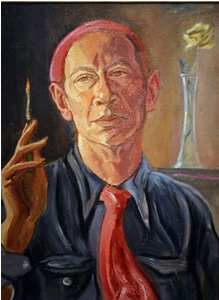
De Amerikaanse dichter en schrijver Edward Estlin Cummings werd geboren in Cambridge, Massachusetts op 14 oktober 1894. Zie ook mijn blog van 14 oktober 2010 en eveneens alle tags voor E. E. Cummings op dit blog.
In The Rain-
in the rain-
darkness, the sunset
being sheathed i sit and
think of you
the holy
city which is your face
your little cheeks the streets
of smiles
your eyes half-
thrush
half-angel and your drowsy
lips where float flowers of kiss
and
there is the sweet shy pirouette
your hair
and then
your dancesong
soul. rarely-beloved
a single star is
uttered,and i
think
of you
I Like My Body When It Is With Your
i like my body when it is with your
body. It is so quite new a thing.
Muscles better and nerves more.
i like your body. i like what it does,
i like its hows. i like to feel the spine
of your body and its bones,and the trembling
-firm-smooth ness and which i will
again and again and again
kiss, i like kissing this and that of you,
i like, slowly stroking the,shocking fuzz
of your electric furr,and what-is-it comes
over parting flesh….And eyes big love-crumbs,
and possibly i like the thrill
of under me you so quite new
It Is Funny, You Will Be Dead Some Day
it is funny, you will be
dead some day.
By you the mouth hair eyes,and i mean
the unique and nervously obscene
need;it’s funny. They will all be dead
knead of lustfulhunched deeplytoplay
lips and stare the gross fuzzy-pash
—dead—and the dark gold delicately smash….
grass,and the stars,of my
shoulder in stead.
It is a funny,thing. And you will be
and i and all the days and nights that matter
knocked by sun moon jabbed jerked with ecstasy
….tremble (not knowing how much better
than me will you like the rain’s face and
the rich improbable hands of the Wind)
E. E. Cummings (14 oktober 1894 - 3 september 1962)
Zelfportret, 1958
De Hongaarse schrijver Péter Nádas werd geboren op 14 oktober 1942 in Boedapest. Zie ook mijn blog van 14 oktober 2010 en eveneens alle tags voor Péter Nádas op dit blog.
Uit: A Lovely Tale Of Photography (Vertaald door Imre Goldstein)
"Mein Carl, on the other hand, regrets that the nights are so cool already. Isn't it so, Carl?"
"Our Kornélia keeps telling us that on some southern seas the weather wouldn't be nearly so pleasant."
"In truth, we could hardly afford to interrupt our walk, still we hastened over, since the young lady had sent for us. Would it be too much of an intrusion to suggest that you share the rest of our walk with us?"
"On the contrary. Nothing would please us more. All the more so since the young lady is deeply indebted to Mister Van der Woelde; and if she has taken the liberty of sending for him, she has done so for no other reason than to pay her respects to her savior and to express her gratitude."
"The young lady should not even think in terms of debt and gratitude."
"Forgive me, madam, but why not? And why should she not talk of such things? After all, the young lady was told how the young gentleman had saved her life."
"I grant you that it was he who found her on the steps of that abandoned house of terrible reputation. But that's hardly worth mentioning. We hope that the young lady has recovered from her fright; judging by her radiant complexion I cannot reach any other conclusion."
"The young body can overcome its passing weakness; the rest will be done by the curative effect of this marvelous environment and, last but not least, by the hoped-for company of the two of you."
And there is the voice that, to all indications, follows us everywhere.
"The elderly lady at this moment with a single regal gesture put an end to the stream of mutual courtesy and compliments. And although there was some gain, however unpleasant, to be had from this gesture, its necessity was not readily fathomable."

Péter Nádas (Boedapest,14 oktober 1942)
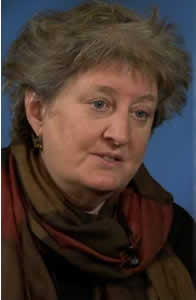
De Amerikaanse dichteres, essayiste, critica en feministe Katha Pollitt werd geboren op 14 oktober 1949 in New York. Zie ook mijn blog van 14 oktober 2010 en eveneens alle tags voor Katha Pollit op dit blog.
Silent Letter
It’s what you don’t hear
that says struggle
as in wrath and wrack
and wrong and wrench and wrangle.
The noiseless wriggle
of a hooked worm
might be a shiver of pleasure
not a slow writhing
on a scythe from nowhere.
So too the seeming leisure
of a girl alone in her blue
bedroom late at night
who stares at the bitten
end of her pen
and wonders how to write
so that what she writes
stays written.
Job
Worse than the boils and sores
and the stench and the terrible flies
was the nattering: Think.
You must have done something.
Things happen for a reason.
What goes around.
His life swept off in a whirlwind of camels and children!
Still, he knew enough to shut up
when his skin cleared pink as a baby’s
and overnight lambs blanketed the burnt fields.
People even said he looked taller
in his fine new robes: You see?
When one door closes, two doors open.
Nobody wanted to hear
about the rain or its father
or leviathan slicing the deeps
at the black edge of the world
under the cold blue light of the Pleiades.
The new sons were strong and didn’t ask difficult questions,
the new daughters beautiful, with glass-green eyes.
Katha
Pollitt (New York,14 oktober 1949)
De Nederlandse schrijver Daniël Rovers werd geboren in Zelhem op 14 oktober 1975. Zie ook mijn blog van 14 oktober 2010 en eveneens alle tags voot Daniël Rovers op dit blog.
Uit: Walter
“Da zal ow kontje wel vaore,’ gromde
Van Leijsen, en hij schopte het beest in de linkerflank. ‘Onzen misdienaar
laote gerust.’
Van Leijsen stampte op de straatstenen, alsof hij het koud had. Zijn klompen
moesten nodig hersteld worden. De klompen van een knecht, maar de praatjes van
een boer. Het werd tijd voor de mis. ‘Houdoe, Van Leijsen.’ Land bij de
Moerdijk, dat kreeg die van zijn leven niet.
Op de Heuvel graasden de vaarzen van Van der Ven. De weide tussen de bomen was
leeggevreten, toch bleven de beesten naar de laatste grassprieten op zoek.
Daarom ook waren hun ogen zo groot, zoals bij vliegen. Eentje draaide zich om,
rood zwol haar achterste op, stront – vlats, vlats – kwam in stoten uit de aars
zetten. De zon zou er de hele dag op blijven schijnen. Daar kreeg je stevige,
bijna zwarte korsten van, met van binnen groene saus. Maakte de zon alles hard?
Kleigrond, pas gemaaid gras, broodkruimels. Maar boter wordt zacht als het in
de zon op het aanrecht ligt, en ijs smelt in de sloten als de vorstnachten
ophouden te duren.
Walter keek naar de punten van zijn schoenen, Trees had ze gisteren nog
gepoetst. Er zat een vlekje op. Was dat water van het wassen of een
strontspetter van zo-even? Hij spuugde in zijn zakdoek en ging door zijn knieën
om het leder schoon te vegen. Wit belletjesschuim. Jezus Christus stond voor de
kerk op zijn sokkel een witte slagtand te wezen.
De kerkdeur had een grote smeedijzeren klink, die je met twee handen naar
beneden moest duwen. Donker was het voorportaal, het rook naar kelder en naar
hersenschudding. Een tweede deur moest hij door, met daarachter het kerkschip.
De koster had naast het altaar twee kaarsen aangestoken. In Made was zo vorig
jaar op een ochtend brand uitgebroken; de preekstoel had als een braambos vlam
gevat.
Weduwe Van Raamsdonk zat al in de kerk, aan de linkerkant, die van de vrouwen.
Het silhouet dat al een keer in zijn dromen was verschenen: gebogen schouders,
een dunne nek, het haar dat in een knot samengebonden werd.”
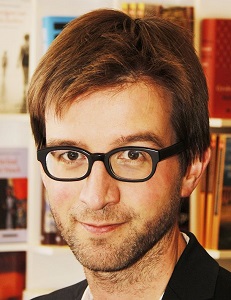
Daniël Rovers (Zelhem, 14 oktober 1975)
De Nieuw-Zeelandse schrijfster Katherine Mansfield werd geboren op 14 oktober 1888 in Wellington. Zie ook mijn blog van 14 oktober 2010 en eveneens alle tags voor Katherine Mansfield op dit blog.
Uit: The Swing of the Pendulum
“She heard him walk down the passage and then pause - lighting a cigarette. Yes - a faint scent of delicious cigarette smoke penetrated her room. She sniffed at it, smiling again. Well, that had been a fascinating interlude! He looked so amazingly happy: his heavy clothes and big buttoned gloves; his beautifully brushed hair... and that smile... 'Jolly' was the word - just a well-fed boy with the world for his playground. People like that did one good - one felt 'made over' at the sight of them. Sane they were - so sane and solid. You could depend on them never having one mad impulse from the day they were born until the day they died. And Life was in league with them - jumped them on her knee - quite rightly, too. At that moment she noticed Casimir's letter, crumpled up on the floor - the smile faded. Staring at the letter she began braiding her hair - a dull feeling of rage crept through her - she seemed to be braiding it into her brain, and binding it, tightly, above her head...”
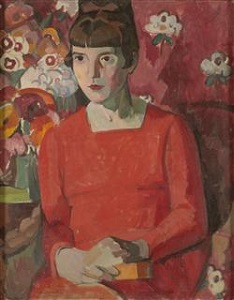
Katherine Mansfield (14 oktober 1888 – 9 januari 1923)
Portret door Anne Estelle Rice, 1918
De Duitse dichteres, schrijfster en filosofe Margarete Susman werd geboren op 14 oktober 1872 in Hamburg. Zie ook mijn blog van 14 oktober 2010 en eveneens alle tags voor Margarete Susman op dit blog.
Der Sturm rauscht durch die Linde
Der Sturm rauscht durch die Linde;
Düfte kommen im Winde
In tiefer klingender Nacht.
Mein Herz ist aufgewacht
Und pocht so laut und mächtig
In der Nacht tiefstürmendes Lied.
Ich weiss nicht, wie mir geschieht.
Ah, wie der Nachtsturm saust!
Ein grosses Vergessen umbraust
Das Haupt mir dunkel und nächtig -
Und in dem Vergessen ein Wissen
Von nie gewussten Dingen —
Ein Fliehn und Umschlingen,
Ein Verlieren und Finden,
Ein Erscheinen, Verschwinden —
Das sind die stummen Gestalten,
Das ist das webende Walten
Der Nacht. —
Der Sturm rauscht durch die Linde,
Düfte kommen im Winde,
Mein Herz ist aufgewacht.
Nacht ist's — zu meinen Füssen brandet
Nacht ist's — zu meinen Füssen brandet
Ein Meer von unerlöster Sehnsucht
In schluchzenden Wogen —
Und alle gekreuzigte Liebe der Welt
Steht um mich her. —
Dunkel — beengend — so voll die Welt
Von brennender Liebe,
Die in das dunkle Gewand der Nacht
Einsam ihr Antlitz birgt.
Stockende Seufzer — banges Schluchzen
Und die heiligste Liebe verströmt
Einsam ins All.
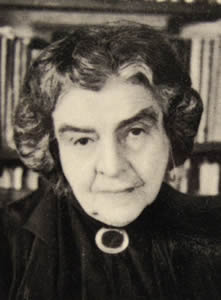
Margarete Susman (14 oktober 1872 - 16 januari 1966)
De Poolse schrijver Stefan Żeromski werd geboren op 14 oktober 1864 in Strawczyn
in de buurt van Kielce. Zie ook mijn blog van 14 oktober 2010 en eveneens alle tags voor Stefan Żeromski op dit blog.
Uit: Forebodings (Vertaald door Marie Busch)
“After having gazed at the awe-inspiring phenomena which surrounded him in the semicircle of the hospital theatre, he had slept during the operation. His simple heart had not worked out the lesson that sleep, the greatest mistress on earth, teaches. After the operation everything had been veiled by moral lassitude. This had continued, but in the afternoon and at night they had mixed something heavy, like a stone ball, into his drinking-cup, and waves of warmth had flowed to the toes of his healthy foot from the cup. Thoughts chased one another swiftly, like tiny quicksilver balls through some corner of his brain, and while he lay bathed in perspiration, and his eyelids closed of their own accord, not in sleep but in unconsciousness, he had been pursued by strange, half-waking visions.
Everything real seemed to disappear, only dimly lighted, vacant space remained, pervaded by the smell of chloroform. He seemed to be in the interior of a huge cone, stretched along the ground like a tunnel. Far away in the distance, where it narrowed towards the opening, there was a sparkling, white spot; if he could get there, he might escape. He seemed to be travelling day and night towards that chink along unending spiral lines running within the surface of the tunnel; he traveled under compulsion and with great effort, slowly, like a snail, although within him something leapt up like a rabbit caught in a snare, or as if wings were fluttering in his soul. He knew what was behind that chink. Only a few steps would lead him to the ridge under the wood… to his own four strips of his potato-field….’
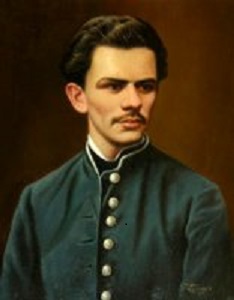
Stefan Żeromski (14 oktober 1864 - 20 november 1925)
Portret in het
Nationale Museum in Kielce