Naar de inhoud

Romenu

Over literatuur, gedichten, kunst en cultuur
seniorennet.beseniorennet.be

Berichten van 22 februari 2014

In Memoriam Leo Vroman

In Memoriam Leo Vroman

De Nederlandse dichter en schrijver Leo Vroman is vanochtend op 98-jarige leeftijd overleden in zijn woonplaats Fort Worth in de Verenigde Staten. Leo Vroman werd op 10 april 1915 in Gouda geboren. Zie ook alle tags voor Leo Vroman op dit blog.


Uitstel van het einde

Het advies in dit stakkergebouw
is: Blijf zo lang mogelijk bezig,
maar ik neem dat niet zo nauw
en ben dus flakkerend aanwezig.

Zo voel ik mij soms naar buiten zweven
als ik naar ons uitzicht kijk,
en ben, Bezig, dan weer even
in twee kamers tegelijk.

Dan weer, graag bij bliksemlicht,
moet ik nodig een gedicht
en ben een vleugelsinterklaas,
een onweerbare huispoweet
van fladderend meesterwerk, helaas
niet wetend hoe het onweer heet.

Duikelend schaam ik mij dan weer
voor mijn vlegelachtigheid
en de draad noodlottig kwijt
schrijf ik mij neer.


Steen

Drie stenen zitten op een steen.
Acht stenen liggen er om heen.
Daar onder liggen er nog negen.
Andere daar naast en tegen.
Een steen steekt half uit het zand naar buiten
om zich nog eventjes te uiten.
Leert, kinderen, dit uit zijnen mond:
houdt steeds een vuist boven de grond.


Sluiting

Als ik morgen niet opsta
moet je niet schrikken:
per slot, elke opera
en alle toneelstukken
hebben hun ogenblikken,
het vallen van gordijnen
of andere ongelukken.
Dit is dan het mijne.

Sluit dus mijn gezicht,
doe die mond en twee ogen
maar netjes dicht
en ik ben voltooid.

Laat zo maar gaan,
en die oren mogen
nog openstaan,
want je weet nooit


 1554265-c0cb09556c42e204e3b8e0c2135acedf.jpg
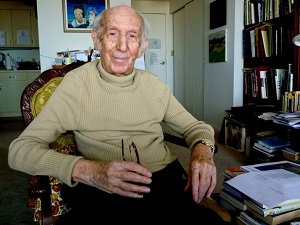
Leo Vroman (10 april 1915 - 22 februari 2014)

Geschreven door Romenu om 17:58 Reageer op dit bericht

Arnon Grunberg, Paul van Ostaijen, Hugo Ball, Danilo Kiš, Sean O'Faolain, Jane Bowles, Ishmael Reed

De Nederlandse schrijver Arnon Grunberg werd geboren in Amsterdam op 22 februari 1971. Zie ook alle tags voor Arnon Grunberg op dit blog.

Uit: Huid en haar

'Waar wacht je op?' vraagt Lea.
Ze draagt een zwarte wollen jas met een bontkraag, tweedehands gekocht. Ze kan zich zulke jassen niet nieuw permitteren. Lea reist lichtbepakt. Een rugzak, meer heeft ze niet nodig voor vijf dagen. Met een föhn krijg je de meeste kreukels uit je kleren.
Op haar knie ligt een hand. Maar een hand op een knie is nog geen intimiteit.
'Waarvan bent u precies een kenner?' had een professor haar die avond tijdens een staande receptie gevraagd terwijl hij schijnbaar terloops haar bovenarm aanraakte. Ze had het onprettig gevonden. De vraag en de aanraking.
Een uur daarvoor had ze haar jurk in de badkamer opgehangen aan de rail waaraan ook het douchegordijn was bevestigd en hem met de föhn behandeld. De kreukels gingen er minder goed uit dan ze had gehoopt. Morgenochtend gaat ze naar huis, dan kan ze haar jurk laten stomen.
Kenner. Een belachelijk woord. Je kunt het eigenlijk alleen ontkennend gebruiken, als in: 'Ik ben geen kenner van porseleinwerk.' Ze is een kenner van Rudolf Höss, dat moest ze toegeven.
'Höss,' had ze geantwoord. Vervolgens had ze zich geëxcuseerd met de woorden: 'Even kijken of hier nog meer mensen zijn die ik ken.'
In de verte, ingeklemd tussen een pilaar en een gesticule- rende man met een baard, had ze Roland Oberstein zien staan. Ze had de behoefte gevoeld om op hem af te stappen en zonder verdere plichtplegingen tegen hem te zeggen: 'Red mij.'
Pathetisch natuurlijk. Maar is hoop op redding niet per definitie pathetisch? Hebben we leren leven zonder hoop? Als we al redding zoeken, mogen we dan alleen diep in onszelf graven?
Ze weigert dit te aanvaarden.
De professor was achter haar aangelopen. 'Höss,' had hij gezegd, 'de commandant van Auschwitz. Boeiend. Had hij niet een verhouding met een gevangene in het kamp?”


 1554150-c742fdb58052eb01f91ff895d5a51092.jpg
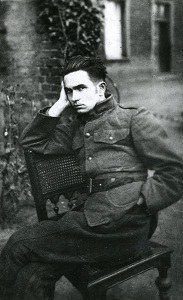
Arnon Grunberg (Amsterdam, 22 februari 1971)


De Vlaamse dichter en schrijver Paul van Ostaijen werd geboren in Antwerpen op 22 februari 1896. Zie ook alle tags voor Paul van Ostaijen op dit blog.


Het dorp

Een vleermuis aan de nacht
hangt niet uw adem aan een vreemde adem
zo gij dit beseft het dorp
en de mensen nacht'lik huis aan huis
één licht - wellicht bij de pastoor -
en langs uw weg een late koe
In de wig van weg en stroom
is van de leegte zo het dorp
alsof 't een boot was die maar voor korte tijd
op anker ligt

Om het staketsel kletst
het donkere water
gemeten
en vreemder dan een moorden zonder gil

Gij weet dat er geen gelaat is
waar gij binnen kunt
als in uw huis

En gij stoot overal der dingen oppervlak
een spiegel van uw eenzaamheid
een teller van uw korte reis


De vaas

Snijd van de struik de seringen
stel de bloemen in een aarden vaas
 
Zoals de aarden vaas draagt
glad juweel van geworden kennis
van zijn kleien oorsprong de herinnering
sluit gij met het laatste doen van uw handen uw verlangen
in de vereniging van de bloem met de aarden vaas


Spleen pour rire
Sophie-Fritz Stuckenberg zu eigen

Het meisje dat te Pampelune geboren tans te Honoloeloe woont
en in een rode lakkooi gevangen houdt
een kobaltblauwe papegaai
- zij schilderde hem met Ripolinkoeleuren
zoals gezeid de veren blauw
de snavel en de poten geel -
het meisje van Pampelune te Honoloeloe
dat om haar hoge hals heeft een krans van purperen anemonen
op haar opalen borst kleine barokkoralen
en om haar dijen niets
(Vogelveren dorsten haar dijen niet te dragen
zo zeer zijn dun haar dunne dijen)
dit pampeluner meisje dat te Honoloeloe woont
ken ik niet

Priez toujours pour le pauvre Gaspard
Il n'est pas encore mort ce soir


 1554150-22218565c795acde85a05dc55aa1b09f.jpg
Paul van Ostaijen (22 februari 1896 – 18 maart 1928)


De Duitse dichter en schrijver Hugo Ball werd geboren op 22 februari 1886 in Pirmasens. Zie ook alle tags voor Hugo Ball op dit blog.


Legende

Vor einem hellen Marienbild
Spielte ein Bettler die Geige.
Die Vögel sangen im Herbstgefild,
Der Tag ging schon zur Neige.

Er spielte der Reben süße Last,
Die hingen ihm bis zur Stirne,
Er spielte den reifen Apfelast
Und der Berge schneeige Firne.

Er spielte der blauen Seen Licht,
Die leuchteten ihm aus den Augen.
Er sang zu der Geige und immer noch nicht
Wollte das Lied ihm taugen.

Da sang er den Mond und die Sterne dazu
Die konnte er alle verschenken
Und weinte des Waldes einsame Ruh,
Die tät seine Geige tränken.

Er spielte und sang und merkte kaum
Wie Maria sich leise bewegte
Und ihm beim Spiel ihrer Hände Schaum
Auf die wehenden Locken legte.

Er drehte beim Spiele sich hin und her,
Das tönende Holz unterm Kinne.
Er wollte, daß seine süße Mär
In alle vier Winde zerrinne.

Da stieg die Madonna vom Sockel herab
Und folgte ihm auf seine Wege.
Die gingen bergauf und gingen bergab
Durch Gestrüpp und Dornengehege.

Er spielte noch, als schon der Hahn gekräht
Und manche Saite zersprungen.
Auf Dreien spielt er die Trinität
Auf zweien die Engelszungen.

Zuletzt war es nur noch das heimliche Lied
Vom eingeborenen Sohne.
Maria deckte den Mantel auf ihn
Darin schläft er zum ewigen Lohne.


 1554150-d27359eb000a9aa335d8251487a6e3cc.jpg
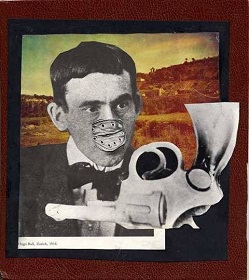
Hugo Ball (22 februari 1886 – 14 september 1927)
Collage door Erik Hurtado Saura


De Servische schrijver Danilo Kiš werd geboren op 22 febrari 1935 in Subotica. Zie ook alle tags voor Danilo Kiš op dit blog.

Uit: Hourglass (Vertaald door Ralph Manheim)

“The flickering shadows dissolve the outlines of things and break up the surfaces of the cube, the walls and ceiling move to and fro to the rhythm of the jagged flame, which by turns flares up and dies down as though about to go out. The yellow clay at the bottom of the cube rises like the floorboards of a sinking boat, then falls back into the darkness, as though flooded with muddy water. The whole room trembles, expands, contracts, moves a few centimeters to the right or left, up or down, all the while keeping its cubical shape. Horizontals and verticals intersect at several points, all in vague confusion, but governed by some higher law, maintaining an equilibrium that prevents the walls from collapsing and the ceiling from tilting or falling. This equilibrium is due no doubt to the regular movement of the crossbeams, for they, too, seem to glide from right to left, up and down, along with their shadows, without friction or effort, as lightly as over water. The waves of the night dash against the sides of the roomboat. Gusts of wind blow soft flakes and sharp icy crystals by turns against the windowpane. The square, embrasure-like window is stuffed with a disemboweled pillow; bits of cloth stick out and dangle like amorphous plants or creepers. It is hard to say whether they are trembling under the impact of the wind blowing through the cracks, or whether it is only their shadow that sways to the rhythm of the jagged flame.”


 1554150-83a8f01345fb0a7cd8dba633fa935d7d.jpg
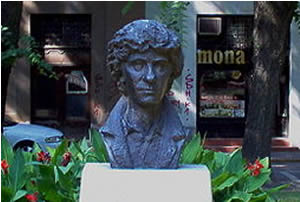
Danilo Kiš (22 februari 1935 – 15 oktober 1989)
Borstbeeld in Subotica


De Ierse schrijver Sean O'Faolain werd geboren op 22 februari 1900 in Cork. Zie ook alle tags voor Sean O'Faolain op dit blog.

Uit: An Irish Journey

"And yet it is a lovely, lovely place. Its slums, that have a hot verminous smell, indescribable and unique -- walk down Millard Street of a hot summer day and you get the pure bouquet of it -- come back to the memory before everything else with a geyser-gush of nostalgia. Cork's poor are its kings. In these ambition has not sharpened the claw, and passion lives at blood-heat. The shawled women and girls (are they passing away into what they used to call, derisively, "hatty wans"?) are magnificent. Observe the coal-quay kids - often dressed in a costume, especially a Sunday costume, that I have seen nowhere else - purple stockings, fawny boots, halfway-up the calf, sometimes a bright velvet cap, golden tasselled, reflecting the half-barbaric love of colour that one used to see in the brilliance of the petticoats and shawls, and in the many half-inch-thick finger-rings and dangling earrings of the mothers roaring over the fish-crates. Note the men, in my youth, straightened by bouts in the North Cork Militia or the Munster Fusiliers, swaggering like sergeant-majors. In all of these there is the principle of life at its full."


 1554150-284978780220ed7c166fbe8db864a89f.jpg
Sean O'Faolain (22 februari 1900 – 20 april 1991)


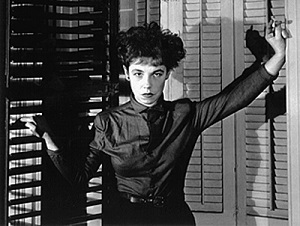
De Amerikaanse schrijfster Jane Bowles werd als Jane Auer geboren op 22 februari 1917 in New York. Zie ook alle tags voor Jane Bowles op dit blog.

Uit: Two Serious Ladies

“Where is your little house Miss Goering?” Arnold asked her, trying to introduce a more natural tone into the conversation. “It’s on an island,” said Miss Goering, “not far from the city by ferryboat. I remember having visited this island as a child and always having disliked it because one can smell the glue factories from the mainland even when walking through the woods or across the fields. One end of the island is very well populated, although you can only buy third-rate goods in any of the stores. Farther out the island is wilder and more old-fashioned; nevertheless there is a little train that meets the ferry frequently and carries you out to the other end. There you land in a little town that is quite lost and looks very tough, and you feel a bit frightened, I think, to find that the mainland opposite the point is as squalid as the island itself and offers you no protection at all. … ” Arnold shifted about uneasily in his chair. . . . “I am sure that the island has certain advantages too, which you know about, but perhaps you prefer to surprise with them rather than disappoint us.” “I know of none at the moment,” said Miss Goering. “Why, are you coming with us?” “I think that I would like to spend quite a bit of time with you out there; that is, if you will invite me.”


 1554150-f19838186ffb46df191e571aa6f03d0b.jpg
Jane Bowles (22 februari 1917 – 4 mei 1973)


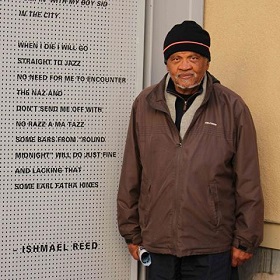
De Afro-Amerikaanse dichter, schrijver en essayist Ishmael Scott Reed werd geboren op 22 februari 1938 in Chattanooga, Tennessee. Zie ook alle tags voor Ishmael Reed op dit blog.


Earthquake Blues

Well the cat started actin funny
and the dog howled all night long
I say the cat started actin very frightful
and the birds chirped all night long
The ground began to rumble
As the panic hit the town

Mr. Earthquake Mr. Earthquake
you don't know good from bad
Mr. Earthquake Mr. Earthquake
you don't know good from bad
You kill the little child in its nursey
You burn up the window's pad

The buildings started swaying
like a drunk man walking hoome
The buildings started swaying
The people they were running
and the hurt folks began to moan

Mr. Earthquake Mr. Earthquake
you don't know good from bad
Mr. Earthquake Mr. Earthquake


 1554150-b450e3ed206dc93a9108a7124b26e004.jpg
Ishmael Reed (Chattanooga, 22 februari 1938)
Bij de installatie van zijn gedicht “"When I Die I Will Go To Jazz”,

SFJAZZ Center, San Francisco


Zie voor nog meer schrijvers van de 22e februari ook mijn vorige blog van vandaag.

Geschreven door Romenu om 14:34 Reageer op dit bericht

Morley Callaghan, Wayne C. Booth, Jules Renard, James Russell Lowell, Edna St. Vincent Millay, Ottilie Wildermuth

De Canadese schrijver Morley Callaghan werd geboren op 22 februari 1903 in Toronto. Zie ook alle tags voor Morley Callaghan op dit blog. 

Uit:All the Years of Her Life

“The drug store was beginning to close for the night. Young Alfred Higgins who worked in the store was putting on his coat, getting ready to go home. On his way out, he passed Mr. Sam Carr, the little gray hair man who owned the store. Mr. Carr looked up at Alfred as he passed and said in a very soft voice, ''Just a moment, Alfred, one moment before you go.''
Mr. Carr spoke so quietly that he worried Alfred. ''What is it, Mr. Carr?''
''Maybe you'd be good enough to take a few things out of your pockets and leave them here before you go.'' Said Mr. Carr.
''What things? What are you talking about?''
''You've got a compact and a lipstick and at least two tubes of toothpaste in your pockets, Alfred.''
''What do you mean?'' Alfred answered. ''Do you think I am crazy?'' His face got red.
Mr. Carr kept looking at Alfred, coldly. Alfred did not know what to say and tried to keep his eyes from meeting the eyes of his boss. After a few moments, he put his hand into his pockets and took out the things he had stolen.
''Petty thieving, eh, Alfred?'' said Mr. Carr. ''And maybe you'd be good enough to tell me how long this has been going on.''
''This is the first time I ever took anything.''
Mr. Carr was quick to answer, ''So now you think you tell me a lie? What kind of a fool do I look like, hah? I don't know what goes on in my own store, eh? I/ tell you, you have been doing this for a long time.'' Mr. Carr had a strange smile on his face. ''I don’t like to call the police,'' he said, ''but maybe I should call your father and let him know I'm going to have to put you in jail.''
''My father is not home, he is a printer, he works nights.''
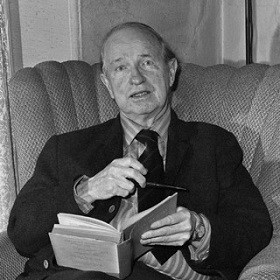
 

 1554130-e867f3f669d2634d6ec70fdbad842174.jpg
Morley Callaghan (22 februari 1903 – 25 augustus 1990)


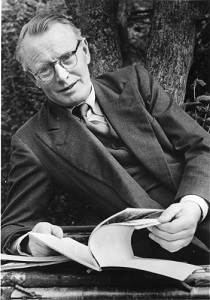
De Amerikaanse letterkundige en literatuurwetenschapper Wayne Clayton Booth werd geboren op 22 februari 1921 in American Fork, Utah. Zie ook alle tags voor Wayne C. Booth op dit blog.

Uit: Confessions of an Aging, Hypocritical Ex-Missionary

“Until I was far into my teens, I was an utterly unquestioning Mormon. My parents and grandparents and aunts and uncles were all visibly, audibly, aggressively devout--all except one uncle, a smoker, a "black sheep." For our family, non-Mormons were beyond the pale--to be tolerated, of course, even treated kindly if they behaved themselves, viewed perhaps as potential converts, but never courted or married, and never even visited socially. They were certainly not destined, like us, to enter the celestial kingdom. We knew that in the next life those lost souls would not even be allowed to come near us, as we all continued our eternal progression, pursuing knowledge and righteousness--concepts that when defined correctly turned out to be the same thing.
What I remember as most important to me was that in heaven the non-Mormon or non-devout males down there in the lower kingdoms would have no hope for what I had a strong hope for, if I kept my nose clean: becoming the god of another world, accompanied by a pious female helpmate. Meanwhile, here and now, non-Mormons were so far beneath us that it was dangerous even to get near them. I remember feeling scared to walk too close to the one non-Mormon church in my home town, American Fork, Utah. I would always cross the road and walk on the other side, to avoid contamination, and I was thankful that we lived in another ward, far from that wicked place.
In short, until my first questioning began at about fourteen, I was a 100 percent devotee of what might be called an exclusivist, or particularist, anti-ecumenical version of Mormonism. That boy, the very young Wayne Booth, would perhaps these days be called by non-Mormons a fundamentalist (the word wasn't in our vocabulary, I'm quite sure). Born and reared in the pre-Darwinian nineteenth century, as you might say, he was for about fifteen years unaware of what had been happening to western thought from long before he was born.”


 1554130-754bb9210c6016aab4d2fc5dbc494400.jpg
Wayne C. Booth (22 februari 1921 – 9 oktober 2005)


De Franse schrijver Jules Renard werd geboren op 22 februari 1864 in Châlons-du-Maine. Zie ook alle tags voor Jules Renard op dit blog.

Uit: Journal de Jules Renard 1905-1910

“Je lui ai fait donner les palmes. Il dit aux gens de son village :
- Mes amis, les palmes me font bien plaisir, mais ce n'est rien à côté de vos félicitations.
L'esprit inquiet mais clairvoyant, c'est-à-dire actif et sain, de l'homme qui ne travaille pas.
Le poëte Ponge me dit :
- Quelques personnes m'ont dit qu'on ferait mieux de m'offrir un bureau de tabac que les palmes académiques. Moi, à cause de mes enfants, je préfère les palmes. Le bureau de tabac, je ne pourrais pas le tenir moi-même parce que mon travail des champs m'en empêcherait ; s'il fallait le faire tenir par un autre, le gain n'en vaudrait plus la peine.
Ragotte m'a apporté de l'eau chaude. Je lui dis :
- Mais la bouillote fuit !
- Oh ! je le sais bien, dit-elle.
Le médecin lui a dit de prendre chez le pharmacien de la denrée qu'elle boira. Elle profite, pour se coucher, d'un instant où je ne suis pas dans la cuisine. Dans le coin, elle ôte sa jupe, met son bonnet. Je vois ses pieds nus dans ses savates.
Leur manie de cacher qu'ils sont malades. Leur ignorance en face de la maladie. En dehors de « J'ai mal aux reins, je ne peux pas dormir ni manger », ils ne savent rien.
Cette odeur de peau raclée de gens qui ne se lavent jamais.
Philippe. Ses oreilles gèlent, cuisent et pèlent.
Toute la campagne tremble de froid.”


 1554130-7a34bf047930438bf6a245f1b6d2c415.jpg
Jules Renard (22 februari 1864 – 22 mei 1910)
Portret door Delannoy, 1903


De Amerikaanse dichter, essayist, uitgever en diplomaat James Russell Lowell werd geboren op 22 februari 1819 in Cambridge, Massachusetts. Zie ook alle tags voor James Russell Lowell op dit blog.


Midnight

The moon shines white and silent
On the mist, which, like a tide
Of some enchanted ocean,
O'er the wide marsh doth glide,
Spreading its ghost-like billows
Silently far and wide.

A vague and starry magic
Makes all things mysteries,
And lures the earth's dumb spirit
Up to the longing skies:
I seem to hear dim whispers,
And tremulous replies.

The fireflies o'er the meadow
In pulses come and go;
The elm-trees' heavy shadow
Weighs on the grass below;
And faintly from the distance
The dreaming cock doth crow.

All things look strange and mystic,
The very bushes swell
And take wild shapes and motions,
As if beneath a spell;
They seem not the same lilacs
From childhood known so well.

The snow of deepest silence
O'er everything doth fall,
So beautiful and quiet,
And yet so like a pall;
As if all life were ended,
And rest were come to all.

O wild and wondrous midnight,
There is a might in thee
To make the charmed body
Almost like spirit be,
And give it some faint glimpses
Of immortality!


 1554130-9b8cfbcf1d68ad3925ee6bee0157b9f1.GIF
James Russell Lowell (22 februari 1819 – 12 augustus 1891)
Borstbeeld door William Wetmore Story, 1892


De Amerikaanse dichteres en schrijfster Edna St. Vincent Millay werd geboren op 22 februari 1892 in Rockland, Maine. Zie ook alle tags voor Edna St. Vincent Millay op dit blog.


What lips my lips have kissed

What lips my lips have kissed, and where, and why,
I have forgotten, and what arms have lain
Under my head till morning; but the rain
Is full of ghosts tonight, that tap and sigh
Upon the glass and listen for reply,
And in my heart there stirs a quiet pain
For unremembered lads that not again
Will turn to me at midnight with a cry.
Thus in winter stands the lonely tree,
Nor knows what birds have vanished one by one,
Yet knows its boughs more silent than before:
I cannot say what loves have come and gone,
I only know that summer sang in me
A little while, that in me sings no more.


Nee, liefde is niet blind

Nee, liefde is niet blind. Jouw lelijkheid
Hoe mooi die vrouwen zijn, ik zie het goed
Dat jouw gezicht aan regels niet voldoet
Te hoog je voorhoofd en uiteen te wijd
Je ogen. En geschoold in lieflijkheid
Maakt dat het hiermee te zijn opgevoed
Mij nu jouw fouten niet ontkennen doet
En lief moet hebben tot het eind der tijd
Subtieler is de oppermacht der liefde
Betrapt men mij als ik iets lelijk vind
’t Is net alsof ik zeg dat niets meer zint
Niet hoogstaand is, kan schrijven. Men mag vrezen
Wat dan die schoonheid is die mannen blieven
Waarom wordt die alom door hen geprezen


Vertaald door Ans Bouter


 1554130-7eb116290b43255d6cf472616281b53f.jpg
Edna St. Vincent Millay (22 februari 1892 – 19 oktober 1950)
Cover biografie 


De Duitse dichteres en schrijfster Ottilie Wildermuth werd geboren op 22 februari 1817 in Rottenburg am Neckar. Zie ook alle tags voor Ottilie Wildermuth op dit blog.


Der Hausfrau Frühlingsfeier - I

Der Frühling schaut zu uns herab
Dort aus den blauen Hallen;
Er lässt als Gruß die milde Luft
Durch alle Lande wallen.

Er lockt hervor das grüne Gras,
Verscheucht viel alte Schmerzen;
Er weckt die Hoffnung und die Lust
In tausend jungen Herzen.

Die Hausfrau aber hat nicht Zeit,
Dass sie im Frühling schwärme;
Nun müssen Thür und Fenster auf,
Damit die Sonne Wärme.

Nun muß der alte Winterstaub
Aus jeglichem Gemache;
Nun soll es hell und sauber sein,
Hinauf bis unter'm Dache.

Da räumt sie aus, da räumt sie ein
In Kisten und in Schränken;
Fürwahr, sie hat vergessen ganz
Noch an den Lenz zu denken.


 1554130-d990eb98f494975d541acb424f0282d5.jpg
Ottilie Wildermuth (22 februari 1817 – 12 juli 1877)

Geschreven door Romenu om 14:15 Reageer op dit bericht

Meer van Romenu

↑ Terug naar de berichten