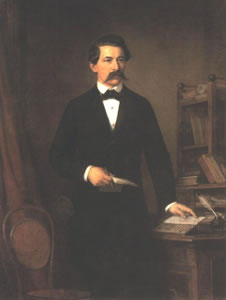
Godfried Bomans, Multatuli, John Irving, Thom Wolfe, Michael Salinger

De Nederlandse schrijver Godfried Bomans werd geboren in Den Haag op 2 maart 1913. Zie ook alle tags voor Godfried Bomans op dit blog.
Uit: De dood van de sprookjesverteller
“Er was eens een sprookjesverteller en die ging dood. Hij had zijn hele leven lang over kabouters verteld en nu wilde hij, voor zijn dood, nog een kabouter zien, een werkelijke kabouter. Hij zocht in de provisiekast, in de ontbijttrommel, onder het buffet, maar er was nergens een kabouter te vinden. Nu begon de sprookjesverteller te wenen: 'Ach, lieve God,' sprak hij, 'ze zijn op. Er is er geen eentje meer! Ik heb mijn hele leven vast geloofd dat er kabouters waren, maar nu zie je wat je er van denken moet. Hij heeft toch gelijk gehad, de kruidenier van hiernaast die mij altijd zo uitlachte. Nu heb ik niets meer van het leven te verwachten.'
En de sprookjesverteller kroop in bed, blies de kaars uit en wachtte op de dood.
Doch de dood kwam niet; hij was de verkeerde weg ingeslagen en liep nu te mopperen om het huis heen. 'Woont hier de sprookjesverteller?' riep hij door het raam. 'Ja, Dood!' antwoordde de sprookjesverteller van uit de bedstee, 'kom er maar in! Maak het kort! Alle aar digheid is er toch voor mij af. Pas op voor de drempel, daar zit een plank los.'
'Je bent een rare.' hernam de Dood, zich over het bed buigend, 'verlang je naar mij? De mensen zijn altijd bang als ik binnenkom. Vind je het prettig, dat ik er ben?'
Jawel,' antwoordde de sprookjesverteller glimlachend, 'ik vind het heel prettig, Dood, de kabouter wil niet komen en daarom ben ik blij dat jij komt. Of het een, of het ander.'
'Wat zit je nu toch te praten van een kabouter?' sprak de Dood verbaasd, 'je bent toch een echte sprookjes verteller, waarlijk. Onderzoek liever je geweten, denk eens aan je zonden en aan de eeuwigheid. Dat zijn nut tige gedachten. Ik zal zo lang wat in de tuin rondlopen. Je roept wel als je klaar bent.'
Godfried Bomans (2 maart 1913 - 22 december 1971)
De Nederlandse schrijver Multatuli (pseudoniem van Eduard Douwes Dekker werd geboren in Amsterdam op 2 maart 1820. Zie ook alle tags voor Multatuli op dit blog.
Uit: De geschiedenis van Woutertje Pieterse
„De opdracht om 'n vers te maken, streelde Wouter. Jufvrouw Pieterse en Stoffel hadden zich vergeefs beyverd hun goede meening omtrent zyn talent, te omzwachtelen met geringschatting. De arme jongen schrikte van genoegen, by de ontdekking dat men hem ‘voor iets aanzag.’ Hy had zóó vaak gehoord dat-i eigenlyk niemendal was, en nooit iets worden zou... dat hy nu ter-nauwernood lette op al de pogingen die z'n moeder en broêr in 't werk stelden, om hem te doen gelooven dat de heele commissie eigenlyk een straf was voor z'n onkunde in de namen van bergen. ‘Ja, zei Stoffel:
- Ja, ik kan je verzekeren dat het by my op school niet gebeuren moest... maar nu moet je letten op behoorlyke afwisseling van liggende en staande regels...
- Hè? vroeg Wouter.
- Wel zeker... weet je dat nog niet eens? Heeft meester Pennewip je dat niet geleerd? Of heb je weêr niet opgelet? Kyk... zoo!
En Stoffel wilde voorbeelden bedenken. Maar 't lukte niet.
- Trui, geef me je gezangboek. Kyk, Wouter: hoog, omhoog, het hart naar boven... dat 's liggend, zieje. En: hier beneden is het niet... dat staat, weetje? En dan moet je er wat inbrengen van God...
- Ja, en dat-i wewenaar is, voegde de moeder er by.
- Haar oom... verbeterde Stoffel. En alle regels moeten even lang wezen.
- En je krygt ulevellen... en als je 'r niet meê terecht kunt, zei de moeder, vraag dan maar aan Stoffel.
- Wel zeker, ik zal je telkens zeggen wat rymt. 't Is heel makkelyk...
Wouter had er wel zin in. Hy ging naar de achterkamer, nam een lei, en schreef er op. Maar mooi was 't niet. Ook kon-i maar niet verder komen dan: Een weduwnaar van God... O God, een weduwnaar...“

Multatuli (2 maart 1820 - 19 februari 1887)
Geboortehuis en museum in de Korsjespoortsteeg in Amsterdam
De Amerikaanse schrijver John Irving werd geboren op 2 maart 1942 in Exeter, New Hampshire. Zie ook alle tags voor John Irving op dit blog.
Uit: The World According to Garp
„Garp's mother Jenny Fields, was arrested in Boston in 1942 for wounding a man in a movie theater. This was shortly after the Japanese had bombed Pearl Harbor and people were being tolerant of soldiers, because suddenly everyone was a soldier, but jenny Fields was quite firm in her intolerance of the behavior of men in general and soldiers in particular. In the movie theater she had to move three times, but each time the soldier moved closer to her until she was sitting against the musty wall, her view of the newsreel almost blocked by some silly colonnade, and she resolved she would not get up and move again. The soldier moved once more and sat beside her.
Jenny was twenty-two. She had dropped out of college almost as soon as she'd begun, but she had finished her nursing-school program at the head of her class and she enjoyed being a nurse. She was an athletic-looking young woman who always had high color in her cheeks; she had dark, glossy hair and what her mother called a mannish way of walking (she swung her arms), and her rump and hips were so slender and hard that, from behind, she resembled a young boy. In jenny's opinion, her breasts were too large; she thought the ostentation of her bust made her look "cheap and easy."
She was nothing of the kind. In fact, she had dropped out of college when she suspected that the chief purpose of her parents' sending her to Wellesley had been to have her dated by and eventually mated to some well-bred man. The recommendation of Wellesley had come from her older brothers, who had assured her parents that Wellesley women were not thought of loosely and were considered high in marriage potential. jenny felt that her education was merely a polite way to bide time, as if she were really a cow, being prepared only for the insertion of the device for artificial insemination.“

John Irving (Exeter, 2 maart 1942)
De Amerikaanse schrijver en journalist Thom Wolfe werd geboren op 2 maart 1930 in Richmond, Virginia. Zie ook alle tags voor Thomas Wolfe op dit blog.
Uit: The Electric Kool-Aid Acid Test
„The things he would somehow suddenly remember about the old home town--over here, for example, is the old white clapboard house they used to live in, and behind it, back a ways, is the radio tower of station KORE with a red light blinking on top--and at night he used to get down on his knees to say his prayers and there would be the sky and the light blinking--and he always kind of thought he was praying to that red light. And the old highway used to take a bend right about here, and it seemed like there was always somebody driving through about three or four in the morning, half asleep, and they would see the lights over there in town where it was getting built up and they'd think the road headed straight for the lights and they'd run off the bend and Kesey and his dad would go out to see if they could help the guy draggle himself out of the muck--chasing street lights!--praying to the red beacon light of KORE!--and a little run-in at Gregg's Drive-In, as it used to be called, it is now Speck's, at Franklin Boulevard at the bridge over the river. That was the big high-school drive-in, with the huge streamlined sculpted pastel display sign with streaming streamlined super-slick A-22 italic script, floodlights, clamp-on trays, car-hop girls in floppy blue slacks, hamburgers in some kind of tissuey wax paper steaming with onions pressed down and fried on the grill and mustard and catsup to squirt all over it from out plastic squirt cylinders. Saturday nights when everybody is out cruising--some guy was in his car in the lot at Gregg's going the wrong way, so nobody could move. The more everybody blew the horns, the more determined the guy got. Like this was the test. He rolls up the windows and locks the doors so they can't get at him and keeps boring in. This guy vs. Kesey. So Kesey goes inside and gets a potato they make the french fries with and comes out and jams it over the guy's exhaust pipe, which causes the motor to conk out and you ain't going any which way now, bub.“

Thom Wolfe (Richmond, 2 maart 1930)
De Amerikaanse dichter en performer Michael Salinger werd geboren op 2 maart 1962 in Cleveland, Ohio. Zie ook alle tags voor Michael Salinger op dit blog.
Nietzsche's Horse
At thirteen
my son,
his body a coat hanger
jutting from a tank top
and baggy shorts,
wants to comprehend
only one thing-
that being,
everything
His mother speaks of gardening
and seeds
because that is what she knows
I lecture on trajectory
the speed of sound sluicing liquid
baseball analogies
economics
Newton's third law of physics
and plumbing fixtures
because I know nothing
all the time swearing
that what I know
is best
He sits
back against checkered tile wall,
in an armless wooden kitchen chair
part of the set
that his mother and I bought
before we split
I think it is made from maple,
waiting for the answers
to the questions
that keep me awake
I do not say
that truth comes as a dream
details fading with sunrise
or that the miracle of life
is that we survive
I say
that in time he will understand
hoping
that'll hold him
for awhile

Michael Salinger (Cleveland, 2 maart 1962)
Zie voor nog meer schrijvers van de 2e maart ook mijn vorige blog van vandaag.