

 Simon Carmiggelt, Rachel Kushner, James Whitcomb Riley, Thomas Keneally, Dirkje Kuik, Steven Erikson, Wilhelm Müller, Sohrab Sepehri, Chigozie Obioma
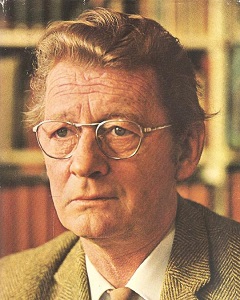
De Nederlandse schrijver en dichter Simon Carmiggelt werd geboren op 7 oktober 1913 in Den Haag. Zie ook mijn blog van 7 oktober 2010 en eveneens alle tags voor Simon Carmiggelt op dit blog.
Louter droefheid
Ik voel mij somber. Ei, wat zal ik doen?
Een platte geest dronk nu een glaasje.
Maar ik ben een poëtisch baasje
en ga mijn weemoed in een versje doen.
Dat is het voordeel van mijn gave.
De burger kan zijn ei niet kwijt,
terwijl ik, rustig mijn neerslachtigheid
gelijk een paardje voor mijn kar laat draven.
Is het volbracht, dan ben ik opgelucht.
'k Heb schoonheid uit mijn pijn gewrongen.
Mijn lieve pen heeft mooi gezongen.
Ik stap in bed. Ik geeuw en zucht.
En staan mijn verzen later soms te kijk
in 'Gouden Aren' of in 'Dichterschat',
dan zegt de leraar bij deez' pennespat:
'Kijk jongens, hier had hij het moejelijk.'
In de trein
Bij Vught dacht ik: 'Hier is broer Jan gestorven.'
En 'k zag mijn vader, met zijn oud gezicht
rood opgezwollen, toen het doodsbericht
zijn late leven toch nog had bedorven.
Voor moeder kwam een eind aan haar pakketten.
Zij streed, zolang Jan zat, met eigen wapen,
stond aan 't fornuis haar moed bijeen te rapen,
zond zeven broden, zeven tegenzetten.
En ook het reizen was achter de rug.
Ze gingen met de trein. Daar ligt het kamp.
Daar zit hij in. Daar woont die ramp.
Dan zuchtten ze en gingen maar weer terug.
Ziet ge de boer de vredesakker ploegen?
Mijn moeder heeft Jans foto op de kast gezet.
Mijn vader geeft in 't graf 'n antwoord aan die vroegen:
'En de oude man, hoe draagt hij het?'
De vader
Dit kleine prinsje, kraaiend, blij en rap,
is 't enig wezen in het aardse tranendal
voor wie hij in een afgrond springen zal.
Nu ja, maar stellig van een hoge trap.
Van vadertrots zwelt hem de weke krop,
want dit is nu toch 's levens suikerstang.
Hij sabbelt, maar het duurt niet lang.
Het zoet slinkt weg, de knaap groeit op.
En geen notaris wordt er uit die stek.
Daaraan werd vaders geld bepaald vermorst.
Toch is de jongen wel een flinke borst.
Als krachtig fietsenmaker lang niet gek.
Maar vrolijk kraaien valt hem niet meer in
wanneer hij, eens per jaar, pa's krot betreedt.
De oude kijkt hem aan. Als jongeling gekleed,
staat hij daar zelve, doch met Anna's kin.
Simon Carmiggelt (7 oktober 1913 – 30 november 1987)
De Amerikaanse schrijfster Rachel Kushner werd geboren op 7 oktober 1968 in Eugene, Oregon en verhuisde naar San Francisco in 1979. Zie ook alle tags voor Rachel Kushner op dit blog.
Uit: The Flamethrowers
“My uncle Bobby, who hauled dirt for a living, spent his final moments oflife jerking his leg to depress the clutch while lying in a hospital, his body determined to operate his dump truck, clutching and shifting gears as he Sped toward death on a hospital gurney. “He died on the job,” his two sons said, unmoved. Bobby was too mean for them to love. Scott and Andy had been forced to oil Bobby’s truck every Sunday and now he was dead and they had Sundays to themselves, to oil their own trucks. Bobby was my mother’s brother. Growing up, we’d all lived together. My mother worked nights, and Bobby was what we had as a parent. Done driving his dump truck, he sat inexplicably nude watching TV and made us operate the dial for him, so he wouldn’t have to get up. He’d fix himselfa big Steak and give us inStant noodles.
Sometimes he’d take us to a casino, leave us in the parking 1ot with bottle rockets. Or play chicken with the other cars on 1-80, with me and Scott and Andy in the backseat covering our eyes. I come from reckless,unsentimental people. Sandro used this againSt me on occasion. Hepretended I was placed in his life to torture him, when it was really the other way around. He acted smitten but I was the smitten one. Sandro held all the power. He was older by fourteen years and a successful artist, tall and good-looking in his work clothes and Steel-toed boots-the same kinds of clothes that Bobby and Scott and Andy wore, but on Sandro they added up to something else: a guy with a family inheritance who could use a nail gun, a drill press, a person not made effete by money, who dressed like a worker or sometimes a burn but was elegant in those clothes, and never hampered by the queStion of whether he belonged in a given situation (the queStion itselfwas evidence ofnot belonging).
Sandro kept a photo above the desk in his loft, him posing on a couch next to Morton Feldman in his Coke-bottle glasses, Sandro looking cool and aloof, holding a raised, loaded shotgun, its barrel one long half of the letter X crossing the photograph diagonally.”

Rachel Kushner (Eugene, 7 oktober 1968)
De Amerikaanse dichter en schrijver James Whitcomb Riley werd geboren op 7 oktober 1849 in Greenfield, Indiana. Zie ook mijn blog van 7 oktober 2010 en eveneens alle tags voor James Whitcomb Riley op dit blog.
September Dark
1
The air falls chill;
The whippoorwill
Pipes lonesomely behind the Hill:
The dusk grows dense,
The silence tense;
And lo, the katydids commence.
2
Through shadowy rifts
Of woodland lifts
The low, slow moon, and upward drifts,
While left and right
The fireflies' light
Swirls eddying in the skirts of Night.
3
O Cloudland gray
And level lay
Thy mists across the face of Day!
At foot and head,
Above the dead
O Dews, weep on uncomforted!

James Whitcomb Riley (7 oktober 1849 – 22 juli 1916)
Standbeeld in Greenfield, Indiana
De Australische schrijver Thomas Keneally werd geboren op 7 oktober 1935 in Sydney. Zie ook mijn blog van 7 oktober 2010 en eveneens alle tags voor Thomas Keneally op dit blog.
Uit: Schindler's List
“Emilie, on the other hand, was delighted to leave her small village and her father’s old-fashioned household, where she had to act as hostess to him and his boring friends. She was enthusiastic about moving into an apartment in Zwittau with her tall, handsome young husband. However, Emilies dream of a happy marriage did not last long. Oskar followed his father’s example and forgot about his wife in the evenings, staying in cafes like a single man, talking to girls who were neither religious nor quiet.
Hans Schindler’s business went bankrupt in 1935, and soon afterwards he left his wife and found an apartment on his own.
Oskar hated his father for abandoning his mother and refused to speak to him. The son seemed blind to the fact that his treatment of Emilie was already following the same pattern.
Meanwhile, even though the world’s economy was suffering, Oskar managed to get a good job. He had good business contacts, he had a background in engineering and he was good company. These qualities made him the perfect man to become the sales manager of Moravian Electrotechnic. He began travelling a lot, which reminded him of his time as a motorbike racer, and which gave him an excuse to stay away from his responsibilities in Zwittau.
By the time of his mother’s funeral in the late 1930s, Oskar, like many young Czech Germans, was wearing a swastika, the badge of the Nazi Party, on the collar of his suit. He was still not interested in politics, but Oskar was a salesman. W hen he went into the office of a German company manager wearing the swastika, he got the orders that he wanted.
Oskar was a busy, successful salesman, but he could feel something even more exciting than money in the air. In 1938, in the month before the German army entered Sudetenland and made it part of the Third Reich,* Oskar sensed that history was being made, and he wanted to be part of the action.”
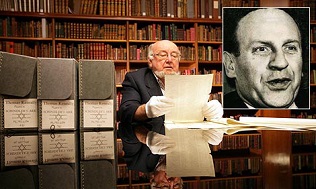
Thomas Keneally (Sydney, 7 oktober 1935)
Scene uit de film van Steven Spielberg uit 1993
De Nederlandse schrijfster en beeldend kunstenares Dirkje Kuik werd geboren in Utrecht op 7 oktober 1929. Zie ook mijn blog van 7 oktober 2010 en eveneens alle tags voor Dirkje Kuik op dit blog.
Uit: De ideale stad
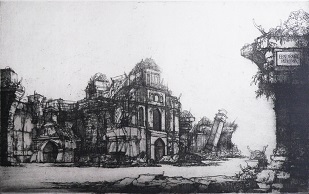
“Ik graaf de grond weg onder de rijtjeshuizen en de torenflats al zou het een gifbelt betreffen. Pas wanneer de laag bereikt wordt waarin sporen voorkomen van kloostermoppen, pestputten en buurtkerkhoven houd ik op met mijn graafwerkzaamheden en ga opnieuw aan het bouwen.
Ja, één modern gebouw spaar ik, het Muziekcentrum. Deze muizenholenachtige schepping kan uitgebrand tot een geblakerde ruïne omgetoverd worden, geplakt tegen het totaal vervallen Hoog-Catharijne, een met graafmachines en bulldozers gesloopt complex, overwoekerd door hoog opgeschoten gras, onkruid, verwilderd struikgewas (…).”
Dirkje Kuik (7 oktober 1929 – 18 maart 2008)
Dirkje Kuik, Gezicht op de Buurkerk en de wallen, ets, 1983
De Canadese schrijver, archeoloog, antropoloog Steven Erikson (pseudoniem van Steve Rune Lundin) werd geboren in Toronto op 7 oktober 1959. Zie ook mijn blog van 7 oktober 2010 en eveneens alle tags voor Steven Erikson op dit blog.
Uit: Fall of Light
“Barely a smudge against the gloom, the sun was fading in the sky over the city of Kharkanas. The two lieutenants from the Houseblades of Lord Anomander, Prazek and Dathenar, met on the outer bridge and stood leaning on one of its walls, forearms on the stone. Like children, their upper bodies were tilted forward as they looked down upon the waters of the Dorssan Ryl. To their right, the Citadel stood like a fortress of night, defying the day. To the left, the city’s jumbled buildings crowded up against the flood wall as if caught in the act of marching over the edge.
Below the two men, the river’s surface was black, twisting with thick currents. Even now, the occasional charred tree trunk slid past, like the swollen limb of a dismembered giant. Ash-grey mud crusted the sheer walls that made up the banks. The boats moored to iron rings in the walls, near the stone steps that reached down into the water at intervals, looked neglected, home to dead leaves and murky pools of rainwater.
‘There is discipline lacking,’ murmured Prazek, ‘in our sordid post upon this bridge.’
‘We are looked down upon,’ Dathenar replied. ‘See us from atop the tower. We are small things upon this frail span. Witness as we betray errant curiosity, not suited to sentries at all, and in our pose you will find, with dismay, civilization’s slouching departure from the world.’
‘I too saw the historian at his lofty perch,’ Prazek said, nodding. ‘Or rather, his hooded regard. Did it track us out here? Does it fix still upon us?’
‘I would think so, as I feel a weight upon me. At least an executioner’s shroud offers mercy in hiding the face above the axe. We might splinter here under Rise Herat’s judgement, bearing as it does no less sharp an edge."

Steven Erikson (Toronto, 7 oktober 1959)
De Duitse, romantische dichter Wilhelm Müller werd geboren op 7 oktober 1794 in Dessau. Zie ook mijn blog van 7 oktober 2010 en eveneens alle tags voor Wilhelm Müller op dit blog.
Rückblick
Es brennt mir unter beiden Sohlen,
Tret' ich auch schon auf Eis und Schnee.
Ich möcht' nicht wieder Atem holen,
Bis ich nicht mehr die Türme seh'.
Hab' mich an jedem Stein gestoßen,
So eilt' ich zu der Stadt hinaus;
Die Krähen warfen Bäll' und Schloßen
Auf meinen Hut von jedem Haus.
Wie anders hast du mich empfangen,
Du Stadt der Unbeständigkeit!
An deinen blanken Fenstern sangen
Die Lerch' und Nachtigall im Streit.
Die runden Lindenbäume blühten,
Die klaren Rinnen rauschten hell,
Und ach, zwei Mädchenaugen glühten!
Da war's geschehn um dich, Gesell!
Kömmt mir der Tag in die Gedanken,
Möcht' ich noch einmal rückwärts sehn,
Möcht' ich zurücke wieder wanken,
Vor ihrem Hause stille stehn.
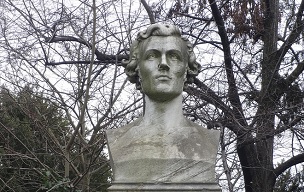
Wilhelm Müller (7 oktober 1794 – 1 oktober 1827)
Borstbeeld in Dessau
De Iraanse dichter en schilder Sohrab Sepehri werd geboren op 7 oktober 1928 in Kashan. Zie ook alle tags voor Sohrab Sepehri op dit blog.
The Flow Of Water
When knowledge
Still nestled by springs,
Man
Indulged himself in his azure philosophy
In the delicate indolence of a meadow.
His thoughts flew with the bird.
He breathed with trees.
He was submissive to the poppy's conditions.
Intrepid meanings of the waters
Roared in the depths of his speech.
Man
Slept
In the text of the elements
And woke up
In dawning fear.
But sometimes
The strange music of growth
Echoed
In the frail joints of his joys
And dust settled
On his struggling knees.
Then
His creative fingers,
Idled and got lost
In precise geometrical grief.
Vertaald door Ismail Salami

Sohrab Sepehri (7 oktober 1928 - 21 april 1980)
Onafhankelijk van geboortedata
De Nigeriaanse schrijver Chigozie Obioma werd geboren in 1986 in Akure. Zie ook alle tags voor Chigozie Obioma op dit blog.
Uit: The Fishermen
“Before we slept that night, Ikenna, who was nearly fifteen and on whom we relied for the interpretation of most things, had suggested Father was being transferred. Boja, a year his junior, who would have felt unwise if he didn’t appear to have any idea about the situation, had said it must be that Father was travelling abroad to a “Western world” just as we often feared he someday would. Obembe who, at eleven, was two years my senior, did not have an opinion. Me neither. But we did not have to wait much longer.
The answer came the following morning when Father suddenly appeared in the room I shared with Obembe. He was dressed in a brown T-shirt. He placed his spectacles on the table, a gesture requesting our attention. “I will start living in Yola from today onwards, and I don’t want you boys to give your mother any troubles.” His face contorted when he said this, the way it did whenever he wanted to drive the hounds of fear into us. He spoke slowly, his voice deeper and louder, every word tacked nine-inches deep into the beams of our minds. So that, if we went ahead and disobeyed, he would make us conjure the exact moment he gave us the instruction in its complete detail with the simple phrase “I told you.”
“I will call her regularly, and if I hear any bad news”—he struck his forefinger aloft to fortify his words—“I mean, any funny acts at all, I’ll give you the Guerdon for them.”
He’d said the word “Guerdon”—a word with which he emphasized a warning or highlighted the retribution for a wrong act—with so much vigour that veins bulged at both sides of his face.”

Chigozie Obioma (Akure, 1986)
